With the passage of time, the transactional elements in the U.S.-Indian partnership have become more conspicuous than the geostrategic dimensions, compounding India’s security dilemmas.
Brahma Chellaney, Open magazine
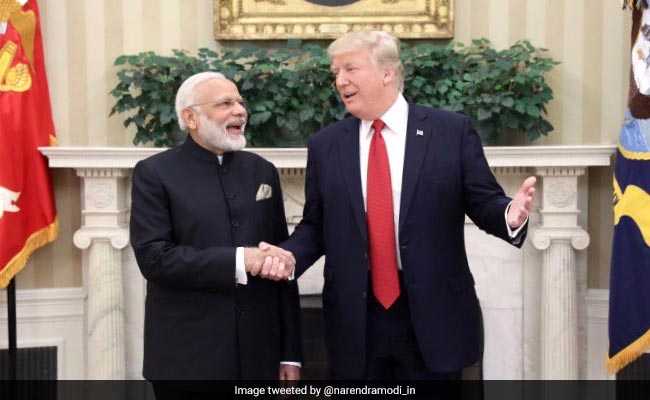
U.S. President Donald Trump made it known during his presidential election campaign that he likes India and Indians. Yet, in office, Trump has taken a series of steps in the immigration and trade realms that have adversely impacted India. Prime Minister Narendra Modi had a good first-ever meeting with Trump, although it yielded few deliverables. The two will have another opportunity to meet soon when Germany hosts the annual G-20 summit in Hamburg. Yet it is still not clear how salient India will be in the Trump foreign policy. This is largely because Trump’s larger geopolitical policy framework is still evolving.
The U.S.-India strategic partnership is essentially founded on two pillars — a U.S. commitment to assist, in America’s own interest, India’s rise; and a shared interest in building an inclusive, stable, rules-based Asian order to help manage China’s muscular rise. The hope in India has been that the U.S. would assist its rise in the way it aided China’s economic ascent since the 1970s. President Jimmy Carter, for example, sent a memo to various U.S government departments instructing them to help in China’s rise. Even China’s firing of missiles into the Taiwan Strait in 1996 did not change that policy. If anything, the U.S. has gradually loosened its close links with Taiwan, with no U.S. Cabinet member visiting that island since those missile manoeuvres.
U.S. policy, effectively, helped turn China into an export juggernaut, which today sells $4 worth of goods to the U.S. for each $1 of imports. In the process, just as the U.S. inadvertently saddled the world with the jihadist scourge by training Afghan mujahedeen — the anti-Soviet guerrillas out of which Al Qaeda evolved — it unintentionally created a rules-violating monster by aiding China’s economic rise. Abusing free-trade rules, China has systematically subsidized its exports while impeding imports to shield domestic jobs and industry. In effect, China has grown strong and rich by quietly waging a trade war. Trump said he told Chinese President Xi Jinping during their Mar-a-Lago summit in April that “we’ve rebuilt China with the money you’ve taken out of the United States.”
India wants the U.S. to buttress the two central pillars of their strategic partnership. Washington’s China “opening” of 1970-1971, engineered by US National Security Adviser Henry Kissinger, was designed in the wake of the 1969 Sino-Soviet military clashes to exploit the rift in the Communist world by aligning China with America’s anti-Soviet strategy. The result was that China, in the second half of the Cold War, became Washington’s partner against the Soviet Union. By comparison, there is no tectonic geopolitical development or calculation motivating the U.S. to assist India’s rise. Rather, the main driver is a transactional calculation — that an economically booming India, just like China’s economic ascent, will be good for American businesses.
Make no mistake: U.S. foreign policy is inherently transactional, with commerce the central plank. Indeed, Trump’s recent visit to the world’s chief ideological sponsor of jihadism, Saudi Arabia, was a reminder that money speaks louder than the international imperative to counter a rapidly metastasizing global jihadist threat. The visit yielded business and investment deals for the U.S. valued at up to almost $400 billion, including a contract to sell $109.7 billion worth of arms to a country that Trump previously accused of being complicit in 9/11.
Trump’s immediate two predecessors, Barack Obama and George W. Bush, did not hide their transactional approach toward a warming relationship with India. For example, the landmark nuclear deal, unveiled in 2005, was pivoted on India boosting its defence transactions with the United States. Consequently, India has emerged as a top U.S. arms client in a matter of years, even as the 12-year-old nuclear deal remains a dud deal on the energy front, with not a single contract signed as yet.
Trump’s weakness, for which he has been widely lampooned, is that he is publicly mercantile and transactional in his foreign-policy approach. His being so commerce-oriented upfront, rather than quietly, as was the case under his predecessors, does not, of course, signify a shift in U.S. policy focus. For example, in the past, the American demand for Indian steps to correct India’s large trade surplus with the U.S. was made in private by a president or publicly by one of his Cabinet members. But Trump articulated that demand forthrightly in his opening remarks at the joint news conference with Modi. “It is important that barriers be removed to the export of U.S. goods into your markets, and that we reduce our trade deficit with your country,” he stated.
The mutual admiration on display during the visit — with Trump lavishing praise on Modi and calling him a “true friend,” and Modi returning the favour to laud Trump’s “vast and successful” business experience — could not obscure the U.S.-India divergence on regional security issues. The Modi visit speeded up Washington’s decision to fill the vacant position of U.S. ambassador to India by naming Kenneth Juster, a senior White House official. Hopefully, the visit will also accelerate the separate inter-agency reviews currently being conducted in Washington on America’s Pakistan and Afghanistan policies.
Take Afghanistan: For nearly 16 years, the U.S. has been stuck in Afghanistan in the longest and most expensive war in its history. It has tried several policies to wind down the war, including a massive military “surge” under Obama to compel the Taliban to sue for peace. Nothing has worked, in large part because the U.S. has continued to fight the war on just one side of the Afghanistan-Pakistan divide and refused to go after the Pakistan-based sanctuaries of the Taliban and its affiliate, the Haqqani network. As Gen. John Nicholson, the U.S. military commander in Afghanistan, acknowledged earlier this year, “It is very difficult to succeed on the battlefield when your enemy enjoys external support and safe haven.” Worse still, the Taliban is conspicuously missing from the U.S. list of Foreign Terrorist Organizations, while the procreator and sponsor of that medieval militia — Pakistan — has been one of the largest recipients of American aid since 2001, when the U.S. invasion of Afghanistan helped remove the Taliban from power.
India is concerned that the U.S. still seeks to preserve the option of reaching a Faustian bargain with the Taliban. No counterterrorism campaign has ever succeeded when militants have enjoyed cross-border havens. The Taliban are unlikely to be routed or seek peace as long as they can operate from sanctuaries in Pakistan, where their top leaders are ensconced. Their string of battlefield victories indeed gives them little incentive to enter into serious peace negotiations. U.S. Defence Secretary Jim Mattis in June signalled a potentially tougher approach to safe havens in Pakistan, saying the U.S. will hit the enemy where it is “fighting from,” which is “not just Afghanistan”. However, only time will be tell whether this was a rhetorical statement or more.
U.S. has long had a blind spot for Pakistan. Today, the key question for Trump on that front is whether to continue the carrots-only approach toward Pakistan of Obama and Bush or finally begin to wield the big stick against a country that defiantly remains wedded to terrorism. To be sure, the tough message to Pakistan in the joint U.S.-India joint statement on the occasion of Modi’s visit was music to Indian ears: “The leaders called on Pakistan to ensure that its territory is not used to launch terrorist attacks on other countries. They further called on Pakistan to expeditiously bring to justice the perpetrators of the 26/11 Mumbai, Pathankot, and other cross-border terrorist attacks perpetrated by Pakistan-based groups”. This was the clearest message to Pakistan that any Indo-U.S. joint statement has incorporated.
Indeed, the Trump-Modi statement also stated: “The leaders stressed that terrorism is a global scourge that must be fought and terrorist safe havens rooted out in every part of the world. They resolved that India and the United States will fight together against this grave challenge to humanity. They committed to strengthen cooperation against terrorist threats from groups including Al Qaida, ISIS, Jaish-e-Mohammad, Lashkar-e-Taiba, D-Company, and their affiliates. India appreciated the United States designation of the Hizbul Mujahideen leader as a Specially Designated Global Terrorist as evidence of the commitment of the United States to end terror in all its forms”.
The Pakistan-based Hizbul Mujahideen leader Syed Salahuddin, who held a joint public rally last December with Lashkar-e-Taiba chief Hafiz Saeed, is the first militant from India’s Jammu and Kashmir to be designated by the U.S. as a global terrorist. The action against Salahuddin, although belated and designed largely to play to the Indian gallery, adds to the number of Pakistan-based individuals designated as terrorists by the U.S. or the United Nations. It thus helps reinforce Pakistan’s image as a leading terrorist hub.
However, it is true that the U.S. has long been reluctant to take concrete action against Pakistan-based individuals that it has labelled “terrorists”, if their terrorism is directed only at India. Take Hafiz Saeed, the mastermind of the cataclysmic 2008 Mumbai terrorist strikes: The U.S. has yet to act five years after putting a $10 million bounty on Saeed’s head. Saeed, who founded the Inter-Services Intelligence agency’s largest front organization, Lashkar-e-Taiba, remains the Pakistani military’s darling, with his public life mocking both America’s bounty on his head and the UN’s inclusion of him on a terrorist list. Washington has refrained from even criticizing Pakistani authorities for aiding and abetting Saeed’s public rallies. The rallies seek to project him as some sort of messiah of the Pakistani people. Saeed’s public role adds insult to injury for India, reinforcing the imperative that it must on its own fight Pakistan’s jihad-inspired war, which shows no sign of abating. Indeed, with Pakistan’s ceasefire violations triggering a fierce Indian response, Pakistani generals since the beginning of 2016 are using their terrorist proxies to target security camps in J&K.
Through both policy inaction and generous aid, the U.S. has effectively turned Pakistan into its terrorist protégé, like Saudi Arabia. Pakistan is a valued asset for China to keep India boxed in, but why does Washington still shield that country? U.S. policy indeed plays into China’s hands by propping up Pakistan and unwittingly helping to cement the Sino-Pakistan nexus. Will Trump fix a broken Pakistan policy that permits the Pakistani military to keep nurturing transnational terrorists? It will be overly optimistic to believe that the U.S. under him will change course fundamentally and apply sustained pressure to encourage a reformed Pakistan at peace with itself.
Compounding matters for India is Trump’s lack of an Asia policy or a larger geostrategic vision that gives primacy to major Asian democracies like Japan and India so as to prevent the emergence of a Sino-centric Asia. Trump came to office vowing to end what he saw as China’s free ride on trade and security issues that has allowed Beijing to flex its muscles more strongly than ever. But in contrast to his tough talk during his presidential campaign, when he famously said he would not “allow China to rape our country,” Trump has sought a cooperative relationship with China grounded in reciprocity. Accordingly, Trump, far from seeking to challenge Beijing’s hegemonic ambitions, has stayed on the same China-friendly path as Obama.
In fact, underscoring how the U.S. still seeks to balance its bilateral relationships with important powers in Asia, Trump invited Xi to Mar-a-Lago — his private estate in Palm Beach, Florida, that he calls the “Southern White House” — because he wanted to offer the leader of the world’s largest autocracy the same hospitality that he extended to the prime minister of China’s archrival, Japan, which is Asia’s oldest democracy. In February, Trump brought Prime Minister Shinzo Abe to Mar-a-Lago on Air Force One for a weekend of working lunches and golf. And in April, he hosted Xi at Mar-a-Lago.
Those Indians getting carried away by Trump’s praise for Modi should know the kind of admiration the U.S. president publicly displayed for Xi. “We have a great chemistry together,” he said about Xi. “We like each other. I like him a lot.” Trump also added that “lots of very potentially bad problems will be going away,” owing to his relationship with the “terrific” Xi.
The mercurial Trump’s honeymoon with Xi (and China), however, appears to be coming to an end. In a stunning admission of failure, Trump tweeted that counting on Xi to address the North Korea challenge hasn’t worked. It was naïve of Trump to rely on Beijing because North Korea has been seeking to escape China’s clutches and pursue direct engagement with Washington. It is possible that Trump may now pursue a tougher line toward Beijing, especially on trade issues. But that may not necessarily be India’s gain, unless he develops a larger geostrategic plan for Asia, including fixing Obama’s unhinged “pivot” policy and treating India as an indispensable partner. At present, Trump scarcely shares India’s concern about Chinese expansionism in its neighborhood and beyond and appears reluctant to aggressively confront Pakistan on its support for terrorist groups.
The growing cosiness in India’s ties with Washington masks New Delhi’s increasing concerns about its deteriorating regional-security environment. China has stepped up strategic pressure on India from different fronts, including deepening its nexus with Pakistan. Even as a pro-U.S. tilt has become pronounced in Indian foreign policy over the past one decade, with India emerging as a leading U.S. arms client, the relationship with Washington offers no answers to New Delhi’s security dilemmas. Trump, besieged by allegations of collusion between his campaign associates and Russia, has little space to fundamentally revamp U.S. foreign policy, including on Pakistan and China. The more things change, the more they tend to stay the same in U.S. foreign policy. India has no choice but to address the security dilemmas — and the regional threats — on its own.
© Open, 2017.


 Brahma Chellaney, Professor of Strategic Studies at the New Delhi-based Center for Policy Research and Fellow at the Robert Bosch Academy in Berlin, is the author of nine books, including Asian Juggernaut, Water: Asia’s New Battleground, and Water, Peace, and War: Confronting the Global Water Crisis.
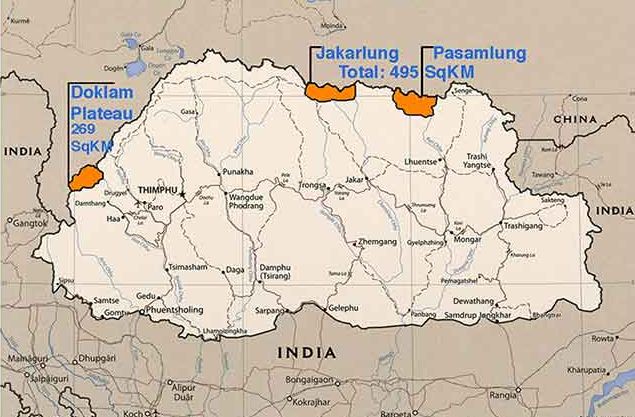
 Standing on the Himalayan crest with well-developed infrastructure, China is in a militarily advantageous position along much of the border with India. The tri-border overlooking the Chinese-held Chumbi Valley is one of the few areas where India still holds a distinct advantage, with Chinese forces within Indian observation-cum-artillery range. If China were to capture Bhutan’s high-altitude Doklam plateau, it would not only mitigate that vulnerability but also hold a knife to India’s jugular vein — the Siliguri Corridor, through which Bhutan’s communications and transportation arteries also pass.



 Stagecraft and Statecraft
You must be logged in to post a comment.