
Upstream engineering and missing warnings may have magnified the natural disaster

Brahma Chellaney
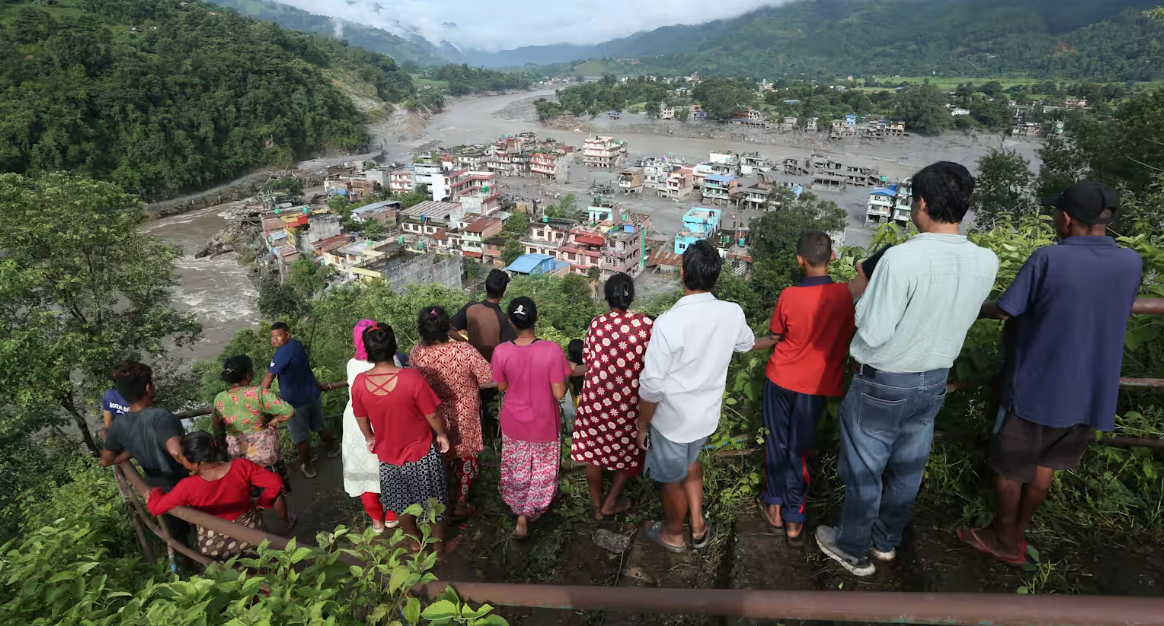
The devastating flash floods that tore through Nepal’s Trishuli and Koshi river valleys should not be seen as simply another Himalayan tragedy.
What began as an act of nature — a massive ice-and-rock avalanche that sheared away part of a glacier at an altitude of 5,200 meters near Tibet’s border with Nepal — became a cascading catastrophe after colliding with an increasingly engineered mountain landscape upstream.
The lesson is clear: In the fragile Himalayas, human alterations to rivers and mountain landscapes can dramatically amplify the impact of natural disasters.
The catastrophe unfolded with astonishing speed. The immense mass of ice and rock plunged into the upper Lhende Khola catchment, pulverizing into a dense slurry that temporarily dammed the narrow gorge before the improvised barrier collapsed. Within minutes, a wall of water, mud and boulders surged downstream, raising river levels. The collapse generated seismic waves so unusual that automated monitoring systems initially mistook the event for a magnitude-5.2 earthquake.
As the deluge thundered through Nepal’s steep valleys, it swept away villages, bridges and roads with devastating force. Several downstream hydroelectric facilities were wrecked by debris, triggering widespread power and communications failures. The floods also ravaged the Tibetan side of the border. In Nepal, however, they left a vast trail of death and destruction, while immense deposits of mud and rubble severely hampered search-and-rescue operations.
But the natural trigger of the disaster discloses only half the story.
The key question is why the floods became so destructive downstream. The answer lies in the cumulative effect of Chinese upstream infrastructure, altered river channels and the absence of meaningful transboundary cooperation. None of these caused the glacier failure, though together they may have amplified its consequences.
One important human factor was the transformation of the river corridor itself near the Tibet-Nepal border.
Over the past decade, China’s expansion of embankments, border facilities, highways and other civil works has narrowed sections of the upper valley by concentrating construction activity along the riverbanks. In ordinary conditions, such projects facilitate trade and transport. During an extreme flood, however, they become sources of vulnerability.
The torrent swept up loose spoil, concrete rubble, heavy machinery and structural debris, turning an already violent debris flow into what hydrologists aptly compare to liquid concrete — a battering ram capable of crushing almost any structure in its path. The deluge caused significant damage to infrastructure downstream.
The second human contribution was reengineered hydrology.
Diversion weirs, intake structures, embankments and other upstream river or stream modifications created localized bottlenecks in the narrow Himalayan gorges. As the avalanche-driven surge struck these chokepoints, temporary ponding and overtopping likely generated secondary flood pulses, accelerating the rapid downstream rise in river levels. The cascading impacts meant that some downstream communities faced not one but multiple destructive waves in quick succession.
Perhaps the most preventable failure was informational rather than physical.
China operates hydrological monitoring stations across the Tibetan headwaters, collecting real-time data on river levels and upstream conditions. Yet, despite its deepening relationship with Kathmandu, Beijing has not established comprehensive, year-round, real-time hydrological data-sharing and emergency notification mechanisms with Nepal (or with any other downstream country).
Even without a fully integrated 24/7 telemetry link feeding upstream water-level data directly into Nepal’s Department of Hydrology and Meteorology, an immediate Chinese emergency notification of sudden water-level spikes, debris-dam formation or other upstream anomalies could have bought precious time to evacuate settlements, trekking routes and vulnerable infrastructure, potentially reducing the death toll.
The absence of institutionalized hydrological transparency thus transformed a natural hazard into a governance failure.
For Nepal, rebuilding shattered hydropower stations, roads, bridges and other infrastructure will require years of investment. Another key task is institutional rather than physical: Nepal should seek from China mandatory real-time hydrological data sharing, cross-border emergency notification protocols, and independent assessments — should Beijing permit them — of how upstream engineering influences flood propagation in shared river basins. Transboundary rivers demand transboundary responsibility.
The Nepal tragedy exposes a more fundamental reality about the Himalayas, the world’s most seismically active major mountain range. The range remains under immense tectonic pressure as the Indian and the Eurasian continental plates collide, leaving its terrain exceptionally unstable.
Climate change is increasingly unsettling glaciers, but climate alone does not determine disaster outcomes. In the world’s youngest and most geologically fragile mountain range, engineering choices, river modifications and the absence of cross-border hydrological cooperation increasingly determine whether a natural hazard remains localized or cascades into a broader catastrophe.
Against this backdrop, the Nepal catastrophe may revive international scrutiny of a far larger gamble unfolding in a different section of the Himalayas: China’s super-dam on the Yarlung Tsangpo at the Great Bend, where the river makes a sharp U-turn around a towering mountain peak before gushing south into India. Constructing a mammoth dam with almost three times the power-generating capacity of the Three Gorges Dam beside a major geological fault carries extraordinary risks, especially for millions living downstream in India and Bangladesh.
China’s damming of rivers in Tibet is already wreaking environmental havoc. Scientists have long warned that the gravest threat to Himalayan dams may not be earthquakes alone, but massive rock-and-ice avalanches plunging into reservoirs and generating tsunami-like impulse waves capable of overtopping engineered structures.
The Nepal disaster is more than a national calamity. It is a warning that the boundary between natural disaster and human-made catastrophe is blurring in the Himalayas. As infrastructure expands across one of Earth’s most volatile mountain systems and glaciers weaken, the question is whether governments upstream and downstream will act before the next cascading catastrophe strikes.
Brahma Chellaney, a professor of strategic studies at the independent New Delhi-based Centre for Policy Research and fellow at the Robert Bosch Academy in Berlin, is the author of nine books, including “Water: Asia’s New Battleground,” which won the Bernard Schwartz Book Award.


You must be logged in to post a comment.