
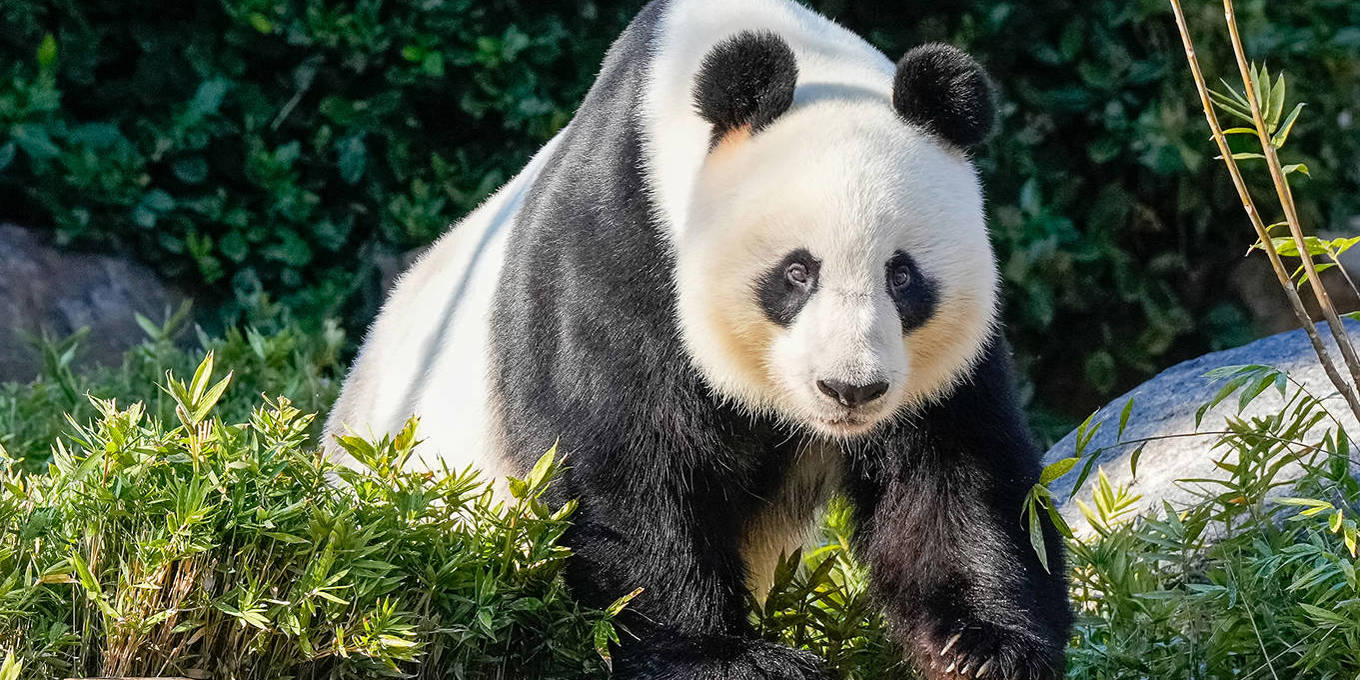
Since giving a pair of giant pandas to the Smithsonian’s National Zoo in 1972 following President Richard Nixon’s visit to Beijing, China has used panda loans as a means of projecting a harmless and friendly image globally. But it was always an act — and foreign audiences are no longer falling for it.
By Brahma Chellaney, Project Syndicate
During his recent visit to Washington, Chinese President Xi Jinping announced that China would send a breeding pair of giant pandas to Zoo Atlanta. The “envoys of friendship,” Ping Ping and Fu Shuang, arrived just a few days later. This is hardly the first time China has used its iconic bear as an instrument of soft power. By loaning the animals to overseas zoos, it seeks to project an image of China not as a threatening dragon, but rather as a tough but cuddly charmer.
But perhaps the true message of this “panda diplomacy” lies in the manipulation and exploitation it embodies. For starters, while China claims the familiar black-and-white bear as its mascot, one of the species’ primary natural habitats is Wolong, which sits on the steep edge of the Tibetan Plateau. Within a horizontal distance of about 30 miles, elevations range from alpine peaks exceeding 17,000 feet to below 1,600 feet, creating a moist, temperate microclimate that sustains the high-altitude bamboo forests where pandas thrive.
Historically part of the Tibetan region of Kham, Wolong is now under Sichuan provincial jurisdiction, in Aba Tibetan-Qiang Autonomous Prefecture—and China is all too eager to subsume everything that makes it culturally unique. Since China’s annexation of resource-rich Tibet in 1950-51, the government has systematically sought to erase Tibetan culture and identity, not least by incorporating the Plateau’s distinctive geography, wildlife, and natural resources into mainstream Chinese national identity. China’s appropriation of others extends even to cherry-tree cultivation, which it has claimed began not in Japan or Korea, but in “China’s Himalayan highlands”—that is, Tibet.
The Tibetan Plateau is home to the endangered red panda, a house-cat-sized mammal with a long, bushy tail, in addition to giant pandas, which are classified as a vulnerable species. There are fewer than 2,000 giant pandas left in the wild, and China claims ownership of almost all of them. This brings us to the second dubious element of China’s panda diplomacy: it is based on a lucrative “rent-a-panda-pair” program.
While China reaps the soft-power benefits of keeping its endearing mascot in foreign zoos, it also charges those zoos high prices: up to $1.1 million per year for the right to display and breed a pair of pandas. China retains ownership not only of the leased adults, but also of any offspring they produce. And yet, the leasing zoo must pay a one-time fee of approximately $600,000 for each cub that is born during its lease. Facilities also often pay up to $2 million in additional sponsorship and research commitments.
The bills add up. Between 1994 and 2023, China raked in almost $300 million from its panda-rental program. Small wonder the Guinness World Records lists the giant panda as the “most expensive species in captivity.”
But the money is just the start. The increasingly one-sided contracts that the state-run China Wildlife Conservation Association signs with zoos allow China to terminate an agreement unilaterally and prematurely recall pandas for a wide variety of reasons, such as the “unauthorized release of relevant information” to the public. This includes information that is seemingly innocuous: China prohibits zoos from using terms such as “lease,” “rental,” “loan,” or “contract,” apparently to obscure the transactional nature of the arrangement.
China also uses panda loans to send political messages. China gave a pair of pandas to the Smithsonian’s National Zoo in 1972, following President Richard Nixon’s visit to Beijing. In 2010, however, it accelerated the recall of two US-born panda cubs after the White House announced that President Barack Obama would not cancel a meeting with the Dalai Lama. In 2023, the three remaining pandas at the Smithsonian’s National Zoo were returned to China, marking the end of a tradition that had lasted more than a half-century.
And it is not just the United States. This year, Japan returned its last two giant pandas to China, leaving it without any for the first time since normalizing relations with China in 1972. By contrast, when China sent a pair of pandas to Qatar before the 2022 World Cup, officials hailed the move as a reflection of the countries’ “depth of relations.”
But the power of China’s panda diplomacy now seems to be waning. While the general public might still find pandas appealing, visits to panda-hosting zoos tend to plateau after the novelty wears off. Meanwhile, conservationists loudly criticize the commercial and diplomatic use of a vulnerable species.
Most importantly for China, political analysts and lawmakers increasingly view panda loans as more of a charming distraction than a meaningful barometer of bilateral relations. This helps to explain why Xi’s recent “gift” to Zoo Atlanta attracted little US media coverage. With active international panda-leasing programs having dropped from 21 countries in 2019 to just 16 today, even Chinese state media are now asking whether panda diplomacy has “lost its sparkle.”
Giant pandas may appear cuddly and docile, but they are formidable bears with long, sharp claws and a highly developed jaw structure, which delivers a bite force of nearly 1,300 Newtons, almost on par with that of lions. While captive-bred pandas introduced into the wild tend to die because they lack critical survival skills, wild pandas can be aggressive and dangerous. In this sense, perhaps pandas really are an accurate symbol of China: even when it appears harmless, it cannot conceal its teeth.

Brahma Chellaney, Professor of Strategic Studies at the New Delhi-based Center for Policy Research and Fellow at the Robert Bosch Academy in Berlin, is the author of nine books, including Water: Asia’s New Battleground (Georgetown University Press, 2011), for which he won the 2012 Asia Society Bernard Schwartz Book Award.


You must be logged in to post a comment.