 Brahma Chellaney, Körber Policy Brief No. 1
- Geopolitical rivalry in the Indian Ocean has increased. Several boundary, sovereignty and jurisdiction disputes threaten freedom of navigation. China has become the most active power in the region and is challenging the existing balance of power.
- With interstate competition over resources in the Indian Ocean sharpening, the EU should assist in creating a predictable regulatory regime and contribute to monitoring and enforcement of internationally agreed rules.
- The EU is already playing a limited security and political role in the Indian Ocean region, where it has important economic interests at stake. It should support regional cooperation to reduce the risks of unilateral action by any side and to help build long-term regional crisis stability.
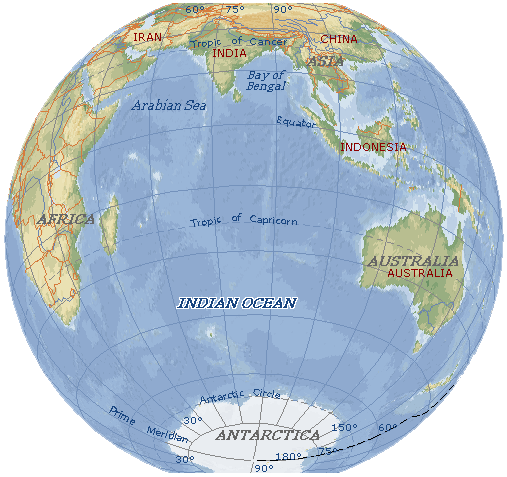
The Indian Ocean, which links Europe with Asia, is becoming the new global center of trade and energy flows. Spanning more than 73 million square kilometers, this critical ocean region is likely to determine the wider geopolitics, maritime order, and balance of power in Asia and beyond. In fact, in no part of the world is the security situation so dynamic and in such flux as in the Indian Ocean. This region, extending from Australia to the Middle East and Southern Africa, promises to become the hub of global geopolitical competition.
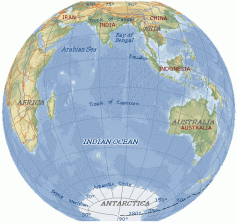 The challenges in this region extend from traditional security threats to nontraditional and emerging challenges. The challenges are linked to its vast size: It is home to a third of the global population, with the littoral states there also accounting for 25 percent of the world’s landmass, 55 percent of its proven oil reserves, and 40 percent of its gas reserves. As symbolized by the 2004 Christmas-eve tsunami and by recurrent cyclones, the region is regularly battered by natural disasters. According to one estimate, 70 percent of the world’s natural disasters occur in this region alone.
The region’s littoral states are linked by a common history of sea faring. Yet, given that it has the world’s largest concentration of fragile or failing states, as exemplified by Somalia, Pakistan and the Maldives, this region represents the symbolic center of the global challenges of the 21st-century world — from terrorism and extremism to piracy and safety of sea lanes of communication. The Indian Ocean indeed covers the entire arc of Islam — from the Horn of Africa and the Saudi Arabian desert to Malaysia and the Indonesian archipelago — and is racked by the world’s highest incidence of transnational terrorism.
The region is on the frontlines of climate change. It thus has states whose future is imperiled by global warming. Such states extend from the island-nations of Mauritius and the Maldives to Bangladesh, whose land area is less than half the size of Germany but with a population more than double. Because it is made up largely of low-lying floodplains and deltas, Bangladesh risks losing 17 percent of its land and 30 percent of its food production by 2050 due to saltwater incursion resulting from the rising ocean level, according to the Intergovernmental Panel on Climate Change. If, in the future, states like the Maldives and Mauritius were submerged, what would be the legal status of their Exclusive Economic Zones (EEZs) and the mineral wealth that these zones hold?
In the Indian Ocean region the old world order coexists uneasily with the new order.
The Indian Ocean illustrates other nontraditional security challenges as well — from environmental pollution, as exemplified by the brown cloud of sooty haze hanging over South Asia, and degradation of coastal ecosystems to a mercantilist approach to energy supplies and the juxtapositioning of energy interests with foreign-policy interests. Put simply, this is the region where old and new security challenges converge. In this region, the old order — as epitomized by the Anglo-American military base at Diego Garcia and the French-administered Réunion and other islands — coexists uneasily with the new order.
Because of the Indian Ocean’s importance to global trade and energy flows and the potential vulnerability of the chokepoints around it, sea-lane security has become a pressing concern. Important regional and extra-regional powers have sought to build maritime security by forging strategic partnerships with key littoral states in the Indian Ocean rim. The partnerships, principally aimed at safeguarding the various “gates” to the Indian Ocean, incorporate trade accords, naval training and joint exercises, counter-piracy operations, energy cooperation, and strategic dialogue.
The chokepoints, and the states adjacent to them, include the Strait of Malacca (Singapore, Indonesia and Malaysia), the Strait of Hormuz (Iran and Oman), the Horn of Africa (Djibouti, Eritrea and Yemen), as well as the Cape of Good Hope and the Mozambique Channel (South Africa, Mozambique and Madagascar).
There are, however, a range of other strategic concerns in the Indian Ocean. Some players, including Iran and the United States, are not yet party to the 1982 UN Convention on the Law of the Sea (UNCLOS). China, although a party, has sought to unilaterally interpret UNCLOS’s provisions in its favor to assert maritime claims, while refusing to accept the Convention’s dispute-settlement mechanism. The Philippines, with apparent U.S. support, has filed a complaint against China with the International Tribunal for the Law of the Sea (ITLOS), but China has simply declined to participate in the proceedings. Iran seized an Indian oil tanker in the autumn of 2013, holding it for nearly a month, but India could not file a case against Teheran with the International Tribunal for the Law of the Sea.
Boundary, sovereignty, and jurisdiction issues carry serious conflict potential.
There are outstanding boundary, sovereignty, and jurisdiction issues, some of which carry serious conflict potential. Bangladesh and Myanmar have set an example by peacefully resolving a dispute over the delimitation of their maritime boundaries in the Bay of Bengal. They took their dispute to the International Tribunal for the Law of the Sea for adjudication. The Tribunal’s verdict, delivered in 2012, ended a potentially dangerous dispute that was fuelled in 2008 when, following the discovery of gas deposits in the Bay of Bengal, Myanmar authorized exploration in a contested area, prompting Bangladesh to dispatch warships to the area.
The threats to navigation and maritime freedoms in the Indian Ocean, including in critical straits and exclusive economic zones (EEZs), can be countered only through adherence to international rules by all parties as well as through monitoring, regulation, and enforcement. Significantly, several states in the region have sought to deny other powers freedom of navigation in their EEZs when they are engaged in military activity, such as surveillance by ship.
Deep seabed mining has emerged as a major new strategic issue.
Deep seabed mining has emerged as a major new strategic issue, given the region’s mineral wealth. Interstate competition over seabed minerals is sharpening. From seeking to tap sulfide deposits — containing valuable metals such as silver, gold, copper, manganese, cobalt, and zinc — to phosphorus nodule mining for phosphor-based fertilizers used in food production, the competition is underscoring the imperative for creating a predictable regulatory regime, developing safe and effective ocean-development technologies, finding ways to share benefits of the common heritage, and ensuring environmental protection. Even China, an extra-regional power, has secured an international deep-seabed block in southwestern Indian Ocean from the International Seabed Authority to explore for polymetallic sulphides.
Great-power rivalries, meanwhile, are complicating maritime-security issues. The rivalries are mirrored in foreign-aided port-building projects along vital sea lanes; attempts to assert control over energy supplies and transport routes as part of a 21st-century-version of the Great Game; the building of inter-country energy corridors involving the construction of pipelines to transport oil or gas sourced by sea from third countries, as China is doing in Myanmar and Pakistan; and strategic plans to assemble a “string of pearls” in the form of listening posts and special naval-access arrangements along the great trade arteries.
China has become the most active power in the Indian Ocean and is challenging the existing balance of power.
Of all the powers, China has become the most active in the Indian Ocean, as underscored by the new port it has built in Pakistan at Gwadar (which sits strategically at the mouth of the Strait of Hormuz) and in Sri Lanka at Hambantota; a Chinese container facility in Chittagong (Bangladesh); and Chinese port projects in Myanmar, including developing a deep-sea port at Kyaukpyu as its international gateway. Such developments have sharpened China’s geopolitical rivalry with India, which enjoys an immense geographic advantage in the Indian Ocean.
With this region having the most-adverse ratio between land size, population, and natural resources, environmental degradation has emerged as an important challenge. The degradation is extending to coastal ecosystems, which sustain diverse species of marine life and are the source of livelihood for many people. The increasing role of external states in overexploiting the region’s marine resources has underscored the need for conservation and management of the biological diversity of the seabed in areas that are beyond national jurisdiction. There is also need for enforcing coastal-protection regulations and for surveillance and policing to stop illegal fishing and to protect structures for deep-sea mining.
Against this background, it is apparent that maritime-security challenges in the Indian Ocean need to be addressed in a holistic strategic framework. Nontraditional issues — from energy security and climate security to transnational terrorism and environmental degradation — have become as important as traditional issues, such as freedom of navigation, security of sea lanes, maritime boundary and domain security, arms proliferation, and challenges to law and order (including piracy and sea robbery, criminal activities like drug, people, and arms smuggling, illicit fishing, illegal immigration, and maritime terrorism).
The Indian Ocean is the maritime center of the world and of critical importance to the European Union’s economic and energy interests. The flow of trade through the maritime Silk Road of the Indian Ocean follows the same route and pattern from which the littoral states drew wealth and strength in history.
Europe could serve as a guide on how to build institutionalized cooperation in this region, where, with maritime boundaries still to be finalized, jurisdictional “creep” threatens to impede freedom of navigation. Seabed mining, for its part, is presenting both new challenges and opportunities on the high seas.
Europe has a role to play on environmental protection and resource sustainability. Environmental degradation in the Indian Ocean, after all, can influence climatic patterns and atmospheric general circulation in the entire Northern Hemisphere. Good governance, built through interstate cooperation and collaboration, can help stem the threats to maritime security and ecosystems.
France and Britain, through their military presence in the Indian Ocean, are promoting their own geopolitical interests in the region. European states, however, can collectively play a role to support peace and stability and environmental sustainability in the Indian Ocean. After all, the Indian Ocean, which accounts for 50 percent of the world’s container traffic and 66 percent of its seaborne trade in oil, is of critical importance to European trade.
The EU should help promote rules-based cooperation in the Indian Ocean region.
The European Union, by citing its own efforts to resolve maritime-boundary questions and other issues in Europe, can lend a helping hand to create a regulatory regime and to promote environmental protection in the Indian Ocean region. In this endeavor, the EU must collaborate with the Indian Ocean Rim Association (IORA), which consists of 20 diverse member-nations ranging from India, Indonesia, and Australia to small island-countries such as the Comoros and Seychelles.
Given its own institutionalized framework of cooperation, the EU, more than any other institution in the world, can help promote rules-based cooperation in the Indian Ocean region. The threats to navigation and maritime freedoms, including in critical straits and EEZs in the Indian Ocean region, can be countered only through adherence to international rules by all parties, as well as through monitoring, regulation and enforcement. In this context, NATO is already playing a limited security and political role in the region, with its contribution to combating piracy in the Horn of Africa.
The EU can also encourage collaborative projects between regional states so that they adopt new technologies and best practices to protect environmental security and build maritime cooperation. Collaborative projects will yield significant peace dividends by helping to reduce the risks of unilateral action by any side and by contributing to building regional crisis stability. European wealth is dependent on peace and stability in the Indian Ocean. This region serves as a test case of Europe’s ability to translate its economic heft into political influence to help shape regional developments in a positive direction.
Brahma Chellaney is Professor of Strategic Studies at the independent Center for Policy Research in New Delhi and the author, most recently, of “Water, Peace, and War” (Rowman & Littlefield, 2013).

 China’s declaration of a so-called air defence identification zone (ADIZ) in the East China Sea, extending to territories it does not control, is just the latest example of a jurisdictional creep that reflects a larger Chinese strategy to supplant the United States as the pre-eminent power in Asia. Yet U.S. President Barack Obama’s administration has responded with words of cautious criticism but no castigatory step, not even delaying Vice-President Joe Biden’s visit to Beijing.

 The pattern has become familiar: construct a dispute, initiate a jurisdictional claim through periodic incursions, and then increase the frequency and duration of such intrusions, thereby establishing a military presence or pressuring a rival to cut a deal on China’s terms. What is ours is ours, the Chinese invariably claim, and what is yours is negotiable. For example, China says “no foundation for dialogue” with Japan exists unless the Japanese accept the existence of a territorial dispute over the uninhabited Senkaku Islands.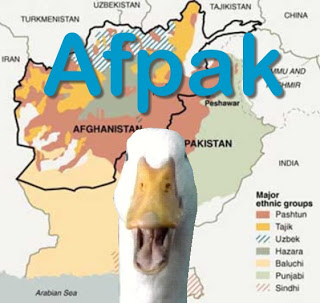
 The Durand Line — arbitrarily bisecting ethnic Pashtun and Baloch homelands — is the Afghan-Indian border the British demarcated in 1893 and which later became the frontier between Afghanistan and Pakistan. Decades after Pakistan’s creation in 1947, the Durand Line remains a mythical border, with successive Afghan governments refusing to recognize it and the validity of the porous line challenged by daily cross-frontier movement of people and extremists.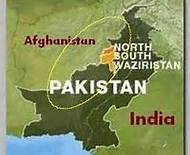

 The rise in US arms sales to India is being widely cited as evidence of the two countries’ deepening defense relationship. But the long-term sustainability of the relationship, in which India is more a client than a partner, remains a deep concern for Indians. Does the recently issued
  Maritime challenges are being fundamentally transformed by new technological and geopolitical realities, shifting trade and energy patterns, and the rise of unconventional threats. The fact that about 50 per cent of the maritime boundaries in the world are still not demarcated accentuates the challenges.

You must be logged in to post a comment.