
Effective diplomacy depends on credibility, consistency, and a clear alignment with national interests. The US administration’s personalized, opaque, and venal shadow diplomacy delivers none of that, and it will leave the US less respected, less trusted, and less effective on the world stage.
By Brahma Chellaney, Project Syndicate
In most democracies, a leader outsourcing high-stakes diplomacy to family members and business associates would provoke outrage. But US President Donald Trump has faced little pushback for doing so, with many downplaying his crony diplomacy as mere “heterodoxy.” The long-term consequences will be severe.
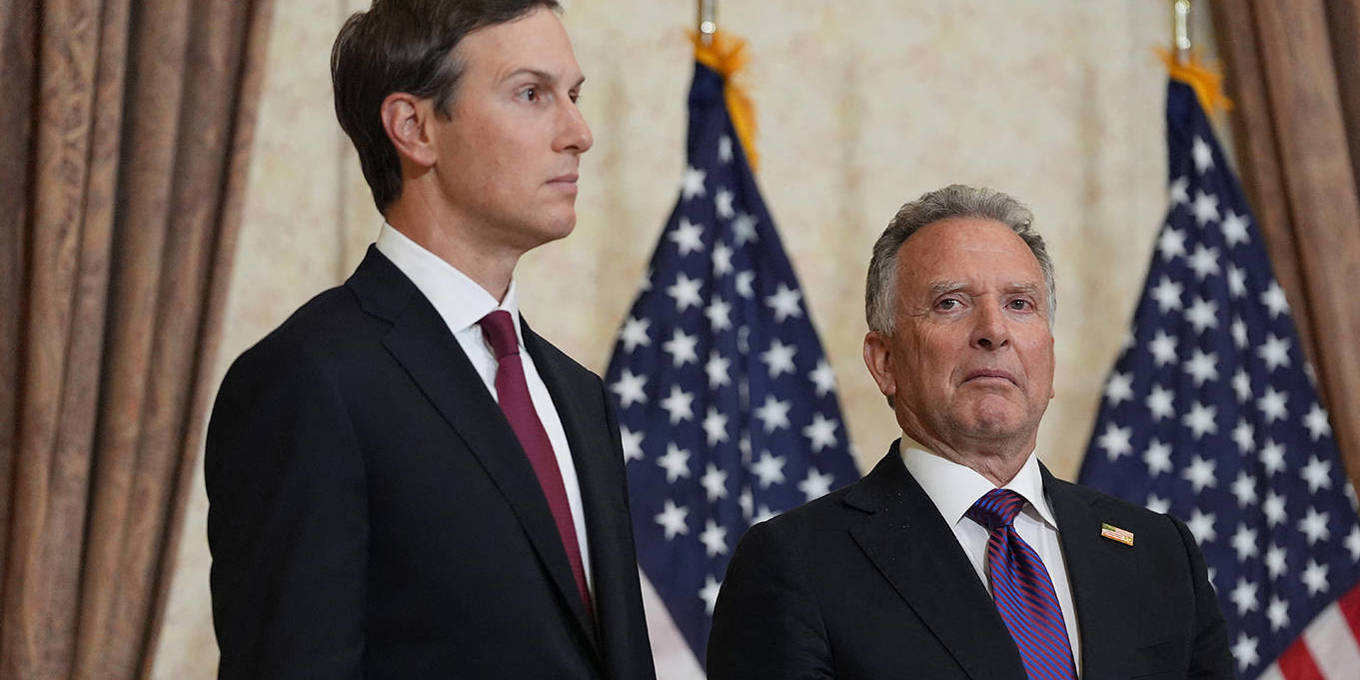
Instead of relying on the secretary of state and the professional diplomatic corps, Trump has placed pivotal diplomacy largely in the hands of his son-in-law, Jared Kushner, and his business partner, the Manhattan real-estate mogul Steve Witkoff. Kushner was a senior adviser in Trump’s first administration, responsible for helping to broker the Abraham Accords between Israel and four Arab states, and is now, like Witkoff, a Special Envoy for Peace.
Together, Kushner and Witkoff have spearheaded negotiations on Ukraine, Gaza, and Iran. Yet neither had any diplomatic experience before Trump tasked them with resolving some of the thorniest and highest-stakes foreign-policy challenges of our time, and both have glaring conflicts of interest.
Start with Witkoff. Last year, Pakistan signed a controversial investment deal with World Liberty Financial, a cryptocurrency firm whose CEO is Witkoff’s son, Zach, and in which the Trump and Witkoff families hold a dominant ownership stake. This past January, a WLF affiliate reached another deal with Pakistan—this time, to introduce the company’s stablecoin for use in cross-border transactions.
But Pakistan has also been the site and, to an extent, the broker of talks between the United States and Iran. When actors are negotiating geopolitical outcomes and pursuing business opportunities in the same arena, diplomacy begins to resemble a marketplace: access, influence, and profit are tightly interwoven.
As for Kushner, after leaving Trump’s first administration, he set up a private-equity firm, Affinity Partners, and took billions of dollars from Gulf monarchies, including about $2 billion from Saudi Arabia’s sovereign wealth fund. In other words, Kushner is dependent on Saudi capital. Yet he is now expected to negotiate a détente with Iran, even as Saudi Crown Prince Mohammed bin Salman reportedly urges Trump to continue the war.
And it is not just Iran. Kushner’s “New Gaza” proposal, unveiled at Davos this past January, has been widely criticized as “real-estate diplomacy,” as it effectively recasts reconstruction as a business venture while ignoring questions of sovereignty and rights.
Kushner and Witkoff’s conflicts of interest, together with their lack of foreign-policy credentials, explain why Trump has not sought to appoint them to official diplomatic positions. Special envoys avoid Senate confirmation hearings, as well as the disclosure requirements, ethics rules, and congressional oversight that bind professional diplomats. Kushner and Witkoff are thus able to exercise influence without transparency, and to negotiate on behalf of the US without accountability.
Of course, Kushner and Witkoff are hardly the only figures capitalizing on their proximity to Trump. Prominent allies and donors, such as Oracle’s Larry Ellison, have won big from their investment in the majority American-owned TikTok venture that Trump effectively forced the Chinese parent company to create, supposedly over national-security concerns.
Moreover, Trump’s sons, Eric and Donald, Jr., recently joined a drone company Powerus, and are attempting to sell drone interceptors to the Gulf states to ward off attacks from Iran as it retaliates for their father’s war. Foundation Future Industries, a robotics startup where Eric is chief strategy adviser, was recently awarded a $24 million Pentagon contract.
Now, reports are emerging of possible insider trading around the Iran war, with large bets being made right before market-moving public statements from Trump. Yet the American public, whether desensitized to Trump’s breaking of norms or simply unable to keep up with the pace and scale of the violations, hardly reacts to such news. Scandals that would have brought any past US administration down—or at least prompted urgent investigation—have become routine under Trump.
With a Republican Party that bows to Trump’s every whim and justifies his every crime—while controlling both houses of Congress—a kind of resignation has taken hold. But as outrage fades, so does the restraining power of political norms. As a result, abuses become increasingly blatant and egregious, and trust is eroded. Even if Trump’s cronies did manage to reach a peace deal, it would warrant suspicion, with every concession raising questions about who really benefits—and who is compromised.
This undercuts not only specific agreements, but also US global leadership more broadly. With US foreign policy now guided by personal loyalty, informal networks, and private gain, whatever credibility the US had as a reliable partner, good-faith negotiator, and champion of the rule of law has been decimated. None of this will be easily restored.
In the meantime, if foreign governments want to influence US policy or secure the country’s geopolitical cooperation, they must make it worth Trump’s while. Nowhere is that more apparent than in Trump’s so-called Board of Peace—a putative alternative to the United Nations where a permanent seat carries a billion-dollar price tag. This is less a multilateral institution than a pay-to-play geopolitical franchise, but some countries appear willing to cough up the cash to stay in the US president’s good graces.
Others seeking to shape US policy head to Trump’s Mar-a-Lago resort in Florida, which he increasingly uses for official diplomatic engagements. And, of course, there are those who go there to get in on the self-dealing, making business deals with Trump’s inner circle. Meanwhile, wars continue to rage, with far-reaching human and economic consequences.
Trump’s defenders argue that unconventional actors can produce breakthroughs where conventional processes have failed. But diplomacy is not merely deal-making; it depends on credibility, consistency, and a clear alignment with national interests. The personalized, opaque, and venal shadow diplomacy being pursued by Kushner and Witkoff can deliver none of that. What it can and will do is ensure that the US is less respected, less trusted, and less effective on the world stage.

Brahma Chellaney, Professor of Strategic Studies at the New Delhi-based Center for Policy Research and Fellow at the Robert Bosch Academy in Berlin, is the author of nine books, including Water: Asia’s New Battleground (Georgetown University Press, 2011), for which he won the 2012 Asia Society Bernard Schwartz Book Award.


You must be logged in to post a comment.