
As competition for this precious resource grows, water will be a key to war and peace

BRAHMA CHELLANEY, The Globe and Mail, Published Wednesday, Oct. 09, 2013
In an increasingly water-stressed world, shared water resources are becoming an instrument of power, fostering competition within and between nations and exacerbating impacts on ecosystems. This week’s Budapest World Water Summit is the latest initiative in the search for ways to mitigate the pressing challenges.
Consider some sobering facts: Bottled water at the grocery store is already more expensive than crude oil on the spot market. More people today own or use a cellphone than have access to water-sanitation services.
Unclean water is the greatest killer on the globe, yet a fifth of humankind still lacks easy access to potable water. More than half of the global population currently lives under water stress — a figure projected to increase to two-thirds during the next decade.
Potentially calamitous water shortages in the coming decades in the densely populated parts of Asia, the Middle East and North Africa — the world’s most-parched regions — could produce large numbers of “water refugees” and overwhelm some states’ institutional capacity to contain the effects. The struggle for water is already escalating interstate and intrastate tensions.
 Downstream Egypt, for example, uses the bulk of the Nile River’s water, yet it is now threatening unspecified reprisals against Ethiopia’s ongoing construction of the Grand Renaissance Dam. China, already the world’s most-dammed nation and unrivaled hydro-hegemon, has approved the construction of 54 new dams — many of them on rivers that are the lifeblood for countries in Southeast and South Asia — as it seeks to build a strategic grip on transboundary water flows.
Turkey, like China, is trying to reinforce its regional riparian dominance by accelerating an ambitious dam-building program, which threatens to diminish cross-border flows into Syria and Iraq. The internal war in Syria and the continuing sectarian bloodletting in Iraq have muted regional opposition to Turkey’s dam-building spree.
Meanwhile, intrastate water-sharing disputes have become common, although they receive little coverage in the international media. Water conflicts within culturally diverse nations, such as Afghanistan, Pakistan, Yemen and Sudan, often assume ethnic dimensions, thereby accentuating internal-security challenges.
But as illustrated by the disputes, for example, within the United States, Spain and Australia, intra-country water conflict is not restricted to the developing world. Water conflicts in America have spread from the arid west to the east. Violent water struggles, however, occur mostly in developing nations, with resource scarcity often promoting environmental degradation and perpetuating poverty.
Adequate access to natural resources has been a key factor, historically, in peace and war. Water, however, is very different from other natural resources. A person can live without love but not without water.
There are substitutes for a number of resources, including oil, but none for water. Countries can import, even from distant lands, fossil fuels, mineral ores, and resources originating in the biosphere, such as fish and timber. But they cannot import the most vital of all resources, water — certainly not in a major or sustainable manner. Water is essentially local and very expensive to ship across seas.
Scarce water resources generate conflict. Even the origin of the word “rival” is tied to water competition. It comes from the Latin rivalis, or one who uses the same stream.
Water’s paradox is that it is a life preserver, but it can also be a life destroyer when it becomes a carrier of deadly bacteria or comes in the deluge of a tsunami, a flash flood, or a hurricane. Many of the greatest natural disasters of our time have been related to water. A recent example is the Fukushima disaster, which triggered a triple nuclear meltdown.
Because of global warming, potable water is set to come under increasing strain even as oceans rise and the intensity and frequency of storms and other extreme weather events increases.
Rapid economic and demographic expansion has already turned potable water into a major issue across large parts of the world. Lifestyle changes, for example, have spurred increasing per-capita water consumption in the form of industrial and agricultural products.
It is against this background that water wars, in a political and economic sense, are already being waged between competing states in several regions, including by building dams on international rivers or, if the country is located downstream, by resorting to coercive diplomacy to prevent such construction. U.S. intelligence has warned that such water conflicts could turn into real wars.
According to a report reflecting the joint judgment of U.S. intelligence agencies, the use of water as a weapon of war or a tool of terrorism appears more likely in the next decade in some regions. The InterAction Council, comprising more than 30 former heads of state or government, meanwhile, has called for urgent action, saying some countries battling severe water shortages risk failing. The U.S. State Department, for its part, has upgraded water to “a central U.S. foreign policy concern.”
Water stress is also imposing mounting socioeconomic costs. Commercial or state decisions in many countries on where to set up new manufacturing or energy plants are increasingly being constrained by inadequate local water availability.
The World Bank has estimated the economic cost of China’s water problems at 2.3 percent of its GDP. But thus far China isn’t even under water stress — a term internationally defined as the availability of less than 1,700 cubic meters of water per head per year. Economies that are already water-stressed, ranging from South Korea and India to Egypt and Morocco, are paying a higher price.
Water is a renewable but finite resource. Nature’s fixed water-replenishment capacity limits the world’s renewable freshwater resources to nearly 43 trillion cubic meters per year. But the human population has almost doubled since 1970 alone, while the global economy has grown even faster.
Consumption growth has become the single biggest driver of water stress. Rising incomes, for example, have promoted changing diets, especially a greater intake of meat, the production of which is notoriously water-intensive. It is about 10 times more water-intensive to produce beef than to produce plant-based calories and proteins.
In this light, water is becoming the world’s next major security and economic challenge.
Although no modern war has been fought just over water, this resource has been an underlying factor in several armed conflicts. With the era of cheap, bountiful water having been replaced by increasing supply and quality constraints, the risks of overt water wars are now increasing.
Avoiding water wars will require rules-based cooperation, water sharing and dispute-settlement mechanisms. However, there is still no international water law in force, and most of the regional water agreements are toothless, lacking monitoring and enforcement rules and provisions formally dividing water among users. Worse still, unilateralist appropriation of shared resources is endemic in the parched world, especially where despots rule.
The international community thus confronts a problem more pressing than peak oil, economic slowdown and other oft-cited challenges. Indeed, this core problem holds the key to other challenges because of water’s nexuses with global warming, energy shortages, stresses on food supply, population, pollution, environmental degradation, global epidemics and natural disasters.
Brahma Chellaney is a geostrategist and the author, most recently, of “Water, Peace, and War”(Rowman & Littlefield, 2013).
(c) The Global and Mail, 2013.
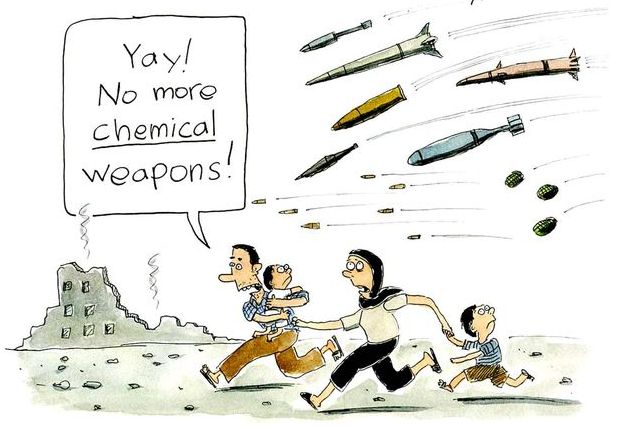
 In just one decade, the United States has intervened militarily in three Muslim-majority countries and overthrown their governments. Now the same coalition of American liberal interventionists and neoconservatives that promoted those wars is pushing for punitive airstrikes in Syria without reflecting on how US policy has ended up strengthening Islamists and fostering anti-Americanism. Indeed, the last “humanitarian intervention” has clearly backfired, turning Libya into a breeding ground for transnational militants.
 Likewise, regime change in Libya aided the rise of Al Qaeda-linked militants, leading to the killing in Benghazi of the US ambassador. A system based on sharia (Islamic law) has been imposed, human-rights abuses are legion, and cross-border movement of weapons and militants has undermined the security of Libya’s neighbors.


 America’s larger chariness has seemingly encouraged China to up the ante against several neighbors. For example, after gradually increasing the frequency of its incursions into Senkaku waters since September 2012, China is now focusing on increasing their duration. Similarly, China’s land incursions into India’s Ladakh region, after going up in frequency, are this year being staged intermittently for longer duration.
 Japan’s alliance with the United States remains the centerpiece of its strategic policy, yet Washington appears increasingly reluctant to get drawn into Sino-Japanese territorial disputes. If anything, the U.S. seems concerned that Prime Minister Shinzo Abe may view U.S. treaty guarantees as a shield for Japan to confront an increasingly assertive China in the East China Sea.


You must be logged in to post a comment.