
China’s Stealth Wars

A Project Syndicate column internationally distributed

Portrait of Brahma Chellaney

China is subverting the status quo in the South and East China Seas, on its border with India, and even concerning international riparian flows ― all without firing a single shot. Just as it grabbed land across the Himalayas in the 1950s by launching furtive encroachments, China is waging stealth wars against its Asian neighbors that threaten to destabilize the entire region. The more economic power China has amassed, the greater its ambition to alter the territorial status quo has become.

Throughout China’s recent rise from poverty to relative prosperity and global economic power, the fundamentals of its statecraft and strategic doctrine have remained largely unchanged. Since the era of Mao Zedong, China has adhered to the Zhou Dynasty military strategist Sun Tzu’s counsel: “subdue the enemy without any battle” by exploiting its weaknesses and camouflaging offense as defense. “All warfare,” Sun famously said, “is based on deception.”

For more than two decades after Deng Xiaoping consolidated power over the Chinese Communist Party, China pursued a “good neighbor” policy in its relations with other Asian countries, enabling it to concentrate on economic development. As China accumulated economic and strategic clout, its neighbors benefited from its rapid GDP growth, which spurred their own economies. But, at some point in the last decade, China’s leaders evidently decided that their country’s moment had finally arrived; its “peaceful rise” has since given way to a more assertive approach.

One of the first signs of this shift was China’s revival in 2006 of its long-dormant claim to Indian territory in Arunachal Pradesh. In a bid to broaden its “core interests,” China soon began to provoke territorial disputes with several of its neighbors. Last year, China formally staked a claim under the United Nations Convention on the Law of the Sea to more than 80 percent of the South China Sea.

From employing its strong trade position to exploiting its near-monopoly on the global production of vital resources like rare-earth minerals, China has staked out a more domineering role in Asia. In fact, the more openly China has embraced market capitalism, the more nationalist it has become, encouraged by its leaders’ need for an alternative to Marxist dogma as a source of political legitimacy. Thus, territorial assertiveness has become intertwined with national renewal.

China’s resource-driven stealth wars are becoming a leading cause of geopolitical instability in Asia. The instruments that China uses are diverse, including a new class of stealth warriors reared by paramilitary maritime agencies. And it has already had some victories.

Last year, China effectively took control of the Scarborough Shoal, an area of the South China Sea that is also claimed by the Philippines and Taiwan, by deploying ships and erecting entry barriers that prohibit Filipino fishermen from accessing their traditional fishing preserve. China and the Philippines have been locked in a standoff ever since. Now the Philippines is faced with a strategic Hobson’s choice: accept the new Chinese-dictated reality or risk an open war.

China has also launched a stealth war in the East China Sea to assert territorial claims over the resource-rich Senkaku Islands (called the Diaoyu Islands in China), which Japan has controlled since 1895 (aside from a period of administration by the United States from 1945 to1972). China’s opening gambit ― to compel the international community to recognize the existence of a dispute ― has been successful, and portends further disturbance of the status quo.

Likewise, China has been posing new challenges to India, ratcheting up strategic pressure on multiple flanks, including by reviving old territorial claims. Given that the two countries share the world’s longest disputed land border, India is particularly vulnerable to direct military pressure from China.

The largest territory that China seeks, Arunachal Pradesh, which it claims is part of Tibet, is almost three times the size of Taiwan. In recent years, China has repeatedly attempted to breach the Himalayan frontier stretching from resource-rich Arunachal Pradesh to the Ladakh region of Jammu and Kashmir ― often successfully, given that the border is vast, inhospitable, and difficult to patrol. China’s aim is to needle India ― and possibly to push the Line of Actual Control (LAC) southward.

Indeed, on April 15, a platoon of Chinese troops stealthily crossed the LAC at night in the Ladakh region, establishing a camp 19 kilometers (12 miles) inside Indian-held territory. China then embarked on coercive diplomacy, withdrawing its troops only after India destroyed a defensive line of fortifications. It also handed a lopsided draft agreement that seeks to freeze the belated, bumbling Indian build-up of border defenses while preserving China’s capability to strike without warning.

India has countered with its own draft designed specifically to prevent border flare-ups. But territory is not the only objective of China’s stealth wars; China is also seeking to disturb the status quo when it comes to riparian relations. Indeed, it has almost furtively initiated dam projects to reengineer cross-border river flows and increase its leverage over its neighbors.

Asian countries ― together with the U.S. ― should be working to address Asia’s security deficit and establish regional norms. But China’s approach to statecraft, in which dominance and manipulation trump cooperation, is impeding such efforts. This presents the U.S., the region’s other leading actor, with a dilemma: watch as China gradually disrupts the status quo and weakens America’s allies and strategic partners, or respond and risk upsetting its relationship with China, the Asian country most integral to its interests. Either choice would have far-reaching consequences.

Against this background, the only way to ensure peace and stability in Asia is to pursue a third option: inducing China to accept the status quo. That will require a new brand of statecraft based on mutually beneficial cooperation ― not brinkmanship and deception.

Brahma Chellaney, Professor of Strategic Studies at the New Delhi-based Center for Policy Research, is the author of Asian JuggernautWater: Asia’s New Battleground, and Water, Peace, and War: Confronting the Global Water Crisis.

(c) Project Syndicate, 2013.

Geostrategic risks of lopsided trade

An asymmetrical trade relationship with China is exposing India to greater strategic pressures and risks while aiding Beijing’s strategy to prevent India’s rise as a peer competitor.

Brahma Chellaney, Mint, May 30, 2013

Chinese territorial assertiveness is obscuring how Beijing is strategically expanding lopsided trade with India to rake in mounting profits while undercutting Indian manufacturing through an avalanche of cheap Chinese-made products. China’s ballooning trade surplus with India is compounded by its import of mainly primary commodities while exporting finished products.

Perpetuating such an asymmetrical relationship presents India in an unflattering light as a raw-material appendage of, and a goods-dumping market for, the Chinese economy. More importantly, the lopsided economic engagement gives China little incentive to bridge a widening political divide with India. If anything, it encourages China to continue with a strategy to keep India under strategic pressure so as to regionally contain it.

With China exporting more than 2½ times as much as it imports, its already large trade surplus will swell if bilateral trade rises from $70 billion currently to the targeted $100 billion in 2015. Economic problems in the West, by contributing to a slowdown in China, have only increased the importance of the Indian market for Beijing. This is what prompted Premier Li Keqiang to choose India as his first overseas destination for an official visit. This factor has also encouraged China’s cash-rich, state-supported banks to offer debt financing to heavily indebted Indian companies that commit to buy Chinese equipment or supply raw materials.

While swamping the Indian market with its products, China has made it difficult for Indian exporters to gain much of a foothold in its own market, including in sectors where India is strong, such as pharmaceuticals and IT. As a result, India’s exports to China largely consist of low-margin, unprocessed commodities. India’s exports have actually slumped since 2012, in part because of legal and other wrangles at home over extraction of iron ore, the leading export item in the past decade to China, which conserves its own reserves of strategic mineral ores to rely on imports.

China’s increasing access to the Indian market has done little to encourage it to pursue a less-adversarial foreign policy. Indeed, the more profits China has reaped, the more assertive it has become. As India’s trade deficit with China has soared from just $1 billion in 2002 to $40 billion in 2013 (or one-third of India’s overall trade deficit), Beijing has, for example, openly challenged Indian sovereignty in the large eastern and western sectors of the Himalayas by playing the Arunachal and Kashmir cards.

Instead of calibrating China’s market access to progress on the political, territorial, and water-resource issues, a politically adrift India is unwittingly doing just the opposite—allowing Beijing to strengthen its leverage against it. The massive trade imbalance with China is worsening India’s current account deficit, pushing the rupee to record lows against the US dollar since last year.

China has effectively turned asymmetrical trade into another instrument to prevent India’s rise as a peer competitor. In fact, China is now leveraging its trade and financial clout—including its role as a major supplier of power and telecom equipment and its emergence as a lender to financially troubled Indian companies—to limit India’s options on countering the Chinese strategic encirclement. An Indian business community dependent on Chinese product supply and financing is lobbying for a continued soft approach towards China, now India’s largest source of imports.

The paradox is that, despite supply of turbines and other equipment, most Chinese exports are not technology items but cheap products that kill small-scale manufacturing and rob jobs in India, with some of them also posing safety risk or public health concern. The bilateral focus on trade, even as China builds up strategic pressure from multiple flanks, aids the Chinese win-win agenda to reap profits while continuing to hem in India.

Consequently, the politics and economics of the relationship are going in opposite directions, to India’s serious detriment. India wrongly bet on rapidly growing trade helping to mute political disputes and moderate Chinese conduct so as to create an environment conducive for settlement of outstanding issues.

For China, trade is not only about economics but also about geostrategic interests. So, it does not allow booming bilateral trade to come in the way of its territorial assertiveness, as the recent Ladakh incursion highlighted. In fact, as underscored by its commercial actions against Japan and the Philippines, it employs trade as a political weapon. With China serving as Japan’s largest overseas market, Beijing has sought to punish Tokyo through an informal boycott of Japanese products since last September.

In this light, any Indian dependency on Chinese imports will carry geostrategic risks. China encourages economic dependencies and then manipulates them to advance its strategic objectives. In its recent territorial feuds with other neighbours, China has bared the cards it is likely to wield when faced with a diplomatic or military crisis next—from employing its trade muscle to inflict commercial pain to exploiting its monopoly on the global production of the vital rare-earth minerals.

So what can India do to prevent China from using its trade prowess for political ends? First, it must avoid any commercial dependency that cannot be easily be substituted with imports from elsewhere.

Second, India must aggressively contain the flood of Chinese-made subsidized goods through countervailing duties and anti-dumping measures that bite, or else it will become harder for it to develop a more mature manufacturing base. Its lodging of anti-dumping cases at the World Trade Organization has proven no deterrent.

And third—in the way China unofficially but assertively links economic issues with political matters—India must not shy away from linking market access to concrete progress on border and water issues. But if push comes to shove, it has the option to take a leaf out of China’s playbook by orchestrating an informal consumer boycott of Chinese products.

Brahma Chellaney is professor of strategic studies at the Centre for Policy Research in New Delhi.

(c) Mint, 2013.

The iron fist in a trade glove

Brahma Chellaney

The Japan Times, May 28, 2013

Trade as a weapon: China promotes economic dependencies and then manipulates them to advance its geostrategic objectives.

Japan and India are natural allies whose fast-growing relationship is remarkably free of any strategic dissonance. So, Indian Prime Minister Manmohan Singh’s Tokyo visit this week stands in sharp contrast to Chinese Premier Li Keqiang’s recently concluded India tour, which, behind the hype, helped to underscore the deep Sino-Indian divide.

India, China and Japan, constituting Asia’s pivotal triangle, are transforming relations between themselves in a way that portends growing strategic collaboration between New Delhi and Tokyo but sharper geopolitical competition between China and the other two Asian powers. The Sino-Indian relationship was recently disturbed by a stealthy incursion across the disputed Himalayan border by the People’s Liberation Army, which pulled back its troops just in time to allow Li to go ahead with a scheduled visit to India.

Li’s visit helped shine a spotlight on a negative aspect extending beyond the Himalayan tensions — India’s ballooning trade deficit with Beijing, compounded by China’s import of mainly primary commodities while exporting finished products. A flood of cheap Chinese-made goods has undercut Indian manufacturing.

The lopsided economic engagement gives China little incentive to bridge a widening political divide with India. If anything, it encourages China to continue with a strategy to keep India under strategic pressure so as to regionally contain that country.

With China exporting more than two-and-half times as much as it imports, its already large trade surplus with India will only swell if the two countries meet their target of raising bilateral trade from the current level of nearly $70 billion to $100 billion by 2015. Its recent border incursion notwithstanding, China has focused on raking in more profits from the Indian market. Li himself underscored the difficulty of correcting the fundamental imbalance in trade by taking mainly exporters in his large business team to India.

Economic problems in the West, by contributing to a slowdown in China, have only increased the importance of the Indian market for Beijing. This is what prompted Li to choose India as his first overseas destination for an official visit. This factor has also encouraged China’s cash-rich, state-supported banks to offer debt financing to heavily indebted Indian companies that commit to buy Chinese equipment or supply raw materials.

While swamping the Indian market with its products, China has made it difficult for Indian exporters to gain much of a foothold in its own market, including in sectors where India is strong, such as pharmaceuticals and information technology. As a result, India’s exports to China largely consist of low-margin, unprocessed commodities.

China’s increasing access to the Indian market, however, has done little to promote a less-adversarial Chinese foreign policy. Indeed, the more profits China has reaped from its trade relationship with India, the more assertive it has become.

As China’s trade surplus with India has soared from just $1 billion in 2002 to $40 billion in 2013, China has openly challenged Indian sovereignty in the large western and eastern sectors of the Himalayas. In this period, China has continued to enlarge its strategic footprint in Pakistani-held Kashmir — a disputed territory — even as sustained Chinese pressure forced India’s state-owned ONGC Videsh Limited (OVL) to pull out of a contract to explore for oil in two blocks off the Vietnamese coast in the South China Sea. Beijing had warned India against “any unilateral exploration activities” in the South China Sea.

The Indian assumption that greater trade would make Beijing more amenable to solving the border dispute and more sensitive to India’s other concerns has been belied. While refusing to accept the territorial status quo with India, China is also working to disturb the status quo on international-river flows to its southern neighbor through an aggressive dam-building program.

India is particularly vulnerable to China’s reengineering of transboundary flows because it alone receives nearly half of all river waters that leave Chinese territory. Beijing, however, has repeatedly spurned India’s proposal to conclude a pact or establish an intergovernmental institution to define rights and responsibilities on shared rivers. China wants only to sell flood-related hydrological data.

That China does not allow booming bilateral trade from coming in the way of its territorial assertiveness is also manifest from the way it has ratcheted up disputes in the East and South China Seas. In fact, as underscored by its actions against Japan and the Philippines since last year, it employs trade as a political weapon. With China serving as Japan’s largest overseas market, Beijing has sought to punish Tokyo through an informal boycott of Japanese products since last September.

For China, trade is not only about economics but also about geostrategic interests. Beijing values the lopsided trade with India as a strategic weapon that undercuts its rival’s manufacturing base, yet yields handsome dividends for it.

In fact, China encourages economic dependencies so that it can manipulate them to advance its strategic objectives. In its recent territorial feuds with other neighbors, China has bared the cards it is likely to wield when faced with a diplomatic or military crisis next — from employing its trade muscle to inflict commercial pain to exploiting its monopoly on the global production of the vital rare-earth minerals.

So what can India do to prevent China from using its trade prowess for political ends

First, it must avoid any commercial dependency that cannot be easily be substituted with imports from elsewhere.

Second, it must aggressively contain the flood of Chinese-made subsidized goods through anti-dumping measures and countervailing duties, or else it will become harder for it to develop a more mature manufacturing base.

And third — in the way China unofficially but assertively links economic issues with political matters — India must not shy away from linking market access to concrete progress on border and water issues.

Brahma Chellaney is professor of strategic studies at the independent Centre for Policy Research in New Delhi and the author, most recently, of “Water, Peace, and War” (Rowman & Littlefield, 2013).

(c) The Japan Times, 2013.

Chinese checkmate

Brahma Chellaney

The Hindustan Times, May 15, 2013

China has taken no break to savour the triumph of its coercive diplomacy when it caught India unawares by sneaking troops into Ladakh’s Depsang plateau and then, employing the threat of an extended standoff and escalation, extracted military concessions. Not content with that success, Beijing is now pushing a frontier accord that, in the name of Himalayan peace and tranquillity, would freeze India’s belated, bumbling build-up of border defences and troop levels while preserving China’s capability to strike without warning.

The People’s Liberation Army (PLA) completed the removal of its encampment from Depsang not on May 5, when India said the face-off was over, but on May 7 after Indian troops dismantled a defensive line of bunkers on their side at Chumar, an action that has spawned another concession — suspension of Indian patrolling along that critical borderline. Earlier on May 4, India received a far-reaching, Chinese-drafted “Border Defence Cooperation Agreement” that, in essence, seeks to keep India at a strategic disadvantage and thus vulnerable to Chinese military preemption.

Beijing is stepping up pressure, lest it gets too late, to stop India from plugging gaps in its border defences. China’s recent incursion forced India to dismantle vantage-point fortifications capable of providing early warning of Chinese troop movements, while the draft Border Defence Cooperation Agreement aims to advance broader Chinese interests and ensure that the PLA retains the option to strike at a time and place of its choosing. An emboldened China believes the Ladakh standoff has so softened India that it can now be inveigled into granting more concessions, especially to make Premier Li Keqiang’s visit a “success”.

In the recent episode, Chinese coercion easily trumped Indian diffidence. By merely positioning a single platoon of up to 50 troops across the de facto border, China compelled India — without firing a single shot — to agree to attenuate its border defences at Chumar (the scene of recurrent Chinese intrusion attempts) and to commit to addressing other Chinese concerns in follow-up negotiations.

China had a lot to lose by persisting with the face-off because it would have led to cancellation of Li’s visit and shone an adverse international spotlight on Chinese territorial aggressiveness with multiple neighbours. It was in India’s interest to raise the diplomatic costs for China so as to deter future military provocations.

Instead of letting China stew for a while after beefing up its forces but without encircling the intruders, India rewarded the aggressor with concessions. It also presented itself in the same light as the aggressor by announcing a simultaneous Indian and Chinese troop pullout from the standoff zone.

While New Delhi wilted under coercive pressure, China incontrovertibly vindicated its raid by paying no diplomatic or economic costs. Yet the corruption-tainted Indian government claims quiet diplomacy made China beat a retreat. If such is the power of Indian diplomacy, why is India bleeding itself by remaining the world’s largest arms importer?

In truth, it was India’s feckless decision to respond only by diplomatic means to a grave military provocation that left it no choice but to publicly play down the incursion and to yield ground.

China’s leverage-pivoted, concessions-mining approach stands in stark contrast with the forbearing Indian diplomacy, now stewarded by Salman Khurshid from his cloud-cuckoo-land perch. Imagine if Indian soldiers had intruded even one kilometre into Chinese territory: Would the Chinese foreign minister have survived in office by belittling it as a pimple on the “beautiful face” of India-China relations? And would he have subsequently rushed to New Delhi, renouncing the right to “do any post-mortem or apportion blame” and saying he would love to live in India?

Note also the striking contrast between the two countries’ approach to agreements. Whereas India’s legalistic line treats agreements as sacrosanct in letter and spirit, China regards accords as just political tools to advance its interests, including lulling the other party into complacency so as to create new exploitable opportunities. The 1954 Panchsheel treaty was a classic example: India valued it as heralding a Hindi-Chini bhai bhai era, while China used it as a cover to start encroaching on Indian territories and to solidify its Tibet annexation, paving the way for its 1962 India invasion.

China does not hesitate to renege on a commitment or violate a key pact, whereas India puts up stoically with even an iniquitous agreement like the 1960 Indus Waters Treaty with Pakistan, despite coming under growing water stress. After exchanging maps of the middle sector with India in 2001, China broke its commitment to also trade maps of the other two sectors to help clarify the entire line of control.

No sooner had the dual 2005 border-peace accords been signed than China began infringing them. Now that its Ladakh incursion has nakedly contravened the 2005 pacts, Beijing’s audacious response is to draft a lopsided Border Defence Cooperation Agreement to supplant all previous accords.

China has a knack of disaggregating any issue into multiple parts and then pursuing a shrewd, quid-pro-quo diplomacy to each element, often drawing a linkage with even extraneous pieces. In contrast to India’s itch to settle issues, settlement in Chinese diplomatic chess involves keeping space to possibly unleash leverage by reopening any component part in the future.

If India’s China policy remains driven by wishful thinking, the country is likely to invite more nasty surprises that end with similar Indian submission to the aggressor’s demands. It is past time to inject greater realism and leverage into the policy.

Brahma Chellaney is the author, most recently, of “Water: Asia’s New Battleground,” winner of America’s 2012 Bernard Schwartz Award.

(c) The Hindustan Times, 2013.

Beijing’s Triumph of Coercive Diplomacy

In exchange for withdrawing from India’s own territory, China wins a slew of military concessions from New Delhi.

Wall Street Journal, May 10, 2013

When India announced on Monday that Chinese troops would draw back from a disputed Himalayan border region, Indian politicians hailed the retreat as a return to normalcy and a win for quiet diplomacy. In truth, the three-week Sino-Indian standoff on the Debsang plateau gravely weakened New Delhi’s strategic position in a region that straddles key access routes linking China’s rebellious Tibet and Xinjiang regions as well as China to Pakistan, while Beijing conceded nothing of value.

The dispute was a study in Chinese coercive diplomacy and Indian fecklessness. Beijing’s incursion 20 kilometers past the de facto Himalayan borderline in mid-April bore all the hallmarks of modern Chinese brinksmanship, such as a reliance on surprise and a complete disregard for the risks of wider military escalation.

Above all, the move demonstrated a keen sense of timing. India has never been so weak internally, and its response to the crisis was hobbled by political paralysis and leadership drift.

Chinese troops in Ladakh, India, on May 5 — Associated Press

Merely by deploying a single platoon of no more than 50 soldiers, China won military concessions far beyond what it has gained through peaceful negotiations. In exchange for Beijing’s retreat from an area China never had the right to control, New Delhi will dismantle a key forward observation post, destroy bunkers and other defensive fortifications, and potentially halt infrastructure development near the border.

Meanwhile, China will continue to build up its offensive capability in the Himalayas so that it can strike without warning. Over the past decade, an increasingly assertive China has steadily encroached on India’s Himalayan territory in the name of expanding its “core interests”—a tactic reminiscent of its ongoing territorial and maritime spats with Japan, Vietnam and the Philippines. India’s spineless Himalayan strategy should be a lesson to those other states on how not to respond to Chinese provocations.

New Delhi’s bumbling began in earnest three years ago, when the Congress Party-led government inexplicably replaced army troops with border police to patrol the frontier. More recently, the entire government leadership kept mum for a week on the latest intrusion, only to break its silence with inanities making light of the encroachment. While Prime Minister Manmohan Singh called it a “localized problem,” Foreign Minister Salman Khurshid described it as “one little spot” of acne on the “beautiful face” of India-China relations—an issue that can be “addressed by simply applying an ointment” because “ointment is part of the process of growing up.” The garrulous Khurshid went on to say that “incidents do happen.”

Had Beijing persisted with the standoff, it would have led to cancellation of Chinese Premier Li Keqiang’s New Delhi visit on May 20—his first overseas trip since assuming office. It was in India’s interest to raise the diplomatic costs for China so as to deter such intrusions in the future. However, the domestic woes of India’s corruption-tainted government left New Delhi no space for it to stand firm or consider how capitulation could embolden the adversary. A never-ending series of scandals have paralyzed the government and undermined its public credibility.

The result was that India wilted in the Himalayas just as China was coming under an adverse international spotlight for its provocations. Instead beefing up its forces and letting Beijing stew for a while, India rewarded the aggressor with concessions. In all likelihood, New Delhi rushed a deal so that its foreign minister could go ahead with a scheduled trip to Beijing this week to prepare for Li’s visit. It was as if Li’s stopover in New Delhi on his way to visit “all-weather ally” Pakistan is more important for India than for China..

The irony is that every visit of a Chinese leader to India in recent years has been preceded by a new aggressive Chinese move. The jarring revival of China’s claim to the Austria-size northeastern Indian state of Arunachal Pradesh came just before President Hu Jintao’s 2006 visit. Before Premier Wen Jiabao’s 2010 visit, Beijing began questioning India’s sovereignty over Kashmir through a new visa policy. And now Mr. Li’s visit has been preceded by a military incursion, which has soured relations.

Instead, the main diplomatic legacy of the Himalayan faceoff will be permanent damage to the Sino-Indian border accords of 2005, in which both states agreed to “strictly respect and observe” the de facto border known as the Line of Actual Control. China openly violated these accords by pitching tents in Indian-held territory and raising banners that read “This Is Chinese Land.” Given New Delhi’s timidity, such proclamations may yet become a reality.

Mr. Chellaney is professor of strategic studies at the Centre for Policy Research in New Delhi.

Copyright 2013 Dow Jones & Company, Inc. All Rights Reserved.

China’s India Land Grab

A column internationally distributed by Project Syndicate

Stoking tensions with Japan, Vietnam, and the Philippines over islands in the South and East China Seas has not prevented an increasingly assertive China from opening yet another front by staging a military incursion across the disputed, forbidding Himalayan frontier. On the night of April 15, a People’s Liberation Army (PLA) platoon stealthily intruded near the China-India-Pakistan tri-junction, established a camp 19 kilometers (12 miles) inside Indian-controlled territory, and presented India’s government with the potential loss of a strategically vital 750-square-kilometer high-altitude plateau.
A stunned India, already reeling under a crippling domestic political crisis, has groped for an effective response to China’s land-grab — the largest and most strategic real estate China has seized since it began pursuing a more muscular policy toward its neighbors. Whether China intends to stay put by building permanent structures for its troops on the plateau’s icy heights, or plans to withdraw after having extracted humiliating military concessions from India, remains an open – and in some ways a moot – question.

The fact is that, with its “peaceful rise” giving way to an increasingly sharp-elbowed approach to its neighbors, China has broadened its “core interests” – which brook no compromise – and territorial claims, while showing a growing readiness to take risks to achieve its goals. For example, China has not only escalated its challenge to Japan’s decades-old control of the Senkaku Islands, but is also facing off against the Philippines since taking effective control of Scarborough Shoal last year.

What makes the Himalayan incursion a powerful symbol of China’s aggressive new stance in Asia is that its intruding troops have set up camp in an area that extends beyond the “line of actual control” (LAC) that China itself unilaterally drew when it defeated India in the 1962 Chinese-initiated border war. While China’s navy and a part of its air force focus on supporting revanchist territorial and maritime claims in the South and East China seas, its army has been active in the mountainous borderlands with India, trying to alter the LAC bit by bit.

One of the novel methods that the PLA has employed is to bring ethnic Han pastoralists to the valleys along the LAC and give them cover to range across it, in the process driving Indian herdsmen from their traditional pasturelands. But the latest crisis was sparked by China’s use of direct military means in a strategic border area close to the Karakoram Pass linking China to Pakistan.

Because the LAC has not been mutually clarified – China reneged on a 2001 promise to exchange maps with India – China claims that PLA troops are merely camping on “Chinese land.” Yet, in a replay of its old strategy of furtively encroaching on disputed land and then presenting itself as the conciliator, China now counsels “patience” and “negotiations” to help resolve the latest “issue.”

China is clearly seeking to exploit India’s political disarray to alter the reality on the ground. A paralyzed and rudderless Indian government initially blacked out reporting on the incursion, lest it come under public pressure to mount a robust response. Its first public statement came only after China issued a bland denial of the intrusion in response to Indian media reports quoting army sources.

To add to India’s woes, Salman Khurshid, the country’s bungling foreign minister, initially made light of the deepest Chinese incursion in more than a quarter-century. The garrulous minister called the intrusion just “one little spot” of acne on the otherwise “beautiful face” of the bilateral relationship – a mere blemish that could be treated with “an ointment.” Those inept comments fatally undercut the government’s summoning of the Chinese ambassador to demand a return to the status quo ante.

With Prime Minister Manmohan Singh’s corruption-tainted government tottering on the brink of collapse, there has been no official explanation of how India was caught napping in a militarily critical area where, in the recent past, China had made repeated attempts to encroach on Indian land. In fact, the government inexplicably replaced regular army troops with border police in 2010 to patrol the mountain-ringed plateau into which the PLA has now intruded. Known as Depsang, the plateau lies astride an ancient silk route connecting Yarkhand in Xinjiang to India’s Ladakh region through the Karakoram Pass.

India, with a military staging post and airstrip just south of the Karakoram Pass, has the capacity to cut off the highway linking China with its “all-weather ally,” Pakistan. The PLA intrusion, by threatening that Indian base, may have been intended to foreclose India’s ability to choke off supplies to Chinese troops and workers in Pakistan’s Gilgit-Baltistan region, where China has expanded its military footprint and strategic projects. To guard those projects, several thousand Chinese troops reportedly have been deployed in the rebellious, predominantly Shia region, which is closed to the outside world.

For India, the Chinese incursion also threatens its access to the 6,300-meter-high Siachin Glacier, to the west of Depsang. Pakistan claims the Indian-controlled glacier, which, strategically wedged between the Pakistani- and Chinese-held parts of Kashmir, served as the world’s highest and coldest battleground (and one of the bloodiest) from the mid-1980s until a cease-fire took effect in 2003.

Hungry dragonIndia’s nonmilitary options to force a Chinese withdrawal from Depsang range from diplomatic (suspension of all official visits or reconsideration of its recognition of Tibet as part of China) to economic (an informal boycott of Chinese goods, just as China has hurt Japan through a nonofficial boycott of Japanese-made products). A possible military response could involve the Indian army establishing a camp of its own on Chinese territory elsewhere that China’s leaders regard as highly strategic.

But, before it can exercise any option credibly, India needs a stable government. Until then, China will continue to assert its claims by whatever means – fair or foul – it deems advantageous.

(c) Project Syndicate, 2013.

China’s furtive wars of acquisition

BY BRAHMA CHELLANEY
In the way China made land-grabs across the mighty Himalayas in the 1950s by launching surreptitious encroachments, it is now waging furtive wars — without firing a single shot — to change the status quo in the South and East China seas, on the long line of control with India, and on international-river flows.

Although China has risen from a poor state to a global economic powerhouse, the key elements in its statecraft and strategic doctrine have not changed.

Since the Mao Zedong era, China has adhered to ancient theorist Sun Tzu’s advice: “The ability to subdue the enemy without any battle is the ultimate reflection of the most supreme strategy.”

This approach involves taking an adversary by surprise by exploiting its weaknesses and seizing an opportunistic timing, as well as camouflaging offense as defense. As Sun Tzu said, “All warfare is based on deception.” Only when a war by stealth cannot achieve the sought objectives should an overt war be unleashed.

China did stage overt military interventions even when it was poor and internally troubled. A Pentagon report has cited Chinese military preemption in 1950, 1962, 1969 and 1979 as examples of offense as defense. There was also China’s seizure of the Paracel Islands in 1974, the Johnson Reef in 1988, the Mischief Reef in 1995, and the Scarborough Shoal last year.

However, for a generation after Deng Xiaoping consolidated power, China actively promoted good-neighborly ties with other Asian states so as to concentrate on rapid economic growth. This strategy allowed Beijing to accumulate considerable economic and strategic heft while permitting its neighbors to spur their own economic growth by plugging into China’s dramatic economic rise.

The good-neighborly approach began changing from the past decade as the Chinese leadership started believing China’s moment in the sun had finally come.

One of the first signs was China’s 2006 revival of its long-dormant claim to the large northeastern Indian state of Arunachal Pradesh. Other evidence of a shift to a muscle-flexing approach followed, with China picking territorial fights with multiple neighbors and broadening its “core interests.” And last year, China formally staked a claim under the United Nations Convention on the Law of the Sea to more than 80 percent of the South China Sea.

From employing its trade muscle to inflict commercial pain on a rival to exploiting its monopoly on the global production of a vital resource like rare-earth minerals, China has staked out a more muscular role, heightening Asian and wider concerns. In fact, the more openly China has embraced market capitalism, the more indigenized its political ideology has become. The country’s elites — by turning their back on Marxist dogma, imported from the West — have put Chinese nationalism at the center of their political legitimacy. As a result, China’s new assertiveness has become more and more linked with national renewal.

Against this background, China’s increasing resort to furtive war to accomplish political and military objectives is turning into a principle source of strategic instability in Asia. The instruments employed are diverse, ranging from waging economic warfare to creating a new class of stealth warriors under the aegis of paramilitary agencies, such as the Maritime Safety Administration, the Fisheries Law Enforcement Command, and the State Oceanic Administration.

These agencies, with the support of the Chinese navy, have been in the vanguard to change the status quo in China’s favor in the South and East China seas. China has already scored some successes, encouraging it to pursue multidirectional assertiveness against more than one neighbor at the same time.

For example, after a months-long standoff with the Philippines, China took effective control of the Scarborough Shoal since last year by deploying ships around it and denying its adversary any access. Philippine fishermen can no longer enter a lagoon that served as their traditional fishing preserve.

With the Chinese ships staying put, the Philippines has been faced with a strategic Hobson’s choice: accept the new Chinese-dictated reality or risk open war.

Even as China has effectively changed the status quo on the ground, the U.S. has done little to come to the aid of its ally, the Philippines. The U.S. kept urging restraint and caution on both sides after a Philippine warship squared off with Chinese vessels near the shoal a year ago, prompting China to embark on economic warfare.

Beijing sought to bankrupt many banana growers in the Philippines and hammer the tourism industry there by curbing banana imports and issuing an advisory against travel to that country. The shoal lies more than 800 kilometers from the Chinese mainland but is well within the Philippines’ “exclusive economic zone,” as defined under the Law of the Sea Convention.

In China’s furtive offensive to contest the decades-old Japanese control over the Senkaku Islands, Beijing has already succeeded in its opening gambit — to make the international community recognize the existence of a dispute. In that sense, the new war of attrition China has launched against Japan over the Senkakus has helped shake the status quo.

By sending patrol ships frequently to the waters around the islands since last fall — and by violating the airspace over them — Beijing has ignored the risk that an incident could spiral out of control, with dire consequences. Indeed, it engaged in a recklessly provocative act early this year when a Chinese vessel locked its weapon-targeting radar on a Japanese ship — an action equivalent to a sniper locking the little red dot of his laser sight onto the forehead of a chosen target.

The campaign against Japan has also spawned economic warfare, with an informal Chinese boycott of Japanese goods leading to a fall in Japan’s exports to China and a decline in sales of Japanese products made in China.

What has been the U.S. response to all this? It has urged both its ally Japan and economic-partner China to tone down their political crisis over the uninhabited islands. Defense Secretary Leon E. Panetta told reporters while traveling to Japan in September 2012 that, “I am concerned that when these countries engage in provocations of one kind or another over these various islands that it raises the possibility that a misjudgment on one side or the other could result in violence and could result in conflict.”

China, in addition to seeking hegemony over the South China Sea and much of the East China Sea, has stepped up strategic pressure on India on multiple flanks, including by ratcheting up territorial disputes. Unlike Japan, the Philippines and some other Asian states that are separated from China by an ocean, India shares with that country the world’s longest contested land border. It is, therefore, more vulnerable to direct Chinese military pressure.

The largest real estate China seeks is not in the South or East China seas; it is not even Taiwan. It is in India — Arunachal Pradesh, which is three times as large as Taiwan and twice bigger than Switzerland. The tensions over China’s territorial disputes with India arise for the same reason as in the South and East China seas — moves to disturb the status quo.

Although the Indian government chooses to underplay Chinese actions so as not to provoke greater aggressiveness, its figures reveal that — in keeping with a pattern witnessed since 2007 — the number of surreptitious Chinese forays into Indian territory again increased last year. With the Himalayan frontier vast and inhospitable and thus difficult to effectively patrol in full, Chinese troops repeatedly attempt to sneak in, both to needle India and to possibly push the line of control southward.

In the latest aggression that has cast a pall over the China-India relationship, a platoon of Chinese troops quietly intruded 19 kilometers across the line of control into disputed land in the Ladakh sector of Kashmir on the night of April 15, setting up a camp. The brazen intrusion into a highly strategic area controlling key access routes has triggered a dangerous military faceoff with India rushing troops to that area. How has the U.S. State Department responded? By urging India and China to work “together to settle their boundary disputes bilaterally and peacefully.”

As in the case of the territorial and maritime disputes, China is seeking to disturb the status quo on international-river flows to its neighbors. Just as it has furtively encroached on disputed land in the past to present a fait accompli, China is seeking to reengineer cross-border river flows by starting dam projects almost by stealth.

China values controlling transboundary water flows to gain greater economic and political leverage over neighboring countries. Power, control and leverage are central elements in Chinese statecraft. Once its planned dam cascades on transnational rivers are completed, it will acquire implicit leverage over neighbors’ behavior.

In this light, China’s increasingly fractious relations with its neighbors and the U.S. — characterized by a security deficit and a norms deficit — are set to face new challenges. Persuading China to accept the status quo has become pivotal to Asian peace and stability.

Brahma Chellaney, a geostrategist, is the author of “Asian Juggernaut” (HarperCollins) and “Water, Peace, and War” (Rowman & Littlefield).

(c) The Japan Times, 2013.

China’s New War Front

Brahma Chellaney

The Times of India, April 23, 2013

Indian Prime Minister Manmohan Singh, during his recent meeting with Chinese President Xi Jinping, asked for more openness on Chinese dam building. Singh said Xi assured him that he would have his proposal for a joint monitoring mechanism “looked into”. Beijing has now conveyed its response to New Delhi, rebuffing that transparency idea.
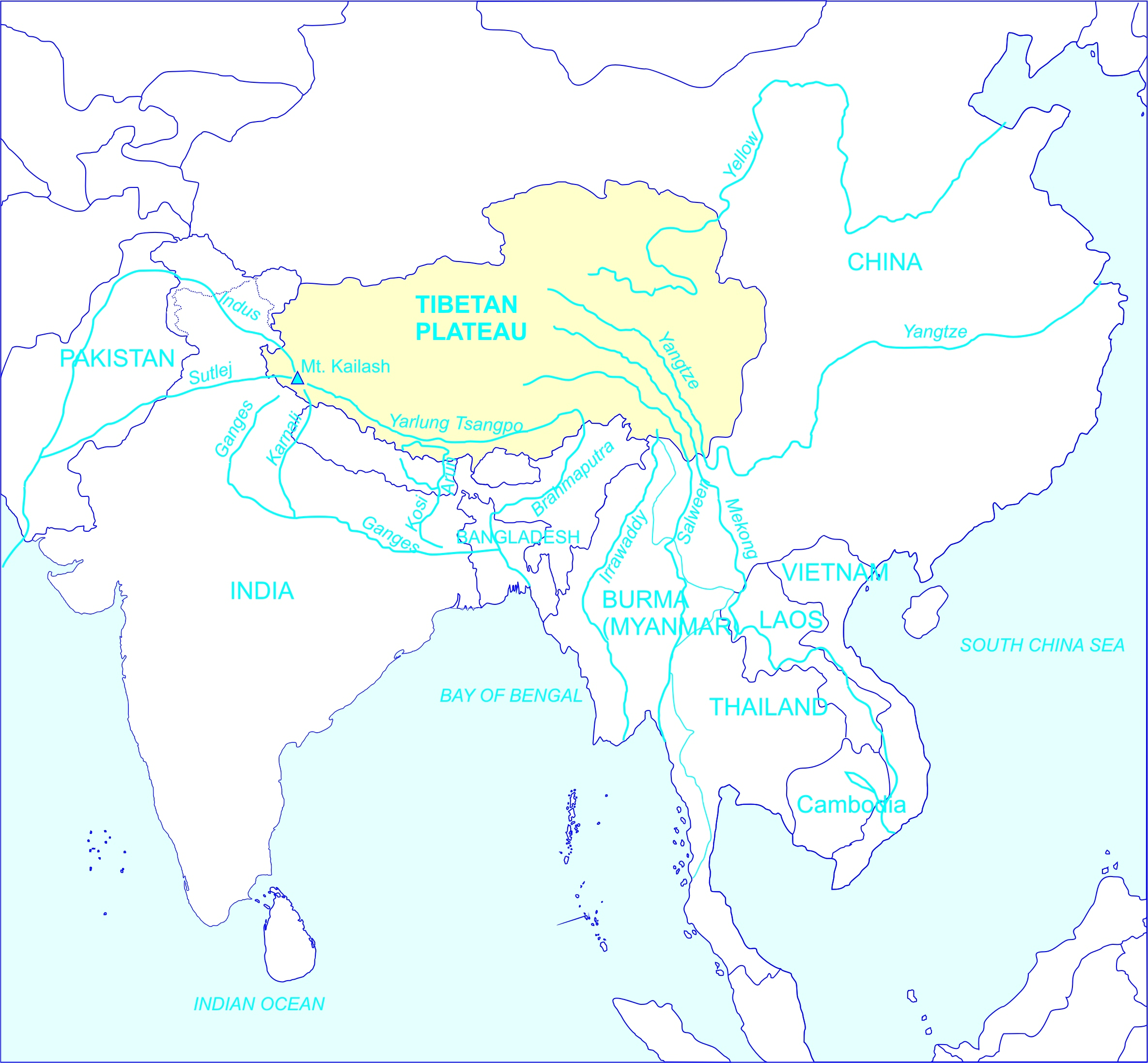
This snub is no surprise: China, the world’s most dammed nation, does not have a single river-collaborative or transparency mechanism with any of its 12 riparian neighbours. Unlike India — which has water-sharing treaties with both its downstream neighbours, Pakistan and Bangladesh, with each pact establishing a distinctively unique principle in international water law — China rejects the very concept of water sharing and is assertively seeking to make water a political weapon. Indeed, as if to proclaim itself as the world’s unrivalled hydro-hegemon, China recently unveiled 11 additional dam projects on the Salween, the Mekong, and the Brahmaputra.

As with territorial and maritime disputes, China is seeking to disrupt the status quo on international-river flows. Just as it has quietly encroached on disputed territory in the past to present a fait accompli — for example, Aksai Chin (1950s), Paracel Islands (1974), Johnson Reef (1988), Mischief Reef (1995), and Scarborough Shoal (2012) — China is seeking to manipulate cross-border river flows by pursuing dam projects furtively until they can no longer be kept hidden.

Although China is the source of transboundary river flows to countries ranging from Russia to Vietnam, no nation is more vulnerable to China’s reengineering of transboundary flows than India. The reason? India alone receives nearly half of all river waters that leave China. According to UN figures, a total of 718 billion cubic meters of surface water flows out of Chinese territory yearly, of which 48.33% runs directly into India.

For Chinese dam builders, the major Tibetan rivers flowing to India directly or via Nepal are a magnet for another striking reason: Their runoff volume totals 21.5% of the aggregate river flows within China, yet these rivers support just 1.6% of China’s population and sustain only 1.8% of its arable land, according to official Chinese statistics. The main beneficiary of their flows is rival India. When Beijing has shown little regard for the interests of China-friendly downriver states like Laos, Cambodia, Thailand and Kazakhstan, why would it be considerate toward India?

India should be under no illusion that diplomacy alone can deter China from significantly altering cross-border flows. In fact, at a time when China’s cartographic aggression and its efforts to nibble at Indian land through stealthy incursions persist, it seems intent on opening a major new front through hydrological aggression. There are warning signs of this.

China is damming not just the Brahmaputra, on which it has already completed several dams, but it has also built a dam each on the Indus and the Sutlej and unveiled plans to erect a cascade of large dams on the Arun (Kosi) river, which helps augment downstream Ganges flows and is thus critical to India’s ability to meet its treaty obligations vis-à-vis Bangladesh. The flashfloods that ravaged Himachal and Arunachal states between 2000 and 2005 were linked to the unannounced releases from rain-swollen Chinese dams and barrages.

The Brahmaputra is a huge attraction for China’s dam programme because this river’s cross-border annual discharge of 165.4 billion cubic meters is greater than the combined transboundary flows of three key rivers running from the Tibetan plateau to Southeast Asia — the Mekong, the Salween, and the Irrawaddy. As China gradually moves its dam building toward the Brahmaputra’s water-rich Great Bend area, it is likely to embark on Mekong-style mega-dams.

India faces difficult choices, largely because of its past mistakes, from which it has learned little. India’s unrestrained recognition of Chinese sovereignty over Tibet, coupled with Beijing’s rejection of any water-treaty arrangement, has left China with a legally unfettered foundation to control international-river flows. Just as India made the mistake in the 1950s of regurgitating empty Chinese assurances about the border, only to face first covert and then overt aggression, New Delhi has been gratuitously reciting Chinese assurances to safeguard downstream interests, even as Beijing acts unilaterally.

India is far more water-stressed than China. Yet India’s capacity to store water for dry-season release is one of the world’s lowest, ranking just above Ethiopia’s. China and even Pakistan have done a much better job on that score. The paradox is that Islamabad, despite securing the most generous water-sharing treaty in modern world history, has dragged India before international arbitral proceedings over a small Indian project, while India watches helplessly as China builds much larger dams and rejects what India does routinely with Pakistan — share project designs and permit on-site scrutiny.

India can counter China’s covert water war only by innovative means, including refocusing on the core issue of Tibet. A counter-strategy must be devised and implemented before China exploits its riparian pre-eminence to emerge as the master of the Indian heartland’s water taps.

The writer is a geostrategist.

(c) The Times of India, 2013.

Afghanistan’s partition might be unpreventable

An ethnic partition of Afghanistan appears the best of bad options

BY BRAHMA CHELLANEY

The National, March 1, 2013

AfghanistanAmerica’s unwinnable war in Afghanistan, after exacting a staggering cost in blood and treasure, is finally drawing to an official close. How this development shapes Afghanistan’s future will have a significant bearing on the security of countries located far beyond. After all, Afghanistan is not Vietnam: the end of U.S.-led combat operations may not end the war, because the enemy will seek to target Western interests wherever located.

Can the fate of Afghanistan be different from two other Muslim countries where the United States also intervened militarily — Iraq and Libya? Iraq has been partitioned in all but name into Shiite, Sunni and Kurdish sections, while Libya seems headed toward a similar three-way but tribal-based partition, underscoring that a foreign military intervention can effect regime change but not establish order. Will there be an Iraq-style “soft partition” of Afghanistan, with protracted strife eventually creating a “hard partition”?

Afghanistan’s large ethnic minorities already enjoy de facto autonomy, which they secured after their Northern Alliance played a central role in the U.S.-led ouster of the Afghan Taliban from power in late 2001. Having enjoyed autonomy for years now, the minorities will resist with all their might from coming under the sway of the ethnic Pashtuns, who ruled the country for long.

For their part, the Pashtuns, despite their tribal divisions, will not rest content with being in charge of just a rump Afghanistan made up of the eastern and southeastern provinces. Given the large Pashtun population resident across the British-drawn Durand Line that separates Afghanistan from Pakistan, they are likely sooner or later to revive their long-dormant campaign for a Greater Pashtunistan — a development that could affect the territorial integrity of another artificial modern construct, Pakistan.

The fact that the ethnic minorities are actually ethnic majorities in distinct geographical zones in the north and the west makes Afghanistan’s partitioning organically doable and more likely to last, unlike the colonial-era geographical line-drawing that created states with no national identity or historical roots. The ethnic minorities account for more than half of Afghanistan — both in land area and population size. The Tajik, Uzbek and Hazara communities alone make up close to 50 percent of Afghanistan’s population.

After waging the longest war in its history at a cost of tens of thousands of lives and nearly a trillion dollars, the U.S. is combat-weary and even financially strapped. The American effort for an honorable exit by cutting a deal with the Pakistan-backed Afghan Taliban, paradoxically, is deepening Afghanistan’s ethnic fissures and increasing the partitioning risk. With President Barack Obama choosing his second-term national security team and his 2014 deadline to end all combat operations approaching, the U.S. effort to strike a deal with the Taliban is back on the front burner.

This effort, being pursued in coordination with Afghan President Hamid Karzai amid an ongoing gradual withdrawal of U.S. and NATO troops, is stirring deep unease among the Afghan minorities, who fought the Taliban and its five-year rule fiercely and suffered greatly. The Taliban’s rule, for example, was marked by several large-scale massacres of members of the historically persecuted Hazara group.

The rupturing of Karzai’s political alliance with ethnic-minority leaders has also aided ethnic polarization. Some non-Pashtun power brokers remain with Karzai, but most others now lead the opposition National Front.

The minority communities are unlikely to accept any power-sharing arrangement that includes the Taliban. In fact, they suspect Karzai’s intention is to restore Pashtun dominance across Afghanistan. Karzai, however, does not belong to the mainstream Pashtun tribes, whose traditional homeland straddles the Durand Line; rather, like key Taliban leaders, he is from the tribally marginal Kandahar region.

The minorities’ misgivings have been strengthened by the “Peace Process Roadmap to 2015” put forward recently by the Karzai-constituted Afghan High Peace Council, empowered to negotiate with the Taliban. The document sketches several striking concessions to the Taliban and to Islamabad, ranging from the Taliban’s recognition as a political party to a role for Pakistan in Afghanistan’s affairs. The roadmap dangles the carrot of cabinet posts and provincial governorships to prominent Taliban figures.

The ethnic tensions and recriminations, which threaten to undermine cohesion in the fledgling, multiethnic Afghan Army, are breaking along the same lines as when the invading Soviet forces withdrew from Afghanistan in 1989, an exit that led to civil war and Taliban’s subsequent capture of Kabul. This time the minority communities are better armed and prepared to defend their interests after the U.S. exit.

In seeking to co-opt the Taliban, the U.S., besides bestowing legitimacy on that thuggish militia, risks unwittingly reigniting Afghanistan’s ethnic strife. A new civil war, however, would likely tear Afghanistan apart, Balkanizing the country into more distinct warlord-controlled zones than the situation prevailing today.

This raises a fundamental question: Is the territorial unity of Afghanistan essential for regional or international security? In other words, should the policies of outside powers seek to keep Afghanistan united?

First, the sanctity of existing borders has become a powerful norm in world politics. Border fixity is seen as essential for peace and stability. Yet this norm, paradoxically, has allowed the emergence of weak states, whose internal wars spill across international boundaries and create serious regional tensions and insecurity. In other words, a norm intended to build peace and stability may be creating conditions for conflict and regional instability. The survival of ungovernable and unmanageable states can be a serious threat to regional and international security.

Second, outside forces, in any event, are hardly in a position to prevent Afghanistan’s partitioning along Iraqi or Yugoslavian lines, with the bloodiest battles expected to rage over the control of ethnically mixed strategic areas, including the capital Kabul.

A weak, partitioned Afghanistan may not be the best or desirable outcome. Yet it will be far better than an Afghanistan that dissolves into chaos and bloodletting. And infinitely better than one in which the medieval Taliban returns to power and begins a fresh pogrom. Indeed, it may be the only way to thwart transnational terrorists from rebuilding a base of operations there and to prevent the country from sliding into a large-scale civil war. In this scenario — the best of the bad options — Pakistani generals, instead of continuing to sponsor Afghan Pashtun militant groups like the Taliban and the Haqqani network, will be compelled to fend off a potentially potent threat to Pakistan’s unity.

With American options in Afghanistan narrowing considerably and a deal with the Taliban appearing both uncertain and perilous, some sort of partition may also allow the U.S. to exit with honor intact.

Brahma Chellaney is the author of Asian Juggernaut (HarperCollins, 2010) and Water, Peace, and War (Rowman & Littlefield, forthcoming).

(c) The National, 2013.

China’s Hydro-Hegemony

China's grip

Map © Brahma Chellaney, “Water: Asia’s New Battleground” (Georgetown University Press)

By BRAHMA CHELLANEY

International Herald Tribune: February 8, 2013

ASIA is the world’s most water-stressed continent, a situation compounded by China’s hydro-supremacy in the region. Beijing’s recent decision to build a slew of giant new dams on rivers flowing to other countries is thus set to roil riparian relations.

China — which already boasts more large dams than the rest of the world put together and has unveiled a mammoth $635-billion fresh investment in water infrastructure over the next decade — has emerged as the key obstacle to building institutionalized collaboration on shared water resources in Asia.

In contrast to the bilateral water treaties between many of its neighbors, China rejects the concept of a water-sharing arrangement or joint, rules-based management of common resources.

For example, in rejecting the 1997 United Nations convention that lays down rules on shared water resources, Beijing placed on record its contention that an upstream power has the right to assert absolute territorial sovereignty over the waters on its side of the international boundary — or the right to divert as much water as it wishes for its needs, irrespective of the effects on a downriver state.

Today, by building megadams and reservoirs in its borderlands, China is working to re-engineer the flows of major rivers that are the lifeline of lower riparian states.

China is the source of transboundary river flows to the largest number of countries in the world — from Russia, Kazakhstan and Kyrgyzstan to the states in the Indochina peninsula and southern Asia. This pre-eminence resulted from its absorption of the ethnic-minority homelands that now make up 60 percent of its landmass and are the origin of all the international rivers flowing out of Chinese-held territory. No other country in the world comes close to the hydro-hegemony that China has established.

Since the last decade, China’s dam building has been moving from dam-saturated internal rivers to international rivers. Most of the new megaprojects designated recently by China’s state council as priority ventures are concentrated in the country’s seismically active southwest, which is largely populated by ethnic minorities. Such dam building is triggering new ethnic tensions over displacement and submergence.

The state council approved an array of new dams on the Salween, Brahmaputra and Mekong rivers, which originate on the Tibetan plateau and flow to southern and southeastern Asia. The unveiling of projects on the Brahmaputra evoked Indian diplomatic concern at a time when water has emerged as a new Chinese-Indian divide, while the Salween projects end the suspension of dam building on that river announced eight years ago.

The Salween — known in Chinese as Nu Jiang, or the “Angry River” — is Asia’s last largely free-flowing river, running through deep, spectacular gorges and glaciated peaks on its way to Burma and Thailand.

Its upstream basin is inhabited by at least a dozen different ethnic groups and rated as one of the world’s most biologically diverse regions, home to more than 5,000 plant species and nearly half of China’s animal species. No sooner had this stunning region, known as the Three Parallel Rivers, been added to the World Heritage List by Unesco in 2003 than Beijing unveiled plans for a cascade of dams near the area.

The international furor that followed led Prime Minister Wen Jiabao to suspend work. The reversal of that suspension, significantly, comes before Wen and President Hu Jintao step down as part of the country’s power transition.

The third international river cited by the state council in its new project approvals has already been a major target of Chinese dam building. Chinese engineers have constructed six megadams on the Mekong, including the 4,200-megawatt Xiaowan, and a greater water appropriator, the 5,850-megawatt Nuozhadu, whose first generator began producing electricity last September.

Asia needs institutionalized water cooperation because it awaits a future made hotter and drier by climate and environmental change and resource depletion. The continent’s water challenges have been exacerbated by growing consumption, unsustainable irrigation practices, rapid industrialization, pollution and geopolitical shifts.

Asia has morphed into the most likely flash point for water wars. Several countries are currently engaged in dam building on transnational rivers. The majority of these dams are being financed and built by Chinese state entities. Most Chinese-aided dam projects in Laos, Cambodia and Myanmar indeed are designed to pump electricity into China’s southern electricity grid, with the lower riparians bearing the environmental and social costs.

But it is China’s dam-building spree at home — reflected in the fact that it boasts half of the 50,000 large dams in the world — that carries the greatest international implications and obstructs the development of an Asian rules-based order.

China has made the control and manipulation of natural-river flows a fulcrum of its power and economic development. Although promoting multilateralism on the world stage, it has given the cold shoulder to multilateral cooperation among basin nations — as symbolized, for example, by the Mekong River Commission — and rebuffed efforts by states sharing its rivers to seek bilateral water-sharing arrangements.

Beijing already has significant financial, trade and political leverage over most of its neighbors. Now, by building an asymmetric control over cross-border flows, it is seeking to have its hand on Asia’s water tap.

Given China’s unique riparian position and role, it will not be possible to transform the Asian water competition into cooperation without Beijing playing a leadership role to develop a rules-based system.

Brahma Chellaney is the author of “Water: Asia’s New Battleground” and of the forthcoming book “Water, Peace, and War: Confronting the Global Water Crisis.”

(c) New York Times, 2013.