Abstract: Half a century after China and India fought a bloody Himalayan war, the two demographic titans have gained considerable economic heft and are drawing increasing international attention. Their rise highlights the ongoing shifts in global politics and economy. This growth has been accompanied by rising bilateral tensions, with Tibet remaining at the core of their divide and India’s growing strategic ties with the U.S. increasingly rankling China. Even as old rifts persist, new issues have started to emerge in the relationship, including China’s resurrected claim to the sprawling northeastern Indian state of Arunachal Pradesh, almost three times larger than Taiwan. Booming bilateral trade has failed to subdue their rivalry. Although in 1962 China set out, in the words of Premier Zhou Enlai, to “teach India a lesson,” the real lesson that can be drawn today is that the war failed to achieve any lasting political objectives and only embittered bilateral relations. China has frittered away the political gains it made by decisively defeating India on the battleground—the only war it has won under communist rule despite involvement in multiple military conflicts since 1950. In fact, as military tensions rise and border incidents increase, the China-India relationship risks coming full circle. World history attests that genuine efforts at political reconciliation and bridge building can achieve more than war. This essay argues that the future of the Asian economic renaissance and peace hinges on more harmonious relations between the important powers, especially China and India.
A fast-rising Asia has become pivotal in global geopolitical change. Asian policies and challenges now actively shape the international security and economic environments, while Asia’s rise serves as an instigator of global power shifts. Asia, paradoxically, bears the greatest impact of such power shifts. Consequently, the specter of a power imbalance looms large in Asia. At a time when it is politically in transition, Asia is also troubled by growing security challenges, apparent from the resurfacing of Cold War-era territorial and maritime disputes.
Against this background, the tense relationship between the world’s two most-populous countries holds significant implications for international security and Asian power dynamics. As China and India gain economic heft, they are drawing ever more international attention. However, their underlying strategic dissonance and rivalry over issues extending from land and water to geopolitical influence usually attract less notice.
The importance of this relationship in international relations can be seen from the fact that China and India make up nearly two-fifths of humanity. They represent markedly dissimilar cultures and competing models of development. However, they freed themselves from colonial powers and emerged as independent nations around the same time. Today, both seek to play a global role by reclaiming the power they enjoyed for many centuries before going into decline after the advent of the industrial revolution. In 1820, China and India alone made up nearly half of the world’s income, while Asia collectively accounted for 60 percent of the global GDP.[1]
Neither China nor India has ever in history been in a position to dominate the other, yet today each views the other as a geopolitical rival. Booming bilateral trade has failed to moderate their rivalry. In fact, as part of their broader geopolitical contest, China and India are becoming active in each other’s strategic backyard in a game of encirclement and counter-encirclement, thereby fostering tensions and mistrust. Borders incidents have markedly increased along the Himalayas in recent years, even as China has faced growing unrest in Tibet, a core underlying issue in Sino-Indian relations. New Delhi’s expanding strategic ties with the United States have actually encouraged China to try and strategically squeeze India. Yet Washington has refrained from taking sides in the Sino-Indian disputes.
Origins of the Indian-Chinese Disputes
The vast Tibetan plateau separated the Indian and Chinese civilizations throughout history, limiting their interaction to sporadic cultural and religious contacts, with political relations absent. It was only after Tibet’s 1950-1951 annexation that Han Chinese troops appeared for the first time on India’s Himalayan frontiers. Tibet’s forcible absorption began within months of the 1949 Communist victory in China. In one of his first actions after seizing power, Mao Zedong confided in Soviet dictator Joseph Stalin that Chinese forces were “preparing for an attack on Tibet.”[2] The Chinese military attack on Tibet began in October 1950, when global attention was focused on the Korean War. The rapid success in seizing eastern Tibet emboldened China to enter the Korean War soon thereafter.
As new neighbors following Tibet’s annexation, India and China began their relationship on what seemed a promising note. In fact, India was one of the first countries to recognize the legitimacy of communist China. Even when the Chinese military began eliminating India’s outer line of defense by occupying Tibet, Indian Prime Minister Jawaharlal Nehru continued to court China, seeing it as a benign neighbor that had emerged from the ravages of colonialism like India. Consequently, New Delhi rebuffed then-independent Tibet’s appeal for international help against Chinese aggression, and even opposed its plea for a discussion in the United Nations General Assembly in November 1950.
By 1954, Nehru surrendered India’s British-inherited extraterritorial rights in Tibet and recognized the “Tibet region of China” without any quid pro quo — not even Beijing’s acceptance of the then-prevailing Indo-Tibetan border. He did this by signing a pact with Tibet’s occupying power that was mockingly named after the Tibetan Buddhist doctrine of Panchsheela, or the five principles of peaceful coexistence.[3] This treaty was designed to govern India’s relationship with the “Tibet Region of China” — an implicit, if not overt, recognition of China’s annexation of Tibet a few years earlier.
The pact recorded India’s agreement to both fully withdraw within six months its “military escorts now stationed at Yatung and Gyantse” in the “Tibet Region of China” as well as “to hand over to the Government of China at a reasonable price the postal, telegraph and public telephone services together with their equipment operated by the Government of India in Tibet Region of China.”[4] Up to its 1950 invasion, China had maintained a diplomatic mission in Lhasa, as did India, underscoring Tibet’s independent status.
Nehru’s intense courtship of Beijing was such that he rejected a U.S. suggestion in the 1950s for India to take China’s place in the United Nations Security Council. The officially blessed selected works of Nehru quote him as stating the following on record: “Informally, suggestions have been made by the U.S. that China should be taken into the UN but not in the Security Council and that India should take her place in the Council. We cannot, of course, accept this as it means falling out with China and it would be very unfair for a great country like China not to be in the Council.”[5] The selected works also quote Nehru as telling Soviet Premier Marshal Nikolai A. Bulganin in 1955 on the same U.S. offer: “I feel that we should first concentrate on getting China admitted.”[6]
Yet when China sprung a nasty surprise by invading India in 1962, Nehru publicly bemoaned that China had “returned evil for good.”[7] A more realistic leader would have foreseen that war and taken necessary steps to repulse the invasion. After all, using the 1954 friendship treaty as a cover, China had started furtively encroaching on Indian territories, incrementally extending its control to much of the Aksai Chin, a Switzerland-size plateau that was part of the original princely state of Jammu and Kashmir. Sino-Indian relations, in fact, became tense after the Dalai Lama fled across the Himalayas to India in 1959, with Beijing using its state media to mount vicious attacks on India. Nehru, however, still believed that China would not stage military aggression against India. The Indian army remained undermanned and ill-equipped.
Just as Mao had started his invasion of Tibet while the world was occupied with the Korean War, he chose a perfect time for invading India, in the style recommended by the ancient treatise, The Art of War, written by Sun Tzu — a general believed to have lived in the sixth century B.C. and said to be a contemporary of great Chinese philosopher Confucius. The launch of the attack, spread over two separate rounds, coincided with a major international crisis that brought the U.S. and the Soviet Union within a whisker of nuclear war over the stealthy deployment of Soviet missiles in Cuba. A little over a month after launching the invasion of India, Mao announced a unilateral ceasefire that, significantly, coincided with America’s formal termination of Cuba’s quarantine. Mao’s premier, Zhou Enlai, publicly said that the 42-day war was intended “to teach India a lesson.”[8] India suffered a humiliating rout — a defeat that hastened Nehru’s death, but set in motion India’s military modernization and political rise.
Fifty years after that war, tensions between India and China are rising again amid an intense geopolitical rivalry. Their entire 4,057-kilometer-long border — one of the longest in the world — remains in dispute, without a clearly defined line of control in the Himalayas separating the rival armies. This situation has persisted despite regular talks since 1981 to settle their territorial disputes. In fact, these talks constitute the longest and most-futile negotiating process between any two nations in modern world history. During a 2010 New Delhi visit, Premier Wen Jiabao bluntly stated that sorting out the Himalayan border disputes “will take a fairly long period of time.”[9] If so, what does China (or India) gain by carrying on the border negotiations?
As old rifts fester, new political, military, and trade issues have started roiling relations. For example, since 2006 China has publicly raked up an issue that had remained dormant since the 1962 war — Arunachal Pradesh, a resource-rich state in India’s northeast that China claims largely as its own on the basis of the territory’s putative historical ties with Tibet. In fact, the Chinese practice of describing the Austria-size Arunachal Pradesh as “Southern Tibet” started only in 2006. A perceptible hardening of China’s stance toward India since then is also manifest from other developments, including Chinese strategic projects and military presence in the Pakistani-held portion of Kashmir. Kashmir is where the disputed borders of India, Pakistan, and China converge.
Indian defense officials have reported that Chinese troops, taking advantage of the disputed border, have in recent years stepped up military intrusions. In response, India has been beefing up its military deployments in Arunachal Pradesh, Sikkim state, and northern Ladakh region to prevent any Chinese land-grab. It has also launched a crash program to improve its logistical capabilities through new roads, airstrips, and advanced landing stations along the Himalayas.
China’s strategic projects around India are sharpening the geopolitical competition, including new ports in Sri Lanka and Pakistan, new transportation links with Myanmar, Nepal, and Pakistan, and China’s own major upgrades to military infrastructure in Tibet. American academic John Garver describes the Chinese strategy in these words: “A Chinese fable tells of how a frog in a pot of lukewarm water feels quite comfortable and safe. He does not notice as the water temperature slowly rises until, at last, the frog dies and is thoroughly cooked. This homily, wen shui zhu qingwa in Chinese, describes fairly well China’s strategy for growing its influence in South Asia in the face of a deeply suspicious India: move forward slowly and carefully, rouse minimal suspicion, and don’t cause an attempt at escape by the intended victim.”[10]
One apparent Chinese objective is to chip away at India’s maritime dominance in the Indian Ocean — a theater critical to fashioning China’s preeminence in Asia. China’s strategy also seeks to leverage its strengthening nexus with Pakistan to keep India under strategic pressure. Indeed, given China’s control of one-fifth of the original princely state of Jammu and Kashmir and its new military footprint in Pakistani-held Kashmir, India now faces Chinese troops on both flanks of its portion of Kashmir. Moreover, by building new railroads, airports, and highways in Tibet, China is now in a position to rapidly move additional forces to the border to potentially strike at India at a time of its choosing.
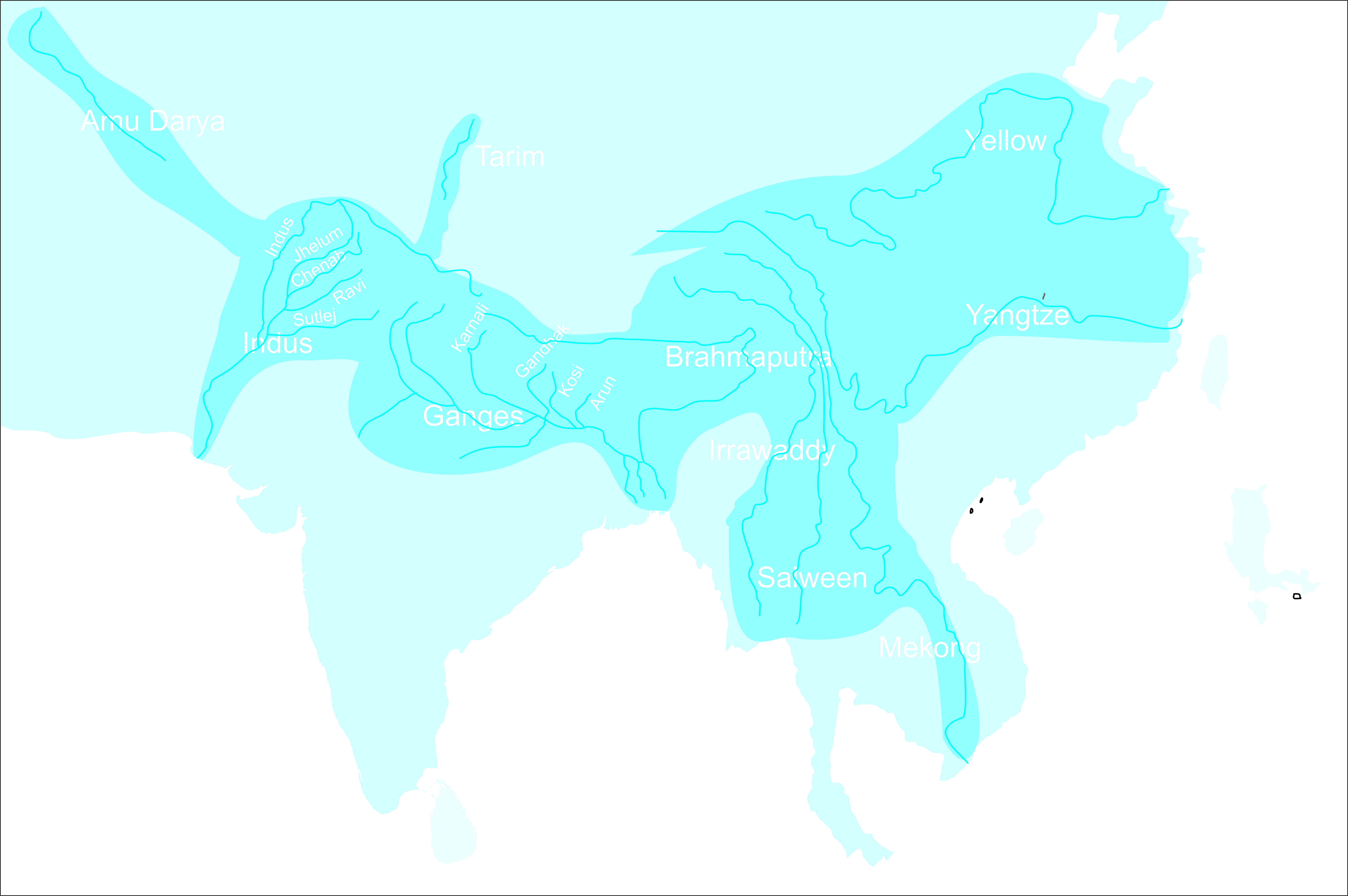
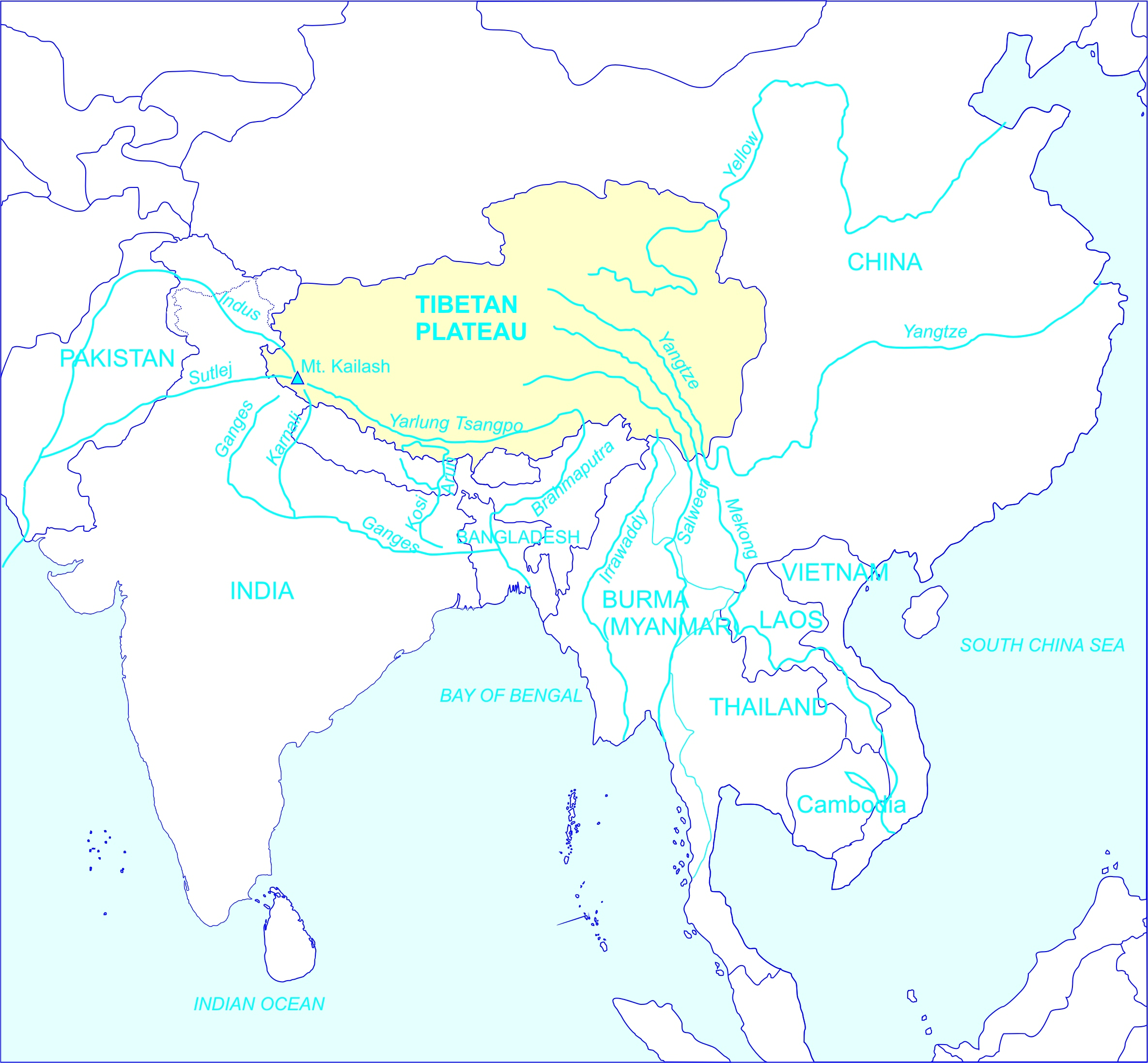
As the aforementioned territorial and maritime issues fester, water is becoming a new source of discord between the two water-stressed countries. India has more arable land than China but much less water. Compounding the situation for a parched India is the fact that most of the important rivers of its northern heartland originate in Chinese-controlled Tibet. The Tibetan plateau’s vast glaciers, huge underground springs, and high altitude make it the world’s largest freshwater repository after the polar icecaps. Although a number of nations stretching from Afghanistan to Vietnam receive waters from the Tibetan plateau, India’s direct dependency on Tibetan waters is greater than that of any other country. With about a dozen important rivers flowing in from the Tibetan Himalayan region, India gets almost one-third of all its yearly water supplies of 1,911 billion cubic meters from Tibet, according to United Nations data.[11]
China is now pursuing major inter-basin and inter-river water transfer projects on the Tibetan plateau. These projects threaten to diminish international-river flows into India and China’s other co-riparian states. Whereas India has signed water-sharing treaties with both the counties located downstream to it — Bangladesh and Pakistan — China rejects the very concept of water sharing. It does not have a single water-sharing treaty with any neighbor, although it is the source of river flows to multiple countries, including Russia, Kazakhstan, Nepal, and Myanmar. One environmentally and politically dangerous idea China is toying with is the construction of a dam of unparalleled size on the Brahmaputra River, known as Yarlung Tsangpo to Tibetans. The proposed 38,000-megawatt dam — almost twice as large as the Three Gorges Dam — is to be located at Metog, just before the Brahmaputra enters India, according to the state-run HydroChina Corporation.[12] In fact, an officially blessed book, Tibet’s Waters Will Save China, has championed the northward rerouting of the Brahmaputra.[13]
With water shortages growing in its northern plains, owing to environmentally unsustainable intensive irrigation and heavy industrialization, China has increasingly turned its attention to the abundant water reserves that Tibet holds. China’s hydroengineering projects and territorial disputes with India serve as a reminder that Tibet is at the heart of the Sino-Indian divide. Tibet ceased to be a political buffer when China annexed it more than six decades ago. But unless Tibet becomes a political bridge, there can be no enduring peace — a fact also underscored by the growing Tibetan unrest and self-immolations on the Tibetan plateau.
An Uneasy Triangle: China, India, United States
The India-China relationship has entered choppy waters. The more muscular Chinese stance toward New Delhi — highlighted by the anti-India rhetoric in the state-run Chinese media — is clearly tied to the new U.S.-India strategic partnership, symbolized by the nuclear deal and the deepening military cooperation. As U.S. President George W. Bush declared in his valedictory speech, “We opened a new historic and strategic partnership with India.” But will Washington take New Delhi’s side in any of its disputes with Beijing?
The fundamental U.S. strategic objective in Asia has remained the same since 1898 when America took the Philippines as spoils of the naval war with Spain — to establish a stable balance of power in order to prevent the rise of any hegemonic power. Yet the United States, according to its official National Security Strategy, is also committed to accommodating “the emergence of a China that is peaceful and prosperous and that cooperates with us to address common challenges and mutual interests.”[14] Thus, America’s Asia policy has in some ways been at war with itself.
In fact, the United States has played a key role in China’s rise. One example was the U.S. decision to turn away from trade sanctions against Beijing after the 1989 Tiananmen Square massacre and instead integrate that country with global institutions — a major decision that allowed China to rise. By contrast, the opposite policy approach was pursued against Myanmar after it similarly crushed pro-democracy protests in 1988 — escalating U.S.-led sanctions, which are only now beginning to be relaxed after 24 years. China’s spectacular economic success — illustrated by its emergence with the world’s biggest trade surplus and largest foreign-currency reserves — actually owes much to the continuation of supportive U.S. polices since the 1970s. Without the significant expansion in U.S.-Chinese trade and financial relations since then, China’s growth would have been much slower and harder.
U.S. economic interests now are so closely intertwined with China that they virtually preclude a policy that seeks to either isolate or confront Beijing. Even on the democracy issue, the United States prefers to lecture some other dictatorships rather than the world’s largest and oldest-surviving autocracy. Yet it is also true that the United States views with unease China’s not-too-hidden aim to dominate Asia — an objective that runs counter to U.S. security and commercial interests and to the larger U.S. goal for a balance in power in Asia. To help avert such dominance, America has already started building countervailing influences and partnerships, without making any attempt to contain China. Where its interests converge with China, the United States will continue to work closely with it.
In this light, China’s more aggressive stance poses a difficult challenge for India. Until mid-2005, China was eschewing anti-India rhetoric and pursuing a policy of active engagement with India, even as it continued to expand its strategic space in southern Asia, to New Delhi’s detriment. In fact, when Premier Wen Jiabao visited India in April 2005, the two countries unveiled an important agreement identifying six broad principles to govern a border settlement. But after the unveiling of the Indo-U.S. defense framework accord and nuclear deal separately in mid-2005, the mood in Beijing perceptibly changed. This gave rise to a pattern that has become commonplace since: Chinese newspapers, individual bloggers, security think-tanks, and even officially blessed websites ratcheting up an “India threat” scenario. Indeed, the present pattern of border provocations, new force deployments, and mutual recriminations is redolent of the situation that prevailed in the run-up to the 1962 war.
A U.S.-India military alliance has always been a strategic nightmare for the Chinese, and the ballyhooed Indo-U.S. global strategic partnership, although it falls short of a formal military alliance, triggered alarm bells in Beijing. That raises the question whether New Delhi helped create the context, however inadvertently, for the new Chinese assertiveness by agreeing to participate in U.S.-led “multinational operations,” share intelligence, and build military-to-military interoperability (key elements of the defense framework accord) and to become America’s partner on a new “global democracy initiative” — a commitment found in the nuclear deal.[15] While Beijing cannot hold a veto over New Delhi’s diplomatic or strategic initiatives, could not India have avoided creating an impression that it was potentially being primed as a new junior partner (or spoke) in America’s hub-and-spoke global alliance system?
India — with its hallowed traditions of policy independence — is an unlikely candidate to be a U.S. ally in a patron-client framework. But the high-pitched Indian and American rhetoric that the new partnership represented a tectonic shift in geopolitical alignments apparently made Chinese policymakers believe that India was being groomed as a new Japan or Australia to the United States — a perception reinforced by subsequent security arrangements and multibillion-dollar defense transactions. In the decade since President Bush launched the U.S.-Indian strategic partnership, India has fundamentally reoriented its defense procurement, moving away from its traditional reliance on Russia. Indeed, nearly half of all Indian defense deals by value in recent years have been bagged by the United States alone, with Israel a distant second and Russia relegated to the third slot.
New Delhi failed to foresee that its rush to forge close strategic bonds with Washington could provoke greater Chinese pressure and that, in such a situation, the United States would offer little comfort to India. Even as Beijing calculatedly has sought to badger India on multiple fronts, President Barack Obama’s administration — far from coming to India’s support — has shied away from even cautioning Beijing against any attempt to forcibly change the existing territorial status quo. Indeed, on a host of issues — from the Dalai Lama to the Arunachal Pradesh issue — Washington has chosen not to antagonize Beijing. That, in effect, has left India on its own.
President Obama had stroked India’s collective ego by inviting Indian Prime Minister Manmohan Singh for his presidency’s first state dinner, leading to the joke that while China gets a deferential America and Pakistan secures billions of dollars in U.S. aid periodically, India is easily won over with a sumptuous dinner and nice compliments. The mutual optimism and excitement that characterized the warming U.S.-Indian ties during the Bush years, admittedly, has given way to more realistic assessments as the relationship has matured. Geostrategic and economic forces, however, continue to drive the two countries closer. Indeed, to lend strategic heft to the Obama-declared U.S. “pivot” toward Asia, closer U.S. strategic collaboration with India has become critical.
While the geostrategic direction of the U.S.-India relationship is irreversibly set toward closer collaboration, such cooperation is unlikely to be at the expense of Washington’s fast-growing ties with Beijing. The United States needs Chinese capital inflows as much as China needs American consumers — an economic interdependence of such import that snapping it would amount to mutually assured destruction (MAD). Even politically, China, with its veto power in the United Nations and international leverage, counts for more in U.S. policy than India. Against this background, it is no surprise that Washington intends to abjure elements in its ties with New Delhi that could rile China, including, for example, holding any joint military drill in Arunachal Pradesh. In fact, Washington has quietly charted a course of tacit neutrality on the Arunachal Pradesh issue.
Yet the present muscular Chinese approach, paradoxically, reinforces the very line of Indian thinking that engendered greater Chinese assertiveness — that India has little option other than to align itself with the United States. Such thinking blithely ignores the limitations of the Indo-U.S. partnership arising from the vicissitudes and compulsions of U.S. policy. Washington is showing through its growing strategic cooperation with India’s regional adversaries, China and Pakistan, that it does not believe in exclusive strategic partnership in any region. Left to fend for itself, New Delhi has decided to steer clear of a direct confrontation with Beijing. Discretion, after all, is the better part of valor.
Concluding Observations
The strategic rivalry between the world’s largest autocracy and democracy has sharpened despite their fast-rising bilateral trade. Between 2000 and 2010, bilateral trade rose 20-fold, making it the only area where relations have thrived. Far from helping to turn the page on old disputes, this commerce has been accompanied by greater Sino-Indian geopolitical rivalry and military tensions. This shows that booming trade is no guarantee of moderation or restraint between countries. Unless estranged neighbors fix their political relations, economics alone will not be enough to create goodwill or stabilize their relationship.
How the India-China relationship evolves will have an important bearing on Asian and wider international security. China seems to be signaling that its real, long-term rivalry is not so much with America as with India. It clearly looks at India as a potential peer rival. India’s great-power ambitions depend on how it is able to manage the rise of China — both independently and in partnership with other powers. A stable, mutually beneficial equation with China is more likely to be realized by India if there is no serious trans-Himalayan military imbalance.
The larger Asian balance of power will be shaped by developments not only in East Asia but also in the Indian Ocean — a crucial international passageway for oil deliveries and other trade. Nontraditional security issues in the Indian Ocean region — from energy security and climate security to transnational terrorism and environmental degradation — have become as important as traditional security issues, like freedom of navigation, security of sea lanes, maritime security, proliferation of weapons of mass destruction, and ocean piracy. The Indian Ocean region indeed is becoming a new global center of trade and energy flows and geopolitics. If China were to gain the upper hand in the Indian Ocean region at India’s expense, it will mark the end of India’s world-power ambitions.
The United States can play a key role in stabilizing the India-China equation, including through U.S.-China-India trilateral dialogue and initiatives for stability and security in the vast Indian Ocean region. If Tibet is to serve as a political bridge between China and India, its strategic significance must be clearly recognized in policy. It is past time to stop treating Tibet as a moral issue and instead elevate it as a strategic issue that impinges on Asian and international security.
Brahma Chellaney is a professor of strategic studies at the independent Center for Policy Research in New Delhi; a fellow of the Nobel Institute in Oslo; and an affiliate with the International Centre for the Study of Radicalization at King’s College London.
Notes
[1]Angus Maddison, The World Economy: A Millennial Perspective (Paris: Organization for Economic Cooperation and Development, 2001); and Haruhiko Kuroda, president, Asian Development Bank, “The Financial Crisis and Its Impact on Asia,” speech to a Conference in Montreal, June 9, 2008.
[2]Jung Chang and Jon Halliday, Mao: The Unknown Story (London: Jonathan Cape, 2005).
[3]What is popularly known as the Panchsheel Treaty is the Agreement between the Republic of India and the People’s Republic of China on Trade and Intercourse between Tibet Region of China and India, signed on April 29, 1954, in Beijing; ratified August 17, 1954.
[4]Item Nos. 1 and 2 in the “Notes Exchanged” concurrently with the 1954 “Agreement between the Republic of India and the People’s Republic of China on Trade and Intercourse between Tibet Region of China and India.” Fot full text, see Brahma Chellaney, Asian Juggernaut (New York: Harper Paperbacks, 2010), appendixes.
[5]H.Y. Sharada Prasad, A.K. Damodaran and Sarvepalli Gopal (eds.), Selected Works of Jawaharlal Nehru, Second Series, Vol. 29, 1 June–31 August 1955 (New Delhi: Oxford University Press, 2005), p. 231.
[7]Address to the Nation on All India Radio, October 22, 1962, in Jawaharlal Nehru’s Speeches, September 1957–April 1963, vol. 4 (New Delhi: Ministry of Information and Broadcasting, 1964), pp. 226–30.
[8]Zhou Enlai’s 1962 comment cited, among others, in Asad-ul Iqbal Latif, Three Sides in Search of a Triangle: Singapore-America-India Relations (Singapore: ISEAS Publishing, 2009), p. 117; and Chellaney, Asian Juggernaut, p. 165.
[10]John W. Garver, “The Diplomacy of a Rising China in South Asia,” Orbis (Summer 2012), p. 392.
[13]Li Ling, Xizang Zhi Shui Jiu Zhongguo: Da Xi Xian Zai Zao Zhongguo Zhan Lue Nei Mu Xiang Lu (Tibet’s Waters Will Save China), in Mandarin (Beijing: Zhongguo Chang’an chu ban she, November 2005), book sponsored by the Ministry of Water Resources.
[14]The White House, The National Security Strategy of the United States of America (Washington, DC: White House, March 2006), p. 41.
[15]Nuclear deal: Joint Statement between President George W. Bush and Prime Minister Manmohan Singh, Washington, DC, July 18, 2005, http://usinfo.state.gov/sa/Archive/2005/Jul/18-624598.html; and defense framework agreement: “New Framework for the U.S.-India Defense Relationship,” Agreement signed in Arlington, Virginia, on June 28, 2005, http://www.indianembassy.org/press_release/2005/June/31.htm.
(c) The Johns Hopkins University Press.


 Of all the natural resources on which the world depends, the supply and demand situation is most critical for water. There are replacements for oil, but no substitute for water, which is essential to produce virtually all the goods in the marketplace.
 Park Geun-hye broke through South Korea’s glass ceiling to win the presidency. But having overcome the gender barrier, she now faces important domestic and foreign-policy challenges. How she handles those challenges, including slowing economic growth and sharpening geopolitical competition in Northeast Asia, will determine if South Korea’s international clout will continue to rise.
 East Asia’s political transitions threaten to exacerbate regional challenges, which include the need to institute a stable balance of power and dispense with historical baggage that weighs on interstate relationships. Booming trade has failed to moderate territorial and historical disputes, highlighting that economic interdependence by itself cannot deliver regional stability unless rival states undertake genuine efforts to mend their political relations.
 Words like “brutal,” “heinous” and “savage” aptly describe the way a Pakistani army unit raided Indian territory and chopped two soldiers, taking away one severed head as a “trophy.” The Indian outrage, however, must not blind us to the unpalatable truth: India is reaping what it sowed. New Delhi is staring at the bitter harvest of a decade-long policy seeking to appease a recalcitrant neighbour with unilateral concessions and gestures.
 These political transitions could compound East Asia’s challenges, which include the need to institute a regional balance of power and dispense with historical baggage that weighs down interstate relationships, particularly among China, Japan, and South Korea. Booming trade in the region has failed to mute or moderate territorial and other disputes; on the contrary, it has only sharpened regional geopolitics and unleashed high-stakes brinkmanship. Economic interdependence cannot deliver regional stability unless rival states undertake genuine efforts to mend their political relations.


You must be logged in to post a comment.