PLA aborts Modi’s China reset

Brahma Chellaney, Mint, October 7, 2014

Despite China finally withdrawing its troops from Ladakh’s Chumar area after extracting a concession from India to demolish a key observation post, the tense standoff on the frigid heights of western Himalayas will be remembered as the symbol of Prime Minister Narendra Modi’s abortive effort to reset India’s relationship with Beijing. After assuming office, Modi went out of his way to befriend China, making a series of overtures.

Modi received the Chinese foreign minister before welcoming any other foreign dignitary. His first bilateral meeting with an important head of state was with President Xi Jinping at the BRICS summit in Brazil. Indeed, Modi postponed his own Japan trip so that he met Xi first in Brazil. Furthermore, Xi was given the honour of being the first G-8 head of state to visit India. Not only that, Modi became the first prime minister to receive a foreign leader outside New Delhi — that too on his own birthday.

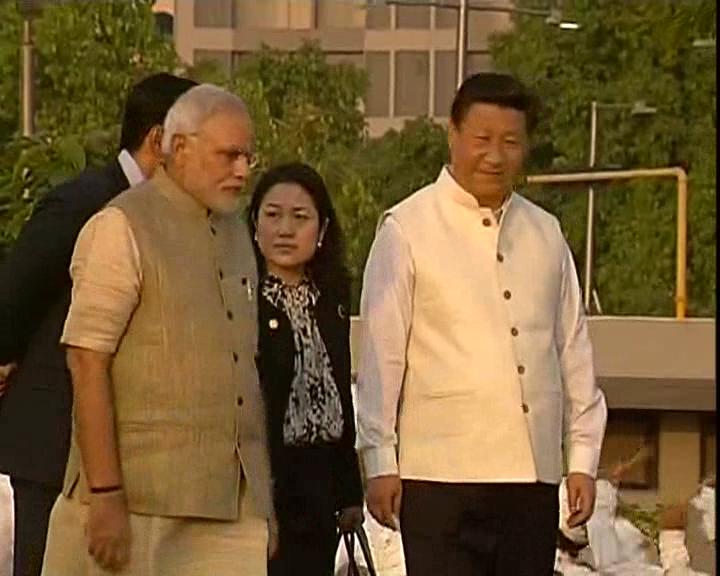
ximodisabarmati4So when Xi, wearing a Nehru jacket, toasted the birthday of his host at a private dinner on the bank of River Sabarmati in Gujarat, it highlighted Modi’s charm offensive to build a more cooperative relationship with a country that poses the main strategic challenge to India. Such was Modi’s courtship that Xi quoted him as saying “India and China are two bodies in one spirit”.

But the diplomatic love-fest quickly turned into diplomatic discomfiture as news trickled in that hundreds of Chinese soldiers had intruded into Chumar. While Modi was publicly espousing “inch toward miles” as the motto of India-China cooperation, the People’s Liberation Army (PLA) was implementing that call through a fresh action on the ground. Even more galling was the fact that this incursion — the worst in troop numbers in many years — came to epitomize Xi’s birthday gift for Modi.

China has used virtually every high-level visit to flex its muscles while talking peace. For example, China conducted its most-powerful nuclear test ever in 1992 during the first-ever state visit of an Indian president. In 2003, when Atal Bihari Vajpayee was surrendering India’s Tibet card in Beijing at the altar of diplomatic expediency, a PLA patrol intruded 14 kilometres into Arunachal Pradesh and abducted a 10-member Indian security team.

When Chinese leaders have visited India, their trips have been preceded by or coincided with territorial provocations. It was just before President Hu Jintao’s 2006 visit that China began claiming Arunachal Pradesh as “South Tibet”. Likewise, prior to Premier Wen Jiabao’s 2010 trip, Beijing began questioning India’s sovereignty over Jammu and Kashmir, one-fifth of which China occupies. And Premier Li Keqiang’s 2013 visit followed a deep PLA encroachment into Ladakh’s Depsang plateau.

The message that China seeks to deliver through such provocations is that if India does not behave, it seriously risks being taught a 1962-style lesson. Indeed, just as it deceptively accused an ill-prepared India in 1962 of having provoked the Chinese trans-Himalayan invasion, China has used its official media and think-tanks to charge India with intentionally ramping up border tensions during Xi’s visit to exert pressure on China.

Modi thought he could co-opt China as a partner in India’s development and help ease the territorial disputes. But in Chinese strategy, political and economic elements are closely integrated, with hard and soft tactics going hand-in-hand. This was demonstrated by China rattling its sabres while its president was paying a state visit to India.

Even without considering Xi’s “birthday gift” for Modi, his visit was underwhelming in substance. Xi’s $20-billion investment promise is like honey presented on a sharp knife: partaking it will cut India’s interests, including by giving China greater leeway to dump more goods in the Indian market and rake in larger profits. China’s exports to India already are almost 3½ times greater in value than its imports. Yet China’s total investment in India is a trifling $500 million, or only slightly over 1% of its yearly trade surplus with it at present.

Had the trade surplus been in India’s favour on this scale, imagine the kind of pressures China would have brought to bear. Indeed, China has a record of using trade as a political weapon, including against Japan, the Philippines and South Korea. India, by hinging China’s market access on progress in resolving political, territorial and water disputes, can prevent Beijing from fortifying its leverage.

The good news is that Modi is standing up to the pressure from an unyielding and revanchist China, signalling that India will no longer put up with incursions, which escalated significantly over the past seven years under his meek predecessor even as he stayed mum. Modi was so jolted by Xi’s “birthday gift” (the intruding Chinese force numbered 1,000 or more at its peak) that he forthrightly called border peace “an essential foundation” for India-China ties, saying it won’t be possible for the two countries to collaborate meaningfully without peace. Modi knows that China has exposed itself by opening fronts with several neighbours.

The PLA’s growing political clout emboldens its strategy of incremental encroachment through furtive nibbling. The only counter to its aggressive deterrence is offensive defence. But India still clings to defensive defence, deploying border police as its first line of defence against regular PLA troops. The result is that India continues to get blindsided by repeated incursions. It is time for India to reappraise its Himalayan defences, or else its posture of defensive defence will continue to spring nasty surprises.

Brahma Chellaney is professor of strategic studies at the Centre for Policy Research in New Delhi.

© Mint, 2014.

India’s China problem

Brahma Chellaney, The World Post/The Huffington Post

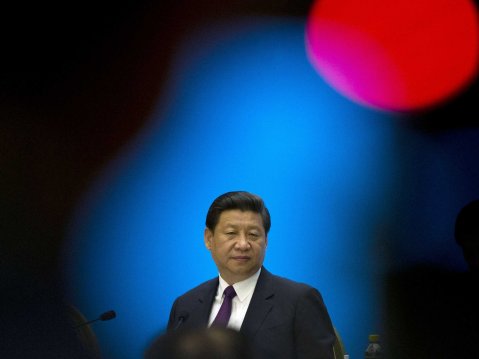
xi-jinping-14Indian Prime Minister Narendra Modi, who swept to power in May with a thumping electoral mandate, faces a major test in diplomacy in the form of bilateral summits this month with three powers central to Indian foreign policy — Japan, China, and the United States. Modi met with Japanese Prime Minister Shinzo Abe in Tokyo on September 1, and will now receive Chinese President Xi Jinping in New Delhi. He will then visit the White House at the end of the month.

China poses the toughest challenge for Modi, although the Indian leader had a good meeting with Xi on the sidelines of the recent summit of BRICS, a grouping of major emerging economies. Their body language at the summit in Brazil indicated the two had formed an easy personal equation.

After assuming office, Modi was quick to reach out to China, negating the assumption of some analysts that his government would be less accommodating toward Beijing than its predecessor. Modi views China, with its massive foreign-exchange reserves, as a potential partner in India’s development. Yet, at a time when the China-India trade relationship is already lopsided, with Beijing exporting three times as much as it imports and treating India as a raw-material appendage of its economy like Africa, Modi must find ways to address this glaring asymmetry while seeking to make a cash-rich China an important partner in India’s developmental priorities.

Another challenge for Modi is to balance such deeper economic engagement with India’s strategic imperatives, including bolstering defenses against China and containing increasing Chinese border provocations. According to figures released by Minister of State for Home Affairs Kiren Rijiju in India’s Parliament recently, Chinese border transgressions this year have exceeded more than one per day, totaling 334 up to August 4.

The often tense relationship between the world’s two most-populous countries holds significant implications for international security and Asian power dynamics. As China and India gain economic heft, they are drawing ever more international attention. However, their underlying strategic dissonance and rivalry over issues extending from land and water to geopolitical influence usually attracts less notice.

The vast Tibetan plateau separated the Indian and Chinese civilizations throughout history, limiting their interaction to sporadic cultural and religious contacts, with political relations absent. It was only after Tibet’s annexation in the early 1950s that Han Chinese military units appeared for the first time on India’s Himalayan frontiers. This was followed by a bloody Himalayan war in 1962.

More than half a century later, their old rifts persist even as new issues have started roiling their relationship, including Beijing’s resurrected claim since 2006 to the sprawling northeastern Indian state of Arunachal Pradesh, almost three times larger than Taiwan. A perceptible hardening of China’s stance toward India is also manifest from other developments, including Chinese strategic projects and military presence in the Pakistan-held portion of Kashmir.

Between 2000 and 2010, China-India trade rose 20-fold, making it the only area where relations have thrived. Yet the booming trade has failed to subdue their rivalry.

At the root of the current Himalayan tensions are China’s persistent efforts to alter the territorial status quo. To be sure, India is not China’s only target: The People’s Liberation Army (PLA) is seeking to also disturb the territorial status quo with several other neighboring countries, including Japan, the Philippines, and Vietnam.

Instead of invading, the PLA has chosen to engage in a steady progression of steps to outwit opponents and create new facts on the ground, whether in the South China Sea or the Indian Himalayas. In this way, it has sought to change the status quo without inviting outright conflict with neighboring countries. While China’s navy and a part of its air force focus on supporting revanchist territorial and maritime claims in the South and East China seas, its army has been active in the mountainous borderlands with India.

To prevent the PLA from further nibbling at its territories, India has been beefing up its military deployments in the two sensitive regions located on the opposite ends of the Himalayas — Ladakh and Arunachal Pradesh. It has also launched a crash program to improve its logistical capabilities through new roads, airstrips, and advanced landing stations along the Himalayas.

More importantly, India is raising a new mountain strike corps to arm itself with quick-reaction ground offensive capabilities against China. This new XVII Corps, with more than 90,000 troops, will cost $10.7 billion and be fully operational within five years. India has already deployed ballistic missile squadrons, spy drones, and Russian-built Sukhoi-30MKI fighterjets in the eastern theater against China.

Still, with the inhospitable Himalayan border difficult to patrol effectively, incursions by PLA troops have increased across the “line of actual control” (LAC) that China itself unilaterally drew when it defeated India in the 1962 Chinese-initiated war. Because the LAC has not been mutually clarified — China reneged on a 2001 promise to exchange maps with India — Beijing disputes each intrusion, claiming its troops are merely on “Chinese land.” To be sure, when challenged by Indian border police, the intruding troops tend to retreat from most points. But the rising pattern of incursions ties down large numbers of Indian border police and army troops along the Himalayas.

Despite China’s belligerence, Modi has gone out of his way to befriend Xi’s government. As prime minister, he received the Chinese foreign minister before welcoming any other foreign dignitary. Modi’s first bilateral meeting with a major state head was with Xi in Brazil. He allowed Xi to advance his India visit to September while postponing his own Japan trip so as to meet with Xi first in Brazil. Xi will be the first leader of a major power to travel to New Delhi for talks with Modi.

Modi sent India’s vice president to the 60th-anniversary celebrations in Beijing of the Panchsheel (Five Principles) treaty of peaceful coexistence, a pact that China used to outfox and outflank India, culminating in the 1962 border war. Modi even agreed to let Shanghai be the headquarters of the new BRICS bank, accepting just a consolation prize for India — an Indian as its first president.

These overtures, however, can barely conceal either India’s anxiety over China’s increasing muscle flexing or Modi’s determination to build close strategic ties with Japan in order to put discreet checks on China’s exercise of its rapidly accumulating power, which risks sliding into arrogance.

China’s strategy of constant outward pressure on its borders not only threatens to destabilize Asia’s status quo but is also pushing countries like India, Japan, and Vietnam to strategically collaborate. Modi’s priority is to ensure stable power equilibrium in Asia.

Brahma Chellaney is a professor of strategic studies at the independent Center for Policy Research in New Delhi and the author, most recently, of “Water, Peace, and War” (Rowman & Littlefield, 2014).

(c) China-United States Exchange Foundation. All rights reserved

India-Japan alliance shapes up

After many rudderless years, India and Japan have prime ministers with a sense of purpose. This has spurred the two nations to forge an alliance.

Brahma Chellaney, Rediff.com

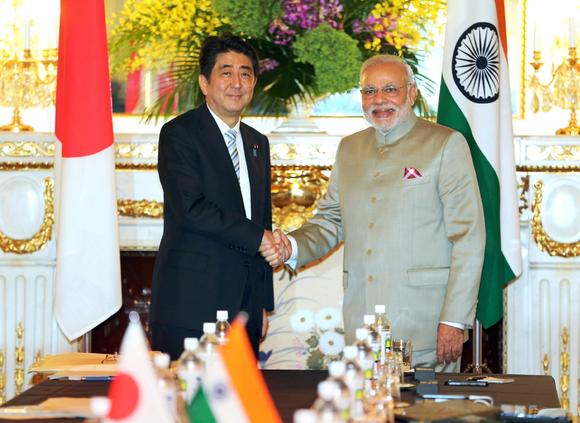
Abe-ModiPrime Minister Narendra Modi returned from Japan with notable gifts, especially a $35-billion Japanese assistance pledge that crowned a host of accords. But, like his predecessors, he will visit the White House bearing gifts, including a $2.5-billion contract for new military helicopters.

This, in a nutshell, explains why Modi’s Japan visit was a watershed, cementing Asia’s new democratic axis and co-opting Tokyo as an important partner in India’s development and a collaborator on mutual security. India and Japan are to cooperate on defense technology, maritime security and military preparedness, including on how to deter aggression and ensure a favorable balance of power in Asia.

For long, with major powers aggressively courting India to get a slice of its rapidly growing market, New Delhi measured success of its diplomacy by how many billions of dollars worth of contracts it doled out at a bilateral summit. It made little effort reciprocally to secure lucrative contracts for Indian industry. As a consequence, India is the only major global economy that remains import-dependent, rather than being export-oriented, and thus relies largely on domestic consumption to fuel its economic growth.

Modi, however, is committed to change that by making India stronger and more robust by reviving slumbering economic growth. He knows there cannot be a better and more reliable partner in India’s development than Japan, especially if his government is to significantly strengthen the country’s manufacturing base, upgrade its rickety infrastructure, create a network of new “smart” cities, and introduce bullet trains.

Japanese technology and investment can help make Modi’s plans a reality. That is why Modi laid emphasis on his “no red tape, only red carpet” message in Japan, saying he is striving to make India more hospitable for corporate activity. “Some people say there is thick red tape in India, but I would like you to believe there is a red carpet in India,” he told Japanese businessmen.

Japanese Prime Minister Shinzo Abe’s $35 billion pledge in private and public investment and financing over the next five years is indeed huge. This funding will be used to improve Indian manufacturing and skills, create “smart cities” and electronics industrial parks, build high-speed rail lines and urban subways, clean up the Ganges, produce clean energy, and accelerate rural development.

But if this $35-billion assistance is to make a major difference, India must address its gaping current account deficit. India’s monthly trade deficit is now running at $11.76 billion, as the figure available for the most recent month (July) shows. The massive trade imbalance with China, which has soared from $1 billion in 2002 to $30 billion in 2013, is at the root of India’s serious current account deficit.

By importing raw materials from India but exporting finished products to it, China has effectively turned asymmetrical trade into an instrument to prevent India’s rise as a peer competitor. China, India’s largest source of imports, is also leveraging its trade and financial clout — including its role as a major supplier of power and telecom equipment and its emergence as a lender to financially troubled Indian companies — to dissuade New Delhi from assertively countering the Chinese strategic encirclement.

Modi recognizes that New Delhi must strategically collaborate with Tokyo to prevent the rise of a Sino-centric Asia, or else India’s world-power aspirations will be stymied for good.

Asia’s balance of power will be determined principally by events in two key regions: East Asia and the Indian Ocean. According to the “Tokyo Declaration for India-Japan Special Strategic and Global Partnership” unveiled during Modi’s visit, these two leading maritime democracies in Asia have agreed to “upgrade and strengthen” their defense relations and work together on advancing security in Asia and the wider Indo-Pacific region, marked by the confluence of the Indian and Pacific Oceans.

As energy-poor countries heavily dependent on oil and gas imports, India and Japan are naturally concerned by China’s mercantilist efforts to assert control over energy supplies and transport routes as well as by its claim to more than 80 percent of the South China Sea, one of the world’s busiest and most-strategic waterways. China, in addition, has unilaterally established an air-defense identification zone (ADIZ) covering territories that it claims (but does not control) in the East China Sea — a dangerous new precedent in international relations.

Make no mistake: China’s “salami slicing” strategy involving the use of military intimidation or force to make furtive, incremental encroachments across land and sea borders has emerged as a key destabilizing element in Asia.

Alluding to China, the Tokyo Declaration says India and Japan “affirmed their shared commitment to maritime security, freedom of navigation and overflight, civil aviation safety, unimpeded lawful commerce, and peaceful settlement of disputes in accordance with international law.” Modi was blunter, telling a Tokyo symposium: “Everywhere around us, we see an 18th century expansionist mind-set — encroaching on another country, intruding in others’ waters, invading other countries, and capturing territory.” This prompted the Global Times — a mouthpiece for China’s rulers — to editorially say that “it is perhaps a fact that he [Modi] embraces some nationalist sentiments against China.”

The new Indo-Japanese axis is pivoted on a mutual recognition that such an alliance can potentially shape Asian geopolitics in much the same way as China’s rise or America’s “pivot” to Asia. Together, Japan and India can impose discreet checks on China’s propensity to flex its muscles and to assert revanchist territorial and maritime claims.

Not surprisingly, Indian and Japanese strategic policies have started evolving in parallel.

Long used to practicing passive, checkbook diplomacy, Japan under Abe is now pursuing a strategy of “proactive contribution to peace” by looking beyond its security ties with the U.S. and building strategic partnerships with militarily capable democracies in the Indo-Pacific region. India, for its part, has progressed from doctrinaire nonalignment to geopolitical pragmatism, the hallmark of Modi’s foreign policy.

After many rudderless years, India and Japan have a prime minister with a sense of purpose and direction. This has not only injected new-found energy in their foreign policy but also is aiding the return of economic confidence in the two countries. Such a trend holds long-term strategic implications. For example, India’s GDP growth in three years could potentially overtake that of China, which faces the specter of a slowing economy.

To be sure, Modi sees the United States as equally important to Indian economic and security interests. Eager to restore momentum to India’s relationship with America, he has shaken off the visa-related humiliations heaped on him by Washington for over nine years and is scheduled to visit the White House on September 30. The U.S. has still not expressed regret for revoking his visa over unproven allegations that he connived in Hindu-Muslim riots in 2002, when he was chief minister of Gujarat state. Yet Modi has decided to place national interest above personal umbrage.

Modi is also reaching out to Beijing in the hope that he can co-opt a cash-rich China as a partner in his mission to economically transform India. But this approach is not without significant risks: For China, trade and economic cooperation is about raking in profits, not about building political bridges. So, booming trade has been no hurdle to its increasing territorial assertiveness. Yet Modi’s overture appears predicated on the belief that growing economic engagement will make Beijing more amenable to a peaceful settlement of border and other disputes.

What makes India’s relationship with Japan special is that it has none of the military and trade tensions that bedevil its ties with China or the political and commercial frictions that jar its relations with America. Between India and Japan, according to Modi, “there is only goodwill and mutual admiration.” Abe has gone to the extent of saying that Japan-India relations hold “the greatest potential of any bilateral relationship anywhere in the world.”

With the economic and security interests of the two countries dovetailing nicely, the process to significantly tap that potential is to be accelerated. Modi urged Abe that the two countries should “strive to achieve in the next five years their relationship’s unrealized potential of the last five decades.” He added that there are “no limits” to cooperation between the two nations and that their actions will help shape the 21st century for Asia.

The Modi trip has helped cement the India-Japan alliance, with the Tokyo Declaration calling the visit’s outcome “the dawn of a new era” in relations between “Asia’s two largest and oldest democracies.” This partnership will strengthen maritime security in the Indo-Pacific region — the world’s leading trade and energy seaway — and shape a healthy and stable Asian power equilibrium, with India serving as the southern anchor and Japan the eastern anchor of this power balance.

Brahma Chellaney is a geostrategist and the author, most recently, of “Water, Peace, and War” (Oxford University Press, 2014).

(c) Rediff.com, 2014.

Modi’s imprint on foreign policy

Brahma Chellaney, Mint, September 3, 2014

One trademark of Modi’s foreign policy is that it is shorn of ideology, with pragmatism being the hallmark

One trademark of Modi’s foreign policy is that it is shorn of ideology, with pragmatism the hallmark

Narendra Modi has surprised many by investing considerable political capital in high-powered diplomacy in his first 100 days in office, even though he had little foreign-policy experience when he became Indian prime minister. His hosting of leaders from India’s neighbourhood when he was sworn in, his highly effective visits to two of India’s neighbours, Nepal and Bhutan, his diplomatic dexterity at the BRICS summit in Brazil, and his watershed trip to Japan are coming to define his nimble foreign-policy approach. Since his thumping electoral mandate, foreign dignitaries have made a beeline to call on him.

Instead of bumptiously enunciating a Modi doctrine in foreign policy, the Prime Minister is allowing his actions, including diplomatic successes and breaks, to define his approach. From the big bear hug with Japanese Prime Minister Shinzo Abe that symbolized the dawn of an India-Japan alliance to his scrapping of scheduled foreign-secretary-level talks with Pakistan after its high commissioner defiantly met Kashmiri secessionists, Modi has managed to put his stamp on foreign policy faster than any predecessor, other than Jawaharlal Nehru. Indeed, as India’s veto at the WTO talks in Geneva exemplified, Modi will even stand up to a powerful, rich nations’ cabal when national interest is at stake.

Signalling his intent to boost India’s economic and security interests through multidirectional collaboration with likeminded powers, the Prime Minister has embarked on building a democratic axis with Japan — an alliance that can help reshape Asian geopolitics and accelerate India’s development. Modi deliberately made Japan his first foreign port of call beyond the Indian subcontinent so as to spotlight that country’s centrality to Indian interests. In fact, not only is Abe the most India-friendly of any world leader today, but also Japan is ready more than any other power to assist in India’s economic rise through aid, investment and technology transfer. Proof of that is its $35 billion pledge this week.

To be sure, India’s relationship with Japan began blossoming before Modi assumed office. The real architect of this axis is Abe, whose push for closer ties with India dates back to his first stint as PM in 2006-07, when Japan and India unveiled their “strategic and global partnership”. However, Modi — recognizing Japan’s importance to his own goal to boost economic growth and restore national pride — has been quick to seize the opportunity to build an entente with Tokyo.

This mission has not dissuaded him from reaching out to archrival China, despite increasing Himalayan border transgressions by its military. In a tricky act, he has sought to tame China’s belligerence through economic courtship designed to rope in that country — with its $4 trillion foreign-exchange reserves — as an important partner in India’s development, like Japan.

Indeed, Modi has gone out of his way to befriend China, negating the early assumptions that he would be less accommodating toward Beijing than his predecessor. He even delayed his Japan tour by several weeks so as to first meet Chinese President Xi Jinping on the sidelines of the BRICS summit. Their body language at that summit indicated the two had formed an easy personal equation. But getting Xi to make progress on the issues that divide India and China won’t be easy.

China represents Modi’s diplomatic gamble. He has invited Chinese investment in his plan to modernize India’s infrastructure, especially railroads, power stations and industrial parks. China’s foreign direct investment in India, however, remains trifling, with Chinese companies preferring to import primary commodities from India while exporting an avalanche of finished products. China, by strategically expanding such lopsided trade with India, has raked in mounting profits, carving out a $30-billion trade surplus in its favour last year.  By dumping its products, it is undercutting Indian manufacturing. How long will Modi be able to walk the tightrope on a country that poses the most difficult challenge for India?

Make no mistake: The extraordinary warmth and harmony that characterized Modi’s Japan tour is unlikely to be replicated in a summit with any other country. In fact, the Prime Minister’s diplomatic skills are about to face a stiffer test in upcoming bilateral summits with Xi — a former military reservist who symbolizes China’s new militarism — and US President Barack Obama, a lame duck increasingly under political siege.

Still, Modi’s actions thus far suggest he has a clear vision of how to proactively recoup India’s regional losses and to boost its global standing. Even his decision to call off talks with Pakistan has made more sense with each passing day, given the political mayhem there. Can any meaningful talks be held at a time the Pakistani military is busy neutering the elected PM and stepping up border provocations against India? Pakistan’s cocky high commissioner is lucky he was not expelled or put in the doghouse for brazenly going against the Indian Foreign Office’s counsel. But he won’t be lucky twice.

One trademark of Modi’s foreign policy is that it is shorn of ideology, with pragmatism being the hallmark. The policy’s overriding objective appears to be to enhance the country’s economic and military security as rapidly as possible. Of course, it is too early to judge the consistency, strength or effectiveness of the Modi diplomacy. But after a long era of ad hoc, reactive, weak-kneed diplomacy, the new clarity and vision represent a welcome change for India.

(c) Mint, 2014.

The Grand Chessboard

Brahma Chellaney: Modi takes Indian diplomacy to the big leagues

Nikkie Asian Review, August 30, 2014

Indian Prime Minister Narendra Modi addresses the nation from the historic Red Fort during Independence Day celebrations in Delhi on Aug. 15. © Reuters

Prime Minister Narendra Modi, who swept to power in May in India’s biggest election victory in a generation, has signaled his determination to strengthen his country’s diplomatic clout in its own strategic backyard while collaborating more closely with the major powers.

So far, Modi has limited himself to visits to two of India’s smaller neighbors, Nepal and Bhutan, where the trips were hailed as successes. But the prime minister’s powers of diplomacy are about to face a stiffer test in successive bilateral summits with the leaders of Japan, China and the U.S. His handling of these talks will set the parameters of Indian foreign policy for years to come.

Time for more substance

Modi’s Aug. 30 to  Sept. 3 tour of Japan is certain to deepen bonds between the two democracies — one the world’s largest, the other Asia’s oldest (and richest). But if this emerging democratic axis is to turn into a game-changer in Asia, the two countries must add more substance to their collaboration through deeper strategic and economic links.

Modi’s visit to Tokyo will pave the way for a greater Japanese role in India’s development. But there is also scope for greater cooperation in the military realm. Some of Prime Minister Shinzo Abe’s recent steps, including easing Japan’s arms export ban and reasserting the right of collective defense, open clear new avenues of potential collaboration with India.

By contrast, when Chinese President Xi Jinping comes to New Delhi in mid-September, Modi will have a more difficult task at hand, given China’s increasing assertiveness on issues such as frontiers and its right to build dams on international rivers originating in Tibet. There may also be friction over the Indian prime minister’s election campaign rhetoric criticizing Beijing’s “expansionist attitude.”

Despite these irritants, Modi is seeking to co-opt China, with its massive foreign-exchange reserves, as a partner in India’s development, negating the early assumptions of some analysts that his government would be less accommodating toward Beijing than its predecessor.

In particular, Modi must find ways to address the lopsided trade relationship between the two countries: Beijing exports three times as much to India as it imports, and treats its huge neighbor as a raw-material appendage of its economy. The Indian leader has already sketched out ways in which this relationship can be transformed by inviting Chinese investment in his plan to modernize India’s infrastructure, especially railroads, power stations and industrial parks.

To prepare the ground for Xi’s visit, Modi has gone out of his way to befriend China. He received the Chinese foreign minister before welcoming any other foreign dignitary. His first bilateral meeting with a major head of state was with Xi on the sidelines of a summit in Brazil of the BRICS grouping of major emerging economies. He allowed the Chinese president to move up his India visit to September while postponing his own Japan trip by eight weeks, a decision that allowed him to meet Xi first. And Modi agreed to let Shanghai host the proposed new BRICS development bank, accepting the consolation prize of having an Indian as its first president.

But the tensions between the neighbors will not go away: Modi’s election-victory pronouncement that the coming decades would constitute “India’s century” sits uneasily alongside China’s similar proclamation of its ownership of the 21st century. And friction along their shared border is increasing, according to Kiren Rijiju, India’s Minister of State for Home Affairs, who told parliament recently that Chinese border transgressions this year have exceeded more than one per day to reach 334 as of Aug. 4. For India, it is clear that China remains as much a strategic rival as an economic opportunity.

Rising above U.S. humiliation

Given the critical importance of the U.S. to India, Modi has wisely placed national interests above personal umbrage by shaking off visa-denial humiliations heaped on him by Washington. These date back to 2005, when the U.S. denied Modi a visa over his alleged involvement in anti-Muslim riots in his home state of Gujarat in 2002. Washington maintained the ban for years, even though he had been cleared of any wrongdoing by an inquiry appointed by India’s Supreme Court.

The U.S. abruptly reversed course when Modi emerged as the favorite to win the election, and in the wake of his overwhelming electoral mandate in May, Modi could have waited for U.S. officials to come calling. Instead, seeking to establish a mutually productive relationship with Washington, he quickly accepted President Barack Obama’s invitation to visit the White House, thereby leaving no room for perceptions about bilateral strains to damage India’s own foreign policy interests.

Nevertheless, the reality is that U.S.-India relations have gradually lost momentum since their heyday under Obama’s predecessor, George W. Bush, even though Washington has quietly become India’s largest arms supplier. Ties hit a new low in December after an Indian diplomat serving as deputy consul general in New York was arrested and strip-searched by police after being accused of underpaying a nanny she had brought with her from India. India’s national security adviser called the diplomat’s treatment, which included vaginal and anal cavity searches by police, “despicable and barbaric.”

Modi appears keen to reinvigorate the bilateral relationship. But he will be visiting Washington at a time when Obama is beset with crises at home and abroad and appears increasingly under political siege, including from members of his own Democratic Party in the Senate. The contrast between a newly empowered Modi and a fading Obama could not be starker.

It is therefore unclear what the White House visit in late September can accomplish, other than drive home the message that all is well on the U.S.-India front. As if to highlight how transactional aspects overshadow strategic elements in the relationship, Washington will be expecting Modi to come bearing gifts in the form of new business and arms contracts.

Standing up for India

But Modi has already shown that he will unflinchingly stand up for his perception of the national interest, even if it means opposing the U.S. He demonstrated this in late July at the World Trade Organization negotiations in Geneva on a new global trade facilitation accord. Failing to win last-minute concessions in relation to India’s food-stockpiling program, the Modi government vetoed the agreement, which the previous Indian administration had tentatively approved, drawing criticism from the U.S. and many of the 158 other countries that had voted in favor of the deal.

Modi’s smoothest interaction will likely be with Japan, despite his apparent focus on wooing China. Abe will ensure that his Indian counterpart’s visit is a success, not least because the relationship is seen in Tokyo as a win-win partnership that can help catalyze Japan’s revival as a world power, while also driving India’s infrastructure development and aspirations to become a top power.

In particular, Modi is expected to return home with a much-hoped-for civil nuclear accord with Tokyo. Such a deal will be presented in India as a diplomatic triumph, even though its practical value is largely symbolic because India cannot afford large-scale investment in imported nuclear reactors. The country would be better off using its own expertise to build fast-breeder reactors and more conventional small reactors.

The Japan-India partnership nevertheless holds the potential to shape Asian geopolitics in much the same way as China’s rise or Obama’s U.S. “pivot” to Asia. Modi says his visit is aimed at taking “time-tested” ties with Japan to “a new level.”

India’s foreign policy has never had a distinct strategic imprint, except for a period under Prime Minister Indira Gandhi. The country has always placed more emphasis on being liked than on being respected. Modi recognizes this failing and, as his actions in Geneva exemplified, appears intent on fixing it.

His overtures to Beijing do not conceal his resolve to build close strategic ties with Japan to help put discreet checks on China’s exercise of its rapidly accumulating power, which risks sliding into arrogance. Modi’s vision for Asia is a stable equilibrium in which India can thrive unhindered.

Achieving that objective will not be easy, given the complex challenges facing India in its relationships with its three most important interlocutors. Yet Modi’s record since May suggests that his government has a clear vision of how a proactive foreign policy might work. For New Delhi, that is a step forward.

Brahma Chellaney is a professor of strategic studies at the independent Center for Policy Research in New Delhi and the author, most recently, of “Water, Peace, and War” (Rowman & Littlefield, 2013).

© Nikkie Asian Review, 2014.

Plugging gaps in diplomacy

Modi can recoup India’s regional losses by staying focused on the key states and avoiding the “Pakistan itch” that derailed Vajpayee’s diplomacy

Brahma Chellaney, Hindustan Times, August 7, 2014

Narendra Modi took office with very high expectations. His cautious, measured start thus may disappoint those who expected his thumping electoral mandate to herald a paradigm shift in governance and policy. In truth, Modi appears to have embraced prudent gradualism.

On the economic front, Modi is seeking to erect the foundation for India’s sustained economic rise with a two-fold emphasis: improving the country’s woeful infrastructure by reversing declining public spending; and boosting manufacturing, including by liberalizing labour laws.

It is, however, on the diplomatic front that Modi is charting an assertive, dynamic approach, including regaining India’s clout in its own strategic backyard, where China stepped into a vacuum left by years of Indian neglect.

Modi has passed his first international test by resisting intense, US-led pressure not to block a new World Trade Organization accord. Members of the rich countries’ club, the Organization for Economic Cooperation and Development, plus China provide the bulk of the world’s agricultural subsidies, estimated at $486 billion in 2012. Yet India would have taken the main hit had WTO’s Trade Facilitation Agreement gone through, losing potentially its sovereign right to stockpile food grains to a secure level. At Bali, Manmohan Singh’s government traded a firm commitment on trade facilitation for an empty assurance, agreeing to kick the can on a stockpiling deal to 2017. This put India’s food security at risk in case no deal was reached by 2017.

Unable to secure any concession, the Modi government vetoed the trade-facilitation accord in Geneva, a decision that has drawn America’s ire. Visiting US Secretary of State John Kerry told Modi that this sent a “wrong signal,” while the state department bluntly stated that the action “undermined the very image Prime Minister Modi is trying to send about India.” However, to Washington’s chagrin, the chief of the UN’s International Fund for Agricultural Development has endorsed India’s stance, saying the real choice in Geneva was between “feeding” one’s own citizens and “creating jobs” for other countries.

Modi’s forward-looking diplomacy is apparent from his early-term focus on retrieving India’s lost ground in its immediate neighbourhood. After charming Bhutan on his first foreign trip, Modi has concluded a highly successful visit to Nepal.

Such had been New Delhi’s neglect of Nepal — a nation symbiotically tied to India — that this was the first bilateral visit by an Indian PM in 17 years, a period in which a waiting China strategically penetrated Nepal. Culturally, Nepal looks south at India. Much of its population is in the south. But China has been muscling in from the north.

Nepal, wracked by severe political flux since the 1990s, stands deeply divided. Yet it unitedly welcomed Modi, with the visit inspiring hope of a new dawn for bilateral ties. If there was any jarring note during the visit, it was a last-minute dispute that stalled signing of a hydropower trade accord. Water can be to Nepal what oil is to Arab sheikhdoms, if Nepal is willing to emulate the example of Bhutan, which has achieved South Asia’s highest per capita income by exploiting its hydropower reserves through small, environmentally sound projects.

By telling Nepal that he wishes to revise the 1950 bilateral treaty during his term in office, Modi, in essence, called Nepal’s bluff. It has become a bipartisan article of faith in Nepal that the treaty is “unequal” and loaded against Nepalese interests. Yet, despite India’s willingness to discuss revision, Nepal has shied away from entering into negotiations.

After independence, India could have sought to absorb Nepal. Jawaharlal Nehru, however, entered into a treaty to safeguard Nepal’s sovereignty. The treaty cemented a “special relationship”, granting Nepal preferential economic treatment. It allowed the Indian Army to enlist Gurkhas, prohibited Nepal from buying arms from a third country without Indian consent, and obligated Nepal not to permit entry into its territory of foreign elements deemed inimical by India to its interests. One glaringly unequal element in the treaty is that Nepalese get national treatment in India but not Indians in Nepal.

The treaty’s defence-related provisions, in reality, have largely fallen by the wayside. Nepal indeed has become a happy hunting ground for Pakistani and Chinese agents seeking to undermine India’s internal security and Indian interests in Nepal. The Modi-proposed treaty revision must not stop India from finding its own ways to secure its porous border with Nepal without affecting rights of Nepalese to travel to or work in India without visa.

Foreign Minister Sushma Swaraj did well by making her first stand-alone foreign trip to Bangladesh, another key neighbour where India has lost substantial influence. Modi has accepted Bangladesh’s invitation to visit.

Modi must also visit Myanmar, critical to Indian interests. Although Myanmar shares a long, sensitive border with India, many in New Delhi don’t seem to regard it as a neighbour, a fact reflected in the failure to invite President Thein Sein to Modi’s swearing-in event. Distant Mauritius was invited to the event but not Myanmar, which has applied for SARRC membership.

Modi can recoup India’s regional losses by staying focused on the key states, without catching the “Pakistan itch”, which helped derail Atal Bihari Vajpayee’s foreign-policy ambitions. Vajpayee’s roller-coaster policy on Pakistan traversed through Lahore, Kargil, Kandahar, Agra, Parliament and Islamabad, yielding only greater cross-border terrorism.

Next month, Modi faces a big test in diplomacy as he holds separate bilateral summits with three powers central to India’s strategic interests — Japan, China and America. Japan will be the easy part, with Modi’s visit likely to forge close strategic bonds with Asia’s oldest (and richest) democracy and clinch a long-elusive nuclear deal.

Brahma Chellaney is a geostrategist and writer.

(c) The Hindustan Times, 2014.

A Nascent Democratic Axis for Asia

 Brahma Chellaney

Narendra Modi, who recently became prime minister of India, is scheduled to visit Japan later this summer. Geostrategist Brahma Chellaney revisits the Indo-Japanese relationship and finds it thriving on both the economic and security fronts. What is the strategic outlook for these partners moving forward?

Nippon.com July 2014

The upcoming visit to Japan of India’s newly elected prime minister, Narendra Modi, is likely to strengthen the strategic bonds between Asia’s oldest (and richest) democracy and the world’s largest democracy. Modi has intentionally chosen Japan as the first major country for a state visit, underscoring New Delhi’s recognition of Japan’s critical importance to Indian economic and security interests.

A similar recognition in Tokyo of India’s vital role for Japan prompted the historic Indian tour of Japan’s venerated Emperor Akihito and Empress Michiko late last year. The emperor’s visit is likely to mark a watershed in Indo-Japanese ties, just as his 1992 China trip—at the height of Japan’s pro-China foreign policy—led to increased Japanese aid, investment, and technology transfer to that country. Also significant was Prime Minister Abe Shinzō’s presence as the chief guest at India’s January 26, 2014, Republic Day parade.

A New Era of Warm Ties

Modi’s election is good news for Japan-India relations, with his visit to Tokyo in August promising to take those ties to a new level of economic and strategic engagement.  Modi’s 2007 and 2012 visits to Japan as the chief minister (governor) of the western Indian state of Gujarat helped forge a special relationship with Japan and also build personal rapport with Abe. Today, Abe follows only three people on Twitter: his outspoken wife Akie, author-turned-politician  Inose Naoki, and Modi.

“Personally, I have a wonderful experience of working with Japan . . . I am sure we will take India-Japan ties to newer heights,” Modi said in one of his tweets after winning a landslide election victory. In response, Abe, after making a congratulatory telephone call, posted on Twitter: “Great talking to you, Mr. Modi. I look forward to welcoming you in Tokyo and further deepening our friendly ties.”

Abe and Modi both champion pro-market reforms and share similar political values and strategic approaches, including seeking close ties with Asian democracies to help create a web of interlocking strategic partnerships. They also share a keen interest in ensuring stable power equilibrium in Asia.

Asia’s balance of power will be determined by events in two principal regions: East Asia and the Indian Ocean. As the two leading maritime democracies in Asia, Japan and India must take the lead in helping to safeguard vital sea-lanes in the wider Indo-Pacific region. After all, as energy-poor countries heavily dependent on oil and gas imports, they are seriously concerned by mercantilist efforts to assert control over energy supplies and transport routes.

With One Eye on the Security Scene

The Japan-India partnership indeed holds the potential to shape Asian geopolitics in much the same way as China’s rise or US President Barack Obama’s “pivot” to Asia. It can, for example, impose discreet checks on China’s exercise of its rapidly accumulating power, which currently risks sliding into arrogance. China has made not-so-subtle efforts to block the rise of Japan and India, including by opposing the expansion of the United Nations Security Council’s permanent membership.

India can serve as the southern anchor and Japan the eastern anchor of an Asian balance of power.

Abe has gone to the extent of saying that Japan-India relations hold “the greatest potential of any bilateral relationship anywhere in the world.” Abe’s push for closer ties with India actually dates back to his first stint as prime minister in 2006–7, when Japan and India unveiled their “strategic and global partnership.”

Japan is to join this year’s Malabar exercises, the Indo-US naval maneuvers in the Pacific. The last such trilateral naval exercises occurred in 2009. In extending the invitation to Japan that year, Modi’s predecessor, Manmohan Singh, declared Japan to be “at the heart of India’s Look East policy.”

Some in Japan have claimed that India is too diverse and complex a partner for homogenous Japan, and that the only reason the two countries are coming closer is because they are geographically distant and free of bilateral disputes. But rather than geographical distance or cultural factors, it is the convergence of key strategic interests that matters in interstate relations. In an era of increasing global interdependence and reduced transportation costs, shared economic and security interests are the main drivers of any intercountry relationship.

Building on Synergies

The dissimilarities between India and Japan, in fact, increase the potential for mutually beneficial economic collaboration.

Japan has a solid heavy manufacturing base, while India boasts services-led growth. India has the world’s largest youthful population, while Japan is aging more rapidly than any other major developed country. Whereas Japan has financial and technological power, India has human capital. Such contrasting features make their economies complementary and open a path to generating strong synergies.

Even in the strategic realm, the two countries’ dissimilar backgrounds are no drawback. For example, India has always valued strategic autonomy, while Japan remains a model US ally that hosts not only a large presence of American troops but also pays generously for their upkeep.

Indian and Japanese strategic policies are now evolving in parallel. Long used to practicing passive, checkbook diplomacy, Tokyo is now signaling its willingness to play a greater geopolitical role. India, for its part, has progressed from doctrinaire nonalignment to geopolitical pragmatism.

Since Japan and India unveiled their strategic and global partnership, their political and economic engagement has deepened significantly. Their free-trade pact, formally known as the Comprehensive Economic Partnership Agreement, came into force in 2011. They have even established an alliance to jointly develop rare earths so as to reduce their dependence on China, which has a near-monopoly on the global supply of these vital minerals.

Japan has become a critical source of capital and commercial technology for India, which has emerged as the largest destination for Japanese foreign direct investment among major industrialized nations. India surpassed China more than a decade ago as the biggest recipient of Japan’s Official Development Assistance, which is currently funding more than 60 Indian projects, such as the Western Freight Corridor, the New Delhi-Mumbai Industrial Corridor, and the Bangalore Metro Rail Project.

In Pursuit of Mutual Benefits

Japan sees India as central to its own economic-revival and security-building strategies. Japan’s prolonged economic woes have obscured one of the most far-reaching but least-noticed developments in Asia—the country’s political resurgence. Japan believes it has little option but to become more competitive and shore up its security by building strategic ties with new partners, such as India.

It is against this background that India and Japan boast the fastest-growing bilateral relationship in Asia today.

But if this emerging democratic axis is to turn into a game-changer in Asia, the two countries need to make their collaboration meatier through deeper economic and security linkages. Modi’s rise opens a window of opportunity to build such linkages, including by making India the leading market for Japan’s new drive to export arms. Some of Abe’s recent steps, including easing a longstanding arms-export ban and reasserting the right of collective defense, are most promising in relation to India.

This will likely be a win-win partnership, helping to drive India’s infrastructure development and great-power aspirations, while catalyzing Japan’s revival as a world power.

India’s Shinzo Abe

Brahma Chellaney

A Project Syndicate column

After a prolonged period of political drift and paralysis, India’s new government will be led by a man known for his decisiveness. Just as Japanese Prime Minister Shinzo Abe’s return to power in late 2012, after six years of political instability, reflected Japan’s determination to reinvent itself as a more competitive and confident country, Narendra Modi’s election victory reflects Indians’ desire for a dynamic, assertive leader to help revitalize their country’s economy and security.

Like Abe, Modi is expected to focus on reviving India’s economic fortunes while simultaneously bolstering its defenses and strengthening its strategic partnerships with likeminded states, thereby promoting regional stability and blocking the rise of a Sino-centric Asia. The charismatic Modi – a darling of business leaders at home and abroad – has promised to restore rapid economic growth, saying there should be “no red tape, only red carpet” for investors.

The 63-year-old Modi mirrors Abe’s soft nationalism, market-oriented economics, and new Asianism, seeking close ties with Asian democracies to create a web of interlocking strategic partnerships.

In a country where the gap between the average age of political leaders and citizens is one of the world’s widest, Modi will be the first prime minister born after India gained independence in 1947. This constitutes another parallel with Abe, who is Japan’s first prime minister born after World War II.

There is, however, an important difference in terms of the two leaders’ upbringing: While Modi rose from humble beginnings to lead the world’s largest democracy, Abe – the grandson and grandnephew of two former Japanese prime ministers and the son of a former foreign minister – boasts a distinguished political lineage. In fact, Modi rode to victory by crushing the dynastic aspirations of Rahul Gandhi, whose failure to articulate clear views or demonstrate leadership ran counter to the Indian electorate’s yearning for an era of decisive government.

Modi, like Abe, faces major foreign-policy challenges. India is home to more than one-sixth of the world’s population, yet it punches far below its weight. A 2013 essay in the journal Foreign Affairs, titled “India’s Feeble Foreign Policy,” focused on how the country is resisting its own rise, as if the political miasma in New Delhi had turned the country into its own worst enemy.

Many Indians want Modi to give a new direction to foreign relations at a time when the gap between India and China in terms of international stature has grown significantly. India’s influence in its own backyard – including Nepal, Sri Lanka, and the Maldives – has shrunk. Indeed, Bhutan remains India’s sole pocket of strategic clout in South Asia.

India also confronts the strengthening nexus between its two nuclear-armed regional adversaries, China and Pakistan, both of which have staked claims to substantial swaths of Indian territory and continue to collaborate on weapons of mass destruction. In dealing with these countries, Modi will face the same dilemma that has haunted previous Indian governments: the Chinese and Pakistani foreign ministries are weak actors. The Communist Party and the military shape Chinese foreign policy, while Pakistan relies on its army and intelligence services, which still use terror groups as proxies. The Modi government is unlikely to let another Mumbai-style terrorist attack staged from Pakistan go unpunished, employing at least non-military retaliatory options.

Restoring momentum to the relationship with the United States – damaged recently by grating diplomatic tensions and trade disputes – is another pressing challenge. But Modi’s commitment to pro-market economic policies and defense modernization is likely to yield new opportunities for US businesses and lift the bilateral relationship to a new level of engagement.

America’s strategic interests will be advanced by likely new defense cooperation and trade that boosts US arms sales and creates avenues for joint military coordination. The US already conducts more military exercises with India than with any other country.

Modi is the sort of leader who can help put US-India ties back on track and boost cooperation. Yet there is a risk that his relations with the US, at least initially, could be more businesslike than warm, owing to an American slight that is hard for him to forget. In 2005, the US government revoked his visa over unproven allegations that he connived in Hindu-Muslim riots in 2002, when he was Chief Minister of Gujarat. Even after India’s Supreme Court found no evidence to link Modi to the violence, the US continued to ostracize him, reaching out to him only on the eve of the recent election.

With the US having expressed no regret for its revocation of his visa, Modi is unlikely to go out of his way to befriend the US by seeking a White House visit. Instead, he is expected to wait for US officials to come calling.

By contrast, Modi is likely to remember states, such as Japan and Israel, that courted him even as the US targeted him. Modi’s 2007 and 2012 visits to Japan opened new avenues for Japanese investment in business-friendly Gujarat.

Moreover, Modi has forged a special relationship with Japan and built personal rapport with Abe. When Abe returned to power, Modi congratulated him with a telephone call.

Modi’s victory is likely to turn Indo-Japanese ties – Asia’s fastest-developing bilateral relationship – into the main driver of India’s “Look East” strategy, which, with America’s blessing, seeks to strengthen economic and strategic cooperation with US allies and partners in East and Southeast Asia. Abe, who has sought to build security options for Japan beyond the current US-centric framework, has argued that his country’s ties with India hold “the greatest potential of any bilateral relationship anywhere in the world.”

A deeper Japan-India entente under Abe and Modi could potentially reshape the Asian strategic landscape. It is no surprise that Abe rooted for a Modi victory.

Brahma Chellaney, Professor of Strategic Studies at the New Delhi-based Center for Policy Research, is the author of Asian JuggernautWater: Asia’s New Battleground, and Water, Peace, and War: Confronting the Global Water Crisis.

(c) Project Syndicate, 2014.

Averting a second cold war

BY BRAHMA CHELLANEYThe Japan Times

001ec949c22b128eb91d2aThat we live in a world of rapid change has been confirmed by the way recent developments over Ukraine have transformed international geopolitics in just a few weeks. The looming cold war triggered by the U.S.-supported putsch in Kiev that deposed Ukraine’s constitutional order and by Russia’s muscular riposte, including annexing Crimea, portends the advent of a new era.U.S. President Barack Obama’s new sanctions approach toward Russia indeed sets the stage for a potential clash between Western democracy and what American ideologues call “Putinism.”

The geopolitical tensions, military deployments and strident rhetoric point to the risk of preemptive moves and miscalculations sparking an accidental confrontation. We need only to recall how a spiral of actions and counter-actions led to World War I a hundred years ago.

Russian President Vladimir Putin’s action in annexing Crimea violated Ukraine’s territorial integrity in breach of international law, even though it followed a referendum in this historically Russian region, where the majority of residents are indisputably with Russia.

Let us, however, not forget that the U.S. and NATO have flagrantly and repeatedly contravened international law in the past 15 years. It’s a long list — the bombing of Serbia, the separation of Kosovo from Serbia, the invasions of Afghanistan and Iraq without U.N. Security Council mandate, the overthrow of Moammar Gahdafi’s regime through aerial bombardment, the aiding of a still-raging bloody insurrection in Syria, and renditions and torture of terror suspects. The U.S. National Security Agency’s mass surveillance program also disregards international law.

An international system based on the rule of law cannot be good unless norms and rules are respected on all sides. Yet power often trumps international law. Neither the U.S. nor Russia respects international borders. America, for example, invoked its Monroe Doctrine to intervene, among others, in Panama, Chile, Cuba, Nicaragua, Grenada, the Dominican Republic and Venezuela.

International law tends to take a back seat when a major power asserts a right to protect vital security interests. Indeed, when a great power needs a threat to justify its intervention in another state, it invariably finds one. There is thus a long political history of world powers quoting international law to others but ignoring it when it comes in their way. The Ukraine case illustrates the international law of convenience.

Yet it is difficult to see how Russian, American or European interests can be advanced by the ominous face-off over Ukraine, which has helped shift the international spotlight from Asia’s festering fault lines and territorial feuds to the new threat to European peace. The showdown, unless defused, is likely to spur significant shifts in geopolitical equations and policies.

For example, the latest developments leave less space for the U.S. to pivot toward Asia but compel Moscow to embark on its own pivot to Asia, particularly China, to promote energy outflows and capital inflows.

With both Obama and Putin actively seeking to woo China on Ukraine, the likely big winner from the turn of events is the country that has been relentlessly expanding its borders ever since it came under communist rule in 1949.

China’s geopolitical gains will solidify if the U.S. jettisons — as appears likely — its post-Cold War policy of seeking to influence Russia’s conduct through engagement and integration into global institutions. The U.S. is closing the door to Russian accession to the Organization for Economic Cooperation and Development and effectively ousting Russia from the Group of Eight by making it the Group of Seven again — an action that can only accelerate that institution’s creeping irrelevance in international relations.

A slippery slope to greater sanctions would clearly signal a U.S. shift to a new Russian policy of selective containment and engagement. Such a shift would be accompanied by an intellectual and normative thrust to present the new policy as vital to rein in an autocratic and ambitious Russia — as if heralding the return of a Cold War-style ideological battle between autocracy and democracy to Europe. But with communism now dead in Russia, America’s ideological war would target “Putinism.”

The demonization of Putin is ironic, given that the Russian leader pursued a pro-Western policy in the initial years after he came to power. For example, he closed down Russian military bases in Cuba and Cam Ranh Bay, Vietnam, and voluntarily supported America’s Afghanistan invasion. Only after his extended overtures went unreciprocated — with the U.S. instigating “color revolutions” in some ex-Soviet states and expanding NATO to the Baltics and the Balkans — did Putin adopt a more nationalistic course.

Yet the new U.S. sanctions approach is premised on a need to check Putin’s capacity to utilize state instruments like military power and energy leverage to block states in Russia’s periphery from moving closer to the West. America is likely to bolster such frontline states, including by transferring military hardware, training and integrating their forces, and placing U.S. systems on their soil. NATO countries are already being urged to cut their reliance on Russian energy supplies.

Obama seems determined to use the tool of sanctions to subtly undermine the Russian economy, including by targeting key businessmen, entities and sectors in Russia and by encouraging a flight of capital and talent from Russia. There is also a push to bar Western firms from aiding Russia’s military modernization in any way.

This punitive approach, however, would not preclude Washington from cooperating with Moscow on issues where bilateral interests overlap. After all, such cooperation occurred even during the height of the Cold War, as in establishing the Nuclear Nonproliferation Treaty.

Still, seeking to economically squeeze Russia and isolate it internationally would mean a strategic boon for China, just as the Soviet Union’s sudden collapse opened the way for Beijing to rapidly increase its geopolitical space globally. Beijing will work to exploit Western sanctions against Russia for its own benefit, including securing Russian energy on favorable terms and gaining greater access to the Russian market for its goods.

America’s only genuine long-term rival now is an ascendant China, which is rapidly accumulating economic and military heft. By contrast, Russian military power today pales in comparison with Soviet might, with Obama admitting Russia is not America’s top geopolitical rival.

If a new cold war is to be averted, Ukraine’s neutrality must be guaranteed. Ukraine should remain neutral between NATO and Russia — a sort of a strategic, sovereign buffer, just as Tibet was before China gobbled it up. Such a diplomatic solution, while ensuring European peace, would also contribute to Asian and international security. Otherwise, a full-blown ideological war will generate a wide geopolitical fallout, stoking greater tensions and increasing risks of miscalculation.

Brahma Chellaney is a geostrategist.

(c) The Japan Times, 2014.

New Fault Lines Fester in Asia

Brahma Chellaney, The Times of India

New fault lines have emerged in Asia — the world’s economic locomotive and largest creditor — that signal increasing geopolitical risks, including for global markets.

The risks have been highlighted by the recent comments of both Japanese Prime Minister Shinzo Abe — who noted that Britain and Germany went to war in 1914 despite being economically interdependent in the same way Japan and China now are — and Philippine President Benigno S. Aquino III, who compared China’s territorial creep with Nazi Germany’s expansionism.

The fact is that Asia today is at a defining moment in its history. Yet the international spotlight on its dramatic economic rise has obscured the serious challenges it confronts.

These challenges range from recrudescence of territorial and maritime disputes and increasingly fervent nationalism to sharpening competition over natural resources and toxic historical legacies that weigh down its major interstate relationships.

The future will not belong to Asia merely because it is the world’s most-populous and fastest-developing continent, where GDP continues to grow by more than 5% each year. Asia’s deepening challenges actually call into question the assumption of some analysts that its continued rise is unstoppable and the West’s decline inevitable.

Two fault lines in particular are putting Asia’s sustained rise at risk, with the adverse geopolitical trends carrying significant ramifications for global markets.

With Asia’s political integration badly lagging behind its economic integration, one fault line is represented by the widening gap between politics and economics. Asia is the only continent other than Africa where political integration has failed to take off.

The other fault line is represented by the so-called history problem — or how the past threatens to imperil Asia’s present and future. Historical distortions and a failure to come to terms with the past have spurred competing and mutually reinforcing nationalisms. Asia must find ways to get rid of its baggage of history so as to chart a more stable and prosperous future.

Respect for boundaries is a prerequisite to peace and stability on any continent. Europe has built its peace on that principle, with a number of European states learning to live with boundaries that they don’t like. But in Asia, renewed attempts to disturb the territorial status quo are stirring geopolitical tensions and fueling rivalries.

In particular, an increasingly muscular China harps on historical grievances — real or imaginary — to justify its claims to territories and fishing areas long held by others. Whether it is strategic islands in the South and East China Seas or the resource-rich Himalayan Indian state of Arunachal Pradesh, China is dangling the threat of force to assert its claims.

Aquino, drawing an analogy between China’s territorial assertiveness and the failure of other powers to support Czechoslovakia against Hitler’s territorial demands in 1938, pointedly asked in a New York Times interview this month: “At what point do you say, ‘Enough is enough’?”

At the root of the rising geopolitical tensions is the fact that Asia is coming together economically but not politically. Indeed, it is becoming more divided politically.  Even as the region’s economic horse seeks to take it toward greater prosperity, its political horse is attempting to steer it in a dangerous direction.

This dichotomy is a reminder that economic interdependence and booming trade by itself is no guarantee of moderation or restraint between states. Unless estranged neighbors fix their political relations, economics alone will not be enough to stabilize their relationship.

The slowing of Asian economic growth underscores the risks arising from this fault line. The risks are heightened by Asia’s lack of a security framework, with even its regional consultation mechanisms remaining weak.

Unlike Europe’s bloody wars of the first half of the twentieth century, which have made war there unthinkable today, the wars in Asia in the second half of the twentieth century only sharpened rivalries, fostering a bitter legacy. Several interstate wars have been fought in Asia since 1950, such as the Korean War, without resolving the underlying disputes.

That the risks posed by the new fault lines are serious can be seen from the situation that prevailed in Europe 100 years ago. Europe then was even more integrated by trade and investment than Asia is today, with its royal families interrelated by marriage. Yet Europe’s disparate economic and political paths led to World War I.

Abe, speaking at the World Economic Forum in Davos, was thus right to warn that economic interdependence cannot by itself prevent war. But by implicitly comparing China with pre-1914 Imperial Germany, Abe sought to gain the moral high ground by depicting Japan as a democratic state that, like Britain a century ago, is seeking to checkmate the expansionist ambitions of a rapidly rising authoritarian power.

The paradox is that China, with its aggressive modernization strategy, appears to be on the same path that made Japan a militaristic state a century ago, with tragic consequences for the region and Japan itself.

Japan’s Meiji Restoration (1868 to 1912) created a powerful military under the national slogan “Enrich the Country and Strengthen the Military.” The military eventually become so strong as to dictate terms to the civilian government. The same could unfold in China, where the generals are becoming increasingly powerful as the Communist Party becomes beholden to the military for retaining its monopoly on power. 

China only highlights the futility of political negotiations byovertly refusing to accept Asia’s territorial status quo. After all, frontiers are significantly redrawn not at the negotiating table but through the use of force, as China has itself demonstrated since 1949.

Make no mistake: The risks inherent in the present Asian trends can be contained only by bridging the gulf between politics and economics. The resurgent territorial and maritime disputes underscore that securing Asian peace and stability hinges fundamentally on respect for existing borders.

Unless that happens, it is far from certain that Asia will be able to spearhead global growth or shape a new world order.

Brahma Chellaney is a geostrategist and author.

(c) The Times of India, 2014.