Don’t believe the hype on U.S.-India civil nuclear deal

Brahma Chellaney, Nikkie Asian Review

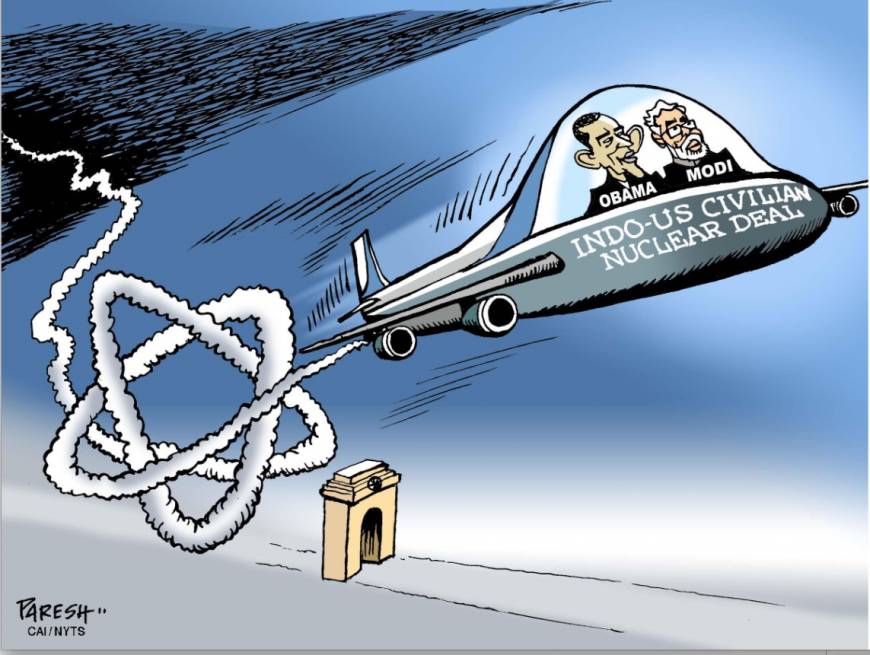
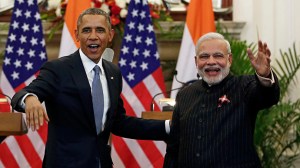
43675476.siA “breakthrough understanding” on the stalled civil nuclear deal between India and the U.S. took center-stage in a recent summit between U.S. President Barack Obama and Indian Prime Minister Narendra Modi in New Delhi. It stands out as the only substantive advance in a presidential visit heavy on pageantry and symbolism. But the publicity surrounding the supposed breakthrough was overblown, and the celebrations can only be described as premature.

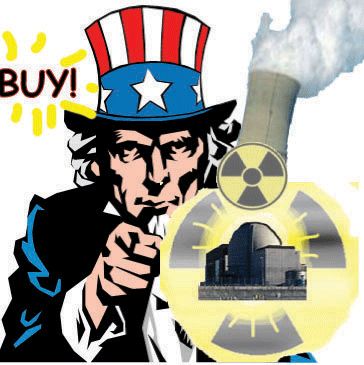
The deal was portrayed internationally as opening the path for U.S. companies to bag multibillion-dollar reactor contracts, and for Japan and Australia to sign similar deals with India, which plans to ramp up its capacity to generate nuclear power by importing two dozen commercial reactors within the next decade. Currently, nuclear power represents barely 2% of India’s total installed power capacity.

Since it was unveiled in 2005, the U.S.-India nuclear deal — with its many twists and turns — has hogged the limelight at virtually every bilateral summit between leaders of the two countries. In its arduous journey toward implementation, the deal has spawned multiple subsidiary agreements, each of which has been hailed as an important breakthrough.

The latest understanding centers on two issues — nuclear accident liability, and administrative arrangements to govern the bilateral nuclear cooperation agreement required under Section 123 of the U.S. Atomic Energy Act. Obama announced that “we achieved a breakthrough understanding on [the] two issues that were holding up our ability to advance our civil nuclear cooperation.” However, there is still little prospect of early commercialization of the deal.

The newest “breakthrough” is short on specifics and raises troubling questions. It contrives a model that shifts the liability risks for nuclear accidents to Indian taxpayers, thus undermining India’s domestic law, the 2011 Civil Liability for Nuclear Damage Act, which holds suppliers, designers and builders liable in case of an accident. The breakthrough compromise has been designed to circumvent the central principle enshrined in that law — the right to bring civil legal action for damages against suppliers in the event of a nuclear accident caused by defective equipment, components or designs.

Remembering Fukushima

Consider Japan’s 2011 Fukushima disaster. General Electric of the U.S. built or designed the three Fukushima reactors that suffered core meltdowns, yet GE escaped penalties or legal action after the disaster, despite a fundamental design deficiency in the reactors, because Japan’s law indemnifies suppliers, making plant operators exclusively and fully liable. It was to avert such a situation that India’s law armed the Nuclear Power Corporation of India, the state-run plant operator, with the right of recourse to suppliers. India’s sensitivity on this point reflects its bitter experience over a 1984 gas leak from a chemical plant in Bhopal that killed as many as 3,000 people shortly after the accident. The plant was owned by Union Carbide of the U.S.

Supplier liability is a well-established legal concept, applied in many business sectors around the world to deter suppliers from taking undue risks. But the 2011 Act makes India an outlier in terms of current international standards on civil nuclear liability. The global nuclear power industry is controlled by a powerful group of a few state-controlled or state-supported companies that push an opposite norm — that plant operators assume absolute liability so that suppliers face no downside risks.

Too many conventions

Globally, the liability issue has been muddied by a multiplicity of international conventions, protocols, and supplementary conventions introduced since 1960. A majority of the 34 states with civil nuclear power generation capacity have signed one or both of two main conventions, or revised versions of the two. Some of the states that did not sign these conventions, including heavyweights such as the U.S., Canada and Japan, have signed the 1997 Convention on Supplementary Compensation for Nuclear Damage, seen by some as a step toward a unified global liability treaty.

This network of overlapping international arrangements makes liability a complex issue. Some important nuclear power states have not signed any international agreements, including China, South Korea, Taiwan, Pakistan and Iran. India has signed but not ratified the CSC. But the conventions have some key points in common, including assigning exclusive liability to plant operators, mandatory insurance coverage of the operators’ liability, and exclusive jurisdiction of the courts in the country where the accident occurs. India’s domestic law follows this template, but also gives the operator the right to recover damages from suppliers.

     The paradox is that U.S. domestic law allows suppliers, designers and builders of nuclear plants to be held legally liable in the event of accidents, although the 1957 Price-Anderson Act restricts economic liability to operators. Yet the U.S. has sought to shield its exporting firms from claims made by foreign customers by insisting that India and other importing countries accept operators’ strict liability and limit all claims to the jurisdiction of their own courts.

Under the compromise worked out by Obama and Modi, U.S. concerns about India’s legal approach are to be addressed through a legal contrivance called a “memorandum of law” — essentially an executive order — and a $245 million “India Nuclear Insurance Pool,” which is to be set up jointly by India’s state-run insurance companies and its federal government. A number of countries have nuclear insurance pools, but most do not have a legal framework that makes suppliers potentially liable for accidents, as India’s 2011 Act does. For this reason, the memorandum calls for an insurance pool that would address both operator and supplier liability, preventing damages claims against foreign supplier companies.

This arrangement, although claimed by New Delhi to be “squarely within our [Indian] law,” constitutes “a risk-transfer mechanism,” as the Indian foreign ministry has admitted. Under the arrangement, the Indian government is effectively scrapping the right of recourse to foreign suppliers provided by Indian domestic law and transferring the liability risk to Indian taxpayers, offset partly by the modest insurance pool. U.S. officials say the two governments are in agreement over India’s memorandum plan, which they view as a creative solution. But how can a “memorandum of law,” with no legislative imprimatur, reinterpret a statute in a way that effectively guts it?

First, the contrivance being fashioned as part of the understanding between the two leaders threatens to open a legal can of worms. U.S. officials are advising American companies to do their own risk assessments, even though Obama’s deputy national security adviser, Ben Rhodes, affirmed in New Delhi that “in our judgment, the Indians have moved sufficiently on these issues to give us an assurance that the issues are resolved and that there is a path open to implementation and investment here.” No details have been announced by either government on the resolution of another sticking point: a U.S. demand that India accept nuclear-materials tracking and accounting arrangements that go beyond the safeguards system approved by the International Atomic Energy Agency. The same obstacle has held up conclusion of a Japan-India nuclear deal. It is now up to U.S. companies to decide whether to do nuclear business in India.

Second, at a time of skyrocketing reactor construction costs, the crash of oil and gas prices has made nuclear power’s economics more unfavorable. Nuclear power is already the world’s most subsidy-fattened energy industry. Since the 1980s, average international costs for nuclear power have jumped from $1,000 per installed kilowatt to nearly $8,000. Few new reactors are under construction in the West, and the International Energy Agency has warned that “uncertainties continue to cloud the future for nuclear.”

Modi has emphasized that reactor imports will be governed by “technical and commercial viability.” The deal’s commercialization, however, will be dictated not by the market but by the extent to which the Indian government is willing to fork out subsidies to support high-priced electricity generated from imported reactors.

India is in negotiations with four foreign supplier companies — Areva of France, Russia’s Atomstroyexport, Westinghouse, owned by Toshiba of Japan, and GE-Hitachi, jointly owned by GE and Hitachi of Japan. The latter two are both based in the U.S. Under the plans, the companies will each be confined to a single site, on which they will build multiple reactors that will be operated by the state-owned nuclear power company, thus freeing the foreign vendors from the problem of producing electricity at marketable rates. Currently, negotiations are stuck over the price of power. India has offered Areva, with which negotiations are most advanced, a price of 11 U.S. cents per kilowatt hour — more than twice the average price of electricity from indigenously built reactors. The state-controlled French company is holding out for a much higher price.

Not in our backyards

20150104_india_nuclear.jpg_middle_320

The U.S.-built Tarapur atomic power station, located near Mumbai, is India’s oldest nuclear power plant.

Finally, grassroots opposition is growing to new nuclear power plants in India, especially against the Fukushima-type multi-reactor parks earmarked for foreign vendors. Building six to eight giant reactors in a single complex raises additional safety issues, as highlighted by the triple Fukushima meltdown. Local communities want nuclear power plants to be located in someone else’s backyard.

Worse still, India plans to import — as Japan did at Fukushima — prototype reactors that are not in operation anywhere in the world, including GE-Hitachi’s Economic Simplified Boiling Water Reactor, which only recently received U.S. regulatory approval, Westinghouse’s AP1000, criticized in the U.S. for supposed design failings, and Areva’s Evolutionary Pressurized Reactor, which is under construction in France and Finland but has suffered major cost overruns and delays. Prototypes usually face major teething troubles and carry greater long-term risks.

     If a serious accident were to occur, India would be saddled with staggering long-term costs. Japan’s Fukushima disaster bill has been conservatively estimated by an Osaka City University study at $105 billion, or 429 times higher than the Indian insurance pool’s capital. Japan is now establishing a state-backed compensation institution to be funded with government bonds totaling 5 trillion yen ($42 billion) and by utilities. This fund surpasses the $13.6 billion cover currently provided by the U.S. Price-Anderson Act, with another $10 billion pledged by the U.S. Department of Energy.

The Price-Anderson Act, which provides subsidies to the U.S. nuclear power industry by underwriting insurance costs, has been mocked by independent U.S. groups as “Half-Price Anderson.” India’s contrivance can be labeled “Free-Ride Anderson.” Yet it is unlikely to resolve all the tricky issues bedeviling the nuclear deal’s commercialization.

BrahmaChellaney-icon_small_150Brahma Chellaney is a professor of strategic studies at the independent Center for Policy Research in New Delhi and author of “Water: Asia’s New Battleground,” winner of the 2012 Bernard Schwartz Award.

(c) Nikkie Asian Review, 2015.

East Asia’s Historical Shackles

A column internationally syndicated by Project Syndicate.

flagsTOKYO – Diplomatic relationships in East Asia have long been held hostage by history. But the region’s “history problem” has been intensifying lately, with growing nationalism among major actors like China, Japan, and South Korea fueling disputes over everything from territory and natural resources to war memorials and textbooks. Can East Asian countries overcome their legacy of conflict to forge a common future that benefits all?

Consider the relationship between America’s closest East Asian allies, Japan and South Korea. Though historical disagreements have long hampered bilateral ties, the increasingly nationalistic stance of Japanese Prime Minister Shinzo Abe and South Korean President Park Geun-hye has aggravated festering tensions. If they fail to work together to stem the revival of bitter historical disputes, their relationship will remain frozen, playing into China’s hands.

And nobody plays the history card with quite as much relish as China, where President Xi Jinping is also relying on nationalism to legitimize his rule. Last year, China introduced two new national memorial days to commemorate China’s long battle against Japanese aggression in World War II: “War against Japanese Aggression Victory Day” on September 3 and “Nanjing Massacre Day” on December 13. What would happen if countries like Vietnam and India dedicated days to remembering China’s aggression toward them since 1949?

By reinforcing negative stereotypes of rival countries, such squabbles over history and remembrance sow fragmentation and instability, and have certainly fueled the region’s recent territorial disputes. Indeed, the politicization of history remains the principal obstacle to reconciliation in East Asia. Repeated attempts to rewrite history – sometimes literally, through textbook revisions – along nationalist lines make it nearly impossible to establish regional institutions.

This should not be the case. Japan and South Korea, for example, are vibrant democracies and export-oriented economic powerhouses, with traditionally close cultural ties and many shared values. In other words, they are ideal candidates for collaboration.

US President Barack Obama recognizes this potential, and has promoted increased strategic cooperation between South Korea and Japan in order to underpin a stronger trilateral security alliance with the US that can balance a rising China. But Japan and South Korea refuse to let go of history.

To be sure, there is some truth to South Korea’s accusation that Japan is denying some of its past behavior. But it is also true that Park – who has refused to meet formally with Abe until he addresses lingering issues over Japan’s annexation of Korea – has used history to pander to domestic nationalist sentiment. Indeed, adopting a hardline stance has enabled her to whitewash some inconvenient family history: Her father, the dictator Park Chung-hee, collaborated with the Japanese military while Korea was under colonial rule.

Abe, too, has stoked tensions, particularly by visiting Tokyo’s Yasukuni Shrine – a controversial memorial that honors, among others, Class A war criminals from World War II. Though Abe visited the shrine only once – in December 2013 – he felt compelled to do so in response to China’s unilateral declaration of an air-defense identification zone, covering territories that it claims but does not control.

Of course, the divergences between Japanese and South Korean historical narratives go back further than WWII. More than a century ago, the Korean activist Ahn Jung-geun assassinated Japan’s first prime minister, Hirobumi Ito, at the railway station in the Chinese city of Harbin, cementing Ahn’s status as a hero in Korea and a terrorist in Japan. Ito’s image can be seen on Japan’s 1,000-yen note; Ahn has appeared on a 200-won postage stamp in South Korea.

A visitor looking at exhibits at the Chinese memorial to the Korean assassin who killed Japan's first PM. © AFP

A visitor looking at exhibits at the Chinese memorial to the Korean assassin who killed Japan’s first PM. © AFP

Last year, Park asked Xi to honor Ahn. Xi seized the opportunity to drive a wedge between America’s two main Asian allies, and built a memorial to Ahn. Japan responded by blasting China for glorifying a terrorist and propagating a “one-sided” view of history – a move that, Japan asserted, was “not conducive to building peace and stability.”

Such conflicts have a clear catalyst: Asia’s rising prosperity. As their economies have expanded, Asian countries have gained the confidence to construct and exalt a new past, in which they either downplay their own aggressions or highlight their steadfastness in the face of brutal victimization.

All countries’ legitimizing narratives blend historical fact and myth. But, in some cases, historical legacies can gain excessive influence, overwhelming leaders’ capacity to make rational policy choices. That explains why Park has sought closer ties with China, even though South Korea’s natural regional partner is democratic Japan. One source of hope stems from Abe’s landslide victory in the recent snap general election, which gives him the political capital to reach out to Park with a grand bargain: If Japan expresses remorse more clearly for its militaristic past, South Korea will agree to leave historical grievances out of official policy.

Japan and South Korea cannot change the past. But they can strive to shape a more cooperative future. As a Russian proverb succinctly puts it, “Forget the past and lose an eye; dwell on the past and lose both eyes.”

© Project Syndicate, 2015.

Reshaping India’s diplomacy

BY BRAHMA CHELLANEY

January 18, 2015, The Japan Times

Building closer ties with important democracies has become the leitmotif of his foreign policy. For example, his much-photographed bear hug with Abe in Kyoto has come to symbolize the dawn of an alliance between the world’s largest democracy and Asia’s oldest (and richest) democracy. Likewise, Modi is enhancing defense and economic cooperation with Israel, with India ordering more Israeli arms in the past six months than in the previous three years.

When Modi won the election, his critics claimed the nationalist would pursue a doctrinaire approach in office. However, one trademark of Modi’s diplomacy is that it is shorn of ideology, with pragmatism being the hallmark.

Nothing better illustrates his pragmatism than the priority he has accorded to restoring momentum to India’s relationship with America.

There was concern in Washington that Modi might nurse a grudge against the United States and keep American officials at arm’s length. After all, the U.S. continued to deny Modi a visa over his alleged involvement in the 2002 anti-Muslim riots in his home state of Gujarat even after he had been cleared of any wrongdoing by an inquiry appointed by India’s Supreme Court. Yet, when he won the election, Obama was quick to telephone him and invite him to the White House — an invitation Modi gladly accepted, given the critical importance of America to India.

Modi’s White House visit last September helped him to establish a personal rapport with Obama. Obama’s impending India visit represents both a thank you to Modi for rising above personal umbrage and an effort to lift the U.S.-India relationship to a higher level of engagement through the major new opportunities being opened up for American businesses by Modi’s commitment to pro-market economic policies and defense modernization.

The U.S. already conducts more military exercises with India than with any other country. And in recent years, it has quietly overtaken Russia as the largest arms supplier to India.

Another example of Modi’s pragmatism is his effort to befriend China. He has invited Chinese investment in his plan to modernize India’s infrastructure, especially railroads, power stations and industrial parks. China’s foreign direct investment in India, however, remains trifling, with Chinese companies preferring to import primary commodities from India while exporting an avalanche of finished products.

China represents Modi’s diplomatic gamble, as was highlighted when Xi’s visit to India four months ago coincided with Chinese military incursions into India’s Ladakh region and a Chinese submarine’s visit to Sri Lanka. The submarine visit underscored an emerging new threat to Indian security from the Indian Ocean, a region where China has been building ports and other infrastructure projects to extend its strategic clout and build naval presence.

Another regional adversary, Pakistan, poses a different set of challenges for Modi, given the Pakistani military’s use of terrorist proxies. More than six years after the horrific Mumbai terrorist attacks, Pakistan has yet to begin the trial of the seven Pakistani perpetrators in its custody. Adding insult to injury, Pakistani authorities recently helped United Nations-designated terrorist Hafiz Saeed — the architect of the Mumbai attacks — to stage a large public rally in Lahore city, including by running special trains to ferry in participants.

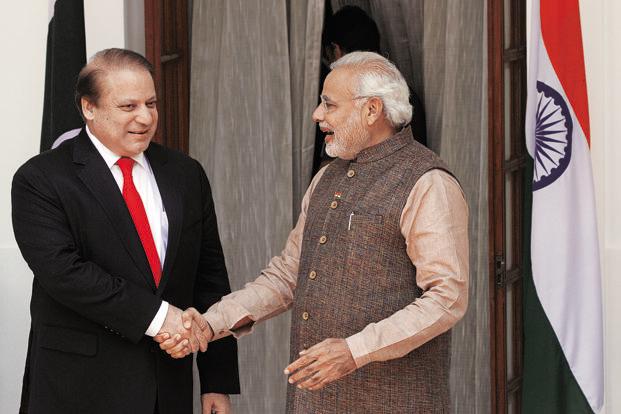
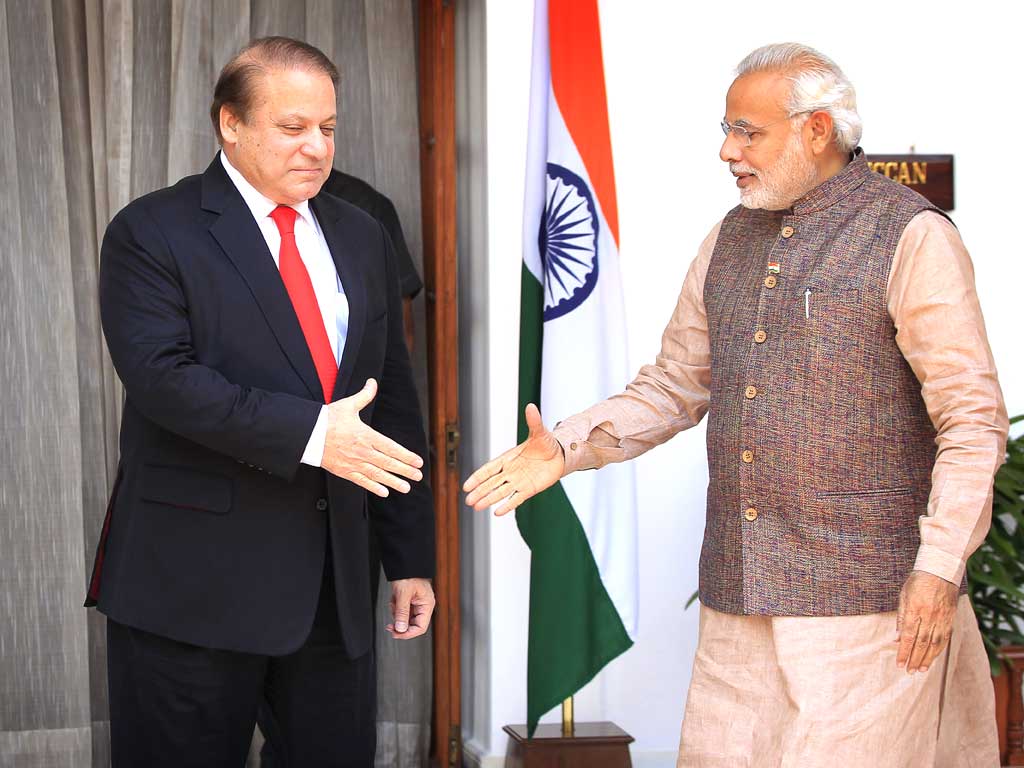
Modi’s Pakistan policy blends a firm response to border provocations with friendly signals. For example, he invited his Pakistani counterpart, Nawaz Sharif, to his inauguration and asked Indian schools to honor the victims of the recent Peshawar attack in Pakistan with a two-minute silence.

At home, Modi has shaken up the diffident foreign-policy establishment with his proactive approach and readiness to break with conventional methods and shibboleths. By taking bold new tacks, Modi is charting a course to boost India’s strategic influence both in its neighborhood and the wider world.

Indeed, Modi has put his stamp on foreign policy faster than any predecessor, other than the country’s first post-independence prime minister, Jawaharlal Nehru. Yet Modi appears to have no intent of enunciating a Modi doctrine in foreign policy. He wants his actions to define his policy trademarks.

His actions have already started speaking for themselves — from his moves to engineer stronger partnerships with Japan and Israel (countries critical to Indian interests but which also courted him even as the U.S. targeted him) to his mortars-for-bullet response to Pakistan’s ceasefire violations. His firm stand at the World Trade Organization on food stockpiling, central to India’s food security, demonstrated that he will stand up even to a powerful, rich nations’ cabal.

More significantly, Modi’s policy appears geared to move India from its long-held nonalignment to a contemporary, globalized practicality. This means from being nonaligned, India is likely to become multialigned, even as it tilts more toward the U.S. and other democracies in Asia and Europe. Yet, importantly, India will continue to chart its own independent course. For example, unlike Japan, it has refused to join American-led financial sanctions against Russia.

After a long era of ad hoc and reactive Indian diplomacy, the new clarity and vision Modi represents is widely seen as a welcome change for India.

Brahma Chellaney is a geostrategist and the author, most recently, of “Water, Peace, and War” (Rowman & Littlefield).

From a nonaligned to multialigned India?

Brahma Chellaney, Nikkie Asian Review

When a country hosts Chinese President Xi Jinping, Russian President Vladimir Putin and U.S. President Barack Obama in rapid succession for bilateral meetings, it demonstrates its ability to forge partnerships with rival powers and broker cooperative international approaches in a changing world. This is exactly what India is doing under Prime Minister Narendra Modi in a display of diplomatic footwork that recently prompted the Russian ambassador to India, Alexander Kadakin, to publicly remark: “India is a rich fiancee with many bridegrooms.”

Indian Prime Minister Narendra Modi, right, shakes hands with Russian President Vladimir Putin ahead of their meeting in New Delhi on Dec. 11. Modi will receive U.S. President Barack Obama in January. © Reuters

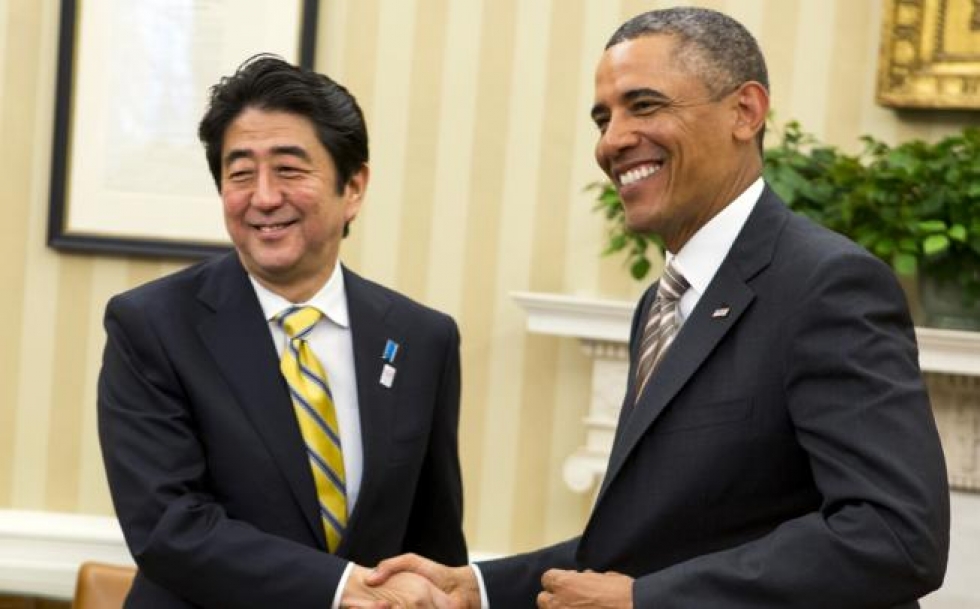
At a time when a new U.S.-Russia Cold War appears to be brewing, Modi — just after hosting Putin — will receive Obama in January, marking the first time an American president will have the honor of being the chief guest at India’s Jan. 26 Republic Day parade. The charismatic Modi, who won Time magazine’s recent reader poll for “Person of the Year” with his rock star-like following, has also sought to strengthen bilateral partnerships with other key players, including Japan, Australia and Israel. For example, his much-photographed bear hug with Japanese Prime Minister Shinzo Abe has come to symbolize the dawn of an alliance between the world’s largest democracy and Asia’s oldest (and richest) democracy.

Since sweeping to power in May in India’s biggest election victory in a generation, Modi has shaken up the country’s reactive and diffident foreign-policy establishment with his proactive approach and readiness to break with conventional methods and shibboleths. The Modi foreign policy appears geared to move India from its long-held nonalignment to a contemporary, globalized practicality.

In essence, this means that India — a founding leader of the nonaligned movement — is likely to become multialigned. Building close partnerships with major powers to pursue a variety of interests in diverse settings will not only enable India to advance its core priorities but will also help to preserve strategic autonomy, in keeping with its longstanding preference for policy independence.

In the last quarter century, the world witnessed the most profound technological, economic and geopolitical changes in the most compressed timeframe in modern history. But much of India’s last 25 years was characterized by political weakness and drift, resulting in erosion of its regional and extra-regional clout. For example, the gap in power and stature between China and India widened significantly in this period. A 2013 essay in the journal Foreign Affairs, entitled “India’s Feeble Foreign Policy,” focused on how India is resisting its own rise, as if political drift had turned the country into its own worst enemy.

Against this background, Modi — widely known for his decisiveness — has made revitalizing the country’s economic and military security his main priority. So far he has made more impact in diplomacy than in domestic policy, a realm where he must prove he can help transform India. Nevertheless, Modi’s focus on the grand chessboard of geopolitics to underpin national interests suggests a strategic bent of mind.

Modi indeed has surprised many by investing considerable political capital in high-powered diplomacy so early in his term, even though he came to office with little foreign-policy experience. He has succeeded in putting his stamp on foreign policy faster than any predecessor, other than the country’s first post-independence prime minister, Jawaharlal Nehru.

Foreign policy pragmatist

Modi’s actions thus far suggest a clear intent to recoup India’s regional losses and to boost its global standing. One trademark of Modi’s foreign policy is that it is shorn of ideology, with pragmatism being the hallmark. In fact, India’s new leader has demonstrated a knack to employ levelheaded ideas in both domestic and foreign policies to lay out a nondoctrinaire vision and to win public support. For example, he has launched a “Make in India” mission to turn the country into an export-driven powerhouse like China and Japan and to transform it from being the world’s largest importer of weapons to becoming an important arms exporter. Modi’s clarity and vision, coming after a long era of ad hoc, reactive Indian diplomacy, is seen as a welcome change for India.

To be sure, the Modi foreign policy faces major regional challenges, exemplified by an arc of failing, revanchist or scofflaw states around India. India’s neighborhood is so chronically troubled that the country faces serious threats from virtually all directions. This tyranny of geography demands that India evolve more dynamic and innovative approaches to diplomacy and national defense. India must actively involve itself regionally to help influence developments, which is what Modi is attempting to do.

A broader and more fundamental challenge for him is to carefully balance closer cooperation with major players in a way that advances India’s economic and security interests, without New Delhi being forced to choose one power over another. One balancing act, for example, is to restore momentum to a flagging relationship with Moscow while boosting ties with the U.S., which has quietly overtaken Russia as the largest arms supplier to India.

Even though Modi told Putin during a summit of BRICS countries — Brazil, Russia, India, China and South Africa — in Brazil in July that “every person, every child” in India knows Russia is the country’s “biggest friend,” the reality is that the India-Russia camaraderie of the Cold War era has been replaced by India-U.S. bonhomie. Modi must stem the new risks as Russia moves closer to India’s strategic rivals — selling top-of-the-line weapon systems to China and signing a military-cooperation agreement with Pakistan in November.

Despite the challenges confronting Modi, India seems set to become multialigned, while tilting more toward the U.S. and other democracies in Europe and Asia. Yet, importantly, India will also continue to chart its own independent course. For example, it has rebuffed U.S. pressure to join American-led financial sanctions against Russia and instead has publicly emphasized “the need to defuse Cold War-like tensions that are increasingly manifesting themselves in global relations.” A multialigned India pursuing omnidirectional cooperation for mutual benefit with key players will be better positioned to expand its strategic influence and promote peace and cooperation in international relations.

Because of its geographical location, India is the natural bridge between the West and the East, and between Europe and Asia. Through forward thinking and a dynamic foreign policy, India can truly play the role of a facilitator and soother between the East and the West, including serving as a link between the competing demands of the developed and developing worlds. At a time of heightened geopolitical tensions, the world needs such a bridge-builder.

Brahma Chellaney is a professor of strategic studies at the independent Center for Policy Research in New Delhi and the author of “Water: Asia’s New Battleground,” the winner of the 2012 Bernard Schwartz Award.

Deconstructing the Modi foreign policy

BRAHMA CHELLANEYThe Hindu, December 4, 2014

India — home to more than a sixth of the human race — punches far below its weight. Internationally, it is a rule-taker, not a rule-maker. A 2013 essay in the journal Foreign Affairs, titled “India’s Feeble Foreign Policy,” focused on how India is resisting its own rise, as if political drift had turned the country into its own worst enemy.

Since the Berlin Wall fell 25 years ago, the world has witnessed the most-profound technological, economic and geopolitical change in the most-compressed time frame in history. Unfortunately for India, despite its impressive economic growth overall, much of its last 25 years has been characterized by political weakness and drift. For example, between 1989 and 1998, India had a succession of six weak governments. It is not an exaggeration to call Prime Minister Manmohan Singh’s two terms “the lost decade” for India strategically.

Waning regional influence

The result of the prolonged leadership crisis has been a sharp erosion in India’s regional and extra-regional clout. The gap in power and stature between China and India has widened significantly. After all, this was the quarter-century in which China took off.

More troubling has been India’s shrinking space in its own strategic backyard. Even tiny Maldives had the gall to kick India in the chin and get away with it. It kicked out its Indian airport operator from the capital Male and publicly dressed down the Indian Ambassador without fear of consequences. In Nepal, India found itself competing with China. And in Sri Lanka, India became content to play second fiddle to China.

The paradox is that India’s economy continued to grow even as India’s regional influence waned. This shows that GDP growth by itself cannot translate into stronger foreign policy in the absence of a dynamic, forward-looking leadership and cogent, strategic goals. In fact, when India was economically weak under Indira Gandhi, it had a fairly robust foreign policy, with no neighbour daring to mess with it.

Job_9086Against this background, the political rise of Narendra Modi — known for his decisiveness — could be a potential game-changer. It is too early to define, let alone judge, his foreign policy, given that Mr. Modi has been in office for just six months. Yet, as he focuses on revitalizing the country’s economic and military security, five things stand out.

First, Mr. Modi continues to invest considerable political capital in high-powered diplomacy so early in his term. Critics may contend that his exceptionally busy foreign-policy schedule, coupled with campaign meetings in serial state elections, leaves him restricted time to focus on his most critical responsibility — domestic issues, which will define his legacy.

Powered by ideas

No previous Indian Prime Minister participated in so many high-powered multilateral and bilateral summits in his or her first months in office as Mr. Modi. U.S. President Barack Obama’s high-profile visit in January will keep national attention on diplomacy. To be sure, Mr. Modi’s focus on the grand chessboard of geopolitics to underpin national interests suggests a strategic bent of mind that only one previous Prime Minister credibly demonstrated — Indira Gandhi.

Second, the Modi foreign policy is powered by ideas, not by any ideology. Indeed, Mr. Modi has demonstrated a knack to skilfully employ level-headed ideas to shape a non-doctrinaire vision and galvanize public opinion. On domestic policy, too, he is using the power of ideas, such as “Swachh Bharat” (or Clean India). In the strategic domain, he is taking his “Make in India” mission to the heavily-import-dependent defence sector. The real test ultimately will be Mr. Modi’s ability to translate his ideas into transformative accomplishments.

Third, he has projected a nimble foreign policy with pragmatism as its hallmark. Nothing better illustrates this than the priority he has accorded — by shaking off U.S. visa-denial humiliation heaped on him over nine years — to restoring momentum to the relationship with America. Mr. Obama’s scheduled visit as chief guest at Republic Day represents both a thank you to Mr. Modi for rising above personal umbrage and an effort to lift the India-U.S. relationship to a higher level of engagement through the major new opportunities being opened up for American businesses by Mr. Modi’s commitment to pro-market economic policies and defence modernization.

The U.S. already conducts more military exercises with India than with any other country. And in recent years, it has quietly overtaken Russia as the largest arms supplier to India.

Food security issue

Fourth, Mr. Modi has put his stamp on foreign policy faster than any predecessor, other than Jawaharlal Nehru. Yet, he appears to have no intent to enunciate a Modi doctrine in foreign policy. In contrast to the meretricious “Gujral Doctrine,” which delivered little more than words, Mr. Modi wants his actions to define his policy trademarks.

In fact, his actions have started speaking for themselves — from his moves to engineer stronger partnerships with Japan and Israel (countries critical to Indian interests but which also courted him even as the U.S. targeted him) to his mortars-for-bullet response to Pakistani ceasefire violations. His firm stand at the World Trade Organization (WTO) on the food-stockpiling issue, central to India’s food security, stood out.

After vetoing the WTO’s Trade Facilitation Agreement in Geneva, Mr. Modi made the U.S. climbdown on the food-stockpiling issue, yet earned praise from Mr. Obama for helping to break the impasse. Even the head of the U.N.’s International Fund for Agricultural Development backed the veto, saying the real choice for India in Geneva was between “feeding” its citizens and “creating jobs” for wealthy economies. After all, the main providers of agricultural subsidies are the rich countries plus China.

For monsoon-dependent, drought-prone India, stockpiling food through a minimum support price to farmers serves as an insurance policy against a 1960s-style mortifying situation that saw New Delhi beseeching foreign food aid, including under U.S.’s PL-480 programme. At Bali, however, the Singh government meekly delinked the Trade Facilitation Agreement from a deal on food stockpiling. By agreeing to kick the can on the stockpiling issue to 2017, it put India’s food security at risk in case no deal was reached by that deadline — a probable scenario. Mr. Modi has succeeded in undoing Dr. Singh’s egregious concession by clinching a deal under which the developing countries’ food-stockholding programmes will face no WTO challenge until a permanent solution is found, thus shielding them from pressures indefinitely.

Looking East

Fifth, Mr. Modi — unlike the leaders who preceded him — attaches major significance to diplomatic symbolism. For example, with the opening of the South Asian Association for Regional Cooperation (SAARC) Summit coinciding with the sombre anniversary of the Mumbai terror attacks, he gave the cold shoulder to his Pakistani counterpart, Nawaz Sharif, for refusing to prosecute the masterminds of that Pakistani scripted and executed operation. Mr. Modi publicly shook hands with Mr. Sharif only the following day at the Dhulikhel retreat. In fact, to concentrate on his broader regional and global agenda, Mr. Modi has done well to sideline Pakistan, a noxious issue that weighed down Mr. Atal Bihari Vajpayee’s foreign policy. Mr. Modi, in any event, faces an important dilemma on Pakistan: With whom to engage there? After being politically cut to size by the military establishment, Mr. Sharif is like a parrot perched on the generals’ shoulders, trying to echo their lines on India, even if stutteringly.

To be sure, Mr. Modi faces major regional challenges, exemplified by the arc of failing, revanchist or scofflaw states around India. This tyranny of geography demands that India evolve more dynamic and innovative approaches to diplomacy and national defence. India must actively involve itself regionally to help influence developments, which is what Mr. Modi is seeking to do. Indeed, his priority — apparent from the time he invited regional leaders to his inauguration — is to retrieve India’s lost ground in its strategic backyard.

As Pakistan’s obstructionism at Kathmandu to greater intra-regional cooperation highlighted, SAARC is likely to remain a stunted organisation. India, while building stronger bilateral linkages with other neighbours, must strengthen its “Look East” policy. India indeed has little choice but to look east because when it looks west, it sees only trouble. The entire belt to India’s west from Pakistan to Syria is a contiguous arc of instability and extremism. Looking east allows India to join the economic dynamism that characterizes the region to its east.

For a politician who came to office with virtually no foreign-policy experience, Mr. Modi has demonstrated impressive diplomatic acumen, including in taking bold new directions, charting a vision to reclaim India’s lost strategic clout, holding his ground in talks with world leaders, and responding to provocations by regional foes. Mr. Modi has shaken India’s foreign-policy establishment with his proactive approach and readiness to break with conventional methods and shibboleths.

All in all, the Modi foreign policy appears geared to reinvent India as a more competitive, confident and secure country claiming its rightful place in the world. A robust foreign policy, however, can sustain itself only on the foundation of a strong domestic policy, a realm where Mr. Modi must prove he can help transform India.

(Brahma Chellaney is a geostrategist and author.)

© The Hindu, 2014.

How India can reclaim leverage over the Tibet issue

Brahma Chellaney, Mint, November 12, 2014

Despite booming two-way trade, India-China strategic discord and rivalry is sharpening. At the core of their divide is Tibet, an issue that fuels territorial disputes, border tensions and water feuds.

Beijing says Tibet is a core issue for China. In truth, Tibet is the core issue in Beijing’s relations with countries like India, Nepal and Bhutan that traditionally did not have a common border with China. These countries became China’s neighbours after it annexed Tibet, which, after waves of genocide since the 1950s, now faces ecocide.

China itself highlights Tibet as the core issue with India by laying claim to Indian territories on the basis of purported Tibetan religious or tutelary links, rather than any professed Han Chinese connection. Indeed, ever since China gobbled up the historical buffer with India, Tibet has remained the core issue.

The latest reminder of this reality came when President Xi Jinping brought Chinese incursions across the Indo-Tibetan border on his recent India visit. Put off by the intrusions, Prime Minister Narendra Modi’s government permitted Tibetan exiles to stage protests during Xi’s New Delhi stay, reversing a pattern since the early 1990s of such protests being foiled by police during the visit of any Chinese leader.

imagesHowever, India oddly bungled on Tibet and Sikkim during Xi’s visit — diplomatic goof-ups that escaped media attention.

In response to China’s increasing belligerence — reflected in a rising number of Chinese border incursions and Beijing’s new assertiveness on Arunachal Pradesh and Jammu and Kashmir (J&K) — India since 2010 stopped making any reference to Tibet being part of China in a joint statement with China. It has also linked any endorsement of “one China” to a reciprocal Chinese commitment to a “one India.”

Yet the Modi-Xi joint statement brought in Tibet via the backdoor, with India appreciating the help extended by the “local government of Tibet Autonomous Region of the People’s Republic of China” to Indian pilgrims visiting Tibet’s Kailash-Mansarover, a mountain-and-lake duo sacred to four faiths: Hinduism, Buddhism, Jainism, and Tibet’s indigenous religion, Bon. Several major rivers, including the Indus, the Brahmaputra, the Sutlej and the Karnali, originate around this holy duo.

The statement’s reference to the “Tibet Autonomous Region of the People’s Republic of China” was out of place. It lent implicit Indian support to Tibet being part of China by gratuitously changing the formulation recorded during Premier Li Keqiang’s 2013 visit, when the joint statement stated: “The Indian side conveyed appreciation to the Chinese side for the improvement of facilities for the Indian pilgrims.” Did those in the ministry of external affairs (MEA) who helped draft the statement apprise the political decision-makers of the implications of the new, China-inserted formulation?

After all, the new wording ran counter to India’s position since 2010 — a stance that came with the promise of repairing the damage from India’s past blunders over Tibet, including by Jawaharlal Nehru and Rajiv Gandhi. Nehru, in the 1954 Panchsheel pact, ceded India’s British-inherited extraterritorial rights in Tibet and implicitly accepted the sprawling region’s annexation without any quid pro quo. Under the terms of this accord, India withdrew its “military escorts” from Tibet, and handed over to China the postal, telegraph and telephone services it operated there.

But in 2003, Atal Bihari Vajpayee went further than any predecessor and formally surrendered India’s Tibet card. In a statement he signed with the Chinese premier, Vajpayee used the legal term “recognize” to accept what China deceptively calls the Tibet Autonomous Region as “part of the territory of the People’s Republic of China.”

Vajpayee’s blunder opened the way for China to claim Arunachal Pradesh as “South Tibet,” a term it coined in 2006 to legitimize its attempt at rolling annexation. Had Vajpayee not caved in, China would not been emboldened to ingeniously invent the term “South Tibet” for Arunachal, which is three times the size of Taiwan and twice as large as Switzerland. And since 2010, Beijing has also questioned India’s sovereignty over J&K, one-fifth of which is under Chinese occupation.

In this light, the reference to China’s Tibet region in the Modi-Xi joint statement granted Beijing via the backdoor what India has refused to grant upfront since 2010. This sleight of hand implicitly endorsed Tibet as being part of China without Xi committing to a “one India” policy.

Now consider India’s second mistake — falling for China’s proposal for establishing an alternative route for Indian pilgrims via Sikkim, a state that strategically faces India’s highly vulnerable “chicken’s neck” and where Beijing is working to insidiously build influence.

Ironically, it is by agreeing to open a circuitous alternative route for pilgrims via Sikkim’s Nathula crossing that Beijing extracted the appreciation from India to China’s Tibet government. Given that Kailash-Mansarovar is located close to the Uttarakhand-Nepal-Tibet tri-junction, the new route entails a long, arduous detour — pilgrims must first cross eastern Himalayas and then head toward western Himalayas through a frigid, high-altitude terrain.

Unsurprisingly, the meandering route has kicked up controversy, with the Uttarakhand chief minister also injecting religion to contend that scriptures “recognize only the traditional paths for pilgrimage passing through Uttarakhand.” China currently permits entry of a very small number of Indian pilgrims through just one point — Uttarakhand’s Lipulekh Pass. The Indian foreign ministry, which organizes the Kailash-Mansarovar visits, is to take a maximum of 1,080 pilgrims in batches this year, with no more than 60 travellers in each lot.

One obvious reason China chose the roundabout route via Sikkim is that the only section of the Indo-Tibetan border it does not dispute is the Sikkim-Tibet frontier, except for the tiny Finger Area there. Beijing recognizes the 1890 Anglo-Sikkim Convention, which demarcated the 206-kilometre Sikkim-Tibet frontier, yet paradoxically rejects as a colonial relic Tibet’s 1914 McMahon Line with India, though not with Myanmar.

tibet_china_rail_map_600_20060828The more important reason is that China is seeking to advance its strategic interests in the Sikkim-Bhutan-Tibet tri-junction, which overlooks the narrow neck of land that connects India’s northeast with the rest of the country. Should the chicken’s neck ever be blocked, the northeast would be cut off from the Indian mainland. In the event of a war, China could seek to do just that.

Two developments underscore its strategic designs. China is offering Bhutan a territorial settlement in which it would cede most of its other claims in return for being given the strategic area that directly overlooks India’s chokepoint. At the same time, Beijing is working systematically to shape a Sino-friendly Kagyu sect, which controls important Indian monasteries along the Tibetan border and is headed by the China-anointed but now India-based Karmapa, Ogyen Trinley.

The Indian government has barred Ogyen Trinley — who raised suspicion in 1999 by escaping from Tibet with astonishing ease — from visiting the sect’s headquarters at Rumtek, Sikkim.

Yet — redounding poorly on Indian intelligence — the Mandarin-speaking Ogyen Trinley has been regularly receiving envoys sent by Beijing. In recent years, he has met Han religious figures as well as Xiao Wunan, the effective head of the Asia-Pacific Exchange and Cooperation Foundation. This dubious foundation, created to project China’s soft power, has unveiled plans with questionable motives to invest $3 billion at Lord Buddha’s birthplace in Nepal — Lumbini, located virtually on the open border with India.

Ogyen Trinley — the first Tibetan lama living in exile to include Han Buddhist rituals in traditional Tibetan practices — was recently accused by the head of the Drukpa sect in India of aiding Beijing’s frontier designs by using his money power to take over Drukpa Himalayan monasteries, including in the Kailash-Mansarovar area. Indeed, Himachal Pradesh police in 2011 seized large sums of Chinese currency from the Karmapa’s office.

Since coming up to power, Modi has pursued a nimble foreign policy. His government, hopefully, can learn from its dual mistakes. With China now challenging Indian interests even in the Indian Ocean region, it has become imperative for India to find ways to blunt Chinese trans-Himalayan pressures.

One key challenge Modi faces is how to build leverage against China, which largely sets the bilateral agenda, yet savours a galloping, $36-plus billion trade surplus with India. Modi’s “Make in India” mission cannot gain traction as long as Chinese dumping of goods undercuts Indian manufacturing.

Also, past blunders on Tibet by leaders from Nehru to Vajpayee have helped narrow the focus of Himalayan disputes to what China claims. The spotlight now is on China’s Tibet-linked claim to Arunachal, rather than on Tibet’s status itself.

To correct that, Modi must find ways to add elasticity and nuance to India’s Tibet stance.

One way for India to gradually reclaim its leverage over the Tibet issue is to start emphasizing that its acceptance of China’s claim over Tibet hinged on a grant of genuine autonomy to that region. But instead of granting autonomy, China has make Tibet autonomous in name only, bringing the region under its tight political control and unleashing increasing repression.

India must not shy away from urging China to begin a process of reconciliation and healing in Tibet in its own interest and in the interest of stable Sino-Indian relations. China’s hydro-engineering projects are another reminder that Tibet is at the heart of the India-China divide and why India must regain leverage over the Tibet issue.

That a settlement of the Tibet issue is imperative for regional stability and for improved Sino-Indian relations should become India’s consistent diplomatic refrain. India must also call on Beijing to help build harmonious bilateral relations by renouncing its claims to Indian-administered territories.

Through such calls, and by using expressions like the “Indo-Tibetan border” and by identifying the plateau to the north of its Himalayas as Tibet (not China) in its official maps, India can subtly reopen Tibet as an outstanding issue, without having to formally renounce any of its previously stated positions.

Tibet ceased to be a political buffer when China occupied it in 1950-51. But Tibet can still turn into a political bridge between China and India. For that to happen, China must start a process of political reconciliation in Tibet, repudiate claims to Indian territories on the basis of their alleged Tibetan links, and turn water into a source of cooperation, not conflict.

(c) Mint, 2014.

A broken international system?

PLA aborts Modi’s China reset

Brahma Chellaney, Mint, October 7, 2014

Despite China finally withdrawing its troops from Ladakh’s Chumar area after extracting a concession from India to demolish a key observation post, the tense standoff on the frigid heights of western Himalayas will be remembered as the symbol of Prime Minister Narendra Modi’s abortive effort to reset India’s relationship with Beijing. After assuming office, Modi went out of his way to befriend China, making a series of overtures.

Modi received the Chinese foreign minister before welcoming any other foreign dignitary. His first bilateral meeting with an important head of state was with President Xi Jinping at the BRICS summit in Brazil. Indeed, Modi postponed his own Japan trip so that he met Xi first in Brazil. Furthermore, Xi was given the honour of being the first G-8 head of state to visit India. Not only that, Modi became the first prime minister to receive a foreign leader outside New Delhi — that too on his own birthday.

ximodisabarmati4So when Xi, wearing a Nehru jacket, toasted the birthday of his host at a private dinner on the bank of River Sabarmati in Gujarat, it highlighted Modi’s charm offensive to build a more cooperative relationship with a country that poses the main strategic challenge to India. Such was Modi’s courtship that Xi quoted him as saying “India and China are two bodies in one spirit”.

But the diplomatic love-fest quickly turned into diplomatic discomfiture as news trickled in that hundreds of Chinese soldiers had intruded into Chumar. While Modi was publicly espousing “inch toward miles” as the motto of India-China cooperation, the People’s Liberation Army (PLA) was implementing that call through a fresh action on the ground. Even more galling was the fact that this incursion — the worst in troop numbers in many years — came to epitomize Xi’s birthday gift for Modi.

China has used virtually every high-level visit to flex its muscles while talking peace. For example, China conducted its most-powerful nuclear test ever in 1992 during the first-ever state visit of an Indian president. In 2003, when Atal Bihari Vajpayee was surrendering India’s Tibet card in Beijing at the altar of diplomatic expediency, a PLA patrol intruded 14 kilometres into Arunachal Pradesh and abducted a 10-member Indian security team.

When Chinese leaders have visited India, their trips have been preceded by or coincided with territorial provocations. It was just before President Hu Jintao’s 2006 visit that China began claiming Arunachal Pradesh as “South Tibet”. Likewise, prior to Premier Wen Jiabao’s 2010 trip, Beijing began questioning India’s sovereignty over Jammu and Kashmir, one-fifth of which China occupies. And Premier Li Keqiang’s 2013 visit followed a deep PLA encroachment into Ladakh’s Depsang plateau.

The message that China seeks to deliver through such provocations is that if India does not behave, it seriously risks being taught a 1962-style lesson. Indeed, just as it deceptively accused an ill-prepared India in 1962 of having provoked the Chinese trans-Himalayan invasion, China has used its official media and think-tanks to charge India with intentionally ramping up border tensions during Xi’s visit to exert pressure on China.

Modi thought he could co-opt China as a partner in India’s development and help ease the territorial disputes. But in Chinese strategy, political and economic elements are closely integrated, with hard and soft tactics going hand-in-hand. This was demonstrated by China rattling its sabres while its president was paying a state visit to India.

Even without considering Xi’s “birthday gift” for Modi, his visit was underwhelming in substance. Xi’s $20-billion investment promise is like honey presented on a sharp knife: partaking it will cut India’s interests, including by giving China greater leeway to dump more goods in the Indian market and rake in larger profits. China’s exports to India already are almost 3½ times greater in value than its imports. Yet China’s total investment in India is a trifling $500 million, or only slightly over 1% of its yearly trade surplus with it at present.

Had the trade surplus been in India’s favour on this scale, imagine the kind of pressures China would have brought to bear. Indeed, China has a record of using trade as a political weapon, including against Japan, the Philippines and South Korea. India, by hinging China’s market access on progress in resolving political, territorial and water disputes, can prevent Beijing from fortifying its leverage.

The good news is that Modi is standing up to the pressure from an unyielding and revanchist China, signalling that India will no longer put up with incursions, which escalated significantly over the past seven years under his meek predecessor even as he stayed mum. Modi was so jolted by Xi’s “birthday gift” (the intruding Chinese force numbered 1,000 or more at its peak) that he forthrightly called border peace “an essential foundation” for India-China ties, saying it won’t be possible for the two countries to collaborate meaningfully without peace. Modi knows that China has exposed itself by opening fronts with several neighbours.

The PLA’s growing political clout emboldens its strategy of incremental encroachment through furtive nibbling. The only counter to its aggressive deterrence is offensive defence. But India still clings to defensive defence, deploying border police as its first line of defence against regular PLA troops. The result is that India continues to get blindsided by repeated incursions. It is time for India to reappraise its Himalayan defences, or else its posture of defensive defence will continue to spring nasty surprises.

Brahma Chellaney is professor of strategic studies at the Centre for Policy Research in New Delhi.

© Mint, 2014.

India’s China problem

Brahma Chellaney, The World Post/The Huffington Post

xi-jinping-14Indian Prime Minister Narendra Modi, who swept to power in May with a thumping electoral mandate, faces a major test in diplomacy in the form of bilateral summits this month with three powers central to Indian foreign policy — Japan, China, and the United States. Modi met with Japanese Prime Minister Shinzo Abe in Tokyo on September 1, and will now receive Chinese President Xi Jinping in New Delhi. He will then visit the White House at the end of the month.

China poses the toughest challenge for Modi, although the Indian leader had a good meeting with Xi on the sidelines of the recent summit of BRICS, a grouping of major emerging economies. Their body language at the summit in Brazil indicated the two had formed an easy personal equation.

After assuming office, Modi was quick to reach out to China, negating the assumption of some analysts that his government would be less accommodating toward Beijing than its predecessor. Modi views China, with its massive foreign-exchange reserves, as a potential partner in India’s development. Yet, at a time when the China-India trade relationship is already lopsided, with Beijing exporting three times as much as it imports and treating India as a raw-material appendage of its economy like Africa, Modi must find ways to address this glaring asymmetry while seeking to make a cash-rich China an important partner in India’s developmental priorities.

Another challenge for Modi is to balance such deeper economic engagement with India’s strategic imperatives, including bolstering defenses against China and containing increasing Chinese border provocations. According to figures released by Minister of State for Home Affairs Kiren Rijiju in India’s Parliament recently, Chinese border transgressions this year have exceeded more than one per day, totaling 334 up to August 4.

The often tense relationship between the world’s two most-populous countries holds significant implications for international security and Asian power dynamics. As China and India gain economic heft, they are drawing ever more international attention. However, their underlying strategic dissonance and rivalry over issues extending from land and water to geopolitical influence usually attracts less notice.

The vast Tibetan plateau separated the Indian and Chinese civilizations throughout history, limiting their interaction to sporadic cultural and religious contacts, with political relations absent. It was only after Tibet’s annexation in the early 1950s that Han Chinese military units appeared for the first time on India’s Himalayan frontiers. This was followed by a bloody Himalayan war in 1962.

More than half a century later, their old rifts persist even as new issues have started roiling their relationship, including Beijing’s resurrected claim since 2006 to the sprawling northeastern Indian state of Arunachal Pradesh, almost three times larger than Taiwan. A perceptible hardening of China’s stance toward India is also manifest from other developments, including Chinese strategic projects and military presence in the Pakistan-held portion of Kashmir.

Between 2000 and 2010, China-India trade rose 20-fold, making it the only area where relations have thrived. Yet the booming trade has failed to subdue their rivalry.

At the root of the current Himalayan tensions are China’s persistent efforts to alter the territorial status quo. To be sure, India is not China’s only target: The People’s Liberation Army (PLA) is seeking to also disturb the territorial status quo with several other neighboring countries, including Japan, the Philippines, and Vietnam.

Instead of invading, the PLA has chosen to engage in a steady progression of steps to outwit opponents and create new facts on the ground, whether in the South China Sea or the Indian Himalayas. In this way, it has sought to change the status quo without inviting outright conflict with neighboring countries. While China’s navy and a part of its air force focus on supporting revanchist territorial and maritime claims in the South and East China seas, its army has been active in the mountainous borderlands with India.

To prevent the PLA from further nibbling at its territories, India has been beefing up its military deployments in the two sensitive regions located on the opposite ends of the Himalayas — Ladakh and Arunachal Pradesh. It has also launched a crash program to improve its logistical capabilities through new roads, airstrips, and advanced landing stations along the Himalayas.

More importantly, India is raising a new mountain strike corps to arm itself with quick-reaction ground offensive capabilities against China. This new XVII Corps, with more than 90,000 troops, will cost $10.7 billion and be fully operational within five years. India has already deployed ballistic missile squadrons, spy drones, and Russian-built Sukhoi-30MKI fighterjets in the eastern theater against China.

Still, with the inhospitable Himalayan border difficult to patrol effectively, incursions by PLA troops have increased across the “line of actual control” (LAC) that China itself unilaterally drew when it defeated India in the 1962 Chinese-initiated war. Because the LAC has not been mutually clarified — China reneged on a 2001 promise to exchange maps with India — Beijing disputes each intrusion, claiming its troops are merely on “Chinese land.” To be sure, when challenged by Indian border police, the intruding troops tend to retreat from most points. But the rising pattern of incursions ties down large numbers of Indian border police and army troops along the Himalayas.

Despite China’s belligerence, Modi has gone out of his way to befriend Xi’s government. As prime minister, he received the Chinese foreign minister before welcoming any other foreign dignitary. Modi’s first bilateral meeting with a major state head was with Xi in Brazil. He allowed Xi to advance his India visit to September while postponing his own Japan trip so as to meet with Xi first in Brazil. Xi will be the first leader of a major power to travel to New Delhi for talks with Modi.

Modi sent India’s vice president to the 60th-anniversary celebrations in Beijing of the Panchsheel (Five Principles) treaty of peaceful coexistence, a pact that China used to outfox and outflank India, culminating in the 1962 border war. Modi even agreed to let Shanghai be the headquarters of the new BRICS bank, accepting just a consolation prize for India — an Indian as its first president.

These overtures, however, can barely conceal either India’s anxiety over China’s increasing muscle flexing or Modi’s determination to build close strategic ties with Japan in order to put discreet checks on China’s exercise of its rapidly accumulating power, which risks sliding into arrogance.

China’s strategy of constant outward pressure on its borders not only threatens to destabilize Asia’s status quo but is also pushing countries like India, Japan, and Vietnam to strategically collaborate. Modi’s priority is to ensure stable power equilibrium in Asia.

Brahma Chellaney is a professor of strategic studies at the independent Center for Policy Research in New Delhi and the author, most recently, of “Water, Peace, and War” (Rowman & Littlefield, 2014).

(c) China-United States Exchange Foundation. All rights reserved

India-Japan alliance shapes up

After many rudderless years, India and Japan have prime ministers with a sense of purpose. This has spurred the two nations to forge an alliance.

Brahma Chellaney, Rediff.com

Abe-ModiPrime Minister Narendra Modi returned from Japan with notable gifts, especially a $35-billion Japanese assistance pledge that crowned a host of accords. But, like his predecessors, he will visit the White House bearing gifts, including a $2.5-billion contract for new military helicopters.

This, in a nutshell, explains why Modi’s Japan visit was a watershed, cementing Asia’s new democratic axis and co-opting Tokyo as an important partner in India’s development and a collaborator on mutual security. India and Japan are to cooperate on defense technology, maritime security and military preparedness, including on how to deter aggression and ensure a favorable balance of power in Asia.

For long, with major powers aggressively courting India to get a slice of its rapidly growing market, New Delhi measured success of its diplomacy by how many billions of dollars worth of contracts it doled out at a bilateral summit. It made little effort reciprocally to secure lucrative contracts for Indian industry. As a consequence, India is the only major global economy that remains import-dependent, rather than being export-oriented, and thus relies largely on domestic consumption to fuel its economic growth.

Modi, however, is committed to change that by making India stronger and more robust by reviving slumbering economic growth. He knows there cannot be a better and more reliable partner in India’s development than Japan, especially if his government is to significantly strengthen the country’s manufacturing base, upgrade its rickety infrastructure, create a network of new “smart” cities, and introduce bullet trains.

Japanese technology and investment can help make Modi’s plans a reality. That is why Modi laid emphasis on his “no red tape, only red carpet” message in Japan, saying he is striving to make India more hospitable for corporate activity. “Some people say there is thick red tape in India, but I would like you to believe there is a red carpet in India,” he told Japanese businessmen.

Japanese Prime Minister Shinzo Abe’s $35 billion pledge in private and public investment and financing over the next five years is indeed huge. This funding will be used to improve Indian manufacturing and skills, create “smart cities” and electronics industrial parks, build high-speed rail lines and urban subways, clean up the Ganges, produce clean energy, and accelerate rural development.

But if this $35-billion assistance is to make a major difference, India must address its gaping current account deficit. India’s monthly trade deficit is now running at $11.76 billion, as the figure available for the most recent month (July) shows. The massive trade imbalance with China, which has soared from $1 billion in 2002 to $30 billion in 2013, is at the root of India’s serious current account deficit.

By importing raw materials from India but exporting finished products to it, China has effectively turned asymmetrical trade into an instrument to prevent India’s rise as a peer competitor. China, India’s largest source of imports, is also leveraging its trade and financial clout — including its role as a major supplier of power and telecom equipment and its emergence as a lender to financially troubled Indian companies — to dissuade New Delhi from assertively countering the Chinese strategic encirclement.

Modi recognizes that New Delhi must strategically collaborate with Tokyo to prevent the rise of a Sino-centric Asia, or else India’s world-power aspirations will be stymied for good.

Asia’s balance of power will be determined principally by events in two key regions: East Asia and the Indian Ocean. According to the “Tokyo Declaration for India-Japan Special Strategic and Global Partnership” unveiled during Modi’s visit, these two leading maritime democracies in Asia have agreed to “upgrade and strengthen” their defense relations and work together on advancing security in Asia and the wider Indo-Pacific region, marked by the confluence of the Indian and Pacific Oceans.

As energy-poor countries heavily dependent on oil and gas imports, India and Japan are naturally concerned by China’s mercantilist efforts to assert control over energy supplies and transport routes as well as by its claim to more than 80 percent of the South China Sea, one of the world’s busiest and most-strategic waterways. China, in addition, has unilaterally established an air-defense identification zone (ADIZ) covering territories that it claims (but does not control) in the East China Sea — a dangerous new precedent in international relations.

Make no mistake: China’s “salami slicing” strategy involving the use of military intimidation or force to make furtive, incremental encroachments across land and sea borders has emerged as a key destabilizing element in Asia.

Alluding to China, the Tokyo Declaration says India and Japan “affirmed their shared commitment to maritime security, freedom of navigation and overflight, civil aviation safety, unimpeded lawful commerce, and peaceful settlement of disputes in accordance with international law.” Modi was blunter, telling a Tokyo symposium: “Everywhere around us, we see an 18th century expansionist mind-set — encroaching on another country, intruding in others’ waters, invading other countries, and capturing territory.” This prompted the Global Times — a mouthpiece for China’s rulers — to editorially say that “it is perhaps a fact that he [Modi] embraces some nationalist sentiments against China.”

The new Indo-Japanese axis is pivoted on a mutual recognition that such an alliance can potentially shape Asian geopolitics in much the same way as China’s rise or America’s “pivot” to Asia. Together, Japan and India can impose discreet checks on China’s propensity to flex its muscles and to assert revanchist territorial and maritime claims.

Not surprisingly, Indian and Japanese strategic policies have started evolving in parallel.

Long used to practicing passive, checkbook diplomacy, Japan under Abe is now pursuing a strategy of “proactive contribution to peace” by looking beyond its security ties with the U.S. and building strategic partnerships with militarily capable democracies in the Indo-Pacific region. India, for its part, has progressed from doctrinaire nonalignment to geopolitical pragmatism, the hallmark of Modi’s foreign policy.

After many rudderless years, India and Japan have a prime minister with a sense of purpose and direction. This has not only injected new-found energy in their foreign policy but also is aiding the return of economic confidence in the two countries. Such a trend holds long-term strategic implications. For example, India’s GDP growth in three years could potentially overtake that of China, which faces the specter of a slowing economy.

To be sure, Modi sees the United States as equally important to Indian economic and security interests. Eager to restore momentum to India’s relationship with America, he has shaken off the visa-related humiliations heaped on him by Washington for over nine years and is scheduled to visit the White House on September 30. The U.S. has still not expressed regret for revoking his visa over unproven allegations that he connived in Hindu-Muslim riots in 2002, when he was chief minister of Gujarat state. Yet Modi has decided to place national interest above personal umbrage.

Modi is also reaching out to Beijing in the hope that he can co-opt a cash-rich China as a partner in his mission to economically transform India. But this approach is not without significant risks: For China, trade and economic cooperation is about raking in profits, not about building political bridges. So, booming trade has been no hurdle to its increasing territorial assertiveness. Yet Modi’s overture appears predicated on the belief that growing economic engagement will make Beijing more amenable to a peaceful settlement of border and other disputes.

What makes India’s relationship with Japan special is that it has none of the military and trade tensions that bedevil its ties with China or the political and commercial frictions that jar its relations with America. Between India and Japan, according to Modi, “there is only goodwill and mutual admiration.” Abe has gone to the extent of saying that Japan-India relations hold “the greatest potential of any bilateral relationship anywhere in the world.”

With the economic and security interests of the two countries dovetailing nicely, the process to significantly tap that potential is to be accelerated. Modi urged Abe that the two countries should “strive to achieve in the next five years their relationship’s unrealized potential of the last five decades.” He added that there are “no limits” to cooperation between the two nations and that their actions will help shape the 21st century for Asia.

The Modi trip has helped cement the India-Japan alliance, with the Tokyo Declaration calling the visit’s outcome “the dawn of a new era” in relations between “Asia’s two largest and oldest democracies.” This partnership will strengthen maritime security in the Indo-Pacific region — the world’s leading trade and energy seaway — and shape a healthy and stable Asian power equilibrium, with India serving as the southern anchor and Japan the eastern anchor of this power balance.

Brahma Chellaney is a geostrategist and the author, most recently, of “Water, Peace, and War” (Oxford University Press, 2014).

(c) Rediff.com, 2014.