Brahma Chellaney, Open magazine
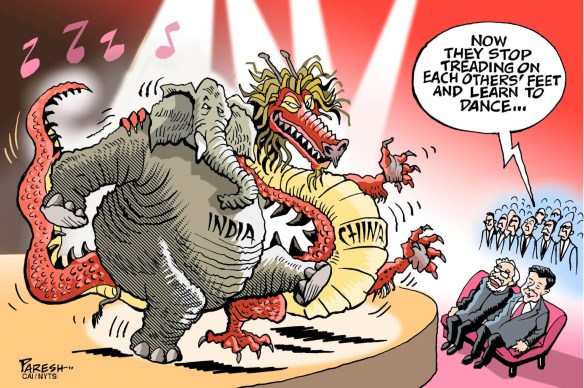
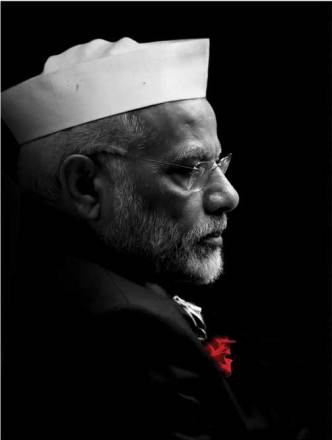 In the four years that he has been in office, Prime Minister Narendra Modi has animated domestic politics in India and the country’s foreign policy by departing often from conventional methods and shibboleths. As he focuses on winning the next general election, the key question is whether the Modi era will mark a defining moment for India, just as Xi Jinping’s ascension to power has been for China. The answer to that question is still not clear. What is clear, however, is that Modi’s stint in office has clearly changed Indian politics and diplomacy.
In domestic politics, Modi has a stronger record: He has led the Bharatiya Janata Party to a string of victories in elections in a number of states, making his party the largest political force in the country by far. Under his leadership, the traditionally urban-focused BJP has significantly expanded its base in rural areas and among the socially disadvantaged classes and spread to the country’s eastern and southern regions. His skills as a political tactician steeped in cold-eyed pragmatism have held him in good stead. Modi, however, has become increasingly polarizing. Consequently, Indian democracy today is probably as divided and polarized as US democracy.
Even before Modi came to power, India’s fast-growing economy and rising geopolitical weight had significantly increased the country’s international profile. India was widely perceived to be a key “swing state” in the emerging geopolitical order. The political stability Modi has brought, coupled with his pro-market economic policies, tax reforms, defence modernization and foreign-policy dynamism, has only helped to further increase India’s international profile. However, India’s troubled neighbourhood, along with its spillover effects, has posed a serious challenge for Modi.
The combustible neighbourhood has underscored the imperative for India to evolve more dynamic and innovative approaches to diplomacy and national defence. For example, with its vulnerability to terrorist attacks linked to its location next to the Pakistan-Afghanistan belt, India has little choice but to prepare for a long-term battle against the forces of Islamist extremism and terrorism. Similarly, India’s ability to secure its maritime backyard, including its main trade arteries in the Indian Ocean region, will be an important test of its maritime strategy and foreign policy, especially at a time when an increasingly powerful and revisionist China is encroaching on India’s maritime space.
It is important to remember that Modi went quickly from being a provincial leader to becoming the prime minister of the world’s largest democracy. In fact, he rode to power in a landslide national-election victory that gave India the first government since the 1980s to be led by a party enjoying an absolute majority on its own in Parliament. One factor that aided Modi’s dramatic rise was clearly the major corruption scandals that marred the decade-long rule of the preceding Congress Party-led coalition government.
Until Modi became the first prime minister born after independence, the wide gap between the average age of political leaders and citizens was conspicuous. But like his predecessors, from Jawaharlal Nehru to Manmohan Singh, Modi took office unschooled in national security. The on-the-job learning of successive leaders, coupled with their reliance on bureaucrats that have generalized knowledge and little time for forward thinking, has blighted national security since independence. Prime minister after prime minister has bypassed institutionalized processes of policymaking and pursued a meandering, personality-driven approach to diplomacy.
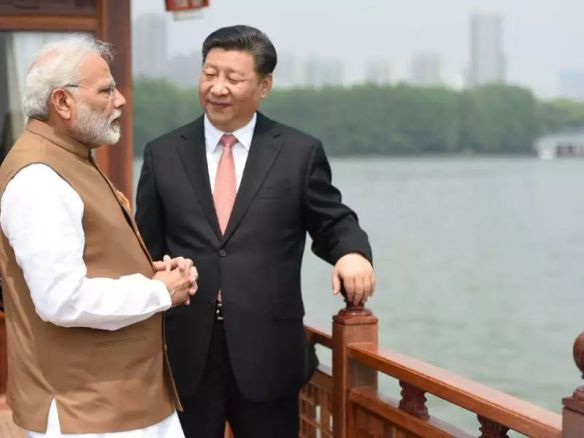
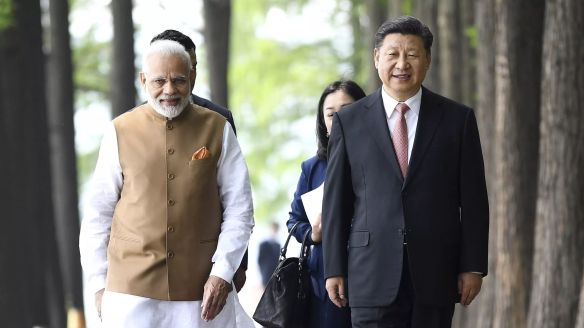
Modi is no exception. In fact, his recent Reset 2.0 with China shows that he does not believe in the “once bitten, twice shy” adage. His Reset 1.0, which was launched soon after he came to office, backfired conspicuously. After taking office, Modi made closer ties with China a priority. He even postponed his Japan visit by several weeks so that his first major bilateral meeting was with Chinese President Xi Jinping, at the BRICS summit in Brazil. His overtures were intended to encourage Beijing to be more cooperative.
Modi’s gamble, however, boomeranged. Xi arrived in India on Modi’s birthday in September 2014 bearing an unusual gift — a deep Chinese military incursion into Ladakh. Relations progressively worsened after that, as China become more hardline on issues ranging from the border to its overt and covert collaboration with Pakistan.
As anyone who has interacted with Modi in person will attest, he is a soft-spoken, attentive and magnetic personality — a contrast to the voluble, rabble-rousing Modi on the campaign trail. Those who meet him are charmed by his disarming ways. That may have helped foster Modi’s abiding faith in the power of his personal diplomacy.
To be sure, Modi has used his personal touch with some effect, addressing several world leaders by their first name and building an easy relationship with them. In keeping with his personalized stamp on diplomacy, Modi has also relied on bilateral summits to try and open new avenues for cooperation and collaboration. Yet, in terms of tangible gains for India, his personal diplomacy has little to show, other than with Japanese Prime Minister Shinzo Abe. For example, Modi’s unannounced visit to Lahore in late 2015, as part of his personal outreach to the then Pakistani Prime Minister Nawaz Sharif, actually engendered a series of Pakistan-orchestrated terrorist attacks on Indian military bases and camps.
Truth be told, Modi’s personal diplomacy mirrors that of the man he intensely dislikes, Nehru. Politically and ideologically, Modi has little in common with Nehru. For example, Modi rose from humble beginnings to lead the world’s most-populous democracy, while Nehru boasted a wealthy lineage. Nehru espoused internationalism, in contrast to the “India first” brand that Modi promoted to come to power. Yet Modi’s foreign-policy approach has a lot in common with Nehru’s. It is indeed ironical that Modi’s faith in his personal diplomacy bears a striking resemblance to the man he and his party abhor.
Foreign policy challenges
India faces major foreign-policy challenges, which by and large predate Modi’s ascension to power. India is home to more than one-sixth of the world’s population, yet it punches far below its weight. A year before Modi assumed office, an essay in the journal Foreign Affairs, titled “India’s Feeble Foreign Policy,” focused on how the country is resisting its own rise, as if the political miasma in New Delhi had turned the country into its own worst enemy.
When Modi became prime minister, many Indians had hoped that he would give a new direction to foreign relations at a time when the gap between India and China in terms of international power and stature was growing significantly. In fact, India’s influence in its own strategic backyard — including Nepal, Sri Lanka, Bangladesh and the Maldives — has shrunk. Today, Bhutan probably remains India’s sole pocket of strategic clout in South Asia. Even in culturally linked Nepal, India now has China as a strategic competitor.
India also confronts the strengthening nexus between its two nuclear-armed regional adversaries, China and Pakistan, both of which have staked claims to substantial swaths of Indian territory and continue to collaborate on weapons of mass destruction. In dealing with these countries, Modi has faced the same dilemma that has haunted previous Indian governments: the Chinese and Pakistani foreign ministries are weak actors. The Communist Party and the military shape Chinese foreign policy, while Pakistan is effectively controlled by its army and intelligence services, which still use terror groups as proxies. Under Modi, India has repeatedly faced daring terrorist attacks staged from Pakistan.
While Modi has found it difficult to contain cross-border terrorist attacks from Pakistan or stem Chinese military incursions across the Himalayan frontier, he has managed to lift the bilateral relationship with the United States to a deeper level of engagement. Modi considers close ties with the US as essential to the advancement of India’s economic and security interests. The US, for its part, sees India as central to its Indo-Pacific strategy. As the White House’s national security strategy report in December put it, “A geopolitical competition between free and repressive visions of world order is taking place in the Indo-Pacific region. The region, which stretches from the west coast of India to the western shores of the United States, represents the most populous and economically dynamic part of the world […] We welcome India’s emergence as a leading global power and stronger strategic and defence partner”.
Still, at a time of greater unpredictability in US policy under President Donald Trump’s administration, Modi has been compelled to balance India’s relations with various powers, in large part because his pro-American foreign policy has failed to secure tangible benefits for the country. Modi’s separate informal summits with Xi in Wuhan and with Russian President Vladimir Putin in Sochi underscore India’s strategic imperative to develop a semblance of balance in relations with different powers, including reversing the declining trajectory of the once-special relationship with Moscow.
The Trump administration’s transactional approach to foreign policy is troubling all US allies and strategic partners. This approach has generated growing American pressures on India, including to slash its $29-billion yearly trade surplus, cut back its ties with Iran and Russia, and desist from imposing diplomatic sanctions on Pakistan, despite the latter’s continued export of terrorists. Trump’s restrictive visa policy, meanwhile, is hurting India’s $150-billion-a-year information technology industry. Washington is also warning that India’s defence transactions with Russia would attract sanctions under the new Countering America’s Adversaries Through Sanctions Act, even as the Trump administration seeks a “flexible waiver authority” from the US Congress to protect relationships with India and others.
Trump’s tightening of the screws on Iran, after withdrawing from the 2015 nuclear deal with that country, is set to compound India’s foreign-policy challenges. America’s preoccupation with Iran and the Middle East creates more space for China to pursue its recidivist actions in the Himalayas, the Indian Ocean and elsewhere. China would likely be the main beneficiary of Trump’s decision to re-impose stringent sanctions against Tehran. Such US sanctions will likely impede India’s transportation corridor to Afghanistan and Central Asia via Iran, including completion of the Chabahar port modernization project. By seeking regime change in Tehran, Trump could relieve US pressure on Iran’s immediate neighbour Pakistan, especially if the CIA were to use that country as a staging ground for covert operations into Iran.
Meanwhile, with the “Russia collusion” sword of Damocles hanging over him, Trump has imposed two rounds of new sanctions against Moscow this year. With escalating US sanctions forcing Russia to pivot to China even as Washington still treats Beijing with kid gloves, India can rely on a capricious and transactional Trump administration only at its own peril. During last summer’s Doklam standoff, for example, Washington did not issue a single statement in India’s favour but chose to stay neutral.
Such realities have led Modi to reach out to other powers in order to increase India’s strategic space and add greater flexibility and manoeuvrability in its foreign-policy strategy. This also helps to explain Modi’s latest effort to improve relations with China. Xi has his own strategic reasons to lower tensions with India at a time when a Western pushback against China’s predatory economic practices is potentially emerging. But Xi is driven by shrewd, tactical calculations. Without Beijing making any concessions to India or even easing its revisionist activities in the Himalayas and the Indian Ocean, Xi believes that he, by encouraging Modi’s overtures, can instil greater caution and reluctance in New Delhi to openly criticize or challenge China.
To be sure, the Modi government has quietly sought to build strategic partnerships with countries around China’s periphery — from Mongolia to Vietnam — so as to counter Beijing’s creeping strategic encirclement of India. But Modi is unlikely to repeat his earlier criticism of China’s military buildup and encroachments in the South China Sea as representing an “18th-century expansionist mindset”. Still, India’s “Act East” policy aims to re-establish historically close ties with countries to the country’s east in order to build a stable balance of power and prevent the emergence of a Sino-centric Asia. As Modi said in an op-ed published in 27 ASEAN newspapers on 26 January 2018 (the day, in a remarkable diplomatic feat, India hosted the leaders of all 10 ASEAN states as chief guests at its Republic Day parade), “Indians have always looked East to see the nurturing sunrise and the light of opportunities. Now, as before, the East, or the Indo-Pacific region, will be indispensable to India’s future and our common destiny”.
Shaping Modi’s legacy
Modi, more fundamentally, sees himself as a practical and spirited leader who likes to play on the grand chessboard of global geopolitics. At a time of increasingly daunting challenges to India’s diplomacy, he is seeking to steer foreign policy in a direction that helps to aid the country’s economic and military security. Modi’s various steps and actions have helped highlight the trademarks of his foreign policy — from pragmatism and minimalism to zeal and showmanship. They have also exemplified his penchant for springing diplomatic surprises.
As his schedule in recent months highlights, Modi continues to invest considerable time and political capital in diplomacy, especially travelling overseas. In addition to maintaining a busy foreign-policy schedule, Modi is often on the campaign trail because India remains almost perennially in the election mode. One state election is followed by another. Modi thus is left with limited time to focus on improving quality of governance and better delivery of public services, although his legacy will largely be shaped by domestic issues. Critics are correct in saying that there has been little improvement in governance under Modi.
The former US secretary of state Madeleine Albright famously said, “The purpose of foreign policy is to persuade other countries to do what we want or, better yet, to want what we want”. How has Modi’s foreign policy done when measured against such a standard of success? The truth is that, in terms of concrete results, Modi’s record thus far isn’t all that impressive. His supporters, however, would say that dividends from a new direction in foreign policy flow slowly and that he has been in office for just four years.
Admittedly, a long period of strategic drift under successive coalition governments undermined India’s strength in its own backyard. Modi, however, has not yet been able to recoup the country’s losses in its neighbourhood. The erosion of India’s influence in its backyard holds far-reaching implications for its security, underscoring the imperative for a more dynamic, forward-looking foreign policy and a greater focus on its immediate neighbourhood. China’s strategic clout, for example, is increasingly on display even in countries symbiotically tied to India, such as Nepal, Sri Lanka and the Maldives. If China were to establish a Djibouti-type naval base in the Maldives or Pakistan, it would effectively open an Indian Ocean front against India in the same quiet way that it opened the trans-Himalayan threat under Mao Zedong by gobbling up Tibet, the historical buffer. China has already leased several tiny islands in the Maldives and is reportedly working on a naval base adjacent to Pakistan’s Chinese-built and -controlled Gwadar port.
Modi has clearly injected dynamism and motivation in Indian diplomacy. But his record also highlights what has long been the bane of the country’s foreign policy — ad hoc and personality-driven actions that confound tactics with strategy. Institutionalised and integrated policymaking is essential for a robust diplomacy that takes a long view. Without healthy institutionalised processes, policy will tend to be ad hoc and shifting, with personalities at the helm having an excessive role in shaping thinking, priorities and objectives. If foreign policy is shaped by the whims and fancies of personalities who hold the reins of power, there will be a propensity to act in haste and repent at leisure, as has happened in India repeatedly since independence.
Today, India confronts a “tyranny of geography” — that is, serious external threats from virtually all directions. But, to a large extent, it is a self-inflicted tyranny. India’s concerns over China, Pakistan, Nepal, Bangladesh, Sri Lanka and the Maldives stem from the failures of its past policies before Modi. With its tyranny of geography putting greater pressure on its external and internal security, India needs to develop more innovative approaches to diplomacy. The erosion of its influence in its own strategic backyard should serve as a wake-up call. India faces a stark choice: ameliorate its regional-security situation to play a larger role or be increasingly weighed down by its region.
A dynamic foreign policy can be built firmly on the foundation of a strong domestic policy, a realm where Modi must overcome political obstacles to shape a transformative legacy. If India is to emerge as a major global economic powerhouse, Modi must make economic growth his first priority and reduce the country’s spiralling arms imports, especially by developing an indigenous defence industry. Unfortunately, Modi’s “Make in India” initiative has yet to take off, with manufacturing’s share of India’s GDP actually contracting.
Modi’s political rise had much to do with the Indian electorate’s yearning for an era of decisive government. Before becoming prime minister, he pledged to qualitatively change governance and strengthen national security. Although he came to office with a popular mandate to usher in major changes, his record in power has been restorative rather than transformative. The transformative moment usually comes once in a generation. Modi failed to seize that moment. He seems to believe in incrementalism, not transformative change. His sheen has clearly dulled, yet his mass appeal remains unmatched in the country.
As for foreign policy, India, despite absorbing greater realism, remains intrinsically cautious and reactive, rather than forward-looking and proactive. India has not fully abandoned its quixotic traditions. India’s tradition of realist strategic thought is probably the oldest in the world. The realist doctrine was propounded by the strategist Kautilya, also known as Chanakya, who wrote the Arthashastra before Christ; this ancient manual on great-power diplomacy and international statecraft remains a must-read classic. Yet India, ironically, appears to have forgotten its own realist strategic thought.
Brahma Chellaney is a geostrategist and the author of nine books, including Water: Asia’s New Battleground, the winner of the Bernard Schwartz Award.
© Open magazine, 2018.

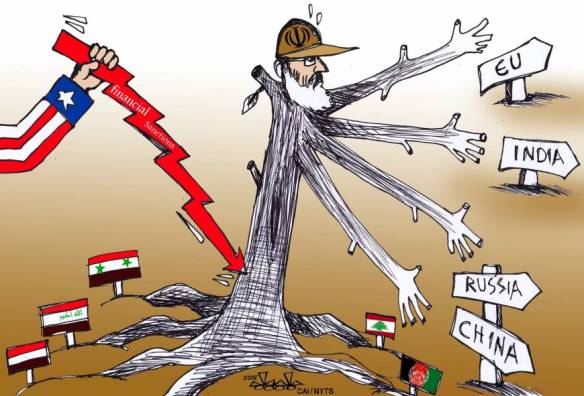
 India is directly in the crosshairs of the new US extraterritorial sanctions targeting Russia and Iran. India is already suffering the unintended consequences of President Donald Trump’s unilateral withdrawal from the Iran nuclear deal — a pullout that has spurred higher oil-import bills, the rupee’s weakening against the US dollar, and increased foreign-exchange outflows. This is just the latest financial hit India has suffered since 2005 when New Delhi, under US persuasion, voted against Iran in the International Atomic Energy Agency’s governing board, prompting Tehran to cancel a long-term LNG deal favourable to India.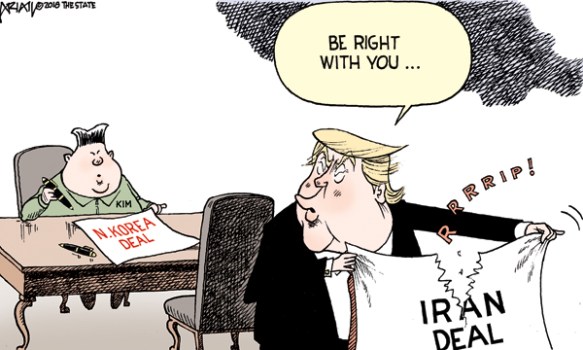
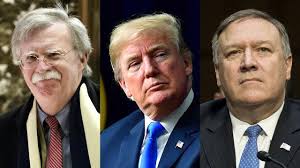 Yet, in the lead-up to the Singapore summit, Trump and Bolton have gratuitously referred to the “Libya model” in the specific context of North Korea. Mentioning the U.S. elimination of Qaddafi, Trump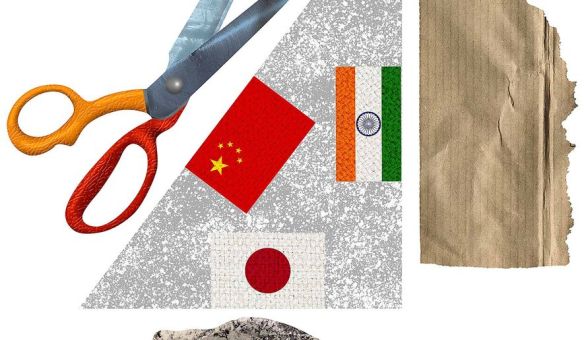


The world’s leading democracy, the United States, is looking increasingly like the world’s biggest and oldest surviving autocracy, China. By pursuing aggressively unilateral policies that flout broad global consensus, President Donald Trump effectively justifies his Chinese counterpart Xi Jinping’s longtime defiance of international law, exacerbating already serious risks to the rules-based world order.
China is aggressively pursuing its territorial claims in the South China Sea – including by militarizing disputed areas and pushing its borders far out into international waters – despite an international arbitral ruling invalidating them. Moreover, the country has weaponized transborder river flows and used trade as an instrument of geo-economic coercion against countries that refuse to toe its line.
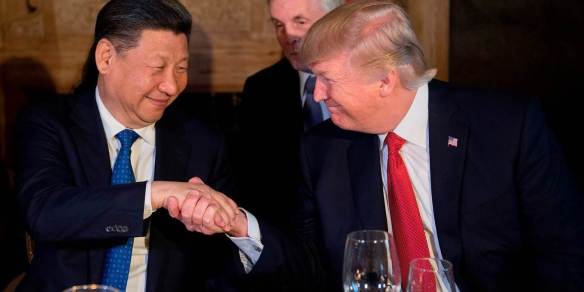
The US has often condemned these actions. But, under Trump, those condemnations have lost credibility, and not just because they are interspersed with praise for Xi, whom Trump has called “terrific” and “a great gentleman.” In fact, Trump’s behavior has heightened the sense of US hypocrisy, emboldening China further in its territorial and maritime revisionism in the Indo-Pacific region.
To be sure, the US has long pursued a unilateralist foreign policy, exemplified by George W. Bush’s 2003 invasion of Iraq and Barack Obama’s 2011 overthrow of Muammar el-Qaddafi’s regime in Libya. Although Trump has not (yet) toppled a regime, he has taken the approach of assertive unilateralism several steps further, waging a multi-pronged assault on the international order.
Almost immediately upon entering the White House, Trump withdrew the US from the Trans-Pacific Partnership (TPP), an ambitious 12-country trade and investment agreement brokered by Obama. Soon after, Trump rejected the Paris climate agreement, with its aim to keep global temperatures “well below” 2°C above pre-industrial levels, making the US the only country not participating in that endeavor.
More recently, Trump moved the US embassy in Israel from Tel Aviv to Jerusalem, despite a broad international consensus to determine the contested city’s status within the context of broader negotiations on a settlement of the Israeli-Palestinian conflict. As the embassy was opened, Palestinian residents of Gaza escalated their protests demanding that Palestinian refugees be allowed to return to what is now Israel, prompting Israeli soldiers to kill at least 62 demonstrators and wound more than 1,500 others at the Gaza boundary fence.
Trump shoulders no small share of the blame for these casualties, not to mention the destruction of America’s traditional role as a mediator of the Israeli-Palestinian conflict. The same will go for whatever conflict and instability arises from Trump’s withdrawal from the 2015 Iran nuclear deal despite Iran’s full compliance with its terms.
Trump’s assault on the rules-based order extends also – and ominously – to trade. While Trump has blinked on China by putting on hold his promised sweeping tariffs on Chinese imports to the US, he has attempted to coerce and shame US allies like Japan, India, and South Korea, even though their combined trade surplus with the US – $95.6 billion in 2017 – amounts to about a quarter of China’s.
Trump has forced South Korea to accept a new trade deal, and has sought to squeeze India’s important information technology industry – which generates output worth $150 billion per year – by imposing a restrictive visa policy. As for Japan, last month Trump forced a reluctant Japanese Prime Minister Shinzo Abe to accept a new trade framework that the US views as a precursor to negotiations on a bilateral free-trade agreement.
Japan would prefer the US to rejoin the now-Japan-led TPP, which would ensure greater overall trade liberalization and a more level playing field than a bilateral deal, which the US would try to tilt in its own favor. But Trump – who has also refused to exclude permanently Japan, the European Union, and Canada from his administration’s steel and aluminum tariffs – pays no mind to his allies’ preferences.
Abe, for one, has “endured repeated surprises and slaps” from Trump. And he is not alone. As European Council President Donald Tusk recently put it, “with friends like [Trump], who needs enemies.”
Trump’s trade tactics, aimed at stemming America’s relative economic decline, reflect the same muscular mercantilism that China has used to become rich and powerful. Both countries are now not only actively undermining the rules-based trading system; they seem to be proving that, as long as a country is powerful enough, it can flout shared rules and norms with impunity. In today’s world, it seems, strength respects only strength.
This dynamic can be seen in the way Trump and Xi respond to each other’s unilateralism. When the US deployed its Terminal High Altitude Area Defense system in South Korea, China used its economic leverage to retaliate against South Korea, but not against America.
Likewise, after Trump signed the Taiwan Travel Act, which encourages official visits between the US and the island, China staged war games against Taiwan and bribed the Dominican Republic to break diplomatic ties with the Taiwanese government. The US, however, faced no consequences from China.
As for Trump, while he has pressed China to change its trade policies, he has given Xi a pass on the South China Sea, taking only symbolic steps – such as freedom of navigation operations – against Chinese expansionism. He also stayed silent in March, when Chinese military threats forced Vietnam to halt oil drilling within its own exclusive economic zone. And he chose to remain neutral last summer, when China’s road-building on the disputed Doklam plateau triggered a military standoff with India.
Trump’s “America First” strategy and Xi’s “Chinese dream” are founded on a common premise: that the world’s two biggest powers have complete latitude to act in their own interest. The G2 world order that they are creating is thus hardly an order at all. It is a trap, in which countries are forced to choose between an unpredictable and transactional Trump-led US and an ambitious and predatory China.