Truth Beyond the Brotherhood

With the passage of time, the transactional elements in the U.S.-Indian partnership have become more conspicuous than the geostrategic dimensions, compounding India’s security dilemmas.

 Brahma Chellaney, Open magazine
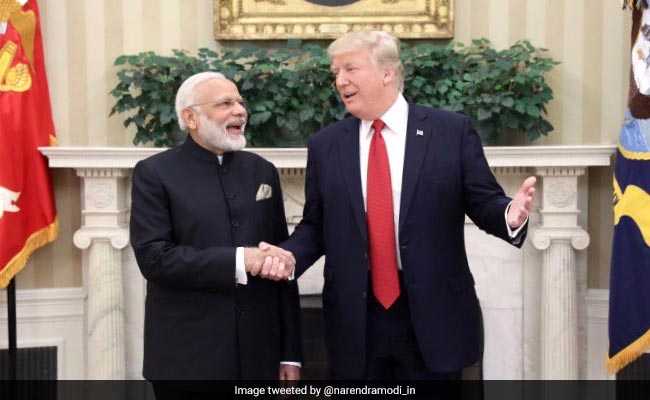
donald-trump-with-pm-modi_650x400_51498518396

U.S. President Donald Trump made it known during his presidential election campaign that he likes India and Indians. Yet, in office, Trump has taken a series of steps in the immigration and trade realms that have adversely impacted India. Prime Minister Narendra Modi had a good first-ever meeting with Trump, although it yielded few deliverables. The two will have another opportunity to meet soon when Germany hosts the annual G-20 summit in Hamburg. Yet it is still not clear how salient India will be in the Trump foreign policy. This is largely because Trump’s larger geopolitical policy framework is still evolving.

The U.S.-India strategic partnership is essentially founded on two pillars — a U.S. commitment to assist, in America’s own interest, India’s rise; and a shared interest in building an inclusive, stable, rules-based Asian order to help manage China’s muscular rise. The hope in India has been that the U.S. would assist its rise in the way it aided China’s economic ascent since the 1970s. President Jimmy Carter, for example, sent a memo to various U.S government departments instructing them to help in China’s rise. Even China’s firing of missiles into the Taiwan Strait in 1996 did not change that policy. If anything, the U.S. has gradually loosened its close links with Taiwan, with no U.S. Cabinet member visiting that island since those missile manoeuvres.

U.S. policy, effectively, helped turn China into an export juggernaut, which today sells $4 worth of goods to the U.S. for each $1 of imports.  In the process, just as the U.S. inadvertently saddled the world with the jihadist scourge by training Afghan mujahedeen — the anti-Soviet guerrillas out of which Al Qaeda evolved — it unintentionally created a rules-violating monster by aiding China’s economic rise. Abusing free-trade rules, China has systematically subsidized its exports while impeding imports to shield domestic jobs and industry. In effect, China has grown strong and rich by quietly waging a trade war. Trump said he told Chinese President Xi Jinping during their Mar-a-Lago summit in April that “we’ve rebuilt China with the money you’ve taken out of the United States.”

India wants the U.S. to buttress the two central pillars of their strategic partnership. Washington’s China “opening” of 1970-1971, engineered by US National Security Adviser Henry Kissinger, was designed in the wake of the 1969 Sino-Soviet military clashes to exploit the rift in the Communist world by aligning China with America’s anti-Soviet strategy. The result was that China, in the second half of the Cold War, became Washington’s partner against the Soviet Union. By comparison, there is no tectonic geopolitical development or calculation motivating the U.S. to assist India’s rise. Rather, the main driver is a transactional calculation — that an economically booming India, just like China’s economic ascent, will be good for American businesses.

Make no mistake: U.S. foreign policy is inherently transactional, with commerce the central plank. Indeed, Trump’s recent visit to the world’s chief ideological sponsor of jihadism, Saudi Arabia, was a reminder that money speaks louder than the international imperative to counter a rapidly metastasizing global jihadist threat. The visit yielded business and investment deals for the U.S. valued at up to almost $400 billion, including a contract to sell $109.7 billion worth of arms to a country that Trump previously accused of being complicit in 9/11.

Trump’s immediate two predecessors, Barack Obama and George W. Bush, did not hide their transactional approach toward a warming relationship with India. For example, the landmark nuclear deal, unveiled in 2005, was pivoted on India boosting its defence transactions with the United States. Consequently, India has emerged as a top U.S. arms client in a matter of years, even as the 12-year-old nuclear deal remains a dud deal on the energy front, with not a single contract signed as yet.

Trump’s weakness, for which he has been widely lampooned, is that he is publicly mercantile and transactional in his foreign-policy approach. His being so commerce-oriented upfront, rather than quietly, as was the case under his predecessors, does not, of course, signify a shift in U.S. policy focus. For example, in the past, the American demand for Indian steps to correct India’s large trade surplus with the U.S. was made in private by a president or publicly by one of his Cabinet members. But Trump articulated that demand forthrightly in his opening remarks at the joint news conference with Modi. “It is important that barriers be removed to the export of U.S. goods into your markets, and that we reduce our trade deficit with your country,” he stated.

The mutual admiration on display during the visit — with Trump lavishing praise on Modi and calling him a “true friend,” and Modi returning the favour to laud Trump’s “vast and successful” business experience — could not obscure the U.S.-India divergence on regional security issues. The Modi visit speeded up Washington’s decision to fill the vacant position of U.S. ambassador to India by naming Kenneth Juster, a senior White House official. Hopefully, the visit will also accelerate the separate inter-agency reviews currently being conducted in Washington on America’s Pakistan and Afghanistan policies.

Take Afghanistan: For nearly 16 years, the U.S. has been stuck in Afghanistan in the longest and most expensive war in its history. It has tried several policies to wind down the war, including a massive military “surge” under Obama to compel the Taliban to sue for peace. Nothing has worked, in large part because the U.S. has continued to fight the war on just one side of the Afghanistan-Pakistan divide and refused to go after the Pakistan-based sanctuaries of the Taliban and its affiliate, the Haqqani network. As Gen. John Nicholson, the U.S. military commander in Afghanistan, acknowledged earlier this year, “It is very difficult to succeed on the battlefield when your enemy enjoys external support and safe haven.” Worse still, the Taliban is conspicuously missing from the U.S. list of Foreign Terrorist Organizations, while the procreator and sponsor of that medieval militia — Pakistan — has been one of the largest recipients of American aid since 2001, when the U.S. invasion of Afghanistan helped remove the Taliban from power.

India is concerned that the U.S. still seeks to preserve the option of reaching a Faustian bargain with the Taliban. No counterterrorism campaign has ever succeeded when militants have enjoyed cross-border havens. The Taliban are unlikely to be routed or seek peace as long as they can operate from sanctuaries in Pakistan, where their top leaders are ensconced. Their string of battlefield victories indeed gives them little incentive to enter into serious peace negotiations. U.S. Defence Secretary Jim Mattis in June signalled a potentially tougher approach to safe havens in Pakistan, saying the U.S. will hit the enemy where it is “fighting from,” which is “not just Afghanistan”. However, only time will be tell whether this was a rhetorical statement or more.

U.S. has long had a blind spot for Pakistan. Today, the key question for Trump on that front is whether to continue the carrots-only approach toward Pakistan of Obama and Bush or finally begin to wield the big stick against a country that defiantly remains wedded to terrorism. To be sure, the tough message to Pakistan in the joint U.S.-India joint statement on the occasion of Modi’s visit was music to Indian ears: “The leaders called on Pakistan to ensure that its territory is not used to launch terrorist attacks on other countries. They further called on Pakistan to expeditiously bring to justice the perpetrators of the 26/11 Mumbai, Pathankot, and other cross-border terrorist attacks perpetrated by Pakistan-based groups”. This was the clearest message to Pakistan that any Indo-U.S. joint statement has incorporated.

Indeed, the Trump-Modi statement also stated: “The leaders stressed that terrorism is a global scourge that must be fought and terrorist safe havens rooted out in every part of the world. They resolved that India and the United States will fight together against this grave challenge to humanity. They committed to strengthen cooperation against terrorist threats from groups including Al Qaida, ISIS, Jaish-e-Mohammad, Lashkar-e-Taiba, D-Company, and their affiliates. India appreciated the United States designation of the Hizbul Mujahideen leader as a Specially Designated Global Terrorist as evidence of the commitment of the United States to end terror in all its forms”.

The Pakistan-based Hizbul Mujahideen leader Syed Salahuddin, who held a joint public rally last December with Lashkar-e-Taiba chief Hafiz Saeed, is the first militant from India’s Jammu and Kashmir to be designated by the U.S. as a global terrorist. The action against Salahuddin, although belated and designed largely to play to the Indian gallery, adds to the number of Pakistan-based individuals designated as terrorists by the U.S. or the United Nations. It thus helps reinforce Pakistan’s image as a leading terrorist hub.

However, it is true that the U.S. has long been reluctant to take concrete action against Pakistan-based individuals that it has labelled “terrorists”, if their terrorism is directed only at India. Take Hafiz Saeed, the mastermind of the cataclysmic 2008 Mumbai terrorist strikes: The U.S. has yet to act five years after putting a $10 million bounty on Saeed’s head. Saeed, who founded the Inter-Services Intelligence agency’s largest front organization, Lashkar-e-Taiba, remains the Pakistani military’s darling, with his public life mocking both America’s bounty on his head and the UN’s inclusion of him on a terrorist list. Washington has refrained from even criticizing Pakistani authorities for aiding and abetting Saeed’s public rallies. The rallies seek to project him as some sort of messiah of the Pakistani people. Saeed’s public role adds insult to injury for India, reinforcing the imperative that it must on its own fight Pakistan’s jihad-inspired war, which shows no sign of abating. Indeed, with Pakistan’s ceasefire violations triggering a fierce Indian response, Pakistani generals since the beginning of 2016 are using their terrorist proxies to target security camps in J&K.

Through both policy inaction and generous aid, the U.S. has effectively turned Pakistan into its terrorist protégé, like Saudi Arabia. Pakistan is a valued asset for China to keep India boxed in, but why does Washington still shield that country? U.S. policy indeed plays into China’s hands by propping up Pakistan and unwittingly helping to cement the Sino-Pakistan nexus. Will Trump fix a broken Pakistan policy that permits the Pakistani military to keep nurturing transnational terrorists? It will be overly optimistic to believe that the U.S. under him will change course fundamentally and apply sustained pressure to encourage a reformed Pakistan at peace with itself.

Compounding matters for India is Trump’s lack of an Asia policy or a larger geostrategic vision that gives primacy to major Asian democracies like Japan and India so as to prevent the emergence of a Sino-centric Asia. Trump came to office vowing to end what he saw as China’s free ride on trade and security issues that has allowed Beijing to flex its muscles more strongly than ever. But in contrast to his tough talk during his presidential campaign, when he famously said he would not “allow China to rape our country,” Trump has sought a cooperative relationship with China grounded in reciprocity. Accordingly, Trump, far from seeking to challenge Beijing’s hegemonic ambitions, has stayed on the same China-friendly path as Obama.

In fact, underscoring how the U.S. still seeks to balance its bilateral relationships with important powers in Asia, Trump invited Xi to Mar-a-Lago — his private estate in Palm Beach, Florida, that he calls the “Southern White House” — because he wanted to offer the leader of the world’s largest autocracy the same hospitality that he extended to the prime minister of China’s archrival, Japan, which is Asia’s oldest democracy. In February, Trump brought Prime Minister Shinzo Abe to Mar-a-Lago on Air Force One for a weekend of working lunches and golf. And in April, he hosted Xi at Mar-a-Lago.

Those Indians getting carried away by Trump’s praise for Modi should know the kind of admiration the U.S. president publicly displayed for Xi. “We have a great chemistry together,” he said about Xi. “We like each other. I like him a lot.” Trump also added that “lots of very potentially bad problems will be going away,” owing to his relationship with the “terrific” Xi.

The mercurial Trump’s honeymoon with Xi (and China), however, appears to be coming to an end. In a stunning admission of failure, Trump tweeted that counting on Xi to address the North Korea challenge hasn’t worked. It was naïve of Trump to rely on Beijing because North Korea has been seeking to escape China’s clutches and pursue direct engagement with Washington. It is possible that Trump may now pursue a tougher line toward Beijing, especially on trade issues. But that may not necessarily be India’s gain, unless he develops a larger geostrategic plan for Asia, including fixing Obama’s unhinged “pivot” policy and treating India as an indispensable partner. At present, Trump scarcely shares India’s concern about Chinese expansionism in its neighborhood and beyond and appears reluctant to aggressively confront Pakistan on its support for terrorist groups.

The growing cosiness in India’s ties with Washington masks New Delhi’s increasing concerns about its deteriorating regional-security environment. China has stepped up strategic pressure on India from different fronts, including deepening its nexus with Pakistan. Even as a pro-U.S. tilt has become pronounced in Indian foreign policy over the past one decade, with India emerging as a leading U.S. arms client, the relationship with Washington offers no answers to New Delhi’s security dilemmas. Trump, besieged by allegations of collusion between his campaign associates and Russia, has little space to fundamentally revamp U.S. foreign policy, including on Pakistan and China. The more things change, the more they tend to stay the same in U.S. foreign policy. India has no choice but to address the security dilemmas — and the regional threats — on its own.

© Open, 2017.
Vladimir Putin’s geopolitical chessboard

p9-chellaney-a-20170606-870x580

, The Japan Times

U.S.-led sanctions against Moscow are helping to create a more assertive Russia determined to countervail American power. The bipartisan support in the U.S. Senate Foreign Relations Committee for additional sanctions, even as a special counsel investigates alleged collusion between U.S. President Donald Trump’s election campaign and Moscow, suggests that the U.S.-Russia relationship is likely to remain at a ragged low.

Despite the Russian economy suffering under the combined weight of sanctions and a fall in oil prices, Moscow is spreading its geopolitical influence to new regions and pursuing a major rearmament program involving both its nuclear and conventional forces. Today, Russia is the only power willing to directly challenge U.S. interests in the Middle East, Europe, the Caspian Sea basin, Central Asia and now Afghanistan, where America is stuck in the longest war in its history.

Put simply, the U.S.-led Western sanctions since 2014 are acting as a spur to Russia’s geopolitical resurgence.

In keeping with the maxim that countries have no permanent friends or enemies, only permanent interests, Russia has rejiggered its geopolitical strategy to respond to the biting sanctions against it. Russian President Vladimir Putin has significantly expanded the geopolitical chessboard on which Moscow can play against the United States and NATO.

Historically, strongman governments facing domestic challenges have whipped up nationalism by rallying popular support against foreign adversaries. Who better to blame for Russia’s economic travails than the sanctions-imposing U.S. and its allies? Putin’s jaw-droppingly high approval ratings contrast starkly with the deepening unpopularity at home of his U.S. counterpart.

Putin has shown himself to be a very skilled player of geopolitical chess. Despite Russia’s gross domestic product shrinking to below that of Italy, Putin has managed to build significant Russian clout in several regions. The blunders of Western powers in Iraq, Libya and Yemen, of course, have aided Russian designs in the Middle East.

Putin has made Russia the central player in the bloody Syrian conflict, fueled by outside powers. Until Russia launched its own air war in Syria in September 2015, the U.S.-British-French alliance had the upper hand there, aiding supposedly “moderate” jihadist rebels against Syrian President Bashar Assad’s government and staging separate bombing campaigns against the Islamic State terrorist organization. Russia’s direct intervention, without bogging down its military in the Syrian quagmire, has helped turn around Assad’s fortunes and reshaped Moscow’s relationships with Turkey, Israel and Iran.

As part of his multidimensional chess game, Putin is also building Russian leverage in other countries that are the key focus of U.S. attention — from North Korea to Libya. But it is Russia’s warming relationship with the medieval Taliban militia — the U.S. military’s main battlefield foe in Afghanistan — that has stood out.

Russia’s new coziness with the Taliban, of course, does not mean that the enemy of its enemy is necessarily a permanent friend. Putin is opportunistically seeking to use the Taliban as a tool to weigh down the U.S. military in Afghanistan.

Because of the Taliban’s command-and-control base and guerrilla sanctuaries in Pakistan, Moscow has also sought to befriend that country. This imperative has been reinforced by the continued U.S. unwillingness to bomb the Taliban’s command and control in Pakistan.

The revival of the “Great Game” in Afghanistan is just one manifestation of the U.S.-Russian relationship turning more poisonous. Another sign is Moscow’s stepped-up courting of China. The U.S.-led sanctions have compelled Russia to pivot to China. Putin attended the recent “One Belt, One Road” summit in Beijing despite his concern that China is using that project to displace Russia as the dominant influence in Central Asia.

To be clear, Russia’s growing ties with India’s regional adversaries, China and Pakistan, have introduced strains in the traditionally close relations between Moscow and New Delhi. The paradox is that as India has moved strategically closer to the U.S., American policy has propelled Russia to forge closer ties with Beijing and to build new relationships with the Taliban and Pakistan.

The Russia-U.S. equation has a significant bearing on Asian and international security. Trump came into office taking potshots at the Chinese leadership but wanting to be friends with Russia. However, the opposite has happened: America’s relationship with Russia, according to U.S. Secretary of State Rex Tillerson, has hit its lowest point in years while Trump has developed a strong personal relationship with China’s top autocrat, Xi Jinping, who welcomes his mercantile, transactional approach to foreign policy.

This pirouette has happened because, in reality, Trump is battling those who, in the 21st century, are unwilling to forgo a Cold War mentality. Washington may be more divided and polarized than ever but, on one issue, there remains strong bipartisanship — Russia phobia. This has come handy to those seeking to inflict death by a thousand cuts on the Trump presidency, including by calculatedly leaking classified information and keeping the spotlight on the alleged Russia scandal in which there is still no shred of evidence of collusion between the Trump campaign and Moscow.

Against this backdrop, America’s sanctions against Russia are unlikely to go, despite clear evidence that they are fostering increasing Moscow-Beijing closeness by making Russia more dependent on China. The sanctions effectively undercut a central U.S. policy objective since the 1972 “opening” to Beijing by President Richard Nixon — to drive a wedge between China and Russia.

For Putin, the sanctions represent war by other means and a justification for him to make his next moves on the grand chessboard. With U.S. Senate Foreign Relations Committee Chairman Bob Corker determined to slap Moscow with additional sanctions, U.S.-Russian tensions and rivalries will continue to serve as a strategic boon for China even as they roil regional and international security.

Longtime Japan Times contributor Brahma Chellaney is a geostrategist and author.

© The Japan Times, 2017.

India’s nuclear industry deserves a place in the sun

New nuclear power has become increasingly uneconomical in the West but electricity from Indian-made reactors is still competitive.

Brahma Chellaney, Nikkei Asian Review, July 3-9, 2017.

22_06_2017_016_023_010The Indian government recently approved the construction of 10 commercial nuclear power reactors of indigenous design, initiating the largest nuclear building program in the world since the 2011 Fukushima disaster in Japan. The global nuclear power industry is still reeling from that calamity: Just three of Japan’s 42 reactors are currently operating, while France — the poster child for nuclear power — plans to cut its reliance on atomic energy significantly.

New nuclear power has become increasingly uneconomical in the West, in part because of rapidly spiraling plant-construction costs, prompting the U.S. and France to push reactor exports aggressively, including to “nuclear newcomers” such as the cash-laden oil and gas sheikhdoms of the Arabian peninsula. Still, the bulk of the new reactors under construction or planned worldwide are located in just four countries — China, Russia, South Korea and India.

The Indian decision to turn to a “fully homegrown initiative” reflects the continuing problems in implementing a 2005 agreement on nuclear power with the U.S. Nine years after the U.S. Congress ratified the landmark deal, commercialization is still not within sight.

India, duped by its own hype over the nuclear deal, had announced plans to import reactors costing tens of billions of dollars from two U.S.-based vendors, Westinghouse Electric and GE Hitachi Nuclear Energy, and France’s state-owned Areva. The Indian plans helped motivate Toshiba to acquire Westinghouse — a takeover that ultimately proved a huge blunder, plunging Toshiba into a grave financial crisis. Westinghouse filed for bankruptcy protection in March.

One missing link in commercializing the U.S.-India deal has been Japan, which signed a separate civil nuclear agreement with New Delhi only in 2016 after other supplier-nations had already concluded such accords. The Japanese parliament’s approval in early June of the agreement with India clears the legal path for Japanese exports. The accord is to take effect in early July.

Japan is a top nuclear equipment supplier, not merely because Toshiba largely owns Westinghouse. Hitachi has a global nuclear power alliance with GE, while Mitsubishi Heavy has one with Areva. Just one Japan-based company, Japan Steel Works, controls 80% of the international market for heavy nuclear forgings.

The Japanese parliamentary approval, although an important development, has come at a time when Westinghouse, GE Hitachi and Areva — which dominate the international reactor export business — are in a dire financial state, with their futures at stake. These are the companies that were to principally benefit from the U.S.-India nuclear deal, although none had secured a supply contract thus far.

Fading promise

Having invested considerable political capital in the vaunted nuclear deal with the U.S., India today confronts an embarrassing situation: The nuclear power promise is fading globally before New Delhi has signed a single reactor contract as part of that deal. To save face, India, with one of the world’s oldest nuclear energy programs, has embarked on a major expansion of domestically designed power reactors.

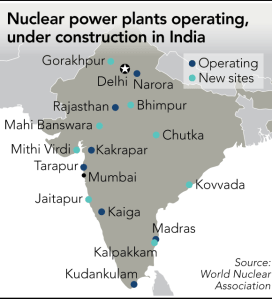
The monumental nature of the decision to construct 10 reactors with 700 megawatts of capacity each is underscored by the fact that the total size of these units surpasses the current installed nuclear generating capacity in the country. India has 22 nuclear reactors in operation which produce 6,219MWe of electricity. The 10 new reactors will be in addition to seven others already under construction which will have a combined capacity of 5,300MWe.

The 10-reactor decision fits well with India’s commitment under the Paris climate accord to reduce reliance on fossil fuels. India is committed to cutting the carbon intensity of its economy by about a third by 2030, including by generating 40% of its electricity from non-fossil fuels. The single-minded focus on carbon, however, threatens to exacerbate India’s water crisis, given the water-guzzling nature of the energy sector, especially nuclear power.

Moreover, U.S. President Donald Trump’s decision to exit the Paris accord has cast unflattering light on the onerous climate-related obligations India has taken on before it has provided electricity to all its citizens. According to a review of global trends by the Netherlands Environmental Assessment Agency the U.S. produces eight times more carbon dioxide emissions than India, on a per capita basis. Under current plans, India will link the last remaining 4,141 villages without power to its electricity grid in 2018, but 24-hour electricity will not be available nationwide to all communities until 2022.

India’s decision to ramp up its nuclear power capacity may contribute little to meeting the 2022 goal, given that the time frame for domestic nuclear plant construction averages seven years. But it will yield major economic dividends, including boosting domestic industry and creating thousands of jobs. By providing $11 billion worth of likely manufacturing orders to Indian industry, the 10-reactor decision will help to transform the domestic nuclear industry, according to Prime Minister Narendra Modi.

By contrast, had India relied primarily on imports of Western reactors to accelerate new capacity additions, the financial costs would have been substantially higher, without tangible benefits accruing to domestic industry. India is already a top weapons importer. Reliance on Western reactors would have made it the world’s largest importer of nuclear power plants — a double whammy for Indian taxpayers, especially given that the country is the only major Asian economy that is import-dependent rather than export driven.

In this light, the travails of the nuclear deal with the U.S. may be a blessing in disguise for India. But for the serious financial woes of Westinghouse, GE Hitachi and Areva — each of which was to build a cluster of reactors at a separate Indian park — Indian taxpayers would have been potentially saddled with plants like Areva’s reactor project in Finland, which is currently almost a decade behind schedule and billions of euros over budget.

Rightful place

To be sure, a dispute with Western suppliers over nuclear accident liability also put a break on India’s reactor-import plans. After India’s 2010 legislation put off foreign reactor vendors by giving plant operators the right of recourse against equipment suppliers in the event of a nuclear accident resulting from substandard equipment or material, New Delhi established a nuclear insurance pool in 2016 to extend protection to suppliers. By then, however, the global nuclear power scene had fundamentally changed due to the impact of the Fukushima disaster.

mapNuclear power may be on a downward trajectory globally, yet it has earned a rightful place in India’s energy mix. The country’s domestic nuclear power industry, without technological assistance from overseas, has done a good job in beating the mean global plant-construction time frame and in producing electricity at a price that is the envy of Western reactor vendors. As a result, power from domestic reactor models is competitive with cheap coal-fired electricity. By contrast, in the U.S., where five reactor closures have been announced since 2013, utilities are seeking greater state subsidies to keep other nuclear plants operating.

India was compelled to establish nuclear autarky, including an independent fuel cycle, because it was excluded from international civil nuclear trade on the grounds that it developed nuclear-weapons capability in 1974 after the Nuclear Non-Proliferation Treaty had already taken effect in 1970. (The five countries that tested bombs before the NPT was concluded were accorded the status of nuclear-weapons states under the NPT.) The Indo-U.S. nuclear deal sought to remedy this situation somewhat by opening civil nuclear commerce to India while recognizing the reality of its nuclear-weapons capability.

For many in India’s governing elite, the nuclear deal with the U.S. — despite the conditions quietly put into the American ratifying legislation — became the acme of their aspirations for the country. They believed the deal would turn the U.S. into India’s enduring benefactor and catapult the country into the big-power league. Years later, for example, New Delhi is still not in the U.S.-led Nuclear Suppliers Group, with China unyielding in its opposition to India’s entry.

A cost-benefit analysis against this background is helping to lower India’s expectations from the nuclear deal. By expanding construction of its own reactor models, India is laying the base for its emergence as a reactor exporter. Compared with the larger reactors of Westinghouse, GE Hitachi and Areva, India’s midsize reactors are better suited for the developing countries, considering their grid limitations.

India may still buy some Western reactors, but the latest decision clearly signals that its focus will be on building its own reactors. It has taken 12 years for Indian hype over the nuclear deal to give way to sober realism. The inward turn reaffirms India’s embrace of a zero-carbon power source and underscores its faith in the likely advent of commercially attractive reactors based not on uranium — a resource it lacks — but on thorium, which it has in plenty.

Brahma Chellaney is a geostrategist and the author of nine books, including the award-winning “Water, Peace, and War.”

© Nikkei Asian Review, 2017.


20170615_India-Nuclear-Plant_article_main_image

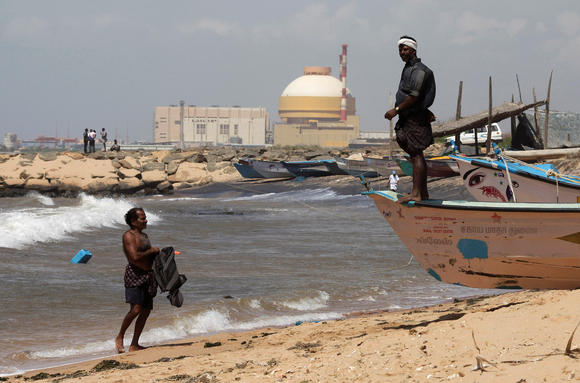
The Kudankulam nuclear power plant seen from a beach in the southern Indian state of Tamil Nadu © Reuters

Modi’s Russia Challenge

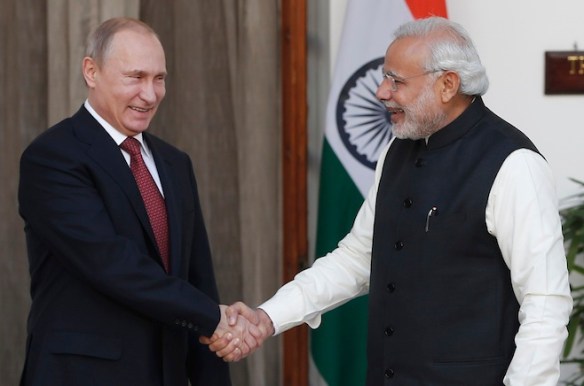
Russian President Putin shakes hands with India's Prime Minister Modi during a photo opportunity ahead of their meeting at Hyderabad House in New Delhi

Brahma Chellaney, The Hindustan Times, June 2, 2017

Indian Prime Minister Narendra Modi’s Russia visit raises a fundamental question: Is Moscow still India’s ‘tried and trusted’ friend? Russia’s growing relations with India’s adversaries, China and Pakistan, have spurred unease in New Delhi. However, many in India have failed to grasp the factors driving Moscow’s overtures to Pakistan or its sale of offensive weapon systems to China.

Such moves have little to do with India. Russia may be in decline economically but, geopolitically, it is a resurgent power, spreading its geopolitical influence to new regions and pursuing rearmament at home. Russia is the only power willing to directly challenge US interests in the Middle East, Europe, Caspian Sea basin, Central Asia and now Afghanistan, where America is stuck in the longest war in its history.

In keeping with the maxim that countries have no permanent friends or enemies, only permanent interests, Russia has rejigged its geopolitical strategy to respond to the biting US-led sanctions against it since 2014. Russian President Vladimir Putin has significantly expanded the geopolitical chessboard on which Moscow can play against the US and NATO.

Putin has made Russia the central player in the bloody Syrian conflict, fuelled by outside powers. Until Russia launched its own air war in Syria in September 2015, the US-British-French alliance had the upper hand there, aiding supposedly ‘moderate’ jihadist rebels against Bashar al-Assad’s regime and staging separate bombing campaigns against ISIS. Russia’s direct intervention, without bogging down its military in the Syrian quagmire, has helped turn around Assad’s fortunes and reshaped Moscow’s relationships with Turkey, Israel and Iran.

As part of his multidimensional chess game, Putin is also building Russian leverage in other countries that are the key focus of US attention — from North Korea to Libya. But it is Russia’s warming relationship with the medieval Taliban — the US military’s main battlefield foe in Afghanistan — that seriously conflicts with India’s interest.

Russia’s new coziness with the Taliban, of course, does not mean that the enemy of its enemy is necessarily a permanent friend. Moscow is opportunistically seeking to use the Taliban as a tool to weigh down the US military in Afghanistan. Because of the Taliban’s command-and-control base and guerrilla sanctuaries in Pakistan, Moscow has also sought to befriend Islamabad. This imperative has been reinforced by the US refusal to bomb the Taliban’s command and control in Pakistan.

The paradox is that as India has moved strategically closer to the US, American policy has worked against India’s regional interests, propelling Russia to forge closer ties with Beijing and to build new relationships with the Taliban and Pakistan. The US still continues to fecklessly accommodate China and battle the Taliban on just one side of the Afghanistan-Pakistan divide. Russia is equally nonchalant if its geopolitical chess play squeezes Indian interests.

The revival of the “Great Game” in Afghanistan is just one manifestation of the US-Russian relationship turning more poisonous. Another sign is Moscow’s stepped-up courting of China. For example, with Russia staying quiet, last year’s BRICS Goa Declaration, at China’s insistence, omitted any reference to cross-border terrorism or to any Pakistan-based group yet mentioned ISIS and al-Nusra. Putin attended the recent “One Belt, One Road” summit in Beijing despite his concern that China is using that project to displace Russia as the dominant influence in Central Asia.

With Russia becoming the largest crude oil exporter to China, Moscow-Beijing ties are booming economically, yet underlying political suspicions and wariness remain. In the India-Russia case, it is the reverse: Relations are warm politically but the two-way trade is in sharp decline, slumping to less than $8 billion in 2015. US-led sanctions against Russia, by promoting Moscow-Beijing closeness, are undercutting a central US policy objective since the 1972 opening to Beijing — to drive a wedge between China and Russia.

For Putin, the sanctions represent war by other means and a justification for Russia to countervail US power. With the US Congress threatening to impose additional sanctions even as a special counsel investigates alleged collusion between President Donald Trump’s election campaign and Moscow, US-Russian tensions and rivalries will continue to buffet India’s regional interests, but serve as a strategic boon for China.

Against this background, Modi faces an exigent challenge to revitalize a flagging partnership with Russia while safeguarding India’s regional security and its $3 billion development aid to Afghanistan since 2002. This challenge is compounded by the fact that a robust relationship with Moscow is vital to a balanced Indian foreign policy, to leveraging India’s ties with other powers, and to managing an increasingly muscular China. A drifting relationship with Russia would crimp India’s options, to its serious detriment.

Brahma Chellaney is a geostrategist and author.

© The Hindustan Times, 2017. 

China’s Imperial Overreach

A column internationally syndicated by Project Syndicate

images

HONG KONG – Chinese President Xi Jinping’s tenure has been marked by high ambition. His vision – the “Chinese dream” – is to make China the world’s leading power by 2049, the centenary of communist rule. But Xi may be biting off more than he can chew.

A critical element of Xi’s strategy to realize the Chinese dream is the “one belt, one road” (OBOR) initiative, whereby China will invest in infrastructure projects abroad, with the goal of bringing countries from Central Asia to Europe firmly into China’s orbit. When Xi calls it “the project of the century,” he may not be exaggerating.

In terms of scale or scope, OBOR has no parallel in modern history. It is more than 12 times the size of the Marshall Plan, America’s post-World War II initiative to aid the reconstruction of Western Europe’s devastated economies. Even if China cannot implement its entire plan, OBOR will have a significant and lasting impact.

Of course, OBOR is not the only challenge Xi has mounted against an aging Western-dominated international order. He has also spearheaded the creation of the Asian Infrastructure Investment Bank, and turned to China’s advantage the two institutions associated with the BRICS grouping of emerging economies (the Shanghai-based New Development Bank and the $100 billion Contingent Reserve Arrangement). At the same time, he has asserted Chinese territorial claims in the South China Sea more aggressively, while seeking to project Chinese power in the western Pacific.

But OBOR takes China’s ambitions a large step further. With it, Xi is attempting to remake globalization on China’s terms, by creating new markets for Chinese firms, which face a growth slowdown and overcapacity at home.

With the recently concluded OBOR summit in Beijing having drawn 29 of the more than 100 invited heads of state or government, Xi is now in a strong position to pursue his vision. But before he does, he will seek to emerge from the National Congress of the Chinese Communist Party later this year as the country’s most powerful leader since Mao Zedong.

Since taking power in 2012, Xi has increasingly centralized power, while tightening censorship and using anti-corruption probes to take down political enemies. Last October, the CCP bestowed on him the title of “core” leader.

Yet Xi has set his sights much higher: he aspires to become modern China’s most transformative leader. Just as Mao helped to create a reunified and independent China, and Deng Xiaoping launched China’s “reform and opening up,” Xi wants to make China the central player in the global economy and the international order.

So, repeating a mantra of connectivity, China dangles low-interest loans in front of countries in urgent need of infrastructure, thereby pulling those countries into its economic and security sphere. China stunned the world by buying the Greek port of Piraeus for $420 million. From there to the Seychelles, Djibouti, and Pakistan, port projects that China insisted were purely commercial have acquired military dimensions.

But Xi’s ambition may be blinding him to the dangers of his approach. Given China’s insistence on government-to-government deals on projects and loans, the risks to lenders and borrowers have continued to grow. Concessionary financing may help China’s state-owned companies bag huge overseas contracts; but, by spawning new asset-quality risks, it also exacerbates the challenges faced by the Chinese banking system.

The risk of non-performing loans at state-owned banks is already clouding China’s future economic prospects. Since reaching a peak of $4 trillion in 2014, the country’s foreign-exchange reserves have fallen by about a quarter. The ratings agency Fitch has warned that many OBOR projects – most of which are being pursued in vulnerable countries with speculative-grade credit ratings – face high execution risks, and could prove unprofitable.

Xi’s approach is not helping China’s international reputation, either. OBOR projects lack transparency and entail no commitment to social or environmental sustainability. They are increasingly viewed as advancing China’s interests – including access to key commodities or strategic maritime and overland passages – at the expense of others.

In a sense, OBOR seems to represent the dawn of a new colonial era – the twenty-first-century equivalent of the East India Company, which paved the way for British imperialism in the East. But, if China is building an empire, it seems already to have succumbed to what the historian Paul Kennedy famously called “imperial overstretch.”

And, indeed, countries are already pushing back. Sri Lanka, despite having slipped into debt servitude to China, recently turned away a Chinese submarine attempting to dock at the Chinese-owned Colombo container terminal. And popular opposition to a 15,000-acre industrial zone in the country has held up China’s move to purchase an 80% stake in the loss-making Hambantota port that it built nearby.

Shi Yinhong, an academic who serves as a counselor to China’s government, the State Council, has warned of the growing risk of Chinese strategic overreach. And he is already being proved right. Xi has gotten so caught up in his aggressive foreign policy that he has undermined his own diplomatic aspirations, failing to recognize that brute force is no substitute for leadership. In the process, he has stretched China’s resources at a time when the economy is already struggling and a shrinking working-age population presages long-term stagnation.

According to a Chinese proverb, “To feed the ambition in your heart is like carrying a tiger under your arm.” The further Xi carries OBOR, the more likely it is to bite him.

p7-chellaney-a-20170527-870x580

Averting an accidental war on the Korean Peninsula

p8-chellaney-a-20170321-870x616

BY BRAHMA CHELLANEY, The Japan Times, March 21, 2017

North Korea’s rapid nuclear and missile advances and America’s rushed deployment of a ballistic missile defense system known as the Terminal High Altitude Area Defense (THAAD) in South Korea have increased the risks of a war on the Korean Peninsula by accident or miscalculation.

U.S. President Donald Trump may be battling the “deep state” at home but, in hastening THAAD’s deployment, his administration has acted proactively to present a fait accompli to the next South Korean president. The new president is to be elected in a snap poll in May after South Korea’s Constitutional Court recently upheld the National Assembly’s impeachment of President Park Geun-hye over alleged corruption. It was the conservative Park who agreed last July to the THAAD placement, triggering grassroots protests, especially in the area where the system was to be deployed.

The THAAD issue increasingly has become divisive in South Korean politics, and the liberals’ presidential hopeful, Moon Jae-in, has said the system’s deployment unnecessarily escalates tensions on the peninsula. However, anticipating that the Constitutional Court would oust Park and that Moon could win the presidential election, the Trump administration began THAAD’s placement early this month.

Trump, during his own election campaign, gleefully challenged diplomatic orthodoxy, including American foreign policy’s long-standing principles and shibboleths. Yet by implementing his predecessor’s THAAD decision with enthusiasm to speed up the system’s deployment, Trump has offered an example of how he is embracing key pillars of the previous administration’s foreign policy.

Two fundamental issues raised by the THAAD placement, however, cannot be obscured.

First, the deployment has been necessitated by the abysmal failure of the U.S.-led strategy to squeeze North Korea with ever-increasing international sanctions while shunning any diplomatic engagement with it. The sanctions-only approach, far from stymieing North Korea’s development of weapons of mass destruction, has only encouraged it to single-mindedly advance its nuclear-weapons and missile capabilities.

In the decade since the United States froze all diplomatic contact with North Korea, that reclusive communist nation has gone from possessing rudimentary WMD capabilities to testing advanced systems that pose a regional threat. For example, it tested a nuclear device last September whose yield, as recorded by outside seismic monitoring stations, was twice as powerful as the atomic bomb that the U.S. dropped on Hiroshima in 1945. Since last year, Pyongyang has also tested solid-fueled missile systems, including one that can launched from a submarine.

And second, the THAAD deployment, although arising from a failed American strategy, is no plausible answer to North Korea’s nuclearization. Indeed, this is a case of the supposed remedy being worse than the disease.

The deployment could counterproductively lead to North Korea (and China, which fears that THAAD’s sophisticated X-Band radar could track its missile forces) aiming to defeat the defensive system by developing greater offensive capability. In fact, China and Russia believe that the THAAD placement is part of a larger American plan to establish a fence of antimissile systems around them and thereby undermine their nuclear deterrents.

Let’s be clear: THAAD cannot credibly protect South Korea from the North’s tactical or short-range ballistic missiles. Designed for high-altitude intercepts, THAAD is geared mainly to interdict medium- and intermediate-range ballistic missiles.

Given South Korea’s relatively small land size, an attack by the North may not necessitate the use of medium- or intermediate-range missiles. Metropolitan Seoul, which has almost as many residents as North Korea’s total population of 25 million, is located just 40 km from the Demilitarized Zone dividing the two Koreas.

North Korea has a virtual artillery choke-hold on Seoul that THAAD cannot neutralize. This is why the U.S. lacks a realistic option to militarily degrade the North’s nuclear and missile capabilities without provoking Pyongyang to unleash its artillery power against Seoul or triggering an all-out war. The absence of credible techno-military options against North Korea is also underscored by the reported failure of the U.S. to undermine Pyongyang’s nuclear and missile programs through coordinated cyber and electronic strikes in recent years.

In this light, THAAD’s political symbolism is greater than its military utility. The system, in any case, has never been battle-tested.

But rather than enhance South Korea’s security, including by reassuring its citizens, the THAAD deployment threatens to make South Koreans more insecure through an action-reaction cycle. For example, the Stalinist regime in Pyongyang may now plan, in a combat scenario, to fire many missiles simultaneously so as to defeat THAAD.

Against this background, a new strategy is needed to stem the growing risk that a small mishap could escalate to a full-fledged war. U.S. President Barack Obama employed sanctions with engagement to clinch a nuclear deal with Iran yet, throughout his eight-year tenure, pursued a completely different approach toward North Korea — sanctions without engagement.

Given that the threat posed by North Korea’s weapons of mass destruction has reached a level defying solution through technological or military means, diplomacy must come into play to reduce tensions. For long, North Korea has sought direct talks with Washington. Trump, during his campaign, said that he would be willing to meet with North Korean ruler Kim Jong Un over a hamburger.

If the THAAD placement is not to prove counterproductive, Washington must shift to a policy of sanctions with engagement toward Pyongyang, with the ultimate goal of clinching a WMD deal as part of a comprehensive peace treaty replacing the Korean War armistice. South Korea has even a bigger stake in engagement with the North in order to reduce the costs it will bear if Korean Peninsula reunification were to occur.

Brahma Chellaney, a longtime contributor to The Japan Times, is a geostrategist and the author of nine books, including “Water, Peace, and War.”

© The Japan Times, 2017.

Trump’s China Challenge

A column internationally syndicated by Project Syndicate.

Photo of Brahma ChellaneyOver the last eight years, as China’s posturing in Asia became increasingly aggressive, many criticized US President Barack Obama for failing to stand up to the Asian giant. It was on Obama’s watch, after all, that China captured the disputed Scarborough Shoal from the Philippines and built seven artificial islands in the South China Sea, on which it then deployed heavy weapons – all without incurring any international costs.

Many expect Obama’s tough-talking successor, Donald Trump, to change all of this. He is not off to a good start.

During the campaign, Trump threatened to retaliate against China for “raping” America on trade, to impose massive tariffs on Chinese imports, and to label China a currency manipulator on “day one.” Soon after his victory, Trump took a congratulatory phone call from the president of Taiwan, thereby breaking with nearly 40 years of diplomatic orthodoxy. Trump then took the matter a step further, publicly suggesting that he would use the “One China” policy as a bargaining chip in bilateral negotiations over contentious economic and security issues – from import taxes to North Korea.

But Trump backed down. Chinese President Xi Jinping made it clear that he would not so much as talk to Trump on the phone without assurance that the US president would pledge fidelity to the One China policy. The call happened, and Trump did exactly what Xi wanted, ostensibly without extracting anything in return. If China now perceives Trump to be all bark and no bite, he will undoubtedly find it harder to secure concessions from China on trade and security issues.

Trump is not the only figure in his administration to stake out a bold position on China, and then retreat meekly. During his Senate confirmation process, US Secretary of State Rex Tillerson declared that the US should “send China a clear signal” by denying it access to its artificial islands in the South China Sea. China’s expansionism in the region, Tillerson asserted, was “akin to Russia’s taking Crimea” from Ukraine – an implicit criticism of Obama for allowing the two developments.

But Tillerson, like his new boss, soon backed down. The US, he now claims, merely needs to be “capable” of restricting China’s access to the South China Sea islands, in the event of a contingency.

And yet China’s behavior merits stronger US action now. The country is attempting to upend the status quo not only in the South China Sea, but also in the East China Sea and the Himalayas. It is working to create a large sphere of influence through its “one belt, one road” initiative. And it is reengineering transboundary river flows. All of this is intended to achieve Chinese leaders’ goal of re-establishing the country’s mythical “Middle Kingdom” status.

Flawed US policy has opened the way for these efforts, in part by helping to turn China into an export juggernaut. The problem isn’t that China has a strong economy, but rather that it abuses free-trade rules to subsidize its exports and impede imports, in order to shield domestic jobs and industry. Today, China sells $4 worth of goods to the US for every $1 in imports.

Just as the US inadvertently saddled the world with the jihadist scourge by training Afghan mujahideen – the anti-Soviet fighting force out of which al-Qaeda evolved – it unintentionally created a rules-violating monster by aiding China’s economic rise. And it sustained its China-friendly trade policy even as China’s abuses became bolder and more obvious.

It is ironic that China, which has quietly waged a trade war for years, has responded to Trump’s threats to impose punitive tariffs by warning – notably, at this year’s World Economic Forum Annual Meeting in Davos – of the risks of protectionism and trade wars. But not everyone is falling for China’s story. A growing number of countries are recognizing that reciprocity should guide their relations with China.

Trump himself may yet challenge China. When he agreed to abide by the One China policy, he said that he had done so at Xi’s request, suggesting that his commitment to the policy should not be taken for granted.

Moreover, even without defying the One China policy, Trump has ample room to apply pressure. He could start by highlighting increasing Chinese repression in Tibet. He could also expand political, commercial, and military contacts with Taiwan, where the One China policy has had the paradoxical effect of deepening people’s sense of national identity and strengthening their determination to maintain autonomy.

In any case, as China continues to pursue its hegemonic ambitions, Trump will have little choice but to pivot toward Asia – substantively, not just rhetorically, as Obama did. To constrain China and bring stability to Asia, he will have to work closely with friends. His efforts to establish a personal connection with Japanese Prime Minister Shinzo Abe – the first foreign leader he hosted at Mar-a-Lago, his “Winter White House” – and the high priority his administration is assigning to relations with India and South Korea are positive signs.

By failing to provide strategic heft to his Asia pivot, Obama left it unhinged. Trump has the opportunity – and the responsibility – to change this. If he doesn’t, China will continue to challenge US allies and interests, with serious potential consequences for Asia and the world.

China’s Debt-Trap Diplomacy

A column internationally syndicated by Project Syndicate

If there is one thing at which China’s leaders truly excel, it is the use of economic tools to advance their country’s geostrategic interests. Through its $1 trillion “one belt, one road” initiative, China is supporting infrastructure projects in strategically located developing countries, often by extending huge loans to their governments. As a result, countries are becoming ensnared in a debt trap that leaves them vulnerable to China’s influence.

Of course, extending loans for infrastructure projects is not inherently bad. But the projects that China is supporting are often intended not to support the local economy, but to facilitate Chinese access to natural resources, or to open the market for low-cost and shoddy Chinese goods. In many cases, China even sends its own construction workers, minimizing the number of local jobs that are created.

Several of the projects that have been completed are now bleeding money. For example, Sri Lanka’s Mattala Rajapaksa International Airport, which opened in 2013 near Hambantota, has been dubbed the world’s emptiest. Likewise, Hambantota’s Magampura Mahinda Rajapaksa Port remains largely idle, as does the multibillion-dollar Gwadar port in Pakistan. For China, however, these projects are operating exactly as needed: Chinese attack submarines have twice docked at Sri Lankan ports, and two Chinese warships were recently pressed into service for Gwadar port security.

In a sense, it is even better for China that the projects don’t do well. After all, the heavier the debt burden on smaller countries, the greater China’s own leverage becomes. Already, China has used its clout to push Cambodia, Laos, Myanmar, and Thailand to block a united ASEAN stand against China’s aggressive pursuit of its territorial claims in the South China Sea.

Moreover, some countries, overwhelmed by their debts to China, are being forced to sell to it stakes in Chinese-financed projects or hand over their management to Chinese state-owned firms. In financially risky countries, China now demands majority ownership up front. For example, China clinched a deal with Nepal this month to build another largely Chinese-owned dam there, with its state-run China Three Gorges Corporation taking a 75% stake.

As if that were not enough, China is taking steps to ensure that countries will not be able to escape their debts. In exchange for rescheduling repayment, China is requiring countries to award it contracts for additional projects, thereby making their debt crises interminable. Last October, China canceled $90 million of Cambodia’s debt, only to secure major new contracts.

Some developing economies are regretting their decision to accept Chinese loans. Protests have erupted over widespread joblessness, purportedly caused by Chinese dumping of goods, which is killing off local manufacturing, and exacerbated by China’s import of workers for its own projects.

New governments in several countries, from Nigeria to Sri Lanka, have ordered investigations into alleged Chinese bribery of the previous leadership. Last month, China’s acting ambassador to Pakistan, Zhao Lijian, was involved in a Twitter spat with Pakistani journalists over accusations of project-related corruption and the use of Chinese convicts as laborers in Pakistan (not a new practice for China). Zhao described the accusations as “nonsense.”

In retrospect, China’s designs might seem obvious. But the decision by many developing countries to accept Chinese loans was, in many ways, understandable. Neglected by institutional investors, they had major unmet infrastructure needs. So when China showed up, promising benevolent investment and easy credit, they were all in. It became clear only later that China’s real objectives were commercial penetration and strategic leverage; by then, it was too late, and countries were trapped in a vicious cycle.

clipboard01Sri Lanka is Exhibit A. Though small, the country is strategically located between China’s eastern ports and the Mediterranean. Chinese President Xi Jinping has called it vital to the completion of the maritime Silk Road.

China began investing heavily in Sri Lanka during the quasi-autocratic nine-year rule of President Mahinda Rajapaksa, and China shielded Rajapaksa at the United Nations from allegations of war crimes. China quickly became Sri Lanka’s leading investor and lender, and its second-largest trading partner, giving it substantial diplomatic leverage.

It was smooth sailing for China, until Rajapaksa was unexpectedly defeated in the early 2015 election by Maithripala Sirisena, who had campaigned on the promise to extricate Sri Lanka from the Chinese debt trap. True to his word, he suspended work on major Chinese projects.

But it was too late: Sri Lanka’s government was already on the brink of default. So, as a Chinese state mouthpiece crowed, Sri Lanka had no choice but “to turn around and embrace China again.” Sirisena, in need of more time to repay old loans, as well as fresh credit, acquiesced to a series of Chinese demands, restarting suspended initiatives, like the $1.4 billion Colombo Port City, and awarding China new projects.

Sirisena also recently agreed to sell an 80% stake in the Hambantota port to China for about $1.1 billion. According to China’s ambassador to Sri Lanka, Yi Xianliang, the sale of stakes in other projects is also under discussion, in order to help Sri Lanka “solve its finance problems.” Now, Rajapaksa is accusing Sirisena of granting China undue concessions.

By integrating its foreign, economic, and security policies, China is advancing its goal of fashioning a hegemonic sphere of trade, communication, transportation, and security links. If states are saddled with onerous levels of debt as a result, their financial woes only aid China’s neocolonial designs. Countries that are not yet ensnared in China’s debt trap should take note – and take whatever steps they can to avoid it.

Nepal’s water curse

Nepal needs bridge over troubled waters

20170127_nepal-river_article_main_image

People ride on a boat to reach the bank of the Rapti River at Sauraha in Chitwan, south of Kathmandu. © Reuters

By Brahma Chellaney, Nikkei Asian Review

Nepal sits on vast water resources. The United Nations describes the landlocked Himalayan state as “one of the Asian countries with the highest level of water resources per inhabitant.” Water can potentially be to Nepal what oil is to Arab sheikhdoms.

Nepal’s renewable water resources are estimated at 7,372 cubic meters per capita annually, or several times higher than those for the two demographic titans between which it is sandwiched — China and India. Yet Nepal, oddly, seems afflicted by a water curse. A failure to adequately harness water resources has left the nation acutely energy-starved, and water shortages are endemic in major Nepalese cities, including the capital, Kathmandu.

Meanwhile, as it increasingly becomes a theater of geopolitical competition between China and India, Nepal is tilting more toward Beijing and away from India, its main partner through the centuries. China, blending economic and security policies, is steadily making strategic inroads. Beijing’s latest deal with Nepal to build another largely Chinese-owned dam there highlights its growing success in clinching major infrastructure contracts in India’s backyard to advance its foreign policy and commercial interests.

Had India tried to secure a contract to set up a largely Indian-owned dam in Nepal, it would likely have faced a nationalistic backlash. Maoists, communists and nationalists in Nepal portray India as a regional hegemon and have seriously impeded its hydropower development plans. China, however, does not face such opposition in communist-dominated Nepal. This helps to explain why the new deal over the planned 750-megawatt West Seti Dam is not the first Chinese hydropower project in the country.

China, through construction projects by Chinese state-run companies and large loans to finance them, is quietly enlarging its presence in and leverage over the increasingly indebted Nepal, which risks becoming its client state. Already, Beijing has used its clout to push Nepal to crack down on Tibetans traveling through Nepal to India, where the Dalai Lama is based.

While dressing its investments in the cloak of economic aid, China is imposing stiff commercial terms on Nepal, plus taking majority project ownership upfront. For example, its state-run China Three Gorges Corporation has picked up a 75% stake in the West Seti Dam project.

Nepal holds up to 83,000 megawatts of hydropower reserves, which, if tapped partially, can make it a major exporter of electricity. By harnessing the natural bounty of the Himalayas to produce renewable electricity, Nepal could emulate the success of Bhutan in generating the hydro dollars to fuel its rapid economic development. Small Bhutan has effectively turned its rich water resources into “blue gold,” achieving the highest per capita income in South Asia.

Power shortages

Nepal, however, produces barely 800 megawatts of electricity for its 30 million citizens from all sources of energy, with the result that long power outages are common even in Kathmandu. Nepal controls the headwaters of, or serves as the corridor for, several rivers that flow into India, yet it imports electricity from that country.

As opposed to China’s water megaprojects at home, smaller and ecologically friendly projects in the Himalayas — if properly planned and designed and conforming to thorough and impartial environmental impact assessments — can yield major benefits without carrying significant environmental and social costs. Environmentally sound hydropower is particularly attractive because, despite the high upfront capital costs, a hydropower plant has a life span almost double that of a nuclear power reactor and generates electricity with no fuel cost.

India, as the subcontinent’s largest energy consumer, has sought to incentivize a subregional energy grid. Yet the vast majority of its own Himalayan hydropower projects have been delayed, suspended or shelved, largely due to grass roots opposition.

India has employed water collaboration as a tool of its diplomacy with Nepal and Bhutan. In Bhutan, India has subsidized the development of environmentally friendly hydropower by providing 60% of the investment for each project as a grant and the remaining amount as a low-interest loan. The projects have helped power Bhutan’s success story.

By contrast, the political dividends from Indo-Nepalese water cooperation have declined over the years, partly because of political constraints in Nepal and partly because India has not been sensitive to Nepalese concerns. Several joint projects have either not been completed or failed to live up to their promise, leaving a troubled legacy that has increasingly weighed down bilateral cooperation.

Bangladesh has actively sought the start of water projects in Nepal to augment the lean-season flows of the Ganges River at Farakka, the critical downriver point where the waters are equally shared between India and Bangladesh under a 1996 treaty. The treaty — which coincided with the 25th anniversary of Bangladesh’s Indian-assisted independence — has set a new principle in international water law by guaranteeing delivery of specific water quantities to downstream Bangladesh in the critical dry season.

Hundreds of rivers, some them originating in Tibet, crisscross Nepal. The country has five major river basins, from the Mahakali in the west to the eastern Kosi. All its river systems empty into the Ganges basin in India. Nepal is also rich in groundwater resources in the southern plains along its long border with India.

Resource curse

Whereas countries afflicted by what development economists call the “resource curse” find it difficult to break out of slow rates of economic growth and high levels of income inequality, despite relying on major exports of natural resources, Nepal’s water curse has come without exploiting its resource reserves for its own needs, let alone exporting hydropower.

No less significant is the fact that Nepal has several water treaties with India but none with China, which has dammed the Karnali River just before it enters Nepal. China is also planning to build a cascade of five dams on the upper reaches of the Arun River. The construction of that cascade, by diminishing flows into the Ganges, could potentially affect India’s Ganges water-sharing arrangement with Bangladesh.

Nepal’s water curse has been compounded by severe political turmoil for the past quarter century. It remains today in a politically shaky position — wracked by underdevelopment, poverty, poor governance and lawlessness and increasingly divided by its murky politics.

The sorry state of affairs in Nepal has seriously hampered its hydropower and irrigation expansion, even though progress in these areas is essential to obtain much-needed revenue and development and to help tame the transboundary rivers that often overrun their banks in Nepalese and Indian areas during the monsoons.

Indeed, the integrated development of the Ganges basin demands trilateral institutional collaboration between the three basin states — Nepal, India and Bangladesh — with cooperation extending to energy, transit and port rights. However, the entry of a non-basin state, China, is muddying the waters. Both through its unilateral dam-building activities in Tibet on the rivers that flow to Nepal, India and Bangladesh, and its entry in the Nepalese hydropower sector, China is compounding the challenges of regional integration.

Breaking the water curse is critical to Nepal’s future. While the mighty Himalayas separate it from Chinese-ruled Tibet, Nepal is tied to India by geography, including multiple shared river basins. Water cooperation with India and Bangladesh can help harness the waters of the common rivers for shared benefit.

But if Nepal remains battered by political turmoil, it risks becoming a failed state — a development that will carry major security implications for India, given the open Indo-Nepalese border that permits passage without documentation or registration.

Brahma Chellaney, a geostrategist, is the author of nine books, including “Water: Asia’s New Battleground.”

© Nikkei Asian Review, 2017.

The World According to the Donald

COVER STORY/Open Magazine/20 January 2017

c2m-2a9viaak-teBy Brahma Chellaney

New US President Donald Trump’s geopolitical focus on China and Islamic radicalism meshes well with Indian strategic priorities. But will his administration add real strategic content to a vaunted ‘strategic partnership’ with New Delhi whose most-prominent feature is the emergence of India as a leading client of the American armament industry?

Trump’s predecessor, Barack Obama, undoubtedly advanced the relationship with India. But it is also true that Obama compounded India’s regional security challenges, both by emboldening China through his meekness toward Beijing and by bolstering China’s ‘contain India through Pakistan’ strategy. While refusing to take sides in the China-India territorial disputes, the Obama administration actually strengthened China’s strategy to box in India by extending munificent US aid to Pakistan, thus encouraging that country to continue to sponsor cross-border terrorism with impunity.

Whether the Trump administration will contribute positively or negatively to India’s regional interests hinges fundamentally on the geopolitical framework that will guide its foreign policy.

Trump ran an election campaign that challenged American diplomacy’s longstanding principles and shibboleths, turning his party’s own establishment against him. This might suggest that his foreign-policy approach would represent a break from the past.

The fact, however, is that the institutional policymaking structure in the US is much stronger than, say, in India. Therefore, it is not easy for a president to break with well-established policies that have been pursued by presidents belonging to both parties. Moreover, the approach and direction of an American president’s foreign policy becomes apparent only after his first year in office.

For example, Obama’s coming to power created high anticipation globally of significant changes in the American foreign-policy approach, with the expectations being strengthened when he surprisingly was awarded the Nobel peace prize less than nine months after assuming office. Yet Obama proved to be as interventionist as any president before him. The chaos in Libya that he sowed through regime change will be remembered—like President George W. Bush’s unravelling of Iraq—as one of his imprints on history.

India needs to play a more active role in influencing policy in Washington. New Delhi has not tried to persuade the US to end its policy of mollycoddling Pakistan by leveraging India’s defence imports from America or by utilising the services of the large and increasingly influential American Indian community.

Obama came to office vowing to end the Bush-era wars in Afghanistan and Iraq. The war in Afghanistan (the longest war in American history) still rages. Obama ended the war in Iraq, only to start a new one there and in Syria. He presided over the birth of a terrorist organisation more potent that Al Qaeda—the Islamic State of Iraq and the Levant, known as ISIS, ISIL or Islamic State. In 2016, Obama’s last year in office, the US dropped more than 26,000 bombs in seven countries, according to one assessment.

By getting the US embroiled in more conflicts, Obama has bequeathed to Trump a Middle East more violent and less stable than the one Obama inherited from Bush in 2009.

Faced with major international challenges, Trump has signalled his intent to revamp American foreign policy so that he can concentrate on his main priority—comprehensive domestic renewal, the central pillar of his promised strategy to “make America great again”. He has also indicated his desire to reverse the interventionist, regime-change policy that successive American presidents have followed since the early 1950s, when the CIA successfully plotted the overthrow of Iranian Prime Minister Mohammad Mossadegh.

Trump’s determination to boost US job growth by eliminating critical roadblocks, including unfair competition from Chinese manufacturers, has set the stage for a tougher American policy on trade. This is also apparent from those he has named to key positions, especially Robert Lighthizer, his nominee for trade representative, Wilbur Ross, his choice to become commerce secretary, and Peter Navarro, the head of the new White House office overseeing trade and industrial policy.

Trump’s trade-related nationalism is linked to the perception that trade liberalisation has contributed to America’s relative decline. For Trump, trade is one area where he must deliver on his campaign promises or risk losing his credibility with the blue-collar constituency that helped him defeat Hillary Clinton.

No country faces a bigger challenge from Trump’s ascension to power than China, which has been flexing its military and economic muscles more strongly than ever. After the Obama administration’s obsequious stance, Beijing must brace up and face an assertive new national security and economic team in Washington that is unlikely to put up with its covert territorial expansion and trade manipulation.

China will likely bear the brunt of Trump’s trade-related nationalism at a time when its economy is slowing despite the state heavily providing fiscal and monetary stimulus. By contrast, the impact on India will be marginal because the fallout will largely be limited to the H-1B visa issue. Trump’s tougher stance on trade with China is unlikely to be deterred by the spectre of a trade war for the simple reason that Beijing is already waging an economic war against major economies.

While subsidising its exporters, China has quietly but systematically been blocking imports. The Obama administration’s announcement last April that China had agreed to scrap export subsidies on some products, mainly agricultural items and textiles, drew scepticism in the international markets because the deal did not cover major exports, including steel. It also left intact other forms of state support to the Chinese industry.

Trump seems willing to call a spade a spade and adopt a tougher and less predictable line toward Beijing, with his choice to become secretary of state, Rex Tillerson, going to the extent of saying that China should be denied access to the artificial islands that it has created in the South China Sea.

China exports $4 worth of goods to the US for each $1 of imports. Its trade with India is even more skewed: It exports nearly $6 worth of goods for each $1 of imports. This mismatch, largely due to the systematic dumping of goods, has allowed China to rapidly double its trade surplus with India to $60 billion just on Prime Minister Narendra Modi’s watch. China’s bilateral trade surplus with the US, of course, is bigger and is equal to about 3 per cent of its entire economy.

The Trump team has clarified that the president is not against free trade but against unfair trade. If China can slap Mongolia with punitive tariffs for merely allowing the Dalai Lama to undertake a purely religious tour, will it be unreasonable for the Trump administration to penalise China likewise for unashamedly distorting free trade?

Of course, the implications for China extend beyond trade. After all, Trump has signalled an imperative to recalibrate America’s foreign policy by shifting its geopolitical focus from Russia—a declining power with a sharply contracting economy—to the increasingly muscular and openly revisionist China. Unlike Russia’s 2014 annexation of Crimea, China’s territorial revisionism, as illustrated in the South China Sea and the Himalayas, is creeping and incremental yet relentless. Also unlike Russia, China sees itself as superior to the rest of the world and seeks to regain its fabled ‘Middle Kingdom’ status.

Abandoning the longstanding US fixation on Moscow and concentrating instead on the more potent, long-term challenge from China makes eminent sense for the Trump administration. In the global geopolitical competition between the US and China, Washington should seek to ensure that Russia stays neutral, if not on America’s side. However, the Obama administration did the opposite—forcing Moscow to pivot to China.

In the Obama era, China’s defiant unilateralism remained cost-free. Indeed, in the dying days of the Obama administration, China rushed more missiles to its man-made islands in the South China Sea, where, on Obama’s watch, it built seven islands and militarised them in an attempt to annex a strategically crucial corridor through which half of the world’s annual merchant fleet tonnage passes.

But now Trump seems willing to call a spade a spade and adopt a tougher and less predictable line toward Beijing, with his choice to become secretary of state, Rex Tillerson, going to the extent of saying that China should be denied access to the artificial islands that it has created in the South China Sea. While Obama remained virtually mum on China’s creeping aggression in the South China Sea, Tillerson has called it “akin to Russia’s taking Crimea” and favoured a strategic payback.

Will Trump try ‘madman diplomacy’ to tame a renegade Pakistan? The plain fact is that only coercive US diplomacy can help break the Pakistan military establishment’s cosy ties with terrorist groups, some of which are among the most dangerous.

China prefers quiet diplomacy, a setting that allows it to play its cards shrewdly. But Trump’s approach is completely different, as is apparent from his statement that, “Everything is under negotiation including One China.” That America’s ‘one-China’ policy since the 1970s is no holy cow for Trump was also apparent earlier from his conversation with Taiwan’s president by telephone. Trump has also turned his Twitter feed into a twenty-first-century version of the bully pulpit, repeatedly castigating Beijing for refusing to play by the rules. President Xi Jinping and his coterie in Beijing are at a loss on how to handle Trump.

Those analysts concerned about Trump’s deal-making approach tend to forget that US foreign policy, essentially, has always been transactional in character. Trump wants to clinch good deals for the US, just as the leader of any nation ought to do.

Another Trump priority is waging war against radical Islamic militancy before it turns into a global jihadist movement. Trump, however, cannot deliver credible or enduring counterterrorism results without disciplining Saudi Arabia, Qatar and the other oil sheikhdoms that continue to export Islamic radicalism. US foreign policy has had a longstanding alliance with Arab monarchs that has continued even as these cloistered royals bankroll Islamic militant groups and in other countries. Trump will also need to abandon the failed US policy on Pakistan that his immediate two predecessors pursued since the September 11, 2001 terrorist attacks in the US.

Had Hilary Clinton won the presidency, we would likely have seen the continuation of America’s failed Pakistan policy, which has involved doling out billions of dollars in US military and civilian assistance to that quasi-failed country without seeking substantive results on the terrorism front. However, the only language Pakistan’s powerful generals understand is of the kind the US delivered right after 9/11 to bend Pakistan to its will. As former Pakistani military dictator Pervez Musharraf has acknowledged in his memoir, he and his fellow generals genuinely believed that unless they met the Bush administration’s demands, they would be ‘bombed back to the stone ages’.

Against this background, as one American analyst has asked, will Trump try ‘madman diplomacy’ to tame a renegade Pakistan? The plain fact is that only coercive US diplomacy can help break the Pakistan military establishment’s cosy ties with terrorist groups, some of which are among the most dangerous in the world.

Yet in his written submissions to the Senate Armed Services Committee during his confirmation hearing process, Defence Secretary-designate James (‘Mad Dog’) Mattis pledged to build ‘trust’ with Pakistan ‘for an effective partnership’. This might suggest that America’s failed Pakistan policy would persist, even though this policy is the main reason why the US military is still stuck in the war in Afghanistan. Trump’s national security adviser, Gen. Michael Flynn, while serving as the US intelligence chief in Afghanistan, and Gen. Mattis, as CentCom chief, established close relations with the Pakistani military establishment. However, the direction of the Pakistan policy will likely be set by Trump himself, with the policy details left to the Cabinet members.

India needs to play a more active role in influencing policy in Washington. For example, it did little in response to Obama’s move nearly a year ago to reward Pakistan with eight more subsidised F-16s and hundreds of millions of dollars in additional aid under the Overseas Contingency Operations fund, which has been dubbed the ‘slush fund’. It was congressional opposition that stymied the planned transfer of additional F-16s. The blunt truth is that New Delhi has not tried to persuade the U.S. to end its policy of mollycoddling Pakistan by leveraging India’s defence imports from America or by utilising the services of the large and increasingly influential American Indian community.

As for Trump, he is already facing resistance to recalibrating US foreign policy from the deep state, which extends to a nexus between the intelligence agencies and major media organisations. To prevent any détente with Russia, powerful interests in Washington have gone to extraordinary lengths to undercut Trump, including by seeking to irreparably dent his image. This underscores the formidable challenge Trump faces to revamp foreign policy.

No president in living memory has taken office with America so politically polarised and divided and the deep state so unwelcoming as Trump, with the outgoing CIA chief actually blasting him on the eve of his inauguration. If Trump succeeds in recalibrating US foreign policy, including relating to China and Pakistan, he will set the stage for a true, robust and enduring partnership with India.

Brahma Chellaney is professor of strategic studies at the Centre for Policy Research in New Delhi and Richard von Weizsäcker Fellow of the Robert Bosch Academy in Berlin. © Open Magazine, 2016.