US sanctions policy risks alienating India

https_s3-ap-northeast-1.amazonaws.compsh-ex-ftnikkei-3937bb4images618015040816-1-eng-GBRTR4GK5D

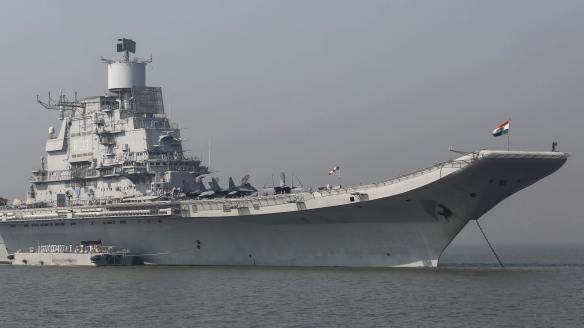
Washington should be mindful of India’s heavy dependence on Iranian oil and Russian arms sales, exemplified by the INS Vikramaditya carrier adopted from Russia.   © Reuters

After hitting New Delhi with Russia and Iran measures, Washington seeks to limit their impact.

When the U.S. slaps a nation with punitive sanctions, it tries to prevent not only American companies from doing business with the target country but also those of other states. Inevitably, these extraterritorial effects hit some countries much harder than others — as India has just found to its cost.

Even though New Delhi has been boosting ties with Washington for over a decade, it is a prime victim of two new sets of U.S. economic sanctions — on Iran and on Russia. These two countries, now at the center of the current American foreign policy debate, are both long-standing economic and political partners for India.

Since New Delhi cannot suddenly wind down the relationships with them without jeopardizing its national security, it must consider carefully how to balance those interests with its growing strategic partnership with the U.S., a top trading and defense partner of India. Washington, for its part, should give maneuvering space to India, a key player in the U.S.’s biggest geopolitical game in the Indo-Pacific region — reining in an increasingly muscular China.

Donald Trump’s unilateral withdrawal from the multilateral Iran nuclear deal, followed by his globally applicable sanctions to choke the Iranian economy, has prompted calls for defiance even from Washington’s close allies in Europe. The U.S. president’s latest offer of direct talks with Iranian leaders may signal a wish to strike a deal but he is a long way off from lifting sanctions.

Extraterritorial sanctions are also at the heart of a new Russia-centered law passed by the U.S. Congress — the Countering America’s Adversaries Through Sanctions Act, or CAASTA. The law hits Russia where it hurts most, its defense and energy businesses.

India, a significant buyer of Russian weapons and the second-largest importer of Iranian oil after China, has been made acutely aware of the risks of aligning itself closer with the U.S.

In actual fact, America has overtaken Russia in recent years as the top arms seller to New Delhi, and also emerged as a source of oil and gas supply to India. But these evolving ties cannot at this stage replace India’s links with Russia and Iran. The U.S. has basically transferred defensive military systems, while Russia has sold India offensive weapons, including a nuclear-powered submarine and an aircraft carrier. India also relies on Russian spare parts for maintenance of its Soviet-origin systems. Meanwhile, in oil, nearby Iran has long been one of India’s top suppliers.

Even before the new Iran sanctions and CAATSA, questions were being asked in India about whether the pro-U.S. foreign policy pursued by successive governments since 2004 had yielded any concrete returns.

One telling point was the tense border standoff between Indian and Chinese troops on the remote Doklam plateau about a year ago, when Washington did not issue a single statement in India’s support but chose to stay neutral, despite a fusillade of Chinese threats to teach India a “lesson.” Many in India have come to believe that New Delhi can rely on an unpredictable and transactional Trump administration only at its peril.

In recent months, Prime Minister Narendra Modi has seemingly attempted to mitigate the risks from his open embrace of the U.S. by seeking to ease tensions with China and reverse a declining relationship with Russia. At his initiative, Modi held separate summit meetings with Chinese President Xi Jinping and Russian President Vladimir Putin in Wuhan and Sochi, respectively. These initiatives were seen in Washington as a subtle attempt to recalibrate ties with the U.S.

Since then, a realization that the new sanctions would be counterproductive to the U.S.’s relations with India and other key partners has led the Trump administration and Congress to separately climb down from their positions that there would be no sanctions exemptions.

Congress this week enacted CAATSA waivers for India and two other countries, while the administration, signaling a readiness to consider granting waivers, has walked back from its pointblank threat to impose sanctions on countries buying Iranian oil beyond its Nov. 4 deadline. The administration has yet to clarify the conditions or duration of any waivers.

However, the Iran-related sanctions, even before entering into force, have already increased the oil import bill of India, the world’s third largest crude importer, by driving up prices.

India, while warning its energy companies of the risk of U.S. sanctions if they do not wind down their trade with Iran by early November, is pressing Washington for sanctions relief. In the previous round of Iran sanctions under Trump’s predecessor, Barack Obama, India secured rolling six-month waivers from U.S. sanctions by showing that it was continuing to reduce its imports of Iranian oil. To sidestep the U.S. financial system, India had to pay Iran in its own currency and accelerate barter trade.

Under CAATSA, Congress deliberately set the bar for any presidential waiver very high so as to tie Trump’s hands on the Russia sanctions. But after Defense Secretary Jim Mattis warned that “the sanctions will only drive strategic partners to buy more Russian hardware and prevent them from buying American in the future,” Congress relented.

Significantly, CAATSA waivers are being granted for the three countries that Washington is trying to bring closer into its orbit — India, Indonesia and Vietnam — but not for Turkey, a NATO member that is, like India, buying the S-400 long-range air and anti-missile defense system from Russia.

U.S. pressure on India, Indonesia and Vietnam, however, is unlikely to fully dissipate because no blanket waivers are being granted. Congress has mandated that each country demonstrate that it is significantly reducing dependence on Russian arms or significantly increasing cooperation with the U.S.

The price the U.S. is seeking to extract from India for a waiver is its signature on two remaining “foundational defense agreements.” After getting India to accept a logistics assistance pact, which includes access to designated Indian military sites, the U.S. is now pushing for India to endorse a secure communications accord (which the Indian military fears could compromise its network) and a geospatial intelligence agreement.

More fundamentally, the U.S. intends to influence the Indian, Indonesian and Vietnamese arms procurement policies. As Mattis told Congress, “we are faced with an once-in-a-lifetime opportunity to decrease Russia’s dominance in key regions.” Indeed, CAATSA was enacted with the intent to shift arms business from Russia — an important weapons seller to China’s potential adversaries, from India to Vietnam and Indonesia — to the U.S., already the world’s top arms exporter.

The Iran sanctions’ impact on India could also impede its loudly touted transportation corridor to Afghanistan via Iran, which includes the Chabahar Port modernization project. This joint India-Iran project, which circumvents any need to cross Pakistani territory, highlights the strategic importance of Tehran for New Delhi.

U.S. foreign policy has long relied on sanctions, despite their uncertain effectiveness and unpredictable consequences. For example, crippling U.S. sanctions prompted Japan’s 1941 Pearl Harbor attack, leading to the Pacific War that ended with the atomic bombing of Hiroshima and Nagasaki.

The newest Iran sanctions, which make China the likely main beneficiary by driving Beijing and Tehran closer together, also underscore the law of unintended consequences.

Ensnaring India in sanctions aimed at punishing Iran and Russia, and then dangling concessions, undermines the U.S. goal of developing a more robust defense relationship with the world’s largest democracy and building a stable power balance in the Indo-Pacific. While the U.S. and India will remain close friends, Washington has gratuitously introduced a major irritant in the relationship that no waivers can fully purge.

Such unilateralism also highlights why the American-led strategy for a free, open and democratic-led Indo-Pacific — aimed at containing China by cooperating with India and other partners — has yet to acquire strategic heft.

Brahma Chellaney is a geostrategist and the author, most recently, of the award-winning “Water, Peace, and War.”

© Nikkei Asian Review, 2018.

Why Moon is courting India

India gains importance for Seoul as South Korea’s ‘miracle economy’ starts to face major new challenges

Brahma Chellaney, The Times of India

korea51

South Korean President Moon Jae-in’s visits to India and Singapore this week underscore his “New Southern Policy” (NSP), which gives priority to deepening bilateral relations with the ASEAN economies and India. NSP was unveiled on the heels of Moon’s “New Northern Policy”, whose primary but unstated objective is to jointly develop Russia’s Far East with Moscow. Simply put, the dual policies aim to invest greater resources in countries that previously were not on South Korea’s priority list.

Moon is seeking to diversify South Korea’s external portfolio so as to build a more “balanced diplomacy”. But while India’s Act East policy is driven by both geostrategic and geo-economic factors, Moon’s NSP is rooted mainly in economic logic.

There isn’t much room to expand Seoul’s already well-developed relations with China, Japan and the US. In fact, with new issues cropping up in ties with China and America, export-driven South Korea must find new markets to cut reliance on its top two trade partners. Moreover, despite increasing exports of semiconductors and electronics, South Korea’s economic growth has slowed, presenting it with important challenges.

Moon is targeting economies with the greatest growth potential: Several ASEAN economies and India are projected to grow at annual rates more than double that of South Korea in the coming years. Seoul, however, is not alone in courting Southeast Asia and India.

Japan under Prime Minister Shinzo Abe has pursued a “southward advance” economic strategy. Taiwan’s new “Southbound Policy” is driven by the same economic rationale, and seeks similar strategic objectives, as Moon’s NSP. China too has a southern policy, which goes by the official name of “One Belt, One Road”. Then there is Australia, which is looking at Southeast Asia and India, in part to mitigate its China-related risks.

Similar risks are also driving Moon’s NSP. China’s heavy-handed economic sanctioning of South Korea, in response to the US deployment of the THAAD anti-missile system, has served as a wake-up call for South Korea, making it conscious of its vulnerabilities and forcing a rethink. Although the informal Chinese sanctions began before Moon was elected president, the shock therapy administered by China’s use of economic coercion as a tool of statecraft led to his NSP.

South Korea is too heavily dependent on one market — China’s market — a factor that arms Beijing with considerable leverage over Seoul. Diversification is essential to a hedging strategy. And hedging is at the heart of Moon’s NSP.

Today, rebooting inter-Korean economic relations is emerging as an option — an option that can yield rich dividends if progress were made toward denuclearizing North Korea. Failure to build enduring inter-Korean peace, however, could rebound on the South Korean economy. Whatever scenario unfolds, the NSP imperative will likely remain intact. NSP, despite its economic focus, promises to yield broader diplomatic and strategic benefits for Seoul.

However, NSP is not an answer to the South Korean economy’s structural challenges. South Korea needs to make its economy less vulnerable to external shocks by undertaking structural reforms. In fact, Moon took office with a strong mandate to “democratize” economic growth and cultivate innovation by switching priorities from the giant family-owned conglomerates known as chaebol to smaller enterprises and start-ups and by encouraging bottom-up jobs growth. The country’s chaebol-centred crony capitalism spawned an influence-peddling scandal that cost Moon’s predecessor her job.

South Korea’s challenges largely arise from its extraordinary success in transforming itself from an economic minnow to the world’s fifth-largest exporter. South Korea was one of the world’s poorest countries in the early 1960s before it embarked on rapid economic expansion, becoming the world’s fastest-growing economy between 1963 and 1979. In 1996, South Korea joined the OECD, the club of the world’s wealthiest nations.

South Korea escaped the “middle income trap” in large part because of its democratic transition. China, however, risks falling into that trap. The fact is that South Korea went from poverty to wealth in almost one generation. There are few examples in modern history of such rapid economic success. But success can breed problems.

An unintended consequence of South Korea’s remarkable success has been its high exposure to global market volatility. South Korea has a high trade-to-GDP ratio, which is a good indicator of how vulnerable any country is to the dips and dives of the global economy. Ongoing changes in global market conditions, including US protectionism and the US-China trade war, will likely hit the South Korean economy harder than less export-dependent economies. For example, a deepening slowdown in China brought about by US tariffs would undermine South Korean exports to China, thereby further depressing South Korean growth.

Moon’s India visit was part of his effort to tide over such challenges. From enlarging South Korea’s footprint in the world’s third-biggest consumer market by purchasing power to peddling wares to the world’s largest arms importer, Moon sees India as central to NSP’s success. However, at a time when many chaebol are navigating generational transitions and Moon has committed to “democratize” economic growth, structural reform at home is the price South Korea must pay to sustain a “miracle economy”.

The writer is a geostrategist.

© The Times of India, 2018.

India’s mistakes have allowed China to make inroads into Nepal

pm-modi-at-nepal_9a643afa-802f-11e8-9920-75f90a7836bc

Indian Prime Minister Narendra Modi with his Nepali counterpart, K.P. Oli, in Kathmandu in May.

Brahma Chellaney, The Hindustan Times

Nepal’s new communist prime minister, K.P. Oli, has paid obeisance in Beijing, where he agreed to the proposal to extend the railway from Shigatse in Tibet to his country so as to reduce Nepali dependence on India. For India, Nepal is not just another neighbour but one that is symbiotically linked through close cultural affinity, overlapping ethnic and linguistic identities, and an open border permitting passport-free passage. The China-Nepal railway — a “game changer”, as a Chinese mouthpiece called it — will compound the impact on India’s strategic interests of Nepal’s emergence as the world’s sixth communist-ruled country.

The two communist groups that came to power in February merged into a single party in May. The new Nepali Communist Party, with almost two-thirds majority in Parliament and governments in six of the nation’s seven provinces, casts an ominous shadow over Nepal’s sputtering democratic transition. From constitutional functionaries, such as the president and vice president, to key officials, including the chief of police services, are today card-carrying communists.

Emboldened by the communists’ pervasive domination, Oli has started undermining the independence of Nepal’s institutions, from the judiciary to the election commission. The communists’ next target will likely be the army. Whether democracy will survive under communist rule is uncertain. What is clear is that Nepal is impinging on Indian security.

A Nepal increasingly open to Chinese influence shares a tightly guarded frontier with Tibet but wishes to maintain an open border with India. India has repeatedly advised Nepal that its southern border belt is turning into a zone of jihadist and foreign intelligence activities that threaten Indian security. Nepal has also become a major transit point for the flow of counterfeit Indian currency, narcotics and Chinese arms to India.

Simply put, Nepal represents a critical challenge for India. But, to a significant extent, this is a self-created problem. Three Indian blunders since the mid-2000s have proved very costly for India — spearheading the abolition of Nepal’s constitutional monarchy; bringing the underground Maoists to the centre-stage of Nepali politics; and, more recently, aiding the plains people’s revolt against the new, 2015-drafted Nepali Constitution and then abandoning their movement and pressuring them (the Madhesis) to participate in the 2017 elections, thus legitimizing a Constitution it said was flawed.

New Delhi indeed owes an apology to Nepal’s citizens for its past meddling, which, as if to underscore the law of unintended consequences, boomeranged on India’s own interests. India’s mistakes set in motion developments that seriously eroded its clout in Nepal and helped China to made major inroads.

When history is written, one Manmohan Singh blunder in particular will stand out for empowering Nepali communists and undermining India’s long-term interests — engineering the ouster of Nepal’s monarchy, the symbol of that country’s stability, continuity and unity for 239 years. The monarchy was removed without ascertaining the will of the people through a referendum and without even a basic level of due process.

Singh’s government, which at that time was dependent on communist support at home for survival, intervened as a peace maker. But what mattered to it was just one thing — accommodating the Maoists’ main demand for the monarchy’s removal in order to bring them into the Nepali political mainstream. It hosted a meeting between Nepal’s Maoists and opposition parties in November 2005 at which an accord to abolish the monarchy was reached. How empowering Nepali Maoists and other communists would serve India’s interest, and what the larger implications of the monarchy’s abolition would be for Nepal’s future, were issues that went unexamined.

The upshot was that Nepal went from being a Hindu kingdom (indeed the world’s only officially Hindu nation) to coming under the sway of communists, who largely filled the void from the monarchy’s removal, thereby undercutting the influence of the Nepali Congress Party, dominant until then. From 2008 onwards, the Nepali communists were in coalition governments for almost a decade before capturing power on their own in the last elections. Oli’s Marxist-Leninist Party and the Maoists, which fought the elections jointly under China’s advice, tapped into grassroots anger over the Indian-backed Madhesi protesters’ earlier border blockade.

India, paradoxically, is still unable to make peace with its own Maoists. In fact, the Nepali Maoists’ Indian-assisted success in enjoying power after waging a decade-long bloody insurrection has emboldened the Indian Maoists to step up their hit-and-run attacks on police and paramilitary troops. Meanwhile, the Maoists’ dreamland, China, is pulling Nepal into its orbit. Make no mistake: India is reaping what it sowed.

Brahma Chellaney is a geostrategist and author.

© The Hindustan Times, 2018.

The challenge of America’s new extraterritorial sanctions

The United States, by imposing extraterritorial sanctions, seeks to effectively extend its jurisdiction far beyond its borders. However, such sanctions — which it euphemistically labels “secondary” sanctions — run counter to international law.

p9-chellaney-a-20180606-870x591
BY BRAHMA CHELLANEY, Japan Times 

How to navigate America’s new extraterritorial sanctions targeting Iran has become an important diplomatic test for Japan and a number of other important democracies concerned about U.S. President Donald Trump’s pursuit of aggressive unilateralism. Many of these countries have already taken an economic hit, in the form of higher oil-import bills, from Trump’s unilateral pullout from the multilateral nuclear deal with Iran.

The United States has also imposed extraterritorial sanctions to punish the Kremlin for its alleged interference in the 2016 U.S. presidential election. The new Countering America’s Adversaries Through Sanctions Act, or CAASTA, which came into effect on Jan. 29, seeks to stop other countries from making “significant” defense transactions with Russia, a leading arms exporter.

However, with Trump seeking a nuclear deal with North Korea, much of the weight of America’s punitive approach is likely to fall on Iran. Trump, whose main aim is to topple the Iranian regime, said ominously on June 1, “You are going to see how powerful the sanctions are when it comes to Iran.”

The U.S. — armed with not just unmatched military might but also unrivaled financial power from the role of the American dollar as the world’s reserve currency — has the capacity and will to coerce allies and adversaries alike. As the world’s dominant currency that greases the wheels of the global financial system, the dollar equips America with tremendous economic leverage while conferring important advantages to its economy.

By imposing extraterritorial — or, as it likes to euphemistically portray them, “secondary” — sanctions, the U.S. seeks to effectively extend its jurisdiction far beyond its borders. Such sanctions, however, run counter to international law, including the United Nations Charter and the rules of the World Trade Organization.

It is one thing for the U.S. to invoke national security or other grounds as a rationale to impose punitive trade sanctions on a country, including prohibiting American persons and companies from engaging in transactions with the designated state. It is quite another for the U.S. to use extraterritorial sanctions to block trade and financial activities by non-U.S. parties with that country — in other words, to coercively turn national actions into global measures, in breach of the sovereignty of other states.

Through extraterritoriality, the U.S. aims not only to sharpen the impact of its sanctions, but also to advance its own geopolitical and commercial interests. One example is how the U.S. today is ingeniously employing the sanctions threat under CAASTA to wean countries as diverse as India and Turkey off their craving for Russian weapons so as to boost its own arms sales. The U.S. is already the world’s No. 1 exporter of weapons, accounting for 34 percent of all global sales between 2013 and 2017.

In the past, few international players were willing to flout U.S. extraterritorial sanctions for fear of being locked out of the U.S. financial system and barred from doing business with American entities. But Trump’s aggressive unilateralism on matters extending from trade and global warming to Iran and Israel has prompted calls for defiance even by U.S. allies, a number of whom have now been slapped with U.S. steel and aluminum tariffs.

The European Commission has decided to revive its “blocking statute” to prevent European firms from adhering to the new U.S. sanctions against Iran. Originally created in 1996 to counter a U.S. trade embargo on Cuba, the blocking statute bars European Union citizens and companies from complying with the extraterritorial aspects of U.S. sanctions. It also grants EU entities the right to “recover any damages, including legal costs,” from the application of such sanctions and nullifies the effect of any foreign court judgment.

The commission hopes its blocking law will be approved by member-states and take effect before Aug. 6, when the first batch of re-imposed U.S. sanctions against Iran kick in, including on trade in precious metals, coal, aluminum and steel. Trump’s shipping- and petroleum-related sanctions — the second set — are scheduled to enter into force on Nov. 4. But global shipping operators and tanker owners are already pulling back from Iran-related business.

Under Trump’s predecessor, Barack Obama, foreign companies were held hostage by America’s Iran-related extraterritorial sanctions, forcing them to cease or cut oil and other business dealings with Tehran between 2012 and 2015. But the U.S. at that time secured wide support from an international community keen to block Iran from developing nuclear weapons.

This time the U.S. is acting alone. It is seeking to tighten the screws on Iran after having reneged on the Iran deal, despite the International Atomic Energy Agency certifying that Tehran was in compliance with its terms. Indeed, the other signatories to the 2015 Iran deal — France, Germany, Britain, Russia and China — have affirmed their intent to preserve the deal without the U.S.

In this situation, the Trump administration will not find it easy to coerce the rest of the world to comply with its Iran-related sanctions regime. Even Washington’s extraterritorial jurisdictional claim in relation to the Russia-centered CAASTA is being challenged. Turkey, a NATO ally, has threatened reprisals if the U.S. cancels the F-35 fighter-jet deal with it in response to its contract with Moscow to buy the S-400 long-range air and anti-missile defense system. India also appears all set to import the lethal, interceptor-based S-400 system.

On Iran, even if the U.S. succeeds in browbeating some vulnerable countries into abiding by its new sanctions, it will likely find it difficult to secure broad international compliance.

The main buyers of Iranian crude oil and petroleum products are all located in Asia: China, India, Japan and South Korea together account for almost three-quarters of Iran’s oil exports.

China, ever ready to swoop in to exploit opportunities in sanctions-hit countries, will find ways to circumvent the new sanctions, as it did in the previous round, including by boosting imports of Iranian fuel oil. It used the earlier sanctions to deeply penetrate the Iranian economy.

Successive U.S. presidents have helped out China — from aiding its economic rise to making it the key beneficiary of their actions elsewhere. Now it is Trump’s turn: His new sanctions are a diplomatic boon for Beijing, including making a reluctant Iran enter into a tighter Chinese embrace and forcing Russia to pivot to China.

In this light, Japan, India and South Korea, instead of simply succumbing again to America’s Iran sanctions or seeking waivers, should push back with full diplomatic strength, including putting the U.S. on notice that they will challenge its extraterritorial sanctions before the WTO dispute-resolution body.

Seeking deal-related or rolling waivers would be tantamount to adhering to the sanctions. And any waiver will come with conditions that crimp their latitude further.

Past experience indicates that when the U.S. is internationally isolated, it ultimately caves in to the demands of its friends who show resolve to defy its sanctions threat. For example, in 1997, the U.S. reached agreement with the EU to suspend enforcement of the extraterritorial dimensions of its Cuba-related sanctions after the threat of an EU complaint to the WTO.

Today, the U.S. is acting counterproductively to its own interest to safeguard the dollar’s centrality: It is leaving other countries with little choice but to work around its sanctions by using non-dollar currencies so as to avoid the American banking system, besides making alternative arrangements for shipping insurance. This development, and Trump’s other actions, could ensure that the dollar’s days as the world’s reserve currency are numbered.

Make no mistake: International adherence to the new extraterritorial sanctions will only embolden the Trump administration’s defiant unilateralism, which is redolent of China’s unilateralist actions. Broad compliance will not only further weaken the WTO, the U.N. and other international institutions, but also allow Washington to dictate international rules and other countries’ choices. Instead of a rules-based world order, the U.S. and China are seeking to impose a power-based Group of Two order founded on unilateralism.

Brahma Chellaney is a professor of strategic studies at the New Delhi-based Center for Policy Research.

© The Japan Times, 2018.

The World According to Trump and Xi

Trump’s “America First” strategy and Xi’s “Chinese dream” are founded on a common premise: that the world’s two biggest powers can act in their own interest with impunity. The G2 world order that they are creating is hardly an order at all; for everyone else, it’s a trap.

b03f18af139a2b8d4a87439bc629de66.2-1-super.1

BRAHMA CHELLANEY, a column internationally syndicated by Project Syndicate

The world’s leading democracy, the United States, is looking increasingly like the world’s biggest and oldest surviving autocracy, China. By pursuing aggressively unilateral policies that flout broad global consensus, President Donald Trump effectively justifies his Chinese counterpart Xi Jinping’s longtime defiance of international law, exacerbating already serious risks to the rules-based world order.

China is aggressively pursuing its territorial claims in the South China Sea – including by militarizing disputed areas and pushing its borders far out into international waters – despite an international arbitral ruling invalidating them. Moreover, the country has weaponized transborder river flows and used trade as an instrument of geo-economic coercion against countries that refuse to toe its line.

The US has often condemned these actions. But, under Trump, those condemnations have lost credibility, and not just because they are interspersed with praise for Xi, whom Trump has called “terrific” and “a great gentleman.” In fact, Trump’s behavior has heightened the sense of US hypocrisy, emboldening China further in its territorial and maritime revisionism in the Indo-Pacific region.

To be sure, the US has long pursued a unilateralist foreign policy, exemplified by George W. Bush’s 2003 invasion of Iraq and Barack Obama’s 2011 overthrow of Muammar el-Qaddafi’s regime in Libya. Although Trump has not (yet) toppled a regime, he has taken the approach of assertive unilateralism several steps further, waging a multi-pronged assault on the international order.

Almost immediately upon entering the White House, Trump withdrew the US from the Trans-Pacific Partnership (TPP), an ambitious 12-country trade and investment agreement brokered by Obama. Soon after, Trump rejected the Paris climate agreement, with its aim to keep global temperatures “well below” 2°C above pre-industrial levels, making the US the only country not participating in that endeavor.

More recently, Trump moved the US embassy in Israel from Tel Aviv to Jerusalem, despite a broad international consensus to determine the contested city’s status within the context of broader negotiations on a settlement of the Israeli-Palestinian conflict. As the embassy was opened, Palestinian residents of Gaza escalated their protests demanding that Palestinian refugees be allowed to return to what is now Israel, prompting Israeli soldiers to kill at least 62 demonstrators and wound more than 1,500 others at the Gaza boundary fence.

Trump shoulders no small share of the blame for these casualties, not to mention the destruction of America’s traditional role as a mediator of the Israeli-Palestinian conflict. The same will go for whatever conflict and instability arises from Trump’s withdrawal from the 2015 Iran nuclear deal despite Iran’s full compliance with its terms.

Trump’s assault on the rules-based order extends also – and ominously – to trade. While Trump has blinked on China by putting on hold his promised sweeping tariffs on Chinese imports to the US, he has attempted to coerce and shame US allies like Japan, India, and South Korea, even though their combined trade surplus with the US – $95.6 billion in 2017 – amounts to about a quarter of China’s.

Trump has forced South Korea to accept a new trade deal, and has sought to squeeze India’s important information technology industry – which generates output worth $150 billion per year – by imposing a restrictive visa policy. As for Japan, last month Trump forced a reluctant Japanese Prime Minister Shinzo Abe to accept a new trade framework that the US views as a precursor to negotiations on a bilateral free-trade agreement.

Japan would prefer the US to rejoin the now-Japan-led TPP, which would ensure greater overall trade liberalization and a more level playing field than a bilateral deal, which the US would try to tilt in its own favor. But Trump – who has also refused to exclude permanently Japan, the European Union, and Canada from his administration’s steel and aluminum tariffs – pays no mind to his allies’ preferences.

Abe, for one, has “endured repeated surprises and slaps” from Trump. And he is not alone. As European Council President Donald Tusk recently put it, “with friends like [Trump], who needs enemies.”

Trump’s trade tactics, aimed at stemming America’s relative economic decline, reflect the same muscular mercantilism that China has used to become rich and powerful. Both countries are now not only actively undermining the rules-based trading system; they seem to be proving that, as long as a country is powerful enough, it can flout shared rules and norms with impunity. In today’s world, it seems, strength respects only strength.

This dynamic can be seen in the way Trump and Xi respond to each other’s unilateralism. When the US deployed its Terminal High Altitude Area Defense system in South Korea, China used its economic leverage to retaliate against South Korea, but not against America.

Likewise, after Trump signed the Taiwan Travel Act, which encourages official visits between the US and the island, China staged war games against Taiwan and bribed the Dominican Republic to break diplomatic ties with the Taiwanese government. The US, however, faced no consequences from China.

As for Trump, while he has pressed China to change its trade policies, he has given Xi a pass on the South China Sea, taking only symbolic steps – such as freedom of navigation operations – against Chinese expansionism. He also stayed silent in March, when Chinese military threats forced Vietnam to halt oil drilling within its own exclusive economic zone. And he chose to remain neutral last summer, when China’s road-building on the disputed Doklam plateau triggered a military standoff with India.

Trump’s “America First” strategy and Xi’s “Chinese dream” are founded on a common premise: that the world’s two biggest powers have complete latitude to act in their own interest. The G2 world order that they are creating is thus hardly an order at all. It is a trap, in which countries are forced to choose between an unpredictable and transactional Trump-led US and an ambitious and predatory China.

U.S. extraterritorial sanctions: Begging for a waiver is the worst possible option for India

Brahma Chellaney, The Times of India

By imposing extraterritorial or “secondary” sanctions, the US seeks to effectively extend its jurisdiction far beyond its borders. Armed with unmatched power from the role of the US dollar as the world’s reserve currency, America has the capacity and will to coerce allies and adversaries alike by threatening to lock them out of the US financial system. But make no mistake: Its extraterritorial sanctions violate international law, the UN Charter and WTO rules.

imagesIndia is directly in the crosshairs of the new US extraterritorial sanctions targeting Russia and Iran. India is already suffering the unintended consequences of President Donald Trump’s unilateral withdrawal from the Iran nuclear deal — a pullout that has spurred higher oil-import bills, the rupee’s weakening against the US dollar, and increased foreign-exchange outflows. This is just the latest financial hit India has suffered since 2005 when New Delhi, under US persuasion, voted against Iran in the International Atomic Energy Agency’s governing board, prompting Tehran to cancel a long-term LNG deal favourable to India.

Under Trump’s predecessor, Barack Obama, India was forced between 2012 and 2015 to significantly slash Iranian oil imports and pay Iran in rupees or initiate barter trade. Now India has to readopt those workarounds on payment and shipping insurance because global shipping operators and tanker owners are pulling back from Iran-related business even before the new sanctions take effect on November 4. The sanctions threaten to also impede India’s Pakistan-bypassing transportation corridor to Afghanistan and Central Asia via Iran, including the Chabahar port project.

The India implications of the new Countering America’s Adversaries Through Sanctions Act (CAATSA) are even more stark. While dangling the prospect of securing a “flexible waiver authority” from its Congress, the US intends to use CAATSA to try and wean India gradually off its craving for Russian weapons so as to boost its own arms sales. The US is already the largest arms seller to India. But it basically has been selling defensive systems, including big-ticket items like the P-8I maritime surveillance aircraft and the C-17 Globemaster III and C-130J Super Hercules military transport planes.

Russia, by contrast, has transferred offensive weapon systems to India, including strategic bombers (Sukhi 30MKI), an aircraft carrier (INS Vikramaditya), conventional submarines and a nuclear-powered submarine (INS Chakra). The only foreign power helping India with strategic projects like the Arihant nuclear submarine is Russia, which today is willing to sell India the lethal, interceptor-based S-400 Triumf air defence system and also lease a second nuclear-powered submarine.

On balance, Russia remains India’s most critical defence partner. Yet, through CAATSA, the US is seeking to have a say in India’s defence dealings with Russia. For example, it has signalled its disapproval of the planned S-400 import on grounds that it would thwart building interoperability with Indian forces, as if India is not America’s strategic partner but its client state. The US is ingeniously employing extraterritorial sanctions to advance its geopolitical and commercial interests. But can India tolerate an American veto over its defence deals with Moscow?

How India navigates the new sanctions will be a crucial test of its ability to safeguard an independent foreign policy. External Affairs Minister Sushma Swaraj says, “India follows only UN sanctions, not unilateral sanctions of any country”. But if India seeks deal-related or rolling waivers, it would, in effect, be adhering to the US sanctions. Begging for a waiver is the worst possible choice India can pursue, because it will come with conditions that crimp New Delhi’s latitude further.

India has diplomatic space to rebuff US pressure because the US this time is acting alone, with its own European allies defiant. If India goes ahead with Russian and Iranian deals regardless of the sanctions threat, the US will have little choice but to exempt India without conditions. India should partner other key democracies to push back with full diplomatic strength, including, if necessary, hauling the US into the WTO dispute-resolution body and introducing a UN General Assembly resolution against unlawful extraterritorial sanctions. The main beneficiary of the new US sanctions, of course, will be China, ever ready to capitalize on opportunities in sanctions-hit countries.

The writer is a geostrategist and author.

© The Times of India, 2018.

The art of unraveling a potential deal

p9-chellaney-a-20180523

Brahma Chellaney, The Japan Times

Donald Trump’s planned summit meeting with Kim Jong Un is still days away but the American president has already stirred things up by warning the North Korean leader of “total decimation,” in the way Libyan strongman Muammar Qaddafi met a gruesome end, “if we don’t make a deal.” Even if that threat were to frighten Kim into agreeing to a deal, he has no assurance that Trump will keep his end of the bargain. Trump’s record, after all, attests to his proclivity to renege on commitments.

In fact, following Trump’s unilateral withdrawal from the 2015 multilateral nuclear deal with Iran, Kim appears to have got cold feet. This is apparent from Pyongyang’s change of tone, including new warnings to the U.S. and South Korea, thereby undercutting the White House hype over the forthcoming Trump-Kim summit in Singapore.

In the run-up to the most-consequential summit of Trump’s presidency, the president’s Cabinet members are also doing their bit to foolishly stoke up regional concerns. It was the neoconservative John Bolton, Trump’s national security adviser, who triggered an angry reaction from Pyongyang by saying that the U.S. wants to apply the “Libya model” to North Korea.

Bolton’s statement was clearly a provocation for Pyongyang. Kim had earlier cited the fate that Qaddafi and Iraq’s Saddam Hussein met when they renounced the nuclear-weapons option.

Indeed, just days after American forces captured Hussein from his dingy hideout, Qaddafi reached an agreement with U.S. President George W. Bush’s administration to dismantle his country’s nascent nuclear-weapons program in exchange for a promised easing of Western sanctions. That agreement proved his undoing, because it eliminated the potential capability that could have deterred the NATO-led intervention that ultimately deposed him.

When Qaddafi was captured, tortured and murdered by NATO-aided rebels, with a video showing him being sodomized with a knife before his execution, then U.S. Secretary of State Hillary Clinton exulted in a live TV interview. Her reaction to receiving that news on her cell phone was to rephrase Julius Caesar’s famous line after a decisive Roman victory in 46 B.C. (“veni, vidi, vici,” or “I came, I saw, I conquered”) as, “We came; we saw; he died.” Clinton then laughed and clapped her hands in apparent celebration.

Against this backdrop, Kim has viewed a nuclear deterrent as the way to escape Qaddafi’s fate. When he assumed power barely two months after the Libyan leader’s killing, Kim made accelerating his country’s nuclear and missiles advances his top priority.

Indeed, when NATO launched its air war against Libya in 2011, a North Korean official said the intervention showed that Qaddafi had been duped in the 2003 nuclear bargain with the West. More recently, a commentary published by North Korea’s state news agency in 2016 said that “history proves that powerful nuclear deterrence serves as the strongest treasure sword for frustrating outsiders’ aggression.”

downloadYet, in the lead-up to the Singapore summit, Trump and Bolton have gratuitously referred to the “Libya model” in the specific context of North Korea. Mentioning the U.S. elimination of Qaddafi, Trump told reporters at the Oval Office, “That model will take place if we don’t make a deal, most likely. But if make a deal, I think Kim Jong Un is going to be very, very happy … I think when John Bolton made that statement, he was talking about if we are going to have problem, because we just cannot let that country have nukes.”

The imprudent references to the “Libya model” can only ensure that Kim will not make the same mistake as Qaddafi. North Korea’s nuclear negotiator and vice foreign minister, Kim Gye Gwan, calling such references “highly sinister,” said the “world knows too well that our country is neither Libya nor Iraq which have met miserable” fates.

Meanwhile, another well-known neocon, Secretary of State Mike Pompeo, has caused misgivings in Japan and South Korea by suggesting that America’s focus is on eliminating North Korea’s nuclear threat to its homeland, not to its allies. “Make no mistake about it: America’s interest here is preventing the risk that North Korea will launch a nuclear weapon into L.A. or Denver or into the very place we’re sitting here this morning,” Pompeo said in a TV interview from Washington.

This implies that the main U.S. objective is to eliminate North Korea’s long-range missile capability. A deal that allows Pyongyang to retain its short- and medium-range nuclear delivery capability will leave regional allies in the lurch.

Such a scenario cannot be ruled out. After all, the U.S. has always focused on forestalling threats to its own security even if its regional friends are left at the receiving end. For example, the U.S. has tolerated the fast-growing nuclear arsenal of Pakistan — one of the largest recipients of American aid in this century — because its nuke capability is subregionally confined.

The U.S. has given no hint as to what concessions it might be willing to make to secure a deal with Kim. Yet the U.S. has publicized unreasonable demands that North Korea is unlikely to accept. For example, Bolton said Pyongyang will have to surrender its entire nuclear program before the U.S. relaxes economic sanctions.

Pyongyang has made it clear that, to preclude a bait-and-switch approach that ensnared Qaddafi, a deal must involve a phased process, with each side making reciprocal concessions in stages. To try and overcome Pyongyang’s stubbornness, U.S. negotiations have suggested a partial surrender up-front of nuclear delivery vehicles (and their components and blueprints), especially the Hwasong-15 and Hwasong-14 ballistic missiles. These two supposedly intercontinental-range systems were tested last year.

It is doubtful Pyongyang will countenance a partial surrender demand because it reeks of the U.S. nuclear bargain with Libya. Qaddafi did not have nuclear weapons like North Korea, but he sealed his fate when he handed Libya’s uranium-enrichment centrifuge components and nuclear-weapons blueprints to the U.S.

More fundamentally, it appears odd that the Trump administration does not recognize the contradiction between wanting to blow up the Iran nuclear deal and, at the same time, pressing North Korea to sign a nuclear deal. It is also strange that Trump and Bolton do not seem to understand that, by raking up the “Libya model,” they are undermining the prospect of a North Korea deal.

At a time when even U.S. allies are finding it difficult to rely on an unpredictable and capricious Trump administration, Kim’s strategy will likely seek to safeguard his nuclear “crown jewels” until a comprehensive peace and denuclearization accord is reached — an agreement he wants with reciprocal obligations, including South Korea coming out of the U.S. nuclear umbrella and the U.S., China and Russia committing not to introduce or threaten to use nuclear weapons on the Korean Peninsula. Such a complex accord can be implemented only in a lengthy process.

If no deal emerges next month, Trump ought to write a sequel to his 1987 book The Art of the Deal with the title, The Art of Unmaking a Potential Deal.

Longtime Japan Times contributor Brahma Chellaney is a geostrategist and the author of nine books. 

© The Japan Times, 2018.

The Nehruvian Style of Modi’s Foreign Policy

Brahma Chellaney, Open magazine

Openessay_6In the four years that he has been in office, Prime Minister Narendra Modi has animated domestic politics in India and the country’s foreign policy by departing often from conventional methods and shibboleths. As he focuses on winning the next general election, the key question is whether the Modi era will mark a defining moment for India, just as Xi Jinping’s ascension to power has been for China. The answer to that question is still not clear. What is clear, however, is that Modi’s stint in office has clearly changed Indian politics and diplomacy.

In domestic politics, Modi has a stronger record: He has led the Bharatiya Janata Party to a string of victories in elections in a number of states, making his party the largest political force in the country by far. Under his leadership, the traditionally urban-focused BJP has significantly expanded its base in rural areas and among the socially disadvantaged classes and spread to the country’s eastern and southern regions. His skills as a political tactician steeped in cold-eyed pragmatism have held him in good stead. Modi, however, has become increasingly polarizing. Consequently, Indian democracy today is probably as divided and polarized as US democracy.

Even before Modi came to power, India’s fast-growing economy and rising geopolitical weight had significantly increased the country’s international profile. India was widely perceived to be a key “swing state” in the emerging geopolitical order. The political stability Modi has brought, coupled with his pro-market economic policies, tax reforms, defence modernization and foreign-policy dynamism, has only helped to further increase India’s international profile. However, India’s troubled neighbourhood, along with its spillover effects, has posed a serious challenge for Modi.

The combustible neighbourhood has underscored the imperative for India to evolve more dynamic and innovative approaches to diplomacy and national defence. For example, with its vulnerability to terrorist attacks linked to its location next to the Pakistan-Afghanistan belt, India has little choice but to prepare for a long-term battle against the forces of Islamist extremism and terrorism. Similarly, India’s ability to secure its maritime backyard, including its main trade arteries in the Indian Ocean region, will be an important test of its maritime strategy and foreign policy, especially at a time when an increasingly powerful and revisionist China is encroaching on India’s maritime space.

It is important to remember that Modi went quickly from being a provincial leader to becoming the prime minister of the world’s largest democracy. In fact, he rode to power in a landslide national-election victory that gave India the first government since the 1980s to be led by a party enjoying an absolute majority on its own in Parliament. One factor that aided Modi’s dramatic rise was clearly the major corruption scandals that marred the decade-long rule of the preceding Congress Party-led coalition government.

Until Modi became the first prime minister born after independence, the wide gap between the average age of political leaders and citizens was conspicuous. But like his predecessors, from Jawaharlal Nehru to Manmohan Singh, Modi took office unschooled in national security. The on-the-job learning of successive leaders, coupled with their reliance on bureaucrats that have generalized knowledge and little time for forward thinking, has blighted national security since independence. Prime minister after prime minister has bypassed institutionalized processes of policymaking and pursued a meandering, personality-driven approach to diplomacy.

Modi is no exception. In fact, his recent Reset 2.0 with China shows that he does not believe in the “once bitten, twice shy” adage. His Reset 1.0, which was launched soon after he came to office, backfired conspicuously. After taking office, Modi made closer ties with China a priority. He even postponed his Japan visit by several weeks so that his first major bilateral meeting was with Chinese President Xi Jinping, at the BRICS summit in Brazil. His overtures were intended to encourage Beijing to be more cooperative.

Modi’s gamble, however, boomeranged. Xi arrived in India on Modi’s birthday in September 2014 bearing an unusual gift — a deep Chinese military incursion into Ladakh. Relations progressively worsened after that, as China become more hardline on issues ranging from the border to its overt and covert collaboration with Pakistan.

As anyone who has interacted with Modi in person will attest, he is a soft-spoken, attentive and magnetic personality — a contrast to the voluble, rabble-rousing Modi on the campaign trail. Those who meet him are charmed by his disarming ways. That may have helped foster Modi’s abiding faith in the power of his personal diplomacy.

To be sure, Modi has used his personal touch with some effect, addressing several world leaders by their first name and building an easy relationship with them. In keeping with his personalized stamp on diplomacy, Modi has also relied on bilateral summits to try and open new avenues for cooperation and collaboration. Yet, in terms of tangible gains for India, his personal diplomacy has little to show, other than with Japanese Prime Minister Shinzo Abe. For example, Modi’s unannounced visit to Lahore in late 2015, as part of his personal outreach to the then Pakistani Prime Minister Nawaz Sharif, actually engendered a series of Pakistan-orchestrated terrorist attacks on Indian military bases and camps.

Truth be told, Modi’s personal diplomacy mirrors that of the man he intensely dislikes, Nehru. Politically and ideologically, Modi has little in common with Nehru. For example, Modi rose from humble beginnings to lead the world’s most-populous democracy, while Nehru boasted a wealthy lineage. Nehru espoused internationalism, in contrast to the “India first” brand that Modi promoted to come to power. Yet Modi’s foreign-policy approach has a lot in common with Nehru’s. It is indeed ironical that Modi’s faith in his personal diplomacy bears a striking resemblance to the man he and his party abhor.

Foreign policy challenges

India faces major foreign-policy challenges, which by and large predate Modi’s ascension to power. India is home to more than one-sixth of the world’s population, yet it punches far below its weight. A year before Modi assumed office, an essay in the journal Foreign Affairs, titled “India’s Feeble Foreign Policy,” focused on how the country is resisting its own rise, as if the political miasma in New Delhi had turned the country into its own worst enemy.

When Modi became prime minister, many Indians had hoped that he would give a new direction to foreign relations at a time when the gap between India and China in terms of international power and stature was growing significantly. In fact, India’s influence in its own strategic backyard — including Nepal, Sri Lanka, Bangladesh and the Maldives — has shrunk. Today, Bhutan probably remains India’s sole pocket of strategic clout in South Asia. Even in culturally linked Nepal, India now has China as a strategic competitor.

India also confronts the strengthening nexus between its two nuclear-armed regional adversaries, China and Pakistan, both of which have staked claims to substantial swaths of Indian territory and continue to collaborate on weapons of mass destruction. In dealing with these countries, Modi has faced the same dilemma that has haunted previous Indian governments: the Chinese and Pakistani foreign ministries are weak actors. The Communist Party and the military shape Chinese foreign policy, while Pakistan is effectively controlled by its army and intelligence services, which still use terror groups as proxies. Under Modi, India has repeatedly faced daring terrorist attacks staged from Pakistan.

While Modi has found it difficult to contain cross-border terrorist attacks from Pakistan or stem Chinese military incursions across the Himalayan frontier, he has managed to lift the bilateral relationship with the United States to a deeper level of engagement. Modi considers close ties with the US as essential to the advancement of India’s economic and security interests. The US, for its part, sees India as central to its Indo-Pacific strategy. As the White House’s national security strategy report in December put it, “A geopolitical competition between free and repressive visions of world order is taking place in the Indo-Pacific region. The region, which stretches from the west coast of India to the western shores of the United States, represents the most populous and economically dynamic part of the world […] We welcome India’s emergence as a leading global power and stronger strategic and defence partner”.

Still, at a time of greater unpredictability in US policy under President Donald Trump’s administration, Modi has been compelled to balance India’s relations with various powers, in large part because his pro-American foreign policy has failed to secure tangible benefits for the country. Modi’s separate informal summits with Xi in Wuhan and with Russian President Vladimir Putin in Sochi underscore India’s strategic imperative to develop a semblance of balance in relations with different powers, including reversing the declining trajectory of the once-special relationship with Moscow.

The Trump administration’s transactional approach to foreign policy is troubling all US allies and strategic partners. This approach has generated growing American pressures on India, including to slash its $29-billion yearly trade surplus, cut back its ties with Iran and Russia, and desist from imposing diplomatic sanctions on Pakistan, despite the latter’s continued export of terrorists. Trump’s restrictive visa policy, meanwhile, is hurting India’s $150-billion-a-year information technology industry. Washington is also warning that India’s defence transactions with Russia would attract sanctions under the new Countering America’s Adversaries Through Sanctions Act, even as the Trump administration seeks a “flexible waiver authority” from the US Congress to protect relationships with India and others.

Trump’s tightening of the screws on Iran, after withdrawing from the 2015 nuclear deal with that country, is set to compound India’s foreign-policy challenges. America’s preoccupation with Iran and the Middle East creates more space for China to pursue its recidivist actions in the Himalayas, the Indian Ocean and elsewhere. China would likely be the main beneficiary of Trump’s decision to re-impose stringent sanctions against Tehran. Such US sanctions will likely impede India’s transportation corridor to Afghanistan and Central Asia via Iran, including completion of the Chabahar port modernization project. By seeking regime change in Tehran, Trump could relieve US pressure on Iran’s immediate neighbour Pakistan, especially if the CIA were to use that country as a staging ground for covert operations into Iran.

Meanwhile, with the “Russia collusion” sword of Damocles hanging over him, Trump has imposed two rounds of new sanctions against Moscow this year. With escalating US sanctions forcing Russia to pivot to China even as Washington still treats Beijing with kid gloves, India can rely on a capricious and transactional Trump administration only at its own peril. During last summer’s Doklam standoff, for example, Washington did not issue a single statement in India’s favour but chose to stay neutral.

Such realities have led Modi to reach out to other powers in order to increase India’s strategic space and add greater flexibility and manoeuvrability in its foreign-policy strategy. This also helps to explain Modi’s latest effort to improve relations with China. Xi has his own strategic reasons to lower tensions with India at a time when a Western pushback against China’s predatory economic practices is potentially emerging. But Xi is driven by shrewd, tactical calculations. Without Beijing making any concessions to India or even easing its revisionist activities in the Himalayas and the Indian Ocean, Xi believes that he, by encouraging Modi’s overtures, can instil greater caution and reluctance in New Delhi to openly criticize or challenge China.

To be sure, the Modi government has quietly sought to build strategic partnerships with countries around China’s periphery — from Mongolia to Vietnam — so as to counter Beijing’s creeping strategic encirclement of India. But Modi is unlikely to repeat his earlier criticism of China’s military buildup and encroachments in the South China Sea as representing an “18th-century expansionist mindset”. Still, India’s “Act East” policy aims to re-establish historically close ties with countries to the country’s east in order to build a stable balance of power and prevent the emergence of a Sino-centric Asia. As Modi said in an op-ed published in 27 ASEAN newspapers on 26 January 2018 (the day, in a remarkable diplomatic feat, India hosted the leaders of all 10 ASEAN states as chief guests at its Republic Day parade), “Indians have always looked East to see the nurturing sunrise and the light of opportunities. Now, as before, the East, or the Indo-Pacific region, will be indispensable to India’s future and our common destiny”.

Shaping Modi’s legacy

Modi, more fundamentally, sees himself as a practical and spirited leader who likes to play on the grand chessboard of global geopolitics. At a time of increasingly daunting challenges to India’s diplomacy, he is seeking to steer foreign policy in a direction that helps to aid the country’s economic and military security. Modi’s various steps and actions have helped highlight the trademarks of his foreign policy — from pragmatism and minimalism to zeal and showmanship. They have also exemplified his penchant for springing diplomatic surprises.

As his schedule in recent months highlights, Modi continues to invest considerable time and political capital in diplomacy, especially travelling overseas. In addition to maintaining a busy foreign-policy schedule, Modi is often on the campaign trail because India remains almost perennially in the election mode. One state election is followed by another. Modi thus is left with limited time to focus on improving quality of governance and better delivery of public services, although his legacy will largely be shaped by domestic issues. Critics are correct in saying that there has been little improvement in governance under Modi.

The former US secretary of state Madeleine Albright famously said, “The purpose of foreign policy is to persuade other countries to do what we want or, better yet, to want what we want”. How has Modi’s foreign policy done when measured against such a standard of success? The truth is that, in terms of concrete results, Modi’s record thus far isn’t all that impressive. His supporters, however, would say that dividends from a new direction in foreign policy flow slowly and that he has been in office for just four years.

Admittedly, a long period of strategic drift under successive coalition governments undermined India’s strength in its own backyard. Modi, however, has not yet been able to recoup the country’s losses in its neighbourhood. The erosion of India’s influence in its backyard holds far-reaching implications for its security, underscoring the imperative for a more dynamic, forward-looking foreign policy and a greater focus on its immediate neighbourhood. China’s strategic clout, for example, is increasingly on display even in countries symbiotically tied to India, such as Nepal, Sri Lanka and the Maldives. If China were to establish a Djibouti-type naval base in the Maldives or Pakistan, it would effectively open an Indian Ocean front against India in the same quiet way that it opened the trans-Himalayan threat under Mao Zedong by gobbling up Tibet, the historical buffer. China has already leased several tiny islands in the Maldives and is reportedly working on a naval base adjacent to Pakistan’s Chinese-built and -controlled Gwadar port.

Modi has clearly injected dynamism and motivation in Indian diplomacy. But his record also highlights what has long been the bane of the country’s foreign policy — ad hoc and personality-driven actions that confound tactics with strategy. Institutionalised and integrated policymaking is essential for a robust diplomacy that takes a long view. Without healthy institutionalised processes, policy will tend to be ad hoc and shifting, with personalities at the helm having an excessive role in shaping thinking, priorities and objectives. If foreign policy is shaped by the whims and fancies of personalities who hold the reins of power, there will be a propensity to act in haste and repent at leisure, as has happened in India repeatedly since independence.

Today, India confronts a “tyranny of geography” — that is, serious external threats from virtually all directions. But, to a large extent, it is a self-inflicted tyranny. India’s concerns over China, Pakistan, Nepal, Bangladesh, Sri Lanka and the Maldives stem from the failures of its past policies before Modi. With its tyranny of geography putting greater pressure on its external and internal security, India needs to develop more innovative approaches to diplomacy. The erosion of its influence in its own strategic backyard should serve as a wake-up call. India faces a stark choice: ameliorate its regional-security situation to play a larger role or be increasingly weighed down by its region.

A dynamic foreign policy can be built firmly on the foundation of a strong domestic policy, a realm where Modi must overcome political obstacles to shape a transformative legacy. If India is to emerge as a major global economic powerhouse, Modi must make economic growth his first priority and reduce the country’s spiralling arms imports, especially by developing an indigenous defence industry. Unfortunately, Modi’s “Make in India” initiative has yet to take off, with manufacturing’s share of India’s GDP actually contracting.

Modi’s political rise had much to do with the Indian electorate’s yearning for an era of decisive government. Before becoming prime minister, he pledged to qualitatively change governance and strengthen national security. Although he came to office with a popular mandate to usher in major changes, his record in power has been restorative rather than transformative. The transformative moment usually comes once in a generation. Modi failed to seize that moment. He seems to believe in incrementalism, not transformative change. His sheen has clearly dulled, yet his mass appeal remains unmatched in the country.

As for foreign policy, India, despite absorbing greater realism, remains intrinsically cautious and reactive, rather than forward-looking and proactive. India has not fully abandoned its quixotic traditions. India’s tradition of realist strategic thought is probably the oldest in the world. The realist doctrine was propounded by the strategist Kautilya, also known as Chanakya, who wrote the Arthashastra before Christ; this ancient manual on great-power diplomacy and international statecraft remains a must-read classic. Yet India, ironically, appears to have forgotten its own realist strategic thought.

Brahma Chellaney is a geostrategist and the author of nine books, including Water: Asia’s New Battleground, the winner of the Bernard Schwartz Award. 

© Open magazine, 2018. 

Changing Indo-Pacific power dynamics

5_9_2018_b3-chel-triangle-gg8201_c0-412-1900-1519_s885x516

Brahma Chellaney, The Washington Times

China’s two main Asian rivals, Japan and India, are seeking to mend their relations with it at a time of greater unpredictability in U.S. policy under President Donald Trump’s administration. This development carries significant implications for geopolitics in the Indo-Pacific region and could strengthen Chinese President Xi Jinping’s hand just when he has made himself China’s absolute ruler by dismantling the collective-leadership system that Deng Xiaoping helped institutionalize.

Add to the picture Australia’s hedging of its bets, despite a national furor there over China’s interference in its internal affairs, and America’s persistently cautious approach toward Beijing, seeking neither overt competition nor confrontation. All this gives Xi the strategic space to carry on with his muscular and revisionist foreign policy, reflected in China’s growing military assertiveness in the vast Indo-Pacific region stretching from the Pacific to the Horn of Africa.

An intense pace of top-level meetings is setting the stage for improving Sino-Indian and Sino-Japanese relations. Chinese Premier Li Keqiang’s Japan visit this week follows Indian Prime Minister Narendra Modi’s April 27-28 “informal” summit meeting with Xi in Wuhan, China. The Wuhan summit came just days after Wang Yi became the first Chinese foreign minister to visit Japan for bilateral talks since 2009.

After his summit with Modi, Xi spoke with Abe by telephone and appreciated Tokyo’s moves to improve relations with China. Tokyo and Beijing are working to arrange respective visits by Abe to China and Xi to Japan. Abe could visit China in the coming months and then host Xi in Tokyo next year.

While the United States remains a central factor in influencing the regional geopolitical landscape, China, Japan and India constitute Asia’s strategic triangle. They form a scalene triangle with three unequal sides, with China representing the longest side, side A, Japan side B and India side C. In this triangle, if B and C gang up, A cannot hope to gain preeminence in Asia.

The relationship between Japan and India is growing fast, yet each of them feels a strategic imperative to try to improve strained ties with China.

Deteriorating ties with Beijing make Tokyo and New Delhi more dependent on an unpredictable Trump administration, whose transactional approach to foreign policy is troubling all U.S. allies and strategic partners. If Japan and India can mend their troubled relations with China, they will be able to inject greater flexibility and maneuverability in their foreign-policy strategies.

Beijing has its own strategic reasons to ease tensions with New Delhi and Tokyo, including preventing the formation of a broader anti-China front and muting or lowering Indian and Japanese criticisms of its policies and moves. While Abe is the author of the “free and open Indo-Pacific” concept that the Trump administration is now pushing, Modi’s government was the global leader in denouncing Xi’s signature “One Belt, One Road” initiative as opaque, predatory and neocolonial — a description that has gained wide international currency.

In seeking better relations with Beijing, Japan and India appear to have separately acknowledged the broader regional trend of countries hedging their bets on China’s rise. Through hedging, countries are seeking to ensure their strategic choices are not narrowed or crimped.

For example, South Korea, treading a tightrope between Washington and Beijing despite being slapped with informal Chinese economic sanctions for agreeing to America’s THAAD deployment, has declined to endorse Trump’s “free and open Indo-Pacific” strategy. Or take Vietnam, which uses close party-to-party ties with China to smooth political relations, even when they are roiled by aggressive Chinese moves.

To propitiate Beijing, Australia withdrew from the annual Indian-initiated Malabar naval exercise a decade ago, although such drills help to strengthen military cooperation and maritime interoperability in the Indo-Pacific. Four months ago, Australian Prime Minister Malcolm Turnbull said discussions on Australia’s return to the India-Japan-U.S. Exercise Malabar were “progressing well.” Yet this year’s naval exercise will be held off Guam without Australian participation.

Australia asked to be an official “observer” at the 2017 Exercise Malabar, which featured aircraft carriers from the U.S. and India, and Japan’s Izumo helicopter carrier in the Bay of Bengal. Australia’s request to be an “observer” at a large and complex exercise — the equivalent of wanting to be half-pregnant — found little favor with India, which saw it as part of Canberra’s continued hedging strategy. Canberra has not clarified whether today it still seeks observer status or is ready to rejoin as a full-fledged member. But accommodating Australia at this stage will run counter to India’s effort to repair relations with China.

U.S. policy has unwittingly encouraged hedging strategies in the Indo-Pacific. For example, while using the China threat to win new strategic partners and strengthen existing alliances, the U.S. has been reluctant to resourcefully push back against Beijing’s territorial and maritime revisionism or take concrete steps to help rein in its military assertiveness. Washington’s kid-glove treatment has emboldened China to step up its creeping aggression to change the status quo in its favor.

Just like it stayed silent when China seized the disputed Scarborough Shoal from the Philippines in 2012, Washington did not side with India but stayed neutral during last summer’s Sino-Indian military standoff, triggered by a Chinese move to change the status quo on the Doklam Plateau. A more powerful example is the South China Sea.

On President Barack Obama’s watch, China created and militarized seven artificial islands in the South China Sea, incurring no international costs. Now, on Trump’s watch, it has embarked on the next phase of its strategy there by installing with impunity surface-to-air missiles, anti-ship cruise missiles and other lethal systems, even though militarization of seized features in international waters directly violates international law.

In the joint statement following last month’s Mar-a-Lago summit with Abe, Trump’s reluctance to single out Beijing for criticism resulted in a false equivalency being created between China and other South China Sea claimant-states. The statement said all “South China Sea claimants, including China, should halt their militarization of disputed features” and that “China and other claimants should manage and resolve disputes peacefully.”

On trade issues, Trump is treating allies and China alike. He has gone to the extent of publicly shaming Japan, India and South Korea, although their combined trade surplus with the U.S. — $95.6 billion in 2017 — pales in comparison to China’s $337.2 billion trade surplus, according to official U.S. data. Trump has made South Korea accept a revamped trade deal, squeezed India’s information-technology industry and forced Abe to agree to new trade dialogue despite Tokyo’s aversion to bilateral trade agreement negotiations with Washington.

Abe, besides being instrumental in shaping the Trump administration’s free and open Indo-Pacific strategy, has been in the lead to shore up the liberal economic order. Yet Trump has sprung nasty surprises on Abe but repeatedly lavished praise on “my good friend” Xi. Indeed, despite raising the ominous specter of a potential trade war with Beijing, Trump has yet to impose a sweeping trade sanction against China.

Against this backdrop, it is scarcely a surprise that Washington has still to provide strategic heft to its free and open Indo-Pacific strategy or that the U.S., Japan, India and Australia have yet to take concrete steps to institutionalize or even crystallize the “Quad,” which remains just an initiative for dialogue among their bureaucrats.

However, the Japanese and Indian efforts to improve relations with Beijing work to China’s advantage.

The mere semblance of better relations with Tokyo and New Delhi increases Xi’s strategic space to advance his grand strategy of making China great again — a goal that implies keeping China’s potential peer competitors like Japan and India in check. Without making any concessions to India and Japan or even easing China’s revisionist activities in the Himalayas, the Indian Ocean and the East China Sea, Xi’s appreciation of Indian and Japanese overtures and positive Chinese statements could help instill greater caution and reluctance in New Delhi and Tokyo to openly challenge China.

Longtime Japan Times contributor Brahma Chellaney is a geostrategist and the author of nine books.

p9-chellaney-a-20180508

© The Washington Times, 2018.

India’s “hug, then repent” proclivity

Clipboard01

Brahma Chellaney, The Hindustan Times

Charles-Maurice de Talleyrand, Napoleon’s famous foreign minister, prescribed a basic rule for pragmatic foreign policy: “by no means show too much zeal”.  In India’s case, oozing zealousness, gushy expectations and self-deluding hype have blighted foreign policy under successive leaders, except for a period under Indira Gandhi. Zeal has been to India’s male prime ministers what grand strategy is to great powers.

India has rushed to believe what it wanted to believe. Consequently, India is the only known country to have repeatedly cried betrayal, not by friends, but by adversaries in whom it reposed trust.

India’s foreign policy since independence can actually be summed up in three words: hug, then repent.

Consider Narendra Modi’s abrupt U-turn in China policy. Stemming the deterioration in relations with Beijing makes eminent sense so as to create more strategic space for India. With escalating US sanctions forcing Moscow to pivot to China even as Washington still treats Beijing with kid gloves, India can rely on an unpredictable and transactional Donald Trump administration only at its own peril. During the Doklam standoff, for example, Washington stayed neutral.

To leverage any policy change, the shift must be subtle, nuanced and measured, with the country displaying not zeal but a readiness to move forward reciprocally. Modi’s first attempt to “reset” ties with China in 2014 boomeranged spectacularly. Still, his latest reset effort began as a jarring volte-face, or what a Global Times commentary hailed as “India’s prudence in addressing Beijing’s concerns over the Dalai Lama”. The cabinet secretary’s intentionally leaked advisory to peers in February was a propitiatory message to China that India has changed its policy to shun official relations with the Dalai Lama and other exiled Tibetan leaders.

It was Modi who sought an “informal” summit with Chinese President Xi Jinping, conveying his readiness to travel to China for such a meeting. In this century, Chinese presidents or premiers have visited India a total of seven times, including twice for BRICS summits. But Modi, in office for barely four years, will be making his fifth visit to China next month for the Shanghai Cooperation Organization summit.

To be sure, Modi’s predecessor, Manmohan Singh, displayed no less zeal toward China. With the era of Hindi-Chini bhai bhai now back, Rahul Gandhi plans to shortly visit the sacred mountain-and-lake duo of Kailash-Mansarover, access to which China punitively cut off for Indians last year. Beijing has now agreed to reopen such access and also resume transfer of hydrological data, but only after it demonstrated its “right” to act punitively, whenever it wants, even by breaching binding bilateral accords, as on sharing Brahmaputra and Sutlej flow data.

For China, the return of the Hindi-Chini bhai bhai era creates a win-win situation. It means India will mute its criticisms and not challenge China. Nor will India leverage trade or threaten Trump-style punitive tariffs to level the playing field. China thus will have its cake and eat it too — it will savour a fast-growing trade surplus (which has already doubled under Modi) while it mounts strategic pressure on multiple Indian flanks.

So, Xi seized on Modi’s overtures by inviting him to his Wuhan parlour — “the prettiest little parlour that ever you did spy”, to quote a line from the poem ‘The Spider and the Fly’. Xi’s generous hospitality extended to glowing state-media coverage. But what did Modi return with? Tellingly, China’s press release supports neither of India’s two key claims — that Xi and Modi “issued strategic guidance” to their respective militaries to prevent further border friction and that the two agreed to “balanced and sustainable” trade.

Winston Churchill famously said, “An appeaser is one who feeds a crocodile hoping it will eat him last”. Modi’s Reset 2.0 seeks to feed the giant crocodile across the Himalayas in the hope of buying peace for India. Modi’s faith in the power of his personal diplomacy is redolent of Jawaharlal Nehru’s similar approach to foreign policy. But as it happened under Nehru, Modi’s fond hope conflicts with China’s grand strategy. Xi is determined to make China great again by fair means or foul, including keeping a potential peer competitor like India in check.

If Modi’s Wuhan trip is not to bring trouble like his Lahore visit, which engendered deadly, Pakistan-scripted terrorist attacks on army bases, India will have to be on its guard. China has already outflanked India by stealthily occupying much of Doklam — a development on which the Modi government has chosen to stay mum in order to escape public embarrassment. As the philosopher George Santayana warned, “Those who cannot remember the past are condemned to repeat it”.

Brahma Chellaney is a geostrategist and author.

© The Hindustan Times, 2018.