Unknown's avatar

About Chellaney

Professor, strategic thinker, author and commentator

Banking on Biden

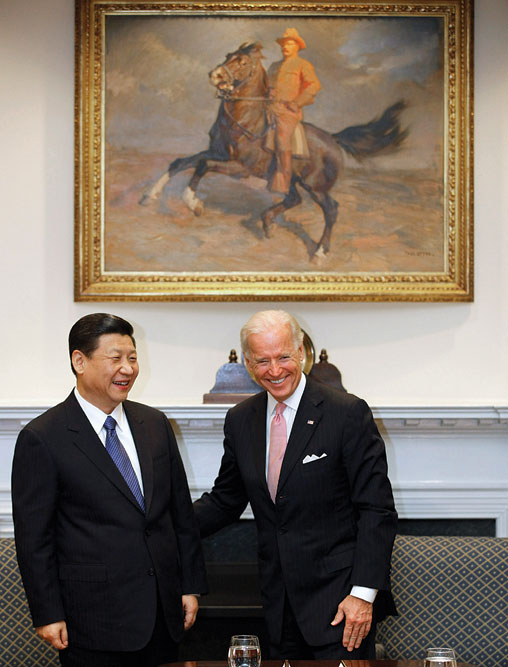
Joe Biden and Xi Jinping at the White House, 2012 (Photo: Getty Images)

Brahma Chellaney, OPEN magazine

It is no exaggeration to say that international policy toward China has for decades been shaped largely by one power — the United States. From Richard Nixon to Barack Obama, a succession of U.S. presidents aided China’s rise, including its integration into international institutions — from the UN Security Council to the World Trade Organization. And other countries followed the American lead in outsourcing manufacturing to China and building closer bonds with that communist giant. It is Donald Trump’s presidency that began a fundamental shift in U.S. policy.

The U.S. and India are now close security partners. But it is no exaggeration to say that India’s security over the years has been gravely undermined by U.S. policies, which created a Frankenstein on India’s northern frontiers (China) and an epicentre of international terrorism on its western borders (Pakistan).

In a major speech on China in July, U.S. Secretary of State Mike Pompeo declared: “President Nixon once said he feared he had created a ‘Frankenstein’ by opening the world to the Chinese Communist Party, and here we are. Now, people of good faith can debate why free nations allowed these bad things to happen for all these years. Perhaps we were naive about China’s virulent strain of communism, or triumphalist after our victory in the Cold War, or cravenly capitalist, or hoodwinked by Beijing’s talk of a ‘peaceful rise.’ Whatever the reason — whatever the reason, today China is increasingly authoritarian at home, and more aggressive in its hostility to freedom everywhere else. And President Trump has said: enough.”

Trump himself has acknowledged that the U.S. created a “monster” by aiding China’s rise: “They [China] took advantage of us for many, many years. And I blame us, I don’t blame them. I don’t blame President Xi. I blame all of our presidents, and not just President Obama. You go back a long way. You look at President Clinton, Bush — everybody; they allowed this to happen, they created a monster.”

Aiding China’s rise was the greatest mistake of U.S. foreign policy since the end of World War II. The U.S. actively contributed to the rise of its most formidable peer competitor in what will be remembered as a historically unprecedented act.

The U.S., however, is separated from China by a vast ocean — the Pacific — and does not have the same immediate and potent security concerns over growing Chinese assertiveness that many Asian states have. The security costs of America’s China blunder are indeed being borne essentially by Asians, from those in Taiwan and Hong Kong to the ethnic Tibetans and Uighurs. And as the Chinese encroachments on Ladakh’s key border areas this year have highlighted, India is bearing the brunt of China’s terrestrial aggression.

Here’s the paradox: As Sino-Indian relations plumb new depths following the Chinese stealth encroachments in Ladakh, India — unable to effectively counter the China threat on its own — is strengthening defence and strategic collaboration with the U.S., the monster creator. Chinese territorial aggression in the Himalayas has been a huge boon for American efforts to win over India, as highlighted by a recent agreement to share geospatial data from airborne and satellite sensors.

The U.S. today is close to accomplishing what it has long struggled to achieve — co-opt India in a “soft alliance.” In October, India signed the last of four “foundational” agreements that the U.S. maintains with all its close defence partners. Then-U.S. Defence Secretary Mark Esper declared that India will be “the most consequential partner for us, I think, in the Indo-Pacific for sure in this century.”

The U.S.-India strategic ties bear little resemblance to America’s Cold War-era system, which rested on a patron-client framework, with the U.S. as the “hub” and its allies as the “spokes.” No such arrangement would work nowadays, for the simple reason that a country as large as India cannot become just another Japan to the U.S.

The U.S., Japan and Australia are already tied by bilateral and trilateral security alliances among themselves, making India’s co-option pivotal to building a constellation of democracies in the Indo-Pacific region. After establishing an Indo-Pacific strategy and resurrecting the Quad, which had been lying dormant for nine years, the Trump administration — in a symbolic nod toward India — renamed the U.S. military’s Pacific Command as the Indo-Pacific Command.

The “soft alliance” the U.S. is seeking to build with India will be devoid of any treaty obligations. And, given India’s longstanding preference for strategic autonomy, the U.S. has sought to reassure New Delhi that it is not seeking to change its foreign-policy traditions.

In the recent words of U.S. Deputy Secretary of State Stephen Biegun, “Rather we want to explore how to empower them and India’s ability to defend its own sovereignty and democracy and to advance Indian interests across the Indo-Pacific region. As the U.S. assesses our own interests and how they intersect with India’s, we have seen the conditions emerge for an organic and deeper partnership — not an alliance on the post-war model, but a fundamental alignment along shared security and geopolitical goals, shared interests and shared values.”

Biden’s tarnished record on China

The year 2020 will be remembered not just for the China-inspired COVID-19 shock and a moment of reckoning for the world’s largest dictatorship in Beijing, but also for the election defeat of Donald Trump, setting in motion the end of his U.S. presidency. Will Trump’s exit help relieve pressure on China?

Will the administration of Joe Biden return to the softer approach toward China of the Obama period? Under Obama’s watch, Chinese President Xi Jinping’s regime built artificial islands and militarized the South China Sea — without firing a single shot or incurring any international costs. The same model China has sought to replicate in the Himalayas, by incrementally encroaching on the territories of India, Nepal and Bhutan.

Yet, just months before he left office, Obama contended that “we have more to fear from a weakened, threatened China than a successful, rising China.” Few of China’s neighbours shared that assessment. The Obama administration did little more than watch China’s aggressive expansionism — from redrawing the geopolitical map in the South China Sea to rolling out the neo-colonial Belt and Road Initiative with the aim to refashion the global economic and political order by luring nations desperate for infrastructure investments into its strategic orbit.

What will be the future of the Quad and the “free and open Indo-Pacific” strategy after Trump’s departure? This is another question with a bearing on India’s security and interests. The Trump administration gave India pride of place in its “free and open Indo-Pacific” strategy. That strategy has relied on the Quad.

The Trump administration, moreover, lent full support to India in countering China’s Himalayan border aggression and cut off security aid to Pakistan for not severing its ties with terrorist groups. It implicitly supported India’s 2019 Balakot airstrike deep inside Pakistan and refrained from criticizing India on its domestic actions, from the reorganization of Jammu and Kashmir to a refugees-related citizenship law amendment.

Prime Minister Narendra Modi’s personal rapport with Trump served India well. Trump’s standalone trip to India less than 10 months ago underscored how the expanding U.S.-India strategic partnership has become an important diplomatic asset for both countries. Trump summed up his trip as “unforgettable, extraordinary and productive.” The visit will be remembered for Trump’s famous words at a mega-rally in Modi’s home city of Ahmedabad: “America loves India, America respects India, and America will always be faithful and loyal friends to the Indian people.”

Under Biden, the fundamental direction of the U.S.-India relationship toward closer cooperation is unlikely to change. But Biden could reset ties with China in order to lower Sino-U.S. tensions and rebuild cooperation in areas where bilateral interests converge.

The open support the U.S. has extended to India in countering China’s border aggression may not survive under a Biden administration, especially if it seeks to reset ties with Beijing. With a pusillanimous Modi government unwilling to call China out on its aggression, let alone wage a diplomatic offensive to spotlight the Chinese encroachments, Trump’s national-security team members spoke out on what Xi’s regime had done to India.

For example, after the Galwan Valley clashes of mid-June, U.S. National Security Advisor Robert O’Brien said, “Chinese troops ambushed the Indians. They beat 20 Indians to death. They beat them so badly with clubs with nails in them and wrapped with concertina wire — barbed wire. They beat the Indians so badly that they were disfigured and could not be identified by their comrades. The Chinese have been very aggressive with India.”

Pompeo, for his part, has repeatedly highlighted China’s aggression against India. On July 8, Pompeo said, “The Chinese took incredibly aggressive action. The Indians have done their best to respond to that … I don’t think it’s possible to look at that particular instance of Chinese Communist Party aggression in isolation.  I think you need to put it in the larger context.” Then on July 22 he said, “The recent clashes initiated by the PLA [People’s Liberation Army] are just the latest examples of the CCP’s unacceptable behaviour.”

On July 30, Pompeo cautioned, “They talk about bringing socialism with Chinese characteristics to the world. Claims that they have now made for real estate in Bhutan, the incursions that took place in India, these are indicative of Chinese intentions. And they are testing, they are probing the world to see if we are going to stand up to their threats and their bullying.” And, in a similar vein, he said on Sept. 2: “From the Taiwan Strait to the Himalayas and beyond, the Chinese Communist Party is engaged in a clear and intensifying pattern of bullying its neighbours.”

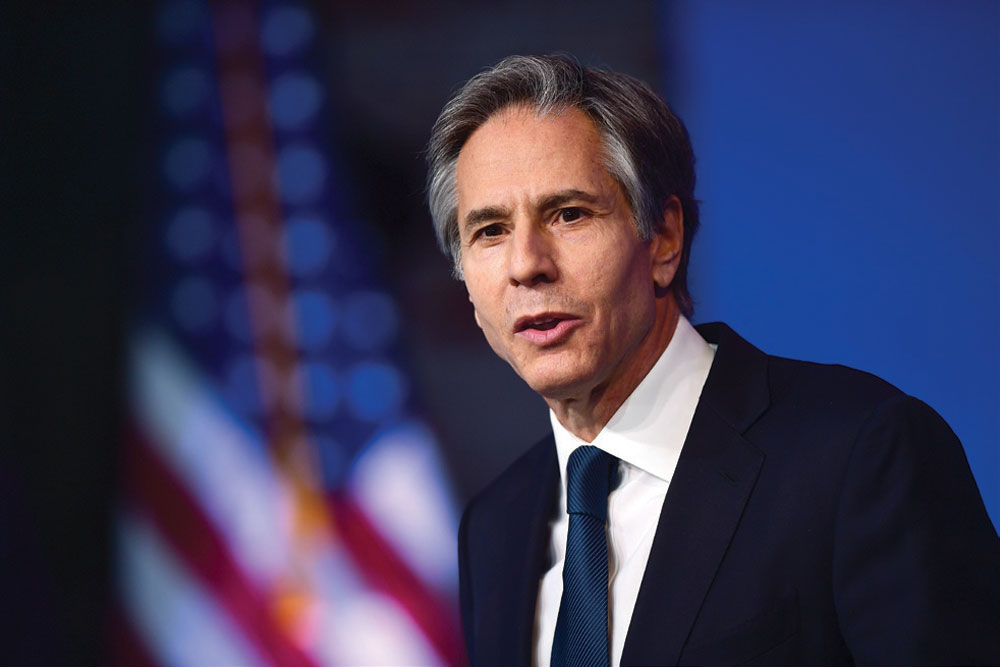
Such plain speaking may become a thing of the past. Biden’s pick for secretary of state, Anthony Blinken, said at a Hudson Institute event in July that a Biden administration would seek to make the U.S. more competitive and values-centred and “reengage China and work with China” from a position of strength. Finding ways to cooperate with Beijing would mark a break with the Trump administration’s approach, which sees the U.S. in deeply ideological, even existential, conflict with the CCP.

Biden’s pick for national security adviser, Jake Sullivan, in a 2017 lecture, warned against “containment” as a policy, stating: “We need to strike a middle course — one that encourages China’s rise in a manner consistent with an open, fair, rules-based, regional order.” An autumn 2019 essay in the Foreign Affairs journalco-authored by Sullivan argued for “managed coexistence” with China, saying China is a “formidable competitor” but also “an essential U.S. partner.” So, containment is not tenable, it posited.

The essay pushed for “managed coexistence” in these words; “Advocates of neo-containment tend to see any call for managed coexistence as an argument for a version of the grand bargain; advocates of a grand bargain tend to see any suggestion of sustained competition as a case for a version of containment. That divide obscures a course between these extremes — one that is not premised on Chinese capitulation or on U.S.-Chinese condominium.” According to the essay, “The need for cooperation between Washington and Beijing is far more acute, given the nature of contemporary challenges.” The key, it argued, is for Washington to get “the balance between cooperation and competition right.”

The essay’s advocacy of “managed coexistence” with China must have been music to Chinese ears. In a recent op-ed in The New York Times, Fu Ying, a vice chairwoman of the Foreign Affairs Committee of China’s National People’s Congress and an ex-vice foreign minister, called for “cooperative competition” between the U.S. and China. Ms. Fu wrote: “Both governments have heavy domestic agendas to attend to, and so even if competition between China and the United States is unavoidable, it needs to be managed well, cooperatively. It is possible for the two countries to develop a relationship of ‘coopetition’ (cooperation + competition) by addressing each other’s concerns.”

The concept of “cooperative competition” sounds a lot like the “managed coexistence” idea. Both concepts imply a G2-style condominium defined by competitive-cum-cooperative elements. But make no mistake: America’s “managed coexistence” with China will further strengthen the CCP internally and externally. China is already the world’s largest, strongest and longest-surviving autocracy. This is a country increasingly oriented to the primacy of the Communist Party.

What is remarkable — and a cause for deep concern — is that Biden has been wrong on China virtually his entire career.

For example, as the lead Democrat on the Senate Foreign Relations Committee, Biden in 2000 supported establishing Permanent Normal Trade Relations (PNTR) with Beijing on grounds that it would yield “economic benefits to the U.S.,” “political reform in China” and a positive “impact on our national security.” More than a decade later, in an op-ed in The New York Times in 2011, Biden gullibly declared, “I remain convinced that a successful China can make our country more prosperous, not less.” 

Just last year, Biden stunned many with his apparent strategic naïveté by declaring at a campaign rally, “China is going to eat our lunch? Come on, man. I mean, you know, they’re not bad folks, folks. But guess what? They’re not competition for us.” The blowback compelled Biden to backtrack and admit China was a threat. 

After Biden’s election win over Trump, Japanese Prime Minister Yoshihide Suga said he received an assurance from the president-elect during a congratulatory call that U.S. security guarantees apply to Japan’s administration of the disputed Senkaku Islands. But, in apparent deference to China, the Biden office readout left out that assurance. In another worrying sign, Steve Ricchetti, who led the effort 21 years ago to get China into the WTO (an entry that has come back to haunt the U.S.), was named as the White House senior adviser to Biden — or, as one American newspaper put it, “tapped for the West Wing’s wise-man role.”

Likely demise of “free and open Indo-Pacific” strategy

Biden’s biggest foreign-policy challenge relates to the world’s economic and geopolitical hub — the Indo-Pacific region, which unites the Indian and Pacific oceans. An expansionist China is injecting greater instability and tensions in the Indo-Pacific through its territorial and maritime revisionism and heavy-handed use of economic and military power.

When Trump took office, he replaced Obama’s floundering “pivot” to Asia with the broader “free and open Indo-Pacific” strategy, besides designating China as a strategic competitor and threat. Will America’s Indo-Pacific policy flip again during Biden’s presidency?

Last month’s “Malabar” Australia-India-Japan-U.S. naval war games in the Bay of Bengal and the Arabian Sea showed that the Quad is beginning to take concrete shape in response to China’s muscular policies. But just when a concert of democracies in the Indo-Pacific seems closer than ever, the impending change of U.S. government has added a new layer of uncertainty, including on the future of America’s Indo-Pacific strategy.

Biden, even before taking office, has signalled his intent to discard the Trump administration’s “free and open Indo-Pacific” strategy. The “free and open Indo-Pacific” concept was originally authored by then-Japanese Prime Minister Shinzo Abe. Rarely has the U.S. adopted a foreign-designed concept as the linchpin of its foreign policy.

The “free and open Indo-Pacific” strategy’s days seem numbered. Even the term “Indo-Pacific,” whose use expanded America’s regional framework to include India as a major power, was conspicuously absent in Biden’s campaign statements and the 2020 Democratic Party Platform.

In fact, the 2020 Democratic Party Platform reverted to the use of the old term “Asia-Pacific” in place of “Indo-Pacific.” It carried a section titled “Asia-Pacific.” China strongly prefers the “Asia-Pacific” term. After the U.S. presidential election, the Chinese state media has been urging the Biden team to replace “Indo-Pacific” with “Asia-Pacific.”

After his election, Biden has started referring to “Indo-Pacific” in calls with foreign leaders but not to “free and open.” Instead, Biden has coined a new phrase — “secure and prosperous Indo-Pacific.” He used the new expression in calls with the leaders of Australia, India and Japan. Biden, however, has given no indication how his “secure and prosperous Indo-Pacific” policy will be different from the current “free and open Indo-Pacific” strategy.

Today, a rules-based and democracy-led order in the Indo-Pacific has become more important than ever to ensure a stable power balance. If the region’s major democracies, from Canada and South Korea to Indonesia and India, leverage their growing strategic bonds to generate progress toward a broader concert of democracies, the vision of a free and open Indo-Pacific may be realized.

Instead, the likely demise of the “free and open Indo-Pacific” strategy is set to spur concerns in Asia. It will also lead to questions about the inherent unpredictability surrounding U.S. strategy and the wisdom of investing in closer strategic bonds with Washington.

Nowhere will these questions generate greater concerns than in India, which hosted the recent Malabar war games. India elevated the war games this year from a trilateral to quadrilateral event by finally acceding to Australia’s pending request to re-join an exercise from which it dropped out 12 years ago in a bid to appease Beijing. The Chinese communist mouthpiece Global Times said earlier that Australia’s inclusion would “signal that the Quad military alliance is officially formed.”

The loss of the expression “free and open Indo-Pacific” will likely be seen in India as a diminution of its future role in American strategy. More broadly, it could be viewed as a possible dilution of the U.S. commitment to establish an Indo-Pacific concert of democracies, with India serving as the western anchor and Japan and Australia the eastern and southern anchors of a regional balance of power.

Biden has promised to host a global Summit for Democracy in his first year in office to help “renew the spirit and shared purpose of the nations of the free world.” But such a values-based, globalized approach contrasts with the current U.S. strategy of regionally leveraging cooperation with democracies for geopolitical ends.

Unless a clearer strategic vision emerges under Biden, the likely unravelling of the “free and open Indo-Pacific” strategy could smother any hoped-for regional concert of democracies.

Gnawing uncertainty

At a time when the strengthening China-Pakistan strategic nexus is imposing greater security costs on India, any shifts in America’s China and Pakistan policies — even if subtle — will only embolden the two hand-in-glove neighbours to further up the ante against New Delhi. U.S.-India relations thrived during the Trump presidency, despite Trump’s mini-trade war against New Delhi. But India now faces new uncertainties with regard to U.S. regional policies, including whether Biden’s administration will seek greater cooperation with Beijing and Islamabad.

Few know what Biden stands for. Biden, who turned 78 last month, will be the oldest ever American president sworn in for the first time. An October op-ed in The Wall Street Journal said, “Though it is impolitic to say so, Biden has exhibited clear signs of mental decline.”

Biden won the election despite having no political base or vision — and no ideas, other than to oust Trump from office. In fact, his divided Democratic Party is trying to figure out what it stands for after realizing the common goal of ending Trump’s presidency.

Some in Indian policy circles still remember how Senator Biden spearheaded a congressional move in 1992 that helped block Russian sale of cryogenic-engine technology for India’s civilian space program, setting it back many years. Today, the U.S. and India are not only space partners, but also the U.S. Strategic Command head defended India’s 2019 demonstration of a capability to destroy an orbiting satellite.

If as president, Biden seeks to mend U.S. ties with the Chinese dictatorship, relieves terrorism-related pressure on Pakistan by restoring security aid, and criticizes India on Kashmir and minority rights, New Delhi will have second thoughts on getting too close to the US. India, however, is likely to remain important for the U.S. because of its massive market and strategic location. It is the only resident power in the western part of the Indo-Pacific that can countervail China’s military and economic moves.

Biden hasn’t revealed his thinking to any significant degree on foreign policy. Most members of the national security team he has selected are considered “liberal interventionists” — or hawks on the American left. It was liberal interventionists who, under Obama, engineered the disastrous interventions in Syria and Libya and who, during the Bill Clinton presidency, spearheaded the NATO air war against Yugoslavia.

Blinken, Biden’s secretary of state pick, favoured invasion of Iraq in 2003 and military intervention in Libya in 2011. Indeed, Blinken publicly celebrated America’s occupation of Iraq as a “success,” claiming it had brought down violence and won grassroots support. Sullivan, another hawk in Biden’s team, supported U.S. supply of anti-tank missiles for Ukraine, which President Obama opposed and Trump finally delivered. 

Espousing military action as humanitarianism has been the common leitmotif uniting liberal interventionists with neoconservatives, who were behind America’s Iraq invasion and occupation. Today, both these powerful groups in Washington remain fixated on Russia, although Russia’s economy today is less than one-tenth the size of China’s and its military spending one-fifth of China.

U.S. policy has already driven two natural competitors, China and Russia, into a growing strategic alignment. This geopolitical reality, if left unaddressed, could crimp U.S. strategy against China.

Let’s be clear: The year 2020 has been particularly bad for Beijing. China’s initial coverup of the coronavirus outbreak in Wuhan that gifted the world a horrendous pandemic, followed by its unchecked expansionism and pursuit of “wolf-warrior diplomacy,” were signal moments that spurred a tectonic shift in views across the political spectrum in the U.S. and helped change global opinion on China. Negative views of China have now reached historic highs in many countries, according to a survey by the Washington-based Pew Research Center.

Perhaps the only bit of good news for Beijing in 2020 has been Trump’s ouster. Xi’s regime is hoping that Biden’s administration will ease the mounting U.S. pressure that has set in motion an international pushback against Beijing. A number of important economies are now seeking a managed and selective decoupling from China in key areas. If Biden proves a weak president, the pushback will certainly ease — and the decoupling could slow.

Although Xi may see Biden’s election victory as a silver lining, it will be a major surprise if “managed coexistence” (aka “cooperative competition”) comes to define Biden’s China policy.

Such an approach will militate against the current bipartisan consensus on China in the U.S., reflected in the 2020 Democratic Party Platform’s pledge that the “Democrats will be clear, strong, and consistent in pushing back where we have profound economic, security and human rights concerns about the actions of China’s government.” Managed coexistence, in fact, could be a recipe for America’s inexorable decline.

There is an additional factor that could constrain Biden from going soft on China — a lingering scandal involving his controversial son, Hunter. As vice president, Biden took Hunter aboard Air Force Two to Beijing in 2013. Within days, Hunter’s firm become a partner in a new Bank of China-backed investment company that raised more than $1.5 billion. Hunter personally made millions of dollars from the deal. Republicans could resurrect that scandal to embarrass Biden.

In fact, after Biden’s election win, the U.S. state department released a 72-page blueprint on how to checkmate China’s imperial ambitions to dominate the world. The blueprint, which includes a section on China’s internal vulnerabilities, is in the style of a landmark 1947 essay by George F. Kennan (the founding director of its Policy Planning Staff) that helped institute the containment policy against the Soviet Union — a policy that defined the Cold War era. Kennan published the essay anonymously in the journal Foreign Affairs, the so-called “X-Article.”

The new blueprint on how to deal with the China challenge is likely to serve as broad guidance for Biden’s administration. It specifies a multipronged approach to address the China challenge.

For New Delhi, the key concern extends beyond the bilateral relationship with Washington — a relationship that is likely to remain close. There is gnawing uncertainty about the larger strategic approach of the Biden presidency and how it will align with India’s own strategic interests.

Without U.S. leadership and resolve, a credible counter to Chinese expansionism will never be convincing. Biden’s China and Indo-Pacific policies will help influence Beijing’s behaviour in Asia and the strategic trajectory of the U.S.-India relationship.

Brahma Chellaney is a geostrategist and the author of nine books, including, most recently, Water, Peace, and War.

© OPEN magazine, 2020.

The Message of Islamist Beheadings

In a world wracked by violence, Islamist beheadings stand out for their savagery. While the absolute number of victims is relatively small, the threat this practice poses should not be underestimated, and the lessons it suggests about prosecuting the “war on terror” must not be ignored.

Brahma ChellaneyProject Syndicate

Last month, an 18-year-old Chechen immigrant stalked, stabbed, and decapitated a history teacher, Samuel Paty, in a Paris suburb near the middle school where Paty worked. Soon after, a Quran-carrying Tunisian man beheaded a woman and fatally stabbed two other people in a church in Nice. In the same month, two British-born Islamic State (ISIS) militants were brought to the United States to face trial for their participation in a brutal abduction scheme in Syria that ended with American and other hostages beheaded on camera.

In a world wracked by violence, such killings stand out for their savagery. While the absolute number of victims is relatively small, the threat this practice poses to fundamental principles of modern civilization should not be underestimated.

The ancient Greeks and Romans instituted beheading as a mode of capital punishment. Today, radical Islamists commonly employ it in extrajudicial executions, which have been reported in a wide range of countries, including Egypt, India, the Philippines, and Nigeria. In Mozambique, up to 50 people, including women and children, have reportedly been murdered – and, in many cases, decapitated – by ISIS-linked fighters this month alone.

Such savagery casts a long shadow – especially because perpetrators so often share images of their actions. Ever since the 2002 decapitation of Wall Street Journal journalist Daniel Pearl in Pakistan, terrorist organizations have taken to posting videos of beheadings online. After murdering Paty, the perpetrator tweeted a photo of the severed head.

For Islamists, beheadings are a potent weapon of asymmetric warfare. The gruesome spectacle inspires jihadi sympathizers around the world, while fomenting fear in local communities, to the point that the Islamists are often able to impose their will – including medieval codes of conduct – on the societies in which they operate.

Jihadis represent a tiny minority of the world’s Muslims. But, by making clear their willingness to behave inhumanely, they have ensured that few dare defy them. Just this month, a Bangladeshi cricket star was forced, under threat of Islamist retaliation, to apologize publicly for briefly attending a Hindu ceremony in India. Through such tactics, Islamists are gradually snuffing out more liberal, diverse Islamic traditions in non-Arab countries.

Although beheadings have a particularly visceral impact, they are far from the only way the jihadists incite fear. Earlier this month, ISIS-linked gunmen stormed Afghanistan’s Kabul University, killing at least 35 – mainly students – and wounding dozens more. In Vienna, another Islamist, who had previously been jailed for trying to join ISIS, killed four people and wounded 22 in a shooting rampage.

The persistent scourge of Islamist violence is a clear signal that the global “war on terror,” launched after the September 11, 2001, attacks in the US, has faltered. Even within Western countries, meaningful government action against Islamist extremism has often been stymied by concerns about discrimination. But, far from protecting Muslims, those crying “Islamophobia” often are making Muslim communities less secure, by allowing extremism to grow unchecked.

The truth is that there is only one country in the world today that is truly cracking down on Islam, rather than on radical Islamism: China. In the last few years, China has incarcerated more than one million Uighurs and members of other Muslim minorities in its western Xinjiang region. Under the pretense of fighting terrorism, the authorities are carrying out a methodical, large-scale erasure of Islamic identities.

And yet the international community – including Muslim countries – have remained largely silent about China’s actions. Last year, Malaysia’s then-prime minister, Mahathir bin Mohamad, explained why: “China is a very powerful nation.”

By contrast, after the Nice attack, Mahathir tweeted that “Muslims have a right to be angry and kill millions of French people for the massacres of the past.” The incendiary tweet has since been removed for “glorifying violence,” though Mahathir’s account wasn’t suspended – a missed opportunity to push back against incitement.

Turkish President Recep Tayyip Erdoğan, for his part, has called for a boycott of French goods, because French President Emmanuel Macron pledged after Paty’s murder to defend secularism against radical Islam. It is clearly far easier to attack a democracy than to stand up to a ruthless dictatorship.

But none of this will protect Muslim communities, let alone end Islamist terrorism. For that, governments must adopt a new approach, based on a better understanding of the enemy they are fighting.

Islamist extremism is not an organization or an army; it is an ideological movement. As recent attacks show, the existence of a clear doctrine of violence obviates the need to coordinate action. That is why eliminating high-level figures in ISIS or al-Qaeda does so little to stop the bloodshed, and why military action alone will always fall short.

Instead, counterterrorism efforts should target the fount of jihadist terrorism: the militaristic Wahhabi theology, which justifies and commands the use of violence against “infidels.” This means, first and foremost, discrediting that “evil ideology,” as former British Prime Minister Theresa May put it, by attacking its core tenets, starting with the claim (unsupported by the Quran) that 72 virgins await every martyr in heaven.

It also means taming the clerics and other preachers of violent jihad. As the late Singaporean leader Lee Kuan Yew explained, we must target the “queen bees” (the preachers of violence) who inspire the “worker bees” (suicide attackers), not the worker bees themselves. Otherwise, the war on terror will continue to rage, and violent Islamism will become more deeply entrenched in societies.

Brahma Chellaney

Brahma Chellaney, Professor of Strategic Studies at the New Delhi-based Center for Policy Research and Fellow at the Robert Bosch Academy in Berlin, is the author of nine books, including Asian Juggernaut; Water: Asia’s New Battleground; and Water, Peace, and War: Confronting the Global Water Crisis.

© Project Syndicate, 2020.

Writing is on the wall for US Indo-Pacific strategy

Flip-flops are to Biden what egomania is to Trump

Brahma Chellaney, Nikkei Asia

The momentum toward deeper collaboration could slow if Biden’s foreign policy downgrades India’s importance in regional strategy.   © AP

Brahma Chellaney is a geostrategist and author of nine books, including “Asian Juggernaut: The Rise of China, India and Japan.”

The current naval war games involving Australia, India, Japan and the U.S. in the Indian Ocean show that the Quad — a loose coalition of the Indo-Pacific region’s four leading democracies — is beginning to take concrete shape in response to China’s muscular foreign policy. A concert of democracies in the Indo-Pacific seems closer than ever.

But just when the four powers appear on the cusp of formalizing their coalition, the impending change in the White House has added a layer of uncertainty. The big unknown is whether America’s Indo-Pacific strategy and how it will treat China will undergo a structural shift under President Joe Biden, as they did under President Donald Trump.

Trump fundamentally changed U.S. policy on China by acting on his campaign pledge to treat Beijing as a strategic rival and threat. He also replaced Barack Obama’s pivot to Asia, which never acquired concrete strategic content, with the free and open Indo-Pacific strategy, a concept authored by then-Japanese Prime Minister Shinzo Abe. Rarely has the U.S. adopted a foreign-designed concept as the linchpin of its foreign policy.

Given Beijing’s heavy-handed use of its military and economic power, if President Biden flips America’s Indo-Pacific and China policies once again, that will raise concerns across Asia. It will also lead to questions about the inherent unpredictability surrounding U.S. strategy and the wisdom of investing in closer strategic bonds with Washington in the first place.

Nowhere will these questions generate greater concerns than in India, the host of the current Quad naval war games up to Nov. 20. Formally known as the Malabar exercise after an area on India’s southwestern coast, this annual series of complex war games is aimed at building military interoperability on the high seas, and now involves aircraft carriers.

India elevated Malabar this year from a trilateral to a quadrilateral event by finally acceding to Australia’s pending request to rejoin after it dropped out 12 years ago in a bid to appease Beijing. The Chinese communist mouthpiece the Global Times said earlier that Australia’s inclusion would “signal that the Quad military alliance is officially formed.”Ships from the Indian navy, Royal Australian Navy, and Japan Maritime Self-Defense Force sail in formation during an exercise as part of Malabar 2020 on Nov. 3. (Handout photo from U.S. Navy)

China’s aggressive expansionism has driven a tectonic shift in India’s security calculus, leading to closer defense and intelligence-sharing collaboration with the U.S. and the signing of military logistics agreements this year with Japan and Australia. The Trump administration helped midwife this tectonic shift by placing India at the center of its Indo-Pacific strategy and seeking to forge a “soft alliance” with New Delhi.

The U.S., Japan and Australia are already tied by bilateral and trilateral security alliances among themselves, making India’s co-option pivotal to building a constellation of democracies. After establishing an Indo-Pacific strategy and resurrecting the Quad, which had been lying dormant for nine years, the Trump administration — in a symbolic nod toward India — renamed the U.S. military’s Pacific Command as the Indo-Pacific Command. Chinese territorial aggression in the Himalayas has helped bring India along.

But the momentum toward deeper collaboration could slow if Biden’s foreign policy downgrades India’s importance in regional strategy and returns — as Biden has signaled — to the Obama-era approach of cooperating with China in areas where Sino-U.S. interests converge. This would mark a break with the current approach that sees the U.S. in deeply ideological — even existential — conflict with the Chinese Communist Party.

Last year, Biden stunned many with his apparent strategic naivete by declaring that “China is going to eat our lunch? Come on, man. I mean, you know, they’re not bad folks, folks. But guess what? They’re not competition for us.” The blowback compelled Biden to backtrack and admit China was a threat.

To be sure, Biden made a habit during the election campaign of reversing his positions on major policy issues. Flip-flops are to Biden what egomania is to Trump. Still, the free and open Indo-Pacific strategy’s days seem numbered. Even the term “Indo-Pacific,” whose use expanded America’s regional framework to include India as a major power, was conspicuously absent in Biden’s campaign statements and the 2020 Democratic Party Platform.

Biden could revert to the old term “Asia-Pacific” or keep “Indo-Pacific” while enunciating a new policy for the region. In calls last week with the leaders of Japan, South Korea and Australia but not India, Biden emphasized a “secure and prosperous Indo-Pacific” instead of a free and open Indo-Pacific. And, in apparent deference to Beijing, the Biden office readout left out the assurance Japanese Prime Minister Yoshihide Suga said he received from the president-elect that U.S. security guarantees apply to Japan’s administration of the Senkaku Islands, which Beijing claims and calls the Diaoyu.

The bipartisan consensus in Washington that the U.S. must get tough with Beijing, however, is likely to prevent Biden’s return to the softer China approach of the Obama period. It was on Obama’s watch that China launched cost-free expansionism, including redrawing the geopolitical map in the South China Sea.

The loss of the expression “free and open Indo-Pacific” will likely be seen in India as a diminution of its future role in American strategy. More broadly, it could be viewed as a possible dilution of the U.S. commitment to establish an Indo-Pacific concert of democracies, with India serving as the western anchor and Japan and Australia the eastern and southern anchors of a regional balance of power.

Biden has promised to host a global Summit for Democracy in his first year in office to help “renew the spirit and shared purpose of the nations of the free world.” But such a values-based, globalized approach contrasts with the current U.S. strategy of regionally leveraging cooperation with democracies for geopolitical ends.

Unless a clearer strategic vision emerges under Biden, the likely unraveling of the free and open Indo-Pacific strategy could silence any hoped-for regional concert of democracies.

Biden Can Make an Ally of India

But Partnership With New Delhi Is Not Guaranteed

By Brahma Chellaney

Foreign Affairs journal

President-elect Joe Biden will inherit a U.S.-Indian relationship that is nearer than ever to a formal alliance. Will the bilateral relationship continue to deepen under the next U.S. administration?

Paintings of U.S. President-elect Joe Biden and Vice President-elect Kamala Harris in Mumbai, India, November 2020. Niharika Kulkarni / Reuters

President-elect Joe Biden will inherit a U.S.-Indian relationship that is nearer than ever to a formal alliance. In the past decade, Washington and New Delhi have deepened their diplomatic and defense ties, but the Indian government has not yet officially allied with the United States. During the administration of U.S. President Donald Trump, India and the United States signed a series of foundational defense, logistics, and intelligence-sharing agreements that pave the way for close security cooperation. Last month, the then U.S. secretary of defense, Mark Esper, declared that India will be “the most consequential partner for us, I think, in the Indo-Pacific for sure in this century.”  

India’s newfound interest in defense collaboration with the United States is mainly a reaction to Chinese imperial expansionism. Beijing’s territorial aggression in the Himalayas this year and the resulting clashes with Indian troops laid bare the risks to India of dealing with its giant neighbor without the clear support of the United States. As the specter of additional Himalayan battles—or even a reprise of the 1962 border war with China—looms large, India has grown more willing to work with the United States to meet common challenges. To that end, India has intensified its involvement with the Quad—a loose coalition among Australia, India, Japan, and the United States that is central to the United States’ strategy for maintaining a “free and open Indo-Pacific.” As a result of these efforts, India is currently hosting the first-ever Quad military exercise: the Malabar naval war games in the Indian Ocean.

Biden is likely to continue to push for closer cooperation between New Delhi and Washington. But he is also widely expected to reset ties with China in order to ease Sino-U.S. tensions and rebuild cooperation with Beijing. Such a reset will affect relations with India and raise doubts in New Delhi about Washington’s reliability. India’s future partnership with the United States is not yet guaranteed, and Biden will have to be careful not to push India away as he devises a new U.S. strategy in Asia.

THREADING THE NEEDLE

Separated from China by a vast ocean, the United States does not share India’s immediate and potent concerns over Beijing’s growing assertiveness. Earlier this year, while India sought to snuff out the novel coronavirus with the world’s strictest lockdown, China stealthily encroached on several border areas in India’s high-altitude Ladakh region. Beijing seized key stretches of territory and has refused to pull back, alarming both Indian policymakers and the public at large.

Given these tensions, Biden will have to thread a diplomatic needle to improve relations with China without alienating India. Successive U.S. presidents from Richard Nixon to Barack Obama aided China’s rise. Beijing militarized the South China Sea under Obama’s watch. Yet, just months before he left office, Obama contended that “we have more to fear from a weakened, threatened China than a successful, rising China.” China’s neighbors do not share that assessment. It was the paradigm policy shift under Trump, who set Beijing in his crosshairs from the beginning of his presidency and designated China as a “revisionist power” and a “strategic competitor,” that persuaded India to move closer to the United States.

A softer U.S. approach toward China and its regional ally, Pakistan, could slow India’s entry into the U.S.-led security architecture and even push New Delhi to revert to its traditional posture of nonalignment, or strategic autonomy from great powers. The strengthening Chinese-Pakistani alliance generates high security costs for India, including raising the ominous prospect of  a war on two fronts. New Delhi would be disappointed if Biden, in seeking to mend U.S. ties with the Chinese dictatorship, abandons Trump’s more confrontational posture toward Beijing. And if Biden relieves terrorism-related pressure on Pakistan by restoring security aid, the Indian government may have second thoughts about hopping on the U.S. security bandwagon.

Another issue that has the potential to sour relations with India during Biden’s presidency relates to India’s domestic division and polarization. While in office, Trump has refrained from commenting on India’s internal matters, understanding that U.S. criticism could strengthen Prime Minister Narendra Modi’s opponents at home. But Biden, through his official campaign page, has already slammed Modi’s government on issues such as Indian actions in Kashmir and a controversial law on citizenship for refugees, calling these matters inconsistent with India’s “long tradition of secularism and with sustaining a multiethnic and multireligious democracy.”

India has traditionally resented such interference in and commentary on its internal affairs. Indian External Affairs Minister Subrahmanyam Jaishankar canceled a meeting with members of the U.S. Congress last December after it emerged that Representative Pramila Jayapal, an outspoken critic of the Modi government, would attend. If U.S. leaders, including Biden, are outspoken in their criticism of Modi’s domestic policies or actions, New Delhi will be less likely and less able to formalize an alliance with Washington.

REASONS FOR OPTIMISM

Such differences have the potential to set back U.S. relations with India. But the general trajectory toward increased strategic collaboration probably won’t be altered. There remains strong bipartisan support in Washington for a closer partnership with India, a relationship that could serve as the fulcrum of the United States’ Indo-Pacific strategy. 

Biden’s administration will probably prioritize deepening the United States’ engagement with India. The incoming president, more broadly, is likely to pursue a pragmatic policy aimed at containing the threats posed by both the Chinese Communist Party and violent Islamist extremists. He will try to strengthen alliances and partnerships, some of which Trump undermined, and could echo Obama, who declared the U.S.-Indian relationship “one of the defining partnerships of the twenty-first century.”

Biden could accomplish what Trump failed to achieve—clinching a trade deal with India. The booming trade between the two countries totaled almost $150 billion last year. That commercial exchange may help the United States break China’s stranglehold on key global supply chains, especially in the medical sector. The Biden administration will need India, the world’s leading exporter of generic drugs, to source pharmaceuticals and medical technology needed to fight the pandemic. And given Vice President-elect Kamala Harris’s Indian heritage, it would be ironic if relations with India did not flourish under Biden.

Current U.S. policies have counterproductively fostered an expanding partnership between Russia and China. In that context, the strengthening bond with India assumes greater meaning for U.S. policymakers. Even as he tries to lower tensions with China, Biden must be careful not to allow the historic opportunity to forge a U.S.-Indian security alliance slip away. The world’s most powerful and most populous democracies could establish a strong partnership that helps underpin a stable power balance in the Indo-Pacific.

BRAHMA CHELLANEY is a geostrategist and the author of Water, Peace, and War: Confronting the Global Water Crisis.

Why do so many Asian nations want to be in China’s debt?

Beijing’s debt-trap diplomacy likely to cost it dearly over the long term

Brahma Chellaney, Nikkei Asia

Power lines near Nam Theun 2 dam in Khammouane province: Beijing has effectively taken control of Laos’s electric grid.   © Reuters

Brahma Chellaney is a geostrategist and author of nine books, including “Asian Juggernaut: The Rise of China, India and Japan.”

China’s debt-trap diplomacy, redolent of colonial-era practices, has claimed its latest victim — the small, resource-rich nation of Laos. Struggling to pay back Chinese loans, Laos has handed China majority control of its national electric grid at a time when its state-owned electricity company’s debt has spiraled to 26% of its gross domestic product.

Sri Lanka and Pakistan, meanwhile, are taking fresh loans from China to pay off old loans, highlighting the vicious cycle in which they find themselves trapped. Both have already been compelled to cede strategic assets to China.

Less than three years ago, Sri Lanka signed away the Indian Ocean region’s most strategically located port, and more than 6,000 hectares of land around it, on a 99-year lease to China. The Hambantota port’s transfer to Beijing was seen in Sri Lanka as the equivalent of a heavily indebted farmer giving away his daughter to a cruel money lender.

Pakistan has given China exclusive rights, coupled with a tax holiday, to run Gwadar port for the next 40 years. China will pocket 91% of the port’s revenues. Next to the port, which is located at the crossroads of the global energy trade, China plans to build a Djibouti-style outpost for its navy.

Tajikistan, whose borrowing binge from 2006 was followed by its ceding of 1,158 sq. kilometers of the Pamir mountains to China and then granting Chinese companies rights to mine gold, silver and other mineral ores, recently asked Beijing for debt relief.

Another country heavily in debt to China, neighboring Kyrgyzstan, also sought relief from Beijing last month before it plunged into political chaos. In Africa, a long list of states wanting suspension of their debt repayments to Beijing during the coronavirus pandemic includes Angola, Cameroon, Congo, Ethiopia, Kenya, Mozambique and Zambia.

Laos’s ambition was to become the battery of Southeast Asia by investing in hydropower development and exporting electricity. So, it agreed to give deep-pocketed Chinese state-run companies an important role in harnessing its rich hydropower reserves.

But today, Beijing has effectively taken control of Laos’s electric grid and, by extension, its water resources. This holds serious implications for environmental security and sustainable development in landlocked Laos, given how China’s heavy upstream damming of the Mekong River is already contributing to depleted river levels and recurrent drought in downstream areas.

China’s deal also arms it with tremendous leverage over a country with just seven million citizens. Beijing’s power to dim all lights in Laos leaves little wiggle room for its tiny neighbor, already reeling under its staggering debt obligations.

Meanwhile, as concerns mount that Sri Lanka could become China’s satellite state, U.S. Secretary of State Mike Pompeo is due to arrive there from New Delhi tomorrow to try and pull Sri Lanka into Washington’s camp. Pompeo will press the ruling Rajapaksa brothers to accept a Status of Forces Agreement and a $480-million, five-year Millennium Challenges Corporation aid compact, both controversial subjects in Sri Lanka.

But cash-strapped Sri Lanka’s recent decision to turn to its biggest lender China, rather than to the International Monetary Fund, for a large loan to avert a default on its debt raises a larger question: What makes some nations sink deeper into Chinese debt, despite the risks of mortgaging their foreign-policy autonomy to Beijing?

The answer is several factors, including the comparative ease of borrowing from China, with IMF lending normally carrying stringent conditions and oversight. China does not evaluate a borrower state’s creditworthiness, unlike the IMF, which will not lend if its assessment indicates that additional loans could drive the country into a serious debt crisis. Indeed, China is happy to lend until nations face a debt crisis because of the greater leverage it gives Beijing.

Typically, China starts as an economic partner of another country, only to gradually become its economic master. In fact, the more desperate a borrower country’s situation, the higher the interest rates it will likely pay on Chinese loans. China has a record of exploiting the vulnerability of small, strategically located countries that borrow big. One such example is the Maldives, where Beijing converted big credits into political influence, including acquiring a couple of islets cheaply in that Indian Ocean archipelago.

New runway built by China’s Beijing Urban Construction Group at the Velana International Airport in Hulhule Island, Maldives, pictured in September 2018.   © AP

Unlike some other heavily indebted states, the Maldives has been lucky to escape a Chinese debt trap. Since the Maldives’s election ousted its authoritarian president barely two years ago, India has stepped in to bail it out with generous budgetary support and a recent aid package.

China’s strategic use of debt to hold vulnerable states captive to its wishes may seem to mesh well with its vaunted focus on the long run. But the wider pushback against its imperial overreach, coupled with the corruption and malpractice in many of its Belt and Road projects, suggests that Beijing could be securing near-term advantages at the expense of its long-term goals.

Negative views of China have reached historic highs this year. The rising public distrust of China even in partner countries, and the fact that many Belt and Road projects are still not financially viable, have resulted in a declining number of new projects. Cumulatively, China is likely to pay a high price for its debt-trap diplomacy, even as the states it has ensnared are bound to suffer.

© Nikkei Asia, 2020.

The Quad Sharpens Its Edges

Despite US President Donald Trump’s undermining of US alliances, his administration has made significant progress in bringing together the Indo-Pacific’s leading democracies. And now that China has forced India’s hand, a new strategic arrangement in the region is almost a foregone conclusion.

Top foreign-policy officials of the Quad countries meet in Tokyo on October 6, 2020. (Charly Triballeau/Pool Photo via AP)

Brahma Chellaney, Project Syndicate

The Quad, a loose strategic coalition of the Indo-Pacific region’s four leading democracies, is rapidly solidifying this year in response to China’s aggressive foreign policy. Following a recent meeting of their top foreign-policy officials in Tokyo, Australia, India, Japan, and the United States are now actively working toward establishing a new multilateral security structure for the region. The idea is not to create an Asian version of NATO, but rather to develop a close security partnership founded on shared values and interests, including the rule of law, freedom of navigation, respect for territorial integrity and sovereignty, peaceful dispute resolution, free markets, and free trade.

China represents a growing challenge to all these principles. At a time when the world is struggling with a pandemic that originated in China, that country’s expansionism and rogue behavior have lent new momentum to the Quad’s evolution toward a concrete formal security arrangement.

Of course, the Quad’s focus also extends beyond China, with the goal being to ensure a stable balance of power within a “free and open Indo-Pacific.” That concept was first articulated in 2016 by then-Japanese Prime Minister Shinzo Abe, and has quickly become the linchpin of America’s regional strategy.

While all of the Quad partners agree in principle on the need for a free and open Indo-Pacific, it is Chinese expansionism that has catalyzed their recent actions. China is forcing even distant powers like the United Kingdom, France, and Germany to view a rules-based Indo-Pacific as central to international peace and security.

France, for example, has just appointed an ambassador for the Indo-Pacific, after unveiling a new strategy affirming the region’s importance in any stable, law-based, multipolar global order. And Germany, which currently holds the European Council presidency, has sought to develop an Indo-Pacific strategy for the European Union. In its own recently released policy guidelines, it calls for measures to ensure that rules prevail over a “might-makes-right” approach in the Indo-Pacific. These developments suggest that in the coming years, Quad members will increasingly work with European partners to establish a strategic constellation of democracies capable of providing stability and an equilibrium of power in the Indo-Pacific.

After lying dormant for nine years, the Quad was resurrected in late 2017, but really only gained momentum over the last year, when its consultations were elevated to the foreign-minister level. US Secretary of State Mike Pompeo said this month that, “once we’ve institutionalized what we’re doing, the four of us together, we can begin to build out a true security framework, a fabric that can counter the challenge that the Chinese Communist Party presents to all of us.”

The Quad’s future, however, hinges on India, because the other three powers in the group are already tied by bilateral and trilateral security alliances among themselves. Australia and Japan are both under the US security (and nuclear) umbrella, whereas India not only shares a large land border with China, but also must confront Chinese territorial aggression on its own, as it is currently doing. China’s stealth land grabs in the northernmost Indian borderlands of Ladakh earlier this year have led to a major military standoff, raising the risks of further localized battles or another 1962-style frontier war.

It is precisely this aggression that has changed the strategic equation. Chinese President Xi Jinping’s authorization of People’s Liberation Army incursions into the Himalayas has forced India itself to take a more confrontational position. It is now more likely than ever that the Quad will shift gears from consultation and coordination to become a de facto strategic alliance that plays a central role in a new multilateral security arrangement for the region.

This new architecture will bear little resemblance to America’s Cold War-era system, which rested on a patron-client framework, with the US as the “hub” and its allies as the “spokes.” No such arrangement would work nowadays, for the simple reason that a country as large as India cannot become just another Japan to the US.

That is why the US is working to coax India into a “soft alliance” devoid of any treaty obligations. This effort will be on full display on October 26-27, when Pompeo and US Secretary of Defense Mark Esper visit New Delhi for joint consultations with their Indian counterparts. Most likely, this meeting will conclude with India signing on to the last of the four foundational agreements that the US maintains with its other close defense partners. Under these accords, both countries will be committed to providing reciprocal access to each other’s military facilities, securing military communications, and sharing geospatial data from airborne and satellite sensors.

Moreover, having held multiple bilateral and trilateral military exercises with its Quad partners, India has invited Australia to next month’s “Malabar” naval war games with the US and Japan. This will mark the first-ever Quad military exercise; or, as the Chinese communist mouthpiece Global Times, put it, “it would signal that the Quad military alliance is officially formed.”

US foreign policy has always been most effective when it leverages cooperation with other countries to advance shared strategic objectives. Despite President Donald Trump’s undermining of US alliances, his administration has built the Quad into a promising coalition, and has upgraded security ties with key Indo-Pacific partners, including Taiwan, Japan, South Korea, Australia, Thailand, and India.

More fundamentally, the Quad’s consolidation is further evidence that the Xi regime’s aggressive policies are starting to backfire. International views of China have reached new lows this year. Yet the Chinese foreign ministry – doubling down on its “wolf warrior” diplomacy – recently dismissed as “nonsense” Pompeo’s plan to forge an international coalition against China. “He won’t see that day,” the ministry declared. “And his successors won’t see that day either, because that day will never, ever come.”

But that day is coming. The Quad once merely symbolized an emerging international effort to establish a discreet check on Chinese power. If Xi’s increasing threats toward Taiwan lead to military action, then a grand international coalition, with the Quad at its core, will become inevitable.

Brahma Chellaney

Brahma Chellaney, Professor of Strategic Studies at the New Delhi-based Center for Policy Research and Fellow at the Robert Bosch Academy in Berlin, is the author of nine books, including Asian Juggernaut; Water: Asia’s New Battleground; and Water, Peace, and War: Confronting the Global Water Crisis.

© Project Syndicate, 2020.

Tibet remains at the center of the China-India divide

Xi Jinping appears to have underestimated New Delhi’s capacity to fight back

Brahma Chellaney, Nikkei Asia

Tibetan exiles celebrate the Dalai Lama’s 85th birthday in Dharmsala, India on July 6: India could tacitly help Tibetan exiles to find, appoint and protect the Dalai Lama’s successor.   © AP

Is China’s insecurity over the restive Tibetan Plateau, which has already led to a major military standoff between the two Asian giants along their long and treacherous Himalayan frontier, driving President Xi Jinping’s belligerent policy toward India? The extended standoff has certainly raised the risks of further localized battles or another full-scale border war.

Xi recently underscored his regime’s anxieties by ordering Communist Party, government and military leaders to turn remote Tibet into an “impregnable fortress” against separatism and “solidify border defenses” to ensure frontier security with India. He also called for the Sinicizing of Tibetan Buddhism to help accelerate the Tibetan minority’s assimilation into the dominant Han culture.

Several issues are fueling Xi’s concerns over Tibet: controlling who succeeds the 85-year-old Dalai Lama; continued Tibetan resistance to Chinese rule; and China’s growing suspicions about India, which hosts a Tibetan government-in-exile and welcomes fleeing Tibetans.

Xi has sought to ruthlessly root out all signs of unrest in Tibet, the world’s largest and highest plateau that is very far from Beijing. Tibet’s capital, Lhasa, is more than 3,500 kilometers from the Chinese capital, but only 1,356 kilometers from New Delhi.

The Tibetan frontier with India was largely peaceful for centuries before China occupied Tibet in 1951. With its conquest of the “Roof of the World,” China enlarged its landmass by more than a third and fundamentally altered Asia’s geostrategic landscape.

After imposing itself as India’s neighbor, China refused to accept the Indo-Tibetan boundary’s customary alignment, which led to a bloody border war in 1962. That war, however, didn’t settle the territorial disputes, with China subsequently laying claim to more Indian territories beyond those it seized in 1962.

As China’s encroachments into India’s northernmost highlands since April show, Beijing is claiming these areas on the basis of alleged Tibetan ecclesial or tutelary links, even though Tibet only became part of China when China itself had been conquered by outsiders such as the Mongols and the Manchus.

The plain fact is that Tibet, despite disappearing as a buffer, remains at the heart of the China-India divide, fueling land disputes, diplomatic tensions, and — given that most of Asia’s great river systems originate on the Tibetan Plateau — feuds over the Chinese re-engineering of cross-border river flows.

Under Xi, China has introduced measures to snuff out Tibetan culture and cut Tibetans off from ancient traditions, including herding and farming. Recent reports have shed light on a coerced labor program to forcibly assimilate Tibetans, including through military drill-style skills training. China has also forced the last remaining Tibetan-language school to teach in Chinese.

India, however, has been funding Tibetan-language schools for its large Tibetan refugee community. The Dalai Lama, who says the Chinese Communist Party has transformed Tibet into a “hell on earth,” has spearheaded the effort to maintain Tibetan culture from his home in India.Tibetan children study at a school in the northern Indian hill town of Dharamsala.   © Reuters

For Xi, capturing the 442-year-old institution of the Dalai Lama is a pivotal final step toward securing China’s hold over Tibet.

India, however, continues to stand in the way of Xi’s plan to install a pawn to succeed the current 14th Dalai Lama. Underscoring the sharpening geopolitics, the U.S. Congress is close to passing the new Tibetan Policy and Support Act, which mandates financial and travel sanctions against Chinese officials who interfere in the Dalai Lama’s succession.

India, acting on the Dalai Lama’s instructions, could tacitly help Tibetan exiles find, appoint and protect his successor. The Dalai Lama has said his “reincarnation will appear in a free country,” which could mean in India’s Tibetan-Buddhist Himalayan regions. This explains why China has intensified its claim to Tawang, the birthplace of the sixth Dalai Lama.

Despite catching India’s military off-guard in Ladakh, located more than 1,500 kilometers from Tawang, Xi seems to have greatly underestimated India’s capacity to recoup from initial setbacks and fight back. About a month ago, Indian special forces stunned China by occupying vacant mountain heights overlooking key Chinese positions on the southern side of Ladakh’s Pangong Lake. Even more humiliating for Beijing is the fact that the Indian operation was spearheaded by a special force made up entirely of Tibetan exiles.

India rubbed salt in the wound by holding a largely-attended military funeral for a Tibetan soldier killed in that operation, with his coffin draped in both the Indian and Tibetan national flags. The funeral’s key message was that, just as China uses Pakistan to contain India, New Delhi can use Tibet as leverage against Beijing.Commandos of India’s all-Tibetan Special Frontier Force carry a coffin containing the body of their comrade Tenzin Nyima during his cremation ceremony in Leh on Sept. 7: the funeral’s key message was New Delhi can use Tibet as leverage against Beijing.   © Reuters

India’s daring seizure of the heights has drawn international attention to its secretive, all-Tibetan Special Frontier Force, established after Mao Zedong’s 1962 war with India. The itch to fight the occupiers of their homeland has drawn Tibetan recruits to this force.

Xi, China’s most powerful leader since Mao, is working to complete Mao’s expansionist vision, from the East and South China Seas to the Himalayan region. But his aggression against India may not be progressing as planned.

His real achievement may be sowing the seeds of the world’s next big conflict and ensuring the rise of a more antagonistic India. This means Tibet’s shadow will only grow longer over China-India relations in the coming years.

© Nikkei Asia, 2020.

Tokyo must thwart Beijing’s Senkaku strategy

Deception, concealment and surprise are central to China’s strategy to win without fighting. Japan’s passive and reactive mode has emboldened China to step up incursions into the waters around the Senkaku Islands. | REUTERS

By BRAHMA CHELLANEY, The Japan Times

The understanding reached between Prime Minister Yoshihide Suga and Chinese President Xi Jinping to pursue high-level contacts is unlikely to stem China’s incursions into the Senkaku territorial waters and airspace. But it will allow Xi’s regime to blend engagement with containment, including challenging Japan’s control of the Senkaku Islands and strengthening Chinese claims of sovereignty over them.

Chinese Foreign Minister Wang Yi’s proposed visit to Tokyo will likely have the same core agenda that his recent trip to Europe had — to avert economic decoupling from China and dissuade U.S. allies from supporting Washington’s moves to impose checks on the exercise of Chinese power. China, however, is unwilling to curb its economic and territorial expansionism.

In fact, Xi continues to push the boundaries, as underscored by the multiple fronts he has opened simultaneously, including in the East and South China seas, the Himalayan frontier, Hong Kong and Taiwan. Yet, Xi has sought to portray China as a country of peace, telling the United Nations General Assembly on Sept. 22, “We will never seek hegemony, expansion, or sphere of influence. We have no intention to fight either a cold war or a hot war with any country. We will continue to narrow differences and resolve disputes with others through dialogue and negotiation.”

Xi’s words rang hollow, especially as they came amid the border aggression he has launched against India since April, when the People’s Liberation Army made stealth encroachments on the highlands of Indian Ladakh. The intrusions have triggered a major India-China military standoff along one of the world’s most inhospitable and treacherous borders, which is as long as the distance between Tokyo and Hanoi.

There are important parallels between the way China is pursuing its territorial revisionism against its two main rivals in Asia, Japan and India. Indeed, China is pursuing a strategy of attrition and containment against both.

More fundamentally, Xi’s regime is pushing expansive territorial claims in Asia on the basis of revisionist history, not international law. Its weak legal case was highlighted by an international arbitral tribunal’s 2016 ruling that invalidated its claims in the South China Sea.

In international law, a territorial claim must be based on continuous and peaceful exercise of sovereignty over the territory concerned. There is absolutely no evidence that China ever had effective control over, for example, the Senkaku Islands.

In fact, China began claiming the Senkakus only after a United Nation agency’s report in 1969 referred to the possible existence of oil reserves in the East China Sea. It was not until the early 1970s that Chinese documents began applying the name “Diaoyu” to the Senkakus and claiming they were part of China.

Sinicizing the names of territories it claims is an old tactic of the Chinese Communist Party. The CCP’s record also reveals its penchant to create a dispute out of the blue by claiming that the territory it covets was part of China since ancient times.

Under Xi, China’s incursions into the Senkaku territorial waters and airspace have steadily intensified, not just in frequency but also with the entry of larger vessels and armed ships. In recent months, China has sought to even police the waters off the Senkakus.

If history is not to be repeated, Suga should draw some lessons, including from the record of his predecessor, Shinzo Abe.

The first lesson is that establishing better relations with Beijing doesn’t necessarily yield better Chinese behavior. Xi’s aggressive revisionism is unaffected by diplomatic progress.

For example, Abe’s 2018 visit to Beijing was instrumental in helping improve ties with China. Yet the ensuing diplomatic progress, far from reining in China’s aggressive actions, engendered increasing Chinese intrusions, including the longest series of incursions into Japanese waters in years.

A second lesson is that responding with notable restraint to China’s belligerence only encourages Beijing to further up the ante. Consider the startling fact that no Japanese defense minister has ever conducted an aerial survey of the Senkakus. In August, the then-defense minister, Taro Kono, decided to break that taboo but then backed off “so as not to provoke China.”

Such shrinking from purely defensive action explains why an emboldened China has stepped up incursions. Japan needs to strengthen its administrative and security control over the Senkakus.

A third lesson relates to China’s strategy. Deception, concealment and surprise are central to China’s strategy to win without fighting. It adheres to the ancient theorist Sun Tzu’s advice, “The ability to subdue the enemy without any battle is the ultimate reflection of the most supreme strategy.”

This approach involves taking an adversary by surprise, including seizing an opportunistic timing, and camouflaging offense as defense.

China’s war of attrition against Japan over the Senkakus has already disturbed the status quo, including by making the international community recognize the existence of a dispute and by regularizing Chinese incursions. China persists with its recklessly provocative actions, including ignoring the risk that an incident could spiral out of control.

A fourth lesson is that as long as China perceives strategic benefits as outweighing costs, Xi will persist with his strategy of attrition against Japan. Xi’s strategy is imposing greater security costs on Japan than on China.

Against this background, a Chinese strike against the Senkaku Islands could conceivably come when Japan has been lulled into complacency and least expects an attack. This is what happened to India. Indian Prime Minister Narendra Modi did not see the Chinese aggression coming because his vision had been clouded by the naive hope that, by meeting Xi 18 times in about five years, he had reset the bilateral relationship.

China’s aim against Japan is to progressively alter the territorial status quo in its favor. Despite the Suga-Xi understanding, Chinese provocations could escalate.

Japan has spent years being on the defensive, allowing China to keep the initiative. It is past time for Tokyo to come out of its reactive mode and turn the tables on China’s machinations by responding assertively. It must frustrate China’s strategy of incrementally altering the status quo without incurring substantive costs.

Japan ought to look at ways to impose costs. This could include first warning Beijing that its provocative actions, such as chasing Japanese fishing vessels within Japanese territorial waters, would henceforth be firmly countered. If provocative actions persist despite the warning, the Japan Coast Guard could selectively act against some intruding Chinese state ships.

To be sure, effectively countering Chinese incursions demands more than ramming or disabling intruding ships and detaining their crews. It calls for an important shift in Japan’s policies, including building defensive facilities in the Senkakus. Japan could begin modestly by building an environmental monitoring station in the Senkakus.

China, of course, will react furiously to any Japanese counteractions. But at a time when the international environment is turning hostile to Xi’s expansionism, Japan must display strength and resolve. If not, China will bring Japanese security under increasing pressure in the coming years.

Japan has a strong case, anchored in international law, that it has exercised sovereignty over the Senkakus since 1895. But make no mistake: The future of the Senkakus will not be decided by international law, even though a just, rules-based order is essential for international peace and security.

The South China Sea is a reminder that international law is powerless against the powerful. China has turned its contrived historical claims in the South China Sea into reality and gained strategic depth, despite the international tribunal’s ruling against it.

Japan undoubtedly faces hard choices. But accommodation with an unyielding China is simply not possible.

Without concrete counteractions, Japan will increasingly find itself at the receiving end of China’s muscular revisionism. To stop its security from coming under siege, Japan must act — with calm, confidence and firmness.

Brahma Chellaney is a geostrategist and the author of nine books, including “Water: Asia’s New Battleground,” the winner of the Bernard Schwartz Award.

China is Paying a High Price for Provoking India

For Xi Jinping, the COVID-19 pandemic – which has preoccupied the world’s governments for months – seemed like an ideal opportunity to make quick progress on his expansionist agenda. But by provoking India, he may have bitten off more than he can chew.

An Indian Army convoy on its way to the frontlines on September 7, 2020. (Photo via Getty Images)

BRAHMA CHELLANEYProject Syndicate

China’s foreign minister, Wang Yi, recently declared that aggression and expansionism have never been in the Chinese nation’s “genes.” It is almost astonishing that he managed to say it with a straight face.

Aggression and expansionism obviously are not genetic traits, but they have defined President Xi Jinping’s tenure. Xi, who in some ways has taken up the expansionist mantle of Mao Zedong, is attempting to implement a modern version of the tributary system that Chinese emperors used to establish authority over vassal states: submit to the emperor, and reap the benefits of peace and trade with the empire.

For Xi, the COVID-19 pandemic – which has preoccupied the world’s governments for months – seemed like an ideal opportunity to make quick progress on his agenda. So, in April and May, he directed the People’s Liberation Army to launch furtive incursions into the icy borderlands of India’s Ladakh region, where it proceeded to establish heavily fortified encampments.

It wasn’t nearly as clever a plan as Xi probably thought. Far from entrenching China’s regional preeminence, it has intensified the pushback by Indo-Pacific powers, which have deepened their security cooperation. This includes China’s most powerful competitor, the United States, thereby escalating a bilateral strategic confrontation that has technological, economic, diplomatic, and military dimensions. The specter of international isolation and supply disruptions now looms over China, spurring Xi to announce plans to hoard mammoth quantities of mineral resources and agricultural products.

But Xi’s real miscalculation on the Himalayan border was vis-à-vis India, which has now abandoned its appeasement policy toward China. Not surprisingly, China remains committed to the PLA’s incursions, which it continues to portray as defensive: late last month, Xi told senior officials to “solidify border defenses” and “ensure frontier security” in the Himalayan region.

India, however, is ready to fight. In June, after the PLA ambushed and killed Indian soldiers patrolling Ladakh’s Galwan Valley, a hand-to-hand confrontation led to the deaths of numerous Chinese troops – the first PLA troops killed in action outside United Nations peacekeeping operations in over four decades. Xi was so embarrassed by this outcome that, whereas India honored its 20 fallen as martyrs, China refuses to admit its precise death toll.

The truth is that, without the element of surprise, China is not equipped to dominate India in a military confrontation. And India is making sure that it will not be caught off guard again. It has now matched Chinese military deployments along the Himalayan frontier and activated its entire logistics network to transport the supplies needed to sustain the troops and equipment through the coming harsh winter.

In another blow to China, Indian special forces recently occupied strategic mountain positions overlooking key Chinese deployments on the southern side of Pangong Lake. Unlike the PLA, which prefers to encroach on undefended border areas, Indian forces carried out their operation right under China’s nose, in the midst of a major PLA buildup.

If that were not humiliating enough for China, India eagerly noted that the Special Frontier Force that spearheaded the operation comprises Tibetan refugees. The Tibetan soldier who was killed by a landmine in the operation was honored with a well-attended military funeral.

India’s message was clear: China’s claims to Tibet, which separated India and China until Mao Zedong’s regime annexed it in 1951, are not nearly as strong as it pretends they are. Tibetans view China as a brutally repressive occupying power, and those eager to fight the occupiers flocked to the Frontier Force, established after Mao’s 1962 war with India.

Here’s the rub: China’s claims to India’s vast Himalayan borderlands are based on their alleged historical links to Tibet. If China is merely occupying Tibet, how can it claim sovereignty over those borderlands?

In any case, Xi’s latest effort to gain control of territories that aren’t China’s to take has proved far more difficult to complete than it was to launch. As China’s actions in the South China Sea demonstrate, Xi prefers asymmetrical or hybrid warfare, which combines conventional and irregular tactics with psychological and media manipulation, disinformation, lawfare, and coercive diplomacy.

But while Xi managed to change the South China Sea’s geopolitical map without firing a shot, it seems clear that this will not work on China’s Himalayan border. Instead, Xi’s approach has placed the Sino-Indian relationship – crucial to regional stability – on a knife edge. Xi wants neither to back down nor to wage an open war, which is unlikely to yield the decisive victory he needs to restore his reputation after the border debacle.

China might have the world’s largest active-duty military force, but India’s is also massive. More important, India’s battle-hardened forces have experience in low-intensity conflicts at high altitudes; the PLA, by contrast, has had no combat experience since its disastrous 1979 invasion of Vietnam. Given this, a Sino-Indian war in the Himalayas would probably end in a stalemate, with both sides suffering heavy losses.

Xi seems to be hoping that he can simply wear India down. At a time when the Indian economy has registered its worst-ever contraction due to the still-escalating COVID-19 crisis, Xi has forced India to divert an increasing share of resources to national defense. Meanwhile, ceasefire violations by Pakistan, China’s close ally, have increased to a record high, raising the specter of a two-front war for India. As some Chinese military analysts have suggested, Xi could use America’s preoccupation with its coming presidential election to carry out a quick, localized strike against India without seeking to start a war.

But it seems less likely that India will wilt under Chinese pressure than that Xi will leave behind a legacy of costly blunders.  With his Himalayan misadventure, Xi has provoked a powerful adversary and boxed himself into a corner.

Brahma Chellaney

Brahma Chellaney, Professor of Strategic Studies at the New Delhi-based Center for Policy Research and Fellow at the Robert Bosch Academy in Berlin, is the author of nine books, including Asian Juggernaut; Water: Asia’s New Battleground; and Water, Peace, and War: Confronting the Global Water Crisis.

© Project Syndicate, 2020.

With China’s aggression, India finds history repeating itself

A common Indian refrain today is that China has betrayed India’s friendship. Those who fail to learn from history are doomed to repeat it. Did India really draw enduring lessons from 1962? If so, how does it explain being “stabbed in the back” again by China?

Brahma Chellaney, The Hindustan Times

Successive Indian governments have put more faith in diplomacy than the armed forces in achieving security objectives. Diplomacy can accomplish little in the absence of strategic vision and resolve or adequate leverage. The diplomatic blunders of 1948 (Kashmir dispute’s internationalization), 1954 (Panchsheel Agreement’s acceptance of the “Tibet region of China”), 1960 (Indus Waters Treaty), 1966 (Taskhent) and 1972 (Simla) have imposed enduring costs.

Worse still, India has learned little from its past, which explains why history repeats itself. Today, with China’s multi-thrust aggression, which caught India napping, history is repeating itself, underscored by a common Indian refrain that Beijing has betrayed India’s friendship.

China’s latest “stab in the back” raises key questions, not about the communist dictatorship in Beijing (which has made a practice of employing deception, concealment and surprise in peacetime), but about India. What explains India’s “hug, then repent” proclivity over the decades that highlights the aphorism, “act in haste, repent at leisure”? Why has India repeatedly cried betrayal, not by friends, but by adversaries in whom it reposed trust?

Why has Indian diplomacy, time after time, rushed to believe what it wanted to believe? Or what makes India keep repeating the cycle of bending over backward to court a foe and then failing to see aggression coming (as in Kargil, Pathankot or Doklam)? More fundamentally, why does India stay at the receiving end of its foes’ machinations and always play the victim? For example, why has it never repaid China with its own “salami slicing”?

One reason history repeats itself is that virtually every Indian prime minister, although unschooled in national security at the time of assuming office, has sought to reinvent the foreign-policy wheel, rather than learn from past blunders. Another reason is that Indian intellectuals and journalists generally shrink from closely scrutinizing foreign-policy moves.

Overselling outcomes of summit meetings with China from 1988 to 2019 for leadership glorification has led to India’s worst China crisis after the 1962 war. For example, five separate border-management agreements were signed at summits between 1993 and 2013, with each accord hailed in India (but not China) as a major or historic “breakthrough.”

Now India admits China has trashed all those agreements with its aggression. Yet India still plays into China’s hands by clinging to the accords and by agreeing recently in Moscow to build on them through new confidence-building measures (CBMs).

China is showing it is a master in protracting negotiations so as to buy time to consolidate its territorial gains, while exploring the limits of its adversary’s flexibility and testing its patience. For Beijing, any agreement is designed to bind not China but the other side to its terms. It is seeking fresh CBMs to make India respect the new, Chinese-created territorial status quo and to restrict India from upgrading its border infrastructure.

China’s foreign minister claims the “consensus” reached at Moscow is to “meet each other halfway.” Meeting China halfway will validate its “10 miles forward, 5 miles back” strategy, with China gaining half but India losing half. This illustrates Beijing’s definition of “give and take” — the other side gives and China takes.

Yet India has placed its faith in diplomacy ever since it discovered China’s intrusions in early May. It reined in its armed forces from taking counteractions until recently. Had it permitted proactive countermeasures earlier, once sufficient acclimatized troops and weapons capability were in place, China’s territorial gains would have been more limited.

China used the talks with India to make additional encroachments, especially on the critical Depsang Y-Junction, which controls access to several areas. Of all the land grabs China has made, the largest is in Depsang, the sector of utmost importance to Indian defences. Yet this encroachment has received little attention.

In fact, some are drawing a false equivalence between the Chinese and Indian military actions to obscure the reality. While China has seized several areas that traditionally were under Indian patrolling jurisdiction, India has occupied its own unmanned mountain heights in one area in order to pre-empt another Chinese land grab.

The defence minister’s statement in Parliament, however, shows the government remains loath to admit that China has encroached on Indian areas. Shielding the government’s image, alas, comes first. This explains why India hasn’t labelled China the aggressor, leaving the field open for China to repeatedly call India the aggressor.

Having redrawn the Line of Actual Control (LAC) in several Ladakh sectors, including Pangong, Gogra-Kongka La, Hot Springs and Galwan, China is now seeking to replace the term LAC with the looser expression “border areas.” It had its way in the Moscow agreement, which repeatedly mentions “border areas,” not LAC (a line unambiguously marked in Indian military maps and up to which Indian forces are supposed to defend all territory).

All the boundary-related bilateral accords and protocols are LAC-centred. But China, signalling its aggressive designs, stopped referring to the term LAC in recent years. Instead it is quietly treating the LAC as a line to actually control by changing facts on the ground.The Moscow agreement’s use of the vague term “border areas” helps to obscure China’s encroachments and creates space for continued Chinese salami slicing.

In this light, diplomacy is unlikely to deliver the status quo ante India seeks. In fact, China seems intent on continuing, below the threshold of armed conflict, coercive military pressure along the entire frontier from Ladakh to Arunachal Pradesh until India acquiesces to its demands, including reconciling to the new status quo.

Will China’s win-without-fighting warfare campaign help create a new India steeped in realism and determined to break the cycle of history repeating itself? At a minimum, it promises to shake up India’s business-as-usual approach to national security.

Brahma Chellaney is a geostrategist.

© The Hindustan Times, 2020.