
Brahma Chellaney, The Hindustan Times
 The linkages between water stress, sharing disputes and environmental degradation threaten to trap Asia in a vicious cycle. In a continent where China’s unilateralism stands out as a destabilizing factor, only four of the 57 transnational river basins have a treaty on water sharing or institutionalized cooperation. Indeed, the only Asian treaties incorporating specific sharing formulas are between India and its downriver neighbours, Pakistan and Bangladesh.
When Pakistan was carved out of India as the first Islamic republic of the post-colonial era, the partition left the Indus headwaters in India, arming it with formidable water leverage over the newly-created country. Yet India ultimately agreed under World Bank and US pressure in 1960 to what still ranks as the world’s most generous (and lopsided) water-sharing pact.
The Indus Waters Treaty (IWT) reserved for Pakistan the largest three rivers that make up more than four-fifths of the Indus-system waters, leaving for India just 19.48% of the total waters. After gifting the lion’s share of the waters to the congenitally hostile Pakistan, India also contributed $173.63 million for dam and other projects there. The Great Water Folly — one of the major strategic problems bequeathed to future Indian generations by the Nehruvian era — began exacting serious costs within a few years.
Far from mollifying an implacable foe, the IWT whetted Pakistan’s territorial revisionism, prompting its 1965 military attack on India’s Jammu and Kashmir. The attack was aimed at gaining political control of the land through which the three largest rivers reserved for Pakistani use flowed, although only one of them originates in J&K. The 1965 attack was essentially a water war.
India’s naïve assumption that it traded water munificence for peace in 1960 has backfired, saddling it with an iniquitous treaty of indefinite duration and keeping water as a core issue in its relations with Pakistan. As for Pakistan, after failing to achieve its water designs militarily in 1965, it has continued to wage a water war against India by other means, including diplomacy and terrorism. Put simply, 56 years after the IWT was signed, Pakistan’s covetous, water-driven claim to India’s J&K remains intact.
Pakistan has cleverly employed the IWT to have its cake and eat it too. While receiving the largest quantum of waters reserved by any treaty for a downstream state, it uses the IWT to sustain its conflict and tensions with India. Worse still, this scofflaw nation repays the upper riparian’s unparalleled water largesse with blood by waging an undeclared, terrorism-centred war, with the Nagrota attack the latest example.
Pakistan has recently succeeded — for the second time in this decade — in persuading a partisan World Bank to initiate international arbitral proceedings against India. Seeking international intercession is part of Pakistan’s ‘water war’ strategy against India, yet it is the World Bank’s ugly role in the latest instance that sticks out. This should surprise few.
After all, it was the World Bank’s murky role that spawned the inherently unequal IWT. Whereas the British colonial government was the instrument in India’s 1947 land partition, the Bank served as the agent to partition the Indus-system rivers, floating the river-partitioning proposal and ramming it down India’s throat. India’s full sovereignty rights were limited to the smallest three of the six rivers, with the Bank uniquely signing a binational treaty as its guarantor.
Since then, World Bank support enabled Pakistan not only to complete mega-dams but also to sustain its ‘water war’ strategy against India by seeking to invoke international intercession repeatedly. Now, in response to Pakistan’s complaint over the design features of two midsized Indian hydropower projects, the World Bank has sought to initiate two concurrent processes that mock the IWT’s provisions for resolving any ‘questions’, ‘differences’ or ‘disputes’ between the parties: It is appointing both a court of arbitration (as sought by Pakistan) and a neutral expert (as suggested by India), while admitting that “pursuing two concurrent processes under the treaty could make it unworkable over time”.
India says it “cannot be party to actions” by the World Bank that breach the IWT’s terms, implying that it might not accept the arbitral tribunal. India’s bark, however, has always been worse than its bite. While protesting the Bank’s “legally untenable” move in the latest case, India has shown little inclination to respond through punitive counter-measures.
Had China been in India’s place, it would have sought to discipline the Bank and Pakistan. Indeed, it is unthinkable that China would have countenanced such an egregiously inequitable treaty. While mouthing empty rhetoric, India still allows Pakistan to draw the IWT’s full benefits even as Pakistan bleeds it by exporting terrorists.
The truth is this: The IWT symbolizes India’s enduring strategic naiveté and negligence. Despite water shortages triggering bitter feuds between Punjab and some other states, India has failed to tap even the allocated 19.48% share of the Indus Basin resources.
For example, the waters of the three India-earmarked rivers not utilized by India aggregate to 10.37 billion cubic metres (BCM) yearly according to Pakistan, and 11.1 BCM according to the UN. These bonus outflows to Pakistan alone amount to six times Mexico’s total water share under its treaty with the US, and are many times greater than the total volumes spelled out in the Israel-Jordan water arrangements. Although the IWT permits India to store 4.4 BCM of waters from the Pakistan-reserved rivers, a careless India has built no storage. And despite the treaty allowing India to build hydropower plants with no dam reservoir, its total installed generating capacity in J&K currently does not equal the size of a single new dam in Pakistan like the 4,500-megawatt Diamer-Bhasha, whose financing for construction was approved last week.
Brahma Chellaney is a geostrategist and author.
 BRAHMA CHELLANEY


 When China joined hands with the United States earlier this year at the United Nations Security Council to approve the toughest new international sanctions in two decades against North Korea, it implicitly highlighted that Beijing now is left with just one real ally in Asia — Pakistan. Indeed, China has forged with Pakistan one of the closest and most-enduring relationships in international diplomacy.
 In keeping with the untrammeled power she enjoys in her ruling National League for Democracy party, Myanmar’s de facto leader Aung San Suu Kyi is rapidly putting her imprint on her country’s international relations. She has shaken up Myanmar’s diffident foreign policy establishment by proactively seeking to build partnerships with multiple powers. But rather than pronouncing a “Suu Kyi doctrine” in foreign policy, she is allowing her actions to define her approach.
 Brahma Chellaney,
 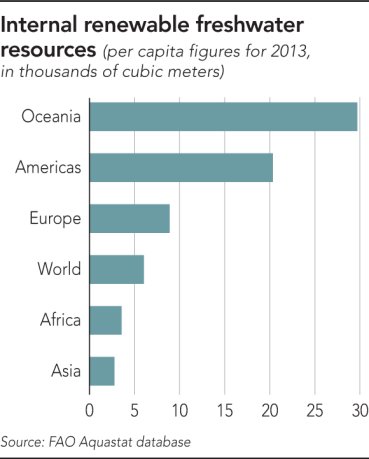 Asia’s per capita water availability is already the lowest of any continent. Fast economic growth, coupled with breakneck urbanization and changing lifestyles, has made a difficult situation worse. In 2012, slightly over half of the world’s population lived in urban areas. By 2050, that ratio is projected to jump to more than two-thirds, with much of that growth taking placing in Asia.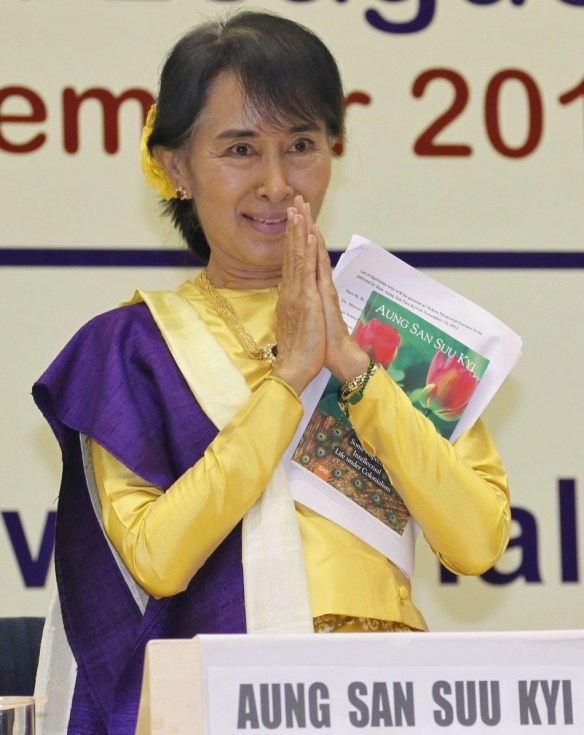
 The visit of Aung San Suu Kyi, Myanmar’s de factor leader, to India is significant. Myanmar’s geographic, cultural and geostrategic positioning between India and China makes it critical to long-term Indian interests. Yet it took 25 years for an Indian prime minister to visit Myanmar, India’s gateway to the east.
 Stagecraft and Statecraft
You must be logged in to post a comment.