
Grand on ambition but short on transparency, Chinese President Xi Jinping’s marquee project, the Belt and Road Initiative (BRI), seeks to refashion the global economic and political order by luring nations desperate for infrastructure investments into China’s strategic orbit. The BRI is essentially an imperial project aiming to make real the mythical Middle Kingdom.
The BRI, rolled out in 2013, attracted many countries, as China offered to finance and build major infrastructure projects, including ports, highways, energy plants and railroads. But after a smooth sailing, the BRI is now encountering strong headwinds, as partner-countries worry about China ensnaring them in sovereignty-eroding debt traps.
China has extended huge loans to financially weak states, only to strengthen its leverage through debt entrapment Indeed, Beijing has converted big credits not just into political influence but also a military presence, as its first overseas naval base at Djibouti illustrates.
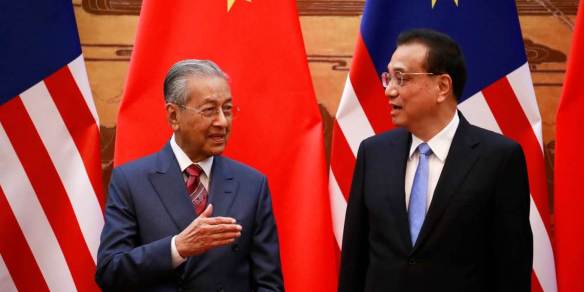
Malaysian Prime Minister Mahathir Mohamad, with Chinese Premier Li Keqiang by his side in Beijing’s Great Hall of the People, recently criticized China’s use of infrastructure projects to spread its influence. By warning China against “a new version of colonialism,” Mr. Mahathir highlighted international concerns over Beijing’s use of geo-economic tools to achieve geopolitical objectives.
A number of countries have now begun trying to renegotiate their deals with Beijing. Some have also decided to scrap or scale back BRI projects. Mr. Mahathir, during his Beijing visit, announced cancellation of Chinese projects worth nearly $23 billion.
BRI seeks to export China’s model of top-down, debt-driven development through government-to-government deals. Vulnerable countries are now awakening to the risks of accepting loans that could financially shackle them to Beijing.
Last December, China acquired the strategic Indian Ocean port of Hambantota on a 99-year lease after the small island nation of Sri Lanka could no longer keep up with debt repayments.
In fact, China is even replicating some of the practices that were used against it during the European-colonial period. For example, the concept of a 99-year lease emerged from the flurry of European-colonial expansion in China in the 19th century.
While rates for Japan’s infrastructure loans usually run below half a percent, China offers BRI loans at rates as high as 7 percent, which can place unsustainable financial strain on small countries. For example, China’s renegotiated Hambantota port loan to Sri Lanka carries a 6.3 percent fixed rate. In China’s client state, Pakistan, Chinese state companies have secured energy contracts that guarantee 16 percent or more yearly returns, in dollar terms.
China has faced accusations in multiple countries of illegally funneling money to authoritarian presidents.
In the Maldives, China has managed to acquire several islets in that heavily indebted Indian Ocean archipelago. Mohamed Nasheed, the nation’s first democratically elected president who was ousted at gunpoint in 2012, said, “Without firing a single shot, China has grabbed more land in the Maldives than what [Britain’s] East India Company did at the height of the 19th century.”
Against this background, the BRI is beginning to encounter a push-back in a number of countries. A growing number of governments are seeking transparency in Chinese lending, investment and trade practices.
However, the BRI is still bagging new contracts in some other countries. One example is the Himalayan nation of Nepal, which became the world’s sixth Communist-ruled country in February. China helped unite warring Communist factions in Nepal and funded the election campaign. Now Beijing is reaping the rewards.
The new Communist government in Nepal in September reinstated a deal with China for a $2.5 billion dam project that was scrapped by the previous government. China won the contract without an open-bidding process. In fact, it has massively inflated the project cost, which will leave Nepal struggling to repay the Chinese loan.
Laos, another Communist-ruled nation, is also seeking more BRI financing and investment. In continental Southeast Asia, while Myanmar, Thailand and Vietnam are wary of getting too close to China, Laos and Cambodia see BRI as critical to boosting their economic growth.
Yet the international reality is that, after a heady first phase, the pace of new contracts under the BRI has slowed, as concerns spread about China’s debt-trap diplomacy and as heavily indebted nations recoil from accepting more Chinese financing in the form of market-rate loans. This trend is likely to intensify in the next few years.
Even within China, the BRI is facing criticism from those who question the wisdom of plowing hundreds of billions of dollars into overseas projects when the government is still grappling with poverty and underdevelopment in a number of provinces. Critics are concerned that Mr. Xi’s aggressive quest for Chinese dominance is inviting an international backlash. The BRI — the world’s biggest building program, which Mr. Xi has hailed as “the project of the century” — exemplifies how China is flaunting its global ambitions.
Meanwhile, the financial and security risks of Chinese projects in failing or dysfunctional states are becoming more apparent. Take Pakistan, the largest recipient of BRI financing. The Pakistani military has raised a special 15,000-strong force to protect Chinese projects. In addition, thousands of police have been deployed in some provinces to protect Chinese workers. Yet sporadic attacks on Chinese in Pakistan have underscored the rising security costs.
The larger push-back against China’s neocolonial practices is likely to intensify in the coming years, putting greater pressure on the BRI. The initiative, however, will continue to benefit from a U.S.-led sanctions approach that seeks to punish countries in the name of human rights or nuclear nonproliferation. Thanks to this approach, the BRI is still bagging major lucrative contracts in countries as diverse as Iran, Sudan and Cambodia.
• Brahma Chellaney is a geostrategist and the author of nine books, including “Water: Asia’s New Battleground.”

 Pakistan has turned into the Mecca of international terrorism even as its new prime minister, Imran “Taliban” Khan, has promised to make his country a Medina-like welfare state. Pakistan, however, is battling a deepening financial crisis, largely exacerbated by its “all-weather” ally, China. Beijing has imposed unfair deals on, and stepped up capital-goods exports to, Pakistan under its so-called Belt and Road Initiative.





The backlash against China can be seen elsewhere, too. The recent annual Pacific Islands Forum meeting was one of the most contentious in its history. Chinese policies in the region, together with the Chinese delegation leader’s behavior at the event itself, drove the president of Nauru – the world’s smallest republic, with just 11,000 inhabitants – to condemn China’s “arrogant” presence in the South Pacific. China cannot, he declared, “dictate things to us.”
When it comes to trade, US President Donald Trump’s escalating trade war with China is grabbing headlines, but Trump is far from alone in criticizing China. With policies ranging from export subsidies and nontariff barriers to intellectual-property piracy and tilting the domestic market in favor of Chinese companies, China represents, in the words of Harvard’s Graham Allison, the “most protectionist, mercantilist, and predatory major economy in the world.”
As the largest merchandise exporter in the world, China is many countries’ biggest trading partner. Beijing has leveraged this role by employing trade to punish those that refuse to toe its line, including by imposing import bans on specific products, halting strategic exports (such as rare-earth minerals), cutting off tourism from China, and encouraging domestic consumer boycotts or protests against foreign businesses.
The fact is that China has grown strong and rich by flouting international trade rules. But now its chickens are coming home to roost, with a growing number of countries imposing antidumping or punitive duties on Chinese goods. And as countries worry about China bending them to its will by luring them into debt traps, it is no longer smooth sailing for the BRI.
Beyond Trump’s tariffs, the European Union has filed a complaint with the World Trade Organization about China’s practices of forcing technology transfer as a condition of market access. China’s export subsidies and other trade-distorting practices are set to encounter greater international resistance. Under WTO rules, countries may impose tariffs on subsidized goods from overseas that harm domestic industries.
Now, Chinese President Xi Jinping finds himself not only defending the BRI, his signature foreign-policy initiative, but also confronting domestic criticism, however muted, for flaunting China’s global ambitions and thereby inviting a US-led international backlash. Xi has discarded one of former Chinese strongman Deng Xiaoping’s most famous dicta: “Hide your strength, bide your time.” Instead, Xi has chosen to pursue an unabashedly aggressive strategy that has many asking whether China is emerging as a new kind of imperialist power.
International trade has afforded China enormous benefits, enabling the country to become the world’s second-largest economy, while lifting hundreds of millions of people out of poverty. The country cannot afford to lose those benefits to an international backlash against its unfair trade and investment practices.
China’s reliance on large trade surpluses and foreign-exchange reserves to fund the expansion of its global footprint makes it all the more vulnerable to the current pushback. In fact, even if China shifts its strategy and adheres to international rules, its trade surplus and foreign-currency reserves will be affected. In short, whichever path it chooses, China’s free ride could be coming to an end.
© Project Syndicate, 2018.