A watershed moment for India

Brahma Chellaney, The Hindustan Times, September 19, 2016
pakterrorFrom Atal Bihari Vajpayee’s Lahore Declaration to Manmohan Singh’s peace-at-any-price doctrine and Narendra Modi’s Lahore visit statement, India’s readiness to trust Pakistan’s anti-terrorism assurances draws attention to the adage: “Fool me once, shame on you. Fool me twice, shame on me”. India has been fooled repeatedly.

The bloody attack by Pakistan-backed terrorists on yet another military camp in Jammu and Kashmir, however, represents double shame for India: Coming after the dramatic terrorist storming of the Pathankot air base at the beginning of this year, the attack on the army headquarters at Uri near the line of control with Pakistan highlights defence-related incompetence. If Modi wishes to send a clear message, he must begin at home by firing his bumbling defence minister and fixing the drift in his Pakistan policy.

For more than a quarter-century, India has been gripped by a vacillating leadership and a paralytic sense of indecision and despair over cross-border terrorism. India’s own passivity and indecision have played no small part in fuelling Pakistan’s proxy war by terror. The rogue Inter-Services Intelligence’s “S” branch — tasked specifically with exporting terrorism to India and Afghanistan — operates through terrorist surrogates.

This year’s series of terrorist attacks on Indian targets — from Jalalabad and Mazar-i-Sharif to Pampore and Uri — signals that the ISI terror masterminds, learning from the international outrage over their November 2008 strikes on civilians in Mumbai, are now concentrating their spectacular hits on symbols of the Indian state, including security forces. For example, as New Year’s gift to India, the four-day terrorist siege of the Pathankot base coincided with a 25-hour gun and bomb attack on the Indian consulate in Mazar-i-Sharif.

The Uri attack is similarly intended to make India feel vulnerable and weak while seeking to minimize the risk of Indian retaliation. This attack, however, is likely to represent a turning point for India, especially given the number of soldiers killed. Indeed, the lesson for India from its restraint despite Pathankot is that all talk and no action invites more deadly terrorism, besides encouraging Pakistan to fuel unrest in the Kashmir Valley and “internationalize” the J&K issue.

For Modi in particular, the Uri attack constitutes a defining moment. He has completed half of his five-year term with his Pakistan policy in a mess.

Indeed, despite terrorists testing India’s resolve from Herat to Gurdaspur and Udhampur after his election victory, Modi’s response to the Pathankot siege underscored continuing strategic naïveté. Even before the siege ended, New Delhi supplied Islamabad communication intercepts and other evidence linking the attackers with their handlers in Pakistan. This was done in the hope that the terror masters will go after their terror proxies, despite India’s bitter experience in the Mumbai case where it presented dossiers of evidence to Pakistan.

India later granted Pakistani investigators access to the Pathankot base. It was like treating arsonists as firefighters. Pakistan set up its investigation team not to bring the Pathankot masterminds to justice but to probe the operational deficiencies of the Pathankot strike and to ensure that the next proxy attack left no similar telltale signs of Pakistani involvement.

Today, India has little choice but to overhaul its strategy as both diplomacy and restraint have failed to stem Pakistan’s relentless efforts to export terrorism and intermittently engage in border provocations. India must shed is focus on the last terror attack:  For example, after Pathankot, India, forgetting Mumbai, asked Pakistan to act in that case. And after Uri, Pathankot could fade into the background. Consequently, Pakistan has still to deliver even in the 1993 ‘Bombay bombings’ case.

India needs a comprehensive, proactive approach. The choice is not between persisting with a weak-kneed approach and risking an all-out war. This is a false, immoral choice that undermines the credibility of India’s nuclear and conventional deterrence and encourages the enemy to sustain aggression. It is also a false argument that India has no choice but to keep battling Pakistan’s unconventional war on its own territory. Seeking to combat cross-border terrorism as an internal law-and-order issue is self-injurious and self-defeating.

Make no mistake: India’s response to the Pakistani strategy to inflict death by a thousand cuts should no longer be survival by a thousand bandages. Rather, India must impose calibrated costs to bolster deterrence and stem aggression. Why should India allow itself to be continually gored by a country that is much smaller than it demographically, economically and militarily and on the brink of becoming dysfunctional? Just because India shied away from imposing costs on the terror masters in Pakistan for their past attacks on Indian targets, from Mumbai to Kabul, is no reason for it to stay stuck in a hole.

To deter Pakistan’s unconventional warfare, India’s response must be spread across a spectrum of unconventional options that no nation will discuss in public. Nuclear weapons have no deterrence value in an unconventional war. If the Pakistani security establishment is to get the message that the benefits of peace outweigh hostilities, it should be made to bear most of the costs that India seeks to impose. India should employ asymmetric instruments to strike hard where the opponent doesn’t expect to be hit. New Delhi should also be ready to downgrade diplomatic relations with Pakistan and mount pressure on its three benefactors, China, America and Saudi Arabia.

India’s goal is narrow: to halt cross-border terrorist attacks. In keeping with the United Nations Charter, which recognizes self-defence as an “inherent right” of every nation, India must impose measured and pointed costs on the terror exporters without displaying overt belligerence or brinkmanship.

The writer is a geostrategist and author.

© The Hindustan Times, 2016.

Wrangles over water

As Karnataka and Tamil Nadu slug it out, Pakistan wages a water war on India

Brahma Chellaney, The Times of India, September 16, 2016

p822ggnuThe violence-marred water feud between Karnataka and Tamil Nadu illustrates how water stress is fuelling bitter discord between Indian states over sharing the most vital of all natural resources. India’s Supreme Court intervened this year too in the Punjab-Haryana dispute in the Indus Basin over the Sutlej-Yamuna Link Canal.
The growing inter-provincial water wrangles draw attention to India’s great water folly in 1960: It signed a treaty that allocated to an enemy state, Pakistan, most of the Indus river system waters, without any quid pro quo. The Indus Waters Treaty (IWT) reserved for India just 19.48% of the total waters of the six-river Indus system.

An emboldened Pakistan, having secured what still ranks as the world’s most generous water-sharing treaty, set its sights on capturing the Indian part of Jammu and Kashmir through which the three large rivers reserved for Pakistani use by the IWT flowed. In more recent years, Pakistan has also found novel ways to turn the IWT into a weapon against India.

From waging conventional wars against India from almost the time it was created to sustaining a protracted proxy war by terror against it, Pakistan has for over a decade now been pursuing a “water war” strategy against India. This strategy centres on repeatedly invoking the IWT’s conflict-resolution provisions to “internationalize” any perceived disagreement so as to mount pressure on India.

In its latest move to corner India, Pakistan has initiated steps to haul it before a seven-member international arbitral tribunal in The Hague for pursuing two hydropower projects in J&K. Twice before in the past decade, Pakistan triggered international intercession by similarly invoking the treaty’s conflict-resolution provisions.

Pakistan’s strategy, coupled with its use of state-reared terrorists, could potentially force India’s hand. If India begins to view the IWT as a liability and sees itself as the suffering loser, little can save the treaty. After all, India has the option in international law to dissolve the lopsided but indefinite treaty. The Anti-Ballistic Missile Treaty was also of indefinite duration but the U.S. unilaterally withdrew from it after Russia opposed its revision.

The withdrawal option, however, cannot be exercised by a risk-averse nation. India may be parched today but there is still no national discussion about how Pakistan is repaying India’s water largesse with blood by sponsoring cross-border acts of grisly terrorism. The water card is probably the most-potent instrument India has in its arsenal — more powerful than the nuclear option, which essentially is for deterrence.

India’s belated moves to address the problem of electricity shortages and underdevelopment in J&K by building modestly sized, run-of-river hydropower plants have rankled Pakistan, although the IWT permits such projects (which use a river’s natural flow energy and elevation drop to produce electricity, without the need for any dam reservoir). The treaty requires India to provide Pakistan with prior notification, including design information, of any new project. Although prior notification does not mean the other party’s prior consent, Pakistan has construed the condition as arming it with a veto power over Indian works. To keep unrest in J&K simmering, it has objected to virtually every Indian project. Its obstruction has delayed Indian projects for years, driving up their costs substantially.

Not surprisingly, there have been repeated calls in the J&K Assembly for revision or abrogation of the IWT. By gifting the state’s river waters to Pakistan, the treaty has hampered development there and fostered popular grievance.

J&K’s total hydropower-generating capacity in operation or under construction does not equal the size of a single mega-dam that Pakistan is currently pursuing, such as the 7,000-megawatt Bunji Dam or the 4,500-megawatt Bhasha Dam. Indeed, while railing against India’s run-of-river projects, Pakistan has invited China to build mega-dams in the Pakistani-occupied part of J&K, itself troubled by discontent, including against the growing Chinese footprint there, especially in Gilgit-Baltistan.

A 2011 report prepared for the U.S. Senate Foreign Relations Committee called the IWT “the world’s most successful water treaty” for having withstood conflicts and wars. The treaty has been a success mainly because of India, which has continued to uphold the pact even when Pakistan has repeatedly waged aggression and fundamentally altered the circumstances of cooperation.

International law recognizes that a party may withdraw from a treaty in the event of fundamentally changed circumstances. Pakistan’s continuing use of state-reared terrorist groups against India constitutes reasonable grounds for the injured party to unilaterally withdraw from the IWT. Sustained sponsorship of cross-border terrorism over many years has created fundamentally changed circumstances that undermine the essential basis of India’s original consent to the IWT, while significantly altering the balance of obligations.

The Indus is Pakistan’s jugular vein. If India wishes to improve Pakistan’s behaviour and dissuade it from exporting more terrorists, it should hold out a credible threat of dissolving the IWT, drawing a clear linkage between Pakistan’s right to unimpeded water inflows and its responsibility not to cause harm to its upper riparian. A failure to respect that linkage should free India, for example, to link the Chenab (which has the largest transboundary flow) with the Ravi-Beas-Sutlej system to address water scarcity in its north.

Brahma Chellaney is Professor of Strategic Studies at the Centre for Policy Research, New Delhi.

© The Times of India, 2016.

How to Stop Terrorism in Europe

Burqa and burkini bans in Europe give the impression of real action when, in truth, they leave the core issue unaddressed — to strike at the roots of terror.

A column internationally syndicated by Project Syndicate

proxy (1)

Europe is under pressure. Integrating asylum-seekers and other migrants — 1.1 million in Germany alone in 2015 — into European society poses a major challenge, one that has been complicated by a spike in crimes committed by new arrivals. Making matters worse, many European Muslims have become radicalized, with some heading to Iraq and Syria to fight under the banner of the so-called Islamic State, and others carrying out terror attacks at home. Add to that the often-incendiary nativist rhetoric of populist political leaders, and the dominant narrative in Europe is increasingly one of growing insecurity.

Many European countries are moving to strengthen internal security. But their approach is incomplete, at best.

Germany and others have introduced new measures, including an increase in police personnel, accelerated deportation of migrants who have committed crimes, and the authority to strip German citizenship from those who join foreign “terror militias.” Other steps include enhanced surveillance of public places and the creation of new units focused on identifying potential terrorists through their Internet activities.

The pressure to reassure the public has driven Belgium, Bulgaria, France, and the Netherlands, as well as the Swiss region of Ticino and the Italian region of Lombardy, to ban the burqa (the full-body covering worn by ultraconservative Muslim women) and other face-covering veils in some or all public places. Several French coastal cities have also banned the burkini, the full-body swimsuit some Muslim women wear to the beach.

Even Germany, whose Interior Minister Thomas de Maizière initially rejected such a ban, has succumbed to pressure from allies of Chancellor Angela Merkel and proposed a ban on face-covering veils in public places where identification is required. Such clothing, the logic goes, is not conducive to integration.

But no internal security measures, much less clothing requirements, can guarantee Europe’s safety. To find a real solution, European leaders must address the ideological roots of the security challenges they face.

The problem is not Islam, as many populists claim (and as the burqa and burkini bans suggest). Muslims have long been part of European society, accounting for about 4% of Europe’s total population in 1990 and 6% in 2010. And previous waves of immigration from Muslim countries have not brought surges in terrorist activity within Europe’s borders. For example, beginning in the 1960s, roughly three million migrants from Turkey settled in Germany to meet the booming economy’s demand for labor, without posing any internal security threat.

Today, that threat results from radical Islamism — a fundamentalist vision of society reordered according to Sharia law. Beyond enduring untold suffering and violence, many of today’s refugees, from war-torn countries like Iraq and Syria, have imbibed radical Islamist ideology and, specifically, calls to jihad. Some might be Islamic State fighters who have disguised themselves as asylum-seekers, in order to carry out terrorist attacks in Europe. US intelligence officials have repeatedly warned of this possibility.

Even for the majority of asylum-seekers, who are genuinely seeking safety, the violence and Islamist rhetoric to which they have been exposed may have had a powerful psychological impact. After living for so long in a conflict zone, assimilating to a peaceful society governed by the rule of law requires the newcomers to develop a new mindset, one that enables them to face genuine challenges without resorting to criminality.

And this does not even account for the deep psychological scars that will afflict many of the refugees. Research indicates that more than 50% of the men and women who have spent time in war zones experience at least partial posttraumatic stress disorder, which is associated with an increased risk of violence.

To many in Europe, these factors suggest that the key to keeping Europe safe is controlling the flow of refugees, including through improved vetting procedures. (Such procedures have often been lacking, owing to the sheer number of refugees pouring in.) And there is a case for keeping the refugees in the Middle East, though a key mechanism for doing that — the European Union’s deal with Turkey — is now at risk, owing to political turmoil following last month’s failed coup against Turkish President Recep Tayyip Erdoğan’s government.

But not even constructing a Fortress Europe would eliminate the terrorist threat. After all, some attacks, including in Brussels and Paris, have been carried out by Muslim European citizens who became radicalized in their own bedrooms. According to Rob Wainwright, who heads Europol, some 5,000 European jihadists have been to Syria and Iraq, and “several hundred” are likely plotting further attacks in Europe after returning home.

The only way to address the threat of terrorism effectively is to tackle the radical Islamist ideology that underpins it. This means working to stop the religious-industrial complexes in Saudi Arabia, Qatar, and elsewhere in the Gulf from using their abundant petrodollars to fund the spread of extremist ideology.

It also means launching a concerted information campaign to discredit that ideology, much like the West discredited communism during the Cold War — a critical component of its eventual triumph. This is a job for all major powers, but it is a particularly urgent task for Europe, given its proximity to the Middle East, especially the new jihadist citadels that countries like Syria, Iraq, and Libya represent.

To take down the terrorists requires delegitimizing the belief system that justifies their actions. Burqa bans and other measures by European authorities that target Islam as such are superficial and counter-productive, as they create divisions in European society, while leaving the ideological underpinnings of terrorism unaddressed.

The Arab World’s Water Insecurity

By , a column internationally syndicated by Project Syndicate

ShowImage

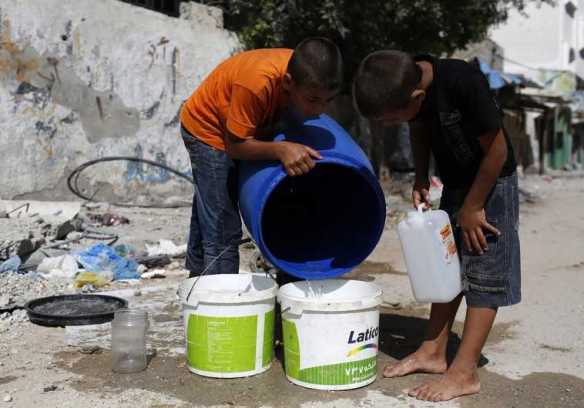
(Palestinian children in Gaza fetch water from a container. Photo credit: Reuters)

Nowhere is freshwater scarcer than in the Arab world. The region is home to most of the world’s poorest states or territories in terms of water resources, including Bahrain, Djibouti, Gaza, Jordan, Kuwait, Libya, Qatar, Saudi Arabia, and the United Arab Emirates. This shortage – exacerbated by exploding populations, depletion and degradation of natural ecosystems, and popular discontent – is casting a shadow over these countries’ future.

There is no shortage of challenges facing the Arab world. Given that many Arab states are modern constructs invented by departing colonial powers, and therefore lack cohesive historical identities, their state structures often lack strong foundations. Add to that external and internal pressures – including from surging Islamism, civil wars, and mass migration from conflict zones – and the future of several Arab countries appears uncertain.

What few seem to recognize is how water scarcity contributes to this cycle of violence. One key trigger of the Arab Spring uprisings – rising food prices – was directly connected to the region’s worsening water crisis. Water also fuels tensions between countries. Saudi Arabia and Jordan, for example, are engaged in a silent race to pump the al-Disi aquifer, which they share.

Water can even be wielded as a weapon. In Syria, the Islamic State has seized control of the upstream basins of the two main rivers, the Tigris and the Euphrates. The fact that nearly half of all Arabs depend on freshwater inflows from non-Arab countries, including Turkey and the upstream states on the Nile River, may serve to exacerbate water insecurity further.

Sky-high fertility rates are another source of stress. According to a United Nationsreport, average annual water availability in the Arab world could fall to 460 cubic metersper capita – less than half the water-poverty threshold of 1,000 cubic meters. In this scenario, water extraction will become even more unsustainable than it already is, with already-limited stores depleted faster than ever – a situation that could fuel further turmoil.

Finally, many countries offer subsidies on water, not to mention gasoline and food, in an effort to “buy” social peace. But such subsidies encourage profligate practices, accelerating water-resource depletion and environmental degradation.

In short, the Arab world is increasingly trapped in a vicious cycle. Environmental, demographic, and economic pressures aggravate water scarcity, and the resulting unemployment and insecurity fuels social unrest, political turmoil, and extremism. Governments respond with increased subsidies on water and other resources, deepening the environmental challenges that exacerbate scarcity and lead to unrest.

Urgent action is needed to break the cycle. For starters, countries should phase out the production of water-intensive crops. Grains, oilseeds, and beef should be imported from water-rich countries, where they can be produced more efficiently and sustainably.

For the crops that Arab countries continue to produce, the introduction of more advanced technologies and best practices from around the world could help to reduce water use. Membrane and distillation technologies can be used to purify degraded or contaminated water, reclaim wastewater, and desalinate brackish or ocean water. Highly efficient drip irrigation can boost the region’s fruit and vegetable production, without excessive water use.

Another important step would be to expand and strengthen water infrastructure to address seasonal imbalances in water availability, make distribution more efficient, and harvest rainwater, thereby opening up an additional source of supply. Jordan, with Israeli collaboration and European Union aid, is creating a Red Sea-Dead Sea pipeline, a conduit that would desalinate Red Sea water, in order to provide potable water to Jordan, Israel, and the Palestinian territories, and then funnel the brine to the dying Dead Sea.

Improved water management is also crucial. One way to achieve this is to price water more appropriately, which would create an incentive to prevent wastage and conserve supplies. While subsidies need not be eliminated completely, they should be targeted at smaller-scale farmers or other high-need workers and redesigned so that they, too, provide incentives for water conservation and efficiency.

Of course, wealthier, more stable countries like Saudi Arabia, Qatar, Kuwait, and the UAE are better placed than conflict-torn countries like Yemen, Libya, and Iraq to address the rapidly intensifying water crisis they face. But, in order to break the cycle of violence and insecurity, all countries will ultimately have to step up to improve water management and protect ecosystems. Otherwise, their water woes – along with internal unrest – will only worsen.

© Project Syndicate, 2016.

Salvaging the war on terror

Brahma Chellaney, The Hindustan Times

Hayat Boumeddiene 'appears in Islamic State film' - 06 Feb 2015

The recent upsurge of jihadist attacks from Nice and Istanbul to Medina and Dhaka is a reminder that the global war on terror stands derailed. The use of a truck for perpetrating mass murder in the French Riviera city of Nice shows how a determined jihadist does not need access to technology or even a gun to unleash terror. Terrorists are increasingly employing innovative methods of attack, and all the recent strikes were on ‘soft’ targets.

To bring the war on terror back on track, it has become necessary to initiate a sustained information campaign to discredit the ideology of radical Islam that is fostering “jihad factories” and promoting self-radicalization. Blaming ISIS for the recent strikes, just as most attacks after 9/11 were pinned on Al Qaeda, creates a simplistic narrative that obscures the factors behind the surging Islamist terror.

Attention needs to be focused on the cases where the scourge of jihadism is largely self-inflicted. This will help to highlight the dangers of playing with fire.

Take the growing Islamist attacks in Bangladesh: The country’s military intelligence agency, the Directorate General of Forces Intelligence (DGFI) — like Pakistan’s rogue Inter-Services Intelligence (ISI) — reared jihadist groups for domestic and foreign-policy purposes. During the periods when Bangladesh was under direct or de facto military rule, DGFI was the key instrument to establish control over civil and political affairs and partnered with the National Security Intelligence agency in the sponsorship and patronage of jihadist outfits.

A top U.S. counterterrorism official, Cofer Black, expressed concern way back in 2004 while visiting Dhaka over “the potential utilization of Bangladesh as a platform for international terrorism.”

The cozy ties that security agencies developed over years with jihadists promoting Islamic revolution in Bangladesh has made it difficult for Prime Minister Sheikh Hasina’s government — elected in 2008 — to effectively clamp down on Islamists. The Dhaka café attack by five young men, some with elite backgrounds, highlighted the dangers of the accelerating radicalization in Bangladesh.

Now consider Turkey’s Pakistanization under Recep Tayyip Erdoğan’s leadership: The recent Istanbul Airport attack, which was followed by a failed coup attempt against Erdoğan’s government, was a reminder that Turkey has come full circle. Turkey served as a rear base and transit hub for ISIS fighters. But when ISIS became a potent threat to Western interests, Turkey came under pressure and began tightening its borders. By allowing the US to fly sorties over Syria and Iraq from one of its air bases, Turkey has now incurred the wrath of the group whose rise it aided — ISIS.

Indeed, Turkey’s main opposition leader Kemal Kilicdaroglu earlier accused Erdoğan and his Justice and Development Party earlier this year of trapping the country in “a process of Pakistanization” by proactively “aiding and abetting terrorist organizations” and helping to turn Syria into a new Afghanistan.

Turkey’s increasingly difficult security predicament reflects the maxim: “If you light a fire in your neighbourhood, it will engulf you”.

Take another case: For more than four decades, Saudi Arabia has exported a hyper-conservative and intolerant strain of Islam known as Wahhabism, which has spawned suicide killers by instilling the spirit of martyrdom. Wahhabism is actually the root from which the world’s leading terrorist groups, including ISIS, Al Qaeda, the Taliban and Lashkar-e-Taiba, draw their ideological sustenance.

The monsters that Saudi Arabia helped create have undermined the security of a number of countries, including India. Now those very monsters are beginning to haunt Saudi Arabia’s own security, as the July 4 terror attacks there indicate. This underscores the law of karma: What you give is what you get returned.

According to the analyst Fareed Zakaria, Riyadh “most lavishly and successfully exported its ideology” to Pakistan, where “Saudi-funded madrasas and mosques preach” Wahhabism. Such has been the extent of the Saudi success in “Wahhabizing” Pakistan that the blowback has now reached the Saudi kingdom. Twelve of the 19 people arrested for the triple bombings on July 4 are Pakistani. In one attack, a Pakistani suicide bomber struck outside the U.S. Consulate in Jiddah.

The same day there was an unprecedented attack outside the Medina mosque where Prophet Mohammad is buried, thereby challenging the Saudi monarchy’s claim that only it can protect Islam’s holiest sites. The Prophet’s Mosque is considered to be Islam’s second holiest site after the Sacred Mosque, or Masjid-al-Haram, which surrounds the Kaaba in the city of Mecca.

The cloistered Saudi royals are reaping what they sowed: Having aided ISIS’s rise, they now confront an existential threat from that terrorist organization, which believes that its caliphate project cannot succeed without gaining control of Mecca and Medina. ISIS thus is using Wahhabism to topple the Wahhabism-exporting House of Saud, labelling it as decadent.

The fact that what goes around comes around is apparent also from the recent Orlando attack. The Orlando killer’s jihadist indoctrination can actually be traced to his father who was a local guerrilla commander in the US-backed jihad against Soviet forces in Afghanistan in the 1980s. The father, a CIA asset, was rewarded with permanent residency in America, where the son was born.

Against this grim background, the fight against terrorism demands two main things. The first is finding ways to stop the religious-industrial complexes in the Persian Gulf from funding Muslim extremist groups and madrasas in other countries. The other imperative is for the US and some of its allies, including France, Britain and Turkey, to learn lessons from their role in aiding jihadism through interventionist policies designed to achieve narrow geostrategic objectives.

Jihad cannot be geographically confined to a targeted nation, however distant, as the examples of Libya, Syria and Afghanistan indicate. Nor can terrorism be stemmed if distinctions are drawn between good and bad terrorists, and between those who threaten their security and those who threaten ours. As illustrated by the Turkish, Saudi and Pakistani cases in particular, the viper reared against another country is a viper against oneself and against third countries. As an Indian proverb warns, feeding milk to a cobra doesn’t make it your friend.

Liberal, pluralistic states could come under siege unless the global war on terror is salvaged and concerted efforts are made to drain the terrorism-breeding swamps reared or tolerated by some countries. After all, radical Islam shares a fondness for totalitarianism and targets what it sees as ideologically antithetical — secular, pluralistic states. Never before has there been a greater need for close international cooperation on counterterrorism, intelligence and law enforcement.

Brahma Chellaney is a geostrategist and author.

© The Hindustan Times, 2016.

Jihadism: What Goes Around, Comes Around

Brahma Chellaney

Orlando-624x415In the wake of the worst gun rampage in American history, U.S. President Barack Obama declared that Omar Mateen, who killed 49 people in an Orlando nightclub, was radicalized online, saying he had been “inspired by various extremist information that was disseminated over the internet.” While that may be partly true, the Orlando shooter’s jihadist indoctrination can actually be traced to his father, Seddique Mir Mateen, a local guerrilla commander in the U.S.-backed jihad against Soviet forces in Afghanistan in the 1980s.

The elder Mateen, an asset to the Central Intelligence Agency, was rewarded with permanent residency in the United States, where Omar was born. With the father presenting himself over the years as an Afghan émigré leader and building close ties with some U.S. government officials and lawmakers, the Federal Bureau of Investigation failed to stop Omar from carrying out the shootings despite interviewing him three times since 2013 on suspicion of terrorist links.

The U.S. debate on the Orlando massacre has focused on the killer’s troubled life and sexual orientation but missed the bigger picture. The real issue centers on the spreading jihadism that is inspiring a spate of terrorist attacks in the world, from Europe (Brussels and Paris) and Asia (Pathankot and Jakarta) to the U.S. (San Bernardino and Boston).

Stemming the spread of the Islamist ideology, which has fostered “jihad factories” and threatens the security of countries as diverse as the U.S. and China, holds the key to containing terrorism.

This demands two things. The first is finding ways to stop the religious-industrial complexes in the Persian Gulf from exporting Wahhabism, a messianic, jihad-extolling form of Sunni fundamentalism that promotes, among other things, the subjugation of women and the death of “infidels.” The cloistered royals in Saudi Arabia, Qatar and elsewhere continue to fund Muslim extremist groups and madrasas in other countries.

Their export of Wahhabism has not only snuffed out more liberal Islamic traditions in many countries, but has also created the wellspring that feeds extremism and terrorism. Wahhabi fanaticism, in fact, is the ideological mother of modern terrorism.

The other imperative is for the U.S. to learn lessons from its role — indirect and direct — in aiding jihadism over the years in pursuit of narrow geostrategic objectives in some regions. China’s love for pariah regimes is well known and has extended to building cozy ties with the Taliban when that medieval militia was in power in Kabul. But how does the U.S. explain its troubling ties with Islamist rulers and groups?

These ties were cemented in the 1980s, when President Ronald Reagan used Islam as an ideological tool to spur jihad to oust the invading Soviet “infidels” from Afghanistan. Through a covert program of unparalleled size, the CIA trained and armed thousands of guerrillas from Afghanistan and elsewhere to establish a multinational Sunni fighting force with Arab petrodollars and the help of Pakistan’s rogue, military-run Inter-Services Intelligence (ISI) agency.

Some U.S. allies, including al-Qaeda leader Osama bin Laden and Taliban chief Mullah Mohammed Omar, later became America’s nemeses. Supping with the devil is always fraught with grave risks for peace and security.

Indeed, it is America’s allies of convenience — both state and non-state — that over the years have come to haunt the security of Western and non-Western democracies alike.

In the second half of the Cold War, the U.S. tacitly encouraged Saudi Arabia to export Wahhabism as an antidote to communism and the 1979 anti-American Shia revolution in Iran. Developments since the end of the Cold War show that Wahhabi fanaticism is the root from which the world’s leading Islamist terrorist groups — such as ISIS, al-Qaeda, the Taliban, Laskar-e-Taiba, Boko Haram and al-Shabaab — draw their ideological sustenance.

Although the U.S.-Saudi alliance has come under strain of late, America has still to release a long-classified section of a 2002 congressional report that discusses a possible Saudi government role in the September 11, 2001 terrorist attacks in the U.S., in which 15 of the 19 passenger jet hijackers were Saudi citizens. Before the approaching 15th anniversary of 9/11, the U.S. would do well to lift the secrecy of the so-called 28 pages. There is no reason why the truth should still be suppressed.

More broadly, the spread of jihadism underscores the imperative for major powers to focus on long-term goals rather than short-term objectives. The need for caution in training Islamic insurgents and funneling lethal arms to them to help overthrow a regime is highlighted by the current chaos in and refugee exodus from Syria and Libya, which now rival Pakistan and Afghanistan as international jihadist citadels.

In fact, the recent terror strikes in the West suggest they are a blowback from the interventionist policies of some powers that have helped unravel fragile states like Libya, Syria, Iraq, Yemen and Afghanistan. Several Muslim countries, including Syria, Iraq, Yemen, Libya, Somalia and Afghanistan, have become de facto partitioned, while Jordan and Lebanon face a similar threat.

The surge of Islamist terrorism is a reminder that jihad cannot be geographically confined to a targeted nation, however distant, as the examples of Afghanistan, Syria and Libya indicate. In fact, no state, due to foreign intervention, has unraveled and become a terrorist haven faster than Libya.

Against this background, containing the spread of the jihad virus is a difficult challenge. The Orlando shootings show how the American-born offspring of a former “holy warrior” who emigrated to the U.S. can imbibe violent extremism when the spirit of jihad runs in the family.

Or take the 2013 Boston Marathon attack case: Anzor Tsarnaev, the Chechen father of the two terrorists involved in the bombings, Tamerlan and Dzhokhar Tsarnaev, moved to America with his family with the help of his U.S.-based brother who had married the daughter of a former high-ranking CIA officer, Graham Fuller. An ex-CIA station chief in Kabul, Fuller was an architect of the Reagan-era “mujahedeen” war against Soviet forces.

Tamerlan and Dzhokhar Tsarnaev were radicalized in America. Similarly, the Paris and Brussels attackers — mainly European nationals of Middle Eastern or North African descent — developed their violent jihadist leanings in France or Belgium.

The fact that what goes around comes around is apparent also from the domestic jihadist threat now faced by jihad-exporting Saudi Arabia, which has bankrolled Islamist terrorism ever since the oil-price boom of the 1970s boosted the country’s wealth dramatically. Likewise, for another leading state sponsor of terrorism, Pakistan, the chickens are coming home to roost with a vengeance.

As secretary of state, Hillary Clinton publicly warned Pakistan that keeping “snakes in your backyard” was dangerous as “those snakes are going to turn on” it. This warning, however, was equally applicable to the U.S., Britain and France.

The three Western powers, instrumental in turning Libya into a battle-worn wasteland through a botched Hillary Clinton-championed regime change, continue to speciously distinguish between “moderate” and “radical” jihadists in Syria so as to aid the former, although those waging jihad by the gun can never be moderate. In fact, it is such aid that created the conditions for ISIS to emerge as a potent force.

The global war on terror, now almost a generation old, will never be won with treacherous allies, such as jihadist rebels and Islamist rulers. Such alliances, as recent terror attacks indicate, strengthen jihadism and endanger the security of secular, pluralistic states.

It is time for Western powers to reconsider their regional strategies and focus attention on attacking the ideology driving terror.

© China-US Focus, 2016.

The Tendrils of Terrorism

20160705_Dhaka_article_main_image

Local residents pay their respects to the victims of the attack on the Holey Artisan Bakery at a stadium in Dhaka on July 4. © AP

Asia needs a concerted campaign to counter the fast-spreading culture of jihad.

Brahma Chellaney, Nikkei Asian Review

One of Bangladesh’s worst terrorist attacks, in which 20 patrons of a Dhaka restaurant were butchered by militants, highlights Asia’s growing threat from Islamist violence. Among those killed were seven Japanese aid workers, including an 80-year-old railway expert, nine Italians, one Indian and a U.S. national. Terrorist attacks this year from Jakarta to Pathankot, India, have served as a reminder of the growing scourge of jihadism in Asia.

Several factors have contributed to the rise of Islamist terrorism. Some Muslim communities are caught in a vicious circle of exploding populations, a chronic dearth of jobs, high illiteracy and fast-spreading extremism. In Bangladesh, among other troubled states, the intersection of political instability, popular discontent, resource stress and population pressures has formed a deadly cocktail of internal disarray, fostering a pervasive jihad culture.

In addition, a corroding state structure has served as an incubator of Islamist terror, creating conditions under which transnational militant groups can thrive. Weak or dysfunctional states are more likely to host terrorist groups that not only carry out transnational attacks but also target their host states.

Another major factor is the systematic export by Saudi Arabia, Qatar and some other oil sheikhdoms of Wahhabism, an obscurantist and intolerant version of Islam. This has gradually snuffed out more liberal and pluralistic interpretations of Islam in Southeast, South and Central Asia, thereby promoting radicalization among many Muslims and allowing Islamist groups to become increasingly entrenched.

Linking radical Islam with radical terror, Wahhabism interprets the Koran in a way that instills the spirit of martyrdom, with promises of reaching paradise through death.

Reinforcing the rise of religious extremism, petrodollar-financed madrasas, or religious schools, have sprung up across Asia. Wahhabi fanaticism has helped spread the tendrils of terrorism, serving as the ideological mother of Asian jihadist groups that murder, maim and menace the innocent — from Jemaah Islamiyah in Southeast Asia to Lashkar-e-Taiba and the Taliban in the Pakistan-Afghanistan belt. Bangladesh authorities have blamed the cafe attack — claimed by the Islamic State group — on a local Wahhabi-infused group, Jamaat ul-Mujahideen, whose top two leaders were convicted and executed in 2008 for carrying out nationwide bombings.

Adding to Asian security concerns, Wahhabi-indoctrinated militants from countries including Australia, the Philippines, Indonesia, Malaysia, Singapore, China, India and Kazakhstan, have gone to Syria and Iraq to fight for another offspring of Wahhabism — IS. Singaporean Prime Minister Lee Hsien Loong last year called Southeast Asia “a key recruitment center” for the fanatical group.

The jihadists who return to their homelands from Syria and Iraq could wage terror campaigns in the same way that the Afghan war veterans, like Osama bin Laden, came to haunt the security of the Middle East, Asia and the West. The multinational rebels in Afghanistan, who became known as “mujahideen” (Islamic holy warriors), were originally trained and armed by the U.S. Central Intelligence Agency in the 1980s to help oust Soviet forces from that country.

Yet another factor that has fueled violent jihadism is state sponsorship of — or collusion with — terrorism. Militants, some promoted by regimes and some operating with the connivance of elements within national militaries and intelligence organizations, have employed religion or ethnic or sectarian aspirations to justify their acts of cross-border terror.

For example, Pakistan’s use of extremist groups as an instrument of foreign policy is well documented, with the U.S. State Department’s Country Report on Terrorism for 2015 stating that some United Nations-designated terrorist organizations continue “to operate within Pakistan, employing economic resources under their control and fundraising openly.” Essentially, the Pakistani military has reared “good” terrorists for cross-border missions while battling “bad” militants that fail to toe its line.

For states nurturing violent jihadist groups, the chickens have come home to roost with a vengeance. For example, the recent Istanbul airport attack is a reminder that Turkey has come full circle. The country served as a rear base and transit hub for IS fighters. But when IS became a potent threat to Western interests, Turkey came under pressure and began tightening its borders. By allowing the U.S. to fly sorties over Syria and Iraq from a Turkish air base, Ankara has now incurred the wrath of IS, the group whose rise it aided.

Saudi Arabia, which has bankrolled Islamist extremism ever since the oil-price boom of the 1970s boosted the kingdom’s wealth, also contributed to the rise of IS, creating a Frankenstein’s monster that now threatens it as much as any other country. This is apparent from the latest explosions in Medina and two other Saudi cities. Paradoxically, IS is using Wahhabism to try and delegitimize Saudi Arabia’s cloistered, Wahhabism-exporting royals.

Bangladesh’s grim challenge

The Dhaka cafe attack highlights the specter of jihadism haunting Bangladesh, the seventh most populous nation, that is made up mainly of low-lying floodplains and deltas. Excluding microstates, Bangladesh features the greatest population density in the world. Less known is the fact that its jihadist problem is largely self-inflicted.

Indeed, Bangladesh’s future is imperiled as much by Islamic radicalization as by global warming. The accelerating radicalization of a society with largely moderate Muslim traditions was highlighted by the fact that the slaughter of mainly foreigners in the cafe attack was perpetrated by educated young men from affluent families.

Ever since her election as prime minister in late 2008 marked the restoration of democracy in Bangladesh, Sheikh Hasina has battled jihadists, including those reared by the country’s military intelligence agency, the Directorate General of Forces Intelligence, and the National Security Intelligence agency. Hasina has sought to curtail the powers of the DGFI, which, like Pakistan’s military-run Inter-Services Intelligence agency, nurtured militant groups and conducted operations against political parties and journalists.

Born in blood in 1971, Bangladesh has been wracked by perennial turmoil, including 22 coup attempts, some successful. Hasina survived when gunmen assassinated her father — Sheikh Mujibur Rahman, the founder of Bangladesh and its first prime minister — and executed her extended family in a single night in 1975. She survived again in 2004 when assassins hurled grenades at one of her political rallies, leaving two dozen people dead. According to Hasina, she has escaped death 19 times.

That Bangladesh’s political turbulence and violence are unlikely to end any time soon is apparent from two developments: The boycott by the largest opposition party of the January 2014 national election, which returned Hasina to power; and the wave of Islamist attacks since 2013 on secular bloggers, atheists, gay rights activists, and members of the Hindu minority, with some of the targets decapitated or hacked to death in public. Now, there are serious questions about whether a politically divided Bangladesh can cope with the upsurge of Islamist violence.

Against this background, the fight against terrorism in Asia is likely to prove long and difficult. A study by the Washington-based Pew Research Center estimates that the aggregate Muslim population by 2030 will have doubled since 1990, with the largest increase being in Asia. The demographic explosion could accentuate the stresses that are contributing to violent jihadism and thereby act as a threat multiplier.

There is greater need than ever to bring the international fight against terrorism back on track. Only a concerted, sustained campaign to deal with the factors spurring jihadism can help stem the challenge from the forces of terror.

Brahma Chellaney is a professor of strategic studies at the Center for Policy Research, New Delhi, and a Richard von Weizsacker Fellow at the Robert Bosch Academy, Berlin.

© Nikkei Asian Review, 2016.

Obama’s Bitter Afghan Legacy

A column internationally syndicated by Project Syndicate

afghanistan_war_imageNearly 15 years after its launch, the United States’ war in Afghanistan is still raging, making it the longest war in American history. Nowadays, the war is barely on the world’s radar, with only dramatic developments, like America’s recent drone-strike assassination of Afghan Taliban Chief Akhtar Mohammad Mansour, getting airtime. But Afghans continue to lose their friends, neighbors, and children to conflict, as they have since the 1979 Soviet invasion, which triggered the refugee exodus that brought the parents of Omar Mateen, the killer of 49 people in a nightclub in Orlando, to the US.

America’s invasion, launched by former President George W. Bush in the wake of the September 11, 2001, terror attacks, was intended to dismantle Al Qaeda and remove the Taliban from power, thereby ensuring that Afghanistan would no longer serve as a safe base of operations for extremists. With those goals ostensibly accomplished, Bush’s successor, Barack Obama, reduced troop levels in the country, even declaring a year and a half ago that the war was “coming to a responsible conclusion.”

But, with a resurgent Taliban stepping up attacks, the war has raged on, exacting staggering costs in blood and treasure. One key reason is Pakistan, which has harbored the Afghan Taliban’s command and control, while pretending to be a US ally.

If there were any doubts about Pakistan’s duplicity, they should have been eliminated in 2011, when Osama bin Laden was killed in a military garrison town near the country’s capital. Yet, five years later, Pakistan still has not revealed who helped bin Laden hide for all those years. Meanwhile, the Obama administration has continued to shower the country with billions of dollars in aid.

The assassination of Mansour on Pakistan’s territory, near its border with Iran and Afghanistan, has exposed, yet again, the deceitfulness of Pakistani officials, who have repeatedly denied sheltering Taliban leaders. Like the raid by US Navy SEALs that killed bin Laden, Mansour’s assassination required the US to violate the sovereignty of a country that, as one of the largest recipients of American aid, should have been supporting the effort. The question is whether the US will acknowledge the obvious lesson this time and change course.

While Mansour’s killing may be, as Obama put it, “an important milestone” in the effort to bring peace to Afghanistan, it also exposed America’s policy failures under the Obama administration, rooted in the desire not to confront either Pakistan or even the Taliban too strongly. Obama’s objective was to preserve the option of reaching a Faustian bargain with the Taliban – a power-sharing arrangement to underpin a peace deal – facilitated by the Pakistani military. That is why the US has not branded the Afghan Taliban – much less Pakistan’s rogue intelligence agency, Inter-Services Intelligence (ISI) – a terrorist organization, and instead has engaged in semantic jugglery.

This approach goes beyond rhetoric. America took almost 15 years to carry out its first drone strike in Pakistan’s sprawling Balochistan province, even though the Afghan Taliban leadership established its command-and-control structure there almost immediately after the US military intervention ousted it from Afghanistan. Instead, the US concentrated its drone strikes in Pakistan’s Waziristan region, allowing the Taliban leaders to remain ensconced.

The US has even made direct overtures to the Taliban, in order to promote negotiations aimed at securing peace through a power-sharing arrangement. It allowed the Taliban to set up a de facto diplomatic mission in Doha, Qatar, in 2013. A year later, it traded five senior Taliban leaders who had been jailed at Guantánamo Bay for a captured US Army sergeant.

What the US did not know was that the Taliban’s founder, Mullah Mohammed Omar, died in 2013 in a hospital in the Pakistani city of Karachi. Omar’s death was kept secret for more than two years, during which time ISI claimed to be facilitating contacts with him.

Finally, last July, Mansour was installed as the Taliban’s new leader – and he was not interested in peace talks. It was Mansour’s intransigence that spurred the US to change its tactics. Instead of using carrots to secure Taliban support for a peace deal, the Obama administration is now using very large sticks.

But even if this approach manages to bring the Taliban to the negotiating table, it will probably not be enough to secure a lasting peace deal. If the US is to succeed at ending the war in Afghanistan, it must do more than change tactics; it must rethink its fundamental strategy.

The reality is that the medieval Taliban will neither be defeated nor seek peace until their Pakistani sanctuaries are eliminated. No counterterrorism campaign has ever succeeded in a country when the militants have found refuge in another. While Obama recognizes the imperative of eliminating terrorist sanctuaries, he has failed to do what is needed.

Simply put, bribing Pakistan’s military will not work. Over the last 14 years, the US has given Pakistan more than $33 billion in aid and armed it with lethal weapons, ranging from F-16s and P-3C Orion maritime aircraft to Harpoon anti-ship missiles and TOW anti-armor missiles. And yet Pakistan continues to provide the Afghan Taliban a safe haven within its borders.

A better approach would be to link aid disbursement to concrete Pakistani action against militants, while officially classifying ISI as a terrorist entity. Such a move would send a strong signal to Pakistan’s military – which views the Taliban and other militant groups as useful proxies and force multipliers vis-à-vis Afghanistan and India – that it can no longer hunt with the hounds and run with the foxes.

Obama’s decision last October to prolong indefinitely US involvement in Afghanistan means not only that he will leave office without fulfilling his promise to end Bush-era military entanglements, but also that the US will continue to fight the war on the wrong side of the Afghan-Pakistani border. Perhaps his successor will finally recognize the truth: the end of the war in Afghanistan lies in Pakistan.

Attacking the ideology behind terror

The West must hold Arab monarchs to account for spawning Wahhabi extremism

WT terror
By Brahma Chellaney, Washington Times June 15, 2016

In the wake of the worst mass shooting in U.S. history, it is pointless to debate whether the Orlando killings constitute just an act of Islamist terror or also an act of hate directed at the LGBT community. Every act of terror springs from hatred of its target, be it a nation or government or community.

The real issue centers on the ideology that is inspiring a spate of Islamist terrorist attacks in the world. The scourge of Islamist terror is tied to Wahhabism, an insidious ideology.

Make no mistake: Wahhabi fanaticism is terrorism’s ideological mother, whose offspring include groups such as al Qaeda, the Taliban, Laskar-e-Taiba, Boko Haram, al-Shabab and Islamic State, all of which blend hostility toward non-Sunnis and anti-modern romanticism into nihilistic rage.

The only way to defeat an enemy driven by ideology is to emasculate its ideology. The West won the Cold War not so much by military means as by spreading the ideas of political freedom and market capitalism that helped suck the lifeblood out of communism’s international appeal, making it incapable of meeting the widespread yearning for a better, more open life.

Today, stemming the spread of the ideology that has fostered “jihad factories” holds the key to containing terrorism. The export of Wahhabism by Saudi Arabia, Qatar and some other oil sheikhdoms is the source of modern Islamist terror.

Yet the rest of the world — in thrall to Arab money and reliant on Arab oil and gas — has largely turned a blind eye to the jihadi agenda of some Arab monarchs. In fact, with Western support, tyrannical oil monarchies in Riyadh, Doha and elsewhere were able to ride out the Arab Spring, emerging virtually unscathed.

Saudi Arabia has faced little international pressure, even on human rights. How the Saudi kingdom buys up world leaders is apparent from the Malaysian attorney general’s claim that Prime Minister Najib Razak received a $681 million “personal donation” from the Saudi royals. Saudi Arabia has given as much as $25 million to the Clinton Foundation.

There are signs, however, that the Western attitude toward Saudi Arabia might be beginning to change. German Vice Chancellor Sigmar Gabriel said recently, “We must make it clear to the Saudis that the time of looking the other way is over.” After a married couple of Pakistani origin staged a mass shooting in San Bernardino, President Obama alluded to Wahhabism as a “perverted interpretation of Islam.”

No country has contributed more than Saudi Arabia to the international spread of Wahhabism, which is gradually snuffing out more liberal Islamic traditions in many countries. Jihadism and sectarianism indeed are institutionalized in Saudi Arabia, the only country in the world named after its founder, commonly known as Ibn Saud.

Saud, who ruled for 20 years until his death, brought the central part of the Arabian Peninsula under his control with British assistance in 1932, establishing a desert kingdom tethered to Wahhabism, a messianic radicalism that was considered a fringe form of Islam until oil wealth transformed the once-barren Saudi Arabia, the world’s largest country without a river.

Since the oil-price boom of the 1970s, Saudi Arabia has spent more than $200 billion on its global jihad project, including funding Wahhabi madrassas, mosques, clerics and books. Western powers actually encouraged the kingdom — as an antidote to communism and the 1979 anti-U.S. Iranian revolution — to export Wahhabism.

But the wave of new attacks serve as a reminder that Wahhabi fanaticism is the root from which Islamist terrorists draw their ideological sustenance. As Vice President Joe Biden said in a 2014 Harvard speech, Saudi and other “allies’ policies wound up helping to arm and build allies of al Qaeda and eventually the terrorist Islamic State.”

Today, with its own future more uncertain than ever, the House of Saud is increasingly playing the sectarian card in order to shore up support among the Sunni majority at home and to rally other Islamist rulers in the region to its side. Having militarily crushed the Arab Spring uprising in Sunni-led but Shia-majority Bahrain, Saudi Arabia early this year executed its own Arab Spring leader — Sheikh Nimr al-Nimr — who had led anti-regime Shia protests in 2011.

Before the execution, the kingdom formed an alliance of Sunni states purportedly to fight terrorism. The coalition included all the main sponsors of international terror, like Qatar and Pakistan. It was like arsonists pretending to be fire wardens.

According to a U.N. panel of experts, Saudi Arabia is currently engaged in war crimes in Yemen.

The Saudi royals seem to mistakenly believe that widening the sectarian fault lines in the Islamic world will keep them in power. By drawing legitimacy from jihadism and by being beholden to sectarianism, the royals could be digging their own graves. After all, fueling jihadism and sectarianism threatens to empower extremists at home and devour the royalty.

More broadly, the global war on terror cannot be won without closing the wellspring that feeds terrorism — Wahhabi fanaticism. Wahhabism is the ultimate source of the hatred that triggered September 11, 2001, and the recent string of attacks, from Paris and Brussels to San Bernardino and Orlando. Shutting that wellspring demands that the West hold Arab monarchs to account for spawning the kinds of dangerous extremists that are imperiling regional and international security.

The late Singaporean leader Lee Kuan Yew rightly said in 2003 that success of the war on terror hinges more on controlling the “queen bees” — the “preachers” of the “deviant form of Islam” — than on just killing the “worker bees” (terrorists). As long as Arab petro-dollars keep “jihad factories” in business, there will be suicide killers.

Brahma Chellaney is a geostrategist and the author, most recently, of “Water, Peace, and War” (Rowman & Littlefield, 2015).

Copyright © 2016 The Washington Times, LLC. Click here for reprint permission.

China’s Pakistani Outpost

A column internationally syndicated by Project Syndicate

Pak-China-1024x591

Like a typical school bully, China is big and strong, but it doesn’t have a lot of friends. Indeed, now that the country has joined with the United States to approve new international sanctions on its former vassal state North Korea, it has just one real ally left: Pakistan. But, given how much China is currently sucking out of its smaller neighbor – not to mention how much it extracts from others in its neighborhood – Chinese leaders seem plenty satisfied.

Chinese Foreign Minister Wang Yi has declared that China and Pakistan are “as close as lips and teeth,” owing to their geographical links. China’s government has also calledPakistan its “irreplaceable all-weather friend.” The two countries often boast of their “iron brotherhood.” In 2010, Pakistan’s then-prime minister, Syed Yousuf Raza Gilani,waxed poetic about the relationship, describing it as “taller than the mountains, deeper than the oceans, stronger than steel, and sweeter than honey.”

In fact, wealthy China has little in common with aid-dependent Pakistan, beyond the fact that both are revisionist states not content with their existing frontiers. They do, however, share an interest in containing India. The prospect of a two-front war, should India enter into conflict with either country, certainly advances that interest.

For China, the appeal of working with Pakistan is heightened by its ability to treat the country as a client, rather than an actual partner. In fact, China treats Pakistan as something of a guinea pig, selling the country weapons systems not deployed by the Chinese military and outdated or untested nuclear reactors. Pakistan is currently building two AC-1000 reactors – based on a model that China has adapted from French designs, but has yet to build at home – near the southern port city of Karachi.

China does not even need its supposed “brother” to be strong and stable. On the contrary, Pakistan’s descent into jihadist extremism has benefited China, as it has provided an ideal pretext to advance its strategic interests within its neighbor’s borders. Already, China has deployed thousands of troops in Pakistani-administered Kashmir, with the goal of turning Pakistan into its land corridor to the Arabian Sea and the Indian Ocean. And, as a newly released US Defense Department report shows, Pakistan – “China’s primary customer for conventional weapons” – is likely to host a Chinese naval hub intended to project power in the Indian Ocean region.

That is not all. President Xi Jinping’s first visit to Pakistan last year produced an agreement to construct a $46 billion “economic corridor” stretching from China’s restive Xinjiang region to Pakistan’s Chinese-built (and Chinese-run) Gwadar port. That corridor, comprising a series of infrastructure projects, will serve as the link between the maritime and overland “Silk Roads” that China is creating. It will shorten China’s route to the Middle East by 12,000 kilometers (7,456 miles) and give China access to the Indian Ocean, where it would be able to challenge India from India’s own maritime backyard.

Xi also signed deals for new power projects, including the $1.4 billion Karot Dam, the first project to be financed by China’s $40 billion Silk Road Fund. All of the power projects will be Chinese-owned, with the Pakistani government committed to buying electricity from China at a pre-determined rate. Pakistan’s status as China’s economic and security client will thus be cemented, precluding it from eventually following the example of Myanmar or Sri Lanka and forging a non-Chinese path.

To be sure, the relationship also brings major benefits for Pakistan. China provided critical assistance in building Pakistan’s arsenal of nuclear weapons, including by reducing the likelihood of US sanctions or Indian retaliation. China still offers covert nuclear and missile assistance, reflected in the recent transfer of the launcher for the Shaheen-3, Pakistan’s nuclear-capable ballistic missile, which has a range of 2,750 kilometers.

Overtly, China offers Pakistan security assurances and political protection, especially diplomatic cover at the United Nations. For example, China recently vetoed UN action against Masood Azhar, the Pakistan-based chief of the extremist group Jaish-e-Mohammed, which, backed by Pakistani intelligence services, has carried out several terrorist attacks on Indian targets, including the Pathankot air base early this year. And last month, Sartaj Aziz, the Pakistani prime minister’s foreign-policy adviser, said that China has helped Pakistan to block India’s US-supported bid to gain membership of the Nuclear Suppliers Group, an export-control association.

A grateful Pakistan has given China exclusive rights to run Gwadar port for the next 40 years. It has also established a new 13,000-troop army division to protect the emerging economic corridor. And it has deployed police forces to shield Chinese nationals and construction sites from tribal insurgents and Islamist gunmen.

This is not to say that China is content to depend on Pakistani security forces. China’sstationing of its own troops in the Pakistani part of Kashmir for years, ostensibly to protect its ongoing strategic projects there, betrays its lack of confidence in Pakistani security arrangements – and suggests that China will continue to enlarge its military footprint in Pakistan.

But Pakistan’s behavior indicates that it is, for now, satisfied with its arrangement with China – a sentiment that is probably reinforced, if unconsciously, by the billions of dollars in aid the country receives each year from the US. As China continues to elbow its way into Pakistan’s politics and economy, increasingly turning the country into a colonial outpost, that sense of satisfaction will probably fade. But, by the time it does, it will probably be too late to change course.

© 1995-2016 Project Syndicate.