By refusing to buckle under China’s threats, India has called the bully’s bluff

Brahma Chellaney, The Times of India

modi-style_0_0Standing on the Himalayan crest with well-developed infrastructure, China is in a militarily advantageous position along much of the border with India. The tri-border overlooking the Chinese-held Chumbi Valley is one of the few areas where India still holds a distinct advantage, with Chinese forces within Indian observation-cum-artillery range. If China were to capture Bhutan’s high-altitude Doklam plateau, it would not only mitigate that vulnerability but also hold a knife to India’s jugular vein — the Siliguri Corridor, through which Bhutan’s communications and transportation arteries also pass.

While existential stakes drove India to halt China’s construction of a strategic highway through Doklam, Beijing made a serious strategic miscalculation by intruding there: It anticipated Bhutan’s diplomatic protest but not India’s swift, stealthy military intervention. The Indian army had long geared up to respond to such a contingency.

No Indian government can countenance the construction of a road through Doklam that allows China to bring main battle tanks to the tri-border and implement, in the event of a war, its military plan to decapitate India. In such a corridor-bisecting scenario, while China gobbles up Arunachal Pradesh, the other northeast Indian states, as a Chinese state mouthpiece warned recently, could become “independent”.

Today, thanks to its miscalculation, China finds itself in an unenviable position: It must extricate itself from a militarily wretched situation in Doklam, where its intruding soldiers are caught in a pincer movement. If China were to initiate hostilities at the tri-border, it will likely be left, as in 1967, with a bloodied nose, given the Indian army’s terrain and tactical advantages.

Politically, Beijing has boxed itself in a corner, with its intense psychological warfare (“psywar”) and disinformation operations failing to yield continuing gains, after the success in initially dominating the narrative. If anything, its psychological operations (“psy-ops”) and manipulation of legal arguments (“lawfare”), as by selectively quoting an 1890 colonial-era accord, offer India important lessons. It is standard Chinese strategy to play the victim in any conflict or dispute, as China brazenly did even in 1962.

Mounting frustration has sharpened Beijing’s war rhetoric, as its latest 15-page diatribe against India underscores. To compound matters, the standoff is imposing reputational costs on a power that supposedly brooks no challenge and is ever willing to wreak punishment. India, in the face of vitriolic warmongering, has defiantly stood up to China and refused to budge. By calling the bully’s bluff, India has set an example for other Asian states to emulate.

Beijing’s story that Indian troops “trespassed” into Chinese territory was designed to disguise its intrusion into tiny Bhutan. But this tale, along with President Xi Jinping’s vow not to permit the loss of “any piece” of Chinese land, deepens China’s discomfiture by undermining the image it has sought to project at home and abroad — Asia’s pre-eminent power that no neighbour will mess with.

In sum, China, if it is to save face, needs India’s help to extricate itself from a mess of its own making. Beijing’s coarse statements and threats, while integral to its psywar, are also part of a negotiating ploy to secure a compromise on largely its terms.

There is no reason, however, why India should let China off the hook easily. With Xi looking ahead to this autumn’s Communist Party congress to cement his status as China’s most powerful leader since Mao Zedong, India should play psychological hardball because Chinese incursions have become increasingly recurrent.

India should allow the Doklam military stalemate to drag on until the arrival of the harsh winter forces the rival troops to retreat, thus restoring the status quo ante, including frustrating China’s road-building plan. If an earlier negotiated mutual retreat from Doklam becomes possible, it should be based on an unequivocal assurance that China henceforth will refrain from unilaterally disturbing the territorial status quo anywhere in the Himalayan borderlands.

Implicitly, if not explicitly, China must come out a significant loser in order to help rein in its creeping, covert encroachments. There should be no more Depsangs, Chumars and Doklams or the quiet chipping away at Indian and Bhutanese lands.

The writer is a geostrategist and author. 

© The Times of India, 2017.

Turn the tables on China

China’s strategy is to subdue India by attacking its weak points and stymieing its rise to the extent possible.

china_dragon

Brahma Chellaney, The Hindustan Times, July 22, 2017

The current troop standoff with China at Doklam offers India important lessons that go far beyond the Chinese intrusion into this Bhutanese plateau. Unless India grasps the long-term threat posed by an increasingly muscular China and responds with an appropriate counter-strategy, it is sure to confront much bigger problems than Doklam. Unfortunately, institutional memory in India tends to be short, with a mindset of immediacy blurring the bigger picture.

For example, Jammu and Kashmir Chief Minister Mehbooba Mufti’s recent statement that China is “meddling” in her state was seen as signifying a new trend. In truth, China — occupying a fifth of the original princely state of J&K and now enlarging its strategic footprint in Pakistan-occupied J&K — has long been playing the Kashmir card against India. In 2010 it honed that card by aggressively adopting a stapled-visa policy for J&K residents.

To mount pressure, Beijing has tacitly questioned India’s sovereignty over the 45% of J&K under Indian control and officially shortened the length of the Himalayan border it shares with India by purging the 1,597-kilometre line separating Indian J&K from Chinese-held J&K. China’s Kashmir interference will only increase as a result of its so-called economic corridor through Pakistan-held J&K, where Chinese military presence is growing, including near Pakistan’s ceasefire line with India. India now faces Chinese troops on both flanks of its portion of J&K.

China, which fomented the Naga and Mizo insurgencies, taught its “all weather” client Pakistan how to wage proxy war against India. China still fans flames in India’s northeast. For example, Paresh Barua, the long-time fugitive commander-in-chief of ULFA, has been traced to Ruili, in China’s Yunnan province. Some other Indian insurgent leaders have been ensconced in Myanmar’s Yunnan-bordering region controlled by the China-backed Kachin Independence Army. This newspaper reported in 2015 that Chinese intelligence played “an active role” in assisting nine northeast Indian insurgent groups to form a united front. The illicit flow of Chinese arms to India, including to Maoists, was confirmed by Home Secretary G.K. Pillai in 2010. Meanwhile, the deepening China-Pakistan nexus presents India with a two-front theatre in the event of a war with either country.

China’s strategy is to subdue India by attacking its weak points, striking where it is unprepared, and stymieing its rise to the extent possible. As part of this strategy, it is waging a multipronged unconventional war without firing a single shot. It is closing in on India from multiple flanks, extending from Nepal to the Indian Ocean.

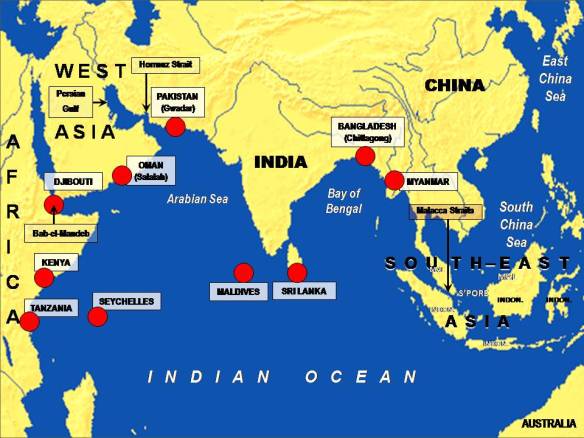
Sixty-six years after gobbling up buffer Tibet and mounting a Himalayan threat, China — with the world’s fastest-growing submarine fleet — is opening a threat from the seas against India. Its recently opened naval base in Djibouti, at the Indian Ocean’s north-western edge, constitutes just a first step in its game plan to dominate the region. For India, whose energy and strategic infrastructure is concentrated along a vulnerable, 7,600-kilometre coastline, this represents a tectonic shift in its threat calculus.

Add to the picture China’s economic warfare to undermine India’s strength in various ways, including stifling its manufacturing capability through large-scale dumping of goods. Artificially low prices of Chinese products also translate into India losing billions of dollars yearly in customs duties and tax revenue. Portentously, China, including Hong Kong, made up 22% of India’s imports in 2015, with the US just at 5% and Japan at 2%.

Yet India has yet to fully shed its policy blinkers. As India repeats the same old platitudes about conciliation and cooperation, China is making clear that there cannot be “two Suns in the sky” — or, as a Chinese idiom goes, “one mountain cannot accommodate two tigers”. With its rekindled, atavistic nationalism, China plainly wants to be Asia’s sole tiger.

Beijing is currently waging full-throttle psychological warfare over Doklam to tame India. Deception and mendacity are its tools. If India gives in, it will endure strategic subordination and ignominy forever. Foreign Minister Sushma Swaraj’s excellent rebuttal in Parliament of Chinese disinformation begs the question: Why has India been so slow in countering Beijing’s propaganda war?

New Delhi must play psychological hardball: Instead of appearing zealous for talks, it should insist that China first withdraw both its troops and preconditions, while leaving Beijing in no doubt that India will hold its ground, come what may. If India is to stop China’s creeping, covert encroachments and secure Himalayan peace, it must be ready to give Beijing a real bloody nose if it escalates the standoff to a conflict. Humiliating China even in a localized military engagement, in 1967 style, is vital to help destabilize its expansionist regime.

Brahma Chellaney is a geostrategist and author.

© The Hindustan Times, 2017.

China’s Bhutan land grab aims at bigger target

Beijing employs stealth aggression in territorial expansion

My map of Himalayan territorial disputes (NAR)

Brahma Chellaney, Nikkei Asian Review

China honed its “salami slicing” strategy in the Himalayan borderlands with India in the 1950s, when it grabbed the Switzerland-sized Aksai Chin plateau by surreptitiously building a strategic highway through that unguarded region. Aksai Chin, part of the original princely state of Jammu and Kashmir, has since provided China with the only passageway between its rebellious regions of Tibet and Xinjiang.

Now, the attempt by the People’s Liberation Army to replicate its seizure of Aksai Chin by building a military road through the Doklam plateau of tiny Bhutan has triggered one of the most serious troop standoffs in years between China and India, which is a guarantor of Bhutanese security.

The standoff involving hundreds of PLA and Indian troops, near where the borders of Tibet, Bhutan and India’s Sikkim state meet, has successfully halted the Chinese construction of the highway in Doklam, which Beijing claims as a “traditional pasture for Tibetans.” This is similar to Beijing’s claims in the South and East China seas, which are based on “traditional fishing grounds for Chinese.” The Indian intervention has triggered a furious reaction from China, which is warning India almost daily to back down or face reprisals, including a possible war. India has mobilized up to 10,000 troops for any contingency.

The Chinese defense ministry has warned India to learn the “historical lessons” from the major military reversals it suffered in 1962 when China carried out a surprise trans-Himalayan invasion just when the U.S. and the Soviet Union were locked in the Cuban missile crisis. Beijing has also stepped up diplomatic pressure on New Delhi, with the Chinese foreign ministry insisting that the “precondition for any meaningful dialogue” would be for Indian troops to “unconditionally” pull back from Doklam.

Beijing’s full-throttle campaign against India amounts to psychological warfare, from mounting daily threats to staging military drills in Tibet. For example, a recent “full combat readiness” exercise with tanks was aimed at delivering a clear warning to New Delhi, according to Chinese state media. However, the more China threatens India and the more it refuses to seek a compromise, the more it paints itself in a corner.

Beijing has no good options in emerging as a winner from this confrontation. Given the geography, military logistics, weapon deployments and the entrenched Indian positions, the PLA will find it hard to give India a bloody nose and seize Doklam. If it were to attack, it could suffer a setback. Just as Beijing’s intense propaganda war against India over the Dalai Lama’s April tour to the Chinese-claimed northeastern Indian state of Arunachal Pradesh achieved nothing, China risks losing face over the current troop standoff.

The central issue that China has sought to disguise is its intrusion into tiny Bhutan, which has less than 800,000 people. To cause a distraction, Beijing, in keeping with ancient military theorist Sun Tzu’s concept of strategic deception, has tried to shift the focus to India through a public relations blitzkrieg that presents China as the victim and India as the aggressor. Just as it has touted historical claims to much of the South China Sea, which have been dismissed by an international arbitral tribunal as groundless, Beijing contends that Doklam (or “Donglang” as China calls it) has belonged to it “since ancient times.”

Beijing’s dire warning

Besides launching a flurry of official denunciations of India, China has employed the state media in the psychological warfare campaign. “We firmly believe that the face-off in the Donglang area will end up with the Indian troops in retreat. The Indian military can choose to return to its territory with dignity or be kicked out of the area by Chinese soldiers,” China’s nationalist tabloid Global Times said on July 5. “This time we must teach New Delhi a bitter lesson.”

An article on the PLA’s English-language website, China Military Online, has warned that “if a solution isn’t reached through diplomatic or military communication or the issue isn’t handled properly, another armed conflict … is not completely out of the question.”

Despite the Indian army’s prompt actions to protect Bhutan’s territorial interests, the standoff has exposed some of India’s institutional weaknesses. In combating disinformation in war or peace, time is of the essence. Yet it took New Delhi more than four days to issue its first statement in response to China’s verbal attacks against India’s move to protect Bhutan, its longstanding strategic ally. The result was that after Beijing revealed the days-old troop standoff just hours before the June 26 meeting between Indian Prime Minister Narendra Modi and U.S. President Donald Trump at the White House, the Indian media was awash with Chinese propaganda, reporting only Beijing’s line on the standoff.

The current crisis has shown that New Delhi is ill-prepared to counter China’s grandstanding tactics. India’s response to the continuing barrage of hostile Chinese statements against it has been confined to a single statement issued by its foreign ministry on June 30. This is partly to do with India’s intrinsically defensive strategic mindset, including a reluctance to employ its natural economic leverage to rein in Chinese belligerence.

Since China has an almost $60 billion annual trade surplus with India currently, New Delhi has an opportunity to emulate Beijing’s use of trade as a political instrument in punishing South Korea, Mongolia, the Philippines, Japan and others. The flood of Chinese goods entering India is overwhelming. The lopsided trade balance not only rewards China’s strategic hostility but also foots the bill for its strategy of encircling India. Beijing thus has little incentive to moderate its behavior or avoid belligerence.

India also appears reluctant to reopen the Tibet issue, even though China is laying claim to Indian and Bhutanese territories on the basis of alleged Tibetan (not Han Chinese) historical links to these areas. Like Doklam, China claims Arunachal Pradesh, a territory almost three times larger than Taiwan that is famous for its virgin forests and soaring mountain ranges. To help curb such territorial revisionism, India needs to question China’s claim to Tibet itself.

Tibet, autonomous until China annexed it in 1951, enjoyed close historical transportation, trade and cultural links with India, exemplified by the fact that the main Tibetan cities are located close to the Indian border. But with Tibet now locked behind a Chinese “iron curtain,” the formerly integrated economies and cultures of the entire Himalayan region have broken apart.

Expansion drive

Modern China has come a long way since the Great Wall denoted the limits of the Han empire’s political frontiers, as during the Ming dynasty (1368-1644). Territorially, Han power is now at its zenith. With the exception of Mongolia, China is seeking to expand its frontiers beyond the conquests made by the Manchu Qing dynasty in the 17th and 18th centuries. By relying on stealth aggression in which no bullets or missiles need to be fired, China has mastered the art of creeping, covert warfare, as is apparent in the Himalayas and the South and East China seas. “Only vast lands can cradle great powers,” according to Chinese geographers Du Debin and Ma Yahua.

Recent events have offered clear evidence on how China uses history to justify its territorial ambitions. In the same week that it dusted off an 1890 colonial-era accord on the Tibet-Sikkim border to use in its propaganda war against India, even though the agreement was irrelevant to its intrusion into Bhutan, it mocked as worthless the legally binding 1984 pact with Britain that paved the way for Hong Kong’s handover in 1997 by guaranteeing the city’s rights and freedoms under China’s “one country, two systems” formula. By turning its back on the 1984 pact, Beijing indicated that “one country, two systems” was just a ruse to recover Hong Kong. Yet China will cling to colonial-era accords if they still serve its interests.

Unless Beijing reopens the door to diplomacy, the present military stalemate at Doklam could drag on until the arrival of the harsh winter forces the rival troops to retreat, thus ending the confrontation. This would restore the status quo ante by frustrating the PLA’s road-building plan. The brief July 7 meeting between Chinese President Xi Jinping and Modi at the G-20 summit in Hamburg has offered China an opening to save face through a possible mutual retreat from Doklam.

Whatever happens, the current crisis offers India important lessons, including how a clever China presents itself as the victim and feeds disinformation to the Indian media. This should, however, not have come as a surprise. It is standard Chinese strategy to play the victim in any conflict or dispute in an example of how China blends toughness, savvy, single-mindedness and deft propaganda to try to achieve its goals. Psychological warfare is integral to China’s military strategy. Yet India found itself taken by surprise.

More fundamentally, India must recognize that while caution is prudent, diffidence tends to embolden the aggressor. It should continue to err on the side of caution but must shed its reluctance to employ countervailing leverage against China so that it is not always in a reactive mode.

Brahma Chellaney is a geostrategist and the author of nine books, including “Water: Asia’s New Battleground,” the winner of the Bernard Schwartz Award.

© Nikkei Asian Review, 2017.

Asia’s colossus threatens a tiny state

In the latest chapter in China’s stealth wars, Bhutan is the target.

BY , The Japan Times, July 5, 2017

chickens-neck-India.jpg

Bhutan, one of the world’s smallest nations, has protested that the Asian colossus, China, is chipping away at its territory by building a strategic highway near the Tibet-India-Bhutan trijunction in the Himalayas. Bhutan has security arrangements with India, and the construction has triggered a tense standoff between Chinese and Indian troops at the trijunction, with the Chinese state media warning of the possibility of war.

Bhutan says “China’s construction of the road inside Bhutanese territory is a direct violation” of its agreements with Beijing. China, however, has sought to obscure its aggression by blaming India for not respecting either the trijunction points or the boundary between Tibet and the Indian state of Sikkim, which is also contiguous to Bhutan.

In the way an increasingly muscular China — without firing a single shot — has waged stealth wars to change the status quo in the South and East China seas, it has been making furtive encroachments across its Himalayan frontiers with the intent to expand its control meter by meter, kilometer by kilometer. It has targeted strategic areas in particular.

If its land grab is challenged, China tends to play the victim, including accusing the other side of making a dangerous provocation. And to mask the real issue involved, it chooses to wage a furious propaganda war. Both these elements have vividly been on display in the current troop standoff at the edge of the Chumbi Valley, a Chinese-controlled zone that forms a wedge between Bhutan and Sikkim, and juts out as a dagger against a thin strip of Indian territory known as the Chicken Neck, which connects India’s northeast to the rest of the country.

In recent years, China has been upgrading its military infrastructure and deployments in this highly strategic region so that, in the event of a war, its military blitzkrieg can cut off India from its northeast. Such an invasion would also leave Bhutan completely surrounded and at China’s mercy.

India-Bhutan defense ties

Bhutan, with a population of only 750,000, shares some of its national defense responsibilities with India under a friendship treaty. Indian troops, for example, assist the undersized Royal Bhutan Army in guarding the vulnerable portions of Bhutan’s border with China.

The 2007 Bhutan-India friendship treaty states that the two neighbors “shall cooperate closely with each other on issues relating to their national interests.” The 2007 pact — signed after the Himalayan kingdom introduced major political reforms to emerge as the world’s newest democracy — replaced their 1949 treaty under which Bhutan effectively was an Indian protectorate, with one of the clauses stipulating that it would be “guided by” India in its foreign policy.

Recently, after days of rising Sino-Indian tensions at the trijunction, the People’s Liberation Army on June 16 brought in heavy earth-moving equipment and began building a road through Bhutan’s Doklam Plateau, which China claims, including Sinicizing its name as Donglong. Indian troops intervened, leading to scuffles with PLA soldiers, with the ongoing standoff halting work at the 3,000-meter-high construction site.

Significantly, the standoff did not become public until June 26 when China released a complaint against India, just as Indian Prime Minister Narendra Modi was about to begin discussions with U.S. President Donald Trump at the White House. The statement — timed to cast a shadow over the Modi-Trump discussions and to remind Modi of the costs Beijing could impose on India for his pro-U.S. tilt — presented China as the victim by alleging that Indian troops had “intruded” into “China’s Donglong region” and halted a legitimate construction activity. It demanded India withdraw its troops or face retaliation.

This was followed by a frenzied Chinese public-relations blitzkrieg against India designed to obfuscate the real issue — the PLA’s encroachment on Bhutanese territory. Chinese officials and state media fulminated against India over the troop standoff but shied away from even mentioning Bhutan.

It was only after Bhutan’s ambassador to India publicly revealed on June 28 that his country had protested the PLA’s violation of its territorial sovereignty and demanded a return to status quo ante that Beijing finally acknowledged the involvement of a third party in the dispute. The fact that an insecure and apprehensive Bhutan (which has no diplomatic relations with China) took eight days to make public its protest to Beijing played into China’s hands.

China piles on the pressure

The Chinese attacks on India for halting the road construction, meanwhile, are continuing. For example, the Chinese defense ministry spokesperson, alluding to India’s defeat in the 1962 war with China, asked the Indian army on June 29 to “learn from historical lessons” and to stop “clamoring for war.” The Indian defense minister, in response, said the India of today was different from the one in 1962.

The same trijunction was the scene of heavy Sino-Indian military clashes in 1967, barely five years after China’s 1962 trans-Himalayan invasion led to major Indian reverses. But unlike in 1962, the Chinese side suffered far heavier casualties in the 1967 clashes, concentrated at Nathu-la and Cho-la.

Today, to mount pressure on India, China has cut off Indian pilgrims’ historical access to a mountain-and-lake site in Tibet that is sacred to four faiths: Hinduism, Buddhism, Jainism and the indigenous religion of Tibet, Bon. While Manasarovar is the world’s highest freshwater lake at 4,557 meters above sea level, Mount Kailash — the world’s legendary center — is worshipped by believers as the abode of the planet’s father and mother, the gods Shiva and Uma, and as the place where Lord Buddha manifested himself in his super-bliss form. Four important rivers of Asia, including the Indus and the Brahmaputra, originate from around this duo.

By arbitrarily halting the pilgrimages, Beijing is reminding New Delhi to review its Tibet policy. India needs to subtly reopen Tibet as an outstanding issue in order to fend off Chinese pressure. After all, China lays claim to Indian and Bhutanese territories on the basis of alleged Tibetan (not Han Chinese) links to them historically. India must start to question China’s purportedly historical claim to Tibet itself.

More broadly, by waging stealth wars to accomplish political and military objectives, China is turning into a principle source of strategic instability in Asia. The stealth wars include constructing a dispute and then setting in motion a jurisdictional creep through a steady increase in the frequency and duration of Chinese incursions — all with the intent of either establishing military control over a coveted area or pressuring the opponent to cut a deal on its terms.

This strategy of territorial creep is based not on chess, which is centered on securing a decisive victory, but on the ancient Chinese game of Go, aimed at steadily making incremental gains by outwitting the opponent through unrelenting attacks on its weak points.

China has long camouflaged offense as defense, in keeping with the ancient theorist Sun Tzu’s advice that all warfare is “based on deception.” Still, the fact that the world’s fourth largest country in area, after Russia, Canada and the United States, is seeking to nibble away at the territory of a tiny nation speaks volumes about China’s aggressive strategy of expansion.

Longtime Japan Times contributor Brahma Chellaney is a geostrategist and the author of nine books.

© The Japan Times, 2017.

Truth Beyond the Brotherhood

With the passage of time, the transactional elements in the U.S.-Indian partnership have become more conspicuous than the geostrategic dimensions, compounding India’s security dilemmas.

 Brahma Chellaney, Open magazine

donald-trump-with-pm-modi_650x400_51498518396

U.S. President Donald Trump made it known during his presidential election campaign that he likes India and Indians. Yet, in office, Trump has taken a series of steps in the immigration and trade realms that have adversely impacted India. Prime Minister Narendra Modi had a good first-ever meeting with Trump, although it yielded few deliverables. The two will have another opportunity to meet soon when Germany hosts the annual G-20 summit in Hamburg. Yet it is still not clear how salient India will be in the Trump foreign policy. This is largely because Trump’s larger geopolitical policy framework is still evolving.

The U.S.-India strategic partnership is essentially founded on two pillars — a U.S. commitment to assist, in America’s own interest, India’s rise; and a shared interest in building an inclusive, stable, rules-based Asian order to help manage China’s muscular rise. The hope in India has been that the U.S. would assist its rise in the way it aided China’s economic ascent since the 1970s. President Jimmy Carter, for example, sent a memo to various U.S government departments instructing them to help in China’s rise. Even China’s firing of missiles into the Taiwan Strait in 1996 did not change that policy. If anything, the U.S. has gradually loosened its close links with Taiwan, with no U.S. Cabinet member visiting that island since those missile manoeuvres.

U.S. policy, effectively, helped turn China into an export juggernaut, which today sells $4 worth of goods to the U.S. for each $1 of imports.  In the process, just as the U.S. inadvertently saddled the world with the jihadist scourge by training Afghan mujahedeen — the anti-Soviet guerrillas out of which Al Qaeda evolved — it unintentionally created a rules-violating monster by aiding China’s economic rise. Abusing free-trade rules, China has systematically subsidized its exports while impeding imports to shield domestic jobs and industry. In effect, China has grown strong and rich by quietly waging a trade war. Trump said he told Chinese President Xi Jinping during their Mar-a-Lago summit in April that “we’ve rebuilt China with the money you’ve taken out of the United States.”

India wants the U.S. to buttress the two central pillars of their strategic partnership. Washington’s China “opening” of 1970-1971, engineered by US National Security Adviser Henry Kissinger, was designed in the wake of the 1969 Sino-Soviet military clashes to exploit the rift in the Communist world by aligning China with America’s anti-Soviet strategy. The result was that China, in the second half of the Cold War, became Washington’s partner against the Soviet Union. By comparison, there is no tectonic geopolitical development or calculation motivating the U.S. to assist India’s rise. Rather, the main driver is a transactional calculation — that an economically booming India, just like China’s economic ascent, will be good for American businesses.

Make no mistake: U.S. foreign policy is inherently transactional, with commerce the central plank. Indeed, Trump’s recent visit to the world’s chief ideological sponsor of jihadism, Saudi Arabia, was a reminder that money speaks louder than the international imperative to counter a rapidly metastasizing global jihadist threat. The visit yielded business and investment deals for the U.S. valued at up to almost $400 billion, including a contract to sell $109.7 billion worth of arms to a country that Trump previously accused of being complicit in 9/11.

Trump’s immediate two predecessors, Barack Obama and George W. Bush, did not hide their transactional approach toward a warming relationship with India. For example, the landmark nuclear deal, unveiled in 2005, was pivoted on India boosting its defence transactions with the United States. Consequently, India has emerged as a top U.S. arms client in a matter of years, even as the 12-year-old nuclear deal remains a dud deal on the energy front, with not a single contract signed as yet.

Trump’s weakness, for which he has been widely lampooned, is that he is publicly mercantile and transactional in his foreign-policy approach. His being so commerce-oriented upfront, rather than quietly, as was the case under his predecessors, does not, of course, signify a shift in U.S. policy focus. For example, in the past, the American demand for Indian steps to correct India’s large trade surplus with the U.S. was made in private by a president or publicly by one of his Cabinet members. But Trump articulated that demand forthrightly in his opening remarks at the joint news conference with Modi. “It is important that barriers be removed to the export of U.S. goods into your markets, and that we reduce our trade deficit with your country,” he stated.

The mutual admiration on display during the visit — with Trump lavishing praise on Modi and calling him a “true friend,” and Modi returning the favour to laud Trump’s “vast and successful” business experience — could not obscure the U.S.-India divergence on regional security issues. The Modi visit speeded up Washington’s decision to fill the vacant position of U.S. ambassador to India by naming Kenneth Juster, a senior White House official. Hopefully, the visit will also accelerate the separate inter-agency reviews currently being conducted in Washington on America’s Pakistan and Afghanistan policies.

Take Afghanistan: For nearly 16 years, the U.S. has been stuck in Afghanistan in the longest and most expensive war in its history. It has tried several policies to wind down the war, including a massive military “surge” under Obama to compel the Taliban to sue for peace. Nothing has worked, in large part because the U.S. has continued to fight the war on just one side of the Afghanistan-Pakistan divide and refused to go after the Pakistan-based sanctuaries of the Taliban and its affiliate, the Haqqani network. As Gen. John Nicholson, the U.S. military commander in Afghanistan, acknowledged earlier this year, “It is very difficult to succeed on the battlefield when your enemy enjoys external support and safe haven.” Worse still, the Taliban is conspicuously missing from the U.S. list of Foreign Terrorist Organizations, while the procreator and sponsor of that medieval militia — Pakistan — has been one of the largest recipients of American aid since 2001, when the U.S. invasion of Afghanistan helped remove the Taliban from power.

India is concerned that the U.S. still seeks to preserve the option of reaching a Faustian bargain with the Taliban. No counterterrorism campaign has ever succeeded when militants have enjoyed cross-border havens. The Taliban are unlikely to be routed or seek peace as long as they can operate from sanctuaries in Pakistan, where their top leaders are ensconced. Their string of battlefield victories indeed gives them little incentive to enter into serious peace negotiations. U.S. Defence Secretary Jim Mattis in June signalled a potentially tougher approach to safe havens in Pakistan, saying the U.S. will hit the enemy where it is “fighting from,” which is “not just Afghanistan”. However, only time will be tell whether this was a rhetorical statement or more.

U.S. has long had a blind spot for Pakistan. Today, the key question for Trump on that front is whether to continue the carrots-only approach toward Pakistan of Obama and Bush or finally begin to wield the big stick against a country that defiantly remains wedded to terrorism. To be sure, the tough message to Pakistan in the joint U.S.-India joint statement on the occasion of Modi’s visit was music to Indian ears: “The leaders called on Pakistan to ensure that its territory is not used to launch terrorist attacks on other countries. They further called on Pakistan to expeditiously bring to justice the perpetrators of the 26/11 Mumbai, Pathankot, and other cross-border terrorist attacks perpetrated by Pakistan-based groups”. This was the clearest message to Pakistan that any Indo-U.S. joint statement has incorporated.

Indeed, the Trump-Modi statement also stated: “The leaders stressed that terrorism is a global scourge that must be fought and terrorist safe havens rooted out in every part of the world. They resolved that India and the United States will fight together against this grave challenge to humanity. They committed to strengthen cooperation against terrorist threats from groups including Al Qaida, ISIS, Jaish-e-Mohammad, Lashkar-e-Taiba, D-Company, and their affiliates. India appreciated the United States designation of the Hizbul Mujahideen leader as a Specially Designated Global Terrorist as evidence of the commitment of the United States to end terror in all its forms”.

The Pakistan-based Hizbul Mujahideen leader Syed Salahuddin, who held a joint public rally last December with Lashkar-e-Taiba chief Hafiz Saeed, is the first militant from India’s Jammu and Kashmir to be designated by the U.S. as a global terrorist. The action against Salahuddin, although belated and designed largely to play to the Indian gallery, adds to the number of Pakistan-based individuals designated as terrorists by the U.S. or the United Nations. It thus helps reinforce Pakistan’s image as a leading terrorist hub.

However, it is true that the U.S. has long been reluctant to take concrete action against Pakistan-based individuals that it has labelled “terrorists”, if their terrorism is directed only at India. Take Hafiz Saeed, the mastermind of the cataclysmic 2008 Mumbai terrorist strikes: The U.S. has yet to act five years after putting a $10 million bounty on Saeed’s head. Saeed, who founded the Inter-Services Intelligence agency’s largest front organization, Lashkar-e-Taiba, remains the Pakistani military’s darling, with his public life mocking both America’s bounty on his head and the UN’s inclusion of him on a terrorist list. Washington has refrained from even criticizing Pakistani authorities for aiding and abetting Saeed’s public rallies. The rallies seek to project him as some sort of messiah of the Pakistani people. Saeed’s public role adds insult to injury for India, reinforcing the imperative that it must on its own fight Pakistan’s jihad-inspired war, which shows no sign of abating. Indeed, with Pakistan’s ceasefire violations triggering a fierce Indian response, Pakistani generals since the beginning of 2016 are using their terrorist proxies to target security camps in J&K.

Through both policy inaction and generous aid, the U.S. has effectively turned Pakistan into its terrorist protégé, like Saudi Arabia. Pakistan is a valued asset for China to keep India boxed in, but why does Washington still shield that country? U.S. policy indeed plays into China’s hands by propping up Pakistan and unwittingly helping to cement the Sino-Pakistan nexus. Will Trump fix a broken Pakistan policy that permits the Pakistani military to keep nurturing transnational terrorists? It will be overly optimistic to believe that the U.S. under him will change course fundamentally and apply sustained pressure to encourage a reformed Pakistan at peace with itself.

Compounding matters for India is Trump’s lack of an Asia policy or a larger geostrategic vision that gives primacy to major Asian democracies like Japan and India so as to prevent the emergence of a Sino-centric Asia. Trump came to office vowing to end what he saw as China’s free ride on trade and security issues that has allowed Beijing to flex its muscles more strongly than ever. But in contrast to his tough talk during his presidential campaign, when he famously said he would not “allow China to rape our country,” Trump has sought a cooperative relationship with China grounded in reciprocity. Accordingly, Trump, far from seeking to challenge Beijing’s hegemonic ambitions, has stayed on the same China-friendly path as Obama.

In fact, underscoring how the U.S. still seeks to balance its bilateral relationships with important powers in Asia, Trump invited Xi to Mar-a-Lago — his private estate in Palm Beach, Florida, that he calls the “Southern White House” — because he wanted to offer the leader of the world’s largest autocracy the same hospitality that he extended to the prime minister of China’s archrival, Japan, which is Asia’s oldest democracy. In February, Trump brought Prime Minister Shinzo Abe to Mar-a-Lago on Air Force One for a weekend of working lunches and golf. And in April, he hosted Xi at Mar-a-Lago.

Those Indians getting carried away by Trump’s praise for Modi should know the kind of admiration the U.S. president publicly displayed for Xi. “We have a great chemistry together,” he said about Xi. “We like each other. I like him a lot.” Trump also added that “lots of very potentially bad problems will be going away,” owing to his relationship with the “terrific” Xi.

The mercurial Trump’s honeymoon with Xi (and China), however, appears to be coming to an end. In a stunning admission of failure, Trump tweeted that counting on Xi to address the North Korea challenge hasn’t worked. It was naïve of Trump to rely on Beijing because North Korea has been seeking to escape China’s clutches and pursue direct engagement with Washington. It is possible that Trump may now pursue a tougher line toward Beijing, especially on trade issues. But that may not necessarily be India’s gain, unless he develops a larger geostrategic plan for Asia, including fixing Obama’s unhinged “pivot” policy and treating India as an indispensable partner. At present, Trump scarcely shares India’s concern about Chinese expansionism in its neighborhood and beyond and appears reluctant to aggressively confront Pakistan on its support for terrorist groups.

The growing cosiness in India’s ties with Washington masks New Delhi’s increasing concerns about its deteriorating regional-security environment. China has stepped up strategic pressure on India from different fronts, including deepening its nexus with Pakistan. Even as a pro-U.S. tilt has become pronounced in Indian foreign policy over the past one decade, with India emerging as a leading U.S. arms client, the relationship with Washington offers no answers to New Delhi’s security dilemmas. Trump, besieged by allegations of collusion between his campaign associates and Russia, has little space to fundamentally revamp U.S. foreign policy, including on Pakistan and China. The more things change, the more they tend to stay the same in U.S. foreign policy. India has no choice but to address the security dilemmas — and the regional threats — on its own.

© Open, 2017.

The Bull in the China Shop

Beijing’s annual trade surplus with India is large enough for it to finance one China-Pakistan Economic Corridor (CPEC) every calendar year and still have a few billion dollars to spare.

Brahma Chellaney, The Hindustan Times, June 29, 2017

Doklam plateau

Just as Indian Prime Minister Narendra Modi was meeting US President Donald Trump at the White House, Beijing ratcheted up pressure on India by officially publicizing a military standoff at the Sikkim-Bhutan-Tibet tri-junction. The shadow of China’s muscle flexing over the Modi-Trump discussions paralleled what happened when Chinese President Xi Jinping paid an official visit to India in 2014. Xi arrived on Modi’s birthday bearing an unusual gift for his host — a major Chinese military encroachment into Ladakh’s Chumar region. And Chinese Premier Li Keqiang’s 2013 visit was preceded by a 19-kilometre incursion into Ladakh’s Depsang Plateau.

In China’s Sun Tsu-style strategy, diplomacy and military pressure, as well as soft and hard tactics, go hand-in-hand. In the same way, China’s xenophobic nationalism goes hand-in-hand with its economic globalization project. Similarly, Beijing poses as a champion of free trade even as it abuses free-trade rules to maintain high trade barriers and to subsidize its exports. In effect, China has grown strong by quietly waging a trade war.  China has held border talks with India while its forces perched on the upper heights of the Tibetan massif have staged fresh incursions.

In Beijing’s view, India is a critical “swing state” that increasingly is moving to the US camp, undercutting Xi’s ambition to establish a Sino-centric Asia through an expanded tianxia system of the 15th century. Given India’s vantage geographical location, China needs its participation to plug key gaps in Xi’s “One Belt, One Road” (OBOR) project. But India not only boycotted Xi’s OBOR summit but has also portrayed OBOR as an opaque, neo-colonial enterprise seeking to ensnare smaller, cash-strapped states in a debt trap.

China, by encroaching on Bhutan’s Doklam enclave, may have orchestrated the tri-junction standoff not so much to cast a shadow over the Modi-Trump discussions as to warn Modi that his increasing tilt toward America will carry long-term costs. China is already stepping up its direct and surrogate threats against India. One example is the proliferation of incursions and other border incidents since the 2005 Indo-US nuclear deal, which laid out a strategic framework for the US to co-opt India. China is also waging psy-war through media.

With Chinese forces aggressively seeking to nibble away at Indian territory, India’s Himalayan challenge has been compounded by a lack of an integrated approach that blends military, economic and diplomatic elements into a coherent strategy. Modi, for example, has allowed China’s trade surplus with India to double on his watch to almost $60 billion. By comparison, India’s trade surplus with the US is about half of that, yet Trump wants urgent Indian action to balance the two-way trade.

By importing $5 worth of goods from China for every $1 worth of exports to it, India not only rewards Chinese belligerence but also foots the bill for Beijing’s encirclement strategy. Beijing’s annual trade surplus with India is large enough for it to finance one China-Pakistan Economic Corridor (CPEC) every calendar year and still have a few billion dollars to spare. India’s most powerful weapon against China is trade. Given China’s proclivity to deploy trade as a political weapon, as against South Korea in the latest case, why doesn’t India take a page out of the Chinese playbook?

India also needs to eschew accommodating rhetoric that plays into China’s hands. Modi’s recent statement that — despite the boundary dispute — “not a single bullet has been fired” was music to Chinese ears, with Beijing going out of its way to welcome it. In truth, China’s bullet-less Himalayan aggression, as the Sikkim episode demonstrates, is similar to the way it has expanded its control in the South China Sea. Indian statements should not give comfort to an adversary that employs furtive, creeping actions to alter the frontier bit by bit.

Meanwhile, China, by arbitrarily suspending Indians’ pilgrimage to the sacred duo of Mount Kailash and Lake Mansarover, is reminding New Delhi to review its Tibet policy. To blunt China’s Tibet-linked claims to Indian territories and to defend against the growing Chinese pressure, India must subtly reopen Tibet as an outstanding issue. Theoretically, India has a better historical claim to Kailash-Mansarover than China has to Arunachal, where no Han Chinese set foot until the 1962 invasion.

Make no mistake: Despite the cosy ties with Washington, India, essentially, is on its own against China. It needs to bolster its border defences and boost its nuclear and missile deterrent capabilities. The U.S., with a price tag of up to $3 billion, is offering 22 unarmed MQ-9B unmanned aerial vehicles (UAVs) for surveillance, not the “hunter-killer” UAVs India needs to counter the emerging Indian Ocean threat from China. By investing that kind of money, India could develop potent new deterrent instruments against China — intercontinental ballistic missiles (ICBMs) and long-range cruise missiles, the symbols of power in today’s world.

Brahma Chellaney is a geostrategist and author.

© The Hindustan Times, 2017.

Vladimir Putin’s geopolitical chessboard

p9-chellaney-a-20170606-870x580

, The Japan Times

U.S.-led sanctions against Moscow are helping to create a more assertive Russia determined to countervail American power. The bipartisan support in the U.S. Senate Foreign Relations Committee for additional sanctions, even as a special counsel investigates alleged collusion between U.S. President Donald Trump’s election campaign and Moscow, suggests that the U.S.-Russia relationship is likely to remain at a ragged low.

Despite the Russian economy suffering under the combined weight of sanctions and a fall in oil prices, Moscow is spreading its geopolitical influence to new regions and pursuing a major rearmament program involving both its nuclear and conventional forces. Today, Russia is the only power willing to directly challenge U.S. interests in the Middle East, Europe, the Caspian Sea basin, Central Asia and now Afghanistan, where America is stuck in the longest war in its history.

Put simply, the U.S.-led Western sanctions since 2014 are acting as a spur to Russia’s geopolitical resurgence.

In keeping with the maxim that countries have no permanent friends or enemies, only permanent interests, Russia has rejiggered its geopolitical strategy to respond to the biting sanctions against it. Russian President Vladimir Putin has significantly expanded the geopolitical chessboard on which Moscow can play against the United States and NATO.

Historically, strongman governments facing domestic challenges have whipped up nationalism by rallying popular support against foreign adversaries. Who better to blame for Russia’s economic travails than the sanctions-imposing U.S. and its allies? Putin’s jaw-droppingly high approval ratings contrast starkly with the deepening unpopularity at home of his U.S. counterpart.

Putin has shown himself to be a very skilled player of geopolitical chess. Despite Russia’s gross domestic product shrinking to below that of Italy, Putin has managed to build significant Russian clout in several regions. The blunders of Western powers in Iraq, Libya and Yemen, of course, have aided Russian designs in the Middle East.

Putin has made Russia the central player in the bloody Syrian conflict, fueled by outside powers. Until Russia launched its own air war in Syria in September 2015, the U.S.-British-French alliance had the upper hand there, aiding supposedly “moderate” jihadist rebels against Syrian President Bashar Assad’s government and staging separate bombing campaigns against the Islamic State terrorist organization. Russia’s direct intervention, without bogging down its military in the Syrian quagmire, has helped turn around Assad’s fortunes and reshaped Moscow’s relationships with Turkey, Israel and Iran.

As part of his multidimensional chess game, Putin is also building Russian leverage in other countries that are the key focus of U.S. attention — from North Korea to Libya. But it is Russia’s warming relationship with the medieval Taliban militia — the U.S. military’s main battlefield foe in Afghanistan — that has stood out.

Russia’s new coziness with the Taliban, of course, does not mean that the enemy of its enemy is necessarily a permanent friend. Putin is opportunistically seeking to use the Taliban as a tool to weigh down the U.S. military in Afghanistan.

Because of the Taliban’s command-and-control base and guerrilla sanctuaries in Pakistan, Moscow has also sought to befriend that country. This imperative has been reinforced by the continued U.S. unwillingness to bomb the Taliban’s command and control in Pakistan.

The revival of the “Great Game” in Afghanistan is just one manifestation of the U.S.-Russian relationship turning more poisonous. Another sign is Moscow’s stepped-up courting of China. The U.S.-led sanctions have compelled Russia to pivot to China. Putin attended the recent “One Belt, One Road” summit in Beijing despite his concern that China is using that project to displace Russia as the dominant influence in Central Asia.

To be clear, Russia’s growing ties with India’s regional adversaries, China and Pakistan, have introduced strains in the traditionally close relations between Moscow and New Delhi. The paradox is that as India has moved strategically closer to the U.S., American policy has propelled Russia to forge closer ties with Beijing and to build new relationships with the Taliban and Pakistan.

The Russia-U.S. equation has a significant bearing on Asian and international security. Trump came into office taking potshots at the Chinese leadership but wanting to be friends with Russia. However, the opposite has happened: America’s relationship with Russia, according to U.S. Secretary of State Rex Tillerson, has hit its lowest point in years while Trump has developed a strong personal relationship with China’s top autocrat, Xi Jinping, who welcomes his mercantile, transactional approach to foreign policy.

This pirouette has happened because, in reality, Trump is battling those who, in the 21st century, are unwilling to forgo a Cold War mentality. Washington may be more divided and polarized than ever but, on one issue, there remains strong bipartisanship — Russia phobia. This has come handy to those seeking to inflict death by a thousand cuts on the Trump presidency, including by calculatedly leaking classified information and keeping the spotlight on the alleged Russia scandal in which there is still no shred of evidence of collusion between the Trump campaign and Moscow.

Against this backdrop, America’s sanctions against Russia are unlikely to go, despite clear evidence that they are fostering increasing Moscow-Beijing closeness by making Russia more dependent on China. The sanctions effectively undercut a central U.S. policy objective since the 1972 “opening” to Beijing by President Richard Nixon — to drive a wedge between China and Russia.

For Putin, the sanctions represent war by other means and a justification for him to make his next moves on the grand chessboard. With U.S. Senate Foreign Relations Committee Chairman Bob Corker determined to slap Moscow with additional sanctions, U.S.-Russian tensions and rivalries will continue to serve as a strategic boon for China even as they roil regional and international security.

Longtime Japan Times contributor Brahma Chellaney is a geostrategist and author.

© The Japan Times, 2017.

Countering China’s High-Altitude Land Grab

A column internationally syndicated by Project Syndicate.

Bite by kilometer-size bite, China is eating away at India’s Himalayan borderlands. For decades, Asia’s two giants have fought a bulletless war for territory along their high-altitude border. Recently, though, China has become more assertive, underscoring the need for a new Indian containment strategy.

On average, China launches one stealth incursion into India every 24 hours. Kiren Rijiju, India’s Minister of State for Home Affairs, says the People’s Liberation Army is actively intruding into vacant border space with the objective of occupying it. And according to a former top official with India’s Intelligence Bureau, India has lost nearly 2,000 square kilometers to PLA encroachments over the last decade.

The strategy underlying China’s actions is more remarkable than their scope. On land, like at sea, China uses civilian resources – herders, farmers, and grazers – as the tip of the spear. Once civilians settle on contested land, army troops gain control of the disputed area, paving the way for the establishment of more permanent encampments or observation posts. Similarly, in the South China Sea, China’s naval forces follow fishermen to carve out space for the reclamation of rocks or reefs. In both theaters, China has deployed no missiles, drones, or bullets to advance its objectives.

China’s non-violent terrestrial aggression has garnered less opposition than its blue-water ambition, which has been challenged by the United States and under international law (albeit with little effect). Indian leaders have at times even seemed to condone China’s actions. During a recent panel discussion in Russia, for example, Indian Prime Minister Narendra Modi said that although China and India are at odds over borders, it was remarkable that “in the last 40 years, not a single bullet has been fired because of [it].” The Chinese foreign ministry responded by praising Modi’s “positive remarks.”

Moreover, Modi’s predecessor, Manmohan Singh, used to claim that, in their 5,000-year history, India and China fought only one war, in 1962. What this rose-tinted history failed to acknowledge was that China and India became neighbors only after China annexed the buffer Tibet in 1951.

Given India’s accommodating rhetoric, it is easy to view the country as a paper tiger. While Modi has used the phrase “inch toward miles” as the motto of India-China cooperation, the PLA has continued its cynical territorial aggrandizement by translating that slogan into incremental advance. After spending so many years on the defensive, India must retake the narrative.

The first order of business is to abandon the platitudes. Modi’s calls for border peace and tranquility might be sincere, but his tone has made India look like a meek enabler.

yh9Tk17LChina’s fast-growing trade surplus with India, which has doubled to almost $60 billion on Modi’s watch, has increased Chinese President Xi Jinping’s territorial assertiveness. The absence of clarity about the frontier – China reneged on a 2001 promise to exchange maps with India – serves as cover for the PLA’s aggression, with China denying all incursions and claiming that its troops are operating on “Chinese land.” But, by acquiescing on bilateral trade – the dumping of Chinese-made steel on the Indian market is just one of many examples – India has inadvertently helped foot the bill for the PLA’s encirclement strategy.

China’s financial regional leverage has grown dramatically in the past decade, as it has become almost all Asian economies’ largest trade and investment partner. In turn, many of the region’s developing countries have moved toward China on matters of regional security and transport connectivity. But, as Modi himself has stressed, there remains plenty of room for India to engage in Asia’s economic development. A more regionally integrated Indian economy would, by default, serve as a counterweight to China’s territorial expansion.

India should also beef up its border security forces to become a more formidable barrier to the PLA. India’s under-resourced Indo-Tibetan Border Police, under the command of the home ministry, is little more than a doorman. Training and equipping these units properly, and placing them under the command of the army, would signal to China that the days of an open door are over.

If the tables were turned, and Indian forces were attempting to chip away at Chinese territory, the PLA would surely respond with more than words. But in many cases, Indian border police patrolling the area don’t even carry weapons. With such a docile response, China has been able to do as it pleases along India’s northern frontier. China’s support of the Pakistani military, whose forces often fire at Indian troops along the disputed Kashmir frontier, should be viewed in this light.

The PLA began honing its “salami tactics” in the Himalayas in the 1950s, when it sliced off the Switzerland-size Aksai Chin plateau. Later, China inflicted a humiliating defeat on India in the 1962 border war, securing peace, as a state mouthpiece crowed in 2012, on its own terms. Today, China pursues a “cabbage” approach to borders, cutting off access to an adversary’s previously controlled territory and gradually surrounding it with multiple civilian and security layers.

Against this backdrop, the true sign of Himalayan peace will not be the holstering of guns, but rather the end of border incursions. India’s accommodating approach has failed to deter China. To halt further encroachments, India will need to bare its own teeth.

© 1995-2017 Project Syndicate.

DC5I29nUwAAy5S4

The Age of Blowback Terror

A column internationally syndicated by Project Syndicate.

p8-chellaney-a-20170609-870x511

World powers have often been known to intervene, overtly and covertly, to overthrow other countries’ governments, install pliant regimes, and then prop up those regimes, even with military action. But, more often than not, what seems like a good idea in the short term often brings about disastrous unintended consequences, with intervention causing countries to dissolve into conflict, and intervening powers emerging as targets of violence. That sequence is starkly apparent today, as countries that have meddled in the Middle East face a surge in terrorist attacks.

Last month, Salman Ramadan Abedi – a 22-year-old British-born son of Libyan immigrants – carried out a suicide bombing at the concert of the American pop star Ariana Grande in Manchester, England. The bombing – the worst terrorist attack in the United Kingdom in more than a decade – can be described only as blowback from the activities of the UK and its allies in Libya, where external intervention has given rise to a battle-worn terrorist haven.

The UK has not just actively aided jihadists in Libya; it encouraged foreign fighters, including British Libyans, to get involved in the NATO-led operation that toppled Colonel Muammar el-Qaddafi’s regime in 2011. Among those fighters was Abedi’s father, a longtime member of the al-Qaeda-linked Libyan Islamic Fighting Group, whose functionaries were imprisoned or forced into exile during Qaddafi’s rule. The elder Abedi returned to Libya six years ago to fight alongside a new Western-backed Islamist militia known as the Tripoli Brigade. His son had recently returned from a visit to Libya when he carried out the Manchester Arena attack.

This was not the first time a former “Islamic holy warrior” passed jihadism to his Western-born son. Omar Saddiqui Mateen, who carried out last June’s Pulse nightclub shooting in Orlando, Florida – the deadliest single-day mass shooting in US history – also drew inspiration from his father, who fought with the US-backed mujahedeen forces that drove the Soviet Union out of Afghanistan in the 1980s.

In fact, the United States’ activities in Afghanistan at that time may be the single biggest source of blowback terrorism today. With the help of Pakistan’s Inter-Services Intelligence agency and Saudi Arabia’s money, the CIA staged what remains the largest covert operation in its history, training and arming thousands of anti-Soviet insurgents. The US also spent $50 million on a “jihad literacy” project to inspire Afghans to fight the Soviet “infidels” and to portray the CIA-trained guerrillas as “holy warriors.”

1021324883After the Soviets left, however, many of those holy warriors ended up forming al-Qaeda, the Taliban, and other terrorist groups. Some, such as Osama bin Laden, remained in the Afghanistan-Pakistan belt, turning it into a base for organizing international terrorism, like the September 11, 2001, attacks in the US. Others returned to their home countries – from Egypt to the Philippines – to wage terror campaigns against what they viewed as Western-tainted governments. “We helped to create the problem that we are now fighting,” then-Secretary of State Hillary Clinton admitted in 2010.

Yet the US – indeed, the entire West – seems not to have learned its lesson. Clinton herself was instrumental in coaxing a hesitant President Barack Obama to back military action to depose Qaddafi in Libya. As a result, just as President George W. Bush will be remembered for the unraveling of Iraq, one of Obama’s central legacies is the mayhem in Libya.

In Syria, the CIA is again supporting supposedly “moderate” jihadist rebel factions, many of which have links to groups like al-Qaeda. Russia, for its part, has been propping up its client, President Bashar al-Assad – and experiencing blowback of its own, exemplified by the 2015 downing of a Russian airliner over the Sinai Peninsula. Russia has also been seeking to use the Taliban to tie down the US militarily in Afghanistan.

As for Europe, two jihadist citadels – Syria and Libya – now sit on its doorstep, and the blowback from its past interventions, exemplified by terrorist attacks in France, Germany, and the UK, is intensifying. Meanwhile, Bin Laden’s favorite son, Hamza bin Laden, is seeking to revive al-Qaeda’s global network.

Of course, regional powers, too, have had plenty to do with perpetuating the cycle of chaos and conflict in the Middle East. Saudi Arabia may have fallen out with a fellow jihad-bankrolling state, Qatar, but it continues to engage in a brutal proxy war with Iran in Yemen, which has brought that country, like Iraq and Libya, to the brink of state failure.

Moreover, Saudi Arabia has been the chief exporter of intolerant and extremist Wahhabi Islam since the second half of the Cold War. Western powers, which viewed Wahhabism as an antidote to communism and the 1979 Shia “revolution” in Iran, tacitly encouraged it.

Ultimately, Wahhabi fanaticism became the basis of modern Sunni Islamist terror, and Saudi Arabia itself is now threatened by its own creation. Pakistan – another major state sponsor of terrorism – is also seeing its chickens coming home to roost, with a spate of terrorist attacks.

It is high time for a new approach. Recognizing that arming or supporting Islamist radicals anywhere ultimately fuels international terrorism, such alliances of convenience should be avoided. In general, Western powers should resist the temptation to intervene at all. Instead, they should work systematically to discredit what British Prime Minister Theresa May has called “the evil ideology of Islamist extremism.”

On this front, US President Donald Trump has already sent the wrong message. On his first foreign trip, he visited Saudi Arabia, a decadent theocracy where, ironically, he opened the Global Center for Combating Extremist Ideology. As the US and its allies continue to face terrorist blowback, one hopes that Trump comes to his senses, and helps to turn the seemingly interminable War on Terror that Bush launched in 2001 into a battle that can actually be won.

Brahma Chellaney, Professor of Strategic Studies at the New Delhi-based Center for Policy Research and Fellow at the Robert Bosch Academy in Berlin, is the author of nine books, including Asian Juggernaut, Water: Asia’s New Battleground, and Water, Peace, and War: Confronting the Global Water Crisis.

© 1995-2017 Project Syndicate.

Modi’s Russia Challenge

Russian President Putin shakes hands with India's Prime Minister Modi during a photo opportunity ahead of their meeting at Hyderabad House in New Delhi

Brahma Chellaney, The Hindustan Times, June 2, 2017

Indian Prime Minister Narendra Modi’s Russia visit raises a fundamental question: Is Moscow still India’s ‘tried and trusted’ friend? Russia’s growing relations with India’s adversaries, China and Pakistan, have spurred unease in New Delhi. However, many in India have failed to grasp the factors driving Moscow’s overtures to Pakistan or its sale of offensive weapon systems to China.

Such moves have little to do with India. Russia may be in decline economically but, geopolitically, it is a resurgent power, spreading its geopolitical influence to new regions and pursuing rearmament at home. Russia is the only power willing to directly challenge US interests in the Middle East, Europe, Caspian Sea basin, Central Asia and now Afghanistan, where America is stuck in the longest war in its history.

In keeping with the maxim that countries have no permanent friends or enemies, only permanent interests, Russia has rejigged its geopolitical strategy to respond to the biting US-led sanctions against it since 2014. Russian President Vladimir Putin has significantly expanded the geopolitical chessboard on which Moscow can play against the US and NATO.

Putin has made Russia the central player in the bloody Syrian conflict, fuelled by outside powers. Until Russia launched its own air war in Syria in September 2015, the US-British-French alliance had the upper hand there, aiding supposedly ‘moderate’ jihadist rebels against Bashar al-Assad’s regime and staging separate bombing campaigns against ISIS. Russia’s direct intervention, without bogging down its military in the Syrian quagmire, has helped turn around Assad’s fortunes and reshaped Moscow’s relationships with Turkey, Israel and Iran.

As part of his multidimensional chess game, Putin is also building Russian leverage in other countries that are the key focus of US attention — from North Korea to Libya. But it is Russia’s warming relationship with the medieval Taliban — the US military’s main battlefield foe in Afghanistan — that seriously conflicts with India’s interest.

Russia’s new coziness with the Taliban, of course, does not mean that the enemy of its enemy is necessarily a permanent friend. Moscow is opportunistically seeking to use the Taliban as a tool to weigh down the US military in Afghanistan. Because of the Taliban’s command-and-control base and guerrilla sanctuaries in Pakistan, Moscow has also sought to befriend Islamabad. This imperative has been reinforced by the US refusal to bomb the Taliban’s command and control in Pakistan.

The paradox is that as India has moved strategically closer to the US, American policy has worked against India’s regional interests, propelling Russia to forge closer ties with Beijing and to build new relationships with the Taliban and Pakistan. The US still continues to fecklessly accommodate China and battle the Taliban on just one side of the Afghanistan-Pakistan divide. Russia is equally nonchalant if its geopolitical chess play squeezes Indian interests.

The revival of the “Great Game” in Afghanistan is just one manifestation of the US-Russian relationship turning more poisonous. Another sign is Moscow’s stepped-up courting of China. For example, with Russia staying quiet, last year’s BRICS Goa Declaration, at China’s insistence, omitted any reference to cross-border terrorism or to any Pakistan-based group yet mentioned ISIS and al-Nusra. Putin attended the recent “One Belt, One Road” summit in Beijing despite his concern that China is using that project to displace Russia as the dominant influence in Central Asia.

With Russia becoming the largest crude oil exporter to China, Moscow-Beijing ties are booming economically, yet underlying political suspicions and wariness remain. In the India-Russia case, it is the reverse: Relations are warm politically but the two-way trade is in sharp decline, slumping to less than $8 billion in 2015. US-led sanctions against Russia, by promoting Moscow-Beijing closeness, are undercutting a central US policy objective since the 1972 opening to Beijing — to drive a wedge between China and Russia.

For Putin, the sanctions represent war by other means and a justification for Russia to countervail US power. With the US Congress threatening to impose additional sanctions even as a special counsel investigates alleged collusion between President Donald Trump’s election campaign and Moscow, US-Russian tensions and rivalries will continue to buffet India’s regional interests, but serve as a strategic boon for China.

Against this background, Modi faces an exigent challenge to revitalize a flagging partnership with Russia while safeguarding India’s regional security and its $3 billion development aid to Afghanistan since 2002. This challenge is compounded by the fact that a robust relationship with Moscow is vital to a balanced Indian foreign policy, to leveraging India’s ties with other powers, and to managing an increasingly muscular China. A drifting relationship with Russia would crimp India’s options, to its serious detriment.

Brahma Chellaney is a geostrategist and author.

© The Hindustan Times, 2017.