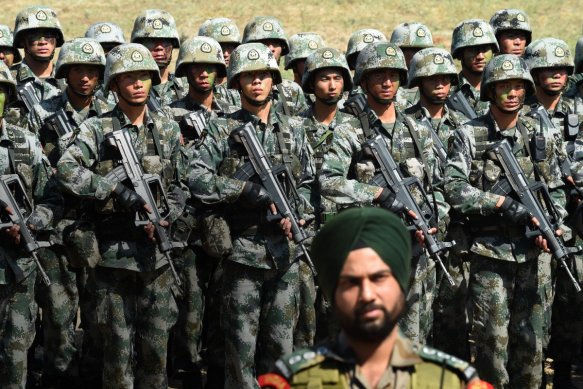
A Marriage of Convenience

The partnership between the world’s largest autocracy (China) and the Mecca of jihadist terrorism (Pakistan) has been cemented on the issue of Jammu and Kashmir (J&K), 55% of which the two together occupy. As revanchist states, Pakistan and China are still seeking to grab more of J&K.

TOI OCT28 2016  CHAD CROWE EDIT.tif

With Pakistan the springboard for China’s containment of India, J&K helps cement that axis.

Brahma Chellaney, The Times of India, August 22, 2019

Like a typical school bully, China doesn’t have a lot of friends. Having joined with the US to impose international sanctions on its former vassal, North Korea, China has just one real ally left — an increasingly fragile and debt-ridden Pakistan. China, however, has little in common with Pakistan, beyond the fact that both are revanchist states not content with their existing borders. Despite China’s brutal repression of its Muslims, Pakistan remains Beijing’s tail-wagging client. The marriage of convenience between the world’s largest autocracy and the fountainhead of jihadist terrorism is founded on a shared strategy to contain India.

In the latest example, China engineered an informal, closed-door UN Security Council (UNSC) meeting on Jammu and Kashmir (J&K) and then, despite the absence of a joint statement, presented to the media a phony summary of the discussions. Few would be surprised by Beijing’s conduct or by its attempt to aid Pakistan’s effort to internationalize the Kashmir issue, including by obscuring China’s own status as the third party in the J&K dispute. China occupies one-fifth of the original princely state J&K, including the areas it seized up to 1962 and the trans-Karakoram tract ceded to it by Pakistan in 1963.

China’s UNSC machinations highlight the fact that the longstanding Sino-Pakistan nexus has been cemented on the issue of J&K, where the borders of India, Xinjiang, Tibet, Pakistan and Afghanistan converge. The Chinese-built Karakoram Highway, since it opened in 1978, has epitomized this nexus. The highway passes through J&K’s Pakistan-held Gilgit-Baltistan region, just like the axis’ new symbol — China’s so-called economic corridor to Pakistan.

Not content with stationing thousands of its own troops in Pakistani-occupied J&K, ostensibly to protect its strategic projects, China is working to enlarge its military footprint in Pakistan. China’s “economic corridor” seeks to turn Pakistan into its land corridor to the Indian Ocean, with Jiwani (located near Gwadar and just 170 kilometres from Iran’s India-aided Chabahar port) likely to become a Chinese naval hub. China is already militarizing northern Arabian Sea: It has secured naval turnaround facilities at Karachi and 40-year exclusive rights to run Gwadar port; its submarines are on patrol; and it has supplied new warships to Pakistan.

Slowly but surely, Pakistan is becoming China’s colonial outpost, primarily aimed at checkmating India. After the Pulwama massacre of Indian paramilitary soldiers, Beijing came to Pakistan’s help by shielding it from international calls to take concrete anti-terrorist steps. For a decade, China vetoed UN action against Pakistan-based terrorist Masood Azhar, until it could no longer sustain its obstruction. But China still blocks India’s membership of the Nuclear Suppliers Group, asserting that — as happened in the Shanghai Cooperation Organization — India’s entry must be counterbalanced with Pakistan’s admission.

Indeed, China has long played the Kashmir card against India. For example, in 2010, it started the practice of issuing stapled visas to Indian citizens from J&K and denied a visa to the Indian Army’s Northern Command chief for a bilateral defence dialogue on grounds that he commanded “a disputed area, J&K”. It also officially shortened the length of the border it shares with India by purging the line separating Indian J&K from Chinese-held J&K. The then Prime Minister, Manmohan Singh, warned that, “Beijing could be tempted to use India’s ‘soft underbelly’, Kashmir”.

Although J&K is divided among three countries, only India was maintaining special powers and privileges for its portion. Even if India had maintained J&K’s special constitutional status, the Sino-Pakistan J&K pincer movement would have continued. This is why China shields Pakistan’s proxy war by terror against India, even though it has locked up more than a million Muslims in the name of cleansing their minds of extremist thoughts. In fact, like Pakistan, China wages asymmetric warfare against India. This is in the form of a “salami slicing” strategy of furtive, incremental territorial encroachments in Ladakh and elsewhere.

Turning Ladakh into a union territory will likely advance India’s effort to counter China’s hostile manoeuvrings, including increasing military forays and incursions. The J&K constitutional change also compartmentalizes India’s territorial disputes with Pakistan and China centred in that region, although India today faces Chinese troops on both flanks of its portion of J&K because of Chinese military presence in the Pakistan-held areas.

India, however, needs to recognize the difference between being cautious and being meek: The former helps avert problems, while the latter invites more pressure. China has the temerity to talk about human rights in Indian J&K and chastise India for unilateralism, while India stays mum on the Tibet repression, Xinjiang gulag policy and Hong Kong excesses. Indeed, Beijing has sought to masquerade as a neutral party because India is loath to remind the world that China, in unlawful occupation of parts of J&K, is directly involved in the dispute. India has shunned even indirect criticism, such as reminding Beijing that those living in glass houses should not throw stones.

Worse still, New Delhi has allowed China to reap a growing trade surplus with India that has more than doubled in the past five years and now dwarfs India’s total defence spending. This, in effect, means Beijing is able to have its cake and eat it too. India must subtly change tack, or else the fire-breathing dragon will be emboldened to step up hostile acts.

The writer is a geostrategist.

© The Times of India, 2019.

Data in the digital era is power and wealth

security-concept_5839249a-c289-11e9-8b78-a387d3830b78

Brahma Chellaney, The Hindustan Times

Data is the oil of today’s digital age, in which every individual, through Internet activity, leaves a footprint of personal information, which is controlled by others. In fact, just like oil in the past century, data is now the most valuable resource in the world — an engine of growth and change. Akin to uranium, data is a game changer. But like oil or uranium, data must be processed to create something of value.

How data is processed and stored carries major implications for national and international security. Hacking and theft of critical data is central to cyber-espionage.

The global “data economy” is dominated by a few tech titans like Alphabet (Google’s parent company), Amazon, Apple, Facebook and Microsoft. These giants vacuum up vast troves of data that help build a digital profile of every individual, including the person’s preferences, foibles and secrets. Their data collection can reveal as much about a person as government surveillance, if not more.

Today’s “data brokers” are financially incentivized to collect and monetize personal data of people all over the world. The collected data, however, is used not just for business purposes. Nor does it stay in the private sector alone. Thanks to Edward Snowden and other revelations, we know that the US government employs several tools to acquire data from the Internet giants. And through its National Security Agency it directly accesses the systems of Google, Facebook, Apple and others.

America’s massive databases arm it with an Orwellian capacity to track digital footprints and personal information of individuals, both Americans and those overseas, including decision-makers. In fact, the 2015 US Cybersecurity Information Sharing Act has essentially legalized all forms of government and corporate spying. This serves as a reminder that the Internet, although a major boon that we cannot live without, facilitates surveillance.

It is paradoxical that those in India who raised a hullabaloo about how the digital-identity Aadhaar system threatens privacy are mute on the larger and more fundamental issue — the monopolistic control of the most powerful tech companies on the data of all, including Indians. It is as if they believe that Aadhaar, aimed at turning parts of India’s data economy into public infrastructure for doling out subsidies and deterring fake identities, is more dangerous than the expansive data vaults of the global tech giants.

There has little debate in India on the government’s Personal Data Protection Bill, which seeks to take data back from the global behemoths by granting Indians protection rights and mandating local storage. Not surprisingly, the bill has come under withering attack from the giants and the US government, which is wielding the threat of a Section 301 investigation against India on this and other trade-related issues.

A handful of companies’ data hegemony is raising security concerns not just in India. Many Americans, concerned about unchecked privacy intrusions, are calling for guardrails to protect data. Europe’s 2018 General Data Protection Regulation enforces tough data-privacy rules. Google has faced huge fines in Europe for abusing its data power. France recently imposed a 3% tax on digital transactions, and Italy is following suit. If India and other countries emulated their example, billions of dollars could shift from US tech companies to local economies.

Let’s face it: The Internet is not a competitive, free-market place but an oligopoly, with Google dominating search, Apple and Google controlling mobile, Facebook ruling the social media and Amazon dominating e-commerce. Worse still, these behemoths are relatively opaque when it comes to their data-collection and retention policies. Their data collection is no less intrusive than government surveillance.

Against this background, India’s data bill, carrying European-style protections and penalties for data-privacy breaches, is a step in the right direction. After India’s Supreme Court held that privacy is a fundamental right, the Srikrishna Committee helped draft this bill. Unfortunately, the government, while introducing and getting passed a record 28 bills in Parliament’s recently concluded session, held back the long-pending data bill to consider changes that could satisfy the US. The bill’s dilution could seriously hobble its purpose.

By opposing India’s move to localize data storage, the tech giants wish to remain unfettered to collect and utilize data opaquely. Their message to India is “trust us”. But as Ronald Reagan said, “Trust, but verify”. A few extraordinarily powerful corporations, with oligopolistic control of sensitive data and US government backing, should not be allowed to influence the provisions of Indian legislation.

Requiring multinational corporations to respect privacy and to store data locally is not about limiting their ability to make money. It is about shielding data through legislative protections that compel these firms to correct their practices. India must seek to loosen their grip over data by mandating greater transparency and imposing limitations on the processing and sharing of personal and sensitive data.

Make no mistake: Like European colonialism in the past three centuries, data imperialism could have serious and lasting consequences.

Brahma Chellaney is a geostrategist.

© The Hindustan Times, 2019.

On nuclear protection, Japan gets a wake-up call from Trump

Brahma Chellaney, The Globe and Mail

254SM6TDY5F35F3ZLMF56PGALI

North Korea test-fires a new short-range ballistic missile in this photo released by North Korea’s Korean Central News Agency (KCNA).

North Korea has test-fired a slew of short-range ballistic missiles in recent weeks, including three new systems, indicating that it has been busy boosting its sub-regional capabilities since its leader Kim Jong-un met with U.S. President Donald Trump at the Korean demilitarized zone in June. Yet Mr. Trump has openly condoned the North Korean tests, largely because the new missiles threaten not the United States but Japan and South Korea.

Indeed, Mr. Trump has clearly indicated that his administration will put up with North Korea’s sub-regionally confined nuclear arsenal (as Washington has done with Pakistan’s) as long as Mr. Kim does not pursue long-range capability that threatens the United States. Not surprisingly, this American stand unnerves Japan, which is central to U.S. military deployments in Asia but feels increasingly vulnerable to growing Chinese and North Korean missile capabilities.

Mr. Trump’s position not only emboldens Mr. Kim but also gives him virtually a free hand in developing and testing short-range missiles that can potentially deliver nuclear warheads.

Mr. Trump has gone to the extent of making allowances for North Korea’s firing of such missiles by accepting Pyongyang’s explanation that the tests are in reaction to the continuing joint military exercises between the United States and South Korea. Mr. Trump has called the two-week exercises “ridiculous and expensive.”

Others in Mr. Trump’s administration have also shrugged off North Korea’s short-range missile tests. Secretary of State Mike Pompeo’s statements, for example, have highlighted a U.S. willingness to put up with the test of any North Korean missile whose range is far short of an intercontinental ballistic missile (ICBM).

After North Korea in early May conducted what was its first missile test in a year and a half, Mr. Pompeo said on ABC’s This Week that “at no point was there ever any international boundary crossed.” Referring to the agreement reached at the first Trump-Kim summit in Singapore in June, 2018, Mr. Pompeo candidly told Fox News Sunday, “The moratorium was focused, very focused, on intercontinental missile systems, the ones that threaten the United States, for sure.”

Japan has said that North Korea’s missile firings have violated United Nations Security Council resolutions that ban Pyongyang from developing and testing ballistic missile technologies. According to Mr. Trump, there “may be a United Nations violation,” but the missile “tests are not a violation of our signed Singapore agreement, nor was there [any] discussion of short-range missiles when we shook hands.”

This position, in effect, means that the Trump administration is ready to sacrifice the security interests of the United States’ regional allies as long as Mr. Kim does not test any capability that threatens American security.

All three of the new missile systems test-fired by Pyongyang symbolize significant technological advances. They are all solid-fuelled and road-mobile systems, making it easier to hide and launch them by surprise. By contrast, North Korea’s older, liquid-fuelled missiles are detectable during the pre-launch fuelling stage. At least one of the new missile systems can possibly be manoeuvred during flight, making its interception more difficult for a missile-defence system.

Japan’s security nightmare has been that, as China continues to expand its already-formidable nuclear and conventional military capabilities, the United States will let North Korea retain the short- and medium-range portion of its nuclear arsenal. With self-interest driving U.S. policy, that nightmare appears to be coming true.

A North Korean sub-regionally confined nuclear capability will only deepen Japanese reliance on security arrangements with the United States. Japan, like Canada, has long remained ensconced under the protection of the U.S. nuclear umbrella. But given the Trump administration’s “America First” approach and its constant refrain that U.S. allies must do more for the alliance, will the United States use nuclear weapons to defend Japan against an attack by China or North Korea?

For the U.S., its nuclear-umbrella protection serves more as a potent symbol of American security commitment and as a nonproliferation tool to prevent Japan and other allies from considering their own nuclear weapons. In a military contingency, the United States is more likely to employ conventional weapons to defend Japan, which pays Washington billions of dollars yearly for the basing of American troops on Japanese territory in the most generous host-nation support by any of America’s 27 allies.

However, the threat to Japan from North Korea’s nuclear-weapons capability comes not only from a potential nuclear strike but also from nuclear blackmail and coercion. Pyongyang could employ the tacit threat of use of nuclear weapons to coerce Tokyo to make economic or political concessions.

The main lesson for Japan from Mr. Trump’s focus on addressing only U.S. security interests is to directly engage Pyongyang by leveraging its own economic power to build better relations with North Korea. And to shore up its security, Tokyo could also consider mutual-defence arrangements with other powers.

Pacifism remains deeply embedded in Japanese society, in part because of the painful legacy of Japan’s prewar militarism. But the key issue at stake today is not whether Japan should remain pacifist, (Japan is the world’s first constitutionally pacifist nation) but whether it can afford to stay passive in a rapidly changing security environment. And with the United States stepping back, peace in East Asia demands a proactive Japan.

© The Globe and Mail, 2019.

India’s real test begins now after the bold J&K move

vcm_s_kf_repr_766x678

Brahma Chellaney, The Hindustan Times

A final deal between the US and the Pakistan-reared Afghan Taliban appears imminent, with the Taliban saying major differences have been resolved. Pakistan’s key role in this process, and in the implementation of the deal that emerges, has emboldened it to downgrade diplomatic relations and suspend bilateral trade with India — actions that India itself should have taken long ago against its terrorism-exporting neighbour.

In fact, Trump’s looming Faustian bargain with the Taliban was an important factor behind India’s change of the constitutional status of Jammu and Kashmir (J&K). A resurgent Pakistan-Taliban duo controlling Afghanistan would spell greater trouble for J&K, including through increased cross-border entry of armed jihadists.

J&K’s reorganization effectively compartmentalizes India’s territorial disputes with Pakistan and China centred in that region. China’s protestation that India’s inclusion of Chinese-held Ladakhi areas in the new Ladakh union territory “hurts Chinese sovereignty” underscores that there will be no let up in Chinese incursions. In recent years, China — which occupies the Switzerland-size Aksai Chin Plateau and lays claim to several other Ladakh areas — has stepped up its military forays and incursions into Ladakh’s Demchok, Chumar, Pangong Tso, Spanggur Gap and Trig Heights.

The immediate trigger for rejigging J&K’s constitutional status was Trump’s Af-Pak gambit. Trump has beseeched Pakistan to “extricate us” from Afghanistan. The paradox is that the US is stuck in the longest war in its history because of Pakistan, which harbours the Taliban’s command-and-control base. Yet Trump, after accusing Pakistan of “lies and deceit”, is now appeasing it, including by slightly reopening the military-aid spigot and offering twice to mediate the Kashmir conflict, even though such an offer is a red rag to the Indian bull.

It is against this background that, to level the field, J&K’s special powers and privileges were revoked, Ladakh was carved out as a separate entity, and the misogynist Article 35A was repealed — all in one fell swoop. For India, three decades of a Pakistan-backed Islamist insurrection in the Kashmir Valley made the status quo no longer sustainable. Armed jihadists today call the shots in the Kashmir Valley, from where the virtually entire indigenous minority — the Kashmiri Pandits — were driven out in one of modern history’s most successful and swiftest ethnic-cleansing operations.

Even if India had maintained J&K’s special constitutional status, Pakistan would have continued its low-intensity asymmetric warfare. After all, Pakistan is a revisionist state that seeks to redraw borders in blood. Yet Pakistan, far from granting autonomy or special status to the two parts of J&K it holds (the sprawling Gilgit-Baltistan and the so-called Azad Kashmir), has treated them as its colonies, recklessly exploiting their mineral and water wealth and transforming their ethnic and linguistic identities through demographic change.

Today, nothing is encouraging Pakistan more than Trump’s turning to it to “help us out” in Afghanistan. Pakistan’s brutal proxies have compelled the US to negotiate the terms of its Afghanistan surrender and seek Pakistani support for a face-saving exit. Just days after the US reached a tentative deal with the Taliban in late January, a suicide bombing claimed by a Pakistan-based terrorist group killed 41 Indian paramilitary soldiers.

Now, with a final deal in the offing and the elected Afghan government sidelined, a scofflaw Pakistan has sought to turn the tables on India by ironically lecturing it on international law and expelling the Indian envoy, even as India still treats Pakistan as a terrorist state only in rhetoric, not in actual policy terms. It will not be long before Pakistan’s roguish military also ups the ante against India, either directly or via its non-uniformed soldiers — the terrorist proxies.

India, through the J&K constitutional change, has pre-emptively sought to safeguard its security before America hands Afghanistan back to the same terrorist militia it removed from power in 2001. But India has a history of losing the advantage after a potentially game-changing move. After Balakot, Pakistan was quick to neutralize India’s advantage with a daring aerial blitz that crossed a red line by targeting Indian military sites. Yet Pakistan escaped scot-free.

India’s real test begins now after the bold, legacy-shaping J&K action. Indeed, the government needs to tackle head on the protracted proxy war of a renegade neighbour that, far from becoming diplomatically isolated as sought by India, has been emboldened by Trump’s gambit.

Does India have the political will to impose costs in a manner to make them increasingly unbearable for Pakistan?

Brahma Chellaney is a geostrategist.

© The Hindustan Times, 2019.

Trump’s Pakistan concessions only provoked India’s Kashmir move

BC (2)India’s action in revoking the special status of the mountainous northern region known as Jammu and Kashmir (J&K) was driven not just by domestic factors, but by U.S. President Donald Trump’s looming Faustian bargain with the Pakistan-reared Afghan Taliban. A resurgent Pakistan-Taliban duo controlling Afghanistan would spell greater trouble for India’s J&K, including through increased cross-border entry of armed jihadis.

Mr. Trump is desperate to end U.S. involvement in the war in Afghanistan and pull the majority of U.S. troops out of the country before seeking re-election next year. While recently hosting the military-backed Pakistani Prime Minister Imran Khan at the White House, Mr. Trump said he’s seeking Pakistan’s help to “extricate” the United States from Afghanistan.

The paradox is that the U.S. is stuck in the longest war in its history because of Pakistan, which, by harbouring the Taliban’s command-and-control base, has effectively undercut the U.S. military mission in Afghanistan. Just last year, Mr. Trump tweeted that, although Pakistan received more than US$33-billion in U.S. aid since 2002, it has returned “nothing but lies and deceit,” including providing “safe haven to the terrorists we hunt in Afghanistan.”

But now, seeking to appease Pakistan, Mr. Trump has offered twice in recent days to mediate the Kashmir conflict, although such an offer is a red rag to the Indian bull. His administration recently facilitated a US$6-billion International Monetary Fund bailout for Pakistan and relaxed its suspension of military aid by clearing US$125-million in assistance for Pakistan’s F-16 fleet.

It is against this background that the Indian government moved several proposals in Parliament on Monday to alter the constitutional status of the Indian portion of J&K. This included revoking the special powers and privileges of J&K, separating the traditionally Buddhist Ladakh region from J&K, and converting the rest of J&K (made up of Muslim-dominated Kashmir Valley and Hindu-majority Jammu) from a state to a federal territory. In addition, it proposed abrogating a misogynist clause permitting women to be stripped of their rights in J&K if they married outsiders.

The government’s proposals won approval easily in both houses of Parliament, with some opposition parties lending support. In fact, much of India has welcomed revoking J&K’s special status. However, the action carries risks of fuelling greater discontent and violence in the Kashmir Valley.

In the Kashmir Valley, jihadis increasingly call the shots. In one of the most successful and swiftest ethnic-cleansing operations in modern history, Islamists in January, 1990, drove out virtually the entire indigenous Hindu minority from the Kashmir Valley.

For India, three decades of a Pakistan-backed Islamist insurrection in the Kashmir Valley made the status quo no longer sustainable. This led the federal government to assume greater power and responsibility in dealing with the J&K security situation. But the Indian action, coupled with Mr. Trump’s Afghanistan exit plan, could embolden Pakistan, which hosts 22 United Nations-designated terrorist entities, to step up its use of armed jihadis as a force multiplier against stronger India.

The widely disseminated fiction on the Kashmir dispute must be dispensed: J&K is not a territory divided just between India and Pakistan. China occupies one-fifth of the original princely state. Underlining that fact, the Indian Home Minister on Tuesday referred to the Switzerland-size, Chinese-held Aksai Chin Plateau as “an integral part” of J&K, while China protested the “inclusion of Chinese territory” by India in the new Ladakh federal territory.

To be clear, Pakistan is a revisionist state that covets the Kashmir Valley and seeks to redraw borders in blood. But far from granting autonomy or special status to the parts of J&K it holds, Pakistan has treated them as its colonies, exploiting their mineral and water wealth and transforming their ethnic and linguistic identities through demographic changes.

Emboldening military-dominated Pakistan is Mr. Trump’s turning to that country to “help us out” in Afghanistan. Just days after Mr. Trump’s special envoy Zalmay Khalilzad reached a tentative deal with the Taliban in late January, a suicide bombing claimed by a Pakistan-based terrorist group killed 41 Indian paramilitary soldiers, triggering tit-for-tat Indian and Pakistani airstrikes and fears of a wider military conflict.

A final deal now seems imminent, with the Taliban saying on Tuesday key differences have been resolved and Mr. Khalilzad reporting “excellent progress.” The talks, while sidelining the elected Afghan government, have signalled U.S. readiness to accept Pakistan’s primacy in Afghanistan.

Before the United States hands Afghanistan back to the same terrorist militia it removed from power in 2001, India has pre-emptively sought to safeguard its security through the J&K action. The U.S., by coming full circle on the Taliban and Pakistan, is validating Karl Marx’s famous statement, “History repeats itself, first as tragedy, then as farce.”

Brahma Chellaney is a geostrategist and the author of nine books, including the award-winning Water: Asia’s New Battleground.

© The Globe and Mail, 2019.

Trump shows India the limits of friendship with the US

By Brahma Chellaney, Daily’O

downloadUS President Donald Trump’s offer to mediate Kashmir conflict was not the only controversial or outlandish statement he made in his 40-minute media interaction on July 22 while hosting Pakistan’s military-backed prime minister, Imran Khan, at the Oval Office. Trump also drew a perverse equivalence between India and Pakistan, threw Afghanistan and Hong Kong under the bus, and begged Pakistan to “extricate us” from Afghanistan.

At a time when Trump is under attack at home for his fear-mongering and racist rhetoric, he has also courted controversy with his comments on other nations. Take his comments that he could have had Afghanistan “wiped off the face of the Earth” but did not “want to kill 10 million people.”

Those comments were not just bizarre; they were also paradoxical because they were made in the presence of the prime minister of Pakistan, which, by creating and nurturing the Taliban, has actively contributed to Afghanistan’s ruin. Indeed, Trump’s repeated bragging that he could kill 10 million Afghans sent out a racist and supercilious message, triggering outrage in Afghanistan.

In just one media interaction, Trump seriously complicated his country’s relations with Afghanistan and India while betraying Hong Kong’s pro-democracy movement. Trump not only endorsed Chinese President Xi Jinping’s handling of Hong Kong, saying Xi “has acted responsibly, very responsibly,” but also gave Xi a virtual license to crack down and end the protests, which he lamented had gone on for “a very long time.”

More than Trump’s offer to mediate the Kashmir conflict, it is his turning to Pakistan to “help us out” in Afghanistan that should concern India. The Faustian bargain that Trump is preparing to strike with the Pakistan-sponsored Taliban will seriously impinge on India’s regional interests and on Indian security, especially in the Kashmir Valley.

Pakistan has harboured the Taliban leadership since the 2001 US invasion of Afghanistan in the expectation that the Taliban, with the Pakistani military’s not-so-covert support, would recapture power in Kabul. Trump’s desperation to end America’s nearly 19-year war in Afghanistan has come handy to Pakistan to play Washington again.

In fact, the deal that Islamabad has sought to push with the Trump administration is that, in return for Pakistani help in Afghanistan, the US will agree to play a role in the Kashmir dispute, including helping to revive India-Pakistan talks. So, it was not sheer coincidence that Trump chose to speak on Kashmir in Imran Khan’s presence, including declaring that he would “love to be a mediator” between India and Pakistan.

India should not be surprised by Trump’s Kashmir mediation offer because it allowed him to intercede and defuse the subcontinental crisis after the Indian airstrike on the terrorist sanctuary at Balakot, deep inside Pakistan. It was Trump — not Prime Minister Narendra Modi — who announced the India-Pakistan de-escalation. Trump made that announcement on February 28, 2019 while attending a summit meeting with North Korean leader Kim Jong Un in Hanoi.

The February 26 Balakot strike held the promise of a potential game-changer. India, however, allowed that defining moment to slip away by failing to retaliate against Pakistan’s February 27 aerial blitz. Worse still, it allowed the egotistical showman Trump to intercede and take credit for de-escalating the situation — a development that led to the return of the captured Indian pilot.

India similarly allowed US diplomatic intervention to help end the Kargil War, whose 20th anniversary is currently being observed, with Army chief General Bipin Rawat warning Pakistan of a “bloodier nose” next time.

The blunt fact is that India has never sought to bring finality to its disputes with Pakistan even when opportunities have beckoned it. At Simla in 1972, for example, India could have traded the return of captured territories and 93,000 prisoners of war for a Kashmir settlement and border adjustments, including securing Kartarpur. Yet, despite holding all the cards, India surrendered at the negotiating table what its martyrs gained on the battlefield.

Defence Minister Rajnath Singh said on July 26 that Pakistan can afford to neither fight a full-fledged war nor a limited war with India, which is why it has chosen instead to wage a proxy war by terror. That is absolutely correct. But it is also true that India’s hesitation to bring closure to its disputes with Pakistan, including treating it as a terrorist state in policy (as opposed to rhetoric), encourages Pakistan’s proxy war as well as America’s readiness to intercede.

Today, India should be deeply concerned that Trump, by emboldening the Pakistan-Taliban combine, is riding roughshod over its regional and security interests. Add to the picture Trump’s other actions, including barring oil shipments from Iran and raising India’s energy-import bill, expelling India from the US Generalized System of Preferences, and mounting a trade war to secure Indian concessions.

Pakistan used the US-supplied F-16s against India on Feb. 27. Yet, the US has just approved $125 million worth of technical and logistics support services for Pakistan’s F-16 fleet, saying it will not affect the “regional balance”. Those who claim Trump’s July 22 comments mean nothing are missing the new courtship.

Earlier, Trump patted Pakistan’s back for arresting Hafiz Saeed, the mastermind of the 2008 Mumbai terrorist attacks. Although Saeed has been living in the open in Pakistan, inciting jihad at public rallies and plotting new attacks despite a $10-million US bounty on him since 2012, Trump on July 17 tweeted, “After a ten year search, the so-called ‘mastermind’ of the Mumbai Terror attacks has been arrested in Pakistan. Great pressure has been exerted over the last two years to find him!”

The Taliban, which once harboured Al Qaeda and now carries out the world’s deadliest terrorist attacks, has secured not just the commitment of a US military exit but also a pathway to power in Kabul. Pakistan’s military generals are showing that sponsoring cross-border terrorism pays: Their brutal proxies, the Taliban and Haqqani Network, have compelled the US president to negotiate the terms of American surrender in Afghanistan and seek Pakistan’s support to finalize the exit.

The draft agreement Trump’s special envoy Zalmay Khalilzad has reached with the Taliban reportedly incorporates mere Taliban promises but major US concessions, including a pledge to release 13,000 Taliban prisoners, a reference to the Taliban controlling an “emirate,” and a deal for the “safe passage” of American troops out of Afghanistan.

Not surprisingly, the Trump administration’s impending capitulation to the Taliban-Pakistan axis will come as a shot in the arm for Pakistan’s India-centred terrorist outfits like the Lashkar-e-Taiba and Jaish-e-Mohammed. Indeed, no organization will likely be more emboldened than Pakistan’s rogue Inter-Services Intelligence (ISI) agency, which fathered these outfits.

History is repeating itself. The US is once again abandoning war-ravaged Afghanistan, just as it did three decades ago following a successful CIA covert operation that forced Soviet troops out of that country. That success, paradoxically, helped turn Afghanistan into a citadel of transnational terrorism. It also allowed the ISI (which actively aided the CIA operation) to install the Taliban in power.

With the US again ready to let Pakistan have its way in Afghanistan, whatever gains the latter has made in terms of women’s and civil rights would likely be reversed once the Taliban re-impose the medieval practices they enforced during their harsh rule from 1996 to 2001. That development, in turn, will further boost the power of Islamists in Pakistan.

The US is clearly coming full circle. Nearly 19 years after removing the Taliban from power and forcing their leaders to flee to Pakistan, the US is ready to let that same thuggish group regain the reins of power.

Henry Kissinger once quipped that “it may be dangerous to be America’s enemy, but to be America’s friend is fatal.” India is learning the soundness of that statement the hard way.

U.S. courtship of Pakistan amplifies India’s challenge

TrumpKhan

Donald Trump speaks to reporters during an Oval Office meeting with the military-backed Pakistani Prime Minister Imran Khan on July 22.

Brahma Chellaney, The Hindustan Times

The United States has quietly replaced its threat of sanctions against Pakistan with renewed engagement — and rewards. Desperate to finalize a “peace” deal with the brutal and thuggish Taliban, President Donald Trump is wooing its sponsor, Pakistan, to help the US “extricate ourselves” from Afghanistan. The courtship has been highlighted by a $6-billion International Monetary Fund (IMF) bailout for Islamabad, the US designation of the leading Baloch separatist group as “terrorist”, and Trump’s re-hyphenation of India with Pakistan, including offering to mediate the Kashmir conflict — the equivalent of a red rag to a bull.

Look at this paradox: The Taliban, despite countless attacks on US forces, are still absent from the US terrorism lists. Yet, to appease Pakistan and China (whose interests and citizens have been targeted), the US on July 2 listed the Baloch Liberation Army (BLA) as “terrorist” under Executive Order 13224. The action provides Pakistan international legitimacy to go after the group and step up its dirty war in Balochistan, even as it shields state-nurtured terrorist outfits.

By handing Pakistan a major diplomatic victory, BLA’s listing balances India’s gain from the earlier US-aided UN designation of the Pakistan-based Masood Azhar as a terrorist. Similarly, as if to balance its $10 million bounty on the India-sought Hafiz Saeed, America last year announced $11 million in reward money for information on three of Pakistan’s most-wanted men linked to Tehrik-e-Taliban Pakistan (TTP). It then assassinated TTP’s third consecutive chief, even as Saeed’s very public life continued.

Meanwhile, Trump, by hosting Pakistan’s Imran Khan at the White House, has bestowed legitimacy on a figure derisively called “selected prime minister”, a reference to how the military generals engineered his ascent to power. Indeed, Pakistan’s army chief and Inter-Services Intelligence head chaperoned Khan on his US visit and attended the White House meeting. Khan is one of the weakest PMs Pakistan has ever had. Almost servile in his fealty to the military, he has shown himself to be a willing puppet — more loyal than the king.

Pakistan, in the run-up to the White House meeting, made some seemingly right moves, including arresting Hafiz Saeed, agreeing to create the Kartarpur Corridor by November, and reopening its airspace to east-west overflights after more than 15 weeks — a closure that forced airlines to incur additional costs by taking detours but also cost a cash-strapped Pakistan $55 million in lost overflight fees. The new moves signal anything but behavioural change.

Take Pakistan’s revolving-door policy on Hafiz Saeed: Pakistan has enacted a catch-and-release drama eight times since 2001. Saeed will again be released once pressure on Pakistan eases. The real issue is not his detention but whether Saeed will be tried and convicted for international terrorism.

Make no mistake: America has ample leverage to reform Pakistan but is loath to exercise it. In contrast to Trump’s sanctions-heavy approach to Iran, preposterously labelled “the world’s leading state sponsor of terrorism”, he — like his predecessor — is relying on carrots to handle the real epicentre of global terror, his public threats notwithstanding. Trump’s suspension of security assistance to Pakistan and several other nations was intended to signal that there is no free lunch — much like his recent expulsion of India from the Generalized System of Preferences. Washington retains Pakistan as its “major non-NATO ally” and refuses to bring Pakistan’s military to account for exporting terrorism.

Hoping that Pakistan on its own would reform and be at peace with itself is akin to expecting a dog to straighten its tail. Coddling terrorists seems to be second nature for Pakistan’s generals. Refusing to bail out Pakistan’s economy could perhaps have yielded as good results as the use of military force. Instead the US, despite enjoying veto power over IMF decisions, has done the opposite. The IMF bailout actually opens billions of dollars more for Pakistan from other international lenders. And by freeing up Pakistani foreign exchange for debt repayments to Beijing, it also bails out China’s projects in Pakistan.

Narrow geopolitical interests guiding America’s Pakistan policy will likely continue to impose costs on India, as has been the case since the 1950s. Although US-India relations have been radically transformed, Washington’s engagement with Pakistan still gives it leverage it values over India. Significantly, the US-Pakistan relationship is on the mend just as Indo-US ties are being tested by Trump’s transactional approach, including punitively increased duties on 14.3% of India’s exports to America.

Another factor at play is Trump’s determination to pull out most US troops from Afghanistan before he seeks re-election. Under the US-initiated “peace” process, Trump is preparing to sell out democratic Afghanistan’s interests to the Pakistan-Taliban axis. India’s exclusion from this process is a blessing in disguise because India must stay away from the sellout, which will bring anything but peace. Indeed, Trump’s Faustian bargain with the Taliban will only embolden Pakistan’s military by proving that sponsoring cross-border terrorism pays.

Karl Marx famously said, “History repeats itself, first as tragedy, then as farce”. Nothing better validates that than America’s Pakistan policy.

Brahma Chellaney is a geostrategist.

© The Hindustan Times, 2019.

From Moon Walk to Space Wars

It is easy to get caught up in escalating strategic competition and conflict on Earth. But, 50 years after the Apollo 11 mission reached the Moon, guaranteeing the freedom to navigate the stars has become no less essential to global peace and security than safeguarding the freedom to navigate the seas.

Spacecraft In The Rays Of Sun. 3D Scene.

BRAHMA CHELLANEYProject Syndicate

Fifty years after astronauts first walked on the Moon, space wars have gone from Hollywood fantasy to looming threat. Not content with possessing enough nuclear weapons to wipe out all life on Earth many times over, major powers are rapidly militarizing space. Given the world’s increasing reliance on space-based assets, the risks are enormous.

As with the Cold War-era Space Race between the United States and the Soviet Union, the new global space race has an important symbolic dimension. And, given the lunar landing’s role in establishing US dominance in space, the Moon is a natural starting point for many of the countries now jostling for position there.

In January, China became the first country to land an unmanned robotic spacecraft on the far side of the Moon. India – which in 2014 became the first Asian country to reach Mars, three years after China’s own failed attempt to leave Earth’s orbit – is scheduled to launch an unmanned mission to the Moon’s uncharted south pole on July 22, a week after the first planned launch was called off at the last minute due to a helium fuel leak. Japan and even smaller countries like South Korea and Israel are also pursuing lunar missions.

But the US will not surrender its position easily. US President Donald Trump’s administration has vowed to “return American astronauts to the Moon within the next five years.” As US Vice President Mike Pence put it, “just as the United States was the first nation to reach the Moon in the 20th century,” it will be the first “to return astronauts to the Moon in the 21st century.”

This escalating space race is not just about bragging rights; countries are also making rapid progress on developing their military space capabilities. Some, like systems that can shoot down incoming ballistic missiles, are defensive. But others, such as anti-satellite (ASAT) weapons technologies that can target space assets, are offensive.

The ability to take advantage of such systems, while denying them to adversaries, is becoming central to military strategies. That is why Trump directed the US Department of Defense to establish the Space Force, an independent military branch that will undertake space-related missions and operations.

The US hopes that such a force can protect its “margin of dominance” in space. Before Patrick M. Shanahan resigned as acting defense secretary last month, he said that that margin is “quickly shrinking,” as newer powers become adept at militarizing commercial space technologies, including those first developed as part of civilian prestige projects. The most notable such powers are Russia and China.

China, which established an independent space force in 2016, is aiming for global leadership in space. And both China and Russia have demonstrated offensive space capabilities in the form of “experimental” satellites that can potentially aid military operations. According to a US Air Force report, the purpose of these countries’ orbiting offensive capabilities is to hold US space assets hostage in the event of conflict.

This highlights the tremendous vulnerability of these assets, and not just those belonging to the US. The existing space infrastructure comprises at least 1,880 satellites owned or operated by 45 countries. These assets support a wide range of activities, including telecommunications, navigation, financial-transaction authentication, connectivity, remote sensing, and weather forecasting. From a security perspective, they facilitate intelligence, surveillance, early warning, arms-control verification, and missile guidance, for example.

There is one more key player in this intensifying space race: India. In March, the country used a ballistic-missile interceptor to destroy one of its own satellites orbiting at nearly 30,000 kilometers (18,641 miles) per hour, making it the fourth power – after the US, Russia, and China – to shoot down an object in space. The test employed some of the same technologies the US used to shoot down an intercontinental ballistic missile in a test conducted just a couple of days before.

Unlike China’s 2007 demonstration of its ASAT capabilities – which left more than 3,000 pieces of debris in orbit – the Indian test faced no international criticism, largely because it was intended to blunt China’s edge in space-war capabilities. In fact, the head of US Strategic Command, General John E. Hyten, defended India’s test: Indians are “concerned about threats to their nation from space,” he said, and thus “feel they have to have a capability to defend themselves in space.”

This sounds a lot like the justification used to build today’s enormous nuclear arsenals, and we know where that logic leads. As with nuclear deterrence, countries continue to upgrade their offensive space capabilities, until “mutually assured destruction” becomes their best hope of protecting themselves and their assets.

Before that happens, international norms and laws must be strengthened. The 1967 Outer Space Treaty bans space-based weapons of mass destruction, but not other types of weapons or ASAT tests. A new treaty is needed to outlaw all use of force in space, with clearly delineated – and reliably enforced – consequences for violations. Likewise, norms for responsible behavior in space must be established, in order to deter ASAT weapons testing or other actions that endanger space assets.

It is easy to get caught up in the escalating strategic competition and conflict on Earth. Safeguarding, say, freedom of maritime navigation in places like the Persian Gulf and the South China Sea (where China continues to  the territorial status quo unilaterally) is vitally important. But guaranteeing the freedom to navigate the stars has become no less essential to global peace and security.

China’s Tiananmen Reckoning

The 30th anniversary of the Tiananmen Square massacre is a reminder that the free ride China has enjoyed internationally in recent decades is ending. It should also serve as a warning to the Communist Party that its continued reliance on brute power to keep China’s citizens in line could eventually leave it on the ash heap of history.

tian2

Tiananmen Square just after the massacre on the night of June 3-4, 1989.

BRAHMA CHELLANEY, Project Syndicate

The 30th anniversary of the Tiananmen Square massacre of at least 10,000 people is significant for several reasons. For one thing, the deadly assault on student-led demonstrators remains a dark and hidden chapter in China’s communist narrative. For another, the Chinese government’s arbitrary exercise of power against its own citizens has not only continued since the massacre, but has become more methodical, sophisticated, and efficient, with the country’s internal-security budget now officially surpassing its mammoth defense spending. Yet at the same time, this reliance on brute force carries an ominous message for the Communist Party of China (CPC) itself.

In a night of carnage on June 3-4, 1989, the Chinese authorities crushed the pro-democracy protests with tanks and machine guns. In Eastern Europe, the democratization push led to the fall of the Berlin Wall just five months later, heralding the end of the Cold War. But the West recoiled from sustaining its post-Tiananmen sanctions against China, thereby paving the way for the country’s dramatic rise.

The West not only glossed over the massacre, but also ignored China’s subsequent excesses and unfair trade practices. US President Donald Trump recently lamented how the United States had aided China’s rise and spawned a “monster”: “[China] took advantage of us for many, many years. And I blame us, I don’t blame them,” Trump said. “I don’t blame [Chinese] President Xi [Jinping]. I blame all of our presidents, and not just President [Barack] Obama. You go back a long way. You look at President [Bill] Clinton, [George W.] Bush – everybody; they allowed this to happen, they created a monster.”

Yet, after a long post-massacre boom, China – the world’s largest, strongest, wealthiest, and most technologically advanced autocracy – is entering a period of uncertainty just as it prepares to celebrate a record 70 years of communist rule. (The longest-lasting autocratic system in the modern era, the Soviet Union, survived 69 years.)

China’s many anniversaries in 2019 are making this a politically sensitive year. The Tiananmen Square protests in 1989 were inspired by the watershed May 4, 1919, student demonstrations against Western colonialism at the same site. But whereas Xi recently extolled the May Fourth Movement in a speech marking the centenary of that event, he and the CPC  about the Tiananmen anniversary.

This year also marks the 60th anniversary of a failed uprising in Tibet against Chinese occupation. And it is ten years since a Uighur revolt killed hundreds in the Xinjiang region, where more than one million Muslims have now been  as part of a Xi-initiated effort to “cleanse” their minds of extremist thoughts. Then, on October 1, the People’s Republic of China will celebrate its 70th birthday.

But the anniversary of the 1989 Tiananmen crackdown is the most portentous for the CPC’s continued monopoly on power. The massacre was carried out because the party has relied on brute force since its inception, including to seize power. During the rule of the PRC’s founder, Mao Zedong, tens of millions died in the so-called Great Leap Forward, the Cultural Revolution, and other state-engineered disasters.

Adolf Hitler was responsible for an estimated 11-12 million civilian deaths, and Joseph Stalin for at least six million. But Mao, with some 42.5 million, was the undisputed champion butcher of the twentieth century. And his blood-soaked rule influenced his successor, Deng Xiaoping, who ordered the savage assault on the Tiananmen demonstrators.

The CPC’s survival in power reflects not only its willingness to deploy massive violence, but also its skill at distorting reality with propaganda and snuffing out dissent. But how long can the world’s oldest autocracy continue to sustain itself? By dispensing with collective leadership and orderly succession, Xi has already undermined the institutionalism that made post-Mao China resilient to the forces of change that helped to unravel the Soviet empire.

Until Xi’s lurch to despotism, it seemed that history was by and large going China’s way. Its economy was booming, its control of the South China Sea was steadily expanding, and its Belt and Road Initiative (BRI) of transnational infrastructure projects was progressing smoothly. But China is now facing strong international headwinds at a time when its economy has noticeably slowed. BRI partner countries are increasingly concerned about becoming ensnared in sovereignty-eroding debt traps. China’s influence operations in democratic countries – and the Trojan horse of Confucius Institutes at foreign universities – are now meeting increased resistance. And, more fundamentally, the paradigm shift in US policy toward China under Trump is altering the geopolitical landscape for Xi’s government.

Meanwhile, China’s growing economic risks – such as rising local government debt, higher US trade tariffs, and Western pushback against its technological expansion and trade and investment practices – are compounding the CPC’s concerns about social unrest. By prompting some multinationals to move production from China to Vietnam, Malaysia, Indonesia, and elsewhere, Trump’s tariffs are further intensifying the party’s anxiety.

As a result, China’s triumphalism has ceased, and Xi has warned that the country faces major new risks at home and abroad that could escalate and ignite turbulence. The CPC fears that it could meet the same fate as its Soviet counterpart, especially if it fails to prevent small incidents from spiraling into major defiance of its authority. This explains Xi’s emphasis on enforcing strict Leninist discipline. Yet Xi himself is undermining the CPC by building a cult of personality around his one-man rule and by inviting international pushback through his overemphasis on China’s strength and power.

The anniversary of the Tiananmen Square massacre is a reminder that the free ride China has enjoyed internationally over the past 30 years is ending. It should also serve as a warning to the CPC that its continued reliance on brute power to keep China’s citizens in line could eventually leave it on the ash heap of history.

Action needed to save the world’s rivers, especially in China

  • Brahma Chellaney writes that excessive damming and drastic overuse of water resources are causing the world’s major waterways to run dry.

Brahma Chellaney, South China Morning Post

Urgent action is needed to save the world’s rivers, including improving agricultural practices, which account for the bulk of freshwater withdrawals

Thanks to excessive damming and drastic overuse of water resources, an increasing number of major rivers across the world are drying up before reaching the sea. Nowhere is this more evident than in China, where the old saying, “Follow the river and it will eventually lead you to a sea,” is no longer wholly true.

While a number of smaller rivers in China have simply disappeared, the Yellow River – the cradle of the Chinese civilisation – now tends to run dry before reaching the sea. This has prompted Chinese scientists to embark on a controversial rainmaking project to help increase the Yellow’s flow. By sucking moisture from the air, however, the project could potentially affect monsoon rains elsewhere.

For large sections of the world’s population, major river systems serve as lifelines. The rivers not only supply the most essential of all natural resources – water – but also sustain biodiversity, which in turn supports human beings.

Yet an increasing number of rivers, not just in China, are drying up before reaching the sea. A major new United Nations study published early this month offers grim conclusions: human actions are irremediably altering rivers and other ecosystems and driving increasing numbers of plant and animal species to extinction. “Nature across the globe has now been significantly altered,” according to the study’s summary of findings.

Water sustains life and livelihoods and enables economic development. If the world is to avert a thirsty future and contain the risks of greater intrastate and interstate water conflict, it must protect freshwater ecosystems, which harbour the greatest concentration of species.

Yet, according to another study published in Nature this month humans have modified the flows of most long rivers, other than those found in the remote regions of the Amazon and Congo basins and the Arctic. Consequently, only a little more than one-third of the world’s 246 long rivers are still free-flowing, meaning they remain free from dams, levees and other man-made water-diversion structures that leave them increasingly fragmented.

Such fragmentation is affecting river hydrology, flow of nutrient-rich sediment from the mountains where rivers originate, riparian vegetation, migration of fish and quality of water.

Take the Colorado River, one of the world’s most diverted and dammed rivers. Broken up by more than 100 dams and thousands of kilometres of diversion canals, the Colorado has not reached the sea since 1998.

The river, which originates in the Rocky Mountains and is the lifeblood for the southwestern United States, used to empty into the Sea of Cortez in Mexico. But now, owing to the upstream diversion of 9.3 billion cubic metres (328.4 billion cubic feet) of water annually, the Colorado’s flow into its delta has been reduced to a trickle.

Other major rivers that run dry before reaching the sea include the Amu Darya and the Syr Darya, the two lifelines of Central Asia; the Euphrates and the Tigris in the Middle East; and the Rio Grande, which marks the border between Texas and Mexico before heading to the Gulf of Mexico. The overused Murray in Australia and Indus in Pakistan are at risk of meeting the same fate.

More fundamentally, altered flow characteristics of rivers are among the most serious problems for sustainable development, because they seriously affect the ecosystem services on which both humans and wildlife depend. Free-flowing rivers, while supporting a wealth of biodiversity, allow billions of fish – the main source of protein for the poor – to trek through their waters and breed copiously.

Free-flowing rivers also deliver nutrient-rich silt crucial to agriculture, fisheries and marine life. Such high-quality sediment helps to naturally re-fertilise overworked soils in the plains, sustain freshwater species and, after rivers empty into seas or oceans, underpin the aquatic food chain supporting marine life.

China’s hyperactive dam building illustrates the high costs of river fragmentation. No country in history has built more dams than China. In fact, China today boasts more large dams than the rest of the world combined.

China’s chain of dams and reservoirs on each of its long rivers impedes the downstream flow of sediment, thereby denying essential nutrients to agricultural land and aquatic species. A case in point is China’s Three Gorges Dam – the world’s largest – which has a problematic build-up of sediment in its own massive reservoir because it has disrupted silt flows in the Yangtze River.

Likewise, China’s cascade of eight giant dams on the Mekong, just before the river enters Southeast Asia, is affecting the quality and quantity of flows in the delta, in Vietnam. Undeterred, China is building or planning another 20 dams on the Mekong.

How the drying up of rivers affects seas and oceans is apparent from the Aral Sea, which has shrunk 74 per cent in area and 90 per cent in volume, with its salinity growing nine-fold. This change is the result of the Aral Sea’s principal water sources, the Amu Darya and Syr Darya, being so overexploited for irrigation that they are drying up before reaching what was once the world’s fourth-largest inland lake.

Compounding the challenges is the increasing pollution of rivers. Aquatic ecosystems have lost half of their biodiversity since the mid-1970s alone.

Urgent action is needed to save the world’s rivers. This includes action on several fronts, including improving practices in agriculture, which accounts for the bulk of the world’s freshwater withdrawals.

Without embracing integrated water resource management and other sustainable practices, the world risks a parched future.

Brahma Chellaney is the author of nine books, including Water, Peace, and War.
© South China Morning Post, 2019.