The forgotten nuclear deal

BY BRAHMA CHELLANEYThe Japan Times

a-chechen-woman-holding-h-0015The current international attention on the nuclear deal with Iran obscures another much-trumpeted nuclear accord signed a decade ago — between the United States and India. On the 10th anniversary of the U.S.-India nuclear deal, six words sum it up: Built on hype, deflated by reality. Indeed, it has become the forgotten nuclear deal.

When it was unveiled by U.S. President George W. Bush and Indian Prime Minister Manmohan Singh in Washington on July 18, 2005, the deal was touted as a major transformative initiative — one that would serve as a “basis for expanding bilateral activities and commerce in space, civil nuclear energy and dual-use technology.” Bush, while leaving office, declared: “We opened a new historic and strategic partnership with India.”

The deal indeed symbolized warming ties between the once-estranged democracies. The deal also became a legacy-building issue for Bush and Singh, just as U.S. President Barack Obama sought the Iran nuclear accord as the biggest diplomatic achievement of his presidency.

At its core, the Indo-U.S. deal-making centered on finding a compromise between an India determined to safeguard its nuclear military program and an America that insisted on imposing stringent nonproliferation conditions. As part of the deal to bring India into the international nuclear mainstream, New Delhi opened the sizable Indian civilian nuclear program to permanent international inspections, signed an additional protocol with the Vienna-based International Atomic Energy Agency, dismantled its Cirus plutonium-production reactor, and harmonized its export policies with the guidelines of U.S.-led technology-control regimes.

But a decade later, the deal’s much-advertised energy, technological and strategic benefits for India still seem elusive. Indeed, the deal has yet to be commercialized. The premise on which it was founded — that India could build energy “security” by importing high-priced, foreign fuel-dependent reactors — was, in any case, a pipe dream. For the U.S., however, the deal was more geostrategic in nature, designed to make India a major U.S. arms client and coopt it as a quasi-ally.

The deal did help place the U.S.-India relationship on a much-higher pedestal. But bilateral ties had begun to significantly improve much before the deal. And the strategic rationale that has brought the two countries closer remains independent of the deal. For the U.S., displacing Russia as India’s largest arms supplier has been a diplomatic coup.

Given the heavy political investment in it, the deal eventually will be operationalized, however belatedly. It will, however, take a minimum of 10 years thereafter for the first nuclear power reactor under the deal to come on line in India.

After all, the international plant-construction time frame, with licensing approval, now averages at least a decade, with the vast majority of reactors currently under construction in the world plagued by serious delays and cost overruns. For example, the Areva-designed plant in Finland, on Olkiluoto Island, is running at least nine years behind schedule, with its cost projected to rise from €3.2 billion to €8.5 billion. The Russian-origin plant at Kudankulam, at the southern tip of India, took 13 years to be completed, with the second of its two reactors yet to be commissioned. In this light, the U.S.-India deal is expected to deliver its first commissioned reactor a generation after being signed.

If India’s reactor imports were governed by “technical and commercial viability” — in Prime Minister Narendra Modi’s words — not a single contract would be feasible. The stalled Indian negotiations with the French firm, Areva, over the price of power suggest that the deal’s commercialization would be dictated neither by technical nor commercial viability but by the extent to which India is willing to fork out subsidies to support high-priced imported reactors.

Indeed, it is a moot question whether the deal will ever yield substantive energy benefits, given the exorbitant price of foreign-origin reactors, the concomitant need to heavily subsidize electricity generated by such plants, and the grassroots safety concerns over the Fukushima-type multi-plant nuclear parks that India has earmarked for Westinghouse, GE-Hitachi and Areva, each of which is to sell prototype Light Water Reactor (LWR) models presently not in operation anywhere in the world. The accident-stricken Fukushima reactors were also the first of their kind.

Adding to India’s risks from proposed import of prototype models is its plan to induct a multiplicity of different LWR technologies from the U.S., France and Russia. Given the several different reactor technologies already in operation or under development in India, such imports will likely exacerbate the country’s maintenance and safety challenges.

The nuclear power dream has faded globally. The crash of oil and gas prices, coupled with skyrocketing reactor-construction costs, has made nuclear power’s economics more unfavorable than ever. Few new reactors are under construction in the West, with the troubled nuclear power industry desperate for exports.

Even as the global role of nuclear power appears set to become marginal, India stands out today as the sole country in the world wedded to major reactor-import plans.

Washington has long pandered to the Indian weakness for the deal’s consummation, with its decade-long negotiations characterized by shifting goalposts.

Gone is the pretense of Washington extending India “full” nuclear cooperation or granting it “the same benefits and advantages as other leading countries with advanced nuclear technology, such as the U.S.,” as the 2005 deal stated. Gone also is the original accord that India would “assume the same responsibilities and practices” as America.

Instead of meeting its commitment to adjust domestic laws and guidelines of U.S.-led multilateral regimes to “enable full civil nuclear energy cooperation and trade with India,” the U.S. actually worked with its Congress and with the Nuclear Suppliers Group (NSG) to bar exports to India of what New Delhi really needs — civilian enrichment and reprocessing equipment and technology, even though such transfers would be under international safeguards.

As a senator, Obama helped insert an important provision in the India-specific Hyde Act of 2006. The so-called Obama Amendment stipulates that the supply of nuclear fuel to India be “commensurate with reasonable operating requirements.” This amendment negated Singh’s pledge to India’s Parliament — that India intended, with U.S. support, to develop “a strategic reserve of nuclear fuel to guard against any disruption of supply for the lifetime of India’s reactors.”

Consider another issue: Years after the U.S. pledged to bring India into the four American-led technology-control cartels — the NSG, Missile Technology Control Regime, Australia Group, and Wassenaar Arrangement — India is still pleading for its admission. It is now filing a formal application for admission to each regime, in the hope that the U.S. would be more forthcoming in its support than it has been so far.

Even in the event that India is admitted to the regimes, the technology controls it still faces will not go away. These regimes are designed to harmonize export policies, not to promote technology trade among member-states.

The key fact is that U.S. nonproliferation policy has yet to treat India on a par with another nuclear-armed country outside the Nuclear Non-Proliferation Treaty (NPT) fold, Israel.

Against this background, India’s diplomatic overinvestment in the deal has already made it harder for it to address more fundamental issues in its warming relations with the U.S., including an increasingly one-sided defense relationship and munificent U.S. aid implicitly subsidizing the Pakistani military’s export of terrorism.

Could the deal with Iran follow the trajectory of the deal with India — a great strategic move, followed by protracted negotiations on follow-up steps, moving goalposts, and the gradual diminution of the original accord? It is possible, but in one fundamental aspect, the two situations are different: Even without a nuclear accord, the U.S. and India would still have become close partners.

Brahma Chellaney is a geostrategist, author and longtime Japan Times contributor.

© The Japan Times, 2015.

Saving Tibet’s unique heritage

Brahma Chellaney, The Japan Times

China's gripThe Dalai Lama is the Tibetans’ god-king and also the embodiment of India’s leverage on the core issue with China — Tibet. But with the longest-living Dalai Lama having just turned 80, the future of both Tibet, and the leverage that India has shied away from exercising, looks more uncertain than ever. Beijing is waiting for the Tibetan leader to die in exile in India to install a puppet as his successor, in the way it has captured the Panchen Lama institution.

The Dalai Lama’s 80th birthday came just weeks after the 20th anniversary of China’s abduction of the Tibetan-appointed Panchen Lama, one of the world’s youngest and longest-serving political prisoners. And it will be followed by the 50th anniversary of the founding of what China deceptively calls the ‘Tibet Autonomous Region.’

This, in reality, is a gerrymandered and directly ruled Tibet, half of whose traditional areas have been taken away and incorporated in Chinese provinces. Tibet was almost the size of western Europe before it came under Chinese rule.

China’s conquest of the sprawling, resource-rich Tibet enlarged its landmass by more than 35 percent, turned it into India’s neighbor, armed it with control over Asia’s major river systems, and gave it access to a treasure-trove of mineral resources.

The Chinese name for Tibet since the Qing Dynasty of the Manchus — Xizang, or “Western Treasure Land” — underscores the great value that this restive region, strategically located in the heart of Asia, holds for China. With its galloping, often-improvident style of economic growth, China has depleted its own natural resources and now is avariciously draining resources from Tibet, the world’s highest plateau known as ‘the Roof of the World.’

Tibet — holding China’s biggest reserves of 10 different metals and serving as the world’s largest lithium producer — is now the focal point of China’s mining and damming activities, which threaten the fragile ecosystems and endemic species of the Tibetan plateau.

Tibet is one of the world’s most bio-diverse regions, with the rarest medicinal plants, the highest-living primates on Earth, and scores of bird, mammal, amphibian, reptile, fish, and plant species not found anywhere else. As a land that includes ecological zones from the arctic to subtropical, this plateau has a range of landscapes extending from tundra to tropical jungles, besides boasting the world’s steepest and longest canyon as well as its tallest peak, Mount Everest.

Serving as Asia’s main freshwater repository, largest water supplier, and principal rainmaker, Tibet plays a unique hydrological role. With its vast glaciers and permafrost, Tibet is called the “Third Pole” because it has the Earth’s largest perennial ice mass after the Arctic and Antarctica.

No development since India’s independence has carried greater implications for its long-term security than the fall of Tibet. Indeed, China’s military and resource advantage from capturing Tibet — which has led to the Tibetan plateau’s increasing militarization and the Chinese damming of its rivers, such as the Mekong, the Salween and the Brahmaputra — is turning into a strategic and environmental nightmare for downstream countries in Southeast and South Asia.

Yet for China, capturing the Dalai Lama institution has become a priority, as if it were the unfinished business of its takeover of the then-independent Tibet.

The aging 14th Dalai Lama, while coping with bouts of ill health, has publicly discussed a range of reincarnation possibilities that break from tradition, including his successor being a woman or being named while he is still alive.

To avert a Panchen Lama-type abduction, he has even suggested that he be the last Dalai Lama or that the 15th Dalai Lama be found in the “free world” — among Tibetan exiles or in the Tibetan Buddhism citadels of Ladakh and Tawang in India. He, however, has yet to issue clear-cut guidelines on his reincarnation, raising the question whether it is a calculated move or a risky hesitation.

Nevertheless, it is doubtful that things would go China’s way in Tibet merely by its installation of a marionette as the next Dalai Lama. Given how most Tibetans despise the China-appointed Panchen Lama as a fake, Beijing would be hard pressed to make its Dalai Lama appointee acceptable to them. Its bigger problem, however, would likely be different.

The present Dalai Lama, with his espousal of nonviolence and his conciliatory “Middle Way” approach of seeking Tibet’s autonomy without independence, has kept the Tibetan resistance to Chinese rule peaceful. But once he passes away, it is far from certain that the movement would remain peaceful or seek only autonomy. His “Middle Way” approach may not survive, thus closing Beijing’s window of opportunity to resolve the Tibet issue by conceding genuine, meaningful autonomy.

The Tibetan resistance movement, for its part, would become rudderless without the current Dalai Lama. This would fuel greater turbulence in a region that China has tried hard to pacify.

The 15th Dalai Lama chosen by Tibetans to take on Beijing’s doppelgänger appointee would be a small child. It was such a power vacuum that China exploited to invade and occupy Tibet when the present Dalai Lama was just 15. After the 13th Dalai Lama died in 1933, Tibet remained leaderless and wracked by fierce regent-related intrigues until the present Dalai Lama was hurriedly enthroned when the Chinese invasion started in 1950.

The next power vacuum in the Tibetan hierarchy could be historically momentous in sealing the fate of the Dalai Lama lineage, shaping Tibet’s destiny, and having an impact far beyond.

Given that China’s actions in Tibet pose a bigger challenge to India than any other country, New Delhi must not remain a mere spectator. India — home to a large Tibetan exile community, including the Tibetan government-in-exile, and directly bearing the impact of China’s activities on the Tibetan plateau — has a legitimate stake in Tibet’s future.

Tibet is to India against China what Pakistan is to China against India. But in sharp contrast to India’s qualms about playing the Tibet card, Beijing has had no hesitation to employ the Pakistan card against India, including by building Pakistan as a military and nuclear balancer on the subcontinent. Beijing also plays the Kashmir card against an inordinately defensive India.

Even as China politically shields Pakistani terrorism against India — exemplified by its recent step to block United Nations action against the Pakistani release of UN-designated terrorist Zaki-ur Rehman Lakhvi — it has stepped up its own engagement with insurgent groups in India’s northeast, including funneling arms to them via the Myanmar route and encouraging them to coalesce.

Tibet is India’s only important instrument of leverage against a muscular China bent upon altering the territorial, river-waters and geopolitical status quo and fomenting terrorism in India’s vulnerable northeast, which is sandwiched between Myanmar, Bangladesh, Tibet and Bhutan. Yet, under Prime Minister Narendra Modi, India unfortunately has resumed doing what his supposedly “weakling” predecessor Manmohan Singh had halted since 2010 — referring to Tibet as part of China in joint statements with Beijing.

Tibet, ever since China eliminated it as a buffer with India, has been at the heart of the Sino-Indian divide. It will remain so until Beijing pursues reconciliation and healing there.

Modi, given his dynamic, forward-looking foreign policy, must work to gradually reclaim India’s Tibet leverage against a China that openly challenges India’s territorial integrity by claiming Indian areas on the basis of their alleged ecclesial or tutelary links with annexed Tibet. China’s attempt at expanding annexation in this manner draws encouragement from India’s imprudent acceptance since the 1950s of Chinese suzerainty over Tibet.

The Dalai Lama is India’s strategic asset and ultimate trump card. If India is to safeguard its Tibet leverage for use, it must plan to act as a pivot in the Tibetan process to find, appoint and shield the next Dalai Lama.

In fact, with China’s mega-dams, mines and military activities in Tibet set to increasingly affect Asian environment and security, the world’s leading democracies must consider playing a role to help save the Tibetan plateau’s unique cultural and natural heritage from becoming extinct.

Brahma Chellaney is a geostrategist and author.

© The Japan Times, 2015.

Built on hype, deflated by reality

Brahma Chellaney, The Hindu, July 14, 2015

imagesUnveiled with great fanfare on July 18, 2005, the Indo-U.S. nuclear deal was touted as a major transformative initiative. But on its 10th anniversary, the deal’s much-advertised energy, technological and strategic benefits for India still seem elusive. Indeed, the deal has yet to be commercialized. The premise on which it was founded — that India could build energy “security” by importing high-priced, foreign fuel-dependent reactors — was, in any case, a pipe dream.

The deal, given the heavy political investment in it, will eventually be operationalized, however belatedly. It will take a minimum of 10 years thereafter for the first nuclear power reactor under the deal to come on line. After all, the international plant-construction time frame, with licensing approval, now averages at least a decade, with the vast majority of reactors currently under construction in the world plagued by serious delays and cost overruns.

For example, the Areva-designed plant in Finland, on Olkiluoto Island, is running at least nine years behind schedule, with its cost projected to rise from €3.2 billion to €8.5 billion. The Russian-origin plant at Kudankulam, in Tamil Nadu, took 13 years to be completed, with the second of its two reactors yet to be commissioned. In this light, the deal is expected to deliver its first commissioned reactor a generation after being signed.

But if reactor imports are to be governed by “technical and commercial viability,” as Prime Minister Narendra Modi has declared, not a single contract would be feasible. The stalled negotiations with Areva over the price of power suggest that the deal’s commercialization would be dictated neither by technical nor commercial viability but by the extent to which India is willing to fork out subsidies to support high-priced imported reactors of a kind that do not even mesh with its three-phase nuclear power programme.

Indeed, it is a moot question whether the deal will ever yield substantive energy benefits, given the exorbitant price of foreign-origin reactors, the concomitant need to heavily subsidize electricity generated by such plants, and the grassroots safety concerns over the Fukushima-type multi-plant nuclear parks that India has earmarked for Westinghouse, GE-Hitachi and Areva, each of which is to sell prototype Light Water Reactor (LWR) models presently not in operation anywhere in the world. The accident-stricken Fukushima reactors, in Japan, were also the first of their kind.

Adding to India’s risks from proposed import of prototype models is its plan to induct a multiplicity of different LWR technologies from the U.S., France and Russia. Given the several different reactor technologies already in operation or under development in India, such imports will likely exacerbate the country’s maintenance and safety challenges.

The Indo-U.S. deal — with its many twists and turns — has hogged the limelight at virtually every bilateral summit. The deal took centre-stage even during U.S. President Barack Obama’s January visit. In its arduous journey toward implementation, the deal has spawned multiple subsidiary agreements. Each auxiliary deal has been hailed by an overzealous New Delhi as an important breakthrough and a diplomatic success, regardless of the concessions it had to make or the new obligations thrust upon it. Indeed, it has employed smoke and mirrors to camouflage its concessions.

Consider the latest “breakthrough” announced during Obama’s visit: India agreed to reinterpret its own law so as to effectively transfer reactor vendors’ nuclear-accident liability to Indian taxpayers. India is also reinterpreting a provision of domestic law in order to bar victims of a nuclear accident in India from suing for damages in America.

Does this yielding indicate that India has learned anything from its bitter experience over the 1984 gas leak from an American-owned Bhopal chemical plant that killed about as many people as the Fukushima disaster? Indeed, Japan’s law, which indemnifies reactor suppliers and makes plant operators exclusively and fully liable, should serve as a sobering lesson for India: GE built or designed the three Fukushima reactors that suffered core meltdowns; yet, despite a fundamental design deficiency in the reactors, the U.S. firm escaped penalties or legal action after the disaster.

Supplier liability is a well-established legal concept, applied in many business sectors around the world to deter suppliers from taking undue risks. In fact, U.S. law allows suppliers, designers and builders of nuclear plants to be held legally liable in the event of accidents, although the 1957 Price-Anderson Act channels economic liability, but not legal liability, to plant operators. Internationally, however, America has pushed an opposite norm — that importing countries channel all liability to their plant operators and limit all claims to the jurisdiction of their own courts so as to free suppliers of any downside risks.

The nuclear power dream has faded globally. The crash of oil and gas prices, coupled with skyrocketing reactor-construction costs, has made nuclear power’s economics more unfavourable than ever. Few new reactors are under construction in the West, with the troubled nuclear power industry desperate for exports. Even as the global role of nuclear power appears set to become marginal, India stands out today as the sole country wedded to major reactor-import plans.

Surprisingly, Modi has placed the nuclear deal, like his predecessor, at the hub of the relationship with America. Washington has long pandered to the Indian weakness for the deal’s consummation, with its decade-long negotiations characterized by shifting goalposts.

It made the Modi government yield some ground even on its demand that India accept nuclear-material tracking and accounting arrangements that go beyond the safeguards system that the International Atomic Energy Agency has approved and applied to India’s civilian nuclear programme. In other words, establishing an elaborate bilateral safeguards system, on top of IAEA inspections, in which India will separately track and account for nuclear materials “by flag” (that is, by each national origin).

For its part, the U.S. has reneged on several of its 2005 commitments. Gone is the pretence of Washington extending India “full” nuclear cooperation or granting it “the same benefits and advantages as other leading countries with advanced nuclear technology, such as the U.S.” Gone also is the original agreement that India would “assume the same responsibilities and practices” as America. Instead of meeting its commitment to adjust domestic laws and guidelines of U.S.-led multilateral regimes to “enable full civil nuclear energy cooperation and trade with India,” the U.S. actually worked with its Congress and with the Nuclear Suppliers Group (NSG) to bar exports of what India really needs — civilian enrichment and reprocessing equipment and technology, even though such transfers would be under international safeguards.

Consider another issue: Years after the U.S. pledged to bring India into the four American-led technology-control cartels — the NSG, Missile Technology Control Regime, Australia Group, and Wassenaar Arrangement — India is still pleading for its admission, with Obama in New Delhi merely reiterating America’s support for India’s “phased entry” into these groups. In anticipation of membership, India had largely harmonized its export controls with the four cartels’ guidelines. It is now filing a formal application for admission to each regime, in the hope that the U.S. would be more forthcoming in its support than it has been so far.

Even in the event of India being admitted to the regimes, the technology controls it still faces will not go away. These regimes are designed to harmonize export policies, not to promote technology trade among member-states. Despite the vaunted U.S.-India Defence Technology and Trade Initiative, the U.S. side refused early this year to accept any of the six joint high-technology projects proposed by India, insisting that New Delhi first sign “foundational agreements” on military logistics and communication interoperability that America has designed for its allies in a patron-client framework. The four joint projects announced during the Obama visit were for relatively modest defence products.

The key fact is that U.S. non-proliferation policy has yet to treat India on a par with another nuclear-armed country outside the Nuclear Non-Proliferation Treaty fold, Israel.

Against this background, why an import deal to generate an increasingly expensive source of energy is critical to Indian interests has never been elaborated by deal pushers in India. They have peddled only beguiling slogans, such as “End of nuclear apartheid against India” and “A place for India at the international high table.” India would be foolhardy to saddle its taxpayers with uneconomical reactor imports, making the Enron dud look small. India’s diplomatic overinvestment in the deal has already made it harder for it to address more fundamental issues with the U.S., including an increasingly one-sided defence relationship.

It is past time for India to reduce the salience of the deal in its relations with America. Without being weighed down by the nuclear-deal millstone, India would be better placed to forge a closer, more balanced partnership with Washington. The warming U.S.-India relationship has gained momentum independent of the deal’s future.

Brahma Chellaney, professor of strategic studies at the Centre for Policy Research, is the author, among others, of “Nuclear Proliferation: The U.S.-India Conflict.”

© The Hindu, 2015.

A Healthy, Climate-Friendly Diet

A column internationally syndicated by Project Syndicate.

livestock-production-1351694005

How we are slowly killing the planet with our love of meat.

This December, world leaders will meet in Paris for the United Nations Climate Change Conference, where they will hammer out a comprehensive agreement to reduce carbon emissions and stem global warming. In the run-up to that meeting, governments worldwide should note one critical, but often overlooked, fact: the single biggest driver of environmental degradation and resource stress today is our changing diet – a diet that is not particularly conducive to a healthy life, either.

In recent decades, rising incomes have catalyzed a major shift in people’s eating habits, with meat, in particular, becoming an increasingly important feature of people’s diets. Given that livestock require much more food, land, water, and energy to raise and transport than plants, increased demand for meat depletes natural resources, places pressure on food-production systems, damages ecosystems, and fuels climate change.

Meat production is about ten times more water-intensive than plant-based calories and proteins, with one kilogram of beef, for example, requiring 15,415 liters of water. It is also an inefficient way of generating food; up to 30 crop calories are needed to produce one meat calorie.

At any given time, the global livestock population amounts to more than 150 billion, compared to just 7.2 billion humans – meaning that livestock have a larger direct ecological footprint than we do. Livestock production causes almost 14.5% of global greenhouse-gas emissions and contributes significantly to water pollution.

Moreover, livestock production consumes one-third of the total water resources used in agriculture (which accounts for 71% of the world’s water consumption), as well as more than 40% of the global output of wheat, rye, oats, and corn. And livestock production uses 30% of the earth’s land surface that once was home to wildlife, thereby playing a critical role in biodiversity loss and species extinction.

It took more than a century for the European diet to reach the point at which meat is consumed at every meal, including breakfast. But, in large parts of Asia, a similar shift has occurred in just one generation. Meaty diets have created a global obesity problem, including, of all places, in China, whose expanding international clout is accompanied by expanding waistlines at home.

Americans consume the most meat per capita, after Luxembourgers. Given the size of the US population, this is already a problem. If the rest of the world caught up to the United States – where meat consumption averages 125.4 kilograms per person annually, compared with a measly 3.2 kilograms in India – the environmental consequences would be catastrophic.

Already, the signs are worrying. The demand for meat is projected to increase by 50% from 2013 to 2025, with overall consumption still rising in the West and soaring in the developing world, especially Asia.

In order to meet this demand, meat producers have had to adopt an extremely problematic approach to raising livestock. In order to ensure that their animals gain weight rapidly, meat producers feed them grain, rather than the grass that they would naturally consume – an approach that is a major source of pressure on grain production, natural resources, and the environment.

Making matters worse, the livestock are injected with large amounts of hormones and antibiotics. In the US, 80% of all antibiotics sold are administered prophylactically to livestock. Yet this has been inadequate to stem the spread of disease; in fact, with many of the new and emerging infectious diseases affecting humans originating in animals, veterinarians, microbiologists, and epidemiologists have been trying to understand the “ecology of disease” (how nature, and humanity’s impact on it, spreads disease).

Though the environmental and health costs of our changing diets have been widely documented, the message has gone largely unheard. With the world facing a serious water crisis, rapidly increasing global temperatures, staggering population growth, and growing health problems like coronary disease, this must change – and fast.

For starters, to ease some of the resource pressure, livestock producers should switch to water-saving technologies, including drip irrigation. At the same time, governments and civil-society groups should promote healthier diets that rely more on plant-based proteins and calories.

According to recent research, if the world stopped producing crops for animal feed or diverting them to biofuels, it could not only end global hunger, but also feed four billion extra people – more than the number of projected arrivals before the global population stabilizes. Meat consumption actually leads to more greenhouse-gas emissions annually than the use of cars does.

This is not to say that everyone must become vegetarian. But even a partial shift in meat-consumption habits – with consumers choosing options like chicken and seafood, instead of beef – could have a far-reaching impact. Indeed, beef production requires, on average, 28 times more land and 11 times more water than the other livestock categories, while producing five times more greenhouse-gas emissions and six times more reactive nitrogen.

Adopting a balanced, largely plant-based diet, with minimal consumption of red and processed meat, would help conserve natural resources, contribute to the fight against human-induced global warming, and reduce people’s risk of diet-related chronic diseases and even cancer mortality. Just as governments have used laws, regulations, and other tools with great success to discourage smoking, so must they encourage citizens to eat a balanced diet – for the sake of their health and that of our planet.

© 1995-2015 Project Syndicate.

Asia on the frontlines of natural disasters

Brahma Chellaney, Nikkie Asian Review 

No continent is more vulnerable to natural disasters than Asia, the world’s largest and most populous region. It has the dubious distinction of being home to some of the world’s leading natural disaster-related hot spots.

One fact confirms Asia’s status as a high humanitarian risk area: It accounts for the majority of all people killed, injured or uprooted by natural disasters globally in the past four decades. In the first half of 2014, 820 people were killed and 31 million affected in 56 disasters in Asia, according to the United Nations Office for the Coordination of Humanitarian Affairs. Looking a little further back and including the humanitarian impact of Typhoon Haiyan, which hit the Philippine island of Leyte last November, the estimated death toll exceeds 10,000.

Asia’s vulnerability to disasters arises from five factors: geography, geology, natural climate extremes, human-induced changes to the environment and global warming.

The most common and potent hazards in Asia are water-related: floods, cyclones and droughts, for example. Geological hazards, such as earthquakes, landslides and volcanic eruptions, also claim lives and displace residents regularly, wreaking serious economic damage at the same time. Asia’s poor bear the brunt of the recurrent cataclysms.

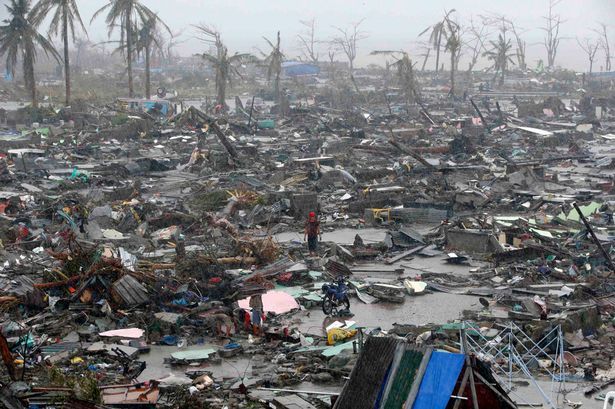
People stand among debris and ruins of houses after Typhoon Haiyan pulverized the city of Tacloban.

People stand among debris and ruins of houses after Typhoon Haiyan pulverized the city of Tacloban.

The region’s geographical vulnerability — Asia has suffered 40% of the world’s disasters in the past decade and 80% of the disaster-related fatalities — is compounded by two factors. The continent’s high population density in low-lying areas and its vast stretches of coastline, the world’s longest, lead to increased risk. Southeast Asia, in particular, stands out for its coastline-related vulnerability: It has 3.3% of the global landmass, but more than 11% of the world’s coastline. The majority of the 600 million people in the world living in areas less than 10 meters above sea level are Asian, residing mainly in Southeast and South Asia.

Moreover, the areas of Asia experiencing high economic growth are located along coastlines, which tend to be heavily populated and constitute prime real estate. Indeed, many of Asia’s major cities, energy plants and industries are located along the coasts. The vulnerability of coastal infrastructure has emerged as an important concern.

Nuclear-power plants, for example, guzzle water. All new nuclear plants in Asia — the center of global atomic energy construction — are located along coastlines, allowing them to draw on seawater for cooling. Seaside reactors face big risks from the global-warming-induced increase in natural disasters, as was highlighted by Japan’s 2011 Fukushima disaster, in part caused by a tsunami.

Cursed land

Geologically, Asia is one of the world’s most complex and vulnerable zones, as the interaction of the region’s tectonic plates shows. Its vulnerability extends from where the Indian plate meets the Eurasian plate in the Himalayas to the northern margins of the Australian plate. The edges of the plates meet along Pacific’s Ring of Fire.

Tectonic plate interactions make Asia vulnerable to earthquakes and tsunamis. Two of the world’s biggest ever combined earthquake and tsunami disasters have occurred in Asia in the past decade: in the Indian Ocean in late 2004 and in Japan in March 2011. The 2004 disaster led to more than 230,000 deaths, while Japan’s cost more than 15,000 lives.

Asia’s climate extremes are shaped by water: There can be too little, or too much, of it; it can be too dirty, becoming unsafe to drink; when it rains, it often pours; dry periods can go on too long; and weak monsoons can trigger serious droughts.

Much of Asia receives most of its yearly rainfall during monsoon periods, which can last from three to four months. Flooding in this season is endemic, exacting heavy economic and human costs. But drought — a slow-onset hazard with crippling effects — often tends to be a bigger problem, as this year has shown. Indeed, global drought risks, in terms of the number of people exposed, are concentrated in Asia.

Human-induced changes to the landscape — which are distinct from global warming, though they can be a stepping stone to it — are also contributing to extreme weather events and aggravating their impacts. Environmental change arises from human actions such as reckless land use, contamination of surface-water resources, groundwater depletion, environmentally unsustainable irrigation, degradation of coastal ecosystems, waste mismanagement, and the destruction of forests, mangroves and other natural habitats.

Coastal erosion, for example, has become a serious problem in certain zones, in part because of the clearing of coastal forests. The over-exploitation of coastal aquifer systems is accelerating seawater intrusion. When freshwater reserves are depleted in coastal aquifers, seawater seeps in to supplant the lost freshwater. This factor is beginning to affect drinking-water supplies in coastal cities such as Manila, Jakarta, Bangkok and Dhaka.

Consider another example: The rivers originating on the Tibetan plateau form 11 Asian mega-deltas, which are home to cities such as Tianjin, Shanghai, Guangzhou, Bangkok, Dhaka, Kolkata and Karachi. But these megadeltas, according to the Intergovernmental Panel on Climate Change, have become “much more vulnerable” to the effects of global warming and sea-level rise because of deforestation in Tibet’s upstream catchment areas and the over-damming of the rivers.

Global warming is a fifth factor. There are some gaps in our scientific understanding of this phenomenon. Climate science, after all, is still young. Yet what we know should be a cause for concern for Asia, which must cope with new challenges, such as greater variability in the movement, distribution and quality of water. Natural climate events, such as the intermittent El Nino and La Nina ocean currents that cause secondary disasters in tropical regions, including forest fires with trans-boundary haze, further complicate the problem.

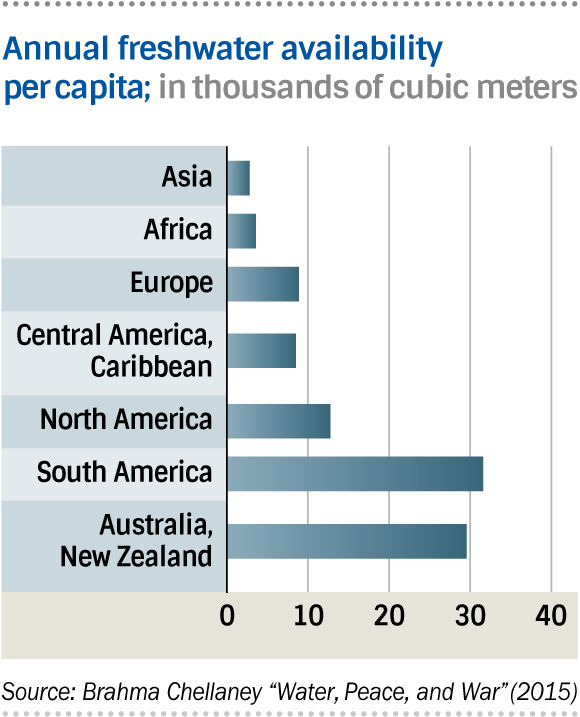
Two water-related implications of global warming for Asia are beyond dispute. First, water stress will intensify and spread to new areas. Asia already has the lowest per-capita water availability among all continents, with large parts of the region now facing water crises. Second, shifts in precipitation and runoff patterns will mean greater variability in water availability, potentially affecting Asian food security.

To deal with their disaster vulnerability, Asian states must do two things: develop greater institutional and organizational capacity to manage environmental stresses and increasing susceptibility to natural hazards; and build resilience. As underscored by the Indian Ocean tsunami and the more recent typhoons that hit the Philippines, building resilience is at the heart of the challenge.

Warning not enough

Resilience is the capacity to absorb shocks and disturbances in such a way as to be able to reorganize fairly quickly. But to be able to reorganize rapidly, a state must have the necessary institutional and organizational means, including implementing forward-looking measures.

Along with developing early-warning systems and preparedness, states must establish smart water-resource management, adapt to water stress by adopting innovative practices and technologies, and develop new crop varieties more tolerant of drought and flooding. Not just governments but also communities and companies need to become more resilient by going beyond traditional risk management to prepare for systemic changes and unforeseen events.

When a disaster strikes a country, the crucial first response cannot come from outside. It must come from within. When nuclear meltdowns occurred at Fukushima, even the International Atomic Energy Agency, a specialized agency, was not initially in a position to offer any concrete assistance to Japan. In the early phase, the IAEA offered criticism but little else.

Yet it is in this critical early phase that a country’s institutional and organizational capacity can make an important difference in saving lives and rescuing people. Rapid-response capability, including local emergency action and providing clean water, food and shelter to survivors, can significantly limit fatalities.

More fundamentally, risk-reduction measures, including protecting or restoring ecosystems that buffer the impact of natural disasters, can help limit both fatalities and economic losses from cataclysms. But the ability of states to adopt best-available practices and technologies to mitigate their disaster-related vulnerabilities very much depends on their political and economic capabilities.

Simple preventive actions, such as the mass evacuation of residents on the basis of early warning systems, can save countless lives. For example, the evacuation of half a million residents from the southeastern Indian coast in October in advance of Typhoon Hudhud — one of the fiercest cyclones to hit the region in years — kept the death toll to fewer than 50. When a typhoon struck the same area in 1999, 10,000 were killed. In contrast to India’s improvement, the failure to evacuate residents caused an estimated 84,500 deaths in Myanmar’s 2008 Typhoon Nargis, according to the International Committee of the Red Cross.

In Asia as elsewhere, countries must develop institutional, organizational and financial capacity as a bulwark against disasters. States with good governance and adequate financial resources will deal with their vulnerabilities in a much better way than cash-strapped nations wracked by internal turmoil and corroding governance.

Brahma Chellaney is a professor of strategic studies at the independent Center for Policy Research in New Delhi and the author of “Water: Asia’s New Battleground,” the winner of the 2012 Bernard Schwartz Award.

© Nikkie Asian Review, 2014. 

Nuclear power’s dark future  

Brahma Chellaney, The Japan Times, November 26, 2014

Hamaoka Nuclear Power Plant in Japan.

Hamaoka Nuclear Power Plant in Japan.

Nuclear power constitutes the world’s most-subsidy-fattened energy industry, yet it faces an increasingly uncertain future. The global nuclear-power industry has enjoyed growing state subsidies over the years, even as it generates the most dangerous wastes whose safe disposal saddles future generations. Despite the fat subsidies, new developments are highlighting the nuclear-power industry’s growing travails. For example, France — the “poster child” of atomic power — is rethinking its love affair with nuclear energy. Its Parliament voted last month to cut the country’s nuclear-generating capacity by a third by 2025 and focus instead on renewable sources by emulating neighboring countries like Germany and Spain.

As nuclear power becomes increasingly uneconomical at home because of skyrocketing costs, the U.S. and France are aggressively pushing exports, not just to India and China, but also to “nuclear newcomers,” such as the cash-laden petroleum sheikhdoms in the Persian Gulf. Such exports raise new challenges related to freshwater resources, nuclear safety and nuclear-weapons proliferation.

Still, the bulk of the reactors under construction or planned worldwide are in just four countries — China, Russia, South Korea and India.

Six decades after Lewis Strauss, the chairman of the U.S. Atomic Energy Commission, claimed that nuclear energy would become “too cheap to meter,” nuclear power confronts an increasingly uncertain future, largely because of unfavorable economics.

The just-released International Energy Agency’s World Energy Outlook 2014 report states: “Uncertainties continue to cloud the future for nuclear — government policy, public confidence, financing in liberalized markets, competitiveness versus other sources of generation, and the looming retirement of a large fleet of older plants.” The stock of the state-owned French nuclear technology giant Areva recently tumbled after it cited major delays in its reactor projects and a “lackluster” global atomic-energy market to warn of an uncertain outlook for its business.

For example, the Areva-designed plant in Finland, on Olkiluoto Island, in running at least nine years behind schedule, with its cost expected to rise from €3.2 billion to almost €8.5 billion. Even in Areva’s home market, the Flamanville 3 reactor project in northern France is facing serious delays and cost overruns.

In Japan, the last of its 48 commercial reactors went offline in September 2013. Repeated polls have shown that the Japanese public remains opposed to nuclear restarts by a 2-to-1 margin, despite toughened safety regulations after the March 2011 disaster at the Fukushima No. 1 nuclear power plant. Yet the southern city of Satsuma Sendai in Kagoshima Prefecture recently gave its consent to restarting, as soon as early next year, two reactors operated by Kyushu Electric Power Company.

Nuclear power has the energy sector’s highest capital and water intensity and longest plant-construction time frame, making it hardly attractive for private investors. Plant-construction time frame, with licensing approval, still averages about a decade, as underscored by the new reactors commissioned in the past decade. In fact, the World Nuclear Industry Status Report 2014 acknowledges that 49 of the 66 reactors currently under construction are plagued with delays and cost overruns.

Commercial reactors have been in operation for more than half a century, yet the industry still cannot stand on its own feet without major state support. Instead of the cost of nuclear power declining with the technology’s maturation — as is the case with other sources of energy — the costs have escalated multiple times. Just in the past decade, average costs jumped from $1,000 per installed kilowatt to almost $8,000/kW.

In this light, nuclear power has inexorably been on a downward trajectory. The nuclear share of the world’s total electricity production reached its peak of 17% in the late 1980s. Since then, it has been falling, and is currently estimated at about 13%, even as new uranium discoveries have swelled global reserves. With proven reserves having grown by 12.5% since just 2008, there is enough uranium to meet current demand for more than 100 years.

Yet the worldwide aggregate installed capacity of just three renewables — wind power, solar power and biomass — has surpassed installed nuclear-generating capacity. In India and China, wind power output alone exceeds nuclear-generated electricity.

Before the Fukushima disaster, the global nuclear power industry — a powerful cartel of less than a dozen major state-owned or state-guided firms — had been trumpeting a global “nuclear renaissance.” This spiel was largely anchored in hope.

However, the triple meltdown at Fukushima not only reopened old safety concerns but also has set in motion the renaissance of nuclear power in reverse. The dual imperative for costly upgrades post-Fukushima and for making the industry competitive, including by cutting back on the munificent government subsidies it enjoys, underscores nuclear power’s dimming future.

New nuclear plants in most countries are located in coastal regions so that these water-guzzling facilities can largely draw on seawater for their operations and not bring freshwater resources under strain.

But coastal areas are often not only heavily populated but also constitute prime real estate. Moreover, the projected greater frequency of natural disasters like storms, hurricanes, and tsunamis due to climate change, along with the rise of ocean levels, makes seaside reactors particularly vulnerable.

The risks that seaside reactors face from global-warming-induced natural disasters became evident more than six years before Fukushima, when the 2004 Indian Ocean tsunami inundated the Madras Atomic Power Station. But the reactor core could be kept in a safe shutdown mode because the electrical systems had been installed on higher ground than the plant level.

In 1992, Hurricane Andrew caused significant damage at the Turkey Point nuclear power plant in Florida, but fortunately not to any critical system. And in a 2012 incident, an alert was declared at the New Jersey Oyster Creek nuclear power plant — the oldest operating commercial reactor in the U.S. — after water rose in its water intake structure during Hurricane Sandy, potentially affecting the pumps that circulate cooling water through the plant.

All of Britain’s nuclear power plants are located along the coast, and a government assessment has identified as many as 12 of the country’s 19 civil nuclear sites as being at risk due to rising sea levels. Several nuclear plants in Britain, as in a number of other countries, are just a few meters above sea level.

Yet even as Germany steps out of the nuclear power business, Britain is pressing ahead with a costly new nuclear power station at Hinkley Point, underscoring the divisions among European countries over nuclear power. Britain indeed intends to build several more plants to replace its aging nuclear stations. The Hinkley Point project, however, is running years behind schedule, with the costs mounting.

Globally, nuclear power is set to face increasing challenges due to its inability to compete with other energy sources in pricing. Another factor is how to manage the rising volumes of spent nuclear fuel in the absence of permanent disposal facilities.

More fundamentally, without a breakthrough in fusion energy or greater commercial advances in the area that the U.S. has strived to block — breeder (and thorium) reactors — nuclear power is in no position to lead the world out of the fossil-fuel age.

Brahma Chellaney, a regular contributor to The Japan Times, is a geostrategist and the author, most recently, of “Water, Peace, and War” (Rowman & Littlefield).

© The Japan Times, 2014.

False Promise of Nuclear Power

Brahma Chellaney, The Hindu, November 19, 2014

wind-nuclearNew developments highlight the growing travails of the global nuclear-power industry. France — the “poster child” of atomic power — plans to cut its nuclear-generating capacity by a third by 2025 and focus instead on renewable sources, like its neighbours, Germany and Spain. As nuclear power becomes increasingly uneconomical at home because of skyrocketing costs, the U.S. and France are aggressively pushing exports, not just to India and China, but also to “nuclear newcomers,” such as the cash-laden oil sheikhdoms. Still, the bulk of the reactors under construction or planned worldwide are located in just four countries — China, Russia, South Korea and India.

Six decades after Lewis Strauss, chairman of the U.S. Atomic Energy Commission, claimed that nuclear energy would become “too cheap to meter,” nuclear power confronts an increasingly uncertain future, largely because of unfavourable economics. The International Energy Agency’s World Energy Outlook 2014, released last week, states: “Uncertainties continue to cloud the future for nuclear — government policy, public confidence, financing in liberalized markets, competitiveness versus other sources of generation, and the looming retirement of a large fleet of older plants.”

Heavily subsidy reliant

Nuclear power has the energy sector’s highest capital and water intensity and longest plant-construction time frame, making it hardly attractive for private investors. Plant-construction time frame, with licensing approval, still averages almost a decade, as underscored by the new reactors commissioned in the past decade.

The key fact about nuclear power is that it is the world’s most-subsidy-fattened energy industry, even as it generates the most dangerous wastes whose safe disposal saddles future generations. Commercial reactors have been in operation for more than half-a-century, yet the industry still cannot stand on its own feet without major state support. Instead of the cost of nuclear power declining with the technology’s maturation — as is the case with other sources of energy — the costs have escalated multiple times.

In this light, nuclear power has inexorably been on a downward trajectory. The nuclear share of the world’s total electricity production reached its peak of 17 per cent in the late 1980s. Since then, it has been falling, and is currently estimated at about 13 per cent, even as new uranium discoveries have swelled global reserves. With proven reserves having grown by 12.5 per cent since just 2008, there is enough uranium to meet current demand for more than 100 years.

Yet, the worldwide aggregate installed capacity of just three renewables — wind power, solar power and biomass — has surpassed installed nuclear-generating capacity. In India and China, wind power output alone exceeds nuclear-generated electricity.

Fukushima’s impact

Before the 2011 Fukushima disaster, the global nuclear power industry — a powerful cartel of less than a dozen major state-owned or state-guided firms — had been trumpeting a global “nuclear renaissance.” This spiel was largely anchored in hope. However, the triple meltdown at Fukushima has not only reopened old safety concerns but also set in motion the renaissance of nuclear power in reverse. The dual imperative for costly upgrades post-Fukushima and for making the industry competitive, including by cutting back on the munificent government subsidies, underscores nuclear power’s dimming future.

It is against this background that India’s itch to import high-priced reactors must be examined. To be sure, India should ramp up electricity production from all energy sources. There is definitely a place for safe nuclear power in India’s energy mix. Indeed, the country’s domestic nuclear-power industry has done a fairly good job both in delivering electricity at a price that is the envy of Western firms and, as the newest indigenous reactors show, in beating the mean global plant-construction time frame.

No competitive bidding

India should actually be encouraging its industry to export its tested and reliable midsize reactor model, which is better suited for the developing countries, considering their grid limitations. Instead, Prime Minister Manmohan Singh’s government, after making India the world’s largest importer of conventional arms since 2006, set out to make the country the world’s single largest importer of nuclear power reactors — a double whammy for Indian taxpayers, already heavily burdened by the fact that India is the only major economy in Asia that is import-dependent rather than export driven.

To compound matters, the Singh government opted for major reactor imports without a competitive bidding process. It reserved a nuclear park each for four foreign firms (Areva of France, Westinghouse and GE of the U.S., and Atomstroyexport of Russia) to build multiple reactors at a single site. It then set out to acquire land from farmers and other residents, employing coercion in some cases.

Having undercut its leverage by dedicating a park to each foreign vendor, it entered into price negotiations. Because the imported reactors are to be operated by the Indian state, the foreign vendors have been freed from producing electricity at marketable rates. In other words, Indian taxpayers are to subsidise the high-priced electricity generated.

Westinghouse, GE and Areva also wish to shift the primary liability for any accident to the Indian taxpayer so that they have no downside risk but only profits to reap. If a Fukushima-type catastrophe were to strike India, it would seriously damage the Indian economy. A recent Osaka City University study has put Japan’s Fukushima-disaster bill at a whopping $105 billion.

To Dr. Singh’s discomfiture, three factors put a break on his reactor-import plans — the exorbitant price of French- and U.S.-origin reactors, the accident-liability issue, and grassroots opposition to the planned multi-reactor complexes. After Fukushima, the grassroots attitude in India is that nuclear power is okay as long as the plant is located in someone else’s backyard, not one’s own. This attitude took a peculiar form at Kudankulam, in Tamil Nadu, where a protest movement suddenly flared just when the Russian-origin, twin-unit nuclear power plant was virtually complete.

India’s new nuclear plants, like in most other countries, are located in coastal regions so that these water-guzzling facilities can largely draw on seawater for their operations and not bring freshwater resources under strain. But coastal areas are often not only heavily populated but also constitute prime real estate. The risks that seaside reactors face from global-warming-induced natural disasters became evident more than six years before Fukushima, when the 2004 Indian Ocean tsunami inundated parts of the Madras Atomic Power Station. But the reactor core could be kept in a safe shutdown mode because the electrical systems had been installed on higher ground than the plant level.

One-sided

Dr. Singh invested so such political capital in the Indo-U.S. civil nuclear agreement that much of his first term was spent in negotiating and consummating the deal. He never explained why he overruled the nuclear establishment and shut down the CIRUS research reactor — the source of much of India’s cumulative historic production of weapons-grade plutonium since the 1960s. In fact, CIRUS had been refurbished at a cost of millions of dollars and reopened for barely two years when Dr. Singh succumbed to U.S. pressure and agreed to close it down.

Nevertheless, the nuclear accord has turned out to be a dud deal for India on energy but a roaring success for the U.S. in opening the door to major weapon sales — a development that has quietly made America the largest arms supplier to India. For the U.S., the deal from the beginning was more geostrategic in nature (designed to co-opt India as a quasi-ally) than centred on just energy.

Even if no differences had arisen over the accident-liability issue, the deal would still not have delivered a single operational nuclear power plant for a more than a decade for two reasons — the inflated price of Western-origin commercial reactors and grassroots opposition. Areva, Westinghouse and GE signed Memorandums of Understanding with the state-run Nuclear Power Corporation of India Limited (NPCIL) in 2009, but construction has yet to begin at any site.

India has offered Areva, with which negotiations are at an advanced stage, a power price of Rs.6.50 per kilowatt hour — twice the average electricity price from indigenous reactors. But the state-owned French firm is still holding out for a higher price. If Kudankulam is a clue, work at the massive nuclear complexes at Jaitapur in Maharashtra (earmarked for Areva), Mithi Virdi in Gujarat (Westinghouse), and Kovvada in Andhra Pradesh (GE) is likely to run into grassroots resistance. Indeed, if India wishes to boost nuclear-generating capacity without paying through its nose, the better choice — given its new access to the world uranium market — would be an accelerated indigenous programme.

Globally, nuclear power is set to face increasing challenges due to its inability to compete with other energy sources in pricing. Another factor is how to manage the rising volumes of spent nuclear fuel in the absence of permanent disposal facilities. More fundamentally, without a breakthrough in fusion energy or greater commercial advances in the area that the U.S. has strived to block — breeder (and thorium) reactors — nuclear power is in no position to lead the world out of the fossil-fuel age.

(Brahma Chellaney is a geostrategist and author.)

© The Hindu, 2014.

Co-opt the water hegemon

BY BRAHMA CHELLANEY
Unless China abandons its unilateralist approach to cross-border rivers and enters into water-sharing arrangements with its neighbors, prospects for a rule-based order in Asia could perish forever.
delaware-river-splash

Asia’s water resources are largely transnational, making inter-country cooperation and collaboration essential. Yet the vast majority of the 57 transnational river basins in continental Asia have no water-sharing arrangement or any other cooperative mechanism. This troubling reality has to be seen in the context of the strained political relations in several Asian sub-regions.

The river basins in the Asian continent that have a treaty-based sharing arrangement currently in place are the Al-Asi/Orontes (Lebanon-Syria), Araks-Atrek (Iran-Russia), El-Kaber (Lebanon-Syria), Euphrates (Iraq-Syria), Gandhak (India-Nepal), Ganges (Bangladesh-India), Indus (India-Pakistan), Jordan (Israel-Jordan), and Mahakali (India-Nepal).

Arrangements in some of these basins, such as the Gandhak, Jordan, and Mahakali, do not incorporate a formula dividing the shared waters between the parties but rather center on specific water withdrawals, transfers, or rights of utilization. An important arrangement in the Mekong Basin is centered on sustainable water management but without any water sharing.

The only treaties in Asia with specific sharing formulas on cross-border river flows are the ones between India and its two downriver neighbors, Pakistan and Bangladesh. The Indus Waters Treaty remains the world’s most generous water-sharing arrangement, under which India agreed to keep for itself only a 19.48 percent share of the waters. (The volume of waters earmarked for Pakistan — by way of comparison — is over 90 times greater than the 1.85 billion cubic meters the U.S. is required to release to Mexico under a 1944 treaty with that country.)

In addition, Soviet-era water arrangements in Central Asia continue to hold, even if tenuously. Such is the competition over scarce water resources that even sharing arrangements are not free of rancor and discord.

b3-mosher-dragon-china-gg_c0-125-1584-1181_s300x200More broadly, Asia’s water map stands out for the unique riparian status that China enjoys. It has established a hydro-hegemony unparalleled on any continent. China is the source of rivers for a dozen countries. No other country serves as the riverhead for so many countries. This makes China the driver of inter-riparian relations in Asia. Yet China also stands out for not having a single water-sharing arrangement or cooperation treaty with any co-riparian state. Its refusal to accede to the Mekong Agreement of 1995, for example, has stunted the development of a genuine basin community.

By building mega-dams and reservoirs in its borderlands, China is unilaterally re-engineering the flows of major rivers that are the lifeblood for the lower riparian states.

To be sure, China trumpets several bilateral water agreements. But none is about water sharing or institutionalized cooperation on shared resources. Some accords are commercial contracts to sell hydrological data to downstream nations. Others center on joint research initiatives, flood-control projects, hydropower development, fishing, navigation, river islands, hydrologic work, border demarcation, environmental principles, or nonbinding memorandums of understanding.

By fobbing off such accords as water agreements, China creates a false impression that it has cooperative riparian relations. In fact, it is to deflect attention from its unwillingness to enter into water sharing or institutionalized cooperation that Beijing even advertises the accords it has signed on sharing flow statistics with co-riparian states.

These agreements are merely contracts to sell hydrological data, which some other upstream countries provide free to downriver states.

The plain fact is that China rejects the very concept of water sharing. It also asserts a general principle that standing and flowing waters are subject to the full sovereignty of the state where they are located. It thus claims “indisputable sovereignty” over the waters on its side of the international boundary, including the right to divert as much shared water as it wishes for its legitimate needs.

This principle was embodied in the now-discredited “Harmon Doctrine” in the United States more than a century ago. This doctrine is named after U.S. Attorney General Judson Harmon, who put forth the argument that the U.S. owed no obligations under international law to Mexico on shared water resources and was effectively free to divert as much of the shared waters as it wished for U.S. needs.

Despite this thesis, the U.S. went on to conclude water-sharing agreements with Mexico between 1906 and 1944.

China, in rejecting the 1997 U.N. Watercourse Convention (which sets rules on shared water resources to establish an international water law), placed on record its assertion of absolute territorial sovereignty over the waters within its borders: “The text did not reflect the principle of territorial sovereignty of a watercourse state. Such a state had indisputable sovereignty over a watercourse which flowed through its territory.” The Harmon Doctrine may be dead in the country of its birth but it appears to be alive and kicking in China.

In this light, it is hardly a surprise that water has become a new divide in China’s relations with riparian neighbors. This divide has become apparent as Beijing has increasingly shifted its dam-building focus from the dam-saturated internal rivers to international rivers, most of which originate on the water-rich Tibetan Plateau.

Then Indian Prime Minister Manmohan Singh personally proposed to Chinese President Xi Jinping and Premier Li Keqiang, in separate meetings in the spring of 2013, that the two countries enter into a water treaty or establish an intergovernmental institution to define mutual rights and responsibilities on shared rivers. Both Xi and Li, however, spurned the proposal.

The Indian assumption that booming bilateral trade would make Beijing more amenable to solving border and water disputes has clearly been belied.

Only three important transnational rivers — the Amur, the Irtysh, and the Ili, which flow to Russia or Kazakhstan — originate in China outside the Tibetan plateau, whose wealth of water and mineral resources is a big factor in its political subjugation.

China’s water disputes with neighbors extend even to North Korea, with which it has yet to settle issues relating to Lake Chonji and two border rivers, the Yalu and the Tumen.

downloadChina’s rush to build more dams promises to roil inter-riparian relations, foster greater water competition and impede the already slow progress toward regional cooperation and integration. By erecting dams, barrages and other water diversion structures in its borderlands, China is spurring growing unease and concern in downriver countries. Getting China on board has thus become critical to shape water for peace in Asia.

At a time when dam building has run into growing grass-roots opposition in Asian democracies like Japan, South Korea, and India, China will remain the nucleus of the world’s dam projects. Significantly, China is also the global leader in exporting dams.

While the dams China is building in Africa and Latin America are largely designed to supply the energy for its mineral-resource extraction and processing there, many of its dam projects in Southeast Asia are intended to generate electricity for export to its own market. China is demonstrating that it has no qualms about building dams in disputed territories, such as Pakistan-administered Kashmir, or in areas torn by ethnic separatism, like northern Myanmar.

Transparency, collaboration, and sharing are the building blocks of water peace. Renewed efforts are needed to try and co-opt China in basin-level institutions. Without China’s active participation in water institutions, it will not be possible to transform Asian competition into cooperation.

Only water institutions involving all important co-riparians can make headway to regulate inter-country competition, help balance the rights and obligations of co-basin states, and promote sustainable practices.

If China were to accept rule-based cooperation, it would have to strike a balance between its right to harness transnational water resources for its development and a corresponding obligation (embedded in customary international law and the U.N. Watercourse Convention) not to cause palpable harm to any co-riparian state.

A balance between rights and obligations indeed is at the heart of how to achieve harmonious, rule-based relations between co-basin states. To be sure, any water arrangement’s comparative benefits and burdens should be such that the advantages outweigh the duties and responsibilities, or else a key state that sees itself as a loser may walk out of discussions or fail to comply with its obligations.

China must be persuaded that its diplomatic and economic interests would be better served by joining forward-looking institutionalized cooperation. Beijing will need considerable convincing, of course, if it is to participate in any basin-level framework centered on compromise, coordination, and collaboration. If China insists on staying on its current unilateralist course, the risk is not only that it will define and implement its water interests in ways irreconcilable with those of its co-riparian states, but also that prospects for a rule-based order in Asia could perish forever.

Brahma Chellaney is a geostrategist. This is excerpted from his paper in the latest issue of Asian Survey by permission of the Regents of the University of California.

Water, Power, and Competition in Asia

BRAHMA CHELLANEY

Asian Survey, Vol. 54, Number 4, pp. 621–650. ISSN0004-4687, electronic ISSN1533-838X. (Copyright 2014 by the Regents of the University of California.)

ABSTRACT: At a time when Asia is at a defining moment in its history, water stress has emerged as one of its most serious challenges. Water shortages have not only stirred geopolitical tensions by intensifying competition over the resources of shared rivers and aquifers, but they also threaten Asia’s continued economic rise.

KEYWORDS: Water stress, hydropolitics, dam racing, hydro-hegemony, Harmon Doctrine

Brahma Chellaney is Professor of Strategic Studies at the independent Center for Policy Research in New Delhi and the author of Water, Peace, and War: Confronting the Global Water Crisis (2013) and Water: Asia’s New Battleground (2012), which won the Asia Society’s 2012 Bernard Schwartz Award. Email: < bc@live.in>.

THE FUTURE OF OUR WORLD WILL BE determined by several factors. One critical factor is adequate access to natural resources. The sharpening geopolitical competition over natural resources has already turned some strategic resources into engines of power struggle. Water, mineral ores, and fossil fuels like coal, oil, and gas are resources of the greatest strategic import. They hold the key to human development and, in the case of water, to human survival.

Food production is closely intertwined with water and energy, whereas water and energy are closely connected with each other. Water is essential for energy extraction, processing, and production, while energy is vital to treat, distribute, and supply water. Moreover, water is intimately linked with climate change. Human-induced changes in the hydrological cycle contribute to climate variation, and global warming, in turn, affects water resources, creating a vicious circle in the process.

Access to potable water is becoming a major issue across large parts of the world because of rapid demographic and economic expansion. Lifestyle and dietary changes have spurred increasing per-capita water consumption in the form of industrial and agricultural products. Freshwater, although a renewable resource, is a finite commodity whose quantity has virtually remained the same since the dawn of civilization.  In fact, less than 1% of the world’s water is usable because 97.5% of it is ocean salt water while another 1.6% is locked up in polar icecaps, glaciers, and permafrost.

Asia is attracting international attention more than ever before, in large part because of its reemergence on the global stage after a two-century decline. Asia is now the world’s largest creditor and main economic locomotive. Asia’s rise, however, has been accompanied by an insatiable appetite for natural resources. This has set off a sharpening resource competition between Asian economies within Asia and far beyond in other continents.

Although able to secure fossil fuels, mineral ores, and timber from distant lands, Asian economies cannot import the most critical resource for their socioeconomic development—water. Water is essentially local and prohibitively expensive to ship across seas. To compound the continent’s challenges, some of the world’s worst water pollution and shortages are found in Asia, promoting environmental degradation and creating a potential for conflict over shared waters.

A little-known fact is that Asia, not Africa, is the world’s most water-stressed continent. Water stress is internationally defined as the per capita availability of less than 1,700 cubic meters per year. Not only is Asia’s per capita water availability the lowest of any continent, but its water stress has also been exacerbated by its dramatic economic rise. The rapid economic growth, coupled with breakneck urbanization and the changing lifestyles of Asians, has made an already difficult water situation worse. Much of the world’s coming expansion of urban population is projected to take place in Asia, with the portion of the global population living in urban areas expected to jump from slightly over half in 2011 to more than two-thirds in 2050.[1] Asia’s rapid urbanization is driving increased water demand both for municipal supply and for the industrial and agricultural products in demand in cities.

This essay analyzes how shared water has become an instrument of power in interstate relations in Asia, stoking underlying tensions, fostering competition, exacerbating impacts on ecosystems, and impeding broader regional collaboration. It examines cases of both upriver and downriver hydro-hegemony, which is water-resource capture or control at the basin level achieved through coercive or diplomatic means by exploiting and reinforcing regional power asymmetries. And it analyzes the security-related water trends in Asia, now the center of global water challenges. In doing so, the essay opens a window to the nature of interstate water competition and conflict, its wider impacts, and its management.

ASIA’S RESOURCE CHALLENGES

Natural-resource constraints in Asia raise troubling questions about the region’s future growth trajectory. Asian economies facing a domestic resource crunch are being forced increasingly to rely on imported mineral ores, timber, and fossil fuels, bringing international supplies under pressure and triggering price volatility. Yet Asia, paradoxically, remains the world’s economic locomotive. Its growing resource constraints raise the issue of whether it can continue to spearhead global economic growth in the coming years.

Asia’s rise has fueled an insatiable appetite for resources it does not have. Unlike North America and Europe, which are well endowed with natural capital, Asia is the world’s most resource-poor continent in per-capita terms. Its resources are also unevenly spread. Its energy resources, for example, are largely concentrated in the desert lands of Central and West Asia, while its water resources are concentrated in the mountainous hinterlands, yet 95% of Asians live in the plains or coastal regions. Even as resource-wealthy countries such as Australia, Brazil, Canada, and Russia enjoy commodity-export booms, Asia’s resource struggle has brought it to a treacherous point of growing external dependency, geopolitical tensions, and environmental degradation.

Asia’s overexploitation of its own natural resources has spurred an environmental crisis, which, in turn, is furthering regional climate change. Asia thus confronts three interlinked crises—a resource crisis, an environmental crisis, and a climate crisis—that threaten its future. From Asian cities dominating the list of the world’s most-polluted cities to many urban areas reeling under serious water shortages, Asia faces increasing resource-related stresses. Meanwhile, sharpening Asian resource competition has aggravated disputes over resource-rich territories, including in the East and South China Seas and southern and central Asia.

Shortages

All the important Asian economies are in or near conditions of water stress.China supports 19% of the world’s population on its territory with a 6.7% share of global water resources. The situation in India is grimmer: It has 17.8% of the global population but just 4.3% of the world’s water.[2]

A World Bank estimate placed the economic cost of water-resource degradation and depletion for China at 2.3% of gross domestic product (GDP), including 1% stemming from the direct impact of rampant water pollution. The health and non-health impacts of both air and water pollution in China were estimated at US$100 billion a year, or about 5.8% of GDP.[3] China, with a per capita annual availability of 2,060 cubic meters in 2013, is not yet in the category of water-stressed states, a list that includes a number of other Asian economies. Water-scarce India and South Korea, for example, are seeing a greater impact nationally than China, with water shortages already beginning to reshape their economies, including the location of industries.

Asia’s yearly per capita freshwater availability (2,816 cubic meters) is not even half the global average of 6,079 cubic meters.[4] Yet Asia has experienced the world’s most rapid growth in freshwater withdrawals from rivers, lakes, and aquifers in the period since it began rising economically. One international report, detailing the resulting steep declines in water availability for development in a number of Asian states since 1980, had this warning about the regional water situation: “Water shortfalls on this scale heighten competition for a precious resource and frequently lead to conflicts, which are emerging as new threats to social stability.”[5]

Asia’s rate of utilization of freshwater already exceeds its renewable stocks. By digging deeper wells, further damming rivers, and transferring surface water across some basins, Asia is using tomorrow’s water to meet today’s needs, thereby accelerating environmental degradation. State policies, including the provision of irrigation subsidies as well as subsidized electricity and diesel fuel to farmers, have unwittingly contributed to water-resource depletion and environmental degradation.

The fact that Asia has one of the lowest levels of water efficiency and productivity in the world makes a bad situation worse. With water stress projected to cover two-thirds of the global population by the end of the next decade, up from about 50% today, the majority of the world’s people living in water-related despair will continue to be in Asia.

Food

Asian economies are already facing a new problem on the food front at a time when agriculture’s appropriation of the bulk of the water resources is coming under challenge from expanding cities and industries. Growth in crop yields and overall food production in Asia is now beginning to lag behind demand. Rising prosperity and changing diets, including an increased preference for animal-based protein, are compounding Asia’s food challenges.

While new technologies, including genetic engineering, can serve as tools to enhance agricultural productivity, a way has not yet been found to reduce the dependence of crops on large amounts of water, except by installing expensive micro-irrigation systems. Unlike the large conglomerates that own much of the cropland in North America and Europe, most farmers in Asia have small acreage, limiting their capacity to invest in new technologies and irrigation systems.

The fast-rising Asian consumption of meat has by itself turned into a major driver of water stress. After all, production of meat is as much as 10 times more water-intensive than plant-based calories and proteins.[6] In a reflection of the larger Asian trend, meat consumption quadrupled between 1980 and 2010 in China. The ecological footprint of Asia’s increasing livestock population is compounding environmental and resource stresses. The only silver lining for India in an otherwise dismal water situation is the fact that a sizable percentage of its population remains vegetarian.

Asia needs to grow more food with less water. To be sure, the region has come a long way in addressing its food needs. Up to the 1960s, it was troubled by food shortages and recurrent famines. Then, on the back of an unparalleled expansion of irrigation, Asia emerged as a net food exporter in just one generation, opening the door to its economic rise. The total irrigated cropland in Asia doubled between 1960 and 2000 alone. Now, Asia boasts 72% of the world’s total acreage equipped for irrigation, with irrigation mostly concentrated in its most populous subregions.[7]

The irrigation-spurred farming boom, however, has come at a high price. Asia channels 82% of its water resources for agricultural use.[8] This level is not sustainable. With the world’s most rapid industrialization and urbanization, Asia is witnessing the fastest increase in water demand from its industries and municipalities. It thus must make major water savings in agriculture to quench the thirst of its booming industries and expanding cities. This challenge is compounded by the slowing growth in crop yields at a time when Asian food demand, for the first time in decades, is outstripping supply.

Poverty

How Asian states manage their resource challenges will shape their security and economic trajectories in the coming years. For example, the biggest enemies of alleviating economic poverty are water poverty and energy poverty. Water and energy poverty keep the poor chained to economic poverty. Asia needs an energy-technology revolution that can deliver cheap, reliable power to those mired in energy poverty and help clean up polluted or brackish waters, chemically treat and recycle wastewater, and make ocean water potable. Otherwise, water pollution—largely an intrastate challenge at present—is likely to assume transboundary dimensions and compound inter-country tensions and discord.

ABSENCE OF COOPERATION IN MOST BASINS 

Asia’s water resources are largely transnational, making inter-country cooperation and collaboration essential. Yet the vast majority of the 57 transnational river basins in continental Asia have no water-sharing arrangement or any other cooperative mechanism. This troubling reality has to be seen in the context of the strained political relations in several Asian subregions.

The river basins in the Asian continent that have a treaty-based sharing arrangement currently in place are the Al-Asi/Orontes (Lebanon-Syria), Araks-Atrek (Iran-Russia), El-Kaber (Lebanon-Syria), Euphrates (Iraq-Syria), Gandhak (India-Nepal), Ganges (Bangladesh-India), Indus (India-Pakistan), Jordan (Israel-Jordan), and Mahakali (India-Nepal). Arrangements in some of these basins, such as the Gandhak, Jordan, and Mahakali, do not incorporate a formula dividing the shared waters between the parties but rather center on specific water withdrawals, transfers, or rights of utilization. An important arrangement in the Mekong Basin—limited to the lower riparian nations—is centered on the sustainable management of water resources but without any water sharing.

The only treaties in Asia with specific sharing formulas on cross-border river flows are the ones between India and its two downriver neighbors, Pakistan and Bangladesh. In addition, the Soviet-era water arrangements in Central Asia continue to hold, even if tenuously, through an interim agreement signed in February 1992. Such is the competition over scarce water resources that even sharing arrangements are not free of rancor and discord.

Central Asia

Consider the water discord among the five so-called “stans” of Central Asia. The interim agreement, signed shortly after these states gained independence, defined on an ad hoc basis the principles to govern the sharing of the waters of the region’s two main rivers, the Syr Darya and the Amu Darya. Soviet Central Asia’s internal rivers became international watercourses following the independence of Kazakhstan, Uzbekistan, Kyrgyzstan, Tajikistan, and Turkmenistan. The post-Soviet agreement, while stipulating that the principles would continue until the parties had worked out a new water-sharing arrangement, set up an Interstate Commission for Water Coordination (ICWC) to help develop a new but still-illusive regional water management system.

In the Syr Darya River Basin, where the total annual flows aggregate to 36.57 billion cubic meters, the share of Kazakhstan—located farthest downriver—was set to be no less than 10 billion cubic meters downstream of the Chardara Reservoir. Uzbekistan, however, is the main consumer of the waters of both the Syr Darya and the region’s largest river, the Amu Darya, whose average yearly flows total 78.46 billion cubic meters. In 1996, Uzbekistan and Turkmenistan reached a water-allocation accord between themselves to supplement the five-nation 1992 interim agreement.

The fact, however, is that rising nationalism and competition over water resources in parched Central Asia has impeded the development of a regional alternative to the Soviet-era water management system. The old system survives largely due to the threat of force. The three lower but militarily powerful riparians—Uzbekistan, Kazakhstan, and Turkmenistan—wield the threat of force against the small and weak Kyrgyzstan and Tajikistan, which are the sources of the Syr Darya and the Amu Darya, respectively. Most of the water flows in these two lifelines of Central Asia are generated in the mountainous parts of Tajikistan and Kyrgyzstan.

China

More broadly, Asia’s water map stands out for the unique riparian status that China enjoys. China is the source of rivers for a dozen countries. No other country in the world serves as the riverhead for so many countries. This makes China the central driver of inter-riparian relations in Asia.

Yet China also stands out for not having a single water-sharing arrangement or cooperation treaty with any co-riparian state. Its refusal to accede to the Mekong Agreement of 1995, for example, has stunted the development of a genuine basin community. By building mega-dams and reservoirs in its borderlands, China is working to unilaterally re-engineer the flows of major rivers that are the lifeblood for the lower riparian states.

To be sure, China trumpets several bilateral water agreements. But none is about water sharing or institutionalized cooperation on shared resources. Some accords are commercial contracts to sell hydrological data to given downstream nations. Others center on joint research initiatives, flood-control projects, hydropower development, fishing, navigation, river islands, hydrologic work, border demarcation, environmental principles, “good-neighborliness and friendly cooperation,” or nonbinding memorandums of understanding.[9] By fobbing off such accords as water agreements, China creates a false impression that it has cooperative riparian relations. In fact, it is to deflect attention from its unwillingness to enter into water sharing or institutionalized cooperation to sustainably manage common rivers that Beijing even advertises the accords it has signed on sharing flow statistics with co-riparian states. These agreements are merely contracts to sell hydrological data, which some other upstream countries provide free to downriver states.

The plain fact is that China rejects the very concept of water sharing. It also asserts a general principle that standing and flowing waters are subject to the full sovereignty of the state where they are located. It thus claims “indisputable sovereignty” over the waters on its side of the international boundary, including the right to divert as much shared water as it wishes for its legitimate needs.

This principle was embodied in the now-discredited “Harmon Doctrine” in the U.S. more than a century ago. This doctrine is named after U.S. Attorney General Judson Harmon, who put forth the argument that the U.S. owed no obligations under international law to Mexico on shared water resources and was effectively free to divert as much of the shared waters as it wished for U.S. needs.[10]  Yet, despite this thesis, the U.S. went on to conclude water-sharing agreements with Mexico between 1906 and 1944.

China, in rejecting the 1997 United Nations Convention on the Law of the Non-Navigational Uses of International Watercourses (which lays down rules on shared water resources and constitutes the first move to establish an international water law), placed on record its assertion of absolute territorial sovereignty over the waters within its borders: “The text did not reflect the principle of territorial sovereignty of a watercourse state. Such a state had indisputable sovereignty over a watercourse which flowed through its territory.”[11] This indicates that the Harmon Doctrine may be dead in the country of its birth but is alive and kicking in China.

In this light, it is hardly a surprise that water has become a new divide in China’s relations with riparian neighbors. This divide has become apparent as Beijing has increasingly shifted its dam-building focus from the dam-saturated internal rivers to international rivers, most of which originate on the water-rich Tibetan Plateau. Only three important transnational rivers—the Amur, the Irtysh, and the Ili (or Yili), which flow to Russia or Kazakhstan—originate in China outside the Tibetan plateau, whose wealth of water and mineral resources is a big factor in its political subjugation. China’s water disputes with neighbors extend even to North Korea, with which it has yet to settle issues relating to Lake Chonji and two border rivers, the Yalu and the Tumen.

China’s rush to build more dams promises to roil inter-riparian relations, fostering greater water competition and impeding the already slow progress toward regional cooperation and integration. By erecting dams, barrages, and other water diversion structures in its borderlands, China is setting up an extensive upstream infrastructure, thereby spurring growing unease and concern in downriver countries. Getting China on board has thus become critical to shape water for peace in Asia.

More fundamentally, the absence of water institutions in the bulk of transnational basins in Asia is hardly conducive for water peace because it increases the geopolitical risks from the sharpening resource competition and unchecked environmental degradation. These risks are accentuated by the lack of an overarching Asian security architecture and by weak regional consultation mechanisms. Asia is the only continent other than Africa where regional integration has yet to take off, largely because Asian political and cultural diversity has hindered institution building.

Integrated management of transnational water resources through interstate collaboration is essential to prevent their degradation, depletion, and pollution. Only robust water institutions, with rule-based cooperation and sharing, can create the right incentives for nations to sustainably manage and conserve water supplies and to refrain from actions at the expense or injury of a downriver state. When cooperative arrangements are absent in any basin, there is a strong incentive for an upper riparian to try to capture water resources before they flow out of its national borders.

WATER AS POWER

Just as the scramble for energy resources has defined Asian geopolitics in recent decades, the struggle for water seems set to define many inter-country relationships in the coming years. At a time when territorial disputes and separatist struggles in Asia increasingly are being driven by resource issues, water indeed is becoming the new oil. But unlike oil—dependence on which can be reduced by tapping other sources of energy—there is no substitute for water.

In what can be described as tacit hydrological warfare, the resources of transnational rivers, aquifers, and lakes have become the target of rival appropriation plans. The fusion between national identity and river or groundwater basins creates a sense of ownership and propels efforts to control water resources, even if they are internationally shared. Driving the rival appropriation plans and the accompanying water nationalism is the notion that sharing waters is a zero-sum game. This, in turn, has given rise to environmentally questionable ideas with transboundary implications—from China’s Western Route to divert river waters from the Tibetan plateau to its parched north and northwest, to India’s embryonic National River Linking Project that proposes to connect rivers across India to alleviate floods and shortages. China’s Western Route plan is the third phase of its South-North Water Transfer (or Diversion) Project (Nanshui Beidiao Gongcheng), whose first two phases involving internal rivers—the Eastern Route and the Central Route—are already complete or nearing completion.

The danger that riparian disputes could escalate to overt conflict looms large on the Asian horizon, with important implications for Asia’s continued rapid economic growth and water security. Water-rich areas, ominously, are at the center of geopolitical tensions in Asia. They range from Kashmir and Tibet to the Golan Heights and the West Bank. Such areas not only boast water wealth but also are strategically located.

Take Central Asia’s Fergana Valley, whose control is divided among Kyrgyzstan (which holds almost two-thirds), Uzbekistan, and Tajikistan. The ethnic fault lines that run through the Fergana Valley—a minefield of ethnic animosities—are the source of periodic clashes among the Kyrgyz, Tajiks, and Uzbeks. The 2010 bloody riots in the Fergana Valley, which left several hundred Uzbek citizens of Kyrgyzstan dead, were sparked in part by local ethnic Kyrgyz fear that Uzbekistan wanted to absorb the water-rich Kyrgyz part.[12]

There is a similar tripartite political split over water-rich Kashmir. India controls about 45% of the original princely state of Jammu and Kashmir, Pakistan 35%, and China the remaining 20%. Because the largest rivers flow to Pakistan from the Indian-administered part of Kashmir, many Pakistanis—especially the military generals and their longstanding allies, the mullahs—have linked the Kashmir dispute with Pakistan’s water security. However, only one of the six Indus-system rivers originates in Indian Kashmir; three have their source in India’s Himachal Pradesh state and two in Chinese-ruled Tibet.

Even the Pakistani-held portion of Kashmir, paradoxically, has assumed water-related significance for Pakistan’s unity and social harmony because the upstream Pakistani construction of giant dams on the Indus has created a deep divide between the downriver Sind and Baluchistan provinces and the upriver Punjab, which has appropriated the bulk of the river waters through hydroengineering structures, located largely in Pakistani Kashmir. This large-scale upstream diversion has reduced the Indus system’s farthest downstream flows to a trickle, turning the Indus Delta into a saline marsh and inviting saltwater intrusion from the Arabian Sea into a once-fertile land.

However, to deflect attention from their water appropriation, the Punjabi elites that rule Pakistan have sought to scapegoat India, an increasingly water-stressed country that reserved more than 80% of the Indus basin waters for Pakistan under the 1960 Indus Waters Treaty. This pact remains the world’s most generous water-sharing arrangement, under which India agreed to keep for itself only a 19.48% share of the waters. (The volume of waters earmarked for Pakistan—by way of comparison—is over 90 times greater than the 1.85 billion cubic meters the U.S. is required to release to Mexico under a 1944 treaty with that country.) India is wracked by increasingly bitter domestic water-sharing disputes that have defied settlement through judicial arbitration.

Significantly, South Asia is the only region, other than North America, where inter-riparian relations are governed by bilateral treaty arrangements, which involve India, Bangladesh, Nepal, and Pakistan. There are also project-specific water agreements between Bhutan and India. Yet water has emerged as a divisive issue in this region in both the inter-country and intra-country context, with dam building at the center of tensions and recriminations on the subcontinent. The India-Pakistan water relationship remains rife with disputes.

Pakistan, for example, invoked the Indus treaty’s dispute settlement provisions in recent years to take two Indian hydropower projects separately for international adjudication. India has embarked on several dam projects in its part of Kashmir to address chronic electricity shortages there. While railing against the modestly sized run-of-the-river Indian dams, Pakistan has stirred local grassroots protests at home by embarking on much larger, storage-type dams such as the 4,500-megawatt Bhasha Dam (also known as Diamer-Bhasha) and the 7,000-megawatt Bunji Dam. While storage-type hydropower plants impound large volumes of water, run-of-the-river projects are located so as to use a river’s natural flow energy and elevation drop to generate electricity without the aid of a large reservoir and dam.

Pakistan’s new dams are centered in Pakistani Kashmir’s northernmost Gilgit and Baltistan areas, where the Pakistan Army and Sunni jihadist groups have sought to suppress a long-simmering rebellion against Pakistani rule by the local Shiite Muslims. China’s growing role in dam building and other strategic projects in Gilgit-Baltistan, along with the entry of Chinese military units to guard such construction sites, has made the situation there more complex and unsettled, as underscored by the June 2013 killing of nine foreign tourists, including three Chinese, by gunmen.

Kashmir, like other water-rich regions, is a key crossroads in the international geopolitical rivalry, with the Islamic insurrection in the Indian-administered part adding to the India-Pakistan tensions. Tibet is firmly under China’s rule, while the Golan Heights (the source of the Jordan River’s headwaters) and the aquifer-controlling West Bank remain under Israel’s control since their capture in the 1967 Six-Day War. However, Kashmir, like the Fergana Valley, remains a divided and contested territory, with Pakistan averse to accepting the territorial status quo. For the foreseeable future, all the water-rich regions extending up to the traditional Kurdish homeland, which straddles the Tigris-Euphrates basin, are likely to stay potential flashpoints for water conflict in Asia because they seem ripe for further geopolitical jousting.

In fact, like arms racing, “dam racing” has emerged as a geopolitical concern in Asia, where the world’s fastest economic growth is being accompanied by the world’s fastest increase in military spending and the world’s fiercest competition for natural resources. As riparian neighbors compete to capture the water of shared rivers by building dams, reservoirs, barrages, irrigation networks, and other structures, distrust and discord have begun to roil relations between upstream and downstream states.

Asia is already the world’s most dam-dotted continent: It has more dams than the rest of the world combined. China, the world’s biggest dam builder, alone has slightly more than half of the approximately 50,000 large dams on the planet.[13] China’s dam-building zeal began in the Mao Zedong era but picked up momentum after Deng Xiaoping emerged as the paramount leader in 1978. A succession of engineer-presidents in China—Jiang Zemin, Hu Jintao, and Xi Jinping—have supported grand water-diversion projects, including the Three Gorges Dam and the South-North Water Diversion Project.

The numerous new dam projects in China and elsewhere show that the damming of rivers remains an important priority for Asian policymakers. In the West, the building of large dams has largely petered out; the rate of decommissioning of dams indeed has overtaken the pace of building new ones in several developed countries. According to international projections for the next 10 years, the total number of dams in developed countries is likely to remain about the same. Much of the dam building in the developing world, in terms of aggregate storage-capacity buildup, is expected to be concentrated in Asia. Dam building on transnational rivers, however, is already stoking inter-riparian tensions in Asia.

ZONES OF WATER DISCORD

Water disputes in Asia center on four distinct zones: China and its neighbors; India and its neighbors; the countries of continental Southeast Asia; and the five “stans” of Central Asia. The dam-building competition involves even the lower riparian states because it is often driven by the doctrine of prior appropriation, which legitimizes the principle “First in time, first in right.” Under this doctrine of customary international water law, the first user of river waters (whether an upstream or downstream state) acquires a priority right to the continued utilization of river waters, as long as those resources are diverted for “beneficial” applications, including irrigation, industrial or mining purposes, electric power generation, and municipal supply.

In the interstate context, water can be turned into an instrument of power through resource capture and control or by upholding inequitable utilization patterns. This usually necessitates either the construction of hydroengineering structures to reengineer transboundary flows or the perpetuation of unfair, pre-independence arrangements in the name of protecting “historical rights.” The latter could involve implicit threats of use of force. Dam building, by intensifying water disputes and tensions across Asia, carries implications for regional stability.

The ability to fashion water into an instrument of control or manipulation, of course, hinges on regional power equations. Only militarily and economically powerful states can normally shape water into a possible political weapon, irrespective of whether they are located upstream or downstream. But if one party, even if lacking matching military and economic prowess, has sufficient capability and political will to mount an effective or strong challenge against a co-basin state, it crimps the latter’s potential to use water as a weapon. Generally, downstream states have a tendency to be alarmist on an upper riparian’s damming of a shared river. When the upper riparian is the preeminent regional power, it may have little incentive to enter into a water-sharing treaty with a downriver state, although the United States and India have concluded such pacts with weaker neighbors.

Central Asia

Central Asia serves as a good example of how water can be wielded as an instrument of power through downstream control, including through threat of force. The regional water competition pits the upstream interests of energy-poor Kyrgyzstan and Tajikistan against those of the larger and stronger countries that are the main water consumers: Uzbekistan, Kazakhstan, and Turkmenistan. The three hydrocarbon-rich countries not only use the bulk of the region’s renewable water resources—estimated at 263 billion cubic meters per year—but also insist that their leonine share is protected under the norm of “historical rights.”

The Central Asian downstream states, with their military might, have the capacity to prevent the upstream countries from building any new hydroengineering projects that could materially alter transboundary flows. This power has blocked the emergence of an equitable successor regime to the region’s Soviet-era water-management system, which integrated water, energy, and agriculture under a federally run and highly centralized regional arrangement. The region’s artificial political frontiers, which bear little resemblance to natural or ethnic fault lines, have also compounded water-sharing issues. The regional water competition indeed is fraught with major ethnic-rivalry dimensions. The intersection between ethnic identity and water insecurity in Central Asia has fostered deep-seated ill will among communities and occasionally spawned violent conflict.

The continued downstream production of cotton, a highly water-intensive crop, through intensive irrigation has exacerbated the regional water discord. In fact, the curse of cotton from the Soviet era has been an important contributor to the degradation of water and land resources in Uzbekistan, Turkmenistan, and Tajikistan. It has also led to the extensive retreat of the Aral Sea, which has shrunk to about one-fourth of its original size because of heavy extractions for irrigation from its principal sources, the Amu Darya and the Syr Darya.[14]

In this tricky and risky situation, Uzbekistan, with 45% of the Central Asian population, consumes more than half the region’s water supply and uses threats of military reprisals against upstream states to shield its appropriation of the dominant share of water resources. It remains embroiled in bitter water rows with Tajikistan and Kyrgyzstan over their dam-building proposals to boost energy production. Tajikistan and Kyrgyzstan contend that such dam building is imperative because the main water-consuming states located downstream are unwilling to supply them with hydrocarbons at concessional rates, as was the practice in the Soviet era. However, Uzbekistan’s implicit military threats have stymied their plans to build large new hydroelectric stations and become renewable-energy exporters. The threats have compelled Tajikistan, for example, not to press ahead with plans to resume work on unfinished Soviet-era hydropower projects, including one on the Vakhsh River that was intended to be the world’s highest dam.

China

China, however, serves as the best example of upstream water hegemony in Asia—and indeed the wider world. It has established a hydro-hegemony unparalleled on any continent by annexing in 1951 the Tibetan Plateau, the starting place of major international rivers. Another sprawling territory Beijing forcibly absorbed, Xinjiang, is the source of the transnational Irtysh and Ili Rivers. Given that China is at the geographical hub of Asia, sharing land or sea frontiers with 20 countries, no rules-based regional order can emerge without its participation in institutionalized cooperation. This challenge is most striking on transboundary rivers.

The Tibetan Plateau is central in Asia's water map

The Tibetan Plateau is central in Asia’s water map

Not content with the large number of dams, reservoirs, barrages, and irrigation networks it has already built, the Chinese government in early 2013 unveiled plans to build new cascades of dams, many of them on major rivers flowing to other countries. The decision by China’s State Council to ride roughshod over downstream countries’ concerns and proceed unilaterally showed that the main issue facing Asia is not readiness to accommodate China’s rise but the need to persuade its leaders to institutionalize cooperation with neighboring countries.

Most of China’s dams serve multiple functions, including generating electric power and supplying water for manufacturing, mining, irrigation, and households. Dam building in downstream countries, although stoking interstate disputes too, pales in comparison with the extent of China’s dam building. For example, China’s latest dam on the Mekong River, the 5,850-megawatt Nuozhadu, can alone generate more electricity than the combined installed hydropower capacity in the lower-Mekong countries at present. The 330-megawatt Indian dam project on the Kishenganga (Neelum) stream that prompted Pakistan to invoke international arbitration proceedings under the Indus Treaty in 2010 is of a size that Chinese dam builders would scoff at, considering it uneconomical as a stand-alone project unconnected to a cascade of dams. In fact, the largest dam India has built since independence, the 2,000-megawatt Tehri on the Bhagirathi River, is not large by Chinese standards. Tehri is capable of producing barely one-tenth of the electricity generated by China’s Three Gorges Dam, the world’s biggest.

By ramping up the size of its dams, China now not only boasts the world’s largest number of mega-dams, but it has also emerged as the biggest global producer of hydropower, with an installed generating capacity of nearly 230 gigawatts. The serious environmental and social problems spawned by the Three Gorges Dam—which officially uprooted 1.7 million Chinese—have failed to dampen China’s hyperactive dam building.

In its 2013 actions, China’s State Council, seeking to boost the country’s hydropower capacity by another 120 gigawatts, identified 54 new dams—in addition to the ones currently under construction—as “key construction projects” in a revised energy-sector plan up to 2015. Most of the new dams are planned in the biodiversity-rich southwest, where natural ecosystems and indigenous cultures are increasingly threatened. Among the slew of newly approved dam projects are five on the Salween and three each on the Brahmaputra and the Mekong. China has already built six mega-dams on the Mekong, the lifeblood for continental Southeast Asia.

The new damming plans threaten both the Salween River’s Grand Canyon—a UNESCO World Heritage site—and the pristine, environmentally sensitive upstream areas through which the Brahmaputra and the Mekong flow. These three international rivers originate on the Tibetan plateau, whose bounteous water resources have become a magnet for Chinese planners. The Salween, which runs through Yunnan Province into Myanmar and along the Thai border for a stretch before draining into the Andaman Sea, will cease to be Asia’s last largely free-flowing river once work is completed on the giant 4,200-megawatt Songta Dam in Tibet.

The State Council decision reversed the suspension of dam building on the Salween announced by Premier Wen Jiabao in 2004, after an international uproar over the start of multiple megaprojects in the National Nature Reserves, adjacent to a world heritage area—a stunning canyon region through which the Salween, the Mekong, and the Jinsha flow in parallel. The decision to resume work on dams along the rim of the Three Parallel Rivers World Heritage Area was consistent with the pattern established elsewhere, including the Yangtze: China temporarily suspends a controversial plan after major protests in order to let public passions cool and to buy time, before resurrecting the same plan.

China’s new dam projects on the Brahmaputra, the main river running through northeastern India and eastern Bangladesh, have meanwhile prompted the Indian government to advise China to “ensure that the interests of downstream states are not harmed” by the upstream works. Water has emerged as a new divide in Sino-Indian relations. Then-Indian Prime Minister Manmohan Singh personally proposed to Chinese President Xi Jinping and Premier Li Keqiang in separate meetings in the spring of 2013 that the two countries enter into a water treaty or establish an intergovernmental institution to define mutual rights and responsibilities on shared rivers. Both Xi and Li, however, spurned the proposal. The Indian assumption that booming bilateral trade would make Beijing more amenable to solving the border and water disputes with India has clearly been belied.

Indeed, China is damming not just the Brahmaputra, on which it has already completed several dams, but also other rivers in Tibet that flow into India. It has built a dam each on the Indus and the Sutlej and unveiled plans to erect a cascade of dams on the Arun River, which helps augment downstream Ganges flows and is thus critical for India to meet its water-sharing treaty obligations vis-à-vis Bangladesh. The flash floods that ravaged India’s Himachal Pradesh and Arunachal Pradesh states between 2000 and 2005 were linked to the unannounced releases from rain-swollen Chinese dams and barrages.

The Brahmaputra is a huge attraction for China’s dam program because this river’s cross-border annual discharge of 165.4 billion cubic meters into India is greater than the combined transboundary flows of the three key rivers running from the Tibetan plateau to Southeast Asia—the Mekong, the Salween, and the Irrawaddy. An officially blessed book published in 2005, Tibet’s Waters Will Save China, openly championed the northward rerouting of the mighty Brahmaputra, although it is unclear whether this idea is technically feasible.[15] As China gradually moves its dam building on the Brahmaputra from the upper reaches to the river’s lower water-rich Great Bend—the area where the Brahmaputra makes a U-turn around the Himalayas to enter India, forming the world’s longest and steepest canyon in the process—it is expected to embark on Mekong-style mega-dams.

More fundamentally, China’s new focus on building dams in its southwest carries transnational safety concerns because this is an earthquake-prone region. Indeed, some Chinese scientists blamed the massive 2008 earthquake that struck the Tibetan Plateau’s eastern rim, killing 87,000 people, mainly in Sichuan Province, on the newly constructed Zipingpu Dam, located beside a seismic fault.[16] The weight of the water impounded in the 156-meter-high dam’s massive reservoir was said to have triggered severe tectonic stresses, or what scientists call reservoir-triggered seismicity (RTS). China’s southwest is an area of high seismic activity because it sits on the fault line where the Indian Plate collides against the Eurasian Plate.

To be sure, China, despite its riparian dominance in Asia, faces important water challenges internally. Although China’s average renewable water resources are 2,051 cubic meters per capita annually, the figure is just 700 cubic meters in its water-stressed north, home to nearly half the country’s population.[17] The intrastate disparity in water availability is compounded by the fact that the largely parched north serves as the country’s agricultural and industrial heartland. This has contributed to serious surface-water pollution and the steady depletion of groundwater resources in the north.

Yet such is its fixation on supply-side measures that China is to spend a staggering $290 billion under its current five-year plan on water-related infrastructure projects, including dams.[18] At a time when dam building has run into growing grassroots opposition in Asian democracies like Japan, South Korea, and India, China will remain the nucleus of the world’s dam projects. Significantly, China is also the global leader in exporting dams.

While the dams China is building in Africa and Latin America are largely designed to supply the energy for its mineral-resource extraction and processing, many of the dam projects in Southeast Asia financed and undertaken by Chinese state-run firms are intended to generate electricity for export to China’s own market. Indeed, China is demonstrating that it has no qualms about building dams in disputed territories, such as Pakistan-administered Kashmir, or in areas torn by ethnic separatism, like northern Myanmar. At home, by embarking on a series of dams in its ethnic-minority-populated borderlands, China is seeking to appropriate river waters before they cross its frontiers, thereby exacerbating ethnic tensions through the submergence of land and displacement of residents.

China’s overseas dam projects have drawn attention to their mounting environmental and human costs. For example, work on the Myitsone Dam—the biggest of the seven dam projects in Myanmar sponsored by China to import electricity—instigated new disputes and fighting, ending a 17-year ceasefire between the Kachin Independence Army and government forces, before authorities shocked Beijing by suspending the project in late 2011. The bold action set the stage for Myanmar’s own transformation from military rule and a virtual Chinese client state to a country that has opened its doors to political and economic reform, attracting global investors and the first-ever visit by a U.S. president. The question haunting Chinese policymakers today is, “Who lost Burma?”

As for China’s dam projects at home, the countries likely to bear the brunt of the Chinese thirst for power and control over transboundary waters are those located farthest downstream on rivers like the Brahmaputra, the Mekong, and the Ili: Bangladesh, whose future is threatened by climate and environmental change; Vietnam, a rice bowl of Asia; and Kazakhstan, which boasts 17,000 natural lakes but whose own overexploitation of water resources has already dried up 8,000 small lakes.[19]

Whereas the Brahmaputra is the largest source of freshwater for Bangladesh, Vietnam is located downstream on two rivers flowing in from the edge of the Tibetan plateau: the Red River, the main watercourse of northern Vietnam; and the Mekong, the principal river of southern Vietnam. China’s water appropriations from the Ili threaten to turn Kazakhstan’s largest lake—Balkhash, spread over 18,000 square kilometers—into another Aral Sea, which has become the symbol of human-made environmental disaster. Diversion of water for irrigation from the Ili Basin already “has led to ecological problems in the region, notably the drying up of small lakes.”[20]

At a time when upstream Chinese dams have helped stir popular passions in Vietnam, Laos, Cambodia, and Thailand, the U.S. has sought to diplomatically cash in on downstream concerns by launching the Lower Mekong Initiative, or LMI. The U.S.-sponsored LMI—seeking to promote integrated cooperation among Cambodia, Laos, Thailand, and Vietnam in the areas of environment, education, health, and infrastructure—emphasizes sustainable hydropower development and natural resource management, including improving institutional capacity to address connected transnational issues. The LMI, however, cannot obscure the imperative to build institutionalized cooperative arrangements involving all the Mekong basin states, including China. One U.S. official has urged Beijing to overcome its loathing of institutionalized water cooperation and join the Mekong River Commission, which was set up in 1995 to foster integrated and sustainable management of basin resources.[21]

The situation in the basin has also been roiled by Laotian and Cambodian plans to build dams on the Mekong, including with Chinese financial and technical aid. Laos, which wants to become the “battery” of Southeast Asia by selling electricity to its neighbors, has courted regional controversy by starting work on the 1,260-megawatt Xayaburi (Sayabouly) Dam and unveiling a plan to build the smaller 260-megawatt Don Sahong Dam near its iconic Khone Falls area in the south, just before the river enters Cambodia. Environmentalists have warned that the Xayaburi Dam, which Laos began constructing over its neighbors’ objections, posed a potential threat to the survival of the wild population of the Mekong giant catfish.

India

Another zone of water discord centers on India, which has multiple riparian identities. It is the uppermost riparian on some rivers that originate on its territory, such as the Chenab and the Jhelum, which flow to Pakistan, and the Teesta, which drains a part of northern Bangladesh. India is the mid-riparian on the Brahmaputra and the main Indus stream. And India is the lowermost riparian on the rivers that begin in Tibet and flow southward via Nepal to empty into the Ganges Basin, such as the Karnali, the Gandak, and the Kosi (Arun). Besides India, few other states in Asia fall in all the three categories—upper, middle, and lower riparian. Indeed, such is India’s geographical spread that it has a direct stake in all the important river basins in South Asia.

Because of its mottled riparian status, India is potentially affected by water-related actions of states located upstream—China, Nepal, and Bhutan—while its own actions can carry a cross-border impact on Pakistan or Bangladesh. No nation is more vulnerable to China’s re-engineering of transboundary flows than India because it alone receives nearly half of all river waters that leave Chinese territory. A total of 718 billion cubic meters of surface water flows out of Chinese territory yearly, of which 48.33% runs directly into India.[22] (Some additional Tibetan waters also flow to India via Nepal.) Bangladesh, on the other hand, has one of the world’s highest dependency ratios with regard to cross-border inflows, receiving 91.3% of its water from India, although a sizable portion of that water originates in Tibet.

India confronts a deepening water crisis, which is more acute than China’s. Yet India’s per capita capacity to store water for dry-season release (200 cubic meters yearly) is one of the world’s lowest; indeed, it is 11 times lower than China’s (2,200 cubic meters).[23] The 2030 Water Resources Group—a consortium of private social-sector organizations providing insights into worldwide water issues—has a dire warning for India: the country is likely to face a 50% deficit between water demand and supply by 2030.[24] India’s own agencies say it must nearly double its annual grain production to more than 450 million tons by 2050 to meet the demands of increasing prosperity and a growing population, or risk becoming a major food importer—a development that will disrupt the already tight international food markets.[25] The growing water shortages also threaten to slow Indian economic growth and fuel social tensions.

With water increasingly at the center of interprovincial feuds in India, the country’s Supreme Court has struggled for years to settle water-related lawsuits, with several of the parties returning to litigate on new grounds. Plans for large water projects in India, meanwhile, have run into stiff opposition from influential nongovernment organizations (NGOs), so that it has become increasingly difficult to build a large dam, blighting the promise of hydropower. Proof of this was the federal government’s 2010 decision to abandon three dam projects on the Bhagirathi River, a Ganges tributary, including one that was already half-built, with authorities having spent $139 million on construction work and ordered equipment worth $288 million.

Yet, seeking to exercise the right of prior appropriation on transnational rivers, the Indian government has since 2012 approved the construction of several dams for electric-power generation in the Himalayan states of Arunachal Pradesh, Sikkim, Uttarakhand, and Jammu and Kashmir. They include the Tawang (800 megawatt), Tato (700 megawatt), Subansiri Upper (1,800 megawatt), and Teesta (520 megawatt) projects. Cost and time overruns are common problems in every dam project in India. But given the growing grassroots power of NGOs in blocking dam building, it is unclear which of the newly approved projects will be completed and in what time frame.

In truth, India demonstrates that dams and democracy normally don’t go well together. Whereas China continues to build giant dams and reroute rivers, trumpeting these projects as symbols of its engineering prowess, the public pressures generated by India’s democracy act as a brake on ambitious water projects that displace many people or flood vast areas. For example, while India’s river-linking plan remains in the realm of fantasy, China’s similar program began transferring water domestically through the Eastern Route by 2013.

Still, given the growing gap between Asian water demand and supply, water disputes are almost as rife between India and its neighbors as they are between China and its neighbors. There are, however, two key differences. One, India has water pacts with all its riparian neighbors other than China. And two, its water-sharing treaties with Bangladesh and Pakistan contain dispute-settlement mechanisms.

The Indus Treaty, according to a 2011 majority staff report prepared for the U.S. Senate Foreign Relations Committee, is “considered the world’s most successful water treaty, having remained relatively intact for 50 years and having withstood four Indo-Pakistani wars.”[26] Yet this treaty has not been able to stop bilateral water disputes from surfacing and embittering relations. The treaty, however, contains elaborate provisions to resolve differences or disputes through the appointment of a neutral international expert or a court of arbitration. These mechanisms help to moderate disagreements, ensuring that they do not escalate to conflict.

Still, the reality is that water shortages have become acute in Pakistan, which maintains one of Asia’s highest population-growth rates. The total quantum of cross-border flows into Pakistan from India has not materially changed over the years, in spite of genuine concerns over the impact of global warming. The inflows include an average of 167.2 billion cubic meters yearly from the three large rivers reserved for Pakistan under the Indus Treaty, plus 11.1 billion cubic meters in bonus waters that run across the border from the three smaller rivers set aside for India’s use. So, Pakistan’s effective share, according to the U.N., adds up to 85.9% of the 207.6 billion cubic meters in total yearly flows of the six Indus-system rivers.[27] In other words, Pakistan’s share of transboundary waters is greater than that of Egypt, another state located farthest downstream on a major international river system.

But with Pakistan’s per capita water availability falling in proportion to its population expansion, the country has since the 1980s gone from being a water-sufficient country to becoming a water-stressed one. It is now headed toward acute water scarcity. India’s own portion of the Indus Basin is reeling under growing water stress, with the deficit between water supply and demand estimated at 52%.[28] Both Pakistan and India thus face difficult choices on water that are likely to be compounded by climate change, including the accelerated thawing of glaciers—a significant source of meltwaters for the major rivers, particularly the Indus and the Brahmaputra.[29]  Dealing with the challenges demands greater bilateral water cooperation, which hinges on improved India-Pakistan relations.

Low-lying Bangladesh, for its part, has too much water during the annual four-month monsoon, when large parts of the deltaic country become inundated, and too little in the dry season, which runs from early spring to early summer. Bangladesh’s annual per capita water availability averages 8,252 cubic meters—or more than five times that of India—but the major interseasonal variations, which are larger than that in any other South Asian country, and the limited storage capacity of its aquifers, make its water situation difficult.

India’s 1996 Ganges water-sharing treaty with Bangladesh, which ended protracted acrimony over the diversion of water by India’s Farakka Barrage, guarantees the downstream state specific cross-border flows in the critical dry season—a new principle in international water relations. This provision means that even if the river’s flows were to diminish due to reasons beyond India’s control—such as climate change or the planned Chinese damming of a key Ganges tributary, the Arun (also known as the Kosi) that contributes significantly to downstream Ganges water levels—India would still be obligated to supply Bangladesh with 34,060 cubic feet of water per second of time (cusecs) on average in the dry season, as stipulated by the treaty. Bangladesh’s share of downstream flows is about 50%.

The Ganges Treaty, by and large, has been smoothly implemented, but new disagreements have flared over smaller river basins shared by Bangladesh and India, especially over New Delhi’s proposed revival of a long-dormant multipurpose dam project, Tipaimukh, in remote Manipur State bordering Myanmar. Located 210 kilometers upstream from the Bangladesh border on the Barak River and designed to control floods, improve river navigation, and generate 1,500 megawatts of hydropower, the Tipaimukh Dam had been held up for years by grassroots concerns on the Indian side over displacement and submergence. To help resolve bilateral differences over this plan, India has arranged tours for Bangladeshi officials and lawmakers to the project site and supplied the design and other technical details.

Separately, Bangladesh wants India to reserve for it about half of the waters of the Teesta River, which originates in the Himalayan Indian state of Sikkim and ultimately merges with the Brahmaputra in the Bangladeshi delta. The draft text of the proposed Teesta Treaty has been under discussion since at least 2010, and the two countries would have signed the agreement in 2013 but for the opposition of the government of India’s West Bengal State, for whose northern part the Teesta serves as the lifeline. Many believe that it is only a matter of time before this agreement is signed, a development that will end the long global absence of a new water-sharing treaty since 2002, when Syria and Lebanon agreed on a sharing formula on their small border river El-Kaber.

Two other South Asian states, Nepal and Bhutan, sit on vast untapped Himalayan hydropower reserves. Nepal, which remains in danger of becoming a failed state, holds up to 83,000 megawatts of potential hydropower reserves, yet it produces less than 1,000 megawatts of electricity for its 32 million citizens from all sources of energy and actually imports power from India. Several water treaties underpin the India-Nepal relationship, but the pacts have been particularly controversial in upstream Nepal, where many seem to believe that they are loaded in India’s favor. The two neighbors thus have made slow progress on bilateral water collaboration, with Nepal recently turning to China for dam construction. The Bhutan-India water relationship, by contrast, has flourished through joint, small-scale hydropower projects, with electricity exports swelling Bhutanese coffers.

If the already difficult water situation on the Indian subcontinent is to be prevented from deteriorating, much greater interstate and intrastate cooperation is needed. This is one of the world’s most-densely populated and thirstiest regions. Yet it is wracked by complex water challenges that are set to become more difficult due to demographic and economic expansion and global warming. This region has virtually the same land area as Central Asia, but a population that is more than 18 times larger. Its water resources are barely six times greater than those of Central Asia. In global terms, the countries of South Asia account for about 22% of the world’s population, but make do with barely 8.3% of the global water resources.[30]

CONCLUSION: FROM COMPETITION TO COOPERATION

The situation in Asia—the hub of global water challenges—shows that water can be fashioned into a hidden political weapon by various means, including the denial or delayed transfer of hydrological data, and that a powerful state can wield the water weapon irrespective of whether it is located upstream or downstream. In a diplomatic or economic sense, water wars are already being waged between riparian neighbors in several of Asia’s subregions. With a number of Asian nations jockeying to control transnational water resources, even as they demand transparency and the sharing of information about their neighbors’ hydroengineering projects, sharpening water competition could provoke greater tensions and conflict.

Such competition actually underscores Asia’s broader challenges, which threaten its continued rise. To be sure, the ongoing global power shifts are primarily linked to Asia’s economic rise, the speed and scale of which have been phenomenal. But Asia faces major constraints. It must cope with entrenched territorial and maritime disputes; harmful historical legacies that weigh down its most important interstate relationships; increasingly fervent nationalism; growing religious extremism; and sharpening competition over water, energy, and other resources.

Moreover, Asia’s political integration lags behind its economic integration and, to compound matters, it has no overarching security framework. One central concern is that, unlike Europe’s bloody wars of the first half of the 20th century, which made war there unthinkable until the advent of the Ukraine crisis recently, the wars in Asia in the second half of the 20th century only accentuated bitter rivalries. Several interstate wars have been fought in Asia since 1950, when both the Korean War and the annexation of Tibet started, without resolving the underlying disputes. Given the significant role that natural resources have historically played in global strategic relations—including instigating conflict—Asia’s increasingly murky resource geopolitics threatens to exacerbate existing interstate tensions.

Water-sharing disputes have become common across Asia. Measures taken by one nation or province to augment its water supply or storage capacity often threaten to adversely affect downstream basins, thereby stoking political or ethnic tensions. To compound matters, governmental or commercial decisions on where to set up new manufacturing or energy plants are increasingly being influenced by local availability of adequate water resources. Attempts to set up water-intensive energy or manufacturing plants in already water-stressed areas have provoked strong local protests, including violent confrontations with police.

Today, it has become virtually impossible to set up nuclear power plants along freshwater bodies in Asia, the center of the so-called global nuclear renaissance. These water-guzzling plants perforce have to be erected along coastlines so that they can rely on seawater for their operations. Yet the 2011 Fukushima disaster has served as a warning of the vulnerability of seaside nuclear facilities to extreme weather events, which are likely to become more common in an increasingly global-warming-driven environment. Meanwhile, the proliferation of new dam projects highlights the continuing Asian efforts to engineer potential solutions to the water crisis via traditional supply-side approaches when the imperative is instead to adopt smart water management.

Against this background, the big question is: how can the struggle for water be prevented from becoming a tipping point for overt conflict? Strategic competition over natural resources will continue to shape Asia’s security dynamics, yet the associated risks could be moderated if Asia’s leaders were to establish norms and institutions aimed at building rules-based cooperation. Unfortunately, little progress has been made in this direction, as underlined by the absence of institutionalized cooperation in the vast majority of transnational river basins.

Averting water wars demands rule-based cooperation, water sharing, uninterrupted data flow, and dispute-settlement mechanisms. Transparency, collaboration, and sharing are the building blocks of water peace. Asia also needs new market mechanisms, public-private partnerships, innovative practices and technologies, conservation, and astute management to advance adaptation and affordable solutions and thereby open the path to a more sustainable and peaceful environment to safeguard its continued rise.

Asian economies must focus on three specific areas to mitigate their water crisis. One is achieving greater water-use efficiency and productivity, especially by controlling profligate agricultural practices. Another is using new clean-water technologies to open up nontraditional supply sources, including desalinated ocean and brackish water and recycled wastewater. The third is expanding and enhancing water infrastructure to correct regional and seasonal imbalances in water availability, and to harvest rainwater, which can be an additional supply source to help ease shortages. Improving water-supply management calls for abandoning the business-as-usual outlook and embracing unconventional approaches.

Renewed efforts are also needed to try and co-opt China in basin-level institutions. Without China’s active participation in water institutions, it will not be possible to transform Asian competition into cooperation. Only water institutions involving all important co-riparians can make headway to regulate inter-country competition, help balance the rights and obligations of co-basin states, and promote sustainable practices. If China were to accept rule-based cooperation, it would have to strike a balance between its right to harness transnational water resources for its development and a corresponding obligation (embedded in customary international law and the 1997 United Nations Convention) not to cause palpable harm to any co-riparian state.

A balance between rights and obligations indeed is at the heart of how to achieve harmonious, rule-based relations between co-basin states. To be sure, any water arrangement’s comparative benefits and burdens should be such that the advantages outweigh the duties and responsibilities, or else the state that sees itself as a loser may walk out of discussions or fail to comply with its obligations. China must be persuaded that its diplomatic and economic interests would be better served by joining forward-looking institutionalized cooperation. Beijing will need considerable convincing, of course, if it is to participate in any basin-level framework centered on compromise, coordination, and collaboration. If China insists on staying on its current unilateralist course, the risk is not only that it will define and implement its water interests in ways irreconcilable with those of its co-riparian states, but also that prospects for a rule-based order in Asia could perish forever.

The dirty little secret about bilateral or multilateral water cooperation in any basin is that it is really more about politics than about law. Without improved inter-country relations and better trust, Asia’s hydropolitics will remain grating. Strained political relations in most of Asia’s subregions make an Asia-wide security structure or more effective resource cooperation difficult to achieve. Connected with this is the overarching challenge for Asian countries to eliminate the baggage of history that is preventing them from charting a more stable and peaceful future. Unassuaged historical grievances have constricted diplomatic space for building political accommodation and reconciliation. Asian states must find ways to overcome their histories of antagonism to build cooperation. As a Russian proverb warns, “Forget the past and lose an eye; dwell on the past and lose both eyes.”

ENDNOTES:

[1] United Nations, World Urbanization Prospects: The 2011 Revision (New York: UN, April 2012).

[2] Brahma Chellaney, Water, Peace, and War: Confronting the Global Water Crisis (Lanham, MD: Rowman & Littlefield, 2013), p. 273.

[3] World Bank, Cost of Pollution in China: Economic Estimates of Physical Damages (Washington, DC: World Bank, 2007), <http://goo.gl/OTXc1>.

[4] United Nations Food and Agriculture Organization, Aquastat online database. Figures for 2011, http://goo.gl/Q9PNcJ.

[5] United Nations, The State of the Environment in Asia and the Pacific 2005 (Bangkok: United Nations Economic and Social Commission for Asia and the Pacific, 2006), pp. 57-58.

[6] A. Y. Hoekstra and A. K. Chapagain, Globalization of Water: Sharing the Planet’s Freshwater Resources (Oxford: Blackwell, 2008); and Food and Agriculture Organization, Water Resources of the Near-East Region: A Review (Rome: FAO, 1997).

[7] FAO, Aquastat online database.

[8] Ibid.

[9] For a list of agreements China advertises, see Annex I in Patricia Wouters and Huiping Chen, “China’s ‘Soft-Path’ to Transboundary Water Cooperation Examined in the Light of Two UN Global Water Conventions—Exploring the ‘Chinese Way’,” The Journal of Water Law 22:6 (2011), pp. 246-47.

[10] U.S. Attorney General Opinions, 21 Op. Att’y Gen. 274 (1895) (‘‘Harmon Opinion’’). Attorney General Judson Harmon wrote in 1895 that ‘‘the fundamental principle of international law is the absolute sovereignty of every nation, as against all others, within its own territory.’’ Hon. Judson Harmon to the Secretary of State, December 12, 1895, in E. C. Brandenburg, ed., Official Opinions: The Attorneys-General of the United States, Advising the President and Heads of Departments,vol. 21 (Washington, D.C.: Government Printing Office, 1898), p. 281.

[11] Statement of Chinese envoy Gao Feng at the United Nations General Assembly, May 21, 1997, in “General Assembly Adopts Convention on the Law of the Non-Navigational Uses of International Watercourses,” United Nations Press Release, GA/9248, <http://goo.gl/12DqY>.

[12] Michael Schwirtz and Ellen Barry, “Russia Weighs Pleas to Step in as Uzbeks Flee Kyrgyzstan,” New York Times, June 14, 2010.

[13] Chellaney, Water, Peace, and War, p. 233. Also see International Commission on Large Dams (ICOLD), “Register of Dams,” < http://goo.gl/BqMsPM>.

[14] Philip Micklin, “The Aral Sea Disaster,” Annual Review of Earth and Planetary Sciences 35 (May 2007), pp. 47–72.

[15] Li Ling, Xizang Zhi Shui Jiu Zhongguo: Da Xi Xian Zai Zao Zhongguo Zhan Lue Nei Mu Xiang Lu [Tibet’s Waters Will Save China], in Mandarin (Beijing: Zhongguo Chang’an chu ban she, November 2005), book sponsored by the Ministry of Water Resources.

[16]Shemin Ge, Mian Liu, Ning Lu, Jonathan W. Godt, and Gang Luo, “Did the Zipingpu Reservoir Trigger the 2008 Wenchuan Earthquake?” Geophysical Research Letters 36 (2009). Also see Richard Kerr and Richard Stone, “A Human Trigger for the Great Quake of Sichuan,” Science, 323, no. 5912 (January 16, 2009); Sharon La Franiere, “Possible Link Between Dam and China Quake,” New York Times, February 6, 2009; and Jordan Lite, “Great China Earthquake May Have Been Man-Made,” Scientific American, February 3, 2009.

[17] United Nations Food and Agriculture Organization, Country Fact-Sheet: China, Aquastat, 2014, <http://goo.gl/Oull20>.

[18] Leslie Hook, “China: High and Dry,” Financial Times, May 14, 2013.

[19] United Nations Food and Agriculture Organization, Irrigation in the Countries of the Former Soviet Union in Figures, FAO Water Report No. 15 (Rome: FAO, 1997).

[20] FAO, Irrigation in the Countries of the Former Soviet Union.

[21] Joshua Lipes, “China Should Join Mekong Commission: U.S. Official,” Radio Free Asia, January 9, 2014, <http://goo.gl/sMOZzg>.

[22] FAO, Aquastat online database.

[23] Chellaney, Water, Peace, and War, p. 287.

[24] 2030 Water Resources Group (Barilla Group, Coca-Cola Company, International Finance Corporation, McKinsey & Company, Nestlé S.A., New Holland Agriculture, SABMiller PLC, Standard Chartered Bank, and Syngenta AG), Charting Our Water Future (New York: 2030 Water Resources Group, 2009), p. 10.

[25] Commission for Integrated Water Resource Development, Integrated Water Resource Development: A Plan for Action, vol. 1 (New Delhi: Commission for Integrated Water Resource Development, Ministry of Water Resources, 1999); National Water Development Agency, Indian Ministry of Water Resources, “The Need,” <http://goo.gl/bIuvm>.

[26] United States Senate, Avoiding Water Wars: Water Scarcity and Central Asia’s Growing Importance for Stability in Afghanistan and Pakistan, A Majority Staff Report, Prepared for the Use of the Committee on Foreign Relations (Washington, DC: U.S. Government Printing Office, February 22, 2011), p. 7.

[27] United Nations Food and Agriculture Organization, Irrigation in Southern and Eastern Asia in Figures, Water Report 37 (Rome: FAO, 2012). The figure does not include the waters of the Kabul River, which flows from Afghanistan to join the main Indus stream in Pakistan.

[28] 2030 Water Resources Group, Charting Our Water Future, p. 56.

[29]

Walter W. Immerzeel, Ludovicus P. H. van Beek, and Marc F. P. Bierkens, “Climate Change Will Affect the Asian Water Towers,” Science 328:5983 (June 11, 2010), pp. 1384–85.

[30] FAO, Aquastat online database.

Asian Survey, Vol. 54, Number 4, pp. 621–650. ISSN0004-4687, electronic ISSN1533-838X.

Copyright 2014 by the Regents of the University of California. All rights reserved. Please direct all requests for permission to photocopy or reproduce article content through the University of California Press’s Rights and Permissions website, http://www.ucpressjournals.com/reprintInfo.asp. DOI: 10.1525/AS.2014.54.4.621.

How do we avert a thirsty future?

BRAHMA CHELLANEY, Special to The Globe and Mail, July 15, 2014

There is a tongue-in-cheek saying in America – attributed to Mark Twain, who lived through the early phase of the California Water Wars – that “whisky is for drinking and water is for fighting over.” It highlights the consequences, even if somewhat apocryphally, as ever-scarcer water resources create a parched world. California is currently reeling under its worst drought in modern times.

Adequate availability of water, food and energy is critical to global security. Water – the sustainer of life and livelihoods – is already the world’s most exploited natural resource. With nature’s capacity for providing renewable freshwater lagging behind humanity’s current rate of utilization, tomorrow’s water is being used to meet today’s need.

Consequently, the resources of shared rivers, aquifers and lakes have become the target of rival appropriation plans. Canada, which is the Saudi Arabia of the freshwater world, is fortunate to be blessed with exceptional water wealth. But more than half of the global population lives in conditions of water distress.

The struggle for water is exacerbating effects on the earth’s ecosystems. Groundwater depletion, for its part, is affecting natural stream flows, groundwater-fed wetlands and lakes, and related ecosystems.

If resources like water are degraded and depleted, environmental refugees will follow. Sanaa in Yemen risks becoming the first capital city to run out of water. If Bangladesh bears the main impact of China’s damming of River Brahmaputra, the resulting exodus of thirsty refugees will compound India’s security challenges.

Silent water wars between states, meanwhile, are already being waged in several regions, including by building dams on international rivers and by resorting to coercive diplomacy to prevent such construction. Examples include China’s frenetic upstream dam building in its borderlands and downriver Egypt’s threats of military reprisals against the ongoing Ethiopian construction of a large dam on the Blue Nile.

The yearly global economic losses from water shortages are conservatively estimated at $260-billion. Water-stressed South Korea is encouraging its corporate giants to produce water-intensive items — from food to steel — for the home market in overseas lands. But this strategy is creating problems elsewhere. For instance, a South Korean contract to lease as much as half of all arable land in Madagascar — a large Indian Ocean island-nation — triggered a powerful grassroots backlash that toppled the country’s democratically elected president in 2009.

Unlike mineral ores, fossils fuels, and resources from the biosphere such as fish and timber, water (unless bottled) is not a globally traded commodity. But the human population has doubled since 1970 alone, while the global economy has grown even faster.

Lifestyle changes have become a key driver of water stress. In East and Southeast Asia, for example, traditional diets have been transformed in just one generation, becoming much meatier. Meat production is highly water-intensive. If the world stopped diverting food to feed livestock and produce biofuels, it could not only abolish hunger but also feed a four-billion-larger population, according to a University of Minnesota study.

Compounding the diet-change impacts on the global water situation is the increasing body mass index (BMI) of humans in recent decades, with the prevalence of obesity doubling since the 1980s. Obesity rates in important economies now range from 33 per cent in the United States and 26.2 per cent in Canada to 5.7 per cent in China and 1.9 per cent in India. Heavier citizens make heavier demands on natural resources, especially water and energy. A study published in the British journal BMC Public Health found that if the rest of the world had the same average BMI as Americans, it would be equivalent to adding nearly an extra billion people to the global population, with major implications for the world’s water situation.

The future of human civilization hinges on sustainable development, with water at the centre of that challenge. The world can ill-afford to waste time – or water – to find ways to avert a thirsty future.

Brahma Chellaney is a geostrategist and the author, most recently, of Water, Peace and War.

(c) The Globe and Mail, 2014.