A double whammy for India

Brahma Chellaney

India’s energy and diplomatic dilemmas have been compounded by murky big-power geopolitics, which has allowed the oil monarchies to ride out the Arab Spring but brought the region’s two remaining anti-Western regimes in Iran and Syria under intensifying pressure. The sharpening U.S.-Israeli geopolitical confrontation with Iran risks escalating to military hostilities. After all, even as Israel steps up its “shadow war” with Tehran, the U.S. has declared indirect war through an oil embargo designed to financially throttle Iran.

The risks of India getting sucked into this geopolitical fight or becoming a proxy battleground are real. Israel’s instant accusation that Iran was behind the New Delhi car bombing serves as a reminder. Why would Iran target someone unimportant — an Israeli diplomat’s wife — just when the West is breathing down India’s neck to cease importing Iranian oil? This is the worst possible time for Iran to alienate one of its last-remaining economic lifelines, India. Despite the explosive device’s sophistication, the car incident in New Delhi (like the one in Tbilisi) bore the characteristics of an amateurish job.

If Iran indeed was behind the attack, it connotes sheer recklessness and incompetence. There has been no instance of Iranian terrorism in India in the past but several instances of Pakistan-based terrorists targeting Israelis or other Jews in areas ranging from Jammu and Kashmir to Mumbai. Yet, with Israeli Prime Minister Benjamin Netanyahu blaming Iran even before the police in New Delhi could complete the initial examination of the car-blast scene and consequently the media following just that angle, a possible link between Pakistan-aided terrorists and the attack has escaped public scrutiny. Significantly, the U.S., while condemning the bomb incidents in New Delhi, Tbilisi and Bangkok, has stopped short of endorsing the Netanyahu-led claims that Iran is behind the bombings.

Still, even as India faces the spectre of a proxy war between Israel and Iran on its soil, the blast incident only adds to the external pressures on New Delhi to break its energy ties with Iran.

More broadly, the narrow logic driving U.S. and Israeli policies has trumped larger considerations. Instead of seeking to reap long-term benefits by promoting genuine democratic transition across the Arab world, the U.S., for example, has deepened its alliance with oil monarchies, including the tyrannical House of Saud and the ambitious Qatari royalty, and winked at Bahrain’s brutal suppression of its Arab Spring movement. The long-term risks of aiding Islamist rulers or groups also have been overlooked.

This explains why the Arab Spring has brought no change to the oil monarchies. It is the Arab states with a presidential form of government that are at the centre of the ongoing profound changes, which, paradoxically, are sought to be influenced by the iron-fisted but deep-pocketed oil sheikhdoms.

Their already-swelling coffers — thanks to the U.S. energy embargo against Iran and rising oil prices — are set to overflow, increasing their leverage in the region and beyond.

The experience of the past half a century shows that the greater the transfer of oil wealth to these monarchies, the more they have funded fundamentalism and extremism, thereby contributing to the rise of international terrorism. In fact, the more wealth they have accumulated, the more the price of freedom has risen in the region.

In this light, the U.S. attempt to give international effect to its new Iran Sanctions Act threatens a double whammy for strategic-partner India. First, it will sabotage India’s energy-import-diversification strategy by making it place most of its eggs in the basket of the Islamist-bankrolling oil monarchies. India will become overly reliant on the wrong types of regimes and thus exposed to the games they play.

Over the years, the share of Iranian crude in India’s total oil imports has declined to barely 11 percent as part of a conscious Indian effort to reduce supply-disruption risks linked with the lurking potential for conflict. Given India’s soaring oil imports and search for new sources of supply, the Iranian share — even if the total quantity remains constant — will likely decline further. Still, as the nearest oil source for India, Iran offers lower shipment costs.

If India joins the total U.S. oil embargo against Iran, Indian refineries with a technical capacity to process only Iranian crude will be left high and dry. Oils from different countries vary in terms of two basic properties — specific gravity and sulphur content. Retrofitting those old refineries to process crude from other countries will be uneconomical.

Second, at a time when the U.S. is quickening its Afghanistan disengagement and seeking to cut a deal with the Taliban with little regard for Indian interests, jumping on the American sanctions bandwagon will rupture India’s relations with the very country central to its Afghanistan strategy — Iran, a conduit for the substantial Indian aid flow to Afghanistan. America’s Afghanistan-exit strategy — which is beginning to look like a sprint — only reinforces Iran’s geopolitical importance for India.

It should not be forgotten that India already has paid a heavy price for taking America’s side on some critical issues in its long-running battle against Iran, even though Washington doesn’t take India’s side in its disputes with China or Pakistan.

The Bush administration persuaded India not to conclude any new long-term oil and gas contracts with Iran and — in return for a civil nuclear deal with the U.S. — abandon the idea of a gas pipeline from Iran. By voting against Iran at the International Atomic Energy Agency’s governing board in 2005 and 2006, New Delhi invited Iranian reprisal in the form of cancellation of a 25-year, $22-billion liquefied natural gas deal which had terms highly favourable to India. That deal’s scrapping alone left India poorer by several billion dollars.

Now the U.S. embargo against Iran — the world’s third-largest net exporter of oil — has pushed international oil prices higher, increasing the oil-import bill of India and a number of other countries, while undercutting civil society in Iran and strengthening the clerical regime there. The embargo indeed is having a negative impact on the global economy by placing additional strain on oil supplies and threatening to slow economic growth.

Significantly, those states in favour of the total oil embargo on Iran (including the U.S., Britain, France and Germany) buy little oil from that country, while those countries advising caution (such as India, Japan, South Korea and China) are important importers of Iranian oil. These four Asian economies account for 60 percent of Iran’s oil sales. The U.S., in fact, stopped importing Iranian oil way back in 1987. The international division thus is between those that have nothing to lose and those that have much to lose.

Yet without offering any credible alternatives, Washington is mounting more pressures related to oil sourcing and payments that strike at the heart of energy-poor India’s efforts to secure stable, assured supplies. The Iran issue, in effect, has turned into a diplomatic litmus test as to whether India will stand up for its energy and geopolitical interests in the region or be co-opted to serve the short-term interests of its friends, particularly the U.S. and Israel.

A version of this article appeared in the Mint, February 17, 2012.
The world’s most “dammed” country

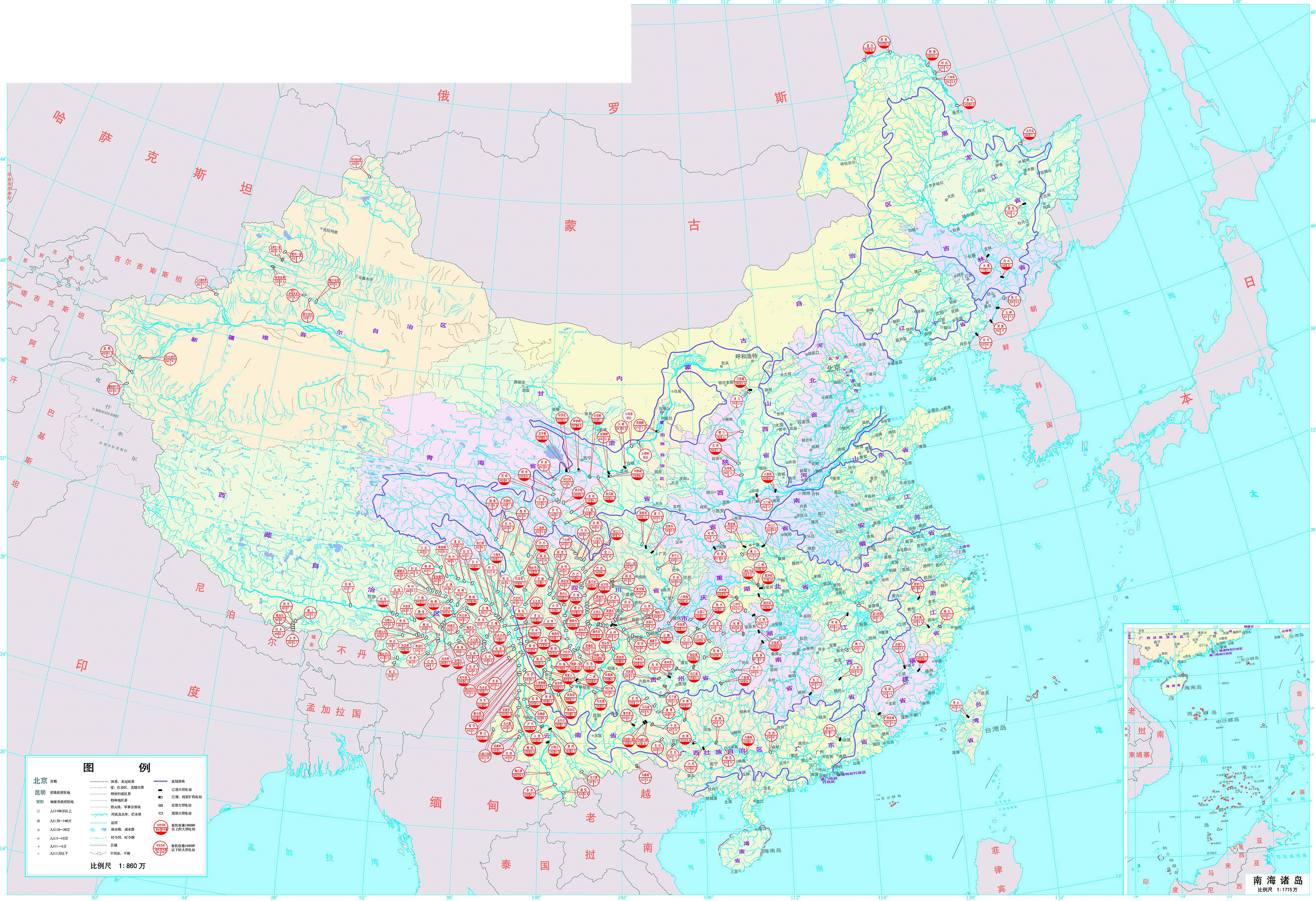
The map of planned new dams released by state-run HydroChina Corporation in 2010 shows that China's dam-building spree is anything but slowing. It reveals the planned construction of a dam twice as large as the Three Gorges Dam at Metog (‘‘Motuo’’ in Chinese), just before the Brahmaputra River enters India.

Brahma Chellaney

India Today, December 26, 2011

China’s frenzied dam building recently hit a wall in Myanmar, whose bold decision to halt a controversial Chinese dam project on its territory has acted as a catalyst to a series of developments, including the first visit of a US secretary of state to that country in more than half a century. Despite the setback in Myanmar, China remains the world’s biggest dam builder at home and abroad. No country in history has built more dams than China. In fact, China today boasts more dams at home than the rest of the world combined. 

Before the Communists came to power in 1949, there were only 22 dams of any significant size in China. But now China has more than half of the almost 50,000 dams in the world that are classified as “large” because they have a height of at least 15 m or a storage capacity of more than 3 million cubic metres. This feat means that China has completed on an average at least one large dam per day since 1949. If dams of all sizes are counted, the number in China surpasses 85,000.

Another striking fact is that China is also the global leader in exporting dams. Its state-run companies today are building more dams overseas than the other international dam builders put together. As many as 37 Chinese financial and corporate entities are involved in more than 100 major dam projects in the developing world. Profit motives and a diplomatic effort to showcase its engineering prowess drive China to build dams overseas. China’s declaratory policy of “non-interference in domestic affairs” actually serves as a virtual licence to pursue dam projects that flood ethnic-minority lands and forcibly uproot people in other countries, just as it is doing at home by shifting its dam-building focus from the dam-saturated internal rivers to the international rivers originating in the Tibetan plateau, Xinjiang, Inner Mongolia, and Manchuria.

China contends that its role as the global leader in exporting dams has created a “win-win” situation for the host countries and its companies. Yet evidence from a number of project sites shows that those dams are imposing serious costs. These projects, in fact, often serve to inflame anti-Chinese sentiment, as underscored by grassroots protests at several sites in Asia, Africa and Latin America. Indeed, by taking much of the workforce from home to build dams and other projects abroad-a practice that runs counter to its own 2006 regulations that call for “localisation”-China reinforces a perception that it is engaged in exploitative practices. Chinese convicts have also been used as labourers on projects in countries too poor and weak to protest.

As the world’s most “dammed” country, China is already the     world’s largest producer of hydropower, with an installed generating capacity of more than 170 gigawatts. Yet its ambitious plans to significantly boost hydro-generating capacity by damming international rivers have embroiled it in water disputes with almost all neighbours, even North Korea. More broadly, China’s dam-building passion has spawned two developments. First, Chinese companies now dominate the global hydropower-equipment export market. And second, the growing clout of the state-run hydropower industry within China has led Beijing to aggressively seek dam projects overseas by offering attractive, low-interest loans to other governments. At home, it recently unveiled a mammoth $635-billion fresh investment in water infrastructure over the next decade, more than a third of which is to be channelled for building dams, reservoirs, and other supply structures.

China’s over-damming of rivers and its inter-river and inter-basin water transfers have already wreaked havoc on the natural ecosystems, causing fragmentation and depletion of rivers and thereby promoting exploitation of groundwater beyond the nature’s replenishment capacity. The social costs have been even more staggering, a fact reflected in Prime Minister Wen Jiabao’s stunning admission in 2007 that China relocated a total of 22.9 million Chinese since 1949 to make way for water projects-a number bigger than the entire population of Australia, Romania or Chile. Since that admission, another 3,50,000 residents, mostly poor villagers, have been officially uprooted. So, by official count alone, 1,035 citizens on an average have been forcibly evicted daily in the past 62 years for water projects.

With Beijing now increasingly damming transnational rivers such as the Mekong, Salween, Brahmaputra, Irtysh, Illy and Amur, the new projects threaten to “export” the serious degradation haunting China’s internal rivers to those rivers. The time has come to exert concerted external pressure on Beijing to rein in its dam frenzy and embrace international environmental standards. 

Brahma Chellaney is the author of the newly released Water: Asia’s New Battleground. (c) India Today, 2011.

Asia’s water stress challenges growth and security

Growing water shortages threaten Asia’s economic and political rise by creating obstacles to continued rapid economic growth, by stoking interstate and intrastate tensions over shared resources, and by raising new security risks. 
Japan Times, December 3, 2011

Water, the most vital of all resources, has emerged as a key issue that will determine whether Asia is headed toward cooperation or competition. After all, the driest continent in the world is not Africa, but Asia, where availability of freshwater is not even half the global annual average of 6,380 cubic meters per inhabitant.

When the estimated reserves of rivers, lakes and aquifers are added up, Asia has less than one-tenth of the waters of South America, Australia and New Zealand, not even one-fourth of North America, almost one-third of Europe and moderately less than Africa per inhabitant. Yet the world’s fastest-growing demand for water for food and industrial production and for municipal supply is in Asia, which now serves as the locomotive of the world economy.

Today, the fastest-growing Asian economies are all at or near water-stressed conditions, including China, India, South Korea, Vietnam and Indonesia. But just three or four decades ago, these economies were relatively free of water stress. Now if we look three or four decades ahead, it is clear that the water situation will only exacerbate, carrying major implications for rapid economic growth and inter-riparian relations.

Yet Asia continues to draw on tomorrow’s water to meet today’s needs. Worse still, Asia has one of the lowest levels of water efficiency and productivity in the world. Against this background, it is no exaggeration to say that the water crisis threatens Asia’s economic and political rise and its environmental sustainability. For investors, it carries risks that potentially are as damaging as nonperforming loans, real estate bubbles and political corruption. Water has also emerged as a source of increasing competition and discord within and between nations, spurring new tensions over shared basin resources and local resistance to governmental or corporate decisions to set up water-intensive industries.

These developments raise the question whether the risks of water conflict are higher in Asia than elsewhere in the world. With Asia becoming the scene of increasingly fierce intrastate and interstate water competition, the answer clearly is yes. Water is a new arena in the Asian Great Game.

In fact, water wars — in a political, diplomatic, or economic sense — are already being waged between riparian neighbors in several Asian regions, fuelling a cycle of bitter recrimination and fostering mistrust that impedes broader regional cooperation and integration. Without any shots being fired, rising costs continue to be exacted. The resources of transnational rivers, aquifers and lakes have become the target of rival appropriation plans.

With a river or groundwater basin often becoming tied with a nation’s identity, ownership and control over its resources is considered crucial to national interests. That has helped give rise to grand but environmentally questionable ideas — from China’s Great Western Route to divert river waters from the Tibetan Plateau to its parched north and South Korea’s politically divisive four-rivers project, to India’s now-stalled proposal to link up its important rivers and Jordan’s plan to save the dying Dead Sea by bringing water from the Red Sea through a 178-km canal, which is also to serve as a source for desalinated drinking water.

Several factors have contributed to the Asian water crisis, which is leading to river and aquifer degradation. One is that Asia is not only the largest and most-populous continent but also the fastest developing. How the swift economic rise of Asia has brought water resources under increasing pressure can be seen from the fact that most Asian economies now are water-stressed.

The exceptions are few: Bhutan, Burma, Papua New Guinea, Laos, Cambodia, Brunei and Malaysia.

Unlike the fossils fuels, mineral ores and timber that they import even from distant lands, the Asian economies must make do with their own water resources, a significant share of which is in transnational watercourses. This fact only serves as a strong incentive for some nations to try and commandeer internationally shared waters before they leave their national borders. Given the critical role of water in economic modernization, this continent has emerged at the centre of the global water challenges.

Another factor is consumption growth, as a consequence of rising prosperity. The plain fact is that on average Asians are consuming more resources, including water, food, oil and energy. The consumption growth is best illustrated by the changing diets, especially the greater intake of meat, whose production is notoriously water-intensive.

A third factor is the role of irrigation in accentuating the Asian water stress. Asia more than doubled its total irrigated cropland just between 1960 and 2000. Once a continent of serious food shortages and recurrent famines, Asia opened the path to its dramatic economic rise by emerging as a net food exporter on the back of this unparalleled irrigation expansion.

Asia now boasts the leonine proportion of the world’s surface land under irrigation. About 70 percent of the world’s 301 million hectares of land equipped for irrigation is in Asia alone, making it the global irrigation hub. Just three sub-regions of Asia — South Asia, China and Southeast Asia — by themselves account for about 50 percent of the world’s total irrigated land.

It is thus hardly a surprise that Asia leads the world in the total volume of freshwater withdrawn for agriculture. Indeed, almost 74 percent of the total global freshwater withdrawals for agriculture by volume are made in Asia alone.

Water literally is food in Asia. Yet the growth of rice and wheat output in Asia, after the dramatic increases of the previous quarter-century, has actually slowed since the late 1990s, raising concerns that Asian countries will become major food importers, roiling the international market. The international food market is not large enough to meet major import demands from Asia.

A fourth factor is that the fastest increase in water demand in Asia is now coming not from agriculture but from the industrial sector and urban households, in keeping with the fact that this continent has become the seat of the world’s fastest industrialization and urbanization.

A final factor linked to Asia’s water stress is the large-scale impoundment of water resources through dams, barrages, reservoirs and other human-made structures without factoring in long-term environmental considerations. Dams, to be sure, bring important benefits. But upstream dams on rivers shared by two or more nations or provinces in an era of growing water stress often carry broader political and social implications, especially because they can affect water quality and quantity downstream. Dams can also alter fluvial ecosystems, damage biodiversity and promote coastal erosion and saltwater intrusion.

Asia is not just the global irrigation hub; it is also the world’s most dam-dotted continent. China, the world’s biggest dam builder, alone has slightly more than half of the approximately 50,000 large dams on the planet. Most of the best dam sites in Asia already have been taken. Yet the numerous new dam projects in Asia show that the damming of rivers is still an important priority for policymakers. Such a focus on dam building has only intensified intrastate and interstate water disputes and tensions in Asia, with implications for regional security and stability.

The countries likely to bear the brunt of upstream diversion of waters are those located farthest downstream on rivers like the Brahmaputra, Mekong and Tigris-Euphrates: Bangladesh, whose very future is threatened by climate and environmental change; Vietnam, a rice bowl of Asia; and Iraq, still internally torn. Cross-border water appropriations from the Illy River threaten to turn Kazakhstan’s Lake Balkhash into another Aral Sea, which is dying.

So, the big question is: How can Asian nations prevent the sharpening struggle for water resources from becoming a tipping point for overt conflict? To contain the security risks, Asian states must invest more in institutionalized cooperation on trans-boundary basin resources in order to underpin strategic stability, protect continued economic growth and promote environmental sustainability.

The harsh truth is that only four of the 57 transnational river basins in Asia have a treaty covering water sharing or other institutionalized cooperation. These are the Mekong, Ganges, Indus and Jordan river basins. The absence of a cooperative arrangement in most Asian transnational basins is making inter-country water competition a major security risk, increasing the likelihood of geopolitical tensions and instabilities.

With its multitude of inter-country basins, Asia cannot continue to prosper without building political and technological partnerships to help stabilize inter-riparian relations, encourage greater water efficiency, promote environmental sustainability, take on practicable conservation strategies, and invest in clean-water technologies. If Asian states are to address their water challenges, they will need to embrace good practices on the strategic planning and management of water resources.

This article is excerpted from Brahma Chellaney’s latest book, “Water: Asia’s New Battleground” (Georgetown University Press, 2011).

Dams muddy China’s image

The global leader in dam building faces a backlash.

Brahma Chellaney
The Japan Times, October 6, 2011

https://i0.wp.com/www.rfa.org/english/news/burma/dam-08112011182157.html/burmaMyitsoneDam081211-400.jpg

China’s frenzied dam building at home and abroad is emerging as a flashpoint in interstate and intrastate relations in Asia. Burma’s decision to suspend work on a controversial Chinese-funded dam marks a tactical retreat on a project that has symbolized China’s resource greed and is a trigger for renewed ethnic insurgency in areas of northern Burma (aka Myanmar).

The Myitsone Dam, where work is being halted, is one of seven dam projects in northern Burma sponsored by China to generate electricity for export to its own market, even as much of Burma suffers from long power outages every day. China also has been erecting dams on its side of the border on the rivers flowing to Burma and other neighboring countries — from Russia to India.

The projects have drawn attention to their mounting environmental and human costs. In Burma, the submergence of vast tracts of land and the forced displacement of thousands of residents have instigated new intrastate disputes, leading to renewed fighting and ending a 17-year ceasefire between the Kachin Independence Army and government forces.

The giant, 3,200-megawatt Myitsone Dam — at the headwaters of the Irrawaddy River, the cradle of the Burmese civilization — was conceived as China’s project for China. The suspension of work on the largest dam project, so as to help stem a groundswell of public anger, represents a blow for China and a victory for local communities who had battled to protect their livelihoods and environment.

Burma is just one of several countries where hydropower projects financed and built by China have triggered local backlashes. China — the world’s biggest dam builder at home and abroad — is currently erecting giant dams in a number of countries in Asia, Africa and Latin America, besides damming transnational rivers on its territory and thereby spurring growing concerns in downstream countries.

China contends that its role as the global leader in exporting dams has created a “win-win” situation for the host countries and its companies.

Yet, evidence from a number of project sites shows that, with Chinese dam builders still to embrace environmental-sustainability standards, those dams are imposing serious social and environmental costs. Indeed, China is demonstrating that it has no qualms about building dams in disputed territories, such as Pakistan-held Kashmir, or in areas torn by ethnic separatism, like northern Burma, or in other human rights-abusing countries.

In Pakistan-held Kashmir, it has even deployed thousands of People’s Liberation Army troops at dam and other strategic projects. Yet it loudly protests when foreign firms seek to explore for oil in blocks offered by Vietnam and others in the disputed South China Sea.

China’s declaratory policy of “noninterference in domestic affairs” actually serves as a virtual license to pursue dam projects that flood ethnic-minority lands and forcibly uproot people in other countries, just as it is doing at home by shifting its dam-building focus from internal rivers to international rivers that originate in the Tibetan Plateau, Xinjiang, Inner Mongolia and Manchuria.

Today, as many as 37 Chinese financial and corporate entities are involved in more than 100 dam projects in the developing world. Some of these entities are very large and have multiple subsidiaries. For instance, Sinohydro Corporation — which is under the supervision of the State-Owned Assets Supervision and Administration Commission of China’s State Council, and is made up of 10 holdings companies and 18 wholly owned subsidiaries — boasts 59 overseas branches.

The frenzied dam-building at home and abroad has spawned two developments:

(1) Chinese companies now dominate the global hydropower-equipment export market. Sinohydro alone claims to control half the market.

(2) The growing clout of the state-run hydropower industry in policymaking has led China to aggressively seek dam projects overseas by offering attractive, low-interest loans and to increasingly tap the resources of rivers flowing to other countries from Chinese-ruled territories.

It was HydroChina, the country’s largest dam builder, that last year revealed government-approved sites for new mega-dams in China, including one larger than the Three Gorges Dam to be built virtually on the disputed border with India.

In a number of nations, ranging from Burma and Congo to Laos and Zambia, Chinese dam construction also is aimed at creating the energy infrastructure to extract mineral ores and other resources to feed the voracious demand in China.

Burma is not the only case where Chinese dam building has triggered violence. From Sudan to the restive, Shiite-dominated areas of Pakistan-held Kashmir, such projects have sparked violent clashes and even police shootings. In Burma, however, the violence spread from the Myitsone Dam — where several small bombs went off in April 2010 — to other Chinese projects, including the Dapein and Shweli dams.

For China, its dam projects in the developing countries showcase its growing economic ties with them. In reality, however, these projects often serve to inflame growing anti-Chinese sentiment in those countries.

China has contributed to such sentiment by refusing to abide by international standards or its own regulations, including the State Council’s 2006 directives that Chinese overseas businesses, among other things, “pay attention to environmental protection” and “support local community and people’s livelihood cause.”

The perception that China is engaged in exploitative practices abroad has been reinforced by the fact that it brings much of the workforce from home to build dams and other projects. This practice runs counter to the Chinese Commerce Ministry’s 2006 regulations — promulgated after anti-Chinese riots in Zambia — that called for “localization,” including hiring local workers and respecting local customs.

China can stop its dam builders from further undermining its image by enforcing its regulations and embracing internationally accepted standards.

Brahma Chellaney is professor of strategic studies at the independent Center for Policy Research in New Delhi and the author of the newly released Water: Asia’s New Battleground.

DC Events with Brahma Chellaney

From Georgetown University Press
http://georgetownup.files.wordpress.com/2011/09/chellaney.jpg?w=300&h=199
This past week Brahma Chellaney, author of Water: Asia’s New Battleground, visited Washington, DC, on a book tour. He stopped by the Woodrow Wilson Center, the Carnegie Endowment for International Peace, the East-West Center, John Hopkins University’s SAIS, American University’s SIS, and the Transatlantic Academy. In sum, Dr. Chellaney spoke to 300 audience members, and numerous copies of his book were carried away by their delighted new owners. Those who did not get the chance to hear him speak may watch the video from the Wilson Center here and the Carnegie Endowment for International Peace here.

Book-related address at the Hong Kong University here.

Talk at the East-West Center here.

The New Delhi release of the book by the Vice President of India here.

Interview conducted by the Georgetown University Press here.

Writeup on the presentation at the Transatlantic Academy here.

Water is the new weapon in Beijing’s armoury

By Brahma Chellaney
Financial Times, August 31, 2011

China has aroused international alarm by using its virtual monopoly of rare earths as a trade instrument and by stalling multilateral efforts to resolve disputes in the South China Sea. Among its neighbours, there is deep concern at the way it is seeking to make water a political weapon.

At the hub of Asia, China is the source of cross-border river flows to the largest number of countries in the world — from Russia to India, Kazakhstan to the Indochina peninsula. This results from its absorption of the ethnic minority homelands that make up 60 per cent of its land mass and are the origin of all the important international rivers flowing out of Chinese territory.

Getting this pre-eminent riparian power to accept water-sharing arrangements or other co-operative institutional mechanisms has proved unsuccessful so far in any basin. Instead, the construction of upstream dams on international rivers such as the Mekong, Brahmaputra or Amur shows China is increasingly bent on unilateral actions, impervious to the concerns of downstream nations.

China already boasts both the world’s biggest dam (Three Gorges) and a greater total number of dams than the rest of the world combined. It has shifted its focus from internal to international rivers, and graduated from building large dams to building mega-dams. Among its newest dams on the Mekong is the 4,200 megawatt Xiaowan — taller than Paris’s Eiffel Tower. New dams approved for construction include one on the Brahmaputra at Metog (or Motuo in Chinese) that is to be twice the size of the 18,300MW Three Gorges — and sited almost on the disputed border with India.

The consequences of such frenetic construction are already clear. First, China is in water disputes with almost all its neighbours, from Russia and India to weak client-states such as North Korea and Burma. Second, its new focus on water mega-projects in the homelands of ethnic minorities has triggered tensions over displacement and submergence at a time when the Tibetan plateau, Xinjiang and Inner Mongolia have all been wracked by protests against Chinese rule. Third, the projects threaten to replicate in international rivers the degradation haunting China’s internal rivers.

Yet, as if to declare itself the world’s unrivalled hydro-hegemon, China is also the largest dam builder overseas. From Pakistan-held Kashmir to Burma’s troubled Kachin and Shan states, China is building dams in disputed or insurgency-torn areas, despite local backlash. Dam building in Burma has contributed to renewed fighting, ending a 17-year ceasefire between the Kachin Independence Army and government.

For downriver countries, a key concern is China’s opacity on its dam projects. It usually begins work quietly, almost furtively, then presents a project as unalterable and as holding flood-control benefits.

Worse, although there are water treaties among states in south and south-east Asia, Beijing rejects the concept of a water-sharing arrangement. It is one of only three countries that voted against the 1997 UN convention laying down rules on the shared resources of international watercourses.

Yet water is fast becoming a cause of competition and discord between countries in Asia, where per capita freshwater availability is less than half the global average. The growing water stress threatens Asia’s rapid economic growth and carries risks for investors potentially as damaging as non-performing loans, real estate bubbles and political corruption.

By having its hand on Asia’s water tap, China is therefore acquiring tremendous leverage over its neighbours’ behaviour.

That the country controlling the headwaters of major Asian rivers is also a rising superpower, with a muscular confidence increasingly on open display, only compounds the need for international pressure on Beijing to halt its appropriation of shared waters and accept some form of institutionalised co-operation.

The writer is a professor at the independent Centre for Policy Research in New Delhi and author of Water: Asia’s New Battleground.

Copyright The Financial Times Limited 2011.

The Ominous Rise of a Thirsty Dragon

https://i0.wp.com/cmp.hku.hk/wp-content/uploads/2010/02/three-gorges-dam.jpg
A Chinese dam under construction.

Brahma Chellaney
Times of India, August 7, 2011

China, the geographical hub of Asia, is the source of transboundary-river flows to the largest number of countries in the world — from Russia to India, and from Kazakhstan to the Indochina Peninsula. This unique status is because of its forcible absorption of sprawling ethnic-minority homelands, which make up 60% of its landmass and are the origin of all the important international rivers flowing out of Chinese-held territory.

Getting this pre-eminent riparian power to accept water-sharing arrangements or other cooperative institutional mechanisms has proven unsuccessful in any basin. In fact, as epitomized by its planned or actual construction of a separate cascade of upstream dams on several major international rivers, including the Mekong, Salween, Brahmaputra, Arun, Irtysh-Illy, and Amur, China is increasingly headed in the opposite direction — toward unilateralist actions impervious to the concerns of downstream nations.

No country in history has been a greater dam builder than China, which boasts not only the world’s biggest dam (Three Gorges) but also more total number of dams than the rest of the world combined. Yet far from slowing its dam-building spree, China has stepped up its re-engineering of river flows in two ways: by portentously shifting its focus from internal rivers to international rivers, and by concentrating on mega-dams.

For example, its newest dams on the Mekong are the 4,200-megawatt Xiaowan — taller than Paris’s Eiffel Tower and producing more electricity than the installed hydropower-generating capacity of all of the lower Mekong countries together — and the 5,850-megawatt Nuozhadu, which when complete will be even bigger in storage volume but not in height.

Last summer, China’s state-run hydropower industry published a map of major new dams approved for construction, including one on the Brahmaputra at Metog (or “Motuo” in Chinese) that will be larger than even the 18,300-megawatt Three Gorges. India’s largest dam — the 2,000-megawatt Tehri — pales in comparison with China’s dams.

In the next one decade, according to international projections, the number of dams in the developed countries is likely to remain about the same, while much of the dam building in the developing world, in terms of aggregate storage-capacity buildup, will be concentrated in just one country — China.

The consequences of such frenetic construction are already visible. First, China is now involved in water disputes with almost all its riparian neighbours, ranging from big Russia and India to weak clients like North Korea and Myanmar.

Second, its new focus on water mega-projects in the traditional homelands of ethnic minorities has triggered fresh tensions along ethnic fault lines over displacement and submergence issues at a time when the Tibetan plateau, Xinjiang and Inner Mongolia have all been racked by revolts or protests against Chinese rule. And third, Chinese projects threaten to extend the serious degradation of internal rivers to international rivers.

Yet, as if to underpin its rise as the world’s unrivalled hydro-hegemon, China is also the largest dam builder overseas. From Pakistan-occupied Kashmir to Myanmar’s troubled Kachin and Shan states, China has widened its dam building to disputed or insurgency-torn areas, even in the face of local backlash. While PLA units are engaged in dam and other strategic projects in restive Gilgit-Baltistan, China’s dam building inside Myanmar has contributed to renewed bloody fighting recently, ending a 17-year ceasefire between the Kachin Independence Army and the government.

For downriver countries, a key concern is China’s opacity on its hydro-engineering projects. It usually begins work quietly, almost furtively, and then presents a project as holding transboundary flood-control benefits and as an unalterable fait accompli.

Worse still, China rejects the very notion of a water-sharing arrangement or treaty with any riparian neighbour. The terms “water sharing,” “shared water resources,” “treaty” and “common norms and rules” are an anathema to it. It is one of only three countries that voted against the 1997 UN Convention, which lays down rules on shared basin resources.

It is thus no accident that there are treaties among co-riparian states in South and Southeast Asia, but not between China and any of its neighbours. That the country with a throttlehold over the headwaters of major Asian rivers is also a rising superpower, whose muscular confidence is increasingly on open display, only compounds the regional security challenges.

In this light, China poses the single biggest obstacle to the building of institutionalized cooperation in Asia to harness internationally shared rivers for mutual and sustainable benefit.

Brahma Chellaney is professor of strategic studies at Centre for Policy Research, New Delhi.

(c) Times of India, 2011.

False Promise of Nuclear Energy

Nuclear power no solution

By BRAHMA CHELLANEY
The Japan Times, March 23, 2011
https://i0.wp.com/img.timeinc.net/time/photoessays/2009/10_nukes/fukushima_nuclear.jpg
Just when nuclear energy had come to be seen as part of the solution to energy and global-warming challenges, the serial reactor incidents in Fukushima have dealt a severe blow to the world nuclear-power industry, a powerful cartel of less than a dozen major state-owned or state-guided firms.

Even before the Fukushima No. 1 plant become the site of the world’s worst accident since Chernobyl, the share of nuclear power in worldwide electricity production had been stagnant for a quarter-century. In fact, after being constant at 16 to 17 percent from 1986 to 2005, the contribution of nuclear power in global electricity actually has dropped to 14 percent since then.

International studies have shown that nuclear power, although a 50-year-old mature technology, has demonstrated the slowest “rate of learning” in comparison to other energy sources, including newer technologies such as wind power and combined-cycle gas turbines. Nuclear power remains highly capital-intensive. It has high up-front capital costs, long lead times for construction and commissioning, and drawn-out amortization periods that put off private investors.

The industry’s trumpeting of a global nuclear renaissance thus has been premature. But after Fukushima, the attraction of nuclear power is likely to dim worldwide. Inherently risky, water-intensive and vulnerable to natural disasters, nuclear-power plants will now face greater public scrutiny.

Many nuclear-power reactors are located along coastlines because they are highly water-intensive. Yet natural disasters like storms, hurricanes, and tsunami are becoming more common, owing to climate change, which will also cause a rise in ocean levels, making seaside reactors even more vulnerable.

For example, many nuclear-power plants located along the British coast are just a few meters above sea level. In 1992, Hurricane Andrew caused significant damage at the Turkey Point nuclear-power plant on Biscayne Bay, Florida, but, fortunately, not to any critical system.

All energy generators, including coal- and gas-fired plants, make major demands on water resources. But nuclear power requires even more. Light-water reactors (LWRs) like those in Japan and the United States, which use water as their main coolant, produce most of the world’s nuclear power. The huge quantities of local water that LWRs use for their operations become hot-water outflows, which are pumped back into rivers, lakes and oceans.

Because reactors located inland put serious strain on local freshwater resources — including greater damage to plant life and fish — water-stressed countries that are not landlocked try to find suitable seashore sites. But whether located inland or on a coast, nuclear power is vulnerable to the likely effects of climate change.

As global warming brings about a rise in temperatures and ocean levels, inland reactors will increasingly contribute to, and be affected by, water shortages. During the 2003 heat wave in France, operations at 17 nuclear reactors had to be scaled back or stopped because of rapidly rising temperatures in rivers and lake.

Paradoxically, the very conditions that made it impossible for the nuclear industry to deliver full power in Europe in 2003 and 2006 created peak demand for electricity, owing to the increased use of air conditioning.

Indeed, during the 2003 heat wave, Electricite de France, which operates 58 reactors — the majority on ecologically sensitive rivers like the Loire — was compelled to buy power on the European spot market. The state-owned EDF, which normally exports power, ended up paying 10 times the price of domestic power, incurring a financial cost of 300 million euro.

Similarly, water and heat problems caused by a heat wave in 2006 forced Germany, Spain, and France to take some nuclear power plants offline and reduce operations at others. Highlighting the vulnerability of nuclear power to environmental change or extreme-weather patterns, in 2006 plant operators in Western Europe also secured exemptions from environmental regulations so that they could discharge overheated water into natural ecosystems — an action that affected fisheries.

France likes to showcase its nuclear power industry, which supplies 78 percent of the country’s electricity. But such is the nuclear industry’s water intensity that EDF withdraws up to 19 billion cubic meters of water per year from rivers and lakes, or roughly half of France’s total freshwater consumption. Freshwater scarcity is a growing international challenge, and the vast majority of countries are in no position to approve of such highly water-intensive inland-based energy systems.

Seaside nuclear plants do not face similar problems in hot conditions because ocean waters do not heat up anywhere near as rapidly as rivers or lakes. And because they rely on seawater, they cause no freshwater scarcity. But as the Fukushima reactors have shown, coastal nuclear-power plants confront more serious dangers.

When the 2004 Indian Ocean tsunami struck, it flooded India’s Madras Atomic Power Station. But the reactor core could be kept in a safe shutdown mode because the electrical systems had been installed on higher ground than the plant itself. But unlike Fukushima, the Indian plant did not bear the direct tsunami impact.

The central dilemma of nuclear power in an increasingly water-stressed world is that it is a water guzzler, yet vulnerable to water. And decades after Lewis L. Strauss, the chairman of the United States Atomic Energy Agency, claimed that nuclear power would become “too cheap to meter,” the nuclear industry still subsists on munificent government subsidies.

While the appeal of nuclear power has declined considerably in the West, it has grown among the so-called nuclear newcomers, which brings with it new proliferation and safety challenges. Moreover, with nearly two-fifths of the world’s population living within 100 km of a coastline, finding suitable seaside sites for initiation or expansion of a nuclear-power program is no longer easy.

Without a breakthrough in fusion energy or greater commercial advances in breeder (and thorium) reactors, nuclear power is in no position to lead the world out of the fossil-fuel age. In fact, Fukushima is likely to stunt the appeal of nuclear power in a way similar to the 1979 Three Mile Island accident and the 1986 Chernobyl meltdown.

Brahma Chellaney is the author of “Nuclear Proliferation” (Longman, 1993) and “Water: Asia’s New Battlefield” (Georgetown University Press, forthcoming).

The Japan Times: March 23, 2011
(C) All rights reserved

A blow to the global nuclear-power industry

Fukushima blast shows nuclear is not the answer

Inherently risky, water-intensive and unreliable — we must admit we cannot depend on nuclear power

Brahma Chellaney
guardian.co.uk, 15 March 2011
https://i0.wp.com/blogs.telegraph.co.uk/news/files/2011/03/japan-chopper-460.jpg
The troubles of the Fukushima nuclear-power plant — and other reactors — in earthquake-hit Japan have dealt a severe blow to the global nuclear industry, a powerful cartel of less than a dozen major state-owned or state-guided firms that have been trumpeting a nuclear-power renaissance.

But the risks that seaside reactors like Fukushima face from natural disasters are well-known. Indeed, they became evident six years ago, when the Indian Ocean tsunami in December 2004 inundated India’s second-largest nuclear complex, shutting down the Madras power station.

Many nuclear-power plants are located along coastlines, because they are highly water-intensive. Yet natural disasters such as storms, hurricanes, and tsunamis are becoming more common, owing to climate change, which will also cause a rise in ocean levels, making seaside reactors even more vulnerable.

For example, many nuclear-power plants located along the British coast are just a few metres above sea level. In 1992, Hurricane Andrew caused significant damage at the Turkey Point nuclear-power plant on Biscayne Bay, Florida, but, fortunately, not to any critical systems.

All energy generators, including coal- and gas-fired plants, make major demands on water resources. But nuclear power requires even more. Light-water reactors (LWRs) like those at Fukushima, which use water as a primary coolant, produce most of the world’s nuclear power. The huge quantities of local water that LWRs consume for their operations become hot-water outflows, which are pumped back into rivers, lakes, and oceans.

Because reactors located inland put serious strain on local freshwater resources — including greater damage to plant life and fish — water-stressed countries that are not landlocked try to find suitable seashore sites. But, whether located inland or on a coast, nuclear power is vulnerable to the likely effects of climate change.

As global warming brings about a rise in average temperatures and ocean levels, inland reactors will increasingly contribute to, and be affected by, water shortages. During the record-breaking 2003 heatwave in France, operations at 17 commercial nuclear reactors had to be scaled back or stopped because of rapidly rising temperatures in rivers and lakes. Spain’s reactor at Santa María de Garoña was shut for a week in July 2006 after high temperatures were recorded in the Ebro river.

Paradoxically, then, the very conditions that made it impossible for the nuclear industry to deliver full power in Europe in 2003 and 2006 created peak demand for electricity, as use of air-conditioning increased.

During the 2003 heat wave, Électricité de France, which operates 58 reactors — the majority on ecologically sensitive rivers such as the Loire — was compelled to buy power from neighboring countries on the European spot market. The state-owned EDF, which normally exports power, ended up paying 10 times the price of domestic power, incurring a financial cost of €300m.

Similarly, although the 2006 European heatwave was less intense, water and heat problems forced Germany, Spain, and France to take some nuclear power plants offline and reduce operations at others. Highlighting the vulnerability of nuclear power to environmental change or extreme-weather patterns, in 2006 plant operators in western Europe also secured exemptions from regulations that would have prevented them from discharging overheated water into natural ecosystems, affecting fisheries.

France likes to showcase its nuclear power industry, which supplies 78% of the country’s electricity. But such is the nuclear industry’s water intensity that EDF withdraws up to 19bn cubic metres of water per year from rivers and lakes, or roughly half of France’s total freshwater consumption. Freshwater scarcity is a growing international challenge, and the vast majority of countries are in no position to approve of such highly water-intensive inland-based energy systems.

Nuclear plants located by the sea do not face similar problems in hot conditions, because ocean waters do not heat up anywhere near as rapidly as rivers or lakes. And, because they rely on seawater, they cause no freshwater scarcity. But as Japan’s reactors have shown, coastal nuclear-power plants confront more serious dangers.

When the Indian Ocean tsunami struck, the Madras reactor’s core could be kept in safe shutdown condition because the electrical systems had been ingeniously installed on higher ground than the plant itself. And, unlike Fukushima, which bore a direct impact, Madras was far away from the epicenter of the earthquake that unleashed the tsunami.

The central dilemma of nuclear power in an increasingly water-stressed world is that it is a water-guzzler, yet vulnerable to water. And, decades after Lewis L Strauss, chairman of the United States Atomic Energy Agency, claimed that nuclear power would become “too cheap to meter”, the nuclear industry everywhere still subsists on government subsidies.

While the appeal of nuclear power has declined considerably in the west, it has grown among the so-called “nuclear newcomers”, which brings with it new challenges, including concerns about proliferation of nuclear weapons. Moreover, with nearly two-fifths of the world’s population living within 100km of a coastline, finding suitable seaside sites for initiation or expansion of a nuclear-power programme is no longer easy.

Fukushima is likely to stunt the appeal of nuclear power in a way similar to the accident at the Three Mile Island plant in Pennsylvania in 1979 did, not to mention the far more severe meltdown of the Chernobyl reactor in 1986. If the fallout from those incidents is a reliable guide, however, nuclear power’s advocates will eventually be back.

Brahma Chellaney is Professor of Strategic Studies at the Center for Policy Research in New Delhi.

Fukushima nos recuerda las debilidades y amenazas de las centrales nucleares en el mundo

TRIBUNA: BRAHMA CHELLANEY
Moraleja nuclear de Japón
Muchas centrales nucleares están situadas en las costas, porque necesitan una gran cantidad de agua. Sin embargo, los desastres naturales y el cambio climático hacen que resulten aún más vulnerables
BRAHMA CHELLANEY
El Pais, 17/03/2011

Los problemas de la central nuclear de Fukushima -y de otros reactores- en el noroeste de Japón han asestado un duro golpe a la industria nuclear mundial, poderoso cartel de menos de una docena de importantes empresas de propiedad u orientación estatal que han estado pregonando un renacimiento de la energía nuclear.

Pero ya se conocen perfectamente los riesgos que corren los reactores costeros, como el de Fukushima, a consecuencia de desastres naturales. De hecho, resultaron evidentes hace seis años, cuando el maremoto habido en el océano Índico en diciembre de 2004 inundó el segundo complejo nuclear en importancia de India, con lo que quedó desconectada la central eléctrica de Madrás.

Muchas centrales nucleares están situadas a lo largo de las costas, porque en ellas se utiliza una gran cantidad de agua. Sin embargo, desastres naturales como las tormentas, los huracanes y los maremotos están resultando más frecuentes a causa del cambio climático, que también causará una elevación del nivel de los océanos, con lo que los reactores costeros resultarán aún más vulnerables.

Por ejemplo, muchas centrales nucleares situadas a lo largo de la costa británica están a tan solo unos metros por encima del nivel del mar. En 1992, el huracán Andrew causó importantes daños en la central nuclear de Turkey Point, en la bahía de Biscayne (Florida), pero no así, por fortuna, a ninguno de los sistemas decisivos para su funcionamiento.

Todos los generadores de energía, incluidas las centrales alimentadas con carbón o gas, requieren grandes cantidades de recursos hídricos, pero la energía nuclear más aún. Los reactores de agua ligera, como los de Fukushima, que utilizan el agua como refrigerante primordial, son los que producen la mayor parte de la energía nuclear. Las enormes cantidades de agua local que dichos reactores consumen para sus operaciones pasan a ser corrientes de agua caliente, que se bombean a los ríos, los lagos y los océanos.

Como los reactores situados en zonas del interior ejercen una grave presión sobre los recursos de agua dulce, incluidos daños mayores a la vida vegetal y a los peces, los países que tienen litoral y padecen escasez de agua procuran buscar emplazamientos costeros adecuados, pero, ya tengan o no litoral, la energía nuclear es vulnerable a los probables efectos del cambio climático.

A medida que el calentamiento planetario provoque un aumento de las temperaturas medias y del nivel de los océanos, los reactores situados en el interior contribuirán cada vez más a la escasez de agua y resultarán afectados por ella. Durante la ola de calor sin precedentes de 2003 en Francia, hubo que reducir o detener las operaciones en 17 reactores nucleares comerciales a causa del rápido aumento de las temperaturas de los ríos y los lagos. En julio de 2006, hubo que desconectar el reactor de Santa María de Garoña (España) durante una semana, después de que se registraran altas temperaturas en el río Ebro.

Así, pues, las propias condiciones que en 2003 y 2006 impidieron a la industria nuclear suministrar toda la energía necesaria en Europa fueron, paradójicamente, las que crearon una demanda máxima de electricidad a causa de un aumento de la utilización del aire acondicionado.

De hecho, durante la ola de calor de 2003, Électricité de France, que tiene 58 reactores en funcionamiento -la mayoría de ellos en ríos ecológicamente delicados, como el Loira- se vio obligada a comprar electricidad a los países vecinos en el mercado europeo al contado. EDF, empresa de propiedad estatal que normalmente exporta electricidad, acabó pagándola a un precio 10 veces mayor, con un coste financiero de 300 millones de euros.

Asimismo, aunque la ola de calor europea de 2006 fue menos intensa, los problemas de agua y calor obligaron a España, Alemania y Francia a desconectar algunas centrales nucleares y reducir las operaciones de otras. En 2006 las empresas propietarias de centrales nucleares de Europa occidental consiguieron también exenciones para incumplir la reglamentación que les habría impedido descargar agua recalentada en los ecosistemas naturales, lo que afectó a la pesca.

Francia gusta de exhibir su industria de energía nuclear, que suministra el 78% de la electricidad del país, pero la intensidad del consumo de agua de dicha industria es tal, que EDF retira todos los años 19.000 millones de metros cúbicos de agua de los ríos y lagos, es decir, la mitad, aproximadamente, del consumo total de agua dulce de Francia. La escasez de agua dulce es una amenaza internacional cada vez mayor y la inmensa mayoría de los países no están en condiciones de aprobar el emplazamiento en el interior de semejantes sistemas energéticos que hacen un consumo tan elevado de agua.

Las centrales nucleares situadas junto al mar no afrontan problemas similares en situaciones de calor, porque el agua de los océanos no se calienta ni mucho menos con la misma rapidez que la de los ríos o los lagos y, al contar con el agua del mar, no provocan escasez de agua dulce, pero, como han demostrado los reactores del Japón, las centrales nucleares costeras afrontan peligros más graves.

Cuando el núcleo del reactor de Madrás resultó afectado por el maremoto del océano Índico, se pudo mantenerlo a salvo desconectado, porque se había tenido la previsión de instalar los sistemas eléctricos en un terreno más alto que la propia central y, a diferencia de lo ocurrido en Fukushima, que recibió un impacto directo, la central de Madrás estaba alejada del epicentro del terremoto que desencadenó el maremoto.

El dilema fundamental de la energía nuclear en un mundo cada vez más afectado por la escasez de agua es el de que necesita enormes cantidades de agua y, sin embargo, es vulnerable ante el agua y, decenios después de que Lewis L. Strauss, el presidente del Organismo de Energía Atómica de Estados Unidos, afirmara que la energía nuclear llegaría a ser “demasiado barata para medirla con contador”, la industria nuclear sigue subsistiendo en todas partes gracias a muníficas subvenciones estatales.

Aunque el atractivo de la energía nuclear ha disminuido considerablemente en Occidente, ha aumentado entre los llamados “recién llegados nucleares”, con el acompañamiento de nuevas amenazas, incluida la preocupación por la proliferación de armas nucleares. Además, cuando casi dos quintas partes de la población mundial viven a menos de 100 kilómetros de una costa, ya no resulta fácil encontrar emplazamientos costeros adecuados para iniciar o ampliar un programa de energía nuclear.

Es probable que lo sucedido en Fukushima afecte irremisiblemente a la energía nuclear de forma similar al accidente en la central de Three Mile Island en Pensilvania en 1979, por no hablar de la fusión, mucho más grave, del reactor de Chernóbil en 1986. Sin embargo, a juzgar por lo sucedido después de aquellos accidentes, los defensores de la energía nuclear acabarán volviendo a la carga.