Energy challenges test water-stressed Asia

BRAHMA CHELLANEY
Nikkie Asian Review, February 27, 2014
 

Asia is attracting more attention than ever before, in large part because of its re-emergence after a two-century decline. Amid the world’s ever-growing energy focus, Asia’s serious energy challenges have driven sharpening oil-and-gas competition there, spurring maritime tensions, territorial disputes, and resource and environmental stresses. There has been, however, insufficient discussion of such challenges in Asia.

In coming years, energy demand is likely to accelerate because the continent’s per capita energy consumption levels remain low by Western standards. The largest increase in global energy demand is in Asia. This demand is likely to only accelerate.

Over the next 20 years, Asia’s share of global energy consumption is projected to almost double, to about 54% for oil and 22% for natural gas. The densely populated subregions of Asia — East, Southeast and South — with their heavy dependence on oil and gas imports, will remain particularly vulnerable to sudden supply shortages or disruptions.

Asia’s growing energy consumption — much of it from fossil fuels, especially coal — militates against the gathering international push to combat global warming. Coal use, for example, has helped China lift hundreds of millions of people out of poverty, with the rising coal demand there not expected to plateau until at least 2025.

Yet the environmental and public-health costs of China’s coal use (it burns nearly as much coal as the rest of the world combined) are already high. Smog and soot periodically force citywide shutdowns, while the life expectancy of the people living in the northern parts of the country, according to a recent scientific study, has declined by more than five years on average.

Stress nexus

The energy-water-food nexus is at the core of Asia’s sustainable-development challenges. This stress nexus is behind the continent’s three interlinked crises: A resource crisis has spurred an environmental crisis, which in turn is contributing to regional climate change.

The reason for such stresses is that food production is reliant on water and energy, and energy and water are directly connected with each other. Energy is vital to extract, treat, distribute and supply water. Water is essential for energy extraction, processing and production. It takes, on average, up to 10 calories of fossil fuel energy to produce one calorie of food.

Groundwater extraction is particularly energy-intensive, and sinking water tables across much of Asia have significantly increased the energy needed to bring the same quantity of water to the surface. The expanding output of biofuels from irrigated crops has emerged as another important source of growing energy-related water consumption.

In an increasingly water-stressed Asia, the struggle for water is not only escalating political tensions and intensifying the impact on ecosystems, but it is also crimping rapid expansion of the region’s energy infrastructure. In many Asian countries, decisions about where to place new energy plants are increasingly constrained due to inadequate availability of local water.

Compounding the challenge is the fact that energy shortages in the heavily populated Asian subregions are usually the most severe in water-scarce areas. Yet, copious amounts of water are needed to generate electricity from coal, nuclear energy, natural gas, oil, biomass, concentrated solar energy and geothermal energy. In India, water stress is exacerbating an energy crisis, with its largest power generator, the National Thermal Power Corp., being forced to abandon plans for new coal-fired plants in water-scarce areas.

     One key reason why China has failed to develop its shale hydrocarbon industry is water paucity. To initially stimulate a shale well, millions of gallons of water must be shot into it to crack the shale rock and get crude oil, natural gas or natural-gaslike liquids flowing.

About 56,150 cu. feet (1,590 cu. meters) of water is used for every 1 million cu. feet of gas that comes from shale. Shale oil development is typically several times more water intensive than shale gas. China has impressive shale-hydrocarbon deposits, but these are largely located in areas where water resources are already scarce or under pressure.

Water constraints are increasingly shaping Asian decisions about energy facilities, cooling technologies and plant sites. For example, all new nuclear plants in Asia — the center of global nuclear power construction — are located along coastlines so that these water-guzzling facilities can draw more on seawater. Yet, seaside reactors face major risks from global-warming-induced natural disasters, as highlighted by Japan’s Fukushima disaster in 2011, which though tsunami-induced, showed the risks of sudden sea changes. Southeast Asia, with 3.3% of global landmass but more than 11% of the world’s coastline, is particularly vulnerable to water-related disasters.

Moreover, with Asia’s economic boom zones located along coastlines, finding suitable seaside sites for new nuclear plants is no longer easy. Coastal areas are often not only heavily populated but also constitute prime real estate. For example, India, despite having a 6,000km coastline, has seen its plans for a huge expansion of nuclear power through seaside plants run into stiff grass-roots objections.

Maritime disputes in play

Another concern in Asia is the growing linkage of territorial and maritime disputes with energy resources. Such linkage is hardly conducive to Asian peace and stability.

Access to resources has historically been a critical factor in war and peace. According to a recently published study, between one-quarter and one-half of interstate wars since the advent of the modern oil age in 1973 have been connected to oil geopolitics, including access concerns, producer politics, control and market structure.

Asia’s sharpening energy competition has contributed to aggravating territorial disputes in the South China and East China seas. The disputed Spratly and Senkaku islands occupy an area of barely 11 sq. km but are surrounded by rich hydrocarbon reserves.

China did not lay a formal claim to the Japanese-controlled Senkaku Islands until international studies in the late 1960s pointed to potentially vast hydrocarbon reserves beneath the seabed. Its newly declared air defense identification zone (ADIZ) covers territories that China claims but does not control, setting a dangerous precedent in international relations.

      Meanwhile, pipeline geopolitics have also intensified in Asia, even as Europe has sought to route additional Caspian Sea and Central Asian energy supplies to European markets at the cost of Asian markets.

China has managed to secure new hydrocarbon supplies through pipelines from Kazakhstan and Russia. But this option is not available to Asia’s other leading economies — Japan, India, and South Korea — which are not contiguous with suppliers in Central Asia, Iran or Russia. These countries will remain dependent on oil imports from an increasingly unstable Persian Gulf.

Furthermore, China’s fears that hostile naval forces could hold its economy hostage by interdicting its oil imports have prompted it to build a massive oil reserve, and to plan two strategic energy corridors in southern Asia. The corridors will provide a more direct transport route for oil and liquefied gas from Africa and the Persian Gulf, while minimizing exposure to sea lanes policed by the U.S. Navy.

One such corridor extends 800km from the Bay of Bengal across Myanmar to southern China. In addition to gas pipelines — the first was completed last year — it will include a high-speed railway and a highway from Myanmar’s west coast to China’s Yunnan Province, offering China’s remote interior provinces a link to the sea for the first time.

The other corridor — work on which has been delayed due to a separatist insurrection in Pakistan’s Baluchistan Province — will stretch from the Chinese-operated port at Gwadar, near Pakistan’s border with Iran, through the Karakoram mountains to the landlocked, energy-producing Xinjiang Uighur Autonomous Region of China. Notably, with Pakistan giving China control of its strategic Gwadar Port in early 2013, the path has been opened for the Chinese government to build a naval base there.

     Given the significant role that energy resources play in global strategic relations, Asia’s increasingly murky resource geopolitics threatens to exacerbate interstate tensions. Rising dependence on energy imports has already been used to rationalize an increased emphasis on maritime power, raising new concerns about sea lane safety and vulnerability to supply disruptions.

Asia is one of only two continents, along with Africa, where regional integration has yet to take hold, largely because political and cultural diversity — together with historical animosities — has hindered institution-building. Strained political relations among most of Asia’s subregions are also obstacles.

Strategic competition over energy resources will continue to shape Asia’s security dynamics. The associated risks can be moderated only if Asia’s leaders seek to break from the present insecurity by establishing norms and institutions aimed at building rules-based cooperation.

Energy and water shortages keep the poor chained to poverty. Asia needs an energy-technology revolution that can deliver cheap, reliable power to those mired in energy poverty and help clean up polluted waters, treat and recycle wastewater and make ocean water potable. Such a revolution is also critical for Asia to sustain its economic “miracle.”

Brahma Chellaney, a geostrategist and professor at the New Delhi-based Center for Policy Research, is the author, most recently, of “Water, Peace, and War” (Rowman & Littlefield, 2013).

Water Woes in Asia

By Brahma Chellaney, World Policy, Winter 2013/2014

Asia faces a dilemma. The continent has the lowest global per capita freshwater resources, less than half the global annual average of 222,480 cubic feet per head. At the same time, Asia has the fastest growing demand for water in the world. Asia can in no sense remain the engine of global economic growth without addressing its water crisis.

In an increasingly water-stressed Asia, the struggle for water is escalating political tensions and intensifying the impact on eco-systems. The water situation will worsen in the fastest growing Asian economies as well as in less developed countries where fertility rates remain high. In many Asian countries, decisions about where to place new manufacturing or energy plants are increasingly constrained by inadequate local water availability. The World Bank has estimated the economic cost of China’s water shortages at 2.3 percent of its GDP. China, however, is not yet under “water stress”—a term defined as the availability of less than 60,000 cubic feet of water per person per year. But already water-stressed economies, from South Korea to India, are paying a higher price.

It is against this background that water wars are being waged between competing states in several regions. Tactics include building dams on international rivers or, if the country is located downstream, resorting to coercive diplomacy to prevent such construction. In the case of Sino-Indian relations, water is becoming a key security issue and a potential source of serious discord. China, having established hydro-supremacy by annexing the starting places of multiple major international rivers, is now pursuing an increasingly ambitious dam-building program on the Tibetan plateau, which threatens to diminish international river flows into India and other states that share these same upland water sources.

Averting water wars demands rules-based cooperation, water sharing, and dispute settlement mechanisms. China, however, is working to get its hand on Asia’s water tap by constructing an extensive upstream hydro-infrastructure. China does not have a single water-sharing treaty with any of its neighbors.

India, by contrast, has water-sharing treaties with its two downstream neighbors—Pakistan and Bangladesh, covering the Indus and Ganges Rivers and setting new precedents in international water law. In the 1996 Ganges Pact, India guaranteed Bangladesh an equal share of the downstream flows during the difficult dry season. The 1960 Indus Treaty remains the world’s most generous water-sharing arrangement. India agreed to set aside 80 percent of the waters of the six-river Indus system for Pakistan indefinitely, in the hope that it could trade water for peace.

A central issue facing Asia is the need to persuade China’s leaders to institutionalize cooperation with neighboring states on shared resources. Given China’s centrality in Asia’s water map, its rush to build more giant dams promises to upset relations across Asia, imperiling prospects for establishing any rules-based Asian water regime.

Brahma Chellaney is the author of Water, Peace, and War: Confronting the Global Water Crisis (Rowman & Littlefield, 2013) and the earlier book, Water: Asia’s New Battleground, which won the 2012 Bernard Schwartz Award.

(c) World Policy, 2013.

Resource crisis threatens Asia’s rise

BRAHMA CHELLANEY

Asian economies facing a domestic resource crunch are being forced increasingly to rely on imported mineral ores, timber and fossil fuels, bringing international supplies under pressure and triggering price volatility. Yet Asia, paradoxically, is the world’s economic locomotive. Its resource constraints raise the question of whether the region can continue to spearhead global economic growth.

Essentially, Asia’s rise has fueled an insatiable appetite for resources it does not have. Unlike North America and Europe, which are well endowed with natural capital, Asia is the world’s most resource-poor continent in per-capita terms.

Resource-poor

This is best exemplified by the world’s two most populous countries, China and India. India has 17.8% of the world’s population but just 0.8% of its known oil and gas reserves. In water resources, India must make do with only 4.3% of the world’s water.

China, for its part, supports 19% of the world’s population on its territory with a 6.6% share of global water resources. It has fairly rich hydrocarbon reserves in Xinjiang, a territory it forcibly absorbed, along with Tibet, a treasure-trove of natural resources. Yet China is a leading importer of oil and gas — a fact that has shaped its aggressive international and domestic strategies to lock up long-term resource supplies.

Even as resource-wealthy countries such as Australia, Brazil, Canada and Russia enjoy commodities export booms, Asia’s resource struggle has brought it to a treacherous point of growing external dependency, geopolitical tensions and environmental degradation.

On the security front, sharpening Asian competition over natural resources has served to aggravate disputes over resource-rich territories, including in the East and South China Seas and in southern and central Asia. For instance, the Japanese-controlled Senkaku Islands that China now assertively covets occupy just 7 sq. km but are surrounded by rich hydrocarbon reserves. Similarly, the disputed Spratly Islands sprawl over more than 425,000 sq. km of the South China Sea but contain less than 4 sq. km of land area.

The common factor in territorial issues over Kashmir, the Golan Heights, the West Bank, Tibet and Central Asia’s divided Ferghana Valley is that they are more about resources than about land. These territories are desirable as wellsprings of natural resources.

Asia’s overexploitation of its own natural resources, meanwhile, has spurred an environmental crisis which, in turn, is contributing to regional climate change. Asia confronts three interlinked crises — focused on resources, environment and climate change — that threaten its economic, social, and ecological future. From Asian cities that dominate the list of the world’s most polluted cities to many urban areas suffering acute water shortages, the region faces intensifying resource-related stresses.

Whereas Asian economies can import fossil fuels, mineral ores and timber, they cannot import the most vital resource — water, shortages of which are accentuating food-security challenges. Increases in crop yields and overall food production in Asia are now lagging demand growth. Rising incomes have driven a shift in diets, especially towards meat, which requires a notoriously water-intensive production process.

The resource competition has also intensified interstate tensions over the direction of oil and gas pipelines. China has managed to secure new hydrocarbon supplies through pipelines from Russia, Kazakhstan and Myanmar. But other major Asian economies, such as Japan, India and South Korea lack direct access to such pipeline supply routes and will remain largely dependent on energy imports by sea from the increasingly unstable Persian Gulf region.

Strained relations

Historically, access to resources has been a critical factor in both war and peace. For example, Japan — a U.S. ally in World War I — became America’s principal foe in World War II after launching a sneak attack on Pearl Harbor in desperation over U.S. oil, steel and scrap-metal embargoes. America’s invasion of oil-rich Iraq a decade ago had a resource motive. Today, natural resources are at the hub of various Asian conflicts.

Asia’s resource-related “Great Game” can be prevented from injecting greater instability only by establishing rules-based cooperation and competition. Lamentably, there has been little headway in this direction. For example, 53 of Asia’s 57 transnational river basins have no water-sharing arrangement or other cooperative mechanisms. This reality needs to be seen in the context of strained political relations in most Asian subregions.

Those who believe that Asia’s continued rise is unstoppable and the West’s decline inevitable should consider whether Asian economies can keep making impressive economic strides without mitigating their resource challenges through greater efficiency of use, recycling and other innovative means. Ultimately, Asia must find ways to build a more sustainable and peaceful future for itself.

Brahma Chellaney, a geostrategist, is professor of strategic studies at the New Delhi-based Center for Policy Research and is an author, most recently, of “Water, Peace, and War” (Rowman & Littlefield, 2013).

 (c) Nikkie Asian Review, 2013.

Tackling new maritime challenges

The international maritime order will continue to gradually but fundamentally change as new powers acquire greater economic and naval heft

BRAHMA CHELLANEY, The Hindu, November 5, 2013

Maritime challenges are being fundamentally transformed by new technological and geopolitical realities, shifting trade and energy patterns, and the rise of unconventional threats. The fact that about 50 per cent of the maritime boundaries in the world are still not demarcated accentuates the challenges.

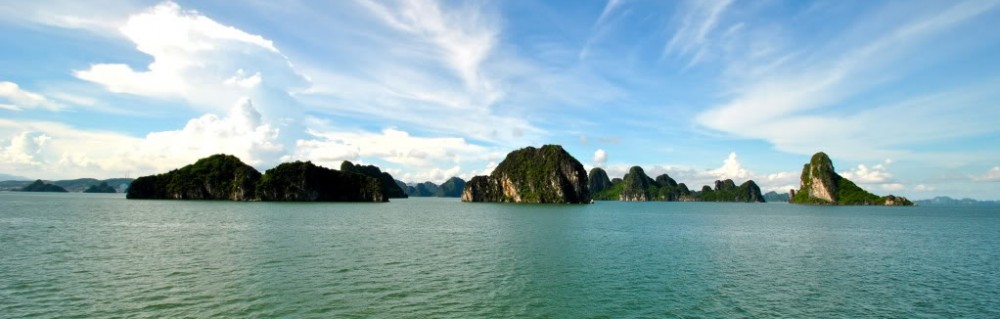
Water covers more than seven-tenths of the planet’s surface, and almost half the global population lives within 200 km of a coastline. It may thus surprise few that 90 per cent of the world’s trade uses maritime routes. With countless freighters, fishing boats, passenger ferries, leisure yachts, and cruise ships plying the waters, a pressing concern is maritime security — a mission tasked to national navies, coast guards, and harbour police forces.

Altering equations

The maritime order has entered a phase of evolutionary change in response to global power shifts. Maritime power equations are beginning to alter. The shifts actually symbolize the birth-pangs of a new world order.

Emerging changes in trade and energy patterns promise to further alter maritime power equations. For example, energy-related equations are being transformed by a new development: the centre of gravity in the hydrocarbon world is beginning to quietly shift from the Persian Gulf to the Americas, thanks to the shale boom, hydrocarbon extraction in the South Atlantic and Canada’s Alberta Province, and other developments.

The United States, for the foreseeable future, will remain the dominant sea power, while Europe will stay a significant maritime player. Yet, the international maritime order will continue to gradually but fundamentally change as new powers acquire greater economic and naval heft.

According to a projection by the recently released Global Marine Trends 2030 report, as the global GDP doubles over the next 17 years, China will come to own a quarter of the world’s merchant fleet. Several other maritime states in the Asia-Pacific, including Japan, South Korea, India, and Vietnam, are also set to significantly enlarge their maritime footprints.

Admittedly, there are real threats to maritime peace and security from the changing maritime power equations and the sharpening competition over resources and geopolitical influence. The Asia-Pacific region — with its crowded and, in some cases, contested sea lanes — is becoming the centre of global maritime competition. Maritime tensions remain high in this region due to rival sovereignty claims, resource-related competition, naval buildups, and rising nationalism.

A lot of attention has focussed on the maritime implications of China’s rise. President Xi Jinping has championed efforts to build China into a global maritime power, saying his government will do everything possible to safeguard China’s “maritime rights and interests” and warning that “in no way will the country abandon its legitimate rights and interests.” China’s increasing emphasis on the oceans was also evident from the November 2012 report to the 18th national congress of the Chinese Communist Party that outlined the country’s maritime power strategy. It called for safeguarding China’s maritime rights and interests, including building improved capacity for exploiting marine resources and for asserting the country’s larger rights.

The risks of maritime conflict arising from mistake or miscalculation are higher between China and its neighbours than between China and the United States.

There has been a course correction in the Obama administration’s “pivot” toward Asia, lest it puts it on the path of taking on Beijing. Washington has bent over backward to tamp down the military aspects of that policy. Even the term “pivot” has been abandoned in favour of the softer new phrase of “rebalancing.”

The U.S., moreover, has pointedly refused to take sides in sovereignty disputes between China and its neighbours. It has sought the middle ground between seeking to restrain China and reassure allies but, as former U.S. Deputy Secretary of State James Steinberg has put it, “without getting ourselves into a shooting war.”

China has also shied away from directly challenging U.S. interests. It has been careful not to step on America’s toes. Its assertiveness has been largely directed at its neighbours.

After all, China is seeking to alter the territorial and maritime status quo in Asia little by little. This can be described as a “salami-slice” strategy or, what a Chinese general, Zhang Zhaozhong, this year called a “cabbage” strategy — surround a contested area with multiple security layers to deny access to a rival nation.

Bit-by-bit strategy

This bit-by-bit strategy increases the risk of maritime conflict through overreach, and the inadvertent encouragement it provides to neighbouring countries to overcome their differences and strategically collaborate.

The new international maritime challenges, however, go beyond China’s jurisdictional “creep.”

The oceans and seas not only have become pivotal to any power’s security and engagement with the outside world but they also constitute the strategic hub of the global geopolitical competition. The growing importance of maritime resources and of sea-lane safety, as well as the concentration of economic boom zones along the world’s coastlines, has made maritime security more critical than ever.

The maritime challenges extend to non-traditional threats such as climate security, transnational terrorism, illicit fishing, human trafficking, and environmental degradation. The overexploitation of marine resources has underscored the need for conservation and prudent management of the biological diversity of the seabed.

Deep seabed mining has emerged as a major new strategic issue. From seeking to tap sulphide deposits — containing valuable metals such as silver, gold, copper, manganese, cobalt and zinc — to phosphorus nodule mining for phosphor-based fertilizers used in food production, the interstate competition over seabed-mineral wealth underscores the imperative for creating a regulatory regime, developing safe and effective ocean-development technologies, finding ways to share benefits of the common heritage, and ensuring environmental protection.

Interstate competition over seabed minerals is sharpening in the Indian Ocean, for example. Even China, an extra-regional power, has secured an international deep-seabed block in southwestern Indian Ocean from the International Seabed Authority to explore for polymetallic sulphides.

More broadly, some of the outstanding boundary, sovereignty and jurisdiction issues — extending from the Arctic to the Indian Ocean — carry serious conflict potential. The recrudescence of territorial and maritime disputes, largely tied to competition over natural resources, will increasingly have a bearing on maritime peace and security.

Bangladesh and Myanmar have set an example by peacefully resolving a dispute over the delimitation of their maritime boundaries in the Bay of Bengal. They took their dispute to the International Tribunal for the Law of the Sea for adjudication. The Tribunal’s verdict, delivered in 2012, ended a potentially dangerous dispute that was fuelled in 2008 when, following the discovery of gas deposits in the Bay of Bengal, Myanmar authorized exploration in a contested area, prompting Bangladesh to dispatch warships to the area.

However, some important maritime powers, including the U.S., are still not party to the 1982 U.N. Convention on the Law of the Sea (UNCLOS).

Iran recently seized an Indian oil tanker, holding it for about a month, but India could not file a complaint with the International Tribunal for the Law of the Sea because Tehran has not ratified UNCLOS. The seizure of the tanker, carrying Iraqi oil, appeared to be an act of reprisal against India’s sharp reduction of Iranian oil purchases, under U.S. pressure.

The threats to navigation and maritime freedoms, including in critical straits and exclusive economic zones (EEZs), can be countered only through adherence to international rules by all parties as well as through monitoring, regulation and enforcement.

Great-power rivalries, however, continue to complicate international maritime security. The rivalries are mirrored in foreign-aided port-building projects; attempts to assert control over energy supplies and transport routes as part of a 21st-century-version of the Great Game; and the establishment of listening posts and special naval-access arrangements along the world’s great trade arteries.

The evolving architecture of global governance will determine how the world handles the pressing maritime challenges it confronts. The assertive pursuit of national interest for relative gain in an increasingly interdependent world is hardly a recipe for harmonious maritime relations. Another concern is the narrow, compartmentalized approach in which each maritime issue is sought to be dealt with separately, instead of addressing the challenges in an integrated framework.

(Brahma Chellaney, a geostrategist, is the author, most recently, of Water, Peace, and War — Rowman & Littlefield, 2013)

(c) The Hindu, 2013.

Singh’s Sham Water Accord

A new agreement between China and India doesn’t require Beijing to institutionalize rules-based cooperation on shared resources.

  • By Brahma Chellaney
  • Zuma

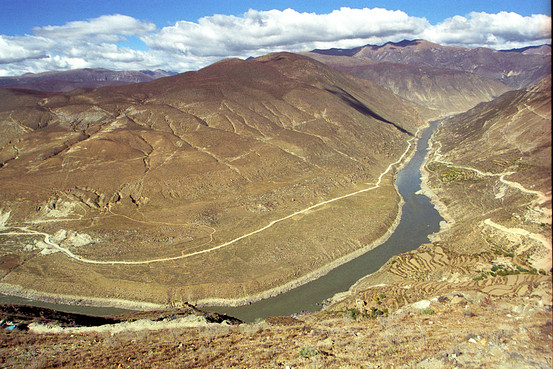
    The Brahmaputra River in Tibet, site of the Zangmu hydroelectric project. Zuma Press

    For the past decade, China has pursued a series of ambitious dam-building projects in Tibet, making water a source of significant discord in Sino-Indian relations. Yet last week Indian Prime Minister Manmohan Singh returned from a much-publicized visit to Beijing with an accord on water cooperation that offers only jingles and slogans.

    The memorandum of understanding signed during Mr. Singh’s visit merely records that both parties “recognized that transborder rivers and related natural resources and the environment are assets of immense value,” and that they “agreed that cooperation on transborder rivers will further enhance mutual strategic trust and communication.” India even “expressed appreciation to China for providing flood-season hydrological data.”

    With the help of the planeload of journalists he took with him at taxpayer expense, Mr. Singh has presented this trivial accord as a diplomatic success. In truth, the deal hands China a propaganda lever without addressing India’s concerns.

    In an increasingly water-stressed Asia, China has established a hydro-supremacy unparalleled in the world by annexing the starting place of Asia’s major rivers—the Tibetan plateau—and working to reengineer cross-border flows through dams, barrages and other structures. More transboundary rivers flow from China than from any other hydro-hegemon.

    Having already built more large dams than the rest of the world combined, Beijing has in the past decade shifted focus from dam-saturated internal rivers to international rivers. This year alone it has approved the construction of 54 new dam projects mainly concentrated in southeastern Tibet, including on rivers flowing to South and Southeast Asia.

    India is particularly vulnerable because it directly receives more than 48% of the 718 billion cubic meters of surface water that flows out of Chinese territory every year. In addition, Nepal’s Tibet-originating rivers empty into India’s Ganges basin. India has more arable land than China, but the source of most major Indian rivers is Chinese-controlled Tibet.

    If Beijing continues on its present unilateralist path, its upstream projects could complicate India’s water-sharing with Bangladesh and Pakistan. In the 1996 Ganges Treaty, India guaranteed Bangladesh an equal share of the downriver flows during the difficult dry season. But China is now planning to build a cascade of dams on the Ganges tributaries that contribute significantly to such downstream flows.

    The 1960 Indus Treaty remains the world’s most generous water-sharing arrangement, under which India agreed to set aside 80.52% of the waters of the six-river Indus system for Pakistan indefinitely, hoping it could trade water for peace. Two of these six rivers are now targeted by China’s dam builders.

    New Delhi has been pressing Beijing for transparency on its dam projects and a commitment not to redirect the natural flow of any river or to diminish cross-border flows. But even a joint expert-level mechanism between China and India—set up in 2007 for “interaction and cooperation” on hydrological data—has proven of little value. China has limited its cooperation to the sale of flood-season hydrological data. India provides such data free to Pakistan year-round.

    Averting water wars demands rules-based cooperation, water-sharing and dispute-settlement mechanisms. Yet China rejects the very concept of water-sharing and doesn’t have a single water-sharing treaty with any of its neighbors. India has such treaties with both of its downstream neighbors, Pakistan and Bangladesh, including mechanisms to help resolve disputes that flare intermittently.

    Prime Minister Singh pleaded for a bilateral water treaty in separate meetings this year with Chinese President Xi Jinping and Premier Li Keqiang, asking at least for a joint commission to ensure transparency in upstream dam-building on the Brahmaputra River (which runs from Tibet to eastern India and Bangladesh) and other southerly-flowing rivers. India currently has to rely on aerial reconnaissance and other intelligence inputs to know of Chinese dam-building activities. Messrs. Xi and Li rebuffed Mr. Singh’s plea.

    Now, with his job-approval rating plummeting to an all-time low and corruption scandals swirling, Mr. Singh didn’t wish to return empty-handed from Beijing. So he accepted what China was willing to offer—a token accord bereft of substance. Beijing will henceforth flaunt this accord to rebut criticism that it is unwilling to cooperate on shared water resources.

    This accord cannot obscure the importance of persuading Beijing to institutionalize rules-based cooperation on shared resources. The failure to build such cooperation between China and its neighbors will have long-term consequences, including making China the master of Asia’s water taps.

    China’s geographic advantage and rising military and economic might limit India’s bargaining power. To influence Beijing, then, India must leverage China’s growing Indian-market access. Yet India’s trade deficit with China in the past decade has climbed at about four times the pace of aggregate bilateral commerce. Perpetuating such a lopsided economic relationship while China disturbs the territorial and river-flow status quo is a double whammy for India.

    China’s dam-building spree is a reminder that Tibet remains at the heart of the India-China divide. This sprawling region ceased to be a political buffer when China annexed it more than six decades ago. For Tibet to turn into a political bridge between China and India, water has to become a source of cooperation, not conflict.

    Mr. Chellaney is the author, most recently, of “Water, Peace, and War: Confronting the Global Water Crisis.”

  • Copyright 2013 Dow Jones & Company, Inc. All Rights Reserved
  • Age of the water wars

    As competition for this precious resource grows, water will be a key to war and peace 

    BRAHMA CHELLANEY, The Globe and Mail, Published Wednesday, Oct. 09, 2013

    In an increasingly water-stressed world, shared water resources are becoming an instrument of power, fostering competition within and between nations and exacerbating impacts on ecosystems. This week’s Budapest World Water Summit is the latest initiative in the search for ways to mitigate the pressing challenges.

    Consider some sobering facts: Bottled water at the grocery store is already more expensive than crude oil on the spot market. More people today own or use a cellphone than have access to water-sanitation services.

    Unclean water is the greatest killer on the globe, yet a fifth of humankind still lacks easy access to potable water. More than half of the global population currently lives under water stress — a figure projected to increase to two-thirds during the next decade.

    Potentially calamitous water shortages in the coming decades in the densely populated parts of Asia, the Middle East and North Africa — the world’s most-parched regions — could produce large numbers of “water refugees” and overwhelm some states’ institutional capacity to contain the effects. The struggle for water is already escalating interstate and intrastate tensions.

    108_2013_b1-chellany-water-w8201_s640x467Downstream Egypt, for example, uses the bulk of the Nile River’s water, yet it is now threatening unspecified reprisals against Ethiopia’s ongoing construction of the Grand Renaissance Dam. China, already the world’s most-dammed nation and unrivaled hydro-hegemon, has approved the construction of 54 new dams — many of them on rivers that are the lifeblood for countries in Southeast and South Asia — as it seeks to build a strategic grip on transboundary water flows.

    Turkey, like China, is trying to reinforce its regional riparian dominance by accelerating an ambitious dam-building program, which threatens to diminish cross-border flows into Syria and Iraq. The internal war in Syria and the continuing sectarian bloodletting in Iraq have muted regional opposition to Turkey’s dam-building spree.

    Meanwhile, intrastate water-sharing disputes have become common, although they receive little coverage in the international media. Water conflicts within culturally diverse nations, such as Afghanistan, Pakistan, Yemen and Sudan, often assume ethnic dimensions, thereby accentuating internal-security challenges.

    But as illustrated by the disputes, for example, within the United States, Spain and Australia, intra-country water conflict is not restricted to the developing world. Water conflicts in America have spread from the arid west to the east. Violent water struggles, however, occur mostly in developing nations, with resource scarcity often promoting environmental degradation and perpetuating poverty.

    Adequate access to natural resources has been a key factor, historically, in peace and war. Water, however, is very different from other natural resources. A person can live without love but not without water.

    There are substitutes for a number of resources, including oil, but none for water. Countries can import, even from distant lands, fossil fuels, mineral ores, and resources originating in the biosphere, such as fish and timber. But they cannot import the most vital of all resources, water — certainly not in a major or sustainable manner. Water is essentially local and very expensive to ship across seas.

    Scarce water resources generate conflict. Even the origin of the word “rival” is tied to water competition. It comes from the Latin rivalis, or one who uses the same stream.

    Water’s paradox is that it is a life preserver, but it can also be a life destroyer when it becomes a carrier of deadly bacteria or comes in the deluge of a tsunami, a flash flood, or a hurricane. Many of the greatest natural disasters of our time have been related to water. A recent example is the Fukushima disaster, which triggered a triple nuclear meltdown.

    Because of global warming, potable water is set to come under increasing strain even as oceans rise and the intensity and frequency of storms and other extreme weather events increases.

    Rapid economic and demographic expansion has already turned potable water into a major issue across large parts of the world. Lifestyle changes, for example, have spurred increasing per-capita water consumption in the form of industrial and agricultural products.

    It is against this background that water wars, in a political and economic sense, are already being waged between competing states in several regions, including by building dams on international rivers or, if the country is located downstream, by resorting to coercive diplomacy to prevent such construction. U.S. intelligence has warned that such water conflicts could turn into real wars.

    According to a report reflecting the joint judgment of U.S. intelligence agencies, the use of water as a weapon of war or a tool of terrorism appears more likely in the next decade in some regions. The InterAction Council, comprising more than 30 former heads of state or government, meanwhile, has called for urgent action, saying some countries battling severe water shortages risk failing. The U.S. State Department, for its part, has upgraded water to “a central U.S. foreign policy concern.”

    Water stress is also imposing mounting socioeconomic costs. Commercial or state decisions in many countries on where to set up new manufacturing or energy plants are increasingly being constrained by inadequate local water availability.

    The World Bank has estimated the economic cost of China’s water problems at 2.3 percent of its GDP. But thus far China isn’t even under water stress — a term internationally defined as the availability of less than 1,700 cubic meters of water per head per year. Economies that are already water-stressed, ranging from South Korea and India to Egypt and Morocco, are paying a higher price.

    Water is a renewable but finite resource. Nature’s fixed water-replenishment capacity limits the world’s renewable freshwater resources to nearly 43 trillion cubic meters per year. But the human population has almost doubled since 1970 alone, while the global economy has grown even faster.

    Consumption growth has become the single biggest driver of water stress. Rising incomes, for example, have promoted changing diets, especially a greater intake of meat, the production of which is notoriously water-intensive. It is about 10 times more water-intensive to produce beef than to produce plant-based calories and proteins.

    In this light, water is becoming the world’s next major security and economic challenge.

    Although no modern war has been fought just over water, this resource has been an underlying factor in several armed conflicts. With the era of cheap, bountiful water having been replaced by increasing supply and quality constraints, the risks of overt water wars are now increasing.

    Avoiding water wars will require rules-based cooperation, water sharing and dispute-settlement mechanisms. However, there is still no international water law in force, and most of the regional water agreements are toothless, lacking monitoring and enforcement rules and provisions formally dividing water among users. Worse still, unilateralist appropriation of shared resources is endemic in the parched world, especially where despots rule.

    The international community thus confronts a problem more pressing than peak oil, economic slowdown and other oft-cited challenges. Indeed, this core problem holds the key to other challenges because of water’s nexuses with global warming, energy shortages, stresses on food supply, population, pollution, environmental degradation, global epidemics and natural disasters.

    Brahma Chellaney is a geostrategist and the author, most recently, of “Water, Peace, and War”(Rowman & Littlefield, 2013).

    (c) The Global and Mail, 2013.

    The Battle for Water

    Portrait of Brahma Chellaney

    A Project Syndicate column internationally distributed

    You may also read this column in any of the following languages:

    ArabicChineseCzechFrenchGermanItalianPortugueseRussian

    Spanish

    NEW YORK – The sharpening international geopolitical competition over natural resources has turned some strategic resources into engines of power struggle. Transnational water resources have become an especially active source of competition and conflict, triggering a dam-building race and prompting growing calls for the United Nations to recognize water as a key security concern.

    Water is different from other natural resources. After all, there are substitutes for many resources, including oil, but none for water. Similarly, countries can import fossil fuels, mineral ores, and resources from the biosphere like fish and timber; but they cannot import water, which is essentially local, on a large scale and on a prolonged – much less permanent – basis. Water is heavier than oil, making it very expensive to ship or transport across long distances even by pipeline (which would require large, energy-intensive pumps).

    The paradox of water is that it sustains life but can also cause death when it becomes a carrier of deadly microbes or takes the form of a tsunami, flash flood, storm, or hurricane. Many of the greatest natural disasters of our time – including, for example, the Fukushima catastrophe in 2011 – have been water-related.

    Global warming is set to put potable-water supplies under increasing strain – even as oceans rise and the intensity and frequency of storms and other extreme weather events increase. Rapid economic and demographic expansion has already turned adequate access to potable water into a major issue across large parts of the world. Lifestyle changes, for example, have spurred increasing per capita water consumption, with rising incomes promoting dietary change, for example, especially higher consumption of meat, production of which is ten times more water-intensive, on average, than plant-based calories and proteins.

    Today, the earth’s human population totals slightly more than seven billion, but the livestock population at any given time numbers more than 150 billion. The direct ecological footprint of the livestock population is larger than that of the human population, with rapidly rising global meat consumption becoming a key driver of water stress by itself.

    Political and economic water wars are already being waged in several regions, reflected in dam construction on international rivers and coercive diplomacy or other means to prevent such works. Consider, for example, the silent water war triggered by Ethiopia’s dam building on the Blue Nile, which has elicited Egyptian threats of covert or overt military reprisals.

    A report reflecting the joint judgment of US intelligence agencies warned last year that the use of water as a weapon of war or a tool of terrorism would become more likely in the next decade in some regions. The InterAction Council, comprising more than 30 former heads of state or government, has called for urgent action to prevent some countries battling severe water shortages from becoming failed states. The US State Department, for its part, has upgraded water to “a central US foreign policy concern.”

    In many countries, inadequate local water availability is increasingly constraining decisions about where to set up new manufacturing facilities and energy plants. The World Bank estimates that such constraints are costing China 2.3% of GDP. China, however, is not yet in the category of water-stressed states. Those that are, stretching from South Korea and India to Egypt and Israel, are paying an even higher price for their water problems.

    These countries already understand that water is a renewable but finite resource. Nature’s water-replenishment capacity is fixed, limiting the world’s usable freshwater resources to about 200,000 cubic kilometers. But the human population has almost doubled since 1970, while the global economy has grown even faster.

    Major increases in water demand, however, are being driven not merely by economic and demographic growth, or by the additional energy, manufacturing, and food production to meet rising consumption levels, but also by the fact that the global population is getting fatter. The average body mass index (BMI) of humans has been increasing in the post-World War II period, but especially since the 1980’s, with the prevalence of obesity doubling in the past three decades.

    Heavier citizens make heavier demands on natural resources, especially water and energy. The issue thus is not just about how many mouths there are to feed, but also how much excess body fat there is on the planet. For example, a study published in the British journal BMC Public Health has found that if the rest of the world had the same average body mass index as the US, this would be the equivalent of adding almost one billion people to the global population, greatly exacerbating water stress.

    With the era of cheap, bountiful water having been replaced by increasing supply and quality constraints, many investors are beginning to view water as the new oil. The dramatic rise of the bottled-water industry since the 1990’s attests to the increasing commodification of the world’s most critical resource. Not only are water shortages likely to intensify and spread, but consumers also will increasingly have to pay more for their water supply.

    This double whammy can be mitigated only by innovative water management and conservation, and by developing nontraditional supply sources. As in the oil and gas sector – where tapping unconventional sources, such as shale and tar sands, has proved a game changer – the water sector must adopt all unconventional options, including recycling wastewater and desalinating ocean and brackish waters.

    In short, we must focus on addressing our water-supply problems as if our lives depended on it. In fact, they do.

    Brahma Chellaney, Professor of Strategic Studies at the New Delhi-based Center for Policy Research, is the author ofAsian JuggernautWater: Asia’s New Battleground, andWater, Peace, and War: Confronting the Global Water Crisis.

    (c) Project Syndicate, 2013.

    Read more from Project Syndicate’s “Visionary Voices” Focal Point.

    Indus largesse backfires on India

    Brahma Chellaney, India Today, April 22, 2013

    Indus system rivers

    The six Indus-system rivers flowing from India to Pakistan, with the main rivers (the upper three) reserved for Pakistan’s use.

    The Indus treaty represents the most generous water-sharing agreement in modern world history, reserving for Pakistan 80.52 percent of the waters, or 167.2 billion cubic meters annually. No other water pact in the world comes anywhere close to this level of upper-riparian munificence. In fact, the Indus treaty uniquely allocates entire rivers by drawing a north-south partition line to gift Pakistan the upper three Indus-system rivers, confining India’s full sovereignty rights to the much-smaller three rivers to the south.

    Yet this 1960 treaty imposes more fetters on the upper-riparian state than any other water pact in the world. An elaborate series of India-specific curbs obviate any Indian control over the timing or quantum of the transboundary flows of the Pakistan-earmarked rivers — the Chenab and the Jhelum (which boast the largest cross-border discharge) and the main Indus stream. Indeed, the treaty remains the only interstate water agreement in the world embodying the doctrine of restricted sovereignty, whichseeks to compel an upriver state to defer to the interests of a downstream state.

    Pakistan, despite securing a matchless water-sharing arrangement, has repaid India’s water largesse with blood by sponsoring acts of grisly terrorism there. This treaty of indefinite duration may stand out as a major folly bequeathed to future Indian generations by the Nehruvian era, yet no Indian government has ever sought to link water flows with an end to terrorism. However, the same question must haunt the Pakistani generals as Lady Macbeth in William Shakespeare’s Macbeth: “Will all great Neptune’s ocean wash this blood clean from my hand?”

    Unfortunately for India, its already-limited sovereignty over the upper rivers is now being further crimped by a sweeping new principle defined for all future projects by the recent international arbitration award on the small Kishenganga project. This is a big price India is being made to pay for embarking on the long-delayed, 330-megawatt Kishenganga project, whose design and size, paradoxically, were changed and scaled down in 2006 in response to Pakistani objections.

    The treaty permits India to build only run-of-river plants — a type that generates hydropower without a reservoir by using a river’s natural flow velocity and elevation drop.Because of very limited water storage, such plants experience fluctuations in power output due to seasonal flow changes, making them less cost-effective than the larger, storage-centred plants.

    Clipboard01

    Pakistan has repaid India’s water largesse with blood by sponsoring acts of terrorism.

    The arbitration award represents a triumph of Pakistan’s efforts to reinterpret the treaty’s terms more narrowly so as to remove whatever leeway India may have and make the Indus regime even more lopsided. The recent award imposes a new condition on spillway configuration that would seriously undermine the run-of-river plants’ commercial viability by potentially allowing them to silt up, as happened with India’s Salal plant in the 1980s due to design changes carried out at Pakistan’s insistence. By precluding effective silt control through drawdown sluicing and flushing, the award flies in the face of the common international practice to build gated spillways.

    Indeed, the arbiters have attempted to override — without any legal power — an international neutral expert’s 2007 decision in the earlier Baglihar case that such spillway outlets were consistent with the treaty’s provisions. The spillway matter is a technical issue and, as per the terms of the treaty, it must decided by a neutral expert, not by an arbitration panel. Yet, overruling India’s objection, the arbiters chose to wilfully encroach onto the technical turf.

    International arbitration — with the arbiters and high-priced lawyers collecting millions of dollars in fees from the parties — often functions on the lowest common denominator. In the Kishenganga case, the panel, while upholding the legality of the Indian project, has tilted in Pakistan’s favour on the key design issue. And in an effort to further milk the two parties, the arbiters have extended the lengthy proceedings since 2010 to at least until this year-end, when they “hope” to give their “final award” on another issue that they have contrived — the minimum flow of water India would be required to release for Pakistan in the Kishenganga stream.

    Fixing a minimum flow rate will go beyond the terms of the treaty and tie India’s hands, even if climate change or hydrological factors were to affect the stability and predictability of the Kishenganga flow.

    Pakistan’s motive is clear: to deny the limited benefits the treaty grants Jammu and Kashmir by objecting and seeking to stall the modest-size projects that New Delhi has belatedly sought to initiate there to allay popular resentment over crippling power shortages. This motive springs from the Pakistani military’s continuing strategy to foment discontent and violence there. The arbiters have unwittingly played into Pakistan’s hands by going beyond the Indus treaty’s provisions on a crucial issue and thereby seeking to effectively arm Islamabad with a veto on any Indian project’s viability.

    India must blame itself for reaping the bitter fruits of a remarkable lack of strategy. It concluded the treaty, as its chief negotiator admitted, without any long-term assessment. Despite a widening demand-supply water gap in its own Indus basin, India has yet to exercise some key treaty-sanctioned rights (such as on storage) but allowed Pakistan to drag it before international proceedings. How much longer can a parched but generous India remain visionless?

    Brahma Chellaney is the author of the award-winning book, Water: Asia’s New Battleground.

    (c) India Today, 2013.

    China’s great water wall

    Damming downstream flow to neighbors could trigger water wars

    By Brahma Chellaney, Washington Times, Monday, April 8, 2013

    The Chinese government’s recent decision to build an array of new dams on rivers flowing to other countries seems set to roil inter-riparian relations in Asia and make it more difficult to establish rules-based water cooperation and sharing.

    Asia, not Africa, is the world’s driest continent. China, which already boasts more large dams than the rest of the world combined, has emerged as the key impediment to building institutionalized collaboration on shared water resources. In contrast to the bilateral water treaties between many of its neighbors, China rejects the concept of a water-sharing arrangement or joint, rules-based management of common resources.

    The long-term implications of China’s dam program for India are particularly stark because several major rivers flow south from the Tibetan plateau. India has water-sharing treaties with both the countries located downstream from it: the Indus pact with Pakistan guarantees the world’s largest cross-border flows of any treaty regime, while the Ganges accord has set a new principle in international water law by assuring Bangladesh an equal share of downriver flows in the dry season. China, by contrast, does not have a single water-sharing treaty with any neighbor.

    Yet most of Asia’s international rivers originate in territories that China annexed after its 1949 communist “revolution.” The sprawling Tibetan plateau, for example, is the world’s largest freshwater repository and the source of Asia’s greatest rivers, including those that are the lifeblood of mainland China, South Asia and Southeast Asia. Other Chinese-held homelands of ethnic minorities contain the headwaters of rivers such as the Irtysh, Illy and Amur, which flow to Russia and Central Asia.

    China’s dam program on international rivers is following a well-established pattern: Build modest-size dams on a river’s difficult uppermost reaches, and then construct larger dams in the upper-middle sections as the river picks up greater water volume and momentum, then embarking on megadams in the border area facing another country. The cascade of megadams on the Mekong River, for example, is located in the area just before the river enters continental Southeast Asia.

    Most of the new dam projects announced recently by China’s state council, or Cabinet, are concentrated in the seismically active southwest, covering parts of the Tibetan plateau. The restart of dam building on the Salween River after an eight-year moratorium is in keeping with a precedent set on other river systems: Beijing temporarily suspends a controversial plan after major protests flare so as to buy time — before resurrecting the same plan.

    The Salween — Asia’s last largely free-flowing river — runs through deep, spectacular gorges, glaciated peaks and karst on its way into Burma and along the Thai border before emptying into the Andaman Sea. Its upstream basin is inhabited by 16 ethnic groups, including some, like the Derung tribe, with tiny populations numbering in the thousands. As one of the world’s most biologically diverse regions, the upper basin boasts more than 5,000 plant species and nearly half of China’s animal species.

    The decision to formally lift the moratorium and construct five dams — with work to start immediately on the Songta dam, the farthest upriver structure in Tibet — threatens the region’s biodiversity and could uproot endangered aboriginal tribes. There is also the risk that the weight of huge, new dam reservoirs could accentuate seismic instability in a region prone to recurrent earthquakes.

    No country is more vulnerable to China’s re-engineering of transboundary flows than India. The reason is that India alone receives nearly half of the river waters that leave Chinese-held territory. According to United Nations figures, a total of 718 billion cubic meters of surface water flows out of Chinese territory yearly, of which 347 billion cubic meters (or 48.3 percent of the total) runs directly into India.

    China already has a dozen dams in the Brahmaputra River basin and one each on the Indus and the Sutlej rivers. On the Brahmaputra, it is currently close to completing one dam and has just cleared work on three others. Two more are planned in this cascade before the dam-building moves to the water-rich border segment as the river makes a U-turn to enter India.

    Asia awaits a future made hotter and drier by climate and environmental change, and resource depletion. The continent’s water challenges have been exacerbated by consumption growth, unsustainable irrigation practices, rapid industrialization, pollution, environmental degradation and geopolitical shifts.

    If Asia is to prevent water wars, it must build institutionalized cooperation in transboundary basins that co-opts all riparian neighbors. If a dominant riparian state refuses to join, such institutional arrangements — as in the Mekong basin — will be ineffective. The arrangements must be centered on transparency, unhindered information flow, equitable sharing, dispute settlement, pollution control and a commitment to refrain from any projects that could materially diminish transboundary flows. International dispute-settlement mechanisms, as in the Indus treaty, help stem the risk that water wrangles could escalate to open conflict.

    China — with its hold over Asia’s transnational water resources and boasting more than half of the world’s 50,000 large dams — has made the control and manipulation of river flows a pivot of its power and economic progress. Unless it is willing to play a leadership role in developing a rules-based system, the economic and security risks arising from the Asian water competition can scarcely be mitigated.

    Brahma Chellaney is the author of “Water, Peace, and War: Confronting the Global Water Crisis” (Rowman & Littlefield, 2013).

    (c) Washington Times, 2013.