Wages of Mishandling Pakistan

  Brahma Chellaney, The Economic Times, October 9, 2013

Prime Minister Manmohan Singh’s recent state visit to Washington generated a lot of media coverage, not in the U.S. (where the media literally took no note of it) but in India, thanks to the planeload of journalists that Singh took with him. Rarely before had an Indian prime minister’s state visit to U.S. been so invisible to Americans.

If the American media did notice Singh, it was only at the fag end of his trip when he met with his Pakistani counterpart in New York. That put the spotlight, however briefly, on the India-Pakistan equation rather than on the Indo-U.S. relationship. New Delhi doesn’t like the India-Pakistan hyphenation, yet its own actions can be counterproductive. Singh defiantly met Nawaz Sharif, disregarding both public opinion at home and the Pakistani military’s increased hostility.

But before meeting Sharif, Singh complained to US President Barack Obama about Pakistan’s continuing export of terrorism — a complaint that prompted Sharif to purportedly compare Singh with a whining “dehati aurat.” By grumbling to Obama, Singh implicitly expressed his government’s helplessness in countering Pakistani terrorism, besides signalling that his meeting with Sharif was at the U.S. request. In fact, the state department welcomed his discussion with Sharif, saying “dialogue is a positive step forward and we’ll continue to encourage that.”

If Singh believed that holding political dialogue with Pakistan’s new civilian government was important, a New York meeting at the foreign minister level would have sufficed at this stage, especially since no one expected a meeting between the two PMs to break new ground.

Yet the extent to which Singh went to save his September 29 meeting with Sharif can be gauged from one troubling fact: news about the September 24 Pakistani cross-border raid into the Keran sector — which triggered a two-week gunbattle between Indian army troops and the intruders — was not released by the government until after the Singh-Sharif meeting. It is unfortunate the government allowed the political exigencies of a meeting in New York to take precedence over the imperative to inform the nation about a major intrusion involving Pakistani special forces.

It is crystal clear that India’s Pakistan policy has lost all sense of direction. Indeed, it is so adrift that it has emboldened the Pakistan army to carry out multiple acts of aggression across the line of control this year without fear of Indian retribution — from the decapitation of two Indian soldiers and the separate killing of five troops to the Samba raid and the Keran incursion. Sadly, the government has also sowed factionalism in the army’s senior hierarchy by playing favourites and targeting the ex-chief, Gen. V.K. Singh, through media plants.

Worse still, the government has restrained the army both from responding appropriately and effectively to cross-border aggression and from giving out any information to the media on Pakistani (or Chinese) border violations. The restraint order has crimped the army’s traditional leeway to act preemptively against an impending aggression and to inflict a just retribution for any cross-border attack.

Can any force be turned into a veritable sitting duck struggling to fend off repeated aggression? By allowing the army’s operational imperatives to be trumped by the government’s meandering and clueless foreign policy, army chief Gen. Bikram Singh faces an unflattering reality on his record: His stint as chief has coincided with a pattern of rising cross-border aggression by Pakistan (and China).

Let’s be clear: Battling repeated cross-border encroachments on terms dictated by the enemy — a tradition India set in 1999 when it fought the entire Kargil War on Indian territory on Pakistan’s terms — is anything but sound strategy. Indeed, it is an invitation to bringing the country’s border security under siege.

More fundamentally, why has it become a virtual custom since the late 1990s for an Indian prime minister’s meeting with Pakistan’s leader to invariably spell trouble for India? Atal Bihari Vajpayee publicly bemoaned that his peace bus to Lahore in February 1999 was “hijacked and taken to Kargil.” Still, he went to Pakistan in early 2004 for a second time as PM — a trip that sowed the seeds of Pakistan’s stepped-up export of terrorism in the subsequent years.

With his blow-hot-blow-cold approach, the sphinx-like Vajpayee executed several U-turns in his Pakistan policy, which traversed through Lahore, Kargil, Kandahar, Agra, and Parliament House, before culminating in Islamabad on his second trip to Pakistan.

The scandal-tainted Singh has brought a nasty “gift” for his nation from each meeting with a Pakistani counterpart.

Apart from the latest Keran surprise, Singh came back from Sharm el-Sheikh after arming Pakistan with the Baluchistan card against India, while he returned from Havana earlier after declaring that the exporter of terrorism is actually a “victim of terrorism” like India.

In the absence of a long-term strategic blueprint, coupled with the marginalization of the ministry of external affairs and other professional bodies, Indian foreign policy increasingly is being driven by ad hoc, personal interventions of the prime minister — with serious costs to national interest.

Brahma Chellaney is a strategic affairs expert.

(c) The Economic Times, 2013.

Obama’s Great Asian Dawdle

BY BRAHMA CHELLANEY, Washington Times, September 2, 2013

The U.S. is shying away from China’s stealth aggression.

The more assertive Beijing has become, the more reluctant U.S. President Barack Obama has been to take sides in Asian territorial disputes, although they center on a combative China’s efforts to change the territorial status quo with America’s strategic allies or partners. Washington’s feckless Asia policy has helped deepen the security dilemma of several Asian states on how to protect their territorial and economic rights against China’s power grab.

Washington has made it amply clear that despite its “pivot” toward Asia, it will not put American lives at risk to defend its allies’ territorial claims against Beijing or act in ways detrimental to its close engagement with China. Defense Secretary Chuck Hagel even said in an August 28 BBC interview that the U.S. does not look at China’s military buildup as a threat.

Indeed, there has been a course correction in the Obama administration’s “pivot” policy. After initially raising Asian expectations about a robust U.S. response to China’s assertiveness, Washington has tamped down the military aspects of its “pivot,” lest it puts it on the path of taking on Beijing. Instead it has started laying emphasis on the economic aspects.

Obama’s Asia policy has treaded a course of neutrality on territorial disputes between China and its neighbors, while seeking to reap the economic and strategic benefits of closer engagement with Asian states.

Washington, for example, is chary of getting drawn into Sino-Japanese territorial disputes, although Tokyo is its close ally and U.S. forward military deployments in Japan are a linchpin of America’s strategy to retain primacy in Asia. In fact, the Japanese-controlled Senkaku Islands to which China has laid claim are close to Okinawa, home to the largest U.S. military presence in Asia.

Similarly, even as China purposely badgers India along the Himalayan frontier, Washington has shied away from cautioning Beijing against any attempt to change the territorial status quo by force. In fact, on a host of Asian disputes, including China’s claim since 2006 to India’s Austria-size Arunachal Pradesh state, Washington has chosen not to antagonize Beijing and stayed neutral.

Even in a case when China has forcibly changed the status quo — by taking effective control since last year of the Scarborough Shoal, located in the South China Sea within the Philippines’ exclusive economic zone — the Obama team has done little more than counsel restraint and talks. With Chinese vessels this year present near the Second Thomas Shoal, the lesson the Philippines is learning that might remains right in international relations and that its security dependence on Washington is no check on the intruding colossus.

The paradox is that China’s rising assertiveness has helped the U.S. to return to Asia’s center-stage, yet Obama is wary of taking sides in the territorial disputes. The only issue on which Washington has spoken up is freedom of navigation in the South China Sea.

The China factor, which has allowed the U.S. to strengthen its existing military relationships and build new strategic partnerships in Asia, can remain useful for America only if it is seen by its allies and partners as a credible guarantor of stability and security in Asia. That is a function not of its military strength but of its political will.

To be sure, Washington has an interest in preventing the emergence of a Sino-centric Asia. But it has no interest in getting entangled in Asia’s territorial feuds. If it can, it would like to find a way to support its allies and partners in their disputes with China, but without alienating Beijing — a tough balancing act.

For example, the Obama administration has said the U.S. security treaty with Japan covers the Senkaku Islands because they “are under Japanese jurisdiction,” yet “we also stress that we don’t take a position on the sovereignty of the Senkaku Islands.” How reassured can Japan be with such doublespeak?

Washington indeed has advised Tokyo and Beijing repeatedly to sort out their dispute peacefully. Some U.S. analysts who have served in the government have urged Washington not to issue a “blank check” to an uncompromising Japan that refuses to negotiate with Beijing on the dispute.

If China were to employ military force in the dispute, would the U.S. take all necessary actions, including the use of its military capability, to repulse a Chinese action that was confined to the 7-square-kilometer disputed real estate in the East China Sea? The Obama administration has simply said that despite China’s increasing intrusions into the Senkaku waters, “we do not envision that this current tension will rise to that level in any foreseeable scenario.”

Tokyo, skeptical that the U.S. will go to war with China to back Japan’s territorial rights, wants a clear U.S. defense guarantee. The Obama administration, however, has balked at Tokyo’s November 2012 proposal that the U.S.-Japan alliance’s defense guidelines be updated to specifically include the Senkakus.

America’s larger chariness has seemingly encouraged China to up the ante against several neighbors. For example, after gradually increasing the frequency of its incursions into Senkaku waters since September 2012, China is now focusing on increasing their duration. Similarly, China’s land incursions into India’s Ladakh region, after going up in frequency, are this year being staged intermittently for longer duration.
This pattern appears designed to pressure an opponent to cut a deal on Chinese terms, in keeping with Beijing’s stratagem on territorial disputes — what is ours is ours and what is yours is negotiable.

China, despite its bluster, is unlikely to wage open war against a determined, well-armed opponent for fear it may get a bloody nose, as happened in 1979 when it invaded Vietnam. Yet the possibility of an overt war resulting from mistake or miscalculation cannot be ruled out.

Even if no open war flares, Japan and several other Asian states already face China’s war by stealth. Through a clever strategy of furtive, incremental encroachments, China is actually undercutting the value of its opponents’ security relationships with Washington. Compounding this situation is Washington’s signal to its allies and partners that it is their own responsibility to safeguard territories that China covets.

Given Washington’s hands-off approach to Beijing’s creeping, covert warfare — designed to change facts on the ground slowly without having to fire a single shot — the relevance of U.S. security assurances to China’s neighbors risks becoming largely symbolic. In fact, the U.S. has sent out a contradictory message: It wants its allies to do more for their own security, yet it has scowled at Japan’s interest in acquiring offensive capability to deter aggression, asking Tokyo to consider the plan’s potential negative fallout in East Asia.

China’s aggressive stance thus poses difficult challenges for America’s allies and partners. For these states, the logical response to their security predicament would be to bolster defenses; build partnerships with each other to create a web of interlocking strategic relationships; and deepen their strategic engagement with Washington but without expecting the U.S. to come to their aid in a military contingency in which American interests are not at stake directly.

Brahma Chellaney is a geostrategist and the author, most recently, of “Water, Peace, and War” (Rowman & Littlefield, 2013).

 (c) Washington Times, 2013.

Cheek-turners as leaders

Image

Brahma Chellaney, INDIA TODAY, September 2, 2013, Upfront column, page 10

George Washington famously said, “If we desire to avoid insult, we must be able to repel it; if we desire to secure peace—one of the most powerful instruments of our rising prosperity—it must be known that we are at all times ready for war.” India, however, has stomached not just insults but also acts of cross-border aggression by Pakistan while continuing to sing peace to its tormentor, a smaller state by every yardstick. No amount of terror has convinced India to change course—not even the Pakistani-scripted attacks on symbols of Indian power, including Parliament, Red Fort, stock exchange, national capital, business capital and IT capital.

Each act of aggression has been greeted with inaction and stoic tolerance. For a succession of prime ministers, every new attack has effectively been more water under the bridge. Manmohan Singh—the weakest and most clueless of them—has put even the internationally unprecedented Mumbai terrorist siege behind him by delinking dialogue from terrorism and resuming cricketing ties.

If anyone questions this approach of turning the other cheek to every Pakistani (or Chinese) attack, government propagandists retort, “Do you want war?” This mirrors the classic argument of appeasers that the only alternative to appeasement is all-out war. As the proverbial extremists, appeasers are able to see only the extreme ends of the policy spectrum: Propitiation and open warfare.

UpfrontThe appeasers thus have presented India with a false choice: Either persevere with pusillanimity or risk a full-fledged war. This false choice, in which the only alternative to appeasement is military conflict, is an immoral and immoderate line of argument designed to snuff out any legitimate debate on rational options. There are a hundred different options between these two extremities that India must explore and pursue. Indeed, only a policy approach that avoids the extremes of abject appeasement and thoughtless provocation can have merit.

The appeasers also argue that neighbours cannot be changed. So, as Singh has said blithely, “a stable, peaceful, and prosperous Pakistan” is in India’s “own interest.” But political maps are never carved in stone, as the breaking away of South Sudan, East Timor and Eritrea has shown. Didn’t Indira Gandhi change political geography in 1971? In fact, the most-profound global events in recent history have been the disintegration of several states, including the Soviet Union and Yugoslavia. Even if India cannot change its neighbours, it must seek to change their behaviour so that it conforms to international norms.

Yet India has shied away from employing even non-coercive options to discipline a wayward Pakistan, which is waging low-intensity unconventional warfare. Rather than squeeze Pakistan economically and diplomatically, India is doing just the opposite. Similarly, India has stepped up its propitiation of China, in spite of facing a Sino-Pak pincer offensive centred on Jammu and Kashmir: Chinese incursions into Ladakh have increased in parallel with Pakistani ceasefire violations. Still, Singh is determined to meet his Pakistan counterpart in New York and later pay obeisance to an increasingly combative China on yet another trip to Beijing.

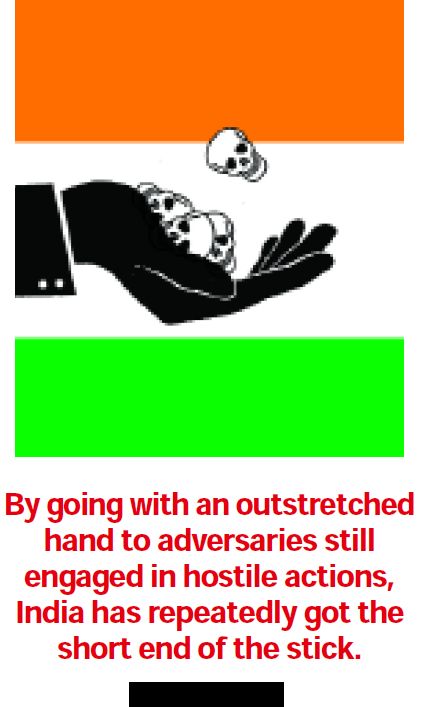
By going with an outstretched hand to adversaries still engaged in hostile actions, India repeatedly has got the short end of the stick. Nothing better illustrates India’s clap-when-given-a-slap approach than the way it portrayed the 19-km Chinese encroachment in April-May as a mere “acne” and tried to cover up the Pakistan Army’s role in the recent Indian soldiers’ killing. A hawk is defined in the U.S. as someone who seeks the use of force pre-emptively against another country. But in India—reflecting the ascendancy of cheek-turners and the country’s consequent descent as an exceptionally soft state—a hawk has come to signify someone who merely advises against turning the other cheek to a recalcitrant or renegade neighbour.

An easy way for Indian diplomacy to make the transition from timidity to prudence is to start spotlighting plain facts on cross-border aggression. Yet the Indian political class is so busy feathering its own nests that it is willing to even twist facts about how soldiers were martyred and suppress figures showing a rising pattern of Chinese incursions.

How does one explain that leaders, while shrewd and calculating in political life, have pursued a fundamentally naïve foreign policy that has shrunk India’s regional strategic space and brought its security under siege? The answer lies in one word: Corruption. Untrammelled corruption has spawned a political class too compromised to safeguard national interests. Appeasement thus thrives, with the ministry of external affairs effectively being turned into the ministry of external appeasement. India’s reputation as weak-kneed indeed has become the single most important factor inviting aggression, spurring a vicious circle.

Brahma Chellaney is a geostrategist and author.

(c) India Today, 2013.

An insecurity trap of India’s own making

Brahma Chellaney, Mint, August 15, 2013

India can no longer evade the question as to why its regional adversaries are able to carry out cross-border acts of aggression with impunity.

Have you thought of why India faces unending cross-border acts of aggression while persisting with a process of dialogue and peace building? Is it merely because India has scofflaw neighbours? Or can at least part of the blame be pinned on India’s pursuit of a foreign policy driven by neither pragmatism nor statecraft?

Take the challenge from Pakistan, a country 1/13th India’s size economically: After suffering each attack since the late 1990s, India has had the same debate, largely centred on the merit of staying put in the process of talks with Islamabad. Few ask the real questions: How many more attacks is India willing to bear? Is there no limit to India’s patience? What has outraged the country over the two recent back-to-back Pakistani acts of aggression — the suicide raid on the Indian consulate in Jalalabad and the ambush-killing of five soldiers along the line of control (LoC) — is more the government’s meek response and prevarications than the attacks themselves.

A key plank of Pakistan’s jihad strategy against India is deniability. Carry out an attack, deny involvement, keep India engaged in talks to serve as a continuing cover, and execute the next attack. This strategy can fool no one. But India’s political class is so corrupt and compromised that it has little time to look beyond self-interest.

Indian leaders are very protective of their own interests. Indeed they have an overinflated view of themselves. Their hard-headedness in serving personal interests contrasts with their faint-heartedness in shielding national interests. If they had spent just a quarter of their time on their primary duty — protection of national interest — the country wouldn’t be in the mess it is today, with the economy sinking, national security under siege, and pessimism reigning.

The foundation of India’s present weak-kneed foreign policy was actually laid between 1999 and 2004 by Atal Bihari Vajpayee, who executed more policy U-turns than probably any other prime minister since independence. Vajpayee’s roller-coaster policy on Pakistan exacted a major toll on institutionalized policy-making, exposing India’s glaring inadequacy to set and unwaveringly pursue clear goals.

Under Vajpayee — who also surrendered India’s Tibet card in a 2003 Beijing visit — personal rather than professional characteristics defined India’s foreign policy. His shifting Pakistan stance traversed through Lahore, Kargil, Kandahar, Agra, and Parliament, before culminating in Islamabad on his second trip to Pakistan as prime minister. It was Vajpayee’s 2001 Agra invitation that helped Pervez Musharraf to come out of the international doghouse for staging a military coup.

In an operation with no parallel in modern world history, the Indian military was kept in war-ready position against Pakistan for 10 months, ostensibly to force Pakistan to dismantle its terrorist infrastructure. Yet, without accomplishing any objective, Vajpayee called off the costly, self-debilitating operation, which the then Navy chief later labelled the “most punishing mistake.” Worse still, Vajpayee during his 2004 Islamabad visit hailed as a big gain Pakistan’s commitment on paper to not let its territory to be used for cross-border terrorism — the very assurance Musharraf had given before Operation Parakram began.

Vajpayee’s swinging policy pendulum emboldened his successor, Manmohan Singh — a foreign-policy greenhorn — to pursue a blinkered approach that blended naiveté with appeasement, thereby inviting greater acts of aggression against India. Mistaking tactics for strategy, Singh has treated the process of engagement with Pakistan (and China) as an end in itself, losing sight of the purpose — putting an end to acts of aggression.

Singh’s fixation on quasi-failed Pakistan has paralleled Vajpayee’s quest to make peace with that implacable enemy. The Vajpayee and Singh eras will also be remembered for the corruption in public life, with scandals at times sought to be deflected through peace building with Pakistan. A famous son-in-law in each of the two eras came to symbolize unbridled corruption.

In this light, is it any surprise that personal and not professional characteristics have shaped India’s foreign policy for almost 15 years now? This trend marks goodbye to institutionalized policymaking.

Singh, of course, has taken appeasement to unmatched levels. In 2006 at Havana, he equated the exporter of terrorism with the victim of its terrorism, setting up the infamous and now-defunct joint anti-terror mechanism. Three years later at Sharm el-Sheikh, Singh included Baluchistan in the agenda — grist for the Pakistani propaganda mill that India was fomenting the insurrection there. This blunder allowed Pakistan to externalize the Baluch problem by turning its terrorism target, India, into the principal accused.

Even the savagery last January when Pakistani troops chopped two Indian soldiers and took away one severed head as a “trophy” failed to stop Singh from returning to business as usual with Pakistan, in spite of his own promise to the nation that it won’t be business as usual. The result is that Singh’s constant engagement of Pakistan has yielded uninterrupted Pakistani acts of military brutality and terror. In fact, the worst acts of cross-border aggression have occurred during Singh’s stint as prime minister.

Instead of dictating terms to Pakistan, India allows Pakistan to retain initiative. Each time India is caught by surprise, it does little more than react passively. Whereas Pakistan’s India policy has remained consistent for long, India’s ad hoc Pakistan policy continues to inflict self-injury.

Make no mistake: India has fashioned its own insecurity trap. To break out of it, it must pursue a clearheaded, goal-oriented foreign policy focused on an assertive promotion of national interests. That process can begin only if India stops looking at inter-country relations through rose-coloured glasses and establishes professional policymaking.

Brahma Chellaney is a professor at the Centre for Policy Research in New Delhi.

(c) Mint, 2013

China’s game plan is to keep India on the back foot

Brahma Chellaney, Mint, July 31, 2013

An increasingly assertive China has indisputably emerged as India’s immediate strategic challenge. While erring on the side of caution is prudent, strategic diffidence and tentativeness are likely to exact increasing costs. The more feckless and fearful a policy, the more pressures it is bound to invite.

India’s current China policy indeed exemplifies how meekness attracts bullying. The more timorous India has been, the more belligerent China has become.

A key defining event has been the three-week Chinese military incursion into Ladakh’s Depsang plateau, which ended on May 7 only after India virtually capitulated by demolishing a line of new defensive fortifications in the Chumar region, 400 kilometres to the south, and agreeing to consider a Chinese-drafted “Border Defence Cooperation Agreement”. Since then, an emboldened China has escalated its military pressure on India.

Its provocations have included several military forays into Chumar — a lightening raid on June 17 to smash up surveillance equipment was followed by more incursions on July 16-17, 18 and 20. Depsang was the scene of a 28-kilometre-deep Chinese intrusion on July 12. Border transgressions also occurred this month in Arunchal’s Dichu and Uttarakhand’s Barahoti areas.

Yet this spate of incursions has received little attention as the Indian state, mired in petty politics, remains woefully adrift. Indeed, the government kept the June 17 Chinese raid under wraps for three weeks for fear that news about it would provoke public pressure to cancel the impending separate visits to Beijing of the national security adviser and defence minister. Similarly, to safeguard the Chinese premier’s visit earlier, New Delhi — as if reading from the aggressor’s script in Chinglish — tried to pass off the watershed event at Depsang as a “small little spot” of “acne” treatable with “an ointment”.

China’s newest provocations, in fact, draw encouragement from its bloodless victory when it sneaked troops into Depsang and then, employing the threat of escalation, extracted Indian concessions. One of the concessions — suspension of forward patrolling in Chumar — has created the opening for stepped-up Chinese intrusions, designed to assert claims to that highly strategic area overlooking the Tibet-Xinjiang highway.

By making India remove fortifications and halt forward patrolling in Chumar, China accomplished two objectives — securing India’s acquiescence to Chinese-defined constraints on deployment and surveillance and an Indian acknowledgment, even if tacit, that the area is disputed. Pursuit of the next objective will likely witness Beijing’s call for “mutual accommodation” and “mutual respect” to achieve a dispute resolution on the basis of a now-familiar Chinese dictum — “what is ours is ours to keep, but what is yours must be on the negotiating table to be settled through give-and-take”.

To cover up its entrenched strategic timidity, however, New Delhi has flaunted its go-ahead for establishing a new mountain strike corps — a clearance that should have come several years earlier and without media hype. Yawning gaps in India’s Himalayan defences remain unplugged owing to sluggish decision-making. Even as China develops and deploys capabilities quietly, New Delhi advertises any deterrence move, however nascent.

It will take India probably up to seven years to establish and fully deploy the new strike corps. But the government has already betrayed its trademark meekness by deciding to deploy the new strike corps, or any of its formations, not where most needed — Arunachal Pradesh — but in West Bengal and elsewhere so as not to raise the hackles of Beijing, which calls Arunachal “disputed territory”. This is just one example of how New Delhi allows Beijing to dictate terms to it.

Consider another, more mortifying example: China’s draft Border Defence Cooperation Agreement is receiving India’s fullest consideration. The draft was handed to India in circumstances that amounted to holding a gun to its head and demanding that it enter into discussions on concluding the agreement. It was given on May 4 before Beijing agreed to dismantle its Depsang encampment.

China’s intent is to keep India at a strategic disadvantage and thus vulnerable to Chinese military pre-emption through an agreed freeze on build-up of border defences and troop levels. The aim clearly is to stymie India’s belated and still-bumbling efforts to enhance its defences and military logistics support.

China has a knack of defining important principles in an accord so as to bind the other party to them by fostering a belief that their mere enunciation represents progress, even as Beijing pays lip service to those principles. In the face of belligerent Chinese actions, however, it has become difficult to keep up the pretence of progress. The Depsang encampment represented a shot through the heart of the border-peace concept central to the existing accords concluded in 1993, 1996 and 2005. China thus wants these accords replaced with a new lopsided agreement to aid its containment-behind-engagement strategy.

But why is New Delhi furthering China’s game plan? Can a draft thrust by China at gunpoint be the basis for negotiating an agreement? As if content to play second fiddle to China, India is offering its comments and suggestions on the Chinese draft. In a July 6 joint statement with his Chinese counterpart, General Chang Wanquan, Defence Minister A.K. Anthony even “agreed to the early conclusion of negotiations” on the proposed agreement. Is India a vanquished nation that had little choice but to embrace an imposed draft as the basis for negotiations?

With India’s lame-duck prime minister scheduled to visit Beijing in November, symbolism will again trump substance. Yet, without a fundamental course correction, India seriously risks courting another 1962-style Himalayan debacle.

Brahma Chellaney is a professor at the Centre for Policy Research in New Delhi.

(c) Mint, 2013.

The iron fist in a trade glove

Brahma Chellaney

The Japan Times, May 28, 2013

Trade as a weapon: China promotes economic dependencies and then manipulates them to advance its geostrategic objectives.

Japan and India are natural allies whose fast-growing relationship is remarkably free of any strategic dissonance. So, Indian Prime Minister Manmohan Singh’s Tokyo visit this week stands in sharp contrast to Chinese Premier Li Keqiang’s recently concluded India tour, which, behind the hype, helped to underscore the deep Sino-Indian divide.

India, China and Japan, constituting Asia’s pivotal triangle, are transforming relations between themselves in a way that portends growing strategic collaboration between New Delhi and Tokyo but sharper geopolitical competition between China and the other two Asian powers. The Sino-Indian relationship was recently disturbed by a stealthy incursion across the disputed Himalayan border by the People’s Liberation Army, which pulled back its troops just in time to allow Li to go ahead with a scheduled visit to India.

Li’s visit helped shine a spotlight on a negative aspect extending beyond the Himalayan tensions — India’s ballooning trade deficit with Beijing, compounded by China’s import of mainly primary commodities while exporting finished products. A flood of cheap Chinese-made goods has undercut Indian manufacturing.

The lopsided economic engagement gives China little incentive to bridge a widening political divide with India. If anything, it encourages China to continue with a strategy to keep India under strategic pressure so as to regionally contain that country.

With China exporting more than two-and-half times as much as it imports, its already large trade surplus with India will only swell if the two countries meet their target of raising bilateral trade from the current level of nearly $70 billion to $100 billion by 2015. Its recent border incursion notwithstanding, China has focused on raking in more profits from the Indian market. Li himself underscored the difficulty of correcting the fundamental imbalance in trade by taking mainly exporters in his large business team to India.

Economic problems in the West, by contributing to a slowdown in China, have only increased the importance of the Indian market for Beijing. This is what prompted Li to choose India as his first overseas destination for an official visit. This factor has also encouraged China’s cash-rich, state-supported banks to offer debt financing to heavily indebted Indian companies that commit to buy Chinese equipment or supply raw materials.

While swamping the Indian market with its products, China has made it difficult for Indian exporters to gain much of a foothold in its own market, including in sectors where India is strong, such as pharmaceuticals and information technology. As a result, India’s exports to China largely consist of low-margin, unprocessed commodities.

China’s increasing access to the Indian market, however, has done little to promote a less-adversarial Chinese foreign policy. Indeed, the more profits China has reaped from its trade relationship with India, the more assertive it has become.

As China’s trade surplus with India has soared from just $1 billion in 2002 to $40 billion in 2013, China has openly challenged Indian sovereignty in the large western and eastern sectors of the Himalayas. In this period, China has continued to enlarge its strategic footprint in Pakistani-held Kashmir — a disputed territory — even as sustained Chinese pressure forced India’s state-owned ONGC Videsh Limited (OVL) to pull out of a contract to explore for oil in two blocks off the Vietnamese coast in the South China Sea. Beijing had warned India against “any unilateral exploration activities” in the South China Sea.

The Indian assumption that greater trade would make Beijing more amenable to solving the border dispute and more sensitive to India’s other concerns has been belied. While refusing to accept the territorial status quo with India, China is also working to disturb the status quo on international-river flows to its southern neighbor through an aggressive dam-building program.

India is particularly vulnerable to China’s reengineering of transboundary flows because it alone receives nearly half of all river waters that leave Chinese territory. Beijing, however, has repeatedly spurned India’s proposal to conclude a pact or establish an intergovernmental institution to define rights and responsibilities on shared rivers. China wants only to sell flood-related hydrological data.

That China does not allow booming bilateral trade from coming in the way of its territorial assertiveness is also manifest from the way it has ratcheted up disputes in the East and South China Seas. In fact, as underscored by its actions against Japan and the Philippines since last year, it employs trade as a political weapon. With China serving as Japan’s largest overseas market, Beijing has sought to punish Tokyo through an informal boycott of Japanese products since last September.

For China, trade is not only about economics but also about geostrategic interests. Beijing values the lopsided trade with India as a strategic weapon that undercuts its rival’s manufacturing base, yet yields handsome dividends for it.

In fact, China encourages economic dependencies so that it can manipulate them to advance its strategic objectives. In its recent territorial feuds with other neighbors, China has bared the cards it is likely to wield when faced with a diplomatic or military crisis next — from employing its trade muscle to inflict commercial pain to exploiting its monopoly on the global production of the vital rare-earth minerals.

So what can India do to prevent China from using its trade prowess for political ends

First, it must avoid any commercial dependency that cannot be easily be substituted with imports from elsewhere.

Second, it must aggressively contain the flood of Chinese-made subsidized goods through anti-dumping measures and countervailing duties, or else it will become harder for it to develop a more mature manufacturing base.

And third — in the way China unofficially but assertively links economic issues with political matters — India must not shy away from linking market access to concrete progress on border and water issues.

Brahma Chellaney is professor of strategic studies at the independent Centre for Policy Research in New Delhi and the author, most recently, of “Water, Peace, and War” (Rowman & Littlefield, 2013).

(c) The Japan Times, 2013.

China’s Iron Fist in a Velvet Glove

Brahma Chellaney

The Economic Times, May 26, 2013

Behind the hype and hustle, any India-China summit meeting runs along familiar lines: India flags its concerns sedulously, especially over Beijing’s reluctance to clarify the line of control, the lopsided trade relationship, China’s activities in Pakistan-occupied Kashmir (PoK), and the opaque Chinese projects on transnational rivers. The Chinese side responds with pious platitudes about friendship and cooperation that win front-page coverage in Indian press. All this is quickly forgotten until the next summit, when India goes through the same motions again.

In the intervening time, however, the trade pattern has turned more unequal, China has unveiled new dam projects on transboundary rivers and enlarged its strategic footprint in PoK, and the number of cross-frontier forays and border incidents staged by Chinese troops to pressure India has increased. This is exactly what happened between the 2010 New Delhi visit of Premier Wen Jiabao and the just-concluded trip of his successor, Li Keqiang.

Take the growing trade asymmetry. The joint statement issued at the end of Li’s visit promises “measures to address the issue of the trade imbalance.” But when Wen Jiabao came calling, China made a similar commitment to level the playing field by taking “measures to promote greater Indian exports to China with a view to reduce India’s trade deficit.”

Yet China’s trade surplus has soared since then, significantly expanding India’s current account deficit. With trade talks that began in late 2010 yielding little, there is little hope of any respite for India from China’s escalating dumping of goods.

Confident that India will continue to do little else other than file anti-dumping cases at the World Trade Organization, Beijing is systematically undermining Indian manufacturing. Moreover, it still largely imports raw materials from India and exports finished products. One new way it is seeking to perpetuate this distorted pattern is by providing debt financing through its banks to financially troubled Indian companies that agree to buy Chinese equipment or supply primary commodities.

Now consider China’s response to India’s exhortations to stem its growing strategic involvement in PoK, a disputed territory. Li, as if to mock India’s pleas, went straight from India to “all-weather” ally, Pakistan, and signed an agreement to build an economic corridor through PoK, where China is already engaged in several strategic projects. To shield these projects, Beijing has stationed its own forces in the rebellious, Shia-majority Gilgit-Baltistan, with the result that India now faces Chinese troops on both flanks of Jammu and Kashmir, one-fifth of which China has annexed.

Contrast China’s refusal to heed New Delh’s PoK-related protestations with the intense diplomatic pressure it mounted after India’s ONGC Videsh Limited (OVL) signed a contract with PetroVietnam to jointly explore for oil in two blocks in the South China Sea. Beijing warned India against “any unilateral exploration activities” there. OVL eventually withdrew from one block in 2011 and the other in 2012 after paying millions of dollars in exit fees to PetroVietnam.

Water has emerged as a key security issue in Sino-Indian relations and a potential source of enduring discord. But like Chinese President Xi Jinping earlier, Li snubbed Prime Minister Manmohan Singh’s plea that water cooperation ought to extend beyond mere data-sharing to institutionalized transparency on dam building.

China is the source of river flows to a dozen countries. But India is the most vulnerable of them to China’s reengineering of transboundary flows because it alone receives nearly half of all river waters that leave Chinese territory. Beijing, however, continues to spurn India’s proposal to conclude a pact or establish an inter-governmental institution to define rights and responsibilities on shared rivers. China wants only to sell flood-related hydrological data.

While working to disturb the status quo on international-river flows, China is clearly unwilling to accept the territorial status quo with India. The Indian assumption that greater trade would make Beijing more amenable to solving the border dispute and more sensitive to India’s other concerns has been belied.  

For more than three decades now, India has engaged China in never-ending rounds of sterile discussions on the boundary issue in what has become the longest, most-barren process of negotiations between any two countries in modern history. China has not only derailed the process to clarify the Line of Actual Control (LAC), rendering that term farcical, but it has also signalled unequivocally that it will not accept the LAC as the basis for a boundary settlement.

When Wen Jiabao came in 2010, he delivered a hard message on the border issue — that it will “not be easy to completely resolve the question” and that, in any event, it will “take a fairly long period of time.” These remarks in a prepared speech amounted to a public disavowal of the “firm commitment” enshrined in the joint statement issued just hours earlier to resolve the border dispute “at an early date.”

The latest joint statement, deferring to China, actually drops the “early date” reference. The fact that Li’s visit was preceded by a 19-kilometre-deep Chinese incursion into Ladakh attests to China’s resolve to keep India under sustained pressure by neither clarifying the LAC nor moving towards a border settlement. Beijing earlier sabotaged the Joint Working Group (JWG) on border talks by going back on its 2001 commitment to exchange maps of the eastern and western sectors with India. And by playing the Arunachal and Kashmir cards, it is now seeking to stymie the JWG’s replacement mechanism led by the so-called special representatives (SRs).

Having being shaken by the daring Ladakh incursion, India has every right to tacitly link China’s one-sided market privileges and bilateral political and military exchanges to substantive progress on the border issue. But it is flubbing the opportunity. The joint statement, for example, preposterously expresses “satisfaction” over the decade-long border talks between the SRs, even as it encourages them to “push forward the process of negotiations.” This stance only aids the Chinese game-plan to take India round and round the mulberry bush.

India, however, has done well to counter China’s draft “Border Defence Cooperation Agreement” by proposing its own accord designed specifically to prevent border flare-ups and incursions. The Chinese-drafted agreement, in the name of preserving Himalayan peace and tranquillity, cleverly aims to keep India vulnerable to Chinese military pre-emption by freezing its belated build-up of border defences.

Li’s visit has served as a fresh reminder that India-China summits yield little more than hype, spin and reassuring clichés. Imploring China to see reason on border, trade, water and other issues is pointless because Beijing only understands the language of leverage. Combating China’s containment-behind-engagement strategy demands a concerted Indian plan of action that combines beefed-up deterrent capabilities with leveraged diplomacy and military cooperation with friendly countries.

Brahma Chellaney is professor of strategic studies at the Centre for Policy Research in New Delhi and the author of  “Water: Asia’s New Battleground.”

(c) The Economc Times, 2013.

Chinese checkmate

Brahma Chellaney

The Hindustan Times, May 15, 2013

China has taken no break to savour the triumph of its coercive diplomacy when it caught India unawares by sneaking troops into Ladakh’s Depsang plateau and then, employing the threat of an extended standoff and escalation, extracted military concessions. Not content with that success, Beijing is now pushing a frontier accord that, in the name of Himalayan peace and tranquillity, would freeze India’s belated, bumbling build-up of border defences and troop levels while preserving China’s capability to strike without warning.

The People’s Liberation Army (PLA) completed the removal of its encampment from Depsang not on May 5, when India said the face-off was over, but on May 7 after Indian troops dismantled a defensive line of bunkers on their side at Chumar, an action that has spawned another concession — suspension of Indian patrolling along that critical borderline. Earlier on May 4, India received a far-reaching, Chinese-drafted “Border Defence Cooperation Agreement” that, in essence, seeks to keep India at a strategic disadvantage and thus vulnerable to Chinese military preemption.

Beijing is stepping up pressure, lest it gets too late, to stop India from plugging gaps in its border defences. China’s recent incursion forced India to dismantle vantage-point fortifications capable of providing early warning of Chinese troop movements, while the draft Border Defence Cooperation Agreement aims to advance broader Chinese interests and ensure that the PLA retains the option to strike at a time and place of its choosing. An emboldened China believes the Ladakh standoff has so softened India that it can now be inveigled into granting more concessions, especially to make Premier Li Keqiang’s visit a “success”.

In the recent episode, Chinese coercion easily trumped Indian diffidence. By merely positioning a single platoon of up to 50 troops across the de facto border, China compelled India — without firing a single shot — to agree to attenuate its border defences at Chumar (the scene of recurrent Chinese intrusion attempts) and to commit to addressing other Chinese concerns in follow-up negotiations.

China had a lot to lose by persisting with the face-off because it would have led to cancellation of Li’s visit and shone an adverse international spotlight on Chinese territorial aggressiveness with multiple neighbours. It was in India’s interest to raise the diplomatic costs for China so as to deter future military provocations.

Instead of letting China stew for a while after beefing up its forces but without encircling the intruders, India rewarded the aggressor with concessions. It also presented itself in the same light as the aggressor by announcing a simultaneous Indian and Chinese troop pullout from the standoff zone.

While New Delhi wilted under coercive pressure, China incontrovertibly vindicated its raid by paying no diplomatic or economic costs. Yet the corruption-tainted Indian government claims quiet diplomacy made China beat a retreat. If such is the power of Indian diplomacy, why is India bleeding itself by remaining the world’s largest arms importer?

In truth, it was India’s feckless decision to respond only by diplomatic means to a grave military provocation that left it no choice but to publicly play down the incursion and to yield ground.

China’s leverage-pivoted, concessions-mining approach stands in stark contrast with the forbearing Indian diplomacy, now stewarded by Salman Khurshid from his cloud-cuckoo-land perch. Imagine if Indian soldiers had intruded even one kilometre into Chinese territory: Would the Chinese foreign minister have survived in office by belittling it as a pimple on the “beautiful face” of India-China relations? And would he have subsequently rushed to New Delhi, renouncing the right to “do any post-mortem or apportion blame” and saying he would love to live in India?

Note also the striking contrast between the two countries’ approach to agreements. Whereas India’s legalistic line treats agreements as sacrosanct in letter and spirit, China regards accords as just political tools to advance its interests, including lulling the other party into complacency so as to create new exploitable opportunities. The 1954 Panchsheel treaty was a classic example: India valued it as heralding a Hindi-Chini bhai bhai era, while China used it as a cover to start encroaching on Indian territories and to solidify its Tibet annexation, paving the way for its 1962 India invasion.

China does not hesitate to renege on a commitment or violate a key pact, whereas India puts up stoically with even an iniquitous agreement like the 1960 Indus Waters Treaty with Pakistan, despite coming under growing water stress. After exchanging maps of the middle sector with India in 2001, China broke its commitment to also trade maps of the other two sectors to help clarify the entire line of control.

No sooner had the dual 2005 border-peace accords been signed than China began infringing them. Now that its Ladakh incursion has nakedly contravened the 2005 pacts, Beijing’s audacious response is to draft a lopsided Border Defence Cooperation Agreement to supplant all previous accords.

China has a knack of disaggregating any issue into multiple parts and then pursuing a shrewd, quid-pro-quo diplomacy to each element, often drawing a linkage with even extraneous pieces. In contrast to India’s itch to settle issues, settlement in Chinese diplomatic chess involves keeping space to possibly unleash leverage by reopening any component part in the future.

If India’s China policy remains driven by wishful thinking, the country is likely to invite more nasty surprises that end with similar Indian submission to the aggressor’s demands. It is past time to inject greater realism and leverage into the policy.

Brahma Chellaney is the author, most recently, of “Water: Asia’s New Battleground,” winner of America’s 2012 Bernard Schwartz Award.

(c) The Hindustan Times, 2013.

Beijing’s Triumph of Coercive Diplomacy

In exchange for withdrawing from India’s own territory, China wins a slew of military concessions from New Delhi.

Wall Street Journal, May 10, 2013

When India announced on Monday that Chinese troops would draw back from a disputed Himalayan border region, Indian politicians hailed the retreat as a return to normalcy and a win for quiet diplomacy. In truth, the three-week Sino-Indian standoff on the Debsang plateau gravely weakened New Delhi’s strategic position in a region that straddles key access routes linking China’s rebellious Tibet and Xinjiang regions as well as China to Pakistan, while Beijing conceded nothing of value.

The dispute was a study in Chinese coercive diplomacy and Indian fecklessness. Beijing’s incursion 20 kilometers past the de facto Himalayan borderline in mid-April bore all the hallmarks of modern Chinese brinksmanship, such as a reliance on surprise and a complete disregard for the risks of wider military escalation.

Above all, the move demonstrated a keen sense of timing. India has never been so weak internally, and its response to the crisis was hobbled by political paralysis and leadership drift.

Chinese troops in Ladakh, India, on May 5 — Associated Press

Merely by deploying a single platoon of no more than 50 soldiers, China won military concessions far beyond what it has gained through peaceful negotiations. In exchange for Beijing’s retreat from an area China never had the right to control, New Delhi will dismantle a key forward observation post, destroy bunkers and other defensive fortifications, and potentially halt infrastructure development near the border.

Meanwhile, China will continue to build up its offensive capability in the Himalayas so that it can strike without warning. Over the past decade, an increasingly assertive China has steadily encroached on India’s Himalayan territory in the name of expanding its “core interests”—a tactic reminiscent of its ongoing territorial and maritime spats with Japan, Vietnam and the Philippines. India’s spineless Himalayan strategy should be a lesson to those other states on how not to respond to Chinese provocations.

New Delhi’s bumbling began in earnest three years ago, when the Congress Party-led government inexplicably replaced army troops with border police to patrol the frontier. More recently, the entire government leadership kept mum for a week on the latest intrusion, only to break its silence with inanities making light of the encroachment. While Prime Minister Manmohan Singh called it a “localized problem,” Foreign Minister Salman Khurshid described it as “one little spot” of acne on the “beautiful face” of India-China relations—an issue that can be “addressed by simply applying an ointment” because “ointment is part of the process of growing up.” The garrulous Khurshid went on to say that “incidents do happen.”

Had Beijing persisted with the standoff, it would have led to cancellation of Chinese Premier Li Keqiang’s New Delhi visit on May 20—his first overseas trip since assuming office. It was in India’s interest to raise the diplomatic costs for China so as to deter such intrusions in the future. However, the domestic woes of India’s corruption-tainted government left New Delhi no space for it to stand firm or consider how capitulation could embolden the adversary. A never-ending series of scandals have paralyzed the government and undermined its public credibility.

The result was that India wilted in the Himalayas just as China was coming under an adverse international spotlight for its provocations. Instead beefing up its forces and letting Beijing stew for a while, India rewarded the aggressor with concessions. In all likelihood, New Delhi rushed a deal so that its foreign minister could go ahead with a scheduled trip to Beijing this week to prepare for Li’s visit. It was as if Li’s stopover in New Delhi on his way to visit “all-weather ally” Pakistan is more important for India than for China..

The irony is that every visit of a Chinese leader to India in recent years has been preceded by a new aggressive Chinese move. The jarring revival of China’s claim to the Austria-size northeastern Indian state of Arunachal Pradesh came just before President Hu Jintao’s 2006 visit. Before Premier Wen Jiabao’s 2010 visit, Beijing began questioning India’s sovereignty over Kashmir through a new visa policy. And now Mr. Li’s visit has been preceded by a military incursion, which has soured relations.

Instead, the main diplomatic legacy of the Himalayan faceoff will be permanent damage to the Sino-Indian border accords of 2005, in which both states agreed to “strictly respect and observe” the de facto border known as the Line of Actual Control. China openly violated these accords by pitching tents in Indian-held territory and raising banners that read “This Is Chinese Land.” Given New Delhi’s timidity, such proclamations may yet become a reality.

Mr. Chellaney is professor of strategic studies at the Centre for Policy Research in New Delhi.

Copyright 2013 Dow Jones & Company, Inc. All Rights Reserved.

Timid India allows China to nibble at Himalayan border

Brahma Chellaney

The National, May 7, 2013

Intruding Chinese soldiers hold banner asking Indian troops to “Go Back.”

China’s “peaceful rise” is giving way to a more muscular approach as Beijing broadens its “core interests” and exhibits a growing readiness to take risks.

As if to highlight its new multi-directional assertiveness, China’s recent occupation of a 19-kilometre-deep Indian border area, close to where the frontiers of India, Pakistan and China converge, has coincided with its escalating challenge to Japan’s decades-old control of the Senkaku Islands and territorial spats with Vietnam and the Philippines.

China is aggressively conducting regular patrols to support its sovereignty claims in the South and East China seas, while furtively enlarging its footprint in the Himalayan borderlands. While naval and air force units focus on asserting sovereignty claims on the seas, the army stays active in the Himalayas, nibbling at territory.

China is employing novel methods to alter its line of control with India in the mountains and valleys bit by bit – without having to fire a shot. For example, the Chinese army has brought ethnic Han pastoralists to the frontier and given them cover to range across the line. This tactic is designed to drive native herdsmen out of their pasturelands and assert Chinese control over those places.

Such subversion of the status quo, along with China’s ever-expanding “core interests” – which have grown from Tibet and Taiwan to include Xinjiang and now the South China Sea and the Senkakus – is at the root of instability in Asia. This pattern of increasing Chinese assertiveness began when China revived its long-dormant claim to the large, north-eastern Indian state of Arunachal Pradesh just before the 2006 visit to India of China’s then-president, Hu Jintao.

The resurrection of that claim was followed by territorial spats China provoked with several other neighbours. Together these signalled that China was staking out a more domineering role in Asia. It was as if China had decided that its moment had finally arrived.

For example, playing a game of chicken, China has been posing major new challenges to India, ratcheting up strategic pressure on multiple fronts, including stepping up cross-border military forays and questioning India’s territorial sovereignty in key sectors.

China has repeatedly tried to breach the Himalayan border by taking advantage of the fact that this long, forbidding frontier is difficult for India to patrol effectively, since in many sections Indian troops are based at lower elevations. When an incursion is discovered, Beijing’s refrain is that its troops are on “Chinese land.”

Yet India remains focused on the process rather than on the substance of diplomacy. Process is important only if it buys time to build countervailing leverage. Unfortunately, a rudderless India has made little effort to craft such leverage.

India’s defensive mindset has been on full display in the latest episode. It initially blacked out the April 15 incursion, just as it has suppressed its own figures showing a rising pattern of Chinese military forays across the border.

A whole week went by before New Delhi said a word on the record about the furtive Chinese ingress. The first official Indian comment came only after Beijing issued a bland denial of the incursion, in response to Indian media reports quoting army sources.

India’s cautious, conciliatory response to the deepest Chinese incursion in more than a quarter of a century was revealed in its decision not to scrap its foreign minister’s scheduled trip to Beijing this Thursday and to welcome Li Keqiang, the new Chinese premier on May 20.

This approach has invited rebuke from critics, who portray the intrusion as premeditated, muscle-flexing provocation backed by China’s new leadership.

The immediate crisis eased on Sunday when the Chinese government agreed to end the three-week-old standoff, in return for India’s acceptance of some Chinese demands, including the dismantling of some border-defence structures. China, meanwhile, conceded nothing, in a triumph for its coercive diplomacy.

As China’s coercive power grows, it is beginning to use its capabilities against several neighbours to alter the status quo in its favour, without having to wage open war.

In light of this, India can maintain border peace only by leaving China in no doubt that it has the capability and political will to defend itself. If the Chinese see an opportunity to nibble at Indian land, they will seize it. It is for India to ensure that such opportunities do not arise.

India thus needs a counter-strategy to tame Chinese aggressiveness. Tibet remains at the core of the Sino-Indian divide. And India’s growing strategic ties with the US increasingly rankle China.

To build countervailing leverage, India has little choice but to slowly reopen the central issue of Tibet – a card New Delhi surrendered at the altar of diplomacy. India’s recognition of full Chinese sovereignty over Tibet was based on Beijing’s acknowledgement that Tibet is an “autonomous region” in China. The fact that China has squashed Tibet’s autonomy creates an opening for India to take a more nuanced position.

More broadly, China’s strategy to assemble a “string of pearls” – ports, staging posts and hubs for expanding its interests and presence from East Africa to the Pacific – can be countered by India forming a “string of rapiers” with like-minded Asian-Pacific countries.

At the root of Asia’s growing tensions and insecurity is China’s strategic subversion of the status quo. Only cooperation can shield peace and economic growth; muscle-flexing will not accomplish it.

Brahma Chellaney is a strategic-studies scholar based in New Delhi. His most recent book is Water, Peace, and War.

(c) The National, 2013.