The contrast between the elections held earlier this month in the mountain kingdom of Bhutan and that held in populous Bangladesh — the former peaceful and the latter marred by violence and an opposition boycott — underscore the challenges involved with consolidating democratic transitions in South Asia, a region with long autocratic traditions.
India, the region’s geographical hub, is considered the world’s largest democracy. But authoritarian structures have not been fully dismantled in neighboring countries ranging from Nepal to the Maldives.
The region, in fact, illustrates that elections alone cannot ensure genuine democratic transitions. Even if competitive, elections do not guarantee genuine democratic empowerment at the grassroots level or adherence to constitutional rules by those wielding power.
Pakistan and Myanmar, for example, are to hold parliamentary elections this year that are unlikely to weaken the viselike grip of their militaries on domestic politics.
Myanmar’s generals derailed their nation’s democratic transition in February 2021 by ousting Aung San Suu Kyi’s elected government, leading the U.S. and its allies to impose wide-ranging sanctions.
Military ruler Min Aung Hlaing said earlier this month that “free and fair multiparty democratic elections” will be held once the current state of emergency is lifted, with “state responsibilities” then to pass to the duly elected government.
Few, however, put much credence in talk of the army going back to its barracks. Directly or indirectly, the military has called the shots in Myanmar since the country’s independence in 1948.
More ominously, escalating armed attacks by insurgents and pro-democracy groups attempting to overthrow the military junta, coupled with crippling U.S.-led sanctions, are threatening to turn Myanmar into a failed state.
The U.N. warned last month that Myanmar is slipping into a deepening humanitarian crisis, with more than 2 million people internally displaced and one-third of the country’s 54 million population requiring humanitarian aid.
The military has also been the most powerful political player traditionally in Pakistan. The generals there today wield power indirectly through a caretaker civilian-led government that remains in office even after failing to meet a constitutional mandate to hold elections within 90 days of the dissolution last August of the National Assembly.
The election is now scheduled for Feb. 8 but could be further postponed. The military-friendly Senate passed a resolution on Jan. 6 calling for a delay due to “prevailing security conditions” and harsh seasonal weather in certain parts of the country.
The head of Pakistan’s army has long acted as the country’s effective ruler. The military, intelligence agencies and the nuclear establishment have never been answerable to civilian-led governments.
When decisive power rests with generals, democratization can scarcely gain traction. In contrast, Bhutan and Nepal have each been transitioning from traditional monarchy to parliamentary government.
Bhutan’s recent fourth national election has brought an opposition party to power amid an economic crisis. A benevolent king has helped facilitate the country’s democratic transition.
Nepal’s tenuous democracy, however, has come under the shadow of former communist guerrillas who waged war against the state, notably Prime Minister Pushpa Kamal Dahal as well as opposition leader K.P. Sharma Oli.
Ahead of parliamentary elections to be held Jan. 25, the communists’ ascendance has raised questions about whether their ideology is compatible with democracy. After all, communism has traditionally eroded individual rights and freedoms that democracies enshrine. While democracy is pluralistic, communism in practice has tended to be monopolistic, as in neighboring China.
Democracy is struggling in Bangladesh, too, in part due to the growth of radical Islamist forces. Prime Minister Sheikh Hasina, who has led a secular government that has given Bangladesh political stability and rapid economic growth, on Jan. 7 secured a fourth straight term in office, with her party winning nearly three-quarters of the parliamentary seats as the main opposition party sat out the vote.
Excluding Singapore, the Maldives and other small nations, Bangladesh is the world’s most densely populated country. Given its porous borders, its continued stability is pivotal to regional security.
The Maldives offers a lesson on how democratic progress can be easily reversed if the entrenched forces of the old order are not cut down to size and the rule of law firmly established.
After an election in 2008 swept away decades of autocratic rule, it took barely four years for authoritarianism to rear its ugly head again. President Mohamed Nasheed was forced to resign at gunpoint, as Islamists stormed the national museum and smashed priceless Buddhist and Hindu statues, erasing evidence of the country’s pre-Islamic past.
Since then, Islamic radicals have significantly expanded their grassroots base in the strategically important Indian Ocean archipelago, resulting in Mohamed Muizzu winning election to the presidency two months ago. Despite a population of barely 550,000, the tropical islands are home to cells of Islamic State and al-Qaida.
Around South Asia, past authoritarian regimes in effect promoted extremist forces by establishing opportunistic political alliances with them. The combination of dire economic conditions and a powerful national protest movement can often help topple such a regime.
In Sri Lanka, an economic meltdown in 2022 led to mass protests and chaos that caused the Rajapaksa brothers’ dynastic government to fall apart. With the support of their party, Ranil Wickremesinghe has since served as president, but the country is due to hold fresh presidential and parliamentary polls later this year.
India will also be going to the polls in the coming months to elect a new parliament in the world’s largest election exercise, stretching over several weeks.
India is a raucous democracy that confronts intensifying partisanship and polarization. In its hyperpartisan environment, Prime Minister Narendra Modi has become a lightning rod for allegations that he is acting as a strongman pursuing divisive policies, and that he favors populism over constitutionalism. These complaints mirror criticisms of Donald Trump when he was in the White House, but Modi and his party are likely to fare better in their reelection campaign.
But the sputtering democratic transitions around India, and the specter of spillover effects from an unstable neighborhood, pose important challenges for New Delhi. They also impede regional cooperation and free trade. Whether or not elections are held, democratic development still has a distance to go in most South Asian states.
Brahma Chellaney is professor emeritus of strategic studies at the Centre for Policy Research in New Delhi and a former adviser to India’s National Security Council. He is the author of nine books, including “Water: Asia’s New Battleground.”
It was America’s abandonment of a failed sanctions policy in favor of calibrated engagement that helped bring about the formal end of Myanmar’s military dictatorship in 2015. Today, US President Joe Biden’s administration must adopt a similar strategy – or risk allowing Myanmar to become a failed state.
As the Israel-Hamas war rages, the dire humanitarian situation in Gaza is grabbing headlines – as well it should. But another armed conflict, in Myanmar, is also causing mass suffering, with more than two million people internally displaced and over a million more streaming into neighboring Bangladesh, India, and Thailand. And it is attracting far less international attention.
This is not to say that outside forces are not engaged in the conflict in Myanmar. On the contrary, the United States seems to view supporting the rebel and pro-democracy groups attempting to overthrow the military junta – which returned to power in a February 2021 coup – as a kind of moral test. But its approach is doing Myanmar little good.
After the military overthrew Myanmar’s nascent civilian government – to which it had begun ceding power barely six years earlier – US President Joe Biden’s administration re-imposed wide-ranging sanctions, which it has since ratcheted up. But, so far, the sanctions have left Myanmar’s military elites relatively unscathed, even as they have unraveled the economic progress made over the last decade and inflicted misery on ordinary citizens.
The Biden administration has also deepened engagement with the so-called National Unity Government that was formed as an alternative to the junta. Though the US, like the rest of the world, has refrained from formally recognizing the shadow government, this has not stopped the Biden administration from providing “non-lethal aid” to its notional army, the People’s Defense Force, as well as to ethnic insurgent organizations and pro-democracy groups, under the BURMA Act. And the US has a history of interpreting “non-lethal” rather loosely. Non-lethal support for Syrian rebels, for example, included enhancing their operational capabilities on the battlefield.
The groups the Biden administration supports in Myanmar do not share a common cause, let alone a single political strategy. The shadow government has failed to win the support of all major ethnic groups, and its armed wing lacks a unified military command. The ethnic insurgent groups – some of which have records of brutality – are often more interested in securing autonomy for their communities than in building an inclusive federal democratic system, and some are willing to collaborate with the junta to get it. Complicating matters further, these groups’ territorial claims sometimes overlap.
It is impossible to say for certain whether growing US aid flows have fueled more violence in Myanmar. But there is no doubt that rebel attacks have lately intensified, with serious consequences not only for civilians, who often are caught in the crossfire, but also for neighboring states. Just last month, a major offensive – which enabled the rebels to gain control of several border towns and dozens of military outposts – drove at least 72 government soldiers to flee to India in just one week. The junta responded by intensifying its own lethal force, including punitive air strikes and artillery barrages.
Meanwhile, more than 32,000 ethnic Chin from Myanmar have taken refuge in India’s Chin-majority Mizoram state, where they live mostly in refugee camps. Thousands more have fled to another Indian border state, Manipur, fueling an increasingly violent conflict between the local population’s two main ethnic groups.
US aid to armed groups around the world has often fueled disorder and suffering, undercutting the quest for democracy. Judging by Myanmar’s deteriorating humanitarian situation, it seems that this may well be happening again. And Myanmar’s neighbors are being affected in much the same way the US would be affected if faraway powers sought to punish Mexico and aid rebel groups there. Yet, far from letting the neighboring countries take the lead in setting policy toward Myanmar, the Biden administration has insisted they toe the US line.
America’s uncompromisingly punitive approach to Myanmar’s military junta has hopelessly divided the ten-country Association of Southeast Asian Nations, preventing it from playing a constructive role in the conflict. Paradoxically, the US has sought to co-opt ASEAN to promote democracy in Myanmar, even though the majority of the group’s members remain under authoritarian rule.
India, the world’s most populous democracy, is increasingly concerned that the US approach is pushing resource-rich Myanmar into China’s arms. India not only shares long land and sea borders with Myanmar, but also views the country as a strategic corridor to Southeast Asia. Given the cross-border movement of people and guerrillas – some trained and armed by China – close counterinsurgency cooperation with Myanmar is vital for India’s security.
Biden’s misguided Myanmar policy seems to align with his public rhetoric about a “global battle between democracy and autocracy.” But elsewhere, his administration has adopted a more pragmatic foreign-policy approach, deepening strategic relations with non-democracies in order to counter China’s growing influence. For example, during the G20 summit in New Delhi this past September, Biden sought to mend ties with Saudi Arabia. He then visited Vietnam, calling it a “critical Indo-Pacific partner.”
Such realism should be welcomed: if the promotion of democracy and human rights overrode all other considerations, US diplomacy would have very few partners outside the West. But this approach needs to be extended to Myanmar. The US would stand a better chance of helping to end direct military rule there by opening up lines of communication with the junta and offering it incentives to reverse course.
It was the abandonment of a failed sanctions policy in favor of calibrated US engagement that helped bring about the formal end of Myanmar’s military dictatorship in 2015. If Myanmar is to avoid becoming a failed state, the Biden administration must adopt a similar strategy today.
Brahma Chellaney, Professor of Strategic Studies at the New Delhi-based Center for Policy Research and Fellow at the Robert Bosch Academy in Berlin, is the author of nine books, including Water: Asia’s New Battleground (Georgetown University Press, 2011), for which he won the 2012 Asia Society Bernard Schwartz Book Award.
American fantasies about China helped create the biggest strategic adversary the US has ever faced. For over 45 years, from Richard Nixon to Barack Obama, successive American presidents aided China’s economic rise as a matter of policy. Even as Beijing cheated on trade rules, stole technology, and flexed its military muscle, including against Taiwan, the US looked the other way, in the naive hope that a more prosperous China would liberalize economically and politically.
Despite the fundamental shift in America’s China policy introduced by then-US president Donald Trump’s administration, US fantasies, to some extent, still persist, complicating the pursuit of a cleareyed strategy to deter Chinese President Xi Jinping (習近平) from moving against Taiwan.
Consider, for example, President Joe Biden’s greater emphasis on placating Beijing than on strengthening deterrence, including by taking the possibility of a Chinese blockade of Taiwan seriously. The US needs to urgently help bolster Taiwan’s defenses by stepping up arms sales and military training. But with Biden continuing to prioritize weapons deliveries to Ukraine despite its failed counteroffensive against Russian forces, US arms transfers to Taipei are lagging years behind orders.
This year has stood out for Biden’s conciliatory moves toward China — from sending a string of cabinet officials to Beijing and holding a summit meeting with Xi in California to emphasizing that the US-led effort is to “de-risk” the relationship with China but not to “decouple” from it.
While keeping the door to diplomacy with Russia shut, Biden has beseeched China to stabilize bilateral ties. By presenting the US, the stronger power, as more zealous than China to improve relations, Biden could embolden Xi’s risk-taking.
In dealing with China, Biden has a weaker hand that he would like. The deepening US involvement in the Ukraine and Israel wars is sapping America’s diplomatic and military resources. This could tempt Xi to move on Taiwan, especially because he knows the US would struggle to deal with a third war simultaneously. In fact, the longer the Ukraine and Gaza wars rage, the greater would be the likelihood of Beijing launching aggression against Taiwan.
Yet, while letting hope drive his overtures to China, Biden has not only doubled down on his Ukraine strategy but also is raising the specter of “American troops fighting Russian troops” if the US Congress does not approve US$61 billion in additional assistance for Kyiv. A US mired in a protracted Ukraine war would open greater opportunity for Beijing to move on Taiwan.
Despite the China-policy debate in the US reflecting more realism in recent years, illusions continue to guide Biden’s approach. One illusion is to believe, as Biden apparently does, that China would cooperate with the US on major global issues. Another illusion is that risks of aggression against Taiwan or miscommunication can be mitigated through regular dialogue, including military-to-military contact.
Such thinking misses the fact that China’s strategy centers on stealth, deception and surprise. These three elements have characterized China’s expansionism from the South China Sea to the Himalayas. Xi’s unpredictability demands greater US attention to shoring up deterrence in the Indo-Pacific region.
Unfortunately, the China fantasies extend to some American scholars. For example, three China specialists argued in a recent essay that averting Chinese aggression against Taiwan demands that the US “reassure, not just threaten, China.” Their thesis effectively calls for rewarding China for steadily regularizing its coercion of Taiwan.
This is redolent of how the US looked the other way as China created and militarized artificial islands in the South China Sea. Indeed, at the height of Xi’s island-building drive, Obama argued in his final year in the White House that “we have more to fear from a weakened, threatened China than a successful, rising China.” Such appeasement helped turn China’s contrived historical claims to the South China Sea into reality without Beijing incurring any international costs.
Success in the South China Sea has made Xi more determined to annex Taiwan on his watch, especially as China erodes America’s military’s edge in the Indo-Pacific. Worse still, America’s entanglement in the Ukraine war has made Taiwan more vulnerable to Chinese aggression. Ukraine has secured key war materiel that could have gone to Taipei.
Yet, some Americans still argue that the US must first defeat Russia in Ukraine before pivoting to deter China. It is as if Xi would wait on Taiwan until the US has humiliated Russia on the battlefield and turned its attention to containing China!
Taiwan’s continued autonomous status is central to America’s safeguarding of its global preeminence. Yet, at a time when more than two-thirds of American voters worry about the 81-year-old Biden’s mental and physical health, the lack of US strategic clarity on how to deter or respond to a Chinese attack on Taiwan is striking.
If Xi perceives that China has a window of opportunity to act during the Biden presidency, he will likely move on Taiwan. If that were to happen, China would likely emerge as a pressing military threat to the US itself.
Brahma Chellaney, a professor of strategic studies at the New Delhi-based Center for Policy Research, is the author of nine books, including the award-winning Water: Asia’s New Battleground (Georgetown University Press).
The latest round of talks between China and Bhutan over their unsettled border concluded last week with an agreement about the responsibilities and functions of a new joint technical team set up to demarcate the frontier.
The team was formed as the result of an agreement the two governments reached in August. That in turn followed a 2021 memorandum of understanding to expedite the border talks, which have been going on since 1984.
Despite these recent outward signs of accord, however, China and Bhutan in fact remain far apart and a resolution to the border talks is not imminent.
For China, the talks are a way to deflect attention from its incremental encroachments into Bhutanese territory, one pasture and one valley at a time. Beijing has linked fundamental resolution of its border claims to the establishment of bilateral diplomatic relations and securing permission to open an embassy in Thimphu.
That is a sensitive point. Under a 1949 treaty of friendship, Bhutan pledged “to be guided by the advice of the government of India in regard to its external relations.” In a revised 2007 treaty, this promise was reframed as a commitment by both countries to “cooperate closely with each other on the issues relating to their national interests.”
India, however, remains the de facto security guarantor of Bhutan, which is a diplomatic minnow. It has no official diplomatic relations with any of the five permanent members of the U.N. Security Council and only India, Bangladesh and Kuwait have embassies in the Bhutanese capital.
To be sure, China has also dragged out the border settlement talks it launched with India in 1981. Seeking to replicate in the Himalayas its expansionism in the South China Sea, Beijing has made stealth encroachments on Indian borderlands. China’s ongoing military standoff with India at multiple points along their frontier was triggered by Chinese incursions into the northernmost Indian territory of Ladakh in April 2020.
In Bhutan, Beijing is seeking to carve out a strategic footprint in the way it has done in nearby Nepal, which also has close ties to India. China’s influence has been on the rise in recent years in Nepal, as it has poured money into loans and infrastructure projects despite concerns from observers about the sustainability of the debt Kathmandu is taking on.
It was Mao Zedong’s 1951 annexation of Tibet, whose religion and culture have shaped Bhutanese society, that made China the neighbor of Bhutan as well as of Nepal and India.
Mao considered Tibet to be the palm of China’s right hand. In turn, he saw the “fingers” of that hand, “to be liberated” in due course, as Bhutan, Nepal, and what are now the Indian territories of Ladakh, Sikkim and Arunachal Pradesh. Chinese incursions into the borderlands of the five fingers in recent years suggest that President Xi Jinping may be seeking to complete Mao’s expansionist vision.
Beijing has previously signaled a willingness to withdraw from areas it has occupied in northern Bhutan, including the sacred, monastery-rich valley of Beyul Khenpajong, if Thimphu were to give up some of its western borderlands. Since 2017, China has been encroaching on Bhutan’s western regions as well, including the Doklam Plateau, a Sino-Indian strategic flashpoint, despite a 1998 commitment “not to resort to unilateral action to alter the status quo of the border.”
By building military roads through Bhutanese territory and planting settlers on encroached land, China has effectively opened a new front on India’s most vulnerable point, the Siliguri Corridor that connects the country’s remote northeast to its heartland. The corridor, sandwiched between Tibet, Nepal, Bhutan and Bangladesh, is barely 22 kilometers wide at its narrowest point.
The settlements, roads and military facilities China has constructed on occupied land suggest that the encroachments may not be rolled back, even if Beijing eventually reached a border settlement with Bhutan.
If anything, Beijing has continued to up the ante against Bhutan. In 2020, it laid claim to the Sakteng Wildlife Sanctuary, home to some of the world’s most-endangered mammals, in the east of Bhutan. The fact that this sanctuary can be accessed only through the Indian state of Arunachal Pradesh suggests that the move was directed against both Bhutan and India. Chinese maps already show Arunachal Pradesh — more than twice the size of Bhutan — as part of China.
Against this backdrop, it is scarcely a surprise that a Sino-Bhutanese border settlement is still not on the cards. Indeed, Bhutanese Prime Minister Lotay Tshering said in March that demarcation of the frontiers of Bhutan, China and India where they converge at the Doklam Plateau can be done only trilaterally.
“It is not up to Bhutan alone to solve the problem,” he told an interviewer. “We are three.”
Bhutan remains treaty-bound to respect Indian interests. India remains opposed to the cession of Bhutanese territory to China, particularly around the Doklam Plateau. So while Bhutan and China may reach more incremental agreements on how to take forward their talks, the end still appears nowhere in sight.
Brahma Chellaney is professor emeritus of strategic studies at the Centre for Policy Research in New Delhi and a former adviser to India’s National Security Council. He is the author of nine books, including “Water: Asia’s New Battleground.”
The G20 summit in New Delhi, which brought presidents, prime ministers and monarchs together, was a high point in Indian diplomacy at a time when rival China is grappling with multiple crises, from a dramatic economic downturn to growing domestic discontent. The summit’s adoption of a 37-page consensus document outlining the roadmap for a more sustainable and peaceful global future underscored India’s burgeoning economic and geopolitical clout.
Few had expected the summit to be a success, given the international divisiveness. The war in Ukraine has created a deep divide between the West and the Sino-Russian bloc. There is also a Western clash with a rising Global South. But by bridging global divides, India helped build consensus.
The rising international profile of the world’s largest democracy comes at a time when India is positioning itself as a potential mediator between the West and Russia. There is also growing Western recognition that India is well placed to serve as a key counterweight to communist China’s neo-imperial ambitions.
A fully agreed joint communique was not the only achievement of the summit. The real value of any G20 summit lies not in the pious commitments that world leaders make (which are rarely honoured) but as a venue for bilateral, trilateral or even quadrilateral meetings between the various heads of state or government. The New Delhi summit was no exception.
The discussions on the margins of the summit led to the announcement of an ambitious US-led plan to build a rail and shipping corridor linking India with the Middle East and Europe.
As part of the US approach to counter China’s decade-old Belt and Road Initiative (BRI) through alternative arrangements, the corridor proposal was portrayed by American President Joe Biden as a “real big deal” that would link Middle East countries by railway and connect them to India and Europe through port interconnections, thus helping the flow of energy and trade, including by slashing shipping times and costs. Prime Minister Narendra Modi, for his part, called the proposal “a big connectivity initiative” that would permit “future generations to dream bigger”.
To be sure, the corridor initiative was not the only plan to counter the BRI that emerged from the summit. The US won the summit’s endorsement for reshaping and scaling up multilateral development banks like the World Bank and the International Monetary Fund by significantly boosting their lending capacities. This would help counter China’s predatory lending practices by providing an alternative means of financing for infrastructure and development projects.
China’s lending binge has made it the world’s largest sovereign creditor to developing countries. Almost every Chinese loan issued in the last decade has included a secrecy clause compelling the borrowing country not to disclose the loan’s terms—or even the loan’s existence. Many African, Asian and Latin American countries have become ensnared in a debt trap, leaving them highly vulnerable to Chinese pressure to pursue policies that advance China’s economic and geopolitical interests. According to one study, the loan contracts give China “broad latitude to cancel loans or accelerate repayment if it disagrees with a borrower’s policies”.
Xi’s absence was China’s loss
Chinese President Xi Jinping’s absence at the G20 summit drew international attention to China’s military and political tensions with India. The two demographic giants have been locked in a 41-month-long military standoff triggered by China’s stealth territorial intrusions into Ladakh in April 2020.
With Chinese forces massed along the India border, it would have been odd for Xi to visit New Delhi without taking the initiative to defuse the border confrontation with India. In the tense border crisis, India has more than matched China’s forward deployment of forces. Consequently, tens of thousands of troops on each side have been facing off along the Indo-Tibetan border.
By deciding to skip the G20 summit, Xi may have done India a favour. It would have been particularly galling to India had Xi visited New Delhi even as China’s border aggression continued.
The only way to end the military standoff is through a deal to implement a sequential process of disengagement, de-escalation and de-induction of rival forces. But no deal can emerge unless the aggressor state is willing to settle matters.
One would have expected the Indian invitation to Xi to attend the G20 summit to catalyse efforts to defuse the dangerous border confrontation. After all, the risk of the military standoff escalating to intense bloody clashes or even a limited border war can no longer be discounted, given the large-scale forward military deployments by both sides.
In fact, military-to-military talks were held at different levels a few weeks before the G20 and BRICS summits. Indian media reports on the talks suggested that there was some forward movement to help defuse the border crisis in a gradual manner.
But, at the political level, Xi’s regime appeared to recoil from concluding a deal with India. This was apparent from the failure of the Xi-Modi talks on the sidelines of the BRICS summit in Johannesburg to achieve any progress toward ending the military standoff.
Indeed, as if to underline its hardline stance, Beijing issued a statement that undiplomatically claimed that the meeting at Johannesburg took place at Modi’s “request,” a claim India said was untrue.
The condescension inherent in that statement was apparent from its implicit advice to India to put up with China’s April 2020 land grabs in Ladakh so that the two countries can “handle properly the border issue” and stabilize their relations. Indeed, by regurgitating the same position that Beijing has held for over three years, the statement signalled that China was unwilling to climb down to some extent to help end the military standoff with India that is now in its fourth year.
The plain fact is that Xi has been wearing his intransigence on his sleeve. He created the border crisis by ordering the stealthy territorial encroachments on key borderlands of Ladakh. And now he refuses to reach a compromise settlement with India to end the border confrontation.
Simply put, the ball remains in China’s court.
However, in ordering the intrusions into Ladakh, Xi seriously miscalculated that China would be able to impose the changed territorial status quo on India as a fait accompli, without inviting a robust Indian military response. By locking horns with China even at the risk of sparking a full-scale war, India is openly challenging Chinese power and capability in a way that no other country has done in this century.
Embarrassed by the strong Indian military challenge, Xi’s regime has sought to exert greater pressure on India by deploying more Chinese forces in offensive positions, by constructing new warfare infrastructure along the frontier, and by mounting infowar and psychological operations against India.
All that, however, risks making a permanent enemy of India. This runs counter to China’s own long-term interests.
It is apparent that Xi is caught in a military crisis of his own making. His efforts to compel India to buckle have come a cropper.
Meanwhile, Xi’s regime has stepped up its buildup of military infrastructure and capabilities across the entire frontier with India, from the Aksai Chin plateau and the Uttarakhand-Tibet border to the Sikkim-Tibet and Arunachal-Tibet frontier. It is engaged in the frenzied construction of new permanent military structures as if it were preparing for war. Its construction activities are compelling India to focus on expanding its own military infrastructure along the Himalayan frontier.
The key question is: What are the strategic and military objectives that are driving China’s frenetic construction activity along the India frontier?
The construction of new permanent military structures appears designed to consolidate China’s existing territorial control, aggressively assert its claims to other Indian territories, and deter any Indian operation to regain lost territory.
But the hectic construction activity also appears aimed at a broader strategic mission — to stop India from opening another front against China when Xi decides to move against Taiwan.
Just as China invaded India in 1962 during the US-Soviet Cuban missile crisis, a Taiwan attack could offer India a historic opportunity to settle the Himalayan border. China may be seeking to constrict such an Indian option by creating new warfare infrastructure on its side of the India frontier, including boring tunnels and shafts in mountainsides to set up reinforced troop shelters and command positions as well as underground weapons storage facilities.
In any event, by digging in for the long haul and creating a “hot” border, China is doubling down on a more aggressive strategy against India. There seems little prospect of a return to the status quo ante along the frontier, even if a deal of some sorts was reached in the future to ease military tensions.
A more dangerous China?
The dilemma that Xi faces is how to resolve the India border crisis without losing face, especially at a time when China is facing mounting challenges at home and abroad. The external challenges extend far beyond India.
The fact is that, under Xi, China is turning into its own worst enemy. It is picking geostrategic fights with all of the world’s other major powers except Russia. This is possibly unprecedented in modern world history.
Xi, for his part, has shown an increasing appetite for taking major risks, as the South and East China Seas, the Himalayas and Hong Kong show. He is willing to ruthlessly run roughshod over international law and norms.
Through his aggressive revisionism, Xi has counterproductively set in motion trends in the Indo-Pacific region that seem antithetical to China’s long-term interests.
Australia has abandoned hedging and joined the AUKUS alliance against China. India is being driven closer to the United States even as it seeks to maintain its strategic autonomy. Japan has been shaken out of its complacency by China’s pursuit of Asian hegemony. And people in Taiwan are increasingly embracing a Taiwanese identity that is distinct from that of China.
Xi’s foreign policy is an outgrowth of his domestic despotism. Under Xi’s leadership, the ruling Communist Party has established an Orwellian techno-totalitarian surveillance state that seeks to bend reality to the illusions that it propagates. Egged on by state propaganda, Chinese nationalism has become feverish and vitriolic.
Yet, Xi’s domestic challenges are getting acute, from a remarkable economic downturn to a battered public trust in the party’s ability to manage the country. China is grappling with worsening macroeconomic conditions and falling investor confidence. Add to that picture high youth unemployment and an aging workforce.
Unless reversed, the economic slump over time is likely to undermine regime stability and constrain China’s geopolitical ambitions. The economic slowdown is already undercutting the Communist Party’s rationale for monopolizing power — that only it can deliver rapid growth.
Biden, calling a stagnant China a “ticking time bomb,” warned recently that, “When bad folks have problems, they do bad things.” In a reminder of that, Beijing released a new national map late last month showing inside China vast swaths of Indian land and the territories of several other neighbours, including tiny Bhutan.
The map, which drew protests from several neighbouring countries, illustrates the “bad things” Beijing is willing to do. One can expect more “bad things” from Beijing.
The party and the regime are now packed with men loyal to Xi. The tightening grip of a dictator without checks and balances, and with yes men around him, represents a major Chinese weakness because it is likely to spawn more miscalculations. It could even lead to a ruinous miscalculation.
That risk is heightened by the fact that Xi seems to be in a hurry to achieve what he calls the “Chinese dream”—that is, achieve China’s global pre-eminence.
With a demographic crisis deepening, economic growth stalled, and the global environment becoming increasingly unfavourable to China, Xi seems to have concluded that China has a narrow window of strategic opportunity to shape the international order in its favour. So, his appetite for risk has perceptibly grown.
In this light, as China’s economic and geopolitical fortunes sink, the risks to Taiwan and India from an aggressive China are bound to increase.
India thus has to be on its guard. Just as Mao Zedong invaded India in 1962 after his disastrous “Great Leap Forward” initiative created a manmade famine that killed countless millions of Chinese, Xi’s growing troubles could tempt him to launch a military adventure against India to help restore his standing at home and abroad.
When Mao launched his war against India, his mission, as his premier put it, was to “teach India a lesson.” Xi may be itching to teach India another lesson in order to cut it down to size and open the path to Chinese hegemony in Asia.
In military terms, defence generally has a significant advantage over offense because it is easier to protect and hold than to advance, destroy and seize. This is particularly true about mountain warfare. In mountainous terrain, the defending force can defeat an attacking force much larger than its own.
With one of the world’s largest and most-experienced mountain warfare armies, India is well placed, even without fully matching China’s military capabilities, to effectively defend itself against any Chinese aggression.
The key is not to be taken by surprise again. India failed to foresee the 2020 Chinese aggression coming largely because its foreign policy was focused on befriending China. Despite the 2017 Chinese capture of almost the entire Doklam Plateau, India allowed the “Wuhan spirit” and “Chennai connect” lullabies—like the old Hindi-Chini bhai bhai pitch—to lull it into complacency. The result is that, for more than three years, India has been locked in a costly and dangerous military standoff with China, after losing access to some strategic borderlands in Ladakh that it traditionally patrolled.
Deception, stealth and surprise have long been the key elements in China’s warfare strategy. If India were to taken unawares again, it would prove extremely costly for it because any Chinese military adventure would likely seek to leave India humiliated. But if India anticipates and effectively resists an attack, China will get a bloody nose.
Brahma Chellaney is a geostrategist and the author of two award-winning books on water: Water, Peace, and War; and Water: Asia’s New Battleground.
Given the rising strategic importance of Vietnam, U.S. President Joe Biden did well by stopping in Hanoi last weekend after attending the Group of 20 summit in New Delhi.
His visit has helped cement a new American strategic partnership with Vietnam that seeks to focus on present and future Asian challenges by burying bitter memories of the past.
The stopover in one of Asia’s more authoritarian countries is the latest reminder of how Biden is not hewing to his own simplistic narrative of a “global battle between democracy and autocracy,” implicitly recognizing that the approach would crimp the wider pursuit of U.S. diplomatic interests.
In New Delhi, Biden gave Saudi Crown Prince Mohammed bin Salman a hearty handshake even though he was criticized at home for fist-bumping him last year. Biden’s embrace of the crown prince contrasts starkly with his own 2019 presidential campaign pledge to treat Saudi Arabia like “the pariah that they are.”
The mending of frayed ties with Saudi Arabia is already paying dividends for Washington. Biden and Prince Mohammed joined other leaders in New Delhi to unveil an ambitious plan to build a rail and shipping corridor that would link India with the Middle East and Europe.
Not surprisingly, Biden’s trip to Vietnam has drawn flak from American human rights activists concerned with Hanoi’s widening crackdown on dissent and peaceful protest. Taking a different stance, Biden said Vietnam is a “critical Indo-Pacific partner” for America.
The promotion of democracy and human rights has a legitimate role in American foreign policy. But if these issues are allowed to outweigh all other considerations, the U.S. will have few countries outside the Western bloc to partner with. The need for a balanced approach is underlined by the fact that even in the U.S. itself, more than two-thirds of the citizenry think the country’s democracy is broken.
Against this backdrop, Biden ought to review his administration’s use of sanctions to promote democracy. Rather than advancing democratic freedoms, punitive measures against vulnerable states often further the interests of China, the world’s largest and longest-surviving autocracy.
While flying from New Delhi to Hanoi, Biden’s Air Force One passed over Myanmar, a country with a struggling economy that has been greatly impacted by U.S. sanctions.
Seeking to restore democracy in military-ruled Myanmar through punishing sanctions while building closer partnerships with other autocracies is inherently contradictory and undercuts U.S. interests.
The fact is that there is not a single truly democratic country in the arc of Southeast Asian countries that stretches between Myanmar and Vietnam and shares a Buddhist heritage.
An alliance between Thailand’s military and monarchy has long shaped politics in that U.S. treaty ally. Nine years after a military coup, Thailand last month installed a new government that still has military-linked parties at its core, sidelining voters who showed a clear preference for opposition parties in May’s general election.
The military has also been the most powerful political player traditionally in Myanmar. But while the U.S. put up with Thailand’s coup without imposing meaningful penalties, the Biden administration imposed wide-ranging sanctions against Myanmar after generals there ousted Aung San Suu Kyi’s elected government in February 2021.
Indeed, sanctions may have contributed to the coup. Thirteen months earlier, the U.S. penalized a number of the generals in relation to Myanmar’s bloody campaign to drive out Rohingya Muslims. Some military leaders may have felt they had little to lose by seizing power.
Post-coup sanctions have made a bad situation in Myanmar worse without advancing American interests. Left with little leverage to influence political developments, the U.S. has been lending increasing support to armed resistance forces fighting military rule.
With its strategic location, Myanmar, like Vietnam, could be co-opted into America’s Indo-Pacific strategy. Instead, thanks to U.S. sanctions policy, China’s footprint in Myanmar is growing fast.
If Biden were to shift from isolating and squeezing Myanmar to gradually engaging with the junta, he would stand a better chance of accelerating the end of direct military rule. Sanctions without engagement have never worked.
Human rights activists and democracy promoters may be highly influential within the foreign policy apparatus of Biden’s Democratic Party, but despite his public rhetoric about democracy versus autocracy, the president has wisely taken a more pragmatic approach.
This approach would benefit more if long-term strategic interests, not narrow considerations or moralizing, guided engagement with any autocracy.
In beseeching China to stabilize its relationship with the U.S. through direct talks, Biden has sent a string of senior officials to Beijing since May, including the director of the CIA, his secretaries of state, treasury and commerce, as well as his climate envoy. Yet Washington has balked at even just opening lines of communication with Myanmar’s generals.
Biden managed to persuade Vietnam to sign a “comprehensive strategic partnership” that grants the U.S. coveted status that Hanoi previously reserved for China, Russia, India and South Korea.
The U.S. could likewise potentially become a favored partner of Myanmar by gradually developing ties with its nationalist military — the only functioning national institution in the culturally and ethnically diverse country.
Today, the U.S. maintains close cooperation with a wide array of undemocratic or weakly democratic governments. Without giving authoritarian states a free pass on democracy or rights issues, the U.S. should use positive incentives, rather than sanctions, to persuade potential and existing partner nations to address their political shortcomings. America’s sharpening competition with China makes it crucial that it prioritize strategic interests by building new partnerships.
Brahma Chellaney is professor emeritus of strategic studies at the Center for Policy Research in New Delhi and a former adviser to India’s National Security Council. He is the author of nine books, including “Water: Asia’s New Battleground.”
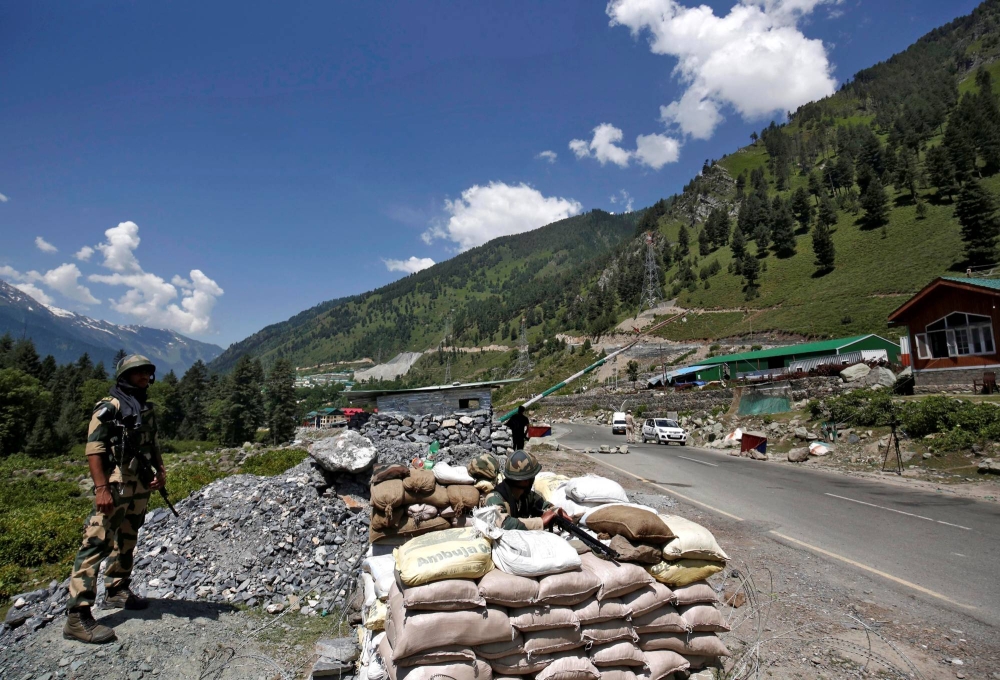
China and India have been locked in a tense conflict along their Himalayan border since April 2020, when Chinese troops stealthily encroached upon some key borderlands in the northernmost Indian territory of Ladakh. More than three years later, the standoff between rival forces has solidified, with China continuing to frenetically erect new warfare infrastructure along the long frontier.
Even then, Chinese President Xi Jinping is expected to visit New Delhi next month for the Group of 20 summit, which is likely to be attended by other world leaders, from U.S. President Joe Biden and French President Emmanuel Macron to Prime Minister Fumio Kishida. Russian President Vladimir Putin’s appearance is uncertain given that the war in Ukraine appears to be at a pivotal stage.
The Sept. 9-10 summit raises the possibility that Xi’s trip could propel efforts for a deal to help defuse what has become an increasingly dangerous military confrontation between the nuclear-armed demographic titans. Both sides have forward deployed more and more lethal weapons.
Meanwhile, border clashes have intermittently occurred since May 2020, even as corps commanders from the two militaries have met 18 times over three years to negotiate a pullback of forces. Through these lengthy negotiations, India has managed only to get China to convert its smaller encroachments into buffer zones — largely on Beijing’s terms, with Indian forces retreating further back into their own territory.
Today, with more than 100,000 rival troops backed by reserves locked in the standoff at multiple sites from the western to the eastern Himalayas, the military crisis can be eased only if both sides agree to sequentially disengage, de-escalate and de-induct forces from front-line positions through verifiable methods.
However, there seems little prospect of a return to the status quo ante along the disputed frontier. China has not only changed the territorial status quo in the western sector but also remains engaged in a frenzied construction of new military infrastructure along the entire border, as if it were preparing for war. The new infrastructure extends from helipads and radar sites to cold-weather troop shelters and ammunition depots.
Even if a deal of some sorts was reached to ease military tensions, the largest Himalayan buildup of rival forces in history, coupled with the expanding Chinese warfare infrastructure, promises to lastingly turn what was once a lightly patrolled frontier into a perennially hot border.
More broadly, the Himalayan conflict also holds lessons for Japan, whose control of the Senkaku Islands, calledthe Diaoyu in China, has come under increasing challenge from China. The record-long Chinese intrusion in April into Japanese territorial waters near the islets highlighted this challenge.
In fact, China is pursuing its revisionism against Japan in ways that mirror its strategy of attrition, friction and containment against India. Incremental advances by stealth below the threshold of war through a “salami-slicing” approach have become integral to China’s expansionism.
Sinicizing the names of the places it covets is also part of China’s strategy to buttress its sovereignty claims. But China’s various territorial claims in Asia are based not on international law but on alleged history.
Like Japan, India has been overly on the defensive. Consequently, the daunting challenge India faces today is to regain lost territory in the same way China took it — without resort to open combat.
For Japan, the fundamental message from Chinese expansionism in the Himalayas is that China can disturb the status quo at any time of its choosing, even if it means violating binding bilateral agreements and international norms. China’s military actions against India openly breach four separate border management agreements the two sides signed between 1993 and 2013, including forswearing any attempt to unilaterally change the territorial status quo.
As Japan’s own experience in dealing with Chinese intrusions underscores, stealth, deception and surprise are central to China’s strategy.
In fact, improvements in bilateral relations do not deter Beijing from springing a nasty surprise on the other side. The Chinese encroachments on the Indian borderlands occurred just six months after Xi declared during an India visit that, “China-India relations have entered a new phase of sound and stable development.”
Simply put, China’s aggressive actions bear no relation to the state of ties with the country it targets. Seeking better relations with Beijing, far from helping to improve Chinese behavior, can even backfire, as Indian Prime Minister Narendra Modi has bitterly discovered. Seeking to befriend China, Modi met with Xi 18 times over five years before the Chinese encroachments occurred.
Another lesson is that booming bilateral trade and economic interdependence also do not constrain China’s behavior. If anything, expanding economic ties only constrict the other side’s strategic leeway for fear of losing access to the Chinese market.
Yet another lesson for Japan, as for India, is that being constantly on the defensive only emboldens China to needle the targeted country or infringe its sovereignty. Coming out of a reactive and defensive mode is vital to checkmate China’s expansionist designs.
Having normalized its intrusions into Japanese territorial waters and airspace, China is working to progressively alter the status quo in the East China Sea in its favor. It draws strength from its success in redrawing the geopolitical map of the South China Sea without firing a single shot or incurring any international costs.
If Japan is not to find itself increasingly at the receiving end of China’s muscular revisionism, it must formulate a concrete counterstrategy.
Brahma Chellaney, a longtime contributor to The Japan Times, is a geostrategist and author of nine books, including “Water: Asia’s New Battleground.”
China is unmatched as the world’s hydro hegemon, with more large dams in service than every other country combined. Now it is building the world’s first super dam, close to its heavily militarized frontier with India.
This megaproject, with a planned capacity of 60 gigawatts, would generate three times as much electricity as the Three Gorges Dam, now the world’s largest hydropower plant. China, though, has given few updates about the project’s status since the National People’s Congress approved it in March 2021.
Opacity about the development of past projects has often served as cover for quiet action. Beijing has a record of keeping work on major dam projects on international rivers under wraps until the activity can no longer be hidden in commercially available satellite imagery.
The super dam is located in some of the world’s most treacherous terrain, in an area long thought impassable.
Here, the Brahmaputra, known to Tibetans as the Yarlung Tsangpo, drops almost 3,000 meters as it takes a sharp southerly turn from the Himalayas into India, with the world’s highest-altitude major river descending through the globe’s longest and steepest canyon.
Twice as deep as the U.S. Grand Canyon, the Brahmaputra gorge holds Asia’s greatest untapped water reserves while the river’s precipitous fall creates one of the greatest concentrations of river energy on Earth. The combination has acted as a powerful magnet for Chinese dam builders.
The behemoth dam, however, is the world’s riskiest project as it is being built in a seismically active area. This makes it potentially a ticking water bomb for downstream communities in India and Bangladesh.
The southeastern part of the Tibetan Plateau is earthquake prone because it sits on the geological fault line where the Indian and Eurasian plates collide.
The 2008 Sichuan earthquake, along the Tibetan Plateau’s eastern rim, killed 87,000 people and drew international attention to the phenomenon of reservoir-triggered seismicity (RTS).
Some Chinese and American scientists drew a link between the quake and Sichuan’s Zipingpu Dam, which came into service two years earlier near a seismic fault. They suggested that the weight of the several hundred million cubic meters of water impounded in the dam’s reservoir could have triggered RTS or severe tectonic stresses.
But even without a quake, the new super dam could be a threat to downriver communities if torrential monsoon rains trigger flash floods in the Great Bend of the Brahmaputra. Barely two years ago, some 400 million Chinese were put at risk after record flooding endangered the Three Gorges Dam.
Meanwhile, the 11 large dams China has built on the upper reaches of the Mekong have had many negative ecological impacts, including recurrent drought, for downriver nations. But not only is China constructing more big dams on the Mekong, it is now also turning its attention to tapping the bounteous water resources in the Brahmaputra Basin.
In pursuing its controversial megaproject on the Brahmaputra, China is cloaking its construction activity to mute international reaction.
China presented the super dam project for the approval of the National People’s Congress only after it had built sufficient infrastructure to start transporting heavy equipment, materials and workers to the remote site.
Barely two months after parliament’s approval two years ago, Beijing announced that it had accomplished the feat of completing a “highway through the world’s deepest canyon.” That highway ends very close to the Indian border.
The following month, Beijing announced the launch of a new rail line from Lhasa to Nyangtri, a frontier military base less than 16 kilometers from the India border. In fact, President Xi Jinping began a surprise tour of Tibet in July 2021 from Nyangtri, taking the new train from there to the regional capital.
The new infrastructure indicates that work on the dam’s foundation likely began quietly after the opening of the railroad and highway.
The Brahmaputra was one of the world’s last undammed rivers until China began constructing a series of midsized dams on sections upstream from the famous canyon. With its dam building now moving close to border areas, China will in due course be able to leverage transboundary flows in its relations with rival India.
But the brunt of the environmental havoc that the megaproject is likely to wreak will be borne by Bangladesh, in the last stretch of the river. The environmental damage, however, is likely to extend up through Tibet, one of the world’s most biodiverse regions. In fact, with its super dam, China will be desecrating the canyon region which is a crucial Tibetan holy place.
A cardinal principle of water peace is transparency. The far-reaching strategic, environmental and inter-riparian implications of the largest dam ever conceived make it imperative that China be transparent. Only sustained international pressure can force Beijing to drop the veil of secrecy surrounding its project.
Brahma Chellaney is professor emeritus of strategic studies at the Center for Policy Research in New Delhi and a former adviser to India’s National Security Council. He is the author of nine books, including “Water: Asia’s New Battleground.”
How does one explain the fact that the administration of U.S. President Joe Biden has made Bangladesh a focus of its democracy promotion efforts by dangling the threat of visa sanctions against officials who undermine free elections while staying silent on the undeclared martial law situation in Pakistan, where mass arrests, disappearances and torture have become political weapons?
The short answer is that U.S. promotion of democratic rights has long been selective, with geopolitical considerations often dominant. The pursuit of moral legitimacy for the cause of democracy promotion has also contributed to making sanctions the tool of choice for U.S. policymakers.
In the case of Bangladesh, the Biden administration is seeking to leverage two other factors: that close relatives of many Bangladeshi politicians live in the U.S. or Britain, including Prime Minister Sheikh Hasina’s son who holds an American green card; and that the bulk of Bangladesh’s exports go to the West, with the U.S. the top destination.
Few can object to what Secretary of State Antony Blinken says is the U.S. goal: that Bangladesh’s next election in early 2024 is free and fair. However, his threat to withhold visas from individuals “responsible for, or complicit in, undermining the democratic election process” is hardly conducive to the promotion of this aim. If anything, it is likely to prove counterproductive.
Hasina, daughter of the country’s independence leader and first head of state, contends that the U.S. is pursuing a strategy of regime change in her country. “They are trying to eliminate democracy and introduce a government that will not have a democratic existence,” she told parliament in April. “It will be an undemocratic action.”
Leading a secular government since 2009 that Bangladesh’s Islamists detest, Hasina has given the country political stability and rapid economic growth, although the global economic fallout from the Ukraine war is now weighing on the country’s finances.
Bangladesh’s impressive growth trajectory stands in stark contrast to the chronic political and economic turmoil seen in Pakistan, which today is teetering on the brink of default. Yet while Bangladesh was excluded from the Summits for Democracy convened in 2021 and earlier this year by Biden, Pakistan was invited both times though it did not attend either.
While continuing to reward Pakistan by prioritizing short-term geopolitical considerations, the Biden administration has been criticizing democratic backsliding in Bangladesh. In 2021, it designated Bangladesh’s elite Rapid Action Battalion and six of its current and former leaders as complicit in, or engaged in, serious human rights abuses in relation to the country’s war on drugs, effectively freezing all their assets in the U.S.
In December, Peter Haas, the U.S. ambassador to Bangladesh, insolently demanded that the authorities investigate a deadly clash between police and members of the Bangladesh Nationalist Party, which is the country’s largest opposition party and has allied itself with radical Islamist parties. More recently, Blinken told Bangladeshi Foreign Minister Abdul Momen of his “concerns about violence against, and intimidation of, the media and civil society,” according to a State Department statement.
Blinken’s wielding of the visa-sanctions stick is clearly aimed at members of Hasina’s government, including law enforcement and other security officials, although the announcement of the new policy also mentioned members of opposition parties.
But sanctioning foreign officials usually serves no more than a symbolic purpose while hampering diplomacy. It can also have unintended consequences.
Earlier this month, Beijing rebuffed Washington’s request for a meeting in Singapore between U.S. Defense Secretary Lloyd Austin and Gen. Li Shangfu, his Chinese counterpart. Beijing cited Li’s presence on a U.S. sanctions list to which he was added five years before his appointment in March as defense minister.
It could even be argued that U.S. sanctions against Min Aung Hlaing, the commander-in-chief of the Myanmar military, alongside three other senior commanders, contributed to the coup that ousted the country’s civilian government in 2021, as the generals may have felt they had little to lose personally by going ahead. Added sanctions since then have only exacerbated Myanmar’s internal situation and driven the country closer to China.
From Myanmar and Iran to Belarus and Cuba, U.S. sanctions have failed to bring about political change. The relative decline of American influence and the ongoing shift in global power from the West to the East are making U.S.-led sanctions less and less effective. However, with the West still controlling the global financial architecture and the dollar remaining the world’s primary reserve currency, sanctions are still an attractive option for American policymakers.
The new hard line toward Dhaka makes little sense. The Hasina government could be a significant partner in the U.S. war on terror and in improving Asian security. Instead, bilateral relations are under strain. No one from the Biden administration even met with Hasina when she visited Washington last month for discussions with the World Bank and International Monetary Fund.
While in Singapore this month, Austin declared that America “will not flinch in the face of bullying or coercion” from China. But bullying and coercion are also unlikely to advance U.S. interests in Bangladesh.
In fact, bullying the world’s seventh-most populous country, far from helping to promote a free and fair election, is more likely to revive painful memories of how the U.S. looked the other way in 1971 as the Pakistani military brutally resisted Bangladesh’s efforts to achieve independence from Islamabad, slaughtering up to 3 million people. What is Washington really after now?
Brahma Chellaney is professor emeritus of strategic studies at the Center for Policy Research in New Delhi and a former adviser to India’s National Security Council. He is the author of nine books, including “Water: Asia’s New Battleground.”
U.S. President Joe Biden’s last-minute cancellation of his planned appearance at a Quad summit in Australia will strengthen the perception that the war of attrition in Ukraine is deflecting Washington’s attention from mounting security challenges in the Indo-Pacific region.
Citing the imperative of cutting a deal with congressional leaders to avert a looming U.S. debt default, Biden also scrapped plans to stop in Papua New Guinea for what was to be the first visit by a U.S. president to a Pacific Island nation.
The dual cancellations will reinforce questions about America’s commitment to the Indo-Pacific, which is shaping up as the world’s economic and geopolitical hub.
If Russia’s invasion of Ukraine has shaken the foundations of the international order, as many observers contend, a Chinese takeover of Taiwan would usher in a new global order by ending America’s preeminence and irreparably damaging the U.S.-led alliance system. Yet the Biden administration remains overly focused on European security.
Biden’s planned Pacific tour next week had promised to put the international spotlight back on the Indo-Pacific and would have signaled that Washington had not taken its eye off the region despite America’s increasing involvement in the Ukraine war in terms of providing weapons, training and battlefield targeting data to Kyiv.
Only China can be pleased by Biden’s decision to simply return to the White House after the Group of Seven summit in Hiroshima, Japan.
Just as China is the sole country really benefiting from the conflict in Ukraine, Biden’s scrapped visits are likely to bolster Chinese ambitions in the Pacific while setting back Washington’s efforts to contain Beijing’s growing influence. Using its economic power and the world’s largest naval fleet, China has been making rapid inroads among Pacific island nations.
Biden’s canceled visits serve as a fresh reminder that hyperpartisan politics and hardened polarization in the U.S. are crimping the country’s foreign policy. Indeed, America’s partisan divide has a direct bearing on its foreign policy priorities, with Republicans most concerned about China and Democrats about Russia, according to opinion polls.
Indian Prime Minister Narendra Modi plans to proceed without Biden to Papua New Guinea for a summit with Pacific island leaders, and then to go on to Australia.
India has been steadily expanding its outreach to strategically located Pacific nations, stepping up foreign aid and establishing the Forum for India-Pacific Island Cooperation. Meanwhile, around 24,000 people have registered to welcome Modi to Stadium Australia in Sydney next Tuesday.
More broadly, the Quad summit’s cancellation could not come at a worse time for a grouping that is already at a crossroads.
The Quad was resurrected during U.S. President Donald Trump’s term but summits among its leaders began only after Biden took office in 2021. Despite this increased engagement, the Quad’s challenges have been growing due to the absence of a clearly defined strategic mission for the group.
Biden is the third straight U.S. president to commit to shifting America’s primary strategic focus to Asia and the wider Indo-Pacific. But the deepening U.S. involvement in the Ukraine conflict, coupled with the possibility that the war could drag on for a long time, suggests that he, too, could fail to genuinely make a pivot.
As if that were not bad enough, Biden has saddled the Quad with an increasingly expansive agenda that dilutes its Indo-Pacific strategic focus.
Biden’s Indo-Pacific strategy, unveiled last year, underlined how the Quad has turned its attentions to everlasting universal challenges ranging from climate change and cybersecurity to global health and resilient supply chains. Such an ambitious agenda has little to do with the Quad’s original core objectives, including acting as a bulwark against Chinese expansionism and ensuring a stable balance of power in the Indo-Pacific.
By pursuing a strategy to bleed Russia in Ukraine, Biden may be weakening a major adversary, but he is also sapping America’s strength.
The war is revealing Western military shortcomings, with weapons in short supply, critical munitions depleted, and U.S. capacity to restock insufficient. More fundamentally, it is distracting America from growing Indo-Pacific challenges.
The last thing Chinese President Xi Jinping wants is an end to the Ukraine war because that would leave the U.S. free to focus on the Indo-Pacific.
Indeed, before moving on Taiwan, Xi could seek to further deplete U.S. weapons arsenals through indirect arms shipments to Russia that could force the West to send more supplies to Ukraine. To a limited extent, Xi is already aiding Russian President Vladimir Putin’s war by supplying drones, navigation equipment, jamming technology, fighter-jet parts and semiconductors to sanctioned Russian entities.
Against this backdrop, the Ukraine war is accentuating the Quad’s challenges, even while its leaders continue to regularly hold discussions, including an expected gathering on the sidelines of the G-7 summit in Hiroshima where Modi and Australian Prime Minister Anthony Albanese will appear as special guests.
To acquire clear strategic direction and meaning, the Quad must focus on dealing with Indo-Pacific challenges, not global ones. Without a distinct strategic vision and agenda, the Quad will have little impact and just be an ineffective talking shop.
Brahma Chellaney is professor emeritus of strategic studies at the Center for Policy Research in New Delhi and a former adviser to India’s National Security Council. He is the author of nine books, including “Water: Asia’s New Battleground.”



 A banner erected by the Indian army near Pangong Tso lake along the country’s frontier with China. © AP


 The last thing Chinese President Xi Jinping, left, wants is an end to the Ukraine war because that would leave the U.S. free to focus on the Indo-Pacific. © Reuters
 Stagecraft and Statecraft
You must be logged in to post a comment.