China Must Not Choose the Next Dalai Lama

With his relentless espousal of non-violence, the Dalai Lama embodies Tibetan resistance to Chinese occupation. This helps to explain why China is so intent on choosing his successor, and why the US and India must make sure that it does not.

BRAHMA CHELLANEY, Project Syndicate

As the Dalai Lama – the spiritual leader of Tibet – visits the United States to receive medical treatment on his knees, concerns over who will succeed him have become acute. While Tibetans around the world pray that the 88-year-old Tenzin Gyatso, the 14th Dalai Lama, still has plenty of life ahead of him, China is eagerly awaiting his demise, so that it can install a puppet successor.

Tibetans regard the Dalai Lama as the living incarnation of Buddha. Since 1391, the Dalai Lama has been reincarnated 13 times. When one Dalai Lama dies, the search for the next one begins, with a council of senior disciples taking responsibility for identifying him, based on signs and visions. But in recent years, the Chinese government has insisted that only it has the right to identify the next Dalai Lama.

This would not be the first time China selected a leader of Tibetan Buddhism. In 1995, it anointed its own Panchen Lama, whose spiritual authority is second only to that of the Dalai Lama, after abducting the actual Panchen Lama – a six-year-old boy who had already been confirmed by the Dalai Lama. Almost three decades later, the real Panchen Lama is among the world’s longest-serving political prisoners.

China also appointed the Karmapa, Tibetan Buddhism’s third most important spiritual leader and the head of the Karma Kagyu sect. But in 1999, its appointee, Ogyen Trinley Dorje, fled to India. The ease with which the 14-year-old Karmapa escaped China raised suspicions among Indians about his loyalties. After imposing travel restrictions on him, India decided in 2018 no longer to recognize the China-anointed Karmapa as the legitimate head of his sect. Now, he and his rival Karmapa, Trinley Thaye Dorje, have issued a joint statement pledging to cooperatively resolve the leadership split in the Karma Kagyu sect.

But the Dalai Lama is China’s “white whale.” The incumbent – who was identified as the Dalai Lama in 1937, at age two – has been a thorn in the side of the Communist Party of China (CPC) since China’s 1951 annexation of Tibet. With his relentless espousal of non-violence, the Dalai Lama, who won the Nobel Peace Prize in 1989, embodies Tibetan resistance to the Chinese occupation. (Had Tibet remained self-governing like Taiwan, it would be the world’s tenth-largest country by area.)

In his past incarnations, the Dalai Lama was not only Tibet’s spiritual leader, but also its political leader, making him a kind of cross between a pope and a president. But the Dalai Lama ceded his political role in 2011 to a Tibetan government-in-exile, which is democratically elected every five years by Tibetan refugees living in India and elsewhere.

Moreover, the Dalai Lama has declared that he might choose not to be reborn – a decision that would undermine the legitimacy of any Chinese-anointed successor. He knows that, for China, a Dalai Lama devoted to the CPC is much more useful than no Dalai Lama at all. He also knows that, while he has retained his mental acuity, his body is weakening. In 2016, he underwent radiation therapy for prostate cancer. He says he was “completely cured,” but he continues to struggle with his knees. Given his advanced age, more health problems are to be expected.

The Dalai Lama’s frailty is one reason why his travel schedule has slowed considerably. But it is not the only one: bowing to Chinese pressure, most countries – including European democracies and Asia’s Buddhist states (except Japan) – are unwilling to grant him entry. Fortunately, some countries have retained their backbones. The US is hosting the Dalai Lama for knee treatment, and India has proudly been his home for more than 65 years. India has officially designated the Dalai Lama its “most esteemed and honored guest,” while the Tibetan leader describes himself as a “son of India.”

In fact, India is home to the vast majority of Tibetan exiles, and has played a central role in helping to preserve the Tibetan culture, including by supporting Tibetan-language schools. By contrast, China has been working actively to destroy Tibetan culture and identity, especially since Chinese President Xi Jinping has been in charge.

Meanwhile, China’s appropriation of Tibetan natural resources has gone into overdrive, with consequences that extend far beyond the Tibetan Plateau. Resource-rich Tibet is a source of fresh water for more than one-fifth of the world’s population and a global biodiversity hotspot. The plateau influences Asia’s weather and monsoonal patterns, as well as the Northern Hemisphere’s “atmospheric general circulation” – the system of winds that helps transport warm air from the equator toward higher latitudes, creating different climate zones.

It is imperative that the US and India work together to foil China’s plan to handpick the next Dalai Lama. Already, America’s Tibetan Policy and Support Act, which took effect in 2020, says that “the wishes of the 14th Dalai Lama, including any written instructions, should play a determinative role in the selection, education, and veneration of a future 15th Dalai Lama.” And it calls for sanctions on Chinese officials who interfere with Tibetan Buddhist succession practices.

But more must be done. For starters, US President Joe Biden should take the opportunity presented by the Dalai Lama’s knee treatment to fulfill a 2020 campaign promise to meet with the Dalai Lama. More broadly, the US should work with India to devise a multilateral strategy to counter Xi’s plan to capture the more than 600-year-old institution of the Dalai Lama. This must include efforts to persuade the Dalai Lama to spell out, once and for all, the rules that must be followed to identify his successor.

Brahma Chellaney, Professor of Strategic Studies at the New Delhi-based Center for Policy Research and Fellow at the Robert Bosch Academy in Berlin, is the author of nine books, including Water: Asia’s New Battleground (Georgetown University Press, 2011), for which he won the 2012 Asia Society Bernard Schwartz Book Award.

© Project Syndicate, 2024.

Is the U.S. prepared for a Taiwan invasion?

Brahma Chellaney, Taipei Times

Preserving its global dominance appears to have driven the West’s expanding involvement in the Ukraine conflict, with former British Prime Minister Boris Johnson recently arguing in a column that a Russian victory would be “a turning point in history, the moment when the West finally loses its post-war hegemony.” Such a decisive outcome, however, seems doubtful, given the attritional character of the Ukraine war and the progressively escalating Western involvement in the conflict.

The defining moment that formally brings the era of Western preeminence to an end is more likely to be a surprise Chinese aggression aimed at subjugating Taiwan.

With the wars in Ukraine and the Middle East testing U.S.-led alliances and with America already looking overextended, Chinese aggression against Taiwan could come sooner than many in U.S. policy circles expect.

There are ominous signs that Chinese President Xi Jinping is preparing his country for a war over Taiwan. But whether the U.S. is prepared to respond to such a contingency is becoming a vexed question, especially as international concerns grow that Xi might view America’s preoccupation with extended conflicts in Europe and the Middle East as a window of opportunity to act, without triggering a full-fledged war with the U.S.

The defense of Taiwan is assuming greater significance for international security for two other reasons. The first is the possibility that Xi might seek to replicate in the Taiwan Strait the techniques of incremental expansionism that his regime has successfully honed in the South China Sea without drawing a concerted U.S. response.

Tellingly, three successive U.S. administrations have failed to credibly push back against China’s intensifying expansionism in the South China Sea, relying instead on rhetoric or symbolic actions. As a result, the American debate now largely centers on how the South China Sea was effectively lost and what can be done now to respond to China’s increasingly aggressive sea tactics aimed at tightening its grip on this strategic corridor between the Pacific and Indian Oceans.

These tactics are triggering a number of incidents with other claimant states, particularly the Philippines and Vietnam, even as China seeks to interfere with U.S. and allied air and maritime transits.

China’s recent menacing military drills that encircled Taiwan seemed to be a rehearsal for implementing at least a blockade with the aim of slowly throttling the island democracy. In fact, this was the third Chinese dress rehearsal in less than two years for an assault on Taiwan.

Compared to the first large-scale Chinese military exercise in August 2022, when then-U.S. House Speaker Nancy Pelosi visited Taipei, the latest drills were more sophisticated, elaborate and geographically expansive.

The second reason is the U.S. failure to genuinely pivot to Asia and the wider Indo-Pacific, despite U.S. Defense Secretary Lloyd Austin claiming that this region is “our priority theater of operations” and “the heart of American grand strategy.”

A just-released book, “Lost Decade: The U.S. Pivot to Asia and the Rise of Chinese Power,” by two former American policymakers, Robert Blackwill and Richard Fontaine, bemoans that America’s “pivot to Asia” strategy (first unveiled in 2011) has failed thus far because a coherent approach to the Indo-Pacific remains largely absent. Consequently, the U.S. has been unable to respond adequately to China’s aggressive rise, in what the authors call one of the greatest mistakes in American foreign policy in the post-World War II period.

The plain fact is that, as long as conflicts elsewhere distract the U.S. from the pressing Asian security challenges, the Indo-Pacific is unlikely to become the hub of its grand strategy.

The latest American foreign assistance package that provides $60.8 billion for Ukraine and a meager $8.1 billion for Indo-Pacific security, including Taiwan, has dimmed the prospects of a correction in skewed strategic priorities. In fact, U.S. President Joe Biden recently plunged the U.S. deeper into the Ukraine war by permitting Kyiv to use American-donated weapons to strike inside Russia.

More fundamentally, the drawn-out Ukraine war is crimping America’s China policy and weakening its deterrent posture in the Indo-Pacific, thereby making a Taiwan Strait crisis more likely.

In an effort to forestall the U.S. from realizing its worst geopolitical nightmare, a formal Sino-Russian alliance, and to dissuade China from directly aiding the Kremlin’s war machine, Biden has been compelled to adopt a more conciliatory approach to Beijing.

This approach, in turn, is emboldening China vis-à-vis Taiwan. While stepping up coercive pressures on Taiwan, Beijing is making its ultimate goal clearer. Xi recently declared that the “essence” of his national rejuvenation drive is “the unification of the motherland.” And his new defense minister, Dong Jun, while accusing the U.S. of “malign intentions [that] are drawing Taiwan to the dangers of war,” told the annual Shangri-La Dialogue in Singapore that, “Anyone who dares split Taiwan from China will be smashed to pieces and court their own destruction.”

Yet some in the West insist that the U.S. must first rout Russia on the Ukrainian battlefield before turning to deter China. As if Xi would wait to move against Taiwan until the U.S. has humiliated Russia in Ukraine in a long war and then turned its attention to containing China. Indeed, the last thing Xi wants is an end to the Ukraine war because that would leave the U.S. free to pivot to Asia.

Make no mistake: With China’s lengthening shadow belligerently darkening Taiwan’s doorstep, the risks of failing to deter Chinese aggression against the self-governing island are increasing. Consequently, calls are growing in the U.S. that Washington must embrace strategic clarity in relation to Taiwan’s defense by abandoning its outdated strategic ambiguity policy, which was formulated when China was still backward and in no position to annex Taiwan.

America’s deepening involvement in the Ukraine war at a time it seems ill-prepared for armed conflict over Taiwan is a strategic mistake that could eventually come to haunt its long-term security.

Brahma Chellaney, professor of strategic studies at the independent Center for Policy Research in New Delhi, is the author of nine books, including the award-winning Water: Asia’s New Battleground (Georgetown University Press).

India’s global role will grow in Modi’s third term

Photo by AFP: Supporters of Narendra Modi, India’s Prime Minister and leader of Bharatiya Janata Party (BJP), celebrate vote counting results for India’s general election, at BJP headquarters in New Delhi on June 4, 2024.

BY BRAHMA CHELLANEY, The Hill

India’s election, the world’s largest democratic exercise, may have delivered a stunning surprise by denying Prime Minister Narendra Modi’s party an outright majority in parliament, but this setback is unlikely to affect the stability or direction of his third-term government.

The primary reason is that the ruling Bharatiya Janata Party, or BJP, contested the election in alliance with several small political groups, with the coalition winning a majority of seats in parliament’s ruling lower house.

Still, the BJP’s loss of its commanding majority in the lower house represents a blow to Modi’s political standing, including puncturing his air of invincibility. After stacking up political win after win, an overconfident Modi had predicted even before the campaign formally began that the BJP would secure more than two-thirds of the seats in the lower house.

The BJP’s failure to win a simple majority on its own, however, is unlikely to have a direct bearing on Modi’s national agenda or foreign policy. The allied parties Modi will depend on are provincial groups with no national vision or ideas.

Moreover, while the fragmented opposition may have unified to stop Modi’s juggernaut in the election, it lacks a common agenda or leader, which raises the question of whether its unity will endure. In fact, the combined number of seats won by the multiple parties in the opposition coalition is slightly less than what the BJP secured on its own.

Modi, 73, is entering a second decade as prime minister, despite a strong anti-incumbency sentiment in Indian society. Only one other Indian leader, Jawaharlal Nehru, secured a third term decades ago.

Modi’s leadership has given India political stability, robust economic growth and accelerated military modernization. India’s international profile and geopolitical weight are rising, partly because the end of China’s economic boom has thrown into relief the emergence of Asia’s other demographic giant as a geopolitical and economic force. India is now the world’s fastest-growing major economy.

After the election results, Modi declared that his third term would represent a “new chapter of big decisions.” But, given India’s fractious politics, big decisions often tend to fuel division and polarization, especially when they challenge entrenched interests. In his second term, Modi, for example, was compelled to repeal farm reform laws after a year of opposition-backed grassroots protests.

With his pro-growth and pro-market agenda, Modi is aiming to transform India into a global manufacturing hub at a time when Western companies are interested in shifting production away from China. Consequently, his new term is likely to see greater government spending not just in manufacturing and infrastructure but also on human capital, particularly in education and training.

The new government will have to urgently consider the nation’s foreign policy challenges, above all the military standoff with China, which recently entered its fifth year. The tense standoff, triggered by furtive Chinese encroachments on some Indian borderlands, may not be grabbing international headlines, but China persists with a frenzied buildup of force deployments along the Himalayan border, as if it is preparing for war. China recently deployed its most advanced J-20 stealth fighter jets near the India frontier.

India’s most-pressing foreign policy challenges relate to its troubled neighborhood, not least a strengthening strategic axis between China and Pakistan, with both these nuclear-armed allies staking claims to swaths of Indian territory. India is already the world’s third-largest defense spender, behind the U.S. and China.

More fundamentally, Modi has helped shape a pragmatic foreign policy vision. Shorn of ideology, Indian foreign policy has sought to revitalize the country’s economic and military security, while avoiding having to overtly choose one power over another as a dominant partner.

In practice, however, closer cooperation with the U.S. has remained Modi’s signature foreign policy initiative, despite some new irritants in the bilateral relationship, including the role of U.S.- and Canada-based Sikh militants.

While tilting toward the West, India remains loath to enter into a formal military alliance with the Western bloc. President Joe Biden’s reluctance to say anything on the Sino-Indian military standoff, let alone side with New Delhi, reminds India that it must defend itself all on its own.

India’s independent approach to international affairs is unlikely to change given that New Delhi believes in friendship without dependence. This makes India the world’s ultimate “swing state” in the current transition from the post–World War II American-led order to a new global order whose contours are still not clearly visible.

In contending with China, its sole challenger at the global level, the U.S. needs a degree of adaptability in forging partnerships, instead of hewing to the Cold War–style “us versus them” approach. A country as large as India cannot become just another Japan or Britain to America. Yet no anti-China alliance can play a strategically meaningful role without India, which has locked horns with the Chinese military in a way no other power has done in this century.

To be sure, India’s size and diversity pose enormous challenges. It is now the world’s most populous nation and is demographically and culturally very heterogeneous.

Still, as the latest election highlights, India’s democratic framework serves as a pillar of inclusion, stability and strength. By empowering people at the grassroots level through participatory processes and open dialogue, the Indian political system has enabled members of historically marginalized classes and castes to gradually gain prominence in politics and bureaucracy. Modi’s own humble beginnings illustrate this.

India today is an ascendant global player, and Modi’s focus in the third term will likely be on enabling India to play a bigger role on the world stage. India’s accelerated rise will not only increase its salience in the global balance of power but also help advance American goals in the Indo-Pacific region, the world’s new economic and geopolitical hub.

Brahma Chellaney is a geostrategist and the author of nine books, including the award-winning “Water: Asia’s New Battleground” (Georgetown University Press).

Kishida’s zeal on Ukraine comes at Japan’s expense

Japan should be worrying about Taiwan, not Ukraine.

A Patriot missile unit outside the Ministry of Defense in Tokyo in 2017: The government should not be taking weapons out of its air defenses at this time. © AP

Brahma Chellaney, Nikkei Asia

Japan has become one of Ukraine’s most-important financial backers, pouring in some $12.1 billion in aid to support the country’s war-battered economy and its defenses with nonlethal equipment such as anti-drone systems.

“As I often say, Ukraine of today may be East Asia of tomorrow,” Prime Minister Fumio Kishida told a joint session of the U.S. Congress two weeks ago, underlining the rationale for aligning Tokyo closely with America’s de facto proxy war against Russia.

But how does Kishida’s leadership role on Ukraine, including sanctions on Russia and a long-term commitment to support postwar reconstruction, tangibly advance Japan’s strategic interests at a time when its own neighborhood is becoming increasingly dangerous?

Oddly, there has been little debate in Japan on this issue. Yet the country’s deepening engagement with Ukraine at a time it is ill-prepared for armed conflict over Taiwan is a huge strategic mistake.

Ukrainian Prime Minister Denys Shmyhal, left, with Japanese Prime Minister Fumio Kishida at the reconstruction conference held in Tokyo on Feb. 19. © Reuters

The drawn-out Ukraine war is not just impeding the U.S.-led attempt to rein in China’s aggressive expansionism, it is also stretching American resources thinly and weakening Washington’s deterrent posture in the Indo-Pacific region, thereby making a Taiwan Strait crisis more likely.

Kishida’s surprise move in December, at Washington’s urging, to ship Patriot air-defense systems to the U.S. to cover for ones being sent to Kyiv illustrates the risks of a Ukraine-centric approach.

Any Chinese operation to blockade or attack Taiwan would likely intrude into Japanese airspace and waters, conceivably pulling Tokyo into a war over the island democracy. Yet amid signs Chinese President Xi Jinping is preparing his country to go to war over Taiwan, Kishida has agreed to take weapons out of Japan’s air defenses for an increasingly hopeless war in distant Europe.

In fact, with U.S. attention and resources focused on conflicts in Europe and the Middle East, China’s efforts to alter the territorial and maritime status quo in Asia and secure strategic dominance are reaching a tipping point.

Yet some in the West myopically insist that the U.S. must first defeat Russia in Ukraine before pivoting to deter China. As if Xi would wait to move against Taiwan until the U.S. has humiliated Russia in a long war and was then ready to direct greater attention his way. Indeed, the last thing Xi would like is an end to the Ukraine war because that would leave the U.S. free to focus on the Indo-Pacific region.

This explains why China, as Washington now acknowledges, is quietly aiding the Kremlin’s war machine by supplying technologies and geospatial intelligence. The transfers suggest that, before making a move on Taiwan, Xi wants the Ukraine war to further deplete America’s weapons and munitions stocks.

The flip side to America’s deepening involvement in conflicts elsewhere is a desire to avoid direct confrontation with China. This explains U.S. President Joe Biden’s more conciliatory approach to Beijing in recent months, including a greater emphasis on diplomacy than on deterrence.

The U.S. may still be the world’s foremost military power, but it is in no position to meaningfully take on Russia and China simultaneously. According to its own official national security doctrine, the U.S. maintains the military capability to fight and defeat China or Russia with some allied support — but not both simultaneously.

In recent decades, the U.S. has waged overlapping wars, but these were against much weaker states, namely Iraq and Afghanistan. Still, these protracted wars exposed shortcomings in America’s ability to pursue two military missions simultaneously at full tempo.

In this light, Biden has stepped up his administration’s outreach to Beijing to help avert a Chinese attack on Taiwan that could result in a direct war between the U.S. and a near-peer adversary. But with the U.S. looking overextended and Xi viewing Biden’s conciliatory posture as one of weakness, the risks of failing to deter aggression against Taiwan are increasing.

The risks are particularly acute for Japan, whose southernmost islands lie close to Taiwan. As former Prime Minister Taro Aso has warned, if Taiwan falls, “Okinawa could be next.”

Japan should recall that U.S. appreciation of its generous financial support for previous missions has been fleeting.

A classic example is the 1991 Gulf War campaign against Iraq for which Japan contributed $13 billion. Yet then-U.S. Secretary of State James A. Baker III said, “Your ‘checkbook diplomacy,’ like our ‘dollar diplomacy’ of an earlier era, is clearly too narrow.”

Today, Japan needs to shed its zeal toward Ukraine and focus squarely on Taiwan. This should include not sending more Patriots or other defense systems to backstop Kyiv.

An overstretched America and a Japan straining to avert recession must persuade Europe to step up and take primary responsibility for Ukraine, its own neighbor.

To safeguard Asian security and the region’s balance of power, there can be no substitute for a prudent, balanced and forward-looking approach.

With China’s lengthening shadow darkening its doorstep, Japan needs to focus primarily on its combustible neighborhood and prepare for a Taiwan Strait contingency.

This should include assuring its ability to respond to a scenario in which Xi seeks to bring Taiwan to its knees by employing the techniques of incremental expansionism that his regime has successfully honed in the South China Sea without triggering a concerted U.S. response.

Not Ukraine, but the South China Sea of today could be the Taiwan of tomorrow. This means that Japan, without being unduly distracted by developments afar, must find effective ways to beat back China’s hybrid warfare.

Brahma Chellaney is professor emeritus of strategic studies at the Centre for Policy Research in New Delhi and a former adviser to India’s National Security Council. He is the author of nine books, including “Water: Asia’s New Battleground.”

Biden’s massive military aid package neglects the real strategic threat: China

A Great Wall 236 submarine of the Chinese People’s Liberation Army Navy.

BY BRAHMA CHELLANEY, The Hill

The congressional breakthrough on the $95 billion foreign assistance package after months of political wrangling provides President Joe Biden’s administration with arms outlays that are larger than the defense budget of every country other than the United States, China and Russia. Biden now has considerable leverage to further conflict or deterrence across three large geographic regions encompassing more than half of the world — Europe, the Middle East and the Indo-Pacific.

The package effectively opens the floodgates to the greater flow of sophisticated American weapons, especially to Ukraine. In fact, even before Biden signed the foreign assistance bill into law, Ukraine began using longer-range ATACMS missiles against Russian forces that the U.S. had secretly supplied. And as the law took effect, the Pentagon immediately rushed $1 billion worth of American weapons to Ukraine.

The package reflects the Biden administration’s skewed strategic priorities: It provides $60.8 billion for Ukraine in its war of attrition with Russia, with much of the funding going to U.S. defense contractors and the Pentagon; $26.4 billion for Israel and America’s supporting military operations in the Middle East; and a relatively miserly $8.1 billion for Taiwan and other security challenges in the Indo-Pacific region — the world’s center of gravity where America’s main rival, China, is incrementally changing the territorial and maritime status quo.

The congressional logjam over the package had jeopardized the centerpiece of Biden’s foreign policy, which has focused America’s attention and resources on the wars in Europe and the Middle East. But the region central to the global balance of power and peace is the Indo-Pacific.

The longer the U.S. remains involved in the conflicts in Europe and the Middle East, the greater will be the likelihood of China invading Taiwan. It is telling that, under Biden, an overextended America is seeking to dissuade Chinese President Xi Jinping from launching an attack on Taiwan more through diplomacy than deterrence.

Biden’s latest defense budget, and the small outlays for the Indo-Pacific in the $95.3 billion package, show that deterrence against China has assumed a subsidiary policy role. The budget not only underfunds key enabling capabilities for the Indo-Pacific but also cuts programs, including slashing the production goal for Virginia-class submarines from two per year to just one.

China, on the other hand, is engaged in a frenzied naval buildup. China’s surface naval fleet is now already much larger than the American fleet. In terms of number of submarines, China, by embarking on a new generation of nuclear-armed subs, possibly with Russian assistance, is set to go beyond its current near-parity with the U.S. Meanwhile, qualitative improvements in battle force ships and more aggressive tactics by the Chinese navy are already making it more challenging for American ships and submarines to operate in China’s maritime backyard.

The Ukraine war, for its part, has helped raise the specter of the U.S. realizing its worst geopolitical nightmare: a Sino-Russian strategic axis. Secretary of State Anthony Blinken this month called China “the primary contributor” to Russia’s defense industrial base.

The conflict has already exposed NATO’s military shortcomings, including its struggle to scale up weapons and munitions manufacturing to match the output of Russia’s war economy. Chinese President Xi Jinping seems to be aiding the Kremlin’s war machine in an apparent effort to keep the U.S. tied down in Ukraine and further deplete Western arsenals before invading Taiwan.

Against this background, the massive new U.S. funding for Ukraine will further deepen American involvement in the conflict without any prospect of changing the tide of the war. U.S. officials now acknowledge that there is little prospect of Ukraine regaining the 20 percent of its territory already occupied by Russia.

The Biden administration’s narrative on the war has evolved through three distinct phases. In the immediate aftermath of the Russian invasion, the “save Ukraine” narrative was dominant, before being overtaken by the “bleed Russia” narrative, which presented the Western supply of weapons and battlefield intelligence to Ukrainian forces as a cost-effective investment to severely “weaken” an adversary militarily.

Even after the much-hyped Ukrainian counteroffensive floundered last summer, dashing NATO’s hopes of a major military breakthrough against Russia, the administration — anxious not to lose public support for the war — continued to peddle the line that Ukraine was winning the fight against Russia.

The third phase, “help Ukraine stave off defeat,” began more recently, when CIA Director Bill Burns warned that Ukraine could lose the war to Russia by year’s end absent additional American aid. The shift in the narrative from “Ukraine is winning” to “Ukraine may be facing defeat” was jarringly abrupt.

Make no mistake: Even if the new U.S. assistance of $60.8 billion helps Ukraine avert defeat, it is unlikely to dramatically reverse Ukrainian fortunes on the battlefield against a much stronger foe. Indeed, the longer the war extends, the greater is likely to be Ukraine’s devastation, making reconstruction more costly and onerous.

By sending more lethal and longer-range weapons to Ukraine, the U.S. funding, however, carries the risk of triggering a direct NATO conflict with Russia, which has the world’s largest nuclear arsenal. Western powers have also increasingly provided Ukraine battlefield targeting data and even some actual assistance on the ground near the front lines.

German Chancellor Olaf Scholz faced some flak in February for inadvertently exposing the role of Britain, France and possibly the U.S. in militarily helping direct attacks on Russian targets from Ukrainian soil through “target control.” Scholz said that if Germany followed Britain and France in supplying Ukraine with long-range missiles, it would make it a “participant in the war,” too.

Throwing good money after bad and hoping for a miracle isn’t a strategy. Yet that exactly is the basis of the new foreign assistance package.

A wise course for Biden would be to leverage the package by quietly pushing for a ceasefire in the Ukraine war through back-channel diplomacy. The alternative is to sap America’s strength by continuing to invest heavily in a failing war, thereby creating more strategic space for China to overthrow U.S. global preeminence.

Brahma Chellaney is a geostrategist and the author of nine books, including the award-winning “Water: Asia’s New Battleground” (Georgetown University Press).

Biden’s China policy prioritizes diplomacy over deterrence

Brahma Chellaney, Taipei Times

Can US dialogue and cooperation with the communist dictatorship in Beijing help avert a Taiwan Strait crisis? Or is US President Joe Biden playing into Chinese President Xi Jinping’s (習近平) hands?

With America preoccupied with the wars in Europe and the Middle East, Biden is seeking better relations with Xi’s regime. The goal is to responsibly manage US-China competition and prevent unintended conflict, thereby hoping to create greater space for the two countries to work together in areas where their interests align.

The existing wars have already stretched US military resources thin, and the last thing Biden wants is yet another war. So, to forestall a war over Taiwan, Biden has made a series of overtures to Xi’s regime, including stressing, along with his G7 partners, that the West is seeking to “de-risk” its relationship with China, not “decouple” from the world’s second-largest economy.

Notably, after sending a string of cabinet officials to Beijing, Biden held a summit meeting with Xi in Woodside, California, last November. Biden’s recent phone call with Xi was part of the ongoing effort, as the White House put it, to responsibly manage ties with China.

But what stands out is the current US focus on a thaw with Beijing, instead of concentrating on deterring China’s aggressive expansionism. In fact, with Biden’s China strategy incorporating no clear vision of success, a “managed competition” has become an end in itself, instead of being a means to an end.

That deterrence has assumed a subsidiary role in policy is apparent from Biden’s latest proposed defense budget, which reinforces the administration’s approach of not taking the China threat seriously. It significantly underfunds key enabling capabilities for the Indo-Pacific and even cuts programs, including slashing the production goal for Virginia-class submarines from two per year to just one.

Funding just one Virginia-class attack boat is a break from the US navy’s steady two-per-year demand signal. The US is committed to selling up to three Virginia-class submarines to Australia in the 2030s under the AUKUS deal, which would make the American submarine deficit worse. In fact, America’s fiscal year 2025 budget seeks only six new battle force ships while retiring 10.

Contrast that with the way China churns out ever more weapon systems and platforms, with its surface naval fleet now significantly larger than the American fleet in number of ships. And, in terms of number of submarines, China, by embarking on a new generation of nuclear-armed subs, possibly with Russian assistance, is set to go beyond its current near parity with the US.

Meanwhile, qualitative improvements in battle force ships and more aggressive tactics by the Chinese navy are already making it more difficult for American ships and submarines to operate in China’s maritime backyard.

Make no mistake: Biden’s more conciliatory approach to China has so far yielded no tangible dividends. It has neither eased Beijing’s coercive pressures on Taiwan nor diminished China’s aggressive efforts to entrench its dominance in the South China Sea.

If anything, it has only emboldened China’s pursuit of strategic dominance in Asia. Washington now admits that China is even aiding Russia’s war in Ukraine by transferring technologies and sharing geospatial intelligence.

According to Beijing’s readout, Xi cautioned Biden during their recent phone conversation that Taiwan is a “red line that must not be crossed.”

With Xi preparing China for war against Taiwan, it has become more imperative than ever for the US to strengthen deterrence, including bolstering Taiwan’s defenses.

Yet, there is a huge backlog in US military sales to Taiwan, with weapons deals announced as long ago as 2017 still unfulfilled. For Taiwan, the US Congress previously authorized a US$1 billion-a-year replenishment of drawdown funding, but that has been slashed to US$500 million in the Pentagon’s latest budget.

In contrast to the Biden administration’s generous weapons shipments to Ukraine, there appears no urgency in providing arms to Taiwan to counter China’s increasing aggressiveness.

The administration also seems loath to address its resolve gap by stating unambiguously that the US has the strategic intent and political will to defend Taiwan against an attack.

Biden, asked last September whether American forces would defend Taiwan if China attacked, replied with a caveat, “Yes, if in fact there was an unprecedented attack.” But what would be the US response if, instead of an unprecedented attack, Xi launched a wily strategy of gradually escalating aggression against Taiwan anchored in stealth, deception and surprise?

Deterrence — or peace through strength, as it is commonly called — has stood the test of time. It has prevented wars of aggression. But failure to build and sustain adequate deterrent capabilities, by signaling weakness, can invite aggression.

Deterrence, however, must always be accompanied by diplomacy so as to forestall a destabilizing arms race or unintended conflict and create space for eventual compromise and reconciliation.

Under then-US president Ronald Reagan, the US grand strategy against the Soviet Union was designed to apply maximum pressure on the Soviet Union — diplomatic, ideological, economic and military — while pursuing a policy of engagement with Moscow. It was as much carrot as it was stick, contributing ultimately to the Soviet Union’s disintegration.

By contrast, Biden’s approach to China is more carrot than stick. “I don’t want to contain China,” Biden gratuitously declared while visiting Hanoi last September. “We’re not trying to hurt China.” The goal, Biden said, is “getting the relationship right” between the US and China.

Biden has repeatedly assured Xi that the US would not seek to change China’s political system or direct alliances against it.

Prioritizing diplomacy over deterrence has resulted in a strange paradox: the stronger established power, in attempting to preserve the status quo, is seeking to appease the revisionist power, whose expansionism continues apace.

Brahma Chellaney, professor of strategic studies at the independent Center for Policy Research in New Delhi, is the author of nine books, including the award-winning Water: Asia’s New Battleground (Georgetown University Press).

The South China Sea Could Boil Over

With the wars in Ukraine and Gaza stretching its military resources thin, a direct confrontation with China is the last thing the US needs. But America’s refusal to rein in China’s aggressive expansionism, not least in the South China Sea, may well make a clash more likely – and more destructive.

BRAHMA CHELLANEYProject Syndicate

HANOI – For over a decade now, China has been working stealthily to alter the territorial and maritime status quo in the Indo-Pacific – an effort that has increasingly stoked tensions with regional neighbors like Australia, India, Japan, Taiwan, and several Southeast Asian countries, as well as the United States. And with US attention and resources focused on conflicts in Europe and the Middle East, China has lately become even more aggressive in its expansionism. Chinese regional hegemony is closer than ever.

Almost daily, China finds a new way to bully Taiwan, which Chinese President Xi Jinping has repeatedly pledged to “reunify” with the mainland (though that objective has no basis in international law or history). As China takes steps like encroaching on Taiwan’s air-defense zone and encircling the island with warships, it raises the risk of a war that would transform global geopolitics.

There are war clouds also gathering over the Himalayas, where a military standoff triggered by China’s repeated furtive encroachments on India’s borderlands has dragged on for nearly four years. And in the East China Sea, China’s intrusions into the territorial waters and airspace of the Japanese-controlled Senkaku Islands, which China claims as its own, are fueling Japan’s drive toward rearmament.

But the biggest risks of escalation may well lie in the South China Sea, where China’s aggressive efforts to entrench its dominance have regularly led to dangerous near-confrontations, including with US warships and aircraft. For years, China has been working relentlessly to cement its dominance over the South China Sea and exploit that region’s vast resources and strategic position as a critical corridor through which one-third of global shipping passes.

To this end, China has constructed artificial islands atop remote reefs and atolls and transformed them into forward military bases. Though these activities constitute a blatant violation of international law, including a 2016 ruling by an arbitral tribunal at The Hague that invalidated Chinese claims in the South China Sea, there has been little pushback from three successive US administrations. As a result, China has managed to expand its maritime borders unilaterally without firing a single shot.

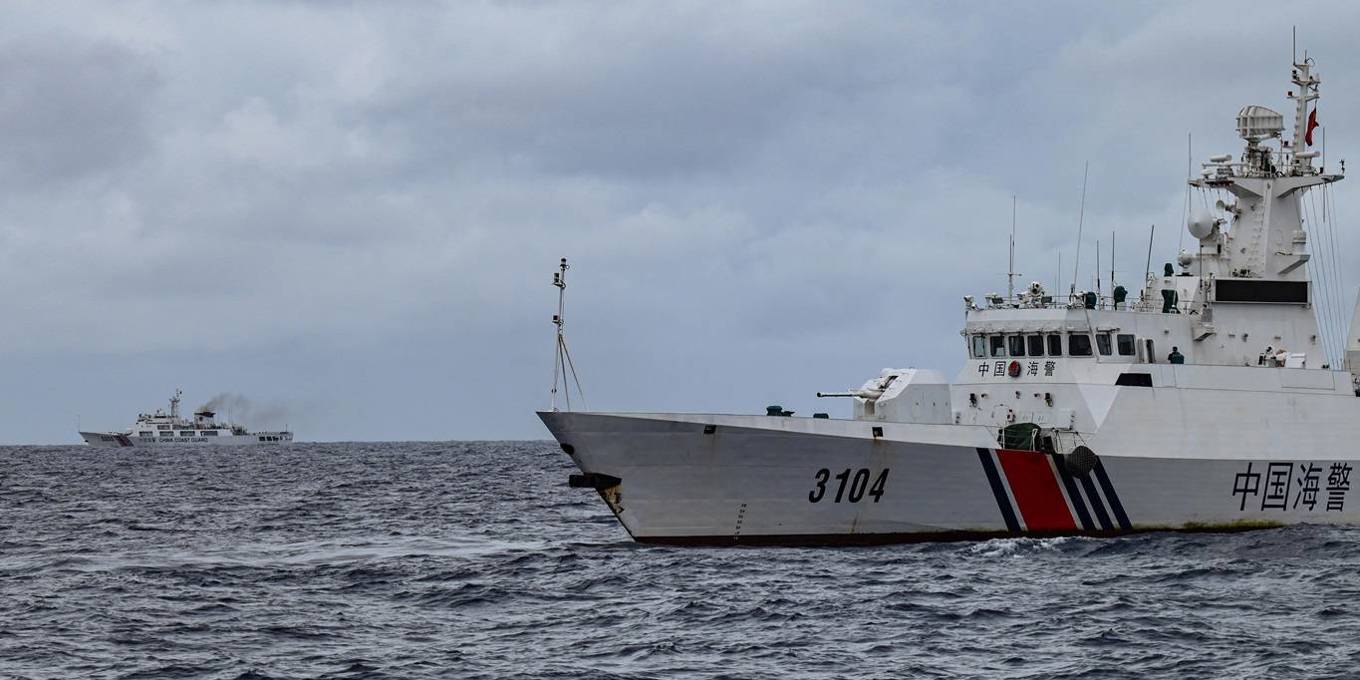
Now, China’s navy and air force routinely patrol its neighbors’ exclusive economic zones (EEZs), and its coast guard – the world’s largest and most militarized – has conducted “intrusive patrols” of others’ offshore oil and gas fields. Chinese coast-guard vessels, including megaships, wantonly employ “non-lethal” weapons like high-pressure water cannons and long-range acoustic devices.

Moreover, China has been sending its navy and coast guard to shadow, hound, and harass vessels belonging to the US, as well as to smaller neighbors, such as the Philippines and Vietnam, with territorial claims in the area. Even fishing boats have been targeted and destroyed. With Chinese ships now being deliberately designed for “ramming” and “shouldering” other vessels, it seems clear that China will become more aggressive in asserting its territorial claims – and the associated fishing and energy-exploration rights – in the South China Sea.

China’s militarization of the South China Sea poses the greatest threat to the Philippines and Vietnam. But whereas Vietnam pursues an independent foreign policy, which its prime minister calls a historical imperative, the Philippines is a longstanding US ally, with a mutual defense treaty in place since 1951.

And yet, when it comes to China’s expansionism in the South China Sea, the US has largely left the Philippines to fend for itself. In 2012, when China occupied the Scarborough Shoal, a traditional Philippine fishing ground located within the country’s EEZ, US President Barack Obama’s administration stayed silent. Since then, China has steadily eroded the Philippines’ control of other areas within its EEZ, but the US has offered its ally little beyond statements of support.

This is unlikely to change any time soon. With the wars in Ukraine and Gaza stretching American military resources thin, a direct confrontation with China is the last thing the US needs. But refusing to stand up to China may well make a clash more likely – and more destructive.

Already, the US has allowed China to gain such a strong footing in the South China Sea that restoring the status quo of just a decade ago would be all but impossible without a full-scale war. And, as the recent increase in provocations in the South China Sea indicate, Xi is bolder than ever, despite the rising risk of escalation, accidental or otherwise. In the meantime, America’s failure to rein in China’s aggressive expansionism is undermining its own security and trade interests.

US President Joe Biden insists that the US wants “competition with China, not conflict.” But China wants strategic dominance – beginning with the South China Sea – and it is willing to risk conflict to get it. The South China Sea has become a test of American resolve, which Xi is expecting Biden to fail. The world, especially the countries on the front lines of Chinese expansionism, can only hope that Xi is wrong, and that the US finds ways to rein in China without armed conflict.

Brahma Chellaney, Professor of Strategic Studies at the New Delhi-based Center for Policy Research and Fellow at the Robert Bosch Academy in Berlin, is the author of nine books, including Water: Asia’s New Battleground (Georgetown University Press, 2011), for which he won the 2012 Asia Society Bernard Schwartz Book Award.

© Project Syndicate, 2024.

China’s Indian land grab has become a strategic disaster

Xi Jinping faces dilemma in resolving crisis without losing face

An Indian fighter plane flies over a mountain range in Ladakh: The Chinese army would be hard put to get the better of India’s armed forces in a Himalayan war. © Reuters

Brahma Chellaney, Nikkei Asia

The military standoff along the long Himalayan frontier between China and India may not be grabbing international headlines these days given the open warfare raging elsewhere in the world, but the threat of the confrontation returning to armed conflict cannot be discounted.

Last week, Indian Foreign Minister S. Jaishankar called the Chinese border situation “very tense and dangerous.” Both sides have been significantly ramping up deployments of troops and weapons, girding for the possibility of war.

Soon to enter its fifth year, the current standoff was triggered by furtive Chinese encroachments into India’s northernmost territory of Ladakh in April 2020, just before thawing ice would normally reopen Himalayan access routes after the brutal winter.

Ahead of this year’s spring thaw and possible new Chinese provocations, India moved an additional 10,000 troops to the frontier. “The possibility that we may face a similar situation that we faced in 2020 is keeping us active all the time,” Indian Defense Secretary Giridhar Aramane said last month.

China has also been expanding its troop presence and frenetically building warfare-related infrastructure along the inhospitable frontier. This has included boring tunnels and shafts in mountainsides to set up command positions, reinforced troop shelters and weapons-storage facilities.

In addition, it has planted settlers in new militarized border villages that are becoming the equivalent of the artificial islands it created in the South China Sea to serve as forward military bases.

About 100,000 troops remain locked in a faceoff along the border’s westernmost Ladakh sector. Another key sector is the vulnerable area where the borders of Tibet, Bhutan and India’s Sikkim state meet, a 22-kilometer-wide corridor known as “the chicken neck” due to the crooked way it connects India’s northeast to the country’s heartland.

The corridor’s vulnerability has been increased by Chinese encroachments on Bhutan’s southwest borderlands, with the chicken neck now potentially within striking distance of China’s long-range conventional weapons.

There are also troop faceoffs in the eastern Himalayas along Tibet’s long border with India’s Arunachal Pradesh state. This has long been a heavily militarized area, largely because China claims the Indian state is part of Tibet, although the Dalai Lama, the exiled Tibetan leader, says this has no historical basis.

Talks to de-escalate tensions along the frontier have made little progress. In January, Indian Army chief Gen. Manoj Pande said the standoff would continue until China rolled back from its Ladakh encroachments, calling restoration of the previous frontier line “our first aim to achieve.”

Despite taking some flak at home for losing border areas to Chinese encroachment, Indian Prime Minister Narendra Modi continues to seek a negotiated end to the crisis.

While his government has banned numerous Chinese apps, blocked investments by certain Chinese companies and launched enforcement actions against others over alleged tax and foreign exchange violations, it has not imposed broad sanctions against its northern neighbor.

Consequently, despite the border confrontation, China’s annual trade surplus with India has continued to rise; it is now larger than India’s annual defense spending.

Modi discussed the crisis in brief with Chinese President Xi Jinping on the sidelines of multilateral summits in November 2022 and August 2023. Jaishankar reiterated earlier this month that New Delhi remains “committed to finding a fair, reasonable” agreement.

Now Xi is faced with the challenge of resolving the Himalayan military crisis without losing face.

Indian Prime Minister Narendra Modi, right, has discussed the Himalayan crisis with Chinese President Xi Jinping at two separate multilateral summits. © Reuters

For four years, tens of thousands of Chinese troops have remained deployed in extremely harsh conditions along the Himalayan frontier. If Xi somehow came to an agreement with Modi about undoing China’s territorial encroachments, he would face questions about why he embarked on the aggression in the first place.

The longer the standoff persists, though, the greater the risk that Beijing turns India into an enduring enemy, a development that would weigh down China’s global and regional ambitions.

Xi has already been confronted by his failure to anticipate India’s robust military and strategic response, with the standoff driving New Delhi closer to Washington. It also set in motion a major military buildup and modernization drive, as illustrated by a flight test last week to demonstrate that India now can put multiple independently targetable nuclear warheads on a single intercontinental ballistic missile.

Since the standoff began, India has tested several other leading-edge missile systems, including a hypersonic cruise missile, a hybrid missile-torpedo for use against submarines and aircraft carriers, an anti-radiation missile for destroying radar-equipped air defense systems and a new generation, intermediate-range ballistic missile capable of carrying nuclear or conventional warheads.

India has also been importing major weapon systems from the U.S. as well as France and other sources. In November, Defense Minister Rajnath Singh told his U.S. counterpart that their two governments are “in agreement on strategic issues, including countering China’s aggression.” India’s growing alignment with the U.S. undoubtedly worries Xi.

Without the elements of stealth, deception and surprise that characterized China’s 2020 encroachments, the People’s Liberation Army would be hard put to get the better of India’s armed forces in a Himalayan war. While the PLA relies heavily on conscripts, India has an all-volunteer force that is considered the world’s most experienced in mountain warfare.

As two of the world’s most ancient civilizations, China and India need to find ways to peacefully coexist as neighbors and to cooperate on shared objectives. But it is far from certain that reconciliation between the two most populous nations will be possible while Xi and the Chinese Communist Party remain in power.

Brahma Chellaney is professor emeritus of strategic studies at the Centre for Policy Research in New Delhi and a former adviser to India’s National Security Council. He is the author of nine books, including “Water: Asia’s New Battleground.”

China’s self-serving historical tales

Taipei Times

When Beijing says “Taiwan has always been an inalienable part of China” and calls this “an indisputable legal and historical fact,” it promotes a claim that has absolutely no basis in international law or history.

But by aggressively stating that claim time and again over the years, it has made many in the world believe that fiction, especially when the dominant Western media outlets are reluctant to challenge the Chinese narrative.

Indeed, some international publications now use the phrase “reunify” without quotation marks while referring to Beijing’s Taiwan goal.

The truth is that Taiwan, for most of its history, had no relationship with China and has remained fully outside Chinese control for the last 129 years since 1895 when, following defeat in the First Sino-Japanese War, China’s Manchu-run Qing government signed the Treaty of Shimonoseki that ceded Taiwan to Japan.

In international law, a territorial claim must be based on lasting and peaceful exercise of sovereignty over the entire territory concerned.

But Taiwan has never been an integral part of China in history. And the only outside power that secured control over all of Taiwan was Japan.

While Taiwan remained under Japanese colonial rule until 1945, Japan officially renounced its sovereignty over it only in the 1951 San Francisco Peace Treaty, but without the transferee being identified.

The communist-led People’s Republic of China, having exercised no territorial sovereignty over Taiwan, lacks the legal standing to lay claim to the island democracy.

In fact, the Chinese Communist Party (CCP), founded in 1921, long regarded Taiwan as a foreign territory and articulated for the first time its goal of “liberating” the island just months before it seized power in Beijing in 1949.

Beijing, likewise, dubiously claims that the Japanese-administered Senkaku Islands have always been part of China. There is unquestionably no concrete evidence that China ever had effective control over those islands.

In fact, China began claiming the Senkakus only after a United Nations agency’s report in 1969 referred to the possible existence of oil reserves in the East China Sea.

It was not until the early 1970s that Chinese documents began applying the name “Diaoyu” (釣魚) to the Senkakus and claiming they were part of China.

Sinicizing the names of the territories it claims is a standard tactic of the CCP, which it is also applying to the Himalayan borderlands of India, Bhutan and Nepal.

This tactic is designed to lend credence to its assertion that the areas it covets have always been part of China.

For example, in three separate batches between 2017 and 2023, Beijing renamed a number of places in India’s sprawling Himalayan state of Arunachal Pradesh, which is almost three times larger than Taiwan.

When India protested, Beijing doubled down, contending that Arunachal Pradesh is its own “territory” and Sinicizing names of places there is “China’s sovereign right.”

Such aggressive tactics, including claiming that a region controlled by another country has been part of China since ancient times, help over time to gain wide international recognition that the territory concerned is disputed.

This then encourages China to disturb the territorial status quo through stealthy maneuvers or encroachments.

China’s nearly four-year-long Himalayan military standoff with India has its origins in the April 2020 furtive Chinese encroachments on key borderlands in the northernmost Indian territory of Ladakh, which is located 2,000 kilometers from Arunachal Pradesh.

India, challenging Chinese power and capability, has more than matched China’s Himalayan military deployments and made clear that the standoff would continue until Beijing agrees to restore status quo ante.

More broadly, China, under President Xi Jinping (習近平), has been pushing expansive territorial claims in Asia on the basis of an ingenious principle — “what is ours is ours and what is yours is negotiable.”

It is telling that these territorial claims, from the East and South China Seas to the Taiwan Strait and the Himalayas, are based not on international law but on revisionist history. China’s weak legal case was highlighted by the 2016 Hague ruling, when an international arbitral tribunal invalidated Chinese claims in the South China Sea.

Yet, such is Beijing’s unmitigated scorn for international law that, in defiance of the Hague ruling, it has accelerated its expansionism in the South China Sea, turning its seven human-made islands into forward military bases and gradually securing greater and greater control of this critical corridor between the Pacific and Indian Oceans.

China’s “nine-dash line” encompassing much of the South China Sea exemplifies how it uses alleged history to pursue aggressive expansionism.

But Beijing’s manipulation of history extends beyond advancing extravagant territorial claims.

It also uses history to instill among the Chinese an abiding sense of grievance over the 110 years of national humiliation that China suffered up to the communist takeover in Beijing.

While Beijing misses no opportunity to shame Japan with the history card, its selective historical memory is highlighted by Chinese school textbooks, which black out the Chinese invasion and annexation of Tibet in the early 1950s and the wars it unleashed against India (1962) and Vietnam (1979).

In fact, as the mythical Middle Kingdom, China claims to be the mother of all civilizations, weaving legend with history to claim a dual historical entitlement — to recover “lost” lands and become a world power second to none. This helps to rationalize its muscular foreign policy, which seeks to make real the legend that drives the CCP’s revisionist history — China’s centrality in the world.

In the name of “reunification,” Xi seems determined to annex Taiwan, just as Mao Zedong (毛澤東) occupied the then-autonomous and resource-rich Tibet.

Chinese aggression against Taiwan would constitute the biggest threat to world peace in a generation.

It has thus become imperative to contest Beijing’s strange fairy tale that Taiwan was part of China since time immemorial.

Taiwan has all the attributes of a robust independent state, and most Taiwanese want it to stay that way.

After all, why would the Taiwanese be willing to give up their freedoms and be absorbed by the world’s largest autocracy, which is also a technology-driven Orwellian surveillance state?

People in Taiwan, in fact, have developed an identity that is distinct from that of Chinese citizens.

Brahma Chellaney, a professor of strategic studies at the independent Center for Policy Research in New Delhi, is the author of nine books, including the award-winning Water: Asia’s New Battleground (Georgetown University Press).

Biden’s neglect of the Quad carries Indo-Pacific risks

Summitry seems suspended amid U.S. effort to ease tensions with China

Brahma Chellaney, Nikkei Asia

Quad leaders meet on the sidelines of the G7 summit in Hiroshima in May 2023: Another summit is unlikely to happen until early 2025. (Pool via Reuters)

When U.S. President Joe Biden took office in 2021, he ardently embraced the Quad initiative that had been revived by his predecessor, Donald Trump, elevating discussions in the four-nation grouping with Australia, India and Japan to the level of summits of national leaders instead of just meetings of foreign ministers.

Biden first brought his counterparts together in March 2021 online, due to the COVID-19 pandemic. The White House then hosted the first in-person Quad summit six months later.

Yet after a flurry of similar meetings, including an informal gathering in Hiroshima, Japan last May on the sidelines of a Group of Seven summit at which the four leaders committed to jointly “meet the challenges” facing the Indo-Pacific region, there is no tangible plan in place now for another summit.

Indeed, U.S. Ambassador to India Eric Garcetti has suggested that the next summit will likely have to wait until after November’s presidential election.

This in effect probably rules out any fresh summit before early 2025 even as regional security challenges mount, with China applying increasing coercive pressure on Taiwan in the wake of the presidential election victory of the Democratic Progressive Party’s Lai Ching-te and further tensions building along China’s frontiers with India and Bhutan, and with the Philippines in the South China Sea.

If that was not discouraging enough, it must be noted also that little concrete progress has been made in the six Quad working groups established over the last three years, covering critical and emerging technologies, climate change, cybersecurity, infrastructure, space and COVID-19 vaccines.

To be sure, an overly ambitious agenda, as underscored by the working groups’ focus on diverse global issues, has constrained the Quad’s ability to produce tangible results.

The Quad, as a grouping of just four democracies, is in little position to manage universal challenges. Yet this is the course Biden has taken the Quad on, with the result that the group’s Indo-Pacific security objectives have sometimes taken a back seat to discussion of global challenges.

The Quad’s core agenda, as affirmed by the U.S. in 2019, is supposed to center on realizing members’ vision of a free and open Indo-Pacific region. This should mean effectively acting as a bulwark against Chinese expansionism and ensuring a stable balance of power in a region that brings together the Indian and Pacific Oceans.

But Biden’s policy of engagement with China may explain why, despite a changing geostrategic landscape in the Indo-Pacific region, the Quad now lacks clear strategic direction and resolve.

With the wars in Ukraine and the Middle East claiming America’s attention and resources, and draining stocks of critical munitions and air defense systems, the last thing Biden wants is conflict or even greater tensions with China.

This likely explains his moves to ease Chinese concerns.

“I don’t want to contain China,” Biden declared while visiting Hanoi last September. “We’re not trying to hurt China.”

The goal, he said, is “getting the relationship right” between the world’s two leading powers. Biden earlier assured Chinese President Xi Jinping that the U.S. would not seek to change China’s political system nor direct alliances against it.

After sending a string of cabinet officials to Beijing for discussions, Biden made a promise to “responsibly manage the relationship” during talks with Xi in San Francisco on the sidelines of the Asia-Pacific Economic Cooperation summit last November.

The stepped-up effort to steady the fraught Sino-U.S. relationship thus may have contributed to U.S. soft-pedaling of the Quad. Indeed, the four Quad leaders pointedly did not convene when they were all together at the Group of 20 summit in New Delhi last September as they did in Hiroshima four months before.

The question then is whether Biden’s policy of coexistence and cooperation with China is paying dividends.

It would not seem so. Xi, seeing America distracted with Europe and the Middle East, has upped the ante by stepping up coercion of Taiwan. There have also been more frequent Chinese provocations and maritime incidents in the South China Sea, including with U.S. aircraft and ships.

Xi may even see a window of opportunity for more dramatic action over Taiwan. At the same time, the new U.S. cold war with Russia has pushed Moscow closer to Beijing and turned China into its banker and most important trade partner, risking the creation of a pan-Eurasian axis that could further overstretch America and accelerate its relative decline.

While Xi is still willing to talk to the U.S., his actions suggest that, despite a slowing economy, he believes China, with a ramped-up nuclear arsenal, is in a position of strategic strength that it must leverage.

Against this backdrop, it would be a mistake to relegate the Quad to the periphery or turn it into a mere showpiece.

If anything, it is time to refocus the Quad’s attention on the strategic challenges in the Indo-Pacific region, as it remains critical to the global balance of power and world peace. This means reaffirming the Quad’s strategic mission of preserving the present regional order. Without that, the goal of a free and open Indo-Pacific could become illusory.

Brahma Chellaney is professor emeritus of strategic studies at the Centre for Policy Research in New Delhi and a former adviser to India’s National Security Council. He is the author of nine books, including “Water: Asia’s New Battleground.”