The long history of Rohingya Islamist militancy

Brahma Chellaney, Mail Today

4f659e10-145e-11e7-8424-32eaba91fe03_1280x720_171752

Inside Myanmar’s Rakhine state: Members of the well-oiled Arakan Rohingya Salvation Army, also known as Harakah al-Yaqin, which is aided by militant organizations in Saudi Arabia and Pakistan.

The current international narrative on the plight of Myanmar’s persecuted Rohingya minority has failed to recognize the roots of the present crisis or the growing transnational jihadist links of Rohingya militants, who have stepped up attacks. Contrary to the perception that the Rohingya militancy has arisen from military repression in recent years, Myanmar’s jihad scourge is decades old, with Rohingya Islamist violence beginning even before Myanmar gained independence in 1948.

Rohingya militants have actually been in the vanguard of the global rise of Islamic radicalism since the early 1940s, when they joined the campaign to press the British to establish Pakistan by partitioning India. It was the British who earlier moved large numbers of Rohingyas from East Bengal to work on rubber and tea plantations in Burma, now Myanmar, which was administered as a province of India until 1937 before it became a separate, self-governing colony. Rohingya migrants settled mainly in Myanmar’s East Bengal-bordering Arakan region (now renamed Rakhine state).

Between 1942 and the early 1950s, a civil war raged in Arakan between Muslims and Buddhists. Communal hatred spilled into violence during World War II as the Japanese military advanced into Arakan in 1942 and the British launched a counter-offensive, with local Buddhists largely siding with the Japanese and Rohingyas with the British.

Britain recruited Rohingya Muslims into its guerrilla force — the so-called “V” Force — to ambush and kill Japanese troops. When the British eventually regained control of Arakan in 1945, they rewarded Rohingya Muslims for their loyalty by appointing them to the main posts in the local government.

Emboldened by the open British support, Rohingya militants set out to settle old scores with Buddhists. And in July 1946, they formed the North Arakan Muslim League to seek the Muslim-dominated northern Arakan’s secession from Myanmar. In the religious bloodletting that preceded and followed the partition of India, Rohingya attacks sought to drive out Buddhists from northern Arakan as part of the campaign to join East Pakistan.

Failure to achieve that goal turned many Rohingyas to armed jihadism, with mujahideen forces in 1948 gaining effective control of northern Arakan. Government forces suppressed the revolt in the early 1950s, although intermittent mujahideen attacks continued until the early 1960s. From the 1970s onwards, however, Rohingya Islamist movements re-emerged, with a series of insurgent groups rising and fading away. The aim of the groups was to establish an Islamist state within a Buddhist state, principally through demographic change and jihad.

Now history has come full circle, with the Myanmar military being accused of driving Rohingyas out of Rakhine state. But in a development that carries ominous security implications for the region, especially Myanmar, India and Bangladesh, Rakhine is becoming a magnet for the global jihadist movement, with Rohingya radicals increasingly being aided by militant organizations in Pakistan and Saudi Arabia.

The new breed of Rohingya insurgents is suspected of having links with ISIS, Lashkar-e-Taiba, al-Qaeda and even Pakistan’s Inter-Services Intelligence (ISI) agency. Ata Ullah, the Pakistani who heads the Rohingya terrorist group, the well-oiled Arakan Rohingya Salvation Army, reportedly returned to Pakistan from an extended stay in Saudi Arabia with millions of dollars to wage jihad against Myanmar after the 2012 deadly communal riots in Rakhine.

Against this background, India is legitimately concerned about the illegal entry of over 40,000 Rohingyas since 2012, with the government telling the Supreme Court that their arrival poses a “serious security threat” because of the links of Rohingya militants with terrorist outfits and the ISI agency. Some of these militants have become active in India, according to the government.

What is particularly disturbing is the organized manner in which the Rohingyas have sneaked into India from multiple routes and then settled across the length and breadth of the country, including in sensitive places like Jammu, Kashmir Valley, Mewat and Hyderabad. Rohingya settlements have come up even in New Delhi. Because they entered India unlawfully, the Rohingas are illegal aliens, not refugees.

Normally, those fleeing a conflict-torn zone tend to camp just across an international border. But in this case the Rohingyas entered India via a third nation, Bangladesh. And then large numbers of them dispersed from West Bengal and Tripura states to different parts of India. Many of them, as the government admits, have obtained Aadhaar and other identity cards.

Still, the government is reluctant to order an inquiry into the role of internal forces in assisting the Rohingyas’ entry, dispersal and settlement across India. Worse yet, it has passed the buck to the Supreme Court, with Home Minister Rajnath Singh saying the government would await the Court’s hearing and decision on the Rohingyas’ plea against possible deportation to Bangladesh, from where they entered. Thus far, New Delhi has been all talk and no action.

Make no mistake: India is a crowded country that, nonetheless, has generously admitted asylum seekers or refugees over the years from a host of places, including Tibet, Afghanistan, Iran, Pakistan, Sri Lanka, Myanmar and mainland China. India is already home to some 20 million illegal migrants from Bangladesh.

But the Rohingya aliens pose a special challenge because of the escalating jihad in Rakhine and some Rohingyas’ militant activities on Indian soil. The external forces fomenting jihadist attacks in Rakhine bear considerable responsibility for the Rohingyas’ current plight.

© Mail Today, 2017.

Democratic powers must intensify Indian Ocean cooperation

The Indian Ocean is becoming the center of international maritime rivalry

Brahma Chellaney, Nikkei Asian Review

ccf04eb1acc75ac2abbbd4c7610259e0f01da1cc7888d0cb9b8f8b61c1545c56

The Indian Ocean, with its crowded and in some cases contested sea lanes, is becoming the center of international maritime rivalry, with various powers jousting for influence and advantage in the world’s third largest body of water, which serves as a vital transit route for the global economy.

As if to highlight this trend, the Chinese navy recently conducted live-fire drills in the western Indian Ocean. China’s state-run Xinhua news agency quoted the fleet commander as saying that his ships “carried out strikes against ‘enemy’ surface ships” in an “exercise that lasted several days.” The fleet included a destroyer, a guided-missile frigate and a supply vessel. Earlier this year, similar live-fire drills were carried out in the eastern Indian Ocean by a Chinese fleet that also included a destroyer.

As the Chinese live-fire exercises show, the geostrategic maritime environment in the Indian Ocean is altering fundamentally. After consolidating its position in the South China Sea, Beijing is focusing increasingly on the Indian Ocean. A 1971 United Nations resolution declaring it a “zone of peace” has fallen by the wayside.

China’s increasing activity reflects a strategic shift from “offshore waters defense” to “open seas protection,” in the name of safeguarding its trade and energy interests. This mirrors the evolution of its land-combat strategy from “deep defense” (luring enemy forces into Chinese territory, where they can be garroted) to “active defense” (a proactive posture designed to fight on enemy territory).

Beijing is also employing supposedly economic initiatives to advance its geostrategic ambitions, including implementing its Maritime Silk Road project to gain a major foothold in the Indian Ocean and chip away at India’s natural-geographic advantage.

In recognition of this changing situation, U.S. Defense Secretary Jim Mattis kicked off a visit to New Delhi on Sept. 26 by offering a slew of weapon systems to India, including 22 unarmed MQ-9 “Reaper” unmanned aerial vehicles to aid naval intelligence, surveillance, reconnaissance and precision strikes. Mattis’s boss, President Donald Trump, recently called India “a key security and economic partner of the United States” and said the two countries are “committed to pursuing our shared objectives” in the Indo-Pacific region.

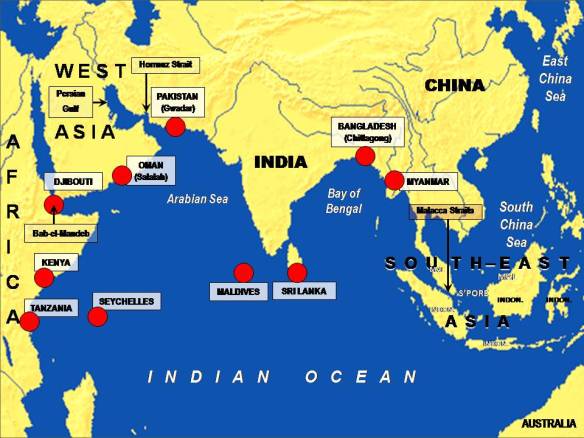
The growing importance of the Indian Ocean resources and sea lanes is apparent. More than half of the world’s container traffic, two-thirds of its seaborne petroleum trade, and a third of all maritime traffic traverse the ocean, much of it through chokepoints such as the Malacca and Hormuz straits.

The Indian Ocean is also rich in mineral wealth, with deep seabed mining emerging as a major new strategic issue. Various powers are seeking to tap seabed resources extending from sulfide deposits — which contain valuable metals such as silver, gold, copper, manganese, cobalt and zinc — to phosphorus nodules for phosphor-based fertilizers, underscoring the need for a regulatory regime and environmental protection.

The dangerous rush to exploit mineral and halieutic resources threatens to impose considerable environmental costs and spark new conflicts and confrontations. For example, several studies have indicated that commercial fishing by foreign fleets, by depleting local resources, has driven poor Somali fishermen to piracy.

Projecting naval power

The growth of nonstate actors such as pirates, terrorists and criminal syndicates off the Horn of Africa and elsewhere is also linked with the increasing density and importance of maritime flows through the Indian Ocean. This development, however, has become a pretext for outside powers to intervene and to project naval power. China, for example, has used the excuse of oceanic piracy to launch naval operations around the Horn of Africa and to set up its first overseas naval base at Djibouti, at the northwestern edge of the Indian Ocean in north Africa.

China’s growing activities in the Indian Ocean draw strength from its success in changing the status quo in its favor in the adjacent South China Sea, where it has pushed its borders far out into international waters in a way that no power has done elsewhere. By erecting military facilities on manmade islands in the Spratly and Paracel archipelagos, China has positioned naval and air power at the mouth of the Indian Ocean.

It is now rapidly expanding its Indian Ocean footprint after setting up the Djibouti base and investing in building regional ports, including in Pakistan at Gwadar (which sits strategically at the mouth of the Strait of Hormuz), in Sri Lanka at Hambantota, and in Myanmar at Kyaukpyu. It also has port projects in the Seychelles and the Maldives. China’s submarine fleet — one of the fastest-growing in the world — is best suited not for the shallow South China Sea but for the Indian Ocean’s deep waters, a message Beijing has conveyed by dispatching attack submarines to the area.

It was always clear that if China got its way in the South China Sea, it would turn its attention to the Indian Ocean and the western Pacific. Yet U.S. President Barack Obama’s administration allowed China to change the status quo by force in the South China Sea without incurring any international costs, even though this development carries greater and more far-reaching international geopolitical ramifications than Russia’s actions in Ukraine. Under Trump, the U.S. has shown no desire to seek a return to the status quo ante in the South China Sea. As a result, China is firming up its dominance there, while the U.S. symbolically undertakes freedom-of-navigation operations.

Cost-free unilateralism

In effect, China has demonstrated that defiant unilateralism is cost-free. This has left countries bearing the brunt of China’s recidivist policies with difficult choices. However, China’s actions have prompted Japan to reverse a decade of declining military outlays and India to revive stalled naval modernization.

Japan, which is heavily dependent on the Indian Ocean region for supplies of energy and raw materials, has also stepped up its regional engagement. For example, it is investing in eight port construction or renovation projects in Indonesia, India, Iran, Oman, Kenya, Mozambique, Madagascar and the Seychelles. Japan is also seeking to play a more active role in protecting the Indian Ocean sea lanes.

India, despite its strategic depth in the Indian Ocean, faces a new threat from the oceanic south. With Chinese submarines now making regular forays into India’s maritime backyard right under the nose of its Andaman and Nicobar Command, New Delhi must devise concrete steps to deal with China’s growing footprint.

With India’s energy and strategic infrastructure concentrated along a vulnerable, 7,600km coastline, the emergence of an oceanic challenge represents a tectonic shift in the country’s threat calculus. Yet it has been slow to face up to this reality. It needs a comprehensive maritime security strategy backed by naval capabilities that can take on tasks ranging from protecting and securing the seas to projecting power across the Indian Ocean region.

The Andaman and Nicobar archipelago in the Bay of Bengal is a critical asset for India to counter the growing Chinese maritime presence and to blunt the increasing land-based, trans-Himalayan military threat mounted by China. Located next to the Strait of Malacca, the Andaman and Nicobar chain offers control of this strategic chokepoint, which is one of China’s greatest maritime vulnerabilities. Just as the Chinese military harasses and threatens Indian border patrols in the Himalayas, India can potentially play the same game off the Andaman and Nicobar chain, including by establishing China-style civilian maritime militias backed by the Indian Coast Guard.

The importance of this chokepoint can be easily stated: A third of the 61% of global petroleum and other liquids production that moves on maritime routes transits the Strait of Malacca, including around 82% of China’s fuel imports. China’s hold on the South China Sea jugular makes the Strait of Malacca chokepoint a critical defense area for Indian security.

More fundamentally, greater maritime cooperation among democratic powers is becoming inescapable. Cooperation between Japan, India, Australia, Indonesia and the U.S. must extend to guarding the various “gates” to the Indian Ocean by exerting naval power at critical chokepoints. The aim should be to forestall the emergence of a destabilizing Sinocentric Asia. The common observation that, “Whoever controls the Indian Ocean dominates Asia,” is unattributed, but nonetheless true.

Brahma Chellaney is a geostrategist and author of nine books, including the award-winning “Water: Asia’s New Battleground.”

China’s troublesome civil-military relations

Recent developments suggest President Xi Jinping is still struggling to keep the People’s Liberation Army in line.


China Military Parade

Chinese President Xi Jinping inspects People’s Liberation Army troops during a military parade to commemorate the 90th anniversary of the founding of the PLA on July 30. | AP

BY The Japan Times

Has Chinese President Xi Jinping managed to assert full civilian control over the People’s Liberation Army through purges of generals and admirals and other reform-related actions? China’s secretive and opaque political system makes it hard to get a clear picture. Yet recent developments suggest Xi is still struggling to keep the PLA in line.

Take the recent troop standoff with India that raised the specter of a Himalayan war, with China threatening reprisals if New Delhi did not unconditionally withdraw its forces from a small Bhutanese plateau that Beijing claims is Chinese territory “since ancient times.” After 10 weeks, the faceoff on the Doklam Plateau dramatically ended with both sides pulling back troops and equipment from the site on the same day, signaling that Beijing, not New Delhi, had blinked.

The mutual-withdrawal deal was struck just after Xi replaced the chief of the PLA’s Joint Staff Department. This topmost position — equivalent to the chairman of the U.S. Joint Chiefs of Staff — was created only last year as part of Xi’s military reforms to turn the PLA into a force “able to fight and win wars.” The Joint Staff Department is in charge of PLA’s operations, intelligence and training.

The Doklam pullbacks suggest that the removed chief, General Fang Fenghui, who has since been detained for alleged corruption, was an obstacle to clinching a deal with India.

In mid-June, India’s close ally, the tiny Himalayan kingdom of Bhutan, discovered PLA crews working to build a road through Doklam, prompting New Delhi to dispatch troops and equipment to halt the construction of the road that was to overlook the trijunction where Tibet, Bhutan and the Indian state of Sikkim meet.

In seeking to use road construction to change the status quo in a disputed Himalayan territory, the PLA, in a strategic miscalculation, anticipated Bhutan’s diplomatic protest but not India’s rapid military intervention. With the attempted land grab also threatening Indian security, New Delhi was quick to turn Bhutan’s call for help into India’s own fight.

To be sure, this was not the first time the PLA’s belligerent actions in the Himalayas imposed diplomatic costs on China. A classic case was what happened when Xi went to India for a state visit in September 2014. Xi arrived on Indian Prime Minister Narendra Modi’s birthday with a strange gift for his host — a predawn Chinese military encroachment that day deep into India’s northern region of Ladakh. The encroachment, the worst in many years in terms of the number of intruding troops, overshadowed Xi’s visit.

It appeared bizarre that the military of an important power would seek to mar in this manner the visit of its own head of state to a key neighboring country.

Yet Chinese Premier Li Keqiang’s earlier visit to New Delhi in 2013 was similarly preceded by a 19-km PLA incursion into another part of Ladakh that lasted three weeks. The encroachment was seemingly intended to convey anger over India’s belated efforts to fortify its border defenses.

Such provocations might suggest that they are intentional, with the Chinese government in the know, thus reflecting a preference for blending soft and hard tactics. But it is also possible that the provocations — at least their timing and duration — underscore the continuing “disconnect between the military and the civilian leadership” in China that then-U.S. Defense Secretary Robert Gates warned about in 2011.

During his 2014 India trip, Xi appeared embarrassed by the accompanying PLA encroachment that cast a pall over his visit. He assured Modi that he would sort it out upon his return.

Soon after he returned, the Chinese defense ministry quoted Xi as telling a closed-door meeting with PLA commanders that “all PLA forces should follow the president’s instructions” and that the military must display “absolute loyalty and firm faith in the Communist Party, guarantee a smooth chain of command, and make sure all decisions from the central leadership are fully implemented.”

Just weeks later, Xi again asked for the PLA’s full loyalty to the party, telling a military-political conference in Fujian that “the Communist Party commands the gun.”

Recently Xi conveyed that same message yet again when he addressed a parade marking the 90th anniversary of the PLA’s creation on Aug. 1, 1927. Donning military fatigues, Xi exhorted members of his 2.3 million-strong armed forces to “unswervingly follow the absolute leadership of the party.”

Had civilian control of the PLA been working well, would Xi repeatedly be demanding “absolute loyalty” from the military or asking it to “follow his instructions”?

With its one-party dictatorship placing the Communist Party above the state, China does not have a national army; rather the party has an army. So the PLA has traditionally sworn fealty to the party, not the nation. By contrast, in the case of China’s closest ally, Pakistan, the army has a country.

Under Xi’s two immediate predecessors, Hu Jintao and Jiang Zemin, the PLA gradually became stronger at the expense of the party. The military’s rising clout has troubled Xi because it hampers his ambition to become China’s most powerful leader since Mao Zedong. Xi’s present wife — folk singer Peng Liyuan — is actually a civilian member of the PLA, holding a rank equivalent to major general.

As part of his effort to reassert party control over the military and carry out defense reforms, Xi has used his anti-corruption campaign to ensnare a number of top PLA officers. He has also cut the size of the ground force and established a new command-and-control structure.

But just as a dog’s tail cannot be straightened, asserting full civilian control over a politically ascendant PLA is proving unachievable. After all, the party is ideologically bankrupt and morally adrift, and depends on the PLA to ensure domestic order and sustain its own political monopoly.

The regime’s legitimacy increasingly relies on an appeal to nationalism. But the PLA, with its soaring budgets and expanding role to safeguard China’s overseas interests, sees itself as the ultimate arbiter of nationalism.

To make matters worse, Xi has made many enemies at home in his ruthless effort to concentrate power in himself, including through corruption purges. It is not known whether the PLA’s upper echelon respects him to the extent to be fully guided by his instructions.

The PLA and the government appeared to be on the same page during the Doklam standoff, with the Chinese foreign and defense ministries and other state organs keeping up a barrage of threats and vitriol against India. But no sooner had Xi fired the chief of the Joint Staff Department, Gen. Fang, then a deal with India was clinched. This suggested that the topmost general was resisting ending the standoff.

Fang was fired just days after he hosted America’s highest-ranking military officer, Gen. Joseph Dunford, chairman of the Joint Chiefs of Staff. Fang was replaced by Gen. Li Zuocheng, considered a “war hero” for his combat role in the 1979 Chinese invasion of Vietnam, although China received a bloody nose from the more battle-hardened Vietnamese.

Xi’s military purges have been designed to consolidate his authority over the PLA and ensure that it does not blindside the government with actions or statements. But as Fang’s firing and other latest changes in the PLA leadership signal, Xi is still working to bring the military fully under his control.

More fundamentally, the PLA’s growing power is redolent of what happened in Imperial Japan, which rose dramatically as a world power in one generation after the 1868 Meiji Restoration. Boosted by war victories against Manchu-ruled China and czarist Russia, the Japanese military acquired political clout and gradually went on to dictate terms to the civilian government, as the 1931 Manchurian Incident first highlighted. This opened the path to aggression and conquest in Asia, with tragic consequences for Japan and the region.

In the past decade, the PLA’s increasing clout has led China to stake out a more muscular role. This includes resurrecting territorial and maritime disputes, asserting new sovereignty claims, and using construction activity to change the status quo. It won’t be long before the PLA rekindles Himalayan tensions with a major new encroachment.

China’s cut-throat internal politics and troublesome civil-military relations clearly have a bearing on its external policy. The risks of China’s rise as a praetorian state are real and carry major implications for neighboring countries.

Brahma Chellaney is a geostrategist.

© The Japan Times, 2017.

India, beware: China could seek revenge for Doklam

Damage from the Himalayan military standoff will not be easily repaired

20170901_China-India_article_main_image

Exile Tibetans listen to a speaker during an Aug. 11 protest in New Delhi to show support for India in its Doklam standoff with China. The banners in local language read “Tibet’s independence is India’s security.” © AP

Brahma Chellaney, Nikkei Asian Review

China and India have defused one of their worst border flare-ups in decades, which had threatened to trigger an armed conflict between the nuclear-armed Asian giants. However, the damage the 10-week troop standoff inflicted on the already frayed bilateral relationship will not be easy to repair. Indeed, the China-India divide over border, water, trade, maritime and other issues, including transportation and economic corridors, may only widen.

There is also the risk that the end of the face-off on the small Himalayan plateau of Doklam could prove just a temporary respite from border tensions before confrontation flares anew.

Beijing had all along insisted that if there was any dispute over Doklam — home to mainly Bhutanese shepherds — it was between China and tiny Bhutan. But, ultimately, it accepted a deal with the country it said had no role at all, India, which it labeled an “illegal trespasser.” The Chinese Communist Party and its People’s Liberation Army may find it difficult to live with a retreat that China was compelled to make after failing to intimidate India into submission through torrents of vitriol and warmongering.

China’s record under communist rule shows that it has at times retreated only to open a new front in the same area or elsewhere.

The Himalayan standoff was triggered when Chinese forces sought to change the territorial status quo by building a road through Doklam, the high-altitude Bhutanese plateau that China claims as its own. India, Bhutan’s security guarantor, intervened militarily and halted the construction, saying the road overlooking the triple border of Tibet, Bhutan and the Indian state of Sikkim threatened its own security.

The standoff ended on Aug. 28, the same day the state-owned China Daily had warned that India stood “to face retribution” over its intransigence. The Indian troops retreated 500 meters to the Indian side of the border, to a ridge-top post from where they can quickly intervene again if the PLA restarts work on the military road. China withdrew troops and construction equipment from the site while asserting the right to send armed patrols to the disputed plateau.

China sought to save face by spinning the deal as an Indian climbdown, camouflaging its own troop withdrawal from the site. It could not admit that it had withdrawn because it had claimed that Doklam — like the Japanese-administered Senkaku Islands in the East China Sea, or the disputed South China Sea — had been Chinese territory “since ancient times.” In reality, China is unlikely to be able to resume work on the road project, which perished when India called China’s bluff.

Standing up to China

More fundamentally, India, like Japan before it, has shown that if a neighbor is willing to stand up to China, it can be made to back away. Doklam is a defining event: For the first time since China’s success in expanding its control in the South China Sea by artificially creating seven islands and militarizing them, a rival power has stalled Chinese construction activity to change the status quo on a disputed territory. In a grudging admission about the Doklam setback, China’s ultranationalist Global Times newspaper said on Aug. 30: “China needs to enhance its deterrence to avoid external provocations.”

Beijing was left with little choice but to negotiate a deal after India showed that it would not be cowed. To “win without fighting,” as the ancient Chinese military theorist Sun Tzu recommended, Beijing made India the target of its new “three warfares” doctrine, which was first described in a 2008 Pentagon report to Congress. The standoff revealed how China blends psychological warfare with disinformation campaigns, media manipulation, and legal action or “lawfare” to mount intense pressure while presenting the other side as the aggressor and itself as the aggrieved party.

Repeated Chinese warnings to India to back down or face dire consequences, however, fell on deaf ears. India allowed the war of words to become one-sided by refusing to react to the almost daily Chinese verbal attacks.

Eventually, Beijing was forced to end the face-off through mutual disengagement of troops. Two factors forced Beijing’s hand. It wished to save the Sept. 3-5 summit in Xiamen, China, of the BRICS countries, a bloc comprising Brazil, China, India, Russia and South Africa. More importantly, it wanted to safeguard Chinese President Xi Jinping’s reputation in the run-up to the critical party congress this autumn. Had the standoff with India dragged on, it could potentially have taken a toll on Xi’s standing.

U.S. President Donald Trump’s administration also helped put pressure on Beijing by implicitly supporting the Indian and Bhutanese positions, including backing a “return to the status quo” that prevailed on Doklam before the road building began.

The deal with India was clinched shortly after Xi replaced Gen. Fang Fenghui with Gen. Li Zuocheng in the top PLA post that is equivalent to the chairman of the U.S. Joint Chiefs of Staff. This suggested that the removed chief, as head of the PLA’s operations, was an obstacle to a Doklam deal.

Despite China’s overall military superiority, India, with its terrain and tactical advantages, was in a stronger position in the triple border area. It could have prolonged the face-off until the onset of the harsh Himalayan winter, thus casting a cloud over the Chinese party congress. A protracted standoff would also have exacted increasing diplomatic costs for Beijing, given that India had dared to stand up to it, thus denting China’s reputed preeminence in Asia.

Doing Xi a favor

By reaching the deal, India effectively let China off the hook and did Xi an important favor at a time when he is focused on the party congress, which is expected to see him emerge as the most powerful Chinese leader since Mao Zedong. For New Delhi, salvaging Prime Minister Narendra Modi’s China visit for the BRICS summit, unfortunately, became an important consideration, although that grouping has increasingly come under Chinese sway.

But Beijing is unlikely to return the favor, and India’s decision to let China escape a strategic predicament of its own making could come back to haunt it.

China has tactically retreated because, beyond declaring war on India, it was running out of options. But without the distraction of a looming party congress, China could seek revenge for Doklam at a time and place of its choosing. Next time, the PLA is unlikely to make the mistake of encroaching onto an area where India enjoys the military advantage. It will choose a place where it can spring a nasty surprise and dictate terms to the Indian army.

With India already facing increasingly persistent PLA efforts to intrude into its borderlands, eternal vigilance holds the key to Himalayan peace. India’s army chief, Gen. Bipin Rawat, has cautioned that the country cannot be complacent because Doklam-style encroachments are likely to “increase in the future.” But while China uses the disputed long border with India as a justification to probe Indian defenses, India remains perennially in a reactive mode.

A grim reminder of the larger challenges in the bilateral relationship is China’s breach of legally binding obligations to supply India with hydrological data on upstream river flows in Tibet in order to facilitate flood forecasting and warnings. A third of India’s freshwater supply comes from river flows from Tibet. The current monsoon season has brought record flooding in parts of northern India.

Beijing has offered no explanation for its failure this year to honor bilateral accords that require it to transfer data on specific rivers to India annually from May 15 to Oct. 15. Had China been in India’s place, it would have linked the breach of commitments to the downstream floods and deaths. But India has been quiet. Timely transmission of data would have helped generate flood warnings, thus saving lives and reducing material losses in India’s northeast. The data denial apparently is designed to punish India for boycotting Xi’s Belt and Road infrastructure summit in Beijing in May.

When Beijing can breach formal bilateral agreements, will it continue to stick to the Doklam deal? In 2012, China and the Philippines reached a U.S.-brokered deal to withdraw naval vessels from around the disputed Scarborough Shoal. China gave the impression it was withdrawing its ships, only to return and capture the shoal.

China’s autocrats are actually undermining their country’s long-term interests by making a mortal enemy of India, with which they are currently running an annual trade surplus of nearly $60 billion. The cloistered process of decision-making in China has glossed over the far-reaching strategic ramifications of driving Asia’s most important geopolitical “swing state” into the U.S. camp.

Whatever happens next, Doklam illustrates China’s proclivity to miscalculate and overreach. India’s refusal to bend while talking peace offers other Asia-Pacific nations an example of how to manage Chinese coercion. Doklam also raises a broader question: Had U.S. President Barack Obama’s administration stood up to China in the South China Sea, would the seven artificial and now-militarized islands have been created? It is China’s success in altering the status quo there — without incurring any international costs — that has emboldened its territorial revisionism in the East China Sea and the Himalayas.

Brahma Chellaney is a geostrategist and the author of nine books, including the award-winning “Water, Peace, and War.”

© Nikkei Asian Review, 2017.

China’s water war on India by other means

kashmir-india-china_e0046f98-8630-11e7-a194-d8b7abb7611c

Brahma Chellaney, The Hindustan Times

Tibet, a treasure-trove of natural resources, including water and precious metals, is a great strategic asset for China in its pursuit of an often-improvident style of economic growth. The sprawling Tibetan plateau also arms Beijing with water leverage over downstream countries because it is the starting point for most of Asia’s great rivers, many of which are being heavily dammed just before they cross into neighbouring nations.

China is sharpening its leverage with co-riparian India. Water indeed has emerged as a new divide in Sino-Indian relations, as Beijing quietly and opaquely builds dams, barrages and other structures on rivers flowing to India. It spurned then Prime Minister Manmohan Singh’s 2013 proposal that the two countries enter into a water treaty or establish an intergovernmental institution to define mutual rights and responsibilities on shared rivers. The flash floods that ravaged Himachal Pradesh and Arunachal Pradesh between 2000 and 2005 were linked to the unannounced releases from rain-swollen Chinese dams and barrages.

At a time when the Doklam face-off has entered its third month and the risk of a Chinese military attack on India is growing, there is more troubling news: Beijing is fashioning water into a political weapon by denying India flood-related hydrological data since May, even as major flooding has hit the region from Assam to Uttar Pradesh. Data on upstream river flows is essential for flood forecasting and warning in order to save lives and reduce material losses. China’s data denial crimps flash flood modelling in India.

By embarking on a dangerous game of water poker, Beijing has demonstrated how the denial of hydrological data in the critically important monsoon season amounts to the use of water as a political tool against a downstream country. Indeed, even while supplying data in past years, China’s lack of transparency raised questions. After all, like rice traded on the world market, hydrological data comes in different grades and qualities — from good, reliable data to inferior data and broken data.

China’s latest action actually violates two bilateral MOUs of 2013 and a 2014 accord, which obligate it to transfer hydrological data to India from three upstream monitoring stations in Tibet every year from May 15 to October 15. No data has been transferred thus far this year, although India, in keeping with the MOUs, paid for the data in advance. While China sells hydrological data to downriver countries, India provides such data free to both its downstream neighbours — Pakistan and Bangladesh.

China has long displayed contempt for international law. No bilateral accord seems to have binding force for it once its immediate purpose has passed, as Beijing recently highlighted by trashing the 1984 Sino-British treaty that paved the way for Hong Kong’s handover in 1997. China said that pact had lost “practical meaning” because 20 years had passed since Hong Kong’s return. Yet it selectively invokes a 19th-century, colonial-era accord to justify its Doklam intrusion, while ignoring its own violations — cited by Bhutan and India — of more recent bilateral agreements not to disturb the territorial status quo.

India should not be downplaying China’s breach of commitment to supply hydrological data from May 15. Yet, for two months, the ministry of external affairs hid China’s contravention, which began much before the Doklam standoff. When MEA finally admitted China’s breach of obligation, it simultaneously sought to shield Beijing by saying there could be a “technical reason” for non-transfer of data (just as MEA sought to obscure China’s Aug. 15 twin raids in the Lake Pangong area by gratuitously telling the Financial Times that “no commonly delineated boundary” exists there). How can a technical hitch explain data withholding from three separate stations for over two months? MEA also went out of its way to reject a linkage between China’s data denial and the flooding, for example, in Assam. Wouldn’t the timely transmission of data have generated flood warnings and thus helped save lives and movable assets?

Had China been in India’s place, it would have promptly raised a hue and cry about the commitment violation and linked it to the downstream floods and deaths.

More fundamentally, the Doklam standoff, the Chinese hydro-engineering projects to reengineer cross-border river flows, the denial of hydrological data, and China’s claims to vast tracts of Indian land are all a reminder that Tibet is at the heart of the India-China divide. The 1951 fall of Tibet represented the most far-reaching geopolitical development in modern India’s history, with the impact exacerbated by subsequent Indian blunders. India must subtly reopen Tibet as an outstanding issue, including by using historically more accurate expressions like “Indo-Tibetan border” (not “India-China border”) and emphasizing that its previously stated positions were linked to Tibet securing real autonomy.

Brahma Chellaney is a geostrategist and author.

© The Hindustan Times, 2017.

Calling the Chinese Bully’s Bluff

13902ddf4ea0f3481a90f54f38f6a266

BRAHMA CHELLANEY

A column internationally syndicated by Project Syndicate.

The more power China has accumulated, the more it has attempted to achieve its foreign-policy objectives with bluff, bluster, and bullying. But, as its Himalayan border standoff with India’s military continues, the limits of this approach are becoming increasingly apparent.

The current standoff began in mid-June, when Bhutan, a close ally of India, discovered the People’s Liberation Army trying to extend a road through Doklam, a high-altitude plateau in the Himalayas that belongs to Bhutan, but is claimed by China. India, which guarantees tiny Bhutan’s security, quickly sent troops and equipment to halt the construction, asserting that the road – which would overlook the point where Tibet, Bhutan, and the Indian state of Sikkim meet – threatened its own security.

Since then, China’s leaders have been warning India almost daily to back down or face military reprisals. China’s defense ministry has threatened to teach India a “bitter lesson,” vowing that any conflict would inflict “greater losses” than the Sino-Indian War of 1962, when China invaded India during a Himalayan border dispute and inflicted major damage within a few weeks. Likewise, China’s foreign ministry has unleashed a torrent of vitriol intended to intimidate India into submission.

Despite all of this, India’s government, led by Prime Minister Narendra Modi, has kept its cool, refusing to respond to any Chinese threat, much less withdraw its forces. As China’s warmongering has continued, its true colors have become increasingly vivid. It is now clear that China is attempting to use psychological warfare (“psywar”) to advance its strategic objectives – to “win without fighting,” as the ancient Chinese military theorist Sun Tzu recommended.

China has waged its psywar against India largely through disinformation campaigns and media manipulation, aimed at presenting India – a raucous democracy with poor public diplomacy – as the aggressor and China as the aggrieved party. Chinese state media have been engaged in eager India-bashing for weeks. China has also employed “lawfare,” selectively invoking a colonial-era accord, while ignoring its own violations – cited by Bhutan and India – of more recent bilateral agreements.

For the first few days of the standoff, China’s psywar blitz helped it dominate the narrative. But, as China’s claims and tactics have come under growing scrutiny, its approach has faced diminishing returns. In fact, from a domestic perspective, China’s attempts to portray itself as the victim – claiming that Indian troops had illegally entered Chinese territory, where they remain – has been distinctly damaging, provoking a nationalist backlash over the failure to evict the intruders.

As a result, President Xi Jinping’s image as a commanding leader, along with the presumption of China’s regional dominance, is coming under strain, just months before the critical 19th National Congress of the Chinese Communist Party (CCP). And it is difficult to see how Xi could turn the situation around.

Despite China’s overall military superiority, it is scarcely in a position to defeat India decisively in a Himalayan war, given India’s fortified defenses along the border. Even localized hostilities at the tri-border area would be beyond China’s capacity to dominate, because the Indian army controls higher terrain and has greater troop density. If such military clashes left China with so much as a bloodied nose, as happened in the same area in 1967, it could spell serious trouble for Xi at the upcoming National Congress.

But, even without actual conflict, China stands to lose. Its confrontational approach could drive India, Asia’s most important geopolitical “swing state,” firmly into the camp of the United States, China’s main global rival. It could also undermine its own commercial interests in the world’s fastest-growing major economy, which sits astride China’s energy-import lifeline.

Already, Indian Foreign Minister Sushma Swaraj has tacitly warned of economic sanctions if China, which is running an annual trade surplus of nearly $60 billion with India, continues to disturb border peace. More broadly, as China has declaredunconditional Indian troop withdrawal to be a “prerequisite” for ending the standoff, India, facing recurrent Chinese incursions over the last decade, has insisted that border peace is a “prerequisite” for developing bilateral ties.

Against this background, the smartest move for Xi would be to attempt to secure India’s help in finding a face-saving compromise to end the crisis. The longer the standoff lasts, the more likely it is to sully Xi’s carefully cultivated image as a powerful leader, and that of China as Asia’s hegemon, which would undermine popular support for the regime at home and severely weaken China’s influence over its neighbors.

Already, the standoff is offering important lessons to other Asian countries seeking to cope with China’s bullying. For example, China recently threatened to launch military action against Vietnam’s outposts in the disputed Spratly Islands, forcing the Vietnamese government to stop drilling for gas at the edge of China’s exclusive economic zone in the South China Sea.

China does not yet appear ready to change its approach. Some experts even predict that it will soon move forward with a “small-scale military operation” to expel the Indian troops currently in its claimed territory. But such an attack is unlikely to do China any good, much less change the territorial status quo in the tri-border area. It certainly won’t make it possible for China to resume work on the road it wanted to build. That dream most likely died when India called the Chinese bully’s bluff.

Brahma Chellaney, Professor of Strategic Studies at the New Delhi-based Center for Policy Research and Fellow at the Robert Bosch Academy in Berlin, is the author of nine books, including Asian JuggernautWater: Asia’s New Battleground, and Water, Peace, and War: Confronting the Global Water Crisis.

© 1995-2017 Project Syndicate.

By refusing to buckle under China’s threats, India has called the bully’s bluff

Brahma Chellaney, The Times of India

modi-style_0_0Standing on the Himalayan crest with well-developed infrastructure, China is in a militarily advantageous position along much of the border with India. The tri-border overlooking the Chinese-held Chumbi Valley is one of the few areas where India still holds a distinct advantage, with Chinese forces within Indian observation-cum-artillery range. If China were to capture Bhutan’s high-altitude Doklam plateau, it would not only mitigate that vulnerability but also hold a knife to India’s jugular vein — the Siliguri Corridor, through which Bhutan’s communications and transportation arteries also pass.

While existential stakes drove India to halt China’s construction of a strategic highway through Doklam, Beijing made a serious strategic miscalculation by intruding there: It anticipated Bhutan’s diplomatic protest but not India’s swift, stealthy military intervention. The Indian army had long geared up to respond to such a contingency.

No Indian government can countenance the construction of a road through Doklam that allows China to bring main battle tanks to the tri-border and implement, in the event of a war, its military plan to decapitate India. In such a corridor-bisecting scenario, while China gobbles up Arunachal Pradesh, the other northeast Indian states, as a Chinese state mouthpiece warned recently, could become “independent”.

Today, thanks to its miscalculation, China finds itself in an unenviable position: It must extricate itself from a militarily wretched situation in Doklam, where its intruding soldiers are caught in a pincer movement. If China were to initiate hostilities at the tri-border, it will likely be left, as in 1967, with a bloodied nose, given the Indian army’s terrain and tactical advantages.

Politically, Beijing has boxed itself in a corner, with its intense psychological warfare (“psywar”) and disinformation operations failing to yield continuing gains, after the success in initially dominating the narrative. If anything, its psychological operations (“psy-ops”) and manipulation of legal arguments (“lawfare”), as by selectively quoting an 1890 colonial-era accord, offer India important lessons. It is standard Chinese strategy to play the victim in any conflict or dispute, as China brazenly did even in 1962.

Mounting frustration has sharpened Beijing’s war rhetoric, as its latest 15-page diatribe against India underscores. To compound matters, the standoff is imposing reputational costs on a power that supposedly brooks no challenge and is ever willing to wreak punishment. India, in the face of vitriolic warmongering, has defiantly stood up to China and refused to budge. By calling the bully’s bluff, India has set an example for other Asian states to emulate.

Beijing’s story that Indian troops “trespassed” into Chinese territory was designed to disguise its intrusion into tiny Bhutan. But this tale, along with President Xi Jinping’s vow not to permit the loss of “any piece” of Chinese land, deepens China’s discomfiture by undermining the image it has sought to project at home and abroad — Asia’s pre-eminent power that no neighbour will mess with.

In sum, China, if it is to save face, needs India’s help to extricate itself from a mess of its own making. Beijing’s coarse statements and threats, while integral to its psywar, are also part of a negotiating ploy to secure a compromise on largely its terms.

There is no reason, however, why India should let China off the hook easily. With Xi looking ahead to this autumn’s Communist Party congress to cement his status as China’s most powerful leader since Mao Zedong, India should play psychological hardball because Chinese incursions have become increasingly recurrent.

India should allow the Doklam military stalemate to drag on until the arrival of the harsh winter forces the rival troops to retreat, thus restoring the status quo ante, including frustrating China’s road-building plan. If an earlier negotiated mutual retreat from Doklam becomes possible, it should be based on an unequivocal assurance that China henceforth will refrain from unilaterally disturbing the territorial status quo anywhere in the Himalayan borderlands.

Implicitly, if not explicitly, China must come out a significant loser in order to help rein in its creeping, covert encroachments. There should be no more Depsangs, Chumars and Doklams or the quiet chipping away at Indian and Bhutanese lands.

The writer is a geostrategist and author. 

© The Times of India, 2017.

China Reveals How it Wages Psychological Warfare

The Sino-Indian troop standoff has underscored the centrality of propaganda in China’s foreign policy.

5a52d1ce-7040-11e7-9a9a-a7d2083b6658_1280x720_170533

A Chinese government handout photo of a live-fire military exercise in Tibet. The photo was released amid rising border tensions with India. It later came to light that the military exercise was conducted before the crisis began.

By , The Japan Times

Since a Sino-Indian troop standoff began at the border where Tibet, Bhutan and the Indian state of Sikkim meet, China’s warmongering has become so raucous and coarse that, to the casual observer, a Himalayan military conflict may seem imminent. In reality, Beijing is waging — in Chinese strategic tradition — full-throttle psychological warfare to compel India to back down without a shot being fired.

The current crisis, more significantly, has underscored the centrality of propaganda in China’s foreign policy — from the aggressor playing the victim to unremitting efforts to camouflage its intrusion into tiny Bhutan that precipitated the standoff. China’s vitriolic war rhetoric and unrealistic preconditions for holding talks stand out in stark contrast to India’s measured response and emphasis on diplomacy and dialogue to peacefully resolve the standoff. The U.S. has implicitly supported India’s stance by similarly calling for a dialogue to peacefully end the crisis.

The crisis, in fact, has highlighted how China blends psychological warfare (“psywar”), media warfare and the manipulation of legal arguments (“lawfare”) to undermine the opponent’s information-control capabilities and to buttress its strategic game plan. Disinformation and deceit are among the tools China is employing in its psywar to tame India without military combat, in Sun Tzu style.

Its psychological operations (psy-ops) have included mounting almost daily threats to teach India a lesson, unless it gives in. Indeed, the authoritarian regime in Beijing has shown itself adept at exploiting the political divisions in the world’s largest democracy, including reaching out to Indian Prime Minister Narendra Modi’s opponents and attacking his “Hindu nationalism” in order to help sow dissensions in India on its current China approach.

Given China’s rise as a praetorian state, its foreign ministry is probably the weakest government branch; yet that ministry has taken the lead to intimidate India in unbecoming and undiplomatic language. Beijing is also using its state media to threaten an “all out confrontation” along the entire, more than 4,000-kilometer-long Sino-Indian border and to warn India that it would suffer a humiliating rout greater than it did in the 1962 war. One Chinese state mouthpiece even called the Indian foreign minister a liar.

In the current crisis, the Chinese state and its media have worked in tandem to feed disinformation as part of the psy-ops. After all, media organizations, backed by an annual $10 billion budget from the state, have become integral to China’s global propaganda offensive. Chinese propaganda is getting smarter and more targeted, with some in the Indian media lapping up the disinformation, yet Beijing’s mendacity is becoming conspicuous.

Consider two examples. In mid-July, the Chinese state broadcaster CCTV telecast a video of live-fire military exercises in Tibet by a mountain brigade deployed against India. It later came to light that this was a routine annual drill conducted in early June before the crisis began. Shortly after the CCTV report, the Chinese military’s official newspaper, PLA Daily, said tens of thousands of tons of military hardware had been moved to Tibet in response to the troop standoff. This report too turned out to be part of China’s psywar, with Indian intelligence still finding no evidence of a Chinese military buildup in Tibet.

In this light, what can China hope to achieve through its psy-ops? India has a lot at stake: If it were to wilt under the Chinese pressure, it would impair its national security and potentially open the path to its long-term strategic subordination to China. In addition, China would be able to mount a stronger military threat against India’s hold on its far northeast.

India is a raucous democracy with poor public relations and media outreach. Yet China’s psywar has failed to obscure even the key facts, let alone achieve any political objective.

The crisis, which offers important insights to other countries on China’s psychological-warfare practices, was triggered in mid-June after days of growing local military tensions when People’s Liberation Army troops sought to unilaterally change the territorial status quo by beginning work on a strategic highway through Bhutan’s Doklam Plateau, which is located very close to the Tibet-Bhutan-Sikkim trijunction. (China contends that Doklam is its own territory in the way it claims the Japanese-controlled Senkaku Islands or the sprawling northeastern Indian state of Arunachal Pradesh.) The Chinese encroachment prompted the Indian army to swiftly intervene and halt the road construction, triggering the standoff.

The PLA has for years been quietly chipping away at strategic areas in Bhutan’s north and west. It has also waged an aggression by stealth to assert its claim over the Doklam Plateau, including by increasingly sending Tibetan herdsmen and armed patrols there and by turning some natural paths into small paved roads. Bhutan has long complained of Chinese encroachments. For example, it told its Parliament in 2009 that it had “protested many times to the Chinese regarding the road-construction activities.”

Bhutan, with just 8,000 men in its military, police and militia, has no means to resist Chinese encroachments. Its security partner, India, was previously loath to go beyond training and advising Bhutanese forces. But with China’s latest land grab also threatening Indian security, New Delhi decided that Bhutan’s fight was India’s fight. In a strategic miscalculation that has fueled its current fury, China anticipated Bhutan’s diplomatic protest over its latest road construction but not India’s rapid military intervention.

New Delhi cannot allow Beijing to gain control of Doklam because it will result in China fortifying its military positions around the border trijunction and bringing India’s territorial link with its northeastern states within Chinese artillery range. This link — the Siliguri Corridor — is just 27 kilometers wide at its narrowest point and is aptly known as the “Chicken Neck.” If China built the highway through Doklam, it would be able to transport heavy tanks to the trijunction and, in the event of a war, seek to implement its military plan to cut off mainland India from northeast India.

The risk that a frustrated China could escalate its current psy-ops to a military conflict cannot be discounted. Indeed, Beijing is signaling that it will brook no Indian “interference” in Bhutan’s external relations or national security, although Indo-Bhutanese relations are governed by a friendship treaty and defense arrangements. It wants India to leave Bhutan to its fate.

More fundamentally, China’s intrusion into Bhutan and its war rhetoric against India raise important larger issues. One issue is China’s disregard of international law, including the bilateral accords it has signed with Bhutan and India pledging not to alter the status quo unilaterally. As the South and East China seas also illustrate, Beijing signs agreements and treaties but does not comply with them.

Another issue is China’s abiding faith in propaganda, extending from fake history claims to other countries’ territories to disinformation operations intended to deceive and outmaneuver opponents. The reliance on propaganda blurs the line between fact and fiction to such an extent that, gradually, the Chinese state begins to believe its own propaganda and act upon it. This factor, along with its associated risks, is apparent in the Doklam standoff.

Brahma Chellaney is a geostrategist and the author of nine books, including “Water, Peace, and War” (Rowman & Littlefield).

© The Japan Times, 2017.

Turn the tables on China

China’s strategy is to subdue India by attacking its weak points and stymieing its rise to the extent possible.

china_dragon

Brahma Chellaney, The Hindustan Times, July 22, 2017

The current troop standoff with China at Doklam offers India important lessons that go far beyond the Chinese intrusion into this Bhutanese plateau. Unless India grasps the long-term threat posed by an increasingly muscular China and responds with an appropriate counter-strategy, it is sure to confront much bigger problems than Doklam. Unfortunately, institutional memory in India tends to be short, with a mindset of immediacy blurring the bigger picture.

For example, Jammu and Kashmir Chief Minister Mehbooba Mufti’s recent statement that China is “meddling” in her state was seen as signifying a new trend. In truth, China — occupying a fifth of the original princely state of J&K and now enlarging its strategic footprint in Pakistan-occupied J&K — has long been playing the Kashmir card against India. In 2010 it honed that card by aggressively adopting a stapled-visa policy for J&K residents.

To mount pressure, Beijing has tacitly questioned India’s sovereignty over the 45% of J&K under Indian control and officially shortened the length of the Himalayan border it shares with India by purging the 1,597-kilometre line separating Indian J&K from Chinese-held J&K. China’s Kashmir interference will only increase as a result of its so-called economic corridor through Pakistan-held J&K, where Chinese military presence is growing, including near Pakistan’s ceasefire line with India. India now faces Chinese troops on both flanks of its portion of J&K.

China, which fomented the Naga and Mizo insurgencies, taught its “all weather” client Pakistan how to wage proxy war against India. China still fans flames in India’s northeast. For example, Paresh Barua, the long-time fugitive commander-in-chief of ULFA, has been traced to Ruili, in China’s Yunnan province. Some other Indian insurgent leaders have been ensconced in Myanmar’s Yunnan-bordering region controlled by the China-backed Kachin Independence Army. This newspaper reported in 2015 that Chinese intelligence played “an active role” in assisting nine northeast Indian insurgent groups to form a united front. The illicit flow of Chinese arms to India, including to Maoists, was confirmed by Home Secretary G.K. Pillai in 2010. Meanwhile, the deepening China-Pakistan nexus presents India with a two-front theatre in the event of a war with either country.

China’s strategy is to subdue India by attacking its weak points, striking where it is unprepared, and stymieing its rise to the extent possible. As part of this strategy, it is waging a multipronged unconventional war without firing a single shot. It is closing in on India from multiple flanks, extending from Nepal to the Indian Ocean.

Sixty-six years after gobbling up buffer Tibet and mounting a Himalayan threat, China — with the world’s fastest-growing submarine fleet — is opening a threat from the seas against India. Its recently opened naval base in Djibouti, at the Indian Ocean’s north-western edge, constitutes just a first step in its game plan to dominate the region. For India, whose energy and strategic infrastructure is concentrated along a vulnerable, 7,600-kilometre coastline, this represents a tectonic shift in its threat calculus.

Add to the picture China’s economic warfare to undermine India’s strength in various ways, including stifling its manufacturing capability through large-scale dumping of goods. Artificially low prices of Chinese products also translate into India losing billions of dollars yearly in customs duties and tax revenue. Portentously, China, including Hong Kong, made up 22% of India’s imports in 2015, with the US just at 5% and Japan at 2%.

Yet India has yet to fully shed its policy blinkers. As India repeats the same old platitudes about conciliation and cooperation, China is making clear that there cannot be “two Suns in the sky” — or, as a Chinese idiom goes, “one mountain cannot accommodate two tigers”. With its rekindled, atavistic nationalism, China plainly wants to be Asia’s sole tiger.

Beijing is currently waging full-throttle psychological warfare over Doklam to tame India. Deception and mendacity are its tools. If India gives in, it will endure strategic subordination and ignominy forever. Foreign Minister Sushma Swaraj’s excellent rebuttal in Parliament of Chinese disinformation begs the question: Why has India been so slow in countering Beijing’s propaganda war?

New Delhi must play psychological hardball: Instead of appearing zealous for talks, it should insist that China first withdraw both its troops and preconditions, while leaving Beijing in no doubt that India will hold its ground, come what may. If India is to stop China’s creeping, covert encroachments and secure Himalayan peace, it must be ready to give Beijing a real bloody nose if it escalates the standoff to a conflict. Humiliating China even in a localized military engagement, in 1967 style, is vital to help destabilize its expansionist regime.

Brahma Chellaney is a geostrategist and author.

© The Hindustan Times, 2017.

China’s Bhutan land grab aims at bigger target

Beijing employs stealth aggression in territorial expansion

My map of Himalayan territorial disputes (NAR)

Brahma Chellaney, Nikkei Asian Review

China honed its “salami slicing” strategy in the Himalayan borderlands with India in the 1950s, when it grabbed the Switzerland-sized Aksai Chin plateau by surreptitiously building a strategic highway through that unguarded region. Aksai Chin, part of the original princely state of Jammu and Kashmir, has since provided China with the only passageway between its rebellious regions of Tibet and Xinjiang.

Now, the attempt by the People’s Liberation Army to replicate its seizure of Aksai Chin by building a military road through the Doklam plateau of tiny Bhutan has triggered one of the most serious troop standoffs in years between China and India, which is a guarantor of Bhutanese security.

The standoff involving hundreds of PLA and Indian troops, near where the borders of Tibet, Bhutan and India’s Sikkim state meet, has successfully halted the Chinese construction of the highway in Doklam, which Beijing claims as a “traditional pasture for Tibetans.” This is similar to Beijing’s claims in the South and East China seas, which are based on “traditional fishing grounds for Chinese.” The Indian intervention has triggered a furious reaction from China, which is warning India almost daily to back down or face reprisals, including a possible war. India has mobilized up to 10,000 troops for any contingency.

The Chinese defense ministry has warned India to learn the “historical lessons” from the major military reversals it suffered in 1962 when China carried out a surprise trans-Himalayan invasion just when the U.S. and the Soviet Union were locked in the Cuban missile crisis. Beijing has also stepped up diplomatic pressure on New Delhi, with the Chinese foreign ministry insisting that the “precondition for any meaningful dialogue” would be for Indian troops to “unconditionally” pull back from Doklam.

Beijing’s full-throttle campaign against India amounts to psychological warfare, from mounting daily threats to staging military drills in Tibet. For example, a recent “full combat readiness” exercise with tanks was aimed at delivering a clear warning to New Delhi, according to Chinese state media. However, the more China threatens India and the more it refuses to seek a compromise, the more it paints itself in a corner.

Beijing has no good options in emerging as a winner from this confrontation. Given the geography, military logistics, weapon deployments and the entrenched Indian positions, the PLA will find it hard to give India a bloody nose and seize Doklam. If it were to attack, it could suffer a setback. Just as Beijing’s intense propaganda war against India over the Dalai Lama’s April tour to the Chinese-claimed northeastern Indian state of Arunachal Pradesh achieved nothing, China risks losing face over the current troop standoff.

The central issue that China has sought to disguise is its intrusion into tiny Bhutan, which has less than 800,000 people. To cause a distraction, Beijing, in keeping with ancient military theorist Sun Tzu’s concept of strategic deception, has tried to shift the focus to India through a public relations blitzkrieg that presents China as the victim and India as the aggressor. Just as it has touted historical claims to much of the South China Sea, which have been dismissed by an international arbitral tribunal as groundless, Beijing contends that Doklam (or “Donglang” as China calls it) has belonged to it “since ancient times.”

Beijing’s dire warning

Besides launching a flurry of official denunciations of India, China has employed the state media in the psychological warfare campaign. “We firmly believe that the face-off in the Donglang area will end up with the Indian troops in retreat. The Indian military can choose to return to its territory with dignity or be kicked out of the area by Chinese soldiers,” China’s nationalist tabloid Global Times said on July 5. “This time we must teach New Delhi a bitter lesson.”

An article on the PLA’s English-language website, China Military Online, has warned that “if a solution isn’t reached through diplomatic or military communication or the issue isn’t handled properly, another armed conflict … is not completely out of the question.”

Despite the Indian army’s prompt actions to protect Bhutan’s territorial interests, the standoff has exposed some of India’s institutional weaknesses. In combating disinformation in war or peace, time is of the essence. Yet it took New Delhi more than four days to issue its first statement in response to China’s verbal attacks against India’s move to protect Bhutan, its longstanding strategic ally. The result was that after Beijing revealed the days-old troop standoff just hours before the June 26 meeting between Indian Prime Minister Narendra Modi and U.S. President Donald Trump at the White House, the Indian media was awash with Chinese propaganda, reporting only Beijing’s line on the standoff.

The current crisis has shown that New Delhi is ill-prepared to counter China’s grandstanding tactics. India’s response to the continuing barrage of hostile Chinese statements against it has been confined to a single statement issued by its foreign ministry on June 30. This is partly to do with India’s intrinsically defensive strategic mindset, including a reluctance to employ its natural economic leverage to rein in Chinese belligerence.

Since China has an almost $60 billion annual trade surplus with India currently, New Delhi has an opportunity to emulate Beijing’s use of trade as a political instrument in punishing South Korea, Mongolia, the Philippines, Japan and others. The flood of Chinese goods entering India is overwhelming. The lopsided trade balance not only rewards China’s strategic hostility but also foots the bill for its strategy of encircling India. Beijing thus has little incentive to moderate its behavior or avoid belligerence.

India also appears reluctant to reopen the Tibet issue, even though China is laying claim to Indian and Bhutanese territories on the basis of alleged Tibetan (not Han Chinese) historical links to these areas. Like Doklam, China claims Arunachal Pradesh, a territory almost three times larger than Taiwan that is famous for its virgin forests and soaring mountain ranges. To help curb such territorial revisionism, India needs to question China’s claim to Tibet itself.

Tibet, autonomous until China annexed it in 1951, enjoyed close historical transportation, trade and cultural links with India, exemplified by the fact that the main Tibetan cities are located close to the Indian border. But with Tibet now locked behind a Chinese “iron curtain,” the formerly integrated economies and cultures of the entire Himalayan region have broken apart.

Expansion drive

Modern China has come a long way since the Great Wall denoted the limits of the Han empire’s political frontiers, as during the Ming dynasty (1368-1644). Territorially, Han power is now at its zenith. With the exception of Mongolia, China is seeking to expand its frontiers beyond the conquests made by the Manchu Qing dynasty in the 17th and 18th centuries. By relying on stealth aggression in which no bullets or missiles need to be fired, China has mastered the art of creeping, covert warfare, as is apparent in the Himalayas and the South and East China seas. “Only vast lands can cradle great powers,” according to Chinese geographers Du Debin and Ma Yahua.

Recent events have offered clear evidence on how China uses history to justify its territorial ambitions. In the same week that it dusted off an 1890 colonial-era accord on the Tibet-Sikkim border to use in its propaganda war against India, even though the agreement was irrelevant to its intrusion into Bhutan, it mocked as worthless the legally binding 1984 pact with Britain that paved the way for Hong Kong’s handover in 1997 by guaranteeing the city’s rights and freedoms under China’s “one country, two systems” formula. By turning its back on the 1984 pact, Beijing indicated that “one country, two systems” was just a ruse to recover Hong Kong. Yet China will cling to colonial-era accords if they still serve its interests.

Unless Beijing reopens the door to diplomacy, the present military stalemate at Doklam could drag on until the arrival of the harsh winter forces the rival troops to retreat, thus ending the confrontation. This would restore the status quo ante by frustrating the PLA’s road-building plan. The brief July 7 meeting between Chinese President Xi Jinping and Modi at the G-20 summit in Hamburg has offered China an opening to save face through a possible mutual retreat from Doklam.

Whatever happens, the current crisis offers India important lessons, including how a clever China presents itself as the victim and feeds disinformation to the Indian media. This should, however, not have come as a surprise. It is standard Chinese strategy to play the victim in any conflict or dispute in an example of how China blends toughness, savvy, single-mindedness and deft propaganda to try to achieve its goals. Psychological warfare is integral to China’s military strategy. Yet India found itself taken by surprise.

More fundamentally, India must recognize that while caution is prudent, diffidence tends to embolden the aggressor. It should continue to err on the side of caution but must shed its reluctance to employ countervailing leverage against China so that it is not always in a reactive mode.

Brahma Chellaney is a geostrategist and the author of nine books, including “Water: Asia’s New Battleground,” the winner of the Bernard Schwartz Award.

© Nikkei Asian Review, 2017.