


BY BRAHMA CHELLANEY, The Japan Times, March 21, 2017
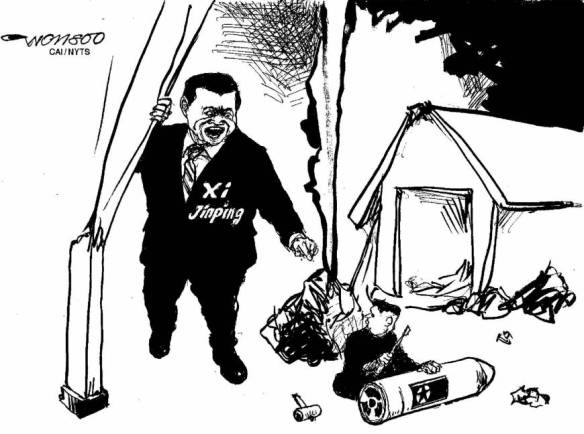
North Korea’s rapid nuclear and missile advances and America’s rushed deployment of a ballistic missile defense system known as the Terminal High Altitude Area Defense (THAAD) in South Korea have increased the risks of a war on the Korean Peninsula by accident or miscalculation.
U.S. President Donald Trump may be battling the “deep state” at home but, in hastening THAAD’s deployment, his administration has acted proactively to present a fait accompli to the next South Korean president. The new president is to be elected in a snap poll in May after South Korea’s Constitutional Court recently upheld the National Assembly’s impeachment of President Park Geun-hye over alleged corruption. It was the conservative Park who agreed last July to the THAAD placement, triggering grassroots protests, especially in the area where the system was to be deployed.
The THAAD issue increasingly has become divisive in South Korean politics, and the liberals’ presidential hopeful, Moon Jae-in, has said the system’s deployment unnecessarily escalates tensions on the peninsula. However, anticipating that the Constitutional Court would oust Park and that Moon could win the presidential election, the Trump administration began THAAD’s placement early this month.
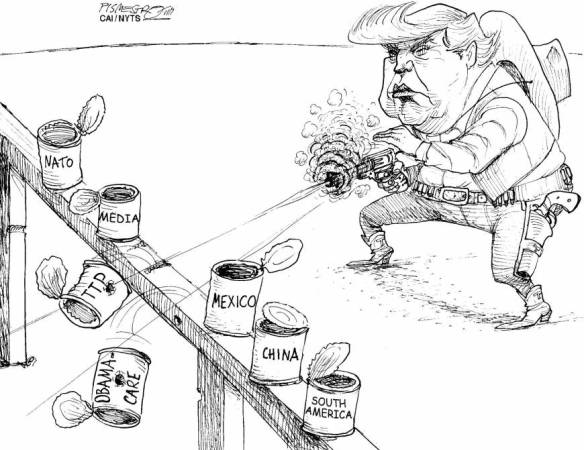
Trump, during his own election campaign, gleefully challenged diplomatic orthodoxy, including American foreign policy’s long-standing principles and shibboleths. Yet by implementing his predecessor’s THAAD decision with enthusiasm to speed up the system’s deployment, Trump has offered an example of how he is embracing key pillars of the previous administration’s foreign policy.
Two fundamental issues raised by the THAAD placement, however, cannot be obscured.
First, the deployment has been necessitated by the abysmal failure of the U.S.-led strategy to squeeze North Korea with ever-increasing international sanctions while shunning any diplomatic engagement with it. The sanctions-only approach, far from stymieing North Korea’s development of weapons of mass destruction, has only encouraged it to single-mindedly advance its nuclear-weapons and missile capabilities.
In the decade since the United States froze all diplomatic contact with North Korea, that reclusive communist nation has gone from possessing rudimentary WMD capabilities to testing advanced systems that pose a regional threat. For example, it tested a nuclear device last September whose yield, as recorded by outside seismic monitoring stations, was twice as powerful as the atomic bomb that the U.S. dropped on Hiroshima in 1945. Since last year, Pyongyang has also tested solid-fueled missile systems, including one that can launched from a submarine.
And second, the THAAD deployment, although arising from a failed American strategy, is no plausible answer to North Korea’s nuclearization. Indeed, this is a case of the supposed remedy being worse than the disease.
The deployment could counterproductively lead to North Korea (and China, which fears that THAAD’s sophisticated X-Band radar could track its missile forces) aiming to defeat the defensive system by developing greater offensive capability. In fact, China and Russia believe that the THAAD placement is part of a larger American plan to establish a fence of antimissile systems around them and thereby undermine their nuclear deterrents.
Let’s be clear: THAAD cannot credibly protect South Korea from the North’s tactical or short-range ballistic missiles. Designed for high-altitude intercepts, THAAD is geared mainly to interdict medium- and intermediate-range ballistic missiles.
Given South Korea’s relatively small land size, an attack by the North may not necessitate the use of medium- or intermediate-range missiles. Metropolitan Seoul, which has almost as many residents as North Korea’s total population of 25 million, is located just 40 km from the Demilitarized Zone dividing the two Koreas.
North Korea has a virtual artillery choke-hold on Seoul that THAAD cannot neutralize. This is why the U.S. lacks a realistic option to militarily degrade the North’s nuclear and missile capabilities without provoking Pyongyang to unleash its artillery power against Seoul or triggering an all-out war. The absence of credible techno-military options against North Korea is also underscored by the reported failure of the U.S. to undermine Pyongyang’s nuclear and missile programs through coordinated cyber and electronic strikes in recent years.
In this light, THAAD’s political symbolism is greater than its military utility. The system, in any case, has never been battle-tested.
But rather than enhance South Korea’s security, including by reassuring its citizens, the THAAD deployment threatens to make South Koreans more insecure through an action-reaction cycle. For example, the Stalinist regime in Pyongyang may now plan, in a combat scenario, to fire many missiles simultaneously so as to defeat THAAD.
Against this background, a new strategy is needed to stem the growing risk that a small mishap could escalate to a full-fledged war. U.S. President Barack Obama employed sanctions with engagement to clinch a nuclear deal with Iran yet, throughout his eight-year tenure, pursued a completely different approach toward North Korea — sanctions without engagement.
Given that the threat posed by North Korea’s weapons of mass destruction has reached a level defying solution through technological or military means, diplomacy must come into play to reduce tensions. For long, North Korea has sought direct talks with Washington. Trump, during his campaign, said that he would be willing to meet with North Korean ruler Kim Jong Un over a hamburger.
If the THAAD placement is not to prove counterproductive, Washington must shift to a policy of sanctions with engagement toward Pyongyang, with the ultimate goal of clinching a WMD deal as part of a comprehensive peace treaty replacing the Korean War armistice. South Korea has even a bigger stake in engagement with the North in order to reduce the costs it will bear if Korean Peninsula reunification were to occur.
Brahma Chellaney, a longtime contributor to The Japan Times, is a geostrategist and the author of nine books, including “Water, Peace, and War.”
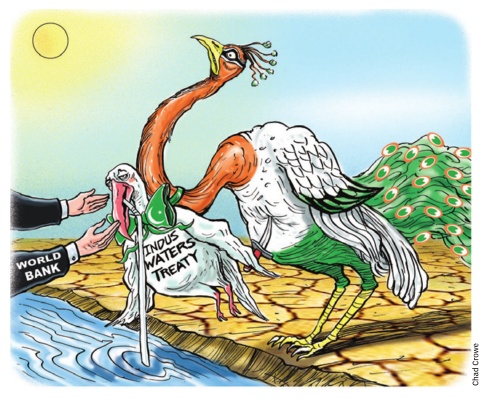
 Last year was an unusual year: Never before had so many Indian security bases come under attack by Pakistan-based terrorists in a single year. For example, the terrorist strike on the Pathankot air base was New Year’s gift to India, while the strike on the Indian Army’s Uri base represented a birthday gift for Prime Minister Narendra Modi. Furthermore, the number of Indian security personnel killed in gunbattles with terrorists in Jammu and Kashmir in 2016 was the highest in years.
 BRAHMA CHELLANEY
 Over the last eight years, as China’s posturing in Asia became increasingly aggressive, many criticized US President Barack Obama for failing to stand up to the Asian giant. It was on Obama’s watch, after all, that China captured the disputed Scarborough Shoal from the Philippines and built seven artificial islands in the South China Sea, on which it then deployed heavy weapons – all without incurring any international costs.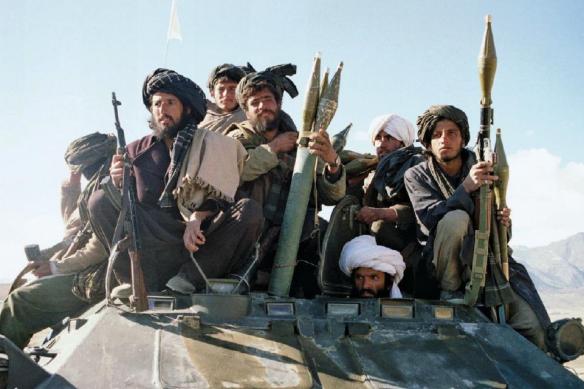

 BRAHMA CHELLANEY
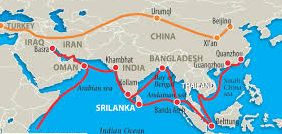 Sri Lanka is Exhibit A. Though small, the country is strategically located between China’s eastern ports and the Mediterranean. Chinese President Xi Jinping has called it vital to the completion of the maritime Silk Road.
 Stagecraft and Statecraft
You must be logged in to post a comment.