Unknown's avatar

About Chellaney

Professor, strategic thinker, author and commentator

China’s stealth wars in the Himalayas

Beijing’s military advance into Bhutan-claimed territory leaves New Delhi floundering, raising concern over India’s own borders.

CCTV image

China’s CCTV in August shows a target exploding during a live-fire drill by the Chinese army near its border with India. © CCTV/AP

Brahma Chellaney, Nikkei Asian Review

Operating in the threshold between peace and war, China has pushed its borders far out into international waters in the South China Sea in a way no other power has done elsewhere. Less known is that China is using a similar strategy in the Himalayas to alter facts on the ground — meter by meter — without firing a single shot.

India is facing increasingly persistent Chinese efforts to intrude into its desolate borderlands. China, however, has not spared even one of the world’s smallest countries, Bhutan, which has barely 8,000 men in its security forces. In the disputed Himalayan plateau of Doklam, claimed by both Bhutan and China, the People’s Liberation Army has incrementally changed the status quo since last fall.

Doklam became a defining event in a 10-week standoff between Chinese and Indian troops last summer after the PLA started building a highway on that plateau to the India border: For the first time since China’s success in the South China Sea, a rival power stalled Chinese construction activity to change the status quo in a disputed territory.

India intervened as Bhutan’s security guarantor to thwart a threat to its own security. Despite almost daily Chinese threats to “teach it a lesson,” India refused to back down, forcing a humiliated Beijing to eventually accept a mutual-withdrawal deal to end the standoff with a country it sees as economically and militarily inferior.

But as happened with the 2012 U.S.-brokered deal for Chinese and Philippine naval vessels to withdraw from around the Scarborough Shoal, China did not faithfully comply with the Doklam accord. If anything, China applied the Scarborough “model” to Doklam — agree to disengage and, after the standoff is over, quietly send in forces to occupy the territory.

Doklam thus illustrates that while India may be content with a tactical win, China has the perseverance and guile to win at the strategic level. Camouflaging offense as defense, China hews to ancient military theorist Sun Tzu’s advice, “The ability to subdue the enemy without any battle is the ultimate reflection of the most supreme strategy.” As Sun Tzu said, “All warfare is based on deception.”

India tried for months to obfuscate the PLA’s increasing control of Doklam so as not to dilute the “victory” it had sold to its public. Even as commercially available satellite images showed China’s rapidly expanding military infrastructure in Doklam, India’s foreign ministry tried pulling the wool over the public’s eyes by repeatedly saying there were “no new developments at the faceoff site or its vicinity,” located at the plateau’s southern edge. Meanwhile, China continued to build permanent military structures and forward deploy troops across much of Doklam.

This month, Indian Defense Minister Nirmala Sitharaman grudgingly admitted China has constructed helipads and other military structures in Doklam so as to “maintain” troop deployments even in winter. Previously, there were no force deployments or permanent military structures on the uninhabited plateau, which was visited by nomadic shepherds and Bhutanese and Chinese mobile patrols other than in the harsh winter.

To be sure, China has dictated a Hobson’s choice to India on Doklam, like it did to the Philippines over Scarborough: Go along with the changed status quo or face the risk of open war. Clearly, New Delhi didn’t anticipate that an end to the faceoff would result in rapid Chinese encroachments that now virtually preclude India intervening again in Doklam at Bhutan’s behest.

In effect, Beijing has shown Bhutan that India cannot guarantee its territorial integrity.

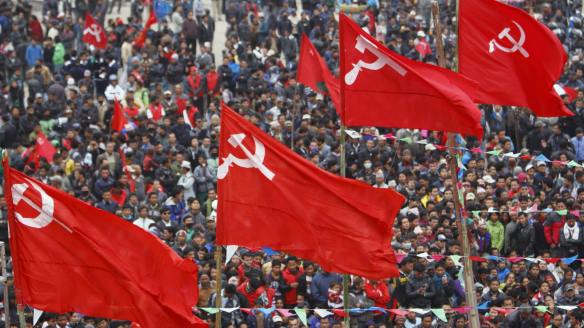
China’s objective unmistakably is to undercut India’s influence in Bhutan in the way Beijing has succeeded in another Himalayan nation, Nepal, where a Chinese-backed communist government took office earlier this year. It was Beijing that persuaded Nepal’s two main communist parties to overcome their bitter squabbles and join hands in national and local elections.

China’s new control over much of Doklam, however, effectively overturns the land-swap deal it has long offered Bhutan. Under the offer, the tiny kingdom was to cede its claim to that plateau in return for Beijing renouncing its claim to a slice of northern Bhutan.

Beijing has held some 24 rounds of border talks with Bhutan since 1984, just as its negotiations with India on territorial and boundary issues have gone on interminably since 1980 without tangible progress. In fact, the largest real estate China covets in Asia is in India — Arunachal Pradesh, a resource-rich Himalayan territory almost three times as large as Taiwan.

Today, China has stepped up military pressure on India, including beefing up its ground and air assets in the Himalayan region. The Indian government recently told Parliament that the number of Chinese military intrusions into India’s vulnerable borderlands jumped 56% in one year — from 273 in 2016 to 426 in 2017, or more than one per day. It seems that just as China’s trade surplus with India has doubled since Indian Prime Minister Narendra Modi took office in 2014, its border incursions are also on a similar rising trajectory.

India’s perennially reactive mode allows the PLA to keep the initiative in the Himalayas. More fundamentally, China — by mounting strategic pressure on multiple Indian flanks while raking in a fast-growing trade surplus (currently running at nearly $5 billion a month) — is able to have its cake and eat it too.

Add to the picture another important element of China’s Himalayan strategy — reengineering transboundary flows of rivers originating in Tibet through dams and other projects. A third of India’s total freshwater supply comes from rivers that start in Tibet. Last year, China breached two bilateral accords with India by withholding upstream river flow data, which is necessary for flood forecasting and warning. Supply of such data could have prevented some of the deaths in the record flooding that ravaged India’s northeast.

Some 67 years after China eliminated the historical buffer with India by annexing Tibet, it is transforming Himalayan geopolitics to its advantage. China’s strategic penetration of Nepal, which has an open border with India permitting passport-free passage, carries major implications for Indian security. Having lost the outer buffer, Tibet, India now risks losing the inner buffer, Nepal.

In the absence of a coherent strategy to counter China’s aggressive Himalayan strategy, an increasingly defensive India has now sought to make peace with Beijing. For example, it not only advised its officials to stay away from events marking the 60th anniversary this month of the Dalai Lama’s flight to India, but also got Tibetan exiles to move those events from New Delhi to remote Dharamsala, in the Himalayan foothills. Modi’s attention is focused on returning to power in the next national election, which is due to be held in April-May 2019 but might be advanced to this year-end.

Just when Chinese President Xi Jinping’s lurch toward one-man rule has led to a rethink in the West on its relationship with China, India has signaled its intent to go soft on China, with its foreign ministry saying that New Delhi was willing to develop relations with Beijing “based on commonalities.” Salvaging Modi’s China visit for last September’s BRICS (Brazil, China, India, Russia and South Africa) summit prompted New Delhi to cut the Doklam deal with Beijing, paving the way for the Chinese advance into the plateau. Now Modi is again set to go to China, this time for a bilateral summit with Xi. But India will likely not only come away empty-handed from its new propitiatory approach but also give cover to China’s designs against it.

Brahma Chellaney, a geostrategist and author, is professor of strategic studies at the New Delhi-based Center for Policy Research.

© Nikkei Asian Review, 2018.

A New Order for the Indo-Pacific

China has transformed the Indo-Pacific region’s strategic landscape in just five years. If other powers do not step in to counter further challenges to the territorial and maritime status quo, the next five years could entrench China’s strategic advantages.

BRAHMA CHELLANEY, Project Syndicate

SYDNEY – Security dynamics are changing rapidly in the Indo-Pacific. The region is home not only to the world’s fastest-growing economies, but also to the fastest-increasing military expenditures and naval capabilities, the fiercest competition over natural resources, and the most dangerous strategic hot spots. One might even say that it holds the key to global security.

The increasing use of the term “Indo-Pacific” – which refers to all countries bordering the Indian and Pacific oceans – rather than “Asia-Pacific,” underscores the maritime dimension of today’s tensions. Asia’s oceans have increasingly become an arena of competition for resources and influence. It now seems likely that future regional crises will be triggered and/or settled at sea.

The main driver of this shift has been China, which over the last five years has been working to push its borders far out into international waters, by building artificial islands in the South China Sea. Having militarized these outposts – presented as a fait accompli to the rest of the world – it has now shifted its focus to the Indian Ocean.

Already, China has established its first overseas military base in Djibouti, which recently expropriated its main port from a Dubai-based company, possibly to give it to China. Moreover, China is planning to open a new naval base next to Pakistan’s China-controlled Gwadar port. And it has leased several islands in the crisis-ridden Maldives, where it is set to build a marine observatory that will provide subsurface data supporting the deployment of nuclear-powered attack submarines (SSNs) and nuclear-powered ballistic missile subs (SSBNs) in the Indian Ocean.

In short, China has transformed the region’s strategic landscape in just five years. If other powers do not step in to counter further challenges to the territorial and maritime status quo, the next five years could entrench China’s strategic advantages. The result could be the ascendancy of a China-led illiberal hegemonic regional order, at the expense of the liberal rules-based order that most countries in the region support. Given the region’s economic weight, this would create significant risks for global markets and international security.

To mitigate the threat, the countries of the Indo-Pacific must confront three key challenges, beginning with the widening gap between politics and economics. Despite a lack of political integration and the absence of a common security framework in the Indo-Pacific, free-trade agreements are proliferating, the latest being the 11-country Comprehensive and Progressive Agreement for Trans-Pacific Partnership (CPTPP). China has emerged as the leading trade partner of most regional economies.

But booming trade alone cannot reduce political risks. That requires a framework of shared and enforceable rules and norms. In particular, all countries should agree to state or clarify their territorial or maritime claims on the basis of international law, and to settle any dispute by peaceful means – never through force or coercion.

Establishing a regional framework that reinforces the rule of law will require progress on overcoming the second challenge: the region’s “history problem.” Disputes over territory, natural resources, war memorials, air defense zones, and textbooks are all linked, in one way or another, with rival historical narratives. The result is competing and mutually reinforcing nationalisms that imperil the region’s future.

The past continues to cast a shadow over the relationship between South Korea and Japan – America’s closest allies in East Asia. China, for its part, uses history to justify its efforts to upend the territorial and maritime status quo and emulate the pre-1945 colonial depredations of its rival Japan. All of China’s border disputes with 11 of its neighborsare based on historical claims, not international law.

This brings us to the third key challenge facing the Indo-Pacific: changing maritime dynamics. Amid surging maritime trade flows, regional powers are fighting for access, influence, and relative advantage.

Here, the biggest threat lies in China’s unilateral attempts to alter the regional status quo. What China achieved in the South China Sea has significantly more far-reaching and longer-term strategic implications than, say, Russia’s annexation of Crimea, as it sends the message that defiant unilateralism does not necessarily carry international costs.

Add to that new challenges – from climate change, overfishing, and degradation of marine ecosystems to the emergence of maritime non-state actors, such as pirates, terrorists, and criminal syndicates – and the regional security environment is becoming increasingly fraught and uncertain. All of this raises the risks of war, whether accidental or intentional.

As the most recent US National Security Strategy report put it, “A geopolitical competition between free and repressive visions of world order is taking place in the Indo-Pacific region.” And yet while the major players in the region all agree that an open, rules-based order is vastly preferable to Chinese hegemony, they have so far done far too little to promote collaboration.

There is no more time to waste. Indo-Pacific powers must take stronger action to strengthen regional stability, reiterating their commitment to shared norms, not to mention international law, and creating robust institutions.

For starters, Australia, India, Japan, and the US must make progress in institutionalizing their Quadrilateral Security Dialogue, so that they can better coordinate their policies and pursue broader collaboration with other important players like Vietnam, Indonesia, and South Korea, as well as with smaller countries.

Economically and strategically, the global center of gravity is shifting to the Indo-Pacific. If the region’s players don’t act now to fortify an open, rules-based order, the security situation will continue to deteriorate – with consequences that are likely to reverberate worldwide.

Brahma ChellaneyBrahma Chellaney, Professor of Strategic Studies at the New Delhi-based Center for Policy Research and Fellow at the Robert Bosch Academy in Berlin, is the author of nine books, including Asian JuggernautWater: Asia’s New Battleground, and Water, Peace, and War: Confronting the Global Water Crisis. © Project Syndicate.


China ensnares vulnerable states in a debt trap

Easy loans are used to secure influence and grab control of strategic assets

20180219_china-Djibouti-ship_article_main_image

A ship departs a port in Zhanjiang, China, in July 2017 for Djibouti to dispatch members of the People’s Liberation Army to man a military base there. © Xinhua

Brahma Chellaney, Nikkei Asian Review

“There are two ways to conquer and enslave a country,” American statesman John Adams (U.S. president from 1797 to 1801) famously said. “One is by the sword. The other is by debt.”

China has chosen the second path. Aggressively employing economic tools to advance its strategic interests, Beijing has extended huge loans to financially-weak states and ensnared some in debt traps that greatly strengthen its leverage.

After establishing a growing presence in the South China Sea, Beijing seems increasingly determined to extend its influence in the Indian Ocean, not least in countries surrounding India, its regional strategic rival.

From Djibouti in Africa to the Indian Ocean island of Sri Lanka, China has converted big credits into political influence and even a military presence.

Now a political crisis in the Maldives has highlighted the fact that China has quietly acquired several islets in the heavily-indebted Indian Ocean archipelago.

Mohamed Nasheed, the nation’s first and only democratically elected president who was ousted at gunpoint, says the country cannot repay the $1.5bn-$2bn it owes China, equivalent to 80% of the total foreign debt. “Without firing a single shot, China has grabbed more land” in the Maldives than what Britain’s “East India Company did at the height of the 19th century.”

Among the unpopulated Maldivian islands China has acquired on lease are Feydhoo Finolhu, lying close to the capital Male and previously used for police training, and the seven-kilometer-long Kalhufahalufushi, with a magnificent reef. For Feydhoo Finolhu, it paid $4 million, which is what a luxury apartment in Hong Kong sells for; Kalhufahalufushi was even cheaper.

China is the only country to come out in support of Maldives’ embattled authoritarian president, Abdulla Yameen, who came to power in 2013. Beijing has also issued an open threat against India, which has traditionally been the dominant foreign influence in the Maldives since the islands were granted independence from Britain. Chinese state-controlled media has warned that if India militarily intervenes in the Maldives, Beijing won’t “sit idly by” but will “take action to stop” it.

To be sure, China claims sound commercial grounds for acquiring its Maldivian islands. But across the Indian Ocean, port projects that China insisted were purely commercial have acquired military dimensions.

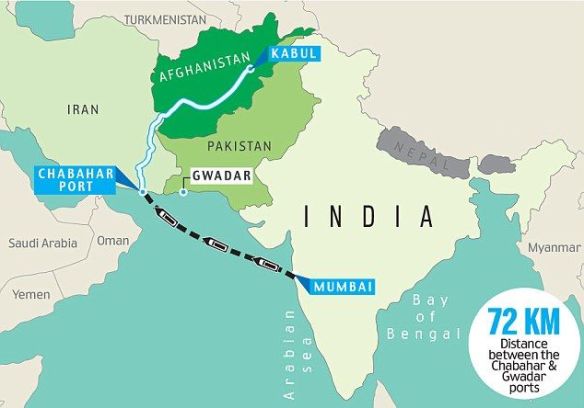
After lending billions of dollars to Djibouti, China last year established its first overseas military base in that tiny but strategically important state, located on the northwestern edge of the Indian Ocean. In Pakistan, Beijing has deployed its warships for the security of the Chinese-built Gwadar port, whilst seeking to establish a military base nearby.

Beijing’s creditor diplomacy scored a major success in December when Sri Lanka formally handed over its strategically located Hambantota port to China under a 99-year lease valued at $1.12 billion. Earlier, after Sri Lanka’s $500-million, largely Chinese-owned Colombo Port container terminal opened in 2014, Chinese submarines arrived quietly and docked there.

Further east in Myanmar, there are concerns in India and the West that Kyauk Pyu, a deep-water port to be developed and financed largely by China, could eventually also serve military purposes.

In the Maldives, Beijing has shown interest in turning an uninhabited island into a naval base by cutting through the surrounding coral reefs to create passageways for its warships. Or it could create an artificial island and militarize it, as it has done in the South China Sea.

Underscoring Beijing’s strategic calculations, three Chinese frigates visited the Maldives about six months ago, docking in Male and at Girifushi Island and imparting special training to Maldivian troops.

Meanwhile, China’s stepped-up naval presence in the Indian Ocean in recent weeks might be intended to send a message to India, including seeking to deter it from militarily intervening in the Maldives, as New Delhi did with Western backing in 1988, when Indian paratroopers foiled a coup attempt. The action reinforced India’s claim to be the region’s peacekeeper.

The current ruler, Yameen, has facilitated China’s island acquisitions in his country by amending the constitution in 2015 to legalize foreign ownership of land. The amendment appeared tailored for China; the new rules for foreign ownership require a minimum $1 billion construction project that involves reclaiming at least 70% of the desired land from the ocean.

By also awarding Beijing major Chinese-financed infrastructure contracts, Yameen is saddling the Maldives with mounting debt that is likely to prove unserviceable.

Several countries that have fallen into, or risk slipping into, debt servitude to China are India’s immediate neighbors, including Bangladesh, the Maldives, Myanmar, Nepal, Pakistan and Sri Lanka. This holds major foreign-policy implications for India, which is seeing its influence erode in its backyard. By establishing a Djibouti-type naval base in the Maldives, China could open an Indian Ocean front against India in the same quiet way that it opened the trans-Himalayan threat under Mao Zedong by gobbling up Tibet, the historical buffer.

China’s strategy in southern Asia and beyond is aimed at fashioning a Sinosphere of trade, communication, transportation and security links. By financially shackling smaller states through projects it funds and builds, it is crimping their decision-making autonomy in a way that helps bring them within its strategic orbit. It is even replicating some of the practices that were used against it during the European-colonial period when, in the words of the Chinese nationalist revolutionary leader Sun Yat-sen, “India was the favored wife of Britain while China was the common prostitute of all powers.” One such practice is the long-term lease, an echo of the 99-year-lease through which 19th-century Britain secured control of the New Territories, expanding Hong Kong’s landmass by 90%.

The International Monetary Fund has warned that Chinese loans, offered at rates as high as 7 percent, are promoting unsustainable debt burdens. The price that such loans exact can extend to national sovereignty and self-respect. The handover of Hambantota was seen in Sri Lanka as the equivalent of a heavily indebted farmer giving away his daughter to the cruel money lender.

In Pakistan, Chinese state companies have secured energy contracts on terms that include ownership of the plants and 16% guaranteed yearly returns, very high by global standards. The “economic corridor” that China seems intent on building across Pakistan has become a vehicle for a deep Chinese penetration of the Pakistani state, with most of the investment going into energy, agricultural and security projects often unrelated to a corridor.

Against this background, the word “predatory” is increasingly being used internationally about China’s practices. U.S. Secretary of State Rex Tillerson has called China a “new imperialist power” whose practices are “reminiscent of European colonialism.”

Mao said, “Political power grows out of the barrel of a gun.” But with China emerging as the first major power in modern history without real allies, an additional principle is guiding its policy: buying friendship by opening a fat wallet. China is co-opting states into its sphere of influence by burying them in debt.

Brahma Chellaney is a geostrategist and the author of nine books, including the award-winning “Water, Peace, and War.”

© Nikkei Asian Review, 2018.

India’s Choice in the Maldives

72c3405b293d7d1dbbdc7e24438ace91.2-1-super.1

As the political situation in the Maldives deteriorates, peace and security in the Indian Ocean is increasingly in jeopardy. With China seeking to capitalize on its support for the authoritarian president, Abdulla Yameen, to expand its influence in the region, the crisis has become a defining moment for India.

BRAHMA CHELLANEY, Project Syndicate

The Maldives – that beautiful Indian Ocean country comprising more than 1,000 coral islands – is known the world over as a tranquil and luxurious travel destination. But the country is now being roiled by a political crisis so severe that international advisories are cautioning against travel there.

The rule of law in the Maldives has been steadily deteriorating ever since President Abdulla Yameen came to power in 2013. The situation escalated sharply earlier this month, when Yameen refused to comply with the Supreme Court’s unanimous order quashing the convictions, which he had engineered, of nine opposition figures – including the exiled former president, Mohamed Nasheed – on terrorism charges. Instead of freeing those whose sentences were nullified, Yameen declared a state of emergency and jailed two of the Supreme Court’s five judges, including the chief justice.

To be sure, authoritarianism is not new to the Maldives. Indeed, Nasheed is the only democratically elected, non-autocratic president the country has had since it gained independence from Britain in 1965. His tenure lasted just over three years, until, in 2012, he was forced at gunpoint to resign.

But the Maldives’ sordid politics is having an increasingly far-reaching impact, not least because it is closely linked to radical Islam. On the day Nasheed was overthrown, Islamists ransacked the Maldives’ main museum, smashing priceless Buddhist and Hindu statues and erasing all evidence of the country’s pre-Islamic roots. On a per capita basis, the Maldives has sent the highest number of foreign fighters to support terrorist groups in Syria and Iraq.

Moreover, the Maldives sits astride critical shipping lanes in the Indian Ocean, making it vital to security in the region. As a result, the country’s deteriorating political conditions are increasingly capturing the international community’s attention. Democratic powers, from the United States to India, are calling upon the United Nations to intervene in the crisis, while China, seeking to advance its own interests in the Indian Ocean, is defending the graft-tainted Yameen.

The increasingly close relationship between China and the Maldives represents a significant shift from the past, when India was the country’s primary regional partner. Maldivians are mainly of Indian and Sri Lankan origin, and have strong cultural and economic ties to those countries. Their country has traditionally been viewed as part of India’s sphere of influence.

But, in recent years, China has been eroding India’s influence in the Maldives, as part of its effort to build its “string of pearls”: a chain of military installations and economic projects aimed at projecting Chinese power in the Indian Ocean. Just as China recently secured the Sri Lankan port of Hambantota on a 99-year lease, it has, according to Nasheed, quietly acquired 17 islands in the heavily indebted Maldives for investment purposes.

But, betraying its strategic objectives, China has also sent warships to visit the Maldives. If China, which has stepped up military pressure on India along their Himalayan frontier, turned one of the Maldivian islands into a naval base, it would effectively open a maritime front against India – a milestone in China’s strategic encirclement of its neighbor.

The Maldivian crisis thus is a defining moment for India. Will India intervene militarily, as Nasheed and other Maldivian opposition leaders have requested, or will it allow Yameen to continue to enable China to pursue its strategic objectives in the region?

There is some precedent for an Indian military intervention in the Maldives. In 1988, India snuffed out a coup attempt against the autocratic Maumoon Abdul Gayoom engineered by a Maldivian businessman with the aid of armed mercenaries, especially Sri Lankan Tamil separatists. Thanks to India’s swift military action, Gayoom would hold onto power for another two decades.

Yet when the country’s first and only democratically elected president beseeched India in 2012 to rescue him from the Islamist forces laying siege to his office, India looked the other way. India’s government felt betrayed by Nasheed’s own burgeoning relationship with China. Not only had Nasheed awarded China its first infrastructure contracts; just three months before his ouster, he had inaugurated the new Chinese embassy in the capital, Malé, on the same day that India’s then-prime minister, Manmohan Singh, arrived for a regional summit.

Today, an Indian intervention could be dicey, not least because no legitimate authority is inviting India to send in forces. Indian paratroopers could gain effective control of Malé within a few hours. But what would the endgame be? Amid rising Islamist influence and shifting political allegiances among the handful of powerful families that dominate the Maldives’ economy and politics, finding reliable allies committed to – much less capable of – protecting democratic freedoms would prove a daunting challenge.

Moreover, even if Yameen were ousted and the country held a democratic election, it is unlikely that China’s influence could be contained. As the experiences of Bangladesh, Myanmar, Nepal, and Sri Lanka illustrate, China has outmaneuvered India diplomatically, even when dealing with democratically elected governments. Indeed, it did so in the Maldives itself, with Nasheed. Because the country’s debt will continue to rise, regardless of its leadership, China will retain its favorite source of leverage.

India, with its proximity and historical ties to the Maldives, may seem to hold a strong hand. But it has a lot to lose if it aggravates an already volatile political situation in its maritime backyard by intervening militarily.

India’s best option is to hold out a credible threat of military action, while imposing, together with other democratic powers, economic sanctions that undercut support for Yameen among the Maldivian elite, many of whom own the luxury resorts that now have far too many empty rooms. With them on side, perhaps the international community would be able to ensure that the presidential election scheduled for later this year is fair and inclusive – and supervised by the UN. That is the only way to end the crisis, and restore peace to an Indian Ocean paradise.

Brahma ChellaneyBrahma Chellaney, Professor of Strategic Studies at the New Delhi-based Center for Policy Research and Fellow at the Robert Bosch Academy in Berlin, is the author of nine books, including Asian JuggernautWater: Asia’s New Battleground, and Water, Peace, and War: Confronting the Global Water Crisis.

© Project Syndicate, 2018.

The Maldives: The moment of truth

maldives-location-on-the-indian-ocean-map

Brahma Chellaney, The Hindustan Times

China, the sole defender of the Maldives’ embattled autocrat, Abdulla Yameen, has issued an open threat through a state mouthpiece: If India militarily intervenes in the Maldives, Beijing won’t “sit idly by” but will “take action to stop” it. This essentially is an empty threat because China has no credible capability to sustain a military operation far from its shores. Despite China’s rising naval power, taking on India in its own maritime backyard will be a fool’s errand.

India could call China’s bluff through quick military action that deposes Yameen and installs the jailed Supreme Court chief justice as the interim president to oversee fair elections under UN supervision. In truth, an Indian intervention is not on the cards, in part because such action would trample on the principles India has long championed.

India has carefully weighed all the factors and resolved not to intervene at present in the vicious politics of the increasingly radicalized Maldives. If the crisis there were to escalate to civil war-like conditions, with street clashes erupting in the capital Malé, where two-fifths of the nation’s total population lives, India could, of course, intervene in the name of “responsibility to protect”, the moral principle NATO invoked to counterproductively overthrow Libya’s Muammar Gaddafi.

India had a narrow window of opportunity to intervene immediately after Yameen declared a state of emergency and jailed many, including his elderly half-brother, Maumoon Abdul Gayoom, whose dictatorship lasted three decades largely because Indian paratroopers in 1988 salvaged his presidency from coup plotters who seized control of much of Malé. Before Yameen fell out with Gayoom, he actually ran a family dictatorship, with Gayoom’s daughter his foreign minister.

Beijing’s threat at this stage is not only Doklam-style psychological warfare against India but, more importantly, also an effort to curry favour with the internationally isolated Yameen. By claiming to shield him from India’s potential action, China wants to expand its strategic footprint in the Maldives, where it has already acquired several of the country’s 1,190 atolls for projects. The Maldives’ first and only democratically elected president, Mohamed Nasheed, who was ousted at gunpoint by Gayoom’s pro-Islamist cronies, claims China’s “land grab” has netted 17 islets.

While India has wisely refrained from any precipitous action in response to Yameen’s unbridled lurch toward authoritarianism, it faces a pressing foreign-policy challenge extending beyond the Maldivian crisis. Make no mistake: India’s rapidly eroding influence in its strategic backyard holds far-reaching implications for its security, underscoring the imperative for a more dynamic, forward-looking strategy. India’s inaction and missteps have aided China’s aggressive diplomacy, with Chinese clout increasingly on display even in countries symbiotically tied to India, such as Nepal, Sri Lanka and the Maldives. With Beijing seeking to establish a Djibouti-type naval base in the Maldives, China is opening an oceanic threat against India in the same quiet way that it opened the trans-Himalayan threat under Mao Zedong.

On the Maldives, India’s moment of truth came not with the latest emergency proclamation but in February 2012 when Nasheed made desperate phone calls to Prime Minister Manmohan Singh pleading for an Indian intervention against the Islamists besieging his office. Nasheed, however, had roiled New Delhi with his overtures to Beijing, including personally inaugurating the newly established Chinese Embassy on the day Singh arrived in Malé for a SAARC summit. India’s refusal to take a long-term strategic view and prevent Nasheed’s overthrow has had important consequences, including empowering the Islamists and ceding more space to China. Just months after Nasheed’s ouster, the Maldives expropriated its main international airport from India’s GMR Infrastructure.

In recent years, an emboldened Maldives has increasingly acted against India’s strategic interests with impunity. Six months ago, it sent New Delhi a chilling message by welcoming three Chinese frigates, which docked in Malé and Girifushi Island and imparted special training to Maldivian troops. Yameen amended the Constitution in 2015 to legalize foreign ownership of land in a way tailored for China, requiring a minimal $1-billion construction project that reclaims at least 70% of the desired land from the ocean. New Delhi’s carrots-only approach also encouraged Yameen more recently to sign a free-trade agreement with China that seems designed to use the Maldives as a conduit for the flow of Chinese goods to the Indian market.

India must now start wielding the stick. With other democratic powers, it should impose punishing sanctions. However, the right powers to militarily intervene in the Maldives are the U.S. and Britain because, unlike India, they have little to lose and democracy promotion is a legitimate foreign-policy plank for them. China’s growing presence in the Indian Ocean threatens not just India’s security but also the Diego Garcia-centred Anglo-American naval pre-eminence in the region.

Brahma Chellaney is a geostrategist and author.

© The Hindustan Times, 2018.

How Can America Change Pakistani Behavior?

The US has plenty of incentive to put pressure on Pakistan, a country that has long pretended to be an ally, even as it continues to aid the militant groups fighting and killing US soldiers in neighboring Afghanistan. In fact, it is partly because of that aid that Afghanistan is a failing state, leaving the US mired in its longest-ever war.

BRAHMA CHELLANEYProject Syndicate column

LeT-terroristUS President Donald Trump’s recent decision to freeze some $2 billion in security assistance to Pakistan as punishment for the country’s refusal to crack down on transnational terrorist groups is a step in the right direction. But more steps are needed.

The United States has plenty of incentive to put pressure on Pakistan, a country that has long pretended to be an ally, even as it continues to aid the militant groups fighting and killing US soldiers in neighboring Afghanistan. In fact, it is partly because of that aid that Afghanistan is a failing state, leaving the US mired in the longest war in its history.

More than 16 years after the US invaded Afghanistan, its capital Kabul has come under siege, exemplified by the recent terrorist attack on Kabul’s Intercontinental Hotel and the suicide bombing, using an explosives-laden ambulance, in the city center. In recent months, the US has launched a major air offensive to halt the rapid advance of the Afghan Taliban. The US has now carried out more airstrikes since last August than in 2015 and 2016 combined.

Yet neither the air blitz nor the Trump administration’s deployment of 3,000 additional US troops can reverse the deteriorating security situation in Afghanistan. To achieve that, Pakistan would have to dismantle the cross-border sanctuaries used by the Taliban and its affiliate, the Haqqani network, as well as their command-and-control operations, which are sited on Pakistani territory. As the US military commander in Afghanistan, General John Nicholson, has acknowledged, “It’s very difficult to succeed on the battlefield when your enemy enjoys external support and safe haven.”

The problem is that Pakistan’s powerful military, whose generals dictate terms to a largely impotent civilian government, seems committed to protecting, and even nurturing, terrorists on Pakistani soil. Only those militants who threaten Pakistan are targeted by the country’s rogue Inter-Services Intelligence agency.

Far from holding Pakistan’s generals accountable for the American blood on their hands, the US has provided them large amounts of funding – so much, in fact, that Pakistan has been one of America’s largest aid recipients. Even when the US found Osama bin Laden, after a ten-year hunt, holed up in a compound next to Pakistan’s main military academy, it did not meaningfully alter its carrot-only strategy. This has enabled the military to tighten its grip on Pakistan further, frustrating domestic efforts to bring about a genuine democratic transition.

Making matters worse, the US has dissuaded its ally India – a major target of Pakistan-supported terrorists – from imposing any sanctions on the country. Instead, successive US administrations have pressured India to engage diplomatically with Pakistan, including through secret meetings between Indian Prime Minister Narendra Modi’s national security adviser and his Pakistani counterpart in Bangkok and elsewhere.

This approach has emboldened Pakistan-based terrorists to carry out cross-border attacks on targets from Mumbai to Kashmir. As for the US, the White House’s new National Security Strategy confirms that America “continues to face threats from transnational terrorists and militants operating from within Pakistan.” This conclusion echoes then-Secretary of State Hillary Clinton’s warning in 2009 that Pakistan “poses a mortal threat to the security and safety of our country and the world.”

Against this background, the Trump administration’s acknowledgement of US policy failure in Pakistan is good news. But history suggests that simply suspending security aid – economic assistance and military training are set to continue – will not be enough to bring about meaningful change in Pakistan (which also counts China and Saudi Arabia among its benefactors).

One additional step the US could take would be to label Pakistan as a state sponsor of terrorism. If the US prefers not to do so, it should at least strip Pakistan of its status, acquired in 2004, as a Major non-NATO Ally, thereby ending its preferential access to American weapons and technologies.

Moreover, the US should impose targeted sanctions, including asset freezes on senior military officers who maintain particularly close ties to terrorists. With the children of many Pakistani military officers living in the US, it would also be worth barring these families from the country.

Finally, the US should take advantage of its enduring position as Pakistan’s largest export market to tighten the economic screws on the cash-strapped country. Since 2013, Pakistan has attempted to offset the sharp decline in its foreign-exchange reserves by raising billions of dollars in dollar-denominated debt with ten-year bonds. Pakistan’s efforts to stave off default create leverage that the US should use.

Likewise, Pakistan agreed to privatize 68 state-run companies, in exchange for $6.7 billion in credit from the International Monetary Fund. If the US extended financial and trade sanctions to multilateral lending, and suspended supplies of military spare parts, it would gain another effective means of bringing Pakistan to heel.

To be sure, Pakistan could respond to such sanctions by blocking America’s overland access to Afghanistan, thereby increasing the cost of resupplying US forces by up to 50%. But, as Pakistan learned in 2011-2012, such a move would hurt its own economy, especially its military-dominated trucking industry. Meanwhile, the added cost to the US would be lower than America’s military reimbursements to Pakistan in the last year, which covered, among other things, resupply routes and the country’s supposed counterterrorism operations.

If Pakistan is going to abandon its double game of claiming to be a US ally while harboring terrorists, the US will need to stop rewarding it for offering, as Trump put it, “nothing but lies and deceit.” More than that, the US will need to punish Pakistan for its duplicity. And US policymakers must act soon, or an increasingly fragile Pakistan could well be transformed from a state sponsor of terrorism into a state sponsored by terrorists.

Brahma Chellaney, Professor of Strategic Studies at the New Delhi-based Center for Policy Research and Fellow at the Robert Bosch Academy in Berlin, is the author of nine books, including Asian JuggernautWater: Asia’s New Battleground, and Water, Peace, and War: Confronting the Global Water Crisis.

© Project Syndicate, 2018.

India has forgotten its own realist strategic thought

India’s tradition of realist strategic thought is probably the oldest in the world. Yet India has forgotten its own realist strategic thought, as propounded before Christ by the strategist Kautilya (also known as Chanakya). So, despite growing realism in foreign policy, quixotic traditions from the Nehruvian era still persist to this day. 

Chanakya

Brahma Chellaney, DNA, January 26, 2018

Madeleine Albright famously said that, “The purpose of foreign policy is to persuade other countries to do what you want or, better yet, to want what we want.” How has Indian foreign policy done when measured against such a standard of success?

In this century, India’s growing geopolitical weight, impressive economic-growth rate, rising military capabilities, increasing maritime role, abundant market opportunities, and favourable long-term demographics have helped increase its international profile. India is widely perceived to be a key “swing state” in the emerging international order. Yet Indian foreign policy offers little clue as to whether India is a world power in the making or just a sub-regional power with global-power pretensions.

India has yet to resolve an underlying tension in policy between realism and idealism. The struggle between idealism and pragmatism has bedevilled its diplomacy since independence, imposing serious costs. For example, Jawaharlal Nehru, the idealist, rejected a U.S. suggestion in the 1950s that India take China’s vacant seat in the United Nations Security Council. The officially blessed selected works of Nehru quote him as saying that India could not accept the American proposal because it meant “falling out with China and it would be very unfair for a great country like China not to be in the [Security] Council.” The selected works also quote Nehru as telling Soviet Premier Marshal Nikolai A. Bulganin in 1955 on the same U.S. offer that “we should first concentrate on getting China admitted.”

Such have been the national-security costs for future Indian generations that just in the first seven years after independence, India allowed Pakistan to seize and retain one-third of Jammu and Kashmir; looked the other way when the newly established People’s Republic of China gobbled up the large historical buffer, the Tibetan Plateau; and tamely surrendered its British-inherited extra-territorial rights in Tibet without any quid pro quo, not even Beijing’s acceptance of the then-prevailing Indo-Tibetan border. The 1954 surrender of extra-territorial rights in Tibet included India shutting its military outposts at Yatung and Gyantse in Tibet and handing over Tibet’s postal, telegraph and public telephone services that it had been running to the Chinese government.

India thought that if it sought peace, it would get peace. In reality, a nation gets peace only if it can defend peace. This reality did not sink in until China humiliated India in 1962.

The 1962 invasion, however, did not change another characteristic of Indian diplomacy — it has been driven not by integrated, institutionalized policymaking but by largely an ad hoc, personality-driven approach. This remains the bane of Indian foreign policy, precluding the establishment of a strategic framework for pursuit of goals. The reliance by successive prime ministers on ad hoc, personal initiatives and decisions has helped marginalize the national security establishment and compounded India’s challenges.

This needs to be corrected. The ministry of external affairs, for example, must play its assigned role in the formulation and execution of key aspects of foreign policy — a role that has increasingly been usurped by the Prime Minister’s Office.

Today, India confronts a “tyranny of geography” — that is, serious external threats from virtually all directions. To some extent, it is a self-inflicted tyranny. India’s concerns over China, Nepal, Bangladesh, Sri Lanka, the Maldives and even Pakistan stem from the failures of its past policies. An increasingly unstable neighbourhood also makes it more difficult to promote regional cooperation and integration.

With its tyranny of geography putting greater pressure on its external and internal security, India needs to develop more innovative approaches to diplomacy. The erosion of its influence in its own backyard should serve as a wake-up call. Only through forward thinking and a dynamic foreign policy can India hope to ameliorate its regional-security situation, freeing it to play a larger global role. Otherwise, it will continue to be weighed down by its region.

While India undoubtedly is imbibing greater realism in its foreign policy, it remains intrinsically cautious and reactive, rather than forward-looking and proactive. And as illustrated by Narendra Modi’s unannounced Lahore visit or by his government’s reluctance to impose any sanctions on a country it has called “Terroristan,” India hasn’t fully abandoned its quixotic traditions from the Nehruvian era.

India’s tradition of realist strategic thought is probably the oldest in the world. The realist doctrine was propounded by the strategist Kautilya, also known as Chanakya, who wrote the Arthashastra before Christ. This ancient manual on great-power diplomacy and international statecraft remains a must-read classic. Yet India, ironically, has forgotten Arthashastra.

© DNA, 2018.

A quiet water war takes a page out of Sun Tzu’s Art of War playbook

International pressure is needed to rein in Beijing’s dam-building frenzy and ensure it respects the environment and rights of downstream nations.
Dam frenzy illustration
Column by Brahma Chellaney, South China Morning Post, January 17, 2018
China’s hyperactive dam building is a reminder that, while the international attention remains on its recidivist activities in the South China Sea’s disputed waters, it is also focusing quietly on other waters – of rivers that originate in Chinese-controlled territory like Tibet and flow to other countries. No country in history has built more dams than China. In fact, China today boasts more dams than the rest of the world combined.

As part of its broader strategy to corner natural resources, China’s new obsession is freshwater, a life-creating and life-supporting resource whose growing shortages are casting a cloud over Asia’s economic future. Dams are integral to this strategy, although they have wreaked havoc on the natural ecosystems.

Dams in China now total 86,000, which means it has completed, on average, at least one dam per day since 1949. Nearly a third of these are large dams, defined as having a height of at least 15 metres (49 feet) or a water storage capacity of more than 3 million cubic metres (793 million gallons). The United States, the world’s second most dammed country with about 5,500 large dams, has been left far behind.

With the world’s most resource-hungry economy, China has gone into overdrive to appropriate natural resources. On the most essential resource, freshwater, it is seeking to become the upstream controller by re-engineering transboundary flows through dams and other structures. Its dam building has largely shifted from internal rivers to transnational rivers, such as the Mekong, Salween, Brahmaputra, Irtysh, Illy and Amur.

Just as the Persian Gulf states sit over immense reserves of oil and gas, China controls vast transnational water resources. By forcibly absorbing Asia’s “water tower”, the Tibetan Plateau, in 1951, it gained a throttlehold on the headwaters of Asia’s major river systems. Its actions in more recent years have sought to build water leverage over its downstream neighbours.

For example, China has erected eight giant dams on the Mekong just before the river enters Southeast Asia, and is building or planning another 20. Armed with the new dam-centred clout, Beijing has rejected the treaty-linked Mekong River Commission and instead co-opted the vulnerable downstream nations in its own Lancang-Mekong Cooperation initiative, which lacks binding rules.

Similar unilateralism by China has fostered increasing water-related tensions with India, many of whose important rivers originate in Tibet.

In 2017, in violation of two legally binding bilateral accords, China refused to supply hydrological data to India, underscoring how it is weaponising the sharing of water data on upstream river flows. The data denial was apparently intended to punish India for boycotting China’s “Belt and Road Initiative” summit and for last summer’s border stand-off on the remote Himalayan plateau of Doklam.

The monsoon-swollen Brahmaputra River last year caused record flooding that left a major trail of death and destruction, especially in India’s Assam state. Some of these deaths might have been prevented had China’s data denial not crimped India’s flood early-warning systems.

Even as Beijing has yet to indicate if it would resume sharing data this year, a major new issue has cropped up in its relations with India – the water in the main artery of the Brahmaputra river system, the Siang, has turned dirty and grey when the stream enters India from Tibet. This has spurred downstream concern in India and elsewhere that China’s upstream activities could be threatening the ecosystem health of the cross-border rivers in the way it has polluted its own domestic rivers, including the Yellow, the cradle of the Chinese civilisation.

After staying quiet over the Siang’s contamination for many weeks, Beijing claimed on December 27 that an earthquake that struck southeastern Tibet in mid-November “might have led to the turbidity” in the river waters. But the flows of the Siang, one of the world’s most pristine rivers, had turned blackish grey before the quake struck.

China has been engaged in major mining and dam-building activities in southeastern Tibet. The Tibetan Plateau is rich in both water and minerals.

As China quietly works on a series of hydro projects in Tibet that could affect the quality and quantity of downstream flows in South and Southeast Asia, it is apparently still toying with the idea of re-routing the upper Brahmaputra river system. An officially blessed book published in 2005 championed the Brahmaputra’s re-routing to the Han heartland.

To deflect attention from its continuing dam-building frenzy and its refusal to enter into a water-sharing treaty with any neighbour, China has bragged about its hydrological-data sharing accords.

Yet it showed in 2017 that it can breach these accords at will. The denial of hydrological data to India actually underscores how China is using transboundary water as a tool of coercive diplomacy.

Such is China’s defiant unilateralism that, to complete a major dam project, it cut off the flow of a Brahmaputra tributary, the Xiabuqu, in 2016 and is currently damming another such tributary, the Lhasa River, into a series of artificial lakes.

Make no mistake: China, by building increasing control over cross-border water resources through hydroengineering structures, is dragging its riparian neighbours into high-stakes games of geopolitical poker over water-related issues. In waging water wars by stealth, China seeks to hew to the central principle enunciated by the ancient military theorist Sun Tzu – “all wars are based on deception”.

International pressure needs to be mounted on Beijing to rein in its dam frenzy and respect environmental standards and the rights of downstream nations.

Brahma Chellaney is a geostrategist and author of nine books, including Water: Asia’s New Battleground , which won the Bernard Schwartz Book Award.

© South China Morning Post, 2018.

China’s Creditor Imperialism

Just as European imperial powers employed gunboat diplomacy, China is using sovereign debt to bend other states to its will. As Sri Lanka’s handover of the strategic Hambantota port shows, states caught in debt bondage to the new imperial giant risk losing both natural assets and their very sovereignty.

4788297355451c4bdef3042b0b070218.2-1-super.1

, Project Syndicate
BERLIN – This month, Sri Lanka, unable to pay the onerous debt to China it has accumulated, formally handed over its strategically located Hambantota port to the Asian giant. It was a major acquisition for China’s Belt and Road Initiative (BRI) – which President Xi Jinping calls the “project of the century” – and proof of just how effective China’s debt-trap diplomacy can be.

Unlike International Monetary Fund and World Bank lending, Chinese loans are collateralized by strategically important natural assets with high long-term value (even if they lack short-term commercial viability). Hambantota, for example, straddles Indian Ocean trade routes linking Europe, Africa, and the Middle East to Asia. In exchange for financing and building the infrastructure that poorer countries need, China demands favorable access to their natural assets, from mineral resources to ports.

Moreover, as Sri Lanka’s experience starkly illustrates, Chinese financing can shackle its “partner” countries. Rather than offering grants or concessionary loans, China provides huge project-related loans at market-based rates, without transparency, much less environmental- or social-impact assessments. As US Secretary of State Rex Tillerson put it recently, with the BRI, China is aiming to define “its own rules and norms.”

To strengthen its position further, China has encouraged its companies to bid for outright purchase of strategic ports, where possible. The Mediterranean port of Piraeus, which a Chinese firm acquired for $436 million from cash-strapped Greece last year, will serve as the BRI’s “dragon head” in Europe.

By wielding its financial clout in this manner, China seeks to kill two birds with one stone. First, it wants to address overcapacity at home by boosting exports. And, second, it hopes to advance its strategic interests, including expanding its diplomatic influence, securing natural resources, promoting the international use of its currency, and gaining a relative advantage over other powers.

China’s predatory approach – and its gloating over securing Hambantota – is ironic, to say the least. In its relationships with smaller countries like Sri Lanka, China is replicating the practices used against it in the European-colonial period, which began with the 1839-1860 Opium Wars and ended with the 1949 communist takeover – a period that China bitterly refers to as its “century of humiliation.”

China portrayed the 1997 restoration of its sovereignty over Hong Kong, following more than a century of British administration, as righting a historic injustice. Yet, as Hambantota shows, China is now establishing its own Hong Kong-style neocolonial arrangements. Apparently Xi’s promise of the “great rejuvenation of the Chinese nation” is inextricable from the erosion of smaller states’ sovereignty.4

Just as European imperial powers employed gunboat diplomacy to open new markets and colonial outposts, China uses sovereign debt to bend other states to its will, without having to fire a single shot. Like the opium the British exported to China, the easy loans China offers are addictive. And, because China chooses its projects according to their long-term strategic value, they may yield short-term returns that are insufficient for countries to repay their debts. This gives China added leverage, which it can use, say, to force borrowers to swap debt for equity, thereby expanding China’s global footprint by trapping a growing number of countries in debt servitude.

Even the terms of the 99-year Hambantota port lease echo those used to force China to lease its own ports to Western colonial powers. Britain leased the New Territories from China for 99 years in 1898, causing Hong Kong’s landmass to expand by 90%. Yet the 99-year term was fixed merely to help China’s ethnic-Manchu Qing Dynasty save face; the reality was that all acquisitions were believed to be permanent.

Now, China is applying the imperial 99-year lease concept in distant lands. China’s lease agreement over Hambantota, concluded this summer, included a promise that China would shave $1.1 billion off Sri Lanka’s debt. In 2015, a Chinese firm took out a 99-year lease on Australia’s deep-water port of Darwin – home to more than 1,000 US Marines – for $388 million.

Similarly, after lending billions of dollars to heavily indebted Djibouti, China established its first overseas military base this year in that tiny but strategic state, just a few miles from a US naval base – the only permanent American military facility in Africa. Trapped in a debt crisis, Djibouti had no choice but to lease land to China for $20 million per year. China has also used its leverage over Turkmenistan to secure natural gas by pipeline largely on Chinese terms.

Several other countries, from Argentina to Namibia to Laos, have been ensnared in a Chinese debt trap, forcing them to confront agonizing choices in order to stave off default. Kenya’s crushing debt to China now threatens to turn its busy port of Mombasa – the gateway to East Africa – into another Hambantota.

These experiences should serve as a warning that the BRI is essentially an imperial project that aims to bring to fruition the mythical Middle Kingdom. States caught in debt bondage to China risk losing both their most valuable natural assets and their very sovereignty. The new imperial giant’s velvet glove cloaks an iron fist – one with the strength to squeeze the vitality out of smaller countries.

Water shortages could trigger Asia conflicts

A number of factors threaten environmental stability and spur climate change

Clipboard01

Asia exemplifies that dams and democracy do not go well together. Dam building has run into major grassroots opposition in major Asian democracies. But it continues unhindered in countries where grassroots empowerment is absent.

Brahma Chellaney, Nikkei Asian Review

In recent weeks, one of the most pristine Himalayan rivers has mysteriously turned black when entering India from Tibet, highlighting how China’s upstream tunneling, damming and mining activities might be causing major environmental contamination. The plight of the Siang, the central artery of the Brahmaputra river system — the lifeline of northeastern India and Bangladesh — is a stark reminder that transboundary river water issues in Asia are no less important than the regional maritime issues of the South and East China seas and the Indian Ocean, which have attracted greater global attention.

Freshwater, or water that is not salty, is a life-supporting resource. But it is increasingly in short supply in Asia. Although home to 60% of the world’s population, Asia has less freshwater per capita than any other continent. Its annual freshwater availability of 2,697 cubic meters per person is less than half the global average of 5,829 cubic meters. Yet Asia has experienced the world’s most rapid growth in freshwater withdrawals from rivers, lakes and aquifers since its economic rise.

The region’s freshwater usage rate exceeds its renewable stocks. By digging deeper wells and overexploiting river resources, combined with irrigation subsidies, Asia is accelerating water resource depletion and environmental degradation.

Transboundary problem

Water contamination until now has been mainly a domestic issue as highlighted by the pollution problems affecting the Yellow River in China and the Ganges in India. But the contamination of the Siang signals that this problem is becoming a transboundary problem, which will increase tensions and discord between neighboring countries.

Sino-India tensions have already increased due to freshwater disputes. Beijing has withheld hydrological data from New Delhi on upstream river flows in 2017 in breach of two bilateral accords. This undermined India’s flood early-warning systems during the critical monsoon season. In India’s Assam state, which suffered record flooding despite below-normal monsoon rainfall, many deaths were preventable. The data denial was apparently intended to punish India for boycotting China’s Belt and Road summit and for the border standoff on the remote Himalayan plateau of Doklam.

Asia’s water crisis, meanwhile, has given rise to grand but environmentally problematic projects such as China’s South-to-North Water Diversion Project. China has already completed two of the three legs of the world’s most ambitious water transfer program, which is now diverting billions of cubic meters of river waters yearly to its parched north. Because this program’s highly controversial third leg is to divert waters from rivers flowing to other countries from the Tibetan Plateau, China refuses to divulge any details about it.

More broadly, even as threats to Asia’s sustainable water supply are intensifying, geostrategic factors are raising the specter of water wars. Dam building and other diversions are often at the center of tensions and recriminations between states.

Asia illustrates that once shared water becomes a political and diplomatic battleground between countries, it begins to insidiously exact geopolitical costs in ways not dissimilar to the legacy of an armed conflict. The casualty usually is sub-regional stability and cooperation.

Asia also exemplifies another important trend — that dams and democracy do not go well together. Dam building has run into major grassroots opposition in Asian democracies like Japan, South Korea and India, driving up project costs and acting as a damper on hydropower expansion. In the absence of grassroots empowerment, however, there are few impediments to dam construction in Laos, Myanmar, Pakistan, China and elsewhere.

Indeed, China has become the global leader in dam building, boasting more large dams than the rest of the world combined. What is intensifying concern among downstream nations about China’s dam frenzy is the shift in its focus from domestic rivers to ones that cross borders. The Siang River’s contamination triggered a political furor and grassroots protests in India’s northeast, forcing Beijing to break its long silence and claim that a Nov. 18 earthquake in southeastern Tibet “might have led to the turbidity (clouding)” of the river. But the river waters turned dirty and gray before the quake struck.

The plain fact is that the environmental futures of China and its many neighbors are inextricably linked. Environmental degradation on the world’s largest and highest plateau — Tibet (which is warming at a rate three times the global average) — carries pan-Asian implications. With its height and other unique features, the Tibetan Plateau influences climatic and rainfall patterns across Asia.

Several other developments are also undermining Asia’s hydrological and climatic stability and fostering a cycle of chronic flooding and droughts. In many Asian countries, watersheds, watercourses, coastal ecosystems and the broader environment are being degraded, resulting in shrinking wetlands and forests, increased water pollution and other ecological problems.

These developments spur global warming. Natural water flows, evaporation and condensation help to propel the earth’s biogeochemical cycles and regulate its climate. Environmental degradation creates a vicious circle. It affects the hydrological cycle that shapes regional climate. A warming climate, in turn, has a significant impact on water resources.

Demand-side options

Jakarta illustrates how Asia’s mounting threats from climate change are fostered by changes in the hydrological cycle. The Indonesian capital, home to nearly 30 million people, is sinking faster than any other major city in the world because of accelerated groundwater depletion. Tens of thousands of wells across Jakarta pump out groundwater at such a rate that it is causing large-scale subsidence, with as much as 40% of the city now said to be below sea level. Groundwater depletion is also contributing to the rise of the Java Sea, thus exacerbating Jakarta’s troubles. Some of the waters extracted from Jakarta’s underground aquifers ultimately end up in the sea.

A surfeit of water but not enough to drink is a scenario likely to confront many coastal Asian cities. One study estimates that groundwater depletion contributes 0.8 millimeters per year to the rise of ocean levels globally, or about a quarter of the total rise. Groundwater depletion, by inviting seawater intrusion into aquifers, is already compounding freshwater shortages in some Asian cities. Meanwhile, the plethora of upstream dams on rivers is causing a perceptible retreat of Asia’s heavily populated deltas that are home to megacities like Bangkok, Dhaka, Guangzhou, Kolkata, Shanghai and Tianjin.

Given that Asia is likely to face a hotter, drier future, governments there must initiate action to mitigate the impacts. The freshwater crisis that many Asian countries already confront should be tackled in a way that contributes to combating climate change. The imperative is to move from purely supply-side approaches to demand-side options that emphasize water conservation and quality as much as quantity. Even on the supply side, nontraditional measures, from recycling of water to rainwater capture, must be embraced.

If unsustainable practices and mismanagement of water resources are not addressed, freshwater will become a precious commodity whose control will spark conflicts in Asia. The rise of water nationalism at a time of increasing water stress highlights the linkage between water and peace. Cooperative institutional mechanisms and sustainable resource utilization constitute the building blocks of water peace. Water is a key test of whether Asian leaders have the political will and good sense to think and act long term. What Asia confronts today, other continents are likely to face tomorrow.

Brahma Chellaney is a geostrategic and author of nine books, including “Water: Asia’s New Battleground,” which won the Bernard Schwartz Award.

© Nikkei Asian Review, 2017.