Unknown's avatar

About Chellaney

Professor, strategic thinker, author and commentator

The US and India in a new world

Brahma Chellaney, The Spectator

The world’s center of gravity is shifting to the Indo-Pacific. The new global order will be shaped by developments in a sprawling region where interstate rivalries and tensions are sharpening geopolitical risks. Building a stable balance of power in the Indo-Pacific has become more important than ever, but China’s territorial and maritime revisionism, and its heavy-handed use of economic and military power, are causing instability and undercutting international norms.

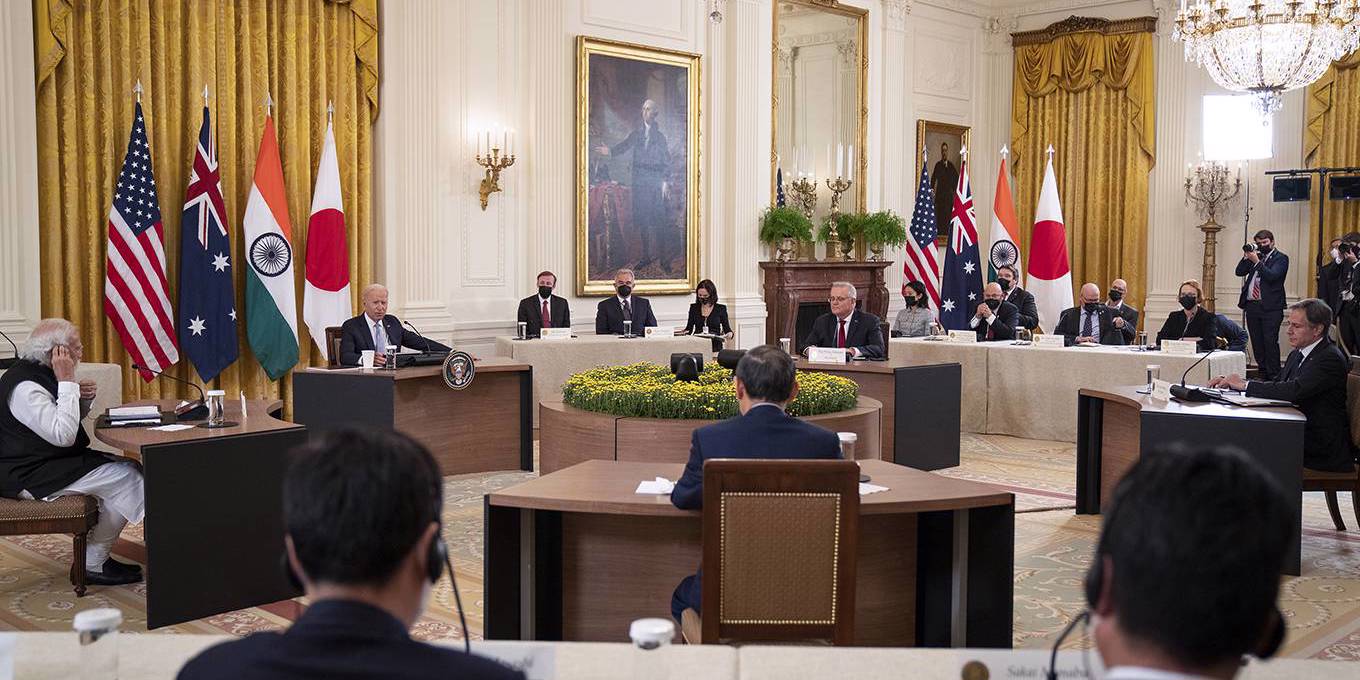
Against this background, the expanding strategic partnership between the world’s most powerful and most populous democracies — the United States and India — has become pivotal to equilibrium in the Indo-Pacific. With India’s closer integration, the four-nation Quad — Australia, India, Japan and the US — is blossoming as a strategic coalition of the leading Indo-Pacific democracies.

The Quad is central to the US’s “free and open Indo-Pacific” strategy. As American preeminence erodes, the US must augment its power with that of allies and partners. China’s foreign minister Wang Yi famously mocked the Quad in 2018 as a “headline-grabbing idea” that will dissipate “like the sea foam in the Pacific or Indian Ocean.” Instead, and thanks to China’s expansionist policies, the Quad continues to gain strength — despite the new, US-initiated AUKUS alliance with Australia and Britain. The US cannot build an Asian power equilibrium without India, Japan and Australia — and they cannot build it without the US.

Today, the US is also close to achieving a long-sought goal: a “soft alliance” with India that needs no treaty. The US has already emerged as the largest arms seller to India, leaving its traditional supplier, Russia, far behind. US defense transactions with India went from near zero in 2008 to over $20 billion in 2020. Furthermore, India has signed the four “foundational” agreements that the US maintains with all its close defense partners. These accords range from providing reciprocal access to each other’s military facilities and securing military communications to sharing geospatial data from airborne and satellite sensors.

India, a founder and leader of the Nonaligned Movement that sought to chart a neutral course in the US-Soviet rivalry during the Cold War, now makes little mention of nonalignment. Instead, it is multi-aligned and building close partnerships with democratic powers from Asia to Europe. India now holds more annual military exercises with America than any other country.

The main driver of the growing US-India strategic collaboration is China’s neo-imperial expansionism. President Xi Jinping believes that China has a narrow window of strategic opportunity to modify the international order in its favor before it confronts a demographic crisis, stalled economic growth and an unfavorable global environment. Accordingly, Xi has shown an increasing appetite for taking major risks.

American and Indian strategic priorities regarding China are, however, not the same. The US has never considered fighting a land war against China. The primary American objective is non-military: to counter China’s geopolitical, economic and ideological challenges. By contrast, China poses a pressing military challenge for India. The spotlight on the Chinese threats against Taiwan has helped obscure China’s more serious military confrontation with India along the long Himalayan frontier — a confrontation that is still raging.

The US and India, however, are united by other shared strategic interests. These include the rule of law, respect for territorial integrity and sovereignty, freedom of navigation, peaceful dispute resolution and a rules-based Indo-Pacific free of coercion. The biggest challenge to all these principles comes from China.

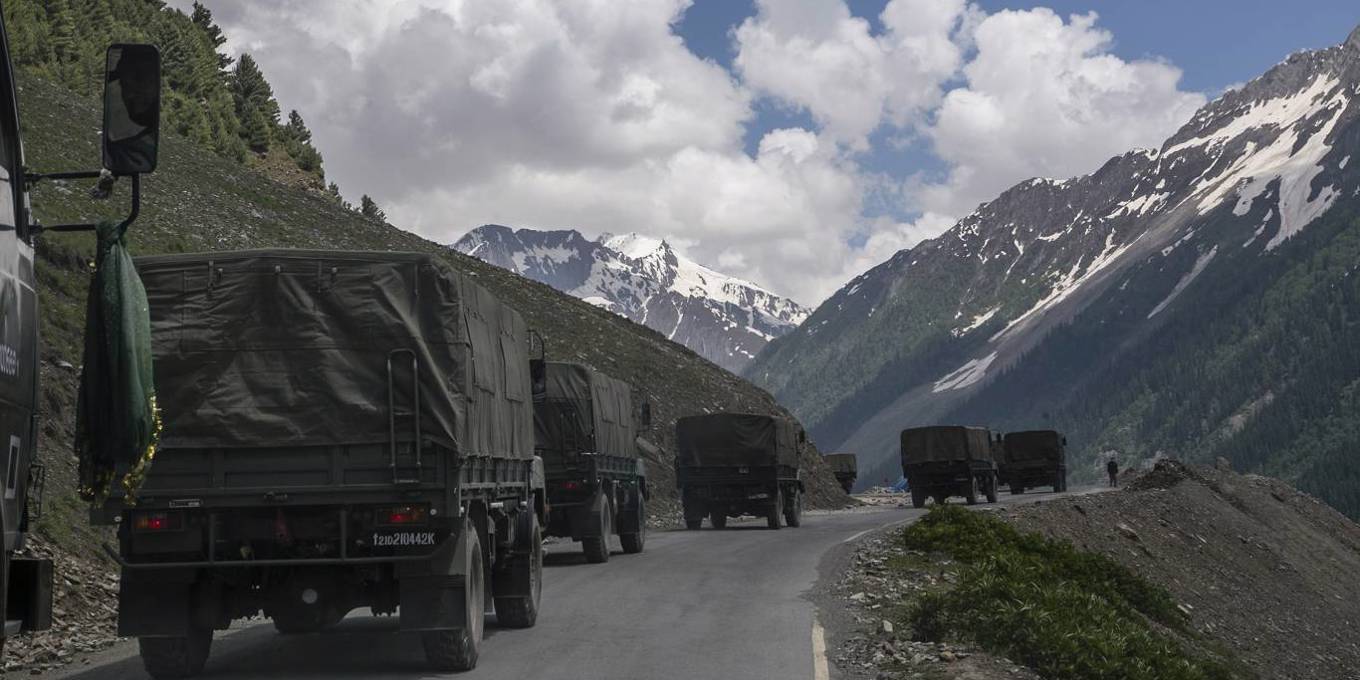
In May 2020, a shocked India discovered that China had stealthily encroached on several key border areas in the northernmost Indian territory of Ladakh. The discovery led to the first deadly Chinese-Indian military clashes in the Himalayas since 1975, including China’s first combat deaths in over four decades. The Indian and Chinese militaries remain locked in multiple standoffs, and the steadily increasing introduction of new weapons and troops by both sides has amplified the risk of renewed border skirmishing, if not outright war. Xi has picked a border fight with India that China cannot win. A war between these two nuclear- armed demographic giants is likely to end in a bloody stalemate with heavy losses on both sides. This is not the only instance in which Xi’s aggressive policies have proved to be counterproductive.

For India, China’s territorial aggression proves the importance of building close strategic collaboration with the US and likeminded powers. India today seems more determined than ever to frustrate China’s ambition to achieve Asian hegemony. By locking horns with China in tense military standoffs despite the risk of a full-scale war, India has openly challenged Chinese capability and power in a way no other power has done in this century. Since 2020, when India let Australia join the annual Exercise Malabar war games with the American, Japanese and Indian navies, the Quad has possessed a platform for an annual military exercise involving all its members.

Xi must now also contend with the strengthening US-India relationship. In a pivot to Asia that much of the US media either ignored or derided, the Trump administration gave India pride of place in its Indo-Pacific strategy. It also instituted fundamental shifts in US policies on China and Pakistan, two close allies whose strengthening strategic axis in southern Asia imposes high security costs on India, including raising the specter of a two-front war. Trump reversed the forty-five-year US policy of aiding China’s rise; with bipartisan support, he designated China as a strategic rival and threat. His administration also cut off security aid to Pakistan for not severing its ties with terrorist groups.

Relations between the Indo-Pacific’s two largest democratic powers thrived during the Trump presidency. Trump built a personal rapport with India’s prime minister Narendra Modi, with whom he shares a love for big audiences and theatrics. Trump joined Modi’s September 2019 public rally in Houston, which was attended by 59,000 Indian Americans and a number of US congressmen and senators. Then, during his February 2020 standalone visit to India, Trump spoke at the largest rally any American president has ever addressed — at home or abroad.

More than 100,000 people packed the world’s largest cricket stadium, in Modi’s home state of Gujarat. “America loves India, America respects India, and America will always be faithful and loyal friends to the Indian people,” Trump declared. After returning home, Trump called India an “incredible country,” saying, “Our relationship with India is extraordinary right now.”

The US and India are both bitterly polarized democracies. In each, rival political forces are self-segregated into their own ideological silos. Trump and Modi have faced similar accusations from critics. Both are accused of being blinkered demagogues, of pursuing divisive policies and choosing populism over constitutionalism. Each consciously avoided saying anything that could give a handle to the other’s domestic critics.

President Biden, by contrast, entered the White House after criticizing Modi’s government on issues like Kashmir and a new Indian law on citizenship for non-Muslim refugees who had fled religious persecution in neighboring Islamic countries. Biden’s election victory created uncertainty over the future direction of US-India ties. Indeed, as a senator, Biden had spearheaded a congressional sanctions move in 1992 that helped block Russia’s sale of cryogenic-engine technology for India’s civilian space program, setting it back many years.

Yet President Biden has sustained the momentum in the growth of the bilateral relationship. As with tacit acceptances of Trump’s other unorthodox foreign-policy initiatives, Biden has no choice but to recognize India’s centrality in an Asian balance of power. Despite his party’s hostility to Modi and Hindu nationalism, Biden’s interactions with Modi have been characterized by ease and warmth. In September, Biden welcomed Modi to the White House as “my friend” and said, “I’ve long believed that the US-India relationship can help us solve an awful lot of global challenges.”

Booming US exports to India — one of the world’s fastest-growing markets —reinforce bipartisan support in Washington for a closer partnership with New Delhi. The US has rapidly become an important source of crude oil and petroleum products for India, which is the world’s third-largest oil consumer after the US and China. But the US and India are not entirely on the same page.

America’s self-inflicted defeat and humiliation in Afghanistan at the hands of a Pakistan-backed terrorist militia have compounded India’s security challenges at a time when it should be fully focused on countering China’s Himalayan expansionism. Worse still, Team Biden, unlike the Trump administration, has placed outreach to Beijing as a high priority, and has been wary of publicly supporting India against Chinese aggression. The Democrats’ Russia fixation, meanwhile, is only strengthening under Biden.

Nevertheless, India will continue to quietly gain greater salience in US policy — especially as Russia and China deepen their entente. Instead of driving a wedge between these two natural competitors, US policy has helped turn them into close strategic partners. If the US is not to accelerate its relative decline through strategic overreach, it needs India more than ever. It would be doubly ironic, given Vice President Kamala Harris’s Indian heritage, if Biden did not seize the opportunity to formalize the US’s de facto and deepening security alliance with India.

This article was originally published in The Spectator’s March 2022 World edition. 

Leverage water treaty to tame Pakistan’s terrorism

Brahma Chellaney, The Times of India

One paradox in Asia stands out: China, by occupying water-rich Tibetan Plateau, dominates Asia’s water map, yet it refuses to enter into a water-sharing treaty with any neighbour. But water-stressed India has a water-sharing treaty with each of the two countries located downstream to it — Pakistan and Bangladesh. And each of these treaties has set a new principle in international water law.

The 1996 Ganges treaty set a new standard by guaranteeing Bangladesh specific cross-border flows in the critical dry season. And the 1960 Indus treaty with Pakistan still remains the world’s most generous water-sharing arrangement, in terms of both the sharing ratio and the total volume of cross-border flows.

Under this treaty of indefinite duration, India foolishly reserved 80.52% of the aggregate water flows in the six-river Indus system for Pakistan, with that arch-nemesis securing 90 times greater volume of water than Mexico’s share under a 1944 pact with the US.

In fact, the treaty effectively partitioned the rivers in the Indus Basin, with India’s full sovereignty rights limited to the three smaller rivers in the lower section and Pakistan bagging the bigger rivers of the upper basin. It remains the world’s only water pact embodying the ‘doctrine of restricted sovereignty’ in which the upper riparian state defers to the interests of a downstream state.

To make matters worse, only four of the six Indus-system rivers originate in India; the other two start in Tibet, with China free to reengineer cross-flow flows.

Against this background, the Indus treaty remains a millstone around India’s neck. India should be seeking to mitigate the burdens of a treaty that carries no benefits for it but which emboldens Pakistan’s sponsorship of cross-border terrorism. Pakistan repays India’s unparalleled water generosity with its self-avowed “War of a Thousand Cuts”.

How can India allow its water largesse to be repaid with blood? A feckless India continues to shore up the treaty, including by sending a 10-member delegation to Pakistan for a Permanent Indus Commission meeting from March 1. For the first time in the commission’s history, female officers (all from India) will participate.

The commission’s meetings can be suspended, as they have been in the past, but India clings to the treaty’s letter and spirit, even as Pakistan flouts international norms without incurring any costs. In fact, by failing to build sufficient storage, India allows unutilized waters from its meagre share to flow to Pakistan as a continuing bonus.

Other world powers have dumped binding accords at will. One of Russia’s grievances contributing to the present crisis with the US, with Ukraine as the theatre of Russian invasion, has been Washington’s unilateral termination of the Anti-Ballistic Missile Treaty (which was of unlimited duration) and the Intermediate-Range Nuclear Forces Treaty. China has demonstrated its contempt for bilateral pacts through its current border aggression against India and by its 2017 withholding of data from India on upstream river flows.

A scofflaw Pakistan wants rights without responsibilities. It demands eternal Indian water munificence while its military sustains export of terrorism to India. Leveraging the Indus treaty to help reform Pakistan’s behaviour offers India a bloodless path.

Pakistan’s use of state-reared terrorist groups could be invoked by India under international law as constituting reasonable grounds for withdrawal from the treaty. The International Court of Justice has upheld the principle that a treaty may be dissolved by reason of a fundamental change of circumstances.

But without withdrawing from the treaty, India can seek to balance the scales by invoking its treaty rights to enforce Pakistan’s responsibilities. For starters, it should condition further consultations and information exchanges, including on project-related design data, to Pakistan’s verified severing of ties with terrorist groups. Keeping its Indus commissioner’s post vacant for some years would effectively suspend riparian consultations with Pakistan. Given India’s proverbial red tape, such a vacancy will be easy to explain.

India’s approach should be to speak softly but carry a big stick. It should shun meaningless hyperbole and let its actions speak for themselves. India, however, must make clear that it has no intention of turning off or even restricting water flows to Pakistan. Indeed, India doesn’t have the hydro-infrastructure to limit river flows. The issue is about ending Pakistan’s roguish actions.

Building basin leverage can serve as a potent instrument in India’s arsenal against Pakistan.

The worst option for India is to continue hewing to its present approach by mechanically bearing all the burdens of the treaty without any tangible benefits accruing to it. Instead of advertising that its bark is worse than its bite, an imaginative India should work to remake the terms of the Indus engagement.

The writer is a geostrategist.

The new global Cold War clouds India’s tightrope walk

India, having confronted Chinese border aggression over the past 22 months, has taken a restrained stance on the Russian invasion of Ukraine, underscoring its focus on countering Beijing’s military actions without affecting its close relationships with the United States and Russia. The new U.S.-Russia Cold War, however, promises to compound India’s strategic challenges.

India is the only member of “the Quad” to refrain from openly condemning Russia for invading a sovereign country. In fact, like its archnemesis China, India abstained from the Feb. 25 vote at the United Nations Security Council on a U.S.-sponsored resolution deploring the Russian invasion as a violation of the U.N. Charter. India, however, has implicitly criticized Russia’s abandonment of the path of diplomacy and called for an end to all violence.

Unlike Japan and Australia, which are under the U.S. security (and nuclear) umbrella, India has to deal with China on its own, as the current Himalayan border conflict has highlighted. And while China poses a pressing military challenge for India along a more than 4,000-kilometer-long land frontier, the U.S. has never considered a land war against China and its primary objective is nonmilitary — to counter China’s geopolitical, economic and ideological challenges to its global preeminence.

India’s solo struggle to rein in an expansionist China in the icy Himalayan region has helped influence its measured response to the Russian aggression against Ukraine. After all, which head of a Western government has condemned China’s aggression against India or even urged Beijing to pull back its forces from the Himalayan frontier?

U.S. President Joe Biden has not uttered a word on the subject. His State Department on Feb. 3 urged India and China to find “a peaceful resolution of the border disputes,” and then added in general terms, “We have previously voiced our concerns of Beijing’s pattern of ongoing attempts to intimidate its neighbors.”

The Biden administration, unlike former President Donald Trump’s administration, has placed outreach to Beijing as a high priority, and has been wary of publicly supporting India against Chinese aggression. Indeed, Biden’s recently unveiled Indo-Pacific Strategy refers to China’s military actions against India since 2020 not as “aggression,” but in neutral language — as “the conflict along the Line of Actual Control with India.”

In May 2020, a shocked India discovered that China had stealthily encroached on several key border areas in the northernmost Indian territory of Ladakh. The discovery led to the first deadly Chinese-Indian military clashes in the Himalayas since 1975, including China’s first combat deaths in over four decades.

By locking horns with China in tense military standoffs despite the risk of a full-scale war, India has openly challenged Chinese capability and power in a way no other power has done in this century. China has massed up to 200,000 soldiers along the frontier, but India has more than matched the Chinese force deployments — with the steadily increasing induction of new weapons and troops by both sides amplifying the risk of renewed border skirmishing, if not outright war.

The U.S.-India strategic partnership, meanwhile, continues to strengthen. The U.S. has already surpassed Russia as the largest arms seller to India. American defense transactions with India, according to the State Department, went from “near zero in 2008 to over $20 billion in 2020.”

Still, in an effort to make India its sole arms client, the U.S. has sought to leverage a domestic law — the 2017 ​Countering America’s Adversaries Through Sanctions Act — to downgrade Indian defense ties with Moscow. Russia, however, remains a critical source of arms and military technology for India.

In the current Himalayan military crisis, Russia, despite its deepening entente with China, has transferred weapons to help strengthen India’s defenses. It is advancing the delivery of its S-400 air and anti-missile defense system that India urgently needs as a protection against China’s forward deployment of an array of lethal missiles.

The latest Western financial sanctions on Moscow, however, threaten to affect Russia-India defense trade by complicating the issue of payments. The escalating sanctions could also impede India’s plans for greater investment both in the Russian oil and gas sector and in Russia’s Far East.

The U.S., with the aid of its energy sanctions on Iran, has emerged as an important source of crude oil and petroleum products for India, the world’s third-largest oil consumer after America and China. And its new sanctions on Russia are expected to facilitate greater American arms exports to India.

More fundamentally, the advent of the new Cold War promises to make India’s neutrality more challenging. Biden has made clear that he has embarked on a strategy of Containment 2.0 against Russia.

The new U.S. sanctions, which Biden has called “the broadest sanctions in history,” seek to disrupt the Russian economy. Simultaneously, Biden is planning to ensnare Russia in a military quagmire in Ukraine through massive arms supplies to the Ukrainian armed forces and other resistance forces. He has asked Congress for a staggering $6.4 billion for this mission.

However, U.S. power now faces a double whammy: China’s military, economic and technological challenge on a scale the U.S. has not seen before and a re-militarized Russia challenging the NATO creep to its borders.

But with its strategic focus shifting to shoring up European security, the U.S. is pouring military resources into that theater — and the main casualty of such a shift is likely to be Asian security.

By compounding America’s strategic overstretch and distracting it from the China challenge, the new Cold War will open greater space for Chinese President Xi Jinping’s aggressive revisionism. It will also likely advance China’s economic power and energy security by making Beijing the main beneficiary of the new Western sanctions on Russia.

India may have no dog in the fight, yet — like Japan — it will not be able to escape the larger strategic ramifications of the conflict over Ukraine. This could prove a watershed moment in international relations and complicate India’s ability to walk a diplomatic tightrope.

Brahma Chellaney, a longtime contributor to The Japan Times, is a geostrategist and the author of nine books, including “Water: Asia’s New Battleground” (Georgetown University Press).

Ukraine war puts U.S. Indo-Pacific strategy in jeopardy

Focus on Russia will curtail efforts to limit Chinese expansionism

Brahma Chellaney, Nikkei Asia

Joe Biden meets virtually with Xi Jinping from the White House in November 2021: Biden has sought to stabilize the geopolitical competition with China so as to focus on containing Russia.   © AP

The Indo-Pacific region — home to the world’s most populous nations, largest economies and largest militaries — has emerged as the world’s economic and geopolitical hub. This vast region will shape the new world order, including America’s geopolitical standing, in the coming years.

Greater volatility in the Indo-Pacific, however, seems inevitable as a result of the deepening international crisis triggered by Russia’s invasion of Ukraine and the Western retaliation in the form of an unprecedented hybrid war against Moscow.

Sanctions are a form of warfare whose unforeseen consequences have, historically, set in motion an escalating spiral leading to devastating armed conflict. It was a raft of U.S. sanctions intended to squeeze Imperial Japan that ultimately provoked the attack on Pearl Harbor, leading to the Pacific war and eventually the nuclear bombings of Hiroshima and Nagasaki.

Russia, now the world’s most-sanctioned country, remains a nuclear and cyber superpower, as well as the world’s richest country when it comes to natural resources, and its own likely reprisals to the West’s hybrid war will increase the risks of a wider conflict.

The new Cold War will constrain an overstretched Washington from genuinely pivoting to the Indo-Pacific or robustly countering the challenge to its global preeminence from China, which dwarfs Russia in economic power and military spending.

Since taking office, U.S. President Joe Biden has sought to stabilize the geopolitical competition with China so as to focus on containing Russia, in keeping with what he told CBS “60 Minutes” just before being elected: Russia is “the biggest threat to America” and China “the biggest competitor.”

As part of that approach — a reversal of the Trump administration policy of treating the Chinese Communist Party as an existential threat to U.S. interests — Biden last year poured a record $650 million in military aid into Ukraine. Last autumn’s U.S.-NATO military exercises near Russia’s Black Sea coast incensed Moscow, foreshadowing Russian aggression today.

To help stabilize relations with Beijing, Biden has taken a number of steps, including a decision not to reinstate certain tariffs. Biden allowed Beijing to escape scot-free over its failure to meet commitments in the so-called Phase One trade deal with the Trump administration. China’s increased purchases of U.S. goods and services fell far below its commitment of $200 billion over 2017 levels during the deal’s two-year period that ended on Dec. 31, 2021.

Chinese President Xi Jinping’s unrelenting expansionism from the South and East China Seas to Hong Kong and the Himalayas has essentially been cost-free. Even Xi’s mass incarceration of over a million Muslims in Xinjiang, which the Biden administration acknowledges is “genocide” and “crimes against humanity,” has gone unpunished, with the U.S. imposing only symbolic sanctions.

Biden, after more than a year in office and barely two weeks before Russia’s invasion of Ukraine, unveiled the “Indo-Pacific Strategy of the United States.” This followed criticism at home that he lacked clarity on a region central to long-term U.S. interests.

Biden’s Indo-Pacific strategy, while acknowledging that “our allies and partners in the region bear much of the cost” of China’s “harmful behavior,” goes out of its way to mollify Xi’s regime, stating that America’s “objective is not to change the PRC (People’s Republic of China) but to shape the strategic environment in which it operates.” It also says the U.S. will “manage competition with the PRC responsibly” and “work with the PRC in areas like climate change and nonproliferation.”

As if seeking to allay China’s concerns, Biden has also progressively diluted the Quad’s agenda, broadening it, as his Indo-Pacific strategy attests, to everlasting universal challenges like climate change, sustainability, “global health” and “advancing common technology principles.” The Quad, however, was designed as a bulwark against China’s expansionism.

Biden has yet to comment on China’s nearly two-year border aggression against India. Nor has the U.S. asked Beijing to pull back the nearly 200,000 Chinese troops it has massed along the Indian frontier. Yet Biden, seeking to co-opt India in his new Cold War with Russia, hosted a special Quad summit by video link on Mar. 3 to discuss the Russian aggression.

But the summit, as the unusually short White House statement indicated, achieved little. Indian Prime Minister Narendra Modi put his foot down over extending the Quad’s sphere to Ukraine, saying the group must “remain focused on its core objective… in the Indo-Pacific region.”

India — the only Quad member not under the U.S. security and nuclear umbrella — has taken an independent stance on Ukraine, calling for an end to hostilities and a return to the path of diplomacy but abstaining from the United Nations votes to condemn Russia.

As Biden steps up his hybrid war against Russia, his conciliatory approach will become more pronounced toward China, which has the capacity to bail out the Russian economy. But Xi is likely to work toward neutralizing similar Western sanctions against China in the event of a Chinese invasion of Taiwan. Xi is expected to fast-track progress on parallel international financial arrangements that are free from Western domination and weaponization.

Biden’s imperative to win Chinese cooperation on his sanctions against Russia gives Beijing important leverage. Like a double-edged sword, it will wield that leverage to extract U.S. and Russian concessions. With Biden’s characterization of Russia as Enemy No. 1 becoming a self-fulfilling prophecy, a major casualty is likely to be America’s Indo-Pacific strategy.

Brahma Chellaney is a geostrategist and author of nine books, including “Asian Juggernaut: The Rise of China, India and Japan.”

Ukraine crisis: Perils of a ‘with us or against us’ approach

Brahma Chellaney, The New Indian Express

Russia’s invasion of Ukraine is just the latest example of “might makes right”. Despite claims to the contrary, the world has never had a rules-based order. Just consider the history of this century, especially the number of military invasions of sovereign states that have occurred since the year 2001.

International law is powerful against the powerless, but powerless against the powerful. Both the Russian invasion and the West’s no-holds-barred retaliatory economic war against Russia, including practically expelling it from the Western-led financial order, mock a rules-based order. While Russia’s aggression is violating Ukraine’s territorial sovereignty, the West’s economic warfare is violating Russia’s economic sovereignty.

Yet this conflict holds global implications, with the potential to remake our world, including spawning the polarization of both the world economy and international politics.

As a new Cold War dawns, the US appears returning to a “with us or against us” approach. This promises to bring countries that take an objective and balanced view under intense pressure. It is also likely to complicate, if not strain, American ties with countries that insist on remaining neutral or taking a more nuanced approach than Washington’s black-and-white portrayal of the situation.

In echoes of a familiar Manichaean logic, US President Joe Biden’s administration is seeking to prod India to be on America’s side against Russia by implicitly asking, “Are you with us or against us?”

Team Biden has bristled at India abstaining from the United Nations votes to condemn Moscow, including at the Security Council on February 25 when Russia vetoed a US-sponsored resolution deploring the Russian invasion as a violation of the UN Charter. India, however, has implicitly criticized Russia’s abandonment of the path of diplomacy and repeatedly called for an end to all violence.

According to the US-based news website Axios, the State Department has recalled a strongly-worded cable to American embassies instructing them to inform India and the United Arab Emirates that their neutral stance on Ukraine put them “in Russia’s camp”. US diplomacy has a record of using media “leaks” to convey messages or warnings. In 1998, to spoil India’s ties with China, the White House leaked Prime Minister Atal Bihari Vajpayee’s letter to President Bill Clinton about the Indian nuclear tests.

The Axios story ended by saying that India “has faced allegations — rarely discussed by the US in public — of democratic backsliding and repression of religious minorities.” The implication is that, unless New Delhi falls in line, the Biden administration could start discussing such allegations in public.

US pressure has already compelled the UAE to reverse course. After abstaining in the Security Council, it voted in support of the March 2 non-binding resolution in the General Assembly condemning Russia. However, 35 countries abstained on the General Assembly resolution, including all of India’s major neighbours, while a further 11 didn’t vote at all.

Here’s the paradox: No head of a Western government has condemned China’s nearly 23-month-long border aggression against India or even urged Beijing to pull back the nearly 200,000 troops it has massed along the Himalayan frontier in violation of binding bilateral accords. Yet the Western bloc demands that India be firmly on its side over the Russian aggression against Ukraine, which is a member of neither NATO nor the European Union.

When Donald Trump was the US president, his top officials, including Secretary of State Mike Pompeo and National Security Adviser Robert O’Brien, regularly blasted China’s aggression against India, calling it “incredibly aggressive action”, “unacceptable behaviour” and part of a “clear and intensifying pattern of bullying”.

But the Biden administration, having placed outreach to Beijing as a high priority, has been wary of publicly supporting India against the Chinese aggression. Biden hasn’t uttered a word on that aggression. Indeed, Biden’s recently unveiled “Indo-Pacific Strategy” refers to China’s military actions against India since 2020 not as “aggression” but in neutral language — as “the conflict along the Line of Actual Control with India”.

Even in the India-Pakistan context, Team Biden isn’t firmly on India’s side. It has hedged its bets by retaining Pakistan as a “major non-NATO ally”, despite America’s humiliating defeat in Afghanistan at the hands of Pakistan-backed Taliban terrorists. Biden’s failure to impose any penalties on Pakistan also explains why that country is still missing from America’s list of state sponsors of terrorism.

Yet now Team Biden demands that India side with the US against Russia over Ukraine, which historically has been viewed by Moscow as its strategic buffer. Its unstated message to India is: “Do as I say, not as I do”.

India’s measured response to the Russian aggression enjoys bipartisan support at home. For India, the US has increasingly become an important strategic partner. But Moscow, which rescued India half a dozen times by vetoing UN Security Council resolutions over the decades, remains an equally important friend.

Had India voted with the Western bloc to condemn Russia, it would have burned its bridges with a country that remains a critical source of weapons and military technology in projects ranging from the Brahmos missile to nuclear submarines. To help shore up India’s defences against China, Russia has advanced the delivery of its S-400 air and anti-missile system.

The US values its strategic autonomy. So should India. Undermining ties with Moscow would make India dependent on America, whose unpredictability is legendary.

The US is already bagging billions of dollars worth of Indian arms contracts every year. Yet it is working to make India its sole arms client, including by seeking to leverage its domestic law — the 2017 ​Countering America’s Adversaries Through Sanctions Act (CAATSA) — to downgrade Indian defence ties with Moscow. Given the advent of the new Cold War, it is likely to step up that effort.

India now holds more annual military exercises with America than any other country. The US has already overtaken Russia as the largest arms seller to India. New Delhi wishes to further deepen its ties with Washington. But such cooperation cannot be exclusionary.

A “with us or against us” approach that seeks to compel India to make a choice between the US and Russia will only bring the blossoming Indo-American relationship under strain. 

Brahma Chellaney is a geostrategist and the author of nine books, including the award-winning “Water: Asia’s New Battleground” (Georgetown University Press).

America Is Focusing on the Wrong Enemy

US President Joe Biden is treating a “rogue” Russia as a peer competitor, when he should be focused on the challenge from America’s actual peer, China. Not only is China more powerful than Russia; it also genuinely seeks to supplant the US as the preeminent global power.

BRAHMA CHELLANEY, Project Syndicate

Much of the democratic world would like the United States to remain the preeminent global power. But with the US apparently committed to strategic overreach, that outcome risks becoming unlikely.

The problem with America’s global leadership begins at home. Hyper-partisan politics and profound polarization are eroding American democracy and impeding the pursuit of long-term objectives. In foreign policy, the partisan divide can be seen in perceptions of potential challengers to the US: according to a March 2021 poll, Republicans are most concerned about China, while Democrats worry about Russia above all.

This may explain why US President Joe Biden is treating a “rogue” Russia as a peer competitor, when he should be focused on the challenge from America’s actual peer, China. In comparison to Russia, China’s population is about ten times bigger, its economy is almost ten times larger, and its military expenditure is around four times greater. Not only is China more powerful; it genuinely seeks to supplant the US as the preeminent global power. By contrast, with its military buildup on Ukraine’s borders, Russia is seeking to mitigate a perceived security threat in its neighborhood.

Hastening the decline of US global leadership is hardly the preserve of Democrats. A bipartisan parade of US leaders has failed to recognize that the post-Cold War unipolar world order, characterized by unchallenged US economic and military predominance, is long gone. The US squandered its “unipolar moment,” especially by waging an expensive and amorphous “Global War on Terrorism,” including several military interventions, and through its treatment of Russia.

After its Cold War victory, the US essentially took an extended victory lap, pursuing strategic maneuvers that flaunted its dominance. Notably, it sought to expand NATO to Russia’s backyard, but made little effort to bring Russia into the Western fold, as it had done with Germany and Japan after World War II. The souring of relations with the Kremlin contributed to Russia’s eventual remilitarization.

So, while the US remains the world’s foremost military power, it has been stretched thin by the decisions and commitments it has made, in Europe and elsewhere, since 1991. This goes a long way toward explaining why the US has ruled out deploying its own troops to defend Ukraine today. What the US is offering Ukraine – weapons and ammunition – cannot protect the country from Russia, which has an overwhelming military advantage.

But US leaders made another fatal mistake since the Cold War: by aiding China’s rise, they helped to create the greatest rival their country has ever faced. Unfortunately, they have yet to learn from this. Instead, the US continues to dedicate insufficient attention and resources to an excessively wide array of global issues, from Russian revanchism and Chinese aggression to lesser threats in the Middle East and Africa and on the Korean Peninsula. And it continues inadvertently to bolster China’s global influence, not least through its overuse of sanctions.

For example, by barring friends and allies from importing Iranian oil, two successive US administrations enabled China not only to secure oil at a hefty discount, but also to become a top investor in – and security partner of – the Islamic Republic. US sanctions have similarly pushed resource-rich Myanmar into China’s arms. As Cambodian Prime Minister Hun Sen, whose country has faced a US arms embargo over its ties to China, asked last year, “If I don’t rely on China, who will I rely on?”

Russia has been asking itself the same question. Though Russia and China kept each other at arm’s length for decades, US-led sanctions introduced after Russia’s 2014 annexation of Crimea drove President Vladimir Putin to pursue a closer strategic partnership with China. The bilateral relationship is likely to deepen, regardless of what happens in Ukraine. But the raft of harsh new sanctions the US has promised to implement in the event of a Russian invasion will accelerate this shift significantly, with China as the big winner.

The heavy financial penalties the US has planned – including the “nuclear option” of disconnecting Russian banks from the international SWIFT payments system – would turn China into Russia’s banker, enabling it to reap vast profits and expand the international use of its currency, the renminbi. If Biden fulfilled his pledge to block the Nord Stream 2 gas pipeline, which is set to deliver Russian supplies directly to Germany via the Baltic Sea, China would gain greater access to Russian energy.

In fact, by securing a commitment from Putin this month to a nearly tenfold increase in Russian natural gas exports, China is building a safety net that could – in the event of a Chinese invasion of Taiwan – withstand Western energy sanctions and even a blockade. China could also benefit militarily by demanding greater access to Russian military technology in exchange for its support.

For the US, a strengthened Russia-China axis is the worst possible outcome of the Ukraine crisis. The best outcome would be a compromise with Russia to ensure that it does not invade and possibly annex Ukraine. By enabling the US to avoid further entanglement in Europe, this would permit a more realistic balancing of key objectives – especially checking Chinese aggression in the Indo-Pacific – with available resources and capabilities.

The future of the US-led international order will be decided in Asia, and China is currently doing everything in its power to ensure that order’s demise. Already, China is powerful enough that it can host the Winter Olympics even as it carries out a genocide against Muslims in the Xinjiang region, with limited pushback. If the Biden administration does not recognize the true scale of the threat China poses, and adopt an appropriately targeted strategy soon, whatever window of opportunity for preserving US preeminence remains may well close.

Brahma Chellaney

Brahma Chellaney, Professor of Strategic Studies at the New Delhi-based Center for Policy Research and Fellow at the Robert Bosch Academy in Berlin, is the author of nine books, including Asian Juggernaut; Water: Asia’s New Battleground; and Water, Peace, and War: Confronting the Global Water Crisis.

© Project Syndicate, 2022.

Beijing Winter Olympics were a troubling reminder of 1936 Games

The success of the Beijing Winter Olympics is another feather in Xi’s cap. Like Hitler’s 1936 Olympics, Xi’s Games succeeded after an international boycott campaign collapsed. Will an emboldened Xi now embark on fresh repression and expansionism?

Brahma Chellaney, Nikkei Asia

Xi Jinping on the screen during the opening ceremony at the Beijing National Stadium on Feb. 4: murky politics can lurk beneath the surface.   © Getty Images

While the Olympic movement seeks to promote “a spirit of friendship, solidarity and fair play,” murky politics can lurk beneath the surface.

Powerful autocracies serving as hosts have a history of using the Olympics to project themselves as friendly, peace-loving nations so as to advance their geopolitical objectives and cloak their human rights abuses. Yet their actions often speak for themselves.

As the 24th Winter Olympics in Beijing were opening, China warned foreign athletes not to “violate the Olympic spirit” by speaking out on political issues. Yet it has defended its own gross violation of the Olympic spirit by feting as an Olympic torchbearer and national hero a Chinese military officer who led an ambush attack in the Himalayas that killed 20 unarmed Indian soldiers in June 2020.

The lionizing of such a military commander is a telling commentary on the tactics and values of the Chinese Communist Party and its military wing, the People’s Liberation Army. The action also showed that China mixes politics and sports better than any other country.

Since China’s boycott of the 1956 Summer Olympics in Melbourne, the CCP has treated sports as politics by other means. It has engaged in bullying tactics against, among others, America’s National Basketball Association (NBA) and England’s Premier League. And it has used threats of withdrawing lucrative sports contracts, broadcast deals and sponsorship opportunities to buy silence regarding its human rights record.

The Beijing Winter Olympics, dubbed the “Genocide Games” by several international human rights organizations, are probably the most divisive games since the Berlin Summer Olympics. The 1936 Games helped strengthen the hands of Germany’s Adolf Hitler, emboldening his expansionism. The 2022 Games follow Chinese President Xi Jinping’s own expansionism, extending from the South China Sea and Hong Kong, to the Himalayas.

In fact, Xi has taken a page out of the 1936 Olympics playbook: Just as Hitler sought to camouflage his segregation and persecution of Jews by permitting one Jewish athlete — fencing champion Helene Mayer — to join the German team, Xi has tried to whitewash his atrocities in Xinjiang by presenting a Uighur skier as the face of the 2022 Games.

Mayer’s inclusion in the German team not only helped end international calls for a boycott of the Games but also allowed Hitler to project the image of a peace-loving statesman. Xi, for his part, opened the 2022 Games with peace doves and an obscure female Uighur skier, Dinigeer Yilamujiang, as the star of the opening ceremony. Chinese state media quickly claimed Yilamujiang had “showed the world a beautiful and progressive Xinjiang.”

There are some other troubling parallels between the two games. Before the 1936 Games, the Sachsenhausen concentration camp had been established and Hitler’s army had marched into the demilitarized Rhineland. The 2022 Games have followed Xi’s expansionism across Asia and what two successive U.S. administrations have labeled “genocide” and “crimes against humanity” in Xinjiang, where more than a million detainees languish in a Muslim gulag.

Since 2015, when Beijing defeated Almaty, Kazakhstan, to win the bid to host the 2022 Games, China has, among other things, established forward military bases on a chain of artificial islands in the South China Sea, set up the Xinjiang gulag, militarized the Himalayan borderlands and encroached on Indian, Bhutanese and Nepalese territories, weaponized debt and gobbled up Hong Kong.

And at home, Xi has established a globally unparalleled techno-authoritarian state whose soaring budget for internal security has overtaken the country’s massive military budget. A repressive internal machinery, aided by an Orwellian surveillance system, is fostering a state strategy to culturally smother ethnic minorities in their traditional homelands, including through demographic change and harsh policing.

With “Xi Jinping Thought” enshrined in the national constitution and turned into the central doctrine guiding the CCP, China’s destiny is now in the hands of one party, one leader and one ideology.

More broadly, just as a long debate has raged over how Western powers had played into Hitler’s hands by participating in the 1936 Games, the failed boycott of the 2022 Games is likely to be a subject of intense discussion in future years.

To be sure, a number of Western countries, including Australia, Belgium, Britain, Canada, Denmark, Estonia, Kosovo, Lithuania and the U.S., refused to send officials to Beijing for the opening and closing Olympic ceremonies in protest against China’s human rights abuses.

India, too, at the last minute decided not to grace the ceremonies with its official presence. But such diplomatic boycotts have essentially been symbolic as athletes from those countries are participating fully in the Games, including in the opening and closing ceremonies.

Xi’s Olympic Games are being held under the shadow of the COVID-19 pandemic, now in its third year. China’s refusal to cooperate with international efforts to determine the origin of the virus first detected in the city of Wuhan — despite the pandemic’s devastating global impact — underlines the international costs of Xi’s rule.

The U.S., as the world’s leading sports nation and preeminent power, could have undercut the credibility of the Winter Games by deciding not to send its athletes and by leading a wider international boycott. But, as in 1936, it decided to allow its athletes to participate.

Meanwhile, by highlighting that Wall Street remains China’s powerful ally, some of America’s biggest corporations — from Coca-Cola and Visa to Intel and Proctor & Gamble — are underwriting the global spectacle. Very vocal when it comes to political rights at home, such sponsors have kept silent on Xinjiang, the repression in Tibet and Beijing’s clampdown on Hong Kong.

Three years after the 1936 Games, World War II began. Will the 2022 Games also come back to haunt the world? Buoyed by the success of the Games, Xi could embark on fresh repression and expansionism.

Brahma Chellaney is a geostrategist and author of nine books, including “Asian Juggernaut: The Rise of China, India and Japan.”
The US is letting China off the hook over its COVID-19 coverup

The US is letting China off the hook over its COVID-19 coverup
A medical worker takes a swab from a previously recovered COVID-19 coronavirus patient in Wuhan, China on March 14, 2020. © Getty

By Brahma Chellaney, The Hill

America’s death toll from the COVID-19 pandemic, now in its third year, is closing in on one million, with Americans continuing to succumb to the disease at internationally high rates. Both in total case counts and number of deaths since 2020, the United States has led the world. New data show that Americans’ life expectancy in the first year of the pandemic fell 1.8 years — the sharpest decline since at least World War II.

Given the extent of its pain and suffering, the U.S. should have a major stake in unraveling how the COVID-19 virus originated. Knowing the origins of this virus has become imperative to forestall the fourth coronavirus pandemic of the 21 Century after SARS, MERS and COVID-19.

In this light, isn’t it odd that the U.S. government is no longer seeking to get to the bottom of how the virus first emerged in the central Chinese city of Wuhan? In fact, by relieving pressure on China to come clean on the virus’s origins, President Biden’s administration is effectively letting that communist behemoth off the hook despite the costliest government coverup perhaps of all time. 

Chinese President Xi Jinping’s regime censored all news about the initial spread of COVID-19, including hiding evidence of human-to-human transmission, resulting in a local outbreak morphing into a global health calamity. Even today, by covering up the truth on how the virus emerged, Xi’s regime disrespects the memory of the more than 5.7 million people who have died thus far. The only probe China has allowed was a 2021 “joint study” with the World Health Organization (WHO) that it controlled and steered.

Because of Beijing’s stonewalling of investigations, the world still does not know whether COVID-19 evolved naturally from wildlife or was triggered by the accidental escape of a genetically engineered coronavirus from a lab in Wuhan, the center of Chinese research on super-viruses. Xi’s regime has frustrated all efforts, including by the WHO, to conduct an independent forensic inquiry into the Wuhan labs, labeling such an audit “origin-tracing terrorism.” 

The only concession Xi has made is that last September, after the pandemic had already devastated much of the world, he ordered enhanced oversight of Chinese labs handling lethal viruses. 

Against this background, China has been comforted by Biden’s easing of pressure on it. Soon after Kabul fell to the Taliban last August, marking America’s humiliating defeat at the hands of terrorists, a weakened Biden appeared to bow to the Chinese demand that the U.S. stop investigating the virus’s origins by not extending the 90-day term of the intelligence inquiry that he had instituted, despite the probe failing to reach a definitive conclusion. 

Since then, Biden has avoided any reference to the pandemic’s origins. And after having prematurely proclaimed on the Fourth of July that “we’re closer than ever to declaring our independence from a deadly virus,” Biden is now preparing Americans for the “new normal” of living with COVID-19, not conquering it.

Biden’s first misstep occurred just after his inauguration as the 46th president when he announced America’s immediate rejoining of the WHO. He could have leveraged his predecessor’s withdrawal from the WHO to make that international organization take steps to separate itself from the malign influence of China before formalizing America’s reentry.

The WHO led by Tedros Adhanom Ghebreyesus was complicit in China’s coverup. Indeed, it made important concessions to Beijing that may have compromised the search for the virus’s origins. So, America’s unconditional return to the WHO did little more than advertise U.S. weakness and harden Xi’s intransigence.

Then, on Jan. 26, 2021, Biden signed a presidential memorandum that ordered federal agencies to stop referring to the virus by the “geographic location of its origin,” saying that such references contribute to “racism.” So, as a matter of official U.S. policy, the virus could no more be linked to China.

Consequently, official U.S. reports, including the last annual unclassified intelligence report on threats to America, stopped mentioning the virus’s Wuhan origin. Yet, oddly, it has been okay to refer to the virus’s variants by their geographic origins or even slap on a racially tinged travel ban, as Biden did with eight southern Africa countries for five weeks after the omicron variant emerged. 

More recently, the Biden administration’s inexplicable decision not to field a candidate against Tedros left his bid unopposed for a second five-year term as the WHO chief. Indeed, France, Germany and 15 other European Union countries, with possible U.S. acquiescence, took the lead in nominating Tedros for a second term, even as his home country of Ethiopia denounced him. 

Here’s the paradox: Further undermining the WHO’s credibility, Tedros attended the Beijing Winter Olympics, despite a U.S.-led diplomatic boycott, and heaped renewed praise on China’s COVID-19 handling. In fact, Tedros carried the Olympic torch in a relay that also prominently featured another torchbearer, a Chinese military officer who led the ambush killing of 20 Indian troops in June 2020 and who, in gross violation of the Olympic spirit, is now being feted by China as a national hero. Yet, thanks to Western support, Tedros’s reelection in May has become a mere formality.

To Biden’s credit, last May he helped end the long suppression of an open debate on a possible lab leak by calling that hypothesis one of “two likely scenarios” on how the pandemic originated. Until then, the hypothesis was treated as a pure conspiracy theory by major U.S. news organizationssocial-media giants and some influential scientists who hid their conflicts of interest. Facebook and Instagram even suspended accounts that repeatedly referred to the virus’s possible escape from a lab.

The concerted effort to obscure the truth also extended to U.S. scientific and bureaucratic institutions, largely because U.S. government agencies – from the National Institutes of Health (NIH) to USAID – funded dangerous research on coronaviruses at the Wuhan Institute of Virology (WIV) from 2014 to 2020. The long suppression of a debate only aided China’s designs, including giving it sufficient time to conceivably eliminate any incriminating evidence of its negligence or complicity in the worst disaster of our time.  

One key question remains unanswered: Why were official U.S. agencies funding research on viruses at the WIV, which, according to the U.S. government’s own admission, was linked to the Chinese military? A January 2021 State Department fact sheet raised concern over “whether any of our research funding was diverted to secret Chinese military projects at the WIV.” But why did the funding proceed despite that risk?

It appears likely that Anthony Fauci, director of the National Institute of Allergy and Infectious Diseases, and his then-boss, Francis Collins, former director of the National Institutes of Health (NIH), began funding risky experiments at the WIV so as to circumvent the restrictions in the U.S. on “gain of function” research — or altering the genetic make-up of pathogens to enhance their virulence or infectiousness. The NIH money was routed through the New York-based EcoHealth Alliance, whose largest source of funds is the Pentagon. The Pentagon has yet to unequivocally deny that any of the almost $39 million it gave to EcoHealth Alliance ended up in Wuhan. 

The NIH, for its part, has sought to obfuscate its role by scrubbing its website of the “gain of function” definition.

The Beijing Winter Olympics, meanwhile, symbolize an ascendant China that is too powerful to be punished for its COVID-19 coverup, its genocide in Xinjiang and its expansionism across Asia.

Relieving U.S. pressure on China is clearly a mistake. The Biden White House would do well to rebuild pressure on Beijing by lifting the veil on the precise role the U.S. played in supporting WIV research on increasing the transmissivity of bat coronaviruses to human cells. For starters, the U.S. should disclose the full extent of its WIV funding. America’s own transparency is essential for credible pressure on an opaque China.

Brahma Chellaney is a geostrategist and the author of nine books, including the award-winning “Water: Asia’s New Battleground” (Georgetown University Press).

International costs of Biden’s Afghan debacle mount

China and Russia up the ante, violent Islamists become more emboldened, and allies are restive

U.S. Marines stand guard during an evacuation at Hamid Karzai International Airport in August 2021: the costs of the Afghan blunder are becoming increasingly apparent. (Handout photo from U.S. Marine Corps)   © Reuters

Brahma Chellaney, Nikkei Asia

History will remember U.S. President Joe Biden for consigning Afghanistan to the dark age of terrorist rule.

Yet Biden still says he has “no apologies” for his Afghan debacle. America’s self-inflicted defeat and humiliation at the hands of a brutal, Pakistan-backed Islamist militia spawned the greatest victory for terrorists in the modern history of global jihadism.

“I make no apologies for what I did,” Biden defiantly stated at his recent news conference, his first in months. By simply washing his hands of the humanitarian and security nightmare that he created in Afghanistan, Biden has compounded the greatest U.S. foreign-policy disaster in decades.

At a time when global affairs are already in a precarious state, the costs of the Afghan blunder are becoming increasingly apparent, including weakening Biden’s hand against America’s principal adversaries, China and Russia.

While highlighting the decline in American power, the Afghan fiasco has created greater space for China’s muscular revisionism in Asia and enhanced Russia’s geopolitical ambitions in the former Soviet republics extending from Ukraine to Georgia and Kazakhstan.

Worse still, the Taliban’s triumph over the “Great Satan” is serving as a real shot in the arm for Islamic terrorist groups across the world, inspiring jihadi attacks.

One example was the Jan. 15 hostage-taking at a Texas synagogue by a British Pakistani man who sought to free a convicted female Pakistani terrorist, Aafia Siddiqui, serving an 86-year sentence at a nearby prison.

Emboldened militants in Syria in recent days attacked a major prison housing thousands of former ISIS fighters, triggering a six-day wider fight with American ground troops that included U.S. airstrikes. Hundreds reportedly died. It was the biggest confrontation involving the U.S. military in three years since ISIS lost the last remaining portion of its so-called caliphate.

Meanwhile, in the deadliest attack in several years on an Iraqi military base, jihadis recently killed 10 soldiers and an officer. Such attacks raise concerns over the possible rebirth of global terrorism, including the re-emergence of ISIS.

America’s retreat from Afghanistan, meanwhile, is proving a strategic boon for Russia and China, which have ratcheted up their military threats against Ukraine and Taiwan, respectively.

Whereas Russia has massed some 100,000 troops near the Ukrainian border as if poised to invade Ukraine, a record number of Chinese warplanes have intruded into Taiwan’s self-declared air defense identification zone since October.

The U.S. may still be the world’s preeminent military power, but it is in no position to meaningfully take on China and Russia simultaneously. So the U.S.-NATO tensions with Moscow over the Russian military buildup around Ukraine risk whetting Chinese President Xi Jinping’s appetite for risk-taking, especially against Taiwan, his possible next target after notching up successes in the South China Sea and Hong Kong.

Biden’s Afghan disaster, meanwhile, has exacerbated security challenges for America’s regional friends, especially India, which now confronts a strengthening China-Pakistan-Taliban nexus. The rejuvenated epicenter for terrorism in the Afghanistan-Pakistan belt threatens to detract from India’s current efforts to counter China’s border aggression, which began with stealth incursions into the northern Indian territory of Ladakh in April 2020.

While Biden has elevated the Russian military threat against Ukraine to an international crisis, he, in jarring contrast, has not uttered a word on China’s larger-scale Himalayan military buildup that threatens to ignite a war with one of America’s most vital strategic partners, India.

Xi’s summit this week with Russian President Vladimir Putin in Beijing — the Chinese leader’s first face-to-face meeting with a head of state in nearly two years — underlines the deepening strategic axis between China and Russia, which are now “more aligned than at any point since the mid-1950s,” according to a U.S. intelligence assessment.

Warships attend a joint naval exercise of the Iranian, Chinese and Russian navies in the northern Indian Ocean on Jan. 19.   © West Asia News Agency/Reuters

This may be little more than a marriage of convenience so as to jointly collaborate against their common foe in Washington. But since the U.S. defeat in Afghanistan, Beijing and Moscow have surprised America with major joint military exercises, including naval war games off Russia’s Far East coast in October and recent naval drills with Iran in the Gulf of Oman. The Sino-Russian collaboration reportedly extends to hypersonic-weapons technology.

Afghanistan may no longer be grabbing headlines in the West, yet it is ordinary Afghans who are paying for Biden’s blunder, as highlighted by the Taliban’s arbitrary detentions and killings, sexual enslavement of girls through forced “marriages” to their fighters, and stripping women and girls of their rights to education and equality.

The Taliban’s narco-terrorist state, serving as a haven for al-Qaida and other violent jihadi groups, is a threat to regional and international security.

The U.S., for its part, has suffered lasting damage to its international credibility and standing from Biden’s strategic folly in Afghanistan, including throwing America’s allies — the Afghan government and military — under the bus.

The damage is not only emboldening Russia, China and violent Islamists; it also has a bearing on America’s alliances, given that Biden rejected allied demands for a conditions-based withdrawal from Afghanistan.

This adds greater urgency to a question pending since earlier U.S. blunders in Iraq, Syria and Libya: How to reform alliances so that there is less U.S. diktat and more prior consultations with its allies?

Brahma Chellaney is a geostrategist and author of nine books, including “Asian Juggernaut: The Rise of China, India and Japan.”

The Great COVID Coverup

As the world attempts to figure out how to live with COVID-19, it must also commit to identifying the missteps – accidental and otherwise – that caused the pandemic. That means, first and foremost, turning a critical eye toward China.

BRAHMA CHELLANEYProject Syndicate

As the pandemic enters its third year, questions about COVID-19’s origins appear increasingly distant. But if we are to forestall another coronavirus pandemic in the twenty-first century, understanding the causes of the current one is imperative.

Already, COVID-19 has caused more than 5.4 million deaths. But that is just the beginning: the toll of the pandemic includes increased rates of obesityunemploymentpovertydepressionalcoholismhomicidedomestic violencedivorce, and suicide. And, as the Omicron variant fuels record infection rates and disrupts economies in many parts of the world, pandemic fatigue is morphing into pandemic burnout.

Our chances of eliminating COVID-19 now appear increasingly remote. But, as we attempt to figure out how to live with the virus, we must also identify the missteps – accidental and otherwise – that led us here. And that means, first and foremost, turning a critical eye toward China.

It is well known that Chinese President Xi Jinping’s regime censored early reports that a new, deadly coronavirus had emerged in Wuhan and hid evidence of human-to-human transmission, thereby enabling a local outbreak to become a global calamity. What remains to be determined is whether COVID-19 emerged naturally in wildlife or was leaked from a lab – namely, the Wuhan Institute of Virology (WIV).

Here, too, China has embraced obfuscation rather than transparency. Xi’s regime has blocked an independent forensic inquiry into COVID-19’s origins, arguing that any such investigation amounts to “origin-tracing terrorism.” After Australia called for a probe into China’s handling of the outbreak, Xi’s government punished it with a raft of informal sanctions.

China had help covering up its bad behavior. Early in the pandemic, World Health Organization Director-General Tedros Adhanom Ghebreyesus parroted the Chinese government’s talking points and praised its handling of the outbreak. Instead of verifying China’s claims, the WHO broadcast them to the world.

Yet far from condemning this failure of global health leadership, France and Germany took the lead in nominating Tedros for a second term at the WHO’s helm, and the United States decided not to field a candidate to challenge him. Having run unopposed, Tedros will now lead this critical institution for another five years.

The West also helped China to divert attention from the lab-leak hypothesis. Not only are several labs in the West engaged in research to engineer super-viruses; Western governments have ties to the WIV – a French-designed institute where US-funded research has been carried out. Both the National Institutes of Health and USAID have issued grants to EcoHealth Alliance, a group studying bat coronaviruses in collaboration with WIV researchers.

The US government has not disclosed the full extent of its funding to WIV projects, let alone explained why its agencies would fund research at an institution linked to the Chinese military. A January 2021 State Department fact sheet proclaimed that the US has “a right and obligation to determine whether any of our research funding was diverted to secret Chinese military projects at the WIV.” But why was that risk deemed acceptable in the first place?

The conflicts of interest surrounding the lab-leak hypothesis distorted early discussions about the origins of COVID-19. A letter published in the Lancet in February 2020, signed by a group of virologists, is a case in point. The letter “strongly condemned” those “suggesting that COVID-19 did not have a natural origin.” The message was clear: to lend any credence to the possibility of a lab leak would be unscientific.

The letter turned out to be organized and drafted by the president of EcoHealth Alliance. But by the time the conflicts of interest came to light, it was too late. Major US news organizations and social-media giants were treating the lab-leak hypothesis as a baseless conspiracy theory, with Facebook, Instagram, and Twitter censoring references to a lab accident.

It should always have been clear that the lab-leak hypothesis had merit: the 2004 outbreak of SARS (severe acute respiratory syndrome) in Beijing resulted from such a leak. Instead, frank discussion of the possibility was suppressed until May 2021, when US President Joe Biden announced that a lab accident was one of “two likely scenarios” on which US intelligence agencies would focus, as they carried out a 90-day inquiry into the pandemic’s origins.

By then, however, Chinese authorities had had plenty of time to cover whatever tracks there may have been. Add to that its unwillingness to cooperate in a probe, and it should not be surprising that the inquiry’s results were inconclusive.

But the exercise was apparently enough to convince Biden to take the pressure off China. Despite pledging to “do everything [possible] to trace the roots of this outbreak that has caused so much pain and death around the world,” he did not extend the intelligence inquiry, and he has since avoided any reference to the pandemic’s origins.

Xi announced last September that Chinese labs handling deadly pathogens would face closer scrutiny, but he continues to denounce any insinuation that the coronavirus could have been leaked. Meanwhile, China is profiting from the pandemic; exports are surging. The country has capitalized on the crisis to advance its geopolitical interests, including by stepping up its territorial aggression, from East Asia to the Himalayas.

But a reckoning may yet come. Nearly three-quarters of Americans now believe that it is “likely” that COVID-19 was leaked from the WIV. Moreover, as China’s neo-imperialist ambitions have become clear, unfavorable views of China have reached record highs in many advanced economies. If world leaders wanted a mandate to pursue further inquiries into the pandemic’s origins, it is safe to say they have it.

This is not the first made-in-China pandemic – the country also produced SARS in 2003, the Asian flu in 1957, the Hong Kong flu in 1968, and the Russian flu in 1977. If the world keeps letting China off the hook, it will not be the last.

Brahma Chellaney

Brahma Chellaney, Professor of Strategic Studies at the New Delhi-based Center for Policy Research and Fellow at the Robert Bosch Academy in Berlin, is the author of nine books, including Asian Juggernaut; Water: Asia’s New Battleground; and Water, Peace, and War: Confronting the Global Water Crisis.

© Project Syndicate, 2022.