Democratic powers must intensify Indian Ocean cooperation

The Indian Ocean is becoming the center of international maritime rivalry

Brahma Chellaney, Nikkei Asian Review
ccf04eb1acc75ac2abbbd4c7610259e0f01da1cc7888d0cb9b8f8b61c1545c56

The Indian Ocean, with its crowded and in some cases contested sea lanes, is becoming the center of international maritime rivalry, with various powers jousting for influence and advantage in the world’s third largest body of water, which serves as a vital transit route for the global economy.

As if to highlight this trend, the Chinese navy recently conducted live-fire drills in the western Indian Ocean. China’s state-run Xinhua news agency quoted the fleet commander as saying that his ships “carried out strikes against ‘enemy’ surface ships” in an “exercise that lasted several days.” The fleet included a destroyer, a guided-missile frigate and a supply vessel. Earlier this year, similar live-fire drills were carried out in the eastern Indian Ocean by a Chinese fleet that also included a destroyer.

As the Chinese live-fire exercises show, the geostrategic maritime environment in the Indian Ocean is altering fundamentally. After consolidating its position in the South China Sea, Beijing is focusing increasingly on the Indian Ocean. A 1971 United Nations resolution declaring it a “zone of peace” has fallen by the wayside.

China’s increasing activity reflects a strategic shift from “offshore waters defense” to “open seas protection,” in the name of safeguarding its trade and energy interests. This mirrors the evolution of its land-combat strategy from “deep defense” (luring enemy forces into Chinese territory, where they can be garroted) to “active defense” (a proactive posture designed to fight on enemy territory).

Beijing is also employing supposedly economic initiatives to advance its geostrategic ambitions, including implementing its Maritime Silk Road project to gain a major foothold in the Indian Ocean and chip away at India’s natural-geographic advantage.

In recognition of this changing situation, U.S. Defense Secretary Jim Mattis kicked off a visit to New Delhi on Sept. 26 by offering a slew of weapon systems to India, including 22 unarmed MQ-9 “Reaper” unmanned aerial vehicles to aid naval intelligence, surveillance, reconnaissance and precision strikes. Mattis’s boss, President Donald Trump, recently called India “a key security and economic partner of the United States” and said the two countries are “committed to pursuing our shared objectives” in the Indo-Pacific region.

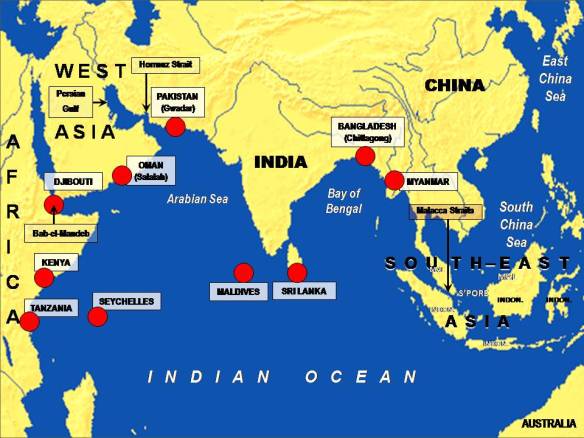
The growing importance of the Indian Ocean resources and sea lanes is apparent. More than half of the world’s container traffic, two-thirds of its seaborne petroleum trade, and a third of all maritime traffic traverse the ocean, much of it through chokepoints such as the Malacca and Hormuz straits.

The Indian Ocean is also rich in mineral wealth, with deep seabed mining emerging as a major new strategic issue. Various powers are seeking to tap seabed resources extending from sulfide deposits — which contain valuable metals such as silver, gold, copper, manganese, cobalt and zinc — to phosphorus nodules for phosphor-based fertilizers, underscoring the need for a regulatory regime and environmental protection.

The dangerous rush to exploit mineral and halieutic resources threatens to impose considerable environmental costs and spark new conflicts and confrontations. For example, several studies have indicated that commercial fishing by foreign fleets, by depleting local resources, has driven poor Somali fishermen to piracy.

Projecting naval power

The growth of nonstate actors such as pirates, terrorists and criminal syndicates off the Horn of Africa and elsewhere is also linked with the increasing density and importance of maritime flows through the Indian Ocean. This development, however, has become a pretext for outside powers to intervene and to project naval power. China, for example, has used the excuse of oceanic piracy to launch naval operations around the Horn of Africa and to set up its first overseas naval base at Djibouti, at the northwestern edge of the Indian Ocean in north Africa.

China’s growing activities in the Indian Ocean draw strength from its success in changing the status quo in its favor in the adjacent South China Sea, where it has pushed its borders far out into international waters in a way that no power has done elsewhere. By erecting military facilities on manmade islands in the Spratly and Paracel archipelagos, China has positioned naval and air power at the mouth of the Indian Ocean.

It is now rapidly expanding its Indian Ocean footprint after setting up the Djibouti base and investing in building regional ports, including in Pakistan at Gwadar (which sits strategically at the mouth of the Strait of Hormuz), in Sri Lanka at Hambantota, and in Myanmar at Kyaukpyu. It also has port projects in the Seychelles and the Maldives. China’s submarine fleet — one of the fastest-growing in the world — is best suited not for the shallow South China Sea but for the Indian Ocean’s deep waters, a message Beijing has conveyed by dispatching attack submarines to the area.

It was always clear that if China got its way in the South China Sea, it would turn its attention to the Indian Ocean and the western Pacific. Yet U.S. President Barack Obama’s administration allowed China to change the status quo by force in the South China Sea without incurring any international costs, even though this development carries greater and more far-reaching international geopolitical ramifications than Russia’s actions in Ukraine. Under Trump, the U.S. has shown no desire to seek a return to the status quo ante in the South China Sea. As a result, China is firming up its dominance there, while the U.S. symbolically undertakes freedom-of-navigation operations.

Cost-free unilateralism

In effect, China has demonstrated that defiant unilateralism is cost-free. This has left countries bearing the brunt of China’s recidivist policies with difficult choices. However, China’s actions have prompted Japan to reverse a decade of declining military outlays and India to revive stalled naval modernization.

Japan, which is heavily dependent on the Indian Ocean region for supplies of energy and raw materials, has also stepped up its regional engagement. For example, it is investing in eight port construction or renovation projects in Indonesia, India, Iran, Oman, Kenya, Mozambique, Madagascar and the Seychelles. Japan is also seeking to play a more active role in protecting the Indian Ocean sea lanes.

India, despite its strategic depth in the Indian Ocean, faces a new threat from the oceanic south. With Chinese submarines now making regular forays into India’s maritime backyard right under the nose of its Andaman and Nicobar Command, New Delhi must devise concrete steps to deal with China’s growing footprint.

With India’s energy and strategic infrastructure concentrated along a vulnerable, 7,600km coastline, the emergence of an oceanic challenge represents a tectonic shift in the country’s threat calculus. Yet it has been slow to face up to this reality. It needs a comprehensive maritime security strategy backed by naval capabilities that can take on tasks ranging from protecting and securing the seas to projecting power across the Indian Ocean region.

The Andaman and Nicobar archipelago in the Bay of Bengal is a critical asset for India to counter the growing Chinese maritime presence and to blunt the increasing land-based, trans-Himalayan military threat mounted by China. Located next to the Strait of Malacca, the Andaman and Nicobar chain offers control of this strategic chokepoint, which is one of China’s greatest maritime vulnerabilities. Just as the Chinese military harasses and threatens Indian border patrols in the Himalayas, India can potentially play the same game off the Andaman and Nicobar chain, including by establishing China-style civilian maritime militias backed by the Indian Coast Guard.

The importance of this chokepoint can be easily stated: A third of the 61% of global petroleum and other liquids production that moves on maritime routes transits the Strait of Malacca, including around 82% of China’s fuel imports. China’s hold on the South China Sea jugular makes the Strait of Malacca chokepoint a critical defense area for Indian security.

More fundamentally, greater maritime cooperation among democratic powers is becoming inescapable. Cooperation between Japan, India, Australia, Indonesia and the U.S. must extend to guarding the various “gates” to the Indian Ocean by exerting naval power at critical chokepoints. The aim should be to forestall the emergence of a destabilizing Sinocentric Asia. The common observation that, “Whoever controls the Indian Ocean dominates Asia,” is unattributed, but nonetheless true.

Brahma Chellaney is a geostrategist and author of nine books, including the award-winning “Water: Asia’s New Battleground.”

Myanmar’s Jihadi Curse

It is vital that Myanmar’s military immediately halt human-rights abuses of Rohingya in Rakhine State. But it is also vital for the international community to reject the prevailing depiction of the current crisis, which fails to recognize the long history of violent extremism among Rohingya militants.

BRAHMA CHELLANEY

A column internationally syndicated by Project Syndicate.

a3d40ea56f322f75acd5c1fe7228a83d.2-1-super.1

Myanmar’s military has lately been engaged in a brutal campaign against the Rohingya, a long-marginalized Muslim ethnic minority group, driving hundreds of thousands to flee to Bangladesh, India, and elsewhere. The international community has rightly condemned the crackdown. But, in doing so, it has failed to recognize that Rohingya militants have been waging jihad in the country – a reality that makes it extremely difficult to break the cycle of terror and violence.

Rakhine State, where most of Myanmar’s Rohingya reside, is attracting jihadists from far and wide. Local militants are suspected of having ties with the Islamic State (ISIS), al-Qaeda, and other terrorist organizations. Moreover, they increasingly receive aid from militant-linked organizations in Saudi Arabia and Pakistan. The main insurgent group – the well-oiled Arakan Rohingya Salvation Army, also known as Harakah al-Yaqin – is led by a Saudi-based committee of Rohingya émigrés.

The external forces fomenting insurgent attacks in Rakhine bear considerable responsibility for the Rohingyas’ current plight. In fact, it is the links between Rohingya militants and such external forces, especially terrorist organizations like ISIS, that have driven the government of India, where some 40,000 Rohingya have settled illegally, to declare that their entry poses a serious security threat. Even Bangladesh acknowledges Rohingya militants’ external jihadi connections.

But the truth is that Myanmar’s jihadi scourge is decades old, a legacy of British colonialism. After all, it was the British who, more than a century ago, moved large numbers of Rohingya from East Bengal to work on rubber and tea plantations in then-Burma, which was administered as a province of India until 1937.

In the years before India gained independence from Britain in 1947, Rohingya militants joined the campaign to establish Pakistan as the first Islamic republic of the postcolonial era. When the British, who elevated the strategy of “divide and rule” into an art, decided to establish two separate wings of Pakistan on either side of a partitioned India, the Rohingya began attempting to drive Buddhists out of the Muslim-dominated Mayu peninsula in northern Rakhine. They wanted the Mayu peninsula to secede and be annexed by East Pakistan (which became Bangladesh in 1971).

Failure to achieve that goal led many Rohingya to take up arms in a self-declared jihad. Local mujahedeen began to organize attacks on government troops and seize control of territory in northern Rakhine, establishing a state within a state. Just months after Myanmar gained independence in 1948, martial law was declared in the region; government forces regained territorial control in the early 1950s.

But Rohingya Islamist militancy continued to thrive, with mujahedeen attacks occurring intermittently. In 2012, bloody clashes broke out between the Rohingya and the ethnic Rakhines, who feared becoming a minority in their home state. The sectarian violence, in which rival gangs burned down villages and some 140,000 people (mostly Rohingya) were displaced, helped to transform the Rohingya militancy back into a full-blown insurgency, with rebels launching hit-and-run attacks on security forces.

Similar attacks have lately been carried out against security forces and, in some cases, non-Rohingya civilians, with the violence having escalated over the last 12 months. Indeed, it was a wave of coordinated predawn insurgent attacks on 30 police stations and an army base on August 25 that triggered the violent military offensive that is driving the Rohingya out of Rakhine.

Breaking the cycle of terror and violence that has plagued Myanmar for decades will require the country to address the deep-seated sectarian tensions that are driving Rohingya toward jihadism. Myanmar is one of the world’s most ethnically diverse countries. Its geographic position makes it a natural bridge between South and Southeast Asia, and between China and India.

But, internally, Myanmar has failed to build bridges among its various ethnic groups and cultures. Since independence, governments dominated by Myanmar’s Burman majority have allowed postcolonial nativism to breed conflict or civil war with many of the country’s minority groups, which have complained of a system of geographic apartheid.

The Rohingya face the most extreme marginalization. Viewed as outsiders even by other minorities, the Rohingya are not officially recognized as one of Myanmar’s 135 ethnic groups. In 1982, the government, concerned about illegal immigration from Bangladesh, enacted a law that stripped the Rohingya of their citizenship, leaving them stateless.

Successive governments have defended this approach, arguing that past secessionist movements indicate that the Rohingya never identified as part of the country. And, in fact, the common classification of Rohingya as stateless “Bengalis” mirrors the status of Rohingya exiles in the country of their dreams, Pakistan, where tens of thousands took refuge during the Pakistani military genocide that led to Bangladesh’s independence.

Still, the fact is that Myanmar’s failure to construct an inclusive national identity has allowed old ethnic rivalries to continue to fuel terrorism, stifling the resource-rich country’s potential. What Myanmar needs now is an equitable, federalist system that accommodates its many ethnic minorities, who comprise roughly a third of the population, but cover half of the total land area.

To this end, it is critical that Myanmar’s military immediately halt human-rights abuses in Rakhine. It will be impossible to ease tensions if soldiers are using disproportionate force, much less targeting civilians; indeed, such an approach is more likely to fuel than quell violent jihadism. But as the international community pressures Myanmar’s de facto leader Aung San Suu Kyi to take stronger action to protect the Rohingya, it is also vital to address the long history of Islamist extremism that has contributed to the ethnic group’s current plight.

China’s troublesome civil-military relations

Recent developments suggest President Xi Jinping is still struggling to keep the People’s Liberation Army in line.


China Military Parade

Chinese President Xi Jinping inspects People’s Liberation Army troops during a military parade to commemorate the 90th anniversary of the founding of the PLA on July 30. | AP

BY The Japan Times

Has Chinese President Xi Jinping managed to assert full civilian control over the People’s Liberation Army through purges of generals and admirals and other reform-related actions? China’s secretive and opaque political system makes it hard to get a clear picture. Yet recent developments suggest Xi is still struggling to keep the PLA in line.

Take the recent troop standoff with India that raised the specter of a Himalayan war, with China threatening reprisals if New Delhi did not unconditionally withdraw its forces from a small Bhutanese plateau that Beijing claims is Chinese territory “since ancient times.” After 10 weeks, the faceoff on the Doklam Plateau dramatically ended with both sides pulling back troops and equipment from the site on the same day, signaling that Beijing, not New Delhi, had blinked.

The mutual-withdrawal deal was struck just after Xi replaced the chief of the PLA’s Joint Staff Department. This topmost position — equivalent to the chairman of the U.S. Joint Chiefs of Staff — was created only last year as part of Xi’s military reforms to turn the PLA into a force “able to fight and win wars.” The Joint Staff Department is in charge of PLA’s operations, intelligence and training.

The Doklam pullbacks suggest that the removed chief, General Fang Fenghui, who has since been detained for alleged corruption, was an obstacle to clinching a deal with India.

In mid-June, India’s close ally, the tiny Himalayan kingdom of Bhutan, discovered PLA crews working to build a road through Doklam, prompting New Delhi to dispatch troops and equipment to halt the construction of the road that was to overlook the trijunction where Tibet, Bhutan and the Indian state of Sikkim meet.

In seeking to use road construction to change the status quo in a disputed Himalayan territory, the PLA, in a strategic miscalculation, anticipated Bhutan’s diplomatic protest but not India’s rapid military intervention. With the attempted land grab also threatening Indian security, New Delhi was quick to turn Bhutan’s call for help into India’s own fight.

To be sure, this was not the first time the PLA’s belligerent actions in the Himalayas imposed diplomatic costs on China. A classic case was what happened when Xi went to India for a state visit in September 2014. Xi arrived on Indian Prime Minister Narendra Modi’s birthday with a strange gift for his host — a predawn Chinese military encroachment that day deep into India’s northern region of Ladakh. The encroachment, the worst in many years in terms of the number of intruding troops, overshadowed Xi’s visit.

It appeared bizarre that the military of an important power would seek to mar in this manner the visit of its own head of state to a key neighboring country.

Yet Chinese Premier Li Keqiang’s earlier visit to New Delhi in 2013 was similarly preceded by a 19-km PLA incursion into another part of Ladakh that lasted three weeks. The encroachment was seemingly intended to convey anger over India’s belated efforts to fortify its border defenses.

Such provocations might suggest that they are intentional, with the Chinese government in the know, thus reflecting a preference for blending soft and hard tactics. But it is also possible that the provocations — at least their timing and duration — underscore the continuing “disconnect between the military and the civilian leadership” in China that then-U.S. Defense Secretary Robert Gates warned about in 2011.

During his 2014 India trip, Xi appeared embarrassed by the accompanying PLA encroachment that cast a pall over his visit. He assured Modi that he would sort it out upon his return.

Soon after he returned, the Chinese defense ministry quoted Xi as telling a closed-door meeting with PLA commanders that “all PLA forces should follow the president’s instructions” and that the military must display “absolute loyalty and firm faith in the Communist Party, guarantee a smooth chain of command, and make sure all decisions from the central leadership are fully implemented.”

Just weeks later, Xi again asked for the PLA’s full loyalty to the party, telling a military-political conference in Fujian that “the Communist Party commands the gun.”

Recently Xi conveyed that same message yet again when he addressed a parade marking the 90th anniversary of the PLA’s creation on Aug. 1, 1927. Donning military fatigues, Xi exhorted members of his 2.3 million-strong armed forces to “unswervingly follow the absolute leadership of the party.”

Had civilian control of the PLA been working well, would Xi repeatedly be demanding “absolute loyalty” from the military or asking it to “follow his instructions”?

With its one-party dictatorship placing the Communist Party above the state, China does not have a national army; rather the party has an army. So the PLA has traditionally sworn fealty to the party, not the nation. By contrast, in the case of China’s closest ally, Pakistan, the army has a country.

Under Xi’s two immediate predecessors, Hu Jintao and Jiang Zemin, the PLA gradually became stronger at the expense of the party. The military’s rising clout has troubled Xi because it hampers his ambition to become China’s most powerful leader since Mao Zedong. Xi’s present wife — folk singer Peng Liyuan — is actually a civilian member of the PLA, holding a rank equivalent to major general.

As part of his effort to reassert party control over the military and carry out defense reforms, Xi has used his anti-corruption campaign to ensnare a number of top PLA officers. He has also cut the size of the ground force and established a new command-and-control structure.

But just as a dog’s tail cannot be straightened, asserting full civilian control over a politically ascendant PLA is proving unachievable. After all, the party is ideologically bankrupt and morally adrift, and depends on the PLA to ensure domestic order and sustain its own political monopoly.

The regime’s legitimacy increasingly relies on an appeal to nationalism. But the PLA, with its soaring budgets and expanding role to safeguard China’s overseas interests, sees itself as the ultimate arbiter of nationalism.

To make matters worse, Xi has made many enemies at home in his ruthless effort to concentrate power in himself, including through corruption purges. It is not known whether the PLA’s upper echelon respects him to the extent to be fully guided by his instructions.

The PLA and the government appeared to be on the same page during the Doklam standoff, with the Chinese foreign and defense ministries and other state organs keeping up a barrage of threats and vitriol against India. But no sooner had Xi fired the chief of the Joint Staff Department, Gen. Fang, then a deal with India was clinched. This suggested that the topmost general was resisting ending the standoff.

Fang was fired just days after he hosted America’s highest-ranking military officer, Gen. Joseph Dunford, chairman of the Joint Chiefs of Staff. Fang was replaced by Gen. Li Zuocheng, considered a “war hero” for his combat role in the 1979 Chinese invasion of Vietnam, although China received a bloody nose from the more battle-hardened Vietnamese.

Xi’s military purges have been designed to consolidate his authority over the PLA and ensure that it does not blindside the government with actions or statements. But as Fang’s firing and other latest changes in the PLA leadership signal, Xi is still working to bring the military fully under his control.

More fundamentally, the PLA’s growing power is redolent of what happened in Imperial Japan, which rose dramatically as a world power in one generation after the 1868 Meiji Restoration. Boosted by war victories against Manchu-ruled China and czarist Russia, the Japanese military acquired political clout and gradually went on to dictate terms to the civilian government, as the 1931 Manchurian Incident first highlighted. This opened the path to aggression and conquest in Asia, with tragic consequences for Japan and the region.

In the past decade, the PLA’s increasing clout has led China to stake out a more muscular role. This includes resurrecting territorial and maritime disputes, asserting new sovereignty claims, and using construction activity to change the status quo. It won’t be long before the PLA rekindles Himalayan tensions with a major new encroachment.

China’s cut-throat internal politics and troublesome civil-military relations clearly have a bearing on its external policy. The risks of China’s rise as a praetorian state are real and carry major implications for neighboring countries.

Brahma Chellaney is a geostrategist.

© The Japan Times, 2017.

India, beware: China could seek revenge for Doklam

Damage from the Himalayan military standoff will not be easily repaired

20170901_China-India_article_main_image

Exile Tibetans listen to a speaker during an Aug. 11 protest in New Delhi to show support for India in its Doklam standoff with China. The banners in local language read “Tibet’s independence is India’s security.” © AP

Brahma Chellaney, Nikkei Asian Review

China and India have defused one of their worst border flare-ups in decades, which had threatened to trigger an armed conflict between the nuclear-armed Asian giants. However, the damage the 10-week troop standoff inflicted on the already frayed bilateral relationship will not be easy to repair. Indeed, the China-India divide over border, water, trade, maritime and other issues, including transportation and economic corridors, may only widen.

There is also the risk that the end of the face-off on the small Himalayan plateau of Doklam could prove just a temporary respite from border tensions before confrontation flares anew.

Beijing had all along insisted that if there was any dispute over Doklam — home to mainly Bhutanese shepherds — it was between China and tiny Bhutan. But, ultimately, it accepted a deal with the country it said had no role at all, India, which it labeled an “illegal trespasser.” The Chinese Communist Party and its People’s Liberation Army may find it difficult to live with a retreat that China was compelled to make after failing to intimidate India into submission through torrents of vitriol and warmongering.

China’s record under communist rule shows that it has at times retreated only to open a new front in the same area or elsewhere.

The Himalayan standoff was triggered when Chinese forces sought to change the territorial status quo by building a road through Doklam, the high-altitude Bhutanese plateau that China claims as its own. India, Bhutan’s security guarantor, intervened militarily and halted the construction, saying the road overlooking the triple border of Tibet, Bhutan and the Indian state of Sikkim threatened its own security.

The standoff ended on Aug. 28, the same day the state-owned China Daily had warned that India stood “to face retribution” over its intransigence. The Indian troops retreated 500 meters to the Indian side of the border, to a ridge-top post from where they can quickly intervene again if the PLA restarts work on the military road. China withdrew troops and construction equipment from the site while asserting the right to send armed patrols to the disputed plateau.

China sought to save face by spinning the deal as an Indian climbdown, camouflaging its own troop withdrawal from the site. It could not admit that it had withdrawn because it had claimed that Doklam — like the Japanese-administered Senkaku Islands in the East China Sea, or the disputed South China Sea — had been Chinese territory “since ancient times.” In reality, China is unlikely to be able to resume work on the road project, which perished when India called China’s bluff.

Standing up to China

More fundamentally, India, like Japan before it, has shown that if a neighbor is willing to stand up to China, it can be made to back away. Doklam is a defining event: For the first time since China’s success in expanding its control in the South China Sea by artificially creating seven islands and militarizing them, a rival power has stalled Chinese construction activity to change the status quo on a disputed territory. In a grudging admission about the Doklam setback, China’s ultranationalist Global Times newspaper said on Aug. 30: “China needs to enhance its deterrence to avoid external provocations.”

Beijing was left with little choice but to negotiate a deal after India showed that it would not be cowed. To “win without fighting,” as the ancient Chinese military theorist Sun Tzu recommended, Beijing made India the target of its new “three warfares” doctrine, which was first described in a 2008 Pentagon report to Congress. The standoff revealed how China blends psychological warfare with disinformation campaigns, media manipulation, and legal action or “lawfare” to mount intense pressure while presenting the other side as the aggressor and itself as the aggrieved party.

Repeated Chinese warnings to India to back down or face dire consequences, however, fell on deaf ears. India allowed the war of words to become one-sided by refusing to react to the almost daily Chinese verbal attacks.

Eventually, Beijing was forced to end the face-off through mutual disengagement of troops. Two factors forced Beijing’s hand. It wished to save the Sept. 3-5 summit in Xiamen, China, of the BRICS countries, a bloc comprising Brazil, China, India, Russia and South Africa. More importantly, it wanted to safeguard Chinese President Xi Jinping’s reputation in the run-up to the critical party congress this autumn. Had the standoff with India dragged on, it could potentially have taken a toll on Xi’s standing.

U.S. President Donald Trump’s administration also helped put pressure on Beijing by implicitly supporting the Indian and Bhutanese positions, including backing a “return to the status quo” that prevailed on Doklam before the road building began.

The deal with India was clinched shortly after Xi replaced Gen. Fang Fenghui with Gen. Li Zuocheng in the top PLA post that is equivalent to the chairman of the U.S. Joint Chiefs of Staff. This suggested that the removed chief, as head of the PLA’s operations, was an obstacle to a Doklam deal.

Despite China’s overall military superiority, India, with its terrain and tactical advantages, was in a stronger position in the triple border area. It could have prolonged the face-off until the onset of the harsh Himalayan winter, thus casting a cloud over the Chinese party congress. A protracted standoff would also have exacted increasing diplomatic costs for Beijing, given that India had dared to stand up to it, thus denting China’s reputed preeminence in Asia.

Doing Xi a favor

By reaching the deal, India effectively let China off the hook and did Xi an important favor at a time when he is focused on the party congress, which is expected to see him emerge as the most powerful Chinese leader since Mao Zedong. For New Delhi, salvaging Prime Minister Narendra Modi’s China visit for the BRICS summit, unfortunately, became an important consideration, although that grouping has increasingly come under Chinese sway.

But Beijing is unlikely to return the favor, and India’s decision to let China escape a strategic predicament of its own making could come back to haunt it.

China has tactically retreated because, beyond declaring war on India, it was running out of options. But without the distraction of a looming party congress, China could seek revenge for Doklam at a time and place of its choosing. Next time, the PLA is unlikely to make the mistake of encroaching onto an area where India enjoys the military advantage. It will choose a place where it can spring a nasty surprise and dictate terms to the Indian army.

With India already facing increasingly persistent PLA efforts to intrude into its borderlands, eternal vigilance holds the key to Himalayan peace. India’s army chief, Gen. Bipin Rawat, has cautioned that the country cannot be complacent because Doklam-style encroachments are likely to “increase in the future.” But while China uses the disputed long border with India as a justification to probe Indian defenses, India remains perennially in a reactive mode.

A grim reminder of the larger challenges in the bilateral relationship is China’s breach of legally binding obligations to supply India with hydrological data on upstream river flows in Tibet in order to facilitate flood forecasting and warnings. A third of India’s freshwater supply comes from river flows from Tibet. The current monsoon season has brought record flooding in parts of northern India.

Beijing has offered no explanation for its failure this year to honor bilateral accords that require it to transfer data on specific rivers to India annually from May 15 to Oct. 15. Had China been in India’s place, it would have linked the breach of commitments to the downstream floods and deaths. But India has been quiet. Timely transmission of data would have helped generate flood warnings, thus saving lives and reducing material losses in India’s northeast. The data denial apparently is designed to punish India for boycotting Xi’s Belt and Road infrastructure summit in Beijing in May.

When Beijing can breach formal bilateral agreements, will it continue to stick to the Doklam deal? In 2012, China and the Philippines reached a U.S.-brokered deal to withdraw naval vessels from around the disputed Scarborough Shoal. China gave the impression it was withdrawing its ships, only to return and capture the shoal.

China’s autocrats are actually undermining their country’s long-term interests by making a mortal enemy of India, with which they are currently running an annual trade surplus of nearly $60 billion. The cloistered process of decision-making in China has glossed over the far-reaching strategic ramifications of driving Asia’s most important geopolitical “swing state” into the U.S. camp.

Whatever happens next, Doklam illustrates China’s proclivity to miscalculate and overreach. India’s refusal to bend while talking peace offers other Asia-Pacific nations an example of how to manage Chinese coercion. Doklam also raises a broader question: Had U.S. President Barack Obama’s administration stood up to China in the South China Sea, would the seven artificial and now-militarized islands have been created? It is China’s success in altering the status quo there — without incurring any international costs — that has emboldened its territorial revisionism in the East China Sea and the Himalayas.

Brahma Chellaney is a geostrategist and the author of nine books, including the award-winning “Water, Peace, and War.”

© Nikkei Asian Review, 2017.