China’s dam boom stokes concerns in Asia

Brahma Chellaney, Nikkei Asian Review

At a time when geopolitical competition in resource-poor Asia is sharpening over freshwater, mineral ores and fossil fuels, China’s expansionary activities in the hydrocarbon-rich South China Sea have drawn considerable international attention, especially because of their implications for the global maritime order. By contrast, China’s frenzy of dam-building to appropriate internationally shared water resources has not attracted a similar level of attention, despite the specter of potential water wars.

China is almost unparalleled as a source of fresh water. Most of the major river systems of Asia originate from the Tibetan plateau, which was annexed by the People’s Republic of China soon after its establishment in 1949. Xinjiang, another sprawling region it occupied forcibly, is the source of the Irtysh and Ili rivers, which flow to Kazakhstan and Russia. However, Beijing does not have a single water-sharing pact with the dozen countries located downstream of its rivers because it rejects the concept.

Most of Asia’s dams are in China, which boasts slightly more than half of the world’s approximately 50,000 large dams. Yet its great dam boom shows no sign of slowing. Indeed, its dam-building program is now largely concentrated in the borderlands on international rivers.

By quietly and opaquely building large dams on transnational rivers, Beijing is presenting a fait accompli to its downstream neighbors. Its latent capability to control cross-border river flows arms it with significant leverage over neighbors — a leverage it could employ to influence the behavior of those states, including deterring them from challenging its broader regional interests.

Indeed, by seeking to control the spigot for much of Asia’s water, China is acquiring such clout that smaller downriver countries in Southeast and Central Asia now use only coded language  to express their concerns over Chinese dam building. For example, calling for transparency has become a way of referring obliquely to China, which smaller states are wary of mentioning by name.
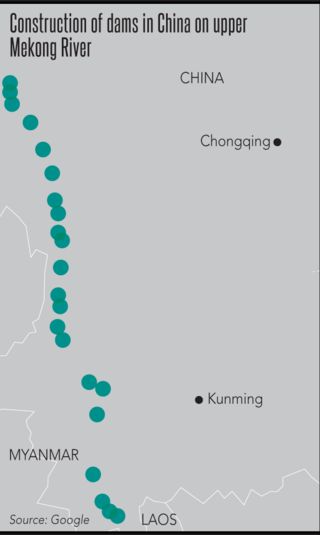
20160315Dams_middle_320On the Mekong river system — Southeast Asia’s lifeblood — China is building or planning a further 14 dams after completing six. It is also constructing a separate cascade of dams on the last two of its free-flowing rivers — the Salween (which flows into Myanmar and along the Thai border before entering into the Andaman Sea) and the Yarlung Tsangpo, also known as the Brahmaputra, which is the lifeline of northeastern India and much of Bangladesh.

Add to the picture China’s damming of other smaller rivers flowing to neighboring countries, as well as tributaries of major rivers, and it is clear that these dams are set to affect the quality and quantity of downstream flows.

Shift in focus

China recently completed ahead of schedule the world’s highest-elevation dam at Zangmu, Tibet, at a cost of $1.6 billion. It is now racing to complete a series of additional dams on the Yarlung Tsangpo, the world’s highest-altitude river. China is also turning an important Yarlung Tsangpo tributary, the Lhasa (or Kyichu), into a series of artificial lakes by building six dams in close proximity along a 20km stretch of the river.

Several factors are behind China’s drive to tap the resources of international rivers, including an officially drawn link between water and national security, the growing political clout of the state-run hydropower industry, and the rise of water nationalism at a time of increasing water stress in the northern Chinese plains. With dam-building reaching virtual saturation levels in the ethnic Han heartland, the focus has shifted to China’s ethnic minority homelands, where major rivers originate.

China’s centralized, megaprojects-driven approach to water resources is the antithesis of the situation in another demographic titan, India, where the constitution makes water an issue for state governments and where anti-dam nongovernmental organizations are powerful. Thanks to organized protests, the much-publicized Sardar Sarovar Dam on the Narmada river in western India remains incomplete decades after work began. The largest dam India has built since independence — the 2,000-megawatt Tehri Dam on the river Bhagirathi — pales in comparison to gigantic Chinese projects. These include the 22,500-megawatt Three Gorges Dam and Mekong dams such as Xiaowan, which dwarfs the Eiffel Tower in height, and Nuozhadu, which boasts a 190 sq. km reservoir.

Yet the water situation in India is far worse than in China, including in terms of per capita availability. China’s population is marginally larger than India’s but its internally renewable water resources (2,813 billion cubic meters per year) are almost twice as large as India’s. In aggregate water availability, including external inflows (which are sizable in India’s case but negligible for the People’s Republic), China boasts almost 50% more resources than India.

As China’s dam-builders increasingly target transnational rivers, concern is growing among downstream neighbors that Beijing is seeking to turn water into a potential political weapon. China pays little heed to the interests even of friendly countries, from Kazakhstan to Thailand and Cambodia.

To be sure, dams bring important socioeconomic benefits and help to deal with drought or seasonal imbalances in water availability through their water-storage capacity. A river can be dammed in an environmentally considerate manner. But what China is doing is over-damming rivers.

One manifestation of this aggressive approach is the construction of series of dams in close proximity to each other on international rivers such as the Mekong or the Salween just before they flow out of Chinese territory. These cascades of dams, looking like strings of beads on a map, aim to capture large quantities of water.

Keeping the silt

Major dams tend to change water quality and the rate at which it flows, and reduce the amount of nutrient-rich silt that is carried downstream. As the major Asian rivers flow down from forbidding Himalayan heights through the soft, sedimentary rock on the Tibetan plateau, they bring with them high-quality silt — a lifeline for agriculture, fisheries and marine life. Silt helps to re-fertilize overworked soils in downstream plains, sustains freshwater species and strengthens the aquatic food chain supporting marine life after rivers empty into seas or oceans.

China’s upstream damming of rivers originating on the Tibetan plateau is not just obstructing the silt flow to downstream plains; it is also causing the retreat of major deltas. Several scientific studies have underscored the link between extensive silt retention behind upstream dams and the retreat and subsidence of Asia’s big deltas, which are home to megacities like Tianjin, Shanghai, Guangzhou, Bangkok, Kolkata and Dhaka. In addition, the fall in freshwater disgorged by rivers into the seas is disturbing the delicate balance of salinity needed in estuaries and beyond to support critical species.

China’s reluctance to bind itself to international rules or norms is rooted in the belief that as the source of these rivers it is in a position to reap the benefits of harnessing their water resources, with the costs borne by those downstream. After all, the river-flow hierarchy reflects the geopolitical one, with the most powerful country controlling the headwaters of Asia’s major rivers.

In reality, though, China is inflicting environmental costs not just on the states lower down these rivers but on itself. One example is the impact of its upstream water diversions on its own mega-deltas, which are economic centers, making up a substantial proportion of the country’s total gross domestic product. Thanks to the diminished amount of silt discharged into the seas, there is less sediment to add to the delta land formed and fortified through sustained release or to prevent underground seepage of saltwater into sweet-water aquifers along the coasts.

More broadly, the Asian delta regions have become “much more vulnerable” to the effects of climate change and sea-level rise, according to the United Nations-sponsored Intergovernmental Panel on Climate Change, the gold standard in climate science.

In this light, the discussion of China’s damming activities on the Tibetan plateau should extend beyond the potential diminution of cross-border flows to the likely effects on the quality of river waters, including through silt-movement blockage. Such effects are already evident within China: the loss of nature’s gift of highly fertile silt due to the Three Gorges Dam and other upriver dams has forced farmers in the lower Yangtze basin to use more chemical fertilizers, accelerating soil and water degradation.

Renewed efforts are needed in Asia to co-opt China into institutionalized cooperation. Without China on board, it will not be possible to build water cooperation and protect critical ecosystems.

Brahma Chellaney is a geostrategist and the author, most recently, of “Water, Peace, and War.”
© Nikkei Asian Review, 2016.

Obama’s counterproductive Pakistan policy

Brahma Chellaney, Hindustan Times

USPakAmerica, despite a deepening relationship with India, still extends munificent aid to Pakistan — “the ally from hell”, as ex-CIA chief Michael Hayden calls it in his just-released book Playing to the Edge. Pakistan, with one of the world’s lowest tax-to-GDP ratios, has the unique status of being a client state of three powers on which it is more dependent than ever for aid — China, America and the jihad-bankrolling Saudi Arabia. US aid actually bolsters China’s strategy to box in India while encouraging Pakistan to diabolically sponsor terrorism.

Take US President Barack Obama’s latest move to reward Pakistan with 8 more subsidized F-16s and hundreds of millions of dollars in additional aid under the Overseas Contingency Operations fund, dubbed the “slush fund” because it is not subject to the same oversight as the regular Pentagon and state department budgets. Obama’s $860-million aid proposal includes $265 million worth of military hardware under the Foreign Military Financing provision, which, despite its name, permits non-repayable grants. The $700-million deal centred on F-16s is separate.

Two of the objectives cited by the state department in support of additional aid for Pakistan are promoting “improved relations with India” and peace in Afghanistan. How bolstering a renegade Pakistan financially and militarily would encourage it to improve ties with India or Afghanistan has been left unsaid. The US, by persistently rewarding a country that refuses to cut its umbilical ties with terrorists, has only exacerbated India’s security challenges.

Indeed, to continue showering Pakistan with aid (which has totalled a staggering $32.6 billion since 9/11), Obama has bent over backward to shield it from sanctions. Contrast that with his alacritous embrace of sanctions against several other countries in the past seven years.

Obama rebuffed congressional advice last year to suspend some aid to Pakistan and impose travel restrictions on Pakistani officials known to have ties to terrorists. Even when Osama bin Laden was found holed up in a lair next to Pakistan’s top military academy, Obama shied away from imposing sanctions. The issue as to how bin Laden was able to hide in a military town was allowed to fade away for the same reason that Pakistan (or anyone there) was not held to account for running the world’s largest nuclear proliferation ring, led by A.Q. Khan.

Obama’s zeal to shield the double-talking Pakistan has extended to persuading its terror target, India, to hold talks with it. If Prime Minister Narendra Modi’s Pakistan policy lies in tatters today, some of the blame must go to Obama, who beguilingly led him up the garden path with specious assurances on Pakistani behaviour.

Modi took office with a prudent approach toward Pakistan — inviting Prime Minister Nawaz Sharif to his inauguration but sidelining the Pakistan issue so as to focus on foreign-policy priorities more amenable to progress. In September 2014, Modi told the UN that “a serious bilateral dialogue with Pakistan” was only possible “without the shadow of terrorism”. But after Obama’s last India visit, Modi made a U-turn in his Pakistan policy, only to induce new cross-border terror attacks, from Gurdaspur to Udhampur.

Undaunted, Modi paid a surprise visit to Pakistan. Far from heralding a promising new era, the Christmas Day trip quickly invited daring Pakistani terror attacks at Pathankot and Mazar-i-Sharif. Today, Modi’s silence on Pakistan underscores the dilemma haunting him — how to fix a broken Pakistan policy. Why Modi yielded to a lame-duck US president is a pertinent question that remains unanswered.

Obama, despite a weak, divisive legacy even at home, got the world’s largest democracy to reverse course on Pakistan — an “achievement” whose regional fallout has been only negative, including denting Modi’s credibility and undermining Indian deterrence under his leadership. The net effect has been to present Modi since Pathankot as some sort of a paper tiger.

Still, with the Nuclear Security Summit forthcoming in Washington, there is little sign of Modi salvaging his Pakistan policy from US manoeuvrings. Indeed, by deciding to welcome Pakistani investigators in the Pathankot case, India bought the myth that terror groups like the Jaish-e-Mohammad (JeM) are independent of the Pakistani state. Army chief Dalbir Singh wants Pakistan “isolated” but Modi is doing the opposite — providing it diplomatic succour.

Consider this: Even as India presses Islamabad to prosecute JeM leaders for the Pathankot and Mazar-i-Sharif strikes, an emboldened Pakistan has used Lashkar-e-Taiba to carry out the Pampore attack. Jalalabad has followed Mazar-i-Sharif. Pakistan has also unleashed the mastermind of the 2008 Mumbai attacks, Hafiz Saeed, against India. Saeed’s very public life, including leading a recent Islamabad rally, mocks the Obama administration’s $10 million bounty on his head and India’s fond hope that Pakistan would rein in terrorist proxies. Clearly, US’s 2012 bounty was just to placate India and buy its cooperation on Pakistan.

Obama’s disastrous policy has strengthened Pakistan as the world’s leading terrorist sanctuary. The scourge of terrorism emanates more from Pakistan’s Scotch whisky-sipping military generals than from its bead-rubbing mullahs. Yet the White House pampers the generals at the expense of Pakistan’s civilian institutions. Washington highlighted the rot in its Pakistan policy by feting army chief Raheel Sharif in November.  Indeed, Gen. Sharif has been awarded the US Legion of Merit for his contributions to, believe it or not, “peace and security”. Tellingly, Washington’s latest aid and F-16 decisions coincided with its Defence Intelligence Agency chief’s warning that Pakistan’s expanding nuclear arsenal, including low-yield tactical nukes for battlefield use, increases “the risk of an incident or accident”.

By wielding only carrots and no stick, the Obama team has allowed itself to be repeatedly duped by false Pakistani promises, some of which it has religiously fed India. Its counterproductive policy has not only turned Uncle Sam into Uncle Sucker but also made it easy for Pakistan to merrily run with the foxes and hunt with the hounds — at grave cost to the security of America’s friend India.

Brahma Chellaney is a geostrategist and author.

© Hindustan Times, 2016.

Why the U.S. Must Tackle the Saudi Menace of Jihadism

1387190723716.cached

Brahma Chellaney, China-US Focus

At a time when the conflict within Islam has sharpened between Sunnis and Shias and between fundamentalists and reformers, the House of Saud — the world’s No. 1 promoter of radical Islamic extremism — is increasingly playing the sectarian card, even at the risk of deepening the schisms.

If Saudi Arabia is to be stopped from continuing to export jihad, the U.S. will have to make necessary adjustments in its policy. By wielding only carrots and no stick, the U.S. allows the double-talking Saudi royals to run with the foxes and hunt with the hounds — at grave cost to the security of many countries.

Indeed, the present U.S. policy approach gives the House of Saud the strategic space to keep all options open and cozy up to China, already Saudi Arabia’s largest trading partner and biggest importer of oil. China’s relationship with Saudi Arabia extends beyond trade and investment to arms, including the covert transfer of Chinese DF-21 and DF-3 medium-range ballistic missiles. Following the U.S.-Iran nuclear deal, China agreed during President Xi Jinping’s recent visit to Saudi Arabia to build that country’s first nuclear power plant.

Jihadism and sectarianism are institutionalized in Saudi Arabia, the only country in the world named after its founder, commonly known as Ibn Saud. Saud, who ruled for 20 years until his death, brought the central part of the Arabian Peninsula under his control with British assistance in 1932, establishing a desert kingdom hewing to Wahhabism, a messianic radicalism from the 18th century that until recent decades was considered a fringe form of Islam.

Jihadism and sectarianism are institutionalized in Saudi Arabia, the only country in the world named after its founder, commonly known as Ibn Saud. Saud, who ruled for 20 years until his death, brought the central part of the Arabian Peninsula under his control with British assistance in 1932, establishing a desert kingdom hewing to Wahhabism, a messianic radicalism from the 18th century that until recent decades was considered a fringe form of Islam.

Oil wealth helped transform the once-barren state, the world’s largest country without a river.

Since the oil-price boom of the 1970s that dramatically increased its wealth, Saudi Arabia has spent more than $200 billion on its global jihad project, including funding Wahhabi madrassas, mosques and books. Wahhabism legitimizes violent jihad with its call for a war on “infidels.”

Saudi funding has helped spread radical Sunni extremism across Africa and Asia and opened a new threat to European nations with significant Muslim minorities. Indeed, Wahhabism’s export is making the tolerant and heterodox Islamic traditions in many South and Southeast Asian countries extinct.

Yet the rest of the world — in thrall to Saudi money and reliant on Saudi oil — has largely turned a blind eye to the kingdom’s jihadist agenda.

Make no mistake: Saudi Arabia’s Wahhabi fanaticism is the root from which Islamist terrorist groups ranging from the Islamic State to al-Qaeda draw their ideological sustenance. As U.S. Vice President Joseph Biden said in a 2014 Harvard speech, Saudi and other “allies’ policies wound up helping to arm and build allies of al-Qaida and eventually the terrorist Islamic State.”

Saudi Arabia has faced little international pressure even on human rights, despite having one of the world’s most tyrannical regimes.

How the kingdom buys up world leaders is apparent from the Malaysian attorney general’s recent disclosure that the $681 million deposited in Prime Minister Najib Razak’s personal bank account was a “personal donation” from the Saudi royals and that $620 of it was returned. Saudi Arabia has given between $10 million and $25 million to the Clinton Foundation, which last year also received a separate donation from a charitable foundation established by Saudi Prince Alwaleed bin Talal.

Saudi Arabia is today engaged in war crimes in Yemen, where it is waging an air war against Iranian-backed Houthi rebels. A United Nations panel of experts said in October that the Saudi-led coalition had committed “grave violations” of the Geneva Conventions by targeting civilian sites in Yemen. Still, the Saudi military is failing in its war in Yemen; the rebels remain in control of Sanaa, the capital.

With its own future more uncertain than ever, the House of Saudi is increasingly playing the sectarian card in order to shore up support among the Sunni majority at home and to rally other Islamist rulers in the region to its side.

Having militarily crushed the Arab Spring uprising in Sunni-led but Shia-majority Bahrain, Saudi Arabia early this year executed its own Arab Spring leader who had led anti-regime Shia protests in 2011.  By executing Sheikh Nimr al-Nimr — a Shia cleric and scholar who had become the symbol of the Arab Spring protests in its oil-rich, mainly Shia Eastern Province — Saudi Arabia ignored U.S. Secretary of State John Kerry’s warning that the action would stoke major tensions with Iran.

Before the execution, the kingdom formed an alliance of Sunni states purportedly to fight terrorism. The coalition included all the main sponsors of international terror, including Qatar, Pakistan and, of course, Saudi Arabia. It was like arsonists pretending to be fire wardens.

When the coalition quickly became the butt of international ridicule, King Salman of Saudi Arabia resorted on a mass scale to what his country is notorious for as the global leader in beheadings. He ordered the execution on terrorism charges of 47 people on a single day, including Nimr al-Nimr. Most were beheaded in a style associated with the Islamic State.

The royals seem to mistakenly believe that widening the sectarian fault lines across the Islamic world will keep them in power. The crash in oil prices is already compounding the royals’ challenges at home. Discontent is growing quietly, even as King Salman pursues aggressive activism in his foreign policy.

By drawing legitimacy from jihadism and by being beholden to sectarianism, the royals could be digging their own graves. After all, fueling jihadism and sectarianism threatens to empower extremists at home and devour the royalty.

Against this background, it has become imperative for the U.S. to stop looking the other way as Saudi Arabia exports radical Islamic extremism. Unlike the ties between Saudi Arabia and China — two major autocracies — oil can no longer provide the glue for the Saudi-U.S. relationship, which is largely bereft of shared strategic interests or values. Moreover, America’s oil production at home is surging.

The U.S.-led war on terror must target not just the effect but the cause of terrorism, especially the central role Saudi Arabia plays through its religious-industrial complex in spreading jihadism. For example, proselytizing efforts by Saudi Arabia — and, to a lesser extent, by Qatar and some other oil sheikdoms — have helped train thousands of imams or teachers in Wahhabism to deliver radical sermons at petrodollar-funded mosques in many countries.

The war on Islamist terror cannot be won without closing the wellspring that feeds it — Wahhabi fanaticism. Wahhabism is the ultimate source of the hatred that triggered the September 11, 2001, strikes in the U.S., the 2008 Mumbai attacks and the Paris terror in November. Shutting that wellspring demands that America drop Saudi Arabia as an ally and treat it as a core part of the problem.

The world’s chief ideological sponsor of jihadism must be held to account for spawning the kinds of dangerous extremists that are imperiling regional and international security.

Brahma Chellaney is a geostrategist and the author, most recently, of “Water, Peace, and War” (Rowman & Littlefield, 2015).

India’s Pakistan policy unravels

Brahma Chellaney, Rediff

APTOPIX Pakistan Walk With Taliban

Despite Pakistan’s unending aggression against India ever since it was created as the world’s first Islamic republic in the post-colonial era, successive Indian governments have failed to evolve a consistent, long-term policy toward that country. In stark contrast, Pakistan has maintained the same India policy since its establishment — to spotlight Kashmir as the unfinished business of partition and to undermine Indian security by whatever means, fair or foul. 

Prime Minister Narendra Modi came to power talking tough about Pakistan. But in office, he has failed to translate his election-campaign talk into a coherent policy. Indeed, his Pakistan policy has already lost both direction and purpose. Worse still, Modi has failed to learn the lessons from the Pakistan blunders of his predecessors.

Thanks to the boomerang effect generated by his Lahore visit on Christmas Day, it has taken less than three months for Modi’s Pakistan policy to unravel. By paying a surprise visit with little preparation to a state whose hostility toward India is inborn, Modi ingenuously thought he was making history. Yet what the trip yielded is a continuing series of terrorist attacks of Pakistani origin on Indian targets — from Pathankot and Mazar-i-Sharif to Pampore and Jalalabad.

In fact, after Modi’s much-publicized bear hug of his Pakistani counterpart, Nawaz Sharif, in Lahore, it took barely a week for the terror masters controlling Pakistan to thank him for his visit by carrying out terror attacks through surrogate Jaish-e-Mohammad (JeM) on India’s Pathankot air base and on the Indian consulate in Mazar-i-Sharif, Afghanistan. The Pathankot attack was the military equivalent of the 2008 Mumbai strikes on civilian targets by terrorists from Pakistan.

After New Delhi began pressing the Sharif government for action against Azhar Masood and other JeM terrorist leaders for carrying out the New Year’s terror attacks at Pathankot and Mazar-i-Sharif, Pakistan used another terrorist proxy — the Lashkar-e-Taiba (LeT) group — to carry out an attack in Pampore, India. Afghan intelligence and former Afghan President Hamid Karzai have also linked the Jalalabad attack on the Indian consulate to Pakistan.

Yet the Modi government is preparing to welcome a Joint Investigation Team (JIT) from Pakistan that was set up to supposedly probe the Pathankot attack. It is like accepting arsonists as firefighters. Indeed, the JIT openly includes one officer of the rogue Inter-Services Intelligence (ISI) agency.

In truth, the JIT was set up not to bring the Pathankot masterminds to justice but to investigate the operational deficiencies of the Pathankot strike and to ensure that the next surrogate attack leaves no telltale signs of the involvement of Pakistanis. This is why Pakistan is seeking even more evidence from India. It was naïve of India to think that by supplying Pakistan communication intercepts and other evidence linking the Pathankot attackers with their handlers in that country, the terror masters there would go after their terror proxies.

Still, the Modi government continues to play into Pakistan’s hands. The latest example is the terror alert it has sounded across western and northern India after receiving a “tip-off” from Sharif’s National Security Adviser that 10 LeT and JeM terrorists had infiltrated into Gujarat state from across the international border.

The LeT and JeM are nothing but front organizations of the ISI. No cross-border infiltration of LeT or JeM terrorists happens without help from the Pakistani military. The alleged tipoff from Naseer Khan Janjua — an army general appointed as Sharif’s NSA at the military’s behest — helps to advertise Pakistan’s “cooperation” on terror while putting India knowingly on a wild-goose chase.

It is significant that the alleged Pakistani tipoff was leaked to the media not by the Pakistani government but by New Delhi. By leaking it in order to highlight Pakistan’s “cooperation” on terrorism, the Modi government might be seeking to create political space at home for a Modi-Sharif meeting in Washington this month-end on the sidelines of the Nuclear Security Summit. Creating political space for further top-level engagement with Pakistan has become necessary because Modi’s famous hug of Sharif in Lahore on Christmas Day backfired. That hug, like Atal Bihari Vajpayee’s hug of Sharif at the Wagah border in 1999, brought not peace but greater terrorism.

Make no mistake: Pakistan has little interest in honouring international norms or its own solemn commitments. When Sharif visited the White House in October 2015, the joint statement said the visiting Pakistani leader apprised U.S. President Barack Obama about Pakistan’s resolve to take “effective action against United Nations-designated terrorist individuals and entities, including Lashkar-e-Taiba and its affiliates, as per its international commitments and obligations under U.N. Security Council resolutions and the Financial Action Task Force (FATF).”

Obama did not question Sharif about the public activities of Hafiz Saeed, Azhar and other terrorist proxies or about Pakistan’s violation of the Security Council and FATF requirements in the case relating to Zakiur Rehman Lakhvi, a LeT leader whom Pakistan arrested and charged with involvement in the 2008 Mumbai attacks. Pakistan failed to investigate the source of funds used to bail out Lakhvi in April 2015.

Obama, however, has exerted Pakistan-related pressure on India. After Obama’s New Delhi visit in early 2015, Modi’s Pakistan policy transformed conspicuously. He resumed bilateral dialogue with Pakistan, only to invite new terror attacks in Punjab and Kashmir states. Still, he paid an unannounced visit to Pakistan.

The attack on the Pathankot base by Pakistani gunmen constituted an act of war. Yet Modi’s only public comment up until now on that attack has been to blame it on “enemies of humanity.” Even when he visited the base after the attack, Modi said nothing. If Obama had said nothing when he visited San Bernardino, California — where a married couple of Pakistani origin killed 14 people in December — he would have been roasted by his critics. Modi has stayed mum on Pakistan even in Parliament despite Rahul Gandhi’s taunt that he has “singlehandedly” bailed out the sponsor of terror by messing up Pakistan policy.

In fact, despite the Pathankot attack, the Modi government allowed the Pakistani high commissioner in New Delhi to meet a hardcore Kashmiri separatist, Ali Shah Geelani. Will Pakistan allow an Indian diplomat to meet a Pakistani separatist?

Today, Modi’s Pakistan policy looks little different than his predecessor’s, indicating that the more things change, the more they stay the same in India.

While welcoming Pakistani investigators in the Pathankot case, India has brushed aside the reality that Pakistan has failed to bring anyone to justice for the 2008 Mumbai terror attacks or even to commence trial in that case despite sending an investigation team to India in 2012 and 2013 that examined witnesses and collected other evidence. While Manmohan Singh rebuffed Pakistan’s request to allow its investigators visiting India to interrogate Ajmal Kasab, the lone surviving terrorist involved in the Mumbai attacks, Modi is considering granting the Pakistani team in the Pathankot case access to the Indian forward air base.

Assisting Pakistani investigators in the Pathankot case amounts to treating cross-border terrorism as a policing issue, as Islamabad wants, when, in reality, it is a strategic weapon that Pakistan diabolically wields to bleed India through a “war of a thousand cuts.” Indeed, helping Pakistan to investigate a terror attack in India is the equivalent of allowing a drug cartel to be in charge of counternarcotics.

When Pakistan openly permits United Nations-designated terrorist groups and terrorist leaders like Hafiz Saeed to operate from its soil and publicly threaten India with more terror attacks, it is nothing but foolhardiness to build counterterrorism cooperation with the Pakistani government. The risk is that, by expecting terror sponsors to go after their terror surrogates, Pakistan’s use of terrorism as a state instrument could be unwittingly legitimated by its victim, India.

More fundamentally, it is a false argument that India has only one choice — to continue useless talks with Pakistan or wage a full-fledged war. An extension of that argument is that India has no option but to keep battling Pakistan’s unconventional war on Indian territory. Such a self-injurious approach means treating cross-border terrorism as an internal law-and-order problem and bringing yourself under siege.

Wisdom actually lies in fighting an unconventional war with an unconventional war that is taken to the enemy’s own land so as to drive home the message that the foe’s aggression is not cost-free. According to Army chief General Dalbir Singh, 17 terrorist-training camps in Pakistan close to the border with India are still operating. If India remains directionless, further acts of cross-border terrorism will follow.

Unfortunately, India’s Pakistan policy has become unhinged. It remains unmoored in reality. If India wants history to stop repeating itself, it must tether its Pakistan policy to reality and develop a credible counterterrorism strategy.

Brahma Chellaney, a geostrategist and author of nine books, is professor of strategic studies at the New Delhi-based Centre for Policy Research.

The Limits of Capitalism with Communist Characteristics

Project Syndicate

a814068c9282d4cb2bae1dc7343a7797.landscapeAs US President Barack Obama prepares to embark on an historic visit to Cuba, the future of the communist-ruled island is the subject of widespread speculation. Some observers are hoping that the ongoing shift toward capitalism, which has been occurring very gradually for five years under Raúl Castro’s direction, will naturally lead Cuba toward democracy. Experience suggests otherwise.

In fact, economic liberalization is far from a surefire route to democracy. Nothing better illustrates this than the world’s largest and oldest autocracy, China, where the Chinese Communist Party (CCP) maintains its monopoly on power, even as pro-market reforms have enabled its economy to surge. (A key beneficiary of this process has been the Chinese military.)

The belief that capitalism automatically brings democracy implies an ideological connection between the two. But the dominance of the CCP – which currently boasts 88 million members, more than Germany’s total population – is no longer rooted in ideology. The Party, represented by a cloistered oligarchy, endures by employing a variety of instruments – coercive, organizational, and remunerative – to preclude the emergence of organized opposition.

A 2013 party circular known as “Document No. 9” listed seven threats to the CCP’s leadership that President Xi Jinping intends to eliminate. These include espousal of “Western constitutional democracy,” promotion of “universal values” of human rights, encouragement of “civil society,” “nihilist” criticisms of the party’s past, and endorsement of “Western news values.”

In short, communism is now focused less on what it is – that is, its ideology – and more on what it is not. Its representatives are committed, above all, to holding on to political power – an effort that the economic prosperity brought by capitalism supports, by helping to stave off popular demands for change.

The story is similar in Vietnam and Laos. Both began decentralizing economic control and encouraging private enterprise in the late 1980s, and are now among Asia’s fastest-growing economies. Vietnam is even a member of the incipient 12-country Trans-Pacific Partnership. But the one-party state remains entrenched, and continues to engage in considerable political repression.

Things do not seem set to change anytime soon. In Vietnam, Nguyễn Tấn Dũng, the reform-minded prime minister, recently failed in his bid to become General Secretary of the Communist Party (the country’s supreme leader); the 12th National Congress reelected the incumbent, Nguyễn Phú Trọng.

Beyond providing sufficient material gains to keep the population satisfied, capitalism strengthens a communist-ruled state’s capacity to increase internal repression and control information. One example is the notorious “Great Firewall of China,” a government operation that screens and blocks Internet content, creating a realm of politically sanitized information for citizens. China is the only major country in the world whose official internal-security budget is larger than its official national-defense budget.

In the face of China’s current economic turmoil, control of information has become more important than ever. In order to forestall potential challenges, China’s leadership has increasingly muzzled the press, limiting, in particular, reporting or commentary that could adversely affect stock prices or the currency. Xi has asked journalists to pledge “absolute loyalty” to the CCP, and closely follow its leadership in “thought, politics, and action.” A state-run newspaper, warning that “the legitimacy of the party might decline,” argued that the “nation’s media outlets are essential to political stability.”

Clearly, where communists call the shots, the development of a free market for goods and services does not necessarily lead to the emergence of a marketplace of ideas. Even Nepal, a communist-dominated country that holds elections, has been unable to translate economic liberalization into a credible democratic transition. Instead, the country’s politics remain in a state of flux, with political and constitutional crises undermining its reputation as a Shangri-La and threatening to turn it into a failed state.

Democracy and communism are, it seems, mutually exclusive. But capitalism and communism clearly are not – and that could be very dangerous.

In fact, the marriage of capitalism and communism, spearheaded by China, has spawned a new political model that represents the first direct challenge to liberal democracy since Fascism: authoritarian capitalism. With its spectacular rise to become a leading global power in little more than a single generation, China has convinced autocratic regimes everywhere that authoritarian capitalism – or, as Chinese leaders call it, “socialism with Chinese characteristics” – is the fastest and smoothest route to prosperity and stability, far superior to messy electoral politics. This may help to explain why the spread of democracy worldwide has lately stalled.

Obama’s impending Cuba visit should be welcomed as a sign of the end of America’s inapt policy of isolation – a development that could open the way to lifting the 55-year-old trade embargo against the country. But it would be a serious mistake to assume that Cuba’s economic opening, advanced by the Obama-initiated rapprochement, will necessarily usher in a new political era in Cuba.

© Project Syndicate, 2016.