China’s Hydro-Hegemony

China's grip

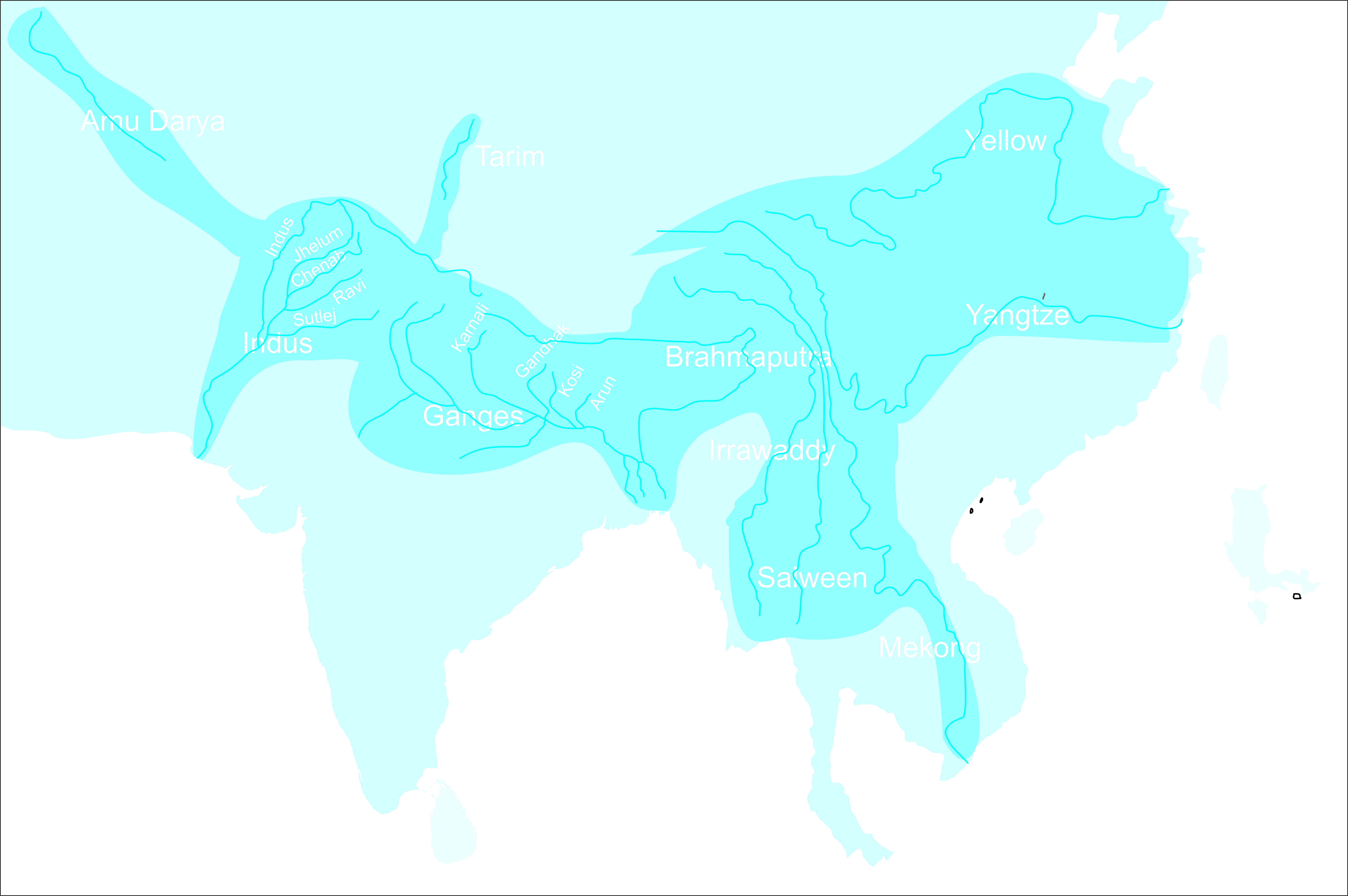
Map © Brahma Chellaney, “Water: Asia’s New Battleground” (Georgetown University Press)

By BRAHMA CHELLANEY

International Herald Tribune: February 8, 2013

ASIA is the world’s most water-stressed continent, a situation compounded by China’s hydro-supremacy in the region. Beijing’s recent decision to build a slew of giant new dams on rivers flowing to other countries is thus set to roil riparian relations.

China — which already boasts more large dams than the rest of the world put together and has unveiled a mammoth $635-billion fresh investment in water infrastructure over the next decade — has emerged as the key obstacle to building institutionalized collaboration on shared water resources in Asia.

In contrast to the bilateral water treaties between many of its neighbors, China rejects the concept of a water-sharing arrangement or joint, rules-based management of common resources.

For example, in rejecting the 1997 United Nations convention that lays down rules on shared water resources, Beijing placed on record its contention that an upstream power has the right to assert absolute territorial sovereignty over the waters on its side of the international boundary — or the right to divert as much water as it wishes for its needs, irrespective of the effects on a downriver state.

Today, by building megadams and reservoirs in its borderlands, China is working to re-engineer the flows of major rivers that are the lifeline of lower riparian states.

China is the source of transboundary river flows to the largest number of countries in the world — from Russia, Kazakhstan and Kyrgyzstan to the states in the Indochina peninsula and southern Asia. This pre-eminence resulted from its absorption of the ethnic-minority homelands that now make up 60 percent of its landmass and are the origin of all the international rivers flowing out of Chinese-held territory. No other country in the world comes close to the hydro-hegemony that China has established.

Since the last decade, China’s dam building has been moving from dam-saturated internal rivers to international rivers. Most of the new megaprojects designated recently by China’s state council as priority ventures are concentrated in the country’s seismically active southwest, which is largely populated by ethnic minorities. Such dam building is triggering new ethnic tensions over displacement and submergence.

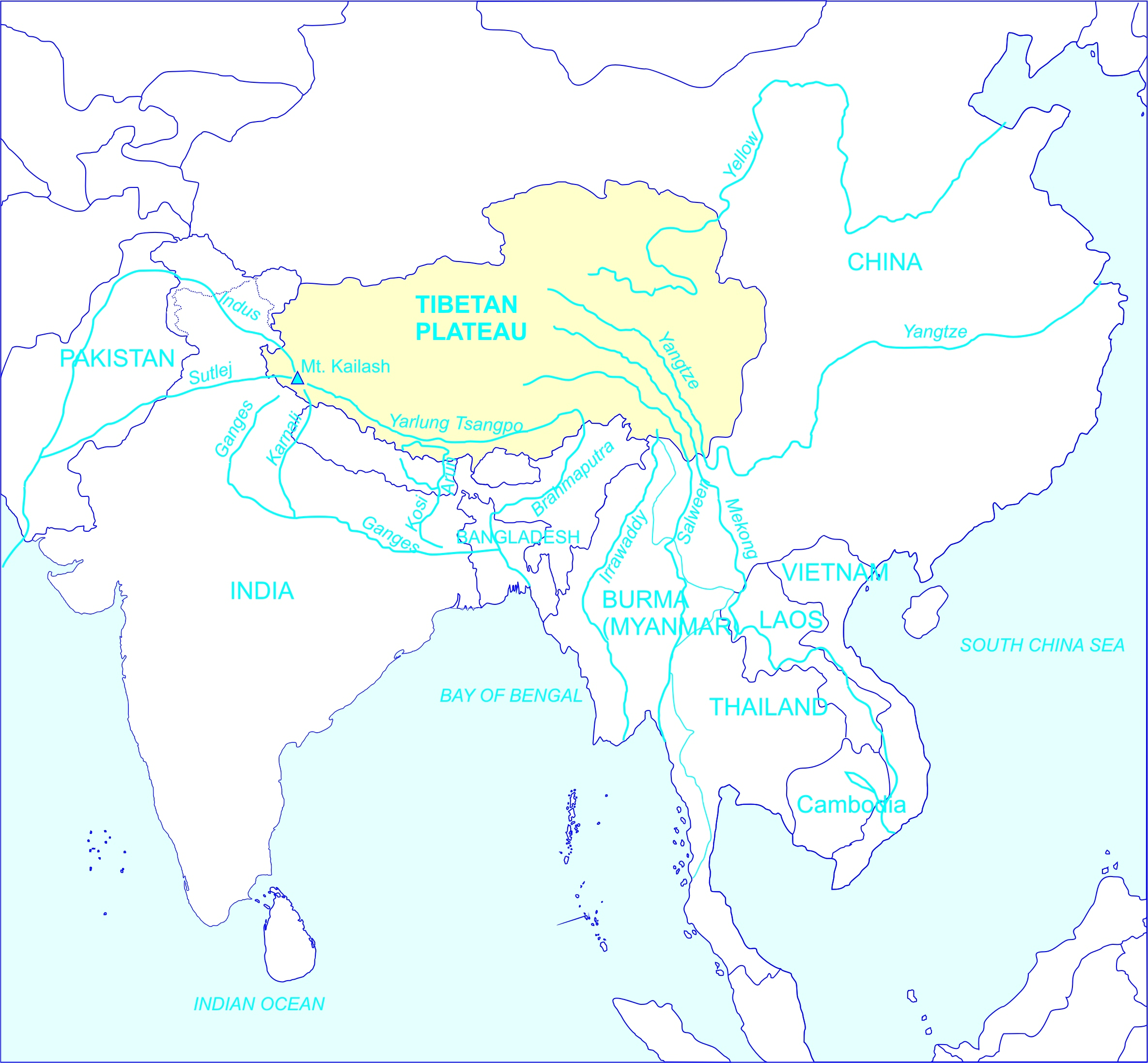
The state council approved an array of new dams on the Salween, Brahmaputra and Mekong rivers, which originate on the Tibetan plateau and flow to southern and southeastern Asia. The unveiling of projects on the Brahmaputra evoked Indian diplomatic concern at a time when water has emerged as a new Chinese-Indian divide, while the Salween projects end the suspension of dam building on that river announced eight years ago.

The Salween — known in Chinese as Nu Jiang, or the “Angry River” — is Asia’s last largely free-flowing river, running through deep, spectacular gorges and glaciated peaks on its way to Burma and Thailand.

Its upstream basin is inhabited by at least a dozen different ethnic groups and rated as one of the world’s most biologically diverse regions, home to more than 5,000 plant species and nearly half of China’s animal species. No sooner had this stunning region, known as the Three Parallel Rivers, been added to the World Heritage List by Unesco in 2003 than Beijing unveiled plans for a cascade of dams near the area.

The international furor that followed led Prime Minister Wen Jiabao to suspend work. The reversal of that suspension, significantly, comes before Wen and President Hu Jintao step down as part of the country’s power transition.

The third international river cited by the state council in its new project approvals has already been a major target of Chinese dam building. Chinese engineers have constructed six megadams on the Mekong, including the 4,200-megawatt Xiaowan, and a greater water appropriator, the 5,850-megawatt Nuozhadu, whose first generator began producing electricity last September.

Asia needs institutionalized water cooperation because it awaits a future made hotter and drier by climate and environmental change and resource depletion. The continent’s water challenges have been exacerbated by growing consumption, unsustainable irrigation practices, rapid industrialization, pollution and geopolitical shifts.

Asia has morphed into the most likely flash point for water wars. Several countries are currently engaged in dam building on transnational rivers. The majority of these dams are being financed and built by Chinese state entities. Most Chinese-aided dam projects in Laos, Cambodia and Myanmar indeed are designed to pump electricity into China’s southern electricity grid, with the lower riparians bearing the environmental and social costs.

But it is China’s dam-building spree at home — reflected in the fact that it boasts half of the 50,000 large dams in the world — that carries the greatest international implications and obstructs the development of an Asian rules-based order.

China has made the control and manipulation of natural-river flows a fulcrum of its power and economic development. Although promoting multilateralism on the world stage, it has given the cold shoulder to multilateral cooperation among basin nations — as symbolized, for example, by the Mekong River Commission — and rebuffed efforts by states sharing its rivers to seek bilateral water-sharing arrangements.

Beijing already has significant financial, trade and political leverage over most of its neighbors. Now, by building an asymmetric control over cross-border flows, it is seeking to have its hand on Asia’s water tap.

Given China’s unique riparian position and role, it will not be possible to transform the Asian water competition into cooperation without Beijing playing a leadership role to develop a rules-based system.

Brahma Chellaney is the author of “Water: Asia’s New Battleground” and of the forthcoming book “Water, Peace, and War: Confronting the Global Water Crisis.”

(c) New York Times, 2013.

Neighbours leave India high and dry for its water supply

Brahma Chellaney

The National, February 1, 2013

Of all the natural resources on which the world depends, the supply and demand situation is most critical for water. There are replacements for oil, but no substitute for water, which is essential to produce virtually all the goods in the marketplace.

Asia, not Africa, is the world’s driest continent. The gap between demand and supply is growing in China, India, South Korea, Japan, Vietnam and elsewhere in Asia.

This raises a question: can Asia remain the locomotive of the global economy if it cannot mitigate its water crisis?

India faces greater water distress than China. China’s population is not even 10 per cent larger than India’s, but its internally renewable water resources (estimated at 2,813 billion cubic metres per year) are almost twice as large as India’s. In aggregate water availability, including inflows (which are sizeable in India’s case), China has virtually 50 per cent more resources than India.

In 1960, India signed a treaty setting aside 80 per cent of the Indus-system waters for downstream Pakistan, in the most generous water-sharing pact in modern history. And its 1996 Ganges treaty with Bangladesh guarantees minimum cross-border flows in the dry season – a new principle in international water law. That treaty divides the flows of the Ganges almost equally between the two countries. And now India is under pressure to reserve about half of the Teesta River’s water for Bangladesh.

But India is downriver from China. About a dozen important rivers flow into India from the Tibetan Himalayas. Indeed, one third of India’s yearly water supply comes from Tibet, according to United Nations’ data. Nations from Afghanistan to Vietnam receive water from the Tibetan Plateau, but India’s direct dependency on Tibetan water is greater than any other country’s.

But Beijing, far from emulating India’s water munificence, rejects the very concept of water sharing and is building large dams on rivers flowing to other nations, with little regard for downriver interests. An extensive Chinese water infrastructure in Tibet will have a serious effect on India.

So India faces difficult choices. Its ambitious plan to link up its major rivers has remained on paper for more than a decade. The idea was to connect 37 Himalayan and peninsular rivers in a pan-Indian water grid, to fight shortages.

Although the grid was ridiculed by the ruling party’s heir-apparent Rahul Gandhi as a “disastrous idea”, the Supreme Court ordered last year that it be implemented in “a time-bound manner”. Will that really happen?

The experience of the Supreme Court-overseen Narmada dam project in Gujarat doesn’t leave much room for optimism. India has struggled for decades to complete Narmada, and yet it is designed to produce less than 7 per cent as much hydropower as China’s Three Gorges Dam, completed last year.

With water increasingly at the centre of inter-provincial feuds in India, the Supreme Court has struggled for years with water cases, but the parties keep returning to litigate again on new grounds.

Plans for large water projects in India usually run into stiff opposition from influential non-government organisations, so that it has become virtually impossible to build a large dam, blighting the promise of hydropower.

Proof of this was New Delhi’s 2010 decision to abandon three dam projects on the Bhagirathi River, a source stream of the Ganges in the Himalayas. One of these was already half-built; hundreds of millions of dollars were wasted.

The largest dam India has built since independence is the 2,000 megawatt Tehri on the Bhagirathi. Compare that with China’s 18,300 megawatt Three Gorges. China’s proposed Metog Dam, almost on the disputed border with India, is to produce nearly twice as much power as Three Gorges Dam. China is also building on the Mekong River.

Meanwhile India’s proposed river-linking plan seems like a dream: a colossal network to handle 178 billion cubic metres of water transfers a year in12,500km of new canals, generating 34 gigawatts of hydropower, creating 35 million hectares of irrigated land and expanding inland navigation. This is the kind of programme that only an autocracy like China can implement.

Government agencies say that by 2050 India must nearly double grain production, to over 450 million tons a year, to meet the demands of prosperity and population growth. Unless it has more irrigated land and adopts new plant varieties and farming techniques, India is likely to become a net food importer before long – a change that will roil world food markets.

More fundamentally, growing water shortages threaten to slow Indian economic growth and fuel social tensions. The government must fix its disjointed policy approach and develop a long-term vision for water resources.

India must treat water as a strategic issue and focus on three key areas. One is achieving greater water efficiency and productivity gains. Another is using clean-water technologies to open up new supply sources, including ocean and brackish waters and recycled wastewater. The third is expanding and enhancing water infrastructure to correct regional and seasonal imbalances in water availability, and to harvest rainwater, which can be a new supply source to ease shortages.

Boosting water supplies demands tapping unconventional sources and adopting non-traditional approaches, as well as improving the old ways of water-supply management.

Brahma Chellaney is a professor of strategic studies at the Center for Policy Research in New Delhi and the author of Water: Asia’s New Battleground.

On Twitter: @Chellaney

(c) The National, 2013

South Korea as bridge-builder

By Brahma Chellaney, JoongAng Ilbo, January 21, 2013, page 6

Park Geun-hye broke through South Korea’s glass ceiling to win the presidency. But having overcome the gender barrier, she now faces important domestic and foreign-policy challenges. How she handles those challenges, including slowing economic growth and sharpening geopolitical competition in Northeast Asia, will determine if South Korea’s international clout will continue to rise.

Coincidentally, she is taking over as president at a time when Japan has elected a new government led by Prime Minister Shinzo Abe and Xi Jinping is assuming the presidency in China. The overlapping power transitions in East Asia’s three main economies promise to mark a defining moment in the region’s harsh geopolitics.

Xi is regarded by the People’s Liberation Army (PLA) as its own man, while Abe is a vocal nationalist. The political transitions, coupled with the brewing territorial spats between China and Japan and South Korea and Japan as well as the underlying tensions between the two Koreas, create new risks to regional peace, stability, and prosperity. In this setting, Ms. Park will need to tread cautiously, seeking to expand mutually beneficial ties with Beijing, Tokyo, and Washington while addressing domestic challenges, including the growing income disparity and a generational divide, as reflected in the presidential election’s voting patterns.

Asia’s other major economy, India, is expecting Ms. Park’s election to accelerate cooperation and trade between Seoul and New Delhi. Her election has received wide coverage in India, a country that has a long tradition of powerful women figures in politics.

Washington, for its part, is delighted that voters in South Korea and Japan have elected conservative, pro-American leaders, raising hope that America will be able to work with its two closest allies in East Asia to ease the security issues that are troubling this economically dynamic region. The Obama administration, however, recognizes that the emotionally charged relations between Tokyo and Seoul can prove a serious impediment. A reminder of that was the decision of departing President Lee Myung-bak last summer to cancel the scheduled signing of a military intelligence-sharing agreement with Japan and scrap a bilateral plan to finalize a military-related Acquisition and Cross-Servicing Agreement.

If Ms. Park is to build a historically positive legacy in her five-year term as president, she will need to be different than Lee Myung-bak in both style and substance, even though he is her colleague from the Saenuri Party. She will need to have a more consensual style than Lee, nicknamed “the Bulldozer” from his career as a construction industry executive. And in terms of substance, she must seek to build more cooperative ties with North Korea and Japan.

Lee pointlessly roiled the relationship with Japan in his last year in year, while his policy approach toward North Korea right from 2008 onward only encouraged greater belligerence and defiance on the part of Pyongyang. Not only did inter-Korean contact and cooperation suffer, but the North carried out provocative actions, including missile tests, and ratcheted up bellicose rhetoric. Relations between the two Koreas sunk to a low. Pyongyang’s recent space launch served as a fresh reminder of its determination to defy even United Nations Security Council resolutions.

Fortunately, Ms. Park has already signaled that she will pursue a more pragmatic and balanced foreign policy than her predecessor. For example, she has vowed to tread the middle path on North Korea between unconditional engagement and uncompromising chastisement. She has even indicated that she would try to hold talks with the North’s young leader Kim Jong-un.

Ms. Park’s more moderate approach could undercut the Obama administration’s sanctions-only North Korean policy just when Pyongyang has signaled open defiance of U.S. and UN pressure. But it is in South Korea’s own long-term interest to build economic cooperation and other contact with the North so that when the regime in Pyongyang eventually collapses, the costs of Korean reunification will not be terribly high.

More broadly, the central challenge in Northeast Asia is to get rid of the baggage of history that weighs down the relationships between all the actors. The rise of nationalism in the region with growing prosperity has only compounded the historical issues.

Booming trade in the region has failed to mute or moderate territorial and other disputes; on the contrary, it has only sharpened regional geopolitics and unleashed high-stakes brinkmanship. Economic interdependence cannot deliver regional stability unless rival states undertake genuine efforts to mend their political relations.

China, for example, has launched a new campaign of attrition against Japan over the Senkaku/ Diaoyu Islands. By sending patrol ships frequently to the waters around the islands since September — and by violating the airspace over them recently — Beijing has sought to challenge Japan’s decades-old control over them, despite the risk that an incident at sea or in the air between the two sides could spiral out of control.  Meanwhile, a continuing informal Chinese boycott of Japanese goods has led to a fall in Japan’s exports to China.

China’s new assertiveness has fueled a nationalist backlash in Japan. But that is only fanning nationalism in China, where the Communist Party has already turned nationalism as the legitimating credo of its monopoly on power to compensate for the decline of the state ideology. Consequently, the two countries find themselves in a vicious circle from which they are finding it difficult to escape.

The risks posed by increasing nationalism and militarism to peace in East Asia have already been highlighted by the rise of a new Chinese dynasty of “princelings,” or sons of revolutionary heroes who have widespread contacts in the military. In fact, what distinguishes Xi, a former military reservist, from China’s other civilian leaders is his strong relationship with the PLA, whose rising clout has underpinned China’s increasingly muscular foreign policy.

Against this background, Ms. Park’s test is to prove a visionary, dynamic leader who has the foresight and courage to chart a more stable and prosperous future for her country and region. Her lasting legacy could be to boost South Korea’s economic and foreign-policy influence and turn it into a bridge-builder between Japan and China, between China and the United States, and between Russia and Japan.

Brahma Chellaney, professor of strategic studies at the Center for Policy Research in New Delhi, is the author of “Asian Juggernaut” (Harper, 2010) and “Water: Asia’s New Battleground” (Georgetown University Press, 2011), which won the 2012 Bernard Schwartz Award.

(Translated and published in Korean. © JoongAng Ilbo, 2013.)

East Asia’s Defining Moment

By BRAHMA CHELLANEY

International Herald Tribune: December 22, 2012

Portrait of Brahma Chellaney

The overlapping power transitions in East Asia’s three main economies promise to mark a defining moment in the region’s tense geopolitics. After the ascension in China of Xi Jinping, regarded by the People’s Liberation Army as its own man, Japan’s swing to the right in its parliamentary election seems set to fuel nationalist passion on both sides of the Sino-Japanese rivalry at a time when their brewing territorial spat in the East China Sea has created new risks to regional peace and stability.

South Korea’s presidential election swept another conservative to power, but one who supports conditional rapprochement with North Korea — a line at variance with the policies of departing President Lee Myung-bak and President Obama to keep Pyongyang punitively isolated. Park Geun-hye, the first woman to be elected president in a country that ranks poorly in gender equality, says she intends to tread the middle path between unconditional engagement and uncompromising chastisement.

Park Geun-hye, the 60-year-old daughter of the military general who served as South Korea’s dictator for 18 years until 1979, will assume the presidency in February — a month before Xi, the new leader of the ruling Communist Party, becomes China’s president — while Shinzo Abe, a vocal nationalist, will return as Japan’s prime minister a day after Christmas.

Abe, as prime minister in 2006 and 2007, proposed a concert of democracies in the Asia-Pacific — an idea that spawned the Quadrilateral Initiative of Australia, India, Japan and the United States. Although China’s strong response prevented the “quad” from developing into a formal institution, the four countries have been building strategic collaboration on a bilateral and — in the case of India, Japan and America — even trilateral basis.

East Asia’s political transitions threaten to exacerbate regional challenges, which include the need to institute a stable balance of power and dispense with historical baggage that weighs on interstate relationships. Booming trade has failed to moderate territorial and historical disputes, highlighting that economic interdependence by itself cannot deliver regional stability unless rival states undertake genuine efforts to mend their political relations.

The timing of the political transitions is particularly problematic for the Obama administration, which has been urging China and Japan to peacefully resolve their disputes, while keeping the Stalinist regime in North Korea under stringent sanctions and seeking to promote strategic cooperation between its two allies, South Korea and Japan.

South Korea’s decade-long “sunshine policy” of engagement with North Korea was reversed by the neoconservative Lee after he took office in 2008, triggering a series of tit-for-tat actions that brought the South-North relationship to a low by 2010.

Despite Pyongyang’s successful rocket launch last week in defiance of U.N. Security Council resolutions, Lee’s successor and colleague in the Saenuri Party, Park, has promised to allow humanitarian aid to the North and to try to meet its young leader Kim Jong-un, who is less than half her age. Kim came to power a year ago following the death of his father. Park’s more moderate approach could undercut Obama’s sanctions-centered policy just when Pyongyang has signaled open defiance of U.S. and U.N. pressure.

Washington’s diplomatic efforts notwithstanding, the new strains in South Korea’s relationship with Japan, owing to the revival of historical issues, may also not be easy to mend. Earlier this year, Lee, at the last minute, canceled the scheduled signing of a military intelligence-sharing pact with Japan, besides scrapping a bilateral plan to finalize a military-related Acquisition and Cross-Servicing Agreement. Weeks later, Lee provocatively visited the contested islets known as the Dokdo Islands in South Korea (which controls them) and the Takeshima Islands in Japan.

Park may seek to similarly pander to nationalist sentiment at home by taking a tough stance against Japan, especially to play down her father’s collaboration with the Japanese military while Korea was under Japanese colonial rule.

China, meanwhile, has launched a new campaign of attrition against Japan over the Senkaku Islands. By sending patrol ships frequently to the waters around the islands — and by violating the airspace over them — Beijing has sought to challenge Japan’s decades-old control, despite the risk that an incident could spiral out of control.

This assertiveness followed often-violent anti-Japanese protests in China in September. An informal Chinese boycott of Japanese goods has led to a sharp fall in Japan’s exports to China, raising the risk of another Japanese recession. China remains Japan’s largest overseas market. A nationalist backlash in Japan is in turn fanning nationalism in China, where the Communist Party has made ultranationalism the legitimating credo of its monopoly on power. Consequently, China and Japan find themselves in a vicious circle that is difficult to escape.

The risks to peace in East Asia posed by increasing nationalism and militarism are highlighted by the rise of a new Chinese dynasty of “princelings” — the sons of revolutionary heroes who have widespread contacts in the military. In fact, what distinguishes Xi, a former military reservist, from China’s other civilian leaders is his strong relationship with the military, whose rising clout has underpinned China’s increasingly muscular foreign policy.

Against this background, the central challenge for East Asia’s three largest economies is to resolve the historical issues that are preventing them from charting a more stable and prosperous future. As a Russian proverb warns, “Forget the past and lose an eye; dwell on the past and lose both eyes.”

Brahma Chellaney, a professor of strategic studies at the New Delhi-based Center for Policy Research, is the author, most recently, of “Asian Juggernaut.” 

(c) International Herald Tribune/New York Times, 2012.

Peace overtures to Pakistan: India reaps a bitter harvest

Brahma Chellaney

The Economic Times, January 10, 2013

Words like “brutal,” “heinous” and “savage” aptly describe the way a Pakistani army unit raided Indian territory and chopped two soldiers, taking away one severed head as a “trophy.” The Indian outrage, however, must not blind us to the unpalatable truth: India is reaping what it sowed. New Delhi is staring at the bitter harvest of a decade-long policy seeking to appease a recalcitrant neighbour with unilateral concessions and gestures.

The “peace-at-any-price diplomacy” was started by Prime Minister Atal Bihari Vajpayee in an abrupt policy U-turn in 2003, and has been pursued with greater vigour by his successor, Manmohan Singh — interrupted only by the Pakistan-orchestrated Mumbai terrorist rampage of 2008. Regrettably, no policy lessons were drawn by New Delhi from the Mumbai terrorist siege, which occurred because India presented itself as weak and a tempting target.

The latest episode — one of the worst acts of Pakistani savagery in peacetime ever — has followed a dozen Pakistani violations of the line of control in the past one month. The question to ask is what has prompted the Pakistani military establishment to adopt an overtly aggressive posture vis-à-vis India of late.

The Pakistani military is drawing encouragement from two factors. The first factor is that the US-Pakistan relationship, after being on the boil for more than a year, has gradually returned to normalcy. That the US-Pakistan rift has healed is apparent from Washington’s resumption of large-scale military aid and its coddling of the Pakistan army and ISI. US aid to Pakistan is now at a historic high — at more than 3 billion dollars a year.

US policy — because of the exigencies of an exit strategy from Afghanistan — has permitted political expediency to trump long-term interests vis-à-vis Pakistan. The US has allowed even a key issue to fade away: how was Osama bin Laden able to hide deep inside Pakistan? The reason for that is the same as to why the US didn’t pursue the A.Q. Khan case.

The second factor is the series of unilateral political concessions by India, including delinking dialogue from terrorism, and recognizing Pakistan, the sponsor of terror, as a victim of terror. Whereas US policy has increased the Pakistani military’s room for manoeuvre against India, Indian policy has both solidified Pakistani reluctance to bring the Mumbai-attack masterminds to justice and emboldened the Pakistani military to commit yet another act of aggression.

India has considerably eased pressure on Pakistan, both on the Mumbai-attack issue and on Hafiz Saeed, the militant leader who still preaches terrorism against India. India has also pursued a host of goodwill gestures, including resuming high-level political exchanges and cricketing ties and introducing a less-restricted visa regime for Pakistanis. All these moves, unfortunately, have sent the wrong message to Islamabad.

Being nice with a determined adversary in the hope that this will change its behaviour is not strategy. With Singh dreaming of open borders with terror-exporting Pakistan, India’s Pakistan policy remains driven by hopes and gushy expectations, not statecraft.

In fact, some of the public statements Singh has made in recent years have not only been insensitive in relation to those slain by Pakistan-trained terrorists but may also have inadvertently encouraged Pakistani intransigence and aggression. Consider the following examples:

  • “We both [Pakistani Prime Minister Gilani and myself] recognize that if there is another attack like Mumbai, it will be a setback to the normalization of relations.” In other words, if there were another Mumbai-style terrorist attack, it will merely be a “setback” to ties — that too, as past experience shows, a temporary setback followed by Indian concessions.
  • “India-Pakistan relations are prone to accidents.” Were the attacks on the Indian Parliament and Red Fort, the Mumbai terrorist strikes, and the myriad other Pakistan-scripted outrages just “accidents”? Will the latest savagery also be treated as another “accident” after the current public indignation fades?
  • “We cannot wish away the fact that Pakistan is our neighbour.” And therefore “a stable, peaceful and prosperous Pakistan” is in India’s “own interest.” But the breaking away of South Sudan, East Timor, and Eritrea and the disintegration of the Soviet Union and Yugoslavia since the 1990s have shown that political maps are not carved in stone. In fact, the most profound global events in recent history have been the fragmentation of several countries. Didn’t Indira Gandhi change political geography in 1971?
  • India and Pakistan are locked by a “shared destiny,” and thus “our objective must be a permanent peace with Pakistan, where we are bound together by a shared future and a common prosperity.” How can a plural, inclusive and democratic India share a common destiny with a theocratic, militarized, fundamentalist and failing Pakistan?
  • “It is in our vital interest to make sincere efforts to live in peace with Pakistan … Unless we want to go to war with Pakistan, dialogue is the only way out.” This reflects the classically flawed argument that the only alternative to one extreme (appeasement) is another extreme — war. The simple truth is that any country must avoid either extreme. After all, between bending backwards to please Pakistan and waging war lie a hundred different practical options for India.

For more than two decades now, every Pakistani aggression against India — covert or overt — has been greeted with Indian inaction. India has shied away from employing even non-military options to discipline a wayward Pakistan. Will the latest strike also evoke mere Indian condemnation and no reprisal?

Any right-minded citizen would want peace between India and Pakistan. India indeed has tried everything possible to build peace with Pakistan, but the Pakistani military establishment in particular has construed India’s overtures as signs of the Indian republic’s weakness.

Today, India’s Pakistan policy is adrift because it is not backed by any goal-oriented strategy. It is past time for India to inject greater realism into its Pakistan policy.

(c) The Economic Times, 2013.

Rising Powers, Rising Tensions: The Troubled China-India Relationship

Brahma Chellaney

From: SAIS Review
Volume 32, Number 2
pp. 99-108 | doi: 10.1353/sais.2012.0030

Abstract: Half a century after China and India fought a bloody Himalayan war, the two demographic titans have gained considerable economic heft and are drawing increasing international attention. Their rise highlights the ongoing shifts in global politics and economy. This growth has been accompanied by rising bilateral tensions, with Tibet remaining at the core of their divide and India’s growing strategic ties with the U.S. increasingly rankling China. Even as old rifts persist, new issues have started to emerge in the relationship, including China’s resurrected claim to the sprawling northeastern Indian state of Arunachal Pradesh, almost three times larger than Taiwan. Booming bilateral trade has failed to subdue their rivalry. Although in 1962 China set out, in the words of Premier Zhou Enlai, to “teach India a lesson,” the real lesson that can be drawn today is that the war failed to achieve any lasting political objectives and only embittered bilateral relations. China has frittered away the political gains it made by decisively defeating India on the battleground—the only war it has won under communist rule despite involvement in multiple military conflicts since 1950. In fact, as military tensions rise and border incidents increase, the China-India relationship risks coming full circle. World history attests that genuine efforts at political reconciliation and bridge building can achieve more than war. This essay argues that the future of the Asian economic renaissance and peace hinges on more harmonious relations between the important powers, especially China and India.

A fast-rising Asia has become pivotal in global geopolitical change. Asian policies and challenges now actively shape the international security and economic environments, while Asia’s rise serves as an instigator of global power shifts. Asia, paradoxically, bears the greatest impact of such power shifts. Consequently, the specter of a power imbalance looms large in Asia. At a time when it is politically in transition, Asia is also troubled by growing security challenges, apparent from the resurfacing of Cold War-era territorial and maritime disputes.

Against this background, the tense relationship between the world’s two most-populous countries holds significant implications for international security and Asian power dynamics. As China and India gain economic heft, they are drawing ever more international attention. However, their underlying strategic dissonance and rivalry over issues extending from land and water to geopolitical influence usually attract less notice.

The importance of this relationship in international relations can be seen from the fact that China and India make up nearly two-fifths of humanity. They represent markedly dissimilar cultures and competing models of development. However, they freed themselves from colonial powers and emerged as independent nations around the same time. Today, both seek to play a global role by reclaiming the power they enjoyed for many centuries before going into decline after the advent of the industrial revolution. In 1820, China and India alone made up nearly half of the world’s income, while Asia collectively accounted for 60 percent of the global GDP.[1]

Neither China nor India has ever in history been in a position to dominate the other, yet today each views the other as a geopolitical rival. Booming bilateral trade has failed to moderate their rivalry. In fact, as part of their broader geopolitical contest, China and India are becoming active in each other’s strategic backyard in a game of encirclement and counter-encirclement, thereby fostering tensions and mistrust. Borders incidents have markedly increased along the Himalayas in recent years, even as China has faced growing unrest in Tibet, a core underlying issue in Sino-Indian relations. New Delhi’s expanding strategic ties with the United States have actually encouraged China to try and strategically squeeze India. Yet Washington has refrained from taking sides in the Sino-Indian disputes.

Origins of the Indian-Chinese Disputes

The  vast Tibetan plateau separated the Indian and Chinese civilizations throughout history, limiting their interaction to sporadic cultural and religious contacts, with political relations absent. It was only after Tibet’s 1950-1951 annexation that Han Chinese troops appeared for the first time on India’s Himalayan frontiers. Tibet’s forcible absorption began within months of the 1949 Communist victory in China. In one of his first actions after seizing power, Mao Zedong confided in Soviet dictator Joseph Stalin that Chinese forces were “preparing for an attack on Tibet.”[2] The Chinese military attack on Tibet began in October 1950, when global attention was focused on the Korean War. The rapid success in seizing eastern Tibet emboldened China to enter the Korean War soon thereafter.

As new neighbors following Tibet’s annexation, India and China began their relationship on what seemed a promising note. In fact, India was one of the first countries to recognize the legitimacy of communist China. Even when the Chinese military began eliminating India’s outer line of defense by occupying Tibet, Indian Prime Minister Jawaharlal Nehru continued to court China, seeing it as a benign neighbor that had emerged from the ravages of colonialism like India. Consequently, New Delhi rebuffed then-independent Tibet’s appeal for international help against Chinese aggression, and even opposed its plea for a discussion in the United Nations General Assembly in November 1950.

By 1954, Nehru surrendered India’s British-inherited extraterritorial rights in Tibet and recognized the “Tibet region of China” without any quid pro quo — not even Beijing’s acceptance of the then-prevailing Indo-Tibetan border. He did this by signing a pact with Tibet’s occupying power that was mockingly named after the Tibetan Buddhist doctrine of Panchsheela, or the five principles of peaceful coexistence.[3] This treaty was designed to govern India’s relationship with the “Tibet Region of China” — an implicit, if not overt, recognition of China’s annexation of Tibet a few years earlier.

The pact recorded India’s agreement to both fully withdraw within six months its “military escorts now stationed at Yatung and Gyantse” in the “Tibet Region of China” as well as “to hand over to the Government of China at a reasonable price the postal, telegraph and public telephone services together with their equipment operated by the Government of India in Tibet Region of China.”[4]  Up to its 1950 invasion, China had maintained a diplomatic mission in Lhasa, as did India, underscoring Tibet’s independent status.

Nehru’s intense courtship of Beijing was such that he rejected a U.S. suggestion in the 1950s for India to take China’s place in the United Nations Security Council. The officially blessed selected works of Nehru quote him as stating the following on record: “Informally, suggestions have been made by the U.S. that China should be taken into the UN but not in the Security Council and that India should take her place in the Council. We cannot, of course, accept this as it means falling out with China and it would be very unfair for a great country like China not to be in the Council.”[5] The selected works also quote Nehru as telling Soviet Premier Marshal Nikolai A. Bulganin in 1955 on the same U.S. offer: “I feel that we should first concentrate on getting China admitted.”[6]

Yet when China sprung a nasty surprise by invading India in 1962, Nehru publicly bemoaned that China had “returned evil for good.”[7] A more realistic leader would have foreseen that war and taken necessary steps to repulse the invasion. After all, using the 1954 friendship treaty as a cover, China had started furtively encroaching on Indian territories, incrementally extending its control to much of the Aksai Chin, a Switzerland-size plateau that was part of the original princely state of Jammu and Kashmir. Sino-Indian relations, in fact, became tense after the Dalai Lama fled across the Himalayas to India in 1959, with Beijing using its state media to mount vicious attacks on India. Nehru, however, still believed that China would not stage military aggression against India. The Indian army remained undermanned and ill-equipped.

Just as Mao had started his invasion of Tibet while the world was occupied with the Korean War, he chose a perfect time for invading India, in the style recommended by the ancient treatise, The Art of War, written by Sun Tzu — a general believed to have lived in the sixth century B.C. and said to be a contemporary of great Chinese philosopher Confucius. The launch of the attack, spread over two separate rounds, coincided with a major international crisis that brought the U.S. and the Soviet Union within a whisker of nuclear war over the stealthy deployment of Soviet missiles in Cuba. A little over a month after launching the invasion of India, Mao announced a unilateral ceasefire that, significantly, coincided with America’s formal termination of Cuba’s quarantine. Mao’s premier, Zhou Enlai, publicly said that the 42-day war was intended “to teach India a lesson.”[8] India suffered a humiliating rout — a defeat that hastened Nehru’s death, but set in motion India’s military modernization and political rise.

Fifty years after that war, tensions between India and China are rising again amid an intense geopolitical rivalry. Their entire 4,057-kilometer-long border — one of the longest in the world — remains in dispute, without a clearly defined line of control in the Himalayas separating the rival armies. This situation has persisted despite regular talks since 1981 to settle their territorial disputes. In fact, these talks constitute the longest and most-futile negotiating process between any two nations in modern world history. During a 2010 New Delhi visit, Premier Wen Jiabao bluntly stated that sorting out the Himalayan border disputes “will take a fairly long period of time.”[9] If so, what does China (or India) gain by carrying on the border negotiations?

As old rifts fester, new political, military, and trade issues have started roiling relations. For example, since 2006 China has publicly raked up an issue that had remained dormant since the 1962 war — Arunachal Pradesh, a resource-rich state in India’s northeast that China claims largely as its own on the basis of the territory’s putative historical ties with Tibet. In fact, the Chinese practice of describing the Austria-size Arunachal Pradesh as “Southern Tibet” started only in 2006. A perceptible hardening of China’s stance toward India since then is also manifest from other developments, including Chinese strategic projects and military presence in the Pakistani-held portion of Kashmir. Kashmir is where the disputed borders of India, Pakistan, and China converge.

Indian defense officials have reported that Chinese troops, taking advantage of the disputed border, have in recent years stepped up military intrusions. In response, India has been beefing up its military deployments in Arunachal Pradesh, Sikkim state, and northern Ladakh region to prevent any Chinese land-grab. It has also launched a crash program to improve its logistical capabilities through new roads, airstrips, and advanced landing stations along the Himalayas.

China’s strategic projects around India are sharpening the geopolitical competition, including new ports in Sri Lanka and Pakistan, new transportation links with Myanmar, Nepal, and Pakistan, and China’s own major upgrades to military infrastructure in Tibet. American academic John Garver describes the Chinese strategy in these words: “A Chinese fable tells of how a frog in a pot of lukewarm water feels quite comfortable and safe. He does not notice as the water temperature slowly rises until, at last, the frog dies and is thoroughly cooked. This homily, wen shui zhu qingwa in Chinese, describes fairly well China’s strategy for growing its influence in South Asia in the face of a deeply suspicious India: move forward slowly and carefully, rouse minimal suspicion, and don’t cause an attempt at escape by the intended victim.”[10]

One apparent Chinese objective is to chip away at India’s maritime dominance in the Indian Ocean — a theater critical to fashioning China’s preeminence in Asia. China’s strategy also seeks to leverage its strengthening nexus with Pakistan to keep India under strategic pressure. Indeed, given China’s control of one-fifth of the original princely state of Jammu and Kashmir and its new military footprint in Pakistani-held Kashmir, India now faces Chinese troops on both flanks of its portion of Kashmir.  Moreover, by building new railroads, airports, and highways in Tibet, China is now in a position to rapidly move additional forces to the border to potentially strike at India at a time of its choosing.

As the aforementioned territorial and maritime issues fester, water is becoming a new source of discord between the two water-stressed countries. India has more arable land than China but much less water. Compounding the situation for a parched India is the fact that most of the important rivers of its northern heartland originate in Chinese-controlled Tibet. The Tibetan plateau’s vast glaciers, huge underground springs, and high altitude make it the world’s largest freshwater repository after the polar icecaps. Although a number of nations stretching from Afghanistan to Vietnam receive waters from the Tibetan plateau, India’s direct dependency on Tibetan waters is greater than that of any other country. With about a dozen important rivers flowing in from the Tibetan Himalayan region, India gets almost one-third of all its yearly water supplies of 1,911 billion cubic meters from Tibet, according to United Nations data.[11]

China is now pursuing major inter-basin and inter-river water transfer projects on the Tibetan plateau. These projects threaten to diminish international-river flows into India and China’s other co-riparian states. Whereas India has signed water-sharing treaties with both the counties located downstream to it — Bangladesh and Pakistan — China rejects the very concept of water sharing. It does not have a single water-sharing treaty with any neighbor, although it is the source of river flows to multiple countries, including Russia, Kazakhstan, Nepal, and Myanmar.  One environmentally and politically dangerous idea China is toying with is the construction of a dam of unparalleled size on the Brahmaputra River, known as Yarlung Tsangpo to Tibetans. The proposed 38,000-megawatt dam — almost twice as large as the Three Gorges Dam — is to be located at Metog, just before the Brahmaputra enters India, according to the state-run HydroChina Corporation.[12] In fact, an officially blessed book, Tibet’s Waters Will Save China, has championed the northward rerouting of the Brahmaputra.[13]

With water shortages growing in its northern plains, owing to environmentally unsustainable intensive irrigation and heavy industrialization, China has increasingly turned its attention to the abundant water reserves that Tibet holds. China’s hydroengineering projects and territorial disputes with India serve as a reminder that Tibet is at the heart of the Sino-Indian divide. Tibet ceased to be a political buffer when China annexed it more than six decades ago. But unless Tibet becomes a political bridge, there can be no enduring peace — a fact also underscored by the growing Tibetan unrest and self-immolations on the Tibetan plateau.

An Uneasy Triangle: China, India, United States

The India-China relationship has entered choppy waters. The more muscular Chinese stance toward New Delhi — highlighted by the anti-India rhetoric in the state-run Chinese media — is clearly tied to the new U.S.-India strategic partnership, symbolized by the nuclear deal and the deepening military cooperation. As U.S. President George W. Bush declared in his valedictory speech, “We opened a new historic and strategic partnership with India.” But will Washington take New Delhi’s side in any of its disputes with Beijing?

The fundamental U.S. strategic objective in Asia has remained the same since 1898 when America took the Philippines as spoils of the naval war with Spain — to establish a stable balance of power in order to prevent the rise of any hegemonic power. Yet the United States, according to its official National Security Strategy, is also committed to accommodating “the emergence of a China that is peaceful and prosperous and that cooperates with us to address common challenges and mutual interests.”[14] Thus, America’s Asia policy has in some ways been at war with itself.

In fact, the United States has played a key role in China’s rise. One example was the U.S. decision to turn away from trade sanctions against Beijing after the 1989 Tiananmen Square massacre and instead integrate that country with global institutions — a major decision that allowed China to rise. By contrast, the opposite policy approach was pursued against Myanmar after it similarly crushed pro-democracy protests in 1988 — escalating U.S.-led sanctions, which are only now beginning to be relaxed after 24 years.  China’s spectacular economic success — illustrated by its emergence with the world’s biggest trade surplus and largest foreign-currency reserves — actually owes much to the continuation of supportive U.S. polices since the 1970s. Without the significant expansion in U.S.-Chinese trade and financial relations since then, China’s growth would have been much slower and harder.

U.S. economic interests now are so closely intertwined with China that they virtually preclude a policy that seeks to either isolate or confront Beijing. Even on the democracy issue, the United States prefers to lecture some other dictatorships rather than the world’s largest and oldest-surviving autocracy. Yet it is also true that the United States views with unease China’s not-too-hidden aim to dominate Asia — an objective that runs counter to U.S. security and commercial interests and to the larger U.S. goal for a balance in power in Asia. To help avert such dominance, America has already started building countervailing influences and partnerships, without making any attempt to contain China. Where its interests converge with China, the United States will continue to work closely with it.

In this light, China’s more aggressive stance poses a difficult challenge for India. Until mid-2005, China was eschewing anti-India rhetoric and pursuing a policy of active engagement with India, even as it continued to expand its strategic space in southern Asia, to New Delhi’s detriment. In fact, when Premier Wen Jiabao visited India in April 2005, the two countries unveiled an important agreement identifying six broad principles to govern a border settlement. But after the unveiling of the Indo-U.S. defense framework accord and nuclear deal separately in mid-2005, the mood in Beijing perceptibly changed. This gave rise to a pattern that has become commonplace since: Chinese newspapers, individual bloggers, security think-tanks, and even officially blessed websites ratcheting up an “India threat” scenario.  Indeed, the present pattern of border provocations, new force deployments, and mutual recriminations is redolent of the situation that prevailed in the run-up to the 1962 war.

A U.S.-India military alliance has always been a strategic nightmare for the Chinese, and the ballyhooed Indo-U.S. global strategic partnership, although it falls short of a formal military alliance, triggered alarm bells in Beijing. That raises the question whether New Delhi helped create the context, however inadvertently, for the new Chinese assertiveness by agreeing to participate in U.S.-led “multinational operations,” share intelligence, and build military-to-military interoperability (key elements of the defense framework accord) and to become America’s partner on a new “global democracy initiative” — a commitment found in the nuclear deal.[15] While Beijing cannot hold a veto over New Delhi’s diplomatic or strategic initiatives, could not India have avoided creating an impression that it was potentially being primed as a new junior partner (or spoke) in America’s hub-and-spoke global alliance system?

India — with its hallowed traditions of policy independence — is an unlikely candidate to be a U.S. ally in a patron-client framework. But the high-pitched Indian and American rhetoric that the new partnership represented a tectonic shift in geopolitical alignments apparently made Chinese policymakers believe that India was being groomed as a new Japan or Australia to the United States — a perception reinforced by subsequent security arrangements and multibillion-dollar defense transactions. In the decade since President Bush launched the U.S.-Indian strategic partnership, India has fundamentally reoriented its defense procurement, moving away from its traditional reliance on Russia. Indeed, nearly half of all Indian defense deals by value in recent years have been bagged by the United States alone, with Israel a distant second and Russia relegated to the third slot.

New Delhi failed to foresee that its rush to forge close strategic bonds with Washington could provoke greater Chinese pressure and that, in such a situation, the United States would offer little comfort to India. Even as Beijing calculatedly has sought to badger India on multiple fronts, President Barack Obama’s administration — far from coming to India’s support — has shied away from even cautioning Beijing against any attempt to forcibly change the existing territorial status quo. Indeed, on a host of issues — from the Dalai Lama to the Arunachal Pradesh issue — Washington has chosen not to antagonize Beijing. That, in effect, has left India on its own.

President Obama had stroked India’s collective ego by inviting Indian Prime Minister Manmohan Singh for his presidency’s first state dinner, leading to the joke that while China gets a deferential America and Pakistan secures billions of dollars in U.S. aid periodically, India is easily won over with a sumptuous dinner and nice compliments. The mutual optimism and excitement that characterized the warming U.S.-Indian ties during the Bush years, admittedly, has given way to more realistic assessments as the relationship has matured. Geostrategic and economic forces, however, continue to drive the two countries closer. Indeed, to lend strategic heft to the Obama-declared U.S. “pivot” toward Asia, closer U.S. strategic collaboration with India has become critical.

While the geostrategic direction of the U.S.-India relationship is irreversibly set toward closer collaboration, such cooperation is unlikely to be at the expense of Washington’s fast-growing ties with Beijing. The United States needs Chinese capital inflows as much as China needs American consumers — an economic interdependence of such import that snapping it would amount to mutually assured destruction (MAD). Even politically, China, with its veto power in the United Nations and international leverage, counts for more in U.S. policy than India. Against this background, it is no surprise that Washington intends to abjure elements in its ties with New Delhi that could rile China, including, for example, holding any joint military drill in Arunachal Pradesh. In fact, Washington has quietly charted a course of tacit neutrality on the Arunachal Pradesh issue.

Yet the present muscular Chinese approach, paradoxically, reinforces the very line of Indian thinking that engendered greater Chinese assertiveness — that India has little option other than to align itself with the United States. Such thinking blithely ignores the limitations of the Indo-U.S. partnership arising from the vicissitudes and compulsions of U.S. policy. Washington is showing through its growing strategic cooperation with India’s regional adversaries, China and Pakistan, that it does not believe in exclusive strategic partnership in any region. Left to fend for itself, New Delhi has decided to steer clear of a direct confrontation with Beijing. Discretion, after all, is the better part of valor.

Concluding Observations

The strategic rivalry between the world’s largest autocracy and democracy has sharpened despite their fast-rising bilateral trade. Between 2000 and 2010, bilateral trade rose 20-fold, making it the only area where relations have thrived. Far from helping to turn the page on old disputes, this commerce has been accompanied by greater Sino-Indian geopolitical rivalry and military tensions. This shows that booming trade is no guarantee of moderation or restraint between countries. Unless estranged neighbors fix their political relations, economics alone will not be enough to create goodwill or stabilize their relationship.

How the India-China relationship evolves will have an important bearing on Asian and wider international security. China seems to be signaling that its real, long-term rivalry is not so much with America as with India. It clearly looks at India as a potential peer rival. India’s great-power ambitions depend on how it is able to manage the rise of China — both independently and in partnership with other powers. A stable, mutually beneficial equation with China is more likely to be realized by India if there is no serious trans-Himalayan military imbalance.

The larger Asian balance of power will be shaped by developments not only in East Asia but also in the Indian Ocean — a crucial international passageway for oil deliveries and other trade. Nontraditional security issues in the Indian Ocean region — from energy security and climate security to transnational terrorism and environmental degradation — have become as important as traditional security issues, like freedom of navigation, security of sea lanes, maritime security, proliferation of weapons of mass destruction, and ocean piracy. The Indian Ocean region indeed is becoming a new global center of trade and energy flows and geopolitics. If China were to gain the upper hand in the Indian Ocean region at India’s expense, it will mark the end of India’s world-power ambitions.

The United States can play a key role in stabilizing the India-China equation, including through U.S.-China-India trilateral dialogue and initiatives for stability and security in the vast Indian Ocean region. If Tibet is to serve as a political bridge between China and India, its strategic significance must be clearly recognized in policy. It is past time to stop treating Tibet as a moral issue and instead elevate it as a strategic issue that impinges on Asian and international security.

Brahma Chellaney is a professor of strategic studies at the independent Center for Policy Research in New Delhi; a fellow of the Nobel Institute in Oslo; and an affiliate with the International Centre for the Study of Radicalization at King’s College London.


Notes

[1]Angus Maddison, The World Economy: A Millennial Perspective (Paris: Organization for Economic Cooperation and Development, 2001); and Haruhiko Kuroda, president, Asian Development Bank, “The Financial Crisis and Its Impact on Asia,” speech to a Conference in Montreal, June 9, 2008.

[2]Jung Chang and Jon Halliday, Mao: The Unknown Story (London: Jonathan Cape, 2005).

[3]What is popularly known as the Panchsheel Treaty is the Agreement between the Republic of India and the People’s Republic of China on Trade and Intercourse between Tibet Region of China and India, signed on April 29, 1954, in Beijing; ratified August 17, 1954.

[4]Item Nos. 1 and 2 in the “Notes Exchanged” concurrently with the 1954 “Agreement between the Republic of India and the People’s Republic of China on Trade and Intercourse between Tibet Region of China and India.” Fot full text, see Brahma Chellaney, Asian Juggernaut (New York: Harper Paperbacks, 2010), appendixes.

[5]H.Y. Sharada Prasad, A.K. Damodaran and Sarvepalli Gopal (eds.), Selected Works of Jawaharlal Nehru, Second Series, Vol. 29, 1 June31 August 1955 (New Delhi: Oxford University Press, 2005), p. 231.

[6]Ibid.

[7]Address to the Nation on All India Radio, October 22, 1962, in Jawaharlal Nehru’s Speeches, September 1957–April 1963, vol. 4 (New Delhi: Ministry of Information and Broadcasting, 1964), pp. 226–30.

[8]Zhou Enlai’s 1962 comment cited, among others, in Asad-ul Iqbal Latif, Three Sides in Search of a Triangle: Singapore-America-India Relations (Singapore: ISEAS Publishing, 2009), p. 117; and Chellaney, Asian Juggernaut, p. 165.

[9]Chinese Premier Wen Jiabao, “Working Together for New Glories of the Oriental Civilization,” Speech at the Indian Council of World Affairs, New Delhi, December 16, 2010, http://www.icwa.in/pdfs/Chinapm_Lecture.pdf.

[10]John W. Garver, “The Diplomacy of a Rising China in South Asia,” Orbis (Summer 2012), p. 392.

[11]Food and Agriculture Organization of the United Nations (FAO), Aquastat online data, http://goo.gl/83tfb.

[12]HydroChina Corporation, “Map of Planned Dams,” http://www.hydrochina.com.cn/zgsd/images/ziyuan_b.gif.

[13]Li Ling, Xizang Zhi Shui Jiu Zhongguo: Da Xi Xian Zai Zao Zhongguo Zhan Lue Nei Mu Xiang Lu (Tibet’s Waters Will Save China), in Mandarin (Beijing: Zhongguo Chang’an chu ban she, November 2005), book sponsored by the Ministry of Water Resources.

[14]The White House, The National Security Strategy of the United States of America (Washington, DC: White House, March 2006), p. 41.

[15]Nuclear deal: Joint Statement between President George W. Bush and Prime Minister Manmohan Singh, Washington, DC, July 18, 2005, http://usinfo.state.gov/sa/Archive/2005/Jul/18-624598.html; and defense framework agreement: “New Framework for the U.S.-India Defense Relationship,” Agreement signed in Arlington, Virginia, on June 28, 2005, http://www.indianembassy.org/press_release/2005/June/31.htm.

(c) The Johns Hopkins University Press.

Historical issues weigh down East Asia

A Project Syndicate column internationally syndicated. This column also in Arabic; Chinese; Russian; and Spanish.

Portrait of Brahma Chellaney

Political transitions in East Asia promise to mark a defining moment in the region’s jittery geopolitics. After the ascension in China of Xi Jinping, regarded by the People’s Liberation Army (PLA) as its own man, Japan seems set to swing to the right in its impending election — an outcome likely to fuel nationalist passion on both sides of the Sino-Japanese rivalry.

Japan’s expected rightward turn comes more than three years after voters put the left-leaning Democratic Party of Japan (DPJ) in power. By contrast, South Korea’s election — scheduled for December 19, just three days after the Japanese go to the polls — could take that country to the left, after the nearly five-year rule of rightist President Lee Myung-bak, who proved to be a polarizing leader.

These political transitions could compound East Asia’s challenges, which include the need to institute a regional balance of power and dispense with historical baggage that weighs down interstate relationships, particularly among China, Japan, and South Korea. Booming trade in the region has failed to mute or moderate territorial and other disputes; on the contrary, it has only sharpened regional geopolitics and unleashed high-stakes brinkmanship. Economic interdependence cannot deliver regional stability unless rival states undertake genuine efforts to mend their political relations.

The scandals surrounding the top aides to Lee — nicknamed “the Bulldozer” from his career as a construction industry executive — have complicated matters for the ruling Saenuri Party’s candidate, Park Geun-hye, and buoyed the hopes of her leftist rival, Moon Jae-in of the Democratic United Party. Park is the daughter of former president, General Park Chung-hee, who seized power in a military coup in 1961.

 Reining in South Korea’s powerful chaebol (family-run conglomerates) has become a key issue in the presidential election, with even Park favoring tighter control over them, although it was her father’s regime that helped build them with generous government support. Her populist stance on the chaebol suggests that, if elected, she might similarly pander to nationalist sentiment by taking a tough stance against Japan, especially to play down her father’s service in Japan’s military while Korea was under Japanese colonial rule.

 But, even if Moon becomes president, the new strains in South Korea’s relationship with Japan, owing to the revival of historical issues, may not be easy to mend. Earlier this year, Lee, at the last minute, canceled the scheduled signing of the “General Security of Military Information Agreement” with Japan, which would have established military intelligence-sharing between the two countries, both US allies, for the first time. Lee also scrapped a bilateral plan to finalize a military-related Acquisition and Cross-Servicing Agreement. Weeks later, he provocatively visited the contested islets known as the Dokdo Islands in South Korea (which controls them) and the Takeshima Islands in Japan.

China, meanwhile, has cast a long shadow over the Japanese parliamentary elections. In recent months, China has launched a new war of attrition by sending patrol ships frequently to the waters around the Japanese-controlled Senkaku islands, which China calls Diaoyu. This physical assertiveness followed often-violent anti-Japanese protests in China in September, while a continuing informal boycott of Japanese goods has led to a sharp fall in Japan’s exports to China, raising the risk of another Japanese recession.

The DPJ’s 2009 election victory had been expected to lead to a noticeable warming of Japan’s ties with China. After all, the DPJ came to power on a promise to balance Japan’s dependence on the US with closer ties with the People’s Republic. But its bridge-building agenda foundered on growing Chinese assertiveness, leading successive DPJ governments to bolster Japan’s security ties with the US.

China’s behavior has fueled a nationalist backlash in Japan, helping to turn hawkish, marginal politicians like Shintaro Ishihara into important mainstream figures. Japan may be in economic decline, but it is rising politically. Indeed, Albert del Rosario, the foreign minister of the Philippines, which was under Japanese occupation during WWII, now strongly supports a re-armed Japan as a counterweight to China.

But the resurgence of nationalism in Japan is only fanning Chinese nationalism, creating a vicious circle from which the two countries are finding it difficult to escape. Shinzo Abe of the Liberal Democratic Party, who is likely to become Japan’s next prime minister, has vowed to take a tougher line on Senkaku and other disputes with China. More important, the LDP has called for revising Article 9 of Japan’s US-imposed post-1945 constitution, which renounces war.

The  risks posed by increasing nationalism and militarism to regional peace have already been highlighted by the rise of a new Chinese dynasty of “princelings,” or sons of revolutionary heroes who have widespread contacts in the military. The real winner from the recent appointment of the conservative-dominated, seven-member Politburo Standing Committee is the PLA, whose rising clout has underpinned China’s increasingly assertive foreign policy.

In fact, what distinguishes Xi from China’s other civilian leaders is his strong relationship with the PLA. As Xi rose through the Communist Party ranks, he forged close military ties as a reservist, assuming leadership of a provincial garrison and serving as a key aide to a defense minister. His wife, Peng Liyuan, is also linked to the military, having served as a civilian member of the army’s musical troupe, and carries an honorary rank of general.

Against  this background, the central challenge for East Asia’s major economies — particularly Japan and South Korea — is to resolve the historical issues that are preventing them from charting a more stable and prosperous future. As a Russian proverb warns, “Forget the past and lose an eye; dwell on the past and lose both eyes.”

Brahma Chellaney, Professor of Strategic Studies at the New Delhi-based Center for Policy Research, is the author of Asian Juggernaut and Water: Asia’s New Battleground. Full profile

(c) Project Syndicate, 2012. Reprinting this article without written consent from Project Syndicate is a violation of international copyright law. To secure permission, please contact us.

The art of war, Chinese style

By BRAHMA CHELLANEY  Japan Times  December 14, 2012

The recent 50th anniversary of China’s invasion of India attracted much discussion, especially within India. Yet the debate shied away from drawing the broader, long-term lessons for Asian security.

The lessons are also relevant for China’s other neighbors because the 1962 war helped uncover the key elements of Beijing’s war-fighting doctrine — a doctrine it brought into play in 1969 (provoking bloody border clashes with Soviet forces), 1974 (occupying the Paracel Islands), 1979 (invading Vietnam), 1988 (seizing Johnson Reef), and 1995 (grabbing Mischief Reef). In each of those aggressions, the major 1962 elements were replicated.

As a 2010 Pentagon report citing the 1962 war, among others, put it, “The history of modern Chinese warfare provides numerous case studies in which China’s leaders have claimed military pre-emption as a strategically defensive act.” In fact, a 2010 essay in the Qiu Shi Journal — the ideological and theoretical organ of the Chinese Communist Party’s central committee — underscored the centrality of “offense as defense” in Chinese policy by declaring that “Throughout the history of new China, peace in China has never been gained by giving in, only through war. Safeguarding national interests is never achieved by mere negotiations, but by war.”

Unlike India, which still naively believes that it gained independence through nonviolence, not because a war-debilitated Britain could no longer hold on to its colonies, “new China” was born in blood after a long civil war. And it was built on blood, with Mao Zedong and other revolutionaries ever ready to employ force internally and externally. No sooner had the new China been established than it doubled its territorial size by forcibly absorbing Xinjiang and Tibet. Domestically, countless millions perished in witch-hunts, fratricidal killings and human-made disasters.

In fact, Mao attacked India after his “Great Leap Forward” created the worst famine in recorded world history, with the resulting damage to his credibility serving as a strong incentive for him to reassert his leadership through a war. The military victory over India indeed helped him to consolidate his grip on power, besides raising his international stature.

Yet, like a rape victim being scolded for inviting the attack, India was repeatedly rapped by some analysts during the anniversary debate for having brought on the Chinese aggression through “provocative” gestures and moves.

When the Chinese military marched hundreds of miles south to occupy the then-independent Tibet, bringing Han soldiers in large numbers to the Himalayan frontiers for the first time and setting the stage for China’s furtive encroachment on Indian territory, this supposedly did not constitute sufficient grounds for India to try to guard its undefended Himalayan borders. So when India belatedly deployed some units of its army, the action became, in Beijing’s words, a “forward policy” — a term lapped up by biddable analysts and still being bandied about.

The duplicity in China’s claims indeed became clear some years earlier. For example, after a 1959 Chinese border attack killed some Indian soldiers, Soviet leader Nikita Khrushchev raised that issue with Mao Zedong at their summit in Beijing on October 2 1959. “Why did you have to kill people on the border with India?” Khrushchev asked Mao after arriving straight from his historic Camp David summit with U.S. President Dwight Eisenhower. Sarcastically rejecting Beijing’s claim that India started it, he commented: “Yes, they [the Indian soldiers] began to shoot and they themselves fell dead.”

The Soviet transcript of that meeting, published by the Washington-based Cold War International History Project Bulletin, indicates that Khrushchev believed that Mao deliberately designed that border attack and new tensions with India to sabotage Moscow’s efforts to reach detente with the U.S.

India does not commemorate war anniversaries the way the United States does — with annual ceremonies honoring its fallen heroes. For example, at the exact time the Japanese began bombing Pearl Harbor 71 years earlier, commemorations were held last weekend at Pearl Harbor and memorials elsewhere, drawing thousands of Americans. India, in fact, has not built a single memorial to honor those who were martyred in 1962 or any of its other wars. China, by contrast, has a 1962 war memorial in Tibet and its Beijing military museum depicts India as the “aggressor.”

In this light, the 50th anniversary of what American scholar Roderick MacFarquhar has dubbed “Mao’s India War,” which killed 3,270 Indian troops and 725 Chinese, ought to have served as a time for reflection on its larger lessons. By baring key features of Beijing’s warfighting doctrine, the 42-day war indeed holds lasting lessons for India and other countries locked in territorial disputes with China.

Here are six of the 1962 principles China replicated in its subsequent aggressions: (1) take the adversary by surprise to maximize political and psychological shock; (2) strike only when the international and regional timing is opportune; (3) hit as fast and as hard as possible by unleashing “human wave” assaults; (4) be willing to take military gambles; (5) mask offense as defense; and (6) wage war with the political objective to “teach a lesson” — an aim publicly acknowledged by Beijing in the 1962 and 1979 attacks.

The Chinese strategy to choose an opportune moment to strike became evident before 1962 when China invaded Tibet in October 1950 while the world was preoccupied with the Korean war. China’s rapid success in seizing eastern Tibet emboldened it to intervene in Korea.

The classic case of opportunistic timing, however, was 1962: The attack coincided with the Cuban missile crisis, which threatened to trigger nuclear Armageddon and helped cut off India from potential sources of international support. But no sooner had the U.S. signaled an end to the faceoff with the Soviet Union by terminating Cuba’s quarantine than China declared a unilateral cease-fire. Such was the shrewd timing that throughout the Chinese attack, the international spotlight remained on the U.S.-Soviet showdown, not on China’s bloody invasion of India.

Similarly, China seized the Paracel Islands from South Vietnam in 1974 after the U.S. military withdrawal from there had created a strategic vacuum. It occupied the disputed Johnson Reef in the Spratlys in 1988 when Moscow’s support for Vietnam had petered out after the Soviets stopped using Cam Ranh Bay as a major forward deployment base. And in 1995, China seized Mischief Reef when the Philippines stood isolated after having forced the U.S. to close its major military bases at Subic Bay and elsewhere on the archipelago.

The 1979 attack on Vietnam occurred after Chinese leader Deng Xiaoping convinced U.S. President Jimmy Carter during his Washington visit that a “limited military action” against Vietnam was essential to contain Soviet and Vietnamese influence in Southeast Asia and to force Hanoi to withdraw its forces from Cambodia. After 29 days, China ended its Vietnam invasion and withdrew, claiming Hanoi had been sufficiently chastised.

It is apparent that new China hews to ancient theorist Sun Tzu’s advice: “All warfare is based on deception. … Attack where the enemy is unprepared; sally out when it does not expect you. These are the strategist’s keys to victory.”

Brahma Chellaney is the author of “Asian Juggernaut” (Harper, 2010) and “Water: Asia’s New Battleground” (Georgetown University Press, 2011).

(c) Japan Times, 2012.

The shock value of North Korea’s satellite launch

BRAHMA CHELLANEY

The Globe and Mail, December 13, 2012

The success of impoverished, sanctions-battered North Korea in placing a satellite in orbit is a major political boost and propaganda boon for its untested leader, Kim Jong-un, especially because rival South Korea has twice failed in similar efforts. But Wednesday’s launch, just days before Japan and South Korea elect new governments, threatens to make the already tense regional geopolitics murkier and complicate U.S. diplomatic strategy in northeast Asia.

The launch shows the rapid strides the reclusive communist country has made in rocket technology. Just last April, a similar rocket exploded 90 seconds after liftoff. But in barely eight months, North Korea fixed the technical glitches and successfully launched its Unha-3 rocket.

For a country that already has an arsenal of short- and medium-range ballistic missiles and claims to possess nuclear arms, the launch of a satellite was clearly a political project designed to earn prestige at home and abroad. Coming a year after the death of his father, it allows Kim Jong-un to consolidate power by presenting himself as a tough leader who openly defied United Nations Security Council resolutions and international pressures.

The launch’s political fallout promises to bring U.S. President Barack Obama’s North Korea policy under withering criticism at home. It could also have a bearing on Sunday’s Japanese parliamentary election and next Wednesday’s South Korean presidential election but in diametrically opposite ways – by aiding the campaign of the leftist Moon Jae-in of the opposition Democratic Unity Party in South Korea, and bolstering support for Japanese nationalist and other rightist candidates.

Mr. Moon is locked in a close contest with the ruling New Frontier Party’s candidate, Park Geun-hye, the daughter of former president Park Chung-hee, who seized power in a military coup in 1961. The rocket launch has come as a fresh reminder to voters of the failure of South Korean President Lee Myung-bak’s policy to squeeze North Korea.

After the neo-conservative Mr. Lee took office in February of 2008, he reversed his country’s decade-long “sunshine policy” toward North Korea, choosing to cut off bilateral aid and step up pressure on Pyongyang. That, in turn, prompted the North to scale back inter-Korean contact, carry out provocative actions that included missile tests, and ratchet up bellicose rhetoric. Relations between the two Koreas dropped to a low in 2010 after the death of 46 South Korean sailors in the sinking of a warship – blamed on a North Korean torpedo attack – and the North’s shelling of the South’s Yeonpyeong Island.

In Japan, the North Korean launch only reinforces the likelihood of a new right-wing government after more than three years of rule by the left-leaning Democratic Party of Japan. Shinzo Abe, the probable next prime minister, and his Liberal Democratic Party have vowed to take a tougher line on North Korea. They have also called for revising the war-renouncing Article 9 of Japan’s U.S.-imposed Constitution.

The North Korean rocket’s military significance is small compared with the expected political fallout. Theoretically, the Unha-3 gives Pyongyang an intercontinental ballistic missile capability. But, in practice, it will take the North Koreans years to try to translate that latent capability into a reality, chiefly for two reasons.

First, a launch vehicle is merely fired into outer space, while any long-range ballistic missile is designed to re-enter the Earth’s atmosphere from outer space – a task that demands a sophisticated re-entry vehicle that can withstand the heat and stress. And second, the Unha-3 carried a tiny satellite weighing less than 100 kilograms, while compact nuclear warheads on ICBMs weigh, on average, more than 10 times that.

There’s little room for the international community to slap additional sanctions on Pyongyang: North Korea is already one of the world’s most heavily sanctioned countries, with China its only economic partner. Even Western food aid has been used as leverage against North Korea, despite the larger risks of turning food into a political weapon.

If anything, the rocket launch reflects a failure of international efforts to rein in North Korea through United Nations-sponsored sanctions. These sanctions, far from disciplining Pyongyang, have acted as a spur to its missile launches, nuclear tests and covert weapons trades with other problem states such as Pakistan and Iran.

Nuclear, missile and space programs symbolize strategic autonomy and heft, and it’s not an accident that today’s main proliferation threats emanate from countries that have come under increasing international pressure – North Korea, Iran and Pakistan. This is a reminder that pressure and sanctions alone will not deliver results.

Engagement is usually necessary to influence developments within any problem state. Mr. Obama’s reversal of America’s long-standing sanctions policy on Myanmar has set in motion positive developments and helped dispel proliferation-related concerns about that country’s ties with North Korea. It’s now time for Mr. Obama to review his sanctions-only approach toward North Korea if that country is to be dissuaded from committing more acts of defiance.

Brahma Chellaney, professor of strategic studies at the Center for Policy Research in New Delhi, is the author of Asian Juggernaut and Water: Asia’s New Battleground.

 (c) The Globe and Mail, 2012.

Scorched by the dragon

Hindustan Times, December 13, 2012

Brahma Chellaney

The recent October 20–December 1 fiftieth anniversary of China’s invasion of India attracted a lot of Indian discussion, yet the debate shied away from drawing the broader, long-term lessons. The lessons are also relevant for China’s other neighbours because 1962 helped uncover the key elements of Beijing’s war-fighting doctrine — a doctrine it brought into play in 1969 (provoking border clashes with Soviet forces), 1974 (occupying the Paracel Islands), 1979 (invading Vietnam), 1988 (seizing Johnson Reef), and 1995 (grabbing Mischief Reef). In each of those aggressions, the major 1962 elements were replicated.

As a 2010 Pentagon report citing 1962 put it, “The history of modern Chinese warfare provides numerous case studies in which China’s leaders have claimed military pre-emption as a strategically defensive act.” In fact, a 2010 essay in the influential Qiu Shi Journal — the ideological and theoretical organ of the Chinese Communist Party’s central committee — underscored the centrality of “offense as defence” in Chinese policy by declaring that, “Throughout the history of new China, peace in China has never been gained by giving in, only through war. Safeguarding national interests is never achieved by mere negotiations, but by war.”

Unlike India — which still naïvely believes that it gained independence through non-violence, not because a world-war-debilitated Britain could no longer hold on to its colonies — “new China” was born in blood after a long civil war. And it was built on blood, with Mao Zedong and fellow revolutionaries ever ready to employ force internally and externally.

No sooner had the new China been established than it swiftly doubled its territorial size by forcibly absorbing Xinjiang and Tibet. Domestically, countless millions perished in witch-hunts, fratricidal killings and human-made disasters. In fact, Mao attacked India after his “Great Leap Forward” created the worst famine in recorded world history, with the resulting damage to his credibility, according to Chinese scholar Wang Jisi, serving as a strong incentive for him to reassert his leadership through a war.

Yet, like a rape victim being scolded for inviting the attack, India was repeatedly rapped during the anniversary debate for having brought on the Chinese aggression through “provocative” gestures and moves. When the Chinese military marched hundreds of miles south and occupied Tibet, resulting in a major Han military presence along the Himalayas for the first time in history and setting the stage for China’s furtive encroachments on Indian territory, this supposedly did not constitute sufficient grounds for India to try to guard its undefended Himalayan borders. So when India belatedly deployed some units of its then scrappy army, the action became, in Beijing’s words, a “forward policy” — a term lapped up by biddable analysts and still being bandied about.

India does not commemorate war anniversaries the way the U.S. does — with an annual ceremony honouring its fallen heroes. For example, at the exact time the Japanese began bombing Pearl Harbour 71 years earlier, commemorations were held last weekend at Pearl Harbour and memorials elsewhere, drawing thousands of Americans. India, in fact, has not built a single special memorial to honour those who were martyred in 1962 or any of the other wars it has fought. China, by contrast, has a 1962 war memorial in Tibet and its Beijing military museum exhibits depict India as the “aggressor.”

In this light, the fiftieth anniversary of what American scholar Roderick MacFarquhar has dubbed “Mao’s India War” ought to have served as a time for Indian reflection on its larger and enduring lessons. Instead, it regrettably became an occasion for some commentators to recycle myths about 1962, including that it was a “brief war.”

Actually, this was one of the longest and bloodiest of all wars India has faced since 1947. The length of a war, however, is usually irrelevant to its outcome: Israel fundamentally changed the land and water map of its region in a six-day war in 1967, while India carved out Bangladesh in a 13-day war in 1971.

The 1962 war lasted 42 days, longer than the 1965 war (38 days). Even after China unilaterally declared a ceasefire on November 21, 1962, its troops kept firing on the outgunned and outnumbered Indian troops in the east. The war really ended on December 1 when China, while holding on to its territorial gains on the Aksai Chin plateau, began withdrawing its forces from the east, simply because it did not have the logistics capability to maintain forces across the McMahon Line once snow cut off mountain passes.

The war — which ranks as the world’s highest-altitude full-blown war in post-World War II history — left 3,270 Indian troops dead, compared with over 1,100 military men killed in the 1947-48 war; 3,264 in 1965; 3,843 in 1971; 1,157 in Operation Pawan in Sri Lanka; and 522 in Kargil. Yet a couple of analysts at a Mumbai seminar last week had the temerity to call 1962 a “skirmish.”

By baring key elements of Beijing’s strategic doctrine, 1962 indeed holds lasting lessons for India and other countries locked in territorial disputes with China. Here are just some of the 1962 principles China replicated in its subsequent aggressions:

  • take the adversary by surprise to maximize political and psychological shock.
  • strike only when the international and regional timing is opportune.
  • hit as fast and as hard as possible by unleashing “human wave” assaults.
  • be willing to take military gambles.
  • mask offense as defence.
  • wage war with the political objective to “teach a lesson” — an aim publicly acknowledged in the 1962 and 1979 invasions.

New China hews to ancient theorist Sun Tzu’s advice: “All warfare is based on deception … Attack where the enemy is unprepared; sally out when it does not expect you. These are the strategist’s keys to victory.”

Brahma Chellaney is Professor of Strategic Studies at the New Delhi-based Centre for Policy Research.

(c) Hindustan Times, 2012.