How the Japan-India alliance could redraw Asia’s geopolitical map

Brahma Chellaney

The National, February 2, 2014

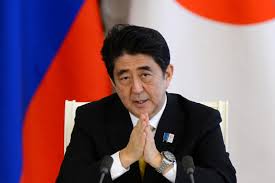
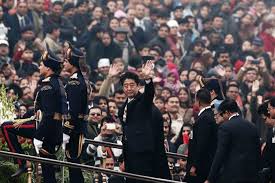
Abe visitHighlighting the strengthening ties between Asia’s second- and third-largest economies, Shinzo Abe, prime minister of Japan, was the guest of honour at India’s January 26 Republic Day celebrations, just weeks after the landmark tour of India by the Japanese emperor and his wife.

Mr Abe’s presence at India’s national day parade, which included a display of the nuclear-armed country’s military might, symbolised the emerging Japan-India strategic alliance. This partnership holds the potential to shape Asian geopolitics in much the same way as China’s rise or America’s Asian “pivot”.

Since Japan and India unveiled a “strategic and global partnership” during Mr Abe’s first stint as prime minister in 2006-2007, their engagement has deepened at pace. The driving force behind their growing collaboration is China’s increasing assertiveness in Asia.

Through persistent nibbling and other strong-arm tactics, a resurgent China is seeking to disturb the territorial status quo. While most international attention has focused on Chinese incursions in the South and East China Seas, China has also been active along its long Himalayan border with India and in the waters of the Indian Ocean.

Asia’s balance of power will be shaped largely by events in East Asia and the Indian Ocean. By linking these two regions, the Indo-Japanese entente – underpinned by close maritime cooperation – can ensure Asian power equilibrium and help safeguard vital sea lanes.

Japan and India value, according to their joint statement last weekend, “freedom, democracy and rule of law” and seek “to contribute jointly to the peace, stability and prosperity of the region and the world, taking into account changes in the strategic environment” – an allusion to the ascent of a muscular China.

India and Japan, natural allies strategically located on opposite flanks of Asia, are energy-poor countries heavily reliant on oil and gas imports from the Arabian Gulf region. The two maritime democracies are seriously concerned by mercantilist efforts to assert control over energy supplies and the transport routes for them. So, the maintenance of a peaceful and lawful maritime domain, including unimpeded freedom of navigation, is critical to their security and economic well-being.

This is why they have held joint naval exercises since 2012. These are just one sign of a shift from emphasising shared values to seeking to protect common interests. During Mr Abe’s visit, India also invited Japan to join this year’s US-Indian naval manoeuvres, known by their Indian name “Malabar”.

The Indo-Japanese relationship, remarkably free of any strategic dissonance or bilateral dispute, traces its roots to the introduction of Buddhism in Japan in the sixth century. The Todaiji Temple in the ancient capital city of Nara is home to Japan’s most famous statue – a gilt bronze image of Lord Buddha.

The statue’s allegorical eyes-opening ceremony in the year 752 was conducted by a priest from India in the presence of Emperor Shomu, who declared himself a servant of the “Three Treasures” – the Buddha, Buddhist law and the monastic order. Japan’s cultural heritage from India extends to Sanskrit influence on the Japanese language.

The Japanese imperial couple’s Indian tour in early December was a watershed moment in Japan-India relations. In the more than 2,600-year history of the Japanese monarchy, no emperor had previously been to India, although India has traditionally been respected in Japan as Tenjiku, or the heavenly country of Buddhism.

Today, Japan is a critical source of capital and commercial technology for India. Indeed, there cannot be a better partner for India’s development than the country that was Asia’s first modern economic-success story, inspiring other Asian states.

Japan, spearheading Asia’s industrial and technology advances since the nineteenth century, was also the first country in the non-Western world to emerge as a world power in modern history – a success that opened the path to its imperial conquests.

Since 2011, Japan has emerged as India’s largest source of foreign direct investment from a major industrialised nation. India overtook China a decade ago as the largest recipient of Japan’s official development assistance, which includes loans, grants and technical assistance.

For Japan, India is central to both its economic-revival and security-building strategies.

Mr Abe’s dynamic leadership and control of both houses of parliament is aiding his moves to return Japan to the right track. “Abenomics”, for example, has succeeded in weakening the yen, making exports more competitive and boosting corporate profits.

As part of his broader strategy of “proactive pacifism” to create a web of interlocking partnerships with countries in China’s periphery, Mr Abe has pushed for close, enduring collaboration with New Delhi. His Indian counterpart, Manmohan Singh, has said that Indians “see Japan as a natural and indispensable partner in our quest for stability and peace in the vast” Indo-Pacific region, marked by the confluence of the Indian and Pacific Oceans.

A growing congruence of strategic interests led India and Japan to sign a Joint Declaration on Security Cooperation in 2008, a significant milestone in building a stable balance of power in Asia. This joint declaration was modelled on Japan’s 2007 defence cooperation accord with Australia – the only other country with whom Japan, a US military ally, has a security-cooperation arrangement. The India-Japan security declaration, in turn, spawned a similar Indian-Australian accord in 2009.

The budding alliance between Japan and India holds the potential to redraw the Asian geopolitical map. Through close collaboration with each other and with other like-minded Asian states, Asia’s two main democracies must lead the effort to build freedom, prosperity and stability in Asia.

Brahma Chellaney, a geostrategist, is the author of Asian Juggernaut

(c) The National, 2014.

Japan and India: A Transformative Entente

BRAHMA CHELLANEY, Nikkie Asian Review, January 23, 2014

download

Asia’s future rests on the strategic triangle of China, India, and Japan — countries that have never before been strong at the same time. In the coming years, Asian geopolitics will be greatly influenced by an inexorable tightening of the bonds between Japan and India, which hope to fend off China’s growing assertiveness and territorial creep.

On the heels of the landmark Indian tour of Japan’s Emperor Akihito and Empress Michiko last month, Prime Minister Shinzo Abe will be the guest of honor at India’s Republic Day parade Jan. 26. This underscores the fast-developing partnership between Asia’s second- and third-largest economies. The two countries are also ramping up defense cooperation, as agreed during a recent visit by Japanese Defense Minister Itsunori Onodera.

Asia’s balance of power will be determined principally by events in East Asia and the Indian Ocean. By linking these two regions, the emerging Indo-Japanese entente holds virtually the same potential to shape the future as China’s ascent or America’s “pivot to Asia.”

Japan and India, natural allies strategically located on opposite flanks of the continent, have a pivotal role to play in ensuring a regional power equilibrium and safeguarding vital sea lanes in the wider Indo-Pacific region — an essential hub for global trade and energy supply.

Complementary partners

The visit of Japan’s Imperial couple in early December was a watershed moment in Japan-India relations. In the more than 2,600-year history of the Japanese monarchy — the world’s oldest continuous hereditary royalty — no emperor had previously been to India, although India has traditionally been respected in Japan as Tenjiku, or the heavenly country of Buddhism.

New Delhi invited the emperor and empress a decade ago. But it was Abe, an admirer of India, who keenly supported their visit as a way to signal his government’s commitment to forging closer ties with New Delhi. Now, Abe’s chief-guest role at India’s national day celebration adds meaning to his talk of a new “arc of freedom and prosperity” connecting Asia’s two main democracies. If there is any potential pitfall to the partnership, it is their messy domestic politics, including a dysfunctional party system that weighs them down.

The fact is that Japan has gone from aiding China’s economic rise through technology transfers and generous official development assistance to trying to balance China’s emergence as a military power. India overtook China a decade ago as the largest recipient of Japanese ODA, which includes loans, grants and technical assistance. Through its ODA, Japan is helping India improve its poor infrastructure, among other programs.

China’s rising labor costs and political muscle-flexing are seen as risks for foreign investors. Meanwhile, India — with its vast domestic market and large, young and cheap labor force — is seeking to position itself as Japan’s investment partner of choice. Japanese companies are themselves aiming for a more regionally balanced approach after years of focusing on China, which has absorbed much of Japan’s emerging-market investments.

The resulting shift in foreign direct investment has turned Japan into India’s largest source of FDI among major industrialized nations. A weakening yen is set to spur only greater Japanese capital outflows, allowing India to attract more Japanese investment to help fund its large current-account deficit.

The contrast between disciplined Japan and tumultuous India is striking. India has the world’s largest youthful population, while Japan is aging more rapidly than any other developed country. Whereas India has always valued strategic autonomy, Japan remains a model U.S. ally that hosts not only a large U.S. troop presence but also pays generously for the upkeep of American forces on its soil. Japan’s contribution surpasses the combined host-nation support of America’s 26 other allies.

Yet the dissimilarities between Japan and India have much to do with the prospects for close collaboration. Japan’s heavy-manufacturing base and India’s services-led growth — as well as their contrasting age structures — make their economies complementary. India’s human capital and Japan’s financial and technological strength can be a good match to propel India’s infrastructure development and great-power aspirations, as well as catalyze Japan’s revival as a world power. There is clear potential for strong synergies.

The logic for strategic collaboration is no less compelling. If China, India and Japan constitute Asia’s scalene triangle — with China representing the longest Side A, India Side B, and Japan Side C — the sum of B and C will always be greater than A. It is thus little surprise that Japan and India are seeking to add strategic bulk to their quickly deepening relationship.

Indeed, the world’s most stable economic partnerships, such as the Atlantic community and the Japan-U.S. partnership, have been built on the bedrock of security collaboration. Economic ties lacking that strategic underpinning tend to be less stable and even volatile, as is apparent from China’s economic relations with Japan, India, and the U.S.

The transformative India-Japan entente promises to positively shape Asia’s power dynamics.

Brahma Chellaney, a geostrategist and author, is a professor at the Center for Policy Research, New Delhi.

© Nikkie Asian Review, 2014.

How do Japan’s leaders reconcile with being on the wrong side of history?

Brahma Chellaney, The National, January 15, 2014

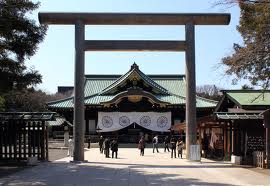
yasukuniHow did Yasukuni, a stately shrine in the heart of Tokyo, become the centre of an international controversy? For an answer, look not so much at the past as at the present, particularly as to how rival states in East Asia are using history as a political instrument.

Unassuaged historical grievances have sharpened rival territorial and maritime claims and constricted diplomatic space for building political reconciliation among China, Japan and South Korea.

In an atmosphere of nationalist grandstanding over conflicting narratives and territorial claims, the risks of a naval or air conflict by accident or miscalculation are increasing in the region, especially between China and Japan.

China and South Korea, which suffered under Japanese occupation, reacted angrily when Shinzo Abe last month became the first Japanese prime minister to pray at Yasukuni since Junichiro Koizumi, who defiantly went each year to the shrine during his 2001-2006 tenure.

Mr Abe, significantly, did not visit the shrine during a previous stint as prime minister. He may well have maintained his restraint had China not provocatively established an air defence identification zone (ADIZ) that sets a perilous precedent in international relations by covering islands that Beijing claims but does not control.

Yasukuni, built by the pre-war Japanese government, enshrines the spirits – not the bones or ashes – of Japan’s 2.5 million war dead, including 14 individuals who were convicted and executed as Class A war criminals by a military tribunal.

In keeping with the dictum that history is written by the winners, the tribunal delivered “victors’ justice”, with its proceedings tainted by extreme arbitrariness. Within a few years, Japan’s US occupation authorities freed a number of important Japanese who had been jailed, further undercutting the credibility of the original proceedings.

To China and South Korea, Yasukuni remains a symbol of Japan’s pre-war militarism, with its adjoining museum promoting the view that Japan waged aggression in Asia to liberate it from European colonial rule. Many foreigners contend that the museum presents a revisionist interpretation of the 20th century to portray Japan as the victim in order to rationalise its militaristic past.

All this, however, cannot obscure a key question: even if Japan must still atone for its past colonial rampage, doesn’t it have the same right today as other nations to honour its citizens killed in the Second World War?

All nations, after all, honour their war dead, even if they were the aggressors, plundering distant lands, as European colonial powers did.

Japanese culture, with its martial traditions, places a high premium on honouring the war dead, with the spirits of the fallen soldiers deified by the Japanese. In the absence of any other commemorative monument, Yasukuni serves as Japan’s war memorial.

Japanese politicians, especially those on the right, like to compare Yasukuni with the Arlington National Cemetery outside Washington DC, which also honours and memorialises the war dead.

Given that a prime ministerial visit to Yasukuni ignites nationalistic passions in China and South Korea, would these countries accept an alternative war memorial in Japan? What if Tokyo proposed building a national war memorial where Japan’s leaders could pay respects to the collective memory of the fallen heroes without igniting international controversy?

Such a proposal would most likely come under immediate attack from China and South Korea as a new Japanese project to honour past militarism. In other words, no war memorial, given Japan’s imperialist history, would be free of controversy.

But the history problem extends beyond Japan. Take the case of China, which justifies its increasingly muscular foreign policy by harping on the 110 years of national humiliation it suffered up to 1949. True, Western colonial powers heaped indignities, forcing China, for example, to import opium in return for Chinese goods, while occupying Japanese forces committed atrocities between 1937 and 1945.

China’s selective historical memory, however, is evident from its school textbooks, which blackout the Chinese invasion of Tibet (1950) and its aggression against India (1962) and Vietnam (1979). A Pentagon report has cited several examples of how China repeatedly has carried out military pre-emption since 1949 in the name of strategic defence.

South Korea has eliminated the last vestiges of Japanese colonial rule, with its president, Park Geun-hye, ruling out holding a summit with Mr Abe until his government addressed lingering issues over Japan’s occupation of Korea. By contrast, Taiwan – a Japanese colony from 1895 to 1945 – has preserved and declared as national treasures its imperial-era structures, including the Presidential Office Building.

The fact is that history is still being used by some states to instil among their citizens an abiding sense of grievance and victimisation. China and Japan use Nanjing and Hiroshima-Nagasaki, respectively, as national symbols of crimes by outsiders against them.

To understand the risks to peace and stability from the widening gulf between economics and politics in East Asia, one must recall the situation that prevailed in Europe a century ago. Europe then was even more integrated by trade and investment than East Asia is today, with its royal families interrelated by marriage. Yet, Europe’s disparate economic and political paths led to the Second World War.

Lack of any security framework and weak regional consultation mechanisms in East Asia underscore its imperative to contain the increasing risks to peace by dispensing with historical baggage that weighs down interstate relationships. If the past is not to imperil the present or the future, regional states have little choice but to mend their political relations.

Brahma Chellaney is a geostrategist and the author of Water, Peace, and War

(c) The National, 2014.

Japan’s Obama Problem

BRAHMA CHELLANEY

A Project Syndicate column internationally syndicated.

TOKYO — When Japanese Prime Minister Shinzo Abe visited Tokyo’s controversial Yasukuni Shrine last month, Chinese leaders, predictably, condemned his decision to honor those behind “the war of aggression against China.” But Abe was also sending a message to Japan’s main ally and defender, the United States. Faced with US President Barack Obama’s reluctance to challenge China’s muscle-flexing and territorial ambition in Asia — reflected in Japan’s recent split with the US over China’s new Air Defense Identification Zone (ADIZ) — an increasingly desperate Abe was compelled to let both countries know that restraint cannot be one-sided.

For China and South Korea, the Yasukuni Shrine’s inclusion of 14 Class A war criminals who were executed after World War II has made it a potent symbol of Japan’s prewar militarism, and Abe long refrained from visiting it — including during his previous stint as prime minister. He may well have maintained that stance had China not established the ADIZ, which set an ominous new precedent by usurping international airspace over the East China Sea, including areas that China does not control. (Abe does not appear to have considered the possibility that his pilgrimage to Yasukuni might end up helping China by deepening South Korea’s antagonism toward Japan.)

The Obama administration had been pressing Abe not to aggravate regional tensions by visiting Yasukuni — an entreaty reiterated by Vice President Joe Biden during a recent stopover in Tokyo on his way to Beijing. In fact, Biden’s tour deepened Japan’s security concerns, because it highlighted America’s focus on balancing its relationships in East Asia, even if that means tolerating an expansionist China as the strategic equivalent of an allied Japan.

Instead of postponing Biden’s trip to Beijing to demonstrate disapproval of China’s new ADIZ, the US advised its commercial airlines to respect it, whereas Japan asked its carriers to ignore China’s demand that they file their flight plans through the zone in advance. By calling for Japanese restraint, the US stoked Japan’s anxiety, without winning any concession from China.

Now, the widening rift between the US and Japan has become starkly apparent. Abe feels let down by Obama’s decision not to take a firm stand on the ADIZ — the latest in a series of aggressive moves by China to upend the status quo in the East China Sea. For its part, the US government openly — and uncharacteristically — criticized Abe’s Yasukuni visit, releasing a statement saying that it was “disappointed that Japan’s leadership has taken an action that will exacerbate tensions with Japan’s neighbors.”

Such recriminations do not mean that the US-Japan alliance — the bedrock of America’s forward military deployment in Asia — is in immediate jeopardy. Japan remains a model ally that hosts a large US troop presence, even paying for the upkeep of American forces on its soil — a generous contribution that surpasses the combined host-nation support of America’s 26 other allies, according to a Pentagon report. Indeed, Abe’s visit to Yasukuni came only a day after he completed a long-elusive, US-backed bilateral deal to relocate America’s air base in Okinawa to a less populous area of the island. And he supports Japan’s entry into the US-led Trans-Pacific Partnership, an emerging regional trading bloc that will exclude China.

Nonetheless, a psychological schism between the Abe and Obama administrations has gradually developed. While the US frets about Abe’s nationalistic stance vis-à-vis China and South Korea, Japanese officials have stopped trying to conceal their uneasiness over Obama’s effort to balance alliance commitments with closer Sino-American ties. Biden spent more than twice as much time in discussions with Chinese President Xi Jinping as he did with Abe.

The paradox is that while anxiety over China’s growing assertiveness has returned the US to the center of Asian geopolitics and enabled it to strengthen its security arrangements in the region, this has not led to action aimed at quelling China’s expansionary policies. As a result, Japan is becoming skeptical about America’s willingness to support it militarily in the event of a Chinese attack on the Japanese-controlled Senkaku Islands (Diaoyu Islands in China). The Obama administration’s contradictory rhetoric — affirming that the US-Japan security treaty covers the Senkakus, while refusing to take a position on the islands’ sovereignty — has not helped.

wake-up call for Japan was Obama’s inaction in 2012, when China captured the Scarborough Shoal, part of the Philippines’ exclusive economic zone. In an effort to end a tense standoff, the US brokered a deal in which both countries agreed to withdraw their maritime vessels from the area. But, after the Philippines withdrew, China occupied the shoal — and, despite a mutual-defense treaty between the US and the Philippines, the US did little in response. This emboldened China effectively to seize a second Philippine-claimed shoal, part of the disputed Spratly Islands.

Factors like geographical distance and economic interdependence have made the US wary of entanglement in Asia’s territorial feuds. And, unlike Asian countries, America would not really suffer from a Chinese “Monroe Doctrine” declaring that China would not accept any outside intervention in Asia. But America’s neutrality on sovereignty disputes threatens to undermine its bilateral security alliances (which, by preventing countries like Japan from turning toward militarism, actually serve Chinese interests).

The Obama administration’s Asian balancing act obfuscates the broader test of power that China’s recent actions represent. What is at stake are not merely islands in the East and South China Seas, but a rules-based regional order, freedom of navigation of the seas and skies, access to maritime resources, and balanced power dynamics in Asia.

By fueling Japanese insecurity, US policy risks bringing about the very outcome — a return to militarism — that it aims to prevent.

Brahma Chellaney, Professor of Strategic Studies at the New Delhi-based Center for Policy Research, is the author of Asian JuggernautWater: Asia’s New Battleground, andWater, Peace, and War: Confronting the Global Water CrisisREAD MORE

(c) Project Syndicate, 2014.

Arming India into dependency

The government-to-government weapon contracts between the U.S. and India, with no competitive bidding or transparency, are deepening India’s import dependency without arming it with a decisive edge.

Brahma Chellaney, The Hindu, January 14, 2013

The blossoming of ties with the United States has become an important diplomatic asset for India in recent years. Yet the heady glow of the much-ballyhooed strategic partnership helped obscure prickly issues that arose much before the Devyani Khobragade episode. In truth, the Obama administration’s reluctance to accommodate Indian interests on major issues, coupled with the fundamental challenge of managing an asymmetrical relationship, has created fault lines that are testing the resilience of the partnership.

One aspect of the relationship, however, has thrived spectacularly — U.S. arms sales to India. In just a few years, the U.S. has quietly emerged as India’s largest arms supplier, leaving Russia and Israel far behind. This development is linked to the Indo-U.S. civilian nuclear deal. Although it remains a dud deal on energy, with little prospect of delivering a single operational nuclear power plant for years to come, it has proved a roaring success in opening the door to major U.S. arms sales. The 2005 nuclear agreement-in-principle incorporated a specific commitment to ramp up defence transactions.

The booming arms sales — rising in barely one decade from a measly $100 million to billions of dollars yearly — have seemingly acquired an independent momentum. Nothing better illustrates this than the fact that, at the height of the Khobragade affair, India, far from seeking to impose any costs on America, awarded it yet another mega-contract — a $1.01-billion deal for supply of six additional C-130J military transport aircraft. When Prime Minister Manmohan Singh visited the White House last September, among the gifts he took for President Barack Obama was a commitment to purchase $5 billion worth of new arms.

Today, India’s largely one-sided defence relationship with the U.S. is beginning to look akin to its lopsided ties with Russia, with weapon sales serving as the driving force. However, unlike the torpid Indo-Russian non-military commerce, the two-way Indo-U.S. trade has quadrupled in just seven years from $25 billion in 2006 to about $100 billion in 2013.

Still, few Indians are raising the key questions: How are India’s security interests being advanced by substituting the corrosive import dependency on Russia with a new dependency on the U.S., without progress to build a domestic arms-production base? What makes the strategic partnership “special,” given that Washington also has special relationships with India’s regional adversaries — a security alliance since 2004 and strategic partnership since 2006 with Pakistan, and a “constructive strategic partnership” with China since 1997 that predates the strategic partnership with India? Is a relationship locking India as a leading U.S. arms client sustainable in the long run?

Let’s be clear: India can never emerge as a major international power in a true sense, or acquire a military edge regionally, if it remains dependent on imports to meet even its basic defence needs. The capacity to defend oneself with one’s own resources is the first test a nation must pass on the way to becoming a great power.

Ominously, a still-poor India has emerged as the world’s biggest arms importer since 2006, accounting for 10% of all weapons sold globally. Such large-scale imports might suggest that India is pursuing a well-planned military build-up. In truth, such imports lack strategic direction, given the absence of long-term political thinking and joint tri-service planning and command. They are being made in a haphazard manner, although any imported weapon makes India hostage to the supplier-nation for spares and service for the full life of that system.

The rising arms imports, far from making India secure, are only exposing new gaps in its capabilities to decisively win a war. The inveterate dependency burdens Indian taxpayers, forcing them to subsidize foreign military-industrial complexes. Worse still, defence transactions remain the single largest source of kickbacks for India’s corrupt and compromised political elites. This factor alone explains why India has failed to replicate in the conventional-arms sector its impressive indigenous achievements in the fields where imports are not possible — the space, missile and nuclear-weapons realms. Consider the glaring paradox: India surprised the world by launching a spacecraft to Mars, yet it still imports rifles.

For the U.S., displacing Russia as India’s largest arms supplier has been a diplomatic coup. Rarely before has America acquired a major arms client of such size so rapidly. The U.S.’s India success indeed parallels what happened in the early 1970s when Egypt switched sides during the Cold War, transforming itself from a Soviet arms client to becoming reliant on American arms supplies. The difference is that unlike the perpetually aid-dependent Egypt, India buys weapons with its own money.

With U.S. military spending slowing and other export markets remaining tight, American firms are eager to further expand arms sales to India. The fact that the U.S. now conducts more military exercises with India than with any other country creates a favourable political milieu for its defence firms to aggressively push their wares for sale. Even so, the troubling lack of competitive bidding or transparency in the arms deals — all clinched on a government-to-government basis — has become conspicuous. In the one case where India invited bids — to buy 126 fighter-jets — American firms failed to make it beyond the competition’s first round.

The annual value of India’s arms contracts to the U.S. already surpasses American military aid to any country other than Israel. Diplomacy, to be effective, must be backed by leverage and cross-linkages to minimize the weaker side’s disadvantages. Yet New Delhi has not tried to leverage its contracts either to persuade the U.S. to stop arming Pakistan against India or to secure better access to the American market for its highly competitive information-technology and pharmaceutical companies, which are facing new U.S. non-tariff barriers. India’s new frontier of dependency has emerged even as the U.S. bolsters Pakistan with generous military aid.

To be sure, the U.S. signed a four-point declaration of intent with India last September to move beyond the sale of complete weapon systems to co-production through technology transfer. Translating that intent into practice won’t be easy, though. According to the joint declaration, efforts to identify specific opportunities for collaborative weapon-related projects will be pursued in accordance with “national policies and procedures.” But if U.S. policies and procedures do not evolve in the direction of facilitating such collaboration, the declared intent will remain little more than pious hope.

The declaration clearly sought to pander to India’s desire for a less inequitable defence relationship. By dangling the carrot of India being upgraded to the same level as America’s “closest partners,” the declaration also peddled a catchy slogan excitedly lapped up by the Indian media. The U.S. is now willing to co-produce some smaller defensive systems with India, such as the Javelin anti-tank missiles. Such restricted technology transfers, the U.S. believes, will pave the way for securing additional multibillion-dollar contracts to sell large readymade weapons to India.

Significantly, U.S. arms to India fall mainly in the category of defensive weapons. Russia, by contrast, has transferred offensive weapon systems to India, including strategic bombers, an aircraft carrier, and a nuclear-powered submarine. Will the U.S. be willing to sell high-precision conventional arms, anti-submarine warfare systems, long range air- and sea-launched cruise missiles, and other conventional counterforce systems that could tilt the regional military balance in India’s favour?

Another issue relates to the strategic benefits from a closer defence relationship. True, such a relationship will have a countervailing value vis-à-vis China. Yet, it is also true that America has a deeper engagement with China than with India. Indeed, China is now central to U.S. economic and strategic interests. This fact helps to explain why the Obama administration has chartered a course of neutrality on territorial disputes between China and its neighbours, shying away from holding even joint military exercises in Arunachal Pradesh.

A wake-up call for Asian states that rely on the U.S. as their security guarantor was Obama’s inaction on the 2012 Chinese capture of the Scarborough Shoal, located within the Philippines’ exclusive economic zone. America’s indifference to its commitment to the Philippines under their Mutual Defence Treaty emboldened China to effectively seize a second Philippine-claimed shoal. This is proof that despite its “pivot” toward Asia, the U.S. won’t act in ways detrimental to its close engagement with China. Obama’s foreign policy bears a distinct transactional imprint.

A wise India would consider declaring a moratorium on arms purchases from all sources to give itself time to strategize its priorities and clean up its procurement system. A moratorium of just three years will save the country a whopping $20 billion without compromising national security. With non-traditional threats — ranging from asymmetric warfare in the form of cross-border terrorism to territorial creep through furtive encroachments — now dominating India’s security calculus, procurement of more mega-weapons to meet traditional security challenges must wait until the nation has added strategic direction to its defence policy.

Brahma Chellaney is a geostrategist and author.

(c) The Hindu, 2014.

Doggy disinformation

China’s faltering ties with North Korea have spawned a disinformation campaign against its estranged ally, with the rift holding larger geopolitical implications.

In happier times: Jang Song Thaek (left) with supreme leader Kim Jong Un.

BY BRAHMA CHELLANEYThe Japan Times, January 8, 2014

China’s autocrats, by upending the status quo in the East and South China Seas and the Himalayas, are waging an undeclared war against multiple neighboring countries at once. Their next target is likely to be fellow communist state North Korea, now an estranged ally and the last frontier of the Cold War.

China’s “blood relations” with North Korea — acclaimed in the past to be as close as “lips and teeth” — have soured badly. A widening chasm between China’s assertive, nationalistic president, Xi Jinping, and North Korea’s defiant young dictator, Kim Jong Un, has thrown the bilateral relationship into a tailspin. The 30-year-old Kim, the world’s youngest head of state, appears determined to chart an independent course, spurring increasing unease in China.

North Korea has become the target of a Chinese campaign of disinformation after it executed China’s most-valued friend in its power hierarchy, Jang Song Thaek, a four-star general who was Kim’s uncle by marriage. The Chinese campaign seeks to portray Kim as a wickedly eccentric and bloodthirsty megalomaniac.

Jang, China’s main link to the Stalinist regime in Pyongyang, was convicted and executed Dec. 12 for treason, including plotting a coup and underselling national resources (such as coal, land and precious metals) to a “foreign country” — a reference to China. This has infuriated Xi and many others in China, with one general warning that North Korea was slipping out of the Chinese sphere of influence and government mouthpieces calling for a tough new approach. China’s online censors have conspicuously overlooked social media’s increasing vilification of Kim.

According to a candid Jan.6 commentary in China’s Global Times, Jang’s fall signifies North Korea’s effort at “de-Sinification,” reflecting an “anxious desire to shake off its overdependence on China and find a way out of the deadlock with the U.S.” The article, authored by Da Zhigang, director of the Institute of Northeast Asian Studies, Heilongjiang Provincial Academy of Social Sciences, said the development represented a serious setback for China’s interests because it symbolizes the “acceleration” of the North’s attempt to “reorient” toward the U.S. as part of its juche ideology of self-reliance and the songun ideal of a militarily strong, secure state.

Immediately after the execution, a small but sensationalist Hong Kong newspaper aligned with the Chinese Communist Party reported that Kim and other senior leaders watched as Jang and five associates were stripped naked, thrown into a cage, and devoured by 120 hungry dogs. The paper, Wen Wei Po, cited not a single source for its claim, which harked back to the ancient Roman tradition of throwing convicts to dogs, lions or other animals.

Yet days later, the outlandish claim was published in the Straits Times, the main newspaper in Singapore, a city-state with no press freedom. The Dec. 24 Straits Times’ report was authored by a former Wen Wei Po reporter who was once jailed in China for allegedly spying for Taiwan. By Jan. 3, the speculative story had been picked up by media across the world.

Swedish Foreign Minister Carl Bildt tweeted Jan. 3, “Well, the truly interesting thing is that the story seems to be put out by the authorities in Beijing.” The death-by-ravenous-dog tale from the country famous for its “dog meat festivals” was a reminder that China uses the Hong Kong-Singapore route for disinformation. Eating dog meat is an ancient custom in China. Indeed, in some regions there, eating dog meat on the summer solstice is believed to help ward off evil spirits and disease.

Demonizing the reclusive and recalcitrant North Korea comes easily to many in the world, given its government’s opaque inner-workings and how little hard information flows out of that hermetic nation. Many outsiders are ready to believe any story about it, especially because there is no way to disprove it.

The international media, in any event, loves stories about dictators, however poorly sourced and farfetched they may be.

In this case, the North Korean regime itself lent a “dog” angle by publicly branding Jang as “worse than a dog.” Still, it is significant that the unverified execution-by-dog story was not lapped up by the media in South Korea, where journalists track developments in North Korea closely with access to intelligence sources and defectors.

The story bore distinctly Chinese characteristics, including attention to precise numbers — 120 dogs, starved for five days, were supposedly unleashed in an action supervised by 300 officials.

Numerical symbolism has always been important in China, extending even to witch hunts — for example, the “Let a Hundred Flowers Bloom” campaign in the 1950s.

China’s warriors of disinformation betrayed an uncanny trait in counting both the number of hounds who ate up Jang and the number of officials who supervised the quan jue, or execution by dogs. The “120 dogs ate up Jang” story was a dead giveaway. In fact, the tale now is an acknowledged fabrication — one that apparently originated as satire on a Chinese microblogging website and was repackaged as hard news. The tale served the disinformers’ purpose in depicting Kim internationally as more brutal than previously believed.

Evidence thus far points to Jang’s execution by North Korea’s normal practice — a firing squad. What is remarkable is that the doggy disinformation was widely disseminated by a country whose political system is no different than North Korea’s. China indeed has well-oiled, sophisticated repression and propaganda machines that, unlike North Korea’s, have kept pace with technological advances.

In truth, China has learned some of its disinformation tricks from the United States, which has a penchant to demonize dictators it dumps after using them.

China’s faltering ties with North Korea, however, make it stand out as a lonely rising power with no real allies, in stark contrast to the U.S., which boasts 27 military allies and a number of other strategic partners. There are no good options for Beijing on North Korea, especially after Jang’s execution and Kim’s purge of some other purportedly pro-China elements.

Kim has presented himself as a tough leader who will not allow China to treat North Korea as a vassal state. Kim Il Sung, the founder of the state, paid 37 official visits to China, and his son and successor, Kim Jong Il, went nine times. But Kim Jong Un has not been to China even once since he came to power after the death of his father, Kim Jong Il, in December 2011.

Thumbing his nose at Xi’s entreaties for restraint, he successfully fired a rocket to place a satellite in orbit in late 2012 and carried out his country’s third nuclear test in February 2013. His open defiance prompted China to endorse new United Nations Security Council sanctions against North Korea, further fraying the bilateral relationship.

China’s policy dilemma is compounded by the fact that it has little interest in the collapse of the Kim family’s rule because that could unravel the North Korean state and create a reunified and resurgent Korea allied with the U.S.

China has territorial and resource disputes with North Korea that a reunified Korea will inherit. The territorial disputes center on Chonji, the crater lake on Mount Paektu — where the Sino-Korean boundary has not been settled — and certain islands in the Yalu and the Tumen, both border rivers.

Indeed, signaling that its present border with North Korea may not be final for it, China has made a revisionist historical claim that the ancient kingdom of Koguryo — founded in the Tongge River basin of northern Korea — was Chinese and not Korean. As a December 2012 U.S. Senate report warned, China “may be seeking to lay the groundwork for possible future territorial claims on the Korean peninsula.”

Whereas Washington’s policy on North Korea focuses narrowly on its denuclearization, Beijing seeks geopolitical influence and continued access to the vast reserves of iron ore, magnesite, copper and other minerals there. It also wants to block Russia and Japan from making strategic inroads into the North. It remains wedded to a strategy to prevent South Korea from absorbing the North.

The Kim regime, for its part, seeks normalized relations with the U.S. so as to escape depending excessively on China. It thus chafes at the Obama administration’s use of Beijing as a diplomatic go-between.

Make no mistake: The China-North Korea rift holds far-reaching implications for regional geopolitics. U.S.’s North Korean policy must reassess its dubious reliance on Beijing as an intermediary and find ways to reengage Pyongyang directly — an imperative that also extends to policymakers in Tokyo and Seoul.

Brahma Chellaney is a geostrategist and the author, most recently, of “Water, Peace, and War” (Oxford University Press, 2014).

(c) The Japan Times, January 8, 2014.

Fury of the meekest

After the U.S. indictment and de facto expulsion of the New York-based Indian woman diplomat who was arrested and strip searched, it is important to remember that India’s only tangible response to the entire episode has been to withdraw some unilateral privileges to U.S. diplomats and consular officials that it shouldn’t have extended in the first place.

Brahma Chellaney, India Today, January 13, 2014

America’s demeaning strip and cavity search of an Indian diplomat in breach of international norms has become a symbol of a once-flourishing bilateral relationship gone awry. The U.S. and India entered into a much-ballyhooed strategic partnership, not a patron-client relationship. With 27 military allies, the U.S., however, is used to a patron-client equation, not a partnership, which demands some degree of equivalence and mutual respect. It thus began to take India for granted, and appeared genuinely surprised that India reacted to Devyani Khobragade’s humiliation as if it were the proverbial straw threatening to break its back.

U.S.’s “problem” with India extends well beyond this episode. For example, almost one-third of all T visas it has issued worldwide to victims of extremely grave sex or labour trafficking have been to Indians, thus mocking the most-populous democracy’s judicial system. The manner in which it spirited out of India the family of Khobragade’s maid on T visas and with tax-exempt tickets improperly procured by its embassy, paradoxically, was tantamount to an act of state-sponsored trafficking. The action had an openly conspiratorial ring to it: No sooner had the U.S., playing global cop, “evacuated” the maid’s family from its home country than it arrested Khobragade.

Make no mistake: America would not have dared to arrest and strip search a Chinese or Russian diplomat for allegedly underpaying a maid because that would have invited swift and disproportionate retaliation. In fact, just one week before Khobragade’s arrest, Preetinder Singh Bharara—the rogue prosecutor in New York who likes to be addressed as “Preet” or “Pete” when in reality he is Mr. Pretender—charged a number of Russian diplomats and consular officials for defrauding Medicaid of $1.5 million. But before unveiling the charges, the defendants were allowed to leave the US.

What has been India’s response to the insults heaped on it, or what the incredible Manmohan Singh called “some hiccups”? Don’t let all the sound and fury spook you: India’s only response thus far has been to start withdrawing non-reciprocal privileges to US diplomatic and consular staff and their families.

In a classic case of impotent fury, India made no effort to try to penalize the U.S. Indeed, India did the exact opposite by rewarding America with a new mega-contract—a $1.01-billion deal for additional C-130J military aircraft. Its demand for a formal apology has dissipated. It did not even hold back its new ambassador from taking charge in Washington until the U.S. made some amends. Why blame the U.S. for taking liberties when India’s toadying foreign minister has hailed NSA’s notorious global surveillance as “only a computer study” and “not snooping”?

Indeed, no Indian is asking the key question: Why did India in the first place unilaterally extend the privileges to U.S. diplomatic and consular staff that it is now withdrawing? India’s servility went to the extent of granting family members of U.S. consular officials a degree of diplomatic immunity for which they were ineligible. Ignoring its own security protocol, India handed out identity-less airport passes usable by any diplomat or consular official.  India’s VVIPs, often seeking visas and other favours for their relatives, blocked New Delhi’s Nyaya Marg (the road behind the U.S. Embassy) to graciously allow U.S. Embassy personnel to visit the American Club without having to cross a public street.

New Delhi made no effort over the years to ensure that those working in American schools and other non-diplomatic U.S. government facilities in India were employed in compliance with Indian labour laws, which mandate, among other things, income tax and provident fund deductions. U.S. diplomats’ spouses worked in American schools and other U.S. facilities without seeking host-nation permission or paying taxes on their earnings. India turned a blind eye to such violations, which, if they occurred in the U.S., would land a violator in serious trouble, possibly even in jail.

India has now asked a reluctant U.S. Embassy to supply all the relevant details. Will the Embassy come clean? Who will crack the enforcement whip? India’s compromised governing elites?

There is yet another unanswered question: When there was a non-bailable Indian warrant against Khobragade’s absconding maid, how did Indian immigration allow her family to leave on “T” visas? True, a family cannot be liable for an absconding member. Yet Indian immigration and intelligence should have smelt a rat that the family was leaving on “trafficking” visas.

Clearly, Indian authorities have a lot to answer for. India—having absorbed no lesson from the case involving U.S. informant David Headley—must blame itself for inviting the latest outrage. Indeed, what was billed as India’s atypically tough response has ended in a whimper, reinforcing the country’s lamb-like image.

Brahma Chellaney is a geostrategist and author.

(c) India Today, 2014.

The International Misrule of Law

  examines two recent cases indicating that China and the United States are the world’s leading rogue states.

A Project Syndicate column internationally syndicated.

Houston presentationOn the face of it, China’s recent declaration of an air defense identification zone (ADIZ) extending to territories that it does not control has nothing in common with America’s arrest and strip-search of a New York-based Indian diplomat for allegedly underpaying a housekeeper she had brought with her from India. In fact, these episodes epitomize both powers’ unilateralist approach to international law.

A just, rules-based global order has long been touted by powerful states as essential for international peace and security. Yet there is a long history of major powers flouting international law while using it against other states. The League of Nations failed because it could not punish or deter such behavior. Today, the United States and China serve as prime examples of a unilateralist approach to international relations, even as they aver support for strengthening global rules and institutions.

Consider the US, which has refused to join key international treaties – for example, the 1982 United Nations Convention on the Law of the Sea (UNCLOS), the 1997 UN Convention on the Law of the Non-Navigational Uses of International Watercourses (which has not yet entered into force), and the 1998 International Criminal Court Statute. Indeed, unilateralism remains the leitmotif of US foreign policy, and this is also reflected in its international interventions, whether cyber warfare and surveillance, drone attacks, or efforts to bring about regime change.

Meanwhile, China’s growing geopolitical heft has led to muscle-flexing and territorial claims in Asia that disregard international norms. China rejects some of the same treaties that the US has declined to join, including the International Criminal Court Statute and the Convention on the Law of the Non-Navigational Uses of International Watercourses (the first law to establish rules on the shared resources of transnational rivers, lakes, and aquifers).

Indeed, despite their geopolitical dissonance, the world’s most-powerful democracy and its most powerful autocracy have much in common when it comes to how they approach international law. For example, the precedent that the US set in a 1984 International Court of Justice (ICJ) case filed by Nicaragua still resonates in China, underscoring that might remains right in international relations.

The ICJ held that America violated international law both by supporting the contras in their insurrection against the Nicaraguan government and by mining Nicaragua’s harbors. But the US prevented Nicaragua from obtaining any compensation by vetoing UN Security Council resolutions that called for enforcement of the ICJ’s judgment.

China still hews to Mao Zedong’s belief that “power grows out of the barrel of a gun.” Indeed, while China ratified UNCLOS, it then reinterpreted the provisions to justify cartographic aggression in the South and East China Seas. Worse still, China has refused to accept the UNCLOS dispute-settlement mechanism, thereby remaining unfettered in altering facts on the ground. The Philippines has filed a complaint against China with the International Tribunal for the Law of the Sea. China, however, has simply refused to participate in the proceedings, as if it were above international law.

Whatever the tribunal’s decision, China will simply shrug it off. Only the Security Council can enforce an international tribunal’s judgment on a noncompliant state. But China wields a veto there and will block enforcement of an adverse ruling, just as the US did in the Nicaragua case.

China’s new ADIZ, while aimed at solidifying its claims to territories held by Japan and South Korea, is similarly provocative, because it extends to areas that China does not control, setting a dangerous precedent in international relations. Japan has asked its airlines to ignore China’s demand for advance notification of flights, even if they are merely transiting the new zone and not heading toward Chinese territorial airspace.

By contrast, the US has advised American carriers to obey China’s prior-notification demand. There is a reason for this: Although the prior-notification rule in American policy applies only to aircraft headed for US national airspace, in practice the US demands advance notification of all flights through its ADIZ, regardless of their intended destination.

If other countries emulated the example set by China and the US by establishing unilateral claims to international airspace, a dangerous situation would result. Binding international rules are thus imperative in order to ensure the safety of fast-growing commercial air traffic. But who is supposed to take the lead when China and the US have pursued a unilateralist approach on this issue?

Now consider the case of the Indian diplomat, Devyani Khobragade, whose treatment India’s national security adviser called “despicable and barbaric.” True, as a consulate-based diplomat, Khobragade enjoyed only limited diplomatic immunity under the 1963 Vienna Convention on Consular Relations. But this convention guarantees freedom from detention until trial and conviction, except for “grave offenses.” Can a wage dispute qualify as a “grave offense” warranting arrest and humiliation? Would the US tolerate similar treatment of one of its consular officers?

The harsh truth is that the US interprets the Vienna Convention restrictively at home but liberally overseas, in order to shield even the military and intelligence contractors that it sends abroad. A classic case involved the CIA contractor Raymond Davis, who fatally shot two men in 2011 in Lahore, Pakistan. Claiming that Davis was a bona fide diplomat with its Lahore consulate, and thus enjoyed immunity from prosecution, the US accused Pakistan of “illegally detaining” him, with President Barack Obama defending him as “our diplomat in Pakistan.”

Despite a widely held belief that the current international system is based on rules, the fact is that major powers are rule makers and rule imposers, not rule takers. They have a propensity to violate or manipulate international law when it is in their interest to do so. If universal conformity to a rules-based international order still seems like a distant prospect, an important reason is that countries that should be leading the charge still so often behave like rogue states.

(c) Project Syndicate, 2013.

The Chinese Art of Creeping, Covert Warfare

Brahma Chellaney, Mint, December 25, 2013

With its increasingly powerful military calling the shots in strategic policy, China’s jurisdictional creep in Asia is manifesting itself in three distinct ways. One mode is by air, as illustrated by its new air defense identification zone (ADIZ) — an action that lays unilateral claims to international airspace over the East China Sea and covers territories that China does not control. Another method is territorial creep by sea. And the third approach is encroachment by land to strengthen its military position and claims against India.

China is working to alter the status quo in Asia little by little as part of a high-stakes effort to extend its control to strategic areas and resources and to gain Asian primacy.

China’s persistent territorial nibbling reflects a strategy of extended coercion against neighbors that aims simultaneously to neutralize America’s extended deterrence in the Asian theater. Unlike the U.S., which has multiple allies and strategic partners, including a hub-and-spoke framework centered on bilateral security treaties, China is a lonely rising power with no real allies, yet propping up two renegade states, North Korea and Pakistan, to secure narrow sub-regional geopolitical advantages.

Through extended coercion, China is waging creeping, covert warfare in Asia while keeping the U.S. at bay. Washington, far from coming to the aid of its allies and strategic partners, has chartered a course of neutrality on sovereignty disputes so as to protect its deep engagement with China.

In practice, the strategy of extended coercion translates into salami slicing. This involves a steady progression of small steps, none of which is dramatic enough to become a cause of war by itself, yet which cumulatively lead over time to a strategic transformation in China’s favor. By creating new facts on the ground by stealth, China seeks to grab the “salami” it covets in slices as part of a plan to bamboozle and outwit the opponent.

By moving slowly and quietly but inexorably, China undercuts the relevance of U.S. security assurances to allies and the value of building countervailing strategic partnerships between and among Asian states and America. More importantly, this salami-slice approach seriously limits the military options of rival states by confounding their deterrence plans and making it difficult for them to devise proportionate or effective counteractions.

China’s strategy seeks to ensure the initiative remains with it. Take India: It is locked in a very defensive and militarily challenging posture vis-à-vis China along what is the world’s longest and most-forbidding disputed border. Whether Beijing wishes to keep India under sustained pressure through cross-frontier incursions or catch India militarily by surprise through a Depsang-style deep but localized encroachment or a 1962-type multipronged invasion, it has ample leeway and capability.

In recent years, China has been pressing steadily outwards on its borders, intimidating its neighbors in a relentless territorial creep. The pace at which China’s bit-by-bit strategy proceeds depends on the extent to which its opponents marshal political will and the capability to resist it. The strategy, for example, has run into stiffer obstacles vis-à-vis an unyielding Japan than with a weaker Philippines.

Nearly 65 years after the communist takeover in China, the country is still seeking to expand its political frontiers, even though Han territorial power is now at its historical zenith. China has never been as large as it is today, except when it was ruled by the foreign Mongol and Manchu dynasties.

Yet China remains territorially a revolutionary power bent on upending the status quo in Asia. Its assertive claims springing from revisionist history — along with its unilateralist approach to international law and its penchant for brinkmanship — threaten Asian peace and stability.

Let’s be clear: Changing the territorial status quo has remained the unfinished business of the People’s Republic of China (PRC) since its founding in 1949, when it set out to forcibly absorb the sprawling Xinjiang and Tibetan plateau — actions that increased the landmass of China by 44 percent.

An emboldened PRC then went on to seize the Switzerland-size Aksai Chin plateau of the original princely state of Jammu and Kashmir in the 1950s, the Paracel Islands in 1974, the Johnson South Reef in 1988, the Mischief Reef in 1995 and, most recently, the Scarborough Shoal (2012) and the Second Thomas Shoal (2013). Its growing military might has strengthened its expansionist impulse.

Yet the apologists for China in India — as elsewhere — are still seeking to whitewash its record of aggression. Belgian scholar Pierre Ryckmans — publishing under the pen name of Simon Leys — coined the phrase the “100 percenters” to describe the PRC fan club members who support whatever China does or says 100%.

The “100 percenters” in India have actually gone to the extent of blaming their own country for “inviting” the 1962 Chinese attack. These inveterate appeasers do not deny that it was China that attacked India, a historical fact beyond the pale of controversy. However, their thesis — relying on a controversial 1970 book by the Australian journalist Neville Maxwell, whose Marxist orientation and deep-seated prejudice against India colored his writings — is that China was provoked into attacking India to defend its honor and dignity and to stop further Indian provocations.

Blaming the victim for inviting the aggression echoes the argument of warped minds that rape victims often invite the assault. It is a thesis that only the true “100 percenters” could have propounded. The historical fact is that the PRC launched a forward policy of aggression from 1950 onwards, gobbling up Tibet and then nibbling at Indian territories, prompting India to belatedly forward deploy some ill-equipped and ill-trained forces.

How could India, with a ragtag military and no robust defense (let alone offensive capability), have itched to take on China in 1962? The Harvard scholar Roderick MacFarquhar has rightly dubbed 1962 “Mao’s India War,” detailing how the Chinese carefully planned the invasion and cleverly used Jawaharlal Nehru’s unguarded remarks (“our instructions are to free our territory”) to brand India as the aggressor.

Offense as defense has remained a core element in the PRC’s strategic doctrine. A Pentagon report published in 2010 has specific cases where China carried out military preemption in the name of a strategically defensive act. These examples include its intervention in the Korean War (1950), the 1962 attack, its initiation of a border conflict with the Soviet Union through a military ambush (1969), the Paracel Islands’ capture, and its invasion of Vietnam (1979).

Even in the more recent acts of aggression involving its seizure of the Johnson South Reef, the Mischief Reef, the Scarborough Shoal and the Second Thomas Shoal in the South China Sea, China claimed it was provoked into carrying out those actions by Vietnam and the Philippines.

Changing facts on the ground is a strategy the PRC first honed at home by staging demographic aggression against ethnic-minority homelands, such as the Tibetan plateau, Xinjiang and Inner Mongolia, and gerrymandering Tibet. Today, China’s navy and new coast guard assert territorial and maritime claims in the South and East China Seas, while its army flexes its muscles in the high-altitude borderlands with India.

The pattern of Chinese territorial creep has become familiar: Construct a dispute, initiate a jurisdictional claim through periodic incursions, and then increase the frequency and duration of such intrusions, thereby establishing a military presence or pressuring a rival to cut a deal on China’s terms. This is in keeping with the PRC’s approach to territorial disputes: What is ours is ours and what is yours is negotiable. If an opponent refuses to give in, China employs punitive instruments from its diplomatic toolbox, including economic warfare.

Along land frontiers, rodent-style surreptitious attacks usually precede salami slicing. The aim is to start eating into enemy land like giant rodents and thereby facilitate the slicing. This strategy is particularly focused on the two strategic Buddhist regions located on opposite ends of the Himalayan frontier — Ladakh and Arunachal Pradesh.

Consider another provocative action: China’s new ADIZ covers territories it claims but does not control, setting a dangerous precedent in international relations. If China prevails in the game of chicken it has started against Japan, India will likely come under greater Chinese pressure.

Japan has asked its airlines to ignore China’s demand for advance notification of flights even if they are merely transiting the new zone and not heading toward Chinese territorial airspace. This demand, unusual by international ADIZ standards, impinges on the principle of freedom of navigation of the skies. Yet Washington has advised U.S. carriers to respect China’s ADIZ, opening a rift with Tokyo.

President Barack Obama’s administration has responded to China’s ADIZ with words of cautious criticism but no castigatory step. Indeed, Washington is urging restraint also on Japan’s part, lest any escalation force it to take sides, undermining its policy to manage China’s rise without trying to contain it.

One handicap Washington faces in seeking to combat the Chinese hegemonic strategy is American consumerism and the U.S. debt to China that has now reached $1.3 trillion. Inflows of cheap Chinese capital remain critical for the U.S. to finance its supersized budget deficits.

The U.S. is not willing to defend its allies’ territorial claims by acting in ways that could damage its relations with China, now central to its economic and political interests. Take the Chinese seizure of the Scarborough Shoal, located barely 200 kilometers west of the Philippines’ Subic Bay.

After lengthy negotiations, the U.S. in June 2012 brokered a deal for a mutual withdrawal of Chinese and Philippine maritime vessels from the area. The Philippines withdrew first on Chinese insistence but on a clear understanding that China will follow suit. China instead pursued a game of deception, giving the indication that it was withdrawing, only to reinforce its muscle power in the area and occupy the Scarborough Shoal.

In this light, Japan faces a deepening security dilemma. To rely on the security treaty with the U.S. in the event of a war with China would be risky for Japan, given America’s strategic compulsions. It would not be the first time that the U.S. failed to honor a treaty with another country. In fact, the U.S., despite a Mutual Defense Treaty with the Philippines that obligates the two nations to defend each another in the case of an attack, has done precious little in response to China’s occupation of the Scarborough Shoal.

The Obama administration’s actions on the world stage have been marked not by resolute leadership but by hesitation and doubt. Its stance not to challenge China directly only aids the Chinese incremental aggression in Asia.

In the absence of any geopolitical blowback, an emboldened China will continue to subvert the status quo to create a hegemonic Middle Kingdom. China’s key neighbors must overcome their differences and collaborate strategically.  Separately, they are outclassed by China but, collectively, they have the potential to rein in its expansionism.

Brahma Chellaney is a professor at the Centre for Policy Research.

(c) Mint, 2013.

Which conflicts will dominate the world in 2014?

by Brahma ChellaneyForbes, January 1, 2014
The three potential flashpoints for international conflict in 2014—East Asia, South Asia, and the Middle East and North Africa—are distinguished by the involvement of autocratic forces in regional troubles.

The world is becoming more interdependent not just in trade and capital flows; the interdependencies extend to technological, public-health, environmental, and climate spheres. Several challenges, extending from jihadist terrorism to climate change, are intrinsically international in character. But even regional challenges, such as in the Middle East or East Asia, carry important global implications.

The interdependencies have not reduced conflict in the world. Many regions remain torn by conflict, even as the ongoing economic and political shifts gradually alter power equations and maritime realities. There is no inter-country war raging currently, but the high number of internal wars—many fuelled by external players—point to the larger dangers.

Three factors will have a bearing on global conflicts in 2014. One is the rise of unconventional threats, which underscores the changing nature of conflict.

Brahma Chellaney.inddA second factor is the phenomenon of failing states, which continues to trouble international and regional security. This development is a direct consequence of the end of the Cold War. While the Cold War raged, weak states were propped up by one bloc or the other. After the Soviet Union’s disintegration, the United States got out of that game. That is why dysfunctional or failing states began to emerge from the 1990s in a significant way.

The phenomenon of failing states has contributed to making such nations a threat to regional and international security either because they are home to transnational pirates (Somalia) or transnational terrorists (the Afghanistan-Pakistan belt), or because of their defiance of global norms (North Korea) or their internal conflicts (Syria, Iraq, Yemen and Libya).

Compounding this phenomenon is the sanctity attached to existing borders, which has become a powerful norm in world politics. Yet, paradoxically, this has allowed the emergence of weak states, whose internal wars spill over and create wider regional tensions and insecurities. This norm, however, is likely to come under challenge in the Afghanistan-Pakistan belt, Iraq, Syria, Libya, Somalia, and elsewhere where the dangers of political fragmentation can no longer be dismissed.

A third factor is the growing power of autocrats. In a reflection of the changing balance of financial power, autocracies are increasingly funding democracies, with Western economies dependent on capital inflows from the cash-laden Chinese and Persian Gulf economies. As a result, the foreign assets of the world’s undemocratic governments are on the rise while those of the deeply rooted democracies are on the decline.

In this light, is it any surprise that the leading financiers of foreign jihadist groups are oil-rich Saudi Arabia and gas-exporting Qatar, two of the most oppressive states in the world?

In fact, the three potential flashpoints for international conflict in 2014—East Asia, South Asia, and the Middle East and North Africa (MENA)—are distinguished by the involvement of autocratic forces in regional troubles.

Take East Asia: The new geopolitical crisis there has been triggered by China’s muscular move in declaring an Air Defence Identification Zone (ADIZ) extending to territories it does not control. This is just the latest example of China’s territorial creep in Asia.

As China accumulates economic and military power, it has increasingly taken to flexing its muscles, ratcheting up territorial disputes with multiple neighbours and seeking to alter the status quo through surprise actions. It is nibbling at territories held by several neighbours, as highlighted by its growing military incursions across the long and disputed Himalayan border with India, its success in outwitting the Philippines to gain effective control of the Scarborough Shoal and the Second Thomas Shoal, and its aggressive moves against Vietnam over their unsettled maritime boundary.

China’s ADIZ, while aimed at solidifying its claims to territories held by Japan and South Korea, increases regional tensions and the risks of Sino-Japanese conflict. Japan has asked its carriers to ignore China’s demand for advance notification of flights transiting the new zone, while South Korea has responded by expanding its own air-defence zone. The overlapping air-defence zones of China, Japan, and South Korea increase the risk of armed conflict by accident or miscalculation.

China—in the absence of any geopolitical blowback over its creeping aggression—will continue to subvert the status quo in the East and South China seas, along its border with India, and even on the cross-border flows of Asia’s major rivers, which originate in the Chinese-annexed Tibetan plateau. But as China escalates its campaign of attrition against a resolute Japan over the Japanese-controlled Senkaku Islands, it increases the chance of armed conflict.

China has also increased geopolitical risks in South Asia by needling India directly and through its ‘all-weather’ ally Pakistan. Despite a new democratically elected government in Pakistan, the military establishment there remains a state within a state, dictating strategic policy and nurturing terrorist groups that carry out cross-border attacks on Indian and Afghan attacks.

If Pakistan-based terrorists were to replicate their Mumbai-style attack in 2014, all bets would be off.

In MENA, with Arab monarchs and other autocrats well entrenched, the Arab Spring has turned into an Islamist Winter. A rising tide of Islamist militancy in the region has fuelled sectarian and tribal conflict and terrorist violence, as highlighted by the deadly attacks in Libya, Lebanon, and the Sinai Peninsula as well as the daily carnage in Syria and Iraq.

The Arab world plus Iran sit astride one of the world’s most active fault lines—a fault line that could trigger major geopolitical earthquakes with far-reaching international effects. The post-Gaddafi Libya has sunk into lawlessness; Egypt’s future political direction remains uncertain; a once-peaceful and secular Syria has been engulfed by a civil war with increasingly jihadist overtones; Yemen remains a sanctuary for transnational terrorists; Iraq and Lebanon continue to be battered by sectarian strife; and the political future of Saudi Arabia and the other oil sheikhdoms appears uncertain.

If there is any good news, it is the possibility of a thaw in relations between Iran and the United States, which has waged an indirect war to financially throttle Tehran by imposing an oil-export embargo. History attests to the linkage between an oil embargo and military hostilities. Although the 1941 Pearl Harbor attack took the United States by surprise, the attack was triggered by a US-British-Dutch oil-import embargo against Japan.

The potential for major conflict in MENA remains high, given the proxy war in Syria between Russia and the US-British-French combine. Moreover, the NATO-engineered regime change in Libya has turned that county into a breeding ground for transnational militants, while the aid to Syrian rebels by Saudi Arabia, Qatar, the United Arab Emirates, and some Western powers has created a Frankenstein’s monster. Even a thaw in US-Iranian relations could set off conflict because of the existential threat such a rapprochement poses to jihad-bankrolling Arab monarchs.

It would be nice if 2014 passed without any nasty geopolitical surprise. But that would be an overly optimistic expectation.

(c) Forbes, 2014.