Obama’s lesson in how to not make peace in Afghanistan

BY BRAHMA CHELLANEYThe Japan Times

p9-Chellaney-a-20150513-870x593The just-concluded exploratory “peace” talks in Qatar between Afghan President Ashraf Ghani’s government and the Taliban militia obscure the continuing combat role in Afghanistan of the United States, which facilitated these discussions. Months after U.S. President Barack Obama declared an end to America’s “combat role” in Afghanistan, U.S. troops are still regularly carrying out strikes on Taliban positions, while U.S. special operations forces continue to raid suspected insurgent hideouts.

The U.S., after militarily toppling the Taliban from power in Afghanistan in 2001, has spent 14 years battling this militia in a still-raging war whose goal in recent time has turned farcically to making peace with the enemy. The result is that America’s longest war in history is getting even longer, with Obama’s overtures to the Taliban exposing fatal flaws in his Afghan policy.

Amending the name of the U.S.-led NATO intervention in Afghanistan from Operation Enduring Freedom to Operation Resolute Support with effect from Jan. 1 has changed little, despite the Afghan forces shouldering increased warfighting responsibilities.

The White House claims that U.S. strikes now are essentially for protection of American soldiers still stationed in Afghanistan and for combating al-Qaida remnants. In truth, it is the Taliban’s advances that are triggering everyday U.S. combat missions, including warplane and drone attacks and Special Operations raids.

Ghani, who has yet to appoint a defense minister, allows the U.S. to run the war, content to play second fiddle to Gen. John F. Campbell, the top American commander in Afghanistan.

The Taliban militia, despite its recent talks with the Afghan government, has stepped up attacks on members of Afghanistan’s military and police. One such attack, which inflicted heavy casualties on a police unit in Badakhshan province, occurred while the talks were under way in Qatar.

Civilians, however, continue to bear the brunt of the fighting. The United Nations documented 10,548 civilian casualties — a record — in increased ground fighting just last year.

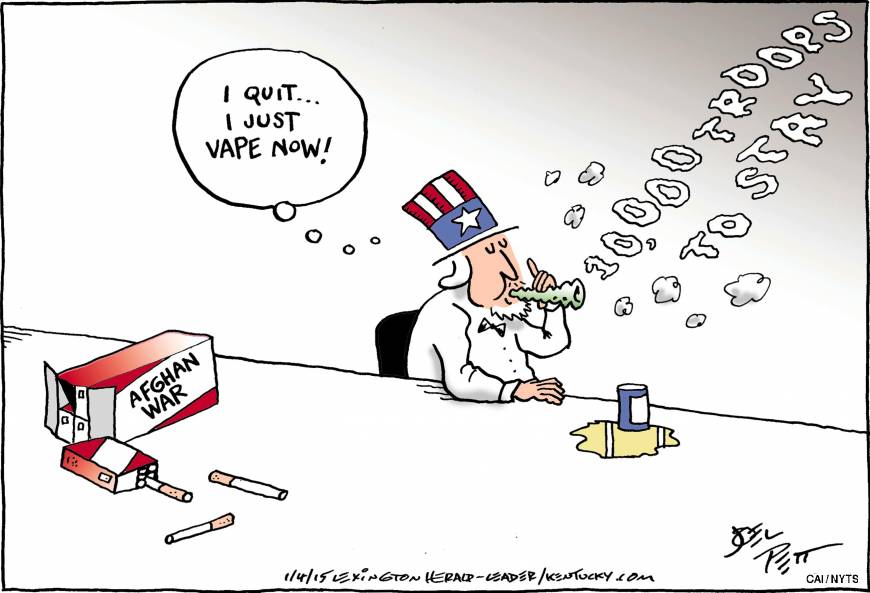
Obama has already missed the 2014 deadline he himself laid down for withdrawal of U.S. forces from Afghanistan. Now he is set to miss his revised deadline to pull out U.S. troops by January 1, 2016. Scrapping the scheduled halving by this year-end of the about 10,000 U.S. troops still deployed, the White House recently decided to maintain the current force level into 2016. Indeed, the duration of U.S. military presence has become open-ended.

The war, which has left 2,315 American troops killed and 20,000 wounded, has already cost nearly $1 trillion.

Obama’s premature declaration that America’s long military campaign against the Taliban is over will be remembered much like his predecessor George W. Bush’s 2003 “Mission Accomplished” speech on the Iraq war. It was Obama that ended Bush’s Iraq war. Yet by 2014, Obama was back at war in Iraq, relying on the same 2002 congressional authorization that Bush secured for military action there.

In Afghanistan, the main enemy of U.S. forces is the Pakistan-backed Taliban, which has already inflicted far more casualties among American and allied forces than al-Qaida and the Islamic State have managed to do in the countries where they operate. Yet Obama refuses to treat the medieval-theology-hewing Taliban as a terrorist organization. Indeed, the White House has sought to paint the Taliban as a moderate force that can be politically accommodated in Afghanistan’s power structure as part of a peace deal.

Obama’s plans, however, have been upset by the Taliban continuing to play for time. The militia, for example, has rebuffed the idea of a ceasefire.

Still, Obama’s pursuit of a peace deal led him to release top Taliban figures from Guantanamo Bay last year and to allow the Taliban in 2013 to set up in Qatar’s capital Doha a virtual embassy in exile, complete with a flag and other trappings of a diplomatic mission.

Five hardened Taliban militants (two of them wanted for war crimes) were freed not so much to secure the release of a U.S. soldier — Sergeant Bowe Bergdahl, who has now been charged with desertion — as to set the stage for talks with the Taliban, which had sought their freedom as a precondition for direct talks. The release of the five — the “hardest of hard core,” according to Senator John McCain — belied U.S. claims that it doesn’t negotiate with militants over hostages or seek a deal with terrorists. Two of them, Mohammad Fazie and Mullah Nori, are suspected of carrying out massacres of Sunni Tajiks and Shiite Hazaras in Afghanistan.

The Taliban’s Doha office, which was shut after its opening angered then Afghan President Hamid Karzai, has become active again, as the U.S. has eased some restrictions on the Taliban leadership, including travel bans.

Tragically, Obama’s overtures to the Taliban have yielded little more than talks about talks, with the militia dragging its feet on negotiating a peace deal. The May 3-4 “unofficial” talks in Qatar — hosted by the Qatari government and the Pugwash Council — produced only broad thoughts, including that “foreign forces have to leave Afghanistan soon,” that Afghanistan will have an “Islamic” government, and that more discussions are necessary to sustain the “peace process.”

The Obama policy has failed to get the Pakistani military to stop sheltering Taliban’s top leadership or to cease treating the militia as an invaluable asset for gaining “strategic depth” in Afghanistan against India. Obama has showered Pakistan with generous aid to secure its cooperation, unveiling $1 billion recently in new assistance flow and another $1 billion package of missiles, helicopters and other weapons.

More fundamentally, Obama’s faltering strategy to win over the Taliban serves as a cautionary tale of how not to make peace with an enemy. Indeed, in a reflection of America’s shrinking options, its success or failure in Afghanistan now hinges on a limited issue — whether it can prevent the Taliban from marching into Kabul.

Despite Obama’s decision to put off a further drawdown of U.S. forces, the Taliban continues to incrementally gain ground. For example, its forces have advanced to the outskirts of the capital of the northern province of Kunduz.

The Taliban, with its top leadership ensconced in Pakistan, no longer has a centralized command and command. Its field commanders are becoming increasingly autonomous.

Worried about desertions from its ranks to the ISIS, a new player in Afghanistan that claimed responsibility for the April 18 series of deadly explosions in the eastern city of Jalalabad that left at least 34 people dead, the Taliban knows that a peace deal offering Obama what he wants — a way to declare victory before his exit from office — will be its death knell. In fact, to stop the erosion in its support, the Taliban is seeking to match the brutal tactics of the ISIS.

The Taliban’s larger strategy to return to power is simply to wait out the Americans.

Before it is too late, Obama must replace his wishful peace-deal pursuit with a clear focus on bolstering the Afghan security forces and finding ways to eliminate the Taliban’s cross-border sanctuaries in Pakistan.

Brahma Chellaney is a geostrategist and the author of “Water: Asia’s New Battleground,” winner of the 2012 Bernard Schwartz Award.
© The Japan Times, 2015.

China and Pakistan: Little in common yet the closest of allies

Brahma Chellaney, The Japan Times

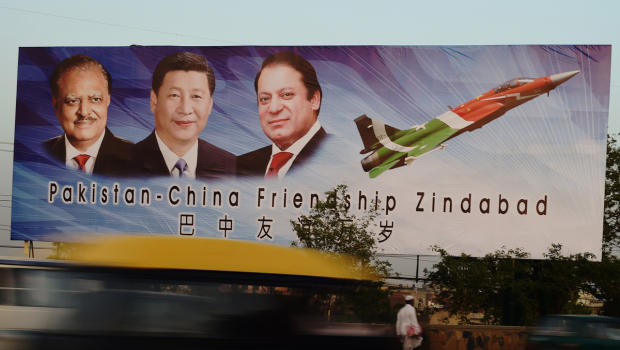
pakistan470080792President Xi Jinping’s recent Islamabad visit, by unveiling agreements valued at $28 billion, shows that China has made Pakistan the central link between its dual Silk Road initiatives. While the maritime Silk Road is the meretriciously benign name for China’s “string of pearls” strategy, the overland Silk Road project has been designed to advance Chinese interests in Central Asia, the Caspian Sea basin and beyond.

These initiatives are part of China’s larger strategy to break out of the East Asia mold and become a more global power.

Xi has now embarked on connecting China’s restive Xinjiang region with the Arabian Sea through a 3,000-kilometer overland transportation corridor to Pakistan’s Chinese-built Gwadar port. Known as the China-Pakistan Economic Corridor, this $46 billion project through Pakistan-held Kashmir will hook up China’s maritime and overland Silk Roads and increase Pakistan’s pivotal importance for Beijing.

When an Indian prime minister visits the Myanmar-bordering Arunachal Pradesh (a large Himalayan territory whose control by India only China questions), or India and Vietnam jointly explore for offshore oil in the South China Sea, China protests loudly, claiming it is “disputed territory.” But the Xi-pushed corridor will traverse an internationally recognized disputed region — Pakistan-held Kashmir — where China has been enlarging its military footprint.

An influx of People’s Liberation Army (PLA) troops into the Pakistani Kashmir’s Shiite-majority Gilgit-Baltistan region in recent years, to supposedly guard Chinese strategic projects there, has resulted in Chinese military presence close to Pakistan’s line of control with India in Kashmir.

The scenario presents India with a two-front theater in Kashmir in the event of a war with either country. This threat is also being highlighted by PLA officers conducting field exercises close to Pakistan’s line of control with India to train Pakistani army troops in the use of Chinese-supplied weapons.

More fundamentally, India is contained geopolitically by the longstanding axis between China and Pakistan, involving, among other things, covert nuclear, missile and intelligence cooperation. With serious strains emerging in Beijing’s relationship with North Korea, Pakistan is now clearly China’s only real ally.

China’s nexus with Pakistan has long been likened to the closeness between lips and teeth, with Beijing recently calling Pakistan its “irreplaceable all-weather friend.” The two often boast of being “iron brothers.” Of late, though, their description of their relationship has become more flowery — “taller than the mountains, deeper than the oceans, stronger than steel, and sweeter than honey.”

Paradoxically, China and Pakistan have little in common, yet boast one of the closest relationships in international diplomacy. Their axis has been built on a shared objective to tie India down, as former state department official Daniel Markey says in his 2013 book, No Exit From Pakistan. Weapon transfers, loans and infrastructure projects allow China to use Pakistan as a cost-effective counterweight to India.

Pakistan, for example, developed its nuclear-weapons capability with Chinese aid and U.S. indulgence, highlighting the fact that no other state has received Chinese and American support in parallel on a sustained basis extending for decades. Indeed, the more Pakistan has become a jihadist snake pit, the greater has been China’s leeway to increase its strategic penetration of that country.

For India, the implications of the growing nexus are particularly stark because both China and Pakistan stake claims to substantial swaths of Indian land and continue to collaborate on weapons of mass destruction.

Significantly, as China’s involvement in strategic projects in Pakistan-held Kashmir has grown, it has openly started needling India on Kashmir, one-fifth of which is under Chinese occupation. It has employed innovative ways to question India’s sovereignty over Kashmir and stepped up military incursions into Indian Kashmir’s Buddhist Ladakh region.

China is clearly signaling that Kashmir is where the Sino-Pakistan nexus can squeeze India. Its military pressure on Arunachal Pradesh, located at the other end of the Himalayas, seems more intended to distract from its Kashmir designs.

Xi’s visit indeed was a reminder that Pakistan-held Kashmir serves as the artery of the Sino-Pakistan nexus.

Xi, who has articulated a more expansive role for China in the world than any modern Chinese leader other than Mao Zedong, showed how high-visibility infrastructure projects drive China’s promotion of commercial and strategic interests. Much of the Chinese funding unveiled during Xi’s visit will be for power projects, including the $1.4-billion Karot Dam, located on the Pakistan-held Kashmir’s border with the Punjab province. This dam is the first project to be financed by China’s new $40-billion Silk Road Fund.

As if to highlight that China treats Pakistan as its newest colony, Xi’s package of power projects will be Chinese-owned, including the Karot Dam station, with the Pakistani government committed to buying power at a preset rate. The power projects, in essence, are to use Pakistan’s resources for Chinese state-run companies to generate profits for repatriation.

In another example of the puppet-puppeteer equation and the risk of Pakistan turning into a Chinistan, Islamabad has given Beijing 40-year exclusive rights to run the port at Gwadar, which is likely to double up as a key outpost for the Chinese navy and serve as China’s first overseas naval station.

The Xi-launched corridor — a network of roads, railway and pipelines — will give China access to the Indian Ocean, thus challenging India in its maritime backyard and opening a new threat for it. The corridor’s transportation links will also allow China to rapidly come to Pakistan’s aid in the event of a war with India.

Moreover, by transforming Pakistan into a client state of the Chinese economy, the corridor will tighten China’s grip over that country, thus preventing it from emulating the example of Myanmar or Sri Lanka to escape Beijing’s clutches. In return for the contracts and other concessions, China will offer Pakistan protection, including diplomatic cover at the United Nations.

However, Pakistan’s insurrection-torn sprawling province of Baluchistan — home to Gwadar — stands out as the Achilles heel of China’s corridor initiative, despite the Pakistani decision during Xi’s visit to create a special security force to protect Chinese projects.

China thinks in the long term. Pakistan — set to get delivery of eight Chinese attack submarines — is now China’s launch pad for playing a bigger role in the Indian Ocean and Middle East, besides serving as a linchpin of its India-containment strategy. China’s land corridor to the Arabian Sea will extend India’s encirclement by the PLA from the Kashmir land borders to the Indian Ocean sea lanes.

No country in the world other than India confronts a strengthening nexus between two revisionist nuclear-armed neighbors with a proven track record of covert actions in breach of international norms. The corridor constitutes China’s new pincer strategy. India — like the proverbial frog in a gradually heating pot of water not realizing the danger until it is too late — can stay silent and passive at its own peril.

Brahma Chellaney, a long-standing contributor to The Japan Times, is a geostrategist and the author of nine books, including “Water: Asia’s New Battleground,” winner of the 2012 Bernard Schwartz Award. His latest book is “Water, Peace, and War: Confronting the Global Water Crisis.”
© The Japan Times, 2015.

Why the U.S. must support constitutional reform in Japan

U.S. security interests will be better served by a more confident, secure Japan free from its constitutional fetters.

Brahma Chellaney

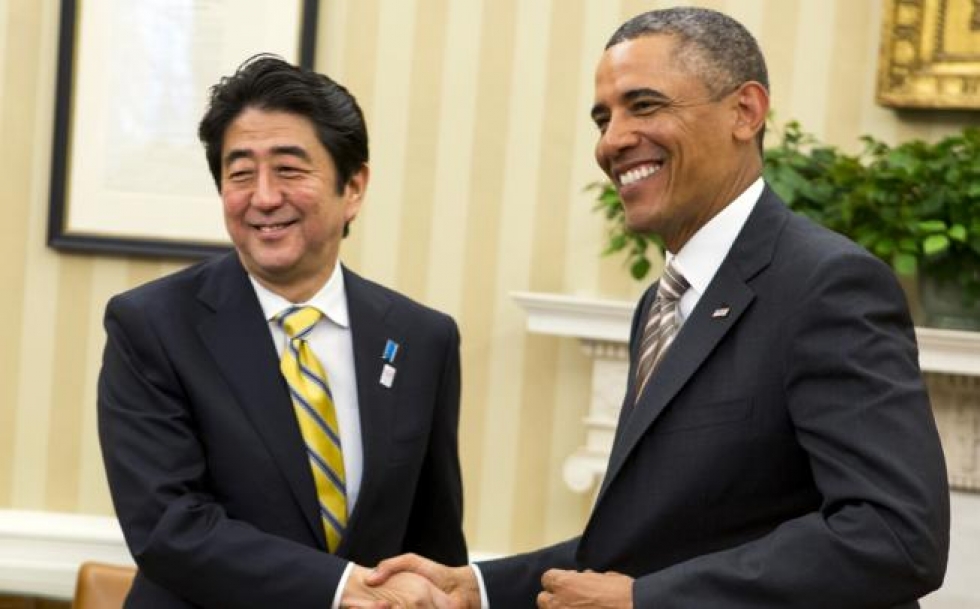
us_news_obama_3_aba_1135298_34228639In keeping with Japan’s interest to play a more robust international role, Prime Minister Shinzo Abe’s U.S. visit has yielded new guidelines for bilateral defense cooperation — the first such revision since 1997. But it is also in U.S. interest to help Japan free itself of its constitutional millstone so that global military cooperation becomes truly feasible. Japan’s antiwar Constitution must be amended to allow its “Self-Defense Forces” to become a full-fledged military.That will allow Japanese forces to play an expanded role, as envisioned by the revised guidelines.

Let’s face it: No other country in the world is bound by the kind of constitutional restrictions that were imposed on vanquished Japan by occupying American forces in 1947.

U.S. policy toward Japan must change with the changing geopolitical circumstances in East Asia. While China will prefer a Japan that remains dependent on America for its security than a Japan that can play a more independent role, the post-1945 security system erected by the United States is more suited to keep Japan as an American protectorate than to allow Tokyo to effectively aid the central U.S.-policy objective in the Asia-Pacific — a stable balance of power. An American policy approach that subtly encourages Tokyo to cut its overdependence on America and do more for its own defense can assist Japan in shaping a new strategic future for itself that contributes to Asian power equilibrium, thus aiding U.S. interests.

Japan’s current Constitution prohibits it from acquiring the means of war and bars its Self-Defense Forces from staging rescue missions or other overseas operations, even to free Japanese hostages. To set up wholly defensive armed forces in the 1950s, Japan had to loosely interpret the Constitution’s Article Nine, which says “land, sea and air forces, as well as other war potential, will never be maintained.”

Japan has clung to this Constitution for 68 years without so much as carrying out a single amendment or changing even one word. Many other democracies regard their constitutions not as cast in stone but as open to change so that they stay abreast with new social, technological and economic developments. For example, India — whose Constitution is almost as old as Japan’s — is set to enact its 100th amendment. Even Germany — also defeated in World War II — has thus far made 59 amendments to its Basic Law, or Constitution, which it adopted when it was under Allied occupation.

If Japan were to break free from its constitutional fetters, it will aid its “normalization” as a nation at a time when the ascent of an increasingly muscular China has exacerbated the Asian security environment. In East Asia, Japan is the only democracy that can balance the power of rising China.

The United Nations charter recognizes individual and collective self-defense as an “inherent right” of nations. Yet Japan did not have this right, until the Abe government last year reinterpreted the Constitution on “collective self-defense” — a step that would allow Japan to come to the aid of its allies. The U.S. wisely supported this reinterpretation.

Abe’s larger constitutional-reform push, however, faces major obstacles at home. For one, the Constitution places a high bar to the enactment of any amendment, making it among the hardest in the world to revise. Any amendment must win support of two-thirds majorities in both chambers of Diet and be ratified by more than half of voters in a public referendum. For another, the majority of citizens, including most of the young, remain comfortable with the present Constitution. After all, pacifism remains deeply ingrained in Japanese society, in part because of the painful legacy of Japan’s prewar militarism.

In fact, many Japanese regard the Constitution as sacrosanct and unchangeable. Such constitutional-sanctity zeal is virtually akin to the religious fundamentalism sweeping elsewhere in the world. To regard every word or provision in the Constitution as sacred is like defending the literal truth of a religious scripture.

Such are the current obstacles to constitutional revision that what Abe can hope for in his term is effecting, at best, a relaxation of amendment procedures, leaving the modification of the force-renouncing Article Nine to a successor government. Yet accomplishing even that limited goal remains uncertain. It is an open question whether any proposed amendment of Article 96 to lower the revision bar — even if it were to clear both houses of the Diet with two-thirds majority — would win public support in a referendum.

If there is one factor that can make a meaningful difference, it is American support. If President Barack Obama’s administration were to lend support to Abe’s constitutional-reform agenda, it will not only blunt Chinese criticism but also assuage many Japanese that amending the Constitution will not mean repudiating the postwar order that America established in Japan or abandoning pacifism.

U.S. security interests would be better served by a more confident and secure Japan that assumes greater responsibility for its own defense and for regional security. In the way America backed Abe’s reinterpretation of the collective self-defense right, it ought to support constitutional reform in Asia’s oldest liberal democracy, which has an enviable record: Japan has not fired a single shot against an outside party since World War II and has been a major donor of economic and humanitarian aid and promoter of global peace. Today, Japan is the only power that can block China from gaining ascendancy in the region.

Brahma Chellaney is a professor at the independent Center for Policy Research in New Delhi and the author, among others, of “Water: Asia’s New Battleground,” winner of the Bernard Schwartz Award.

© China-US Focus, 2015.

China reinvents ‘string of pearls’ as Maritime Silk Road

In contrast to Deng’s “lie low, bide your time” dictum, Xi’s approach is xiong xin bo bo (full of big ambitions)

Brahma Chellaney, Nikkie Asian Review

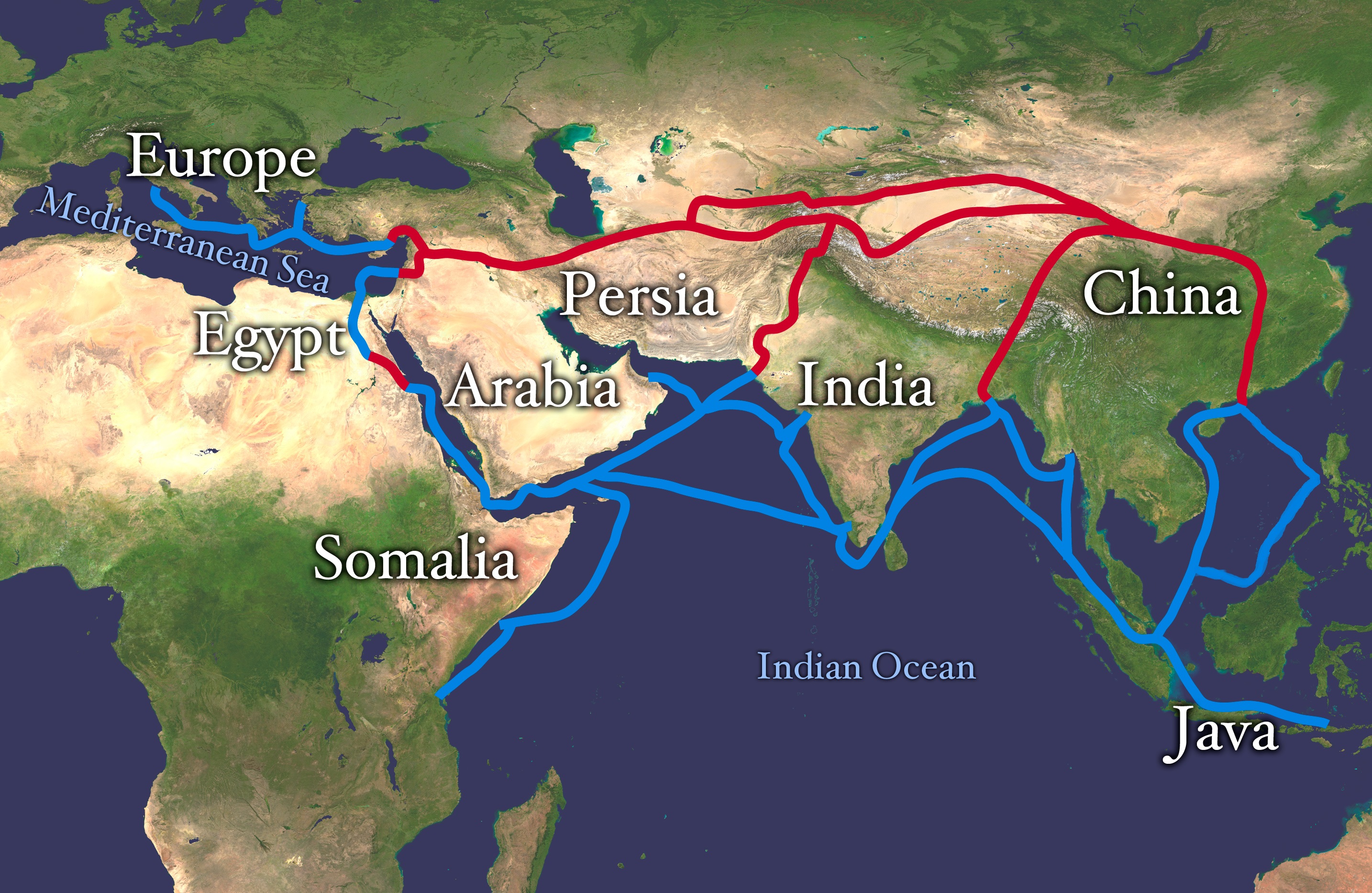
For years, China has pursued a “string of pearls” strategy to create a network of infrastructure projects and staging posts stretching from its eastern coast to the Middle East along the great trade arteries in order to gain strategic clout and naval access. But more recently, China has worked to ease growing concerns in Asia and beyond over its geopolitical aims by rebranding “string of pearls” — a term coined by U.S. consultancy firm Booz Allen Hamilton in a 2005 report for the Pentagon — as the “21st Century Maritime Silk Road” initiative. But can a simple name change allay suspicions that China’s true goal is regional domination?

Stripped of its rhetoric, the Maritime Silk Road initiative — just like the “string of pearls” project — is designed to make China the hub of a new order in Asia and the Indian Ocean region. And just as the “string of pearls” focused on the great trade arteries, the initiative targets key littoral states that sit astride major access routes or are located near choke points. It follows the same route from which, historically, these countries drew wealth and strength.

Coining a name to shake off a foreign-imposed term allows Beijing to market the initiative as a “win-win” trade connectivity project. For small, internationally neglected states, it opens the way for an infusion of major Chinese aid and investment. And for China, it is opening lucrative contracts for its state-run companies and aiding its strategic penetration of regional states. Chinese construction of ports, railroads, highways and pipelines helps project China’s image as a strong but benevolent power. It also permits Beijing to pull regional countries closer to its orbit through economic leverage and soft power.

More broadly, China aims to use the Maritime Silk Road project to counter U.S. President Barack Obama’s “pivot” to Asia, even though the “pivot” remains more rhetorical than real, largely because of American foreign policy’s preoccupation with the Muslim world. For China, economic development is a key drawcard card to help carve out a steadily enlarging sphere of influence in the region.

Silk_routeThe initiative bears the stamp of President Xi Jinping, who is pushing it with a $40 billion Silk Road Fund and the new China-sponsored Asian Infrastructure Investment Bank. Xi announced the Maritime Silk Road initiative during a trip to Indonesia in October 2013, just a month after he unveiled an overland “Silk Road” project to connect China with Central Asia, the Caspian Sea basin and Europe. The new AIIB, according to Chinese Vice Foreign Minister Zhang Yesui, would finance infrastructure construction under both initiatives.

The Maritime Silk Road — to be ultimately protected by Chinese warships — is part of Xi’s focus on the seas that includes employing gunboat diplomacy to challenge Japan in the East China Sea, enlarging China’s control over some of the world’s most strategic waterways in the South China Sea, and making China an important player in the Indian Ocean region. Xi, who has articulated a more expansive role for China than any modern Chinese leader other than Mao Zedong, is using overseas infrastructure projects to extend China’s commercial and strategic interests.

Xi’s call last November for China to establish “big country diplomacy with Chinese characteristics” served as a fresh reminder that he is abandoning Deng Xiaoping’s dictum “hide your brightness, bide your time.” Deng’s “hide and bide” approach was designed to allow China to focus on economic growth and political stability, while Xi’s approach is xiong xin bo bo (full of big ambitions).

Under Xi, China has moved to a proactive posture to shape its external security environment. It is pursuing a muscular approach by boosting its military buildup, asserting territorial claims against its neighbors, and using trade and investment to expand its sphere of influence to the strategic domain.

China’s efforts to disturb the territorial and maritime status quo are best illustrated by the remarkable speed with which it has been building up land mass in the South China Sea, hundreds of kilometers from its mainland. By converting tiny, largely submerged reefs into islands that can host military facilities and personnel, China has highlighted the scale of its ambition to hold sway over vital sea lanes of communication between the Indian and Pacific oceans.

Added to this is China’s frenzied submarine-building program, with the country now boasting more diesel- and nuclear-powered vessels than the U.S., according to Vice Adm. Joseph Mulloy, U.S. deputy chief of naval operations for capabilities and resources. Mulloy recently told the U.S. House Armed Services Committee’s seapower subcommittee that China is extending the geographic areas of operation for its submarines and keeping them at sea for longer periods of deployment.

Soft and hard tactics

China’s construction of seaports, railroads and highways in littoral states contrasts with its broader military assertiveness. Such construction, however, is integral to a strategy that fuses soft and hard tactics to convince regional states that it is in their interest to join forces with China and accept it as the regional leader. In fact, the Maritime Silk Road does little more than attempt to recast the “string of pearls” strategy in meretriciously benign terms.

Paradoxically, China’s whipping up of nationalism at home goes hand-in-hand with its project to globalize and build a vast trading network along the ancient Maritime Silk Road. And even as China works quietly to alter the territorial and maritime status quo with several neighbors, it presents itself to regional states as a partner in their development.

How China blends its economic and military interests was illustrated last autumn by the separate docking of two Chinese attack submarines at the new Chinese-built container terminal at Sri Lanka’s Colombo Harbour. The $500 million container terminal is majority owned by Chinese state companies.

Beijing has been attracted by Sri Lanka’s strategic location, close to the world’s busiest sea lanes. After China completed building Sri Lanka’s southern port of Hambantota, Xi inaugurated construction of a $1.4 billion Chinese-funded project to create a city roughly the size of Monaco on reclaimed land off Colombo, the capital. The planned sprawling complex — currently embroiled in a major political and environmental controversy in Sri Lanka — is intended to become a major stop on China’s nautical “road,” for whose security Chinese warships will increasingly turn up at harbors.

Meanwhile, China’s desire for a permanent military presence in the Indian Ocean — where it has already carried out three deployments — is being whetted by its control of Pakistan’s Gwadar Port, near the Iranian border. Located strategically at the mouth of the Strait of Hormuz, a gateway for a third of the world’s traded oil, the deep-water port epitomizes how an increasingly ambitious China, brimming with hard cash from blazing economic growth, is building new transportation, trade, energy and naval links to advance its interests.

The Gwadar Port Authority chairman recently revealed that Pakistan has granted China 40-year rights to operate the Chinese-built port. Beijing is investing another $1.62 billion in new infrastructure, including a container terminal, an international airport, and an expressway linking the harbor with the coastline.

Strategic corridors

As Xi’s April 20-21 Pakistan visit attested, China is working to connect its restive Xinjiang region with the Arabian Sea by building a 3,000-kilometer overland transportation corridor to Gwadar through Pakistan-held Kashmir. Known as the China-Pakistan Economic Corridor, this $46 billion project will hook up China’s maritime and overland Silk Roads. Contracts worth $28 billion were unveiled during Xi’s visit under the corridor plan.

The strategic corridor will allow Beijing to shorten the route of its oil imports from the Middle East and Africa to barely one quarter of the current 12,000km. The oil will be offloaded at Gwadar for transport by pipeline to western China. Beijing is building a similar network of highways, railroads and energy pipelines from Myanmar’s coast to southern China.

China has operationally taken over Gwadar Port to develop not just its commercial value but also its potential as a naval outpost overlooking Gulf shipping lanes. Having insisted that Gwadar’s role was purely commercial, Beijing was deeply embarrassed when Ahmed Mukhtar, Pakistan’s then-defense minister, disclosed in 2011 that Pakistan had asked China to begin building a naval base there. “We have asked our Chinese brothers to please build a naval base at Gwadar,” he said.

Given China’s proclivity for strategic stealth, its work even on the commercial port at Gwadar was launched quietly. The planned naval base is now being projected as a refueling and works station, which China’s own submarines could use to extend their range in the Indian Ocean.

China has also sought to court the Maldives, a group of strategically located islands in the Indian Ocean where the first democratically elected president was forced at gunpoint to resign in 2012. Xi, during a visit last September, unveiled new Chinese-run infrastructure projects there, calling the Maldives “an important stop” on the Maritime Silk Road. China remains interested in leasing one of its 1,200 islands.

The Indian Ocean is central to Beijing’s intent to fashion a Sino-centric Asia. China’s quiet maneuvering, chipping away at India’s natural geographic advantage, draws strength from its more assertive push for dominance in the South and East China Seas.

In this light, China’s aggressive maritime strategy has emerged as the biggest challenge in the Indo-Pacific region. Just as the U.S. dominates the Western hemisphere, China wants to gain pre-eminence in Asia by widening the power gap with its most formidable neighbors — Japan, Russia and India. It believes the maritime domain holds the key to achieving its goal, thus prompting the launch of the Maritime Silk Road initiative. But success will elude Beijing if other important players in Asia establish a strategic constellation with the aim of inducing China to accept the status quo.

Brahma Chellaney is a geostrategist and the author of “Water: Asia’s New Battleground,” winner of the 2012 Asia Society Bernard Schwartz Book Award.

© Nikkie Asian Review, 2015.

Why is Narendra Modi going to China?  

Brahma Chellaney, Mint, April 30, 2015

oped--621x414Barely eight months after Chinese President Xi Jinping’s India trip, Prime Minister Narendra Modi will shortly make a return visit to China. China’s intrusion into Chumar—one of its biggest incursions ever—coincided with Xi’s arrival, representing his birthday gift for Modi, who turned 64 on that day. Given that Beijing has only hardened its border stance and taken other unfriendly actions since, why is Modi paying a return visit so soon after Xi’s trip?

Normally, a return visit to any country should be undertaken only after preparatory work indicates the trip could tangibly advance the bilateral relationship. Modi’s trip, however, holds little prospect for achieving a more balanced and stable relationship or making progress on resolving land and water disputes and correcting an increasingly lopsided trade relationship. Given the limited time, no real groundwork has been done to ensure that the visit yields enduring results.

Beijing has only been queering the pitch for Modi’s visit. Its reaction to Modi’s Arunachal Pradesh tour in February to open two development projects was unparalleled. Over two days, China fulminated against India, with the Indian ambassador being summarily summoned, the Chinese vice foreign minister speaking scathingly, and the Chinese foreign ministry posting a condemnatory press release on its website.

Worse still, Beijing, in a little-noticed action, used this occasion to escalate its stance on Arunachal. The Chinese vice foreign minister brusquely told the Indian ambassador that the Modi visit undermined “China’s territorial sovereignty, right and interests” and that it “violates the consensus to appropriately handle the border issue.” In other words, Beijing claimed that Arunachal was no longer just a “disputed territory” but China’s sovereign territory, and it contrived a “consensus” against an Indian leader visiting that northeastern state.

Actually, China’s creep began in 2006 when, for the first time, it claimed Arunachal as “South Tibet.” It has since cooked up Tibetan names for invented subdivisions of Arunachal to draw attention to the state’s purported Tibetan identity, even though the Dalai Lama has publicly said that Arunachal historically was not part of Tibet. In its February 20 admonition to India, Beijing alleged the “so-called Arunachal Pradesh” was established largely in the “three areas of China’s Tibet—Monyul, Loyul and Lower Tsayul” and claimed these “had always been Chinese territory.”

What was India’s reaction to Beijing’s serially grating statements on Arunachal, including accusing Modi of breaching an ostensible “consensus”? Conspicuous silence. Modi’s government, however, went ahead and scheduled its maiden round of border talks with China in New Delhi in March, instead of postponing it. Emboldened, Beijing mounted pressure on two fronts — just before and after the border talks, intruding Chinese forces had face-offs with Indian troops in Ladakh’s Depsang plateau; and, without cause, China raked up the Arunachal issue again.

In April, Beijing claimed it is an “undeniable fact” that there is a “huge dispute” over Arunachal. The undeniable fact is actually the converse: that the “huge dispute” is really about Tibet since all Chinese claims flow from that. Sprawling Tibet, the world’s largest and highest plateau, remains at the core of the India-China divide.

Consider yet another hostile action: Chinese intelligence, playing an active role, got nine insurgent groups from India’s northeast recently to meet in Myanmar and form a united front. And just before hosting Modi, Xi has travelled to Pakistan where he signed agreements valued at $28 billion and unveiled the development of a Kashgar-Gwadar land corridor to the Indian Ocean that will challenge India in its own maritime backyard.

Yet, mum’s the word for India. It would seem that safeguarding Modi’s visit has trumped the strategic imperative to respond diplomatically to China’s antagonistic actions. These actions cannot but embarrass Modi, who is still courting Beijing.

For example, how is India planning to respond to China’s stapled-visa policy towards Arunachal residents? Not in kind, such as by introducing stapled visas for the Tibetan plateau’s Han settlers, but by bestowing a reward: e-visa on arrival for Chinese nationals. Such an overture, even if continuing the Indian tradition since 1949 of going overboard to befriend China, signals that India remains hobbled by low self-esteem and a subaltern mindset.

A resurgent India would shine a spotlight on the core dispute by slowly reopening the Tibet issue and reclaiming its lost leverage. After all, China has trampled on its pledge to respect Tibet’s autonomy. Yet, without inviting any reprisal, China continues to squeeze a defensive India. The fact that India does not take its claim to Aksai Chin or Pakistan-held Kashmir seriously encourages China to enlarge its strategic footprint in the Pakistani part of Kashmir and to step up incursions into Ladakh from the Chinese-occupied portion of Kashmir.

In the absence of goal-oriented statecraft, Indian diplomacy has long been shaped by personalities at the helm. Their propensity to act in haste and repent at leisure has been legendary, as India has ignored the sound advice of Talleyrand, Napoleon’s famous foreign minister: “By no means show too much zeal.” Zeal, especially in the form of diplomatic surprises and unilateral gestures, is a trademark of the Modi foreign policy. Indeed, Modi is going to China because he gratuitously told Xi he would pay a return visit before completing his first year in office. With such a schmaltzy approach, can India stand up for its interests and make China walk its talk?

Brahma Chellaney is a professor of strategic studies at the Centre for Policy Research.

© Mint, 2015 

Obama’s Failed Afghan Peace Strategy

A column internationally syndicated by Project Syndicate.

2e8098f118f74f0d1c11096a1728d45a.landscapeSince toppling the Taliban regime in Afghanistan 14 years ago, the United States has been waging a non-stop battle against its foot soldiers. Locked in a war that has already cost nearly $1 trillion, the US has now shifted its focus to making peace with the enemy. It will not work.

Months after President Barack Obama declared that America’s “combat role” in Afghanistan was over, the US and its allies continue to carry out airstrikes on Taliban positions regularly, while American special operations forces continue to raid suspected insurgent hideouts. In fact, beyond an increased role for Afghan forces in the fighting, the situation in the country has changed little since “Operation Enduring Freedom” was renamed “Operation Resolute Support.”

Obama’s premature declaration will be remembered much like his predecessor George W. Bush’s 2003 “Mission Accomplished” speech, which proclaimed the end of major combat operations in Iraq long before they actually ended. Indeed, the overwhelming majority of casualties in Iraq were yet to occur.

Nor is this the first time that Obama has jumped the gun. In October 2011, he announced that he was bringing “the long war in Iraq” to an end by withdrawing all US troops. Yet, last year, the US was back at war in Iraq, this time in an effort to rein in the Islamic State, with Obama relying on the same congressional authorization that Bush secured for military action there a decade before.

In Afghanistan, the Obama administration has already missed the 2014 deadline, set in 2011, for withdrawing US forces. And it has rescinded another self-imposed deadline, having scrapped its plan to halve the number of US troops still deployed in Afghanistan – currently around 10,000 – by the end of this year.

So America’s military intervention in Afghanistan is now open-ended – and the fighting is not subsiding. On the contrary, the recent escalation of Taliban attacks indicates that the approaching summer fighting season will be among the most intense since the war began.

The Taliban has already inflicted far more casualties among US and allied forces than Al Qaeda and the Islamic State combined. A total of 2,215 American troops have been killed in Afghanistan, and another 20,000 wounded, since 2001. The United Nations documented a record-breaking 10,548 conflict-related civilian casualties just last year.

Yet Obama has refused to designate the Taliban as a terrorist organization, leaving it off the list of terrorist networks mentioned, for example, in his recent joint statement with Indian Prime Minister Narendra Modi. Instead, his administration has sought to portray the Taliban as a moderate force that can be accommodated within Afghanistan’s political system.

Moreover, in 2013, Obama allowed the Taliban to establish what was essentially an embassy in exile in Doha, Qatar, complete with a flag and other diplomatic trappings. And, last year, the US released five top Taliban leaders – including Mohammad Fazl and Mullah Nori, who are suspected of carrying out massacres of Sunni Tajiks and Shia Hazaras in Afghanistan – from the Guantánamo Bay detention center.

In releasing the five, the Obama administration claimed that it was simply doing what was necessary to secure the return by the Taliban of Sergeant Bowe Bergdahl (who has now been charged with desertion). But the real objective was clear: to lay the groundwork for direct talks with the Taliban. The move not only belied US claims that it does not negotiate with terrorists; it also failed to bring the Taliban militia to the negotiating table.

With these concessions, the US has revealed to the Taliban – and the world – its desperation to achieve a face-saving settlement that would enable it, at long last, to escape the Afghan quagmire. It is no wonder that the Taliban chief, Mullah Muhammad Omar, hailed the release of his five comrades as evidence that his militia is “closer to the harbor of victory.”

The Obama administration’s desperation is similarly apparent in the generous aid that it has provided to Pakistan, including an imminent arms deal worth almost $1 billion, in an effort to secure the country’s cooperation on counter-terrorism. Yet the Pakistani military continues to shelter the top leadership of the Taliban, which it regards as an invaluable asset for gaining “strategic depth” in Afghanistan against India.

America’s success or failure in Afghanistan now hinges on a single limited issue: whether it can prevent the Taliban from marching into Kabul. By highlighting its desperate search for an exit, the US has given the Taliban the upper hand, letting the militia’s leaders know that they can simply wait it out.

Delaying a further drawdown of US forces will be inadequate to convince the Taliban otherwise. With its top leadership ensconced in Pakistan and its field commanders in Afghanistan becoming increasingly autonomous, the Taliban no longer has a centralized command. And, fearing desertions to the Islamic State, it knows that giving Obama what he wants – a peace deal that enables him to declare victory before his term ends in January 2017 – would be its death knell.

America’s faltering Afghan strategy should serve as a cautionary tale of how not to make peace with an enemy. It is time for Obama to recognize that a political settlement with the Taliban is simply wishful thinking. Instead, he should focus on bolstering Afghanistan’s security forces and identifying ways to eliminate the Taliban militia’s sanctuaries in Pakistan. After all, terrorists are not in the business of making peace; America should not think otherwise.

Why India needs to reformulate its China policy

Brahma Chellaney, The Hindustan Times, April 14, 2015

Xi Jinping in AhmedabadThe hype over Prime Minister Narendra Modi’s China visit next month is likely to obscure the underlying strategic dissonance and tensions between the world’s two most populous countries on issues extending from land and water to geopolitical aims.

Two issues stand out: An increasingly asymmetrical trade relationship and a gradually rising pattern of Chinese border incursions in several regions since 2006, when China for the first time claimed Arunachal Pradesh as ‘South Tibet’.

India-China commerce constitutes one of the world’s most lopsided trade relationships: China’s exports are 3½ times greater in value than its imports, and it buys mainly primary commodities from India but exports value-added goods to it. For example, China’s steel producers find India an easy dumping prey, with Chinese dumping of steel items rising almost fourfold under Modi’s watch in 2014. New Delhi, by tamely allowing China to rake in growing profits through such trade, in effect funds the Chinese strategy to encircle India.

Despite rising border provocations, Indian policymakers have still to get their act together. To Modi’s credit, he has stressed that border peace and tranquillity is a prerequisite to the continued growth of India-China relations. But with his government, like his predecessor’s, preoccupied with fire-fighting on several fronts, policymakers are missing the significance of what China is up to.

There is a clear pattern, backed by an identifiable strategy, to the Chinese incursions. With the aid of progressively increasing or recurrent incursions in each coveted area, the strategy aims to create a dispute where no dispute has existed so that China can subsequently demand that it be settled ‘peacefully’ on give-and-take terms. This pattern and strategy are apparent, for example, from repeated Chinese intrusions in Ladakh’s two strategic regions — Depsang and Chumar — where the geography favours Indian forces, lending a distinct military advantage.

Neither Chumar nor Depsang was in dispute earlier. Yet Chinese President Xi Jinping’s India arrival last September coincided with a Chinese intrusion into Chumar — one of the biggest incursions ever, representing Xi’s birthday gift for Modi, who turned 64 on that day. And Premier Li Keqiang’s 2013 visit followed a Chinese encroachment into Depsang, with the intruding troops setting up camp in an area that extended beyond the ‘line of actual control’ (LAC) that China itself unilaterally drew when it defeated India in the 1962 Chinese-initiated war.

The tense, intrusion-triggered military standoffs notwithstanding, incursions remain business as usual for China. For example, on the eve of the recent border talks, and then soon thereafter, intruding Chinese forces had face-offs with Indian troops in two separate areas of the Depsang plateau. In both the cases on March 20 and March 28, the Chinese attempt to reach India’s Old Patrol Point base was foiled. In response to an incursion, Indian forces hold a banner drill to get the intruding troops out — a task that might also necessitate one or more flag meetings. But no sooner has one face-off ended than another incursion occurs. After all, Chinese border ‘transgressions’, as government figures reveal, now exceed more than one per day.

One novel method the People’s Liberation Army (PLA) has employed is to bring ethnic Han pastoralists to the valleys along the LAC and give them cover to range across it, thus driving Indian herdsmen from their traditional pasturelands. In the absence of a strategy to thwart such PLA-assisted ‘civilian’ encroachments (one of which occurred during Xi’s visit), India has been incrementally losing land, especially in Arunachal and Ladakh.

Why blame China for employing means — fair or foul — to alter the LAC bit by bit when Indians remain confused as ever on how to respond? To thwart encroachment by regular PLA troops, India’s first line of defence remains a thinly stretched police force. The home ministry-administered Indo-Tibetan Border Police is no match for the PLA guile and capability. Beefing up its strength alone won’t suffice; it must be placed under the army’s operational command.

The focus on high-level visits and the border talks proceeding for 34 years — a world record — distracts attention from India’s strategic imperatives while emboldening China to furtively nibble at Indian territories.

The Modi government’s recently concluded maiden border talks with China dashed hopes of these negotiations being reoriented to produce results. The two countries in September recommitted to ‘an early settlement of the boundary question’, with Modi urging Xi to “resume the stalled process of clarifying the LAC” — a process derailed by China’s breaking of a 2001 promise to exchange maps with India. The recent discussions, however, represented no earnest effort to restructure the talks, under way since 1981.

India’s choice is not between persisting with a weak-kneed policy and risking a war. India has a hundred different options between these extremities, as China’s own actions attest. Yet national security adviser Ajit Doval said after the latest round that holding border negotiations was itself valuable, even if the talks yielded no progress, because their absence would mean “conflict is the only means of resolution”. Such logic that the sole choice for India is between staying stuck in futile talks and entering into conflict only encourages a revanchist China to take India round and round the mulberry bush.

India must stop seeing options only at the extreme ends and build a credible counter-strategy. China indeed is trying to limit India’s options by leveraging its economic clout, including as a major supplier of power and telecom equipment and active pharmaceutical ingredients and as a lender to financially troubled Indian firms. China is already India’s largest source of imports.

With creative gradualism his forte, Modi must evolve a China policy that errs on the side of caution, not meekness. Caution averts problems but timidity, as the past decade has shown, invites more problems. Prudence demands denying China the leeway to continue distorting commerce and boosting its trade surplus year after year, even as it keeps India under mounting strategic pressure without incurring political costs.

Brahma Chellaney is a geostrategist and author.

(c) The Hindustan Times, 2015.

History holds Asia hostage

BRAHMA CHELLANEY, Nikkie Asian Review, April 6-12, 2015

A failure to come to terms with history weighs on all the important bilateral relationships in Asia. As the 70th anniversary of the end of World War II approaches, some nations in the region are resurrecting the ghosts of history.
China, for example, is planning a grand military parade in Beijing on Sept. 3 to commemorate what it calls Victory over Japan Day. In announcing the parade, the Chinese Communist Party’s mouthpiece, the People’s Daily, said it will display China’s military prowess and “make Japan tremble.” An increasingly muscular China, however, is rattling not only Japan but also its other neighbors.

How diplomatic relationships are held hostage to history is best exemplified by the strained ties between America’s closest regional allies — South Korea and Japan. Following Japanese Prime Minister Shinzo Abe’s re-election, these two countries were presented with a stark choice: find ways to stem the recrudescence of bitter disputes over history or stay frozen in a political relationship that plays into China’s hands.

Playing the history card, China has made ultranationalism the legitimating credo of Communist rule. In recent years, China has sought to draw attention to the atrocities committed by the Japanese during World War II by expanding and renovating war museums memorializing the 1931-1945 invasion, as well as through other government projects and subsidies. As though to stir its people into a frenzy of patriotism, China has also declared two new national days to remember Japanese aggression.

But what if the victims of China’s aggression followed its example and commemorated Chinese attacks on them? China, while seeking to obscure its own aggressions and occupations since the communist “revolution,” including the 1951 annexation of the sprawling Tibetan plateau and invasions of India and Vietnam in 1962 and 1979, respectively, has long called on Japan to take history as a mirror and demonstrate greater remorse for its past aggressions.

When nationalisms collide

History is rarely an objective chronicle, in keeping with the dictum that it is written by the winners. Yet history greatly shapes national narratives. In Asia, the “history problem” has spurred a resurgence of competing and mutually reinforcing nationalisms. Squabbles over history and remembrance remain the principal obstacle to political reconciliation in Asia, reinforcing negative stereotypes of rival nations and helping to rationalize claims to territories long held by other nations. A country’s commemoration is usually linked with its national identity.

Honoring one country’s heroes and history can be done without seeking to alienate, provoke or rub salt in the wounds of another nation. In an economically integrated but politically divided Asia, however, relations between nations remain trapped in a mutually reinforcing loop: Poor political relations help magnify and accentuate the history problem, thus chaining diplomatic ties to history.

Breaking out of this vicious cycle demands forward-looking leadership and the will to pursue political reconciliation. At present, though, the trend is in the opposite direction. For example, attempts in East Asia to rewrite or sugarcoat history, including by revising textbooks or erecting memorials to newfound heroes, are inciting greater regional rancor and recrimination. A potent mix of domestic politics, growing geopolitical competition and military tensions has turned history into a driver of corrosive nationalism.

Disputes between South Korea and Japan and between China and Japan over territories, war memorials, textbooks and natural resources are the result of an entangled history. The Sino-Indian relationship is also a prisoner of the past. This is especially evident in the context of China’s elimination of the historical buffer — Tibet — and its subsequent war with India. Even the Chinese-South Korean relationship carries the baggage of history, burdened  by China’s more recent revisionist claim to the kingdom of Koguryo, one of the three kingdoms in ancient Korea.

Missed opportunity

The recent commitment of U.S. President Barack Obama and Indian Prime Minister Narendra Modi to work with like-minded states to establish a power equilibrium and a rule-based order in Asia can make little headway if history continues to hinder relations even between democracies. Take Japan and South Korea: As export-oriented powerhouses with traditionally close cultural ties, the two share many values. But resurgent history issues between them have dimmed hopes of a concert of democracies to rein in China’s assertiveness.

The century-old case of Korean activist Ahn Jung-geun illustrates history’s divisive hold. Considered a terrorist in  Japan, where he was hanged, but a hero in South Korea, Ahn assassinated four-time Japanese Prime Minister and the first Resident-General of Korea Hirobumi Ito in 1909 at the Harbin railway station in China.

The case resurfaced after China opened a memorial hall in Harbin in January 2014 commemorating Ahn, prompting Japan to denounce China for glorifying a terrorist. The hall was built at the suggestion of South Korean President Park Geun-hye during a meeting with the Chinese President Xi Jinping in the summer of 2013.

South Korea, a hyper-nationalistic state, has sought to eliminate all signs of Japanese colonial rule. But not all Asian states seek to obliterate their colonial past. India continues to transact much of its key government business from British-era edifices, and some  of its major criminal and civil laws date from the colonial period. Taiwan — a former Japanese colony — also has a tolerant view of its period of subjugation.

Many nations, however, blend historical fact with myth. For example, China, as the fairy-tale Middle Kingdom, claims to be the mother of all civilizations, weaving legend with history to foster a chauvinistic Han culture centered on regaining lost glory. The Communist Party projects great-power status as China’s historical entitlement. Indeed, by embellishing China’s past, it wants to make real the legend that drives Chinese revisionist history — China’s centrality in the world. This is reflected in President Xi’s goal to build what he calls the “Chinese dream.”

Stirring up the past

Harmful historical legacies create serious impediments to rational policy choices. Park, for example, has sought closer ties with China even though South Korea’s natural regional partner is Japan. Japan — Asia’s oldest liberal democracy, which has not fired a single shot against an outside party since World War II — has been a major donor of economic and humanitarian aid.

Since coming to power more than two years ago, Park — the daughter of the military general who served as South Korea’s dictator for 18 years until 1979 — has not held a single one-on-one meeting with Abe, insisting that Japan first address lingering issues over its annexation of Korea more than 100 years ago. Japan declared Korea a protectorate in 1905, and officially annexed it in 1910.

Abe’s re-election places him on strong political ground to reach out to Park and find ways to put history behind them through negotiation. But this will be a challenging task for two reasons. First, South Korea clings to the past while Japan, which has acknowledged and apologized several times for its war crimes, wishes to forget the past. In the last century, Japan was a victor and a loser, as well as an oppressor and a victim, making its historical narrative complex and difficult, especially in relation to China and South Korea.

Second, Park has persisted in raking up the past even at the expense of the bilateral relationship. She has sought to pander to nationalist sentiment at home by being tough on Japan, clearly in part to play down her father’s collaboration with the Japanese Imperial Army. For example, Park recently again called on Japan to acknowledge the historical truth by resolving the “comfort women” issue, a reference to the sexual slavery of Korean and other women by the Japanese Imperial Army.

A grand bargain between the two East Asian neighbors would require Japan to more clearly and fully express regret and remorse over its militaristic past and South Korea to agree not to keep dredging up historical grievances.

If South Korea and Japan take the lead to put their shared past behind them, they could set an example for other relationships in Asia that are burdened by historical differences and distortions.

Asian states cannot change the past, but they can strive to shape a more cooperative future. As a Russian proverb puts it pithily, “Forget the past and lose an eye; dwell on the past and lose both eyes.”

Brahma Chellaney is a geostrategist and the author of the award-winning book Water: Asia’s New Battleground, Georgetown University Press.

India’s Pakistan policy adrift

Brahma Chellaney, Mint, March 26, 2015

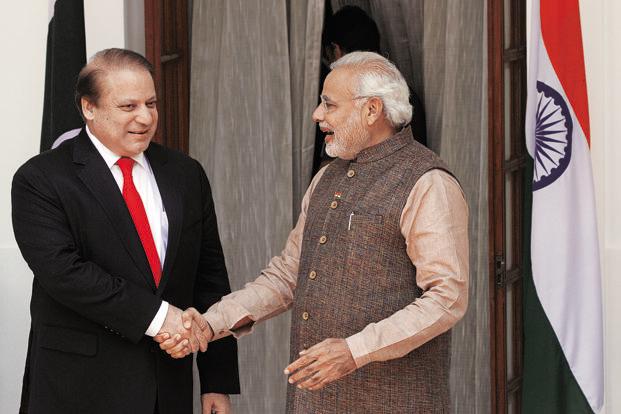
sharifmodi--621x414In his first eight months in office, Prime Minister Narendra Modi impressed many with his foreign-policy skills. For example, he signalled that India’s response to Pakistan’s strategy to inflict death by a thousand cuts will no longer be survival by a thousand bandages; rather the response will be punitive so as to have a deterrent effect and help reform Pakistan’s conduct. Pakistan’s stepped-up ceasefire violations were met with a punishing mortar-for-bullet response.

Yet today, Modi’s Pakistan policy looks barely different from his predecessor’s. Since U.S. President Barack Obama’s New Delhi visit, there has been a major transformation in India’s Pakistan policy. Obama pitched strongly for India’s re-engagement with Pakistan, dwelling on that theme at great length during his famous chai per charcha with Modi. His line of reasoning manifestly left a deep impression on Modi.

This is apparent from India’s policy somersaults on two critical issues. The first U-turn — resumption of bilateral dialogue — raises troubling questions about the logic behind it. Such re-engagement even as Pakistan exports terror encourages it to persist with its roguish conduct. Few thus should be surprised by the return of terror attacks to Jammu and Kashmir. Since the Obama visit, Modi’s conciliatory gestures have included a telephone call to his Pakistani counterpart, Nawaz Sharif, and then a letter to him — hand-delivered by the Indian foreign secretary — in which the Indian leader said he looks forward to visiting Islamabad early next year for the SAARC summit.

The second U-turn is no less puzzling: India conveyed to Pakistan last month that its high commissioner in New Delhi can meet Hurriyat separatists on any occasion other than when official talks are about to begin. In other words, Modi has yielded ground even on the issue that led him to cancel talks with Pakistan last August. The Pakistani high commissioner, in keeping with the Indian advisory, met first with Hurriyat’s Syed Ali Shah Geelani immediately after the foreign secretary-level talks in Islamabad and then this week with a seven-member Hurriyat delegation led by Mirwaiz Umer Farooq.

Now consider another issue — the government’s dispatch of a reluctant minister, General V.K. Singh, to the Pakistan Day event. General Singh is not just any minister of state. As a former Army chief, he deserves due respect. In the Indian system, even civil servants at times try to ride roughshod over service chiefs. In this case, it was the government itself that did not accord due respect to a former Army chief by sending him as its representative to an event bristling with the presence of Pakistan’s Hurriyat surrogates. Look at the paradox: Just months after Modi broke off talks with Pakistan over its high commissioner’s meeting with Hurriyat leaders, he sends Gen. Singh to the Hurriyat-infested Pakistan Day event.

Modi swept to power in India’s biggest election victory in a generation because voters expected him to usher in qualitative change. The hope was that he would be a transformative leader. Today, ironically, the lack of self-respect that permeated Manmohan Singh’s Pakistan policy risks seeping into the Modi government’s actions.

With Modi’s policy adrift, Pakistan feels emboldened not just by his U-turns, but also by other political developments in India, including the Bharatiya Janata Party sacrificing principles at the altar of political expediency by entering into an alliance with the People’s Democratic Party in Jammu and Kashmir and the Modi government putting up with the J&K government’s release of the pro-Pakistan militant Masarat Alam. The opportunistic political alliance in J&K is between the architect of the cave-in in the December 1989 Rubiya Sayed kidnapping — a case in which the release of five jailed Kashmiri extremists triggered overt militancy, fuelling terrorism — and the party whose government at the centre hand-delivered top terrorists to hijackers in Kandahar in final hours of 1999, resulting in India entering the new century with ignominy.

Other than the tool of dialogue, India has little direct leverage over Pakistan. The tool of dialogue thus must be employed judiciously to help change Pakistan’s conduct. If talks are held even when Pakistan’s belligerence remains intense, it will blunt the instrument of dialogue.

Yet India has long had difficulty staying its course. For example, just months after the unparalleled Mumbai attacks by 10 Pakistani gunmen, Manmohan Singh not only reengaged Pakistan at the highest level but signed a joint statement at Sharm-el-Sheikh in which a reference to Baluchistan was included as if to implicate India in fomenting the insurrection there. Modi’s own suspension of talks lasted barely seven months. India’s unconditional resumption of dialogue each time only reinforces Pakistan’s conviction that its provocations carry no costs because even if the dialogue process were suspended again, India will reopen talks for two reasons — U.S. pressure, and Indian foreign policy’s blow-hot-blow-cold traditions.

Today, Islamabad has reason to gloat over how its unbending intransigence has again brought India to the negotiating table and gained Pakistan a licence for interacting with Kashmiri separatists. Pakistan’s Hurriyat stooges are there to take diktats from their Pakistani handlers, not to ensure peace and stability in the Kashmir Valley.

After 10 months in office, Modi needs to fix the broken Pakistan policy he inherited from Manmohan Singh, rather than concoct a mirror image of the same policy. It is high time for India to abandon the notion that it has no option but to stay stuck in the old failed policy of holding dialogue even as Pakistan remains intransigent. And it must stop facilitating Pakistan’s interactions with Hurriyat separatists. Will Pakistan allow any Indian official to meet Baloch secessionists or the protest leaders in Shia-majority Gilgit-Baltistan? If an Indian diplomat defiantly met any Pakistan-based separatist, that secessionist would either disappear for good or be quickly tried before a military court and executed.

Brahma Chellaney is a professor of strategic studies at the Centre for Policy Research.

© Mint, 2015.

Great powers surf to conquer

Brahma Chellaney, The Hindustan Times, March 12, 2015

indian-ocean-bases-180c4Prime Minister Narendra Modi’s three-nation Indian Ocean tour attests to this region’s critical importance for Indian security, including preventing India’s encirclement by hostile powers. If China were to gain the upper hand in the Indian Ocean region, it will mark the end of India’s great-power ambitions. India thereafter will be seen as merely a sub-regional power whose clout does not extend across South Asia, with Pakistan challenging it in the west and China in the north and south.

India’s tactical and strategic disadvantages along its land frontiers are more than compensated by its immense geographic advantage in the Indian Ocean. Such is peninsular India’s vantage location in the Indian Ocean — the world’s premier energy and trade seaway — that the country is positioned dominantly astride vital sea lanes of communication (SLOCs), including China’s emergent Maritime Silk Road.

Despite India’s inherent maritime leverage, its land-frontier compulsions have instilled a landlocked mindset. With its attention fixated on the disputed land borders, India — far from exploiting its advantage on the maritime front — often has difficulty facing up to the fact that it is a major maritime country. Worse still, India diplomatically neglected the Indian Ocean region in the 25-year period from 1989 when it was governed by coalitions. Tellingly, Modi is the first prime minister to visit Seychelles in 34 years and Sri Lanka in 28 years.

India’s long neglect has become China’s strategic gain. China’s quiet manoeuvring in the Indian Ocean, where it is chipping away at India’s natural-geographic advantage through multibillion-dollar projects along the great trade arteries, draws strength from its more assertive push for dominance in the South and East China Seas.

The Indian Ocean promises to shape the wider geopolitics and balance of power in Asia and beyond. India, however, finds itself on the back foot in its own strategic backyard. According to Jawaharlal Nehru, “History has shown that whatever power controls the Indian Ocean has, in the first instance, India’s sea-borne trade at her mercy and, in the second, India’s very independence itself.” The irony is that this is the only ocean in the world named after a single country.

China has been assiduously pursuing a strategy to build a “string of pearls” across the Indian Ocean so as to gain strategic clout and naval access. By rebranding the “string of pearls” strategy as a “21st-century maritime silk road” project, China has now sought to disguise its real intentions. This signature initiative of President Xi Jinping merely recasts the “string of pearls” strategy in meretriciously benign terms. Stripped of its rhetoric, the Silk Road — just like the “string of pearls” — is designed to redraw Asia’s geopolitical map by making China the preeminent power.

The Silk Road indeed exemplifies China’s use of aid, investment and other leverage to pull littoral states closer to its orbit, including through the construction of seaports, railroads and highways. Such construction may provide a counterpoint to China’s military assertiveness. Yet it is integral to a strategy that fuses soft and hard tactics to bind countries to China’s economy and security and to convince them that it is in their interest to accept China as Asia’s alpha power.

How China blends its economic and military interests was illustrated last autumn by the separate docking of two Chinese submarines at the newly opened, Chinese-majority-owned container terminal at Colombo Harbour. China’s desire for permanent military presence in the Indian Ocean, where it has carried out three deployments, is being whetted by its control of Pakistan’s Gwadar port, located strategically at the mouth of the Strait of Hormuz. China has operationally taken over the port it built at Gwadar to develop not its commercial value (which remains unpromising) but its potential as a key naval outpost.

Given the emerging challenge to India in its maritime backyard, Modi must develop a credible strategy to counter it. His charm-offensive tour of regional states with offers of new economic and defence tie-ups marks just a beginning. Modi did well to drop the Maldives from his itinerary, given the political mess there. But he could have delayed his Sri Lanka trip until after the forthcoming parliamentary elections there, especially given the fact that his visit comes barely a month after President Maithripala Sirisena’s India tour.

In keeping with his highly personalized imprint on diplomacy, Modi thus far has relied on bilateral summits to open new avenues for cooperation and collaboration. Diplomacy alone will not suffice. Sirisena, for example, makes his first official visits to Beijing and Islamabad soon after hosting Modi.

To prevent Chinese military encirclement, India needs to significantly accelerate naval modernization. It must build sufficient naval prowess to potentially interdict Chinese SLOCs in the Indian Ocean and hold the Chinese economy hostage if a Himalayan war were thrust upon it again. A major holdback of tanker traffic in wartime would be a crippling jolt to the Chinese economy, though it might not alter the war’s outcome.

Even as the Chinese military keeps Indian ground forces busy in peacetime by staging Himalayan border incursions and other flare-ups, the oil and liquefied gas flowing from the Gulf and Africa to China pass through the Indian Ocean unmolested and unimpeded. Over 80% of China’s oil imports pass through the Malacca Strait chokepoint. Boosting SLOC interdiction capability would allow the Indian Navy to dominate key maritime routes and help improve the Chinese military’s behaviour along the Himalayas.

The contest for major influence in the Indian Ocean is pivotal to the success of China’s strategy to fashion a Sino-centric Asia. This is a contest India cannot afford to lose.

Brahma Chellaney is a geostrategist and author.

© The Hindustan Times, 2015.