Refugees, jihad and the specter of terrorism

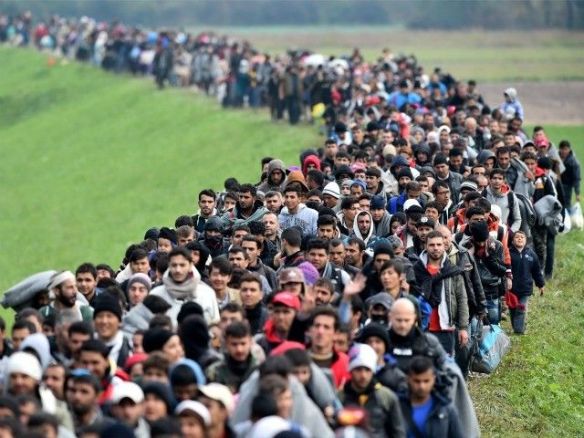
Migrants-Crowds-Cross-Into-Slovenia-Getty-640x480

Europe’s refugee crisis threatens to exact a security price as high as what nations next to the Afghanistan-Pakistan jihadist belt are paying

Brahma Chellaney, The National

Europe today is focused on the refugee crisis, with NATO instituting patrols in the Agean Sea to intercept migrants trying to reach Greece. But in some years, Europe’s focus could shift to internal-security threats. After all, the refugee flows from the Middle East, where grassroots radicalization and arms training are widespread in the war-torn states, hold important security implications for the destination countries.

Indeed, U.S. National Intelligence Director James Clapper has warned that the Islamic State terrorist group is infiltrating refugees escaping from Iraq and Syria so as to operate in the West, while Rob Wainwright, the head of the European Union’s law enforcement agency, Europol, has warned that Europe is facing its biggest terror threat in more than a decade. According to Clapper, Islamic State terrorists are “taking advantage of the torrent of migrants to insert operatives into that flow,” adding that they are “pretty skilled at phony passports so they can travel ostensibly as legitimate travelers.”

Germany, the prime destination of the current migrant flows, welcomed around one million refugees last year. But unlike the roughly three million migrants from Turkey that came to Germany from the 1960s onward to meet the demand for labor in the booming German economy, those arriving today are from countries battered by growing jihadist extremism and violence. Turkey itself is being Pakistanized, in keeping with the maxim: “If you light a fire in your neighborhood, it will engulf you.”

The refugee exodus is just one manifestation of a deeper problem — how interventionist policies of outside powers in recent years have unraveled fragile states, such as Libya, Syria, Iraq, Yemen and Afghanistan. Following World Wars I and II, European colonial powers and the United States sat around tables and redrew political frontiers in the Middle East, creating artificial new nations with no roots in history or preexisting identity.

The net effect of the latest round of interventionist policies is the emergence at Europe’s southern doorstep of a jihadist citadel that extends from the Maghreb to the Sahel, with Libya at its hub, and the rise of another jihadist stronghold in the Syria-Iraq belt. Dealing with the threats from these two jihadist citadels will challenge Europe in the coming years even more than the refugee crisis, in the same way that countries next to the Afghanistan-Pakistan jihadist belt are paying a high price in terms of their security.

In this context, the Paris terror attacks’ larger lesson should not be forgotten: Unless caution is exercised in training and arming Islamic militants in another region, the chickens could come home to roost. Jihad cannot be confined within the borders of a targeted nation, however distant, as the examples of Afghanistan, Syria and Libya indicate. The fact that French and Belgian nationals were behind the Paris attacks has shown how difficult it is to geographically contain the spread of the jihad virus.

Indeed, internal-security challenges in Europe have been compounded by Western foreign-policy missteps and misplaced priorities. Take the situation in battle-worn Syria and Iraq: Defeating the Islamic State is a pressing issue on which an international consensus — and coalition — can be built. But the Western-led camp first needs to get its act together, including by prioritizing the Islamic State’s eradication over regime change in Damascus and by stopping its members from working at cross-purposes. Saudi Arabia, Turkey and Qatar continue to aid al-Qaeda-linked militant groups in Syria and Iraq.

Even without considering the specter of Islamic State fighters hiding among innocent civilians to reach the West, the flow of refugees poses a security challenge for the countries they enter, because they are arriving from violence-scarred lands. In the refugee-producing conflict zones, the call to jihad has indoctrinated many to see violence as a sanctified tool of religion. Large numbers of men have not only received arms training but also used weapons in combat.

More than half of the slightly over one million refugees who flocked to Europe in 2015 were men of fighting age. This year, due to pressure for families to reunify, children and women make up 54 percent of the new arrivals up to now, according to United Nations data.

The risks from jihadist indoctrination cannot be discounted, as was highlighted by what happened in San Bernardino, California, where a married couple of Pakistani origin massacred 14 people in December.

Moreover, former combatants in a civil war — just like ground troops returning from a regular war — are prone to suffer from Post-Traumatic Stress Disorder (PTSD). According to medical research, about 30 percent of the men and women who have spent time in war zones experience PTSD, which is associated with an increased risk of violence.

In this light, addressing the refugee crisis will be no easy task for Europe. Building higher fences to secure Fortress Europe cannot be the answer by itself. Refugees will do anything to escape from war and chaos, including risking their lives, as they are doing by taking unseaworthy boats.

More fundamentally, how can any European nation ensure that the refugees it takes do not include radical jihadists who extol mass murder as a tool of jihad?  Integrating the refugees already admitted will be a major challenge, as Germany has experienced with its Turkish immigrants, who remain poorly integrated in German society.

Let us be clear: No country can accept an unrestrained influx of refugees, because it would get swamped economically, socially and culturally and face major political fallout domestically. The issue is how to control the migrant flow in a humane way, in accordance with international law, while admitting a limited number of genuine, properly vetted refugees.

However, there is no European or international policy on refugees. The two instruments of international law — the 1951 Refugee Convention and the 1967 Refugee Protocol — are scarcely adequate for dealing with the current refugee flows.

For Europe, the Mediterranean holds the key for its security. Yet little attention has been paid in European security policies to shoring up security along the continent’s southern flank. Instead, identity politics in the form of nationalism is back in Europe — a development set to accentuate internal-security challenges relating to refugees.

Long-time Japan Times contributor Brahma Chellaney is a geostrategist and the author, most recently, of “Water, Peace, and War” (Rowman & Littlefield, 2015). 

© The National, 2016.

China’s Thirst Threat

China, with its frenzied damming of rivers and unbridled exploitation of mineral wealth on the resource-rich Tibetan Plateau, is compounding the damage to Himalayan ecosystems by encouraging its bottled-water companies to tap the already-stressed glaciers.

BRAHMA CHELLANEY

Project Syndicate

HONG KONG – When identifying threats to Himalayan ecosystems, China stands out. For years, the People’s Republic has been engaged in frenzied damming of rivers and unbridled exploitation of mineral wealth on the resource-rich Tibetan Plateau. Now it is ramping up efforts to spur its bottled-water industry – the world’s largest and fastest-growing – to siphon off glacier water in the region.

12Nearly three-quarters of the 18,000 high-altitude glaciers in the Great Himalayas are in Tibet, with the rest in India and its immediate neighborhood. The Tibetan glaciers, along with numerous mountain springs and lakes, supply water to Asia’s great rivers, from the Mekong and the Yangtze to the Indus and the Yellow. In fact, the Tibetan Plateau is the starting point of almost all of Asia’s major river systems.

By annexing Tibet, China thus changed Asia’s water map. And it is aiming to change it further, as it builds dams that redirect trans-boundary riparian flows, thereby acquiring significant leverage over downriver countries.

But China is not motivated purely by strategic considerations. With much of the water in its rivers, lakes, and aquifers unfit for human consumption, pristine water has become the new oil for China – a precious and vital resource, the overexploitation of which risks wrecking the natural environment. By encouraging its companies to tap Himalayan glaciers for premium drinking water that can satisfy a public skeptical about the safety of tap water, China is raising the environmental stakes throughout Asia.

Though much of the bottled water currently sold in China comes from other sources – chemically treated tap water or mineral water from other provinces – China seems to think that the bottling of Himalayan glacier water can serve as a new engine of growth, powered by government subsidies. As part of the official “Share Tibet’s Good Water with the World” campaign, China is offering bottlers incentives like tax breaks, low-interest loans, and a tiny extraction fee of just CN¥3 ($0.45) per cubic meter (or 1,000 liters). According to a ten-year plan unveiled by Chinese authorities in Tibet last fall, extraction of glacier water will increase more than 50-fold in just the next four years, including for export.

Some 30 companies have already been awarded licenses to bottle water from Tibet’s ice-capped peaks. Two popular brands in China are Qomolangma Glacier, sourced from a supposedly protected reserve linked to Mount Everest, on the border with Nepal, and 9000 Years, named after the assumed age of its glacial source. A third, Tibet 5100, is so named because it is bottled at a 5,100-meter-high glacial spring in the Nyenchen Tanglha range that feeds the Yarlung Tsangpo (or Brahmaputra River) – the lifeblood of northeastern India and Bangladesh.

Ominously, the Chinese bottled-water industry is sourcing its glacier water mainly from the eastern Himalayas, where accelerated melting of snow and ice fields is already raising concerns in the international scientific community. Glaciers in the western Himalayas, by contrast, are more stable and could be growing. Even the Chinese Academy of Sciences has documented a sharp decrease in the area and mass of eastern Himalayan glaciers.

Himalayan_2074484bOne of the world’s most bio-diverse but ecologically fragile regions, the Tibetan Plateau is now warming at more than twice the average global rate. Beyond undermining the pivotal role Tibet plays in Asian hydrology and climate, this trend endangers the Tibetan Plateau’s unique bird, mammal, amphibian, reptile, fish, and medicinal-plant species.
Nonetheless, China is not reconsidering its unbridled extraction of Tibet’s resources. On the contrary, since building railways to Tibet – the first was completed in 2006, with an extension opened in 2014 – China’s efforts have gone into overdrive.

Beyond water, Tibet is the world’s top lithium producer; home to China’s largest reserves of several metals, including copper and chromite (used in steel production); and an important source of diamonds, gold, and uranium. In recent years, Chinese-controlled companies have launched a mining frenzy on the plateau that not only damages landscapes sacred to Tibetans, but also is eroding Tibet’s ecology further – including by polluting its precious water.

These are precisely the kinds of actions that caused China’s water crisis in the first place. Instead of learning the lessons of its past mistakes, China is compounding them, forcing a growing number of people and ecosystems to pay the price for its imprudent approach to economic growth.

Indeed, China has implemented no effective safeguards against adverse impacts from intensive water mining. Bottled water is being sourced even from protected reserves where glaciers are already in retreat. Meanwhile, the glacier-siphoning boom is attracting highly polluting ancillary industries, including manufacturers of plastic water bottles.

Make no mistake: Glacier-water mining has major environmental costs in terms of biodiversity loss, impairment of some ecosystem services due to insufficient runoff water, and potential depletion or degradation of glacial springs. Moreover, the process of sourcing, processing, bottling, and transporting glacial water from the Himalayas to Chinese cities thousands of miles away has a very large carbon footprint.

Bottling glacier water is not the right way to quench China’s thirst. A better alternative, both environmentally and economically, would be to boost investment in treatment facilities to make tap water safe in cities. Unfortunately, China seems determined to remain on its current course – an approach that could do irreparable and severe damage to Asia’s environment, economy, and political stability.

© Project Syndicate, 2016.

When drama undercut diplomacy

BY , The Japan Times

downloadIt has taken just weeks for Indian Prime Minister Narendra Modi’s Pakistan policy to break down, thanks to his peace overture generating a boomerang effect. Modi thought he was making history by paying a surprise visit to Pakistan on Christmas Day. Few in India dared to ask whether visiting an adversary state unannounced and unprepared could really bring peace.

Today, Modi’s silence on Pakistan underscores the dilemma haunting his government — how to fix a broken Pakistan policy. New Delhi seems to be at a loss as to what to do next.

After Modi’s much-publicized hug of his Pakistani counterpart, Nawaz Sharif, in the Pakistani city of Lahore, it took the terror masters who rule the roost in Pakistan barely a week to thank him for his visit by carrying out terror attacks through their surrogate Jaish-e-Mohammad (JeM) group on an Indian air base at Pathankot and on the Indian consulate in Mazar-i-Sharif, Afghanistan. The Pathankot attack, which killed seven Indian troops, was the military equivalent of the 2008 Mumbai strikes on civilian targets by terrorists from Pakistan.

Now, as India presses the Sharif government for action against Azhar Masood and other JeM terrorist leaders for carrying out the New Year’s terror attacks at Pathankot and Mazar-i-Sharif, Pakistan has let loose Hafiz Saeed, the mastermind of the 2008 cataclysmic Mumbai terrorist strikes. The United States in 2012 put a $10 million bounty on the head of Saeed, a United Nations-designated terrorist who founded the Lashkar-e-Taiba group.

In an example of how the Pakistani military, including the rogue Inter-Services Intelligence (ISI) agency, uses terrorist surrogates, Saeed has justified the Pathankot attack and warned India of more terror strikes.

Saeed’s very public life mocks not just the Obama administration’s bounty but also the Modi government’s fond hope that Sharif — Pakistan’s impotent prime minister who has ceded key powers to the military — would rein in his country’s terrorist proxies. Indeed, Saeed’s latest actions, including staging rallies across Pakistan, including one that he himself led in the Pakistani capital, have helped to highlight the Modi government’s strategic naivete. They also show that the U.S. bounty on his head is just to placate New Delhi and buy its cooperation on Pakistan.

Pakistan has never honored international norms or its own solemn commitments. For example, when Sharif visited the White House in October, the joint statement said the visiting Pakistani leader apprised Obama about Pakistan’s resolve to take “effective action against U.N.-designated terrorist individuals and entities, including Lashkar-e-Taiba and its affiliates, as per its international commitments and obligations under U.N. Security Council resolutions and the Financial Action Task Force (FATF).”

U.S. President Barack Obama did not question Sharif about the public activities of Saeed, Azhar and other terrorist proxies or about Pakistan’s violation of the Security Council and FATF requirements in the case relating to Zakiur Rehman Lakhvi, a Lashkar-e-Taiba leader whom Pakistan arrested and charged with involvement in the Mumbai attacks. Pakistan failed to investigate the source of funds used to bail out Lakhvi in April 2015.

Modi took office in May 2014 with a prudent approach toward Pakistan — inviting Sharif to his inauguration but sidelining the Pakistan issue so as to keep the focus on foreign policy priorities where progress could be made. In September 2014, while addressing the U.N., Modi made clear that “a serious bilateral dialogue with Pakistan” was only possible “without the shadow of terrorism,” urging that country to “create an appropriate environment” for talks.

But later Modi succumbed to pressure from the lame-duck U.S. president, who has not only shielded Pakistan from international sanctions but has also boosted American aid significantly to that renegade state. The U.S. heavily funds the Pakistani military even as sections of the Pakistani Army and intelligence actually work against it, including aiding the killing of American troops next door in Afghanistan through their surrogates, the Taliban and the Haqqani network.

After Obama’s New Delhi visit in early 2015, Modi’s Pakistan policy transformed conspicuously. He resumed bilateral dialogue unconditionally, only to invite new terror attacks in India’s Punjab and Kashmir states. Still, he paid a surprise visit to Pakistan.

The attack on the Pathankot air base by Pakistani gunmen constituted an act of war. Yet Modi’s only public comment thus far on that attack has been to blame it on “enemies of humanity.” Even when he visited the air base after the attack, he said nothing. If Obama had said nothing when he visited San Bernardino, California — where a married couple of Pakistani origin killed 14 people in December — he would have been roasted by his critics.

It was naive of Modi to think that by supplying Pakistan communication intercepts and other evidence linking the Pathankot attackers with their handlers in that country, the terror masters there would go after their terror proxies. Pakistan is currently carrying out investigations into the Pathankot strike, not to prosecute those behind it but to identify the attack’s operational deficiencies so that the next attack by its terrorist proxies is better planned. That is why it is seeking even more evidence from India.

According to a flawed argument, the only choice for India is between continuing useless talks with Pakistan and waging a full-fledged war. Worse still, some Indians believe that India has no choice but to keep battling Pakistan’s unconventional war on Indian territory. This means treating cross-border terrorism as an internal law-and-order problem and bringing yourself under siege.

Wisdom lies in fighting an unconventional war with an unconventional war that is taken to the enemy’s own land so as to drive home the message that the foe’s aggression is not cost-free.

Today, however, Modi’s Pakistan policy lies in tatters. Modi’s Pakistan visit, in fact, illustrated the difference between diplomacy and drama. By putting the emphasis on drama, Modi undermined Indian diplomacy.

The Indian public is sick and tired of the national leadership’s acts of commission and omission that have made the country repeatedly relive history. According to Indian Army chief Gen. Dalbir Singh, 17 terrorist-training camps in Pakistan close to the border with India are still operating. So, India must brace itself to further cross-border terrorism. The enemy will strike at a time and place of its choosing.

With Modi’s credibility at stake, it is difficult to believe that he will continue with a business-as-usual approach toward Pakistan. But if his government wants history to stop repeating itself, it must develop a credible counterterrorism strategy.

Long-time Japan Times contributor Brahma Chellaney, a geostrategist and author of nine books, is a professor of strategic studies at the New Delhi-based Center for Policy Research and a Richard von Weizsacker Fellow of the Robert Bosch Academy in Berlin.

© The Japan Times, 2016.

China Flexes Its Naval Muscles to Project Power Far Beyond Its Shores

Since 1949, China has been redrawing its frontiers. This still remains an unfinished task for its rulers.

Brahma Chellaney, China-US Focus

china-economy

Boosting naval prowess and projecting power as far away as the Middle East are at the center of China’s ambition to fashion a strongly Sino-centric Asia. This will be at the back of U.S. President Barack Obama’s mind when he hosts ASEAN leaders at a February 15-16 summit in Sunnylands, California, with his secretary of state John Kerry already urging Southeast Asia to show unity in response to Beijing’s territorial encroachments in the South China Sea.

Several developments underscore China’s determination to take the sea route to achieve regional dominance — from its frenzied creation of artificial islands in the South China Sea and its rapidly expanding submarine fleet, to its recent admission that it is establishing its first overseas military base in the Indian Ocean rim nation of Djibouti, located on the Horn of Africa. The Middle East base at Djibouti represents a transformative moment in its quest for supremacy at sea, a goal highlighted by its official white paper “China’s Military Strategy,” which last summer outlined a plan for the navy to shift focus from “offshore waters defense” to “open seas protection.”

After China’s inroads into strategically located Indian Ocean nations like Sri Lanka and the Maldives, President Xi Jinping’s latest trip to Iran, Saudi Arabia and Egypt point to the broader Chinese ambitions in the Middle East, a region where political turmoil and Russia’s military intervention in Syria are already altering the delicate balance of power. China has thrown down the gauntlet to the U.S. by deciding to set up its base in Djibouti, which serves as the Pentagon’s main intelligence-gathering post for the Arab world and the critical shipping lanes through the Gulf of Aden and the Red Sea.

China boasts one of the fastest-growing undersea fleets in the world. It has already surpassed the U.S. submarine fleet in quantity but not quality. But as it works to further expand its force of diesel and nuclear attack submarines, its territorial and maritime assertiveness and muscular actions are prompting neighboring countries, from Japan to India, to strengthen their anti-submarine capabilities.

Beijing’s increasing submarine forays into the Indian Ocean — the bridge between Asia and Europe — draw strength from its more assertive push for dominance in the adjacent South China Sea, where it continues to push its borders far out into international waters in a way that no power has done before elsewhere.

Possession is nine-tenths of the law, and Beijing understands that very well, especially because its claim of historic right over virtually all the resource-endowed South China Sea is weak and legally untenable. China thus has set out to achieve effective control, a key principle in international law for determining legitimate ownership of a territory.

This is exactly the same strategy the People’s Republic employed in the past to advance its territorial claims elsewhere, such as the Himalayas. In fact, no sooner had the communists seized power in Beijing than China began gobbling up the then-independent Tibet — a conquest that enlarged its landmass by more than one-third and changed Asia’s water map. Decades later, the redrawing of national frontiers remains an unfinished task for the rulers in Beijing.

The artificial islands in the South China Sea — a global trade and maritime hub — not only arm China with a great bargaining chip but allow it to forward deploy military forces hundreds of miles from its shores. In the process, China is positioning itself at the mouth of the Indian Ocean.

Indeed, Beijing appears to be using the South China Sea as a testing ground for changing the Asian geopolitical map. To advance its larger geostrategic interests, China is assertively using geoeconomic tools, such as the Maritime Silk Road and the Asian Infrastructure Investment Bank, which was launched January 16 by Chinese President Xi Jinping at a ceremony in Beijing. The Maritime Silk Road — designed to link China’s eastern coast with the Indian Ocean region and the Middle East — presents itself as a benign-sounding new banner for the country’s “string of pearls” strategy.

Make no mistake: China’s expanding submarine fleet is suited not for Southeast Asia’s shallow sea basin but for the Indian Ocean’s deep, warm waters. This explains why China is setting up a naval hub in Djibouti, building a naval base at Gwadar, Pakistan, and wanting access to port facilities around India, like it has already secured in Sri Lanka.

China’s territorial expansions in the South China Sea, without incurring any international costs, are whetting its growing interest in the Indian Ocean and the western Pacific. This shows that the South China Sea is critical to the contest for influence from the Middle East to the Pacific.

Yet, the Obama administration has focused its concern on safeguarding freedom of navigation through the South China Sea, not on finding ways to stop China from altering the status quo in its favor. ASEAN disunity has also aided China’s strategy.

Emboldened by international inaction and a series of crises that have helped divert global attention, Beijing has been feverishly turning low-tide elevations in the South China Sea into small islands by dredging seabed material and then dumping it using pipelines and barges. In the process, it has been creating new “facts on the ground,” including military facilities, for enforcing an air defense identification zone without having to declare one.

China’s militarization of the South China Sea not only threatens freedom of navigation in the South China Sea but is also encouraging aggressive Chinese coastguard patrolling. Hanoi, for example, has accused Chinese patrols of frequently intercepting Vietnamese fishing boats, ramming them, damaging equipment, and beating up crews.

Against this background, the South China Sea has emerged as the symbolic center of the international maritime challenges of the 21st century. The region is important even for countries in the Middle East and Europe because what happens there will impinge on larger maritime security. Indeed, developments in the South China Sea — the world’s newest maritime hot spot — carry the potential of upending even the current liberal world order by permitting brute power to trump rules.

The sea’s centrality to the international maritime order should induce likeminded states to work closely together to positively shape developments, including by ensuring that continued unilateralism is not cost-free. Only sustained pressure can persuade Beijing that its future lies in cooperation and not confrontation.

Brahma Chellaney is a geostrategist and the author of nine books, including, most recently, “Water, Peace, and War.” He is also Professor of Strategic Studies at the New Delhi-based Center for Policy Research.

Why a Stable Balance of Power in Asia Calls for a Resurgent Japan

The international spotlight on Japan’s prolonged economic woes has helped obscure one of Asia’s farthest-reaching but least-noticed developments – the political rise of the world’s third-largest economy. By initiating national-security reforms and seeking a more active role in shaping the evolving balance of power in Asia, Japan wants to stop punching below its weight and take its rightful place in the world.

Japan’s quiet political resurgence is reflected in various ways – from the government strengthening security arrangements with the United States and building close strategic partnerships with other major democracies in the Asia-Pacific region, to a grassroots movement at home pressing for changes in the country’s U.S.-imposed pacifist constitution.

Tokyo’s recent landmark deal with South Korea to settle a bitter history dispute over wartime “comfort women” promises to open up greater diplomatic space for it in East Asia.

Already, Japan’s passive chequebook diplomacy is giving way to a proactive approach focused on the Asian mainland and the oceans, including the western Pacific and Indian Ocean. Japan is shoring up ties with other major Asia-Pacific democracies, from Canada and Australia to India and Indonesia.

The single biggest factor driving Japan’s political rise is the ascent of a muscular China.

Japan is the world’s first constitutionally pacifist nation. The constitution’s Article 9 says, “land, sea and air forces, as well as other war potential, will never be maintained.” No other national constitution in the world goes so far as to bar acquisition of the means of war or to renounce “the threat or use of force as a means of settling international disputes.”

The American postwar success in disarming Japan by disbanding its military, imposing a 1946-drafted constitution and overhauling its education system, however, engendered its own challenges. It did not take long for the United States to realize that it had gone too far in creating a demilitarized Japan.

In 1953, then-U.S. vice-president Richard Nixon called the constitution “a mistake.” That reflected a changing U.S. approach toward Japan, owing to America’s Cold War with the Soviet Union, the Communist takeover in China and the protracted Korean War. Through a major reinterpretation of the very constitution it had imposed, the United States encouraged Japan to reconstitute its military as “Self-Defence Forces” in order to make the country the linchpin of America’s Asian strategy.

Japan’s recent constitutional reinterpretation to assert its right to collective self-defence is small in comparison. Tokyo has also relaxed its long-standing, self-imposed ban on export of arms, thus opening the path to building closer security co-operation with other Asia-Pacific democracies.

With Japan’s nationalist impulse to play a bigger international role now rising, its domestic debate on national-security and constitutional reform is set to intensify. However, further national-security reform beyond what Prime Minister Shinzo Abe has carried out is linked – from a legal standpoint – to constitutional reform.

The Japanese constitution is unique in that it defines no head of state. It stripped the emperor of all but symbolic power. This was by design: The United States wanted to have the emperor as merely the symbol of Japan so that it could use him during the 1945-52 occupation years without the monarch being able to rally his people.

Likewise, the force-renouncing Article 9 was designed to keep Japan as America’s client state so that it would never pose a threat to the United States again.

But today, U.S. security interests would be better served by a more confident and secure Japan that assumes greater responsibility for its own defence and for regional security.

The Japanese constitution, however, is among the hardest in the world to revise. It is doubtful that any proposed constitutional change – even after winning approval with the mandated two-thirds vote in both chambers of parliament – can secure majority support in a national referendum in order to take effect.

The large protests against Mr. Abe’s 2015 security legislation permitting the Self-Defence Forces to engage in “collective defence” were a reminder that the U.S.-instilled pacifism remains deeply rooted in Japanese society. A 2014 survey revealed that just 15 per cent of Japanese (compared with almost 75 per cent of Chinese) were willing to defend their country – the lowest figure in the world.

Make no mistake: Enduring peace in Asia demands a proactive Japan. If Japan fails to carry out further reforms of its postwar institutions and policies to meet the new regional challenges, it could erode its security.

Having spawned the problem that Japan now confronts – how to cast off the constitutional albatross – the United States must be part of the solution. Its own geostrategic interests demand that Tokyo play a proactive role in regional affairs and do more for its own defence, within the framework of the U.S.-Japan security treaty. If the United States were to openly support constitutional revision in Japan, it would help blunt criticism from the country’s powerful pacifist constituency and from China.

Constitutional and national-security reform in Japan will help underpin the central goal of America’s Asia-Pacific strategy – a stable balance of power. Although rising powers tend to be revisionist powers, a politically resurgent Japan, strikingly, is seeking to uphold the present Asian political and maritime order.

Washington thus ought to aid the continued political rise of this status quoist country, which is determined to reinvent itself as a more competitive and secure state.

Brahma Chellaney is a professor of strategic studies at the New Delhi-based Centre for Policy Research and author, most recently, of Water, Peace and War.

© The Globe and Mail, 2016.

It is déjà vu all over again

Brahma Chellaney, The Hindustan Times, February 2, 2016

hug

India’s hug-then-repent penchant

Spanish-born US philosopher George Santayana famously said, “Those who cannot remember the past are condemned to repeat it”. India’s propensity to act in haste and repent at leisure has run deep in its personality-driven foreign policy since independence. Even on an issue that poses an existential threat to it — Pakistan-sponsored terrorism — India finds that history is repeating itself.

Despite the unending aggression flowing from Pakistan’s foundational loathing of India, New Delhi has failed to evolve a coherent, long-term policy toward that country. If anything, India’s Pakistan policy has zigzagged under virtually every prime minister. In stark contrast, Pakistan has maintained the same policy since its creation — to spotlight Kashmir and undermine Indian security in every way possible.

Since Narendra Modi’s unannounced Christmas Day visit to Pakistan, New Delhi is relearning one fundamental reality — no amount of Indian hugging of Pakistan’s civilian leadership can blunt the Pakistani military’s strategy to bleed India through a “war of a thousand cuts”.

Consistency in policy or goals has never been India’s forte, given its hug-then-repent penchant. Indeed, successive Indian leaders have assumed that other nations will do what India is adept at pulling off — change beliefs and policies overnight. India has also distinguished itself by reposing trust in foes and then crying “betrayal” when they deceive it, as happened in 1962 and 1999 (Kargil). Another reason India relives history is that virtually every prime minister has sought to reinvent the foreign-policy wheel rather than learn the essentials of statecraft or heed past national mistakes.

Other than the tool of dialogue, India has little direct leverage over Pakistan. The dialogue instrument thus must be employed judiciously to help improve Pakistan’s conduct. For Islamabad, by contrast, talks with India are essential not to help normalize political and economic relations but to aid its hardball tactics to spotlight the revisionist issue that still serves as the glue to prevent a dysfunctional Pakistan from unravelling — Kashmir. Talks also provide Pakistan the equivalence with India it craves.

But with each Indian prime minister ingenuously thinking that he can make peace with Pakistan, successive governments have played into Islamabad’s hands by blundering.

Jawaharlal Nehru internationalized the Kashmir issue by taking it to the United Nations and implicitly accepting Pakistan’s takeover of more than one-third of Jammu and Kashmir (J&K). Lal Bahadur Shastri at Tashkent magnanimously returned Haji Pir, now a key staging ground in Pakistan’s war by terror. Indira Gandhi’s folly at Simla in securing nothing concrete from a vanquished Pakistan helped lay the foundation for Pakistan’s strategy to inflict death by a thousand cuts.

The sphinx-like Atal Bihari Vajpayee took Nawaz Sharif by surprise by embracing him at Wagah and then signing the Lahore Declaration that singled out J&K by name as a bilateral issue awaiting resolution. Not surprisingly, Kashmir and terror dominated Vajpayee’s tenure.

Vajpayee never learned from his serial blunders, which is why he paid another Pakistan visit just months before voters swept him out of office. It was under him that an ignominious episode unparalleled in modern world history occurred, with the Indian foreign minister flying to known terrorist territory to hand-deliver three leading terrorists from Indian jails. Just the way the terrorists-for-Rubaiya Sayed swap a decade earlier helped fuel the Pakistan-scripted Kashmir insurrection, the Kandahar cave-in before hijackers led to a qualitative escalation in cross-border terrorism, including on national emblems of power.

And just as Vajpayee’s 1999 bus journey to Lahore produced the Kargil War and the hijacking of Indian Airlines Flight IC-814, Modi’s Christmas hug of Sharif in Lahore yielded a quick payback from Pakistan as New Year’s gift: twin terror attacks, outsourced to Jaish-e-Mohammad (JeM) — one on the Pathankot airbase (in what was the military equivalent of the 2008 Mumbai strikes on civilian targets) and the other on the Indian consulate in Mazar-i-Sharif, Afghanistan.

Indeed, JeM — an Inter-Services Intelligence (ISI) front organization — typifies why India relives history. India jailed Masood Azhar for taking Western hostages in J&K in 1994 and then forgot about him until the IC-814 hijackers demanded his release. Once Azhar and the other two terrorists were traded for the hostages, the ISI brought him to Pakistan, arranging a hero’s welcome and installing him as the JeM head.

It did not take Azhar’s sponsors long to thank Vajpayee for his release by sending JeM gunmen to kill India’s elected leadership. The 2001 Parliament attack led India to mobilize its armed forces for war and demand that Pakistan shut down its state-run terrorist complex or face punishment. However, after keeping its forces in war-ready mode for months, India backed down meekly without securing anything from Islamabad.

Now, JEM’s sponsors have thanked Modi for his Pakistan visit by carrying out the Pathankot and Mazar-i-Sharif strikes. What has been Modi’s response? To supply Islamabad, even before the airbase siege ended, evidence of the Pathankot attackers’ Pakistani footprints and to tamely put up with Sharif’s charade of “preventively detaining” JEM leaders. If anything, the ISI will use the evidence to ensure that its next attack leaves no similar telltale signs.

By providing evidence and by offering to welcome Pakistani investigators, India has played into Pakistan’s hands by buying the myth that terror groups like JEM are independent of the Pakistani state. Any Indian policymaker who thinks this approach will help contain Pakistani terrorism has probably been spending more time than he should have reading about Alice in Wonderland. Pakistan’s terror masters will focus any Pakistani investigation on identifying their latest attack’s operational deficiencies.

After each terror attack, it is déjà vu all over again, with Pakistan promising to assist Indian investigations, only to take India round and round the mulberry bush. It is past time for India to recognize that escapism as policy is an invitation to never-ending trouble. Moreover, maintaining a peace dialogue with a renegade neighbour only lends legitimacy to its roguish ways because that nation will use such talks as a cover to undermine India’s security.

Brahma Chellaney is a geostrategist and author.

© The Hindustan Times, 2016.

Upholding the Asian Order

Brahma Chellaney

A column internationally syndicated by Project Syndicate

China's President Xi Jinping meets with the guests at the Asian Infrastructure Investment Bank launch ceremony at the Great Hall of the People in Beijing

China’s ambition to reshape the Asian order is no secret. From the “one belt, one road” scheme to the Beijing-based Asian Infrastructure Investment Bank, major Chinese initiatives are gradually but steadily advancing China’s strategic objective of fashioning a Sino-centric Asia. As China’s neighbors well know, the country’s quest for regional dominance could be damaging – and even dangerous. Yet other regional powers have done little to develop a coordinated strategy to thwart China’s hegemonic plans.

To be sure, other powers have laid out important policies. Notably, the United States initiated its much-touted strategic “pivot” toward Asia in 2012, when India also unveiled its “Act East” policy. Similarly, Australia has shifted its focus toward the Indian Ocean, and Japan has adopted a western-facing foreign-policy approach.

But coordinated action – or even agreement on broadly shared policy objectives – has remained elusive. In fact, a key element of America’s Asian pivot, the 12-country Trans-Pacific Partnership trade deal, does not just exclude China; it also leaves out close US allies like India and South Korea.

That is not the only problem with the TPP. Once the lengthy process of ratifying the deal in national legislatures is complete and implementation begins, the impact will be gradual and modest. After all, six members already boast bilateral free-trade agreements with the US, meaning that the TPP’s main effect will be to create a free trade area (FTA) between Japan and the US, which together account for about 80% of the TPP countries’ combined GDP. The conclusion of the ASEAN-initiated Regional Comprehensive Economic Partnership – which includes China, India, South Korea, Japan, Australia, and New Zealand, but not the US – is likely to weaken the TPP’s impact further.

Compare this to the “one belt, one road” initiative, which aims to boost China’s financial leverage over other countries through trade and investment, while revising the maritime status quo, by establishing a Chinese presence in areas like the Indian Ocean. If President Xi Jinping achieves even half of what he has set out to do with this initiative, Asian geopolitics will be profoundly affected.

In this context, Asia’s future is highly uncertain. To ensure geopolitical stability, the interests of the region’s major players must be balanced. But with China eager to flex the political, financial, and military muscles that it has developed over the last few decades, negotiating such a balance will be no easy feat.

As it stands, no single power – not even the US – can offset China’s power and influence on its own. To secure a stable balance of power, likeminded countries must stand together in backing a rules-based regional order, thereby compelling China to embrace international norms, including dispute settlement through peaceful negotiation, rather than military intimidation or outright force. Without such cooperation, China’s ambitions would be constrained only by domestic factors, such as a faltering economy, rising social discontent, a worsening environmental crisis, or vicious politics.

Which countries should take the lead in constraining China’s revisionist ambitions? With the US distracted by other strategic challenges – not to mention its domestic presidential campaign – Asia’s other powers – in particular, an economically surging India and a more politically assertive Japan – are the best candidates for the job.

Both India and Japan are longstanding stakeholders in the US-led global order, emphasizing in their own international relations the values that America espouses, such as the need to maintain a stable balance of power, respect the territorial and maritime status quo, and preserve freedom of navigation. Moreover, they have demonstrated their shared desire to uphold the existing Asian order.

In 2014, while visiting Japanese Prime Minister Shinzo Abe in Tokyo, his Indian counterpart, Narendra Modi, took a veiled swipe at Chinese expansionism, criticizing the “eighteenth-century expansionist mindset” that was becoming apparent “everywhere around us.” Citing encroachment on other countries’ lands, intrusion into their waters, and even the capture of territory, Modi left little doubt about the target of his complaint.

Last month, Abe and Modi took a small step in the direction of cooperation. By jointly appealing to all countries to “avoid unilateral actions” in the South China Sea, they implicitly criticized China’s construction of artificial islands there, which they rightly regard as a blatant attempt to secure leverage in territorial disputes – and gain control over sea lanes of “critical importance” for the Indo-Pacific region.

Clearly, both Japan and India are well aware that China’s ambitions, if realized, would result in a regional order inimical to their interests. Yet, while they are committed to maintaining the status quo, they have failed to coordinate their policies and investments in Myanmar and Sri Lanka, both strategically located countries vulnerable to Chinese pressure. This must change.

Asia’s main powers – beginning with Japan and India, but also including the US – must work together to secure a broadly beneficial and stable regional balance of power. To this end, naval maneuvers, such as the annual US-India-Japan “Exercise Malabar,” are useful, as they strengthen military cooperation and reinforce maritime stability.

But no strategy will be complete without a major economic component. Asia’s powers should move beyond FTAs to initiate joint geo-economic projects that serve the core interests of smaller countries, which would then not have to rely on Chinese investments and initiatives to boost growth. As a result, more countries would be able to contribute to the effort to secure an inclusive, stable, rules-based order in which all countries, including China, can thrive.

© Project Syndicate, 2016.

An oceanic threat rises against India

The rapid rise of a Chinese threat from the Indian Ocean risks completing India’s strategic encirclement by China

Brahma Chellaney, The Hindustan Times, January 20, 2016

ubmarine-nuclear-reactorsubmarine-nuclear-reactors

China’s rapidly growing submarine fleet is suited not for Southeast Asia’s shallow sea basin but for the Indian Ocean’s deep, warm waters.

China’s recent acknowledgement that it is establishing its first overseas military base in the Indian Ocean rim nation of Djibouti, located on the Horn of Africa, represents a transformative moment in its quest for supremacy at sea. With Chinese submarines now making regular forays into India’s maritime backyard right under the nose of its Andaman & Nicobar Command, New Delhi must now face up to a new threat from the south.

China’s growing interest in the Indian Ocean — the bridge between Asia and Europe — draws strength from its aggressive push for dominance in the adjacent South China Sea. Without incurring any international costs, it belligerently continues to push its borders far out into international waters in a way that no power has done before. Its modus operandi to extend its frontiers in the South China Sea involves creating artificial islands and claiming sovereignty over them and their surrounding waters. In just a little over two years, it has built seven islands in its attempt to annex a strategically crucial corridor through which half of the world’s annual merchant fleet tonnage passes.

For India, still grappling to deal with the trans-Himalayan threat following China’s gobbling up of buffer Tibet, the rise of a Chinese oceanic threat signifies a transformative change in its security calculus. By building military facilities on disputed Spratly and Paracel islands, China is positioning itself at the mouth of the Indian Ocean. A Beijing-based defence website, Sina Military Network, last year claimed, even if implausibly, that 10 Chinese attack submarines could blockade India’s eastern and western coastlines.

Make no mistake: China’s rapidly growing submarine fleet is suited not for Southeast Asia’s shallow sea basin but for the Indian Ocean’s deep, warm waters. This explains why China is setting up a naval hub in Djibouti, building a naval base at Gwadar, and wanting access to port facilities around India, like it has secured in Sri Lanka. China’s consolidation of power in the South China Sea will have a direct bearing on India’s interests in its own maritime backyard.

With New Delhi slow to add teeth to its Andaman & Nicobar Command, Beijing is assiduously chipping away at India’s natural-geographic advantage. The longer term strategic risk for India is that China, in partnership with its close ally Pakistan, could encircle it on land and at sea. After covertly transferring nuclear-weapon, missile and, most recently, drone technologies to Pakistan, China has publicized a deal to more than double the size of that country’s submarine force by selling eight subs to it.

More broadly, the South China Sea has become critical to the contest for influence in the Indian Ocean and the larger Indo-Pacific region. Beijing views the South China Sea as a testing ground for changing the Asian maritime map.

The world has been astounded by the speed and scale of China’s creation of islands and military infrastructure in the South China Sea. Yet the international response to China’s expansions hasn’t gone beyond rhetoric. For example, the US, even at the risk of handing Beijing a fait accompli, has done little to challenge China’s expanding frontiers, focussing its concern just on safeguarding freedom of navigation through the South China Sea. As in the Himalayas and the East China Sea, the US has refused to take sides in the South China Sea in the territorial disputes between China and its neighbours. ASEAN disunity has also aided Beijing’s aggression.

Let us be clear: The South China Sea has emerged as the symbolic centre of the international maritime challenges of the 21st century. The region is important for India and even distant countries because what happens there will impinge on Asian power equilibrium and international maritime security. Indian Ocean security is linked to the South China Sea, which, Chinese Vice Admiral Yuan Yubai claimed in September, “belongs to China”. In fact, developments in the South China Sea carry the potential of upending even the current international liberal order by permitting brute power to trump rules.

The South China Sea’s centrality to the international maritime order should induce like-minded states to work closely together to positively shape developments there, including by ensuring that continued unilateralism is not cost-free. In fact, the “US-India Joint Strategic Vision for the Asia-Pacific and Indian Ocean Region”, signed a year ago, and the Pentagon’s subsequent “Asia-Pacific Maritime Strategy” emphasize greater maritime cooperation among democratic powers.

China’s neighbours, however, bear the main responsibility. India, for its part, is working to revitalize relationships with Indian Ocean Rim states. It has also stepped up its military diplomacy and is doling out billions of dollars in credit to key littoral states, including in East Africa. But with accidents and project delays blunting its naval power, India needs to speed up its naval modernization. Trade through the Indian Ocean accounts for half of India’s GDP and the bulk of its energy supplies, underscoring the imperative for India to strengthen its naval capabilities on a priority basis.

If ASEAN states and regional powers like Japan and India do not evolve a common strategy to deal with the South China Sea dispute within an Asian framework, the issue will be left to China and the US to address through a great-power modus vivendi, sidelining the interests of the smaller disputants. A unified strategy must give meaning to the recent appeal to all countries by Narendra Modi and Shinzo Abe, the Indian and Japanese prime ministers, to “avoid unilateral actions”, given the “critical importance of the sea lanes in the South China Sea” for the Indo-Pacific region.

Failure to evolve a common strategy could create a systemic risk to Asian strategic stability, besides opening the path for China to gain a firm strategic foothold in the Indian Ocean and encircle India.

Brahma Chellaney is professor of strategic studies at the New Delhi-based Centre for Policy Research. 

© The Hindustan Times, 2016.

Pathankot terror attack: 26/11 again, in different mode

opedweb-kerD--621x414@LiveMint

Brahma Chellaney, Mint

Make no mistake: The four-day terrorist siege of the Pathankot air base was the equivalent of the 26 November 2008 Mumbai terror strikes. In both cases, the Pakistani terrorists were professionally trained, heavily armed, and dispatched by their masters for a specific suicide mission. The main difference is that in Mumbai, the terrorist proxies struck civilian sites, while, in the latest case, their assigned target was a large military facility.

After the widespread anger and indignation triggered by the recent Paris and San Bernardino attacks, a Mumbai-style strike on civilian targets was not a credible option for the Pakistani military, especially because such an attack would risk Indian retaliation. So, it chose a military target in India, orchestrating the attack through a terror group it founded in 2000 by installing as its head one of the terrorists the Atal Bihari Vajpayee government unwisely released to end the hijacking of Indian Airlines Flight 814.

That a pivotal Indian air base against Pakistan came under an extended siege represented a bigger hit for the terror sponsors than the earlier coordinated attacks on soft targets in Mumbai. And this hit occurred without the international spotlight and outrage that the Mumbai strikes drew.

It was not an accident that the Pathankot attack coincided with a 25-hour gun and bomb siege of the Indian consulate in Mazar-i-Sharif, Afghanistan. The twin attacks, outsourced to Jaish-e-Muhammad, were designed as a New Year’s gift to India.

How did India come out from the crisis? Put simply, not looking good.

Leadership is the key to any country effectively combating the scourge of terrorism. India, however, has faced a protracted crisis of leadership for more than a generation since 1989. In this period, Pakistan has gone from inciting a Jammu and Kashmir insurrection, which ethnically cleansed the Kashmir Valley of its 300,000 Pandit residents, to scripting terror attacks across India.

Narendra Modi’s election win reflected the desire of Indians for a dynamic leader to end political drift. Yet, since Modi’s victory, cross-border terrorists have repeatedly tested India’s resolve — from Herat to Pathankot via Gurdaspur and Udhampur. And each time India flunked the test, as it has done since the Vajpayee era.

The Pathankot strike, above all, constituted an act of war, presenting Modi with his first serious national security challenge. Modi’s leadership, however, was found wanting in nearly every aspect — from leading from the front to reassuring the Indian public.

For almost the first two days of the siege, Modi chose to be away in Karnataka. And the only statement he made during the entire siege seemed to signify euphemism as escapism. Just as he called the Paris strikes an “attack on humanity,” he said the Pathankot terror siege was by “enemies of humanity” (he could not bring himself to even say “enemies of India”). Not a single meeting of the Cabinet Committee on Security was held during the crisis.

Operationally, the action to kill the terrorists in the air base stands out as a textbook example of how not to conduct such a mission. Despite New Delhi receiving advance intelligence of the attack, the terrorists not only gained entry to the base but the operation to flush them out was also poorly conceived and executed, without a unified operational command.

War needs good public relations. But the Modi government doesn’t appear to even have a peacetime communication strategy. During the Pathankot siege, officials gave confusing and conflicting accounts.

The crisis, if anything, highlighted the government’s strategic naïveté. While the gunbattles were still raging inside the base, the government supplied Islamabad communication intercepts and other evidence linking the attackers with their handlers in Pakistan. This was done in the fond hope that the terror masters will go after their terror proxies, despite India’s bitter experience in the Mumbai case where it presented dossiers of evidence to Pakistan.

More laughable was New Delhi’s disclosure on the siege’s final day that, in a telephone call from Nawaz Sharif, Modi asked Pakistan’s toothless prime minister for “firm and immediate action” on the “specific and actionable information” provided by India and that Sharif promised “prompt and decisive action against the terrorists.”

Decisive power in Pakistan rests with the military generals, with the army and Inter-Services Intelligence immune to civilian oversight. India is in no position to change Pakistan’s power dynamics. Yet the critical issues that India wants to discuss with Pakistan — terrorism, infiltration, border peace and nuclear security — are matters over which the Pakistani military has the final say.

So, how can Modi hope to buy peace with a powerless Pakistani government that has ceded its authority in foreign policy and national security to the military?

If Pakistan wants a détente with status-quoist India, it can easily get it. Its military, however, cannot afford peace with India. It employs terrorist surrogates as a highly cost-effective force multiplier to undermine India’s rise and regional clout, which explains why Indian diplomatic missions in Afghanistan have repeatedly been attacked and why Bangladesh and Nepal have become new gateways to India for Pakistan’s proxies.

Yet India, as if expecting the Pakistani security establishment to turn over a new leaf, supplied almost real-time evidence in the Pathankot case.

Modi’s Christmas gift to Pakistan in the form of a surprise Lahore stopover yielded, in return, a New Year’s terror surprise for India. Rather than heed the mistakes of his immediate two predecessors — who learned the hard way how peace overtures to Pakistan, by signalling weakness, invited cross-border aggression — Modi chose to commit the same folly, reposing his faith in Sharif who backstabbed Vajpayee.

Of the 35 countries visited by Modi in his first 19 months in office, no nation has provided a payback to India as quickly as Pakistan. In fact, in modern history, no head of government before Modi visited an enemy country without any preparatory work and with nothing to show in results. Grabbing international spotlight through a brief surprise visit just to have tea does not befit the leader of an aspiring power.

Sadly, Modi is showing that showmanship is to his foreign policy what statecraft is to the diplomacy of great powers.

The recent terror attack in San Bernardino, although not an act of international terrorism, has shaken up American politics. By contrast, multiple cross-border terror attacks have failed to galvanize India into devising a credible counterterrorism strategy. With the ISI using narcotics traffickers to send opiates and terrorists into India’s Punjab, the Pathankot killers — like the Gurdaspur attackers — came dressed in Indian army uniforms through a drug-trafficking route. The influx of narcotics is destroying Punjab’s public health.

When the next major terror strike occurs, India will go through the same cycle again, including a silly debate on whether to talk to Pakistan or not. As Army chief General Dalbir Singh emphasized, “India needs to change its security policy towards Pakistan. Every time Pakistan bleeds us … we just talk about it for a few days and after that it is business as usual.”

Indeed, New Delhi, forgetting Mumbai, wants Pakistan to act in the Pathankot case. And when the next major cross-border attack occurs, Pathankot will be forgotten. With New Delhi focused on the last terror strike, Pakistan has still to deliver even in the 1993 case internationally known as the Bombay bombings — the bloodiest terrorist attack in India.

While the Pakistani military has made the country’s government impotent by appropriating key powers, the Indian government, through inaction, is rendering its powerful military impotent to defeat terrorism. This was apparent even in the Pathankot siege, with precious time lost due to the government’s bungled decision to airlift National Security Guard commandos to the scene rather than immediately press readily available army commandos into action.

India’s biggest threat is from asymmetric warfare, waged across porous borders or gaps in Indian frontier defences. This asymmetric warfare takes different forms — from Pakistan’s proxy war by terror and China’s furtive, salami-style encroachments into the Himalayan borderlands, to Nepal serving as a conduit for India’s foes to funnel militants, arms, explosives and fake currency to India.

Yet India, far from focusing on neutralizing the asymmetric warfare, has sought to prepare for a full-fledged conventional war through improvident arms imports. Modi alone has sunk billions of dollars in such mega-deals. The more weapon systems India imports, the more insecure it feels.

There are several things India can do against the terror sponsors short of war. But first, it must have political will and clear strategic objectives. Today, unfortunately, there is no long-term strategic vision or even a Pakistan policy. Under Modi, India has already made at least six U-turns on Pakistan. For example, its October stance that “talks and terror cannot go together” lasted barely 10 weeks. Almost every season in New Delhi brings a new Pakistan policy.

An unconventional war must be countered with an unconventional war. Nuclear weapons have no deterrence value in an unconventional war. Nor can they guarantee Pakistan’s survival. The Soviet Union unravelled despite having the world’s most formidable nuclear arsenal in mega-tonnage. Why should India allow itself to be continually gored when it is seven times bigger demographically than Pakistan, almost 12 times larger in GDP terms, and militarily more powerful?

Let us be clear: No nation gets peace merely by seeking peace. To secure peace, India must be able to impose deterrent costs when peace is violated in order to tell the other side that the benefits of peaceful cooperation outweigh hostilities.

India, unfortunately, has shied away from imposing costs, although the right to retaliate is a right enshrined in international law. Defending one’s interests against a terrorism onslaught, in fact, is a constitutional and moral obligation for any self-respecting country. The right of self-defence is embedded as an “inherent right” in the United Nations Charter. India did not impose costs on the terror masters in Pakistan even for the bloody Mumbai attacks. Will it allow them to go scot-free again?

Brahma Chellaney is professor of strategic studies at the New Delhi-based Centre for Policy Research.

© Mint, 2016.

Beijing’s Asia Pivot in 2016

In its own “pivot” of sorts, China looks set to pursue broader ties in the Asia-Pacific region in 2016, advancing initiatives such as the Asian Infrastructure Investment Bank and ramping up maritime and land trade corridors. Seven experts assess the challenges and opportunities in China’s relations with Southeast Asia, Japan, Central Asia, South Asia, the Korean Peninsula, and Australia in the next year.

Authors: Joshua Kurlantzick, Senior Fellow for Southeast Asia, Council on Foreign Relations Sheila A. Smith, Senior Fellow for Japan Studies, Council on Foreign Relations Alexander Gabuev, Senior Associate and Chair, Russia in the Asia-Pacific Program, Carnegie Moscow Center Brahma Chellaney, Professor of strategic studies, Centre for Policy Research James Reilly, Senior Lecturer in Northeast Asian Politics, Department of Government and International Relations, University of Sydney Scott A. Snyder, Senior Fellow for Korea Studies and Director of the Program on U.S.-Korea Policy, Council on Foreign Relations Merriden Varrall, Director, East Asia Program, Lowy Institute. Interviewer(s): Eleanor Albert, Online Writer/Editor

China-Military-Parade-617

Soldiers of China’s People’s Liberation Army march during a military parade to mark the 70th anniversary of the end of World War II in Beijing, China. (Photo: Damir Sagolj/Reuters)

Brahma Chellaney, Professor of strategic studies, Centre for Policy Research

China has embarked on major initiatives to change the region’s geopolitical map with its own Asian pivot. The Silk Road initiative and the Asian Infrastructure Investment Bank epitomize Beijing’s efforts to reshape Asia’s security and financial architecture. In 2016, China appears determined to step up its efforts to fashion a Sino-centric Asia in place of the present regional order centered on a stable balance of power.

Chinese President Xi Jinping has articulated a more expansive role for China than any leader since Mao Zedong. His One Belt, One Road project, an expansive initiative to build up land and maritime trade routes,  is intended to extend the country’s commercial and strategic interests. The Maritime Silk Road and the overland Silk Road encompass Southern Asia and are linked by the $46-billion China-Pakistan Economic Corridor. Pakistan has given China exclusive rights to run the Chinese-built port at Gwadar for forty years, which, given its location at the mouth of the Strait of Hormuz, is expected to become a critical outpost for the Chinese navy. Beijing, in turn, has finalized the sale of eight submarines to Islamabad, a transfer that would more than double the size of Pakistan’s submarine force. China is clearly using Pakistan as a launch pad to play a bigger role in the Indian Ocean, the Middle East, and Central Asia.

China’s ambitions in the Indian Ocean are also reflected in its submarine forays in the region, which began in 2014, and the announcement that it would establish a naval hub in Djibouti, which overlooks the narrow Bab el-Mandeb Strait. Sina Military Network, a Beijing-based defense website with ties to the People’s Liberation Army, has claimed that ten Chinese attack submarines could blockade India’s eastern and western coastlines. The question of whether the Maritime Silk Road is just a benign-sounding new name for Beijing’s “string of pearls” strategy can no longer be dismissed.

Make no mistake: China’s strategic maneuvering in the Indian Ocean and Southern Asia draws strength from its muscular actions in the South China Sea, where it has incurred no international costs for creating artificial islands to host military facilities and expand its sea frontiers. Beijing’s territorial nibbling in the Himalayas and its damming of international rivers on the Tibetan plateau are also part of its effort to change the status quo.

© Council on Foreign Relations, January 5, 2016.