Fashioning water as a weapon

By BRAHMA CHELLANEYMail Today

39510d2200000578-3833294-image-a-1_1476223932637China’s cutting off the flow of a Brahmaputra tributary is just the latest example of its emergence as the upstream water controller through a globally unparalleled hydro-engineering infrastructure centred on dams.
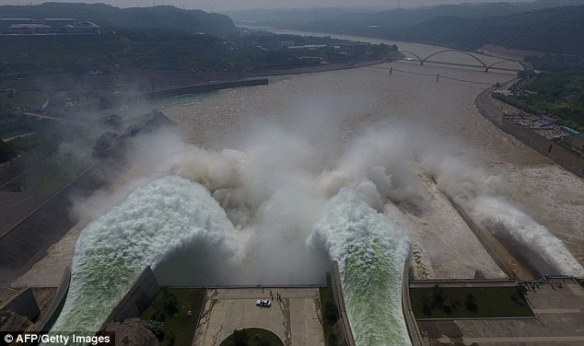
Earlier this year, Beijing itself highlighted its water hegemony over downstream countries by releasing some of its dammed water for drought-hit nations in the lower Mekong basin.

Blocking the flow of the Xiabu river, a Brahmaputra tributary, through a dam project is a significant development, a forewarning that China intends to do a lot more to re-engineer flows in the Brahmaputra system by riding roughshod over the interests of the lower riparians, India and Bangladesh.

Just as it has heavily dammed the Mekong, China is now working to complete a cascade of dams in the Brahmaputra basin.

Dependence

On the Mekong, China has erected six giant dams, with the smallest of them bigger than the largest dam India has built since Independence.

For the downriver countries in that basin, the release of water from the Chinese dams to combat drought was a jarring reminder of not just China’s new-found power to control the flow of a life-sustaining resource, but also of their own reliance on Beijing’s goodwill and charity.

With a further 14 dams being built or planned by China, their dependence on Chinese goodwill is likely to deepen – at some cost to their strategic leeway and environmental security.

Armed with such leverage, Beijing is pushing its Lancang-Mekong Cooperation (LMC) initiative as an alternative to the lower-basin states’ Mekong River Commission, which China has spurned over the years.

Indeed, having its cake and eating it, China is a dialogue partner but not a member of the Mekong River Commission, underscoring its intent to stay clued in on the discussions, without having to take on any legal obligations.

The Mekong, Southeast Asia’s lifeline, is just one of the international rivers China has dammed.

It has also targeted the Arun, the Indus, the Sutlej, the Irtysh, the Illy, the Amur and the Salween, besides the Brahmaputra.

These rivers flow into India, Nepal, Kazakhstan, Russia or Myanmar.

Asia’s water map changed fundamentally after the communists took power in China in 1949.

It wasn’t geography but guns that established China’s chokehold on almost every major transnational river system in Asia, the world’s largest and most-populous continent.

Absorption

By forcibly absorbing the Tibetan Plateau (the giant incubator of Asia’s main river systems) and Xinjiang (the starting point of the Irtysh and the Illy), China became the source of trans-boundary river flows to the largest number of countries in the world, extending from the Indochina Peninsula and South Asia to Kazakhstan and Russia.

Beijing’s claim over these sprawling territories, which make up more than half of China’s landmass today, drew from the fact that they were imperial spoils of the earlier foreign rule in China.

Before the communists seized power, China had only 22 dams of any significant size. But now, China boasts more large dams on its territory than the rest of the world combined.

If dams of all sizes and types are counted, their number in China surpasses 85,000. Strongman Mao Zedong initiated an ambitious dam-building programme, but the majority of the existing dams were built in the period after him.

China’s dam frenzy, however, shows no sign of slowing. The country’s dam builders, in fact, are shifting their focus from the dam-saturated internal rivers (some of which, like the Yellow, are dying) to the international rivers, especially those that originate on the waterrich Tibetan Plateau.

This raises fears that the degradation haunting China’s internal rivers could be replicated in the international rivers.

Leverage

China, after all, has graduated to erecting mega-dams.

Take its latest dams on the Mekong: the 4,200- megawatt Xiaowan (taller than the Eiffel Tower in Paris) and the 5,850- megawatt Nuozhadu, with a 190-square-kilometre reservoir.

Either of them is larger than the current hydropower-generating capacity of the lower Mekong states combined.

Despite its centrality in Asia’s water map, China has rebuffed the idea of a water-sharing treaty with any neighbour. The concern is thus growing among is downstream neighbours that China is seeking to turn water into a potential political weapon.

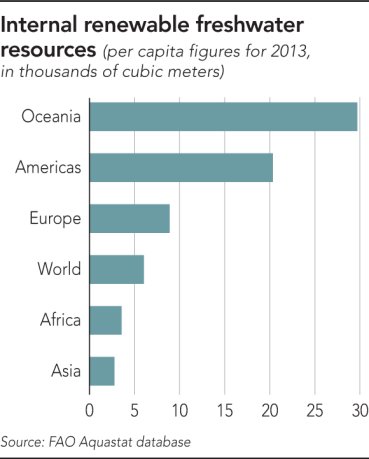
After all, by controlling the spigot for much of Asia’s water, China is acquiring major leverage over its neighbours’ behaviour in a continent already reeling under low freshwater availability.

China is clearly not content with being the world’s most dammed country, and the only thing that could temper its dam frenzy is a prolonged economic slowdown at home.

Flattening demand for electricity due to China’s already-slowing economic growth, for example, offers a sliver of hope that the Salween river could be saved from the cascade of hydroelectric mega-dams that Beijing has planned to build on it.

Even so, China’s riparian might will remain unmatched.

© Mail Today, 2016.

India’s critical test on Pakistan

Brahma Chellaney, Open magazine

pakistan_mapDoes the military operation conducted by Indian para commandos across the Line of Control (LoC) in Jammu and Kashmir (J&K) in the wee hours of September 29 change the fundamentals of India’s strategic dynamic with Pakistan? The answer is no. A single military operation, however successful at the tactical level, cannot by itself impose sufficient deterrent costs on the enemy or demonstrate India’s strategic resolve, which has been found wanting for years. New Delhi has a long way to go before it can hope to reform the Pakistani military’s conduct or deter its rogue Inter-Services Intelligence (ISI) agency from staging more cross-border terrorist strikes, whether in India or on Indian targets in Afghanistan.
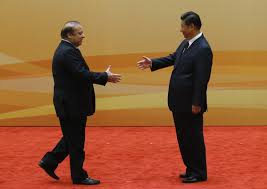
The Indian Army had conducted cross-LoC operations previously, often in reprisal to military provocations, such as when intruding Pakistani forces chopped three Indian soldiers in 2011, taking away the severed heads of two as a “trophies”. What broke new ground on September 29 was the scale of the cross-LoC military action (hitting multiple targets located several kilometres deep) and its public disclosure by the Indian Army and government.

Yet, despite the frenzied hype, the set of surgical strikes on cross-LoC terrorist launchpads was a limited military operation, with limited military objectives, and yielding limited military benefits. The operation cannot by itself dissuade the Pakistani military from continuing to wage an undeclared war against India through terrorist proxies. Indeed, the Indian military must now exercise utmost vigilance to ward off likely Pakistani retaliation, including through terrorist surrogates.

To be sure, the political, psychological, diplomatic and strategic benefits from the Indian surgical strikes are greater than the tactical military gains. The strikes represented a break from India’s “do nothing” approach, which came to define its policy for long. By symbolizing an end to Indian indecision and inaction, the action has helped lift the sense of despair that had gripped the country over the lack of any tangible response to Pakistan-backed terrorist attacks. Politically, by signalling an end to the era of Indian inaction, the operation has put the Pakistani military on notice that India would henceforth respond in punitive, hard-to-anticipate ways.

Still, the benefits accruing from the action can easily be frittered away if India does not stay the course to squeeze Pakistan in a calibrated but ever-increasing manner to help bring it to heel.  The risk of India squandering the gains is real. After all, the biggest shortcoming in India’s Pakistan policy has been the country’s inability to maintain a consistent Pakistan policy. India finds it very difficult to stay its course for more than a few months, before the itch to win a Nobel peace prize or political pressure from the United States prompts whoever is the prime minister to reverse course and resume “peace” talks with Pakistan.

The focus of successive Indian governments on short-term considerations at the expense of India’s enduring interests has remained the country’s Achilles heel. This has exacerbated India’s Pakistan challenge, despite that country’s descent into a jihad-torn, dysfunctional state.

In fact, India’s own passivity and indecision played no small part in fuelling Pakistan’s proxy war by terror. There was little discussion in India as to why it should allow itself to be continually gored by a country that is much smaller than it economically, demographically and militarily. For long, India’s response to the Pakistani strategy to inflict death by a thousand cuts was survival by a thousand bandages.

The illogic of India’s long-suffering, “do nothing” approach to Pakistan’s unconventional war was exposed when it finally mustered the political courage and ordered a daring cross-LoC operation. The surprise action — staged at a time when the Pakistani military, after the Uri terrorist attack, was in a state of full combat readiness — demonstrated how military power can be smartly applied below the threshold of nuclear use and without creating an undue risk of conventional escalation. In doing so, India has created strategic space for staging repeated and more-intense military forays across the LoC to inflict pain and punishment on the terror masters and their surrogates.

In fact, the imperative for further cross-LoC punitive actions in a calibrated manner — not immediately but whenever tempting opportunities open up — has been underscored by the Pakistani military remaining in denial mode over India’s September 29 operation. With Pakistan’s military generals covering up the Indian strikes, Pakistanis seem sceptical of the Indian claims. Deterrence, to be effective, must be targeted not just at the military generals but also at the elected civilian leadership and the public. No military can sustainably operate without public support at home.

In this light, to deter Pakistan’s war by terror, India must carefully but convincingly re-demonstrate its punitive conventional capability in propitious settings. Deterrence, after all, is like beauty: It lies in the eyes of the beholder. It is not what India claims but what its adversary believes that constitutes deterrence (or the lack of it). A one-off cross-LoC operation, in any event, cannot keep the Pakistani military off balance and forestall further terrorist attacks.

For that reason, only time will tell whether the September 29 action constitutes a break with India’s passive, reactive and forbearing mindset or represents just a one-off operation to salvage the Indian leadership’s credibility, which had been dented by inaction on a series of Pakistan-backed terrorist strikes that have occurred over many years, fuelling public wrath. On Prime Minister Narendra Modi’s watch alone since his election in May 2014, Pakistan-scripted terrorist attacks have extended from Indian consulates at Herat, Mazar-i-Sharif and Jalalabad in Afghanistan to targets at Mohra, Gurdaspur, Udhampur, Pathankot, Pampore and Uri in India.

The attacks on Modi’s watch have suggested that the terror masters in Pakistan, learning from the international outrage over their November 2008 strikes on civilians in Mumbai, are concentrating their spectacular hits on symbols of the Indian state, including security forces.

For Modi, the pre-Uri inaction damaged his strongman image that helped bring him to power in the first place. Indeed, the apparent naiveté the government displayed in responding to the Pathankot air-base attack early this year, which killed seven Indian military men, invited public ridicule: It shared intelligence with Pakistan about the Pakistani origins of the attackers while the four-day siege of the base was still on, and then invited a Pakistani team, including at least one ISI officer, to visit the base — all in the fond hope of winning Pakistan’s anti-terrorism cooperation, despite India’s bitter experience in the Mumbai case where it presented dossiers of evidence to Pakistan.

Against this backdrop, the deadly Uri attack, by claiming the lives of 19 Indian soldiers, became Modi’s defining moment, putting his credibility at stake and eliminating inaction as a continuing option. The government had to act to redeem its image. In keeping with Modi’s fondness for springing surprises, the cross-LoC operation caught everyone by surprise, including analysts in India who had been claiming that the country had no military option even against transboundary terrorist bases.

If the latest developments bring consistency to Modi’s often erratic and meandering Pakistan policy, they would represent a potential game changer. But if India some months down the road were to return to “peace” talks with Pakistan, this would be clear proof not only that the Modi government largely designed the September 29 operation to politically save face, but also that the country is still unable to stay its course by kicking its principal weakness.

Let’s be clear: No short-term Indian strategy can help tame a scofflaw Pakistan. That country’s roguish actions spring from its foundational loathing of India. That loathing is rooted in its dual belief that it was created as an embodiment of the legacy of the medieval conquerors and plunderers who unfurled the standard of Islam over India and that Pakistanis, as the progeny of the conquerors and plunderers, are innately braver than the Indian “infidels.” Barely 10 weeks after its birth as the world’s first Islamic republic of the post-colonial era, Pakistan launched its first war against India by sending raiders into J&K while denying any such action. Today, the Pakistani military, steeped in jihadism, controls the deep state, rearing terrorists for cross-border missions and turning the country into the Mecca of terrorism.

India’s fight to tame Pakistan thus will be long and hard. India’s Pakistan dilemma is compounded by the lack of credible military options to inflict unbearable costs on the adversary in peacetime or, in the event of a full-fledged war, to impose peace on India’s terms by decisively defeating the Pakistani military on the battlefield. India thus must exercise its conventional reprisal options in peacetime cautiously and close to the LoC or risk the outbreak of a full-blown war. This may explain why India called its September 29 action an anti-terrorist operation “not aimed at the Pakistani military”, although the military, as the sponsor and protector of terrorist groups, is the root of all terrorism emanating from Pakistan.

Still, bearing in mind that Pakistan’s activities to undermine India are largely carried out across the LoC, a proactive India can make life difficult for the Pakistani military along the LoC, without its special forces having to penetrate too deeply. India, moreover, controls the escalation ladder. The burden is on Pakistan to take any step up on the escalation ladder, knowing that India will respond to such a move by inflicting severe pain and punishment on it.

More fundamentally, without imposing significant and direct costs on the Pakistani military and, by extension, on the Pakistani state, India cannot hope to deter Pakistan’s war by terror. This means India must initiate a comprehensive campaign that uses all employable instruments to squeeze Pakistan hard. Indeed, to organize sustained and mounting pressure on Pakistan, India will have to rely more on non-military tools of leverage than on cross-border operations by its special forces. And if India wants the rest of the world to act against Pakistan, it must first act itself against that country.

Thus far, India has taken no direct action to penalize the Pakistani state, other than informally suspend the Permanent Indus Commission and cause the collapse of the SAARC summit by withdrawing from it — an action that pre-empted Bangladeshi and Afghan moves to pull the plug on the summit. India’s diplomatic relations with Pakistan have not even been downgraded; the Most Favoured Nation status granted to Pakistan on a non-reciprocal basis for two decades has not been withdrawn; and New Delhi has made no move to designate Pakistan as a state sponsor of terrorism or to declare bounties on the heads of terrorist leaders operating openly from Pakistan.

How can India expect the rest of the world to isolate Pakistan while it maintains full diplomatic relations with that country and shies away from imposing sanctions on it? In fact, with Pakistan’s principal benefactors, China and America, continuing to prop it up, it will not be easy for India to internationally isolate Pakistan.

By repeatedly vetoing United Nations action against terrorist Masood Azhar since 2014, China is culpable in the killing of Indian soldiers at Uri and Pathankot. China has shown the extent to which it is willing to go to shield Pakistan’s patronage of terrorism in order to undermine Indian security. To make matters worse, Modi, by letting China double its trade surplus with India on his watch, has weakened his bargaining position with Chinese President Xi Jinping.

The U.S., for its part, enforces sanctions against a host of countries, from Russia and North Korea to Sudan and Syria, yet shields from sanctions the world’s top state sponsors of terrorism — Pakistan and Saudi Arabia. The White House recently went to the extent of shutting down an online petition calling for designating Pakistan as a state sponsor of terrorism, after the petition had garnered 625,723 signatures. America is indirectly subsidizing a renegade Pakistan with the soaring profits from its booming arms sales to India.

Leverage holds the key to effective diplomacy. Yet India has shied away from leveraging its weapon purchases or its recent early ratification of the Paris climate change agreement (weighted in favour of the world’s top two polluters, the U.S. and China) to bring about change in the American stance of opposing any sanctions on Pakistan. If Hillary Clinton is elected president in November, India can be sure that the U.S. will continue to shield its terrorist protégé, Pakistan.

In these circumstances, the onus is on the victim, India, to act against and discipline terror-exporting Pakistan on its own. This means India must stay its course, rebuffing U.S. pressure. As the American academic C. Christine Fair has said in a recent essay in the journal National Interest, the U.S., by exerting diplomatic pressure on India after each terrorist carnage to exercise restraint, “rewards Pakistan in numerous ways,” including “from the consequences of its illegal behaviour” and by implying that “there is a legitimate dispute and that both sides are equally culpable for the enduring nature of this dispute”.

India needs to pursue a doctrine of graduated escalation, applying multipronged pressure on the adversary’s vulnerable points to inflict pain and punishment through economic, diplomatic, riparian and political instruments and its special forces. Consistent with this doctrine, India should start imposing costs on Pakistan in a calibrated and gradually escalating manner.

If Pakistan can wage an undeclared war by terror for over three decades, India, with its greater economic, military and diplomatic resources, is better positioned to spearhead a more-potent undeclared war by other means. India’s objective should be to assist a quasi-failed Pakistan in becoming a failed state that no longer has the capacity to threaten regional and international security. Realizing this objective calls for an unrelenting silent war, employing multiple tools of leverage and coercion to squeeze Pakistan on all fronts, even if it takes years to defang it.

However, if, in a year’s time or so, New Delhi returns to “peace” talks with Pakistan, it will be crystal clear that India’s biggest enemy is India.

Brahma Chellaney is professor of strategic studies at the Centre for Policy Research in New Delhi and Richard von Weizsäcker Fellow of the Robert Bosch Academy in Berlin.

© Open, 2016.

Sino-Pakistan nexus shields terror

BRAHMA CHELLANEY | DNA, 12 October 2016

imagesThe implications for India of the growing strategic nexus between China and Pakistan are stark because the two are hostile, non-status-quo powers bent upon seizing additional Indian territory and undermining Indian security in different ways. Indeed, the nexus extends to shielding Pakistani terrorism at the United Nations. This makes China complicit in Pakistan’s proxy war by terror against India.

Pakistan’s value for Beijing as a strategic surrogate to help box in India has risen even as that country has descended into greater jihadist extremism and political disarray. In fact, a dysfunctional, debt-ridden Pakistan gives China greater leeway to strategically penetrate it. Having deployed thousands of Chinese army troops in Pakistan-occupied Jammu and Kashmir, especially Gilgit-Baltistan, since at least 2010, Beijing is working to turn Pakistan into its land corridor to the Arabian Sea and the Indian Ocean through the so-called “one belt, one road” project.

China’s nexus with Pakistan has been likened by Beijing to the closeness between lips and teeth. Beijing has also been calling Pakistan its “irreplaceable all-weather friend”. The two often boast of their “iron brotherhood”. The relationship has also been described in flowery terms — “taller than the mountains, deeper than the oceans, stronger than steel, and sweeter than honey”.

In reality, a rapidly rising China has little in common with aid-dependent Pakistan, beyond the fact that both are revisionist states not content with their existing frontiers. They do, however, share an interest in containing India, including by unconventional means. This explains why China, seeking to destabilize India, has gone to the extent of shielding Pakistan’s patronage of terrorism.

By repeatedly vetoing UN sanctions on terrorist Masood Azhar, China is culpable in killing of 26 Indian soldiers at Uri and Pathankot by Jaish-e-Mohammed, a covert front organisation for Pakistan’s rogue Inter-Services Intelligence agency. When China on October 8 put a technical hold on the proposed UN sanctions on Azhar, it was its fifth such move since September 2014 blocking action against him.

Previously, China also came in the way of Indian efforts for the UN to proscribe United Jehad Council chief Syed Salahuddin, to censure Pakistan for freeing Lashkar-e-Taiba commander and 26/11 accused Zaki-ur Rehman Lakhvi on bail, and to probe how UN-designated terrorist Hafiz Saeed is able to fund and organise large public rallies in Pakistan.

That Beijing shields Pakistan’s unconventional war against India through terrorist proxies should surprise few, given China’s own use of unconventional instruments in peacetime against India —from dispatching arms to Indian rebel groups, often through the Myanmar corridor, to carrying out intermittent cyber attacks on Indian government, defence and commercial targets. Like Pakistan’s export of terrorism, China employs non-state actors in such missions, designed to keep India off balance or gain asymmetrical advantages.

As China cements Pakistan’s status as its economic and security client, India must do what it can to throw a spanner in the Chinese works. The Chinese military presence in Pakistan-held J&K means that India faces Chinese troops on both flanks of its J&K state. New Delhi cannot stay mum on China’s growing military footprint in a region that India regards as its own territory. The planned $46-billion economic corridor from Xinjiang to Gwadar constitutes China’s new pincer strategy.

India should seek to raise the diplomatic and security costs for China’s activities in Pakistan. After all, no other country in the world faces an axis between two expansionist nuclear-armed neighbours with a proven track record of covert actions in breach of international norms.

Brahma Chellaney is a geostrategist and author.

© DNA, 2016.

The Challenge from Authoritarian Capitalism to Liberal Democracy

Brahma Chellaney

Liberal democracy today faces an internal challenge — from the populist movements of the left and the right that have resulted from the badly skewed distribution of the gains from globalization. The strong tides of anti-establishment anger have shaken politics to its core in a number of Western democracies, as symbolized by the British vote to leave the European Union and the rise of Donald Trump in the United States. Liberal democracy, however, faces a bigger threat from outside that few commentators are talking about.

One of the most profound developments in the post-Cold War era has been the rise of authoritarian capitalism as a political-economic model, especially for developing countries. This model, best symbolized by China, involves a fusion of autocratic politics and crony, state-guided capitalism.

Between 1988 and 1990, as the Cold War was winding down, pro-democracy protests broke out in several parts of the world — from China and Myanmar to Eastern Europe. The protests helped spread political freedoms in Eastern Europe and inspired popular movements elsewhere that overturned dictatorships in countries as disparate as Indonesia, South Korea, Taiwan and Chile. After the Soviet disintegration, even Russia emerged as a credible candidate for democratic reform.

The overthrow of a number of totalitarian or autocratic regimes did shift the global balance of power in favor of the forces of democracy. But not all the pro-democracy movements were successful. And the subsequent “color revolutions” only instilled greater caution among the surviving authoritarian regimes, prompting them to set up countermeasures to foreign-inspired democratization initiatives.

More than a quarter-century after the fall of the Berlin Wall, the global spread of democracy unmistakably has stalled. Democracy may have become the norm in the West but, in the rest of the world, only a minority of states are true democracies. Using market forces to liberalize tightly centralized political systems may actually have aided the rise of authoritarian capitalism.

Political homogeneity may be as inharmonious with economic advance as the parallel pursuit of market capitalism and political autocracy. But where authoritarianism is deeply entrenched, the fusion of autocratic politics and state-guided capitalism has progressed well in some prominent cases.

When U.S. President Barack Obama recently paid a historic visit to Cuba — the first by an American president since that small island-nation’s revolution established the first communist state in the western hemisphere in 1959 — it aroused hopes of change. After all, Cuba has incrementally implemented limited economic reforms. Some analysts have hoped that democracy would follow capitalism into Cuba.

However, where communists monopolize power or dominate the political scene, a transition to democracy needs more than capitalism to proceed. Nothing better illustrates this than the world’s largest and oldest autocracy, China, which has risen dramatically as a world power by blending market capitalism and political monocracy. The Chinese Communist Party — which boasts 88 million members, more than Germany’s total population ¬¬— dominates the country’s political, economic and social life.

Vietnam and Laos — two other countries that, like China, officially claim to be communist while practicing capitalism — have also dashed hope for market forces to create a freer flow of ideas and to gradually open up autocratic political systems thriving on private enterprise. Vietnam and Laos began decentralizing economic control and encouraging private enterprise in the late 1980s and now rank among Asia’s fastest-growing economies. Yet their one-party systems have maintained tight control on political expression.

Capitalism actually strengthens a communist state’s capacity to more effectively employ technology and other resources for internal repression and information control. One classic example is the notorious “Great Firewall of China,” a government operation that screens and blocks Internet content, creating a politically sanitized information realm for citizens.

By practicing authoritarian capitalism, an autocratic state can stay abreast with technological innovations to help deny dissidents the means to denounce injustice. Such denial can include blocking or real-time censorship of social-media platforms, including instant messaging.

The point is that, in countries where communists call the shots, a free market for goods and services does not generate a marketplace of ideas. In a communist state, rising prosperity through economic liberalization does not create conditions for political pluralism. In other words, countries that liberalize economically do not necessarily liberalize politically, especially when political conditions remain adverse to change.

As an ideology, communism may have lost its moorings, yet it remains antithetical to democracy, because it is centered on monopolizing political power. In all the communist-governed states, cloistered oligarchies have emerged as the original ideology has given way to new means to retain political power, including family lineage, network of connections, corruption and ruthless self-promotion.

Still, communism has helped to spawn the model of authoritarian capitalism. Communism was never a credible challenge to liberal democracy but authoritarian capitalism is.

Through its success story, China, for example, advertises that authoritarian capitalism is a more rapid and smoother path to prosperity and stability than the tumult and uncertainty of electoral politics and the constant tussle between the executive branch and the legislature in democracies. This model provides encouragement to other autocratic states to pursue economic growth and regime stability through authoritarian capitalism.

More broadly, at a time when democratic and free-market principles have come under pressure, the rise of authoritarian capitalism underscores the imperative for an international debate on a fundamental issue — why the global spread of democracy has stalled. Is the rise of authoritarian capitalism one factor?

Human dignity matters a lot. A poor person can be happy but a rich individual can be miserable, depending on the circumstances of their existence. With dignity, even a poor person can hold his head high. The question is: Can a political-economic system that strips citizens of their dignity survive indefinitely?

Authoritarian capitalism usually pretends to be meritocracy offering competent governance and economic opportunity for all. In reality, it entrenches corrupt oligarchies that are answerable to no one and that employ ultra-nationalism as the legitimating credo of their monopoly on power.

© China-US Focus, 2016.

Years of Indian indecision and inaction ends

Brahma Chellaney, The Hindustan Times

downloadIndia has finally broken out of years of paralytic indecision and inaction on Pakistan’s proxy war by staging a swift, surgical military strike across the Line of Control — a line it did not cross even during the 1999 Kargil War.  Although a limited but unprecedented action, in which Indian paratroopers destroyed multiple terrorist launchpads, it will help to dispel the sense of despair that had gripped India over its prolonged failure to respond to serial Pakistan-backed terrorist attacks.

At the same time, the action represents a loss of face for Pakistan’s all-powerful military, which was quick to deny any such strike. The denial, however, will carry little credibility even within Pakistan, given the military’s long record of refusing to own up to its own actions — from sending raiders into Jammu and Kashmir in 1947 and staging Operation Gibraltar in 1965 to sending light infantry soldiers into Kargil in 1999. When the Pakistani military even denies training and arming terrorists for cross-border missions, how can it admit that Indian paratroopers targeted terrorist launchpads it maintains?

Still, a one-off surgical attack can do little to help reform the Pakistani military’s conduct or deter its rogue Inter-Services Intelligence agency from staging more terrorist strikes on Indian targets. The critical question to ask is whether India, having shaken off its diffidence, will be willing to stage more raids by its special forces across the LoC — not immediately, but in the months to come, so as to forestall terrorist attacks by keeping the Pakistani military off balance.

However, the proxy war by terror is unlikely to end without India imposing significant costs directly on the Pakistani military and the Pakistani state. Militarily, that is a challenging task.

In general, the purpose of any major military action ought to be twofold: to inflict unbearable costs on the enemy; and, if the action escalates to a full-fledged war, to decisively defeat the foe on the battlefield in order to impose peace on it on one’s own terms.

The current military situation is such that India cannot have full confidence in achieving these objectives. For example, any major military action needs the surprise element to take the enemy unawares and gain a significant early advance. With Pakistan in a state of full combat readiness after scripting the Uri attack, there is no surprise element that can be exploited by India to launch a major offensive.

In these circumstances, applying sustained, multipronged pressure on the enemy’s vulnerable points to inflict pain and punishment through economic, diplomatic, riparian and political instruments and special forces is a better option than waging an open war that might not produce a decisive result.

That India managed to stage a daring cross-border raid despite Pakistan’s full military alertness is a reminder that smart application of military force yields better results than a heavy-handed, knee-jerk military response.

Make no mistake: India’s fight to tame a scofflaw Pakistan will be long and hard. The tendency to seek quick results must be eschewed. Indeed, the biggest enemy of India’s goals has been the failure to maintain a consistent Pakistan policy. Rhetoric is no substitute for clear-eyed policy and deterrent action.

Today, from reviewing the lopsided Indus Waters Treaty to staging the raid across the LoC, India is signalling that enough is enough and that it will do whatever it takes to beat back Pakistan’s terrorism onslaught. India must use every lever of leverage and coercion in a relentless, all-out silent war to bring Pakistan to heel.

Brahma Chellaney is a geostrategist and author.

© The Hindustan Times, 2016.

Why India must reclaim its water leverage in the Indus basin

For India, reclaiming its Indus leverage is a cheaper, more-potent option to reform Pakistan’s behaviour than fighting a war.

cs8tdqxuiaabjep

From Brahma Chellaney, Water: Asia’s New Battleground (Washington, DC: Georegetown University Press).

Brahma Chellaney, The Hindustan Times, September 28, 2016

Be careful what you wish for: Not content with Pakistan enjoying a water-sharing arrangement with India that is by far the world’s most generous, the country’s Senate passed a unanimous resolution in March that declared: “This House recommends that the Government should revisit Indus Waters Treaty (IWT), 1960, in order to make new provisions in the treaty so that Pakistan may get more water for its rivers.” Little did the parliamentarians know that India would heed that call by revisiting the pact, which lopsidedly reserves for the lower riparian 80.52% of the total waters of the six-river Indus system, or 167.2 billion cubic metres of the aggregate 207.6 billion cubic metres average yearly flows. A naïve India, thinking it was trading water for peace through the IWT, even contributed $173.63 million for dam and other water projects in Pakistan.

Prime Minister Narendra Modi’s decision to review IWT arrangements, including India’s rights and obligations, extends to suspending the Permanent Indus Commission. The commission has done little more than run regular consultative meetings between its two commissioners, each of whom acts on behalf of his country. In the aftermath of the December 2001 Parliament attack by five Pakistani gunmen, India suspended any commission meeting. But this marks the first occasion that India has set in motion a reappraisal of the IWT, forming an inter-ministerial panel.

If an inherently unequal water treaty is to endure, the direction of the Pakistan-India relationship needs to change toward respecting all bilateral commitments. Pakistan cannot expect the IWT to survive eternally if it refuses to honour the terms of the central treaty governing bilateral relations — the 1972 peace pact signed at Simla. It also flouts its subsequent commitments not to allow its territory to be used for cross-border terrorism. Rights and obligations under the older IWT cannot override the terms of the Simla treaty, which provides the essential basis for all peaceful cooperation, including mandating the Line of Control’s inviolability and dispute settlement by bilateral means.

Today, Pakistan, refusing to accept international norms of interstate behaviour, demands rights without responsibilities. It wages an undeclared war by terror to bleed the upper riparian while insisting that its target perpetually be munificent on water sharing. Just because a scofflaw state has enjoyed unparalleled water largesse for 56 years does not mean that such generosity by the upper riparian must last forever. Indeed, Pakistan challenges the very fundamentals of international law by seeking to repay its co-riparian’s water munificence with blood.

Like Lady Macbeth in William Shakespeare’s Macbeth, Pakistan’s terrorism-exporting generals must ask themselves whether all the waters flowing in the Indus system would “wash this blood clean” from their hands. Modi has rightly warned: “Blood and water cannot flow simultaneously.” In fact, Pakistan’s roguish conduct has armed India with the lawful option to invoke Article 62 of the Vienna Convention on the Law of Treaties to dissolve the IWT. In the interim, it could suspend the treaty’s implementation.

The purpose of any potential IWT-related action by India would not be to cut off water flows to Pakistan. Rivers flow from mountains to oceans or large lakes, and no nation can completely undo the laws of nature. Rather, the action would be aimed at India regaining sovereignty over the Jammu and Kashmir rivers, which the IWT has reserved for Pakistan’s use by limiting India’s full sovereignty to the three smaller rivers flowing south of J&K. No other modern treaty has partitioned rivers in such a blatant, neo-colonial manner.

By reclaiming its basic right over the J&K rivers, India could fashion water as an instrument of leverage to bring Pakistan to heel. Even a 10% diminution in transboundary water flows would hurt Pakistan, whose debt-ridden economy is reliant on earnings from agricultural exports, especially water-intensive rice and cotton. Pakistan’s per capita water use is almost 80% higher than India’s.

To deter India from employing its water leverage, the bugbear of Chinese retaliation has been invented. The plain fact is that China has little clout in the Indus basin: Four of the six rivers (including the two with the largest transboundary flows into Pakistan, the Chenab and the Jhelum) originate in India — three of them in Himachal Pradesh alone. The other two, the main Indus stream and the Sutlej, begin as small rivers in Tibet and collect their main water in India.

China, which rejects water sharing even as a concept, is already doing whatever it wishes in other transnational basins. From the Brahmaputra and the Arun (Kosi) to the Mekong and the Salween, China is reengineering transboundary flows by building cascades of dams, with little regard for downstream impacts in Asia.

For India, reclaiming its leverage in the Indus basin is a cheaper option to reform Pakistan’s behaviour than fighting a war. Indeed, India’s best bet to end cross-border terrorism is employing ‘peaceful’ options — from diplomatically isolating Pakistan and mounting riparian pressures to waging economic, cyber and asymmetric warfare. Modi’s IWT re-examination is a step in the right direction.

Brahma Chellaney is the author of “Water, Peace, and War” and “Water: Asia’s New Battleground.”

© The Hindustan Times, 2016.

Fifteen years on, the Afghanistan war still rumbles

Brahma Chellaney, The Globe and Mail

dod-photo-by-staff-sgt-william-tremblay-u-s-army1Despite the worsening Afghanistan quagmire, this month’s 15th anniversary of the longest war in American history attracted little attention. The raging battles cast a shadow over Afghanistan’s future and highlight the failure of U.S. President Barack Obama’s strategy to gradually wind down the conflict. The war now draws little international attention, except when a major militant attack occurs.

The current situation in Afghanistan is worse than at any time since 2001, when the U.S. invasion helped oust the Taliban from power, forcing them to set up their command-and-control structure in neighboring Pakistan, their creator and steadfast sponsor.

Today, the resurgent Taliban hold more Afghan territory than before, the civilian toll is at a record high and Afghan military casualties are rising to a level that American commanders warn is unsustainable. From sanctuaries in Pakistan and from the Afghan areas they hold, the militants are carrying out increasingly daring attacks, including in the capital Kabul, as illustrated by the recent strike on the American University of Afghanistan.

In declaring war in Afghanistan on September 21, 2001 after the world’s worst terrorist attack in modern history ten days earlier in the United States, President George W. Bush explained why 9/11 was a turning point for America: “Americans have known wars — but for the past 136 years, they have been wars on foreign soil, except for one Sunday in 1941 [Pearl Harbor]. Americans have known the casualties of war — but not at the center of a great city on a peaceful morning. Americans have known surprise attacks — but never before on thousands of civilians. All of this was brought upon us in a single day…”

Yet before he could accomplish his war objectives in Afghanistan, Bush invaded and occupied Iraq — one of the greatest and most-calamitous military misadventures in modern history that destabilized the Middle East and fueled Islamist terrorism.

Obama came to office with the pledge to end the Bush-era wars in Afghanistan and Iraq. In Iraq, he ended the Bush war, only to start a new war in the Syria-Iraq belt.

In Afghanistan, Obama thought that he could end the war simply by declaring it over. This is what he did in December, 2014, when he famously declared that the war “is coming to a responsible conclusion.” But the Afghan Taliban had little interest in peace, despite Washington allowing them to set up a de facto diplomatic mission in Qatar and then trading five senior Taliban leaders jailed at Guantanamo Bay for a captured U.S. Army sergeant.

As a result, Obama repeatedly has had to change his plans in Afghanistan. In July 2011, he declared that by 2014 “the Afghan people will be responsible for their own security,” adding seven months later that, “By the end of next year, our war in Afghanistan will be over.” Then in May 2014, he promised that, “One year later … our military will draw down to a normal embassy presence.”

But just two months ago, he decided to keep 8,400 U.S. troops in Afghanistan indefinitely and leave any withdrawal decision to his successor. Some 26,000 American military contractors also remain in Afghanistan, doing many jobs that troops would normally do, according to the U.S. House Armed Services Committee.

In fact, the deteriorating Afghan security situation has forced Obama to reverse course on ending U.S. combat operations and give the American military wider latitude to support Afghan forces. For example, he has now allowed American troops to accompany regular Afghan troops into combat. He has also allowed greater use of U.S. air power, particularly close air support. It is a clear recognition that his strategy to end the war lies in tatters.

This raises the key question: Why is the U.S. still stuck in the war? In large part, it is because it has fought the war on just one side of the Afghanistan-Pakistan divide and been reluctant to go after the Pakistan-based sanctuaries of the Afghan Taliban and its affiliate, the Haqqani network, which enjoys tacit Pakistani intelligence support.

The U.S. assassination in May of Afghan Taliban chief Akhtar Mohammad Mansour by a drone strike inside Pakistani territory was a rare exception — a one-off decapitation attack that did little to change the military realities on the ground.

Research shows that terrorist or militant groups are generally resilient to the loss of a top leader, unless their cross-border sanctuaries are systematically targeted. Indeed, as Israel’s record and America’s own experiences in Somalia, Syria and Yemen show, decapitation can actually help a militant group to rally grassroots support in its favor and against the side that did the killing.

The fact is that no counterterrorism campaign has ever succeeded when the militants have enjoyed cross-border havens. The Afghan Taliban are unlikely to be defeated or genuinely seek peace as long as they can operate from sanctuaries in Pakistan. Indeed, their battlefield victories give them little incentive to enter into serious peace negotiations.

As for Pakistan, Mansour’s killing near where its borders meet with Iran and Afghanistan exposed years of denials by Pakistani officials that they were sheltering Taliban leaders. Like in the 2011 raid by U.S. Navy SEALs that killed Osama bin Laden, Mansour’s assassination involved the U.S. violating the sovereignty of a country that is one of the largest recipients of American aid.

Although Obama hailed the Mansour killing as “an important milestone,” the decapitation cast an unflattering light on U.S. policy: America took nearly 15 years to carry out its first – and thus far only – drone strike in Pakistan’s sprawling Balochistan province, the seat of the Afghan Taliban’s command-and-control structure.

In order to preserve the option of reaching a Faustian bargain with the Afghan Taliban, the U.S. over the years has concentrated its drone strikes in Pakistan’s Federally Administered Tribal Areas (FATA), often targeting the Pakistani Taliban — the Pakistani military’s nemesis. The U.S. military has failed to disrupt the Haqqani network because Pakistan, with the intent to keep this group’s leadership out of the reach of American drones, has moved these militants from FATA to safe houses in its major cities. Meanwhile, the Afghan Taliban leadership, with the Pakistani military’s acquiescence, has stayed ensconced in Balochistan, located to the south of FATA.

Tellingly, the United States has not designated the Afghan Taliban as a terrorist organization. The Obama White House has engaged in semantic jugglery to explain why the group is missing from the U.S. list of Foreign Terrorist Organizations.

In truth, the Obama administration is willing, as part of a peace deal, to accommodate the medieval Taliban in a power-sharing arrangement in Afghanistan. It assassinated the Taliban leader because he defiantly refused to revive long-paralyzed peace negotiations.

For almost eight years, Obama has pursued the same unsuccessful Afghanistan-related strategy, changing just the tactics. His strategy essentially has sought to use inducements to prod the Pakistani military and its rogue Inter-Services Intelligence agency to go after the Haqqani network and get the Afghan Taliban to agree to a peace deal. The inducements have ranged from billions of dollars in military aid to the supply of lethal weapons that could eventually be used against India.

However, the carrots-without-sticks approach has only encouraged the Pakistani military to run with the hare and hunt with the hounds.

Barack Obama’s successor will have to make some difficult choices on Afghanistan. To do so, she or he will have to face up to a stark truth: The war in Afghanistan can only be won in Pakistan. With the Afghan government’s hold on many districts looking increasingly tenuous, the next president, however, will not have the time like President Obama to experiment.

Brahma Chellaney is a geostrategist and the author of nine books, including, most recently, “Water, Peace, and War” (Rowman & Littlefield).

© The Globe and Mail, 2016.

Mending Pakistan’s behaviour

Brahma Chellaney, Mint, September 20, 2016

ypicAfter the bloody cross-border terrorist attack on an army camp in Uri, near the Line of Control with Pakistan, it will be difficult for Prime Minister Narendra Modi’s government to return to business as usual. Uri is just the latest in a string of important Pakistan-orchestrated strikes on Indian targets since Modi’s 2014 election victory: The other attacks occurred at Herat, Mazar-i-Sharif and Jalalabad in Afghanistan and at Mohra, Gurdaspur, Udhampur, Pathankot and Pampore in India.

New Delhi’s response to all the attacks has been characterized by one common element — all talk and no action. This is no different than the response of the governments of Manmohan Singh and Atal Bihari Vajpayee to major terrorist strikes on their watch, including at Mumbai and on Parliament and the Red Fort. It would seem that Indian leaders live up to the biblical adage, “Let every man be swift to hear, slow to speak, slow to wrath”.

With successive governments failing to pursue a coherent, resolute and unflinching strategy to combat Pakistan’s proxy war by terror, India continues to be terrorized, assaulted and bled by a smaller neighbour. A scofflaw Pakistan believes it can continue to gore India with minimal or manageable risks of inviting robust Indian retaliation. The Indian public’s patience, however, has worn thin, putting pressure on the government to start imposing deterrent costs on Pakistan so as to stem the increasingly daring terrorist strikes.

Modi’s own credibility is now at stake. Modi responded to the terrorist storming of the Pathankot air force station at the beginning of this year by sharing intelligence about the attackers with Islamabad and allowing a Pakistani team to visit the base for investigations. This was done in the naïve hope of winning Pakistan’s anti-terror cooperation. Modi’s exchange of saris and shawls with his Pakistani counterpart, Nawaz Sharif — as well as his surprise visit to Lahore to wish Sharif on his birthday and attend his granddaughter’s wedding — attested to how New Delhi was focused on optics rather than on outcomes.

The Uri attack offers Modi a chance to redeem himself on the anti-terror front. How he responds to the latest terror outrage could help shape his political legacy.

Let’s dispel with the fiction that a country can get peace by seeking peace with a renegade, terrorism-exporting neighbour. Each time terrorists sent from Pakistan carry out a barbaric attack in India, Indians circle back to a familiar question: What makes Pakistan sponsor terrorism across its borders? The answer is simple: Waging an unconventional war remains an effective, low-cost option for Pakistan against a larger, more-powerful India. The real question Indians must debate is whether India is making Pakistan bear costs for scripting cross-border terrorism.

India has a range of options in the military, economic and diplomatic realms to start imposing costs on Pakistan, in a calibrated and gradually escalating manner. Strategically, an unconventional war waged by a nuclear-armed nation can be effectively countered only through an unconventional war. Let’s be clear: Pakistan is more vulnerable to asymmetric warfare than India, which also has greater economic and diplomatic resources to squeeze that country.

If India jettisons the 1960 Indus Waters Treaty (IWT), it can fashion water into its most-potent tool of leverage to mend Pakistan’s behaviour. Pakistan has consistently backed away from bilateral agreements with India — from the Simla accord to the commitment not to allow its territory to be used for cross-border terrorism. So why should India honour the IWT?

When Pakistan refuses to observe the terms of the 1972 peace treaty signed at Simla, it undercuts the IWT. It cannot selectively demand India’s compliance with one treaty while it flouts a peace pact serving as the essential basis for all peaceful cooperation, including sharing of river waters.

The IWT ranks as the world’s most lopsided and inequitable water pact: It denies India the basic right to utilize the waters of the rivers of its own state of Jammu and Kashmir for industrial and agricultural production. The main J&K rivers — the Chenab, Jhelum and Indus — and their tributaries have been reserved for Pakistani use, with India’s sovereignty limited to the three smaller rivers of the Indus basin flowing south of J&K: the Beas, Ravi and Sutlej. In effect, the IWT kept for India just 19.48% of the total waters of the six-river Indus system.

Pakistan, by repeatedly invoking the IWT’s conflict-resolution provisions to mount pressure on India, is already undermining the treaty, the world’s most-generous sharing arrangement. Waging water war by such means carries the danger of a boomerang effect.

A balance between rights and obligations is at the heart of how to achieve harmonious, rules-based cooperation between co-riparian states. In the Indus basin, however, Pakistan wants rights without responsibilities: It expects eternal Indian water munificence, even as its military generals export terrorists to India and its civilian government wages a constant propaganda campaign against India’s water “hegemony” and seeks to internationalize every dispute.

The IWT has become an albatross around India’s neck. If India wishes to dissuade Pakistan from continuing with its proxy war, it must link the IWT’s future to Islamabad honouring its anti-terror commitment, or else the treaty collapses. Indeed, a Pakistani senate resolution passed earlier this year, calling for Pakistan to “revisit” the IWT, offers India an opening to renegotiate a more balanced and fair Indus treaty — and, if Pakistan refuses, to stop respecting the terms of the existing pact.

In the absence of an enforcement mechanism in international law, nothing can stop India from emulating Pakistan’s example in not honouring its bilateral commitments.  For example, Pakistan has flouted the Simla treaty’s key terms, including respecting the inviolability of the Line of Control as the essential basis for durable peace.

Guile, dexterity and diligence often can achieve more in international relations than the use of overt force. India can still bring Pakistan to heel without overtly employing force. By employing a mix of military, economic and political tools to squeeze Pakistan, India must wage a silent war to eliminate the threat from a quasi-failed nation that has mocked its patience as cowardice.

Brahma Chellaney is a professor at the Centre for Policy Research.

© Mint, 2016.

A watershed moment for India

Brahma Chellaney, The Hindustan Times, September 19, 2016

pakterrorFrom Atal Bihari Vajpayee’s Lahore Declaration to Manmohan Singh’s peace-at-any-price doctrine and Narendra Modi’s Lahore visit statement, India’s readiness to trust Pakistan’s anti-terrorism assurances draws attention to the adage: “Fool me once, shame on you. Fool me twice, shame on me”. India has been fooled repeatedly.

The bloody attack by Pakistan-backed terrorists on yet another military camp in Jammu and Kashmir, however, represents double shame for India: Coming after the dramatic terrorist storming of the Pathankot air base at the beginning of this year, the attack on the army headquarters at Uri near the line of control with Pakistan highlights defence-related incompetence. If Modi wishes to send a clear message, he must begin at home by firing his bumbling defence minister and fixing the drift in his Pakistan policy.

For more than a quarter-century, India has been gripped by a vacillating leadership and a paralytic sense of indecision and despair over cross-border terrorism. India’s own passivity and indecision have played no small part in fuelling Pakistan’s proxy war by terror. The rogue Inter-Services Intelligence’s “S” branch — tasked specifically with exporting terrorism to India and Afghanistan — operates through terrorist surrogates.

This year’s series of terrorist attacks on Indian targets — from Jalalabad and Mazar-i-Sharif to Pampore and Uri — signals that the ISI terror masterminds, learning from the international outrage over their November 2008 strikes on civilians in Mumbai, are now concentrating their spectacular hits on symbols of the Indian state, including security forces. For example, as New Year’s gift to India, the four-day terrorist siege of the Pathankot base coincided with a 25-hour gun and bomb attack on the Indian consulate in Mazar-i-Sharif.

The Uri attack is similarly intended to make India feel vulnerable and weak while seeking to minimize the risk of Indian retaliation. This attack, however, is likely to represent a turning point for India, especially given the number of soldiers killed. Indeed, the lesson for India from its restraint despite Pathankot is that all talk and no action invites more deadly terrorism, besides encouraging Pakistan to fuel unrest in the Kashmir Valley and “internationalize” the J&K issue.

For Modi in particular, the Uri attack constitutes a defining moment. He has completed half of his five-year term with his Pakistan policy in a mess.

Indeed, despite terrorists testing India’s resolve from Herat to Gurdaspur and Udhampur after his election victory, Modi’s response to the Pathankot siege underscored continuing strategic naïveté. Even before the siege ended, New Delhi supplied Islamabad communication intercepts and other evidence linking the attackers with their handlers in Pakistan. This was done in the hope that the terror masters will go after their terror proxies, despite India’s bitter experience in the Mumbai case where it presented dossiers of evidence to Pakistan.

India later granted Pakistani investigators access to the Pathankot base. It was like treating arsonists as firefighters. Pakistan set up its investigation team not to bring the Pathankot masterminds to justice but to probe the operational deficiencies of the Pathankot strike and to ensure that the next proxy attack left no similar telltale signs of Pakistani involvement.

Today, India has little choice but to overhaul its strategy as both diplomacy and restraint have failed to stem Pakistan’s relentless efforts to export terrorism and intermittently engage in border provocations. India must shed is focus on the last terror attack:  For example, after Pathankot, India, forgetting Mumbai, asked Pakistan to act in that case. And after Uri, Pathankot could fade into the background. Consequently, Pakistan has still to deliver even in the 1993 ‘Bombay bombings’ case.

India needs a comprehensive, proactive approach. The choice is not between persisting with a weak-kneed approach and risking an all-out war. This is a false, immoral choice that undermines the credibility of India’s nuclear and conventional deterrence and encourages the enemy to sustain aggression. It is also a false argument that India has no choice but to keep battling Pakistan’s unconventional war on its own territory. Seeking to combat cross-border terrorism as an internal law-and-order issue is self-injurious and self-defeating.

Make no mistake: India’s response to the Pakistani strategy to inflict death by a thousand cuts should no longer be survival by a thousand bandages. Rather, India must impose calibrated costs to bolster deterrence and stem aggression. Why should India allow itself to be continually gored by a country that is much smaller than it demographically, economically and militarily and on the brink of becoming dysfunctional? Just because India shied away from imposing costs on the terror masters in Pakistan for their past attacks on Indian targets, from Mumbai to Kabul, is no reason for it to stay stuck in a hole.

To deter Pakistan’s unconventional warfare, India’s response must be spread across a spectrum of unconventional options that no nation will discuss in public. Nuclear weapons have no deterrence value in an unconventional war. If the Pakistani security establishment is to get the message that the benefits of peace outweigh hostilities, it should be made to bear most of the costs that India seeks to impose. India should employ asymmetric instruments to strike hard where the opponent doesn’t expect to be hit. New Delhi should also be ready to downgrade diplomatic relations with Pakistan and mount pressure on its three benefactors, China, America and Saudi Arabia.

India’s goal is narrow: to halt cross-border terrorist attacks. In keeping with the United Nations Charter, which recognizes self-defence as an “inherent right” of every nation, India must impose measured and pointed costs on the terror exporters without displaying overt belligerence or brinkmanship.

The writer is a geostrategist and author.

© The Hindustan Times, 2016.

Wrangles over water

As Karnataka and Tamil Nadu slug it out, Pakistan wages a water war on India

Brahma Chellaney, The Times of India, September 16, 2016

p822ggnuThe violence-marred water feud between Karnataka and Tamil Nadu illustrates how water stress is fuelling bitter discord between Indian states over sharing the most vital of all natural resources. India’s Supreme Court intervened this year too in the Punjab-Haryana dispute in the Indus Basin over the Sutlej-Yamuna Link Canal.

The growing inter-provincial water wrangles draw attention to India’s great water folly in 1960: It signed a treaty that allocated to an enemy state, Pakistan, most of the Indus river system waters, without any quid pro quo. The Indus Waters Treaty (IWT) reserved for India just 19.48% of the total waters of the six-river Indus system.

An emboldened Pakistan, having secured what still ranks as the world’s most generous water-sharing treaty, set its sights on capturing the Indian part of Jammu and Kashmir through which the three large rivers reserved for Pakistani use by the IWT flowed. In more recent years, Pakistan has also found novel ways to turn the IWT into a weapon against India.

From waging conventional wars against India from almost the time it was created to sustaining a protracted proxy war by terror against it, Pakistan has for over a decade now been pursuing a “water war” strategy against India. This strategy centres on repeatedly invoking the IWT’s conflict-resolution provisions to “internationalize” any perceived disagreement so as to mount pressure on India.

In its latest move to corner India, Pakistan has initiated steps to haul it before a seven-member international arbitral tribunal in The Hague for pursuing two hydropower projects in J&K. Twice before in the past decade, Pakistan triggered international intercession by similarly invoking the treaty’s conflict-resolution provisions.

Pakistan’s strategy, coupled with its use of state-reared terrorists, could potentially force India’s hand. If India begins to view the IWT as a liability and sees itself as the suffering loser, little can save the treaty. After all, India has the option in international law to dissolve the lopsided but indefinite treaty. The Anti-Ballistic Missile Treaty was also of indefinite duration but the U.S. unilaterally withdrew from it after Russia opposed its revision.

The withdrawal option, however, cannot be exercised by a risk-averse nation. India may be parched today but there is still no national discussion about how Pakistan is repaying India’s water largesse with blood by sponsoring cross-border acts of grisly terrorism. The water card is probably the most-potent instrument India has in its arsenal — more powerful than the nuclear option, which essentially is for deterrence.

India’s belated moves to address the problem of electricity shortages and underdevelopment in J&K by building modestly sized, run-of-river hydropower plants have rankled Pakistan, although the IWT permits such projects (which use a river’s natural flow energy and elevation drop to produce electricity, without the need for any dam reservoir). The treaty requires India to provide Pakistan with prior notification, including design information, of any new project. Although prior notification does not mean the other party’s prior consent, Pakistan has construed the condition as arming it with a veto power over Indian works. To keep unrest in J&K simmering, it has objected to virtually every Indian project. Its obstruction has delayed Indian projects for years, driving up their costs substantially.

Not surprisingly, there have been repeated calls in the J&K Assembly for revision or abrogation of the IWT. By gifting the state’s river waters to Pakistan, the treaty has hampered development there and fostered popular grievance.

J&K’s total hydropower-generating capacity in operation or under construction does not equal the size of a single mega-dam that Pakistan is currently pursuing, such as the 7,000-megawatt Bunji Dam or the 4,500-megawatt Bhasha Dam. Indeed, while railing against India’s run-of-river projects, Pakistan has invited China to build mega-dams in the Pakistani-occupied part of J&K, itself troubled by discontent, including against the growing Chinese footprint there, especially in Gilgit-Baltistan.

A 2011 report prepared for the U.S. Senate Foreign Relations Committee called the IWT “the world’s most successful water treaty” for having withstood conflicts and wars. The treaty has been a success mainly because of India, which has continued to uphold the pact even when Pakistan has repeatedly waged aggression and fundamentally altered the circumstances of cooperation.

International law recognizes that a party may withdraw from a treaty in the event of fundamentally changed circumstances. Pakistan’s continuing use of state-reared terrorist groups against India constitutes reasonable grounds for the injured party to unilaterally withdraw from the IWT. Sustained sponsorship of cross-border terrorism over many years has created fundamentally changed circumstances that undermine the essential basis of India’s original consent to the IWT, while significantly altering the balance of obligations.

The Indus is Pakistan’s jugular vein. If India wishes to improve Pakistan’s behaviour and dissuade it from exporting more terrorists, it should hold out a credible threat of dissolving the IWT, drawing a clear linkage between Pakistan’s right to unimpeded water inflows and its responsibility not to cause harm to its upper riparian. A failure to respect that linkage should free India, for example, to link the Chenab (which has the largest transboundary flow) with the Ravi-Beas-Sutlej system to address water scarcity in its north.

Brahma Chellaney is Professor of Strategic Studies at the Centre for Policy Research, New Delhi.

© The Times of India, 2016.