The U.S. today risks accelerating its relative decline through strategic overreach. A first step to addressing that risk is to abandon its sanctions overreach and recalibrate its sanctions so that they stop advancing China’s commercial and strategic interests.
U.S. foreign policy has long relied on sanctions, despite their uncertain effectiveness and unintended consequences. No sooner had President Joe Biden assumed office than he slapped new sanctions on Russia and Myanmar.
Sanctions are a favorite and grossly overused tool of American diplomacy when dealing with countries that cannot impose significant costs in reprisal. Indeed, Washington has fallen into a self-injurious trap by viewing sanctions as the easy answer to any problem.
Sanctions may have been a defensible policy in the second half of the 20th century, when American economic and military power was overwhelming. But with relative U.S. wealth and power in decline, so is the efficacy of its sanctions. Far from exacting a serious penalty, U.S. sanctions often advance the commercial and strategic interests of its main competitor, China.
Nothing better illustrates this fact than China’s latest 25-year economic and security agreement with Iran, where ever-tightening U.S. sanctions have made China that country’s most important commercial partner over the past decade.
Now, under the new accord, China will boost its investment in major Iranian sectors even further, step up defense cooperation and establish a joint bank that will allow Tehran to borrow and trade in yuan, whose international use Beijing is actively promoting. Iran also shows how U.S. sanctions can penalize America’s own friends such as India and Japan.
While India’s compliance with America’s Iran-oil embargo has added billions of dollars to its fuel import costs, China has defiantly stepped up its purchases of Iranian oil at discounted prices. When the U.S. reimposed a new list of penalties on Iran in November 2018, it forced many Japanese companies to suspend their contracts with Iranian energy suppliers.
U.S. policymakers should be most worried by how their punitive actions have forced Russia to pivot to China, helping two natural competitors become close strategic partners. A forward-looking U.S. administration would avoid confronting Russia and China simultaneously, and instead seek to play one off against the other.
But Biden, claiming that a declining Russia poses “just as real” a threat as the powerful, rising, technologically sophisticated China, hit Moscow with new sanctions in early March for detaining dissident Alexei Navalny. And, subsequently vowing that Russian President Vladimir Putin will “pay a price” for his alleged meddling in U.S. presidential elections and calling him a “killer,” Biden has threatened to impose more severe boycotts.
The multiple rounds of U.S. sanctions since Russia’s 2014 takeover of Crimea have already resulted in the worst relationship Washington has had with Moscow since the fall of the Berlin Wall. And as former Defense Secretary Robert Gates recently noted, sanctions “are not going to do much good.”
In fact, Russia’s increasingly close strategic alignment with China represents a profound U.S. foreign policy failure, underscoring the counterproductive nature of American sanctions. The U.S. could seek to rebalance its relationship with Russia by easing its heavy-handed approach, but old habits die hard. More sanctions on Moscow will only strengthen China’s hand in challenging America’s global preeminence.
Paradoxically, the U.S. treats China with respect. Biden, for example, has not called Chinese President Xi Jinping a “killer” or pledged to make him pay a price, despite China’s concentration camps in Xinjiang that hold more than a million Muslim Uighurs. U.S. sanctions over the muzzling of Hong Kong’s autonomy in violation of a United Nations-registered treaty have spared those in Xi’s inner circle.
When it comes to the small kids on the block, however, U.S. sanctions often substitute for forward-thinking policy. For example, the U.S. slapped sanctions on Myanmar’s top generals in late 2019 over the ethnic cleansing of the Rohingya instead of addressing what American officials recognized as the main weakness in policy — Washington’s failure to establish close ties with Myanmar’s military.
The sanctions effectively removed all incentives for the commander in chief of Myanmar’s armed forces, Senior Gen. Min Aung Hlaing, to support continued democratization. Worse still, after helping turn National League for Democracy leader Aung San Suu Kyi into a virtual saint, the U.S. began slamming her over treatment of the Rohingya exodus and her ties to the military, emboldening the generals to stage a coup.
Now the U.S. risks repeating history. Just as crippling sanctions from the late 1980s pushed a reluctant Myanmar into China’s arms, the new series of sanctions on Myanmar since February — including the latest suspension of trade relations — is welcome news for Xi’s regime.
More fundamentally, Washington’s reliance on sanctions has highlighted the inherent weakness in its policy: The failure to develop objective criteria on the circumstances that would justify sanctions has allowed narrow geopolitical considerations to drive the imposition of sanctions seemingly at random.
Why, for example, does the U.S. readily do business with Thailand, even as the leader of the 2014 coup remains ensconced in power, but insists on “immediate restoration of democracy” in neighboring Myanmar? The Biden administration has initiated an internal review of U.S. sanctions programs to understand their utility and consequences. Yet, without waiting for the outcome of the review, Biden has taken to sanctions like a duck to water.
The U.S. today risks accelerating its relative decline through strategic overreach. A first step to addressing that risk is to abandon its sanctions overreach and recalibrate sanctions so that they do not aid Xi’s hegemony-seeking “Chinese dream.”
Brahma Chellaney is a geostrategist and author of nine books, including “Asian Juggernaut: The Rise of China, India and Japan.”
Biden inherited a coherent and realistic Indo-Pacific strategy. This explains why, while overturning his predecessor’s other policies at a rapid pace, Biden has thus far stayed the course set by the Trump administration on China and the Indo-Pacific.
President Biden has been overturning his predecessor’s policies at a frenetic pace, but on one key issue – China – he has stayed the course set by the previous administration. In a reflection of the bipartisan consensus in Washington that an increasingly aggressive China must be reined in, Biden has upped the ante by raising human-rights concerns, which Donald Trump largely ignored until the final months of his presidency. For example, while coordinating joint Western action this week to penalize China for its Muslim gulag, Secretary of State Antony Blinkendeclared that Beijing “continues to commit genocide and crimes against humanity in Xinjiang.”
Nothing better illustrates how Team Biden is hewing to the Trump administration’s approach to China than the Quad, a strategic coalition of the leading democracies of the Indo-Pacific region — Australia, India, Japan and the United States. In 2017, the Trump administration resurrected the Quad, which had been lying dormant for nine years, and placed it at the center of its “free and open Indo-Pacific” strategy. Now, at Biden’s initiative, the Quad leaders this month held their first-ever summit.
When Biden was elected, there was uncertainty over the Quad’s future, including whether the new president would carry forward his predecessor’s “free and open Indo-Pacific” strategy. Even the term “Indo-Pacific” was conspicuously absent in Biden’s presidential campaign statements and the 2020 Democratic Party Platform, which repeatedly used the old name for the region that China prefers — “Asia-Pacific.”
It was only after Biden was sworn in as president that he began speaking about a “free and open Indo-Pacific.” He then proposed the Quad summit, which was held virtually because of the coronavirus pandemic. Calling the Quad “a vital arena for cooperation in the Indo-Pacific,” Biden told the other leaders at the meeting that this was the “first multilateral summit that I’ve had the opportunity to host as president.”
The summit was a testament to the fact that the Biden administration inherited a coherent and realistic strategy on the Indo-Pacific, with the Quad at its core. The Quad has gradually sharpened its edges in recent years in response to China’s aggressive expansionism.
Likewise, Biden’s views on China have evolved significantly since his presidential campaign. On the campaign trail in 2019, Biden stunned many with his apparent strategic naivete by declaring, “China is going to eat our lunch? Come on, man. I mean, you know, they’re not bad folks, folks. But guess what? They’re not competition for us.”
Then, in a 180-degree turn as president, Biden said during an Oval Office meeting last month, “If we don’t get moving, they [China] are going to eat our lunch.” He was talking about China’s frenzied infrastructure development at home and abroad and noting that the U.S. must step up in this regard.
Just six months ago, China dismissed the idea that an international coalition against it will emerge, saying “that day will never, ever come.” But, thanks to China’s heavy-handed use of its military and economic power, that day is coming. China has fueled the Quad’s development. For example, its military aggression in the northernmost Indian borderlands of Ladakh since April 2020 has helped to move India closer into this strategic grouping.
It is precisely this border aggression that has lent new momentum to the Quad’s progress toward a concrete and formal security arrangement. India holds the key to the Quad’s direction and future because the U.S., Australia and Japan already are tied by bilateral and trilateral security alliances among themselves.
The surprise from the Biden-initiated Quad summit was that – unlike the past meetings of the Quad foreign ministers – it yielded a joint statement, which articulated a clear-eyed vision. “We strive for a region that is free, open, inclusive, healthy, anchored by democratic values, and unconstrained by coercion,” the statement declared.
But make no mistake: Without real action and sustained resolve, dialogues and joint statements will not be enough to make a difference in the Indo-Pacific. An emboldened China, after tasting consecutive successes in the South China Sea and Hong Kong, could make Taiwan its next direct target. It has stepped up its expansionist activities in the Himalayan borderlands and the East China Sea.
Despite China’s lengthening shadow, the Quad summit, however, offered little in terms of concrete strategic counteraction. If anything, its vaccine initiative illustrated how a public-relations exercise can be spun into a major summit success. The summit’s “breakthrough” deal centered on helping India’s Biological E firm to produce 1 billion COVID-19 vaccine doses by the end of 2022, including the Johnson & Johnson vaccine. But the firm has confirmed that it already can produce more than 1 billion vaccine doses a year.
The Biden White House would do well to grasp the urgency of developing an actionable and durable American-led approach to China, which is becoming increasingly assertive, expansionist and authoritarian. In fact, the Quad’s unifying theme is opposing China’s aggressive revisionism.
To be sure, Chinese President Xi Jinping’s aggressive policies, underlined by his hegemony-seeking “Chinese dream,” will ensure that the Quad continues to solidify and actively work toward establishing a new multilateral Indo-Pacific security structure. Even powers like France, Germany and Canada now view a rules-based Indo-Pacific as pivotal to international security. They are strengthening maritime collaboration with the Quad states.
Last November’s “Malabar” naval war games in the Indian Ocean – the first-ever Quad military drills – have been followed by “Sea Dragon,” an anti-submarine warfare exercise in January that involved the Quad members and Canada, and the scheduling of another Quad-plus naval exercise, the “La Pérouse” drills with France, for April 4.
As Biden develops great strategic clarity on China, the Quad is likely to become the central dynamic of his Indo-Pacific policy. Xi’s renegade expansionism could even help build a grand international coalition, with the Quad at its core.
Brahma Chellaney, professor of strategic studies at the New Delhi-based Center for Policy Research, is a geostrategist and the author of nine books, including, most recently, “Water, Peace, and War” (Rowman & Littlefield).
Barely six months ago, China dismissed the idea that an international coalition against it will emerge, saying “that day will never, ever come.” But, thanks to China’s aggressive expansionism and renegade actions, that day is coming, with the Quad likely to be at the core of a broader international coalition. China has fuelled the Quad’s development, with its military aggression in Ladakh helping to move India closer into this strategic grouping.
It is precisely this border aggression that has lent new momentum to the Quad’s evolution toward a concrete formal security arrangement. India holds the key to the Quad’s direction and future because the US, Australia and Japan already are tied by bilateral and trilateral security alliances among themselves.
Shocked by China’s furtive territorial encroachments in Ladakh, India shed its reticence and undertook several steps, including concluding mutual logistics support accords with Australia and Japan, signing the last of four “foundational” agreements that the US maintains with all its close defence partners, and playing host to the first-ever Quad military drills by letting Australia re-join the Malabar exercise. Boosting broader military interoperability, India is now participating in Quad-plus naval exercises, such as “Sea Dragon” that involved Canada and the upcoming “La Pérouse” with France.
With India’s closer integration, the Quad is beginning to blossom. However, there is no plan to turn the Quad into a military alliance, let alone an Indo-Pacific version of NATO. In fact, the Quad members’ security interests are not entirely congruent. The security threat China poses is much more acute and immediate for India and, to some extent, Japan than for the distant US and Australia.
The Quad — like the US Indo-Pacific policy — is focused on the maritime domain. But the ongoing Himalayan military standoffs at multiple points highlight China’s land-based threat against India. The only Quad member to share a land border with China is India, a position that allows Beijing to quickly ratchet up aggressive actions against India. In fact, India is the sole Quad state to have faced war with China in the post-World War II period.
With Australia, Japan and the US all focused on the seas, India is the only Quad member that maintains a land-based defence posture. Indeed, the US has never considered a land war against China. America’s main objective is non-military — to counter China’s geopolitical, ideological and economic challenges to its global pre-eminence.
Against this background, public discourse in India shouldn’t get ahead of the operational and functional instruments of strategic collaboration. It is important to understand both the Quad’s utility and its limitations. The Quad certainly cannot mitigate India’s security challenges. Unlike Japan and Australia, India is not under the US security (and nuclear) umbrella. The US, in any case, has a record of disregarding even its treaty-based obligations toward its allies. It was the US silence over China’s mid-2012 capture of the disputed Scarborough Shoal from American ally, the Philippines, that emboldened China to embark on an island-building programme and redraw the South China Sea’s geopolitical map.
India must deal with Chinese belligerence essentially on its own. To be sure, the China-India power asymmetry is widening. But aggregate military and economic capabilities alone do not determine any war’s outcome. History is replete with examples of the weaker side vanquishing the stronger opponent. India, with the world’s most-experienced army in hybrid mountain warfare, focuses on defence, which is easier than offense. Recognizing India’s battle-hardened air and ground forces, China has sought to achieve its territorial and other objectives by stealth. India’s main weakness, which puts it perennially at the receiving end, is a risk-averse political and military leadership.
Still, it is imperative that the Quad gain strategic heft so as to bring an expansionist China under pressure. By cooperating in military, economic and technological realms and coordinating their responses to China’s aggressive actions, the Quad members can put discreet checks on the unbridled exercise of Chinese power. India, by working closely with the other Quad members on matters of mutual interest, will be able to punch above its economic and military weight.
Brahma Chellaney is a Professor of Strategic Studies at the Centre for Policy Research in New Delhi.
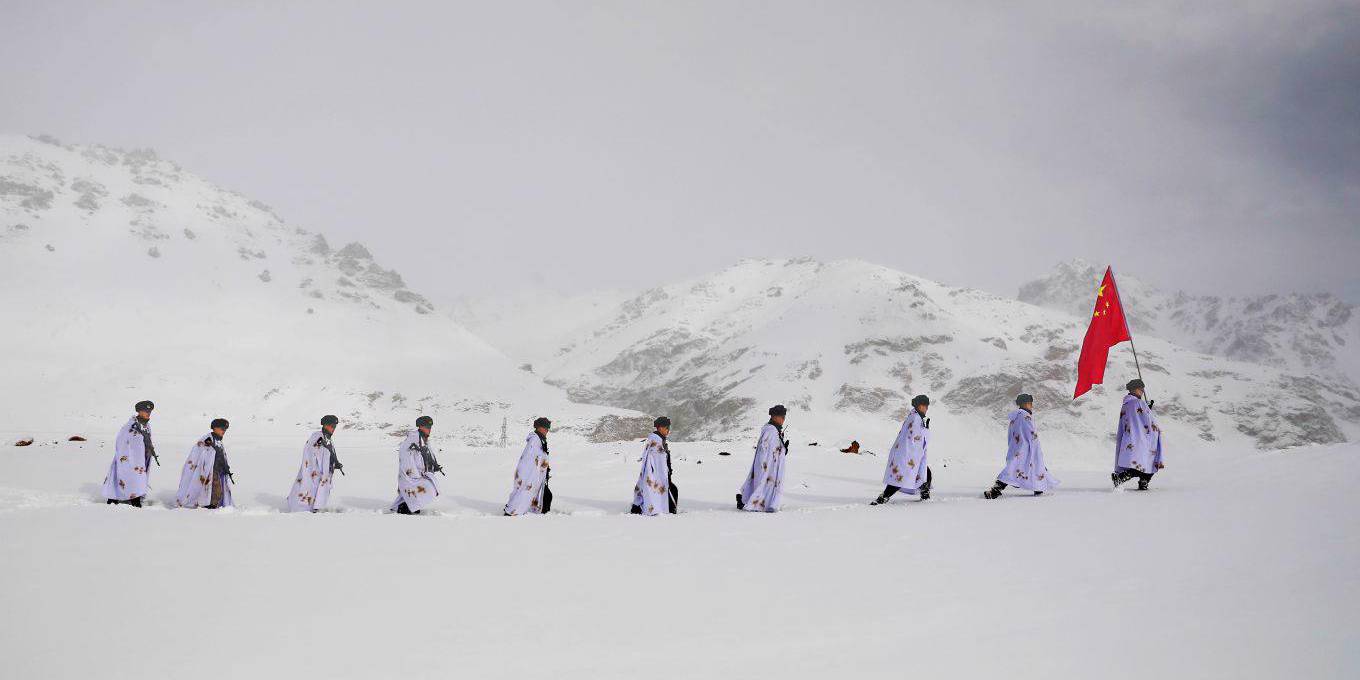
China is applying the same strategy on the roof of the world that has driven its expansion in the South China Sea: gradual territorial encroachments followed by militarized construction. So far, this slice-by-slice approach is proving just as effective on land as it has been at sea.
Emboldened by its cost-free expansion in the South China Sea, Chinese President Xi Jinping’s regime has stepped up efforts to replicate that model in the Himalayas. In particular, China is aggressively building many new villages in disputed borderlands to extend or consolidate its control over strategically important areas that India, Bhutan, and Nepal maintain fall within their national boundaries.
Underscoring the strategic implications of China’s drive to populate these desolate, uninhabited border areas is its major buildup of new military facilities there. The new installations range from electronic warfare stations and air defense sites to underground ammunition depots.
China’s militarized village-building spree has renewed the regional spotlight on Xi’s expansionist strategy at a time when, despite a recent disengagement in one area, tens of thousands of its troops remain locked in multiple standoffs with Indian forces. Recurrent skirmishing began last May after India discovered to its alarm that Chinese forces had stealthily occupied mountaintops and other strategic vantage points in its northernmost Ladakh borderlands.
China’s newly built border villages in the Himalayas are the equivalent of its artificially created islands in the South China Sea, whose geopolitical map Xi’s regime has redrawn without firing a shot. Xi’s regime advanced its South China Sea expansionism through asymmetrical or hybrid warfare, waged below the threshold of overt armed conflict. This approach blends conventional and irregular tactics with small incremental territorial encroachments (or “salami slicing”), psychological manipulation, disinformation, lawfare, and coercive diplomacy.
Now China is applying that playbook in the Himalayan borderlands. The Hong Kong-based South China Morning Post, citing a Chinese government document, recently reported that China intends to build 624 border villages in disputed Himalayan areas. In the name of “poverty alleviation,” the Communist Party of China is callously uprooting Tibetan nomads and forcing them to settle in artificial new border villages in isolated, high-altitude areas. The CPC has also sent ethnic Han Chinese party members to such villages to serve as resident overseers.
Creating a dispute where none previously existed is usually China’s first step toward asserting a territorial claim, before it furtively tries to seize the coveted area. Xi’s regime frequently uses civilian militias in the vanguard of such a strategy.
So, just as China has employed flotillas of coastguard-backed civilian fishing boats for expansionist forays in the South and East China Seas, it has been sending herders and grazers ahead of regular army troops into desolate Himalayan border areas to foment disputes and then assert control. Such an approach has enabled it to nibble away at Himalayan territories, one pasture at a time.
In international law, a territorial claim must be based on continuous and peaceful exercise of sovereignty over the territory concerned. Until now, China’s Himalayan claims have been anchored in a “might makes right” approach that seeks to extend its annexation of Tibet to neighboring countries’ borderlands. By building new border villages and relocating people there, China can now invoke international law in support of its claims. Effective control is the sine qua non of a strong territorial claim in international law. Armed patrols don’t prove effective control, but settlements do.
The speed and stealth with which China has been changing the facts on the ground in the Himalayas, with little regard for the geopolitical fallout, also reflects other considerations. Border villages, for example, will constrain the opposing military’s use of force while aiding Chinese intelligence gathering and cross-frontier operations.
Satellite images show how rapidly such villages have sprouted up, along with extensive new roads and military facilities. The Chinese government recently justified constructing a new village inside the sprawling Indian border state of Arunachal Pradesh by saying it “never recognized” Indian sovereignty over that region. And China’s territorial encroachments have not spared one of the world’s smallest countries, Bhutan, or even Nepal, which has a pro-China communist government.
China conceived its border-village program after Xi called on Tibetan herdsmen in 2017 to settle in frontier areas and “become guardians of Chinese territory.” Xi said in his appeal that, “without peace in the territory, there will be no peaceful lives for millions of families.” But Xi’s “poverty alleviation” program in Tibet, which has steadily gained momentum since 2019, has centered on cynically relocating the poor to neighboring countries’ territories.
The echoes of China’s maritime expansionism extend to the Himalayan environment. Xi’s island building in the South China Sea has “caused severe harm to the coral reef environment,” according to an international arbitral tribunal. Likewise, China’s construction of villages and military facilities in the borderlands threatens to wreak havoc on the ecologically fragile Himalayas, which are the source of Asia’s great rivers. Environmental damage is already apparent on the once-pristine Doklam Plateau, claimed by Bhutan, which China has transformed into a heavily militarized zone since seizing it in 2017.
Indian army chief Manoj Naravane recently claimed that China’s salami tactics “will not work.” Yet even an important military power like India is struggling to find effective ways to counter China’s territorial aggrandizement along one of the world’s most inhospitable and treacherous borders.
China’s bulletless aggression – based on using military-backed civilians to create new facts on the ground – makes defense challenging, because it must be countered without resorting to open combat. Although India has responded with heavy military deployments, Chinese forces remain in control of most of the areas they seized nearly a year ago. So far, China’s strategy is proving just as effective on land as it has been at sea.
The sharpening geopolitical competition over natural resources has turned some strategic resources into engines of power struggle. This is scarcely a surprise: Access to natural resources has historically been a major factor in peace and war. Resource considerations were a major driver of many armed interventions and wars, including the European colonial conquests and a number of the wars of the last century.
Water is the most-critical resource for human well-being, sustainable livelihoods and biodiversity support. Yet, access to adequate supplies of freshwater poses a particularly difficult challenge in several parts of the world because of spreading water shortages. Hydropolitics has consequently become murkier.
It might be cliché but water is the new oil of the twenty-first century. Today, water resources shared between nations are at the centre of increasing competition and conflict, triggering a dam-building race and prompting growing calls for the United Nations to make water a key security concern.
China, which dominates Asia’s water map because of its 1951 annexation of the water-rich Tibetan Plateau, is driving the sharpening hydropolitics in Asia. Almost all of Asia’s major rivers originate on the Tibetan Plateau, and China is erecting an expansive hydro-infrastructure to make itself the upstream water controller. In recent days, its rubber-stamp parliament has ratified a controversial plan to build a mega-dam on the Brahmaputra (known as Yarlung Tsangpo to Tibetans) just before the world’s highest-altitude river crosses into India.
This plan, which is likely to unleash environmental havoc in downstream regions, comes after one of the most pristine Himalayan rivers mysteriously turned black when entering India from Tibet, highlighting how China’s upstream tunnelling, damming and mining activities might be causing major environmental contamination. The plight of the Siang, and the Brahmaputra mega-project, serve as a stark reminder that transboundary river water issues in Asia are no less important than the regional maritime issues of the South and East China seas and the Indian Ocean, which have attracted greater global attention.
Freshwater is increasingly in short supply, with nearly two-thirds of the global population living in water-stressed conditions. Asia, home to 60% of the world’s population, has less freshwater per capita than any other continent. Its annual freshwater availability per person is less than half the global average of 5,829 cubic metres.
Yet Asia, the global economic locomotive, has experienced the world’s most rapid growth in water withdrawals from rivers, lakes and aquifers. Its dramatic economic rise has resulted in its water usage rate surpassing renewable stocks. By digging deeper wells, overexploiting river resources and maintaining generous irrigation subsidies, Asia is accelerating water-resource depletion and environmental degradation.
To be sure, the water crisis extends beyond Asia. Even in the relatively water-rich United States, water-sharing disputes are becoming rife. In fact, national paucity of water and arable land is driving some wealthier countries to produce food for their home markets on farmland acquired overseas, especially in sub-Saharan Africa.
Such land grabs by outsiders are effectively water grabs because the farmland leases come with the right to harness local water resources for cultivation. According to a couple of studies, at least 20 states in sub-Saharan Africa have leased fertile land measuring more than Spain’s landmass to outside governments and agribusiness firms. One mammoth lease in the Indian Ocean island nation of Madagascar by the South Korean corporate giant Daewoo triggered a powerful grassroots backlash, which helped to topple the country’s democratically elected president in 2009.
A potent example of the world’s deepening water crisis is the dramatic rise of the bottled water industry over the past two decades. Bottled water, in fact, has become a major source of plastic waste, with plastic debris clogging up landfills, blocking drains, polluting waterways and contributing to biodiversity loss. Such is the low recycling rate in many countries that, for example, 80% of all plastic water bottles sold in the United States become litter.
Bottled water carries a large environmental footprint that extends beyond plastic waste. Significant resources are needed to source, process, bottle and transport such water, including 1.6 litres of water, on average, to package one litre of bottled water. Add to the picture the carbon footprint from processing and transporting bottled water.
Much of the bottled water sold across the world is extracted groundwater that, before being bottled, has been subjected to reverse osmosis or other treatment. Tapping subterranean water reserves on a large scale for this purpose depletes not just aquifers but also rivers and streams that draw water from aquifers. Premium bottled water, sourced from glaciers’ runoff, is also compounding adverse impacts on fragile ecosystems.
Yet, more and more people are relying on bottled water even in those Western cities where tap water is safe and highly regulated. This has created a strange paradox: While the prosperous in the world now depend largely on bottled drinking water, the poor struggle to get basic access to water for their daily consumption and household chores.
This month’s 10th anniversary of the Fukushima disaster was a reminder of another water-related paradox: Water is a life preserver but also becomes a life destroyer if it carries deadly bacteria or takes the form of tsunamis, flash floods, storms and hurricanes. Fukushima’s triple nuclear meltdown was triggered not by the earthquake that struck the area but by the tsunami that followed.
Global warming, for its part, is set to worsen the water crisis. As oceans rise and the intensity and frequency of storms and other extreme weather events increases due to global warming, freshwater resources will come under increasing strain.
Jakarta demonstrates how human-induced changes in the hydrological cycle are helping to foster threats from global warming. The Indonesian capital, home to more than 10 million people, is sinking faster than any other major city in the world because of stepped-up groundwater depletion. Tens of thousands of wells across Jakarta are pumping out groundwater at such an alarming rate that as much as two-fifths of the city is now said to be below sea level. Groundwater depletion is also aiding the rise of the Java Sea, thus worsening Jakarta’s plight.
One study has estimated that groundwater depletion alone contributes 0.8 millimetre per year to the rise of ocean levels globally, or about a quarter of the total rise of the oceans. Groundwater depletion, by inviting seawater intrusion into aquifers, is already compounding freshwater shortages in coastal Asian cities. Meanwhile, the plethora of upstream dams on rivers is causing a perceptible retreat of Asia’s heavily populated deltas that are home to mega-cities like Bangkok, Dhaka, Guangzhou, Kolkata, Shanghai and Tianjin.
The current freshwater shortages are clearly being exacerbated by water pollution. Water contamination until now had largely been a domestic issue, as highlighted by the pollution problems affecting the Yellow River in China and the Ganges in India and Bangladesh. But the contamination of the Siang has shown that this problem is becoming a transboundary issue.
Against this background, water wars in a political and economic sense are already being waged in several regions, including by building dams on international rivers and by resorting to coercive diplomacy or other means to prevent such construction. One example of a silent water war has been Ethiopia’s dam building on the Blue Nile and the consequent Egyptian threats of covert or overt reprisals.
A report reflecting the joint judgment of US intelligence agencies warned a few years ago that the use of water as a weapon of war or a tool of terrorism would become more likely in some regions. The InterAction Council, comprising more than 30 former heads of state or government, has underscored the imperative for urgent action, saying some countries battling severe water shortages are at risk of failing.
The risks of water conflicts are especially pronounced in the world’s most water-stressed regions — North Africa, the Middle East, and much of Asia. Asia cannot continue to drive global economic growth without finding ways to sustainably alleviate its water crisis.
Water discord, meanwhile, is fuelling China-India tensions. In recent years, Beijing increasingly has been employing its water leverage against India.
In 2017, in breach of two bilateral accords, China withheld hydrological data from India on upstream river flows. This undermined India’s flood early-warning systems during the critical monsoon season. Many of the deaths in Assam, which suffered record flooding that year despite below-normal monsoon rainfall, were preventable. The data denial was apparently intended to punish India for boycotting China’s inaugural Belt and Road summit and for the border standoff at Doklam.
The India-Pakistan water dynamic is driven by different factors. When Pakistan was carved out of India in 1947 as the first Islamic republic of the post-colonial era, the partition left the headwaters of the six-river Indus system on the Indian side of the border but the basin’s larger segment in the newly-created country. This division armed India with tremendous water leverage over Pakistan. But India, without any quid pro quo, ceded that leverage by signing what still remains the world’s most generous water-sharing pact: The 1960 Indus Waters Treaty (IWT) has indefinitely reserved for Pakistan more than 80% of the total Indus-system waters.
Not content with securing the lion’s share of the Indus waters, Pakistan has continued to play the water card against India. From waging conventional wars against India in the past to sustaining a protracted proxy war by terror since the 1980s, Pakistan has in parallel started waging a water war. Its strategy has centred on repeatedly invoking the IWT’s conflict-resolution provisions to internationalize any perceived disagreement so as to keep India under intense pressure.
Asia illustrates that once shared water becomes a diplomatic battleground between countries, it begins to exact geopolitical costs in ways not dissimilar to the legacies of armed conflicts. The casualty usually is sub-regional stability and cooperation. SAARC, for example, has no future; it will remain a stunted initiative.
Asia also exemplifies another important trend — that dams and democracy do not go well together. Dam building has run into major grassroots opposition in Asian democracies like India, Japan and South Korea, driving up project costs and acting as a damper on hydropower expansion. But dam building remains unconstrained in countries where grassroots empowerment is absent, such as China, Pakistan, Myanmar and Laos.
Activist non-governmental organizations (NGOs) — many foreign funded — have made it difficult for India to build large dams. This has only compounded India’s energy conundrum. India’s inability to stem disruptive NGO activism will continue to blight the promise of hydropower in the country.
In contrast, China stands out as the global leader in dam building, boasting more large dams than the rest of the world combined. The focus of China’s dam frenzy has ominously shifted over the past decade from domestic rivers to transboundary rivers. This carries serious implications for downstream neighbours. For example, as downstream droughts become more frequent due to China’s dam network on the Mekong River, China is leveraging its upstream water control to influence policies of downstream states.
The environmental degradation on the world’s largest and highest plateau, Tibet, due to Chinese damming and mining activities carries wide implications. With its height and other unique features, the Tibetan Plateau influences climatic and rainfall patterns across Asia.
To be sure, other countries also are contributing to environmental degradation and thereby undermining Asia’s hydrological and climatic stability. In a number of countries, watersheds, watercourses, coastal environment and other ecosystems are being degraded, resulting in shrinking wetlands and forests, increased water pollution and other ecological problems.
Given that Asia is likely to face a hotter, drier future, governments must initiate plans now to mitigate the effects. The imperative is to move from purely supply-side approaches to demand-side options that emphasize water conservation and quality as much as quantity. Even on the supply side, non-traditional measures, from recycling of water to rainwater capture, must be embraced.
Rainwater harvesting is an ancient technique that originated in Asia, especially India. Rainwater capture is also the cheapest and most-sustainable option to address water shortages and replenish groundwater. Prime Minister Narendra Modi’s “Catch the Rain” initiative, by achieving demonstrable results on the ground, can serve as a model for other countries.
India must elevate water as a strategic resource. The Modi-created new, unified water power ministry is seeking to rectify a splintered, piecemeal approach that has compounded India’s water challenges. But without institutionalized, integrated policymaking, it will not be easy for India to develop a holistic approach to an increasingly scarce resource or fashion an effective hydro-diplomacy that advances the country’s long-term water interests.
Water increasingly will be a critical factor in regional development. So, India needs to get its act together on transboundary water issues. It should, for example, build sustained pressure on China to abide by international norms on shared water resources. Indian diplomacy ought to promote multilateral cooperation on water and hydropower resources in the Bangladesh-Bhutan-India-Myanmar-Nepal growth corridor. Such collaboration will also boost BIMSTEC (Bay of Bengal Initiative for Multi-Sectoral Technical and Economic Cooperation).
More broadly, three interconnected crises — a water crisis, an environmental crisis and a climate crisis — are threatening Asia’s economic, social and ecological future. Wasteful practices and mismanagement of water resources need to be addressed across Asia, or else the water crisis will worsen and spark raging conflicts. Cooperative institutional mechanisms and sustainable practices constitute the building blocks of water peace. Water indeed is a key test of whether Asian leaders have the political will and good sense to think and act long term.
Brahma Chellaney is a geostrategist and the author of two award-winning books on water: “Water, Peace, and War” (Rowman & Littlefield) and “Water: Asia’s New Battleground” (Georgetown University Press).
The “Quad,” as its recent virtual summit underscored, has come a long way in cementing a strategic coalition of the leading democracies of the Indo-Pacific region. Comprising Australia, India, Japan and the United States, it has gradually sharpened its edges since 2019 in response to China’s aggressive expansionism.
Yet, when Joe Biden was elected, there was uncertainty over the Quad’s future, including whether the new U.S. president would carry forward his predecessor’s “free and open Indo-Pacific” strategy based on the concept authored by then-Prime Minister Shinzo Abe in 2016. Even the term “Indo-Pacific” was conspicuously absent in Biden’s presidential campaign statements and the 2020 Democratic Party Platform.
Only after being sworn in as president, Biden began speaking about a “free and open Indo-Pacific.” He then took the initiative for the first-ever Quad summit. This is a testament to the fact that the Biden administration inherited a coherent and realistic strategy on the Indo-Pacific.
The surprise from the March 12 summit was that — unlike the past Quad foreign ministers’ meetings — it yielded a joint statement, which articulated a clear-eyed vision. “We strive for a region that is free, open, inclusive, healthy, anchored by democratic values, and unconstrained by coercion,” the statement declared.
But make no mistake: Without real action and sustained resolve, dialogues and joint statements will not be enough to make a difference in the Indo-Pacific. An emboldened China, after tasting consecutive successes in the South China Sea and Hong Kong, could make Taiwan its next direct target. It has stepped up its expansionist activities in the Himalayan borderlands and the East China Sea.
Despite China’s lengthening shadow, the summit, however, offered little in terms of concrete strategic counteraction. If anything, its vaccine initiative illustrated how, with the media’s help, a public relations gimmick can be spun into a major summit success.
The summit’s “breakthrough” deal centered on helping India’s Biological E firm to produce 1 billion COVID-19 vaccine doses by the end of 2022, including the Johnson & Johnson vaccine. But the firm has confirmed that it already can produce more than 1 billion vaccine doses a year. It signed a preliminary co-production agreement with Johnson & Johnson last August.
The Quad vaccine initiative has done little more than obscure America’s refusal to do something now, including releasing the vaccines it has been hoarding and permitting a temporary intellectual-property waiver so as to give poorer nations access to generic versions of COVID-19 vaccines and treatments. India and South Africa are leading the international push for such a temporary waiver.
Given its relative decline, the U.S. needs its allies more than ever so that, in seeking to address the China challenge and other global problems, its power is augmented by that of its allies and strategic partners.
Yet, under Biden, it is sadly sending a wrong message with its vaccine hoarding, which denies its European allies much-needed supplies to combat COVID-19. This is likely to raise an important question among all allies, from Japan to Poland and Canada: If the U.S. will not share its vaccine stockpile with its closest allies during a horrendous pandemic, how can its leadership be trusted in a security contingency?
In fact, by invoking the 1950 U.S. Defense Production Act, the Biden administration is also hoarding vaccine components. America’s export restriction is creating a global supply chain problem: With not enough critical raw materials to go around, vaccine production is coming under pressure in other manufacturing centers, including India, which boasts the world’s largest vaccine-making capacity. Does Biden want other nations to learn hard lessons during the current pandemic about both China-reliant and U.S.-dependent supply chains?
Instead of persisting with a self-centered vaccine policy, the U.S. would do well to grasp the urgency of developing an actionable and durable American-led approach to China, which is becoming increasingly assertive, expansionist and authoritarian. In fact, the Quad’s unifying theme is opposing China’s aggressive expansionism.
Biden, however, has still to firm up his China policy. In fact, after his calls to Quad leaders, Biden telephoned China’s leader Xi Jinping on Feb. 10 and held a two-hour-long tete-a-tete. Then this month, the Quad summit and America’s “2 plus 2” dialogues in Tokyo and Seoul were followed by the high-level U.S.-China discussions in Anchorage, Alaska.
The parallel U.S. effort to reset ties with Beijing may explain why the two recent online Quad meetings — first between the foreign ministers and then the summit — focused less on the China challenge to a rules-based order and more on global issues like the pandemic and climate change. Vaccine diplomacy — as by India, which has donated more than eight million free COVID-19 vaccines — may aid projection of soft power. But the Quad, as a security coalition, has no need to project soft power.
If the Quad persists with prioritizing global issues over Indo-Pacific security challenges, it would blur its focus and encourage China to step up its coercive diplomacy through heavy-handed use of military and economic power.
The White House’s Interim National Security Strategic Guidance released this month says “we welcome the Chinese government’s cooperation on issues such as climate change, global health security, arms control and nonproliferation where our national fates are intertwined.” However, Biden’s effort to reset ties with China appears doomed, largely because Xi sees the change of the U.S. administration as offering him greater space to pursue his hegemony-seeking “Chinese dream.”
To be sure, Xi’s aggressive policies will ensure that the Quad continues to solidify and actively work toward establishing a new multilateral Indo-Pacific security structure. Even distant powers like France, Germany and Canada now view a rules-based Indo-Pacific as central to international security.
They are strengthening maritime collaboration with the Quad states. Last November’s “Malabar” naval war games — the first-ever Quad military drills — have been followed by “Sea Dragon,” an anti-submarine warfare exercise in January that involved Quad members and Canada, and the scheduling of another Quad-plus naval exercise, the “La Perouse” drills with France, from April 4.
As Biden develops strategic clarity on China, the Quad is likely to become the central dynamic of his Indo-Pacific policy. Xi’s renegade expansionism could even help build a grand international coalition, with the Quad at its core.
Brahma Chellaney, a longtime contributor to The Japan Times, is a geostrategist and the author of nine books, including, most recently, “Water, Peace, and War.”
China’s multi-pronged unconventional war against India has ranged from cyber-attacks on critical infrastructure and furtive territorial encroachments to strategic information warfare and an ongoing village-building drive to populate uninhabited but disputed borderlands. Water wars are a key component of such warfare because they allow China to leverage its upstream Tibet-centred power over the most-essential natural resource.
China knows its troops cannot fight and win decisively against the battle-hardened Indian military on a force-on-force basis, as the Galwan Valley clashes underscored. So, to contain India, it has been applying asymmetric warfare techniques to attack India’s weak points, in keeping with what Sun Tzu said: “All warfare is based on deception.”
India, instead of looking at China’s new face of war in totality and devising a comprehensive and proactive counter-strategy, has brought its security under increasing pressure through a disjointed and fragmented approach. Such is the absence of long-term strategic thinking and planning that, each time China opens a new front or pressure point, India searches for a stopgap or, worse still, seeks to paper over its weak spot.
China’s newly approved Brahmaputra mega-project, which will dwarf its Three Gorges Dam by generating almost three times more electricity, should shake India out of its ad hoc, compartmentalized approach to Chinese aggression. The project is to harness the force of a nearly 3,000-metre drop in the Brahmaputra’s height when the river, just before entering India, takes a U-turn around the Himalayas to form the world’s longest and steepest canyon. By setting out to dam the Brahmaputra there, China is seeking to effectively weaponize water against India.
Unidentified Chinese upstream activities in the past have triggered flash floods in Arunachal Pradesh and Himachal Pradesh and, more recently, turned the water in the once-pristine Siang — Brahmaputra’s main artery — dirty and grey as it entered India. Indeed, such is China’s defiant unilateralism that, to complete a major dam project, it halted the flow of a Brahmaputra tributary, the Xiabuqu, in 2016 and then started damming another such tributary, the Lhasa River, into a series of artificial lakes.
In 2017, China openly demonstrated its use of water as as a tool of coercive diplomacy when, in breach of two bilateral accords, it punitively cut off the flow of hydrological data to India, an action that undermined downstream flood early-warning systems, resulting in preventable deaths in Assam. China reversed the data cutoff only after the 2018 Wuhan summit, which was held following its capture of Doklam behind the cover of the August 2017 disengagement agreement.
About a dozen small or medium-sized Chinese dams are already operational on the Brahmaputra’s upper reaches. But with its dam building now moving to the river’s India-bordering canyon region, China will be able to manipulate transboundary flows and leverage its claim to the adjacent Arunachal Pradesh.
The serious implications, however, are being obscured by misinformation or ignorance. For example, some in Indian policy and academic circles have conjectured that the Brahmaputra collects the larger share of its water in India. This water collection is mainly restricted to the four-month monsoon season. Fluvial ecosystems depend on perennial water sources, which, in the Brahmaputra’s case, are largely in Tibet.
The Brahmaputra, the world’s highest-altitude river, gathers extremely rich silt in its almost 2,200-kilometre Himalayan run. The silt-rich water from Tibet, not monsoon-water collection, is central to the river’s unique hydrology and biodiversity support. The canyon mega-project, like the Three Gorges Dam, will trap downstream flow of nutrient-rich silt. It will also disrupt the Brahmaputra’s annual flooding cycle, which helps to re-fertilize farmland naturally by spreading silt, besides opening giant fish nurseries. That, in turn, is likely to cause subsidence and salinity in the Brahmaputra-Ganges-Meghna Delta.
In the Mekong Basin, the environmental havoc unleashed by China’s upstream giant dams is becoming increasingly apparent. The environmental devastation could be worse in the Brahmaputra Basin, especially in densely populated Bangladesh, triggering a greater exodus of refugees to India, which is already home to countless millions of illegally settled Bangladeshis.
The Brahmaputra mega-dam, ominously, will be built in a seismically active area, thus implying a ticking “water bomb” for downstream communities. The dictatorship in Beijing is not deterred even by the fact that the project will desecrate territory that is sacred to Tibetans: the major mountains, cliffs and caves in the canyon region, known locally as Pemako, or the “Hidden Lotus Land,” represent the body of their guardian deity, the goddess Dorje Pagmo (Vajravarahi in Sanskrit), and the Brahmaputra represents her spine.
The expanding water war is clearly part of China’s integrated, multidimensional strategy against India, which seeks to employ all available means short of open war. Its unconventional war is profoundly impacting every core Indian interest. To deal with this structural challenge, India, in Sun Tzu style, must give China a taste of its own medicine. Two US reports, The Longer Telegram (published by the Atlantic Council) and the state department’s The Elements of the China Challenge, underline the imperative to target China’s weak spots.
India has little choice but to asymmetrically out-compete China’s asymmetric war by exploiting its internal vulnerabilities, fissures and fragilities, including in Tibet, the main launchpad for its unconventional warfare. India has the capabilities to outwit and deter China; what it needs is the vision and resolve.
Chinese President Xi Jinping (R) meets with U.S. Vice President Joe Biden in Davos, Switzerland, Jan. 17, 2017. (Xinhua/Lan Hongguang via Getty Images)
Donald Trump’s tough China policy is his most consequential – and constructive – foreign-policy legacy. Unless President Joe Biden pursues a similar approach, the erosion of US global leadership will become inexorable.
In his inaugural address, US President Joe Biden declared that Americans “will be judged” for how they “resolve the cascading crises of our era.” He expressed confidence that the country would “rise to the occasion,” and pledged that the United States would lead “not merely by the example of our power but by the power of our example.”
The contrast with President Donald Trump’s divisive, isolationist rhetoric could not be sharper. But adopting a different tone is easier than reversing America’s relative decline. To do that, Biden will need to provide wise, forward-looking leadership. And that does not necessarily mean breaking with everything that Trump did.
America’s debilitating political polarization has undermined its international standing. Partisan considerations have hampered – even precluded – the pursuit of long-term foreign-policy objectives. US policy toward a declining Russia, for example, has become hostage to US domestic politics.
Biden’s calls for unity reflect his awareness of this. But the truth is that healing the deep rupture in US society may be beyond any president’s ability, not least because so many Republican voters seem to have abandoned all faith in evidence and expertise. So, rather than becoming consumed by domestic political divisions, Biden must rise above them.
And yet, there is one area where there is broad bipartisan consensus: the need to stand up to China. Trump understood this. Indeed, his tough China policy is his most consequential – and constructive – foreign-policy legacy. Unless Biden pursues a similar approach, the erosion of US global leadership will become inexorable.
The Indo-Pacific region – a global economic hub and geopolitical hotspot – is central to an effective China strategy. Recognizing the region’s immense importance to the world order, China has been steadily reshaping it to serve Chinese interests, using heavy-handed economic coercion, political repression, and aggressive expansionism to have its way from the Himalayas and Hong Kong to the South and East China Seas.
The only way to preserve a stable regional balance of power is with a rules-based, democracy-led order – or, as the Trump administration put it, a “free and open Indo-Pacific.” Over the last year, this vision has spurred the region’s democracies to deepen their strategic bonds and inspired even the faraway democracies of Europe to implement supportive policies. Under the Biden administration’s leadership, countries must now build on this progress, creating a true concert of democracies capable of providing stability and balance in the Indo-Pacific.
Biden seems to understand this. He has made clear his intention to build a united democratic front to counter China. But he is also at risk of undermining his own vision.
For starters, Biden did not embrace the term “Indo-Pacific” until after his electoral victory, and when he did, he replaced “free and open” with “secure and prosperous.” But, whereas “free and open” automatically implies a rules-based, democracy-led order, “secure and prosperous” leaves room for the inclusion of – and even leadership by – autocratic regimes. This ignores the crux of the Indo-Pacific challenge: a revisionist China is actively seeking to supplant the US as the region’s dominant power.
Making matters worse, Biden has signaled a possible reset of ties with China. This would play right into China’s hands.
Trump’s China policy was not just about trade or human rights. It sent the (right) message that China is a predatory communist state without political legitimacy or the rule of law. This helped to tip the scales in America’s favor. Over the last year, unfavorable perceptions of China reached historic highs in many countries. While this was largely because of the made-in-China COVID-19 pandemic, Trump’s ideological onslaught and China’s own aggression – such as on its Himalayan border with India – also played a role.
If the Biden administration abandons economic decoupling and treats China as a major competitor, rather than an implacable adversary, it will tip the scales in the opposite direction, relieving pressure on Chinese President Xi Jinping’s regime and undermining faith in US leadership. This could embolden China to destabilize the Indo-Pacific further, with Taiwan possibly its next direct target.
Moreover, US conciliation would give India second thoughts about aligning itself too closely with the US, and would likely lead to Japan’s militarization – a potential game changer in the Indo-Pacific. It would also facilitate China’s efforts to leverage its vast market to draw in America’s democratic allies – a risk underscored by its recent investment deal with the European Union. All of this would undermine efforts to forge the united democratic front Biden envisions, compounding the threat of China’s aggressive authoritarianism.
The worst choice Biden can make is to seek shared leadership with China in the Indo-Pacific, as some are advocating. Worryingly, Biden’s team does not seem clear on this. In a 2019 essay, Jake Sullivan (Biden’s national security adviser) and Kurt Campbell (Biden’s “Indo-Pacific czar” at the National Security Council) championed “coexistence with China,” describing the country as “an essential US partner.”
To be sure, Sullivan and Campbell did not call for Sino-American joint hegemony, in the Indo-Pacific or beyond. But they also did not take the clear and necessary position that the US must forge a concert of democracies to bring sustained multilateral pressure to bear on China.
After four years of Trump, Biden is right to tout the importance of domestic unity. But a tough line on China is one of the few policy areas behind which Americans can unite. More important, it is the only way to ensure a stable Indo-Pacific and world order.
US President Joe Biden’s administration must not ignore how often American sanctions against other countries have worked to China’s advantage. In this light, the US must take a cautious and prudent approach on Myanmar.
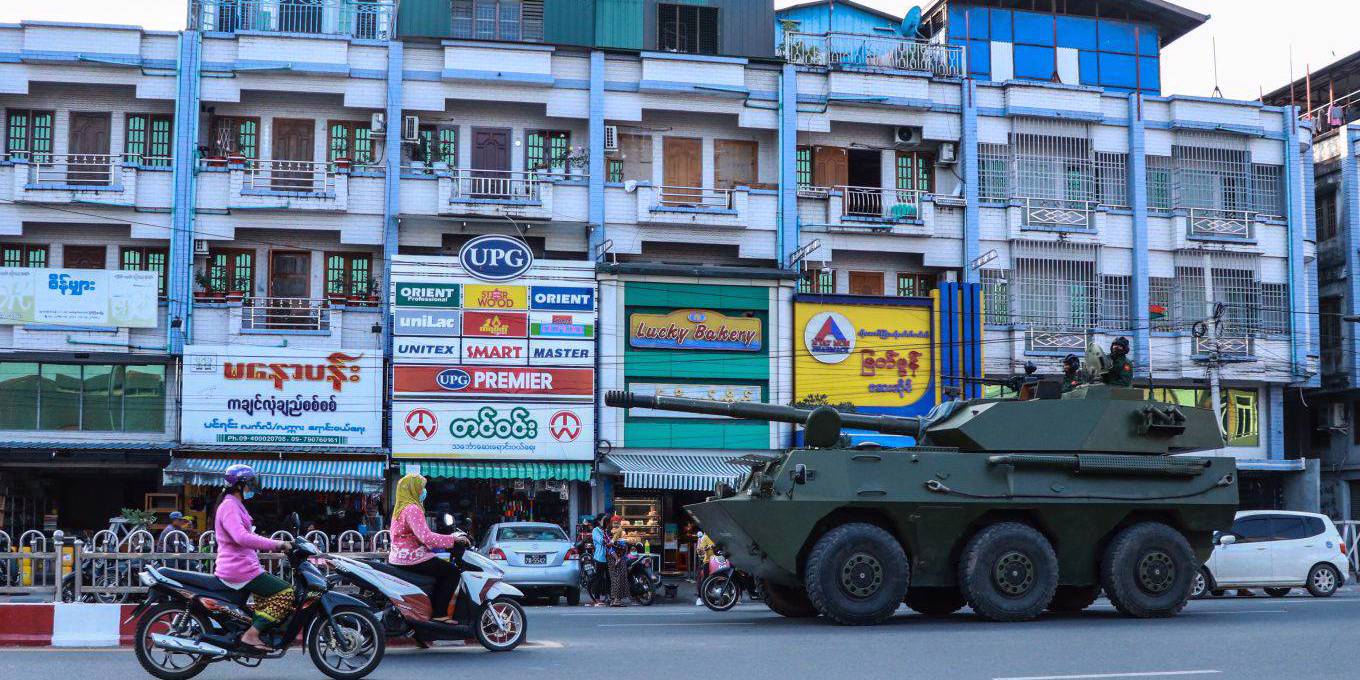
Directly or indirectly, the military has always called the shots in Myanmar. And now that it has removed the decade-old façade of gradual democratization by detaining civilian leaders and seizing power, Western calls to punish the country with sanctions and international isolation are growing louder. Heeding them would be a mistake.
The retreat of the “Myanmar spring” means all the countries of continental Southeast Asia – Thailand, Laos, Cambodia, Vietnam, and Myanmar – are under authoritarian rule, like their giant northern neighbor, China. More fundamentally, the reversal of democratization in Myanmar is a reminder that democracy is unlikely to take root where authoritarian leaders and institutions remain deeply entrenched.
Given this, a punitive approach would merely express democratic countries’ disappointment, at the cost of stymying Myanmar’s economic liberalization, impeding the development of its civil society, and reversing its shift toward closer engagement with democratic powers. And, as in the past, the brunt of sanctions would be borne by ordinary citizens, not the generals.
This is a realistic scenario. US President Joe Biden has warned that the military’s action “will necessitate an immediate review of our sanctions laws,” followed by “appropriate action.” But Biden would do well to consider how US-led sanctions in the past pushed Myanmar into China’s strategic lap, exacerbating regional-security challenges.
Sanctions are a blunt instrument. Thailand’s army chief, with the support of an increasingly unpopular king, has remained ensconced in power in civilian garb since staging a coup in 2014. If the United States can do business with Thailand, where a crackdown on pro-democracy protesters has extended to the use of a feared lèse-majesté law to imprison those who insult the royal family, why hold neighboring Myanmar to a higher standard?
Likewise, the US, India, Japan, and others have established close defense ties with communist-ruled Vietnam. Indeed, the US boasts that in recent years it has established a “robust security partnership” with Vietnam. Only by opening lines of communication and cooperation with Myanmar’s generals can democratic powers hope to influence developments in a strategically important country.
In the past decade, as Myanmar’s democratic transition unfolded, the West neglected to build close relations with the force behind it — the military. Instead, the prevailing Anglo-American approach centered on Aung San Suu Kyi, making her bigger than the cause. That neglect persisted even after Suu Kyi fell from grace over the fate of the country’s Rohingya Muslims, many of whom fled to Bangladesh and some to India during a brutal military campaign to flush out jihadist militants waging hit-and-run attacks.
The West’s lopsided approach eventually contributed to this month’s coup. Today, the US has little influence over Myanmar’s military. The coup leader, General Min Aung Hlaing, and his deputy, General Soe Win, were slapped with US sanctions 14 months ago over the expulsion of the Rohingya. But in responding to the mass detention of Muslims in Xinjiang that it labels “genocide,” the US has spared top Chinese military and party officials, imposing largely symbolic sanctions against lower-ranking functionaries.
Despite their uneven effectiveness and unpredictable consequences, sanctions have remained a favorite – and grossly overused – instrument of Western diplomacy, especially when dealing with the small kids on the global bloc. Non-Western democracies, in stark contrast, prefer constructive engagement.
Japan, for example, has a partnership program with Myanmar’s military that includes capacity-building support and training. Likewise, India’s defense ties with Myanmar extend to joint exercises and operations and supply of military hardware; recently, it gave its neighbor its first submarine. Such ties also seek to counter China’s supply of arms and other aid to Indian tribal insurgents through rebel-controlled northern Myanmar.
Sanctions without engagement have never worked. In 2010, while the US was pursuing a sanctions-only approach to Myanmar, then-President Barack Obama criticized India’s policy of constructive engagement with that country. But within months, Obama embarked on a virtually similar policy, which led to his historic visit to Myanmar in 2012.
Crippling US-led sanctions from the late 1980s paved the way for China to become Myanmar’s dominant trading partner and investor. But in 2011, Myanmar’s bold suspension of a controversial Chinese megaproject, the Myitsone Dam, became a watershed moment for the country’s democratic opening. It set in motion developments that reduced Myanmar’s dependence on China, balanced its foreign policy, and spurred domestic reforms.
Today, nothing would serve Chinese interests more than new US-led efforts to isolate Myanmar, which serves China as a strategic gateway to the Indian Ocean and important source of natural resources. In fact, renewed sanctions and isolation would likely turn Myanmar into another Chinese satellite, like Laos, Cambodia, and Pakistan. As Japan’s state minister for defense, Yasuhide Nakayama, has warned, that outcome would “pose a risk to the security of the region.”
US policymakers must not ignore how often American sanctions against other countries have worked to China’s advantage. They should perhaps be most worried by how sanctions have forced Russia to pivot to China, turning two natural competitors into becoming close strategic partners. And China has been the main trade and investment beneficiary of US sanctions against Iran.
In this light, the US must take a prudent approach to Myanmar. When Biden has expressed a readiness to cooperate with the world’s largest autocracy, China, in areas of mutual interest, he should at least pursue a similar approach with a far weaker Myanmar, where the military is the only functioning institution.
To help influence Myanmar’s trajectory, Biden has little choice but to address what US officials have recognized as a weak spot in American policy – lack of ties with the country’s strongly nationalist military. The US must not turn Myanmar from a partner into a pariah again.
A medic shows a vial of AstraZeneca’s COVISHIELD coronavirus vaccine in Yangon, Myanmar, on Wednesday after the country received 1.5 million doses of the drug manufactured by the Serum Institute of India. | REUTERS
Large parts of the world are still reeling from the rampaging spread of the coronavirus, with renewed lockdowns in effect in many places. With every stricken country focused on tackling its COVID-19 crisis, there is little international generosity in donating large quantities of medicines or vaccines when demand for them is sky-high.
So, when India in recent days delivered millions of COVID-19 vaccines as gifts to countries in the Indian Ocean region, it attracted international attention.
More than five million Indian-made vaccines were airlifted last week to countries extending from Myanmar and Bangladesh to Mauritius and the Seychelles. And millions of more free vaccines are on their way this week.
The scale of India’s vaccine gifts is unrivaled. No other country has delivered millions of free vaccines to other nations — not even China, which has pursued its own vaccine diplomacy in a bid to repair the damage to its global image from the spread of the deadly coronavirus from Chinese soil. The gifts help to highlight India’s enormous vaccine-manufacturing capacity.
What stands out the most about India’s humanitarian gesture is that it was launched just four days after the country began vaccinating its own citizens, starting with health-care workers. On receiving the first shipment of Indian vaccines, the prime minister of the Himalayan kingdom of Bhutan called it “altruism” that “precious commodities are shared even before meeting your own needs.” The overseas vaccine shipments extend from India’s ambitious plan to inoculate its huge 1.3 billion population in one of the world’s biggest COVID-19 vaccination drives.
India’s free-vaccine diplomacy, however, has been driven by more than altruism. There are geopolitical considerations at play, including building goodwill and influence and countering China’s growing strategic footprint in the Indian Ocean region. Supplying free vaccines to combat a raging pandemic also seems a better choice for New Delhi than providing direct aid in another form.
One of India’s strengths is that it supplies more than 60% of the world’s vaccines against various diseases. Now it is leveraging that manufacturing heft by embarking on what has been billed as humanitarian diplomacy — the supply of free vaccines to countries in its extended neighborhood.
Its extensive vaccine-manufacturing infrastructure also explains why India, as research by Fitch Solutions suggests, will be able to inoculate most of its vulnerable citizens such as health-care workers and the elderly by mid-2021 — ahead of the much-smaller South Korea, for example.
India already has agreed to supply more than one billion coronavirus vaccines to various countries and to the World Health Organization-backed Covax initiative aimed at poorer countries. India is currently manufacturing two vaccines — the AstraZeneca-Oxford vaccine, known in India as Covishield, and Covaxin, developed by the Indian pharmaceutical firm Bharat Biotech. Three other Indian companies are close to wrapping up development of their own vaccines.
Before India granted emergency approval to Covishield and Covaxin in early January, the privately-owned Serum Institute of India (SII) — the world’s largest maker of vaccines by volume and the leading production partner of AstraZeneca-Oxford — had already manufactured and stocked between 70 to 80 million Covishield doses. This large stockpile has meant that India has enough vaccines to share with other countries.
Furthermore, India’s rapidly falling coronavirus infections have given Prime Minister Narendra Modi’s government greater room to advance vaccine diplomacy. Daily new cases in India — a distant second to the United States in aggregate infections — have dramatically declined since last fall.
The international spotlight on the competitive vaccine offerings of the United States, Britain, Russia and China has helped obscure India’s role. Since the pandemic began, India has quietly donated or commercially exported crucial items that have encountered massive demand surges, such as COVID-19 test kits, personal protection equipment and medicines for coronavirus symptoms. India, the world’s leading supplier of generic drugs, shipped 50 million tablets of hydroxychloroquine to the U.S. last spring at then-American President Donald Trump’s request.
China, while exploiting its pharmaceutical clout for commercial ends throughout the pandemic, has thus far announced only modest vaccine donations. Its aggressive push to sell vaccines to developing nations, however, has suffered a setback after its leading inoculation candidate turned out to just 50% effective in late-stage trials in Brazil. Indeed, Brazil has turned to India, importing two million vaccines in recent days.
Against this background, will India’s vaccine diplomacy tangibly aid its foreign-policy interests? As more than 100,000 war-ready Indian and Chinese troops remain locked in a months-long Himalayan military standoff, India feels increasingly hemmed in by the expanding Chinese influence in its neighborhood.
India is hoping that, in contrast to the coronavirus’s indelible association with China as the country of origin, it will be remembered for helping many of its neighbors to immunize the vulnerable segments of their populations against the disease.
Still, with China spreading its influence deep into India’s backyard, New Delhi can scarcely reverse its eroding regional clout with just the goodwill generated from its large vaccine donations. India needs to do a lot more on a sustained basis. This demands it shed its intrinsic diffidence in favor of proactive diplomacy.
In fact, there is the question of whether India will bear the financial burden of supplying more free coronavirus vaccines to neighboring countries beyond the initial shipments. The issue whether such vaccines will be free for all of India’s own citizens has yet to be settled.
India’s large overseas shipments, however, belie the current Western narrative that wealthy nations are monopolizing the supply of COVID-19 vaccines and fueling a widening gap in access around the world. As with the shots against many other diseases, from polio and pneumonia to meningitis and measles, India is likely to be the largest and most-affordable source of COVID-19 vaccines, especially as new inoculation candidates enter into Indian production after approval.
In fact, the paradox is that many wealthy countries, especially in the European Union, have been slow to roll out COVID-19 vaccines, making India’s robust vaccine industry stand out as a model.
The Indian industry’s role will be central to ending the pandemic because only India has the vast infrastructure at present to meet the global vaccine demand. However, the extensive damage and five deaths from last week’s major fire at a new building at the SII campus were a reminder that, at a time when many low- and middle-income countries are depending on Indian production, unforeseen events could potentially disrupt supply of essential vaccines.
Brahma Chellaney, a longtime Japan Times contributor, is a geostrategist and the author of nine books, including “Water: Asia’s New Battleground,” which won the Bernard Schwartz Award.






 Stagecraft and Statecraft
You must be logged in to post a comment.