Ending the Ukraine war is in America’s interest

By Brahma Chellaney, The Hill

Russian President Vladimir Putin speaks with recipients of Gold Star medal of Hero of Russia on “Defender of the Fatherland Day,” in Moscow, Russia, Sunday, Feb. 23, 2025. (Mikhail Metzel, Sputnik, Kremlin Pool Photo via AP)

Former President Joe Biden left President Trump a mess in Ukraine, with Russian forces continuing to occupy one-fifth of Ukrainian territory and advancing along the front lines. The U.S. faces diminishing options after three years of deepening entanglement in a brutal war that has devastated numerous Ukrainian cities, towns and villages.

The war has distracted America from pressing challenges in the Indo-Pacific region, the world’s emerging economic and geopolitical hub that is poised to shape the new international order. Worse still, China has emerged as the big winner, as the conflict has ensnared NATO and Russia.

China, significantly stronger than Russia in economic output, military spending and other strategic metrics, remains America’s chief global rival. As Biden’s national security strategy acknowledged, China is committed to achieving global dominance by surpassing the U.S. as the foremost world power.

The U.S.-led “hybrid war” and unprecedented sanctions against Moscow have inadvertently strengthened China’s hand, including by making it Russia’s banker. Russia now conducts much of its international trade in Chinese yuan and deposits the proceeds in Chinese banks, effectively granting Beijing a share in its financial returns.

More concerning is China’s strategic maneuvering to co-opt Russia in an unholy alliance against the U.S. Their “no-limits partnership,” declared in 2022, is creating a two-against-one geopolitical competition that threatens to accelerate America’s relative decline through strategic overreach. A formal Sino-Russian military and strategic alliance could produce a pan-Eurasian colossus — America’s worst geopolitical nightmare.

Given this backdrop, the U.S. needs to return to its old grand strategy, which helped the West win the Cold War by driving a wedge between Moscow and Beijing. Ending the Ukraine war would also enable the U.S. to reallocate military resources from Europe to the Indo-Pacific, where its global primacy is truly at stake.

Trump’s diplomatic outreach to Moscow — aimed at resolving the Ukraine war, as he promised to do in his campaign — has created not only a furor in some Western capitals but also a toxic and divisive political discourse at home. Even before the efforts to end the war have made any tangible progress, Trump already faces fierce criticism. Opponents accuse him of giving Moscow a free pass and endorsing a “Ukraine sellout.” Some claim he has lifted Russia’s international isolation, despite evidence that the West never succeeded in actually isolating Moscow.

But diplomacy between adversaries is crucial to defuse tensions and prevent direct conflict. Biden firmly shut the door to diplomacy with Russia, prolonging Ukraine’s suffering. Only after a change in U.S. leadership did the American and Russian leaders resume direct communication, agreeing to explore pathways to peace.

Ending the Ukraine war will require a complex and carefully negotiated resolution — one that is “enduring, sustainable, and acceptable to all parties,” as Secretary of State Marco Rubio put it. But the political backlash from pro-war factions in the West is making the search for peace even more difficult.

Regardless of how the peace process unfolds, the transatlantic alliance is set for a major transformation. Defense Secretary Pete Hegseth bluntly told European leaders recently to take “responsibility for [their] own security” so that the U.S. can focus on “deterring war with China.” Consequently, tens of thousands of American troops currently stationed in Europe may be redeployed to the Indo-Pacific.

The European Union, which dutifully followed Biden’s lead in escalating the Ukraine conflict through transfers of increasingly sophisticated weapons, now seeks a role in peace negotiations. But the EU is rudderless and deeply divided, grasping for common ground. Its inclusion would be a drag on the negotiations, which may explain why the U.S. and Russian delegations met not in Europe but in Saudi Arabia.

The fact is that the Ukraine conflict remains in many ways a proxy war between Russia and the U.S., with Ukraine caught in the middle — a pawn in the geopolitical chess game. Ukrainian President Volodymyr Zelensky, who has worked to snuff out the country’s nascent democracy through draconian measures, admitted this month that, without America’s continued military aid, it will be “very, very difficult” for Ukraine to “survive.”

By opening direct dialogue with Moscow, the Trump administration has demonstrated both its commitment to ending the war and the marginal role China plays in securing peace in Ukraine. The only nation that benefits from prolonging the war is China, which has more than doubled its nuclear arsenal since 2020 and is expanding its conventional forces faster than any other country has since World War II.

Trump’s decision to extricate America from the Ukraine conflict aligns with long-term U.S. strategic interests. The war, through the flood of Western arms supplies to Kyiv, has exposed the West’s military shortcomings, such as its depleted stocks of critical munitions and air defense systems, as well as America’s struggle to ramp up weapons production.

As Biden himself acknowledged, a “negotiated settlement” is the only viable path to ending the war. A U.S.-Russia peace deal must be reached before Beijing and Moscow can cement a strategic axis that erodes America’s global primacy and increases Taiwan’s vulnerability. A Chinese annexation of Taiwan would reshape the global order, ending America’s global preeminence and undermining its alliance system.

Brahma Chellaney is a geostrategist and the author of nine books, including the award-winning “Water: Asia’s New Battleground.”

Trump’s pivot to the Indo-Pacific from Europe is clear

White House meeting with Modi follows close on the heels of Ishiba’s visit

Avatar

Brahma Chellaney

Nikkei Asia

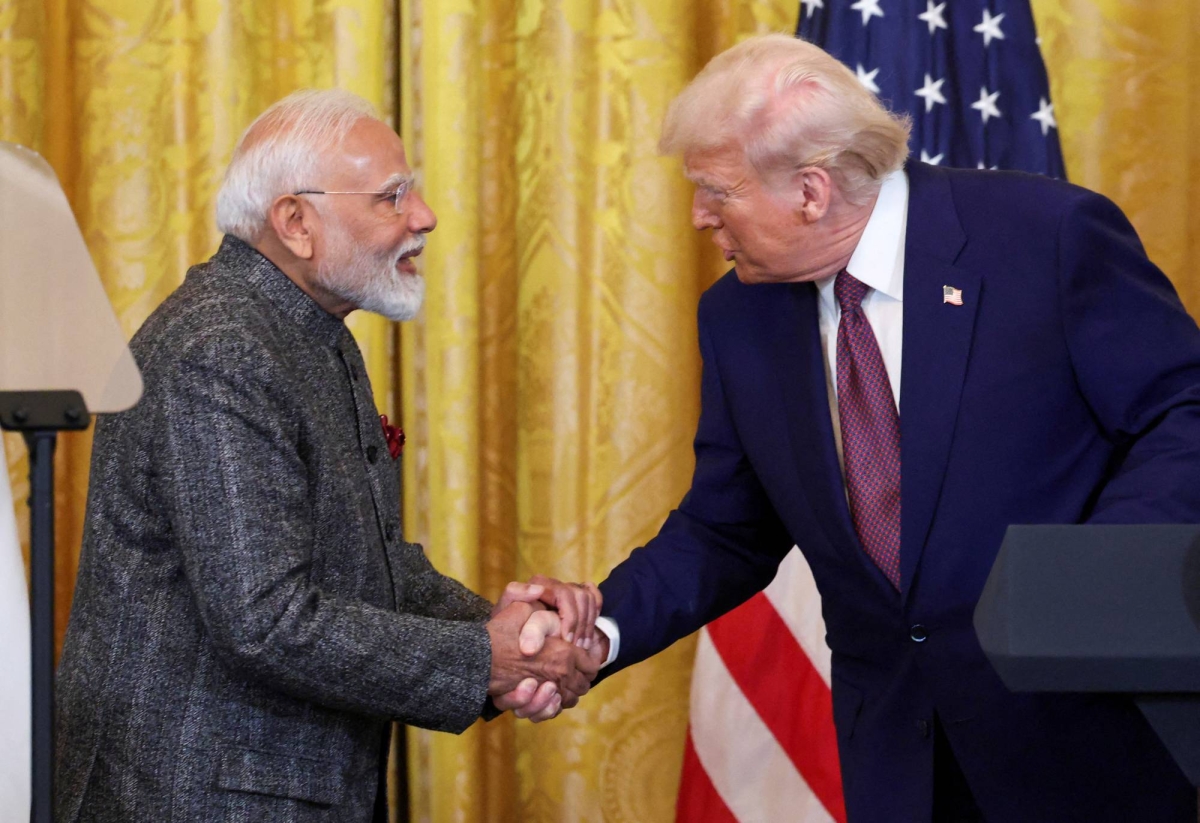
20250218 modi trumpDonald Trump and Narendra Modi prepare to shake hands as they attend a joint press conference at the White House in Washington on Feb. 13, 2025.  © Reuters

U.S. President Donald Trump is seeking to swiftly reorient foreign policy in his second term, shifting America’s strategic focus from Europe and the Middle East to the Indo-Pacific — an increasingly pivotal region in shaping the global order. Trump has already hosted the prime ministers of India and Japan separately and initiated efforts to end the Ukraine war, a conflict that has diverted U.S. attention from pressing Indo-Pacific challenges and made China the big winner.

Secretary of State Marco Rubio, on his first day in office, held a meeting of the foreign ministers of the Quad, a strategic alliance of leading Indo-Pacific democracies that Trump revived in his first term after a decade-long dormancy. Meanwhile, Defense Secretary Pete Hegseth, speaking in Brussels on Feb. 12, warned Europe that “the U.S. will no longer tolerate an imbalanced relationship which encourages dependency” and that Europe must take “responsibility for its own security” by leading “from the front” so that America prioritizes “deterring war with China” in the Indo-Pacific.

Vice President JD Vance followed up from European soil in Munich by reinforcing Hegseth’s warning — Europe needs to shape up before many of the more than 100,000 American troops stationed there begin to be shipped out. Vance’s statement that Europe’s main security threat is “from within” suggests the fraying transatlantic alliance is headed toward a fundamental transformation.

The U.S.-India strategic partnership was a cornerstone of Washington’s strategy from Trump’s first term for a “free and open Indo-Pacific,” a vision originally conceived by then-Japanese Prime Minister Shinzo Abe as a shorthand for a rules-based, liberal order. The China-Russia “no-limits partnership,” which developed during Joe Biden’s presidency, has only intensified the U.S. strategic imperative to forge a “soft” alliance with another nuclear-armed power: India.

Against this backdrop, Trump’s Feb. 13 meeting in Washington with Indian Prime Minister Narendra Modi underscored both leaders’ commitment to revitalizing the U.S.-India relationship.

Successive American presidents since Bill Clinton have left bilateral ties with India stronger than they inherited. However, under Biden, momentum stalled as differences cropped up, including over New Delhi’s reluctance to take sides in the Ukraine war and U.S. policies toward India’s neighbors, including Bangladesh, Myanmar and PakistanA Quad meeting is held on the sidelines of the G7 summit in Hiroshima, Japan, in May 2023.   © Reuters

The outcome of Modi’s White House visit attests to a good start toward rebuilding mutual trust. Trump and Modi, maintaining the warm rapport they developed in their first terms, exchanged a bear hug and projected unity at a joint news conference. Notably, they avoided discord over Trump’s hot-button issues like trade and immigration.

As he did with Japanese Prime Minister Shigeru Ishiba on Feb. 7, Trump touted strong bilateral ties while pressing Modi for “fair” and balanced trade, including increased Indian imports of American hydrocarbons and weapons. In his trademark style of blending some public flattery with hard bargaining, Trump called Modi “a much tougher” and “much better negotiator than me,” just as he had said Ishiba is “a very strong person, I wish he wasn’t so strong.”

Trump, along with the Japanese and Australian prime ministers, is set to visit India in the fall for the Quad leaders’ summit, by which time he hopes significant progress will have been made by negotiators on the U.S.-India trade agreement to which Modi committed in Washington. This strategy mirrors Trump’s previous approach in leveraging tariffs to secure a trade pact with Japan in 2019.

As the U.S. pivots to the Indo-Pacific, stronger ties have become essential with India and Japan, China’s main Asian rivals strategically located on its opposite flanks. The balance of power in the Indo-Pacific will be largely shaped by developments in East Asia and the Indian Ocean.

Japan, hosting over 80 U.S. military facilities and more American troops than any other U.S. ally, is critical to the defense of Taiwan, whose annexation by China would mark the end of U.S. global dominance. Meanwhile, India, locked in a lingering military standoff with China, has actively challenged Beijing’s power and capabilities in a way no other nation has in this century.

Long before Trump entered national politics, U.S. policymakers recognized the need to shift strategic focus to the Indo-Pacific, a region emerging as the world’s economic and geopolitical hub. In 2011, then-President Barack Obama unveiled a “pivot to Asia” strategy, but it remained largely rhetorical, lacking substantive strategic initiatives.

When Trump took office in 2017, he replaced Obama’s symbolic pivot with a comprehensive strategy for a “free and open Indo-Pacific.” He also fundamentally redefined U.S. policy toward Beijing, reversing a four-decade-old U.S. approach of aiding China’s economic rise by classifying that communist behemoth as a strategic rival and threat.

Biden maintained this approach, preserving the free and open Indo-Pacific strategy, including the Quad as a key pillar, while acknowledging China as America’s primary challenger that is bent on world dominance. However, his administration’s entanglement in conflicts in Ukraine and the Middle East left little space for a genuine pivot to the Indo-Pacific.

Trump’s new administration is prioritizing the resolution of these conflicts to focus on the Indo-Pacific, where U.S. global primacy is at stake. Ending involvement in the conflicts would free military resources for the Indo-Pacific, particularly from Europe.

More broadly, America’s grand strategy has long centered on driving a wedge between Moscow and Beijing — a strategy that helped the West win the Cold War without direct military confrontation. However, thanks to Biden-era policies, the U.S. has become the bridge that unites Russia and China.

Ending the Ukraine war could provide an opportunity for Washington to peel Moscow away from Beijing or weaken the Sino-Russian partnership to help isolate China.

More importantly, it would allow the U.S. to concentrate on countering the challenge from a globally ascendant China, with support from allies like Japan and strategic partners like India, whose rise as an independent power meshes with the Trump administration’s aversion to friends’ dependency on the U.S.

Brahma Chellaney, a professor of strategic studies at the independent New Delhi-based Centre for Policy Research and fellow at the Robert Bosch Academy in Berlin, is the author of nine books, including “Water: Asia’s New Battleground” (Georgetown University Press), which won the Bernard Schwartz Book Award.

Putting the Trump-Modi Bromance to the Test

Brahma ChellaneyProject Syndicate

Last time Donald Trump was president, ties between the United States and India flourished. But the bilateral relationship began to fray during Joe Biden’s presidency, owing not least to divisions over the Ukraine war. Will Indian Prime Minister Narendra Modi’s latest meeting with Trump at the White House mark the first step toward restoring this critical relationship?

Trump has made no secret of his conviction that personal bonds between leaders can underpin stronger bilateral relationships. And he and Modi certainly share an affinity: both are nationalist politicians who love little more than to please a roaring crowd with elaborate theatrics. In September 2019, the two came together for a public rally in Houston, attended by 50,000 Indian-Americans and several US legislators. The following February, Trump addressed more than 100,000 people in Ahmedabad. “America loves India,” he declared. “America respects India, and America will always be faithful and loyal friends [sic] to the Indian people.”

US-India relations took a turn for the worse after Russia’s full-scale invasion of Ukraine in 2022. The Biden administration mobilized America’s allies and partners to join its campaign to punish Russia – and, ideally, compel it to change its behavior. But far from joining this effort, India stayed neutral and seized the opportunity to secure cheap Russian oil.

There were other points of contention, as well. The Biden administration sought to weaken Myanmar’s military junta by imposing stringent sanctions on the country and sending “non-lethal aid” to rebel groups – a policy that has contributed to instability in India’s border state of Manipur. Biden also coddled Pakistan’s military-backed regime, including by approving a $450 million deal in 2022 to upgrade the country’s fleet of F-16 fighter jets.

Similarly, Biden welcomed the interim government that Bangladesh’s military installed following the overthrow of the country’s India-friendly government last August. Bangladesh’s rapid descent into lawlessness and Islamist violence since then has raised serious security risks for India, which is already home to millions of illegally settled Bangladeshis.

America’s approach to Sikh separatist leaders on its soil has also raised India’s hackles. Under the Biden administration, the US carried out a criminal investigation into India’s alleged involvement in supposed assassination plots against Sikh militants in the US and Canada. Last September, just days before Biden met with Modi in Delaware, senior White House and US intelligence officials met with Sikh separatists to assure them that they would be protected from “transnational repression.” The following month, the US charged a former Indian intelligence officer in an alleged failed plot to kill a New York-based Sikh militant, who is on India’s most-wanted list.

Against this backdrop, it is easy to see why Trump’s victory in last November’s presidential election raised hopes in India for a reset in bilateral relations. It helps that Trump has repeatedly pledged to negotiate a quick conclusion to the Ukraine war, meaning that India’s choice not to pick a side in that conflict would no longer matter.

A few weeks into Trump’s second presidency, however, there are reasons to doubt this rosy scenario. So far, Trump has done nothing to spare India from his frenetic push to implement his campaign promises, from raising tariffs to deporting undocumented immigrants. When the Trump administration sent more than 100 Indian nationals back to India on a military aircraft – a 40-hour ordeal – their hands and feet were shackled. Modi said nothing.

In fact, far from standing up to Trump, Modi has preemptively slashed tariffs on US imports, hoping that this would keep India out of “Tariff Man’s” sights. But a dissatisfied Trump, who has called India a “very big abuser” of tariffs, has not spared India from his steel and aluminum levies. He wants India to wipe out its $35 billion bilateral trade surplus, by buying more oil and petroleum products, and more weapons, from the US.

India is the world’s third-largest primary energy consumer, after China and the US, and the largest source of oil demand growth. That makes the country a highly attractive market for a US administration that is committed to increasing domestic oil and gas production. It also means that Trump’s commitment to pushing down oil prices, including by applying pressure on OPEC leader Saudi Arabia, would benefit India’s economy.

But Trump has never been particularly concerned about ensuring that his trade agreements are mutually beneficial. Regarding India, his plan may well be to use the threat of tariffs to compel Modi’s government to accept the trade deal of his choosing. That is what he did to Japan during his first presidency. He also tried to do it to India, but failed, so he stripped India of its special trade status instead, prompting India to impose retaliatory tariffs on some US products.

If Trump ends up slapping more tariffs on India, the Indian economy could slow, at least marginally. More broadly, Trump’s “America First” trade agenda – which clashes with Modi’s “Make in India” initiative – threatens to undermine India’s status as the world’s “back office,” providing extensive IT and business services to US companies.

Where trade is concerned, Trump treats friends and foes alike. But it matters that India is a friend – and Trump should want to keep it that way. The US-India strategic partnership helps advance the two countries’ shared interests in the Indo-Pacific region, the world’s emerging economic and geopolitical hub, including strengthening maritime security and supporting a stable balance of power. Already, the two countries are working to deepen military interoperability, and the US has overtaken Russia as India’s leading weapons supplier, as new contracts show.

As Trump and Modi build on their rapport, both should recognize that India is America’s most important partner in countering China’s hegemonic ambitions. It is thus in both countries’ interest to restore and deepen the bilateral relationship, including by strengthening collaboration on critical and emerging technologies, from artificial intelligence to biotechnology. Warm personal relations are an added bonus.

Brahma Chellaney, Professor of Strategic Studies at the New Delhi-based Center for Policy Research and Fellow at the Robert Bosch Academy in Berlin, is the author of nine books, including Water: Asia’s New Battleground (Georgetown University Press, 2011), for which he won the 2012 Asia Society Bernard Schwartz Book Award.

© Project Syndicate, 2025.

Brash Trump diplomacy a better bet

Taipei Times, February 10, 2025

For Taipei, last year was a particularly dangerous period, with China stepping up coercive pressures on Taiwan amid signs of US President Joe Biden’s cognitive decline, which eventually led his Democratic Party to force him to abandon his re-election campaign.

The political drift in the US bred uncertainty in Taiwan and elsewhere in the Indo-Pacific region about American strategic commitment and resolve. With America deeply involved in the wars in Ukraine and the Middle East, the last thing Washington wanted was a Taiwan Strait contingency, which is why Biden invested in personal diplomacy with China’s dictator Xi Jinping (習近平).

The return of Donald Trump to the White House is anything but good news for Xi’s regime. In his first term, Trump fundamentally changed America’s approach to Beijing by ending a four-decade-long US policy since the Richard Nixon era of aiding China’s economic rise, saying his predecessors “created a monster.” Trump’s national security strategy identified China as a strategic rival and threat.

Now, in his second term, Trump has fired a warning shot across Beijing’s bow by imposing new tariffs on imports from China.

The additional 10 percent US tariffs place Xi’s regime in a predicament. Any retaliatory Chinese measures would likely invite further rounds of American tariffs, resulting in Beijing exhausting US exports to target, as happened in the first Trump administration when tariffs were initially slapped on China in 2018. But doing little against Trump’s latest punitive action would make Xi look weak at home.

Given China’s sputtering economic-growth engine, a widening trade war with the US, with its likely international spillover, would seriously harm Chinese interests. China not only exports almost four times more goods to the US than it imports, but also its economic troubles at home have made it even more reliant on exports of excess industrial output that cannot be absorbed in the domestic market.

To make matters worse, China is running into long-term structural constraints, including a shrinking and rapidly aging population and slowing productivity growth, as well as a Western pushback against its neo-imperial ambitions. This may well explain why Xi seems to have concluded that China has a narrow window of strategic opportunity to shape the Asian and international order in its favor. Still, Xi is likely to think twice before seeking to provoke the US on Trump’s watch.

To be sure, Trump’s return is also set to create challenges for Taipei in its economic relationship with the US, given that Taiwan’s trade surplus with America has reached a record high. Trump is intent on wielding the tariffs card to close all of America’s bilateral trade deficits.

Many countries run trade deficits with China that they partly or wholly offset by running trade surpluses with the US. But Taiwan has large trade surpluses with both China and the US.

Trump views tariffs as a game-changing instrument to help fill the nation’s coffers and bring manufacturing back to the US. As he vowed in his inaugural address, “Instead of taxing our citizens to enrich other countries, we will tariff and tax foreign countries to enrich our citizens.”

Taiwan’s growing trade surplus with the US puts it in the crosshairs of Trump’s tariff strategy. Trump has already lamented that chip production “left us and went to Taiwan,” while slamming his predecessor’s US$6.6 billion funding award to the Taiwan Semiconductor Manufacturing Company (TSMC) in November to establish three chipmaking facilities in Arizona.

While stepping up pressure on Taipei to boost its defense spending, Trump could use the tariff card against Taiwan as part of his broader plan to cut reliance on foreign suppliers for critical semiconductors by reversing decades of offshoring in the technology industry. Almost all of the advanced chips used in the US are currently imported from Taiwan.

Against this backdrop, Taipei may have little choice but to encourage its semiconductor companies to significantly boost investments in America for producing next-generation chips. That could help tame Trump’s tariff threat, given that tariffs alone cannot help the US to replicate at home Taiwan’s semiconductor model. Taipei could also seek to placate the Trump administration by offering to jointly establish an international semiconductor supply chain.

It is in Taiwan’s own interest to significantly boost its defense spending so as to deter a Chinese attack. Unfortunately, Taiwan’s opposition-controlled legislature recently imposed significant cuts to the defense budget, including programs for developing asymmetric capabilities like drones.

Diplomacy is in part transactional, and Trump’s predecessors gave precedence to national security and geopolitical calculations even if it meant ignoring human rights and democratic governance issues. One example was Nixon’s China “opening” of 1970-71. Another example was Jimmy Carter’s presidential memo to various US government departments instructing them to help in China’s economic rise.

What stands out about Trump is that he is first and foremost a dealmaker. To advance US interests, he is willing to cut deals with America’s friends and adversaries.

Trump’s new tariffs against China, however, seem to be part of an effort to turn the tables on a country whose foreign policy has long been driven by assertive mercantilism. The deal Trump may eventually offer is likely to be too unpalatable for Beijing.

Yet, with its economic slowdown deepening, China may be reluctant to escalate tensions with the US, let alone risk a military confrontation with a Trump-led America by launching overt aggression against Taiwan.

Brahma Chellaney, professor of strategic studies at the independent Center for Policy Research in New Delhi, is the author of nine books, including the award-winning Water: Asia’s New Battleground (Georgetown University Press).

Trump shows the power of personality on the global stage

By Brahma Chellaney, The Hill

President Trump speaks to reporters on Jan. 23, 2025, in the Oval Office of the White House in Washington (Ben Curtis, Associated Press).

International relations theory gives weight to impersonal factors such as the cold calculations of national interest by different states and their cooperation, competition and conflict. But the return of Donald Trump as president, whose actions on trade, technology and security threaten to shake up global affairs, is a reminder that history is also shaped by the agendas and personalities of leaders, including their personal strengths and weaknesses, their idiosyncrasies and their hobbyhorses.

Decisions and actions of national leaders guide international relations. As the UNESCO constitution states, “since wars begin in the minds of men, it is in the minds of men that the defenses of peace must be constructed.”

In high-level diplomacy, personal bonds between leaders can make a significant difference. And Trump is a great believer in the notion that relationships between leaders can positively mold ties between nations.

In his first term, Trump pursued a personalized approach to diplomacy to help shape U.S. relationships with key countries. In 2019, he became the first sitting American president to set foot in North Korea, crossing the Demilitarized Zone for a brief meeting with dictator Kim Jong Un. And the volatile Middle East moved toward stability as Trump, far from starting a new war, brokered the Abraham Accords.

But Trump’s use of diplomacy to steer relationships from confrontation to cooperation and to end wars (like in Afghanistan) came under withering criticism from commentators and opponents, who wanted him to wield American power assertively.

Many world leaders pursue personalized diplomacy. They give diplomatic moves their imprimatur through social media posts under their names.

Understanding the role of personal factors is important in the study of interstate relations. The power of interpersonal relations in statecraft also extends to the knowledge gained about counterparts’ personalities through private interactions, which can strengthen one’s hand in negotiations.

Trump is first and foremost a dealmaker who views diplomacy through the prism of potential transactions. This makes personalized diplomacy — and personal outreach to other countries’ leaders — critical to his efforts to advance American interests. In fact, he often employs the tactics he outlined in his 1987 book, “Trump: The Art of the Deal.” “A little hyperbole never hurts,” Trump wrote of his deal-making, which he said could also be advanced through some flattery, cajoling and hardball tactics, including seeking to pummel the other side.

In his search for deals, Trump has not hesitated to flatter foreign leaders, including dictators, even as his threats remain barely disguised. For example, Trump has called Chinese President Xi Jinping a brilliant man” and “a very good friend,” and said “nobody in Hollywood could play the role of President Xi.” And he has said that Russian President Vladimir Putin, like Xi, is “smart” and “tough.”

Trump has praised Turkish President Recep Tayyip Erdogan for getting “very high marks” for governing “very, very strongly.” And after meeting Kim, Trump said, tongue-in-cheek, “We fell in love.”

Trump has reportedly expressed interest in making an early visit to Beijing. While the Chinese Communist Party finds Trump’s unpredictability somewhat perturbing, it must love his transactional approach to foreign policy, as the ruling party also likes to cut deals. In fact, assertive mercantilism is a central leitmotif of China’s foreign policy.

More fundamentally, Trump has upended traditional ideas about leadership and diplomacy through his complex personality, which blends refreshing candor with deliberate combativeness, braggadocio and grandiosity. And unlike former President Joe Biden, Trump isn’t scripted, as his freewheeling speeches and news conferences underscore.

Trump is known to talk tough. But his tough talk does not often translate into action. His Iran policy in the first term included withdrawing from the 2015 nuclear deal with Tehran, reimposing sanctions and assassinating in Baghdad by drone strike Iranian Gen. Qassem Soleimani. Yet Trump was reluctant to take on Iran directly lest it embroil the U.S. in another war.

In 2017, Trump threatened “fire and fury” unless North Korea halted its nuclear-weapons program. But just months later, Trump embraced Kim in Singapore in the first-ever U.S.-North Korean summit.

When Trump’s threats center on more realistic action, such as slapping trade tariffs or stepping up or putting on hold military support to an ally, he is able to win through intimidation. Recently, Trump helped secure a Gaza ceasefire deal by warning that there would be “all hell to pay” if the hostages were not freed by his inauguration day — a threat aimed at not only Hamas but also Israel.

And through his pre-inauguration threat to impose a 25 percent tariff on all Canadian exports to the U.S., Trump precipitated a crisis in Canada’s governing Liberal Party that proved the last straw for the deeply unpopular Prime Minister Justin Trudeau, who decided to resign. Indeed, Canada has announced a slew of border-security measures to address Trump’s main concerns — illegal border crossings by migrants and the smuggling of illegal firearms and drugs into the U.S.

Trump basically is a pragmatist. Despite his thunderous criticism of China as an economic predator, Trump did not impose any sweeping trade sanctions against China in his first term, choosing instead to employ the tariff card, while sprinkling some flattery on Xi.

Railing against “endless wars,” Trump finished his first term as the first American president since Jimmy Carter not to start a new war. And he wishes to have a similar record in his second term, saying he wants to be a “peacemaker” who builds the world’s strongest-ever military whose success would be measured “not only by the battles we win but also by the wars that we end — and perhaps, most importantly, the wars we never get into.”

But that has not restrained Trump’s expansionist itch, including taking back the Panama Canal and buying Greenland from Denmark. He has invoked the notion of “manifest destiny,” which drove 19th‑century U.S. territorial expansion.

Real political power comes not from the office a politician holds but from the way a leader is able to change people’s thinking. That power lasts beyond the leader’s term in office. The international power of Trump’s conservative populism will extend beyond his lifetime.

Brahma Chellaney is a geostrategist and the author of nine books, including the award-winning “Water: Asia’s New Battleground.”

Will Trump Crack the Mystery of COVID’s Origin?

Failure to get to the bottom of COVID-19’s origins and spread may not only allow China to evade responsibility, but could also weaken the world’s ability to prevent another global pandemic. Fortunately, there is reason to hope that Donald Trump’s incoming administration will revive the search for an answer.

Brahma ChellaneyProject Syndicate

GENEVA – The COVID-19 pandemic killed an estimated 7.1 million people worldwide, causing global life expectancy to decline by 1.6 years between 2019 and 2021. It disrupted economies, destroyed livelihoods, and strained social cohesion in many countries. Yet no one has been held accountable for it. Will US President-elect Donald Trump change that?

Five years after the emergence of SARS-CoV-2 (the virus that causes COVID-19), we still do not know where the pathogen first arose. Did it emerge naturally in the wet markets of Wuhan, China, or did it escape from the nearby Wuhan Institute of Virology (WIV), where studies into bat coronaviruses were underway?

We do know that China’s government allowed what might have been a local outbreak to morph into a global health crisis. After the first COVID-19 cases were reported in Wuhan, Chinese President Xi Jinping’s regime censored reports about the disease and hid evidence of human-to-human transmission for weeks. Meanwhile, travel to and from Wuhan was allowed to continue unhindered.

Unlike the Muslim gulag in Xinjiang province or naval-base construction in the South China Sea, however, Chinese authorities could not conceal the “novel coronavirus” for long, nor could the rest of the world ignore it once the secret was out. So many people contracted COVID-19 so quickly that many hospitals were soon overwhelmed, leaving many victims to be treated in tents.

China’s government then shifted from concealment to damage control. State media reframed the crisis in Wuhan as a story of successful recovery, while touting unrealistically low mortality rates. Meanwhile, Xi thwarted international efforts to initiate an independent forensic inquiry into COVID-19’s genesis, which he claimed would amount to “origin-tracing terrorism.” The only “investigation” he allowed was a 2021 joint study with the World Health Organization that China controlled and steered.

While Trump, who was president for the first few months of the pandemic, often highlighted the link between China and COVID-19, his successor, Joe Biden, effectively let China off the hook. Less than a week after his inauguration, Biden produced a presidential memorandum urging federal agencies to avoid mentioning the virus’s geographic origins.

Biden’s goal was to stem a rise in bullying, harassment, and hate crimes against Asian Americans and Pacific Islanders. The toxicity of America’s partisan politics meant that pushing back against racism – which Trump and his cohort often stoked – also meant shutting down any discussion of China’s role in causing the crisis. Social-media platforms, mainstream media, and some prominent US scientists (who hid their conflicts of interest) also aided the suppression of debate about COVID-19.

The partisan divide over whether to investigate China’s responsibility for COVID-19 persists to this day. Just last month, Democrats challenged a 520-page report – produced by the Republican-controlled US House Select Subcommittee on the Coronavirus Pandemic – which concluded, after a two-year investigation, that the virus likely escaped from the WIV, faulting the report’s methodology. So, while some US government agencies – including the Department of Energy and the FBI – have given credence to the lab-leak theory, there remains no consensus in Washington.

Failure to get to the bottom of where COVID-19 originated may not only allow China to evade responsibility; it will also weaken the world’s ability to prevent another global pandemic. But there is reason to hope that the incoming Trump administration will revive the search for an answer. Beyond Trump’s own willingness to point the finger at China, some of his cabinet picks – notably, Robert F. Kennedy, Jr., as Secretary of Health and Human Services and Jay Bhattacharya as director of the National Institutes of Health (NIH) – challenged prevailing narratives about COVID-19 (albeit sometimes in dangerous ways).

An effective investigation will require considerable transparency from the US. The NIH, the US government’s medical-research agency, was funding studies on bat coronaviruses at the WIV as far back as 2014. The NIH knew that the work was risky; it was being done in China precisely because the US has stricter rules governing “gain-of-function” research, which involves modifying a biological agent’s genetic structure to confer on it “new or enhanced activity,” such as increasing a pathogen’s transmissibility or virulence. The NIH continued to fund research at the WIV even after multiple State Department cables flagged the lab’s lax safety standards, stopping only after the pandemic began (when it also removed the description of gain-of-function research from its website).

Making matters worse, we now know that the WIV has been carrying out classified research on behalf of the Chinese military since at least 2017. A 2021 State Department fact sheet acknowledged that some US funding for civilian research could have been diverted to secret Chinese military projects at the institute.

One rule of thumb in forensic investigations is to “follow the money,” so the Trump administration should start by disclosing the full extent of US funding of coronavirus research in China. But investigators will also have to “follow the data,” meaning that the US will have to disclose the results of the research it funded in Wuhan, which was part of a collaborative US-China scientific program.

Holding China accountable for its role in the pandemic is only the first step. To safeguard humanity’s future, the Trump administration will also have to address a more fundamental issue: dangerous “gain-of-function” research is still taking place in some labs in China, Russia, and the West. The genetic enhancement of pathogens represents the greatest existential threat to humankind ever produced by science, even greater than nuclear weapons. By tightening rules on such activities – or, ideally, prohibiting lab research that could unleash a pandemic – Trump would leave an important positive legacy.

Brahma Chellaney, Professor of Strategic Studies at the New Delhi-based Center for Policy Research and Fellow at the Robert Bosch Academy in Berlin, is the author of nine books, including Water: Asia’s New Battleground (Georgetown University Press, 2011), for which he won the 2012 Asia Society Bernard Schwartz Book Award.
© Project Syndicate, 2025.

Trump must seize moment to forge ‘soft’ alliance with India

Washington needs New Delhi more than ever to prevail against China

Avatar

Brahma Chellaney, Nikkei Asia

20241226 modi biden

In April 2022, U.S. President Joe Biden’s top economic adviser, Brian Deese, told India that “the costs and consequences” for it would be “significant and long term” if it refused to cooperate with Washington over Russia’s invasion of Ukraine. Two and a half years later, it is apparent, whether by coincidence or design, that America’s once-blossoming strategic partnership with India is fraying.

India’s neutrality in the Ukraine conflict marked just the beginning of a series of disputes that have roiled the bilateral relationship, which Biden has acknowledged is “among the most consequential in the world.”

With the new strains becoming increasingly apparent, U.S.-India ties today are clearly at a low point. Yet, the White House recently declared, “The president is very proud of the way in which our bilateral relationship with India has transformed during his administration.” The relationship may have been transformed — but not exactly in a positive manner, other than stepped-up engagement through the Quad grouping and greater U.S. weapons sales to India, like the latest $3.8 billion drone contract.

In India’s own neighborhood, the divergence of U.S. and Indian interests is becoming stark. The Biden administration has given support to military-backed regimes in Bangladesh and Pakistan but sought to overthrow Myanmar’s military junta through stringent sanctions and “nonlethal” military aid to rebels, even as cross-border arms flows fuel ethnic conflict in India’s Manipur state. Bangladesh’s descent into violent Islamism threatens the security of India, which is already home to millions of illegally settled Bangladeshis.

Salvaging the relationship with India is one of several foreign-policy challenges — from the Ukraine war to the Middle East conflict — that Biden’s successor, Donald Trump, must address after he takes office.

The U.S.-India relationship is key to a stable balance of power in the Indo-Pacific region, the world’s emerging economic and geopolitical hub. Biden’s foreign policy, instead of driving a wedge between China and Russia, has turned the two natural competitors into budding allies. The Sino-Russian unholy alliance against America has made it more imperative for Washington to partner with another nuclear-armed giant, India, especially if the U.S. is to rein in China’s aggressive expansionism.

Restoring the momentum in ties with India, however, will require resolving the differences and concerns that underlie the new strains.

The tensions burst into the open recently when India’s governing Bharatiya Janata Party accused the “U.S. deep state” of using “false narratives” to destabilize India and its business conglomerates, especially the Adani Group, led by Asia’s second-richest man, Gautam Adani, whose major infrastructure projects at home and abroad help advance Prime Minister Narendra Modi’s efforts to showcase India’s rapid strides and enlarge its global footprint.

Biden may have publicly commended Modi’s contribution to strengthening bilateral relations, but he and other prominent U.S. Democrats have barely disguised their antipathy to the Indian leader’s Hindu-nationalist brand of politics. Some U.S. statements during India’s monthslong 2024 election process, by echoing Indian opposition parties’ positions, were viewed by the BJP as an attempt to interfere in the world’s largest democratic exercise.

The simmering bilateral tensions have now come to a head. While New Delhi was still smarting from the dramatic overthrow of Bangladesh Prime Minister Sheikh Hasina’s India-friendly government, the U.S., by filing an indictment against a former Indian intelligence officer in October, implicitly accused elements in Modi’s government of orchestrating a failed plot to kill a New York-based Sikh militant wanted in India on terrorism charges.

And then, by indicting Adani last month on fraud-related charges, centered on alleged bribery in India to win contracts, Washington was widely seen in New Delhi as seeking to indirectly target Modi, given the perceived closeness between the billionaire and the Indian leader.

Those two politically sticky indictments have laid bare the new problems in Washington’s ties with New Delhi and strengthened the view in India that the U.S. legal system has not just been weaponized, as Trump contends, but also has become an instrument of foreign policy. Adani, meanwhile, has responded to the indictment by seeking to cut his U.S.-related risks, including deciding to forgo a Sri Lankan port-related $553 million American loan, which would have been the U.S. government’s largest infrastructure investment in Asia.

The striking irony over the tensions, which have perceptibly soured the mood in New Delhi, is that Modi has come to be seen as India’s most pro-U.S. prime minister ever. While hewing to the country’s traditionally independent approach to international affairs, Modi’s foreign policy has betrayed a not-so-subtle pro-Western tilt.

The new strains in ties with Washington are reinforcing the Indian imperative for better balance and greater maneuverability in foreign policy as a hedge against American unpredictability. This may well explain the agreement India recently reached with China to ease their Himalayan military standoff, which was triggered in 2020 by furtive Chinese encroachments on some Indian borderlands.

Against this backdrop, the future direction of the U.S.-India strategic partnership hinges on the path the incoming Trump administration takes.

Trump’s personal rapport with Modi offers some hope that the U.S. and India may be able to overcome their disputes to invigorate ties. Trump’s first term represented the halcyon days of Washington-New Delhi ties, with the U.S. Indo-Pacific strategy giving India pride of place in American strategy.

Trump, with a reputation of being a wily businessman who seeks to drive a hard campaign, has called India a “very big abuser” of tariffs and will likely demand lower tariffs and greater market access for U.S. products and companies.

But Trump knows the strategic importance of building stronger ties with India, especially given that Washington is unlikely to be able to split China and Russia. If the U.S. is to prevail in its escalating rivalry with China and Russia, and avoid strategic overstretch, it needs India more than ever. Reversing the alienation of America’s most important partner in countering China’s expansionist rise is also crucial for Asian security, as intensifying Chinese coercive pressure threatens to turn Taiwan into the next Ukraine.

Trump has a high favorability rating in India. And by mending bilateral ties, he could seize the historic opportunity to forge a “soft” alliance with India.

Brahma Chellaney, a professor of strategic studies at the independent, New Delhi-based Centre for Policy Research and fellow at the Robert Bosch Academy in Berlin, is the author of nine books, including “Water: Asia’s New Battleground” (Georgetown University Press), which won the Bernard Schwartz Book Award.

The China-India rivalry will define the future of Asia

By Brahma Chellaney, The Hill

China and India have sought in recent weeks to ease a tense military standoff along their mountainous frontier. The drawn-out standoff, triggered by China’s furtive encroachments on the icy borderlands of India’s Ladakh region in 2020, has fostered rival military buildups and intermittent clashes along the Himalayas.

An Oct. 23 meeting between Indian Prime Minister Narendra Modi and Chinese President Xi Jinping on the sidelines of a BRICS summit highlighted mutual interest in improving relations between the Asian giants. Indeed, an agreement was reached for reciprocal steps toward defusing the military standoff and ensuring peace along their disputed frontier, which is one of the world’s longest land borders.

But can a potential thaw in the icy hostility marking bilateral relations blunt the Sino-Indian strategic rivalry, which is defining Asian geopolitics?

The origins of the tensions go back to the early 1950s, when China imposed itself as India’s neighbor by occupying the then-autonomous Tibet, a large region that historically served as a buffer between the Chinese and Indian civilizations. That annexation led to China’s 1962 border war with India. After Mao Zedong’s death in 1976, the two countries restored diplomatic ties, but, despite efforts to establish a modus vivendi, mutual suspicions and antagonisms never disappeared.

In recent years, India is tasting the bitter fruits of Modi’s initial efforts to appease China. The 2020 Chinese territorial encroachments caught India unawares at a time when the country was preoccupied with enforcing one of the world’s strictest lockdowns in response to the COVID-19 pandemic.

Modi came to office in 2014 as a foreign policy novice. He thought that, by resetting the relationship with Beijing, he could help weaken China’s strategic alliance with Pakistan. Pakistan, like China, is a revisionist state that lays claims to sizable swaths of Indian territory. But Pakistan also has employed cross-border terrorism as an instrument of foreign policy.

The China-Pakistan axis has long generated high security costs for India, including raising the specter of a two-front war. Through a “defensive wedge strategy,” in which the status quo power seeks to split a revisionist alliance so as to focus capabilities on the more threatening challenger, India has long sought — unsuccessfully — to break the Sino-Pakistan axis.

The first prime minister from Modi’s Bharatiya Janata (Indian People’s) Party, Atal Bihari Vajpayee, tried to win over Pakistan, famously going there by bus in 1999. Modi, by contrast, focused on befriending China after coming to power, including hosting Xi before any other world leader and opening up the Indian economy for Chinese businesses by delisting China as a “country of concern.”

But Modi’s peace overtures spectacularly backfired. Xi visited India in 2014 bearing an unusual gift — a deep Chinese military incursion into an Indian borderland. This was followed by a bigger Sino-Indian military confrontation in 2017 on the Doklam Plateau, located at the Bhutan-Tibet-India trijunction. And the 2020 Chinese encroachments occurred despite 18 meetings between Modi and Xi over the previous five years.

After taking India on a rollercoaster ride on China, Modi has been injecting greater realism into his policy, including prioritizing military modernization and bolstering border defenses.

As the military standoff has underscored, India, by locking horns with China despite the risk of a full-scale war, openly challenged Chinese capability and power in a way no other power has done in this century. In fact, Xi seriously miscalculated that China would be able to impose the changed status quo on India as a fait accompli without inviting a robust military response.

The standoff has only highlighted Xi’s strategic shortsightedness in turning a once-conciliatory India into a foe that seems determined to forestall a Sinocentric Asia. With Xi accusing the U.S. of “containment from all directions, encirclement and suppression against us,” the last thing China needed to do was to make an enemy of its largest neighbor.

This is similar to how Xi’s muscular revisionism has impelled major shifts in the strategic postures of two other leading Indo-Pacific powers. Japan, by deciding to double its defense spending by 2027, is effectively abandoning its pacifist postwar security policy, and Australia has ended hedging by joining the U.S.-led, anti-China AUKUS alliance.

Today, the Sino-Indian efforts to reduce tensions and pull back forces massed along the common frontier are being driven by different geopolitical factors.

For India, one consideration is to gain greater maneuverability in foreign policy at a time when the once-blossoming strategic partnership with the U.S. has begun to fray, despite President Joe Biden acknowledging that this relationship is “among the most consequential in the world.”

China, for its part, is facing increasing Western pushback against its expansionism. With its economy already sputtering, China is running into long-term growth constraints, including a shrinking and rapidly aging population and slowing productivity increase. By contrast, India — which has one of the world’s most youthful populations with a median age of 28.4 — appears poised to reap a demographic dividend. While India’s economy remains smaller than China’s, it is now growing faster than any other important economy.

Whereas the People’s Liberation Army of China largely relies on conscripts who ostensibly “volunteer” for two years of service at age of 18, India’s all-volunteer military is considered the world’s most experienced force in hybrid mountain warfare. India’s military edge in the high-altitude Himalayan environment, however, could be blunted by China’s superior air power capabilities, including missile prowess.

Against this backdrop, Xi and Modi have sought to defuse the Himalayan military crisis without losing face. While deescalating tensions along the frontier makes eminent sense for both leaders, the Sino-Indian rivalry is unlikely to weaken. In fact, this rivalry promises to shape the Asian and global balance of power.

Brahma Chellaney is a geostrategist and the author of nine books, including the award-winning “Water: Asia’s New Battleground.”

Little reason for the West to exult over Assad’s downfall

A boy holding a rifle borrowed from a Syrian opposition fighter poses on the top of a government forces tank that was left on a street, at the Umayyad Square in Damascus, Syria, Wednesday, Dec. 11, 2024. (AP Photo/Leo Correa)

By Brahma Chellaney, The Hill

With the dramatic fall of Syrian President Bashar Assad’s autocratic regime, the West may have achieved its objective in Syria. But the success could impose enduring costs on Western, and especially European, security.

Assad’s secular regime has been replaced by violent jihadist forces that Western governments regard as terrorists. On President Joe Biden’s watch, first Afghanistan and now Syria have emerged as jihadist citadels. As has already happened in Afghanistan under Taliban rule, the victorious Islamist leaders in Syria have pledged to introduce a system based on Islamic law. 

The main insurgent group that spearheaded the lightning blitz to Damascus seeks to establish a caliphate and has had historic links to both al-Qaeda and the Islamic State (or ISIS). Formerly known as the Al Nusrah Front, it was officially labeled a foreign terrorist organization by the United States in 2014. 

Yet by seeking to engage with its victorious leadership, including sending secret messages to it, Biden is making the same mistake he did following his disastrous withdrawal from Afghanistan, when he drew specious distinctions between “good” and “bad” terrorists, in a bid to obscure both the significance of the Taliban’s takeover and his administration’s outreach to that terrorist militia.  

The current effort to portray this murderous band of terrorists as a reforming group that now cultivates an image of tolerance parallels the 2021 attempt, in the aftermath of Kabul’s fall, to rebrand the Taliban leadership as moderate. Washington is today considering removing its $10 million bounty on Abu Mohammad al-Jolani, the head of this terrorist army, who is claiming to have turned over a new leaf. 

But just as the Taliban has turned Afghanistan into a terrorist super-state, Jolani could make Syria a breeding ground for transnational terrorists that share the Taliban’s ideology and commitment to violent jihad. Those waging violent jihad can never be moderate.   

Make no mistake: The surge of violent jihadism in Syria goes back to a multiyear CIA covert project to overthrow Assad — a $1 billion program that President Barack Obama initiated after seven months of NATO airstrikes toppled another secular dictator, Libya’s Muammar Gaddafi.  

The Syria project — the second largest in the CIA’s history after its 1980s’ covert operation against Soviet forces in Afghanistan — trained and armed anti-Assad rebels from 2012 onward, furthering the jihadist movement and helping spawn the Islamic State in the Syria-Iraq belt, before President Donald Trump shut it down in 2017, calling the program “massive, dangerous and wasteful.” He also stated that some of the U.S.-supplied weapons went to al-Qaeda, an organization that emerged from the CIA-trained Afghan “mujahideen.” 

More broadly, the destabilization of Libya, Syria and Iraq resulted in a major refugee influx into Europe — 1.1 million into Germany alone in 2015. This, in turn, led to a surge of radical Islamism in several European countries, with terror attacks in Munich, Nice, Brussels, Paris and elsewhere necessitating a slew of antiterrorist measures. The new challenges contributed to a resurgence of nativism, populism and antiimmigrant sentiment across Europe, transforming politics. 

Today, the Syrian Rebels’ victory represents a huge boost for global jihadism, including for enlisting new recruits. The Islamist arc extending from the Middle East to North Africa’s Maghreb region could pose a challenge to Europe in the way countries located next to the Afghanistan-Pakistan belt are paying a security price. 

The beleaguered Assad regime, economically and politically weakened by regional developments and the almost decade-long U.S. control of production from Syrian oil fields, fell to the Islamist militants without putting up a fight.

Assad, and his late father, Hafez Assad, ruled Syria for over half a century, forming the longest political legacy in the Arab world. But, as U.S. interventions have shown, when a secular autocrat is overthrown in the Muslim world, the forces of radical Islam usually take over. This often leads to violent upheaval and societal transformation, including imposition of Medieval practices, with women’s status reduced to that of chattels.

This is what happened in Afghanistan after President Mohammed Najibullah was driven out of office in 1992, in Iraq after Saddam Hussein’s overthrow in 2003, and in Libya when Qaddafi was ousted in 2011. Arab Spring “revolutions” elsewhere spawned new strongmen or civil war. Libya, meanwhile, remains a failed state.

Even in Bangladesh, the recent U.S.-supported regime change has led to an upsurge of Islamist violence, with jihadists seeking to Arabize Islam by targeting the country’s syncretic traditions.  

In multiethnic Syria, the seizure of Damascus by Sunni Islamist fighters is unlikely to end the 13-year-long civil war. The recrudescence of bloody sectarian conflicts and power struggles in Syria could send a new wave of refugees to Europe, including radicalized Muslims.

In fact, with the downfall of one of the last remaining secular, anti-jihadist rulers in the Middle East, the partition of Syria looks more likely.

To be sure, Ukraine, too, faces partition: a Trump-backed ceasefire in the nearly three-year war would leave one-fifth of Ukrainian territory under Russian control. But Syria’s partition will be along sectarian lines, as happened in 1947 when Pakistan was carved out of India. Syria could eventually be divided into four parts: A large Sunni state in the center, comprising more than two-thirds of Syria; a U.S.-backed Kurdistan in the northeast, a Druze zone in the south; and an Alawite strip along the Mediterranean coast.  

The West has won the battle against Assad and delivered a strategic setback to his patron, Russia, whose interest long centered on maintaining its several military bases in Syria for power projection in the Middle East. But, having forgotten the lesson of 9/11 to shun the path of geopolitical expediency and focus on long-term interests, the West risks losing the already-flailing global war on terror, especially as the war’s fronts multiply as an unintended byproduct of its own policies. 

Brahma Chellaney is a geostrategist and the author of nine books, including the award-winning “Water: Asia’s New Battleground.”

Biden’s vexed foreign policy legacy leaves hard choices ahead

By Brahma Chellaney, The Hill

(AP Photo/Ben Curtis) President Joe Biden boards Air Force One at Amilcar Cabral international airport on Sal island, Cape Verde Monday, Dec. 2, 2024.

President Biden wanted his foreign policy to be grounded in both realism and moral values, even as he came to define competition between democracies and autocracies as the central geopolitical struggle of today. Given his lifetime of foreign policy experience in Washington, did Biden manage to build a distinct legacy for which he will be remembered?

“America is back” was Biden’s refrain when he took office. But, with the balance of power shifting as the world becomes multipolar, translating that slogan into practice proved increasingly challenging.

In fact, thanks to Biden’s actions (or inaction), the incoming Trump administration faces difficult policy choices on the Ukraine war and China’s aggressive expansionism in Asia, as well as containing the Middle East conflicts.

With Biden’s foreign policy having driven Russia and China into an “unholy alliance” against the U.S., the new administration must also find ways to shove a wedge between these two nuclear powers, lest their growing collaboration unravel America’s global preeminence.

America’s eroding global primacy already signifies that Washington must work not just with its traditional allies but also with new partners to meaningfully exercise power and influence.

However, the Biden White House’s Cold War-style “us-vs.-them” rhetoric, while bracing for some Americans, undercut the U.S. imperative to forge new partnerships, including to isolate Russia over its invasion of Ukraine. The non-Western world largely chose to remain neutral on the Ukraine conflict, including even U.S. allies such as Israel, Turkey and the Gulf Arab states.

A less rigid, more adaptive approach would likely have served American diplomacy better. After all, in the eyes of countless non-American observers, Biden’s foreign policy generally did not square with his claim that the U.S. was leading a global battle for democracy against autocracy.

From visiting Communist-ruled Vietnam and fist-bumping Saudi Crown Prince Mohammed bin Salman to propping up a military-installed regime in Bangladesh, Biden undercut his own “democracy vs. autocracy” narrative. To make matters worse, he remained silent on Ukrainian President Volodymyr Zelensky’s own moves toward authoritarianism.

Zelensky has effectively snuffed out the country’s nascent democracy by outlawing opposition parties and independent media outlets and cracking down on dissent. In fact, Zelensky, who remains in office despite his five-year term having ended in May, has essentially followed in the footsteps of his nemesis, Russian President Vladimir Putin.

Biden’s foreign policy used democracy and human rights promotion as a geopolitical tool to selectively target some nations while turning a blind eye to abuses in nondemocratic states whose leadership is friendly to America’s regional interests.

But nothing proved more damaging to the credibility of Biden’s diplomacy than the president’s backing of Israel’s devastating military operations in Gaza, puncturing his claim of pursuing a values-based foreign policy.

While standing by America’s longtime ally Israel was understandable given the existential crisis that country faces from hostile regional forces, Biden’s policy, by stepping up supply of weapons and other aid to Israel as it staged its military assaults, effectively condoned the large-scale destruction and human suffering in Gaza.

Worse still, this approach has left the U.S. internationally isolated and in a defensive crouch for almost a year. There is no better illustration of this than last month’s American veto of a U.N. Security Council resolution — supported by the other 14 members — calling for “immediate and unconditional release of all hostages” as well as “immediate access [to] humanitarian assistance” in Gaza. It was the fourth time the U.S. blocked a Security Council resolution demanding a ceasefire.

This all puts the incoming administration in a challenging situation that demands forward-looking and innovative approaches to international diplomacy to advance American interests.

Trump could use his personal rapport with Israeli Prime Minister Benjamin Netanyahu to convince him that his drive for permanent victory, instead of tangibly advancing Israel’s security, may be making the country’s situation more tenuous. Israel needs a more stable, not a more troubled, neighborhood.

More broadly, American interests demand a more pragmatic and balanced approach to human rights and democracy promotion, given that China and, to a lesser extent, Russia are gaining greater influence in the non-Western world. Democracy and human rights promotion may have a legitimate role in American foreign policy, but if pursued selectively or disproportionately, the U.S. will have few countries outside the Western bloc to partner with.

But, more fundamentally, the incoming administration’s biggest foreign policy challenge is to disentangle the U.S. from the wars in Ukraine and the Middle East so that it can focus attention and resources on revitalizing America’s economic security and arresting its relative decline.

The only real winner from the Ukraine war, which Biden has escalated in his final days in office, is China, America’s main challenger at the global level, which dwarfs Russia in terms of economic output, military spending and other material measures.

China has more than doubled its nuclear-weapons arsenal since 2020 and is expanding its conventional forces faster than any other country has since World War II. It is using its growing might to supplant the U.S. as the dominant power in the Indo-Pacific, a region that will shape the next world order.

Biden’s troubled legacy has also contributed to an increasing line of countries seeking to join the BRICS grouping, the world’s first major non-U.S. international initiative that represents a search for a post-American world.

Brahma Chellaney is a geostrategist and the author of nine books, including the award-winning “Water: Asia’s New Battleground.”