Why Mike Pence is playing bad cop against China

As the trade war escalates, Donald Trump is seeking to preserve space for a possible deal and leaving his deputy to tackle the tough questions.

SPACE-FORCE

Brahma Chellaney, The National

After a landmark speech this month at the Hudson Institute, which signalled a fundamental shift in America’s China policy, Vice President Mike Pence will lead a US delegation to three important multilateral summits in November. While President Donald Trump has lavished praise on China’s President Xi Jinping despite their escalating trade war, Pence is leading the administration’s charge against China.

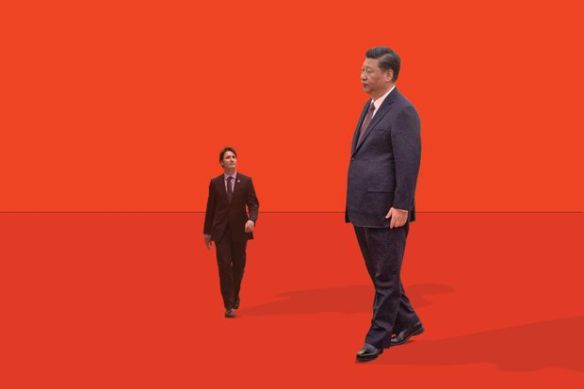
Mr Trump and Mr Pence might, in fact, be playing a deliberate game of good cop, bad cop.

Mr Trump’s handling of China reflects his reluctance to antagonize Mr Xi or impose sanctions on China even in response to egregious human-rights abuses, including its internment of up to one million Muslims from Xinjiang. Had Russia set up such camps, the US response would likely have been swift and resolute.

The US president is a great believer in the idea that a good rapport between heads of government can significantly shape the relationship between the countries they lead. He also prides himself on being a great negotiator and deal-maker.

While letting his vice president forthrightly articulate America’s concerns over China, Mr Trump is seeking to preserve space to cut a possible deal with Mr Xi on trade. Mr Trump and Mr Xi, in their first face-to-face interaction in nearly a year, are likely to meet on November 29 in Buenos Aires, a day before the G20 summit opens there.

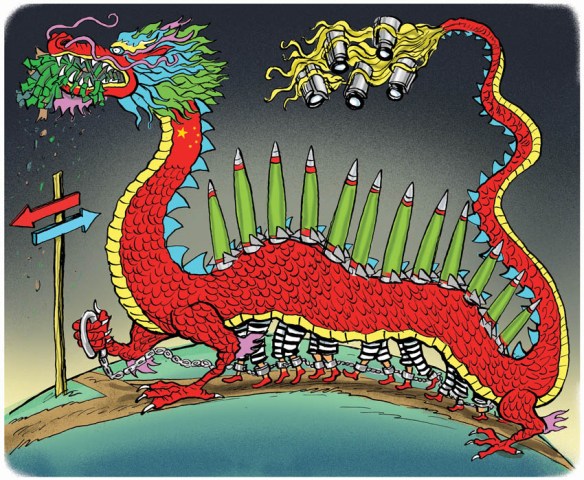
In his recent speech, Mr Pence highlighted how China is blending economic aggression, territorial and maritime revisionism, military adventurism, influence operations and Orwellian repression at home to advance its ambitions.

More importantly, Mr Pence declared that “the US has adopted a new approach to China”, saying that “previous administrations all but ignored China’s actions. And in many cases, they abetted them. But those days are over.”

The speech laid out why the Trump administration is making a course correction in the China policy that successive American presidents have pursued since the early 1970s, when the US managed the diplomatic coup of splitting its two main enemies – the Soviet Union and China. With the US winning over China to its side, it became two against one. This proved a critical factor in the eventual US victory in the Cold War and the Soviet Union’s collapse.

In return, the US actively aided China’s rise. After Deng Xiaoping emerged as China’s paramount leader in 1978, following a fierce power struggle, and embarked on economic modernisation, the US lent full support to his mission.

The US policy of assisting China’s economic ascent did not change even in response to the 1989 Tiananmen Square massacre. There, Chinese authorities used tanks to ruthlessly crush student-led protests in the heart of Beijing – an action that left hundreds, possibly thousands, dead.

But now the Trump administration has unveiled a new strategy to shift the US relationship with China from co-operation to competition, including confronting Chinese mercantilism and Beijing’s campaign of influence operations on American soil.

As Mr Pence put it, the US miscalculated that after the fall of the Soviet Union, “a free China was inevitable”. Today, according to him, an increasingly authoritarian and aggressive China has “mobilised covert actors, front groups, and propaganda outlets to shift Americans’ perception of Chinese policy … what the Russians are doing pales in comparison to what China is doing across this country”.

Against this backdrop, it might seem appropriate that Mr Trump is sending the blunt-speaking Mr Pence in his place to the forthcoming multilateral summits in the Indo-Pacific region − the East Asia Summit (EAS) and the US-Asean summit, both to be held in Singapore in mid-November, followed by the Asia Pacific Economic Cooperation (APEC) group summit at Port Moresby, Papua New Guinea, on November 17-18.

APEC summits, instituted in 1993, have become largely symbolic, and Mr Trump’s absence at Port Moresby will not be unusual. Bill Clinton missed two summits and Barack Obama skipped one. As APEC’s membership has expanded, the grouping’s cohesiveness and mission have weakened.

The promise of the 18-nation EAS has also faded. Like the 21-nation APEC, the EAS includes America’s main geopolitical rivals, China and Russia.

In this light, to counter the rise of an increasingly muscular China that refuses to play by international rules, substance matters more for US policy than group photographs at multilateral summits.

It is significant that, in an otherwise polarised and divided Washington, a bipartisan consensus is emerging that the failed US policy of “constructive engagement” with China must be replaced with concrete counteraction.

For example, in a Harvard University essay this month, Obama’s defence secretary, Ashton Carter, writes: “Washington since the end of the Cold War has often backed down in the face of Chinese bullying. From aggressive territorial claims to human-rights abuses and brazen theft on a trillion-dollar scale, China has violated core international norms time and again with little repercussions beyond scolding American speeches”.

Mr Carter recommends that, “when China behaves inappropriately on the international stage, the US must firmly push back and stand up for the principles of international order”. Mr Pence has signalled that this is precisely what the Trump administration intends to do.

Brahma Chellaney is a geostrategist and the author, most recently, of the award-winning Water, Peace, and War.

China’s Imperial Project Runs into Resistance

Washington Times
101_2018_b1chellanylgchina8201_c0-59-2200-1341_s885x516

Grand on ambition but short on transparency, Chinese President Xi Jinping’s marquee project, the Belt and Road Initiative (BRI), seeks to refashion the global economic and political order by luring nations desperate for infrastructure investments into China’s strategic orbit. The BRI is essentially an imperial project aiming to make real the mythical Middle Kingdom.

The BRI, rolled out in 2013, attracted many countries, as China offered to finance and build major infrastructure projects, including ports, highways, energy plants and railroads. But after a smooth sailing, the BRI is now encountering strong headwinds, as partner-countries worry about China ensnaring them in sovereignty-eroding debt traps.

China has extended huge loans to financially weak states, only to strengthen its leverage through debt entrapment Indeed, Beijing has converted big credits not just into political influence but also a military presence, as its first overseas naval base at Djibouti illustrates.

Malaysian Prime Minister Mahathir Mohamad, with Chinese Premier Li Keqiang by his side in Beijing’s Great Hall of the People, recently criticized China’s use of infrastructure projects to spread its influence. By warning China against “a new version of colonialism,” Mr. Mahathir highlighted international concerns over Beijing’s use of geo-economic tools to achieve geopolitical objectives.

A number of countries have now begun trying to renegotiate their deals with Beijing. Some have also decided to scrap or scale back BRI projects. Mr. Mahathir, during his Beijing visit, announced cancellation of Chinese projects worth nearly $23 billion.

BRI seeks to export China’s model of top-down, debt-driven development through government-to-government deals. Vulnerable countries are now awakening to the risks of accepting loans that could financially shackle them to Beijing.

Last December, China acquired the strategic Indian Ocean port of Hambantota on a 99-year lease after the small island nation of Sri Lanka could no longer keep up with debt repayments.

In fact, China is even replicating some of the practices that were used against it during the European-colonial period. For example, the concept of a 99-year lease emerged from the flurry of European-colonial expansion in China in the 19th century.

While rates for Japan’s infrastructure loans usually run below half a percent, China offers BRI loans at rates as high as 7 percent, which can place unsustainable financial strain on small countries. For example, China’s renegotiated Hambantota port loan to Sri Lanka carries a 6.3 percent fixed rate. In China’s client state, Pakistan, Chinese state companies have secured energy contracts that guarantee 16 percent or more yearly returns, in dollar terms.

China has faced accusations in multiple countries of illegally funneling money to authoritarian presidents.

In the Maldives, China has managed to acquire several islets in that heavily indebted Indian Ocean archipelago. Mohamed Nasheed, the nation’s first democratically elected president who was ousted at gunpoint in 2012, said, “Without firing a single shot, China has grabbed more land in the Maldives than what [Britain’s] East India Company did at the height of the 19th century.”

Against this background, the BRI is beginning to encounter a push-back in a number of countries. A growing number of governments are seeking transparency in Chinese lending, investment and trade practices.

However, the BRI is still bagging new contracts in some other countries. One example is the Himalayan nation of Nepal, which became the world’s sixth Communist-ruled country in February. China helped unite warring Communist factions in Nepal and funded the election campaign. Now Beijing is reaping the rewards.

The new Communist government in Nepal in September reinstated a deal with China for a $2.5 billion dam project that was scrapped by the previous government. China won the contract without an open-bidding process. In fact, it has massively inflated the project cost, which will leave Nepal struggling to repay the Chinese loan.

Laos, another Communist-ruled nation, is also seeking more BRI financing and investment. In continental Southeast Asia, while Myanmar, Thailand and Vietnam are wary of getting too close to China, Laos and Cambodia see BRI as critical to boosting their economic growth.

Yet the international reality is that, after a heady first phase, the pace of new contracts under the BRI has slowed, as concerns spread about China’s debt-trap diplomacy and as heavily indebted nations recoil from accepting more Chinese financing in the form of market-rate loans. This trend is likely to intensify in the next few years.

Even within China, the BRI is facing criticism from those who question the wisdom of plowing hundreds of billions of dollars into overseas projects when the government is still grappling with poverty and underdevelopment in a number of provinces. Critics are concerned that Mr. Xi’s aggressive quest for Chinese dominance is inviting an international backlash. The BRI — the world’s biggest building program, which Mr. Xi has hailed as “the project of the century” — exemplifies how China is flaunting its global ambitions.

Meanwhile, the financial and security risks of Chinese projects in failing or dysfunctional states are becoming more apparent. Take Pakistan, the largest recipient of BRI financing. The Pakistani military has raised a special 15,000-strong force to protect Chinese projects. In addition, thousands of police have been deployed in some provinces to protect Chinese workers. Yet sporadic attacks on Chinese in Pakistan have underscored the rising security costs.

The larger push-back against China’s neocolonial practices is likely to intensify in the coming years, putting greater pressure on the BRI. The initiative, however, will continue to benefit from a U.S.-led sanctions approach that seeks to punish countries in the name of human rights or nuclear nonproliferation. Thanks to this approach, the BRI is still bagging major lucrative contracts in countries as diverse as Iran, Sudan and Cambodia.

• Brahma Chellaney is a geostrategist and the author of nine books, including “Water: Asia’s New Battleground.”

Copyright © 2018 The Washington Times, LLC. Click here for reprint permission.

No easy escape from Afghan war for Trump

Russia, China and Iran now backing Taliban and stymieing U.S. peace efforts

Afgh

The U.S. will find it difficult to pull out of Afghanistan in the face of increased foreign support for the Taliban.   © Reuters

Brahma ChellaneyNikkei Asian Review

Not for the first time, the U.S. is showing signs of desperation in trying to end its war in Afghanistan, by renewing efforts for a peace deal with the Taliban and — yet again — reviewing combat strategy.

Ending the longest war in American history, which marks its 17th anniversary on Oct. 7, appears integral to President Donald Trump’s broader plan to roll back America’s “imperial overreach” — the phenomenon of a great power going into decline when it takes on excessive global commitments.

In contrast to China’s use of economic tools to achieve strategic objectives, the U.S. has too often reached for the gun instead of the purse. Many in Washington now believe U.S. retrenchment must include staying out of faraway wars and making allies pay their fair share for defense.

In the summer of 2017, the Trump administration ended the CIA’s covert operations to train and arm rebels in Syria — a large-scale program that had begun under Trump’s predecessor, Barack Obama. Ironically, it was Obama who in 2013 underscored the danger of perpetual war for U.S. power by recalling the warning of America’s fourth president, James Madison, that “no nation could preserve its freedom in the midst of continual warfare.”

Today, extricating the U.S. from the military quagmire in Afghanistan is seen as important to reversing America’s relative decline, including focusing on domestic renewal. A year ago, Trump acknowledged that his “original instinct was to pull out” but that he had been convinced that “a hasty withdrawal would create a vacuum for terrorists, including ISIS and al-Qaida.” Now, with U.S. patience wearing thin, his administration has stepped up efforts to end the war.

But international geopolitics promises to play spoilsport. U.S. foreign policy, through punitive sanctions and tariffs, is driving Russia, China and Iran to support the Afghan Taliban in a bid to tie down American forces in Afghanistan. Pakistan, which provides cross-border safe havens to America’s main battlefield foe, the Afghan Taliban, seems intent to continue running with the hare and hunting with the hounds — pretending to be a U.S. ally while harboring the Taliban’s network structure.

To make matters worse, an ascendant Afghan Taliban is expanding its territorial control and killing government forces in such record numbers that authorities in Kabul no longer disclose fatality tolls. Afghan military casualties have been rising since 2014, after U.S. forces transferred responsibility for most security to the Afghans. According to one estimate, the daily fatality toll among Afghan security forces has jumped from 22 in 2016 to about 57 recently. Both Kabul and Washington now admit that Afghan casualties have risen to unsustainable levels.

About 14,000 American troops remain in Afghanistan, including 4,000 added by Trump, plus some 26,000 American military contractors.

Trump, instead of the promised fundamentally different approach, is now seeking to essentially repeat Obama’s failed effort — to cut a deal with the Afghan Taliban, for which the U.S. needs the full backing of Pakistan’s powerful generals. To win their support, the U.S. has assassinated three successive chiefs of the Pakistani Taliban, a group that poses no real threat to American forces but is the nemesis of the Pakistan military.

After the latest killing in May, which came about four months after Washington cut most security assistance to Pakistan, the U.S. held face-to-face talks in July with the Afghan Taliban in Qatar.

The Obama administration first sought to make Qatar’s capital, Doha, a negotiations hub by allowing the Afghan Taliban to establish a de facto diplomatic mission there in 2013.

To preserve the option of reaching a Faustian bargain with the Afghan Taliban, the U.S. has not included the militia in its list of foreign terrorist organizations. And the only time the U.S. has assassinated a major Afghan Taliban leader inside the militia leadership’s sanctuary, Pakistan, was in 2016 when a drone strike killed the new chief after he adamantly opposed any peace talks.

U.S. Defense Secretary Jim Mattis, while making an unannounced visit to Kabul recently on his way back from New Delhi, said reconciliation efforts with the militia had gained “traction.”

But the Taliban, while valuing direct talks with the U.S. as a means to undercut the Afghan government’s legitimacy, have little incentive to make peace with America. The Taliban have gained the momentum against regime forces, which are spread thin and on the defensive. Taliban battlefield victories are denting government morale and making it less likely that the insurgents will agree to a deal.

Washington, in response to the increasing Taliban attacks, has advised Afghan troops to pull back from vulnerable outposts and focus on safeguarding cities. Making force protection the priority clearly signals a government in retreat.

Further emboldening the Taliban is new support from Russia, Iran and China. With U.S. sanctions hurting the Iranian and Russian economies and Trump’s trade war against China potentially laying the foundation of a new Cold War, Tehran, Moscow and Beijing are opportunistically seeking to use the Taliban as a tool to step up pressure on the U.S.

The revival of the “Great Game” — the 19th-century Anglo-Russian rivalry for Central Asian influence — makes it harder to pacify war-torn Afghanistan. Behind the changed geopolitics is a major role reversal.

In the 1980s, U.S. President Ronald Reagan used Islam as a tool to spur resistance to the Soviet occupation of Afghanistan, with the CIA arming thousands of Afghan mujahedeen — violent jihadists that later spawned al-Qaida and the Taliban.

Moscow and Tehran long viewed the Taliban as a major terrorist threat and aided the 2001 U.S. overthrow of the five-year-old Taliban regime. But now Russia and Iran are seeking to assist the Taliban against the shaky, U.S.-backed Kabul government.

Meanwhile, China has long had a dubious approach toward the militia. On the day of the 2001 New York World Trade Center terrorist attack, a Chinese delegation signed an economic and technical cooperation agreement with the isolated Taliban regime in its de facto capital, Kandahar.

Seeking a bigger role in Afghanistan, China is again courting the Taliban. It has received Taliban delegations in recent years and offered to mediate peace talks. The Taliban has promised not to attack China’s much-delayed, $3 billion project to mine huge copper deposits at Mes Aynak, near Kabul.

India, a top aid donor to Afghanistan, has pursued a consistently anti-Taliban policy. Despite its warming ties with Washington, India is concerned that U.S. direct talks with the Taliban could lend respectability to a fanatical terrorist organization.

But the U.S. clearly appears willing, as part of a peace deal, to accommodate the Taliban in an Afghan power-sharing arrangement. But the spoiler roles of Russia, China and Iran and the Taliban’s battlefield successes make such a deal less likely. As American senator John McCain predicted before his death, the conflict in Afghanistan would continue “on a low-burning simmer for a long time to come.”

Brahma Chellaney is a geostrategist and the author, most recently, of the award-winning “Water, Peace, and War.”

The China Backlash

US President Donald Trump’s headline-grabbing trade war with China should not obscure a broader pushback against the country’s mercantilist trade, investment, and lending practices. In fact, China’s free ride could be coming to an end.

712d438997986267461f01784924b61d.2-1-super.1

On a recent official visit to China, Malaysian Prime Minister Mahathir Mohamad criticized his host country’s use of major infrastructure projects – and difficult-to-repay loans – to assert its influence over smaller countries. While Mahathir’s warnings in Beijing against “a new version of colonialism” stood out for their boldness, they reflect a broader pushback against China’s mercantilist trade, investment, and lending practices.

Since 2013, under the umbrella of its “Belt and Road Initiative,” China has been funding and implementing large infrastructure projects in countries around the world, in order to help align their interests with its own, gain a political foothold in strategic locations, and export its industrial surpluses. By keeping bidding on BRI projects closed and opaque, China often massively inflates their value, leaving countries struggling to repay their debts.

Once countries become ensnared in China’s debt traps, they can end up being forced into even worse deals to compensate their creditor for lack of repayment. Most notably, last December, Sri Lanka was compelled to transfer the Chinese-built strategic port of Hambantota to China on a 99-year, colonial-style lease, because it could longer afford its debt payments.

Sri Lanka’s experience was a wake-up call for other countries with outsize debts to China. Fearing that they, too, could lose strategic assets, they are now attempting to scrap, scale back, or renegotiate their deals. Mahathir, who previously cleared the way for Chinese investment in Malaysia, ended his trip to Beijing by canceling Chinese projects worth almost $23 billion.

Countries as diverse as Bangladesh, Hungary, and Tanzania have also canceled or scaled back BRI projects. Myanmar, hoping to secure needed infrastructure without becoming caught up in a Chinese debt trap, has used the threat of cancellation to negotiate a reduction in the cost of its planned Kyaukpyu port from $7.3 billion to $1.3 billion.

Even China’s closest partners are now wary of the BRI. In Pakistan, which has long worked with China to contain India and is the largest recipient of BRI financing, the new military-backed government has sought to review or renegotiate projects in response to a worsening debt crisis. In Cambodia, another leading recipient of Chinese loans, fears of effectively becoming a Chinese colony are on the rise.

The backlash against China can be seen elsewhere, too. The recent annual Pacific Islands Forum meeting was one of the most contentious in its history. Chinese policies in the region, together with the Chinese delegation leader’s behavior at the event itself, drove the president of Nauru – the world’s smallest republic, with just 11,000 inhabitants – to condemn China’s “arrogant” presence in the South Pacific. China cannot, he declared, “dictate things to us.”

When it comes to trade, US President Donald Trump’s escalating trade war with China is grabbing headlines, but Trump is far from alone in criticizing China. With policies ranging from export subsidies and nontariff barriers to intellectual-property piracy and tilting the domestic market in favor of Chinese companies, China represents, in the words of Harvard’s Graham Allison, the “most protectionist, mercantilist, and predatory major economy in the world.”

As the largest merchandise exporter in the world, China is many countries’ biggest trading partner. Beijing has leveraged this role by employing trade to punish those that refuse to toe its line, including by imposing import bans on specific products, halting strategic exports (such as rare-earth minerals), cutting off tourism from China, and encouraging domestic consumer boycotts or protests against foreign businesses.

The fact is that China has grown strong and rich by flouting international trade rules. But now its chickens are coming home to roost, with a growing number of countries imposing antidumping or punitive duties on Chinese goods. And as countries worry about China bending them to its will by luring them into debt traps, it is no longer smooth sailing for the BRI.

Beyond Trump’s tariffs, the European Union has filed a complaint with the World Trade Organization about China’s practices of forcing technology transfer as a condition of market access. China’s export subsidies and other trade-distorting practices are set to encounter greater international resistance. Under WTO rules, countries may impose tariffs on subsidized goods from overseas that harm domestic industries.

Now, Chinese President Xi Jinping finds himself not only defending the BRI, his signature foreign-policy initiative, but also confronting domestic criticism, however muted, for flaunting China’s global ambitions and thereby inviting a US-led international backlash. Xi has discarded one of former Chinese strongman Deng Xiaoping’s most famous dicta: “Hide your strength, bide your time.” Instead, Xi has chosen to pursue an unabashedly aggressive strategy that has many asking whether China is emerging as a new kind of imperialist power.

International trade has afforded China enormous benefits, enabling the country to become the world’s second-largest economy, while lifting hundreds of millions of people out of poverty. The country cannot afford to lose those benefits to an international backlash against its unfair trade and investment practices.

China’s reliance on large trade surpluses and foreign-exchange reserves to fund the expansion of its global footprint makes it all the more vulnerable to the current pushback. In fact, even if China shifts its strategy and adheres to international rules, its trade surplus and foreign-currency reserves will be affected. In short, whichever path it chooses, China’s free ride could be coming to an end.

© Project Syndicate, 2018.

India fumbles against a rogue neighbour

Brahma Chellaney, Mail Today

pakistani-flag-reuetrsPakistan has turned into the Mecca of international terrorism even as its new prime minister, Imran “Taliban” Khan, has promised to make his country a Medina-like welfare state. Pakistan, however, is battling a deepening financial crisis, largely exacerbated by its “all-weather” ally, China. Beijing has imposed unfair deals on, and stepped up capital-goods exports to, Pakistan under its so-called Belt and Road Initiative.

The military-manipulated election that brought Khan to power, instead of providing much-needed stability to Pakistan, is likely to inject more turmoil. A supporter of the military-backed jihadists and a religious zealot himself, Khan in February married his burqa-clad “spiritual guide”, who now also serves as his political guide.

The Pakistani military has waged an undeclared war against India since the 1980s. But now that an internationally isolated Pakistan, with its economy in dire straits, is seeking an international bailout package, the military generals there, for tactical reasons, want “peace” talks with India while remaining engaged in aggression. Through such talks, they also wish to legitimize the government they helped to install.

Yet this is exactly what Prime Minister Narendra Modi risked doing by initially agreeing to a bilateral foreign ministers’ meeting. The meeting, on the sidelines of the UN general assembly, would have represented the first high-level contact between India and Pakistan since early 2016, when talks were suspended after the Pakistan-scripted terrorist attack on the Pathankot air force base. Despite frequent terrorist outrages, such a meeting would have signalled a thaw in Indo-Pakistan relations. Fortunately, the Modi government had the good sense to reverse its decision.

It should not be forgotten that another BJP prime minister, Atal Bihari Vajpayee, legitimized General Pervez Musharraf’s military rule by inviting him out of the blue to a summit in Agra. That summit went badly, but Musharraf came out the clear winner.

The Modi government initially agreed to the foreign ministers’ meeting just after the Pakistani army killed an Indian soldier by sniper fire and then slit his throat and mutilated his body. In fact, such was the bad optics that India was playing a cricket match with Pakistan in Dubai on the day the Pakistani savagery was first reported. Worse still, the timing of the Indian announcement to hold the meeting sent out an unfortunate message — that India, instead of being outraged over the mutilation, was rewarding Pakistan with bilateral discussions. That message was reinforced in the immediate aftermath by the abduction and killing of three cops in Jammu and Kashmir by Pakistan-backed terrorists.

To its credit, the Modi government took barely 24 hours to correct its mistake and scrap the foreign ministers’ meeting. Strong reaction on social media played a role in the quick reversal. But it is apparent that the original decision in favour of the meeting was taken without careful thought. There was no consideration of the fact that such talks would not only be futile but also amount to India playing into Pakistan’s hands.

Indeed, no sooner had India reversed its decision than Imran Khan sought to mock Modi by referring to “small men holding big offices” — a statement that effectively closes the door to any senior-level bilateral talks in the coming months. That reference might more aptly apply to Khan himself. After all, Khan (the Pakistani military’s newest puppet) has long been ridiculed as “Im the Dim” for his lack of intelligence.

Still, the fact is that incompetent officials in New Delhi have seriously embarrassed India through their flip-flop and provided new grist to the Pakistani propaganda mill. For example, the ministry of external affairs cited Pakistan’s glorification of terrorists through new postage stamps as one of the provocations for the Indian U-turn, although these stamps were released before Khan took office.

It is an open secret that Washington has sought to persuade New Delhi to engage with Islamabad. America has stepped up its effort to end its longest-ever war by clinching a peace deal with the Afghan Taliban, for which it needs the Pakistani military’s help. India, in its first bilateral engagement with the Imran Khan government, convened a meeting of the Permanent Indus Commission in Lahore at the end of last month, although the meeting was not due until March 2019. The Commission’s meeting, however, attracted little attention in India.

The Modi government’s meandering Pakistan policy is also apparent from another volte-face: It hastily permitted and then, after Khan’s mocking statement, postponed a tour of inspection of new Indian projects on River Chenab by Pakistan’s Indus commissioner and two other officials. In September 2016, Modi had vowed that, “Blood and water cannot flow together”. But two years later, instead of action, visible backsliding is evident. The Indus Waters Treaty remains the world’s most generous water-sharing pact. India, however, remains reluctant to leverage this treaty to tame a scofflaw neighbour.

Successive Indian governments have failed to develop a clear strategy to deal with Pakistan. The Modi government has finally realized what was well known — that “Pakistan will not mend its ways”. It’s better late than never. It has also acknowledged that talks with Pakistan would be “meaningless”, given “the evil agenda of Pakistan” and the “true face” of the Imran Khan government. Can we now hope that India would develop consistency, clarity and courage in its Pakistan policy and fashion a coherent strategy to contain a rogue neighbour?

Brahma Chellaney is a geostrategist and author.
China expands its control in South China Sea

SCS

Filipino activists rally outside the Chinese Consulate in Manila in February to protest Beijing’s continued reclamation activities in the South China Sea. © Reuters

BY BRAHMA CHELLANEY, The Japan Times, September 18, 2018

As China consolidates its hold in South China Sea and wields its military, economic and diplomatic leverage, smaller countries see no credible option but to work with Beijing, even if that means furthering Chinese objectives. Manila, for example, seems willing to accede to Beijing’s demand for joint development of hydrocarbon resources in the Philippines’ own exclusive economic zone.

The plain fact is that U.S. inaction under successive administrations has allowed China to gain effective control over a strategic sea that is more than twice the size of the Gulf of Mexico and 50 percent bigger than the Mediterranean Sea. Australia’s Kevin Rudd, who is still fending off accusations that he was “a slavish pro-China prime minister,” has acknowledged that “Chinese policy has not yet been challenged in the South China Sea by the United States to any significant extent.”

The U.S., even at the risk of fostering Philippine helplessness against Chinese expansionism, has refused to clarify whether its 1951 Mutual Defense Treaty with Manila would apply to an attack on Philippine troops or vessels in the South China Sea. This refusal stands in contrast to Washington’s commitment to the defense of the Japanese-administered but Chinese-claimed Senkaku Islands in the East China Sea. U.S. President Donald Trump, in his joint statement with Prime Minister Shinzo Abe in April, said that “Article 5 of the U.S.-Japan Treaty of Mutual Cooperation and Security covers the Senkaku Islands.”

In the South China Sea, China has astounded the world with the speed and scale of its creation of artificial islands and military infrastructure. The first Chinese dredger arrived in the region in December 2013. Less than five years later, China has largely completed building most of its forward military bases. It is now ramping up its military assets in the South China Sea.

Yet China has incurred no international costs for pushing its borders far out into international waters. In fact, China stepped up the expansion of its frontiers after an international arbitration tribunal invalidated its expansive claims in the South China Sea through a 2016 ruling in a case instituted by the Philippines.

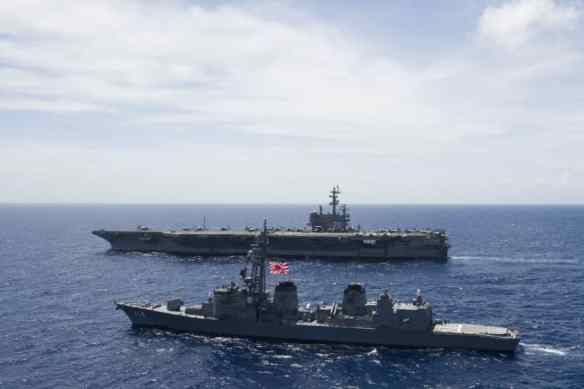
U.S. Defense Secretary Jim Mattis recently called out China for its “intimidation and coercion” of smaller nations in the region. His criticism of the Chinese strategy in the South China Sea followed American action to disinvite China from this summer’s Rim of the Pacific maritime exercise, known as RIMPAC.

This might suggest that the U.S. is taking a tough line. In reality, America’s response to China’s expansionism in the South China Sea has remained muted. The U.S. has focused its concern merely on safeguarding freedom of navigation through the South China Sea.

In fact, the U.S. has refused to take sides in the territorial disputes between China and the other claimant-states in the South China Sea. The Trump administration stayed silent even when Chinese military threats forced Vietnam in March, for the second time in less than nine months, to halt oil and gas drilling on its own continental shelf.

The U.S. has similarly stayed neutral on disputes elsewhere between China and its neighbors. For example, President Barack Obama publicly said that “we don’t take a position on the sovereignty of the Senkaku Islands” and advised Tokyo and Beijing to sort out their dispute peacefully. This line has not changed under Trump, despite his reassurance that the Japan-U.S. security treaty covers the Senkakus.

Growing Asian anxieties over China have helped the U.S. to return to Asia’s center-stage by strengthening old alliances, such as with Japan, South Korea and Singapore, and building new strategic partnerships with India, Vietnam and Indonesia. It has also befriended the former pariah state of Myanmar.

Yet, despite this diplomatic windfall, the U.S. has been reluctant to draw a line on Beijing’s salami-style actions to change facts on the ground.

To be sure, the Trump-led U.S. has stepped up the so-called freedom of navigation operations in the South China Sea. But these operations neither reassure the smaller states nor deter China, whose actions continue to violate the United Nations Convention on the Law of the Sea, or UNCLOS.

In the East China Sea, China established an air-defense identification zone (ADIZ) in 2013 covering territories, like the Senkakus, that it claims but does not control. This action set a dangerous precedent in international relations.

In the South China Sea, rather than openly declare an ADIZ, China will likely seek to enforce one by gradually establishing concentric circles of air control — but only after it has deployed sufficient military assets there and further consolidated its hold.

It has already set up an interconnected array of radar, electronic-attack facilities, missile batteries and airfields on the disputed Spratly Islands. And by turning artificial islands into military bases, it has virtually established permanent aircraft carriers whose role extends to the Indian Ocean and the western Pacific.

China’s strategy poses a serious challenge to its neighbors, which face a deepening dilemma over how to deal with its creeping aggression.

The U.S., while seeking to protect its military freedom of navigation in the South China Sea, has effectively turned a blind eye to the broader Chinese assault on the freedom of the seas, including restricting the rights of other states to natural resources on their own continental shelves.

Unless the U.S. shifts its focus from freedom of navigation to freedom of the seas, China will have its way, including forcing its smaller neighbors to share their legitimate resources with it.

The Philippines, for example, is at serious risk of wilting under Chinese pressure. Prevented by Chinese military threats from tapping energy resources in an area of seabed known as Reed Bank, which is located close the Philippine coast, Manila seems willing to enter into a deal with Beijing to equally share the output from a joint gas project there.

Under the international arbitration ruling, the Philippines have exclusive rights to Reed Bank. But with China trashing the ruling in the absence of an international enforcement mechanism, the message to Manila is that might makes right.

Left with no other option, Manila appears ready to offer Beijing half of the gas production, but no sovereign rights. The logic behind such a prospective offer is that any Western oil giant, if it developed Reed Bank, would take about 50 percent of the output as its share. So the choice is between a Western oil company like Exxon Mobil and a Chinese state-run giant, such as the China National Offshore Oil Corp.

But such a Philippine deal would encourage China to seek similar concessions with other claimant-states, effectively blocking out Western oil firms from the South China Sea.

Make no mistake: Chinese territorial and maritime revisionism has made the South China Sea the world’s most critical hot spot. In fact, the South China Sea has become central to the wider geopolitics, balance of power and maritime order.

Brahma Chellaney is a geostrategist and the author of nine books, including the award-winning “Water: Asia’s New Battleground.”

© The Japan Times, 2018.

A Global Environmental Threat Made in China

From large-scale dam-building to unbridled resource-exploitation, human activity is causing serious damage to Himalayan ecosystems. While all the countries in the region are culpable to some extent, none is doing as much harm as China.

a476b39b5c95b531412b6baca5fcbaa5.2-1-super.1

BRAHMA CHELLANEY, a column internationally syndicated by Project Syndicate

Asia’s future is inextricably tied to the Himalayas, the world’s tallest mountain range and the source of the water-stressed continent’s major river systems. Yet reckless national projects are straining the region’s fragile ecosystems, resulting in a mounting security threat that extends beyond Asia.

With elevations rising dramatically from less than 500 meters (1,640 feet) to over 8,000 meters, the Himalayas are home to ecosystems ranging from high-altitude alluvial grasslands and subtropical broadleaf forests to conifer forests and alpine meadows. Stretching from Myanmar to the Hindu-Kush watershed of Central Asia, the Himalayas play a central role in driving Asia’s hydrological cycle and weather and climate patterns, including triggering the annual summer monsoons. Its 18,000 high-altitude glaciers store massive amounts of freshwater and serve in winter as the world’s second-largest heat sink after Antarctica, thus helping to moderate the global climate. In summer, however, the Himalayas turn into a heat source that draws the monsoonal currents from the oceans into the Asian hinterland.

The Himalayas are now subject to accelerated glacial thaw, climatic instability, and biodiversity loss. Five rivers originating on the Great Himalayan Massif – the Yangtze, the Indus, the Mekong, the Salween, and the Ganges – rank among the world’s ten most endangered rivers.

From large-scale dam construction to the unbridled exploitation of natural resources, human activity is clearly to blame for these potentially devastating changes to the Himalayan ecosystems. While all the countries in the region are culpable to some extent, none is doing as much harm as China.

Unconstrained by the kinds of grassroots activism seen in, say, democratic India, China has used massive, but often opaque, construction projects to bend nature to its will and trumpet its rise as a great power. This includes a globally unmatched inter-river and inter-basin water-transfer infrastructure with the capacity to move over ten billion cubic meters (13 billion cubic yards) through 16,000 kilometers (9,940 miles) of canals.

China’s reengineering of natural river flows through damming – one-fifth of the country’s rivers now have less water flowing through them each year than is diverted to reservoirs – has already degraded riparian ecosystems and caused 350 large lakes to disappear. With these water-diverting projects increasingly focused on international, rather than internal, rivers – in particular those in the Tibetan Plateau, which covers nearly three-quarters of the Himalayan glacier area – the environmental threat extends far beyond China’s borders.

And dams are just the beginning. The Tibetan Plateau is also the subject of Chinese geo-engineering experiments, which aim to induce rain in its arid north and northwest. (Rain in Tibet is concentrated in its Himalayan region.) Such activities threaten to suck moisture from other regions, potentially affecting Asia’s monsoons. Ominously, such experiments are an extension of the Chinese military’s weather-modification program.

Moreover, as if to substantiate the Chinese name for Tibet, Xizang(“Western Treasure Land”), China is draining mineral resources from this ecologically fragile but resource-rich plateau, without regard for the consequences. Already, copper mine tailings are polluting waters in a Himalayan region sacred to Tibetans, which they call Pemako (“Hidden Lotus Land”), where the world’s highest-altitude major river, the Brahmaputra (Yarlung Tsangpo to Tibetans), curves around the Himalayas before entering India.

Last fall, the once-pristine Siang – the Brahmaputra’s main artery – suddenly turned blackish gray as it entered India, potentially because of China’s upstream tunneling, mining, or damming activity. To be sure, the Chinese government claimed that an earthquake that struck southeastern Tibet in mid-November “might have led to the turbidity” in the river waters. But the water had become unfit for human consumption long before the quake.

In any case, China is not letting up. It has, for example, eagerly launched large-scale operations to mine precious minerals like gold and silver in a disputed area of the eastern Himalayas that it seized from India in a 1959 armed clash.

Meanwhile, China’s bottled-water industry – the world’s largest – is siphoning “premium drinking water” from the Himalayas’ already-stressed glaciers, particularly those in the eastern Himalayas, where accelerated melting of snow and ice fields is already conspicuous. Unsurprisingly, this is causing biodiversity loss and impairment of ecosystem services.

Across the Himalayas, scientists report large-scale deforestation, high rates of loss of genetic variability, and species extinction in the highlands. The Tibetan Plateau, for its part, is warming at almost three times the average global rate. This holds environmental implications that extend far beyond Asia.

The towering Himalayan Highlands, particularly Tibet, influence the Northern Hemisphere’s atmospheric-circulation system, which helps to transport warm air from the equator toward the poles, sustaining a variety of climate zones along the way. In other words, Himalayan ecosystem impairment will likely affect European and North American climatic patterns.

Halting rampant environmental degradation in the Himalayas is now urgent, and it is possible only through cooperation among all members of the Himalayan basin community, from the lower Mekong River region and China to the countries of southern Asia. To bring about such cooperation, however, the entire international community will have to apply pressure to rein in China’s reckless environmental impairment, which is by far the greatest source of risk.

Brahma Chellaney, Professor of Strategic Studies at the New Delhi-based Center for Policy Research and Fellow at the Robert Bosch Academy in Berlin, is the author of nine books, including Asian JuggernautWater: Asia’s New Battleground, and Water, Peace, and War: Confronting the Global Water Crisis.

© Project Syndicate, 2018.

U.S. injects new irritant in ties with India

Brahma Chellaney, Mail Today

Robin-sanctions-américaines-UE

U.S. President Donald Trump’s first round of Iran-related sanctions has come into force this week, with no waiver for India in sight as yet. The U.S. Congress has passed legislation granting India a waiver from its new Russia-centred sanctions, but the waiver is conditional and contingent upon a periodic, six-monthly presidential certification. The Indian media highlighted the passing of the waiver legislation but not the conditions it incorporated.

India, as a longstanding significant buyer of Russian weapons and the second-largest importer of Iranian oil after China, is a major victim of the new U.S. sanctions. By implicitly mounting two-pronged pressure on New Delhi on energy and defence fronts, Washington has injected a major new irritant in the bilateral relationship, as if to underscore the risks for India of pursuing a foreign policy too closely aligned with America.

By slapping a nation with punitive sanctions, the U.S. seeks to block trade and financial activities with that country even by other states. Such extraterritorial sanctions — which it euphemistically labels “secondary” sanctions — run counter to international law. Yet the U.S. uses its unmatched power to turn national actions into global measures.

As the world’s reserve currency that greases the wheels of the global financial system, the U.S. dollar arms America with tremendous leverage, making U.S. sanctions the most powerful in the world. Most international transactions, from banking to oil, are conducted in U.S. dollars.

Today, however, the U.S. faces a major test to effectively enforce its new extraterritorial sanctions relating to Iran, a Trump obsession, and Russia, which still evokes bipartisan hostility in Washington although Russia’s economy has shrunk to one-tenth the size of China’s and its military spending to one-fifth of China’s.

Trump’s sanctions aimed at throttling the Iranian economy after his unilateral withdrawal from the multilateral Iran nuclear deal have prompted calls for defiance even in Europe. The new Russia sanctions, however, were initiated by Congress, which passed a law to compel the Trump administration to act against Moscow. Known as Countering America’s Adversaries Through Sanctions Act, or CAATSA, the law uses the sanctions threat to wean countries off their craving for Russian weapons so as to boost America’s own arms sales.

The U.S. is already the world’s leading exporter of weapons by far. Another paradox is that the U.S. has overtaken Russia as the top arms seller to India. But while Russia has transferred to India offensive weapons, including a nuclear-powered submarine (INS Chakra) and an aircraft carrier (INS Vikramaditya), the U.S. has been selling defensive military systems to India, such as the P-8I maritime surveillance aircraft and the C-17 Globemaster III and C-130J Super Hercules military transport planes. India cannot snap its defence ties with Moscow for another reason: It relies on Russian spare parts for maintenance of its Russian-made hardware, some of Soviet origin.

While the CAATSA waiver will allow India to go ahead with the pending purchase from Russia of the interceptor-based S-400 Triumf air and anti-missile defence system, future Indian imports from Russia are likely to face U.S. scrutiny. In fact, the waiver legislation mandates that India, Vietnam and Indonesia — the three countries granted waivers from the CAATSA sanctions — demonstrate that each is significantly reducing dependence on Russian arms or significantly increasing cooperation with the U.S.

The congressional intent was clearly to leverage the waiver. For example, a presidential certification must specify the active steps each nation is taking or planning to cut its inventory of Russian hardware. Such a reporting requirement, by shining a spotlight on India’s arms inventory, promises to act as an irritant in the bilateral relationship. Washington is also stepping up pressure on India to sign the Communications Compatibility and Security Agreement (COMCASA), which the Indian military fears could compromise its network.

The reason why only India, Indonesia and Vietnam were granted waivers is that the U.S. is trying to sway these three into its orbit. In the case of Turkey, a NATO member that, like India, is buying the S-400, Congress is threatening reprisals against Ankara. U.S. pressure on India, Indonesia and Vietnam, however, is unlikely to fully dissipate because no blanket waivers have been granted.

Meanwhile, through its Iran-related sanctions, the U.S. is likely to influence the energy-import policy of India, which currently imports more than three-fourth of its crude oil requirements. According to the International Energy Agency, India is set to emerge as the fastest-growing crude consumer in the world by 2040. Washington is seeking to sell more oil and gas to India and also encouraging it to switch imports from Iran to Saudi Arabia and other U.S. allies.

Next-door Iran, however, has long been a major oil supplier to India. It will remain important for India’s energy-import diversification strategy. U.S. sanctions, however, threaten to affect even New Delhi’s political cooperation with Tehran, including impeding India’s Pakistan-bypassing transportation corridor to Afghanistan via Iran. India has invested in modernizing the Chabahar Port. As the top U.S. general in Afghanistan acknowledged last year, “Iranian-Indian-Afghan cooperation over the Chabahar Port presents great economic potential” for landlocked Afghanistan, which has had to depend on a hostile Pakistan for access to a port.

By making India a key target of the extraterritorial effects of its sanctions on Iran and Russia, and then dangling concessions as favours, the U.S. is doing a disservice to its goal of making the Indo-U.S. strategic partnership a linchpin of its larger strategy to build a free, open and democratic-led Indo-Pacific region. Its actions compound India’s foreign-policy challenges, including how to balance the relationships with various key players.

Brahma Chellaney is a geostrategist and the author.

© Mail Today, 2018.

Trump’s Grand Strategy

p8-chellaney-a-20180802-870x572

As unpredictable as Trump can be, several of his key foreign-policy decisions suggest that his administration is pursuing a coherent vision aimed at reviving America’s global power.

BRAHMA CHELLANEY, a column internationally syndicated by Project Syndicate

US President Donald Trump’s inability to think strategically is undermining longstanding relationships, upending the global order, and accelerating the decline of his country’s global influence – or so the increasingly popular wisdom goes. But this assessment is not nearly as obvious as its proponents – especially political adversaries and critics in the mainstream US media – claim.

America’s relative decline was a hot topic long before Trump took office. The process began when the United States, emboldened by its emergence from the Cold War as the world’s sole superpower, started to overextend itself significantly by enlarging its military footprint and ramping up its global economic and security commitments.

America’s “imperial overreach” was first identified during President Ronald Reagan’s administration, which oversaw a frenetic expansion of military spending. It reached crisis levels with the 2003 US-led invasion and subsequent occupation of Iraq under President George W. Bush – a watershed moment that caused irreparable damage to America’s international standing.

On President Barack Obama’s watch, China rapidly expanded its global influence, including by forcibly changing the status quo in the South China Sea (without incurring any international costs). By that point, it was unmistakable: the era of US hegemony was over.

It is not just that Trump cannot be blamed for America’s relative decline; he may actually be set to arrest it. As unpredictable as Trump can be, several of his key foreign-policy moves suggest that his administration is pursuing a grand strategy aimed at reviving America’s global power.

For starters, the Trump administration seems eager to roll back America’s imperial overreach, including by avoiding intervention in faraway wars and demanding that allies pay their fair share for defense. The fact is that many NATO members do not fulfill their spending commitments, effectively leaving American taxpayers to subsidize their security.

These are not new ideas. Before Trump even decided to run for office, pundits were arguing that the US needed to pursue a policy of retrenchment, drastically reducing its international commitments and transferring more of its defense burden onto its allies. But it was not until Trump, who views running a country much like running a business, that the US had a leader who was willing to pursue that path, even if it undermined the values that have long underpinned US foreign policy.

Trump’s focus on containing China – which FBI Director Christopher Wray recently labeled a far bigger challenge than Russia, even in the area of espionage – fits nicely into this strategy. Successive US presidents, from Richard Nixon to Obama, aided China’s economic rise. Trump, however, regards China not as America’s economic partner, but as “a foe economically” and even, as the official mouthpiece China Daily recently put it, America’s “main strategic rival.”

In general, Trump’s tariffs aim to put the US back in control of its economic relationships by constraining its ballooning trade deficits, with both friends and foes, and bringing economic activity (and the accompanying jobs) back home. But it is no secret that, above all, Trump’s tariffs target China – a country that has long defied international trade rules and engaged in predatory practices.

Meanwhile, Trump is also working to ensure that China does not catch up with the US technologically. In particular, his administration seeks to thwart China’s “Made in China 2025” program, the blueprint unveiled by the Chinese government in 2015 for securing global dominance over ten strategic high-tech industries, from robotics to alternative-energy vehicles.

Trump’s diplomatic activities seem intended to advance this larger strategic vision of reversing America’s relative decline. He has tried to sweet-talk autocratic leaders, from North Korea’s Kim Jong-un to Russia’s Vladimir Putin, into making concessions – an approach that has garnered its share of criticism. But Trump’s compliments have not translated into kowtowing.

For example, despite all the controversy over Russia’s interference in the 2016 presidential election, the fact is that, since Trump took office, the US has expelled Russian diplomats, closed a Russian consulate, and imposed three rounds of sanctions on the country. His administration is now threatening to apply extraterritorial sanctions to stop other countries from making “significant” defense deals with Russia, a leading arms exporter.

Trump has not flattered any foreign leader more than Chinese President Xi Jinping, whom he called “terrific” and “a great gentleman.” Yet, again, when Xi refused to yield to Trump’s demands, the US president did not hesitate to hit back “using Chinese tactics,” including suddenly changing negotiating positions and unpredictably escalating trade tensions.

Even Trump’s direct approach with North Korea undermines China’s position by bypassing it. Trump is right that transforming the US-North Korea relationship matters more than securing complete denuclearization. If he can co-opt North Korea, China’s only formal military ally, northeast Asian geopolitics will be reshaped and China’s lonely rise will be more apparent than ever.

There are plenty of problems with Trump’s methods. His brassy, theatrical, and unpredictable negotiating style, together with his China-like disregard for international norms, are destabilizing international relations. Domestic troubles like political polarization and legislative gridlock – both of which Trump has actively exacerbated – also weaken America’s hand internationally.

But there is no denying that Trump’s muscular “America First” approach – which includes one of the most significant military buildups since World War II – reflects a strategic vision that is focused squarely on ensuring that the US remains more powerful than any rival in the foreseeable future.

Perhaps more important, the transactional approach to international relations on which Trump’s strategy relies is likely to persist long after he leaves office. Friends and foes alike must get used to a more self-seeking America doing everything in its power, no matter the cost, to forestall its precipitous decline.

Pakistan’s sham election reinforces India’s challenge

599481894682c9ea8ab42e7a68c786a3.2-1-super.1

Why India shouldn’t rush into engaging with the new Imran-led Pakistan

Brahma Chellaney, The Hindustan Times, August 4, 2018

It has taken the Pakistani military a full year to complete the soft coup it launched when it used a pliant judiciary to oust an elected prime minister. The military-engineered election outcome in favour of Imran Khan came virtually on the anniversary of Nawaz Sharif’s removal from office. What happened to Sharif will happen to any PM that seeks to assert civilian control over a praetorian military.

In fact, no PM has been allowed to complete a full five-year term. When a PM falls foul of the deep state, the judiciary, opposition and bureaucracy are used to smear the leader’s reputation and oust him or her. Every PM has been thrown out on charges of corruption and incompetence.

Pakistan’s Supreme Court hanged one elected PM in 1979, ousted another in 2017, and legitimized every military coup. Sharif was ousted without a trial, let alone a conviction. Turning natural justice on its head, the Supreme Court first pronounced him guilty of corrupt practices on the basis of the report of a military intelligence-associated Joint Investigation Team and then ordered his trial post-ouster.

The Sharif removal anniversary last Saturday was a reminder that Prime Minister Narendra Modi’s surprise Lahore visit proved very costly for the now-jailed Sharif and for India, with the Pakistani military responding with a series of daring terrorist attacks on Indian security bases, from Pathankot to Uri and Nagrota. Modi’s visit sealed Sharif’s political fate, with the subsequent Panama Papers leak providing the perfect pretext for ousting him.

For India, this is not just a cautionary tale but also a sobering lesson that policy made on the fly increases the odds of a boomerang effect. So does diplomacy seeking to befriend Pakistan’s civilian government in the hope of both offsetting Pakistani military’s implacable hostility to India and driving a wedge between civilian and military authorities. Such diplomacy has repeatedly recoiled on India. Didn’t Atal Bihari Vajpayee ride a bus to Pakistan and then publicly bewail that his “bus got hijacked and taken to the Kargil battlefield”?

The latest election has changed little in Pakistan, a country still struggling to be at peace with itself. The Pakistani military will remain the puppet master calling the shots from behind the scenes, with Imran as its newest puppet.

The military didn’t just stack the electoral odds in Imran’s favour; it did practically everything to put him in power. It took the general election to literally mean that it was to be run by the generals.

It was the military’s brainchild to bring into the political mainstream the terrorists and militants assisting its belligerent India policy and Afghanistan meddling. In the election, not all the Islamists and militants fared badly. One militant group, Tehreek-i-Labbaik, garnered nearly two million votes. Even in the case of the terrorist-affiliated groups that were routed, the military has largely succeeded in its objective of “mainstreaming” them. The terrorists’ conversion into politicians means not just that they no longer are pariahs; their increasing political footprint in the coming years will likely extend Pakistan’s jihad culture to the polity.

The military has actually scored a double win: The next PM is a supporter of the military-backed jihadists and Islamists. Imran, long ridiculed as “Im the Dim” for his lack of intelligence, has morphed into a religious zealot who plays the blasphemy card and whose party brass includes hardcore extremists like Ijaz Shah, an ex-ISI officer and handler of Hafiz Saeed, Mullah Omar and Daniel Pearl’s murderer. Shah, now in Parliament, also helped hide Osama bin Laden.

Make no mistake: After this contrived election, Pakistan seriously risks slipping deeper into a jihadist dungeon. Its exploding population, resource pressures, a pervasive lack of jobs, high illiteracy and fast-spreading jihadism create a deadly cocktail of internal disarray. Caught in mounting debt to China, it now needs an international bailout.

Successive Indian governments have failed to develop a clear strategy to deal with this Mecca of terrorism. India’s policy pendulum on Pakistan actually swings from one extreme to the other — from vowing a decisive fight to making schmaltzy overtures. While Washington has cut off security assistance to Pakistan and periodically slaps new sanctions on Pakistan-based terrorists, India is loath to back its rhetoric with even modest diplomatic sanctions or by leveraging the Indus Waters Treaty, the world’s most generous water-sharing arrangement. All talk and no action, by undermining Indian deterrence, has invited continuing cross-border terrorism.

Today, instead of rushing to engage Imran, New Delhi should let the new leader establish his bona fide intentions for combating terrorism. Tellingly, in his “victory” speech, he called Kashmir the “core” subject but evaded the central issue for India, Afghanistan, the US and Pakistan’s own future — tackling and terminating the presence of terrorist groups on Pakistani soil.

Brahma Chellaney is a geostrategist and author.
© The Hindustan Times, 2018.