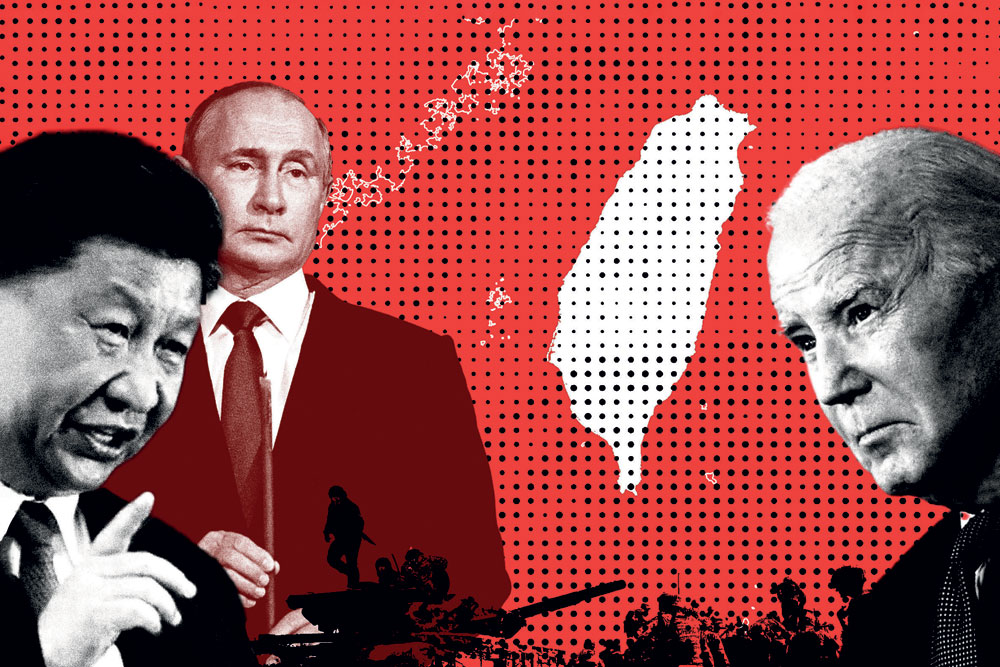
Taiwan is on the front line of international defense against expansionist authoritarianism. Yet, US President Joe Biden’s proposed new aid package includes US$61.4 billion for the war in Ukraine, US$14.3 billion to help Israel fight its war against Hamas, and just US$2 billion for security assistance for allies and partners in the Indo-Pacific region.
The wars Ukraine and Israel are fighting should not obscure Taiwan’s vulnerability to a Chinese attack.
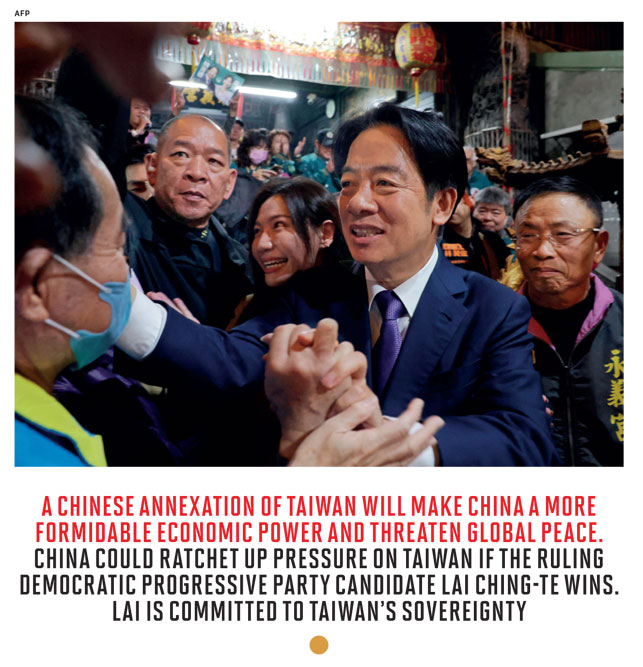
Indeed, the defense of Taiwan must assume greater significance for international security, given that three successive US administrations have failed to credibly push back against China’s expansionism in the South China Sea, whose geopolitical map Beijing has fundamentally altered. Having already swallowed Hong Kong, China may be itching to move on Taiwan, whose incorporation Chinese President Xi Jinping (習近平) has called a “historic mission.” By rehearsing amphibious and air attacks, China has displayed a willingness to seize Taiwan by force.
With the US attention now focused on the wars that Ukraine and Israel are fighting, Xi could be tempted to move against Taiwan at an opportune time. Xi must be observing how Biden’s transfers of critical munitions to Israel are depleting US stockpiles, which were already running low because the US sent Ukraine more than two million artillery shells and other ammunition. Xi could choose to wait until US arsenals deplete further.
In a Taiwan war scenario, the US would likely come to Taipei’s defense not singlehandedly but as part of a coalition, by seeking to rope in its two main allies in East Asia, Japan and South Korea. From Iraq, Afghanistan and Libya to Ukraine, the US has led “coalitions of the willing” in wars.
In fact, any Chinese operation to cut off access to Taiwan would likely intrude into Japanese airspace and likely pull Japan into the conflict. This was apparent when five Chinese missiles landed in Japan’s exclusive economic zone last year during China’s live-fire military drills around Taiwan that effectively simulated an air and sea blockade.
South Korea, however, may find it difficult to directly assist US-led operations to help Taiwan repulse a Chinese attack. This writer’s recent discussions in Seoul indicated that, given its overriding priority to deter a North Korean attack, South Korea would likely be reluctant to get drawn into a Taiwan Strait conflict for fear that that this could create an opening for North Korea to launch aggression — or at least military provocations — against it.
South Korea’s military strength, in any case, centers on its ground forces, not on naval and air forces that would be central to Taiwan’s defense against a Chinese attack.
In fact, a South Korea that directly aided Taiwan’s defense against a Chinese attack would likely face serious punishment from China, which could even push North Korea to open a front against South Korea.
To make matters worse, Russia also appears to be fashioning a North Korea card against South Korea. South Korea’s indirect supply of critical munitions to Ukraine via the US was a likely factor in Russia’s hosting of North Korean leader Kim Jong-un last month. Russian President Vladimir Putin had warned that Seoul would face consequences if it supplied weapons to Ukraine.
Since late last year, South Korea has shipped at least hundreds of thousands of artillery shells to the US, thereby allowing America to continue supplying such munitions to Ukraine for use in fighting Russia. More broadly, the war in Ukraine has helped turn South Korea into a major arms exporter, including of tanks, missiles, howitzers, armored vehicles and warplanes.
Against this backdrop, Russia now seems willing to play the North Korea card against South Korea, including by dangling the threat of transferring sensitive technologies to Pyongyang. North Korea, whose second attempt to launch a spy satellite into orbit failed in August, is seeking access to Russian technologies in return for possibly aiding Russia’s war effort in Ukraine by supplying artillery shells and rockets.
In relation to China, the risk for Seoul would be that, even if it refrained from coming to Taiwan’s aid in a war scenario, Beijing would view South Korea as providing indirect assistance to US-led operations, including logistic and weapons support. Beijing thus could possibly egg on North Korea to rein in South Korea.
A two-war scenario in Asia, with simultaneous conflicts in the Taiwan Strait and the Korean Peninsula, would be a geopolitical and military nightmare for the US, which is currently struggling to meet its weapons commitments to Ukraine and Israel in the wars they face.
In this light, deterring a Chinese attack on Taiwan ought to assume greater priority in US policy. Taiwan cannot be allowed to become the next Ukraine or Hong Kong.
Taiwan’s subjugation would significantly advance China’s hegemonic ambitions in Asia and upend the balance of power in the Indo-Pacific, not least by enabling China to break out of the so-called first island chain.
America’s role is central to Taiwan’s autonomous future. A US that fails to prevent Taiwan’s subjugation would be widely seen as unable or unwilling to defend any other ally, including Japan, which hosts more American troops than any other foreign nation. This, in turn, could unravel US alliances in Asia.
Brahma Chellaney, a professor of strategic studies at the New Delhi-based Center for Policy Research, is the author of nine books, including the award-winning Water: Asia’s New Battleground (Georgetown University Press).
Canadian Prime Minister Justin Trudeau’s recent claim that India’s government might be linked to the fatal shooting of a Sikh separatist on Canadian soil has sent bilateral relations into a tailspin. Even if the current diplomatic ruckus eases, Canada’s refusal to rein in violent Sikh separatism will continue to fuel bilateral tension with India.
Rarely have two major democracies descended into as ugly a diplomatic spat as the one now unfolding between Canada and India. With the traditionally friendly relationship already at its lowest point ever, both sides are now engaging in quiet diplomacy to arrest the downward spiral, using the United States, a Canadian ally and Indian partner, as the intermediary. But even if the current diplomatic ruckus eases, Canada’s tolerance of Sikh separatist activity on its territory will continue to bedevil bilateral ties.
The current dispute began when Canadian Prime Minister Justin Trudeau sensationally claimed that there were “credible allegations” about a “potential link” between India’s government and the fatal shooting in June of Hardeep Singh Nijjar, a Sikh separatist and Canadian citizen, on Canadian soil. India’s government fired back by demanding that Canada reduce its diplomatic staff in India, suspending new visas for Canadians, and accusing Canada of making “absurd” accusations to divert attention from its status as “a safe haven for terrorists.”
Nijjar was hardly the only Sikh separatist living in Canada. In fact, the country has emerged as the global hub of the militant movement for “Khalistan,” or an independent Sikh homeland. The separatists constitute a small minority of the Sikh diaspora, concentrated in the Anglosphere, especially Canada. Sikhs living in India – who overwhelmingly report that they are proud to be Indian – do not support the separatist cause.
With British Columbia as their operational base, the separatists are waging a strident campaign glorifying political violence. For example, they have erected billboards advocating the killing of Indian diplomats (with photos), honored jailed or killed terrorists as “martyrs,” built a parade float on which the assassination of former Indian Prime Minister Indira Gandhi was re-enacted, and staged attacks on Indian diplomatic missions in Canada. They have also held referenda on independence for Khalistan in Canada.
But, much to India’s frustration, Canada has been reluctant to take strong action to rein in Sikh separatism. Trudeau’s first official visit to India in 2018 turned into a disaster after it was revealed that a convicted Sikh terrorist who had spent years in a Canadian prison following the attempted assassination of a visiting Indian state cabinet minister had made it onto the Canadian guest list. At last month’s G20 summit in New Delhi, Indian Prime Minister Narendra Modi gave Trudeau a dressing-down for being soft on violent extremists.
It was against this tense backdrop that Trudeau made his allegations about Nijjar’s murder. When countries have linked foreign agents to a domestic death – for example, in 2010, when the Dubai police chief accused Mossad, Israel’s intelligence service, of killing a Hamas commander in a local luxury hotel – they have typically presented video, audio, or forensic evidence. And they have mostly avoided blaming the government that the foreign agents represent.
Trudeau, by contrast, cast blame directly on the Indian government without presenting a scintilla of evidence. He says the allegations are based on credible intelligence, apparently from a “Five Eyes” partner country (Australia, New Zealand, the United Kingdom, or the United States), but refuses to declassify the information or share it with Indian authorities.
Trudeau apparently has not provided “any facts” even to Canadian opposition leader Pierre Poilievre, a member of the Privy Council. And, according to the premier of British Columbia, the province where the killing occurred, the intelligence briefing he received on the matter included only information “available to the public doing an internet search.”
Meanwhile, Canadian investigators have not made a single arrest in the case. This has left many wondering to what extent Canada’s powerful but unaccountable intelligence establishment controls its foreign policy.
In any case, there is no doubt that Sikh radicals wield real political influence in Canada, including as funders. Trudeau keeps his minority government afloat with the help of Jagmeet Singh, the New Democratic Party’s Sikh leader and a Khalistan sympathizer. According to a former foreign policy adviser to Trudeau’s government, action was not taken to choke off financing for the Khalistani militants because “Trudeau did not want to lose the Sikh vote” to Singh.
Canada must wake up to the threat posed by its Sikh militants. Rising drug-trade profitability and easy gun availability in British Columbia have contributed to internecine infighting among Khalistan radicals in the province. The volatile combination of Sikh militancy, the drug trade, and gangland killings has serious implications for Canadian security, but it is not only Canadians who are in danger.
Under Trudeau’s father, then-Prime Minister Pierre Trudeau, Canada’s reluctance to rein in or extradite Sikh extremists wanted in India for terrorism led to the 1985 twin bombings targeting Air India flights. One attack killed all 329 passengers, most of whom were of Indian origin, on a flight from Toronto; the other misfired, killing two baggage handlers at Tokyo’s Narita Airport. With Khalistani militants continuing to idolize Talwinder Singh Parmar – the terrorist that twoseparate Canadian inquiries identified as the mastermind behind the bombings – history is in danger of repeating itself.
By reopening old wounds, not least those created by the Air India attacks, Trudeau’s accusations have created a rare national consensus in fractious and highly polarized India, with many calling for the government to put sustained pressure on Canada to start cleaning up its act. But more bitterness and recriminations will not restore the bilateral relationship. For that, both sides must use effective, cooperative diplomacy to address each other’s concerns.
Brahma Chellaney, Professor of Strategic Studies at the New Delhi-based Center for Policy Research and Fellow at the Robert Bosch Academy in Berlin, is the author of nine books, including Water: Asia’s New Battleground (Georgetown University Press, 2011), for which he won the 2012 Asia Society Bernard Schwartz Book Award.
For nearly four decades since the deadly Air India flight bombing, New Delhi has put up with the Anglosphere countries’ sheltering of violence-espousing extremists from India. Now a critical moment has been reached when India needs to demonstrate the political will to keep these countries under sustained pressure so that they begin cleaning up their act at home.
The Khalistan movement may be practically dead in India but it is alive and kicking in sections of the Sikh diaspora living in the five Anglosphere countries, thanks to those nations tolerating the operations of extremist Sikh groups that are promoting or glorifying terrorism against the Indian state and its diplomats and citizens. These English-speaking countries, which are tied together by the so-called Five Eyes intelligence-sharing partnership, receive the bulk of Indian students studying abroad and also are home to large Indian immigrant communities.
Notwithstanding the absence of any real support for Khalistan in India and the rejection of religious secessionism by the majority of overseas Sikhs, violence-espousing separatism has grown among Sikh radicals sheltered by the US, Britain, Canada, Australia and, to a smaller extent, New Zealand. Worse still, these foreign-based militants are aiding, financing or orchestrating violence in Punjab and elsewhere in India. In cases where such extremists entered India to stage terror attacks, a number of them were arrested or killed by police in shootouts.
Abroad, the modus operandi of Khalistanis is to take control of cash-rich gurudwaras, using them as a base both for stoking militancy among other Sikhs and for funding terrorist activities by diverting proceeds from narcotics trafficking and worshippers’ donations. To win political protection, such foreign-based militants also contribute, at times generously, to political parties’ electoral campaigns, especially to help preferred candidates win. Canada is a prime example of that.
Control of gurudwaras, no less importantly, gives such militants cover as supposed religious figures. For example, the slain Canadian terrorist, Hardeep Singh Nijjar, who had an Interpol red corner notice against him since 2014 in connection with multiple terrorism cases in India, has been described in the Canadian media as “president” of a gurudwara and “a Sikh preacher”. Such labels help obscure the fact that Nijjar was a terrorist fugitive from India when he entered Canada on a fake passport under the name Ravi Sharma, before he eventually become the Canada-based head of the Khalistan Tiger Force.
The foreign-based Khalistanis also draw recruits from Punjab by financing their emigration or non-immigrant relocation to an Anglosphere country. Malleable youths in Punjab are sponsored for non-immigrant visas, including for work in gurudwaras. Once abroad, the youths, after indoctrination and financial help, serve as “foot soldiers” of the local Khalistan brigade.
Making things murkier is increasing evidence of an unholy nexus between some Anglosphere security or intelligence agencies and prominent Khalistanis. Key extremists are not just being shielded by such agencies; some also serve as intelligence assets, including possibly Gurpatwant Singh Pannu, an American-Canadian dual citizen who recently made headlines by ordering Hindu Canadians, on pain of punishment, to flee from Canada. It is telling that Pannu, like some other Anglosphere-based Khalistani terrorists wanted in India, continues to operate with impunity.
After Nijjar’s killing in June, Khalistanis in the US, especially those residing in California (where many Sikh radicals are based), received warnings from the Federal Bureau of Investigation (FBI) about potential threats to their lives. According to one report, FBI agents individually contacted such radicals to warn that their lives could be at risk.
It is such shielding of the militants, without reining in their growing violence-endorsing extremism, that resulted in twin attacks on the Indian consulate in San Francisco this year. The first occurred in March just hours after Khalistani militants stormed the Indian high commission in London and pulled down the Indian flag. And the second attack came less than four months later, with the Khalistani arsonists quickly posting online a video of the blazing fire they set inside the consulate compound.
Yet, having failed again to protect the consulate, the US merely condemned the attack. And, despite the fire the militants set inside the compound, it qualified the attack as “reported vandalism” and “attempted arson”.
How would the US have reacted had some militants staged twin attacks on one of its consulates in India, setting ablaze some structures, and India did little more than condemn the attack, including seeking to downplay it by calling it reported vandalism and attempted arson? Or how would Canada react if India sheltered gun-toting Quebecois who pursued violent anti-Canadian separatism from Indian soil?
The US inaction, for example, has led India’s anti-terror agency to issue a reward for information over the attacks on the San Francisco consulate. And the Indian government has been constrained to issue a travel advisory warning Indians of the “growing anti-India activities and politically condoned hate crimes and political violence in Canada”.
Meanwhile, Britain, despite an Indian-origin prime minister at the helm, remains a hotbed of anti-India Sikh and Islamist militancy. In fact, as if seeking to emulate its colonial-era “divide-and-rule” policy in India and elsewhere, Britain has long hosted Sikh and Kashmiri secessionists from India, doing little to contain their violent separatism.
Today, Britain has become a safe refuge for Indian financial fraudsters and those accused of terrorism and other crimes in India. London’s failure to protect Indian diplomatic missions and diplomats from militant assaults has led to copycat attacks elsewhere in the Anglosphere, including in San Francisco. The attack on the Indian high commission in London in March was not the first storming: On India’s Independence Day in 2019, for example, extremists from India and Pakistan attacked the high commission, smashing windows and causing other damage.
Oddly, in shielding leading Khalistanis, Western intelligence services are implicitly aiding Pakistan’s efforts to destabilize India. Pakistan’s rogue Inter-Services Intelligence (ISI) agency has actively aided the Khalistan movement, including facilitating military training. For example, the ISI-trained Nijjar went on to establish a training camp for new recruits near Mission, which is about one hour east of Vancouver by car. At this camp, new recruits were trained to use AK-47s and other weapons.
India’s concerns about the operations of Sikh and Kashmiri terrorists from the Anglosphere countries actually go back to the 1980s, when an Indian diplomat was murdered in Birmingham in Britain and a bomb downed an Air India flight from Toronto, killing all 329 people on board. Organized by Khalistani extremists operating out of Canada’s British Columbia province, the Air India bombing, until 9/11, was the worst act of terrorism in the sky.
Today, by continuing to shield dangerous Khalistani terrorists or extremists, the Anglosphere countries are imperilling Indian interests and security. It is as if some Western governments wish to employ the Khalistan card as political leverage against India. Allowing provocations from the Khalistani diaspora in the Anglosphere to go unchecked could even impinge on the interests of Sikhs in India by affecting the traditionally harmonious Hindu-Sikh relations and close bonds.
Canada is ground zero for Khalistan militancy
Canada is both a refuge and a haven — a refuge for migrants from many countries, and a haven for activists, militants and even international terrorist fugitives, including from major democracies like India.
On India, Canada has come full circle: From the early 1980s, it ignored India’s protests over the growing operations of violent Khalistanis from Canadian soil, including the evidence it received from New Delhi, thereby emboldening the extremists to carry out the 1985 Air India flight bombing and a couple of other attacks. In more recent years, by disregarding the detailed intelligence dossiers New Delhi has presented about how Canadian Khalistanis are fomenting terrorism in India, Ottawa brought bilateral ties under increasing strain, before Prime Minister Justin Trudeau dealt a grievous blow to the Indo-Canadian relationship by hurling a bombshell accusation at New Delhi.
Trudeau’s wilful tolerance of violent Khalistanis has followed similar indulgence of Sikh terrorists by his late father. In 1982, then-Prime Minister Pierre Trudeau turned down the request of the Indian government headed by Indira Gandhi to extradite Babbar Khalsa chief Talwinder Parmar. Permitted to stay ensconced in Canada, Parmar went on to become the mastermind of the Air India flight bombing.
Two separate Canadian probes identified Parmar as the chief terrorist behind the bombing of Air India Flight 182. The main probe, a commission of inquiry led by former Supreme Court justice John Major, submitted its report in 2010—25 years after the bombing. The commission of inquiry was set up belatedly—only after a probe led by Bob Rae, an independent adviser to the minister for public safety, submitted its report in 2005. Ottawa extended little cooperation to New Delhi in investigating a bombing whose victims were largely Indian-origin Canadians and Indian nationals. In fact, in the period after the bombing, damning evidence about Canada’s sins of commission and omission was destroyed.
Despite the findings of the two inquiries, Justin Trudeau’s partner in keeping his minority government afloat, New Democratic Party leader Jagmeet Singh, told CBC Television in 2017 that he doubted that Parmar was the true architect of the Air India bombing. He also refused to denounce Canadian Sikhs who glorify Parmar as a martyr. Jagmeet Singh—“a committed Khalistani,” in the recent words of another prominent Canadian Sikh politician, Ujjal Dosanjh—was denied an Indian visa in 2013 over his “anti-India” activities.
Meanwhile, the growing nexus between Sikh militants and criminal and drug networks has contributed to increasing gangland killings in British Columbia. Indeed, Nijjar’s murder came amid sharpening inter-gang rivalries among Khalistanis, largely driven by mounting profitability from the drug trade and easy availability of guns.
Against this backdrop, Canada today serves as ground zero for Khalistan militancy, with British Columbia the global headquarters of Sikh extremists promoting or glorifying terrorism. In per-capita terms, there seem to be far more Khalistanis in Canada than any other country, including India, Britain or the US.
Ominously, money and muscle have helped the Khalistan movement to rapidly enlarge its footprint among Sikhs in Canada, currently estimated to number about 7.7 lakhs. Indeed, such is the growing sway of Khalistanis that they already dominate Sikh politics in Canada, drowning out the voices of moderate Sikhs that do not support secessionism. The majority of Canadian Sikhs, however, remain peaceful and uninterested in violent religious separatism.
But, with Canadian authorities looking the other way, the Khalistani extremists have incited hate and violence, held a Khalistan-linked referendum, and glorified then-Prime Minister Indira Gandhi’s 1984 assassination through a parade float in Brampton, Ontario, that sought to immortalize her assassins. The Khalistanis have also issued death threats and announced cash rewards for attacks. Their targets include Indian diplomats, not just in Canada but also elsewhere, including the current Indian ambassador to the US, who is a Sikh.
Still, internecine infighting among rival factions continues to plague the Khalistan movement in Canada. The toxic intersection of violent separatism, drug trade and gun culture holds significant implications for Canada’s own long-term security. Yet Ottawa remains reluctant to crack down on this nexus.
Trudeau’s political blunders, including cultivating the vote of radical Sikhs and turning a blind eye to the hate and violence they incite, have now extended to personally meeting with and honouring a Nazi war criminal, before arranging for this Canada-based Nazi veteran from Ukraine to receive a standing ovation in the Canadian Parliament in the presence of a cheering Ukrainian President Volodymyr Zelensky.
The tribute to the Nazi veteran, without vetting his background, and the Trudeau-initiated diplomatic spat with India are both helping to shine a spotlight on Canada’s unenviable status as a safe haven for terrorists, war criminals and other extremists from multiple countries. Canada has long been home to international fugitives, with Pierre Trudeau once famously saying that he chose not to prosecute Nazi war criminals in Canada lest it inflame European expat communities.
Meanwhile, on Justin Trudeau’s watch, there has been a steady diminishment of Canada’s place in the world, thanks to his missteps and blunders.
For example, Justin Trudeau inadvertently highlighted his cosy ties to Khalistanis by including a convicted Sikh terrorist, Jaspal Atwal, on his 2018 trip to India. The visit was marred by revelations that Atwal, who went to prison after being convicted in 1986 of the attempted assassination of an Indian state cabinet minister visiting Vancouver Island, was formally invited to a reception in honour of Trudeau at Canada House, the official residence of the country’s high commissioner in New Delhi. During the earlier Mumbai leg of the visit, Atwal was photographed posing with Trudeau’s wife, Sophie Grégoire Trudeau, as well as Canadian cabinet ministers and MPs.
In fact, during Trudeau’s disastrous 2018 trip to India, the then chief minister of Punjab, Amarinder Singh, made a point of handing the Canadian PM in Amritsar a list of terrorism-promoting Khalistani operatives based in Canada. Nijjar was one of the names on the list. Earlier, while voicing concern that Sikh extremists were “infiltrating” Trudeau’s cabinet, Amarinder Singh famously snubbed Trudeau’s then defence minister, Harjitt Sajjan, when Sajjan visited India in 2017.
Take another disquieting example: Canada has given refuge to a key assassin of Bangladesh’s founding father, Sheikh Mujibur Rahman. Bangladesh Prime Minister Sheikh Hasina has repeatedly urged Trudeau over several years to extradite Nur Chowdhury, who is thought to have personally fired the bullets that killed her father. Chowdhury was convicted in absentia. But Trudeau continues to drag his feet over the issue.
The latest blunder in Ottawa in honouring a Nazi war criminal further dents Canada’s international image—and Trudeau’s standing at home.
Canada must start cleaning up its act at home, or else its growing reputation as a sanctuary for international fugitives would become indelibly etched in the collective consciousness of the world. India has already officially labelled Canada as “a safe haven for terrorists, for extremists, and for organized crime”, as the Ministry of External Affairs spokesperson put it.
Trudeau bites off more than he can chew
Let us be clear: Trudeau’s September 18 statement in the House of Commons was not about Canadian security agencies finding evidence of India’s role in Nijjar’s killing but, as he put it, “credible allegations” of a “potential” India “link” to the murder. Months after Nijjar’s killing, Canadian police have not been able to arrest a single suspect in connection with the shooting.
With no arrests, let alone any evidence, Trudeau aired just allegations, knowing that such a step would seriously damage Canada’s relations with the world’s fastest-growing major economy. The phrase “credible allegations”, in fact, is an oxymoron. There is credible evidence, but any allegation is simply an allegation.
When India sought to share intelligence with Canada after 2014 on the violent Sikh separatists operating from Canadian soil, Ottawa refused to take it, contending that “intelligence is not evidence”. That contention is correct: Intelligence is not evidence but mere information whose authenticity and evidentiary value must be established.
Yet, in an ironical twist, Canada’s prime minister has now levelled serious allegations against India on the basis of intelligence that Ottawa will not even share with India. As the Indian external affairs ministry has categorically stated, “No specific information has been shared by Canada on this case, either then or before or after”.
Look at another jarring paradox: Since taking office some eight years ago, Trudeau has refused to cooperate with New Delhi to help address longstanding Indian concerns over the growing Canadian Sikh extremism directed against India. But Trudeau now, with US backing, insists that India cooperate with Canada in probing the Canadian government’s allegations, without Ottawa declassifying the claimed intelligence about the India link to the killing or confidentially sharing the intelligence with New Delhi.
If Trudeau had any convincing intelligence linking India to the killing, he would by now have declassified it, instead of repeatedly airing mere suspicions. The absence of hard evidence, in fact, has led the Trudeau government to plant stories in the Canadian media about intercepts of communications between Indian diplomats after Nijjar’s murder. The intercepts might be about celebratory chatter over a dreaded terrorist’s death, but such conversations can hardly attest to an Indian government role in the killing.
Indeed, with Trudeau having already rushed to a conclusion before Canadian security agencies have managed to collect evidence, we may never know the truth about Nijjar’s killing. One critical eyewitness to the murder, Malkit Singh, who was Nijjar’s gurudwara aide, has suggested that the killers were Sikhs. “He described them as wearing ‘a Sikh get-up’, with hoodies pulled over small pughs [pagris] on their heads and masks over their ‘bearded faces’,” according to a Washington Post report.
Contrast Trudeau’s evidence-free allegations against India with the video, audio or forensic evidence other countries have presented in the past while linking foreign agents to a killing on their soil. And also contrast Trudeau’s direct linking of the Indian government to the killing with the restraint other countries have often exercised, casting the blame on foreign agents for a murder but not the governments they represent so as not to preclude the involvement of rogue elements.
For example, when 11 Israeli agents assassinated Hamas commander Mahmoud al-Mabhouh in a Dubai hotel room in 2010, the United Arab Emirates painstakingly collected a trove of investigative evidence before publicly releasing compelling surveillance footage and photographs of the agents—but without accusing the Israeli government or Mossad of involvement.
The US government’s reaction to Trudeau’s allegations against New Delhi was initially muted to help protect America’s relationship with India. But after the American and Canadian media reported that Canada had received no support from its Western allies in its diplomatic spat with India, US National Security Adviser Jake Sullivan and Secretary of State Anthony Blinken chipped in. But their grating words for New Delhi could only have ruffled Indian feathers.
Sullivan, for example, stated that was no “special exemption” for any country in the matter of extra-territorial killings and that there has to be accountability, which is why the US, he said, was in touch with India at “high levels”. But why would India, to defend its interests, seek any “special exemption” from the Big Daddy of extra-territorial assassinations? While India has never before been accused of assassinating anyone on Western soil, the US is the longstanding world record holder in extra-territorial assassinations.
Here is the reality check: America’s siding with Canada shows that its relationship with any of its Five Eye allies will always take precedence over its ties with India. After all, the Five Eye countries are America’s closest allies and bound together by treaty arrangements, while India is just a strategic partner.
But the fact that the intelligence Washington shared with Ottawa, however sketchy, helped embolden Trudeau to pick a geopolitical fight with India could have a bearing on the direction of U.S.-India ties, not least by reinforcing India’s imperative for preserving its strategic autonomy. The task of building mutual trust becomes harder.
Less clear is what Ottawa and, implicitly, Washington have sought to achieve against India through allegations arising from the murky world of espionage, where the line between information and disinformation gets easily blurred for geopolitical ends. Can vague, unsubstantiated allegations about a “potential” India link to a terrorist killing serve any purpose, other than to make New Delhi rethink its nascent foreign-policy tilt toward the West?
More fundamentally, Trudeau’s gambit, instead of putting India in the international dock, appears to have boomeranged. At home, Trudeau has faced increasing pressure to come clean and present hard evidence to back his allegations against India.
Furthermore, his allegations, instead of creating international solidarity against India, are only helping to focus global attention on what prominent Canadians have long expressed concern about—Canada’s role as a safe haven for terrorists, war criminals and other extremists. India’s longstanding concern over Ottawa’s reluctance to rein in the Khalistan movement and extradite extremists wanted in India for terrorist acts is now getting attention even in the Canadian media.
New Delhi, however, should not expect Trudeau to back down. Trudeau’s track record shows that he never admits that he was wrong. Instead, he seeks to palm off blame to someone else. Even in the tribute-to-a-Nazi case, he has refused to take responsibility, with the House of Commons speaker becoming the fall guy.
The truth about Trudeau, however unpalatable, is that he is a serial hypocrite. For example, while shedding crocodile tears over the killing of a dreaded Sikh terrorist that his government long shielded, including by rebuffing New Delhi’s demand to send him over for prosecution, Trudeau has cited the importance of a “rules-based order.” But in August 2022, Trudeau extolled the US assassination of Ayman al-Zawahiri, a 71-year-old retired terrorist living with his children and grandchildren in a Kabul apartment, hailing the hit-job as “a step toward a safer world”.
Trudeau has accused New Delhi of interfering in Canada’s internal affairs. Yet, illustrating his blatant interference in India’s domestic affairs, Trudeau in 2020 cheered on anti-government Indian farmers blockading highways near New Delhi. While defending protesters’ rights half a world away, Trudeau declared a national emergency in Canada last year to crush peaceful protests against his mandatory COVID-19 vaccination policy, calling their blockades a security threat akin to terrorism. The gun-toting terrorists in Canada, meanwhile, remain untouched by his government.
It is such stunning hypocrisy that has contributed to plunging Indo-Canadian relations to their lowest point ever. Not surprisingly, India today identifies terrorism as the core issue troubling its ties with Ottawa, with its travel advisory warning Indian nationals that Canada is plagued by “politically condoned” violence.
Canada’s indulgence of Sikh separatists, in general, and Sikh terrorists, in particular, has increasingly rankled India. During his term in office, Trudeau has employed freedom of expression as a cover to allow rising anti-India activities of Sikh extremists, as if Canada has no laws against hate or incitement to violence. The extremists openly espouse political violence as a legitimate tool to achieve Khalistan.
With the Paris-based Financial Action Task Force (FATF) content to look the other way, Canada has done little to ensure that its territory is not used for terrorist financing. Former Canadian Security Intelligence Service (CSIS) Director Ward Elcock has raised the question whether Ottawa is wilfully “tolerating terrorist groups operating from Canada”. As Elcock put it, “There is a history in this country of Sikh extremism verging into terrorism”. Cutting off terrorist financing would help choke the Khalistan movement in Canada.
But make no mistake: The rising concern over Canada’s harbouring of terrorists and extremists is not just about Indo-Canadian relations or Indian security; it also holds implications for wider security. A day may come when Canadian Khalistanis carry out a major terrorist strike in Canada or a third country.
After all, Ottawa appears to have learned no lesson from the 1985 Air India flight bombing. Nor is there recognition in Ottawa that it is easier to damage a bilateral relationship with a fellow democracy than to rebuild it.
The emergence of Canada as the international epicentre of Khalistan militancy, however, should not obscure the broader role of the Anglosphere in sheltering and shielding Sikh extremists fomenting terrorism in India. Still, good relations with the Anglosphere countries are pivotal to the wider pursuit of India’s diplomatic interests. India must leverage access to its huge market, including trade deals, as well as geopolitical and military cooperation to bring the Anglosphere countries under sustained pressure to stop tolerating violent Khalistanis.
Brahma Chellaney is a geostrategist and the author of two award-winning books on water: Water, Peace, and War; and Water: Asia’s New Battleground.
Under Trudeau, Canada has become Khalistani extremism’s global hub. He cannot cite free speech law to defend inaction as Canada has other laws against hate and incitement to violence that should be invoked.
Canadian Prime Minister Justin Trudeau has tried to deflect attention away from his cosy political ties to radicals and his government’s indulgence of violence-espousing Khalistanis by seeking to put India in the dock with an astounding allegation. Trudeau’s evidence-free claim should not obscure a larger problem confronting India — the five Anglosphere countries’ sheltering of Sikh extremists that endorse violence as a legitimate tool to achieve Khalistan.
The Khalistan idea has few takers among Sikhs in India, as the highly regarded, Washington-based Pew Research Centre highlighted in a poll released in 2021. The survey found that 95% of Sikhs are “very proud to be Indians”. In fact, 70% of Sikhs believe “a person who disrespects India cannot be a Sikh”. Even in Canada and other English-speaking countries, Khalistan supporters make up just a fraction of the Sikh diaspora.
Yet an unholy combination of two factors is keeping Khalistan militancy alive overseas. The first is Pakistan’s funding, support and possible training of Khalistanis in a bid to destabilize India, as a Hudson Institute report brought out.
More surprising is the role of Canada, Britain, the US, Australia and, marginally, New Zealand, as if no lesson has been learned from the 1985 bombing by Khalistani extremists of an Air India flight from Toronto that killed all 329 people on board. These countries continue to look the other way as Sikh radicals step up their militancy from Western soil, including issuing death threats and calls to violence. The inaction has emboldened the extremists to vandalize Indian diplomatic missions and Hindu temples and threaten Indian diplomats.
Long before Trudeau’s allegation plunged Indo-Canadian ties to their lowest ebb, New Delhi was urging the Anglosphere countries to rein in the rising tide of Khalistani militancy directed at India. Instead what India got were nasty surprises — from militants storming the Indian High Commission in London and dual attacks on the Indian consulate in San Francisco to an anti-India parade in Canada seeking to immortalize Prime Minister Indira Gandhi’s assassins.
Khalistani militancy is particularly acute in Canada, which explains why its British Columbia province has become the global hub of the Khalistan movement. With India’s patience wearing thin, Prime Minister Narendra Modi, in a frosty meeting with Trudeau during the G-20 summit, gave him a dressing-down for being soft on Sikh terrorists.
To keep his minority government afloat, Trudeau depends on support from the New Democratic Party leader Jagmeet Singh, a Khalistan sympathizer. With the tail wagging the dog, Trudeau has pandered to hardline Canadian Sikhs. Take just one example: Trudeau cheered on Indian farmers blockading highways near New Delhi and then later, in the style of an autocrat, declared a national emergency in Canada and crushed peaceful protests against his COVID-19 vaccination policy, calling their blockades a security threat akin to terrorism.
Yet Trudeau refuses to act against the real terrorists in Canada that threaten Indian security. Harbouring violent extremists also threatens Canadian and international security because a day may come when Canadian Khalistani militants carry out a major terrorist strike within Canada or another Western country.
Canada’s record of shielding Khalistani terroristsis a case of“like father, like son”. Trudeau’s father, Prime Minister Pierre Trudeau, turned down Indira Gandhi’s 1982 request for extradition of Babbar Khalsa chief Talwinder Parmar who, according to Canada’s official probe, went on to become the mastermind of the Air India flight bombing. Today, the growing nexus between Khalistani extremists and criminal bands in British Columbia has spawned gangland killings.
In this light, Trudeau’s allegation against India clearly seems a diversionary tactic to help obscure sordid facts, including the continued cover he is giving to operations of Khalistani militants in the name of free speech. His allegation is based not on any police-collected evidence but on purported inputs from the murky world of espionage. In the spy games, geopolitics often trumps facts.
India should not allow Trudeau to deflect attention from Canada’s answerability on becoming a safe haven for militants promoting or glorifying terrorism. Canada cannot cite free speech law to defend inaction because it has other laws against hate or incitement to violence that ought to be invoked. Without curbing its Khalistani militancy, Canada could undermine its internal security, becoming one day the Pakistan of the West.
Indian diplomacy must also exert sustained pressure on the other Anglosphere countries to stop countenancing the rising anti-India activities of extremist Khalistani groups operating from their territories. The paradox is that even as a tilt toward the West is becoming apparent in Indian foreign policy, the Anglosphere countries seem to be looking at the violent Khalistani extremists they shelter as potential leverage against India. Mutual respect and mutual security are indispensable to an informal alliance between the West and India.
For starters, Canada and India must arrest the downward spiral in their relations through quiet diplomacy. With no significant conflict of strategic interest, these two major democracies ought to be close partners. Trudeau can secure India’s cooperation on the murder probe if he is willing to clean up his act at home — in Canada’s own long-term interest.
The end of China’s four-decade-long economic boom has thrown into relief the emergence of Asia’s other demographic giant as a geopolitical and economic force. But while India appears stable and resurgent under Prime Minister Narendra Modi, its future will depend on its ability to maintain political stability and rapid economic growth.
China’s sharp economic slowdown has raised alarm bells around the world. But it has also thrown into relief the rise of another demographic powerhouse next door. The Indian economy grew at an impressive 7.8% annual rate in the second quarter of 2023, and the country recently reached an important milestone by becoming the first to land a spacecraft on the Moon’s potentially water-rich south pole. And, India’s ascent, unlike China’s, has not been accompanied by an increasingly assertive foreign policy or an appetite for other countries’ territory.
As India’s geopolitical, economic, and cultural clout grows, so does its global footprint. China’s “decline,” as some have begun to call the conclusion of the country’s four-decade-long economic boom, opens new opportunities for the Indian economy and other developing and emerging countries.
Earlier this year, India reached another milestone when its population officially surpassed that of China, which had been the world’s most populous country for more than 300 years. While China’s shrinking, rapidly aging population is likely to impede economic growth and may curtail its geopolitical ambitions, India – one of the world’s youngest countries, with a median age of 28.2 – is poised to reap a huge demographic dividend.
But the driving force behind India’s emergence as a major global power is its rapid economic growth. While India’s GDP is still smaller than China’s, the country is currently the world’s fastest-growing major economy and is projected to account for 12.9% of global growth over the next five years, surpassing the United States’ 11.3% share.
In addition to fueling a consumption boom, India’s youthful population is also driving innovation, as evidenced by the country’s world-class information economy and its recent moon landing, which the country managed to achieve despite a national space budget equivalent to roughly 6% of what the US spends on space missions. Having already surpassed the United Kingdom, its former colonial ruler, India’s GDP is poised to overtake that of Japan and Germany to become the world’s third-largest economy by 2030, behind the US and China.
Given its increasingly unstable neighborhood, it should come as no surprise that India has the world’s third-largest defense budget. The deepening strategic alliance between China and Pakistan underscores India’s precarious position as the only country bordering two nuclear-armed revisionist states with expansionist ambitions. Moreover, for the past three years, India has been locked in a tense military standoff with China along its Himalayan border. Bilateral relations, marked by intermittent clashes in the disputed Tibet-Ladakh border region, are at their lowest point in decades.
By confronting China despite the risk of a full-scale war, India has challenged Chinese power in a way no other country has done in this century. But despite leaning toward forging closer ties with the West, India remains hesitant to enter into formal military alliances with Western countries.
Western powers are partly to blame. US President Joe Biden’s reluctance to comment on the Sino-Indian military standoff, let alone openly support India, has sent a clear signal that India is responsible for its own defense. Given that the country’s future growth hinges on its ability to defend itself against external threats, India will likely step up its efforts to modernize its conventional armed forces and enhance its nuclear deterrence.
The escalating geopolitical rivalry between China and India could also impede efforts to unite the Global South and transform the BRICS group into a credible alternative to the G20 and G7. The BRICS countries (Brazil, Russia, India, China, and South Africa) recently agreed to expand the group by adding six new members: Saudi Arabia, the United Arab Emirates, Egypt, Ethiopia, Argentina, and Iran. Given the 11 members’ divergent interests, BRICS+ will likely find it even harder to reach consensus on any major issue.
Meanwhile, China’s economic slump could prompt President Xi Jinping to double down on his expansionist agenda. Biden recently characterized the stagnating Chinese economy as a “ticking time bomb,” warning that, “When bad folks have problems, they do bad things.” China’s controversial new national map, which depicts vast areas of India, Malaysia, the Philippines, Vietnam, Taiwan, and Bhutan (and even a bit of Russia) as Chinese territory, underscores the threat posed by China’s increasingly aggressive behavior.
In addition to these external threats, India’s future will be shaped by its response to domestic economic challenges. Prime Minister Narendra Modi has made great strides in modernizing the notoriously outdated Indian bureaucracy and promoting e-government to reduce red tape and attract foreign direct investment. His government has invested heavily in upgrading and expanding the country’s infrastructure, implemented regulatory reforms, and sought to boost domestic manufacturing through Modi’s “Make in India” initiative. But to transform itself into a global manufacturing hub, India must invest in human capital, particularly in education and training.
Moreover, India’s size and diversity also pose enormous challenges. India may be the first developing economy that, from the beginning, has pursued modernization and prosperity through a democratic system. But as one of the world’s most culturally diverse countries, its seemingly never-ending election cycle has often fueled division and polarization.
But, despite its US-style polarized politics, India’s democratic framework has served as a pillar of stability. By fostering open expression and dialogue, the Indian political system has empowered grassroots communities and individuals, enabling members of historically marginalized classes and castes to rise to the highest levels of policymaking.
Whether India can maintain its current upward trajectory will depend on its ability to maintain political stability, rapid economic growth, domestic and external security, and a forward-looking foreign policy. Success would enhance India’s global standing and help advance US interests in the Indo-Pacific, the world’s new geopolitical fulcrum and home to its fastest-growing economies.
Brahma Chellaney, Professor of Strategic Studies at the New Delhi-based Center for Policy Research and Fellow at the Robert Bosch Academy in Berlin, is the author of nine books, including Water: Asia’s New Battleground (Georgetown University Press, 2011), for which he won the 2012 Asia Society Bernard Schwartz Book Award.
Canada and India are friends, not foes. But Prime Minister Justin Trudeau, by countenancing the rising anti-India activities of extremist Sikh groups in Canada, has brought relations with New Delhi under increasing strain during his term in office. Now, with his statement in the House of Commons on Monday, he has created an unusual diplomatic crisis between two major democracies.
Mr. Trudeau’s extraordinary statement was not about Canadian security agencies finding evidence of India’s involvement in the killing of a Canadian Sikh extremist, Hardeep Singh Nijjar. Rather, his statement was only about “allegations,” which he called credible, of a “potential” India “link” to the murder. More than three months after Mr. Nijjar’s killing, homicide investigators have not arrested a single suspect in connection with the shooting.
In this light, why would Mr. Trudeau air such allegations at this stage, knowing that doing so would hold serious implications for Canada’s relations with India? It has already sparked tit-for-tat expulsions of diplomats and plunged Canada-India relations to their lowest ebb.
A wiser approach would have been to charge all the suspects and present evidence of any Indian government involvement in a court of law. But with no arrests, let alone evidence, Mr. Trudeau has dealt a major blow to Ottawa’s bilateral relationship with New Delhi by echoing the allegations of Canadian Sikh extremists who have held India responsible from the day Mr. Nijjar was shot.
India has never been accused of carrying out an assassination on Western soil, even though it has long been the target of major international terrorist attacks. India’s concerns about the operations of Sikh and Kashmiri terrorists from Anglosphere countries go back to the 1980s, when an Indian diplomat was murdered in Birmingham in Britain and a bomb downed an Air India flight from Toronto, killing all 329 people on board.
Assassinating dissidents abroad is what authoritarian regimes do. India is the world’s largest democracy, and it has not taken down even the United Nations-designated, Pakistan-based terrorists wanted for horrific attacks such as the 2008 Mumbai massacre. Mr. Nijjar, allegedly associated with a small Sikh militant group in Canada, was not on India’s list of most-wanted terrorists.
Significantly, Mr. Trudeau’s allegation came just days after he was chastised by Indian Prime Minister Narendra Modi during the G20 summit for being soft on Sikh terrorists. Mr. Modi conveyed to the Canadian Prime Minister that New Delhi had “strong concerns about continuing anti-India activities of extremist elements in Canada. They are promoting secessionism and inciting violence … The nexus of such forces with organized crime, drug syndicates and human trafficking should be a concern for Canada as well.”
India, which accused Mr. Trudeau on Tuesday of sheltering Sikh “terrorists and extremists,” has been rankled by what appear to be increasing threats against Indian diplomatic missions and diplomats in Canada. Mr. Trudeau’s minority government depends on support from the New Democratic Party leader Jagmeet Singh, who in the past has participated in events where Sikh extremists have demanded the creation of Khalistan, or a Sikh homeland carved out of India. At one such event in 2016, a speaker endorsed the use of political violence as a “legitimate form of resistance” to achieve Khalistan.
The Khalistan movement, however, has little support among Sikhs in India. Even in Canada and other English-speaking countries, such separatists make up a minority of the Sikh diaspora. But what the secessionists lack in numbers, they make up through a pitched campaign that, disturbingly, often glorifies political violence.
To be sure, rising Sikh separatist activity in Canada is not the only issue that has caused bad blood between Mr. Trudeau and Mr. Modi. In 2020, Mr. Trudeau cheered on largely Sikh farmers blockading highways near New Delhi. But while defending protesters’ rights half a world away, Mr. Trudeau declared a federal emergency in Canada last year to quash blockades of Canadians protesting his COVID-19 vaccination policy. The stunning hypocrisy has not been forgotten in New Delhi.
At a time when a major global geopolitical reordering is under way, Canada and India, which have no major clash of strategic interest, should be close partners. Indeed, their shared goals, including universal adherence to international law, make them natural allies. Against this backdrop, Mr. Trudeau’s evidence-free claim against India is not just astounding; it threatens to further corrode Canada’s relations with the world’s fastest-growing major economy.
Repairing the damage to the bilateral relationship may take time but it must begin in earnest after the present diplomatic crisis is over. This may only happen after a change of government in Ottawa.
Brahma Chellaney is the author of nine books on international geopolitics, a professor of strategic studies at the independent Centre for Policy Research in New Delhi, and a Richard von Weizsäcker Fellow of the Robert Bosch Academy in Berlin.
Whereas Russia launched a full-scale invasion of Ukraine, China prefers an incremental approach, enabled by stealth and deception, to advance its revisionist agenda. And, barring a major strategic blunder, it is likely to continue doing so.
It is well known that China has the world’s largest navy and coast guard – the result of a tenfold increase in military spending since 1995 – which it uses to advance its pugnacious revisionism. But there are also numerous lesser-known – indeed, highly opaque – policies, projects, and activities that are supporting Chinese expansionism and placing the entire world at risk.
China has a long record of expanding its strategic footprint through stealthy maneuvers that it brazenly denies. For example, in 2017, it established its first overseas military base in Djibouti – a tiny country on the Horn of Africa, which also happens to be deeply in debt to China – while insisting that it had no such plan.
Today, China is building a naval base in Cambodia, which has leased to China one-fifth of its coastline and some islets. The almost-complete pier at the Chinese-financed Ream Naval Base appears conspicuously similar in size and design to a pier at China’s Djibouti base. China admits to investing in the base, but claims that only Cambodia’s navy will have access to it.
Realistically, however, it seems likely that China’s navy will use the facility at least for military logistics. This would further strengthen China’s position in the South China Sea, where it has already built seven artificial islands as forward military bases, giving it effective control of this critical corridor between the Pacific and Indian Oceans.
China also takes a highly secretive approach to its massive dam projects on international rivers flowing to other countries from the Chinese-annexed Tibetan Plateau. While the world knows that the rubber-stamp National People’s Congress approved the construction of the world’s largest dam near China’s heavily militarized frontier with India in 2021, there have been no public updates on the project since.
The dam is supposed to generate three times as much electricity as the Three Gorges Dam, currently the world’s largest hydropower plant, and China has built a new railroad and highway to transport heavy equipment, materials, and workers to the remote project site. We will find out more only when construction is far enough along that the dam can no longer be hidden from commercially available satellite imagery. At that point, it will be a fait accompli.
China has used this strategy to build 11 giant dams on the Mekong, not only gaining geopolitical leverage over its neighbors, but also wreaking environmental havoc. China is now the world’s most dammed country, with more large dams in operation than the rest of the world combined, and it is constructing or planning at least eight more dams on the Mekong alone.
Opacity has also been a defining feature of the lending binge that has made China the world’s largest sovereign creditor to developing countries. Almost every Chinese loan issued in the last decade has included a sweeping confidentiality clause compelling the borrowing country not to disclose the loan’s terms. Many African, Asian, and Latin American countries have become ensnared in a debt trap, leaving them highly vulnerable to Chinese pressure to pursue policies that advance China’s economic and geopolitical interests. According to one study, the loan contracts give China “broad latitude to cancel loans or accelerate repayment if it disagrees with a borrower’s policies.”
But there can be no better illustration of the global costs of Chinese secrecy than the COVID-19 pandemic. Had China’s government responded quickly to evidence that a deadly new coronavirus had emerged in Wuhan, warning the public and implementing control measures, the damage could have been contained.
Instead, the Communist Party of China (CPC) rushed to suppress and discredit information about the outbreak, paving the way for a raging worldwide pandemic that killed almost seven million people and disrupted countless lives and livelihoods. To this day, Chinese obfuscation has prevented scientists from confirming the true origins of COVID-19, which, lest we forget, emerged in China’s main hub for research on super-viruses.
China’s willingness to violate international laws, rules, and norms compounds the opacity problem. The Chinese government has repeatedly reneged on its international commitments, including promises to safeguard the autonomy of Hong Kong and not to militarize features in the South China Sea. It was China’s furtive violation of its commitment not to alter unilaterally the status quo of its disputed Himalayan border with India that triggered a three-year (and counting) military standoff between the two countries.
There is no reason to expect China to abandon its rule-breaking, its debt-based coercion, or its other malign activities any time soon. Chinese President Xi Jinping – who has strengthened the CPC’s control over information, cutting off outside analysts’ access even to economic data – is now on track to hold power for life, and remains eager to reshape the international order to China’s benefit.
Ominously, Xi’s appetite for risk appears to be growing. This partly reflects time pressure: Xi seems to believe that China has a narrow window of opportunity to achieve global preeminence before unfavorable demographic, economic, and geopolitical trends catch up with it. But Xi has also been emboldened by the international community’s utter failure to impose meaningful consequences on China for its bad behavior.
Whereas Russia launched a full-scale invasion of Ukraine, China prefers incrementalism, enabled by stealth and deception, to advance its revisionist agenda. This, together with tremendous economic clout, shields it from a decisive Western response. That is why, barring a major strategic blunder by Xi, China’s salami-slicing expansionism is likely to persist.
Brahma Chellaney, Professor of Strategic Studies at the New Delhi-based Center for Policy Research and Fellow at the Robert Bosch Academy in Berlin, is the author of nine books, including Water: Asia’s New Battleground (Georgetown University Press, 2011), for which he won the 2012 Asia Society Bernard Schwartz Book Award.
China and India have been locked in a tense conflict along their Himalayan border since April 2020, when Chinese troops stealthily encroached upon some key borderlands in the northernmost Indian territory of Ladakh. More than three years later, the standoff between rival forces has solidified, with China continuing to frenetically erect new warfare infrastructure along the long frontier.
Even then, Chinese President Xi Jinping is expected to visit New Delhi next month for the Group of 20 summit, which is likely to be attended by other world leaders, from U.S. President Joe Biden and French President Emmanuel Macron to Prime Minister Fumio Kishida. Russian President Vladimir Putin’s appearance is uncertain given that the war in Ukraine appears to be at a pivotal stage.
The Sept. 9-10 summit raises the possibility that Xi’s trip could propel efforts for a deal to help defuse what has become an increasingly dangerous military confrontation between the nuclear-armed demographic titans. Both sides have forward deployed more and more lethal weapons.
Meanwhile, border clashes have intermittently occurred since May 2020, even as corps commanders from the two militaries have met 18 times over three years to negotiate a pullback of forces. Through these lengthy negotiations, India has managed only to get China to convert its smaller encroachments into buffer zones — largely on Beijing’s terms, with Indian forces retreating further back into their own territory.
Today, with more than 100,000 rival troops backed by reserves locked in the standoff at multiple sites from the western to the eastern Himalayas, the military crisis can be eased only if both sides agree to sequentially disengage, de-escalate and de-induct forces from front-line positions through verifiable methods.
However, there seems little prospect of a return to the status quo ante along the disputed frontier. China has not only changed the territorial status quo in the western sector but also remains engaged in a frenzied construction of new military infrastructure along the entire border, as if it were preparing for war. The new infrastructure extends from helipads and radar sites to cold-weather troop shelters and ammunition depots.
Even if a deal of some sorts was reached to ease military tensions, the largest Himalayan buildup of rival forces in history, coupled with the expanding Chinese warfare infrastructure, promises to lastingly turn what was once a lightly patrolled frontier into a perennially hot border.
More broadly, the Himalayan conflict also holds lessons for Japan, whose control of the Senkaku Islands, calledthe Diaoyu in China, has come under increasing challenge from China. The record-long Chinese intrusion in April into Japanese territorial waters near the islets highlighted this challenge.
In fact, China is pursuing its revisionism against Japan in ways that mirror its strategy of attrition, friction and containment against India. Incremental advances by stealth below the threshold of war through a “salami-slicing” approach have become integral to China’s expansionism.
Sinicizing the names of the places it covets is also part of China’s strategy to buttress its sovereignty claims. But China’s various territorial claims in Asia are based not on international law but on alleged history.
Like Japan, India has been overly on the defensive. Consequently, the daunting challenge India faces today is to regain lost territory in the same way China took it — without resort to open combat.
For Japan, the fundamental message from Chinese expansionism in the Himalayas is that China can disturb the status quo at any time of its choosing, even if it means violating binding bilateral agreements and international norms. China’s military actions against India openly breach four separate border management agreements the two sides signed between 1993 and 2013, including forswearing any attempt to unilaterally change the territorial status quo.
As Japan’s own experience in dealing with Chinese intrusions underscores, stealth, deception and surprise are central to China’s strategy.
In fact, improvements in bilateral relations do not deter Beijing from springing a nasty surprise on the other side. The Chinese encroachments on the Indian borderlands occurred just six months after Xi declared during an India visit that, “China-India relations have entered a new phase of sound and stable development.”
Simply put, China’s aggressive actions bear no relation to the state of ties with the country it targets. Seeking better relations with Beijing, far from helping to improve Chinese behavior, can even backfire, as Indian Prime Minister Narendra Modi has bitterly discovered. Seeking to befriend China, Modi met with Xi 18 times over five years before the Chinese encroachments occurred.
Another lesson is that booming bilateral trade and economic interdependence also do not constrain China’s behavior. If anything, expanding economic ties only constrict the other side’s strategic leeway for fear of losing access to the Chinese market.
Yet another lesson for Japan, as for India, is that being constantly on the defensive only emboldens China to needle the targeted country or infringe its sovereignty. Coming out of a reactive and defensive mode is vital to checkmate China’s expansionist designs.
Having normalized its intrusions into Japanese territorial waters and airspace, China is working to progressively alter the status quo in the East China Sea in its favor. It draws strength from its success in redrawing the geopolitical map of the South China Sea without firing a single shot or incurring any international costs.
If Japan is not to find itself increasingly at the receiving end of China’s muscular revisionism, it must formulate a concrete counterstrategy.
Brahma Chellaney, a longtime contributor to The Japan Times, is a geostrategist and author of nine books, including “Water: Asia’s New Battleground.”
Ukrainian soldiers fire a M777 howitzer toward Russian positions on the front line in eastern Ukraine. (Anatolii Stepanov/Getty Images)
As the war in Ukraine drags on despite the unprecedented U.S.-led sanctions against Russia, “Ukraine fatigue” in the West is beginning to set in. Most Americans now oppose Congress authorizing further military and economic aid for Kyiv, according to a new CNN-SSRS poll.
It is easier to keep funding and arming a country when things are going well. But Ukraine’s counteroffensive against the entrenched Russian invaders is floundering, despite the West training and equipping Ukrainian formations with tens of billions of dollars’ worth of new weapons.
After the much-hyped counteroffensive began in early June, Ukraine lost as much as 20% of the newly-supplied weaponry in just the first two weeks. The stalled counteroffensive has dashed NATO’s hopes of a major military breakthrough against Russia, which still occupies nearly a fifth of Ukraine.
The counteroffensive’s lack of headway, meanwhile, places President Joe Biden in a tight spot. But instead of rethinking his strategy, he is just throwing good money after bad and hoping for a miracle — an eventual battlefield breakthrough against Russian forces or political upheaval in Moscow.
Only dialogue and diplomacy can halt the war, which, unlike the previous military invasions of sovereign states by foreign powers, is having a global impact in the form of higher food and fuel prices and increased inflation. This is largely because the conflict has shaped up as a kind of proxy war between the great powers, pitting Russia against the American-led bloc.
Biden, while keeping the door to diplomacy with Russia shut, has been beseeching China to stabilize the Sino-American relationship through direct talks. The president has sent a string of senior officials to Beijing this summer, including CIA Director Bill Burns, Secretary of State Anthony Blinken, Treasury Secretary Janet Yellen and “climate czar” John Kerry. The lack of concrete results from these fence-mending visits led to an unannounced trip to Beijing by Henry Kissinger, the 100-year-old former secretary of state who has encouraged the Biden administration to adopt a more conciliatory approach to China.
The fact is that the more the United States has deepened its involvement in the Ukraine war, the more Biden has sought to appease China in the hope of forestalling a Sino-Russian axis against America.
The American-led sanctions against Russia, however, are helping to advance China’s commercial and strategic interests, without reining in the Kremlin’s war machine or pushing Russian President Vladimir Putin to the negotiating table. A report from the Washington-based Free Russia Foundation has called China the “biggest winner” from the Western punitive measures against Moscow.
More ominously, the failure of the world’s toughest-ever sanctions regime to bring Russia to heel could embolden China’s expansionist designs against Taiwan, especially since similar sanctions against Beijing would have even less impact. After all, China’s economy is about 10 times larger than Russia’s. Just as Putin was clear about his plans for invading Ukraine, so has Chinese President Xi Jinping been explicit about eventually absorbing Taiwan.
Yet the U.S. is still not giving sufficient priority to deterring a Chinese attack on Taiwan. The overall $1.65 trillion spending package passed by Congress late last year included $45 billion in additional aid for Ukraine but just $2 billion for Taiwan. The assistance for Taiwan was in loans, not grants.
Meanwhile, the grinding nature of the Ukraine war shows that it has reached a stalemate on the battlefield, with neither side in a position to make significant advances, let alone achieve total victory.
Deepening America’s involvement in what is now an attritional war can only drain Western military resources. It would sap America’s strength at a time of growing security challenges in the Indo-Pacific region. Indeed, the flood of American weapons to Ukraine is already weakening U.S. military muscle in Asia.
The war, for its part, is exposing some key Western military limitations. The U.S. set out to bleed Russia in Ukraine but it is America, not Russia, that is running out of critical munitions. Biden, in a recent CNN interview, admitted that, “This is a war relating to munitions. And they [Ukraine] are running out of that ammunition, and we’re low on it.” So, he said, he was left with no choice but to send Ukraine cluster bombs.
Diplomatic efforts to reach a ceasefire agreement ought to be a natural corollary to the current military gridlock in Ukraine. The 1950-53 Korean War was deadlocked for two years before an armistice agreement was concluded. A similar long delay in reaching a ceasefire agreement in the current war would bring greater devastation to Ukraine.
It is true that the U.S. committed to restoring Ukraine’s sovereignty and territorial integrity. However, with little hope of forcing Russia to retreat from the territories it has occupied in Ukraine’s east and south, a protracted war is not in America’s interest.
Just like the Cold War created an East and West Germany, a North and South Vietnam, and a still-existing North and South Korea, the likely outcome of the present war — however unpalatable it may seem — would be a Russian-held Ukrainian segment that serves as Moscow’s strategic buffer against NATO and a rump Ukraine aligned with (but not part of) NATO.
Brahma Chellaney is a geostrategist and the author of nine books, including the award-winning “Water: Asia’s New Battleground.”
The international focus on the war in Ukraine has helped obscure the China-India military confrontation, which has led to rival force build-ups and intermittent clashes. For more than three years, the two Asian giants have been locked in a tense military standoff along their disputed Himalayan frontier.
The risk of this confrontation escalating to intense bloody clashes or even a limited border war can no longer be discounted, given the large-scale forward military deployments by both sides.
An opposite scenario is also conceivable. If Chinese President Xi Jinping were to visit New Delhi for the Group of Twenty (G20) summit in September, the trip could catalyze efforts to defuse the dangerous confrontation, which was triggered by China’s stealth territorial encroachments into the northernmost Indian territory of Ladakh in April-May 2020.
India failed to foresee the Chinese aggression largely because Prime Minister Narendra Modi had been focused on appeasing Beijing in order to chip away at the China-Pakistan axis. Mr. Xi, though, seriously miscalculated that China would be able to impose the changed territorial status quo on India as a fait accompli, without inviting a robust military response.
India has locked horns with China by more than matching Chinese force deployments. Even at the risk of sparking a full-scale war, India is openly challenging Chinese power and capability in a way that no other country has done in this century.
Discomfited by the strong Indian military challenge, Mr. Xi’s regime has sought to exert greater pressure on India by deploying more Chinese forces in offensive positions, constructing new warfare infrastructure along the frontier, and mounting infowar and psychological operations.
All this, however, risks making a permanent enemy of India, including driving it closer to the United States. Such a scenario is antithetical to China’s long-term interests. U.S. President Joe Biden’s courtship of India, and the pomp and attention he recently lavished on Mr. Modi during a state visit to the U.S., have increased Beijing’s suspicion that New Delhi is drawing closer to Washington to help blunt China.
After China’s border aggression began, New Delhi concluded the last of four foundational defence-related agreements that Washington regularly puts in place with military allies. India has also more closely integrated into the Quad arrangement with Washington, Tokyo and Canberra. And the India-initiated annual Malabar naval war games now include all the Quad partners.
The military standoff with India, meanwhile, leaves Mr. Xi with less room to accomplish what he has called a “historic mission” – the incorporation of Taiwan. India is aiding Taiwan’s defence by tying down a complete Chinese theatre force, which could otherwise be employed against that island democracy.
As Admiral Michael Gilday, the U.S. Navy’s chief of naval operations, put it last year, the standoff presents China with a “two-front” problem: “They [Indians] now force China to not only look east, toward the South China Sea and the Taiwan Strait, but they now have to be looking over their shoulder at India.”
More fundamentally, Mr. Xi has picked a border fight with India that China cannot win. While the Chinese military relies heavily on conscripts, India, with an all-volunteer force, has the world’s most-experienced troops for mountain warfare.
A war between the two nuclear-armed demographic titans would likely end in a bloody stalemate, which would be seen internationally as a defeat for the stronger side, China. That would seriously damage Mr. Xi’s image.
So, if the confrontation with India were to escalate, Mr. Xi could risk being hoisted with his own petard.
Against this backdrop, would Mr. Xi be willing to find ways to defuse the military crisis with India?
The Sept. 9-10 G20 summit will bring together world leaders, including U.S. President Joe Biden, Prime Minister Justin Trudeau, French President Emmanuel Macron, British Prime Minister Rishi Sunak and possibly Russian President Vladimir Putin. However, at a time when tens of thousands of troops on each side are facing off on the Himalayan massif, it would be odd if Mr. Xi visited New Delhi without seeking to defuse the border confrontation.
At the past G20 summit in Bali, Mr. Xi and Mr. Modi briefly interacted at a cultural event in front of television cameras, but did not hold a private meeting, as each did with other leaders.
The only way to end the military standoff is through a deal to implement a sequential process of disengagement, de-escalation and de-induction of rival forces. The details of such a deal could be hammered out through military-to-military talks.
Mr. Xi, however, seems caught in a military crisis of his own making. He may want to resolve the crisis, but without losing face. His efforts to compel India to buckle have come a cropper. This means that any compromise settlement would require that Mr. Xi climb down to some extent.
Brahma Chellaney is a professor of strategic studies at the New Delhi-based Center for Policy Research.
You must be logged in to post a comment.