The Quad needs an economic pillar to stand on

The Quad, a partnership of democracies that had once appeared more concept than reality, has been fortified. But it faces important challenges, including an expansive agenda that could dilute its focus and the absence of an economic pillar to lend support.

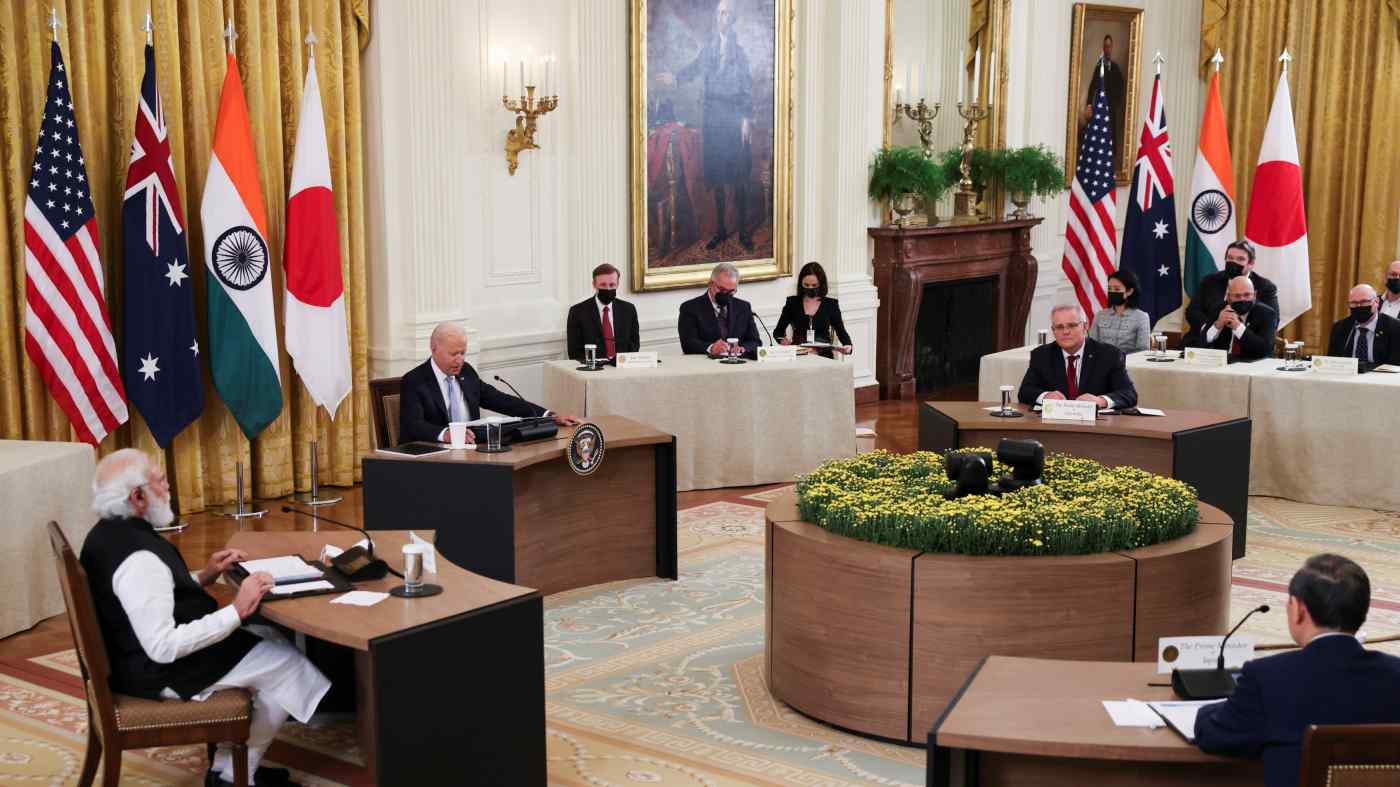
Joe Biden hosts a Quad leaders summit at the White House in September 2021: American, Australian, Indian and Japanese interests are not entirely congruent.   © Reuters

Brahma Chellaney, Nikkei Asia

Resurrected in November 2017, the Australia-India-Japan-United States Quad has come a long way toward cementing a strategic coalition of the leading democracies of the Indo-Pacific region.

But the question of where the Quad is headed has gained greater salience in the wake of the Regional Comprehensive Economic Partnership (RCEP) taking effect with Japan and Australia included in it.

RCEP, billed as the world’s largest trade bloc, and the separate Comprehensive and Progressive Agreement for Trans-Pacific Partnership (CPTPP) seek to promote economic integration around China and Japan, even as Beijing pursues its neo-imperial Belt and Road Initiative (BRI) that has already ensnared some vulnerable states in sovereignty-eroding debt traps. The U.S. and India were to be members of CPTPP and RCEP, respectively, but then both decided not to join.

Chinese Foreign Minister Wang Yi famously mocked the Quad in 2018 as a “headline-grabbing idea” that will dissipate “like the sea foam in the Pacific or Indian Ocean.” However, the Quad, anchored in the free and open Indo-Pacific (FOIP) vision, continues to gain in strength, largely in response to China’s muscular revisionism.Leaders of participating nations at the Regional Comprehensive Economic Partnership meeting in Singapore, pictured in November 2018: the question of where the Quad is headed has gained greater salience in the wake of RCEP taking effect on Jan. 1.   © Reuters

The change of administrations in the U.S. and Japan in 2021 and in Australia in 2018, far from slowing momentum, has helped build continuity, making the Quad’s future more durable.

The past year will be remembered for the first-ever Quad leaders summits — a virtual summit in March, and then an in-person summit at the White House in September. The summits yielded the first-ever Quad joint statements, which articulated a clear-eyed vision. Until then, the pattern was for each state to issue its own statement at the end of a meeting of officials from the Quad countries.

To be sure, when U.S. President Joe Biden was elected, there was uncertainty over the Quad’s future, including whether Biden would carry forward his predecessor’s FOIP strategy. Only after being sworn in did Biden embrace the FOIP concept and speak about the Quad.

There is a reason why the Quad remains central to America’s Indo-Pacific strategy, despite the new, Biden-initiated AUKUS alliance with Australia and Britain. The U.S., given its relative decline, needs its allies more than ever so that, in seeking to address international challenges, American power is augmented with that of its allies and strategic partners. Asian power equilibrium cannot be built without Japan, India and Australia.

In contrast to the AUKUS alliance’s security mission, the Quad now has an agenda extending to geoeconomic issues. While then-U.S. President Donald Trump’s administration helped give the Quad strategic meaning, the Biden administration has sought to reorient the group toward dealing with geoeconomic challenges.

The Quad initiatives since 2021 reflect this new focus. The initiative to build resilient supply chains, for example, extends from the technology and public-health sectors to semiconductors and clean energy. It draws strength from the hard lessons many economies have learned about China-dependent supply chains.

The Quad is also seeking to deliver transparent, high-standard infrastructure by coordinating technical assistance and capacity-building efforts with regional states. The objective is to set up public-private partnership projects that are properly planned and financially and environmentally sustainable, in contrast to China’s BRI projects, many of which have also faced allegations of corruption and malpractice.

The Quad Vaccine Partnership, the most-visible initiative, is aimed at fostering equitable access to COVID-19 vaccines by expanding vaccine manufacturing capacity in the quartet and by donating vaccines to other countries. Vaccine donations collectively by the quartet already rank the largest in the world.

Such initiatives show that the Quad, although catalyzed into action by China’s aggressive actions and irascible behavior, has become more directed toward larger geoeconomic issues.

A partnership of democracies that had once appeared more concept than reality has been fortified, with its leaders pledging to promote a rules-based Indo-Pacific that is “undaunted by coercion.”

However, the Quad’s new attention on global issues, from climate change — Biden’s pet concern — to cybersecurity and the pandemic, risks diluting the group’s Indo-Pacific focus. Its expansive geoeconomic agenda could also weigh it down.

Furthermore, American, Australian, Indian and Japanese interests are not entirely congruent. For example, India, facing the China-Pakistan strategic axis, maintains a land-based defense posture, whereas Australia, Japan and the U.S. are all focused on the maritime domain. And while America’s main objective regarding China is nonmilitary — to counter its geopolitical, ideological and economic challenge to U.S. preeminence — Japan and India confront a direct Chinese threat.

According to Chinese state media commentary, Japan and Australia’s participation in RCEP has taken “the wind out of the Quad’s anti-Chinese sails.” Australia and Japan have consistently refused to bend to Chinese pressure. But they have been lured by the billions of additional dollars that they will likely earn from RCEP’s boosting of regional trade, even as China gains a greater say in shaping trade rules in the Indo-Pacific.

Arrangements like RCEP, CPTPP and BRI, in fact, underscore the imperative for an economic pillar for the FOIP vision in order to give the Quad more comprehensive meaning. The Biden administration says it will unveil an economic framework that will go beyond these arrangements.

The Quad’s security role needs to be complemented with a concretized Indo-Pacific economic dimension so that security and economic interests are fused. Otherwise, if its members pick economic interests over security interests, the Quad’s relevance will erode.

Brahma Chellaney is a geostrategist and author of nine books, including “Asian Juggernaut: The Rise of China, India and Japan.”

China’s Trojan Gift: Creditor Imperialism

We are witnessing the end of China’s happy days when a positive image and almost unlimited capital helped its push for global influence and assets.

The scale and ambition of China’s Belt and Road Initiative (BRI) is staggering. Credible estimates suggest it has now lent $1.5 trillion of state money to 150 countries, more than the International Monetary Fund or the World Bank, let alone any other nation state. Is that sustainable and, given the recent slump in Chinese lending, is the decline an issue that will simply melt away?

What China’s President Xi Jinping hails as the “project of the century” is better described as debt-trap diplomacy. By extending huge loans with strings attached to financially vulnerable states, the BRI has boosted China’s political leverage over debtor states, ensnaring some in sovereignty-eroding debt traps. China has also secured favorable access to their natural assets, such as mineral resources and ports.

BRI loans continue until a borrower nation faces a debt crisis, which then arms China with considerable leverage to wrest political and economic concessions. The Chinese Communist Party (CCP) won its first overseas naval base at Djibouti, for example, as a result of debt entrapment. The more desperate a borrower’s situation, the higher the interest rates China will seek to impose.

Paradoxically however, the China-originating coronavirus pandemic has taken its toll on the BRI by contributing to a sharp drop in lending. Since peaking in the second half of 2019, BRI financing has continued to decline. The pandemic’s socioeconomic disruptions and adverse impacts on GDP have crimped many developing nations’ capacity to undertake new infrastructure projects.

Other factors are also at play, including the international spotlight on China’s predatory lending practices. Xi’s regime, while refusing to come clean on the origins of the covid virus, has utilized the pandemic to step up muscular revisionism and other scofflaw actions, from the East and South China Seas to the Himalayas.

All of which has dented China’s global image, with China’s reputation reaching new lows. This has given confidence to a number of BRI recipient countries, including some that have slipped into debt servitude to China, to oppose unfavorable terms for fresh loans or seek renegotiation of existing loan contracts.

China has invariably refused to renegotiate the terms of existing contracts. But with a number of states scrapping or scaling back BRI projects, it is being compelled to re-strategize and recalibrate lending. The increasingly precarious financial situations of a growing number of BRI partner states have also dampened Chinese state lenders’ appetite for risk-taking.

These factors collectively explain the downward trend in BRI finance and investments, which in the first half of 2021 declined 32% to $19.3 billion compared to the previous six months. In the pre-pandemic boom time, BRI financing had reached a record $63.3 billion in the second half of 2019.

To be sure, the BRI (whose official name at launch was One Belt, One Road) continues to make inroads in the developing world, as illustrated by the newly completed high-speed railway connecting Laos to China. Ironically, Laos was compelled just about a year ago to hand over control of its debt-laden national power grid to a majority Chinese-owned company

And yet the BRI’s glory days are unlikely ever to return, even if the pandemic comes under control. The dangers of China’s creditor imperialism can no longer be ignored by borrowing countries — unless their debt entrapment is beyond redemption. Cash-strapped TajikistanPakistan, and Sri Lanka, for example, have taken fresh Chinese loans to pay off old loans, despite earlier ceding strategic assets to creditor China.

Make no mistake: The BRI faces a growing image problem. The corruption and malpractice in many of its projects are compounded by a pervasive lack of transparency, including on financing and construction. Many completed projects are not financially viable. There is also increasing international awareness that slipping into debt bondage to China will likely mean losing valuable natural assets and perhaps even sovereignty.

Even where governments remain China-friendly, many citizens are beginning to view the BRI as potentially representing the advent of a new colonial era — the 21st equivalent of the East India Company that paved the way for British imperialism in the East, initially through trade.

Meanwhile, the Australia-India-Japan-U.S. “Quad” grouping, as a counter to the BRI, is working to deliver transparent, high-standard infrastructure by coordinating technical assistance and capacity-building efforts with regional states. The objective is to set up public-private partnership projects in the vast Indo-Pacific region, including through the Blue Dot Network, that are properly planned, and financially and environmentally sustainable. The European Union seeks something similar through its Global Gateway.

The Quad effort notwithstanding, the BRI will continue to win new projects. Indeed, U.S. policies to punish or isolate countries — from Zimbabwe and Iran to Myanmar and Cambodia — ensure that China will continue to bag lucrative contracts because there are no alternatives.

However, the damage to the BRI brand may be beyond repair, even if the initiative were renamed a second time. In the coming years, the BRI is likely to encounter stronger headwinds.

Brahma Chellaney is a geostrategist and the author of nine books, including the award-winning “Water: Asia’s New Battleground” (Georgetown University Press).

© CEPA, Center for European Policy Analysis, Washington, DC.


The Quad’s Geo-Economic and Geostrategic Implications

Chinese Foreign Minister Wang Yi famously mocked the Quad as a “headline-grabbing idea” that will dissipate “like the sea foam in the Pacific or Indian Ocean.” But far from dissipating, the Quad is strengthening, largely in response to China’s muscular revisionism.

Brahma CHELLANEY
published by RIETI (Research Institute of Economy, Trade and Industry)

At a time when there is a life-and-death conflict between two systems of governance — repressive and democratic — a loose strategic coalition of the Indo-Pacific region’s four leading democracies, the Quad, is rapidly solidifying. Comprised of Australia, India, Japan and the United States, the Quad has received a lot of international attention, largely because of the promise it holds toward underpinning the power equilibrium in the Indo-Pacific. In fact, the increasing use of the term “Indo-Pacific” — which refers to all countries bordering the Indian and Pacific oceans — rather than the traditional term “Asia-Pacific,” underscores the maritime dimension of today’s challenges. Asia’s oceans have increasingly become an arena of competition for resources and influence (Note 1). It now seems likely that future regional crises will be triggered and settled at sea.

As is apparent from the websites of the White House and the foreign ministries of its four member-states, the Quad’s official name is the Quad, not “Quadrilateral Security Dialogue,” as some publications keep calling it on first reference. The Quad’s origins date back to the 2004 Boxing Day tsunami that devastated large parts of Asia, killing hundreds of thousands across Indonesia, Thailand, India, Sri Lanka and South Africa. The four countries joined hands to coordinate disaster relief and humanitarian assistance. The idea of formalizing a Quad emerged from that humanitarian initiative.

After lying dormant for nine years, the Quad was resurrected in November 2017 and began regular working-level meetings. It started gaining momentum after its consultations were elevated to the foreign-minister level in October 2020. Under U.S. President Joe Biden’s initiative, the Quad leaders convened for the first in-person summit at the White House in September 2021. In fact, just weeks after assuming office, Biden organized a virtual Quad summit that yielded the Quad leaders’ first joint statement, which articulated a clear-eyed vision (Note 2).

China has long viewed the Quad with suspicion, with its misgivings reinforced by the more recent formation of the Australia-UK-U.S. (AUKUS) alliance, which President Biden called “a historic step.” The plain fact is that China’s aggressive actions have driven India closer to America, compelled Japan to strengthen its security alliance with the U.S., and forced Australia to abandon hedging and openly align itself with Washington.

China sees the Quad as a threat to its expansionist ambitions (Note 3). But, publicly, China has been dismissive of the Quad. Chinese Foreign Minister Wang Yi famously mocked the Quad as a “headline-grabbing idea” that will dissipate “like the sea foam in the Pacific or Indian Ocean.” Far from dissipating like “sea foam,” the Quad is strengthening, with its four democracies forging closer bonds in response to China’s increasingly muscular actions, which extend from the East and South China Seas to the Himalayas. In fact, opposing China’s coercive expansionism is the Quad’s unifying theme.

The next logical step would be for these democracies to play a more concerted, coordinated role in advancing broader Indo-Pacific security. The idea, however, is not to create an Asian version of NATO, but rather to develop a close partnership founded on shared values and interests, including the rule of law, freedom of navigation, respect for territorial integrity and sovereignty, peaceful dispute resolution, free markets and free trade.

China represents a growing challenge to these principles. At a time when the world is still battling a deadly pandemic that originated in China, that country’s muscular revisionism has lent new momentum to the Quad’s evolution toward a concrete, institutionalized grouping. In fact, with India’s closer integration, the Quad is beginning to blossom. And the Quad seems poised to deepen its strategic collaboration.

The Australia-India-Japan-U.S. quartet has affirmed a shared commitment to underpin an Indo-Pacific region based on clear and transparent rules, with respect for international law. The Quad’s agenda is centered on building a stable balance of power and a “free and open Indo-Pacific,” a concept authored in 2016 by then-Japanese Prime Minister Shinzo Abe. That concept was later embraced by U.S. policy, becoming the linchpin of America’s Indo-Pacific strategy under two successive administrations. The Quad’s focus, however, extends beyond China and the security realm.

In fact, the media focus on the Quad’s geostrategic aspects has obscured the important role that the group is playing to bring about geo-economic change. The grouping’s geo-economic priorities are apparent from several of its initiatives, including the following (Note 4):

  • Build resilient supply chains. The Quad’s supply-chain initiative extends from the technology and public-health sectors to clean energy. With Beijing seeking to leverage its domination of international supply chains, many economies, since the start of the COVID-19 pandemic, have learned hard lessons about China-dependent supply chains. There is a growing recognition of the imperative to diversify supply chains and make them more resilient to interference or manipulation by any state. Toward that end, the Quad, among other things, has sought to secure supply chains for vaccine production and clean energy, as well as identify vulnerabilities and strengthen supply-chain security for semiconductors and their vital components.
  • Rally expertise, capacity and finance to expand regional infrastructure. The Quad is working to finance and build infrastructure projects in the Indo-Pacific that are properly planned and financially sustainable as a counter to China’s debt-trap diplomacy, which is driving its “Belt and Road Initiative” even as it increasingly ensnares vulnerable nations in sovereignty-eroding debt traps (Note 5). Since 2015, the Quad partners have provided over $48 billion to more than 30 regional states in official finance for infrastructure related to public health, rural development, water supply and sanitation, renewable power generation, telecommunications and road transportation. Meanwhile, the Quad Infrastructure Coordination Group has been established to help deliver transparent, high-standards infrastructure by coordinating technical assistance and capacity-building efforts, including with regional states.
  • Help vaccinate the world against COVID-19. The Quad Vaccine Partnership, launched in March 2021, is aimed at fostering equitable access to COVID-19 vaccines in the Indo-Pacific and the wider world by expanding vaccine manufacturing capacity in the quartet and donating vaccines to developing nations. This initiative is piloted by the Quad Vaccine Experts Group, which coordinates the Quad’s collective response to the pandemic. As part of their plan to donate more than 1.2 billion COVID-19 vaccine doses, in addition to the doses they have already financed through COVAX, the Quad countries seek to leverage the vaccine-manufacturing heft of India, which supplies more than 60% of the world’s vaccines against various diseases. Japan, for example, will invest some $100 million in India’s healthcare sector to help boost the output of COVID-19 vaccines and treatment drugs.
  • Foster an open, accessible and secure technology ecosystem. This goal extends from 5G diversification and deployment to bolstering critical-infrastructure resilience against cyber threats. The Quad partners have now extended their cooperation even to outer space, including building a partnership for exchanging satellite data to promote sustainable use of oceans and marine resources and thereby protect the Earth. Critical and Emerging Technologies Working Group has been established.
  • Keep climate goals within reach through clean-energy innovation and deployment as well as adaptation, resilience and preparedness. A Quad shipping task force, for example, will seek to establish low-emission or zero-emission shipping corridors between the Quad member-countries, including by inviting Yokohama, Los Angeles, Sydney and Mumbai to form a green-shipping network. The Quad is also aiming at a clean-hydrogen partnership to strengthen and reduce costs across all elements of the clean-hydrogen value chain and to boost trade in clean hydrogen across the Indo-Pacific. Another objective of the Quad is improving critical climate information-sharing and disaster-resilient infrastructure.

These initiatives show that the Quad, although catalyzed into action by China’s aggressive actions and irascible behavior, has a broader agenda heavily focused on geo-economic issues. After the administration of U.S. President Donald Trump took the lead in reviving the dormant Quad and giving it strategic meaning, the Biden administration, in partnership with Japan, India and Australia, has sought to orient the Quad toward addressing the geo-economic challenges. Following the G-7 summit in Britain in June 2021, President Biden revealed at a news conference that, after he won the presidential election, a Chinese leader (whom he didn’t name) sought to dissuade him from embracing the Quad (Note 6).

Today, its four members perceive the Quad as providing important new architecture in the Indo-Pacific for advancing cooperation economically and strategically. The Quad, through its geo-economic initiatives, including generous vaccine donations, is also seeking to project soft power.

The fact is that the Quad is fostering greater cooperation between and among its member-states, as well as with outside nations. By seeking to leverage both public and private resources to achieve maximum impact, the Quad offers an alternative model to China’s state-directed lending for infrastructure projects, which has saddled a number of countries with onerous debts and increased their dependence on Beijing. Australia has unveiled a $1.4 billion infrastructure fund for the South Pacific, while Japan and India have agreed to develop a series of joint projects along what they have called the “Asia-Africa Growth Corridor,” which links the two continents via sea routes.

More fundamentally, the Quad member-states have come a long way toward cementing a partnership of democracies that had once appeared more concept than reality. The new AUKUS alliance is likely to complement the Quad. For the U.S., the Quad is becoming the central dynamic of its Indo-Pacific policy, with National Security Adviser Jake Sullivan calling the Quad “a foundation upon which to build substantial American policy in the Indo-Pacific (Note 7).”

While recognizing the Quad’s utility, it is also important to understand its limitations. Unlike the U.S. and Australia, which are geographically distant from China, Japan and India face a direct China threat, which the Quad cannot mitigate. While India in response has embarked on a major defense buildup, Japan — already shaken out of its complacency by an expansionist China vying for regional hegemony — is likely in the coming years to rearm and become militarily more independent of the U.S., without jettisoning its security treaty with Washington (Note 8).

Still, it is imperative that the Quad gain greater economic and strategic heft so as to ensure power equilibrium in the Indo-Pacific. By cooperating in economic, technological and security realms and coordinating their responses, the Quad member-states can help put discreet checks on the unbridled exercise of Chinese power. If China’s growing threats against Taiwan lead to military action, then a grand international coalition, with the Quad at its core, could emerge.

Footnotes:

  1. ^ The White House, United States Strategic Framework for the Indo-Pacific (Washington, DC: The White House, declassified on January 5, 2021); and U.S. Department of State, The Elements of the China Challenge (Washington, DC: Policy Planning Staff, Office of the Secretary of State, November 2020).
  2. ^ The White House, “Quad Leaders’ Joint Statement: ‘The Spirit of the Quad,’” March 12, 2021, available at https://www.whitehouse.gov/briefing-room/statements-releases/2021/03/12/quad-leaders-joint-statement-the-spirit-of-the-quad/.
  3. ^ Kevin Rudd, “Why the Quad Alarms China,” Foreign Affairs, August 6, 2021.
  4. ^ The White House, “Fact Sheet: Quad Leaders’ Summit,” September 24, 2021; and the White House, “Joint Statement from Quad Leaders,” September 24, 2021.
  5. ^ Anna Gelpern, Sebastian Horn, et al, How China Lends: A Rare Look into China’s Debt Contracts with Foreign Governments (Williamsburg, VA: AidData at William & Mary, the Center for Global Development, the Kiel Institute for the World Economy, and the Peterson Institute for International Economics, March 2021).
  6. ^ The White House, “Remarks by President Biden in Press Conference,” June 13, 2021, at Cornwall, United Kingdom, available at https://www.whitehouse.gov/briefing-room/speeches-remarks/2021/06/13/remarks-by-president-biden-in-press-conference-2/.
  7. ^ Kyodo, AFP-Jiji Press, “U.S. national security adviser says ‘Quad’ key in Indo-Pacific,” The Japan Times, January 30, 2021.
  8. ^ Ministry of Foreign Affairs of Japan, Full text of the Treaty of Mutual Cooperation and Security Between Japan and the United States of America, signed on January 19, 1960, available at https://www.mofa.go.jp/region/n-america/us/q&a/ref/1.html.

China will regret weaponizing sports

China has long mixed sports and politics. From its boycott of the 1956 Olympics to its more recent bullying tactics against the N.B.A., England’s Premier League and others, Beijing has treated sports as politics by other means. Now its Winter Olympics face a diplomatic boycott.

BY BRAHMA CHELLANEY, The Hill

The approaching Beijing Winter Olympics – the most divisive games since the 1936 Berlin Olympics – face several challenges: Boycott calls in the West; a Muslim gulag with more than one million detainees in Xinjiang; the new omicron variant of COVID-19; and a silenced #MeToo accuser, Peng Shuai, who is China’s top tennis player. No wonder Beijing is lobbying U.S. businesses, warning that they cannot expect to make money in China if they stay silent. 

The calls for a coordinated boycott of the Beijing Winter Olympics (labeled by critics the “Genocide Games”) raise the question of whether such action can help influence China’s behavior under a president whose record in power is increasingly drawing comparisons to the past century’s most brutal rulers.

Robert O’Brien, national security adviser to then-President Trump, last year equated Xi Jinping to Soviet dictator Josef Stalin. Some others have compared Xi to Adolf Hitler, even coining the nickname “Xitler.” Xi, for his part, has cultivated a Mao Zedong-style personality cult and embarked on completing the expansionist agenda that the communist China’s founder left unfinished.

Indeed, Xi has sought to model himself on Mao, the 20th century’s top butcher. Like Mao Zedong Thought, Xi Jinping Thought has been enshrined in China’s constitution and made the central doctrine guiding the ruling Chinese Communist Party (CCP). Xi, like Mao, is reverently referred to as renmin lingxiu, or “people’s leader.” 

China’s new Mao, while ideologically committed to classical Marxism-Leninism, is apparently seeking to build fascism with Chinese characteristics. 

Under Xi, China has emerged as a wrathful, expansionist power that pursues “wolf warrior” tactics and debt-trap diplomacy and flouts international law at will. Two successive U.S. administrations have described as genocide Xi’s Xinjiang gulag, the largest mass incarceration of people on religious grounds since the Nazi period.

The international costs of Xi’s despotism are apparent from the devastating consequences of the China-originating pandemic. Two years on, the world still does not know whether COVID-19 began as a natural spillover from wildlife or was triggered by the accidental leak of a lab-enhanced virus in Wuhan. What is apparent, though, is that Xi’s regime lied about the initial spread of the disease, hid evidence of human-to-human transmission and silenced doctors who sought to warn about the emergence of a novel coronavirus. 

More ominously, a massive cover-up in China to obscure the genesis of the virus suggests the world may never know the truth. Beijing has refused to cooperate with international investigations, characterizing them as “origin-tracing terrorism,” and instead peddled conspiracy theories. 

Thanks to Xi’s scofflaw actions, China’s global image has been badly dented, forcing the country to increasingly rely on its coercive power. According to a global survey, unfavorable views of China are at or near historic highs in most advanced economies.

But instead of undertaking a course correction, Xi is doubling down on his renegade actions, as underscored by China’s stepped-up bullying of Taiwan. After Beijing’s success in swallowing Hong Kong, redrawing the geopolitical map of the South China Sea and changing the territorial status quo in the Himalayan borderlands with India, Nepal and Bhutan, risk is growing that Xi’s expansionism could make Taiwan its next target.

Beijing will have the honor of becoming the world’s first city to host both a summer and winter Olympics. But since the 2008 Beijing Summer Olympics, the human rights situation in China has worsened, with Xi establishing a techno-authoritarian state whose soaring budget for internal security has overtaken the country’s massive military budget. An increasingly repressive internal machinery, aided by an Orwellian surveillance system, has fostered a state strategy to culturally smother ethnic minorities in their traditional homelands, including through demographic change and harsh policing.

It was in 2015 that Beijing defeated Almaty (Kazakhstan) to win the bid to host the 2022 Winter Olympics. Just in the period since 2015, China, among other things, has established forward military bases on human-made islands in the South China Sea, set up the Xinjiang gulag, militarized the Himalayan borderlands, weaponized debt and gobbled up Hong Kong.

The world must not turn a blind eye to such actions, which thus far have not invited any meaningful Western sanctions. Xi has only been emboldened by the fact that his draconian, expansionist actions have essentially been cost-free. 

Just as other powers’ appeasement emboldened Hitler’s expansionism, leading to World War II, the international failure to impose tangible costs for Chinese aggression is likely to beget more aggression. Indeed, the present business-as-usual approach to China is tantamount to appeasement. 

If the Beijing Winter Olympics were held without any censure of the Xi regime, it would be an insult to every Uyghur, every Tibetan, every jailed Hong Kong democracy activist and every imprisoned Chinese political dissident. A boycott-free Games that wrap up smoothly would only encourage Xi to embark on fresh repression and expansionism.

Make no mistake: If Xi’s China stays on its present path, open conflict with the West and with its neighbors, from Japan to India, would become inevitable.

For the CCP, sports and politics have long been inseparable. From its boycott of the 1956 Summer Olympics in Melbourne (Australia) to its more recent bullying tactics against the N.B.A., England’s Premier League and others, the party has treated sports as politics by other means. It has used threats of withdrawing lucrative sports contracts, broadcast deals and sponsorship opportunities to buy silence on its human rights record.

When China can wield sports as a political weapon, is there any reason why democratic powers should avoid giving it a taste of its own medicine to help put the CCP on notice? A coordinated boycott of the Games would convey to the Chinese people that the CCP’s rogue actions risk isolating China.

Harmonized action on the Games, even if largely symbolic, could serve as a first step toward galvanizing a larger international movement against Xi’s regime, if not triggering a “boycott China” movement along the lines of the sustained global boycott that helped end the apartheid system in South Africa.

Brahma Chellaney is a geostrategist and the author of nine books, including the award-winning “Water: Asia’s New Battleground” (Georgetown University Press).

© The Hill, 2021.

China’s bullying of tiny Bhutan risks South Asian stability

David and Goliath struggle exposes Beijing’s expansionist intent

The Merak village, Eastern Bhutan, pictured from the footpath heading towards Sakteng in May 2015: Xi Jinping’s expansionism has not spared China’s smallest neighbor.   © Corbis/Getty Images

Brahma Chellaney, Nikkei Asia

China has failed to settle the frontier with its tiny neighbor Bhutan, despite holding talks with Bhutan since 1984. Now, after nearly four decades, it is trumpeting a newly signed memorandum of understanding with the kingdom to “expedite” the border negotiations.

The MOU cannot obscure the fact that China has in recent years incrementally encroached on Bhutan’s territory, one of the world’s smallest and least-populated nations, with just 778,000 people. Such aggression violates a 1998 bilateral treaty committing China and Bhutan “not to resort to unilateral action to alter the status quo of the border.”

Druk Yul, or the land of the thunder dragon, as Bhutan is known, lies sandwiched between the elephant of India and since 1950 when Beijing swallowed Tibet, whose religion and culture has greatly influenced Bhutan, the giant Chinese dragon on the other side.

Despite popularizing the concept of gross national happiness as a measure of development, Bhutan’s own happiness is coming under pressure from Chinese aggression under President Xi Jinping, who is implementing the expansionist agenda that Mao Zedong left unfinished.

While China under Mao more than doubled its size, making it the world’s fourth-largest country by area, Xi’s expansionism has not spared China’s smallest neighbor.

Several newly built Chinese villages, unnoticed by the world, have cropped up inside internationally recognized Bhutanese territory, demonstrating how Xi has taken his South China Sea strategy to the Himalayas. With the villages have come planted settlers, roads and military infrastructure.

China’s program to build militarized villages in Himalayan borderlands it claims, or has seized, from Bhutan, Nepal and India gained momentum after Xi in 2017 called on Tibetan herdsmen to settle in frontier areas and “become guardians of Chinese territory.”

Establishing such facts on the ground has become integral to Xi’s strategy of territorial aggrandizement because international law recognizes civilian settlements as evidence of a country’s effective control over an area. This explains why artificial villages have been created in inhospitable Himalayan terrain, just like the human-made islands in the South China Sea.

Satellite images reveal new Chinese villages on land in Bhutan’s west and north. After the Colorado-based Maxar Technologies disclosed one such village named Pangda, Chinese state media claimed it was on Chinese territory.

Meanwhile, China has built military roads through Bhutanese territory to open a new axis against India’s most vulnerable point — the Siliguri Corridor, which connects its far northeast to the heartland. Known as the Chicken Neck, the corridor, at the intersection of Tibet, Nepal, Bhutan and Bangladesh, is barely 22 kilometers wide at its narrowest point.

Not content with such stealth encroachments, Xi’s regime has upped the ante by opening a new territorial front against Bhutan. Out of the blue, China last year laid claim to Bhutan’s rhododendron-laden Sakteng Wildlife Sanctuary, which spreads across 741 sq. kilometers and is known for its unique flora and fauna, including endangered species such as the red panda, Himalayan serow, gorals, capped langurs, Himalayan black bear and barking deer.

The new claim to Bhutan’s easternmost territory is unusual because China has no common border there, it being a region that can only be accessed through the Indian state of Arunachal Pradesh. This is the first time since the end of World War II that one country has laid claim to another state’s territory that can only be accessed via a third nation.

In doing so, Beijing has sought to simultaneously advance its designs against Bhutan and India. Its maps already show the entire area of Arunachal Pradesh — more than two times larger than Bhutan — as being part of China. To be sure, this is not the first time that Xi’s regime has targeted Bhutanese territory to bolster China’s military advantage over India.

In 2017, China occupied most of Bhutan’s Doklam Plateau overlooking India’s Chicken Neck, following a 73-day military standoff with India, the de facto guarantor of Bhutanese security. In fact, China is currently locked in another standoff with Indian forces that was triggered more than 19 months ago by Chinese encroachments on India’s northernmost territory of Ladakh, located almost 1,500 kilometers to Bhutan’s west.

Beijing has long pressed Bhutan to open diplomatic relations with it and accused India of blocking the kingdom from establishing such ties. In the absence of diplomatic relations, China has used the protracted border talks as a channel of communication with Bhutan on issues extending beyond their shared boundary.

Indeed, China’s new claim to the wildlife sanctuary appears aimed at intensifying its discussions with Bhutan to woo the kingdom away from India’s embrace. This may also explain the new MOU, whose text has not been released thus far. Chinese state media reports suggest that the MOU is more about getting Bhutan to establish diplomatic ties with China than about settling the border.

Xi, however, is giving Bhutan ample reason to resist subordination to China. The MOU was signed at a virtual event by the Bhutanese foreign minister and an assistant Chinese minister, as if Bhutan were a client state.

More fundamentally, by employing its South China Sea tactics to unilaterally change facts on the ground, China is presenting a territorial and military fait accompli to a helpless Bhutan.

Brahma Chellaney is a geostrategist and author of nine books, including “Asian Juggernaut: The Rise of China, India and Japan.”

Biden’s Taiwan test is coming

© Getty Images

BY BRAHMA CHELLANEY, The Hill

Chinese President Xi Jinping, in power since 2012, has become increasingly emboldened in pursuing his expansionist agenda, in part because three successive American presidents have allowed him to act with impunity. Having swallowed Hong Kong, is China itching to move on Taiwan, the island democracy whose incorporation Xi recently called a “historic mission”? By rehearsing amphibious and air attacks, China has displayed a readiness to seize Taiwan by force.

Make no mistake: Taiwan is on the frontline of international defense against tyranny. This small island with almost as many people as much-larger Australia is a technological powerhouse that plays a central role in the international semiconductor business. Its absorption will not only make China a more formidable economic competitor to the United States, but also threaten global peace and critically accelerate the global chip shortage.

Encouraging Xi’s unrelenting expansionism is the fact that his heavy-handed actions at home and abroad thus far have essentially been cost-free. Take the South China Sea, whose geopolitical map Xi has forcibly redrawn, despite an international arbitral tribunal’s ruling invalidating China’s territorial claims there.

Then-President Obama seemed content to look the other way as Xi built artificial islands and militarized the South China Sea. This helped turn China’s contrived historical claims to that critical corridor into reality without firing a single shot. 

Under President Trump, despite a paradigm shift in America’s China policy, the administration prioritized a trade deal with Beijing and thus imposed largely symbolic sanctions when evidence of Xi’s Muslim gulag in Xinjiang emerged. Consequently, the largest mass incarceration of people on religious grounds since the Nazi era (which Washington acknowledges is genocide) has gone largely unpunished, even though the 1948 Genocide Convention requires its parties, which include the U.S., to “prevent and punish” acts of genocide.

When Hong Kong’s prodemocracy movement was crushed and the city was brought into political lockstep with the Chinese Communist Party in breach of China’s United Nations-registered treaty with Britain, Xi and his inner circle remained untouched by the sanctions the Trump administration imposed. And all the 24 Chinese targeted by President Biden’s administration in March for their Hong Kong role had already been hit with sanctions by the Trump administration.  

Now there is real danger that, encouraged by Biden’s recent shift toward a more conciliatory approach toward China, Xi will move against Taiwan.

In fact, the exit of a vanquished America from Afghanistan, by underscoring the irreversible decline of U.S. power, may make Xi believe that China has an opening to seize Taiwan. Chinese state media have warned Taiwan that it will be abandoned by America in the face of a Chinese invasion, just as the Afghanistan disaster unfolded after the U.S. threw its allies – the Afghan government and military – under the bus.

Biden has accentuated America’s credibility problems. Asked at an Oct. 21 CNN town hall whether “the U.S. would come to Taiwan’s defense if China attacked,” Biden said emphatically, “Yes, we have a commitment to do that.” Then the White House quickly walked back his words, saying “there is no change in our policy” on Taiwan, which is centered on “strategic ambiguity” about U.S. intentions. 

Once a policy of ambiguity is described in virtually unequivocal terms by the president, and then the White House dials it back, it sends the wrong message to Beijing. Xi may read this as a lack of U.S. resolve to defend Taiwan and plan to invade Taiwan at an opportune time when America is distracted.

With its increasing bullying, Xi’s dictatorship is seeking to normalize hostile pressure on Taiwan. If not outright invasion, Beijing could seek to slowly throttle Taiwan in order to force it to accept “reunification,” including by cutting off its undersea cables, internet connections and liquified natural-gas imports. 

But if Xi perceives that China has a window of opportunity to act during the Biden presidency without inviting a major blowback, he will likely employ military force. In fact, the probability of a surprise Chinese invasion will be greater if Biden is seen as lacking the strategic vision and political will to defend Taiwan against an attack. 

In this light, the imperative for Washington is not merely to embrace strategic clarity by abandoning the outdated strategic ambiguity policy, which was formulated when China was still backward and in no position to annex Taiwan. Rather, the U.S. must shift from a “one China” policy to an overt “one China, one Taiwan” posture that recognizes the island’s independent status. And Xi should be left in no doubt that the U.S. would make China pay a heavy price if it attempted to invade or choke Taiwan.

A U.S. that fails to prevent Taiwan’s subjugation would be widely seen as unable or unwilling to defend any other ally, including Japan, which hosts more American soldiers today than any other foreign country. Taiwan (Imperial Japan’s first colony) is geographically an extension of the Japanese archipelago.

If the U.S. were to put up with a Chinese conquest of Taiwan, it would make the same fatal mistake as the participants of the 1938 Munich Conference who, yielding to Adolf Hitler, transferred the predominantly German-speaking Sudetenland from Czechoslovakia to Germany. That concession paved the way for World War II.

Taiwan’s fall would significantly advance China’s hegemonic ambitions in Asia, including by triggering the unraveling of U.S.-led alliances there. And China would emerge as a pressing military threat to the U.S. itself.

Brahma Chellaney is a geostrategist and the author of nine books, including the award-winning “Water: Asia’s New Battleground” (Georgetown University Press).

App bans not enough. India must start imposing calibrated costs on China

Brahma Chellaney, The Times of India

In 1962, the Chinese Communist Party (CCP) set out to “teach India a lesson” by waging a surprise war. Now, by stealthily encroaching on border areas in Ladakh and then deepening and broadening the border crisis, it seems intent on making a permanent enemy of China’s largest neighbour.

From building a new axis against India’s so-called chicken-neck to advancing its “salami slicing” through militarized border villages, the CCP has steadily upped the ante. Its latest provocation is a “Land Borders Law”, primarily aimed at furthering its Himalayan expansionism.

Instead of mutually settled borders, the new law enables unilaterally imposed borders. Furthermore, the law’s assertion of absolute sovereignty over cross-border waters means that China has a declared right to divert as much of the shared waters of the Tibet-originating rivers as it wishes, regardless of downstream impacts.

Yet Prime Minister Narendra Modi’s government still employs euphemisms to describe China’s 19-month-long aggression: “unilateral change of status quo” for land-grabs; “friction points” for seized areas; and “full restoration of peace and tranquillity” for rollback of the intrusions.

To Modi’s credit, though, India has refused to buckle. India has more than matched China’s military deployments and said bilateral ties cannot return to normal until China disengages and deescalates at the border.

China’s frenzied construction of new military infrastructure along the border, however, signals its intent to hold on to its gains of aggression and turn the once-lightly-patrolled frontier into a perennially hot border. The lengthy negotiations since mid-2020 have only worked to China’s advantage, enabling it to buy time and consolidate its land-grabs and build new military facilities and fibre optic networks along the frontier.

Had India done to China what China has done to it (seize territories through furtive aggression), the CCP dictatorship would have come down on it like a ton of bricks. Yet India has remained loath to impose biting trade and diplomatic sanctions, including as a means to address the largely one-sided trade and contain China’s influence operations.

India’s actions last year — from banning Chinese mobile apps to restricting Chinese companies’ access to Indian government contracts — may have helped assuage public anger at home over the aggression but did little to influence China’s behaviour. China’s exports to India are booming amid its aggression, allowing it to have its cake and eat it too. It is a “win-win” for China; it is literally winning twice.

By refraining from imposing substantive costs, India has allowed the military confrontation to remain a low-risk strategy for China. The multiple standoffs help China to keep India off-balance and stretched. Rather than India, it is China that is imposing costs, including forcing the diversion of greater Indian resources for frontier defence.

Meanwhile, India’s dual blunder in vacating the strategic Kailash Heights and accepting Chinese-designed “buffer zones” in three Ladakh areas has further emboldened China’s intransigence. Beijing has peremptorily dismissed India’s call for a return to the pre-April 2020 positions as “unreasonable and unrealistic”.

It is past time India sheds its risk aversion to build leverage over China. A calibrated imposition of progressively escalating costs has become imperative.

China’s trade with India may be modest as a percentage of its global trade, but its large trade surplus with India contributes significantly to its overall trade surplus. China’s bilateral trade surplus this year is set to nearly equal India’s total defence spending. The CCP has long waged economic war against India through product dumping to kill Indian manufacturing.

India must start employing tariff and non-tariff trade restrictions to curb non-essential imports from China. Indeed, China’s aggressive mercantilism has made trade diversification and import substitution more exigent. While China restricts market access to Indian firms, Chinese tech companies, for example, remain active in India’s lucrative cloud-computing space.

China’s challenge to its territorial integrity must prompt India to finally honour then-Foreign Minister Sushma Swaraj’s 2014 promise to link its one-China policy to Beijing’s adoption of a one-India policy. Geopolitically, Taiwan should be to India what Pakistan is to China. If China swallows Taiwan, it will advance its hegemonic ambitions and become a more pressing military threat to India. Indian policy ought to subtly shift from a one-China stance to a “one China, one Taiwan, one Tibet” posture in practical but undeclared terms.

It is also time for New Delhi to downsize China’s large diplomatic presence in India, starting by shutting its Kolkata consulate, given the CCP’s designs on the Siliguri Corridor and the inflow of Chinese arms to insurgents. Modi’s predecessor played into China’s hands by letting it re-establish its Kolkata consulate without India reciprocally being allowed to reopen its Lhasa consulate, which Beijing shut in 1962.

The CCP is seeking to wear India out in order to impose a territorial and military fait accompli. A punitive Indian diplomatic and economic campaign can help internationally spotlight CCP’s strategic miscalculation in taking on India.

The writer is a geostrategist.

The steadily increasing risk of war between China and India

Chinese troops pictured in Ladakh along the India-China border on Feb.15: China’s Land Borders Law effectively negates the possibility of peacefully resolving its territorial disputes with India.   © Indian Army/AP

Beijing’s use of domestic law underpins its international expansionism

Brahma Chellaney, Nikkei Asia

The spotlight on the growing Chinese military threat against Taiwan has helped obscure China’s more serious military confrontation with India along an extended, mountainous frontier.

Although the intensifying multiple military standoffs between nuclear-armed titans China and India have grabbed few headlines, the risk of renewed border skirmishing, if not outright war, is increasing. Indeed, the Pentagon’s newly released annual report on China says the Chinese military is bracing for a two-front war scenario — “any escalation of border tensions with India, as well as preparing to support a Taiwan contingency.”

A reminder of the looming risks is China’s latest provocation — the enactment of a Land Borders Law — which appears primarily aimed at advancing its territorial revisionism in the Himalayas.

The law effectively negates the possibility of peacefully resolving its territorial disputes with India. Instead of mutually settled borders, the law enables unilaterally imposed borders.

The ongoing military standoffs began more than 18 months ago when a shocked India discovered that China had stealthily encroached on several key border areas in the northernmost Indian territory of Ladakh. The discovery led to the first deadly Chinese-Indian military clashes since 1975, including China’s first combat deaths in decades.

Unlike China’s expansionism elsewhere, including swallowing Hong Kong and redrawing maritime frontiers in the South China Sea without firing a shot, its Himalayan aggression has run into armed resistance. India has not only more than matched Chinese military deployments, but in recent days, it test-fired a nuclear-capable intercontinental ballistic missile as a warning shot to China and conducted daring border paratrooper exercises simulating territory capture behind enemy lines.

The deepening military stalemate at the Himalayan border led Beijing to enact its new Land Borders Law, which gives its imprimatur to assertive actions along land frontiers. Those actions emulate China’s aggressive moves in the East and South China Seas, including an intensifying campaign against the Japan-controlled Senkaku Islands, claimed by Beijing as the Diaoyu, through aerial and maritime incursions.

The Land Borders Law, which India’s foreign ministry slammed as a “unilateral move,” extends to transboundary river waters. According to Chinese state media, the law upholds China’s “legitimate rights and interests” over the Tibet-originating transboundary rivers like the Brahmaputra and Mekong.

The law’s assertion of full sovereignty over cross-border waters means that China has a declared right to divert as much of the shared waters as it wishes, regardless of downstream impacts. Nikkei Asia has reported in an online article, “China law tightens land borders amid regional tensions,” that Beijing is toying with the idea of limiting the volume of cross-border water flows to India during conflicts, by citing the “protection and reasonable use” stipulation of its Land Borders Law.

In fact, underscoring its readiness to weaponize even the sharing of water data on upstream river flows, China in 2017 inexplicably refused to supply hydrological data to India in violation of the terms of two bilateral agreements. The one-year data denial resulted in preventable deaths as the monsoon-swollen Brahmaputra overran its banks, leaving a major trail of destruction, especially in India’s Assam state.

The Land Borders Law is just the latest example of how an increasingly aggressive China is using domestic law to underpin its expansionism. Beijing, for example, used a new national security law to crush Hong Kong’s pro-democracy movement and bring the city into political lockstep with the Chinese Communist Party in breach of China’s United Nations-registered treaty with Britain.

The Land Borders Law came just months after China’s new Coast Guard Law took effect. Several countries, including Japan, the United States, the Philippines and Vietnam, have raised concerns about the Coast Guard Law, which clearly violates the United Nations Convention on the Law of the Sea.

But just as the Coast Guard Law is aimed at accelerating China’s maritime militarization, the Land Borders Law will speed up its militarization of the Himalayas. And just as the Coast Guard Law authorizes the use of lethal force in disputed waters claimed by China, the land law permits the use of force in defending and furthering Chinese claims to contested lands.

Simply put, Beijing enacts domestic law to violate international law. China’s success in unraveling Hong Kong’s autonomy through a national security law could inspire it to enact a Taiwan-specific legislation or activate its 2005 Anti-Secession Law against that island democracy.

By employing domestic law as a cover for unlawful actions, China illustrates that international law is powerless against the powerful, especially scofflaw states. But China’s expansionism often breaches international law with the aim, ironically, of asserting its own claims and rights under international law.

Examples include China’s human-made militarized islands in the South China Sea and its current militarized village-building spree in disputed Himalayan borderlands in order to extend or consolidate its control over strategically important areas that India, Bhutan and Nepal maintain fall within their national boundaries.

Effective control is the sine qua non of a strong territorial claim in international law. Armed patrols do not prove effective control, but civilian settlements do. So, the Chinese Communist Party is callously uprooting Tibetan nomads and forcing them to settle in its artificial new Himalayan border villages, where ethnic Han Chinese party members serve as resident overseers.

Whether China can legitimize unlawful actions retroactively in this manner is a moot point. But lawfare, or the misuse and abuse of law for political and military ends, is a key component of China’s asymmetrical or hybrid warfare.

This blends conventional and irregular tactics with incremental territorial encroachment — salami-slicing — psychological manipulation, disinformation and coercive diplomacy to help advance its expansionism.

Brahma Chellaney is a geostrategist and author of nine books, including “Asian Juggernaut: The Rise of China, India and Japan.”

Biden shifts to a more conciliatory approach toward China

BY BRAHMA CHELLANEY, The Hill

In a defiant speech on Aug. 31, President Biden claimed that his precipitous exit from Afghanistan, which facilitated the terrorist takeover of that country, would allow the United States to focus on its “serious competition with China.” But there are now growing signs that Biden’s Afghan blunder has weakened his hand against China and opened greater strategic space for America’s main rival.

Illustrating his weakened position, the president has just capitulated to China’s hostage-taking tactics. In a deal Biden finalized with Chinese President Xi Jinping, the U.S. dropped its extradition case against Huawei executive Meng Wanzhou, allowing her to return home from Canada, in exchange for China’s release of Canadian hostages Michael Spavor and Michael Kovrig, who spent 1,019 days in Chinese prisons on trumped-up charges. 

The hostages-for-Meng swap is the latest example of Biden’s efforts to ease tensions with China by propitiating Xi. By rewarding Xi’s use of rogue tactics, the deal sends a chilling message to foreigners working in China.

Earlier, Biden bowed to another Chinese demand — that the U.S. stop tracing the origins of the COVID-19 virus, even though the world has a right to know if China caused the worst disaster of our time, which has already killed more than 4.7 million people. Twelve days after Kabul’s fall, Biden announced on Aug. 27 that the intelligence inquiry he initiated had ended, even though it failed to uncover the genesis of the pandemic.

Xi’s regime, involved in one of the greatest cover-ups ever seen, doesn’t want the truth to come out. After all, if China’s negligence or complicity spawned the world’s worst public-health catastrophe in more than a century, it would constitute a crime against humanity.

Biden should have ordered the U.S. intelligence community to keep searching for the true origins of the virus until it reached a definitive conclusion. By not extending the inquiry’s 90-day deadline, Biden met an important Chinese demand.

Since the Afghan debacle, Biden has gone to extraordinary lengths to alleviate tensions with China. Last week began with the president’s China-conciliatory address at the United Nations and ended with Meng’s return home to a hero’s welcome.  

During a recent 90-minute phone conversation with Xi, Biden sought to explain U.S. actions toward China “in a way that [is] not misinterpreted as…somehow trying to sort of undermine Beijing in particular ways,” according to the readout from a senior U.S. official. In fact, during the call, Xi spurned Biden’s face-to-face summit offer, demanding that the U.S. first soften its China policy and tamp down rhetoric.

As if heeding Xi’s demand, Biden in his UN address never uttered the word “China,” even as he called out Iran and North Korea. The address stood in stark contrast with then-President Trump’s 2020 UN speech, which demanded the world “hold China accountable” for unleashing the “China virus.” Biden’s speech defensively stated, “We’re not seeking – say it again, we are not seeking – a new Cold War or a world divided into rigid blocs.”

Such fecklessness appears out of step with reality, given that an ambitious and expansionist China is actively working to supplant the U.S. as the world’s preeminent power while waging a cold war against it. Since Biden assumed the presidency, the U.S. has initiated most moves for high-level talks with China, including the latest phone call.

The White House’s dropping of fraud charges against Meng, the daughter of the man who founded the military-linked Huawei, is a real shot in the arm for Xi, whose increasing appetite for taking major risks poses an international challenge. In a striking paradox, Meng departed for home from Canada on the day Biden hosted the first face-to-face leaders’ meeting of the Quad, a U.S.-India-Japan-Australia grouping catalyzed by China’s muscular foreign policy and rogue behavior.

Deals with hostage-takers usually boomerang. For example, to secure the release of Bowe Bergdahl, a captured U.S. Army sergeant who had deserted his unit in Afghanistan, President Obama in 2014 freed five Taliban leaders from Guantánamo Bay. The release of the five – “the hardest of the hardcore,” as the late Sen. John McCain (R-Ariz.) said then – proved costly.

An emboldened Taliban sharply escalated its attacks in Afghanistan, bringing Afghan and U.S.-NATO forces under increasing pressure. This eventually led to Trump’s one-sided withdrawal deal with the Taliban in February 2020 and then to Biden’s recent handover of Afghanistan to that Pakistan-backed terrorist militia. Today, the five former Guantánamo inmates are senior officials of the new Afghan regime, made up of a who’s who of international terrorism.

The Biden-arranged swap is likely to prove detrimental to the free world. The deal may have unwittingly vindicated Chinese propaganda that the 2018 Canadian arrest of Meng on a U.S. warrant was politically driven and that the U.S. and Canadian judicial systems do not operate independent of political interests.

Indeed, the White House has shamed the rule of law by terminating a legal case through a political deal with a hostage-holding regime, thereby setting a terrible precedent in international relations.

The deal will inspire other hostage-takers, including the Taliban. To press for sanctions relief and other demands, the Taliban is already obstructing the evacuation of the remaining stranded foreigners from Afghanistan, including Afghans with Western passports.

More ominously, America’s yielding to China’s thuggish diplomacy of hostage-taking will encourage greater Chinese defiance of international rules and norms. Xi’s regime doesn’t care about the costs to the country’s image, which explains why, despite unfavorable views of China rising to near historic highs, it is busy corrupting, coercing or co-opting other states.

In pursuing a more conciliatory approach toward China, Biden has given respectability to the rogue-state tactic of taking hostages, making it virtually certain that the two freed Canadians will not be the last foreigners seized by Beijing as bargaining chips.

Brahma Chellaney is a geostrategist and the author of nine books, including the award-winning “Water: Asia’s New Battleground” (Georgetown University Press).

A Striking Paradox: The U.S. Engages Taliban But Isolates Myanmar

Taliban fighters stand guard outside Hamid Karzai International Airport in Kabul on Aug. 16: the White House has praised the Taliban for being businesslike and professional on evacuations.   © Reuters

Naypyitaw’s generals treated as bigger threat than the terrorists controlling Kabul

Brahma Chellaney, Nikkei Asia

No sooner had the Taliban completed their lightning-quick conquest of Afghanistan than U.S. Secretary of State Antony Blinken announced that Washington was ready to work on “counterterrorism” with the same marauding Islamist force that has so much American blood on its hands.

No less shocking was the statement from the chairman of the U.S. Joint Chiefs of Staff, Gen. Mark Milley, that it is “possible” the U.S. will coordinate with the Taliban to conduct counterterrorism strikes on other Islamist terrorists.

British Chief of Defense Staff Gen. Nick Carter called the Taliban — responsible for the killing of more than 2,000 American soldiers and hundreds of allied troops — “country boys” that “live by a code of honor and a standard.” Carter’s claim that the Taliban have “changed” and “want an Afghanistan that is inclusive for all” has already been contradicted.

The Taliban’s all-male regime of hard-core extremists is a who’s who of international terrorism, with 17 of the 33 cabinet ministers on the United Nations’ terrorism-related sanctions list, and four former Guantanamo Bay inmates and several others who remain U.S.-designated global terrorists. The regime is headed by Mohammad Hassan Akhund, a U.N.-listed terrorist and architect of the 2001 destruction of the monumental Buddhas of Bamiyan.

The Anglo-American outreach to the Taliban stands in eerie contrast with U.S. and British efforts to isolate and squeeze another of India’s neighbors — military-ruled Myanmar. It is as if Myanmar’s military government is a bigger threat to international security than a Kabul regime run by some of the world’s deadliest terrorists.

Military rule is nothing new to Myanmar, one of the world’s most ethnically diverse countries whose failure to construct an inclusive national identity has allowed old ethnic insurgencies to fester. Directly or indirectly, the military has always called the shots in Myanmar, a factor stifling the resource-rich nation’s potential.Soldiers set up barricades in Yangon on Feb. 15: military rule is nothing new to Myanmar,   © NurPhoto/Getty Images

Yet, after the latest military takeover on Feb. 1, the U.S. and Britain took the lead in slapping a series of sanctions on Myanmar, with America even suspending bilateral trade ties. Washington says its 2013 Trade and Investment Framework Agreement with Myanmar will remain suspended until the return of a democratically elected government, of which there is currently little hope.

The U.S.-led efforts to use economic and political levers to unseat the military regime have only emboldened insurgent groups to step up their violent campaigns. A shadow government formed by opponents of military rule recently called for taking up arms against the regime. More than 220,000 people have already been displaced by internal conflict since the military takeover.

Yet, the U.S. and Britain appear reconciled to a terrorist regime ruling Afghanistan. In an echo of Gen. Carter’s call to be “very careful about using the term ‘enemy'” for the Taliban, U.S. national security adviser Jake Sullivan has declined to call the militia an enemy of the U.S., saying, “It’s hard to put a label on it.”

In fact, Britain responded to the Taliban’s conquest by immediately announcing a doubling of its aid to Afghanistan. And U.S. President Joe Biden — not content with his Afghan surrender gifting troves of American-made weapons to the Taliban, making them the first terrorist group to acquire advanced air and land-based capabilities — is sending $64 million in aid to Afghanistan. As The Wall Street Journal put it, the Taliban “have overnight turned into a courted U.S. partner.”

The White House has praised the Taliban for being “businesslike and professional” on evacuations. They have certainly been businesslike and professional in detaining and executing perceived opponents, in ongoing ethnic cleansing and in their Pakistan-aided brutal assaults on the Panjshir Valley, the last resistance stronghold, where tens of thousands of residents have been uprooted amid widespread killings.

Meanwhile, Taliban death squads, going door to door, have been hunting down and killing those who assisted the previous government, including, in one documented case, first pulling out all the victim’s fingernails. The Taliban have been businesslike and professional too in their imposition of seventh-century Islamic practices from the Arab world that are alien to Afghan culture.

The Taliban have “changed” in one respect: In place of the blue burqa that women were made to wear during their 1996-2001 rule, they have now prescribed a full-body covering of a different color, black.

The U.S. outreach to the Taliban, including drawing specious distinctions between “good” and “bad” terrorists, is designed to soften the blow from Biden’s handover of a mineral-rich country to a militia that is a wing of the Pakistani deep state. But such an effort cannot camouflage the damage to America’s international credibility and standing.

More fundamentally, the Anglo-American courting of the Taliban highlights the selective, geopolitics-driven approach to combating terrorism, which is why the U.S.-launched global war on terrorism has yielded little even two decades after its launch. The scourge of transnational terrorism has only spread deeper and wider.

The Taliban’s rollback of civil, human and women’s rights, brutal executions, replacement of education and music with religious dogma, and enslavement of prepubescent girls through forced “marriage” to their fighters ought to spur a concerted global response.

The last thing the world can afford is condoning the Taliban’s medieval practices, misogyny and barbarity. Yet the West remains a mute spectator to the Taliban’s ongoing atrocities.

Brahma Chellaney is a geostrategist and author of nine books, including “Asian Juggernaut: The Rise of China, India and Japan.”