The Limits of Capitalism with Communist Characteristics

Project Syndicate

a814068c9282d4cb2bae1dc7343a7797.landscapeAs US President Barack Obama prepares to embark on an historic visit to Cuba, the future of the communist-ruled island is the subject of widespread speculation. Some observers are hoping that the ongoing shift toward capitalism, which has been occurring very gradually for five years under Raúl Castro’s direction, will naturally lead Cuba toward democracy. Experience suggests otherwise.

In fact, economic liberalization is far from a surefire route to democracy. Nothing better illustrates this than the world’s largest and oldest autocracy, China, where the Chinese Communist Party (CCP) maintains its monopoly on power, even as pro-market reforms have enabled its economy to surge. (A key beneficiary of this process has been the Chinese military.)

The belief that capitalism automatically brings democracy implies an ideological connection between the two. But the dominance of the CCP – which currently boasts 88 million members, more than Germany’s total population – is no longer rooted in ideology. The Party, represented by a cloistered oligarchy, endures by employing a variety of instruments – coercive, organizational, and remunerative – to preclude the emergence of organized opposition.

A 2013 party circular known as “Document No. 9” listed seven threats to the CCP’s leadership that President Xi Jinping intends to eliminate. These include espousal of “Western constitutional democracy,” promotion of “universal values” of human rights, encouragement of “civil society,” “nihilist” criticisms of the party’s past, and endorsement of “Western news values.”

In short, communism is now focused less on what it is – that is, its ideology – and more on what it is not. Its representatives are committed, above all, to holding on to political power – an effort that the economic prosperity brought by capitalism supports, by helping to stave off popular demands for change.

The story is similar in Vietnam and Laos. Both began decentralizing economic control and encouraging private enterprise in the late 1980s, and are now among Asia’s fastest-growing economies. Vietnam is even a member of the incipient 12-country Trans-Pacific Partnership. But the one-party state remains entrenched, and continues to engage in considerable political repression.

Things do not seem set to change anytime soon. In Vietnam, Nguyễn Tấn Dũng, the reform-minded prime minister, recently failed in his bid to become General Secretary of the Communist Party (the country’s supreme leader); the 12th National Congress reelected the incumbent, Nguyễn Phú Trọng.

Beyond providing sufficient material gains to keep the population satisfied, capitalism strengthens a communist-ruled state’s capacity to increase internal repression and control information. One example is the notorious “Great Firewall of China,” a government operation that screens and blocks Internet content, creating a realm of politically sanitized information for citizens. China is the only major country in the world whose official internal-security budget is larger than its official national-defense budget.

In the face of China’s current economic turmoil, control of information has become more important than ever. In order to forestall potential challenges, China’s leadership has increasingly muzzled the press, limiting, in particular, reporting or commentary that could adversely affect stock prices or the currency. Xi has asked journalists to pledge “absolute loyalty” to the CCP, and closely follow its leadership in “thought, politics, and action.” A state-run newspaper, warning that “the legitimacy of the party might decline,” argued that the “nation’s media outlets are essential to political stability.”

Clearly, where communists call the shots, the development of a free market for goods and services does not necessarily lead to the emergence of a marketplace of ideas. Even Nepal, a communist-dominated country that holds elections, has been unable to translate economic liberalization into a credible democratic transition. Instead, the country’s politics remain in a state of flux, with political and constitutional crises undermining its reputation as a Shangri-La and threatening to turn it into a failed state.

Democracy and communism are, it seems, mutually exclusive. But capitalism and communism clearly are not – and that could be very dangerous.

In fact, the marriage of capitalism and communism, spearheaded by China, has spawned a new political model that represents the first direct challenge to liberal democracy since Fascism: authoritarian capitalism. With its spectacular rise to become a leading global power in little more than a single generation, China has convinced autocratic regimes everywhere that authoritarian capitalism – or, as Chinese leaders call it, “socialism with Chinese characteristics” – is the fastest and smoothest route to prosperity and stability, far superior to messy electoral politics. This may help to explain why the spread of democracy worldwide has lately stalled.

Obama’s impending Cuba visit should be welcomed as a sign of the end of America’s inapt policy of isolation – a development that could open the way to lifting the 55-year-old trade embargo against the country. But it would be a serious mistake to assume that Cuba’s economic opening, advanced by the Obama-initiated rapprochement, will necessarily usher in a new political era in Cuba.

© Project Syndicate, 2016.

Why a Stable Balance of Power in Asia Calls for a Resurgent Japan

The international spotlight on Japan’s prolonged economic woes has helped obscure one of Asia’s farthest-reaching but least-noticed developments – the political rise of the world’s third-largest economy. By initiating national-security reforms and seeking a more active role in shaping the evolving balance of power in Asia, Japan wants to stop punching below its weight and take its rightful place in the world.

Japan’s quiet political resurgence is reflected in various ways – from the government strengthening security arrangements with the United States and building close strategic partnerships with other major democracies in the Asia-Pacific region, to a grassroots movement at home pressing for changes in the country’s U.S.-imposed pacifist constitution.

Tokyo’s recent landmark deal with South Korea to settle a bitter history dispute over wartime “comfort women” promises to open up greater diplomatic space for it in East Asia.

Already, Japan’s passive chequebook diplomacy is giving way to a proactive approach focused on the Asian mainland and the oceans, including the western Pacific and Indian Ocean. Japan is shoring up ties with other major Asia-Pacific democracies, from Canada and Australia to India and Indonesia.

The single biggest factor driving Japan’s political rise is the ascent of a muscular China.

Japan is the world’s first constitutionally pacifist nation. The constitution’s Article 9 says, “land, sea and air forces, as well as other war potential, will never be maintained.” No other national constitution in the world goes so far as to bar acquisition of the means of war or to renounce “the threat or use of force as a means of settling international disputes.”

The American postwar success in disarming Japan by disbanding its military, imposing a 1946-drafted constitution and overhauling its education system, however, engendered its own challenges. It did not take long for the United States to realize that it had gone too far in creating a demilitarized Japan.

In 1953, then-U.S. vice-president Richard Nixon called the constitution “a mistake.” That reflected a changing U.S. approach toward Japan, owing to America’s Cold War with the Soviet Union, the Communist takeover in China and the protracted Korean War. Through a major reinterpretation of the very constitution it had imposed, the United States encouraged Japan to reconstitute its military as “Self-Defence Forces” in order to make the country the linchpin of America’s Asian strategy.

Japan’s recent constitutional reinterpretation to assert its right to collective self-defence is small in comparison. Tokyo has also relaxed its long-standing, self-imposed ban on export of arms, thus opening the path to building closer security co-operation with other Asia-Pacific democracies.

With Japan’s nationalist impulse to play a bigger international role now rising, its domestic debate on national-security and constitutional reform is set to intensify. However, further national-security reform beyond what Prime Minister Shinzo Abe has carried out is linked – from a legal standpoint – to constitutional reform.

The Japanese constitution is unique in that it defines no head of state. It stripped the emperor of all but symbolic power. This was by design: The United States wanted to have the emperor as merely the symbol of Japan so that it could use him during the 1945-52 occupation years without the monarch being able to rally his people.

Likewise, the force-renouncing Article 9 was designed to keep Japan as America’s client state so that it would never pose a threat to the United States again.

But today, U.S. security interests would be better served by a more confident and secure Japan that assumes greater responsibility for its own defence and for regional security.

The Japanese constitution, however, is among the hardest in the world to revise. It is doubtful that any proposed constitutional change – even after winning approval with the mandated two-thirds vote in both chambers of parliament – can secure majority support in a national referendum in order to take effect.

The large protests against Mr. Abe’s 2015 security legislation permitting the Self-Defence Forces to engage in “collective defence” were a reminder that the U.S.-instilled pacifism remains deeply rooted in Japanese society. A 2014 survey revealed that just 15 per cent of Japanese (compared with almost 75 per cent of Chinese) were willing to defend their country – the lowest figure in the world.

Make no mistake: Enduring peace in Asia demands a proactive Japan. If Japan fails to carry out further reforms of its postwar institutions and policies to meet the new regional challenges, it could erode its security.

Having spawned the problem that Japan now confronts – how to cast off the constitutional albatross – the United States must be part of the solution. Its own geostrategic interests demand that Tokyo play a proactive role in regional affairs and do more for its own defence, within the framework of the U.S.-Japan security treaty. If the United States were to openly support constitutional revision in Japan, it would help blunt criticism from the country’s powerful pacifist constituency and from China.

Constitutional and national-security reform in Japan will help underpin the central goal of America’s Asia-Pacific strategy – a stable balance of power. Although rising powers tend to be revisionist powers, a politically resurgent Japan, strikingly, is seeking to uphold the present Asian political and maritime order.

Washington thus ought to aid the continued political rise of this status quoist country, which is determined to reinvent itself as a more competitive and secure state.

Brahma Chellaney is a professor of strategic studies at the New Delhi-based Centre for Policy Research and author, most recently, of Water, Peace and War.

© The Globe and Mail, 2016.

It is déjà vu all over again

Brahma Chellaney, The Hindustan Times, February 2, 2016

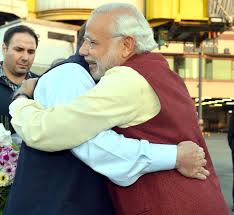
hug

India’s hug-then-repent penchant

Spanish-born US philosopher George Santayana famously said, “Those who cannot remember the past are condemned to repeat it”. India’s propensity to act in haste and repent at leisure has run deep in its personality-driven foreign policy since independence. Even on an issue that poses an existential threat to it — Pakistan-sponsored terrorism — India finds that history is repeating itself.

Despite the unending aggression flowing from Pakistan’s foundational loathing of India, New Delhi has failed to evolve a coherent, long-term policy toward that country. If anything, India’s Pakistan policy has zigzagged under virtually every prime minister. In stark contrast, Pakistan has maintained the same policy since its creation — to spotlight Kashmir and undermine Indian security in every way possible.

Since Narendra Modi’s unannounced Christmas Day visit to Pakistan, New Delhi is relearning one fundamental reality — no amount of Indian hugging of Pakistan’s civilian leadership can blunt the Pakistani military’s strategy to bleed India through a “war of a thousand cuts”.

Consistency in policy or goals has never been India’s forte, given its hug-then-repent penchant. Indeed, successive Indian leaders have assumed that other nations will do what India is adept at pulling off — change beliefs and policies overnight. India has also distinguished itself by reposing trust in foes and then crying “betrayal” when they deceive it, as happened in 1962 and 1999 (Kargil). Another reason India relives history is that virtually every prime minister has sought to reinvent the foreign-policy wheel rather than learn the essentials of statecraft or heed past national mistakes.

Other than the tool of dialogue, India has little direct leverage over Pakistan. The dialogue instrument thus must be employed judiciously to help improve Pakistan’s conduct. For Islamabad, by contrast, talks with India are essential not to help normalize political and economic relations but to aid its hardball tactics to spotlight the revisionist issue that still serves as the glue to prevent a dysfunctional Pakistan from unravelling — Kashmir. Talks also provide Pakistan the equivalence with India it craves.

But with each Indian prime minister ingenuously thinking that he can make peace with Pakistan, successive governments have played into Islamabad’s hands by blundering.

Jawaharlal Nehru internationalized the Kashmir issue by taking it to the United Nations and implicitly accepting Pakistan’s takeover of more than one-third of Jammu and Kashmir (J&K). Lal Bahadur Shastri at Tashkent magnanimously returned Haji Pir, now a key staging ground in Pakistan’s war by terror. Indira Gandhi’s folly at Simla in securing nothing concrete from a vanquished Pakistan helped lay the foundation for Pakistan’s strategy to inflict death by a thousand cuts.

The sphinx-like Atal Bihari Vajpayee took Nawaz Sharif by surprise by embracing him at Wagah and then signing the Lahore Declaration that singled out J&K by name as a bilateral issue awaiting resolution. Not surprisingly, Kashmir and terror dominated Vajpayee’s tenure.

Vajpayee never learned from his serial blunders, which is why he paid another Pakistan visit just months before voters swept him out of office. It was under him that an ignominious episode unparalleled in modern world history occurred, with the Indian foreign minister flying to known terrorist territory to hand-deliver three leading terrorists from Indian jails. Just the way the terrorists-for-Rubaiya Sayed swap a decade earlier helped fuel the Pakistan-scripted Kashmir insurrection, the Kandahar cave-in before hijackers led to a qualitative escalation in cross-border terrorism, including on national emblems of power.

And just as Vajpayee’s 1999 bus journey to Lahore produced the Kargil War and the hijacking of Indian Airlines Flight IC-814, Modi’s Christmas hug of Sharif in Lahore yielded a quick payback from Pakistan as New Year’s gift: twin terror attacks, outsourced to Jaish-e-Mohammad (JeM) — one on the Pathankot airbase (in what was the military equivalent of the 2008 Mumbai strikes on civilian targets) and the other on the Indian consulate in Mazar-i-Sharif, Afghanistan.

Indeed, JeM — an Inter-Services Intelligence (ISI) front organization — typifies why India relives history. India jailed Masood Azhar for taking Western hostages in J&K in 1994 and then forgot about him until the IC-814 hijackers demanded his release. Once Azhar and the other two terrorists were traded for the hostages, the ISI brought him to Pakistan, arranging a hero’s welcome and installing him as the JeM head.

It did not take Azhar’s sponsors long to thank Vajpayee for his release by sending JeM gunmen to kill India’s elected leadership. The 2001 Parliament attack led India to mobilize its armed forces for war and demand that Pakistan shut down its state-run terrorist complex or face punishment. However, after keeping its forces in war-ready mode for months, India backed down meekly without securing anything from Islamabad.

Now, JEM’s sponsors have thanked Modi for his Pakistan visit by carrying out the Pathankot and Mazar-i-Sharif strikes. What has been Modi’s response? To supply Islamabad, even before the airbase siege ended, evidence of the Pathankot attackers’ Pakistani footprints and to tamely put up with Sharif’s charade of “preventively detaining” JEM leaders. If anything, the ISI will use the evidence to ensure that its next attack leaves no similar telltale signs.

By providing evidence and by offering to welcome Pakistani investigators, India has played into Pakistan’s hands by buying the myth that terror groups like JEM are independent of the Pakistani state. Any Indian policymaker who thinks this approach will help contain Pakistani terrorism has probably been spending more time than he should have reading about Alice in Wonderland. Pakistan’s terror masters will focus any Pakistani investigation on identifying their latest attack’s operational deficiencies.

After each terror attack, it is déjà vu all over again, with Pakistan promising to assist Indian investigations, only to take India round and round the mulberry bush. It is past time for India to recognize that escapism as policy is an invitation to never-ending trouble. Moreover, maintaining a peace dialogue with a renegade neighbour only lends legitimacy to its roguish ways because that nation will use such talks as a cover to undermine India’s security.

Brahma Chellaney is a geostrategist and author.

© The Hindustan Times, 2016.

Upholding the Asian Order

Brahma Chellaney

A column internationally syndicated by Project Syndicate

China's President Xi Jinping meets with the guests at the Asian Infrastructure Investment Bank launch ceremony at the Great Hall of the People in Beijing

China’s ambition to reshape the Asian order is no secret. From the “one belt, one road” scheme to the Beijing-based Asian Infrastructure Investment Bank, major Chinese initiatives are gradually but steadily advancing China’s strategic objective of fashioning a Sino-centric Asia. As China’s neighbors well know, the country’s quest for regional dominance could be damaging – and even dangerous. Yet other regional powers have done little to develop a coordinated strategy to thwart China’s hegemonic plans.

To be sure, other powers have laid out important policies. Notably, the United States initiated its much-touted strategic “pivot” toward Asia in 2012, when India also unveiled its “Act East” policy. Similarly, Australia has shifted its focus toward the Indian Ocean, and Japan has adopted a western-facing foreign-policy approach.

But coordinated action – or even agreement on broadly shared policy objectives – has remained elusive. In fact, a key element of America’s Asian pivot, the 12-country Trans-Pacific Partnership trade deal, does not just exclude China; it also leaves out close US allies like India and South Korea.

That is not the only problem with the TPP. Once the lengthy process of ratifying the deal in national legislatures is complete and implementation begins, the impact will be gradual and modest. After all, six members already boast bilateral free-trade agreements with the US, meaning that the TPP’s main effect will be to create a free trade area (FTA) between Japan and the US, which together account for about 80% of the TPP countries’ combined GDP. The conclusion of the ASEAN-initiated Regional Comprehensive Economic Partnership – which includes China, India, South Korea, Japan, Australia, and New Zealand, but not the US – is likely to weaken the TPP’s impact further.

Compare this to the “one belt, one road” initiative, which aims to boost China’s financial leverage over other countries through trade and investment, while revising the maritime status quo, by establishing a Chinese presence in areas like the Indian Ocean. If President Xi Jinping achieves even half of what he has set out to do with this initiative, Asian geopolitics will be profoundly affected.

In this context, Asia’s future is highly uncertain. To ensure geopolitical stability, the interests of the region’s major players must be balanced. But with China eager to flex the political, financial, and military muscles that it has developed over the last few decades, negotiating such a balance will be no easy feat.

As it stands, no single power – not even the US – can offset China’s power and influence on its own. To secure a stable balance of power, likeminded countries must stand together in backing a rules-based regional order, thereby compelling China to embrace international norms, including dispute settlement through peaceful negotiation, rather than military intimidation or outright force. Without such cooperation, China’s ambitions would be constrained only by domestic factors, such as a faltering economy, rising social discontent, a worsening environmental crisis, or vicious politics.

Which countries should take the lead in constraining China’s revisionist ambitions? With the US distracted by other strategic challenges – not to mention its domestic presidential campaign – Asia’s other powers – in particular, an economically surging India and a more politically assertive Japan – are the best candidates for the job.

Both India and Japan are longstanding stakeholders in the US-led global order, emphasizing in their own international relations the values that America espouses, such as the need to maintain a stable balance of power, respect the territorial and maritime status quo, and preserve freedom of navigation. Moreover, they have demonstrated their shared desire to uphold the existing Asian order.

In 2014, while visiting Japanese Prime Minister Shinzo Abe in Tokyo, his Indian counterpart, Narendra Modi, took a veiled swipe at Chinese expansionism, criticizing the “eighteenth-century expansionist mindset” that was becoming apparent “everywhere around us.” Citing encroachment on other countries’ lands, intrusion into their waters, and even the capture of territory, Modi left little doubt about the target of his complaint.

Last month, Abe and Modi took a small step in the direction of cooperation. By jointly appealing to all countries to “avoid unilateral actions” in the South China Sea, they implicitly criticized China’s construction of artificial islands there, which they rightly regard as a blatant attempt to secure leverage in territorial disputes – and gain control over sea lanes of “critical importance” for the Indo-Pacific region.

Clearly, both Japan and India are well aware that China’s ambitions, if realized, would result in a regional order inimical to their interests. Yet, while they are committed to maintaining the status quo, they have failed to coordinate their policies and investments in Myanmar and Sri Lanka, both strategically located countries vulnerable to Chinese pressure. This must change.

Asia’s main powers – beginning with Japan and India, but also including the US – must work together to secure a broadly beneficial and stable regional balance of power. To this end, naval maneuvers, such as the annual US-India-Japan “Exercise Malabar,” are useful, as they strengthen military cooperation and reinforce maritime stability.

But no strategy will be complete without a major economic component. Asia’s powers should move beyond FTAs to initiate joint geo-economic projects that serve the core interests of smaller countries, which would then not have to rely on Chinese investments and initiatives to boost growth. As a result, more countries would be able to contribute to the effort to secure an inclusive, stable, rules-based order in which all countries, including China, can thrive.

© Project Syndicate, 2016.

Pathankot terror attack: 26/11 again, in different mode

opedweb-kerD--621x414@LiveMint

Brahma Chellaney, Mint

Make no mistake: The four-day terrorist siege of the Pathankot air base was the equivalent of the 26 November 2008 Mumbai terror strikes. In both cases, the Pakistani terrorists were professionally trained, heavily armed, and dispatched by their masters for a specific suicide mission. The main difference is that in Mumbai, the terrorist proxies struck civilian sites, while, in the latest case, their assigned target was a large military facility.

After the widespread anger and indignation triggered by the recent Paris and San Bernardino attacks, a Mumbai-style strike on civilian targets was not a credible option for the Pakistani military, especially because such an attack would risk Indian retaliation. So, it chose a military target in India, orchestrating the attack through a terror group it founded in 2000 by installing as its head one of the terrorists the Atal Bihari Vajpayee government unwisely released to end the hijacking of Indian Airlines Flight 814.

That a pivotal Indian air base against Pakistan came under an extended siege represented a bigger hit for the terror sponsors than the earlier coordinated attacks on soft targets in Mumbai. And this hit occurred without the international spotlight and outrage that the Mumbai strikes drew.

It was not an accident that the Pathankot attack coincided with a 25-hour gun and bomb siege of the Indian consulate in Mazar-i-Sharif, Afghanistan. The twin attacks, outsourced to Jaish-e-Muhammad, were designed as a New Year’s gift to India.

How did India come out from the crisis? Put simply, not looking good.

Leadership is the key to any country effectively combating the scourge of terrorism. India, however, has faced a protracted crisis of leadership for more than a generation since 1989. In this period, Pakistan has gone from inciting a Jammu and Kashmir insurrection, which ethnically cleansed the Kashmir Valley of its 300,000 Pandit residents, to scripting terror attacks across India.

Narendra Modi’s election win reflected the desire of Indians for a dynamic leader to end political drift. Yet, since Modi’s victory, cross-border terrorists have repeatedly tested India’s resolve — from Herat to Pathankot via Gurdaspur and Udhampur. And each time India flunked the test, as it has done since the Vajpayee era.

The Pathankot strike, above all, constituted an act of war, presenting Modi with his first serious national security challenge. Modi’s leadership, however, was found wanting in nearly every aspect — from leading from the front to reassuring the Indian public.

For almost the first two days of the siege, Modi chose to be away in Karnataka. And the only statement he made during the entire siege seemed to signify euphemism as escapism. Just as he called the Paris strikes an “attack on humanity,” he said the Pathankot terror siege was by “enemies of humanity” (he could not bring himself to even say “enemies of India”). Not a single meeting of the Cabinet Committee on Security was held during the crisis.

Operationally, the action to kill the terrorists in the air base stands out as a textbook example of how not to conduct such a mission. Despite New Delhi receiving advance intelligence of the attack, the terrorists not only gained entry to the base but the operation to flush them out was also poorly conceived and executed, without a unified operational command.

War needs good public relations. But the Modi government doesn’t appear to even have a peacetime communication strategy. During the Pathankot siege, officials gave confusing and conflicting accounts.

The crisis, if anything, highlighted the government’s strategic naïveté. While the gunbattles were still raging inside the base, the government supplied Islamabad communication intercepts and other evidence linking the attackers with their handlers in Pakistan. This was done in the fond hope that the terror masters will go after their terror proxies, despite India’s bitter experience in the Mumbai case where it presented dossiers of evidence to Pakistan.

More laughable was New Delhi’s disclosure on the siege’s final day that, in a telephone call from Nawaz Sharif, Modi asked Pakistan’s toothless prime minister for “firm and immediate action” on the “specific and actionable information” provided by India and that Sharif promised “prompt and decisive action against the terrorists.”

Decisive power in Pakistan rests with the military generals, with the army and Inter-Services Intelligence immune to civilian oversight. India is in no position to change Pakistan’s power dynamics. Yet the critical issues that India wants to discuss with Pakistan — terrorism, infiltration, border peace and nuclear security — are matters over which the Pakistani military has the final say.

So, how can Modi hope to buy peace with a powerless Pakistani government that has ceded its authority in foreign policy and national security to the military?

If Pakistan wants a détente with status-quoist India, it can easily get it. Its military, however, cannot afford peace with India. It employs terrorist surrogates as a highly cost-effective force multiplier to undermine India’s rise and regional clout, which explains why Indian diplomatic missions in Afghanistan have repeatedly been attacked and why Bangladesh and Nepal have become new gateways to India for Pakistan’s proxies.

Yet India, as if expecting the Pakistani security establishment to turn over a new leaf, supplied almost real-time evidence in the Pathankot case.

Modi’s Christmas gift to Pakistan in the form of a surprise Lahore stopover yielded, in return, a New Year’s terror surprise for India. Rather than heed the mistakes of his immediate two predecessors — who learned the hard way how peace overtures to Pakistan, by signalling weakness, invited cross-border aggression — Modi chose to commit the same folly, reposing his faith in Sharif who backstabbed Vajpayee.

Of the 35 countries visited by Modi in his first 19 months in office, no nation has provided a payback to India as quickly as Pakistan. In fact, in modern history, no head of government before Modi visited an enemy country without any preparatory work and with nothing to show in results. Grabbing international spotlight through a brief surprise visit just to have tea does not befit the leader of an aspiring power.

Sadly, Modi is showing that showmanship is to his foreign policy what statecraft is to the diplomacy of great powers.

The recent terror attack in San Bernardino, although not an act of international terrorism, has shaken up American politics. By contrast, multiple cross-border terror attacks have failed to galvanize India into devising a credible counterterrorism strategy. With the ISI using narcotics traffickers to send opiates and terrorists into India’s Punjab, the Pathankot killers — like the Gurdaspur attackers — came dressed in Indian army uniforms through a drug-trafficking route. The influx of narcotics is destroying Punjab’s public health.

When the next major terror strike occurs, India will go through the same cycle again, including a silly debate on whether to talk to Pakistan or not. As Army chief General Dalbir Singh emphasized, “India needs to change its security policy towards Pakistan. Every time Pakistan bleeds us … we just talk about it for a few days and after that it is business as usual.”

Indeed, New Delhi, forgetting Mumbai, wants Pakistan to act in the Pathankot case. And when the next major cross-border attack occurs, Pathankot will be forgotten. With New Delhi focused on the last terror strike, Pakistan has still to deliver even in the 1993 case internationally known as the Bombay bombings — the bloodiest terrorist attack in India.

While the Pakistani military has made the country’s government impotent by appropriating key powers, the Indian government, through inaction, is rendering its powerful military impotent to defeat terrorism. This was apparent even in the Pathankot siege, with precious time lost due to the government’s bungled decision to airlift National Security Guard commandos to the scene rather than immediately press readily available army commandos into action.

India’s biggest threat is from asymmetric warfare, waged across porous borders or gaps in Indian frontier defences. This asymmetric warfare takes different forms — from Pakistan’s proxy war by terror and China’s furtive, salami-style encroachments into the Himalayan borderlands, to Nepal serving as a conduit for India’s foes to funnel militants, arms, explosives and fake currency to India.

Yet India, far from focusing on neutralizing the asymmetric warfare, has sought to prepare for a full-fledged conventional war through improvident arms imports. Modi alone has sunk billions of dollars in such mega-deals. The more weapon systems India imports, the more insecure it feels.

There are several things India can do against the terror sponsors short of war. But first, it must have political will and clear strategic objectives. Today, unfortunately, there is no long-term strategic vision or even a Pakistan policy. Under Modi, India has already made at least six U-turns on Pakistan. For example, its October stance that “talks and terror cannot go together” lasted barely 10 weeks. Almost every season in New Delhi brings a new Pakistan policy.

An unconventional war must be countered with an unconventional war. Nuclear weapons have no deterrence value in an unconventional war. Nor can they guarantee Pakistan’s survival. The Soviet Union unravelled despite having the world’s most formidable nuclear arsenal in mega-tonnage. Why should India allow itself to be continually gored when it is seven times bigger demographically than Pakistan, almost 12 times larger in GDP terms, and militarily more powerful?

Let us be clear: No nation gets peace merely by seeking peace. To secure peace, India must be able to impose deterrent costs when peace is violated in order to tell the other side that the benefits of peaceful cooperation outweigh hostilities.

India, unfortunately, has shied away from imposing costs, although the right to retaliate is a right enshrined in international law. Defending one’s interests against a terrorism onslaught, in fact, is a constitutional and moral obligation for any self-respecting country. The right of self-defence is embedded as an “inherent right” in the United Nations Charter. India did not impose costs on the terror masters in Pakistan even for the bloody Mumbai attacks. Will it allow them to go scot-free again?

Brahma Chellaney is professor of strategic studies at the New Delhi-based Centre for Policy Research.

© Mint, 2016.

Nepal’s democracy on the brink

The crisis of democracy in communist-led Nepal raises a fundamental question: Can a democratic transition succeed where communists dominate?

Brahma Chellaney, Nikkei Asian Review

download2

Nepalese Prime Minister Oli, dubbed “Oily Oli” by his critics

Landlocked Nepal has lurched from one crisis to the next for a quarter-century. Now the country is on the edge of toppling into dysfunction. The turmoil also carries major implications for India, with which Kathmandu has traditionally maintained an open border. 

Nepal has been in a state of severe political flux since 1990, when it embarked on a democratic transition. But recent developments in the country — which lies between India and the Chinese region of Tibet — are a reminder that democracy means more than just holding elections. In Nepal, an absence of sound institutions has been compounded by constitution-making without political consensus or proper attention to the interests of minority groups.

This constitutional mess is at the root of violent protests and political upheaval that are accelerating spiraling prices for essential items in the impoverished Himalayan country. In the latest crisis ethnic groups have been polarized by a new constitution and a blockade of the border with India is preventing imports of essential goods, including fuel and medicines. The political and economic turmoil comes on top of last April’s devastating 7.9 magnitude earthquake and its aftershocks — the country’s worst natural disaster in more than eight decades.

Nepal adopted a new constitution in September, a whole generation after its democratic transition began with the introduction of a multiparty democracy within the framework of a constitutional monarchy in 1990. That experiment opened the door to a bloody Maoist insurrection that ended only when a peace accord in 2006 paved the way for the insurgent leaders to come to power.

The current constitution emerged from a tortuous eight-year constitutional drafting process that involved two elected constituent assemblies. The first abolished the monarchy in 2008, but became gridlocked by political infighting and missed a mid-2012 deadline set by the country’s Supreme Court. The second assembly, elected in 2013, drafted the constitution and, when it came into effect, was transformed into a legislative parliament.

A constitution must represent all the country’s citizens — the U.S. constitution, for example, begins with the words “We the people.” But multiethnic Nepal’s latest constitution reflects the will of the hill elites that have long dominated its power structures, discriminating against the people who inhabit the country’s southern plains along the 1,872km border with India — an area known as the Terai. Further complicating the issue, the Madhesi ethnic group that dominates the plains has historical, cultural and family links with India.

The constitution creates a federal republic divided into seven new states, merging parts of the ancestral homelands of the Madhesis with those of the hill states. The gerrymandered boundaries leave the plains people politically weaker, while giving the hill people greater political representation than their population size merits.

Disaffected minorities

Minority groups contend that the constitution also undercuts federalism by granting little provincial and local autonomy, and diluting affirmative action. No democracy can be stable and safe if it does not protect minorities. In Nepal, the disaffected minorities are large, making up nearly a third of the population.

For any country, the implementation of a new constitution signifies a promising new beginning. But Nepal’s constitution has provoked a virtually open revolt by the plains people. Since the constitution’s adoption, two damaging divides have emerged: one between Kathmandu and the Terai, and another between Kathmandu and New Delhi, which has called for a more inclusive constitution.

To end its prolonged political instability and arrest its deteriorating internal security, Nepal needed a unifying figure. Alas, what it got in a political upheaval in October was the appointment as prime minister of Khadga Prasad Oli, leader of the Communist Party of Nepal (Unified Marxist-Leninist) — a divisive figure who spent years in jail in the 1970s and 1980s for waging war against the state.

Oli’s maneuvers have deepened Nepal’s ethnic and political fault lines. Dubbed “Oily Oli” by his critics, he has publicly mocked protesters and their demands, fueling civil strife. He has also stoked tensions with India, feeding deep-seated suspicions about India’s intentions that often surface when internal problems intensify. Mistrust of India flows in part from the tensions generated by the disparity in the power and size of the two countries, and in part from overlapping ethnic and linguistic identities.

Oli’s communist-dominated government has blamed India for Nepal’s crippling fuel shortages and political crisis. Seeking to deflect attention from its own role in triggering the crisis, it has accused India of imposing an “unofficial blockade” on the cross-border movement of oil and other supplies to Nepal. In reality, the disruption in supplies has been caused by mass protests against the constitution by the Madhesi and other minority groups.

Police have shot and killed dozens of protesters blockading highways or staging other confrontations. But they have failed to evict protesters from the key border junction at Birgunj that accounts for 70% of the volume of trade with India. The protesting groups say they will not lift the blockade unless the constitution is amended to safeguard their interests.

download1

Nepalese foreign minister meets his Chinese counterpart on Christmas

Meanwhile, the Oli government has tried to play the China card against India, trumpeting a commercial agreement with Beijing and a Chinese gift of 1,000 tons of fuel. The gift was enough to meet barely two days’ requirements. More importantly, it demonstrated that Nepal’s dependence on India for essential supplies is a matter of geography. China could replace India as Nepal’s main supplier only if the Himalayas were shifted.

Passport free

India is increasingly concerned that Nepal’s turmoil could spill over into its northern plains. Moreover, some 6 million Nepalese work and live in India. Before Nepal’s latest crisis flared, New Delhi repeatedly told Kathmandu that China and Pakistan were taking advantage of the open Indo-Nepalese border — which remains a passport-free crossing, despite the blockade — to engage in activities detrimental to India’s security. Nepal has also become a transit point for the flow of counterfeit currency and narcotics into India.

India has stepped up diplomatic efforts to broker a political settlement in Nepal, despite past experience of being blamed for interference in the internal affairs of its smaller neighbor. India recently hosted Nepalese Foreign Minister Kamal Thapa, who brought a proposal to introduce two constitutional amendments. Talks were then held in New Delhi with the Terai protest leaders, who said the two suggested amendments did not go far enough to address their main concerns. India is urging both sides to show “maturity and flexibility to find a satisfactory solution to the constitutional issues.”

Britain recently joined India in calling for “a lasting and inclusive constitutional settlement in Nepal,” reflecting fears that the current crisis could provide an opening for China to extend its influence in Nepal, while the Terai movement could become radicalized and secessionist. India and other outside powers want to see a stable, united Nepal focusing on economic growth.

Water-rich Nepal has the potential to become a prosperous state. The country boasts one of Asia’s highest levels of water resources per inhabitant, with up to 83,000 megawatts of potential hydropower reserves. If it harnessed the natural bounty of the Himalayas to produce renewable electricity for export, Nepal could turn water into “clear gold,” generating hydro dollars to fuel development.

Today, Nepal produces less than 800MW of electricity from all energy sources for its 30 million citizens. Extended power outages are common, even in Kathmandu, and Nepal imports electricity from India even though it controls the upper waters of several rivers suitable for hydroelectric power generation that flow south across the border.

Such has been the rapidity of political change in Nepal that democracy has yet to take root. The democratic transition, far from being the curative that the Nepalese had hoped for, has engendered unending disorder, puncturing Nepal’s reputation as a Shangri-La. The crisis of democracy in a country where the two main communist parties and smaller Marxist groups can between them secure the largest share of the popular vote raises a fundamental question: Can a democratic transition succeed where communists dominate?

If Nepal remains battered by political upheaval, it clearly risks becoming a failed state — a development that will have major trans-Himalayan implications. Before it is too late, a tottering Nepal must accommodate its minorities so that its constitution produces peace, not violence that derails democracy.

Brahma Chellaney is a geostrategist and author. He is currently professor of strategic studies at the Center for Policy Research in New Delhi; a fellow of the Robert Bosch Academy in Berlin; and an affiliate with the International Centre for the Study of Radicalization at King’s College London. 

© Nikkei Asian Review, 2015.

India’s Nepal problem

Brahma Chellaney, Mint

196611

Nepal is not just another neighbour of India but one that is symbiotically linked to it by close cultural affinity, overlapping ethnic and linguistic identities, and an open border permitting passage without documentation or even registration — an unusual arrangement. The Indo-Nepal relationship is deeper than between any two European Union states. Indeed, ever since the 1951 Chinese annexation of Tibet eliminated the outer buffer between India and China, Nepal has served as the main inner buffer. Political turmoil in Nepal directly impinges on Indian security.

Nepal’s current political and constitutional crisis, which has engendered violent protests and serious shortages of fuel and other essential goods, is just the latest chapter in a flawed democratic experiment since 1990. The experiment has yielded mostly political upheavals — from opening the door to a decade-long Maoist insurgency and facilitating the ouster of the country’s monarchy to the deepening of the country’s ethnic fault lines and the empowerment of communists. By fostering unending turmoil, the sputtering democratic transition has made Nepal a playground for powers hostile to India.

Still, Nepali nationalism usually takes the form of India baiting. India is again at the center of a blame game by Nepalese nationalists, many of them communists, including ex-guerrillas like Prime Minister Khadga Prasad Oli. Ultra-nationalism and communism tend to be two sides of the same coin, as is also apparent in several ex-communist countries and China.

Nepal’s latest crisis is linked to a new Constitution that was rammed through with controversial provisions that leave the Terai plains people politically vulnerable. Oli’s communist-dominated government, appointed in October after the Constitution took effect, has only fuelled the crisis with a hardline policy stance. Yet Oli has made India the scapegoat, accusing it of unofficially blockading essential supplies to landlocked Nepal — an accusation lapped up by Prime Minister Narendra Modi’s Indian critics. However, anyone visiting the Birgunj-Raxual border point, through which much of the bilateral trade flows, can see that the blockade is by the ethnic-Madhesi protest groups.

With India mediating between the two sides, Oli has now grudgingly offered to accommodate some of the Terai people’s demands, including through two constitutional amendments. But Madhesi leaders, accusing Oli of being wedded to a divisive agenda, have rejected his offer as inadequate. If the crisis drags on, a failed Constitution will compound Nepal’s political disarray.

The serious challenge posed by a quasi-failed Nepal to India is unlikely to go away, especially given the long open frontier. New Delhi has yet to frame a credible, long-term strategy to deal with a problem that includes Nepal serving as a gateway for China and Pakistan to undermine Indian security. Nepal has also become a conduit for the flow of illicit arms, narcotics and counterfeit currency to India. Kathmandu, instead of cracking down on such activity with Indian assistance, has objected to India increasing the deployment of the Sashastra Seema Bal, a police force that patrols the Nepal and Bhutan borders.

To be sure, India’s missteps and neglect have exacerbated its Nepal problem. For example, it encouraged — in an intimidation-filled environment in Nepal and by ceding strategic space to outside powers and the United Nations — the 2008 election process, which brought the Maoists to power. Having sowed the wind in Nepal, India reaped the Maoist whirlwind in the red corridor from Pashupati to Tirupati.

Despite Nepal’s critical importance to India, Modi’s August 2014 visit was the first by an Indian prime minister to that country in 17 years. It came after China had strategically penetrated Nepal.

To his credit, Modi has sought to diplomatically recoup India’s losses over the years in its strategic backyard. Modi indeed visited Nepal a second time in 2014 to participate in the SAARC summit. The two visits created a groundswell of Nepalese goodwill for India. But as soon as political machinations in Nepal over constitution making triggered a new crisis, the powerful communist parties reignited the entrenched Nepalese suspicion about India’s agenda.

Today, with an India-unfriendly government in Kathmandu, New Delhi must vie with China for influence in a country that was its security preserve for more than half a century. Aided by Nepalese communists, Beijing wields increasing influence in Nepal, which Mao Zedong once described as one of the fingers of the Tibetan palm — the others being Bhutan, Sikkim, Kashmir and Arunachal Pradesh. It is not an accident that having tightened its grip over the palm (Tibet), China is exerting pressure on India through each of the “fingers”.

Nepal’s porous 1,751-km border with India, meanwhile, remains a boon for Pakistani and Chinese intelligence. India has been slow to institute a stricter border regime to choke illicit activities and halt entry of arms, explosives, opiates, fake currency and subversive elements.

Nations respect, and hold in awe, a neighbour that has power, strength and determination. A weak-kneed big neighbour, by contrast, comes in handy to a smaller state for pinning blame on for anything, real or imagined. Nepal, although adrift, has the gumption to bait India and publicly ask it to stop acting like a “big brother”, while paying obeisance to China. It has awarded China a $1.6 billion large dam project — the single biggest foreign investment in Nepal — while failing to revive long-stalled joint energy projects with India. If India cannot manage a state closely tied to it like Nepal, how can it effectively deal with adversarial China and Pakistan?

© Mint, 2015.

Built on hype, deflated by reality

Brahma Chellaney, The Hindu, July 14, 2015

imagesUnveiled with great fanfare on July 18, 2005, the Indo-U.S. nuclear deal was touted as a major transformative initiative. But on its 10th anniversary, the deal’s much-advertised energy, technological and strategic benefits for India still seem elusive. Indeed, the deal has yet to be commercialized. The premise on which it was founded — that India could build energy “security” by importing high-priced, foreign fuel-dependent reactors — was, in any case, a pipe dream.

The deal, given the heavy political investment in it, will eventually be operationalized, however belatedly. It will take a minimum of 10 years thereafter for the first nuclear power reactor under the deal to come on line. After all, the international plant-construction time frame, with licensing approval, now averages at least a decade, with the vast majority of reactors currently under construction in the world plagued by serious delays and cost overruns.

For example, the Areva-designed plant in Finland, on Olkiluoto Island, is running at least nine years behind schedule, with its cost projected to rise from €3.2 billion to €8.5 billion. The Russian-origin plant at Kudankulam, in Tamil Nadu, took 13 years to be completed, with the second of its two reactors yet to be commissioned. In this light, the deal is expected to deliver its first commissioned reactor a generation after being signed.

But if reactor imports are to be governed by “technical and commercial viability,” as Prime Minister Narendra Modi has declared, not a single contract would be feasible. The stalled negotiations with Areva over the price of power suggest that the deal’s commercialization would be dictated neither by technical nor commercial viability but by the extent to which India is willing to fork out subsidies to support high-priced imported reactors of a kind that do not even mesh with its three-phase nuclear power programme.

Indeed, it is a moot question whether the deal will ever yield substantive energy benefits, given the exorbitant price of foreign-origin reactors, the concomitant need to heavily subsidize electricity generated by such plants, and the grassroots safety concerns over the Fukushima-type multi-plant nuclear parks that India has earmarked for Westinghouse, GE-Hitachi and Areva, each of which is to sell prototype Light Water Reactor (LWR) models presently not in operation anywhere in the world. The accident-stricken Fukushima reactors, in Japan, were also the first of their kind.

Adding to India’s risks from proposed import of prototype models is its plan to induct a multiplicity of different LWR technologies from the U.S., France and Russia. Given the several different reactor technologies already in operation or under development in India, such imports will likely exacerbate the country’s maintenance and safety challenges.

The Indo-U.S. deal — with its many twists and turns — has hogged the limelight at virtually every bilateral summit. The deal took centre-stage even during U.S. President Barack Obama’s January visit. In its arduous journey toward implementation, the deal has spawned multiple subsidiary agreements. Each auxiliary deal has been hailed by an overzealous New Delhi as an important breakthrough and a diplomatic success, regardless of the concessions it had to make or the new obligations thrust upon it. Indeed, it has employed smoke and mirrors to camouflage its concessions.

Consider the latest “breakthrough” announced during Obama’s visit: India agreed to reinterpret its own law so as to effectively transfer reactor vendors’ nuclear-accident liability to Indian taxpayers. India is also reinterpreting a provision of domestic law in order to bar victims of a nuclear accident in India from suing for damages in America.

Does this yielding indicate that India has learned anything from its bitter experience over the 1984 gas leak from an American-owned Bhopal chemical plant that killed about as many people as the Fukushima disaster? Indeed, Japan’s law, which indemnifies reactor suppliers and makes plant operators exclusively and fully liable, should serve as a sobering lesson for India: GE built or designed the three Fukushima reactors that suffered core meltdowns; yet, despite a fundamental design deficiency in the reactors, the U.S. firm escaped penalties or legal action after the disaster.

Supplier liability is a well-established legal concept, applied in many business sectors around the world to deter suppliers from taking undue risks. In fact, U.S. law allows suppliers, designers and builders of nuclear plants to be held legally liable in the event of accidents, although the 1957 Price-Anderson Act channels economic liability, but not legal liability, to plant operators. Internationally, however, America has pushed an opposite norm — that importing countries channel all liability to their plant operators and limit all claims to the jurisdiction of their own courts so as to free suppliers of any downside risks.

The nuclear power dream has faded globally. The crash of oil and gas prices, coupled with skyrocketing reactor-construction costs, has made nuclear power’s economics more unfavourable than ever. Few new reactors are under construction in the West, with the troubled nuclear power industry desperate for exports. Even as the global role of nuclear power appears set to become marginal, India stands out today as the sole country wedded to major reactor-import plans.

Surprisingly, Modi has placed the nuclear deal, like his predecessor, at the hub of the relationship with America. Washington has long pandered to the Indian weakness for the deal’s consummation, with its decade-long negotiations characterized by shifting goalposts.

It made the Modi government yield some ground even on its demand that India accept nuclear-material tracking and accounting arrangements that go beyond the safeguards system that the International Atomic Energy Agency has approved and applied to India’s civilian nuclear programme. In other words, establishing an elaborate bilateral safeguards system, on top of IAEA inspections, in which India will separately track and account for nuclear materials “by flag” (that is, by each national origin).

For its part, the U.S. has reneged on several of its 2005 commitments. Gone is the pretence of Washington extending India “full” nuclear cooperation or granting it “the same benefits and advantages as other leading countries with advanced nuclear technology, such as the U.S.” Gone also is the original agreement that India would “assume the same responsibilities and practices” as America. Instead of meeting its commitment to adjust domestic laws and guidelines of U.S.-led multilateral regimes to “enable full civil nuclear energy cooperation and trade with India,” the U.S. actually worked with its Congress and with the Nuclear Suppliers Group (NSG) to bar exports of what India really needs — civilian enrichment and reprocessing equipment and technology, even though such transfers would be under international safeguards.

Consider another issue: Years after the U.S. pledged to bring India into the four American-led technology-control cartels — the NSG, Missile Technology Control Regime, Australia Group, and Wassenaar Arrangement — India is still pleading for its admission, with Obama in New Delhi merely reiterating America’s support for India’s “phased entry” into these groups. In anticipation of membership, India had largely harmonized its export controls with the four cartels’ guidelines. It is now filing a formal application for admission to each regime, in the hope that the U.S. would be more forthcoming in its support than it has been so far.

Even in the event of India being admitted to the regimes, the technology controls it still faces will not go away. These regimes are designed to harmonize export policies, not to promote technology trade among member-states. Despite the vaunted U.S.-India Defence Technology and Trade Initiative, the U.S. side refused early this year to accept any of the six joint high-technology projects proposed by India, insisting that New Delhi first sign “foundational agreements” on military logistics and communication interoperability that America has designed for its allies in a patron-client framework. The four joint projects announced during the Obama visit were for relatively modest defence products.

The key fact is that U.S. non-proliferation policy has yet to treat India on a par with another nuclear-armed country outside the Nuclear Non-Proliferation Treaty fold, Israel.

Against this background, why an import deal to generate an increasingly expensive source of energy is critical to Indian interests has never been elaborated by deal pushers in India. They have peddled only beguiling slogans, such as “End of nuclear apartheid against India” and “A place for India at the international high table.” India would be foolhardy to saddle its taxpayers with uneconomical reactor imports, making the Enron dud look small. India’s diplomatic overinvestment in the deal has already made it harder for it to address more fundamental issues with the U.S., including an increasingly one-sided defence relationship.

It is past time for India to reduce the salience of the deal in its relations with America. Without being weighed down by the nuclear-deal millstone, India would be better placed to forge a closer, more balanced partnership with Washington. The warming U.S.-India relationship has gained momentum independent of the deal’s future.

Brahma Chellaney, professor of strategic studies at the Centre for Policy Research, is the author, among others, of “Nuclear Proliferation: The U.S.-India Conflict.”

© The Hindu, 2015.

Beijing’s bendable principles

China claims neighbors’ territories by inventing the ingenious principle “what is ours is ours and what is yours is negotiable.”

Brahma Chellaney, The Hindustan Times, June 13, 2015

c307762e-1da4-453b-85aa-8be9c65c59e4wallpaper1Narendra Modi became the first Indian prime minister to publicly identify China on Chinese soil as an obstacle to closer bilateral ties by asking Beijing to “reconsider its approach” on some key issues. In a similar vein, his national security advisor, Ajit Doval, has classified China’s border stance as a “complete contravention of accepted principles,” pointing out that the Chinese agreed to the McMahon Line in “settling the border with Myanmar” but say “the same line is not acceptable in the case of India, particularly in Tawang.”

Don’t be surprised by this illogicality: In none of its disputes with neighboring countries has China staked a territorial claim on the basis of international law or norms. Rather, its claims flow from its revanchist view of the past — a shifting standpoint that reinterprets history to legitimize claims to territories long held by other countries. Because China does not apply the rule of law at home, it does not recognize its value in international relations.

For China, principles have always been bendable. And when it cannot bend a principle, it creates a new one.

Take its territorial disputes with India: Content with its Switzerland-size land grab (Aksai Chin) in India’s western sector, China pursues expansive claims in the eastern sector that highlight its ingenious principle to covet neighbors’ territories — “what is ours is ours and what is yours is negotiable.”

Having just articulated regional-hegemony aspirations in its defense white paper, China — an outside power — wants to carve out a major role for itself in the Indian Ocean. It has invited India to collaborate with it on deep seabed mining there and join its Maritime Silk Road. Yet it opposes any Indian involvement in the South China Sea. “My sea is my sea but your ocean is our ocean” seems to be a new Chinese saying.

Since 2006, Beijing has claimed the Austria-size Arunachal Pradesh, in northeastern India, as “South Tibet.” To draw attention to the state’s purported Tibetan identity, it has cooked up Tibetan names for subdivisions of Arunachal Pradesh (which includes the Tawang Valley, the gateway to the Dalai Lama’s 1959 escape from his homeland). In border negotiations in recent years, it has pressed India to cede at least Tawang.

China originally fashioned its claim to resource-rich Arunachal Pradesh — a territory almost three times larger than Taiwan — as a bargaining chip to compel India to recognize its occupation of the Aksai Chin plateau. For this reason, China withdrew from the Arunachal areas it had invaded in the 1962 war but retained its territorial gains in Aksai Chin, which provides the only passageway between its rebellious regions — Tibet and Xinjiang. But now, by ratcheting up the Arunachal issue with India, China is signaling that Arunachal (or at least Tawang) is the new Taiwan that must be “reunified” with the Chinese state.

The Dalai Lama, however, has said publicly that Arunachal Pradesh, including Tawang, was traditionally not part of Tibet. Tawang indeed is a Monpa tribal area, and was separated from Tibet by a well-recognized customary line. The Monpas, like several other Himalayan communities, practice Tibetan Buddhism. They belong to the Gelukpa (“Yellow Hats”) sect.

Significantly, China made its specific claim to Tawang not before it waged war against India in 1962 but decades later as part of a maximalist boundary-related stance extending to several other neighbors. For example, China has not only escalated its challenge to Japan’s century-old control of the Senkaku Islands, but is also facing off against the Philippines since sneakily seizing the Scarborough Shoal in 2012.

The India-China border negotiations have dragged on for 34 years — a world record. With no headway on reaching a frontier settlement, Modi in Beijing rightly emphasized the imperative to resume the process — derailed by China 13 years ago — to clarify the line of actual control (LAC). If the LAC remains ill-defined, can confidence-building measures be effective? To facilitate its cross-border military forays, China, however, still opposes clarification, even though the clarification can be done, as Modi pointed out, “without prejudice” to either side’s “position on the boundary question.” In 2002, after more than two decades of negotiations, China reneged on a promise to exchange maps with India covering the two main disputed sectors — Aksai Chin, along with its adjacent areas, and Arunachal Pradesh — located at either end of the Himalayas.

Doval has done well to highlight China’s hypocrisy in accepting the watershed principle — and thus the McMahon Line — with Myanmar but not with India.

Watershed (also called “river basin,” “drainage basin,” and “catchment”) is the total land area that drains surface water into a watercourse like a river, lake, pond, or aquifer. A watershed, easily identifiable on topographic maps, is delineated by a ridge or drainage divide marking the runoff boundary. Below a ridge line, all water will naturally flow downhill. A watershed boundary is identified on a topographic map by first locating the lowest point, or watershed outlet, and then establishing the highest runoff point.

The colonial-era McMahon Line was drawn on the watershed principle — a well-established international norm for boundary demarcation. Many countries have settled their boundaries on the watershed principle.

In its October 1, 1960, boundary pact with Myanmar, China settled by acquiescing in the McMahon Line, which delineated the customary border on the basis of the watershed principle. Any deviation from the McMahon Line in the accord was minor and largely necessitated by the task of producing maps of the entire 2,200-km border at 1:50,000 scale, in contrast to the thickly-marked McMahon Line.

Make no mistake: While China settled with Myanmar with a few relatively minor rectifications, it is not seeking slight adjustments with India in the eastern sector. Rather, it covets major chunks of real estate — its largest territorial claims against any nation. Myanmar, of course, poses no threat to China. But the 1960 settlement was also driven by Chinese foreign-policy compulsions, underscored by an insurrection in Tibet since 1959 and border tensions and skirmishes with India.

In deference to Beijing, the pact did not mention the McMahon Line but referred to it euphemistically as the “traditional customary line.” According to the Australian academic Brendan Whyte, “While the McMahon Line was followed here, it was used not because it was the McMahon Line, but because it happened to be a sensible boundary.” More importantly, if China openly acknowledged a line agreed to by the Tibet and British Indian governments, it would be admitting that Tibet was independent then — a historical reality Beijing remains loath to accept.

In fact, just six months after Chinese Premier Zhou Enlai told Prime Minister Jawaharlal Nehru that China would never accept the McMahon Line, Beijing bestowed implicit respectability on that line by signing the Myanmar pact. The accord came in record time — in just nine months after a joint committee was set up to define the border and frame a treaty. The pact settled the boundary in alignment with the watershed between the Irrawaddy and Salween rivers and the “traditional customary line” (the McMahon Line).

For China, the boundary question with India is not just a territorial issue but, more fundamentally, a means to keep its peer rival under pressure and on the defensive constantly. Modi’s visit, unlike President Xi Jinping’s India trip, passed without any reported frontier intrusion, yet the danger remains — given China’s risk-taking muscularity — that a border faceoff could plunge the relationship into renewed antagonisms.

India should do what it can to prevent the frontier disputes and tensions from escalating, while factoring in the likelihood that China will not settle the border with it unless the Chinese communist system or economy crashes. But just as China plays all its cards against India and rears even new ones, India must shed its reticence and do likewise. Without building countervailing leverage, India cannot hope to tame Chinese intransigence and belligerence.

Brahma Chellaney is a geostrategist and author.

© The Hindustan Times, 2015.

The Global Pragmatist

Seven features of Modi’s non-doctrinaire foreign policy that is taking
India from non-alignment to multi-alignment

By Brahma Chellaney, Open magazine, June 1, 2015
18626.globalprotagonist1In the one year that he has been in office, Prime Minister Narendra Modi has animated Indian foreign policy by taking a proactive approach on some critical issues and departing often from conventional methods and shibboleths. Modi’s recent China visit illustrated all the trademarks of his foreign policy—from pragmatism and lucidity to zeal and showmanship. It also exemplified his penchant for springing diplomatic surprises, with his announcement to grant Chinese tourists e-visas-on-arrival catching by surprise even his foreign secretary, who had just said at a media briefing that there was ‘no decision’ on the issue. Earlier, in Paris, Modi pulled a rabbit out of a hat by announcing a decision to buy 36 French fighter-jets.

Modi, however, is a realist who loves to play on the grand chessboard of geopolitics. He is clearly seeking to steer foreign policy in a direction that would significantly aid his strategy to revitalise India’s economic and military security. At least seven things stand out about his foreign policy.

First, Modi continues to invest considerable political capital—and time—in high-powered diplomacy. No other prime minister since independence participated in so many bilateral and multilateral summit meetings in his first year in office. The Congress party has criticised his frequent overseas tours, forgetting that Modi’s predecessor, Manmohan Singh, also loved to go abroad frequently. Critics, however, may have a point that Modi’s exceptionally busy foreign- policy schedule leaves him restricted time to focus on his most-critical responsibility: domestic issues, which will define his legacy. Indeed, some of his trips could have been better timed.

Take his Sri Lanka visit in March, the first by an Indian prime minister to that country in 28 years. India’s neglect of Sri Lanka and the larger Indian Ocean region has become the strategic gain of China, which is now seeking to challenge India in its own maritime backyard. A prime ministerial visit to Sri Lanka was long overdue. But Modi chose to travel to Colombo barely a month after President Maithripala Sirisena’s India tour. Modi could have delayed his trip to Sri Lanka until after the forthcoming parliamentary elections there had cleared up the political scene.

Similarly, what was the need for Modi to undertake a China tour barely eight months after Chinese President Xi Jinping’s India visit, a trip that was marred by a major Chinese military incursion into the Chumar region of Ladakh? The early return visit left limited time for preparatory work to achieve tangible and enduring results. The reason Modi went to China is that he had sentimentally promised Xi in India that he would visit China before the end of his first year in office. In that sense, Modi was chasing his own artificial deadline, which left little time for groundwork to make his trip authentically path-breaking.

Modi has lined up several more foreign tours in the coming months, including an important visit to Bangladesh, which under Prime Minister Sheikh Hasina Wajed is standing up to jihadism. Sheikh Hasina, a friend of India, is one of the few leaders in today’s world unafraid to take on violent Islamists, even as she fights to retain control of the country.

Second, pragmatism is the hallmark of the Modi foreign policy. Nothing better illustrates this than the priority he accorded—soon after coming to office—to adding momentum to the relationship with America, despite the US having heaped visa-denial humiliation on him over nine years. He has also gone out of his way to befriend China, negating early assumptions that he would be less accommodating of Beijing than his predecessor. He even delayed his Japan visit by several weeks so that his first major bilateral meeting was with Xi on the sidelines of the BRICS summit in Brazil.

Modi has sought to rope in China, with its overflowing foreign-exchange reserves, as an important partner in India’s infrastructure development, like Japan. But it is unclear whether Modi’s gamble will pay off, given China’s interest in pushing exports, not investment, which remains insignificant in India. The much- publicised contracts signed during Modi’s visit are largely about Chinese state-owned banks financing Indian companies to buy Chinese equipment. This would likely widen India’s already-mammoth trade deficit with China, now nearing $50 billion.

Third, Modi is shaping a non-doctrinaire foreign-policy approach powered by ideas. He has taken some of his domestic ideas (such as ‘Make in India’ and ‘Digital India’) to foreign policy, as if to underscore that his priority is to revitalise India’s economy.

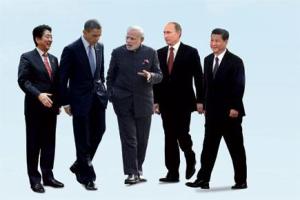
By simultaneously courting Xi, US President Barack Obama, Russian President Vladimir Putin, Japanese Prime Minister Shinzo Abe and other world leaders, Modi wants to demonstrate his ability to forge partnerships with rival powers and broker cooperative international approaches in a changing world. This suggests that the Modi foreign policy is geared to move India from its long-held non-alignment to a contemporary, globalised practicality. In essence, this means that India, a founding leader of the non-aligned movement, could become multi- aligned. Building close partnerships with major powers to pursue a variety of interests in diverse settings will not only enable India to advance its core priorities, but will also help it preserve strategic autonomy in keeping with its long- standing preference for policy independence.

Non-alignment suggests a passive approach, including staying on the sidelines. Being multi- aligned, on the other hand, permits a proactive approach. A multi-aligned India will tilt more towards the major democracies of the world. Yet a multi-aligned India will continue to be scrupulously autonomous in its foreign policy. An example of how India freely charts its own course is its continued refusal to join American- led financial sanctions against Russia.

A multi-aligned India also will not shy away from building strategic partnerships with countries around China’s periphery to counter that country’s India-containment strategy. Modi’s early focus was on diplomatically recouping India’s regional losses by re-engaging countries in the nation’s strategic backyard. Even as that goal remains a priority, India is seeking to advance its ‘Act East’ policy, as Modi’s Mongolia and South Korea visits signal.

Fourth, zeal is to Modi’s diplomacy what Sun Tzu precepts are to Chinese diplomacy. In that sense, Modi is following in the footsteps of his predecessors, other than Indira Gandhi. Talleyrand, the illustrious foreign minister of Napoleon and the Bourbons, prescribed one basic rule for a sound foreign policy: ‘By no means show too much zeal.’ Gushy expectations and oozing zealousness, however, have been the bane of Indian foreign policy almost since independence.

Modi wore his zeal on his sleeve during the China visit. While his hosts uttered a couple of carefully crafted sentences on why India-China cooperation would be mutually beneficial, Modi waxed eloquent on this theme ad nauseum at every public event, including while addressing the expatriate Indian community. The Prime Minister effectively turned Jawaharlal Nehru’s ‘Hindi-Chini bhai bhai’ jingle into ‘Modi-Chini bhai bhai’, among other things, by describing his friendship with Xi as ‘plus one’.

Modi’s zeal also tends to translate into diplomatic showmanship, reflected in the kind of big- ticket speeches he has been making abroad to chants of ‘Modi, Modi’ from the audience. Like a rock star, he unleashed Modi mania among Indian diaspora audiences by taking the stage at New York’s storied Madison Square Garden in September 2014, at Sydney’s Allphones Arena in November, and then in April at Ricoh Coliseum, a hockey arena in downtown Toronto. When permission was sought for a similar speech in Shanghai, an apprehensive Chinese government, which bars any public rally, relented only on the condition that the event would be staged in an indoor stadium.

Fifth, Modi has injected a personal touch to propel Indian foreign policy. Indeed, Modi has used his personal touch with great effect, addressing leaders ranging from Obama to Xi by their first name and building an easy equation with them. Indian diplomacy now bears Modi’s distinct imprint.

In keeping with his personaliszed stamp on diplomacy, Modi has relied on bilateral summits to open new avenues for cooperation and collaboration. At the same time, as if to underscore his nimble approach to diplomacy, he has shown he can think on his feet. The speed with which he rushed aid and rescue teams to quake-battered Nepal, as well as the Indian forces’ evacuation of Indian and foreign nationals from Nepal and conflict-torn Yemen, helped raise India’s international profile, highlighting its capacity to respond swiftly to natural and other disasters.

Sixth, against this background, it is scarcely a surprise that Modi has put his stamp on foreign policy faster than any predecessor other than Nehru. The paradox is that Modi came to office with little foreign-policy experience, yet he has demonstrated impressive diplomatic acumen, including the bold steps taken and vision charted to reclaim India’s lost strategic clout.

Seventh, to be effective, diplomacy must operate on the principle of give-and-take. But successive Indian prime ministers have chosen to operate lopsidedly on the half principle of ‘give’. There are plenty of examples of how unilateral magnanimity has backfired, saddling future Indian generations with serious strategic problems— from taking the Kashmir issue to the United Nations to reserving more than 80 per cent of the waters of the six-river Indus system for Pakistan by signing a treaty of indefinite duration. Even a strategy-minded Indira Gandhi blundered at the Simla Peace Summit in spite of holding all the cards.

Modi can certainly take credit for crafting a sensible and shrewd foreign policy. Yet, despite having cultivated a muscular image, he is no exception to the Indian itch to concede unilaterally. To flaunt a bilateral summit as a ‘success’, Modi is at times willing to abandon—at the altar of diplomatic expediency—the basic tenets of statecraft, including reciprocity (the first principle of diplomacy) and leverage.

Examples of Modi being a Mr Giver range from concessions to America on the nuclear-accident liability of reactor vendors to reversing course and permitting the Pakistani high commissioner in New Delhi to meet Hurriyat separatists on any occasion other than when official Indo- Pakistan talks are about to begin. His China visit also illustrates this chink in his armour.

The Chinese side did not yield on any issue, but Modi did. Overruling objections by the Indian security establishment, Modi announced the grant of e-visa-on-arrival on a non-reciprocal basis to Chinese tourists. So, even as China issues stapled visas to Indian citizens living in Arunachal Pradesh, India has agreed to reward it with that facility. The announcement, made at Beijing’s Tsinghua University, made Chinese Foreign Minister Wang Yi so happy that he asked the assembled students to loudly cheer and thank Modi for the ‘gift’.

As in September during Xi’s visit, Modi also yielded on Tibet, with the joint statement in Beijing referring to the ‘Tibet Autonomous Region of the People’s Republic of China’ in the context of Indian pilgrims’ visits to the sacred Kailash-Mansarovar site. ‘Tibet Autonomous Region’ is China’s official name for truncated Tibet, even though there is nothing autonomous about a region that is brutally repressed and ruled directly by Beijing. Referring to Tibet as part of the PRC undercuts India’s revised policy since 2010 to refrain from such a depiction in any joint statement as long as China persists with its cartographic aggression against India.

The urge to project a summit as a resounding success or to please the other side is often the main driver for India to yield. This is an urge Modi must learn to resist. After all, he is pursuing a foreign policy that, taken as a whole, is smart, realistic and forward-looking.

Modi’s astuteness and perspicuity were on open display in his press statement in Beijing, in which—in a nuanced and sophisticated manner—he held China responsible for impediments in the development of bilateral ties and identified all the key issues for India. Describing his discussions with the Chinese leadership, he said: “We covered all issues, including those that trouble smooth development of our relations. I stressed the need for China to reconsider its approach on some of the issues that hold us back from realising the full potential of our partnership. I suggested that China should take a strategic and long-term view of our relations.”

Modi must bear in mind that institutionalised and integrated policymaking are essential for India to have a robust diplomacy and to be able to stay its course. Without the health of these processes, policy will tend to be ad hoc and shifting, with personalities at the helm having an excessive role in shaping thinking, priorities and objectives. If foreign policy is shaped by the whims and fancies of personalities who hold the reins of power, there will be a propensity to act in haste and repent at leisure, as has happened in India repeatedly since the Nehruvian era.

Diplomacy is largely about negotiations. India must develop a tradition and culture of hard bargaining. Also, no country’s diplomacy can afford to confound tactics with strategy or marginalise its national-security establishment.

The political ascent of Modi, a man known for his decisiveness, can be a game-changer for Indian foreign policy if diplomacy is anchored in goal-oriented statecraft. After a decade of drift and neglect, India, under Modi’s leadership, is actively involving itself regionally to help influence developments in its strategic backyard. Modi realises that big-bucks corruption can enfeeble internal security and crimp foreign- policy options, and is seeking to bring this scourge under control. The Prime Minister seems to recognise that he can sustain a dynamic foreign policy only on the foundation of a strong domestic policy, a realm where he must overcome political obstacles to shape a transformative legacy.

Brahma Chellaney is a geostrategist and the author, most recently, of Water, Peace, and War (Rowman & Littlefield, USA).

© Open, 2015.