A tipping point in the Himalayas

This image has an empty alt attribute; its file name is indian-and-chinese-soldiers-celebrate-new-year_4c9462de-a3fd-11ea-8a8f-b205fc4c21a8.jpg

Brahma Chellaney, The Hindustan Times

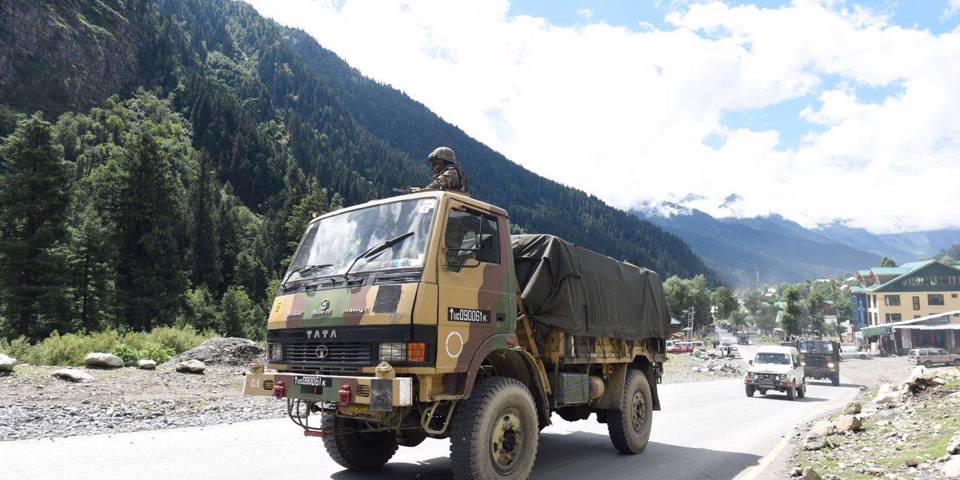
India extended the hand of friendship to China but was repaid with stealth aggression in Ladakh. The Chinese incursions into strategic areas presented India with a Kargil-like challenge. The aggression is not just a wake-up call for India; it could prove to be the deciding factor in fundamentally altering the country’s approach to China.

Shrewdly timing a surprise assault has been central to China’s repeated use of force, as several studies underscore. In 1962, China invaded India just as the Cuban missile crisis was bringing the world to the brink of nuclear Armageddon. And in April-May, as a distracted India was wrestling with the coronavirus that originated in Wuhan, China encroached on Ladakh’s Galwan Valley and Hot Springs (both previously undisputed areas) and simultaneously occupied Lake Pangong’s disputed long stretch between Fingers 4 and 8.

Military strategist Sun Tzu’s advice to “plan for what is difficult while it is easy” led China to strike when India was vulnerable. India’s draconian lockdown — the world’s strictest — flattened not its coronavirus curve but its Gross Domestic Product (GDP) curve, as one industrialist has noted. India now has the worst of both worlds — spiralling infection rates and a seriously-damaged economy, crimping its military options. China, which signalled a bellicose intent by conducting Himalayan military drills since the beginning of this year, seized the opening from the Indian Army’s lockdown-driven deferment of its annual Ladakh exercise, which creates acclimatised troop reserves before late spring unfreezes ingress routes.

Caught off-guard, India faces difficult options while battling the pandemic. India, however, is unlikely to put up with China’s encroachments, which explains its counterforce build-up in eastern Ladakh, despite the viral risks to troops. This week’s mutual pullback of troops at three of the four confrontation sites reduces the threat of war but doesn’t diminish China’s act of belligerence. The 2017 Doklam disengagement is a reminder that China doesn’t deviate from what it has set out to achieve: No sooner had the standoff ended than China began frenzied construction of permanent military structures and occupied almost the entire Doklam.

Let’s be clear. China’s latest aggression is very different from its Ladakh intrusions in the Depsang Plains (2013) and Chumar (2014) that had narrow tactical objectives. For example, it withdrew from Chumar after making India demolish local defensive fortifications.

The latest well-planned encroachments seem strategically geared to altering the frontier by grabbing vantage locations, whose control will place the People’s Liberation Army (PLA) in a commanding position. By building bunkers and other concrete structures, such as between Pangong’s Fingers 4 and 8, PLA has signalled its intent to retain key land grabs.

With PLA forces already present in Pakistan-occupied Kashmir near its frontier with Ladakh, China is seeking to ramp up pressure on both Indian flanks in Ladakh. The encroachments raise the spectre of PLA in a war cutting through northern Ladakh and physically linking up with Pakistan to put India under siege.

China’s aggression potentially signifies a geostrategic sea change. China is seeking to buy enough time through negotiations with India to consolidate its hold on key encroached areas. In this light, Beijing is seeking to string India along. If China vacates occupied land after extracting a price, it won’t be vantage points overlooking enemy positions but marginal territory.

As Mao Zedong admitted, China undertakes negotiations to “buttress its position” and “wear down the opponent”. China has taken India round and round the mulberry bush for 39 years in the negotiations on resolving the larger boundary question. The negotiations began as “senior-level talks” in 1981 before deceptively being relabelled as “joint working group” talks in 1988 and then as “talks between special representatives” in 2003.

India also invested considerable political capital in establishing a border-management framework with China through five different agreements, each signed with great fanfare at summits between 1993 and 2013. However, by brazenly flouting the accords’ basic principles through its encroachments, China has gravely fractured the framework.

In the way it has profoundly changed the status quo in the South China Sea without firing a shot, China is seeking to complete its thus far bullet-less aggression against India by forestalling through negotiations an Indian counter-offensive or an Indian tit-for-tat grab of Chinese-claimed territory elsewhere. So, it is saying the two sides must ensure “differences do not escalate into disputes”. In plain language, China is asking India to stomach its aggression or else the situation will cease to be, in its words, “stable and controllable”.

With its aggression, however, China has brought its relations with India to a tipping point. By opening several international fronts, including one against India, Chinese President Xi Jinping may be biting off more than he can chew. He will discover India is no pushover. By awakening India to China’s threat, Xi’s aggression eventually will prove costly for China, which is already staring at a cold war with the United States.

Far from submitting to China’s aggression, India will make necessary readjustments in its foreign and defence policies with the aim of imposing costs and thwarting Beijing’s larger hegemonic objectives. After all, how India emerges from its military stand-off with China will have an important bearing on its international standing and on Asian security.

According to a Chinese proverb, “To feed the ambition in your heart is like carrying a tiger under your arm.” By starting a conflict with India to advance his larger neo-imperial ambitions, Xi has increased the odds that the tiger under his arm will bite him.

Brahma Chellaney is a geostrategist.

© The Hindustan Times, 2020.

India’s Appeasement Policy Toward China Unravels

Last month’s swift and well-coordinated incursions by People’s Liberation Army troops into the icy borderlands of India’s Ladakh region were likely the product of months of preparation. The aggression – and the fact that Indian Prime Minister Narendra Modi didn’t see it coming – shows just how miserably his China policy has failed.

BRAHMA CHELLANEYProject Syndicate

Indian Prime Minister Narendra Modi is “not in a good mood,” US President Donald Trump recently declared, as he offered to mediate India’s resurgent border conflict with China. After years of bending over backward to appease China, Modi has received yet another Chinese encroachment on Indian territory. Will this be enough to persuade him to change his approach?

While India was preoccupied with the COVID-19 crisis, China was apparently planning its next attempt to change the region’s territorial status quo by force. Last month’s swift and well-coordinated incursions by People’s Liberation Army troops into the icy borderlands of India’s Ladakh region were likely the product of months of preparation. The PLA has now established heavily fortified camps in the areas it infiltrated, in addition to deploying weapons on its side of the Line of Actual Control (LAC), within striking distance of Indian deployments.

China’s “unexpected” maneuver should not have been unexpected at all. Last August, China’s government vigorously condemned India’s establishment of Ladakh – including the Chinese-held Aksai Chin Plateau – as a new federal territory. (China seized Aksai Chin in the 1950s, after gobbling up Tibet, which had previously served as a buffer with India.) And the PLA had been conducting regular combat exercises near the Indian border this year.

Deception, concealment, and surprise often accompany China’s use of force, with Chinese leaders repeatedly claiming that military preemption was a defensive measure. Its latest assault on India – which China claims is the actual aggressor – was taken straight from this playbook.

Yet Modi did not see the Chinese incursions coming. His vision seems to have been clouded by the naive hope that, by appeasing China, he could reset the bilateral relationship and weaken China’s ties with Pakistan, another revisionist state that lays claims to sizable swaths of Indian territory.

The China-Pakistan axis has long generated high security costs for India and raised the specter of a two-front war. That is why some Indian leaders have pursued a “defensive wedge strategy,” in which the status quo power seeks to drive a wedge between two allied revisionist states, so that it can focus its capabilities on the more threatening challenger.

In 1999, the first prime minister from Modi’s Bharatiya Janata Party, Atal Bihari Vajpayee, sought to win over Pakistan by visiting the country on the inaugural trip of a new bus service from Delhi to Lahore. Vajpayee was rewarded for his “bus diplomacy” with a stealth invasion by Pakistan’s powerful military of the Indian border zone of Kargil. This triggered a localized war, in which both sides lost several hundred soldiers before the status quo ante was restored.

Unlike Vajpayee, Modi has focused his attention on China – with similarly disastrous results. In fact, soon after becoming prime minister in 2014 – and just hours before hosting Chinese President Xi Jinping for a summit meeting – he learned that PLA troops had elbowed their way into southern Ladakh’s Chumar area, which lies along the LAC, and built a temporary road there.

The summit was portrayed as a success, even though the Chinese did not withdraw until weeks later, after India agreed to demolish local defensive fortifications. This was the beginning of a policy not of reconciliation, but of appeasement, the costs of which continue to mount.

On a trip to Beijing the next year, Modi surprised his own administration by announcing a decision to issue electronic tourist visas to Chinese nationals upon their arrival in India. He also delisted China as a “country of concern,” in an effort to court Chinese investment. Instead, the move opened India up to even more dumping by Chinese firms. On Modi’s watch, China has more than doubled its trade surplus with India to $60 billion per year – nearly equal to India’s annual defense spending.

Meanwhile, the PLA has continued to encroach on disputed territories. In mid-2017, Indian troops were pushed into another standoff with the PLA – this time, at Doklam, a small and desolate Himalayan plateau where Chinese-ruled Tibet meets the northeastern Indian state of Sikkim and the Kingdom of Bhutan. Indian troops stood up to the Chinese, as the PLA attempted to build a road to the India border through the uninhabited plateau that Bhutan, an Indian ally, regards as its own territory. The standoff lasted 73 days, before China and India agreed to disengage.

India declared the Doklam disengagement a tactical victory. But over the next several months, China steadily expanded its troop deployments by building permanent military structures, thereby gaining control of much of Doklam. Despite being the de facto guarantor of Bhutan’s security, India failed to defend the tiny country’s territorial sovereignty.

Yet Modi maintained India’s appeasement policy. In 2018, his government backed away from official contact with the Dalai Lama and Tibet’s India-based government-in-exile. At the same time, as Xi later revealed, Modi proposed an annual “informal” bilateral summit – a proposal Xi gladly accepted, because high-level meetings aid China’s “engagement with containment” strategy toward India. Two such summits have now been held, as well as 14 other meetings between the two leaders.

And what has Modi gotten for his troubles? China has stepped up its territorial revisionism, while raking in growing profits from the bilateral economic relationship (though, to be sure, India did recently tighten its policy on foreign direct investment, so that any flows from China must be pre-approved).

Modi has himself to blame for this state of affairs. With his excessive personalization of policy and stubborn strategic naiveté, he has shown himself not as the diplomatically deft strongman he purports to be, but as a kind of Indian Neville Chamberlain. Unless he learns from his mistakes and changes his policy toward China, India’s people – and territorial sovereignty – will pay the price.

Brahma Chellaney

Brahma Chellaney, Professor of Strategic Studies at the New Delhi-based Center for Policy Research and Fellow at the Robert Bosch Academy in Berlin, is the author of nine books, including Asian Juggernaut; Water: Asia’s New Battleground; and Water, Peace, and War: Confronting the Global Water Crisis.

© Project Syndicate, 2020.

China Is Its Own Worst Enemy

BRAHMA CHELLANEYProject Syndicate

The global backlash against China over its culpability for the international spread of the deadly coronavirus from Wuhan has gained momentum in recent weeks. And China itself has added fuel to the fire, as exemplified by its recent legal crackdown on Hong Kong. From implicitly seeking a political quid pro quo for supplying other countries with protective medical gear, to rejecting calls for an independent international inquiry into the virus’s origins until a majority of countries backed such a probe, the bullying tactics of President Xi Jinping’s government have damaged and isolated China’s communist regime.

The backlash could take the form of Western sanctions as Xi’s regime seeks to overturn Hong Kong’s “one country, two systems” framework with its proposed new national-security laws for the territory, which has been wracked by widespread pro-democracy protests for over a year. More broadly, Xi’s overreach is inviting increasing hostility among China’s neighbors and around the world.

Had Xi been wise, China would have sought to repair the pandemic-inflicted damage to its image by showing empathy and compassion, such as by granting debt relief to near-bankrupt Belt and Road Initiative partner countries and providing medical aid to poorer countries without seeking their support for its handling of the outbreak. Instead, China has acted in ways that undermine its long-term interests.

Whether through its aggressive “Wolf Warrior” diplomacy – named after two Chinese films in which special-operations forces rout US-led mercenaries – or military-backed expansionist moves in China’s neighborhood, Xi’s regime has caused international alarm. In fact, Xi, the self-styled indispensable leader, views the current global crisis as an opportunity to tighten his grip on power and advance his neo-imperialist agenda, recently telling a Chinese university audience that, “The great steps in history were all taken after major disasters.”

China has certainly sought to make the most of the pandemic. After buying up much of the world’s available supply of protective medical equipment in January, it has engaged in price-gouging and apparent profiteering. And Chinese exports of substandard or defective medical gear have only added to the international anger.

While the world grapples with COVID-19, the Chinese military has provoked border flare-ups with India and attempted to police the waters off the Japanese-controlled Senkaku Islands. China has also recently established two new administrative districts in the South China Sea, and stepped up its incursions and other activities in the area. In early April, for example, a Chinese coast guard ship rammed and sank a Vietnamese fishing boat, prompting the United States to caution China to “stop exploiting the [pandemic-related] distraction or vulnerability of other states to expand its unlawful claims in the South China Sea.”

Meanwhile, China has made good on its threat of economic reprisals against Australia for initiating the idea of an international coronavirus inquiry. Through trade actions, the Chinese government has effectively cut off imports of Australian barley and blocked more than one-third of Australia’s regular beef exports to China.

Whereas Japan readily allowed the International Atomic Energy Agency to conduct a full investigation into the 2011 Fukushima nuclear disaster – a probe that helped the country to improve safety governance – China strongly opposed any coronavirus inquiry, as if it had something to hide. In fact, some Chinese commentators denounced calls for an inquiry as racist.

But once a resolution calling for an “impartial, independent and comprehensive evaluation” of the global response to COVID-19 gained the support of more than 100 countries in the World Health Organization’s decision-making body, the World Health Assembly, Xi sought to save face by telling the assembly that “China supports the idea of a comprehensive review.” At the last minute, China co-sponsored the resolution, which was approved without objection.

The resolution, however, leaves it up to the WHO’s controversial director-general, Tedros Adhanom Ghebreyesus, to launch the review “at the earliest appropriate moment.” Tedros, who has been accused of aiding China’s initial COVID-19 cover-up, may decide to wait until the pandemic has come “under control,” as Xi has proposed.

Make no mistake: the world will not be the same after this wartime-like crisis. Future historians will regard the pandemic as a turning point that helped to reshape global politics and restructure vital production networks. Indeed, the crisis has made the world wake up to the potential threats stemming from China’s grip on many global supply chains, and moves are already afoot to loosen that control.

More fundamentally, Xi’s actions highlight how political institutions that bend to the whim of a single, omnipotent individual are prone to costly blunders. China’s diplomatic and information offensive to obscure facts and deflect criticism of its COVID-19 response may be only the latest example of its brazen use of censure and coercion to browbeat other countries. But it represents a watershed moment.

In the past, China’s reliance on persuasion secured its admission to international institutions like the World Trade Organization and helped to power its economic rise. But under Xi, spreading disinformation, exercising economic leverage, flexing military muscle, and running targeted influence operations have become China’s favorite tools for getting its way. Diplomacy serves as an adjunct of the Communist Party’s propaganda apparatus.

Xi’s approach is alienating other countries, in the process jeopardizing their appetite for Chinese-made goods, scaring away investors, and accentuating China’s image problem. Negative views of China and its leadership among Americans have reached a record high. Major economies such as Japan and the US are offering firms relocation subsidies as an incentive to shift production out of China. And India’s new rule requiring prior government approval of any investment from China is the first of its kind.

China currently faces the most daunting international environment since it began opening up in the late 1970s, and now it risks suffering lasting damage to its image and interests. A boomerang effect from Xi’s overreach seems inevitable. A pandemic that originated in China will likely end up weakening the country’s global position and hamstringing its future growth. In this sense, the hollowing out of Hong Kong’s autonomy in the shadow of COVID-19 could prove to be the proverbial straw that breaks the Chinese camel’s back.

Brahma Chellaney

Brahma Chellaney, Professor of Strategic Studies at the New Delhi-based Center for Policy Research and Fellow at the Robert Bosch Academy in Berlin, is the author of nine books, including Asian Juggernaut; Water: Asia’s New Battleground; and Water, Peace, and War: Confronting the Global Water Crisis.
© Project Syndicate, 2020.

A Made-in-China Pandemic

The COVID-19 pandemic should be a wake-up call for a world that has accepted China’s lengthening shadow over global supply chains for far too long. Only by reducing China’s global economic influence – beginning in the pharmaceutical sector – can the world be kept safe from the country’s political pathologies.

p9-chellaney-a-20200317-870x522

BRAHMA CHELLANEYProject Syndicate

The new COVID-19 coronavirus has spread to more than 100 countries – bringing social disruption, economic damage, sickness, and death – largely because authorities in China, where it emerged, initially suppressed information about it. And yet China is now acting as if its decision not to limit exports of active pharmaceutical ingredients (APIs) and medical supplies – of which it is the dominant global supplier – was a principled and generous act worthy of the world’s gratitude.

When the first clinical evidence of a deadly new virus emerged in Wuhan, Chinese authorities failed to warn the public for weeks and harassed, reprimanded, and detained those who did. This approach is no surprise: China has a long history of “killing” the messenger. Its leaders covered up severe acute respiratory syndrome (SARS), another coronavirus, for over a month after it emerged in 2002, and held the doctor who blew the whistle in military custody for 45 days. SARS ultimately affected more than 8,000 people in 26 countries.

This time around, the Communist Party of China’s proclivity for secrecy was reinforced by President Xi Jinping’s eagerness to be perceived as an in-control strongman, backed by a fortified CPC. But, as with the SARS epidemic, China’s leaders could keep it under wraps for only so long. Once Wuhan-linked COVID-19 cases were detected in Thailand and South Korea, they had little choice but to acknowledge the epidemic.

About two weeks after Xi rejected scientists’ recommendation to declare a state of emergency, the government announced heavy-handed containment measures, including putting millions on lockdown. But it was too late: many thousands of Chinese were already infected with COVID-19, and the virus was rapidly spreading internationally. US National Security Adviser Robert O’Brien has said that China’s initial cover-up “probably cost the world community two months to respond,” exacerbating the global outbreak.

Beyond the escalating global health emergency, which has already killed thousands, the pandemic has disrupted normal trade and travel, forced many school closures, roiled the international financial system, and sunk global stock markets. With oil prices plunging, a global recession appears imminent.

None of this would have happened had China responded quickly to evidence of the deadly new virus by warning the public and implementing containment measures. Indeed, Taiwan and Vietnam have shown the difference a proactive response can make.

Taiwan, learning from its experience with SARS, instituted preventive measures, including flight inspections, before China’s leaders had even acknowledged the outbreak. Likewise, Vietnam quickly halted flights from China and closed all schools. Both responses recognized the need for transparency, including updates on the number and location of infections and public advisories on how to guard against COVID-19.

Thanks to their governments’ policies, both Taiwan and Vietnam – which normally receive huge numbers of travelers from China daily – have kept total cases under 50. Neighbors that were slower to implement similar measures, such as Japan and South Korea, have been hit much harder.

If any other country had triggered such a far-reaching, deadly, and above all preventable crisis, it would now be a global pariah. But China, with its tremendous economic clout, has largely escaped censure. Nonetheless, it will take considerable effort for Xi’s regime to restore its standing at home and abroad.

Perhaps that is why China’s leaders are publicly congratulating themselves for not limiting exports of medical supplies and APIs used to make medicines, vitamins, and vaccines. If China decided to ban such exports to the United States, the state-run news agency Xinhua recently noted, the US would be “plunged into a mighty sea of coronavirus.” China, the article implies, would be justified in taking such a step. It would simply be retaliating against “unkind” US measures taken after COVID-19’s emergence, such as restricting entry to the US by Chinese and foreigners who had visited China. Isn’t the world lucky that China is not that petty?

Maybe so. But that is no reason to trust that China will not be petty in the future. After all, China’s leaders have a record of  other strategic exports (such as rare-earth minerals) to punish countries that defied them.

Moreover, this is not the first time China has considered weaponizing its dominance in global medical supplies and APIs. Last year, Li Daokui, a prominent Chinese economist, suggested curtailing Chinese API exports to the US as a countermeasure in the trade war. “Once the export is reduced,” Li noted, “the medical systems of some developed countries will not work.”

That is no exaggeration. A US Department of Commerce study found that 97% of all antibiotics sold in the US come from China. “If you’re the Chinese and you want to really just destroy us,” Gary Cohn, former chief economic adviser to US President Donald Trump, observed last year, “just stop sending us antibiotics.”

If the specter of China exploiting its pharmaceutical clout for strategic ends were not enough to make the world rethink its cost-cutting outsourcing decisions, the unintended disruption of global supply chains by COVID-19 should be. In fact, China has had no choice but to fall behind in producing and exporting APIs since the outbreak – a development that has constrained global supply and driven up the prices of vital medicines.

That has already forced India, the world’s leading supplier of generic drugs, to restrict its own exports of some commonly used medicines. Almost 70% of the APIs for medicines made in India come from China. If China’s pharmaceutical plants do not return to full capacity soon, severe global medicine shortages will become likely.

The COVID-19 pandemic has highlighted the costs of Xi’s increasing authoritarianism. It should be a wake-up call for political and business leaders who have accepted China’s lengthening shadow over global supply chains for far too long. Only by loosening China’s grip on global supply networks – beginning with the pharmaceutical sector – can the world be kept safe from the country’s political pathologies.

Brahma ChellaneyBrahma Chellaney, Professor of Strategic Studies at the New Delhi-based Center for Policy Research and Fellow at the Robert Bosch Academy in Berlin, is the author of nine books, including Asian Juggernaut; Water: Asia’s New Battleground; and Water, Peace, and War: Confronting the Global Water Crisis.

© Project Syndicate, 2020.

The China Factor Behind India’s Pullout from RCEP

The Regional Comprehensive Economic Partnership was set to become the world’s largest free trade agreement. But India’s withdrawal from it has thrown the negotiated trade bloc into imbalance and has underscored India’s qualms with China’s trade practices.

51122550_303

Brahma Chellaney, China-US Focus 

The 16-nation Regional Comprehensive Economic Partnership (RCEP) was supposed to establish the world’s largest trading bloc, covering half of the global population. But India’s abrupt withdrawal from the RCEP has undercut that goal. The decision came soon after the latest “informal” summit between Chinese President Xi Jinping and Indian Prime Minister Narendra Modi, during which Xi acknowledged India’s China-related concerns over the RCEP and pledged to address them.

New Delhi’s entry into the RCEP would effectively create a China-India free trade agreement (FTA) via the backdoor, at a time when Chinese exports are already swamping the Indian market and questions are being raised domestically on Modi’s management of the economy.

The China factor was central to India’s pullout from the RCEP. India already has FTAs with 12 of the other 15 participating RCEP countries and is negotiating an FTA with Australia. Therefore, the main beneficiary of India’s entry into the RCEP would have been China.

Xi’s two “informal” summits with Modi since April 2018 have yielded little progress in the trade, border, and political issues dividing the world’s two most-populous countries. Indeed, at the second summit, held in the Indian coastal town of Mamallapuram in October, Xi sought to rope India into the RCEP in an effort to shield his country’s burgeoning trade surplus with New Delhi.

When the summit concluded, Indian Foreign Secretary Vijay Gokhale said, “President Xi has assured us that India’s concerns over the RCEP will be duly discussed. Although both Modi and Xi emphasized on the importance of having a rules-based global trading system, the Indian prime minister clarified to China that a deal should be balanced and equitable. China said it has heard India’s concerns and has agreed that there are still issues that need addressing.”

At the summit, Modi agreed to starting bilateral talks between the Chinese vice premier and the Indian finance minister over India’s uneven trade relationship with China, which is weighted heavily in Beijing’s favor. China’s trade surplus with India has jumped from less than $2.5 billion a month in 2014 when Modi took office to more than $5 billion a month.

The Indian commitment to bilateral trade talks represented a diplomatic win for Beijing, allowing it to initiate what it is good at: endless negotiations, as its 38-year-long border talks with India illustrate. Ever since the talks to settle the border disputes began in 1981, China has taken India round and round the mulberry bush.

However, only three weeks after the Xi-Modi summit, India pulled out of the RCEP. And the bilateral trade talks that were agreed upon at the summit have yet to begin.

In November, the other 15 participating RCEP countries concluded text-based negotiations and sent the agreement to the legal team for cleanup. A joint statement following the conclusion of the negotiations in Bangkok said, “India has significant outstanding issues, which remain unresolved. All RCEP participating countries will work together to resolve these outstanding issues in a mutually satisfactory way. India’s final decision will depend on satisfactory resolution of these issues.”

It will not be easy to resolve India’s concerns. At a time of slowing Indian growth, India’s entry into the RCEP could exacerbate the country’s economic problems by opening the floodgates to the entry of cheap Chinese goods.

China, while exploiting India’s rule of law to engage in large-scale dumping and other unfair practices, keeps whole sectors of its economy off-limits to Indian businesses, including India’s $181-billion information technology industry. Beijing has also dragged its feet on dismantling regulatory barriers to the import of Indian agricultural and pharmaceutical products.

Modi, in the hope of spurring greater foreign direct investment (FDI) from China, removed it from the official list as a “country of concern” for India. However, instead of greater FDI, the step invited greater Chinese dumping.

China’s cumulative FDI in India remains a fraction of its yearly trade surplus with the country. In fact, in the list of countries with which China has the highest trade surpluses, India now ranks second behind America.

China’s surplus with the U.S., of course, is massive. But as a percentage of total bilateral trade or as a percentage of national gross domestic product (GDP), India’s trade deficit with China is greater than America’s. India’s trade deficit with China in 2018 accounted for 2.2% of its GDP.

China’s unfair trade practices are systematically undermining Indian manufacturing and competitiveness, with the result that Modi’s vaunted “Make in India” initiative has yet to seriously take off. Indeed, China’s annual trade surplus with India is significantly larger than India’s total defense spending, underscoring the extent to which India is underwriting Chinese hostility.

Against this background, India’s concerns are unlikely to be addressed in time for it to join the other participating countries at the RCEP signing ceremony in Hanoi next year.

Let’s be clear: unlike most other participating countries in the RCEP, India is not an export-driven economy. Rather, like the U.S., it is an import-dependent economy whose growth is largely driven by domestic consumption.

The U.S. and India have big trade deficits in goods with the rest of the world. Through bilateral or trilateral trade deals, they can leverage outsiders’ access to their huge markets to help shape trade norms and practices. This is already the approach of U.S. President Donald Trump’s administration.

Make no mistake – India needs to become more competitive in its own right because no barrier can be high enough to protect it from China’s trade prowess. But it also true that India cannot become more competitive without curbing China’s dumping and other rapacious trade practices.

An RCEP without India could create an imbalance within that trading bloc, just as Japan, Australia, and the ASEAN states have feared. It now seems likely that China will dominate the world’s largest free trade arrangement.

The national security threat from within

bhima-koregaon-violence_9edcc1b6-45c1-11ea-b306-d18e31211930

Brahma Chellaney, The Hindustan Times

Amid the raging media war between Prime Minister Narendra Modi’s supporters and critics, recent developments are helping to disprove one charge — that India is getting isolated internationally. From frustrating China’s latest UN Security Council (UNSC) move on Jammu and Kashmir (J&K) to forcing Malaysia to start addressing its growing trade surplus with India, including by importing more Indian sugar, Indian diplomacy has rarely been more robust. It was China that was isolated in the UNSC discussion on J&K.

US President Donald Trump’s forthcoming visit promises to raise India’s international salience. Building closer cooperation with the US, while shielding India’s longstanding partnership with Russia, has been Modi’s signature foreign-policy initiative. The US and India have never been closer than they are today, despite their differences over the Pakistan, Afghanistan and Iran challenges.

The showmanship, zeal and penchant for surprises that Modi’s diplomacy displayed in his first years in office have gradually given way to a more down-to-earth approach and greater pragmatism, including seeking to more resourcefully advance the country’s core interests. Under Modi, Indian diplomacy has been shedding its conventional methods and shibboleths to help build innovative dynamism. This remains a work in progress.

India is now more willing to act proactively. Consider the imperative to reverse eroding regional clout at a time when China is spreading its influence deep into India’s backyard. In Sri Lanka, no sooner had Gotabaya Rajapaksa won the presidential election than Modi sent his foreign minister to personally invite him to New Delhi. And then, to follow up on the discussions during Gotabaya’s visit, Modi’s national security adviser was in Colombo recently.

Another recent example is India’s pullout from the Regional Comprehensive Economic Partnership (RCEP) to forestall an India-China free trade agreement emerging via the backdoor. The decision not to join RCEP came barely three weeks after Chinese President Xi Jinping, at the Mamallapuram summit, pleaded with Modi for India’s entry and offered to discuss Indian concerns bilaterally.

The trade deficit with China has more than doubled on Modi’s watch and now accounts for 2.2% of India’s GDP, which is higher than its total defence spending. At a time of slowing Indian economic growth, India’s RCEP entry would seriously exacerbate the country’s problems by opening the floodgates to the entry of cheap goods from China, which keeps whole sectors of its economy off-limits to Indian businesses.

While Trump has got his phase-one deal to reduce the US trade deficit with China, India’s trade deficit with China continues to climb. In these circumstances, India’s RCEP entry would not only aid Beijing’s India policy of containment with engagement, including aggressively advancing commercial interests. In essence, China’s policy seeks to ensure it wins doubly — reap soaring profits on India trade while simultaneously working to box India in.

Through greater realism, India has progressively evolved a nondoctrinaire foreign-policy vision since it went overtly nuclear. It seeks to revitalize its economic and military security without having to overtly choose one power over another as a dominant partner. Given its nuclear-armed status, its quixotic founding philosophy centred on non-violence has assumed a largely rhetorical meaning.

As one US official, Alice Wells, has acknowledged, India’s “broadening strategic horizons” have led to a “shift away from a passive foreign policy”. India, however, remains intrinsically diffident, with a tendency to confound tactics with strategy and unable at times to recognize the difference between being cautious and being meek. Caution helps avert problems, while meekness compounds challenges.

Making matters worse, India today is weighed down not just by a troubled neighbourhood but also by its increasingly murky politics. A dynamic diplomacy needs strong bipartisan support, especially for ambitious or risky undertakings. But given India’s fractious and obstreperous politics, such bipartisanship has been hard to come by. Consider the political nitpicking over the Indian Air Force’s daring strike inside Pakistan at Balakot.

The bitter partisanship at home, by sharpening national divisions, makes it more challenging to meaningfully reinvigorate foreign policy. Indeed, the most pressing threat to India’s standing in the world comes not from China’s expansionism or the roguish activity of a scofflaw Pakistan but from polarized Indian politics. Given the threat from within, can India effectively deal with complex regional-security challenges, including the growing strategic axis between China and Pakistan — a dangerous combination of a powerful Leninist autocracy and an Islamist neighbour?

Modi may have become a lightning rod in India’s political churn. But make no mistake: Modi is a symptom of a longer-term trend of rancorous polarization in Indian politics that predates his arrival on the national scene and is likely to persist after he leaves office.

The world’s largest democracy has been in crisis for long. Its systemic problems have an important bearing on national security. Coping with mounting regional-security challenges while managing internal divisions will prove onerous unless India finds ways to control its growing divide.

Brahma Chellaney is a geostrategist.

© The Hindustan Times, 2020.

Why India-Japan ties matter more than ever

abemodito

Brahma Chellaney, The Hindustan Times

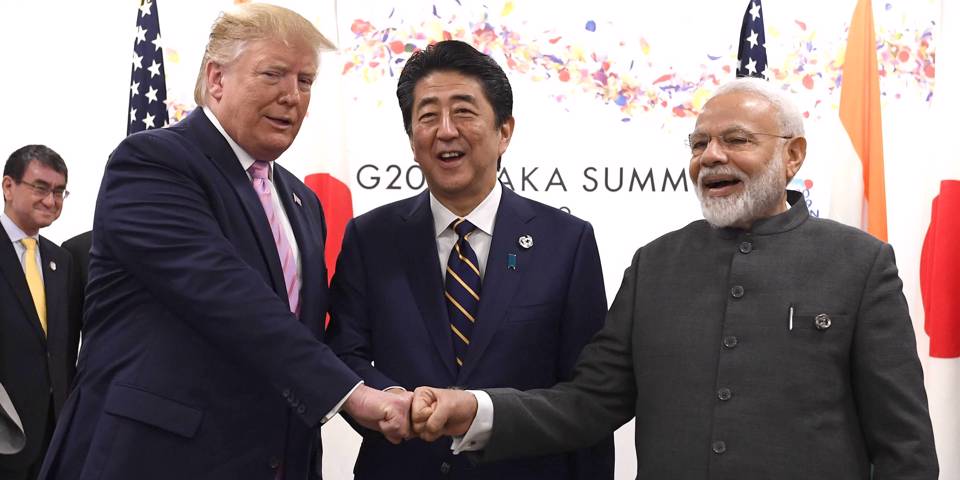
Whereas India-China and Japan-China ties are unlikely to become non-adversarial in the near future, the forthcoming summit between prime ministers Shinzo Abe and Narendra Modi will cement the Japan-India relationship as Asia’s fastest growing relationship, and open the path to a military logistics pact to allow access to each other’s bases. Indeed, the deepening relationship between Asia’s richest democracy and the world’s largest democracy serves the goal of forestalling the emergence of a Sino-centric Asia.

Recently, the Indian and Japanese foreign and defence ministers held their first joint meeting in a so-called “two plus two” format. India has set up such a “two plus two” dialogue with all the other Quad members. The Quad offers a promising platform for strategic maritime cooperation and coordination. But there is no guarantee that it will fulfil that promise.

The India-Japan entente is a central pillar of the U.S.-led strategy for a “free and open Indo-Pacific” — a concept authored by Abe. Today, Japan and India serve as the linchpins for establishing a rules-based Indo-Pacific order. However, US President Donald Trump’s “free and open Indo-Pacific” strategy, like his predecessor’s pivot to Asia, hasn’t been translated into a clear policy approach with any real strategic heft. It is thus important for Japan and India to contribute their bit.

The evolving paradigm shift in Washington’s China policy, however, has put pressure on Chinese President Xi Jinping to improve his country’s relations with India and Japan. Xi is expected to visit Japan in the spring. Xi’s informal summit with Modi in October yielded few tangible results. But India’s commitment at Mamallapuram to enter into bilateral talks over its lopsided trade relationship with China represented a diplomatic win for Beijing. It allows China to initiate what it is good at — endless negotiations, as its 38-year-long border talks with India illustrate.

In fact, Xi, seeking to shield his country’s burgeoning trade surplus with India, sought at Mamallapuram to rope India into the Regional Comprehensive Economic Partnership (RCEP). India already has free trade agreements (FTAs) with 12 of the other 15 RCEP member-states, and is negotiating an FTA with Australia. In this light, India’s entry into the RCEP would have effectively established a China-India FTA via the backdoor.

India’s recent withdrawal from the RCEP, like the earlier US pullout from the Trans-Pacific Partnership (TPP), has created a dilemma for Japan. While Japan took the lead to establish the TPP without the US, Tokyo does not want the RCEP negotiations to conclude without India, because it would build a China-led trading bloc. This suggests Japan may not join the RCEP without India reversing its withdrawal.

Taking advantage of its considerable assets — the world’s third-largest economy, substantial high-tech skills, and a military freed of some legal and constitutional constraints — Japan is boosting its geopolitical clout. Japan’s world-class navy has already begun operating far beyond the country’s waters in order to establish its position in the region. Abe has explained why Japan and India are natural allies, “A strong India benefits Japan, and a strong Japan benefits India.”

Against this background, the Modi-Abe summit will witness the Indian and Japanese militaries clinching a logistics sharing agreement, formally known as the Acquisition and Cross Servicing Agreement (ACSA). A logistics sharing accord has become imperative for the two militaries, given the number of joint manoeuvres they hold, including three-way exercises involving the US navy in the Indian Ocean and the Pacific.

The plain fact is that Japan and India, in the absence of any historical baggage or major strategic disagreement, share largely complementary strategic interests. In fact, Japan has the distinction of being the only foreign power that has been allowed to undertake infrastructure and other projects in India’s sensitive northeast (bordering Myanmar, Tibet, Bhutan and Bangladesh), as well as in the Andaman and Nicobar islands.

If Japan and India continue to add concrete security content to their relationship, their strategic partnership could potentially be a game changer in Asia. The emphasis on boosting trade and investment must be balanced with greater strategic collaboration. Their first joint fighter aircraft exercise will be held in the new year in Japan.

The Abe-Modi summit offers an opportunity to discuss how the Tokyo-New Delhi duet can contribute to the larger effort to build strategic equilibrium, power stability and maritime security in the Indo-Pacific. Besides deepening defence and maritime security cooperation, Japan and India must collaborate on infrastructure and other projects in third countries, including Myanmar, Bangladesh and Sri Lanka, and in Africa, to help enhance strategic connectivity in the Indo-Pacific.

India and Japan have forged a special relationship, which is set to strengthen and deepen in the coming years. At a time of global geopolitical flux, the two are among the important countries that have taken up the baton to champion freedom, international norms and rules, inclusivity, and free and fair trade.

Brahma Chellaney is a geostrategist and author.

China’s dam-building programme must take neighbours into account

  • Since China began damming the Mekong, droughts have become more frequent and intense in downriver countries
  • By diverting river water to its mega-dams, China has emerged as Asia’s upstream water controller, giving it great leverage

Japan’s RCEP Dilemma

RCEP-1-1024x768

Brahma Chellaney, The Japan Times 

India’s pullout from the Regional Comprehensive Economic Partnership (RCEP), like the earlier U.S. withdrawal from the Trans-Pacific Partnership (TPP), has created a dilemma for Japan. But whereas Japan took the lead to establish the TPP without the United States, Tokyo does not desire a RCEP without India because it would create a China-led trading bloc.

The 16-nation RCEP was supposed to establish the world’s largest trading bloc covering half of the global population. But India’s withdrawal from the RCEP has undercut that objective. It now seems likely that China would dominate the RCEP, which is set to be opened for signature next year.

The other 15 participating countries in November concluded text-based negotiations and sent the agreement to the legal scrubbing team for cleanup. A joint statement following the conclusion of the negotiations in Bangkok said, “India has significant outstanding issues, which remain unresolved. All RCEP participating countries will work together to resolve these outstanding issues in a mutually satisfactory way. India’s final decision will depend on satisfactory resolution of these issues.”

Japanese Trade Minister Hiroshi Kajiyama told his Indian counterpart, Piyush Goyal, last week in New Delhi that Japan was ready to take the lead to help resolve the “outstanding issues” so that India can rejoin the RCEP.

The main factor behind India’s pullout from the RCEP was China, which Harvard’s Graham Allison has called “the most protectionist, mercantilist and predatory major economy in the world.” At a time of slowing Indian economic growth, India’s entry into the RCEP could exacerbate the country’s problems by opening the floodgates to the entry of cheap Chinese goods.

China, while exploiting India’s rule of law to engage in large-scale dumping and other unfair practices, keeps whole sectors of its economy off-limits to Indian businesses, including India’s $181-billion information technology industry. Beijing has also dragged its feet on dismantling regulatory barriers to the import of Indian agricultural and pharmaceutical products.

Since Indian Prime Minister Narendra Modi took office in 2014, China’s trade surplus with India has more than doubled to over $60 billion annually. Modi’s 2015 removal of China as a “country of concern,” instead of encouraging major foreign direct investment (FDI) from that country, has only spurred greater dumping.

In the list of countries with which China has the highest trade surpluses, India now ranks second behind America. China’s surplus with the U.S., of course, is massive. But as a percentage of total bilateral trade or as a percentage of national gross domestic product (GDP), India’s trade deficit with China is greater than America’s. India’s trade deficit with China in 2018 accounted for 2.2% of its GDP.

China’s unfair trade practices are systematically undermining Indian manufacturing and competitiveness, with the result that Modi’s vaunted “Make in India” initiative has yet to seriously take off. In fact, China’s annual trade surplus with India is significantly larger than India’s total defense spending, underscoring the extent to which India is underwriting Chinese hostility.

India already has free trade agreements (FTAs) with 12 of the other 15 RCEP participating countries, and is negotiating an FTA with Australia. The main beneficiary of India’s entry into the RCEP would be Beijing, because it would effectively establish a China-India FTA via the backdoor.

The two “informal” summits Chinese President Xi Jinping has held with Modi since April 2018 have yielded little progress on the trade, border and political issues that divide the world’s two most-populous countries. Indeed, at the second summit, held in the Indian coastal town of Mamallapuram about two months ago, Xi sought to rope India into the RCEP in an effort to shield his country’s burgeoning trade surplus with New Delhi.

When the Mamallapuram summit concluded, Indian Foreign Secretary Vijay Gokhale said, “President Xi has assured us that India’s concerns over the RCEP will be duly discussed. Although both Modi and Xi emphasized on the importance of having a rules-based global trading system, the Indian prime minister clarified to China that a deal should be balanced and equitable. China said it has heard India’s concerns and has agreed that there are still issues that need addressing.”

At the summit, Modi agreed to the holding of talks between the Chinese vice premier and the Indian finance minister over India’s lopsided trade relationship with China. The Indian commitment represented a diplomatic win for Beijing, allowing it to initiate what it is good at — endless negotiations, as its 38-year-long border talks with India illustrate. Ever since the talks to settle the border disputes began in 1981, China has taken India round and round the mulberry bush.

However, barely three weeks after the summit, India pulled out of the RCEP. And the bilateral trade talks that were agreed upon at the summit have yet to begin.

Let’s be clear: Unlike most other participating countries in the RCEP, India is not an export-driven economy. Rather, like the U.S., it is an import-dependent economy whose growth is largely driven by domestic consumption.

The U.S. and India have big trade deficits in goods with the rest of the world. Through bilateral or trilateral trade deals, they can leverage outsiders’ access to their huge markets to help shape trade norms and practices. This is already the approach of U.S. President Donald Trump’s administration.

Make no mistake: India needs to become more competitive in its own right, because no barrier can be high enough to protect it from China’s trade prowess. But it also true that India cannot become more competitive without curbing China’s dumping and other rapacious trade practices.

Against this background, Japan has a challenging task to get India back into the world’s largest free-trade arrangement. Whenever Prime Minister Shinzo Abe undertakes his postponed visit to India, he will seek to impress on Modi that India’s — and Japan’s — interests in the Indo-Pacific region would be better served with New Delhi being part of the RCEP.

Longtime Japan Times contributor Brahma Chellaney is a geostrategist and the author of nine books, including the award-winning “Water: Asia’s New Battleground.”

© The Japan Times, 2019.

America’s Feeble Indo-Pacific Strategy

US President Donald Trump’s administration wants to build a rules-based and democracy-led order in the Indo-Pacific, but seems to have no idea how. If it doesn’t find the answer soon, and imbue its Asia policy with strategic heft, constraining Chinese aggression will only become more difficult.

2679db018adb03b2ce714caf3875aaf4.2-1-super.1

BRAHMA CHELLANEYProject Syndicate

HANOI – With the global geopolitical center of gravity shifting toward Asia, a pluralistic, rules-based Indo-Pacific order is more important than ever, including for America’s own global standing. So it was good news when, two years ago, US President Donald Trump began touting a vision of a “free and open” Indo-Pacific, characterized by unimpeded trade flows, freedom of navigation, and respect for the rule of law, national sovereignty, and existing frontiers. Yet, far from realizing this vision, the United States has allowed Chinese expansionism in Asia to continue virtually unimpeded. This failure could not be more consequential.

Like Barack Obama’s pivot to Asia, the concept of a free and open Indo-Pacific hasn’t been translated into a clear policy approach with any real strategic heft. On the contrary, the US has continued to stand by while China has broken rules and conventions to expand its control over strategic territories, especially the South China Sea, where it has built and militarized artificial islands. China has redrawn the geopolitical map in that critical maritime trade corridor without incurring any international costs.

To be sure, the US has often expressed concern about China’s activities, including its ongoing interference in Vietnam’s oil and gas activities within that country’s own exclusive economic zone. More concretely, the US has stepped up its freedom-of-navigation operations in the South China Sea, and engaged with the region’s three largest democracies – Australia, India, and Japan – to hold “quadrilateral consultations” on achieving a free, open, and inclusive Indo-Pacific. Though the “Quad” has no intention of forming a military grouping, it offers a promising platform for strategic maritime cooperation and coordination, especially now that its consultations have been elevated to the foreign-minister level.

Yet there is no guarantee the Quad will fulfill that promise. While the grouping has defined vague objectives – such as ensuring, as US Secretary of State Mike Pompeo has put it, that “China retains only its proper place in the world” – it has offered little indication of how it plans to get there.

America’s wider Indo-Pacific strategy has the same problem. The Trump administration wants to build a rules-based and democracy-led regional order, but seems to have no idea how. And instead of trying to figure that out, it has placed strategic issues on the back burner – for example, it downgraded its participation in the recent Asia-Pacific summits in Bangkok – and focused on bilateral trade deals.

Not surprisingly, this approach has done nothing to curb China’s territorial revisionism, let alone other damaging Chinese policies, including its appalling violations of the human rights of the Uighur ethnic group in Xinjiang. The Chinese government has reportedly detained more than a million Muslims, mostly Uighurs, in so-called reeducation camps – the largest mass incarceration on religious grounds since World War II.

Although a bipartisan US commission recommended sanctions over these internment camps last year, the Trump administration only recently imposed export and visa restrictions on camp-linked entities and officials, respectively. China expressed anger at the decision, insisting that its actions in Xinjiang are intended to “eradicate the breeding soil of extremism and terrorism,” but it is unlikely to be deterred by the relatively restrained US measures.

The Trump administration has also shown caution in its implementation of the Taiwan Travel Act and the Reciprocal Access to Tibet Act, both of which were enacted last year. Bipartisan legislation intended to support the people of Hong Kong, who have been protesting China’s increasingly blatant violations of their rights under the “one country, two systems” regime for months, is likely to face a similar fate.

China has vowed to retaliate if the US enacts the new laws, including one that would require the Secretary of State to certify each year whether Hong Kong is “sufficiently autonomous” to justify its special trading status. More broadly, Chinese President Xi Jinping has warned that anyone “attempting to split China” will end up with “crushed bodies and shattered bones,” and “any external forces backing such attempts” will be “deemed by the Chinese people as pipe-dreaming.”

That mentality – reinforced by years of breaking rules with impunity – will not be changed by economic measures alone. Yet economic measures remain Trump’s weapon of choice. While US sanctions and tariffs have exacerbated China’s economic slowdown, thereby undermining its ability to fund its expanding global footprint, real progress will also require strategic maneuvers These would send a clear message to both China and America’s regional allies.

Such a message is crucial because even the Quad members that were supposed to serve as the pillars of free and open Indo-Pacific have lately been hedging their bets on the US. Japan – whose prime minister, Shinzo Abe, originated the concept – has quietly dropped the term “strategy” from its policy vision for the Indo-Pacific. Australia has forged a comprehensive strategic partnership with China. And Indian Prime Minister Narendra Modi recently hosted Xi.

The longer the US fails to act as a convincing counterweight to China, the more strategic space Xi will have to pursue his neo-imperialist agenda, and the less likely he will be to submit to US pressure, economic or otherwise. To prevent that, the US must provide strategic weight to its Indo-Pacific policy, including by establishing a clear plan for resisting China’s efforts to alter the status quo in the South China Sea. If the US oil company ExxonMobil exits Vietnam’s largest gas project, as seems likely, this will become even more urgent, given China’s interest in shutting extra-regional energy firms out of the South China Sea.

Trump once described Obama’s South China Sea strategy as “impotent.” But today, it is Trump’s approach to Chinese expansionism that looks weak. As China’s aggression continues to increase, that impotence will only become more apparent – and more damaging.

Brahma ChellaneyBrahma Chellaney, Professor of Strategic Studies at the New Delhi-based Center for Policy Research and Fellow at the Robert Bosch Academy in Berlin, is the author of nine books, including Asian Juggernaut; Water: Asia’s New Battleground; and Water, Peace, and War: Confronting the Global Water Crisis.

© Project Syndicate, 2019.