Will China Turn Off Asia’s Tap?

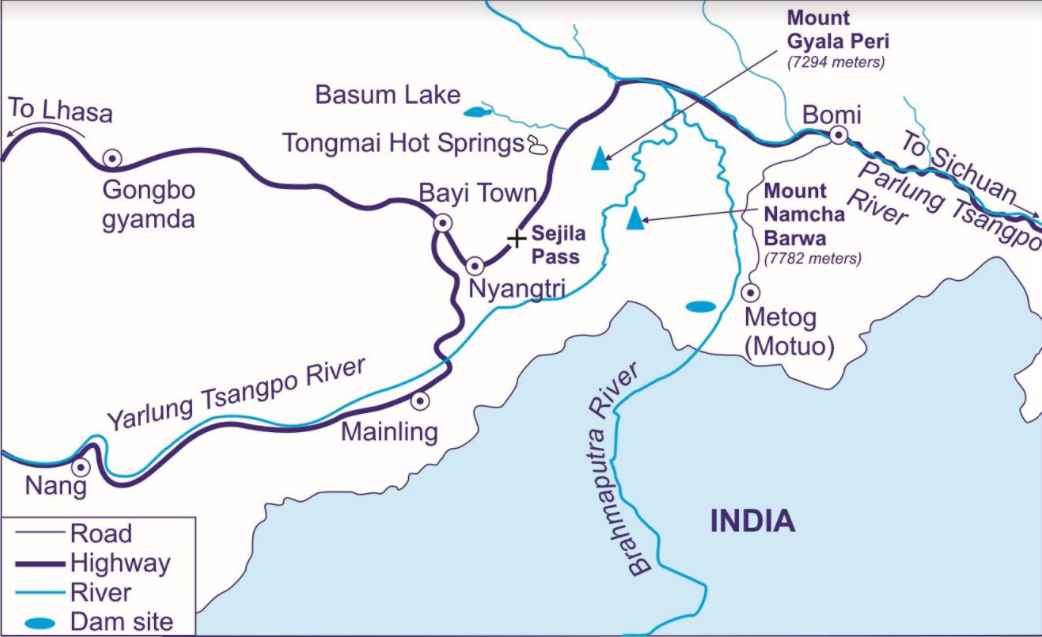
China’s megaproject on the Brahmaputra (Yarlung Tsangpo) is to come up next to Metog (Motuo), just before the mighty river crosses into India.

Brahma ChellaneyProject Syndicate

Even after Asia’s economies climb out of the COVID-19 recession, China’s strategy of frenetically building dams and reservoirs on transnational rivers will confront them with a more permanent barrier to long-term economic prosperity: water scarcity. China’s recently unveiled plan to construct a mega-dam on the Yarlung Zangbo river, better known as the Brahmaputra, may be the biggest threat yet.

China dominates Asia’s water map, owing to its annexation of ethnic-minority homelands, such as the water-rich Tibetan Plateau and Xinjiang. China’s territorial aggrandizement in the South China Sea and the Himalayas, where it has targeted even tiny Bhutan, has been accompanied by stealthier efforts to appropriate water resources in transnational river basins – a strategy that hasn’t spared even friendly or pliant neighbors, such as Thailand, Laos, Cambodia, Nepal, Kazakhstan, and North Korea. Indeed, China has not hesitated to use its hydro-hegemony against its 18 downstream neighbors.

The consequences have been serious. For example, China’s 11 mega-dams on the Mekong river, Southeast Asia’s arterial waterway, have led to recurrent drought downriver, and turned the Mekong Basin into a security and environmental hot spot. Meanwhile, in largely arid Central Asia, China has diverted waters from the Illy and Irtysh rivers, which originate in China-annexed Xinjiang. Its diversion of water from the Illy threatens to turn Kazakhstan’s Lake Balkhash into another Aral Sea, which has all but dried up in less than four decades.

Against this background, China’s plan to dam the Brahmaputra near its disputed – and heavily militarized – border with India should be no surprise. The Chinese communist publication Huanqiu Shibao, citing an article that appeared in Australia, recently urged India’s government to assess how China could “weaponize” its control over transboundary waters and potentially “choke” the Indian economy. With the Brahmaputra megaproject, China has provided an answer.

The planned 60-gigawatts project, which will be integrated into China’s next Five-Year Plan starting in January, will reportedly dwarf China’s Three Gorges Dam – currently the world’s largest – on the Yangtze River, generating almost three times as much electricity. China will achieve this by harnessing the power of a 2,800-meter (3,062-yard) drop just before the river crosses into India.

What the chairman of China’s state-run Power Construction Corp, Yan Zhiyong, calls an “historic opportunity” for his country will be devastating for India. Just before crossing into India, the Brahmaputra curves sharply around the Himalayas, forming the world’s longest and steepest canyon – twice as deep as America’s Grand Canyon – and holding Asia’s largest untapped water resources.

Experience suggests that the proposed megaproject threatens those resources – and China’s downstream neighbors. China’s past upstream activities have triggered flash floods in the Indian states of Arunachal and Himachal. More recently, such activity turned the water in the once-pristine Siang – the Brahmaputra’s main artery – dirty and gray as it entered India.

About a dozen small or medium-size Chinese dams are already operational in the Brahmaputra’s upper reaches. But the megaproject in the Brahmaputra Canyon region will enable the country to manipulate transboundary flows far more effectively. Such manipulation could leverage China’s claim to the adjacent Indian state of Arunachal, which is almost three times the size of Taiwan. Given that China and India are already locked in a tense, months-long military standoff, which began with Chinese territorial encroachments, the risks are acute.

And yet the country that will suffer the most as a result of China’s Brahmaputra dam project is not India at all; it is densely populated and China-friendly Bangladesh, for which the Brahmaputra is the single largest freshwater source. Intensifying pressure on its water supply will likely trigger an exodus of refugees to India, already home to millions of illegally settled Bangladeshis.

The Brahmaputra megaproject also amounts to a slap in the face of Tibet, which is among the world’s most biodiverse regions and has a deeply rooted culture of reverence for nature. In fact, the canyon region is sacred territory for Tibetans: its major mountains, cliffs, and caves represent the body of their guardian deity, the goddess Dorje Pagmo, and the Brahmaputra represents her spine.

If none of this deters China, the damage it is doing to its own people and prospects should. China’s over-damming of internal rivers has severely harmed ecosystems, including by causing river fragmentation and disrupting the annual flooding cycle, which helps to refertilize farmland naturally by spreading silt. In August, some 400 million Chinese were put at risk after record flooding endangered the Three Gorges Dam. If the Brahmaputra mega-dam collapses – hardly implausible, given that it will be built in a seismically active area – millions downstream could die.

The Great Himalayan Watershed is home to thousands of glaciers and the source of Asia’s greatest river systems, which are the lifeblood of nearly half the global population. If glacial attrition is allowed to continue – let alone to be accelerated by China’s environmentally catastrophic activities – China will not be spared.

For its own sake – and the sake of Asia as a whole – China must accept institutionalized cooperation on transnational riparian flows, including measures to protect ecologically fragile zones and agreement not to dam relatively free-flowing rivers (which play a critical role in moderating the effects of climate change). This would require China to rein in its dam frenzy, be transparent about its projects, accept multilateral dispute-settlement mechanisms, and negotiate water-sharing treaties with neighbors.

Unfortunately, there is little reason to believe this will happen. On the contrary, as long as the Communist Party of China remains in power, the country will most likely continue to wage stealthy water wars that no one can win.

Brahma Chellaney

Brahma Chellaney, Professor of Strategic Studies at the New Delhi-based Center for Policy Research and Fellow at the Robert Bosch Academy in Berlin, is the author of nine books, including Asian Juggernaut; Water: Asia’s New Battleground; and Water, Peace, and War: Confronting the Global Water Crisis.

© Project Syndicate, 2020.

Writing is on the wall for US Indo-Pacific strategy

Flip-flops are to Biden what egomania is to Trump

Brahma Chellaney, Nikkei Asia

The momentum toward deeper collaboration could slow if Biden’s foreign policy downgrades India’s importance in regional strategy.   © AP

Brahma Chellaney is a geostrategist and author of nine books, including “Asian Juggernaut: The Rise of China, India and Japan.”

The current naval war games involving Australia, India, Japan and the U.S. in the Indian Ocean show that the Quad — a loose coalition of the Indo-Pacific region’s four leading democracies — is beginning to take concrete shape in response to China’s muscular foreign policy. A concert of democracies in the Indo-Pacific seems closer than ever.

But just when the four powers appear on the cusp of formalizing their coalition, the impending change in the White House has added a layer of uncertainty. The big unknown is whether America’s Indo-Pacific strategy and how it will treat China will undergo a structural shift under President Joe Biden, as they did under President Donald Trump.

Trump fundamentally changed U.S. policy on China by acting on his campaign pledge to treat Beijing as a strategic rival and threat. He also replaced Barack Obama’s pivot to Asia, which never acquired concrete strategic content, with the free and open Indo-Pacific strategy, a concept authored by then-Japanese Prime Minister Shinzo Abe. Rarely has the U.S. adopted a foreign-designed concept as the linchpin of its foreign policy.

Given Beijing’s heavy-handed use of its military and economic power, if President Biden flips America’s Indo-Pacific and China policies once again, that will raise concerns across Asia. It will also lead to questions about the inherent unpredictability surrounding U.S. strategy and the wisdom of investing in closer strategic bonds with Washington in the first place.

Nowhere will these questions generate greater concerns than in India, the host of the current Quad naval war games up to Nov. 20. Formally known as the Malabar exercise after an area on India’s southwestern coast, this annual series of complex war games is aimed at building military interoperability on the high seas, and now involves aircraft carriers.

India elevated Malabar this year from a trilateral to a quadrilateral event by finally acceding to Australia’s pending request to rejoin after it dropped out 12 years ago in a bid to appease Beijing. The Chinese communist mouthpiece the Global Times said earlier that Australia’s inclusion would “signal that the Quad military alliance is officially formed.”Ships from the Indian navy, Royal Australian Navy, and Japan Maritime Self-Defense Force sail in formation during an exercise as part of Malabar 2020 on Nov. 3. (Handout photo from U.S. Navy)

China’s aggressive expansionism has driven a tectonic shift in India’s security calculus, leading to closer defense and intelligence-sharing collaboration with the U.S. and the signing of military logistics agreements this year with Japan and Australia. The Trump administration helped midwife this tectonic shift by placing India at the center of its Indo-Pacific strategy and seeking to forge a “soft alliance” with New Delhi.

The U.S., Japan and Australia are already tied by bilateral and trilateral security alliances among themselves, making India’s co-option pivotal to building a constellation of democracies. After establishing an Indo-Pacific strategy and resurrecting the Quad, which had been lying dormant for nine years, the Trump administration — in a symbolic nod toward India — renamed the U.S. military’s Pacific Command as the Indo-Pacific Command. Chinese territorial aggression in the Himalayas has helped bring India along.

But the momentum toward deeper collaboration could slow if Biden’s foreign policy downgrades India’s importance in regional strategy and returns — as Biden has signaled — to the Obama-era approach of cooperating with China in areas where Sino-U.S. interests converge. This would mark a break with the current approach that sees the U.S. in deeply ideological — even existential — conflict with the Chinese Communist Party.

Last year, Biden stunned many with his apparent strategic naivete by declaring that “China is going to eat our lunch? Come on, man. I mean, you know, they’re not bad folks, folks. But guess what? They’re not competition for us.” The blowback compelled Biden to backtrack and admit China was a threat.

To be sure, Biden made a habit during the election campaign of reversing his positions on major policy issues. Flip-flops are to Biden what egomania is to Trump. Still, the free and open Indo-Pacific strategy’s days seem numbered. Even the term “Indo-Pacific,” whose use expanded America’s regional framework to include India as a major power, was conspicuously absent in Biden’s campaign statements and the 2020 Democratic Party Platform.

Biden could revert to the old term “Asia-Pacific” or keep “Indo-Pacific” while enunciating a new policy for the region. In calls last week with the leaders of Japan, South Korea and Australia but not India, Biden emphasized a “secure and prosperous Indo-Pacific” instead of a free and open Indo-Pacific. And, in apparent deference to Beijing, the Biden office readout left out the assurance Japanese Prime Minister Yoshihide Suga said he received from the president-elect that U.S. security guarantees apply to Japan’s administration of the Senkaku Islands, which Beijing claims and calls the Diaoyu.

The bipartisan consensus in Washington that the U.S. must get tough with Beijing, however, is likely to prevent Biden’s return to the softer China approach of the Obama period. It was on Obama’s watch that China launched cost-free expansionism, including redrawing the geopolitical map in the South China Sea.

The loss of the expression “free and open Indo-Pacific” will likely be seen in India as a diminution of its future role in American strategy. More broadly, it could be viewed as a possible dilution of the U.S. commitment to establish an Indo-Pacific concert of democracies, with India serving as the western anchor and Japan and Australia the eastern and southern anchors of a regional balance of power.

Biden has promised to host a global Summit for Democracy in his first year in office to help “renew the spirit and shared purpose of the nations of the free world.” But such a values-based, globalized approach contrasts with the current U.S. strategy of regionally leveraging cooperation with democracies for geopolitical ends.

Unless a clearer strategic vision emerges under Biden, the likely unraveling of the free and open Indo-Pacific strategy could silence any hoped-for regional concert of democracies.

Biden Can Make an Ally of India

But Partnership With New Delhi Is Not Guaranteed

By Brahma Chellaney

Foreign Affairs journal

President-elect Joe Biden will inherit a U.S.-Indian relationship that is nearer than ever to a formal alliance. Will the bilateral relationship continue to deepen under the next U.S. administration?

Paintings of U.S. President-elect Joe Biden and Vice President-elect Kamala Harris in Mumbai, India, November 2020. Niharika Kulkarni / Reuters

President-elect Joe Biden will inherit a U.S.-Indian relationship that is nearer than ever to a formal alliance. In the past decade, Washington and New Delhi have deepened their diplomatic and defense ties, but the Indian government has not yet officially allied with the United States. During the administration of U.S. President Donald Trump, India and the United States signed a series of foundational defense, logistics, and intelligence-sharing agreements that pave the way for close security cooperation. Last month, the then U.S. secretary of defense, Mark Esper, declared that India will be “the most consequential partner for us, I think, in the Indo-Pacific for sure in this century.”  

India’s newfound interest in defense collaboration with the United States is mainly a reaction to Chinese imperial expansionism. Beijing’s territorial aggression in the Himalayas this year and the resulting clashes with Indian troops laid bare the risks to India of dealing with its giant neighbor without the clear support of the United States. As the specter of additional Himalayan battles—or even a reprise of the 1962 border war with China—looms large, India has grown more willing to work with the United States to meet common challenges. To that end, India has intensified its involvement with the Quad—a loose coalition among Australia, India, Japan, and the United States that is central to the United States’ strategy for maintaining a “free and open Indo-Pacific.” As a result of these efforts, India is currently hosting the first-ever Quad military exercise: the Malabar naval war games in the Indian Ocean.

Biden is likely to continue to push for closer cooperation between New Delhi and Washington. But he is also widely expected to reset ties with China in order to ease Sino-U.S. tensions and rebuild cooperation with Beijing. Such a reset will affect relations with India and raise doubts in New Delhi about Washington’s reliability. India’s future partnership with the United States is not yet guaranteed, and Biden will have to be careful not to push India away as he devises a new U.S. strategy in Asia.

THREADING THE NEEDLE

Separated from China by a vast ocean, the United States does not share India’s immediate and potent concerns over Beijing’s growing assertiveness. Earlier this year, while India sought to snuff out the novel coronavirus with the world’s strictest lockdown, China stealthily encroached on several border areas in India’s high-altitude Ladakh region. Beijing seized key stretches of territory and has refused to pull back, alarming both Indian policymakers and the public at large.

Given these tensions, Biden will have to thread a diplomatic needle to improve relations with China without alienating India. Successive U.S. presidents from Richard Nixon to Barack Obama aided China’s rise. Beijing militarized the South China Sea under Obama’s watch. Yet, just months before he left office, Obama contended that “we have more to fear from a weakened, threatened China than a successful, rising China.” China’s neighbors do not share that assessment. It was the paradigm policy shift under Trump, who set Beijing in his crosshairs from the beginning of his presidency and designated China as a “revisionist power” and a “strategic competitor,” that persuaded India to move closer to the United States.

A softer U.S. approach toward China and its regional ally, Pakistan, could slow India’s entry into the U.S.-led security architecture and even push New Delhi to revert to its traditional posture of nonalignment, or strategic autonomy from great powers. The strengthening Chinese-Pakistani alliance generates high security costs for India, including raising the ominous prospect of  a war on two fronts. New Delhi would be disappointed if Biden, in seeking to mend U.S. ties with the Chinese dictatorship, abandons Trump’s more confrontational posture toward Beijing. And if Biden relieves terrorism-related pressure on Pakistan by restoring security aid, the Indian government may have second thoughts about hopping on the U.S. security bandwagon.

Another issue that has the potential to sour relations with India during Biden’s presidency relates to India’s domestic division and polarization. While in office, Trump has refrained from commenting on India’s internal matters, understanding that U.S. criticism could strengthen Prime Minister Narendra Modi’s opponents at home. But Biden, through his official campaign page, has already slammed Modi’s government on issues such as Indian actions in Kashmir and a controversial law on citizenship for refugees, calling these matters inconsistent with India’s “long tradition of secularism and with sustaining a multiethnic and multireligious democracy.”

India has traditionally resented such interference in and commentary on its internal affairs. Indian External Affairs Minister Subrahmanyam Jaishankar canceled a meeting with members of the U.S. Congress last December after it emerged that Representative Pramila Jayapal, an outspoken critic of the Modi government, would attend. If U.S. leaders, including Biden, are outspoken in their criticism of Modi’s domestic policies or actions, New Delhi will be less likely and less able to formalize an alliance with Washington.

REASONS FOR OPTIMISM

Such differences have the potential to set back U.S. relations with India. But the general trajectory toward increased strategic collaboration probably won’t be altered. There remains strong bipartisan support in Washington for a closer partnership with India, a relationship that could serve as the fulcrum of the United States’ Indo-Pacific strategy. 

Biden’s administration will probably prioritize deepening the United States’ engagement with India. The incoming president, more broadly, is likely to pursue a pragmatic policy aimed at containing the threats posed by both the Chinese Communist Party and violent Islamist extremists. He will try to strengthen alliances and partnerships, some of which Trump undermined, and could echo Obama, who declared the U.S.-Indian relationship “one of the defining partnerships of the twenty-first century.”

Biden could accomplish what Trump failed to achieve—clinching a trade deal with India. The booming trade between the two countries totaled almost $150 billion last year. That commercial exchange may help the United States break China’s stranglehold on key global supply chains, especially in the medical sector. The Biden administration will need India, the world’s leading exporter of generic drugs, to source pharmaceuticals and medical technology needed to fight the pandemic. And given Vice President-elect Kamala Harris’s Indian heritage, it would be ironic if relations with India did not flourish under Biden.

Current U.S. policies have counterproductively fostered an expanding partnership between Russia and China. In that context, the strengthening bond with India assumes greater meaning for U.S. policymakers. Even as he tries to lower tensions with China, Biden must be careful not to allow the historic opportunity to forge a U.S.-Indian security alliance slip away. The world’s most powerful and most populous democracies could establish a strong partnership that helps underpin a stable power balance in the Indo-Pacific.

BRAHMA CHELLANEY is a geostrategist and the author of Water, Peace, and War: Confronting the Global Water Crisis.

Tibet remains at the center of the China-India divide

Xi Jinping appears to have underestimated New Delhi’s capacity to fight back

Brahma Chellaney, Nikkei Asia

Tibetan exiles celebrate the Dalai Lama’s 85th birthday in Dharmsala, India on July 6: India could tacitly help Tibetan exiles to find, appoint and protect the Dalai Lama’s successor.   © AP

Is China’s insecurity over the restive Tibetan Plateau, which has already led to a major military standoff between the two Asian giants along their long and treacherous Himalayan frontier, driving President Xi Jinping’s belligerent policy toward India? The extended standoff has certainly raised the risks of further localized battles or another full-scale border war.

Xi recently underscored his regime’s anxieties by ordering Communist Party, government and military leaders to turn remote Tibet into an “impregnable fortress” against separatism and “solidify border defenses” to ensure frontier security with India. He also called for the Sinicizing of Tibetan Buddhism to help accelerate the Tibetan minority’s assimilation into the dominant Han culture.

Several issues are fueling Xi’s concerns over Tibet: controlling who succeeds the 85-year-old Dalai Lama; continued Tibetan resistance to Chinese rule; and China’s growing suspicions about India, which hosts a Tibetan government-in-exile and welcomes fleeing Tibetans.

Xi has sought to ruthlessly root out all signs of unrest in Tibet, the world’s largest and highest plateau that is very far from Beijing. Tibet’s capital, Lhasa, is more than 3,500 kilometers from the Chinese capital, but only 1,356 kilometers from New Delhi.

The Tibetan frontier with India was largely peaceful for centuries before China occupied Tibet in 1951. With its conquest of the “Roof of the World,” China enlarged its landmass by more than a third and fundamentally altered Asia’s geostrategic landscape.

After imposing itself as India’s neighbor, China refused to accept the Indo-Tibetan boundary’s customary alignment, which led to a bloody border war in 1962. That war, however, didn’t settle the territorial disputes, with China subsequently laying claim to more Indian territories beyond those it seized in 1962.

As China’s encroachments into India’s northernmost highlands since April show, Beijing is claiming these areas on the basis of alleged Tibetan ecclesial or tutelary links, even though Tibet only became part of China when China itself had been conquered by outsiders such as the Mongols and the Manchus.

The plain fact is that Tibet, despite disappearing as a buffer, remains at the heart of the China-India divide, fueling land disputes, diplomatic tensions, and — given that most of Asia’s great river systems originate on the Tibetan Plateau — feuds over the Chinese re-engineering of cross-border river flows.

Under Xi, China has introduced measures to snuff out Tibetan culture and cut Tibetans off from ancient traditions, including herding and farming. Recent reports have shed light on a coerced labor program to forcibly assimilate Tibetans, including through military drill-style skills training. China has also forced the last remaining Tibetan-language school to teach in Chinese.

India, however, has been funding Tibetan-language schools for its large Tibetan refugee community. The Dalai Lama, who says the Chinese Communist Party has transformed Tibet into a “hell on earth,” has spearheaded the effort to maintain Tibetan culture from his home in India.Tibetan children study at a school in the northern Indian hill town of Dharamsala.   © Reuters

For Xi, capturing the 442-year-old institution of the Dalai Lama is a pivotal final step toward securing China’s hold over Tibet.

India, however, continues to stand in the way of Xi’s plan to install a pawn to succeed the current 14th Dalai Lama. Underscoring the sharpening geopolitics, the U.S. Congress is close to passing the new Tibetan Policy and Support Act, which mandates financial and travel sanctions against Chinese officials who interfere in the Dalai Lama’s succession.

India, acting on the Dalai Lama’s instructions, could tacitly help Tibetan exiles find, appoint and protect his successor. The Dalai Lama has said his “reincarnation will appear in a free country,” which could mean in India’s Tibetan-Buddhist Himalayan regions. This explains why China has intensified its claim to Tawang, the birthplace of the sixth Dalai Lama.

Despite catching India’s military off-guard in Ladakh, located more than 1,500 kilometers from Tawang, Xi seems to have greatly underestimated India’s capacity to recoup from initial setbacks and fight back. About a month ago, Indian special forces stunned China by occupying vacant mountain heights overlooking key Chinese positions on the southern side of Ladakh’s Pangong Lake. Even more humiliating for Beijing is the fact that the Indian operation was spearheaded by a special force made up entirely of Tibetan exiles.

India rubbed salt in the wound by holding a largely-attended military funeral for a Tibetan soldier killed in that operation, with his coffin draped in both the Indian and Tibetan national flags. The funeral’s key message was that, just as China uses Pakistan to contain India, New Delhi can use Tibet as leverage against Beijing.Commandos of India’s all-Tibetan Special Frontier Force carry a coffin containing the body of their comrade Tenzin Nyima during his cremation ceremony in Leh on Sept. 7: the funeral’s key message was New Delhi can use Tibet as leverage against Beijing.   © Reuters
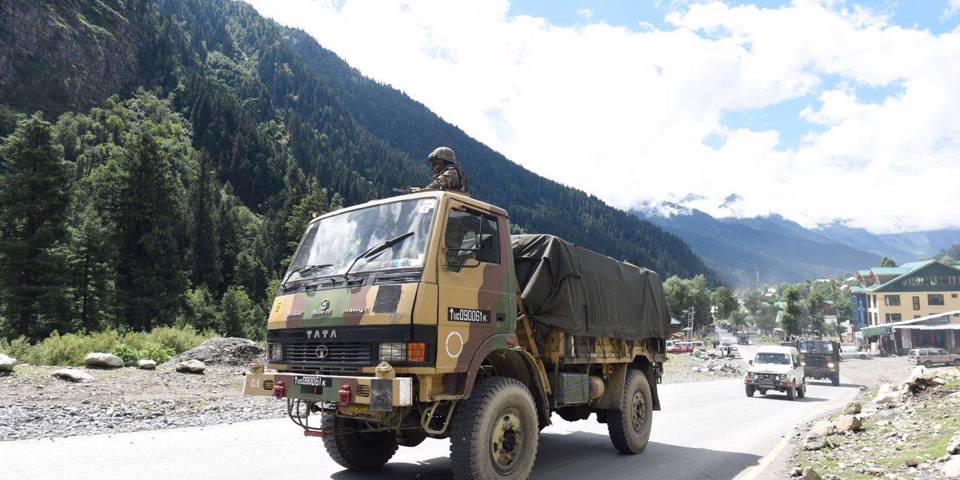
India’s daring seizure of the heights has drawn international attention to its secretive, all-Tibetan Special Frontier Force, established after Mao Zedong’s 1962 war with India. The itch to fight the occupiers of their homeland has drawn Tibetan recruits to this force.

Xi, China’s most powerful leader since Mao, is working to complete Mao’s expansionist vision, from the East and South China Seas to the Himalayan region. But his aggression against India may not be progressing as planned.

His real achievement may be sowing the seeds of the world’s next big conflict and ensuring the rise of a more antagonistic India. This means Tibet’s shadow will only grow longer over China-India relations in the coming years.

© Nikkei Asia, 2020.

Tokyo must thwart Beijing’s Senkaku strategy

Deception, concealment and surprise are central to China’s strategy to win without fighting. Japan’s passive and reactive mode has emboldened China to step up incursions into the waters around the Senkaku Islands. | REUTERS

By BRAHMA CHELLANEY, The Japan Times

The understanding reached between Prime Minister Yoshihide Suga and Chinese President Xi Jinping to pursue high-level contacts is unlikely to stem China’s incursions into the Senkaku territorial waters and airspace. But it will allow Xi’s regime to blend engagement with containment, including challenging Japan’s control of the Senkaku Islands and strengthening Chinese claims of sovereignty over them.

Chinese Foreign Minister Wang Yi’s proposed visit to Tokyo will likely have the same core agenda that his recent trip to Europe had — to avert economic decoupling from China and dissuade U.S. allies from supporting Washington’s moves to impose checks on the exercise of Chinese power. China, however, is unwilling to curb its economic and territorial expansionism.

In fact, Xi continues to push the boundaries, as underscored by the multiple fronts he has opened simultaneously, including in the East and South China seas, the Himalayan frontier, Hong Kong and Taiwan. Yet, Xi has sought to portray China as a country of peace, telling the United Nations General Assembly on Sept. 22, “We will never seek hegemony, expansion, or sphere of influence. We have no intention to fight either a cold war or a hot war with any country. We will continue to narrow differences and resolve disputes with others through dialogue and negotiation.”

Xi’s words rang hollow, especially as they came amid the border aggression he has launched against India since April, when the People’s Liberation Army made stealth encroachments on the highlands of Indian Ladakh. The intrusions have triggered a major India-China military standoff along one of the world’s most inhospitable and treacherous borders, which is as long as the distance between Tokyo and Hanoi.

There are important parallels between the way China is pursuing its territorial revisionism against its two main rivals in Asia, Japan and India. Indeed, China is pursuing a strategy of attrition and containment against both.

More fundamentally, Xi’s regime is pushing expansive territorial claims in Asia on the basis of revisionist history, not international law. Its weak legal case was highlighted by an international arbitral tribunal’s 2016 ruling that invalidated its claims in the South China Sea.

In international law, a territorial claim must be based on continuous and peaceful exercise of sovereignty over the territory concerned. There is absolutely no evidence that China ever had effective control over, for example, the Senkaku Islands.

In fact, China began claiming the Senkakus only after a United Nation agency’s report in 1969 referred to the possible existence of oil reserves in the East China Sea. It was not until the early 1970s that Chinese documents began applying the name “Diaoyu” to the Senkakus and claiming they were part of China.

Sinicizing the names of territories it claims is an old tactic of the Chinese Communist Party. The CCP’s record also reveals its penchant to create a dispute out of the blue by claiming that the territory it covets was part of China since ancient times.

Under Xi, China’s incursions into the Senkaku territorial waters and airspace have steadily intensified, not just in frequency but also with the entry of larger vessels and armed ships. In recent months, China has sought to even police the waters off the Senkakus.

If history is not to be repeated, Suga should draw some lessons, including from the record of his predecessor, Shinzo Abe.

The first lesson is that establishing better relations with Beijing doesn’t necessarily yield better Chinese behavior. Xi’s aggressive revisionism is unaffected by diplomatic progress.

For example, Abe’s 2018 visit to Beijing was instrumental in helping improve ties with China. Yet the ensuing diplomatic progress, far from reining in China’s aggressive actions, engendered increasing Chinese intrusions, including the longest series of incursions into Japanese waters in years.

A second lesson is that responding with notable restraint to China’s belligerence only encourages Beijing to further up the ante. Consider the startling fact that no Japanese defense minister has ever conducted an aerial survey of the Senkakus. In August, the then-defense minister, Taro Kono, decided to break that taboo but then backed off “so as not to provoke China.”

Such shrinking from purely defensive action explains why an emboldened China has stepped up incursions. Japan needs to strengthen its administrative and security control over the Senkakus.

A third lesson relates to China’s strategy. Deception, concealment and surprise are central to China’s strategy to win without fighting. It adheres to the ancient theorist Sun Tzu’s advice, “The ability to subdue the enemy without any battle is the ultimate reflection of the most supreme strategy.”

This approach involves taking an adversary by surprise, including seizing an opportunistic timing, and camouflaging offense as defense.

China’s war of attrition against Japan over the Senkakus has already disturbed the status quo, including by making the international community recognize the existence of a dispute and by regularizing Chinese incursions. China persists with its recklessly provocative actions, including ignoring the risk that an incident could spiral out of control.

A fourth lesson is that as long as China perceives strategic benefits as outweighing costs, Xi will persist with his strategy of attrition against Japan. Xi’s strategy is imposing greater security costs on Japan than on China.

Against this background, a Chinese strike against the Senkaku Islands could conceivably come when Japan has been lulled into complacency and least expects an attack. This is what happened to India. Indian Prime Minister Narendra Modi did not see the Chinese aggression coming because his vision had been clouded by the naive hope that, by meeting Xi 18 times in about five years, he had reset the bilateral relationship.

China’s aim against Japan is to progressively alter the territorial status quo in its favor. Despite the Suga-Xi understanding, Chinese provocations could escalate.

Japan has spent years being on the defensive, allowing China to keep the initiative. It is past time for Tokyo to come out of its reactive mode and turn the tables on China’s machinations by responding assertively. It must frustrate China’s strategy of incrementally altering the status quo without incurring substantive costs.

Japan ought to look at ways to impose costs. This could include first warning Beijing that its provocative actions, such as chasing Japanese fishing vessels within Japanese territorial waters, would henceforth be firmly countered. If provocative actions persist despite the warning, the Japan Coast Guard could selectively act against some intruding Chinese state ships.

To be sure, effectively countering Chinese incursions demands more than ramming or disabling intruding ships and detaining their crews. It calls for an important shift in Japan’s policies, including building defensive facilities in the Senkakus. Japan could begin modestly by building an environmental monitoring station in the Senkakus.

China, of course, will react furiously to any Japanese counteractions. But at a time when the international environment is turning hostile to Xi’s expansionism, Japan must display strength and resolve. If not, China will bring Japanese security under increasing pressure in the coming years.

Japan has a strong case, anchored in international law, that it has exercised sovereignty over the Senkakus since 1895. But make no mistake: The future of the Senkakus will not be decided by international law, even though a just, rules-based order is essential for international peace and security.

The South China Sea is a reminder that international law is powerless against the powerful. China has turned its contrived historical claims in the South China Sea into reality and gained strategic depth, despite the international tribunal’s ruling against it.

Japan undoubtedly faces hard choices. But accommodation with an unyielding China is simply not possible.

Without concrete counteractions, Japan will increasingly find itself at the receiving end of China’s muscular revisionism. To stop its security from coming under siege, Japan must act — with calm, confidence and firmness.

Brahma Chellaney is a geostrategist and the author of nine books, including “Water: Asia’s New Battleground,” the winner of the Bernard Schwartz Award.

China is Paying a High Price for Provoking India

For Xi Jinping, the COVID-19 pandemic – which has preoccupied the world’s governments for months – seemed like an ideal opportunity to make quick progress on his expansionist agenda. But by provoking India, he may have bitten off more than he can chew.

An Indian Army convoy on its way to the frontlines on September 7, 2020. (Photo via Getty Images)

BRAHMA CHELLANEYProject Syndicate

China’s foreign minister, Wang Yi, recently declared that aggression and expansionism have never been in the Chinese nation’s “genes.” It is almost astonishing that he managed to say it with a straight face.

Aggression and expansionism obviously are not genetic traits, but they have defined President Xi Jinping’s tenure. Xi, who in some ways has taken up the expansionist mantle of Mao Zedong, is attempting to implement a modern version of the tributary system that Chinese emperors used to establish authority over vassal states: submit to the emperor, and reap the benefits of peace and trade with the empire.

For Xi, the COVID-19 pandemic – which has preoccupied the world’s governments for months – seemed like an ideal opportunity to make quick progress on his agenda. So, in April and May, he directed the People’s Liberation Army to launch furtive incursions into the icy borderlands of India’s Ladakh region, where it proceeded to establish heavily fortified encampments.

It wasn’t nearly as clever a plan as Xi probably thought. Far from entrenching China’s regional preeminence, it has intensified the pushback by Indo-Pacific powers, which have deepened their security cooperation. This includes China’s most powerful competitor, the United States, thereby escalating a bilateral strategic confrontation that has technological, economic, diplomatic, and military dimensions. The specter of international isolation and supply disruptions now looms over China, spurring Xi to announce plans to hoard mammoth quantities of mineral resources and agricultural products.

But Xi’s real miscalculation on the Himalayan border was vis-à-vis India, which has now abandoned its appeasement policy toward China. Not surprisingly, China remains committed to the PLA’s incursions, which it continues to portray as defensive: late last month, Xi told senior officials to “solidify border defenses” and “ensure frontier security” in the Himalayan region.

India, however, is ready to fight. In June, after the PLA ambushed and killed Indian soldiers patrolling Ladakh’s Galwan Valley, a hand-to-hand confrontation led to the deaths of numerous Chinese troops – the first PLA troops killed in action outside United Nations peacekeeping operations in over four decades. Xi was so embarrassed by this outcome that, whereas India honored its 20 fallen as martyrs, China refuses to admit its precise death toll.

The truth is that, without the element of surprise, China is not equipped to dominate India in a military confrontation. And India is making sure that it will not be caught off guard again. It has now matched Chinese military deployments along the Himalayan frontier and activated its entire logistics network to transport the supplies needed to sustain the troops and equipment through the coming harsh winter.

In another blow to China, Indian special forces recently occupied strategic mountain positions overlooking key Chinese deployments on the southern side of Pangong Lake. Unlike the PLA, which prefers to encroach on undefended border areas, Indian forces carried out their operation right under China’s nose, in the midst of a major PLA buildup.

If that were not humiliating enough for China, India eagerly noted that the Special Frontier Force that spearheaded the operation comprises Tibetan refugees. The Tibetan soldier who was killed by a landmine in the operation was honored with a well-attended military funeral.

India’s message was clear: China’s claims to Tibet, which separated India and China until Mao Zedong’s regime annexed it in 1951, are not nearly as strong as it pretends they are. Tibetans view China as a brutally repressive occupying power, and those eager to fight the occupiers flocked to the Frontier Force, established after Mao’s 1962 war with India.

Here’s the rub: China’s claims to India’s vast Himalayan borderlands are based on their alleged historical links to Tibet. If China is merely occupying Tibet, how can it claim sovereignty over those borderlands?

In any case, Xi’s latest effort to gain control of territories that aren’t China’s to take has proved far more difficult to complete than it was to launch. As China’s actions in the South China Sea demonstrate, Xi prefers asymmetrical or hybrid warfare, which combines conventional and irregular tactics with psychological and media manipulation, disinformation, lawfare, and coercive diplomacy.

But while Xi managed to change the South China Sea’s geopolitical map without firing a shot, it seems clear that this will not work on China’s Himalayan border. Instead, Xi’s approach has placed the Sino-Indian relationship – crucial to regional stability – on a knife edge. Xi wants neither to back down nor to wage an open war, which is unlikely to yield the decisive victory he needs to restore his reputation after the border debacle.

China might have the world’s largest active-duty military force, but India’s is also massive. More important, India’s battle-hardened forces have experience in low-intensity conflicts at high altitudes; the PLA, by contrast, has had no combat experience since its disastrous 1979 invasion of Vietnam. Given this, a Sino-Indian war in the Himalayas would probably end in a stalemate, with both sides suffering heavy losses.

Xi seems to be hoping that he can simply wear India down. At a time when the Indian economy has registered its worst-ever contraction due to the still-escalating COVID-19 crisis, Xi has forced India to divert an increasing share of resources to national defense. Meanwhile, ceasefire violations by Pakistan, China’s close ally, have increased to a record high, raising the specter of a two-front war for India. As some Chinese military analysts have suggested, Xi could use America’s preoccupation with its coming presidential election to carry out a quick, localized strike against India without seeking to start a war.

But it seems less likely that India will wilt under Chinese pressure than that Xi will leave behind a legacy of costly blunders.  With his Himalayan misadventure, Xi has provoked a powerful adversary and boxed himself into a corner.

Brahma Chellaney

Brahma Chellaney, Professor of Strategic Studies at the New Delhi-based Center for Policy Research and Fellow at the Robert Bosch Academy in Berlin, is the author of nine books, including Asian Juggernaut; Water: Asia’s New Battleground; and Water, Peace, and War: Confronting the Global Water Crisis.

© Project Syndicate, 2020.

China’s expansionist agenda takes shape on the Indian border

BRAHMA CHELLANEY, Special to The Globe and Mail

As the past weekend’s latest skirmishes between rival troops underscore, relations between the demographic titans, China and India, have hit a low not seen since their 1962 war. The two countries haveforward-deployedtens of thousands of troops and are now locked in a tense military standoff along one of the world’s most inhospitable and treacherous borders, which is as long as the distance between Toronto and Los Angeles.

The clash of the titans, triggered by a series of furtive Chinese encroachments on key vantage points in India’s northernmost borderlands, has received limited international attention. However, the spectre of further troop clashes or a 1962-style Himalayan war continues to loom, despite continuing bilateral efforts to disengage rival forces.

The confrontation highlights Chinese President Xi Jinping’s muscular revisionism, which has led him to open multiple fronts simultaneously – from the South and East China seas and the Himalayas to Hong Kong and Taiwan. Mr. Xi’s expansionism hasn’t spared the tiny country of Bhutan.

While India was wrestling with the outbreak of the Wuhan-originating coronavirus by enforcing the world’s strictest lockdown, China carried out swift and well co-ordinated incursions into the borderlands of India’s high-altitude Ladakh region from late April. Deception and surprise are integral to the Chinese strategy, even in peacetime. The aggression in Ladakh came just six months after Mr. Xi declared on Indian soil that “China-India relations have entered a new phase of sound and stable development.”

China’s intrusions into Ladakh differ from its previous Asian territorial grabs under Mr. Xi in one key aspect. China went beyond its usual practice of occupying vacant border spaces by snatching territories from right under another country’s nose.

The territorial expansion in the South China Sea by China,for example, has centred on capturing disputed but unoccupied shoals and reefs and then using construction activities to turn them into militarized artificial islands. Since Mr. Xi ordered the launch of major land reclamation in 2013, China has changed the South China Sea’s geopolitical map without firing a shot.

An Indian army convoy drives towards Leh, on a highway bordering China, on June 19, 2020, in Gagangir, India. YAWAR NAZIR/GETTY IMAGES

In 2017, China captured the unoccupied and desolate Himalayan plateau of Doklam, which Bhutan claims as its territory. The occupation came soon after China ended a more than 10-week-long troop faceoff on the plateau with India, Bhutan’s de facto security guarantor.

This summer, Mr. Xi’s communist regime laid claim to another 11 per cent of Bhutan territory, in an area that can be accessed only through India’s Arunachal Pradesh state (which Chinese maps already show as part of China). The move thus sought to advance Mr. Xi’s efforts against both Bhutan and Arunachal Pradesh.

In the East China Sea, meanwhile, China has stepped up incursions into the Japanese-administered Senkaku Islands’ territorial waters and airspace, with the aim of weakening Japan’s control and strengthening its own sovereignty claims. By bringing Japan’s security increasingly under pressure, China is signalling that the U.S. alliance system is not an answer to its aggressive revisionism.

Against this background, Mr. Xi’s aggression against India appears to mark the start of a more daring new phase in his expansionism. As U.S. national security advisor Robert O’Brien has said, “the Chinese have been very aggressive with India” lately.

The Chinese encroachments have led to multiple rounds of clashes with Indian troops in Ladakh. The deadliest occurred on June 15, leaving 20 Indian soldiers, and an unknown number of Chinese troops, dead. While India honoured its fallen as martyrs, China still refuses to divulge its losses. U.S. intelligence agencies believe China suffered more casualties than India.

A model head in the likeness of Chinese President Xi Jinping is hung upside down from a building by Tibetan activists during a protest in Dharmsala, India, on July 23, 2020. ASHWINI BHATIA/THE ASSOCIATED PRESS

Mr. Xi’s Himalayan expansionism has sought to take off from where Mao Zedong left. Mao considered Tibet (which he annexed in 1951) to be China’s right-hand palm, with five fingers – Bhutan, Nepal and the three Indian territories of Ladakh, Arunachal Pradesh and Sikkim. The five fingers were also to be “liberated.” In fact, Mao’s 1962 war against India helped China to gain more territory in Ladakh, after it earlier grabbed a Switzerland-sized chunk, the Aksai Chin plateau.

As long as Mr. Xi, like Mao, perceives the strategic benefits as outweighing the international costs, he will persist with his campaign of expansionism.

But by seeking to start the world’s next big conflict with India, Mr. Xi is likely to end up pushing that country closer to the United States and creating an adversarial bloc around China. Already, international attitudes toward Mr. Xi’s regime have hardened and many countries and companies have begun re-evaluating China-dependent supply chains for essential goods.

Brahma Chellaney is a geostrategist and the author of nine books, including Water: Asia’s New Battleground.

China Alone

As long as the costs of expansionism remain manageable, Chinese President Xi Jinping will stay the course, seeking to exploit electoral politics and polarization in major democracies. The Indo-Pacific’s major democratic powers must not let that happen, which means ensuring that the costs for China do not remain manageable for long.

U.S President Donald Trump does a fist bump with Japan’s Prime Minister, Shinzo Abe, and India’s Prime Minister, Narendra Modi, during a trilateral meeting on the first day of the G20 summit on June 28, 2019 in Osaka, Japan. (Photo by Carl Court/Getty Images)

BRAHMA CHELLANEYProject Syndicate

In his most recent New Year’s speech, Chinese President Xi Jinping declared that 2020 would be “a milestone.” Xi was right, but not in the way he expected. Far from having “friends in every corner of the world,” as he boasted in his speech, China has severely damaged its international reputation, alienated its partners, and left itself with only one real lever of power: brute force. Whether the prospect of isolation thwarts Xi’s imperialist ambitions, however, remains to be seen.

Historians will most likely view 2020 as a watershed year. Thanks to COVID-19, many countries learned hard lessons about China-dependent supply chains, and international attitudes toward China’s communist regime shifted.

The tide began to turn when it was revealed that the Communist Party of China hid crucial information from the world about COVID-19, which was first detected in Wuhan – a finding confirmed by a recent US intelligence report. Making matters worse, Xi attempted to capitalize on the pandemic, first by hoarding medical products – a market China dominates – and then by stepping up aggressive expansionism, particularly in the Indo-Pacific region. This is driving rapid change in the region’s geostrategic landscape, with other powers preparing to counter China.

For starters, Japan now seems set to begin cooperating with the Five Eyes – the world’s oldest intelligence-gathering and -sharing alliance, comprising Australia, Canada, New Zealand, the United Kingdom, and the United States. A new “Six Eyes” alliance would serve as a crucial pillar of Indo-Pacific security.

Moreover, the so-called Quad – comprising Australia, India, Japan, and the US – seems poised to deepen its strategic collaboration. This represents a notable shift for India, in particular, which has spent years attempting to appease China.

As US National Security Adviser Robert O’Brien recently noted, “the Chinese have been very aggressive with India” lately. Since late April, the People’s Liberation Army has occupied several areas in the northern Indian region of Ladakh, turning up the heat on a long-simmering border conflict. This has left Indian Prime Minister Narendra Modi with little choice but to change course.

Modi is considering inviting Australia to participate in the annual Malabar naval exercise with Japanese, American, and Indian forces later this year. Australia withdrew from the exercise in 2008 when it involved only the US and India. Although Japan’s participation was regularized in 2015, India had hesitated to bring Australia back into the fold, for fear of provoking China. Not anymore. With Australia again involved in Malabar, the Quad grouping will have a formal, practical platform for naval drills.

Already, cooperation among Quad members is gaining some strategic heft. In June, Australia and India signed the Mutual Logistics Support Arrangement to increase military interoperability through bilateral defense activities. India has a similar pact with the US and is set to sign one with Japan shortly.

Japan, for its part, recently added Australia, India, and the UK as defense intelligence sharing partners by tweaking its 2014 state secrets law, which previously included exchanges only with the US. This will strengthen Japanese security cooperation under 2016 legislation that redefined Japan’s US-imposed pacifist post-war constitution in such a way that Japan may now come to the aid of allies under attack.

Thus, the Indo-Pacific’s democracies are forging closer strategic bonds in response to China’s increasing aggression. The next logical step would be for these countries to play a more concerted, coordinated role in advancing broader regional security. The problem is that American, Australian, Indian, and Japanese security interests are not entirely congruent.

For India and Japan, the security threat China poses is much more acute and immediate, as shown by China’s aggression against India and its increasingly frequent incursions into Japanese waters. Moreover, India is the only Quad member that maintains a land-based defense posture, and it faces the very real prospect of a serious conflict with China on its Himalayan border.

The US, by contrast, has never considered a land war against China. Its primary objective is to counter China’s geopolitical, ideological, and economic challenges to America’s global preeminence. America’s pursuit of this objective will be President Donald Trump’s most-consequential foreign-policy legacy.

Australia, meanwhile, must engage in a delicate balancing act. While it wants to safeguard its values and regional stability, it remains economically dependent on China, which accounts for one-third of its exports. So, even as Australia has pursued closer ties with the Quad, it has spurned US calls to join naval patrols in the South China Sea. As its foreign minister, Marise Payne, recently declared, Australia has “no intention of injuring” its relationship with China.

If China continues pursuing an expansionist strategy, however, such hedging will no longer be justifiable. Japanese Defense Minister Taro Kono recently declared that the “consensus in the international community” is that China must be “made to pay a high price” for its muscular revisionism in the South and East China seas, the Himalayas, and Hong Kong. He is right – the emphasis is on “high.”

As long as the costs of expansionism remain manageable, Xi will stay the course, seeking to exploit electoral politics and polarization in major democracies. The Indo-Pacific’s major democratic powers must not let that happen, which means ensuring that the costs for China do not remain manageable for long.

Machiavelli famously wrote that, “It is better to be feared than loved.” Xi is not feared so much as hated. But that will mean little unless the Indo-Pacific’s major democracies get their act together, devise ways to stem Chinese expansionism, reconcile their security strategies, and contribute to building a rules-based regional order. Their vision must be clarified and translated into a well-defined policy approach, backed with real strategic weight. Otherwise, Xi will continue to use brute force to destabilize the Indo-Pacific further, possibly even starting a war.

© Project Syndicate, 2020.

India faces crunch time as China digs in

Claims lines in Ladakh historically.

Brahma Chellaney, The Hindustan Times

By occupying key vantage points in eastern Ladakh in an operation backed by tens of thousands of troops in the rear, China has entered a dangerous new phase in its territorial expansionism. It has brazenly seized areas that were under India’s military control or patrolling jurisdiction.

In fact, China intruded into areas located beyond any claim line it has ever published, including its 1956, 1959 and 1960 claim lines in Ladakh. Demonstrating ever-expanding claims, its forces intruded into the Hot Springs-Gogra-Kongka La region and the Depsang Y-Junction and also right up to Galwan River’s mouth and up to Pangong Lake’s Finger 4.

India, facing up to what its defence ministry calls “unilateral aggression,” has made it amply clear to China that it will settle for nothing less than a full return to status quo ante. India’s message to Beijing is that refusing to roll back its encroachments will cast a growing shadow over the bilateral relationship. Publicly, too, India has cautioned that China’s border hostilities will damage bilateral ties.

There has been no national debate, however, on India’s options to restore status quo ante. China seems determined to hold on to its territorial gains, which explains its statement that disengagement is mostly over. Indeed, it has used military and diplomatic talks to demand Indian acquiescence in the new status quo. The protracted talks have also helped it to consolidate its hold on the land grabs, including by building fortifications and installing fibre optic cables.

China has achieved its territorial gains in the same way it made territorial grabs elsewhere in Asia since the 1980s — below the threshold of armed conflict, without firing a shot. Today, it is trying to dictate a Hobson’s choice to India, like it did when it captured Doklam: Go along with the changed status quo or risk an open war. Believing time is on its side, China is seeking to wear India out in order to present a fait accompli.

Against this background, India’s options are clearly narrowing. The longer India has waited, the harder it has become to militarily push back the intruding Chinese forces and restore status quo ante. Imagine if India had dealt with China’s incursions as soon as it discovered them in early May, instead of restraining its forces and entering into unproductive talks. Indian efforts to obscure the intrusions and troop clashes only led to newer Chinese encroachments. As an August 4 defence ministry note points out, China made fresh intrusions into Kugrang, Gogra and Pangong on May 17-18.

India has the world’s most-experienced army in hybrid mountain warfare. Contrary to conventional wisdom that China holds a significant military advantage, several recent international assessments underscore that India’s air and ground forces have a qualitative edge over the People’s Liberation Army. India’s weakness is a reactive and risk-averse strategic culture.

India’s failure to employ its counterattack capability undermined its negotiating position. Instead of a “seize, hold and talk” strategy to clinch an equitable deal, India brought little to the negotiating table, thus allowing China to reinforce its bargaining power. This is apparent from China’s absurd new demands that India further retreat from Pangong and vacate the Kugrang heights.

India now faces crunch time. If it is not going to end up validating China’s forcible realignment of the Line of Actual Control, India must inflict substantive costs on the aggressor. Imposing significant economic and diplomatic costs, coupled with the application of coercive military pressure, holds the key. India must speak from a position of strength. Its professional, battle-hardened armed forces, coupled with its trade and diplomatic leverage, give it that strength.

The only way China will roll back its aggression is if India begins exacting mounting costs that make its territorial gains unbeneficial to hold. The costs India has sought to impose thus far have proved woefully inadequate to make Beijing end its aggression.

A calibrated imposition of progressively escalating costs has become imperative. Economically, India’s main steps thus far — banning Chinese mobile apps and restricting Chinese companies’ access to Indian government contracts — need to be supplemented with informal trade sanctions. Chinese exports to India are still running at more than $5 billion a month, with July witnessing a surge. Now is the time for India to leverage its buying power to correct its massive trade deficit with China.

At a time when the international environment is turning hostile to China’s ambitions, India must launch a diplomatic offensive to spotlight the Chinese aggression. India’s reticence to name and shame China seems unfathomable. Even amid its aggression, China has had no hesitation in raking up the Jammu and Kashmir issue at the United Nations Security Council.

As a warning shot across Beijing’s bow, India should rescind its 2006 decision allowing China to reopen its consulate in Kolkata, given China’s designs on the Siliguri Corridor. That decision was made despite Beijing’s refusal to let India reopen its Lhasa consulate. The Kolkata and Lhasa consulates were shut following Mao Zedong’s 1962 war against India.

Meanwhile, the highest-level visit by a US cabinet official to Taiwan since 1979 has served as an example for India to loosen its own one-China policy by living up to then Foreign Minister Sushma Swaraj’s promise in 2014 — that the one-China policy would henceforth be predicated on China’s adoption of a one-India policy. For starters, the prime minister may like to meet the Dalai Lama and say he sought the Tibetan leader’s counsel regarding China.

India, subscribing to hard-nosed realpolitik, has no choice but to impose costs that cumulatively outweigh Beijing’s aggression gains. Without such a course, China could not only escape scot-free but also reap rewards of aggression and become a bigger threat.

Brahma Chellaney is a geostrategist.

© The Hindustan Times, 2020.

Japan must curb Chinese aggression surrounding the Senkaku Islands

Tokyo should respond to future incursions by disabling ships and detaining crew

A Chinese fishing boat, left, cruises next to Japan Coast Guard vessel in the East China Sea in February 2013; a Chinese strike against the Senkaku Islands could come when Japan least expects it.   © 11th Regional Coast Guard Headquarters/Reuters

Brahma Chellaney, Nikkei Asian Review

Beijing’s stealth aggression against India along the Himalayan border represents a geostrategic sea change. Given China’s stepped-up incursions in or near Japanese waters, this has serious implications for Japan as well.

As part of President Xi Jinping’s aggressive expansionism, China is pursuing a strategy of attrition, friction and containment against Japan and India — its two potential peer rivals in Asia — in order to harass, encumber and weigh them down. This includes China’s efforts to police the waters off the Japanese-administered Senkaku Islands in recent months in order to weaken Japan’s control and strengthen its own sovereignty claims.

More broadly, Xi’s regime is pushing expansive claims on the basis of an ingenious principle — “what is ours is ours and what is yours is negotiable.” This has been underscored by China’s newly minted claim to tiny Bhutan’s eastern region, which shares a border only with India. Perhaps the only time since the end of World War II that one state has laid claim to territory that can only be accessed via another country, China has sought to simultaneously advance its designs against Bhutan and India.

And when Tokyo lodged a protest last month after a Chinese government ship conducted marine research activity in the exclusive economic zone off Japan’s southernmost point, Beijing responded that “Japan’s unilateral claim [to an EEZ there] has no legal basis.” Some in China are even questioning Japanese sovereignty over Okinawa.

China’s various territorial claims, from the East China Sea to the Himalayas, are based not on international law but on alleged history. The Chinese Communist Party’s practice is to furtively occupy another nation’s territory and then claim that the captured area was part of China since ancient times.

Japan could learn from the CCP’s practices and from India’s mistakes that made it the target of China’s latest aggression. After all, China’s strategy against Japan is fairly similar to the one it is pursuing against India.

Incremental advances by stealth below the threshold of war are integral to China’s strategy. Admiral Philip Davidson warned in 2018 before taking over as the U.S. Indo-Pacific commander that China was likely to continue “to coerce Japan without sparking a crisis or conflict.”

The first lesson for Japan is that China’s aggressive actions bear no relation to the state of bilateral ties with the country it targets, as shown by the fact that the Chinese aggression in Ladakh came just six months after Xi declared during an India visit that “China-India relations have entered a new phase of sound and stable development.”

Another sign that the CCP’s revanchism is unaffected by ostensible improvements in bilateral relations was the 2019 increase in Chinese incursions into the Senkaku territorial waters and airspace compared to the previous year.

Attempts to placate Beijing also tend to backfire. After Narendra Modi became Indian prime minister in 2014, he bent over backward to befriend China, including delisting it as a “country of concern” and halting official contact with the Dalai Lama. For nearly six years, Modi ignored all warning signs, including a rising tide of Chinese incursions, especially into Ladakh, and China’s capture of the Bhutan-claimed Doklam Plateau following a 73-day standoff with Indian troops there.

There is a cautionary tale for Japan here. Tokyo, since Prime Minister Shinzo Abe’s 2018 visit to Beijing, has emphasized improving ties with Beijing and responded with conspicuous restraint to the longest series of Chinese incursions into Japanese waters in years.

After its disastrous 1979 invasion of Vietnam, China developed a strategy of winning without fighting. Deception, concealment and surprise have driven its bulletless aggressions, from seizing Johnson Reef in 1988 and Mischief Reef in 1995, to occupying the Scarborough Shoal in 2012.

And now China occupies several vantage points in Indian Ladakh, perhaps following ancient Chinese military strategist Sun Tzu’s advice to “plan for what is difficult while it is easy” by striking when a distracted India was busy wrestling with the coronavirus outbreak.

All of which suggests that a Chinese strike against the Senkaku Islands could come when Japan least expects it.

India’s deeply rooted reactive culture has allowed China to keep the initiative, including when and how to needle India or infringe its sovereignty. Japan, too, has spent years being on the defensive and must come out of its reactive and pacifist mode to safeguard its long-term security. A more secure Japan will also help underpin peace in the Indo-Pacific region.

Today, Japan needs to deal with a more immediate challenge. Once the China-set suspension of fishing around the Senkaku Islands ends on August 16, Chinese provocations could escalate, with the possible entry of many Chinese fishing boats and Coast Guard ships. After all, China’s aim is to progressively alter the status quo in its favor.

It is past time for Tokyo to turn the tables on China’s machinations by responding assertively, including disabling Chinese state ships and detaining their crews when they engage in provocative activities, such as chasing Japanese fishing vessels. Otherwise, Japan will increasingly find itself at the receiving end of China’s muscular revisionism.

Brahma Chellaney is a geostrategist and author of nine books, including “Asian Juggernaut: The Rise of China, India and Japan.”

© Nikkei Asian Review, 2020.