Unknown's avatar

About Chellaney

Professor, strategic thinker, author and commentator

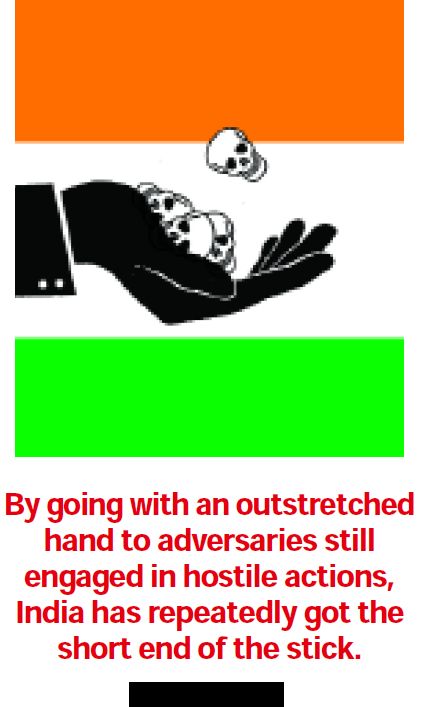
China’s game plan is to keep India on the back foot

Brahma Chellaney, Mint, July 31, 2013

An increasingly assertive China has indisputably emerged as India’s immediate strategic challenge. While erring on the side of caution is prudent, strategic diffidence and tentativeness are likely to exact increasing costs. The more feckless and fearful a policy, the more pressures it is bound to invite.

India’s current China policy indeed exemplifies how meekness attracts bullying. The more timorous India has been, the more belligerent China has become.

A key defining event has been the three-week Chinese military incursion into Ladakh’s Depsang plateau, which ended on May 7 only after India virtually capitulated by demolishing a line of new defensive fortifications in the Chumar region, 400 kilometres to the south, and agreeing to consider a Chinese-drafted “Border Defence Cooperation Agreement”. Since then, an emboldened China has escalated its military pressure on India.

Its provocations have included several military forays into Chumar — a lightening raid on June 17 to smash up surveillance equipment was followed by more incursions on July 16-17, 18 and 20. Depsang was the scene of a 28-kilometre-deep Chinese intrusion on July 12. Border transgressions also occurred this month in Arunchal’s Dichu and Uttarakhand’s Barahoti areas.

Yet this spate of incursions has received little attention as the Indian state, mired in petty politics, remains woefully adrift. Indeed, the government kept the June 17 Chinese raid under wraps for three weeks for fear that news about it would provoke public pressure to cancel the impending separate visits to Beijing of the national security adviser and defence minister. Similarly, to safeguard the Chinese premier’s visit earlier, New Delhi — as if reading from the aggressor’s script in Chinglish — tried to pass off the watershed event at Depsang as a “small little spot” of “acne” treatable with “an ointment”.

China’s newest provocations, in fact, draw encouragement from its bloodless victory when it sneaked troops into Depsang and then, employing the threat of escalation, extracted Indian concessions. One of the concessions — suspension of forward patrolling in Chumar — has created the opening for stepped-up Chinese intrusions, designed to assert claims to that highly strategic area overlooking the Tibet-Xinjiang highway.

By making India remove fortifications and halt forward patrolling in Chumar, China accomplished two objectives — securing India’s acquiescence to Chinese-defined constraints on deployment and surveillance and an Indian acknowledgment, even if tacit, that the area is disputed. Pursuit of the next objective will likely witness Beijing’s call for “mutual accommodation” and “mutual respect” to achieve a dispute resolution on the basis of a now-familiar Chinese dictum — “what is ours is ours to keep, but what is yours must be on the negotiating table to be settled through give-and-take”.

To cover up its entrenched strategic timidity, however, New Delhi has flaunted its go-ahead for establishing a new mountain strike corps — a clearance that should have come several years earlier and without media hype. Yawning gaps in India’s Himalayan defences remain unplugged owing to sluggish decision-making. Even as China develops and deploys capabilities quietly, New Delhi advertises any deterrence move, however nascent.

It will take India probably up to seven years to establish and fully deploy the new strike corps. But the government has already betrayed its trademark meekness by deciding to deploy the new strike corps, or any of its formations, not where most needed — Arunachal Pradesh — but in West Bengal and elsewhere so as not to raise the hackles of Beijing, which calls Arunachal “disputed territory”. This is just one example of how New Delhi allows Beijing to dictate terms to it.

Consider another, more mortifying example: China’s draft Border Defence Cooperation Agreement is receiving India’s fullest consideration. The draft was handed to India in circumstances that amounted to holding a gun to its head and demanding that it enter into discussions on concluding the agreement. It was given on May 4 before Beijing agreed to dismantle its Depsang encampment.

China’s intent is to keep India at a strategic disadvantage and thus vulnerable to Chinese military pre-emption through an agreed freeze on build-up of border defences and troop levels. The aim clearly is to stymie India’s belated and still-bumbling efforts to enhance its defences and military logistics support.

China has a knack of defining important principles in an accord so as to bind the other party to them by fostering a belief that their mere enunciation represents progress, even as Beijing pays lip service to those principles. In the face of belligerent Chinese actions, however, it has become difficult to keep up the pretence of progress. The Depsang encampment represented a shot through the heart of the border-peace concept central to the existing accords concluded in 1993, 1996 and 2005. China thus wants these accords replaced with a new lopsided agreement to aid its containment-behind-engagement strategy.

But why is New Delhi furthering China’s game plan? Can a draft thrust by China at gunpoint be the basis for negotiating an agreement? As if content to play second fiddle to China, India is offering its comments and suggestions on the Chinese draft. In a July 6 joint statement with his Chinese counterpart, General Chang Wanquan, Defence Minister A.K. Anthony even “agreed to the early conclusion of negotiations” on the proposed agreement. Is India a vanquished nation that had little choice but to embrace an imposed draft as the basis for negotiations?

With India’s lame-duck prime minister scheduled to visit Beijing in November, symbolism will again trump substance. Yet, without a fundamental course correction, India seriously risks courting another 1962-style Himalayan debacle.

Brahma Chellaney is a professor at the Centre for Policy Research in New Delhi.

(c) Mint, 2013.

China’s salami-slice strategy

BY BRAHMA CHELLANEY

The Japan Times, July 26, 2013

China’s furtive, incremental encroachments into neighboring countries’ borderlands — propelled by its relative power advantage — have emerged as a key destabilizing element in the Asian security landscape. While China’s navy and a part of its air force focus on asserting revanchist territorial and maritime claims in the South and East China Seas, its army has been active in the mountainous borderlands with India, trying to alter the line of control bit by bit.

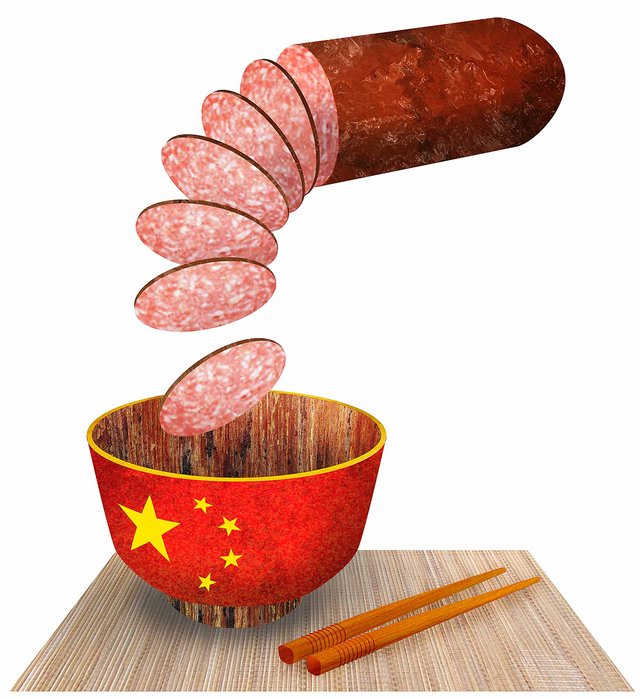
Beijing’s favored frontier strategy to change the territorial and maritime status quo is apparently anchored in “salami slicing.” This involves making a steady progression of small actions, none of which serves as a casus belli by itself, yet which over time lead cumulatively to a strategic transformation in China’s favor.

By relying on quiet salami slicing rather than on overt aggression, China’s strategy aims to seriously limit the options of the targeted countries by confounding their deterrence plans and making it difficult for them to devise proportionate or effective counteractions.

This, in part, is because the strategy — while bearing all the hallmarks of modern Chinese brinksmanship, such as a reliance on surprise and a disregard for the risks of wider military escalation — seeks to ensure the initiative remains with China.

Changing the territorial status quo has been the unfinished business of the People’s Republic of China since its founding in 1949. The early forcible absorption of the sprawling Xinjiang and Tibetan plateau more than doubled the landmass of China.

This was followed by the advent of the earliest incarnation of the salami-slicing strategy, which led to China gaining control, step by step between 1954 and 1962, of the Switzerland-size Aksai Chin plateau of the original princely state of Jammu and Kashmir. An emboldened China then went on to seize the Paracel Islands in 1974, the Johnson Reef in 1988, the Mischief Reef in 1995 and, most recently, the Scarborough Shoal (2012).

At the core of the challenge posed by China to Asian security today is its lack of respect for existing frontier lines. In other words, China is still working to redraw political boundaries.

Along land frontiers, rodent-style surreptitious attacks usually precede its salami slicing. The aim is to start eating into enemy land like giant rodents and thereby facilitate salami slicing. The use of this strategy is becoming increasingly apparent along the Himalayan border with India, the world’s longest disputed frontier.

Here one form of attacks has involved the Chinese military bringing ethnic Han pastoralists to the valleys along the Himalayan line of control and giving them cover to range across it, in the process driving Indian herdsmen from their traditional pasturelands and opening the path to salami slicing. This strategy, which can also begin with the Chinese military nibbling at an unprotected border area, has been especially employed in the two highly strategic Buddhist regions located on opposite ends of the Himalayan frontier — Ladakh and Arunachal Pradesh.

To assert its claims in the South and East China Seas, China unabashedly plays salami slicer. The tools of salami slicing here range from granting hydrocarbon-exploration leases to asserting expansive fishing rights — all designed to advance its territorial and maritime claims.

In the East China Sea, China has employed paramilitary agencies, such as the Maritime Safety Administration, the Fisheries Law Enforcement Command, and the State Oceanic Administration, in a campaign of attrition against Japan over the Senkaku Islands, which it calls Diaoyu — an offensive that has already succeeded in shaking the status quo by making the rest of the world recognize the existence of a dispute. This has emboldened Beijing to gradually increase the frequency of Chinese maritime surveillance ships sent into the 12-nautical-mile zone regarded as the territorial waters of the Senkaku Islands and to violate the airspace over them.

Taking on Japan, its former occupier and historical rival, is part of China’s larger search for new seabed resources and for strategic ascendancy in the western Pacific by breaking out of what it perceives to be “first island chain” — a string that includes the Senkakus, Taiwan, and some islands controlled by Vietnam and the Philippines.

China’s aim in the South China Sea is to slowly but surely legitimize its presence in the 80 percent of the sea it now claims formally. Through repeated and growing acts, China is etching a lasting presence in the claimed zones.

Among the ways Beijing has sought to establish new “facts” on the ground in the South China Sea is to lease hydrocarbon and fishing blocks inside other disputant states’ 200-nautical-mile exclusive economic zones (EEZs), as defined by the United Nations Convention on the Law of the Sea (UNCLOS). Such leases are designed to circumscribe the UNCLOS-granted economic rights of states such as Vietnam and the Philippines while expanding China’s control of the region’s oil-and-gas wealth.

China has even established “Sansha City” on Woody Island in the Paracels as its administrative base for the South China Sea, setting up a local civilian government and a military garrison there to oversee the entire region. And in its latest effort to present a fait accompli over its occupation of the Paracels, it has started tourist cruises to those disputed islands.

To be sure, Beijing usually is careful to slice very thinly so as to avoid any dramatic action that could become a cause of war. Indeed, it has has a knack of disaggregating any action into several parts and then pursuing each element separately in such a manner as to allow the different pieces to fall in place.

This shrewdness helps to keep its opponents off balance and in a bind on how to respond. In fact, as a skillful salami slicer that acts insidiously, camouflaging offense as defense, China acts in ways not only to undercut its opponents’ deterrence but also to cast the burden of starting a war on them.

Any targeted state is presented with a strategic Hobson’s choice: either endure the salami slicing or face a dangerous and costly war with an emerging great power. This is the choice, for example, Manila has faced over China’s effective seizure of the Scarborough Shoal.

China’s tactics and strategy thus pose an increasing challenge to several of its neighbors who face a deepening dilemma over how to thwart the salami slicing. Exchanging notes with each other — and with the United States, the geographically nonresident Asian power — may be necessary to find ways to try and stop this creeping, covert warfare.

After all, China’s multipronged actions, cumulatively, carry the potential of fundamentally altering the Asian power dynamics to shape a Sino-centric region.

Brahma Chellaney is a geostrategist and the author, most recently, of “Water, Peace, and War” (Rowman & Littlefield). 

(c) The Japan Times, 2013.

Afghanistan’s Looming Partition

A Project Syndicate column internationally distributed

The United States, still mired in a protracted Afghan war that has exacted a staggering cost in blood and treasure, has formally opened peace talks with the Taliban, its main battlefield opponent. With the US determined to withdraw its forces after more than a decade of fighting, the talks in Doha, Qatar, are largely intended to allow it to do so “honorably.”

How the end of US-led combat operations shapes Afghanistan’s future will affect the security of countries nearby and beyond. Here the most important question is whether the fate of Afghanistan, which was created as a buffer between Czarist Russia and British India, will be — or should be — different from that of Iraq and Libya (two other imperial creations where the US has intervened militarily in recent years).

Foreign military intervention can effect regime change, but it evidently cannot reestablish order based on centralized government. Iraq has been partitioned in all but name into Shia, Sunni, and Kurdish regions, while Libya seems headed toward a similar tripartite, tribal-based territorial arrangement. In Afghanistan, too, an Iraq-style “soft” partition may be the best possible outcome.

Afghanistan’s large ethnic groups already enjoy de facto autonomy, which they secured after their Northern Alliance played a central role in the US-led ouster of the Taliban from power in late 2001. Having enjoyed virtual self-rule since then, they will fiercely resist falling back under the sway of the Pashtuns, who have ruled the country for most of its history.

For their part, the Pashtuns, despite their tribal divisions, will not be content with control of a rump Afghanistan consisting of its current eastern and southeastern provinces. They will eventually seek integration with fellow Pashtuns in Pakistan, across the British-drawn Durand Line — a border that Afghanistan has never recognized. The demand for a “Greater Pashtunistan” would then challenge the territorial integrity of Pakistan (itself another artificial imperial construct).

The fact that Afghanistan’s ethnic groups are concentrated in distinct geographical zones would simplify partition and make the resulting borders more likely to last, unlike those drawn by colonial officials, who invented countries with no national identity or historical roots. Indeed, both geographically and demographically, Afghanistan’s non-Pashtun groups account for more than half of the country, with Tajiks, Uzbeks, and Hazaras alone making up close to 50% of the population.

After waging the longest war in its history, at a cost of tens of thousands of lives and nearly a trillion dollars, the US is combat-weary and financially strapped. But the American effort to cut a deal with the Pashtun-based, Pakistan-backed Taliban is stirring deep unease among the non-Pashtun groups, which suffered greatly under the Taliban and its five-year rule. (The historically persecuted Hazaras, for example, suffered several large-scale massacres.)

While Afghan President Hamid Karzai has been fickle, to say the least, about cooperation with the Americans (indeed, he has since backed away from participation in the Doha talks), the rupture of his political alliance with non-Pashtun leaders has also fueled ethnic polarization. Some non-Pashtun power brokers continue to support Karzai, but many others are now leading the opposition National Front.

These leaders are unlikely to accept any power-sharing arrangement that includes the Taliban. In fact, they suspect that Karzai’s ultimate goal is to restore Pashtun dominance throughout Afghanistan.

Their misgivings have been strengthened by the “Peace Process Roadmap to 2015,” a document prepared by the Karzai-constituted Afghan High Peace Council that sketches several potential concessions to the Taliban and Pakistan, ranging from the Taliban’s recognition as a political party to a role for Pakistan in Afghanistan’s internal affairs. The roadmap even dangles the carrot of cabinet posts and provincial governorships to prominent Taliban figures.

The most serious problem today is that the country’s ethnic tensions and recriminations threaten to undermine the cohesion of the fledgling, multiethnic Afghan Army. Indeed, the splits today resemble those that occurred when Soviet forces withdrew from Afghanistan in 1989, an exit that led to civil war and the Taliban’s eventual capture of the capital, Kabul.

This time, the non-Pashtun communities are better armed and prepared to defend their interests after the US withdrawal. Thus, in seeking to co-opt the Taliban, the US is not only bestowing legitimacy on a thuggish militia; it also risks unwittingly reigniting Afghanistan’s ethnic strife, which would most likely tear the country apart for good.

This raises a fundamental question: Is Afghanistan’s territorial unity really essential for regional or international security?

To be sure, the sanctity of existing borders has become a powerful norm in world politics. Yet this norm has permitted the emergence of ungovernable and unmanageable states, whose internal wars spill across international boundaries, fueling regional tensions and insecurity.

With a war-exhausted US having run out of patience, outside forces are in no position to prevent Afghanistan’s partition along Iraqi (or even post-Yugoslav) lines, with the bloodiest battles expected to rage over control of ethnically mixed strategic areas, including Kabul. In this scenario, Pakistani generals, instead of continuing to sponsor Afghan Pashtun militant groups (like the Taliban and their allies like the Haqqani network), would be compelled to fend off a potentially grave threat to Pakistan’s unity.

A weak, partitioned Afghanistan may not be a desirable outcome; but a “soft” partition now would be far better than a “hard” partition later, after years of chaos and bloodletting — and infinitely better than the medieval Taliban’s return to power and a fresh reign of terror. Indeed, partition may be the only way to prevent Afghanistan from sliding into large-scale civil war and to thwart transnational terrorists from reestablishing a base of operations in the rubble.

Brahma Chellaney, Professor of Strategic Studies at the New Delhi-based Center for Policy Research, is the author of Asian JuggernautWater: Asia’s New Battleground, and Water, Peace, and War: Confronting the Global Water Crisis.

(c) Project Syndicate, 2013.

China’s Stealth Wars

A Project Syndicate column internationally distributed

Portrait of Brahma Chellaney

China is subverting the status quo in the South and East China Seas, on its border with India, and even concerning international riparian flows ― all without firing a single shot. Just as it grabbed land across the Himalayas in the 1950s by launching furtive encroachments, China is waging stealth wars against its Asian neighbors that threaten to destabilize the entire region. The more economic power China has amassed, the greater its ambition to alter the territorial status quo has become.

Throughout China’s recent rise from poverty to relative prosperity and global economic power, the fundamentals of its statecraft and strategic doctrine have remained largely unchanged. Since the era of Mao Zedong, China has adhered to the Zhou Dynasty military strategist Sun Tzu’s counsel: “subdue the enemy without any battle” by exploiting its weaknesses and camouflaging offense as defense. “All warfare,” Sun famously said, “is based on deception.”

For more than two decades after Deng Xiaoping consolidated power over the Chinese Communist Party, China pursued a “good neighbor” policy in its relations with other Asian countries, enabling it to concentrate on economic development. As China accumulated economic and strategic clout, its neighbors benefited from its rapid GDP growth, which spurred their own economies. But, at some point in the last decade, China’s leaders evidently decided that their country’s moment had finally arrived; its “peaceful rise” has since given way to a more assertive approach.

One of the first signs of this shift was China’s revival in 2006 of its long-dormant claim to Indian territory in Arunachal Pradesh. In a bid to broaden its “core interests,” China soon began to provoke territorial disputes with several of its neighbors. Last year, China formally staked a claim under the United Nations Convention on the Law of the Sea to more than 80 percent of the South China Sea.

From employing its strong trade position to exploiting its near-monopoly on the global production of vital resources like rare-earth minerals, China has staked out a more domineering role in Asia. In fact, the more openly China has embraced market capitalism, the more nationalist it has become, encouraged by its leaders’ need for an alternative to Marxist dogma as a source of political legitimacy. Thus, territorial assertiveness has become intertwined with national renewal.

China’s resource-driven stealth wars are becoming a leading cause of geopolitical instability in Asia. The instruments that China uses are diverse, including a new class of stealth warriors reared by paramilitary maritime agencies. And it has already had some victories.

Last year, China effectively took control of the Scarborough Shoal, an area of the South China Sea that is also claimed by the Philippines and Taiwan, by deploying ships and erecting entry barriers that prohibit Filipino fishermen from accessing their traditional fishing preserve. China and the Philippines have been locked in a standoff ever since. Now the Philippines is faced with a strategic Hobson’s choice: accept the new Chinese-dictated reality or risk an open war.

China has also launched a stealth war in the East China Sea to assert territorial claims over the resource-rich Senkaku Islands (called the Diaoyu Islands in China), which Japan has controlled since 1895 (aside from a period of administration by the United States from 1945 to1972). China’s opening gambit ― to compel the international community to recognize the existence of a dispute ― has been successful, and portends further disturbance of the status quo.

Likewise, China has been posing new challenges to India, ratcheting up strategic pressure on multiple flanks, including by reviving old territorial claims. Given that the two countries share the world’s longest disputed land border, India is particularly vulnerable to direct military pressure from China.

The largest territory that China seeks, Arunachal Pradesh, which it claims is part of Tibet, is almost three times the size of Taiwan. In recent years, China has repeatedly attempted to breach the Himalayan frontier stretching from resource-rich Arunachal Pradesh to the Ladakh region of Jammu and Kashmir ― often successfully, given that the border is vast, inhospitable, and difficult to patrol. China’s aim is to needle India ― and possibly to push the Line of Actual Control (LAC) southward.

Indeed, on April 15, a platoon of Chinese troops stealthily crossed the LAC at night in the Ladakh region, establishing a camp 19 kilometers (12 miles) inside Indian-held territory. China then embarked on coercive diplomacy, withdrawing its troops only after India destroyed a defensive line of fortifications. It also handed a lopsided draft agreement that seeks to freeze the belated, bumbling Indian build-up of border defenses while preserving China’s capability to strike without warning.

India has countered with its own draft designed specifically to prevent border flare-ups. But territory is not the only objective of China’s stealth wars; China is also seeking to disturb the status quo when it comes to riparian relations. Indeed, it has almost furtively initiated dam projects to reengineer cross-border river flows and increase its leverage over its neighbors.

Asian countries ― together with the U.S. ― should be working to address Asia’s security deficit and establish regional norms. But China’s approach to statecraft, in which dominance and manipulation trump cooperation, is impeding such efforts. This presents the U.S., the region’s other leading actor, with a dilemma: watch as China gradually disrupts the status quo and weakens America’s allies and strategic partners, or respond and risk upsetting its relationship with China, the Asian country most integral to its interests. Either choice would have far-reaching consequences.

Against this background, the only way to ensure peace and stability in Asia is to pursue a third option: inducing China to accept the status quo. That will require a new brand of statecraft based on mutually beneficial cooperation ― not brinkmanship and deception.

Brahma Chellaney, Professor of Strategic Studies at the New Delhi-based Center for Policy Research, is the author of Asian JuggernautWater: Asia’s New Battleground, and Water, Peace, and War: Confronting the Global Water Crisis.

(c) Project Syndicate, 2013.

Asia’s pivotal triangle

India has to build on its close ties with Japan to counterbalance an assertive China

India Today, June 3, 2013

ClippedIndia, China and Japan, as they manoeuvre for strategic advantage, are transforming relations between themselves in a way that portends growing strategic collaboration between New Delhi and Tokyo but sharper geopolitical competition between China and the other two Asian powers. This had an echo in two virtually back-to-back summit meetings: the genuine warmth and expansion of substantive cooperation that boosted Prime Minister Manmohan Singh’s Japan visit contrasted vividly with Chinese Premier Li Keqiang’s all-smiles-but-no-compromise approach during his India tour, which, behind the hype, helped to underscore the deep Sino-Indian divide.

Li, who brought a large team of exporters, sought to secure bigger commercial benefits in India—in spite of an already lopsided trade—while safeguarding China’s latitude to box-in India from practically all sides. The visit stood out for the manner it attempted to cloak or underplay the contentious issues and put a positive gloss on the current bilateral relationship.

But just as President Hu Jintao’s 2006 India trip was preceded by Beijing’s jarring resurrection of its long-dormant claim to Arunachal Pradesh in the east and Premier Wen Jiabao’s 2010 tour followed China’s challenge to Indian sovereignty in the western sector, Li also delivered a pre-visit gift—a stealthy, 19-kilometre-deep incursion into Ladakh. The daring military raid after more than six years of increasing Chinese territorial assertiveness should have prompted India to link closer political and commercial engagement with China to substantive progress on the territorial disputes. Yet, a politically besieged Singh responded in a way that can only embolden China to step up its pressure on India.

First, China vindicated its coercive diplomacy by ending the intrusion only after India destroyed defensive fortifications at Chumar to the south and suspended patrolling along the critical borderline there. And second, Li had his way on the joint statement, which omits the standard commitment to try and resolve the border dispute “at an early date”; instead it expresses strange “satisfaction” with never-ending border talks that continue to take India round and round the mulberry bush. Beijing has signalled that it will not cede its territorial and border cards against India.

These are also the cards that China is now wielding against Japan. In the way it is trying to furtively disrupt the territorial and international-river flow status quo in the Himalayas, China launched a stealth war in the East China Sea to assert territorial claims over Japan’s resource-rich Senkaku Islands. China’s opening gambit—to compel the international community to recognize the existence of a dispute—has been successful, and foreshadows further disturbance of the status quo.

Far from allowing its booming bilateral trade to come in the way of its stealth wars against Japan and India, China is employing trade as a political weapon. With China serving as Japan’s largest overseas market, Beijing has sought to punish Tokyo through an informal boycott of Japanese products since last September. For China, trade is also about geostrategic interests. It values the lopsided trade with India as a strategic weapon that undercuts its rival’s manufacturing base, yet yields handsome dividends for it.

The more openly China has embraced market capitalism, the more nationalist it has become, encouraged by its leaders’ political-legitimacy need for an indigenous alternative to the imported but worn-out Marxist dogma. An increasingly muscular foreign policy thus has become intertwined with national renewal.

Cartoon in China’s Global Times (http://goo.gl/hzCCT) mocks Japan-India partnership, with accompanying article warning New Delhi that strategic ties with Tokyo can “only bring trouble to India.”

With China’s rise casting the shadow of a power disequilibrium over Asia, Singh’s Tokyo visit highlighted the imperative for Japan and India to lead an effort to build freedom, prosperity, and sea-lane security in the Indo-Pacific region, the world’s leading trade and energy seaway. Given China’s mercantilist strategy to assert control over natural-resource supplies and their transport routes, the maintenance of a peaceful maritime domain, including unimpeded freedom of navigation, has become critical to the well-being of resource-poor Japan and India.

The fast-growing relationship of these two natural allies is remarkably free of any strategic dissonance. However, meaningful strategic collaboration between them hinges on important shifts in their policies. Japan, America’s treaty ally, has established military interoperability only with U.S. forces. Following its 2008 security-cooperation accord with India, Japan—with Asia’s largest naval fleet—must also build interoperability with Indian naval forces, so that, as Prime Minister Shinzo Abe said in New Delhi before returning to power, “Japan’s navy and the Indian navy are seamlessly interconnected.”

Brahma Chellaney is a strategic thinker and author.

(c) India Today, 2013.

Geostrategic risks of lopsided trade

An asymmetrical trade relationship with China is exposing India to greater strategic pressures and risks while aiding Beijing’s strategy to prevent India’s rise as a peer competitor.

Brahma Chellaney, Mint, May 30, 2013

Chinese territorial assertiveness is obscuring how Beijing is strategically expanding lopsided trade with India to rake in mounting profits while undercutting Indian manufacturing through an avalanche of cheap Chinese-made products. China’s ballooning trade surplus with India is compounded by its import of mainly primary commodities while exporting finished products.

Perpetuating such an asymmetrical relationship presents India in an unflattering light as a raw-material appendage of, and a goods-dumping market for, the Chinese economy. More importantly, the lopsided economic engagement gives China little incentive to bridge a widening political divide with India. If anything, it encourages China to continue with a strategy to keep India under strategic pressure so as to regionally contain it.

With China exporting more than 2½ times as much as it imports, its already large trade surplus will swell if bilateral trade rises from $70 billion currently to the targeted $100 billion in 2015. Economic problems in the West, by contributing to a slowdown in China, have only increased the importance of the Indian market for Beijing. This is what prompted Premier Li Keqiang to choose India as his first overseas destination for an official visit. This factor has also encouraged China’s cash-rich, state-supported banks to offer debt financing to heavily indebted Indian companies that commit to buy Chinese equipment or supply raw materials.

While swamping the Indian market with its products, China has made it difficult for Indian exporters to gain much of a foothold in its own market, including in sectors where India is strong, such as pharmaceuticals and IT. As a result, India’s exports to China largely consist of low-margin, unprocessed commodities. India’s exports have actually slumped since 2012, in part because of legal and other wrangles at home over extraction of iron ore, the leading export item in the past decade to China, which conserves its own reserves of strategic mineral ores to rely on imports.

China’s increasing access to the Indian market has done little to encourage it to pursue a less-adversarial foreign policy. Indeed, the more profits China has reaped, the more assertive it has become. As India’s trade deficit with China has soared from just $1 billion in 2002 to $40 billion in 2013 (or one-third of India’s overall trade deficit), Beijing has, for example, openly challenged Indian sovereignty in the large eastern and western sectors of the Himalayas by playing the Arunachal and Kashmir cards.

Instead of calibrating China’s market access to progress on the political, territorial, and water-resource issues, a politically adrift India is unwittingly doing just the opposite—allowing Beijing to strengthen its leverage against it. The massive trade imbalance with China is worsening India’s current account deficit, pushing the rupee to record lows against the US dollar since last year.

China has effectively turned asymmetrical trade into another instrument to prevent India’s rise as a peer competitor. In fact, China is now leveraging its trade and financial clout—including its role as a major supplier of power and telecom equipment and its emergence as a lender to financially troubled Indian companies—to limit India’s options on countering the Chinese strategic encirclement. An Indian business community dependent on Chinese product supply and financing is lobbying for a continued soft approach towards China, now India’s largest source of imports.

The paradox is that, despite supply of turbines and other equipment, most Chinese exports are not technology items but cheap products that kill small-scale manufacturing and rob jobs in India, with some of them also posing safety risk or public health concern. The bilateral focus on trade, even as China builds up strategic pressure from multiple flanks, aids the Chinese win-win agenda to reap profits while continuing to hem in India.

Consequently, the politics and economics of the relationship are going in opposite directions, to India’s serious detriment. India wrongly bet on rapidly growing trade helping to mute political disputes and moderate Chinese conduct so as to create an environment conducive for settlement of outstanding issues.

For China, trade is not only about economics but also about geostrategic interests. So, it does not allow booming bilateral trade to come in the way of its territorial assertiveness, as the recent Ladakh incursion highlighted. In fact, as underscored by its commercial actions against Japan and the Philippines, it employs trade as a political weapon. With China serving as Japan’s largest overseas market, Beijing has sought to punish Tokyo through an informal boycott of Japanese products since last September.

In this light, any Indian dependency on Chinese imports will carry geostrategic risks. China encourages economic dependencies and then manipulates them to advance its strategic objectives. In its recent territorial feuds with other neighbours, China has bared the cards it is likely to wield when faced with a diplomatic or military crisis next—from employing its trade muscle to inflict commercial pain to exploiting its monopoly on the global production of the vital rare-earth minerals.

So what can India do to prevent China from using its trade prowess for political ends? First, it must avoid any commercial dependency that cannot be easily be substituted with imports from elsewhere.

Second, India must aggressively contain the flood of Chinese-made subsidized goods through countervailing duties and anti-dumping measures that bite, or else it will become harder for it to develop a more mature manufacturing base. Its lodging of anti-dumping cases at the World Trade Organization has proven no deterrent.

And third—in the way China unofficially but assertively links economic issues with political matters—India must not shy away from linking market access to concrete progress on border and water issues. But if push comes to shove, it has the option to take a leaf out of China’s playbook by orchestrating an informal consumer boycott of Chinese products.

Brahma Chellaney is professor of strategic studies at the Centre for Policy Research in New Delhi.

(c) Mint, 2013.

The iron fist in a trade glove

Brahma Chellaney

The Japan Times, May 28, 2013

Trade as a weapon: China promotes economic dependencies and then manipulates them to advance its geostrategic objectives.

Japan and India are natural allies whose fast-growing relationship is remarkably free of any strategic dissonance. So, Indian Prime Minister Manmohan Singh’s Tokyo visit this week stands in sharp contrast to Chinese Premier Li Keqiang’s recently concluded India tour, which, behind the hype, helped to underscore the deep Sino-Indian divide.

India, China and Japan, constituting Asia’s pivotal triangle, are transforming relations between themselves in a way that portends growing strategic collaboration between New Delhi and Tokyo but sharper geopolitical competition between China and the other two Asian powers. The Sino-Indian relationship was recently disturbed by a stealthy incursion across the disputed Himalayan border by the People’s Liberation Army, which pulled back its troops just in time to allow Li to go ahead with a scheduled visit to India.

Li’s visit helped shine a spotlight on a negative aspect extending beyond the Himalayan tensions — India’s ballooning trade deficit with Beijing, compounded by China’s import of mainly primary commodities while exporting finished products. A flood of cheap Chinese-made goods has undercut Indian manufacturing.

The lopsided economic engagement gives China little incentive to bridge a widening political divide with India. If anything, it encourages China to continue with a strategy to keep India under strategic pressure so as to regionally contain that country.

With China exporting more than two-and-half times as much as it imports, its already large trade surplus with India will only swell if the two countries meet their target of raising bilateral trade from the current level of nearly $70 billion to $100 billion by 2015. Its recent border incursion notwithstanding, China has focused on raking in more profits from the Indian market. Li himself underscored the difficulty of correcting the fundamental imbalance in trade by taking mainly exporters in his large business team to India.

Economic problems in the West, by contributing to a slowdown in China, have only increased the importance of the Indian market for Beijing. This is what prompted Li to choose India as his first overseas destination for an official visit. This factor has also encouraged China’s cash-rich, state-supported banks to offer debt financing to heavily indebted Indian companies that commit to buy Chinese equipment or supply raw materials.

While swamping the Indian market with its products, China has made it difficult for Indian exporters to gain much of a foothold in its own market, including in sectors where India is strong, such as pharmaceuticals and information technology. As a result, India’s exports to China largely consist of low-margin, unprocessed commodities.

China’s increasing access to the Indian market, however, has done little to promote a less-adversarial Chinese foreign policy. Indeed, the more profits China has reaped from its trade relationship with India, the more assertive it has become.

As China’s trade surplus with India has soared from just $1 billion in 2002 to $40 billion in 2013, China has openly challenged Indian sovereignty in the large western and eastern sectors of the Himalayas. In this period, China has continued to enlarge its strategic footprint in Pakistani-held Kashmir — a disputed territory — even as sustained Chinese pressure forced India’s state-owned ONGC Videsh Limited (OVL) to pull out of a contract to explore for oil in two blocks off the Vietnamese coast in the South China Sea. Beijing had warned India against “any unilateral exploration activities” in the South China Sea.

The Indian assumption that greater trade would make Beijing more amenable to solving the border dispute and more sensitive to India’s other concerns has been belied. While refusing to accept the territorial status quo with India, China is also working to disturb the status quo on international-river flows to its southern neighbor through an aggressive dam-building program.

India is particularly vulnerable to China’s reengineering of transboundary flows because it alone receives nearly half of all river waters that leave Chinese territory. Beijing, however, has repeatedly spurned India’s proposal to conclude a pact or establish an intergovernmental institution to define rights and responsibilities on shared rivers. China wants only to sell flood-related hydrological data.

That China does not allow booming bilateral trade from coming in the way of its territorial assertiveness is also manifest from the way it has ratcheted up disputes in the East and South China Seas. In fact, as underscored by its actions against Japan and the Philippines since last year, it employs trade as a political weapon. With China serving as Japan’s largest overseas market, Beijing has sought to punish Tokyo through an informal boycott of Japanese products since last September.

For China, trade is not only about economics but also about geostrategic interests. Beijing values the lopsided trade with India as a strategic weapon that undercuts its rival’s manufacturing base, yet yields handsome dividends for it.

In fact, China encourages economic dependencies so that it can manipulate them to advance its strategic objectives. In its recent territorial feuds with other neighbors, China has bared the cards it is likely to wield when faced with a diplomatic or military crisis next — from employing its trade muscle to inflict commercial pain to exploiting its monopoly on the global production of the vital rare-earth minerals.

So what can India do to prevent China from using its trade prowess for political ends

First, it must avoid any commercial dependency that cannot be easily be substituted with imports from elsewhere.

Second, it must aggressively contain the flood of Chinese-made subsidized goods through anti-dumping measures and countervailing duties, or else it will become harder for it to develop a more mature manufacturing base.

And third — in the way China unofficially but assertively links economic issues with political matters — India must not shy away from linking market access to concrete progress on border and water issues.

Brahma Chellaney is professor of strategic studies at the independent Centre for Policy Research in New Delhi and the author, most recently, of “Water, Peace, and War” (Rowman & Littlefield, 2013).

(c) The Japan Times, 2013.

China’s Iron Fist in a Velvet Glove

Brahma Chellaney

The Economic Times, May 26, 2013

Behind the hype and hustle, any India-China summit meeting runs along familiar lines: India flags its concerns sedulously, especially over Beijing’s reluctance to clarify the line of control, the lopsided trade relationship, China’s activities in Pakistan-occupied Kashmir (PoK), and the opaque Chinese projects on transnational rivers. The Chinese side responds with pious platitudes about friendship and cooperation that win front-page coverage in Indian press. All this is quickly forgotten until the next summit, when India goes through the same motions again.

In the intervening time, however, the trade pattern has turned more unequal, China has unveiled new dam projects on transboundary rivers and enlarged its strategic footprint in PoK, and the number of cross-frontier forays and border incidents staged by Chinese troops to pressure India has increased. This is exactly what happened between the 2010 New Delhi visit of Premier Wen Jiabao and the just-concluded trip of his successor, Li Keqiang.

Take the growing trade asymmetry. The joint statement issued at the end of Li’s visit promises “measures to address the issue of the trade imbalance.” But when Wen Jiabao came calling, China made a similar commitment to level the playing field by taking “measures to promote greater Indian exports to China with a view to reduce India’s trade deficit.”

Yet China’s trade surplus has soared since then, significantly expanding India’s current account deficit. With trade talks that began in late 2010 yielding little, there is little hope of any respite for India from China’s escalating dumping of goods.

Confident that India will continue to do little else other than file anti-dumping cases at the World Trade Organization, Beijing is systematically undermining Indian manufacturing. Moreover, it still largely imports raw materials from India and exports finished products. One new way it is seeking to perpetuate this distorted pattern is by providing debt financing through its banks to financially troubled Indian companies that agree to buy Chinese equipment or supply primary commodities.

Now consider China’s response to India’s exhortations to stem its growing strategic involvement in PoK, a disputed territory. Li, as if to mock India’s pleas, went straight from India to “all-weather” ally, Pakistan, and signed an agreement to build an economic corridor through PoK, where China is already engaged in several strategic projects. To shield these projects, Beijing has stationed its own forces in the rebellious, Shia-majority Gilgit-Baltistan, with the result that India now faces Chinese troops on both flanks of Jammu and Kashmir, one-fifth of which China has annexed.

Contrast China’s refusal to heed New Delh’s PoK-related protestations with the intense diplomatic pressure it mounted after India’s ONGC Videsh Limited (OVL) signed a contract with PetroVietnam to jointly explore for oil in two blocks in the South China Sea. Beijing warned India against “any unilateral exploration activities” there. OVL eventually withdrew from one block in 2011 and the other in 2012 after paying millions of dollars in exit fees to PetroVietnam.

Water has emerged as a key security issue in Sino-Indian relations and a potential source of enduring discord. But like Chinese President Xi Jinping earlier, Li snubbed Prime Minister Manmohan Singh’s plea that water cooperation ought to extend beyond mere data-sharing to institutionalized transparency on dam building.

China is the source of river flows to a dozen countries. But India is the most vulnerable of them to China’s reengineering of transboundary flows because it alone receives nearly half of all river waters that leave Chinese territory. Beijing, however, continues to spurn India’s proposal to conclude a pact or establish an inter-governmental institution to define rights and responsibilities on shared rivers. China wants only to sell flood-related hydrological data.

While working to disturb the status quo on international-river flows, China is clearly unwilling to accept the territorial status quo with India. The Indian assumption that greater trade would make Beijing more amenable to solving the border dispute and more sensitive to India’s other concerns has been belied.  

For more than three decades now, India has engaged China in never-ending rounds of sterile discussions on the boundary issue in what has become the longest, most-barren process of negotiations between any two countries in modern history. China has not only derailed the process to clarify the Line of Actual Control (LAC), rendering that term farcical, but it has also signalled unequivocally that it will not accept the LAC as the basis for a boundary settlement.

When Wen Jiabao came in 2010, he delivered a hard message on the border issue — that it will “not be easy to completely resolve the question” and that, in any event, it will “take a fairly long period of time.” These remarks in a prepared speech amounted to a public disavowal of the “firm commitment” enshrined in the joint statement issued just hours earlier to resolve the border dispute “at an early date.”

The latest joint statement, deferring to China, actually drops the “early date” reference. The fact that Li’s visit was preceded by a 19-kilometre-deep Chinese incursion into Ladakh attests to China’s resolve to keep India under sustained pressure by neither clarifying the LAC nor moving towards a border settlement. Beijing earlier sabotaged the Joint Working Group (JWG) on border talks by going back on its 2001 commitment to exchange maps of the eastern and western sectors with India. And by playing the Arunachal and Kashmir cards, it is now seeking to stymie the JWG’s replacement mechanism led by the so-called special representatives (SRs).

Having being shaken by the daring Ladakh incursion, India has every right to tacitly link China’s one-sided market privileges and bilateral political and military exchanges to substantive progress on the border issue. But it is flubbing the opportunity. The joint statement, for example, preposterously expresses “satisfaction” over the decade-long border talks between the SRs, even as it encourages them to “push forward the process of negotiations.” This stance only aids the Chinese game-plan to take India round and round the mulberry bush.

India, however, has done well to counter China’s draft “Border Defence Cooperation Agreement” by proposing its own accord designed specifically to prevent border flare-ups and incursions. The Chinese-drafted agreement, in the name of preserving Himalayan peace and tranquillity, cleverly aims to keep India vulnerable to Chinese military pre-emption by freezing its belated build-up of border defences.

Li’s visit has served as a fresh reminder that India-China summits yield little more than hype, spin and reassuring clichés. Imploring China to see reason on border, trade, water and other issues is pointless because Beijing only understands the language of leverage. Combating China’s containment-behind-engagement strategy demands a concerted Indian plan of action that combines beefed-up deterrent capabilities with leveraged diplomacy and military cooperation with friendly countries.

Brahma Chellaney is professor of strategic studies at the Centre for Policy Research in New Delhi and the author of  “Water: Asia’s New Battleground.”

(c) The Economc Times, 2013.

Chinese checkmate

Brahma Chellaney

The Hindustan Times, May 15, 2013

China has taken no break to savour the triumph of its coercive diplomacy when it caught India unawares by sneaking troops into Ladakh’s Depsang plateau and then, employing the threat of an extended standoff and escalation, extracted military concessions. Not content with that success, Beijing is now pushing a frontier accord that, in the name of Himalayan peace and tranquillity, would freeze India’s belated, bumbling build-up of border defences and troop levels while preserving China’s capability to strike without warning.

The People’s Liberation Army (PLA) completed the removal of its encampment from Depsang not on May 5, when India said the face-off was over, but on May 7 after Indian troops dismantled a defensive line of bunkers on their side at Chumar, an action that has spawned another concession — suspension of Indian patrolling along that critical borderline. Earlier on May 4, India received a far-reaching, Chinese-drafted “Border Defence Cooperation Agreement” that, in essence, seeks to keep India at a strategic disadvantage and thus vulnerable to Chinese military preemption.

Beijing is stepping up pressure, lest it gets too late, to stop India from plugging gaps in its border defences. China’s recent incursion forced India to dismantle vantage-point fortifications capable of providing early warning of Chinese troop movements, while the draft Border Defence Cooperation Agreement aims to advance broader Chinese interests and ensure that the PLA retains the option to strike at a time and place of its choosing. An emboldened China believes the Ladakh standoff has so softened India that it can now be inveigled into granting more concessions, especially to make Premier Li Keqiang’s visit a “success”.

In the recent episode, Chinese coercion easily trumped Indian diffidence. By merely positioning a single platoon of up to 50 troops across the de facto border, China compelled India — without firing a single shot — to agree to attenuate its border defences at Chumar (the scene of recurrent Chinese intrusion attempts) and to commit to addressing other Chinese concerns in follow-up negotiations.

China had a lot to lose by persisting with the face-off because it would have led to cancellation of Li’s visit and shone an adverse international spotlight on Chinese territorial aggressiveness with multiple neighbours. It was in India’s interest to raise the diplomatic costs for China so as to deter future military provocations.

Instead of letting China stew for a while after beefing up its forces but without encircling the intruders, India rewarded the aggressor with concessions. It also presented itself in the same light as the aggressor by announcing a simultaneous Indian and Chinese troop pullout from the standoff zone.

While New Delhi wilted under coercive pressure, China incontrovertibly vindicated its raid by paying no diplomatic or economic costs. Yet the corruption-tainted Indian government claims quiet diplomacy made China beat a retreat. If such is the power of Indian diplomacy, why is India bleeding itself by remaining the world’s largest arms importer?

In truth, it was India’s feckless decision to respond only by diplomatic means to a grave military provocation that left it no choice but to publicly play down the incursion and to yield ground.

China’s leverage-pivoted, concessions-mining approach stands in stark contrast with the forbearing Indian diplomacy, now stewarded by Salman Khurshid from his cloud-cuckoo-land perch. Imagine if Indian soldiers had intruded even one kilometre into Chinese territory: Would the Chinese foreign minister have survived in office by belittling it as a pimple on the “beautiful face” of India-China relations? And would he have subsequently rushed to New Delhi, renouncing the right to “do any post-mortem or apportion blame” and saying he would love to live in India?

Note also the striking contrast between the two countries’ approach to agreements. Whereas India’s legalistic line treats agreements as sacrosanct in letter and spirit, China regards accords as just political tools to advance its interests, including lulling the other party into complacency so as to create new exploitable opportunities. The 1954 Panchsheel treaty was a classic example: India valued it as heralding a Hindi-Chini bhai bhai era, while China used it as a cover to start encroaching on Indian territories and to solidify its Tibet annexation, paving the way for its 1962 India invasion.

China does not hesitate to renege on a commitment or violate a key pact, whereas India puts up stoically with even an iniquitous agreement like the 1960 Indus Waters Treaty with Pakistan, despite coming under growing water stress. After exchanging maps of the middle sector with India in 2001, China broke its commitment to also trade maps of the other two sectors to help clarify the entire line of control.

No sooner had the dual 2005 border-peace accords been signed than China began infringing them. Now that its Ladakh incursion has nakedly contravened the 2005 pacts, Beijing’s audacious response is to draft a lopsided Border Defence Cooperation Agreement to supplant all previous accords.

China has a knack of disaggregating any issue into multiple parts and then pursuing a shrewd, quid-pro-quo diplomacy to each element, often drawing a linkage with even extraneous pieces. In contrast to India’s itch to settle issues, settlement in Chinese diplomatic chess involves keeping space to possibly unleash leverage by reopening any component part in the future.

If India’s China policy remains driven by wishful thinking, the country is likely to invite more nasty surprises that end with similar Indian submission to the aggressor’s demands. It is past time to inject greater realism and leverage into the policy.

Brahma Chellaney is the author, most recently, of “Water: Asia’s New Battleground,” winner of America’s 2012 Bernard Schwartz Award.

(c) The Hindustan Times, 2013.

China’s bloodless victory over India

Brahma Chellaney

The Economic Times, May 12, 2013

In a classic replay of its old game, China intruded stealthily into a strategic border area in Ladakh and then disingenuously played conciliator by counselling “patience,” “wisdom” and “negotiations.” The incursion bore all the hallmarks of Chinese brinkmanship, including taking an adversary by surprise, seizing an opportunistic timing, masking offence as defence, and discounting risks of wider escalation. Occurring at a time when India has never been so politically weak, the intrusion was shrewdly timed to exploit its political paralysis and leadership drift.

What China did was to impudently violate border-peace agreements with India by employing coercive power on the ground. Then — armed with the leverage from its encroachment into the Debsang plateau — it embarked on coercive diplomacy by setting out military demands for India to meet.

In doing so, it presented India with a Hobson’s choice: either endure the Chinese ingress into a region controlling key access routes or meet China’s demands at the cost of irremediably weakening Indian military interest in a wider strategic belt extending up to the Karakoram Pass and the Siachin Glacier. After a three-week standoff, China withdrew from the occupied spot but only after India blinked by ceding some ground — an action it has tried to rationalize as granting China a “necessary face saver.”

The plain fact is that India made a concession to end the standoff, while China — in a triumph for its coercive diplomacy — conceded nothing. In fact, placing the aggressor and the victim on the same pedestal, India announced both sides would pull back troops to end the standoff.

India, oddly, wilted just when China was coming under adverse international spotlight for intruding into Indian-controlled territory after expanding its “core interests” and provoking territorial spats with Japan, Vietnam and the Philippines. Instead of raising China’s diplomatic costs for the encroachment so as to deter it from staging another intrusion at a time and place of its choosing, India rewarded the aggression by dismantling its defensive structures at Chumar. It took China just one platoon of up to 50 troops to bring India to heel.

The intruding troops could not have survived the icy wintertime conditions in the temporary shelters they erected. But had the intrusion continued for several more weeks, it would have shone an unlikable international light on China’s territorial revanchism and imperial resurgence.

All that India needed to do was to reinforce its military positions without encircling the intruders, yet standing firm on the demand it initially made while summoning the Chinese ambassador — an unconditional return to the status quo ante. Yet India gratuitously brought itself under pressure over Premier Li Keqiang’s impending visit, instead of feeling insulted that Li was stopping over in New Delhi on his way to Pakistan to bless the newly elected government there.

Making the most of India’s apparent lack of self-respect, Beijing insisted that India degrade its border defences by dismantling a key forward observation post, destroying defensive fortifications such as live-in bunkers for its troops, and suspending infrastructure development near the line of actual control (LAC). For its part, China, seeking to bolster its larger game-plan in eastern Ladakh to encroach on Indian land bit by bit, continues to rapidly build up an offensive capability.

In forcing Indian troops to start demolishing bunkers before officially terminating the standoff and softening up India for further bargaining, China has vindicated its coercive diplomacy while rendering India more vulnerable to Chinese military manoeuvres and raids. The razing of bunkers has already forced Indian troops to suspend patrolling up to the LAC in the Chumar area, a development that threatens to whittle down Indian salience in a critical border region while opening space for China to expand its sovereignty claims.

Having overtly challenged India’s belated, bumbling moves to fortify frontier defences against a rising pattern of Chinese border provocations, China will now hold the threat of unleashing its coercive power again. In fact, with boundary tensions still lingering, Beijing has made it clear that it has “terminated” the standoff, not settled the dispute, with the two sides, according to it, reaching “an agreement on resolving the incident in the western section of the border.” An actual resolution, Beijing has indicated, hinges on India making more border-related concessions, which is why it is pushing a new Chinese-drafted frontier deal — a clear attempt to rub salt into Indian wounds.

More fundamentally, China’s incursion has wreaked lasting damage on the dual Sino-Indian border accords of 2005, a development scarcely conducive to ensuring Himalayan tranquillity and stability. One pact relates to military confidence building and the other defines political parameters for border peace and an eventual frontier settlement.

While the political accord enjoins the two parties to “strictly respect and observe the LAC and work together to maintain peace and tranquillity in the border areas” (Article IX), the military agreement — echoing an earlier accord of 1993 — mandates that “if the border personnel of the two sides come to a face-to-face situation due to differences on the alignment of the Line of Actual Control or any other reason,” they “shall cease their activities in the area, not advance any further, and simultaneously return to their bases,” without putting up “marks or signs on the spots” (Article IV).

China openly violated these accords by pitching tents in Indian-held territory, provoking an extended faceoff, and publicly justifying its actions. Notwithstanding the “face-to-face situation,” the intruding troops refused to retreat and raised provocative banners such as, “This is Chinese Land” and “Go Back.” If one side violates agreements with impunity, how can their sanctity or value be preserved?

Even so, the incursion betrayed the fecklessness of India’s leadership, which has pathetically sought to disguise its capitulation as a win for quiet diplomacy. It is as if history is repeating itself. Today’s national-security disarray mirrors the confusion and mess of 1962.

Just as the 1954 Panchsheel Agreement paved the way for China’s nibbling at Indian territory, culminating in the 1962 invasion, India lulled itself into complacency by signing the 2005 accords. These accords have yielded a sharp escalation by China in cross-LAC forays and border incidents, including the 2007 destruction of Indian army bunkers near Doka La at the Sikkim-Tibet-Bhutan tri-junction.

For China, agreements are just a tool of deception to lull the enemy. As Sun Tzu famously said, “All warfare is based on deception.” Having scored a bloodless victory, the latest intrusion will not be China’s last. Rather, it is just the first major shot China has fired across India’s bows to alter the Himalayan status quo in its favour by employing coercive power short of an open war.

Brahma Chellaney is professor at the Centre for Policy Research in New Delhi and winner of America’s 2012 Bernard Schwartz Book Award.

(c) The Economic Times, 2013.