Unknown's avatar

About Chellaney

Professor, strategic thinker, author and commentator

How not to combat terror

By The Japan Times

imagesA terror attack by a married, Pakistan-origin couple in California has shaken up American politics and the presidential contest, setting in motion stricter restrictions on grant of some U.S. visas and prompting candidate Donald Trump to propose a temporary ban on Muslims entering the United States. But the attack and the reactions also raise a larger question: Has the U.S. evolved a clear and credible counterterrorism strategy after spearheading the global war on terror since 2001?

President Barack Obama’s first Oval Office address in five years, while aimed at calming a jittery American public after the California attack, has only widened the gap between U.S. rhetoric and the challenge of effectively combating the international spread of Islamist extremism and terrorism.

Obama admitted that, in recent years, “the terrorist threat has evolved into a new phase” and sought to reassure Americans that “we will overcome it.” Yet, as if to underscore his incoherent and ineffectual approach, his Dec. 6 speech was conspicuous by its omission of any reference on how to combat increasing Muslim radicalization, which is spawning violent jihadists.

The radicalization is linked to the role of some Gulf sheikhdoms in spreading Wahhabism, the source of modern Islamic fundamentalism. By exporting this fringe form of Islam, these petrodollar-laden states have gradually snuffed out more liberal Muslim traditions in regions extending from Asia and Africa to the Americas.

Saudi Arabia and Qatar, the two officially Wahhabi states, and the United Arab Emirates still continue to fund madrassas (Islamic schools), mercenaries and militants in other places.

In his speech, Obama said the U.S. is “at war” with the Islamic State (IS) and vowed to “destroy” that terrorist organization. How does he plan to do that? He said by sticking, in essence, to his present, 1½-old strategy that has allowed IS to thrive.

Despite the U.S. military carrying out more than 8,000 airstrikes thus far, it has failed, in the absence of ground forces, to score major gains.

To America’s embarrassment, its Arab allies have gradually sneaked out from the air war, leaving the campaign as a largely American effort — now supplemented by French and Britain bombing raids and Obama’s dispatch of special operations troops in support of CIA-trained Syrian rebels.

Some 10 million people are currently living under IS rule in Syria and Iraq in an area the size of Britain. By strategically capturing oil fields and towns along the Euphrates and Tigris rivers — the region’s lifelines — IS has sought to control oil and water resources. Yet Obama’s speech did little more than repackage a foundering strategy with tougher rhetoric.

Indeed, Obama’s missteps contributed to IS’ dramatic rise. Even as IS rapidly gained sway from 2013, Obama’s strategy remained focused on overthrowing Syria’s secular ruler, Bashar Assad. Obama’s glib dismissal of IS in early 2014 as a local “JV team” trying to imitate al-Qaida but without the capacity to directly threaten America allowed the group to become a monster. In fact, just a day before the recent Paris attacks, Obama claimed IS had been “contained.”

How can IS be contained when the Obama administration has failed to make Turkey seal its frontier to deny IS oil-export revenue and new foreign fighters and weapons? Russia has accused Turkey’s pro-Islamist president, Recep Tayyip Erdogan, and his family of profiting from the illicit oil trade with IS. Obama himself has acknowledged that a 98-km open stretch of the Turkey-Syria border permits IS to flourish.

Consider another element: Repeated U.S. failures to organize and arm a rebel force in Syria have been compounded by the defection of the vast majority of CIA-trained rebels to IS.

Obama said the couple involved in the California mass shooting “had gone down the dark path of radicalization, embracing a perverted interpretation of Islam that calls for war against America and the West.” But his speech shied away from identifying the main international imperative today — to get the sheikhdoms to stop financing the overseas spread of their fundamentalist, jihad-extolling strain of Islam.

It is the U.S.-backed Wahhabist monarchs that have funded the international spread of the “perverted interpretation of Islam.” The House of Saud in particular has used its custodianship of Islam’s holy places as a license to export the Wahhabi ideology.

The killer-couple in California — Syed Rizwan Farook, the U.S.-born son of Pakistani immigrants, and Pakistani national Tashfeen Malik — had been radicalized by Wahhabi ideology before IS gained prominence. Malik attended a Saudi-funded madrassa in Multan, the main city in Pakistan’s southern Punjab region. Multan is a historical center of Sufism, a liberal, mystical form of Islam that has come under open assault from the rapid spread of petrodollar-funded Wahhabism.

On the day Obama made his speech, it was the second-ranking official of one power that isn’t bombing Syria — Germany — that identified the key issue in the global war on terror. In a newspaper interview, German Vice Chancellor Sigmar Gabriel said the era of the West ignoring the Saudi sponsorship of radical Islam must come to an end.

“From Saudi Arabia, Wahhabi mosques are financed throughout the world,” Gabriel said, adding: “We must make it clear to the Saudis that the time of looking the other way is over.”

The reality is that the proliferating, petrodollar-financed Wahhabi mosques and madrassas in several countries have become incubators for terrorist and other militant groups. IS is just the symptom of a disease spawned by Wahhabism.

Indeed, Saudi Arabia shares a lot in common with IS, its ideological offspring. Wahhabism serves as the “complete ideology” of IS and “contributes in other countries to radicalization of moderate Muslims,” as the head of Germany’s Social Democratic Party parliamentary group, Thomas Oppermann, recently put it.

Like IS, Saudi Arabia is on a beheading spree. This year, under the new king Salman, Saudi executioners have been unusually busy as the number of public decapitations, according to Amnesty International, has reached the highest in two decades, with at least 151 executions having taken place as of November. While Saudi Arabia leads the world in barbaric execution practices, IS flaunts the lopped-off heads of its victims as trophies.

Against this background, how can the U.S. positively influence the ideological war now raging in Islam between moderates and extremists without bringing the jihad-exporting states to heel?

It must stop being in thrall to Gulf money and reconsider its long-standing alliance with tyrannical Arab monarchs wedded to jihadism. By backing the 2011 Saudi military intervention in Bahrain, which crushed the pro-democracy movement of the majority Shiite community, and by now aiding the Saudi-led bombing campaign in conflict-torn Yemen, the U.S. has allowed short-term calculations to trump long-term interests.

More fundamentally, without the U.S. embracing a holistic, long-term strategy, the global war on terror — already in its 15th year — has little chance of containing the growing threat from violent jihadism.

Geostrategist Brahma Chellaney is the author of nine books, including “Water, Peace, and War: Confronting the Global Water Crisis.”

© The Japan Times, 2015.

The geopolitical hub of international maritime challenges

Screen-Shot-2015-01-30-at-195348

The U.S. naval and air force base at the British-controlled atoll of Diego Garcia is located strategically in the middle of the Indian Ocean.

Brahma Chellaney, Nikkei Asian Review

The emerging centrality of the Indian Ocean for global trade and energy flows and for a stable balance of power in Asia is sharpening geopolitical competition in the wider region, home to prominent strategic chokepoints such as the Malacca and Hormuz straits. More than half of the world’s container traffic, 70% of its seaborne petroleum trade and a third of all maritime traffic traverses the Indian Ocean, the world’s third-largest body of water, which connects Asia with Africa and, via the Middle East, with Europe.

No less important, the Indian Ocean Rim may be poised to emerge as the world’s fastest-growing region in economic terms over the next decade, according to a recent assessment by the Center for International Development at Harvard University. After two centuries of Atlantic domination followed by the rise of the Pacific Rim, the Indian Ocean Rim could become the next growth engine, amid relatively slow growth in the mature economies and a relentless slowdown in China.

Meanwhile, as outside and local powers joust for access, influence and relative advantage in the region, the Indian Ocean is witnessing a maritime version of the 19th century Great Game — the rivalry between the British and Russian empires for influence in Central Asia. Four national strategies — China’s Maritime Silk Road project, America’s “pivot” to Asia, Japan’s western-facing approach, and India’s Act East Policy — intersect in the Indian Ocean.

China’s Maritime Silk Road — a catchy name for Beijing’s “string of pearls” policy of advancing strategic interests along its trade routes — is centered in the Indian Ocean, with China employing aid, investment and political leverage to pursue geostrategic objectives. A pet project of President Xi Jinping, its larger goal is to redraw Asia’s geopolitical map by pulling strategically located states closer to China’s orbit. It also seeks to deal with China’s problem of overproduction at home by winning lucrative overseas contracts for its state-run companies to build seaports, railroads, highways and energy pipelines in states located along the great trade arteries.

The U.S. has the largest military footprint of any power in the Indian Ocean, including a major naval and air force base at the British-controlled atoll of Diego Garcia, which is located halfway between Africa and Indonesia and serves as a logistic-support center for American military missions in Afghanistan, Syria and Iraq. America’s much-publicized “pivot” to Asia has drawn attention to the ocean’s critical importance. Preoccupied with the Middle East, Washington has yet to provide strategic heft to its pivot, but it has encouraged both India’s Act East policy of building economic and strategic partnerships with likeminded Asian countries and Japanese Prime Minister Shinzo Abe’s pursuit of a western-facing policy focused on mainland Asia and the Indian Ocean. Over the last few years, the U.S. has signed approximately $10 billion in defense sales to India, according to Rich Verma, U.S. ambassador to India.

Japanese reforms

Japan, which imports 96% of its energy requirements, has become increasingly concerned about maritime security in the Indian Ocean, through which three-fifths of its energy supplies pass. Japan’s ongoing national security reforms are opening the path for it to collaborate closely with friendly Indian Ocean Rim countries such as India and Indonesia, and to play a more active role in ensuring the security of the region’s critical sea lanes. Tokyo has already eased its long-standing self-imposed ban on arms exports and reasserted its right to exercise “collective self-defense.”

One manifestation of the increasing geopolitical competition in the Indian Ocean is a naval arms race, especially under the waves. China boasts one of the fastest-growing undersea fleets in the world. It has already surpassed the U.S. submarine fleet in quantity, although not quality. But as it works to further expand its force of diesel and nuclear attack submarines, China’s territorial and maritime assertiveness and muscular actions are prompting other countries to acquire submarines as well as submarine-hunting aircraft.

About a year ago, Chinese attack submarines undertook their first known voyages to the Indian Ocean, with a Song-class diesel-electric submarine and then a Type 091 Han-class nuclear-powered boat docking at a new Chinese-majority-owned container terminal in Colombo, Sri Lanka’s capital. This year, a Chinese submarine docked at the Pakistani port of Karachi. Earlier, Beijing conveyed to New Delhi its decision to deploy a Type-093 Shangclass nuclear-powered attack submarine for Indian Ocean patrol.

For New Delhi, China’s increasing naval forays into India’s maritime backyard carry long-term strategic implications. Just as China’s annexation of Tibet in 1951 created a northern, trans-Himalayan military threat for the first time in Indian history, its Maritime Silk Road promises to open an oceanic threat from the south for the first time since the European colonial depredations of the 18th and 19th centuries. Indeed, a Beijing-based defense website, Sina Military Network, claimed earlier this year that 10 Chinese attack submarines could blockade India’s eastern and western coastlines.

The larger strategic risk for India is that China, in partnership with its close ally Pakistan, could encircle it on land and at sea. Although trade through the Indian Ocean accounts for half of India’s gross domestic product and the bulk of its energy supplies, accidents and project delays have left its diesel submarine fleet severely depleted. India has one nuclear-powered sub on lease from Russia and is completing another domestically as it seeks to bolster its anti-submarine capabilities.

India has also stepped up its military diplomacy and is doling out billions of dollars in credit to key littoral states. At the recent India-Africa summit in New Delhi, attended by leaders of 54 African nations, India pledged $10 billion in new credit and $600-million grant aid, in addition to $7.4 billion in soft loans and $1.2 billion in aid provided since the first such summit in 2008.

Cultural Affinity

At the same time, New Delhi is working to revitalize relationships with Indian Ocean Rim states in the Persian Gulf and elsewhere, including neighboring Myanmar, Bangladesh, Sri Lanka and Indonesia, whose northern tip is close to India’s Nicobar Islands territory. Using cultural affinity — an asset China lacks in region — India has sought to revive linkages along the ancient Spice Route, which had the Indian peninsula as its hub. Indian Prime Minister Narendra Modi has been conveying the message: “Our destinies are linked by the currents of the Indian Ocean.”

Meanwhile, China has finalized the sale of eight diesel-electric submarines to Pakistan, a transfer that would more than double the size of that country’s submarine fleet. Thailand is also poised to buy Chinese submarines, paying more than $1 billion for three. Indonesia, like Vietnam previously, is procuring Kilo-class vessels from Russia. It was this class of Russian boats that launched China’s own submarine modernization program.

Indian Ocean security is also linked to developments in the South China Sea, where threats to freedom of navigation and maritime security have arisen from China’s creation of artificial islands, its effort to establish a major military base on one of them, and its declaration of an expansive exclusive economic zone. Indeed, Chinese Vice Admiral Yuan Yubai claimed on Sept. 14 that the South China Sea “belongs to China.”

The U.S., aware that China’s maneuvering in the Indian Ocean draws strength from its muscular actions in the South China Sea, has been working with its allies and partners to address these challenges. The U.S.-India Joint Strategic Vision for the Asia-Pacific and Indian Ocean Region — signed during President Barack Obama’s New Delhi visit in January — and the Pentagon’s subsequent Asia-Pacific Maritime Security Strategy emphasize the importance of greater maritime cooperation among democratic powers.

Yet, even at the risk of handing Beijing a fait accompli, the U.S. has restricted itself to lodging diplomatic protests over China’s creation of artificial islands in the South China Sea. It has thus far shied away from, on a regular basis, carrying out “freedom of navigation” flyovers or sail-throughs within a 12-nautical-mile zone of China’s recently constructed or expanded outposts. A recent symbolic sail-through does not change the larger picture.

The contest for influence in the Indian Ocean is pivotal to determining the direction of Asian security and shaping the international maritime order. As U.S. Admiral Samuel Locklear has noted, two-thirds of the world’s 300 submarines that are not part of the U.S. Navy (which deploys 73) are already in the Indo-Pacific region. This is a game that democratic powers must positively influence to underpin peace, stability and prosperity in the Indian Ocean and the wider Indo-Pacific region.

Brahma Chellaney is a geostrategist and author. He is currently professor of strategic studies at the Center for Policy Research in New Delhi; a fellow of the Robert Bosch Academy in Berlin; and an affiliate with the International Centre for the Study of Radicalization at King’s College London.

© Nikkei Asian Review, 2015.

China’s rush to dam rivers flowing to other nations

Brahma Chellaney, Hindustan Times, November 28, 2015

Three-Gorges-Dam-008

As if to underscore the contrast between an autocracy and a democracy, China’s recent announcement that all six power-generating units at the world’s highest-elevation dam in Zangmu, Tibet, are now fully operational coincided with protesters stalling movement of trucks to Lower Subansiri, India’s sole large dam project currently under construction. After finishing the $1.6 billion Zangmu project on the Brahmaputra ahead of schedule, China is racing to complete a series of additional dams on the river. These dams, collectively, are set to affect the quality and quantity of downstream flows.

The water situation in India is far worse than in China, including in terms of per capita availability. China’s population is just marginally larger than India’s but its internally renewable water resources (2,813 billion cubic meters per year) are almost twice as large as India’s. In aggregate water availability, including external inflows (which are sizeable in India’s case), China boasts virtually 50% larger resources than India.

Yet, even as China’s dam builders target rivers flowing to India, including the Brahmaputra, Indus, Sutlej and Arun (Kosi), New Delhi has failed to evolve a strategic, long-term approach to the country’s pressing water challenges. The flash floods that ravaged Himachal Pradesh and Arunachal Pradesh between 2000 and 2005 were linked to the unannounced releases from rain-swollen Chinese dams and barrages.

China’s centralized, megaprojects-driven approach to water resources, reflected in its emergence long ago as the world’s most dam-dotted country, is the antithesis of the policy line in India, where water is a state (not federal) subject under the Constitution and where anti-dam NGOs are powerful. The Narmada Dam remains incomplete after decades of work. The largest dam India has built since independence — the 2,000-megawatt Tehri Dam on the Bhagirathi — pales in comparison to China’s giant projects, such as the 22,500-megawatt Three Gorges Dam and the new Mekong mega-dams like Xiaowan, which dwarfs Paris’s Eiffel Tower in height, and Nuozhadu, which boasts a 190-square-km reservoir.

India’s surface-water storage capacity — an important measure of any nation’s ability to deal with drought or seasonal imbalances in water availability — is one of the world’s lowest, in per capita terms. Amounting to 200 cubic meters yearly, it is more than 11 times lower than China’s. The 2030 Water Resources Group has warned that India is likely to face a 50% deficit between water demand and supply by 2030.

In 1960, India generously reserved more than 80% of the Indus basin waters for its adversary Pakistan under a treaty of indefinite duration. This pact remains the world’s most generous water-sharing arrangement. (The volume of waters earmarked for Pakistan — by way of comparison — is over 90 times greater than the 1.85 billion cubic meters the U.S. is required to release to Mexico under a bilateral treaty.)

India’s 1996 Ganges water-sharing treaty with Bangladesh guarantees specific cross-border flows in the critical dry season — a new principle in international water relations. This provision means that even if the river’s flows were to diminish due to reasons beyond India’s control — such as climate change or the planned Chinese damming of a key Ganges tributary, the Arun (Kosi) that contributes significantly to downstream Ganges water levels — India would still be obligated to supply Bangladesh with 34,060 cubic feet of water per second of time (cusecs) on average in the dry season, as stipulated by the treaty. Bangladesh’s share of current downstream flows is about 50%.

But China is not India: With its frenzied dam building, Beijing refuses to enter into a water-sharing arrangement with any co-riparian nation, even though its control over the Tibetan Plateau (the starting place of major international rivers) and Xinjiang (the source of the transnational Irtysh and Ili rivers) has armed it with unparalleled hydro-hegemony. There is deep concern among its riparian neighbours that, by building extensive hydro-engineering infrastructure on upstream basins, it is seeking to turn water into a potential political weapon. China pays little heed to the interests of even friendly countries, as its heavy upstream damming of the Mekong and Salween illustrate.

New Delhi has to brace for China moving its dam building from the upper and middle reaches to the lower, border-hugging sections of the rivers flowing to India. The Brahmaputra is particularly a magnet for China’s dam builders because this river’s cross-border annual discharge of 165.4 billion cubic meters into India is greater than the combined trans-boundary flows of the key rivers running from Chinese territory to Southeast Asia. As China gradually moves its dam building to the Brahmaputra’s water-rich Great Bend — the area where the river takes a horseshoe bend to enter India, forming the world’s longest and steepest canyon in the process — it is expected to embark on Mekong-style mega-dams.

Only five rivers in the world carry more water than the Brahmaputra and only one — mainland China’s Yellow River — carries more silt. The Brahmaputra is the world’s highest-altitude river. It represents a unique fluvial ecosystem largely due to the heavy load of high-quality nutrient-rich silt it carries from forbidding Himalayan heights. The Brahmaputra annual flooding cycle helps re-fertilize overworked soils in the Assam plains and large parts of Bangladesh, where the river is the biggest source of water supply. The likely silt-movement blockage from China’s upstream damming constitutes a bigger threat than even diminution of cross-border flows.

India must get its act together, both by treating water as a highly strategic resource and by shining an international spotlight on China’s unilateralist course. Just as China — through a creeping, covert war — is working to change the territorial and maritime status quo in Asia, its dam frenzy is designed to appropriate internationally shared water resources. No country faces a bigger challenge than India from China’s throttlehold over the headwaters of Asia’s major transnational rivers and its growing capacity to serve as the upstream controller by reengineering trans-boundary flows through dams.

Brahma Chellaney is a geostrategist and the author, most recently, of “Water, Peace, and War.”

© Hindustan Times, 2015.

How alliances of convenience spur deadly terrorism

p7-Chellaney-a-20151121

Brahma ChellaneyWith the horrific Paris attacks refocusing global spotlight on the scourge of international terrorism, we should not forget the factors that continue to aid the rise of jihadist forces. The international fight against transnational Islamic terrorism can never succeed as long as short-term geostrategic interests prompt Western powers to form alliances of convenience that strengthen fundamentalist forces extolling violence as a sanctified tool of religion.

Islamic terrorism poses an existential threat to liberal, pluralistic states everywhere, not just in the West. So, the interventionist policies of some powers that unwittingly bolster Islamist forces threaten not just their internal security but also that of other democracies with sizable Muslim populations.

Make no mistake: The war on terror cannot be credibly fought with treacherous allies, such as jihadist rebels and fundamentalism-exporting sheikhdoms. Indeed, the pursuit of near-term geostrategic goals at the cost of long-term interests has created an energized international jihadist threat and fostered greater transnational terrorism. The focus on securing short-term gains is helping to inflict long-term pain on the international community.

The notion that Western powers can aid “moderate” jihadists in faraway lands — training them in how to make and detonate bombs and arming them with lethal weapons — and yet not endanger their own security has repeatedly been shown to be false. The training and arming of such militants in collaboration with reactionary Islamist sheikhdoms has only allowed these countries’ cloistered royals to play double games and bankroll Muslim extremist groups and madrasas in many countries.

In fact, it is the state and non-state allies of convenience since the 1980s — when the CIA trained and armed thousands of anti-Soviet Afghan rebels with Arab petrodollars and the help of Pakistan’s rogue Inter-Services Intelligence (ISI) agency — that have come to haunt the security of Western and non-Western democracies alike.

In 1985, at a White House ceremony attended by several Afghan top-ranking “mujahedeen” — the jihadists out of which Al Qaeda emerged — President Ronald Reagan gestured toward his guests and declared, “These gentlemen are the moral equivalent of America’s Founding Fathers.” It was the Reagan administration’s use of Islam as an ideological tool to spur jihad against the Soviet military intervention in Afghanistan that created Al Qaeda, undermining the security of several regional states.

As secretary of state, Hillary Clinton admitted in a 2010 ABC News interview that, “We trained them, we equipped them, we funded them, including somebody named Osama bin Laden. And then when we finally saw the end of the Soviet Army crossing back out of Afghanistan, we all breathed a sigh of relief and said, okay, fine, we’re out of there. And it didn’t work out so well for us.”

Today, the Islamic State of Iraq and Syria, or ISIS, has emerged as a new international monster because the lesson from Al Qaeda’s rise has been ignored. This is apparent from President Barack Obama’s recent decision to ramp up U.S. support to Syrian rebels with nearly $100 million in fresh aid. The decision has come despite the vast majority of the CIA-trained “moderate” jihadists having defected with their weapons to ISIS. Now, ISIS wages its terror campaigns largely with Western weapons and with many Western-trained fighters.

France finds itself increasingly in the crosshairs of terrorism in large part because of President François Hollande’s interventionist impulse. A political lightweight who became president by accident in 2012, Hollande has shown himself to be one of the world’s most interventionist leaders, despite being a socialist. Serial interventions have come to define the “Hollande doctrine.”

Under Hollande’s leadership, France has conducted military operations in Ivory Coast, Somalia, Mali, Central African Republic and the Sahel, provided assistance to Syrian rebels as part of a U.S.-led effort to topple President Bashar al-Assad and, more recently, launched airstrikes in Iraq and Syria. When U.S. President Barack Obama considered sending the U.S. military into combat in Syria in 2013, one foreign leader egging him on was Hollande.

Hollande’s happy interventions, especially in the Middle East, have angered radical elements in France’s sizable Arab immigrant community. Hollande was singled out by name by some of those who carried out the November 13 attacks in Paris. Despite several new security measures being implemented after the Charlie Hebdo attack, including a sweeping surveillance law in the supposed cradle of liberty, France has become more vulnerable to terrorist strikes. Hollande now wants the French Constitution amended.

More broadly, almost every Western intervention in the wider Middle East has triggered unforeseen internal and cross-border consequences. Creating a vicious circle of action and reaction, the unintended effects have then prompted another Western intervention in due course to control the fallout.

For example, many of the Arab and other jihadists trained by the CIA in Pakistan, as part of the Reagan administration’s clandestine war against the Soviet Union in Afghanistan, later returned to their homelands to wage terror campaigns against governments they viewed as tainted by Western influence. Such Al Qaeda-linked militants were linked to Egyptian President Anwar Sadat’s assassination and to terrorist attacks on several U.S. targets in the Middle East in the 1990s. Large portions of the multibillion-dollar covert U.S. aid for anti-Soviet Islamic guerrillas were siphoned off by the conduit — Pakistan’s ISI — to ignite a bloody insurgency in the Jammu and Kashmir state of India, which bore the brunt of the unintended consequences of the Russian and U.S.-led interventions in Afghanistan from 1979 to 1989.

More than a decade after its proxy war drove Soviet forces out of Afghanistan, the U.S. — following the September 11, 2001, terror attacks at home — invaded Afghanistan. Over 14 years later, it is still embroiled in that war.

Take another example: The U.S.-French-British toppling of strongman Muammar Gaddafi in 2011 has turned Libya into a battle-worn wasteland that now serves as a happy hunting ground for ISIS, Al Qaeda and other jihadists. This has opened the door to the flow of arms and militants to other countries, leading to the French military’s antiterrorist operations from Mali to the Sahel.

No state has unravelled faster and become a terrorist haven due to foreign intervention than Libya. Yet the U.S. has endlessly debated the 2012 killing of four Americans in Benghazi, including its ambassador, but sidestepped the Obama-made disaster that Libya represents. Indeed, one of the first acts of the short-lived successor regime that the Western powers installed in Tripoli was to introduce Shariah — Islamic law rooted in the ultra-extreme Wahhabi form of Sunni Islam.

Today, a lawless Libya continues to export jihad and guns across the Sahel and undermine the security of fellow Maghreb countries and Egypt. As a jihadist stronghold, it also poses a potential threat to European security.

Likewise, the operation led by the U.S., France and Britain to overthrow Assad not only contributed to turning the once-peaceful, secular Syria into a jihadist bastion and vast killing field but also enabled ISIS to rise from its base in northern Syria as a powerful, marauding army that has gained control over vast swaths of territory extending to Iraq.

That, in turn, prompted Obama more than 14 months ago to launch an open-ended bombing campaign against ISIS in Syria and Iraq. According to Henry Kissinger, the “destruction of ISIS is more urgent than the overthrow of Bashar Assad, who has already lost over half of the area he once controlled. Making sure that this territory does not become a permanent terrorist haven must have precedence.”

Obama’s ineffectual air war, however, has done little to contain ISIS but prompted Russia to launch its own airstrikes. The bomb-triggered crash of a Russian jetliner over the Sinai Peninsula and the ISIS-linked Paris attacks now threaten to deepen outside powers’ military involvement in Syria and Iraq and thereby set off a fresh circle of action and reaction.

More fundamentally, the toppling of secular despots in Iraq and Libya and the attempt to overthrow a similar autocrat in Syria have paved the way for the rise of violent extremists in the Sunni arc that stretches from the Maghreb-Sahel region of North Africa to the Afghanistan-Pakistan belt. Several largely Sunni countries, including Syria, Iraq, Yemen, Libya, Somalia and Afghanistan, have become de facto partitioned, while Jordan and Lebanon face a similar spectre of succumbing to Sunni extremist violence.

In fact, the U.S.-French-British campaign to oust Assad — with the support of Wahhabi sheikhdoms like Saudi Arabia and Qatar — began on the wrong foot by seeking to speciously distinguish between “moderate” and “radical” jihadists. Those waging jihad by the gun can never be moderate, which is why many CIA-trained Syrian rebels have joined ISIS.

Western powers must reconsider their regional strategies, which have long depended on allies of convenience ranging from despotic Islamist rulers, as in the Persian Gulf, to Islamist militias of the type that were used to drive out Soviet forces from Afghanistan or to overthrow Gaddafi. By continuing to shower Pakistan with generous aid and lethal arms, the U.S. unwittingly enables Pakistani export of terrorism to India and Afghanistan.

The West’s dubious allies, ranging from Qatar to Pakistan, have made the international terrorism problem worse. How can the international community combat the ISIS ideology when a major Western ally like Saudi Arabia has played an important role in funding the spread of such ideology and Salafi jihadism?

Western powers must shine a light on their past mistakes so that they don’t repeat them. The Western focus ought to be on securing long-term goals rather than on achieving short-term victories through alliances of convenience.

The larger lesson that should not be forgotten is that unless caution is exercised in training and arming Islamic militants in any region, the chickens could come home to roost. Jihad cannot be confined within the borders of a targeted nation, however distant, as Afghanistan, Syria and Libya illustrate. The involvement of French and Belgian nationals in the Paris attacks indicates how difficult it is to geographically contain the spread of the jihad virus.

© Mint, 2015.

How the U.S. Bolsters China’s Pakistan Strategy at Its Own Expense

The U.S. highlights the rot in its Pakistan policy by feting Gen. Sharif in Washington, where he held talks with Vice President Biden, the secretaries of state and defense, and the CIA chief. The visit showed how the U.S. coddles Pakistani generals at the expense of Pakistan’s elected government.

995098-COAS-1447996768-510-640x480

Brahma Chellaney, China-US Focus

Strategic weapon transfers, loans, and political support allow China to use Pakistan as a relatively inexpensive counterweight to India. Yet, oddly, America also extends unstinted financial and political support to Pakistan, a country that has mastered the art of pretending to be a U.S. ally while hosting those that kill U.S. soldiers in Afghanistan. Washington’s present approach bolsters China’s Pakistan strategy but undercuts its own interests.

U.S. President Barack Obama’s decision to sell an additional eight nuclear-capable F-16 fighter jets to Pakistan is just the latest example of America persistently rewarding a country that still refuses to snap its ties with terrorists or observe other international norms. By showering Pakistan with billions of dollars in aid annually, the U.S. has made the financially-struggling country one of this century’s largest recipients of American assistance.

Terrorists reared by the Pakistani military’s Inter-Services Intelligence (ISI) agency continue to train inside Pakistan for cross-border operations in India and Afghanistan. The Afghan Taliban’s top leaders remain holed up in Pakistan, which also hosts sanctuaries for those waging hit-and-run campaigns in Afghanistan. Pakistan has not come clean even in regards to who helped Osama bin Laden hide for years in a military garrison town near its capital.

Yet, the U.S. has allowed itself to be repeatedly duped by Pakistan’s false promises. U.S. policy has not only turned Uncle Sam into Uncle Sucker but also made it easy for Pakistan to merrily run with the foxes and hunt with the hounds.

Over the past 13 years, the U.S. has given Pakistan more than $31 billion in aid and other financial support. And like China, it has been arming Pakistan with lethal weapons.

Under Obama and his predecessor, George W. Bush, the weapon systems that have flowed to Pakistan or are to be provided include eight P-3C Orion maritime aircraft, 18 new and 14 used F-16s, one Perry-class missile frigate,six C-130E Hercules transport aircraft, 100 Harpoon anti-ship missiles, 2,007 TOW anti-armor missiles, 500 AMRAAM air-to-air missiles, 500 Sidewinder air-to-air missiles, 1,450 2,000-pound bombs, six AN/TPS-77 surveillance radars, 115 M-109 self-propelled howitzers, 20 AH-1F Cobra attack helicopters, and 15 Scan Eagle unmanned aerial vehicles.

More recently, Washington, in a nearly $1 billion deal with Pakistan, agreed to supply 15 AH-1Z Viper attack helicopters, 1,000 Hellfire II missiles, and targeting and positioning systems. The U.S. justification for arming Pakistan with such sophisticated weapons has been that they are needed for counterterrorism, as if the “bad” terrorists that Pakistan seeks to battle (while taking care of the “good” ones) have acquired naval, air, and ground-force capabilities.

Consider another issue: Despite Pakistan’s duplicity in the fight against terrorism, Washington continues to extend carrots to Pakistani military commanders in hopes of convincing them to sever their ties with all terrorist groups and to bring the Taliban to Afghanistan peace talks. Hope seems to spring eternal.

Yet, the U.S.’s Pakistan policy has also failed to deliver on other fronts, including reining in Pakistan’s nuclear-weapons program and promoting a genuine democratic transition there. With the development of a robust civil society remaining stunted, jihad culture is now deeply woven into Pakistan’s national fabric. And despite an elected government in office, the military rules the roost in Pakistan.

Indeed, Prime Minister Nawaz Sharif has been forced to let the military take charge of foreign policy and national security. Army chief Gen. Raheel Sharif (not related to the prime minister) calls the shots on key issues. The government’s main responsibility is now limited to the economy, yet it cannot touch the financial prerogatives of the military, which, according to some estimates, consumes 26% of all tax receipts.

With the military, intelligence, and nuclear establishments not answerable to the government, Pakistan has been frenetically expanding its nuclear arsenal, building even low-yield tactical nukes for use on the battlefield against India. The arsenal provides the generals the nuclear shield to harbor terrorists without inviting military retaliation from India.

More than ever, Pakistan stands out as a military with a country, rather than a country with a military.

Against this background, if Pakistan is to become a moderate, stable country, the military’s viselike grip on power must be broken and the ISI made accountable. However, the U.S., far from seeking to address Pakistan’s skewed civil-military relations, has been mollycoddling Gen. Sharif, awarding him the U.S. Legion of Merit for his contributions to “peace and security.” Shortly, the general will pay another high-profile visit to Washington for talks with top officials.

More ominously, the U.S. has explored the idea of cutting a nuclear deal with Pakistan. Dangling the offer of a “nuclear mainstreaming” Pakistan — as advocates of the exploratory talks call it — carries a double risk: Incentivizing breach of norms by a state sponsor of terrorism, andlegitimizing a nuclear program built through theft of technology, deception, and clandestine transfers from China. A deal would also whitewash the biggest nuclear-proliferation scandal in history, known as the A.Q. Khan affair.

As long as Pakistan’s nuclear-weapons program remains outside government control, any American attempt to limit it would fail.

The U.S.’s Pakistan strategy, despite a long record of failure, remains focused too much on carrots and too little on sticks or disincentives.Obama has spurned congressional advice to suspend some aid to Pakistan and impose travel restrictions and other sanctions on Pakistani officials known to have ties to terrorists.

Worse still, Obama’s recent move to keep U.S. troops in Afghanistan indefinitely, leaving a withdrawal decision to his successor, means that the U.S. will continue to fight the war on the wrong side of the Afpak border while still rewarding the Taliban’s backer, Pakistan.

It is time for America to stop getting duped and fix its broken Pakistan policy, which permits the Pakistani military to nurture more transnational terrorists and Islamists. The policy also plays into China’s hands by unwittingly aiding Beijing’s designs and helping to cement the Sino-Pakistan nexus. Pakistan is a valued asset for China to keep India boxed in, but a burden for America’s geostrategic interests.

Washington must balance its carrots by employing an appropriate level of sticks to force change in Pakistan’s behavior. Sustained U.S. pressure is vital to encourage a reformed Pakistan at peace with itself.

© China-US Focus, 2015.

The Western Roots of Anti-Western Terror

By Brahma Chellaney

A column internationally syndicated by Project Syndicate.

unnamedThe Islamic State’s horrific attacks in Paris provide a stark reminder that Western powers cannot contain – let alone insulate themselves from – the unintended consequences of their interventions in the Middle East. The unraveling of Syria, Iraq, and Libya, together with the civil war that is tearing Yemen apart, have created vast killing fields, generated waves of refugees, and spawned Islamist militants who will remain a threat to international security for years to come. And the West has had more than a little to do with it.

Obviously, Western intervention in the Middle East is not a new phenomenon. With the exceptions of Iran, Egypt, and Turkey, every major power in the Middle East is a modern construct created largely by the British and the French. The United States-led interventions in Afghanistan and Iraq since 2001 represent only the most recent effort by Western powers to shape the region’s geopolitics.

But these powers have always preferred intervention by proxy, and it is this strategy – training, funding, and arming jihadists who are deemed “moderate” to fight against the “radicals” – that is backfiring today. Despite repeated proof to the contrary, Western powers have remained wedded to an approach that endangers their own internal security.

It should be obvious that those waging violent jihad can never be moderate. Yet, even after acknowledging that a majority of the Free Syrian Army’s CIA-trained members have defected to the Islamic State, the US recently pledged nearly $100 million in fresh aid for Syrian rebels.

France, too, has distributed aid to Syrian rebels, and it recently began launching airstrikes against the Islamic State. And that is precisely why France was targeted. According to witnesses, the attackers at Paris’s Bataclan concert hall – where most of the night’s victims were killed – declared that their actions were President François Hollande’s fault. “He didn’t have to intervene in Syria,” they shouted.

To be sure, France has a tradition of independent-minded and pragmatic foreign policy, reflected in its opposition to the 2003 US-led invasion and occupation of Iraq. But after Nicolas Sarkozy became President in 2007, France aligned its policies more firmly with the US and NATO, and participated actively in toppling Libyan leader Muammar el-Qaddafi in 2011. And after Hollande succeeded Sarkozy in 2012, France emerged as one of the world’s most interventionist countries, undertaking military operations in the Central African Republic, the Ivory Coast, Mali, the Sahel, and Somalia before launching its airstrikes in Syria.

Such interventions neglect the lessons of history. Simply put, nearly every Western intervention this century has had unforeseen consequences, which have spilled over borders and ultimately prompted another intervention.

It was no different in the late twentieth century. In the 1980s, under President Ronald Reagan, the US (with funding from Saudi Arabia) trained thousands of Islamic extremists to fight against the Soviet Union in Afghanistan. The result was Al Qaeda, whose actions ultimately prompted President George W. Bush’s invasion of Afghanistan and provided a pretext for invading Iraq. As then-Secretary of State Hillary Clinton admitted in 2010, “We trained them, we equipped them, we funded them, including somebody named Osama bin Laden….And it didn’t work out so well for us.”

And yet, disregarding this lesson, Western powers intervened in Libya to topple Qaddafi, effectively creating a jihadist citadel at Europe’s southern doorstep, while opening the way for arms and militants to flow to other countries. It was this fallout that spurred the French counter-terrorist interventions in Mali and the Sahel.

Having barely stopped to catch their breath, the US, France, and Britain – with the support of Wahhabi states like Saudi Arabia and Qatar – then moved to bring down Syrian President Bashar al-Assad, fueling a civil war that enabled the Islamic State to seize territory and flourish. With the group rapidly gaining control over vast areas extending into Iraq, the US – along with Bahrain, Jordan, Qatar, Saudi Arabia, and the United Arab Emirates – began launching airstrikes inside Syria last year. France joined the effort more recently, as has Russia.

Though Russia is pursuing its military campaign independently of the Western powers (reflecting its support for Assad), it, too, has apparently become a target, with US and European officials increasingly convinced that the Islamic State was behind October’s crash of a Russian airliner in the Sinai Peninsula. That incident, together with the Paris attacks, may spur even greater outside military involvement in Syria and Iraq, thereby accelerating the destructive cycle of intervention. Already, the danger that emotion, not reason, will guide policy is apparent in France, the US, and elsewhere.

What is needed most is a more measured approach that reflects the lessons of recent mistakes. For starters, Western leaders should avoid playing into the terrorists’ hands, as Hollande is doing by calling the Paris attacks “an act of war” and implementing unprecedented measures at home. Instead, they should heed Margaret Thatcher’s advice and starve terrorists of “the oxygen of publicity on which they depend.”

More important, they should recognize that the war on terror cannot credibly be fought with unsavory allies, such as Islamist fighters or fundamentalist-financing sheikhdoms. The risk of adverse unintended consequences – whether terrorist blowback, as in Paris, or military spillovers, as in Syria – is unjustifiably high.

It is not too late for Western powers to consider the lessons of past mistakes and recalibrate their counterterrorism policies accordingly. Unfortunately, this appears to be the least likely response to the Islamic State’s recent attacks.

© Project Syndicate, 2015.

Tail wags the dog

More than ever, Pakistan stands out as a military with a country, rather than a country with a military. In handling Pakistan, the U.S. must remember the old adage: “Fool me once, shame on you. Fool me twice, shame on me.”

Brahma Chellaney, Nikkei Asian Review

Having mastered the art of pretending to be an ally of the U.S. while working to undercut its interests, including aiding its battlefield foes, Pakistan has merrily been playing a double game. Yet, the U.S. continues to arm it with sophisticated weapons and provide multibillion-dollar aid to prop it up.

U.S. President Barack Obama meets Pakistan’s Prime Minister Nawaz Sharif at the White House in Washington on Oct. 22. © Reuters

President Barack Obama’s decision to sell an additional eight nuclear-capable F-16 fighter jets to Pakistan is just the latest example of the U.S. persistently rewarding a country that refuses to cut its ties with violent jihadists or observe other international norms. Indeed, by showering a financially struggling Pakistan with generous aid, the U.S. has made the country one of the largest recipients of U.S. assistance.

Through its financial and political support, the U.S. unwittingly enables Pakistan’s export of terrorism. As two American scholars, C. Christine Fair and Sumit Ganguly, suggested in the journal Foreign Affairs, “If Washington cannot end Pakistan’s noxious behaviors, it should at least stop sponsoring them.”

The Pakistani military’s Inter-Services Intelligence agency continues to aid the Afghan Taliban, which has killed hundreds of U.S. troops in Afghanistan, while nurturing other terrorists for cross-border operations in India and Afghanistan.

Yet, over the past 13 years, the U.S. has given Pakistan more than $18 billion in economic and military aid and $13 billion from the Coalition Support Funds. U.S. policy has made it easy for Pakistan to free ride, turning Uncle Sam into Uncle Sucker.

Since President George W. Bush upgraded U.S. relations with Pakistan by designating it a Major Non-NATO Ally, a lot of U.S. weapon systems have flowed to the country, which has encouraged it to ratchet up hostility with India.

The weapon supplies include eight P-3C Orion maritime aircraft, 18 new and 14 used F-16s, one Perry-class missile frigate, six C-130E Hercules transport aircraft, 100 Harpoon anti-ship missiles, 2,007 TOW anti-armor missiles, 500 AMRAAM air-to-air missiles, 500 Sidewinder air-to-air missiles, 1,450 2,000-pound bombs, six AN/TPS-77 surveillance radars, 115 M-109 self-propelled howitzers, 20 AH-1F Cobra attack helicopters, and 15 Scan Eagle unmanned aerial vehicles.

The Obama administration, in a nearly $1 billion deal with Pakistan, recently agreed to supply 15 AH-1Z Viper attack helicopters, 1,000 Hellfire II missiles, and targeting and positioning systems. However, its move a year ago to equip the Pakistani navy with eight GRC43M cutter vessels for medium to long endurance coverage of the northern Arabian Sea has run into congressional opposition.

The U.S. justification for arming Pakistan with such lethal weapons has been that they are needed for counterterrorism, as if the “bad” terrorists that Pakistan seeks to fight (while taking care of the “good” ones) have acquired sophisticated naval, air and ground-force capabilities. In reality, the U.S., despite emerging as India’s largest arms supplier, has sought to equip Pakistan with specific systems to offset some of India’s military advantages, even though Pakistan refuses to accept the territorial status quo on the subcontinent and continues to train and export terrorists.

While emboldening Pakistan’s antagonism and intransigence, U.S. policy, paradoxically, pushes for an India-Pakistan “peace” dialogue.

Consider another issue. Despite Pakistan’s duplicity in the fight against terrorism, Washington, largely because of its interests in Afghanistan and other regional considerations, has shied away from imposing any costs on the Pakistani military for nurturing jihadist forces. Instead, it continues to extend carrots to Pakistani military leaders in hopes of convincing them to sever ties with all terrorist groups and to bring the Taliban to the Afghan peace talks.

Short-term factors have led the U.S. to forge even closer institutional ties with the Pakistani army and the ISI, the main wielders of power in Pakistan. The F-16 decision followed Obama’s U-turn on U.S. troop withdrawal from Afghanistan.

Significantly, Washington’s Pakistan policy has failed to deliver on other fronts as well, including curbing Pakistan’s nuclear weapons program and promoting a genuine democratic transition there. While the development of a robust civil society remains stunted, jihadist culture is now deeply woven into Pakistan’s national fabric. Despite an elected government in office, the military rules the roost in Pakistan.

The most powerful person is not Prime Minister Nawaz Sharif, but Army chief General Raheel Sharif. Gen. Sharif, who is not related to the prime minister, calls the shots on key issues. Without staging an overt military coup, Gen. Sharif has encroached on the authority of the elected civilian leadership.

In fact, the prime minister has been compelled to let the military take charge of foreign policy and national security, including all aspects of internal security. So the government’s main responsibility is limited to the economy, yet it cannot touch the financial prerogatives of the military, which consumes 26% of all tax receipts, according to some estimates.

With the military, intelligence and nuclear establishments not answerable to an elected government, Pakistan has been expanding its nuclear arsenal, building even low-yield tactical nukes for battlefield use against India. The arsenal provides the generals the nuclear shield to harbor terrorists without inviting military retaliation from India.

More than ever, Pakistan stands out as a military with a country, rather than a country with a military.

If Pakistan is to become a moderate, stable country, the military’s viselike grip on power must be broken and the ISI made accountable. However, far from seeking to address Pakistan’s skewed civil-military relations, the U.S. has been mollycoddling Gen. Sharif, awarding him the U.S. Legion of Merit for his contributions to “peace and security.” Washington will soon host the general on another high-profile visit.

This behavior has also encouraged U.S. allies to pamper Gen. Sharif. British Prime Minister David Cameron held talks with Gen. Sharif earlier this year at Downing Street, while new Afghan President Ashraf Ghani started his Pakistan visit by meeting the general first.

More ominously, the U.S. has explored the idea of cutting a nuclear deal with Pakistan. Dangling the offer of “nuclear mainstreaming” Pakistan, as advocates of the exploratory talks call it, carries a double risk: Incentivizing breach of norms by a state sponsor of terrorism, and legitimizing a nuclear program built through the theft of technology, deception, and clandestine transfers from China. A deal would also whitewash the biggest nuclear proliferation scandal in history, known as the A.Q. Khan affair after the Pakistani nuclear scientist who supplied nuclear know-how to rogue states such as Libya and North Korea.

The irony is that those in Washington who worry about a rogue commander in Pakistan seizing control of a nuclear bomb seem oblivious to the fact that the Pakistani military has already been radicalized and the ISI has turned rogue, with its jihadist rampages spawning more dangerous Islamists.

As long as Pakistan’s nuclear weapons program remains outside government control, any U.S. attempt to limit it will remain a false hope.

The real problem with U.S. policy is that it refuses to learn from past mistakes. For example, the U.S. failure or unwillingness to bring the ISI to heel parallels its ineffectual air war against Islamic State in Iraq and Syria, which bears an acronymic affinity with the ISI. ISI and ISIS became powerful, respectively, because of misguided U.S. policies of arming jihadists in Afghanistan in the 1980s and in Syria in recent years.

Washington’s Pakistan strategy, despite a long record of failure, remains focused too much on carrots and too little on sticks. Obama has spurned congressional advice earlier this year to suspend some aid to Pakistan and impose travel restrictions and other sanctions on Pakistani officials known to have ties to terrorists. Even those that harbored Osama bin Laden in a Pakistani military garrison town have gone scot-free.

Worse still, Obama’s recent move to keep U.S. troops in Afghanistan indefinitely, leaving any withdrawal decision to his successor, means that the U.S. will continue to fight the war on the wrong side of the Afghan-Pakistani border while rewarding the Taliban’s backer, Pakistan.

It is time for the U.S. to stop being duped and instead fix its broken Pakistan policy. It must begin by bridging the gap between policy and practice, including employing some sticks. Sustained U.S. pressure is vital to encourage a reformed Pakistan.

In handling Pakistan, U.S. policymakers must remember the old adage: “Fool me once, shame on you. Fool me twice, shame on me.”

Brahma Chellaney is a geostrategist and the author of nine books, including the award-winning “Water: Asia’s New Battleground.”

© Nikkei Asian Review, 2015.

Murky politics hobble progress on climate change

Brahma Chellaney, Nikkie Asian Review

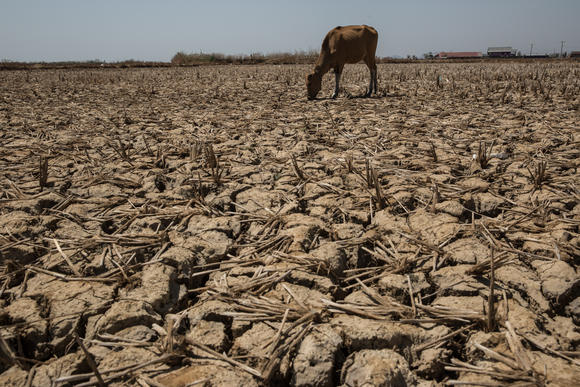
A cow grazes in a parched rice field in Makassar, Indonesia. (Photo by Getty Images)

A cow grazes in a parched rice field in Makassar, Indonesia. (Photo by Getty Images)

Humanity is altering natural ecosystems more rapidly than it is reaching an adequate scientific understanding of the implications of such change. It is widely known that the overuse of energy, water, land, minerals and biological resources is contributing to climate change. But human activities that deplete natural resources and degrade ecosystems are also threatening international, regional and local security.

Moreover, the growing gap between near-term development objectives and long-term human aspirations means that the costs of development are being passed onto future generations.

Yet the international agenda to combat global warming has become politically loaded. Important actors have tacked onto the agenda their own economic and other interests — which explains why the process to negotiate a successor regime to the Kyoto Protocol has been painfully long. Such factors will no doubt be evident at the forthcoming United Nations climate change conference in Paris.

Make no mistake: The future of human civilization hinges on sustainable development. There are several historical examples of societies fatally undermining their ecological security, with the resultant eco-meltdown leading to their fall. Two examples are the early Sumerian civilization, which emerged in the lower basin of the Tigris and Euphrates rivers, and Central America’s Maya civilization. In both cases, land and water degradation stunted food production, setting the stage for their downfall.

Today, the threat from unsustainable human practices has reached global proportions. Indeed, human-induced changes of natural systems have become so profound that the Earth has entered what Nobel Prize-winning chemist Paul Crutzen calls the Anthropocene, a new geological age in which human civilization — not nature — is the dominant force, driving major alterations in the planet’s ecosystems.

As rising regional temperatures clearly illustrate, climate stability is becoming a casualty of such anthropogenic transformations.

Forward and backward

The 20th century brought unprecedented progress but also profound damage to ecosystems, with humans altering or degrading up to 50% of the Earth’s land, modifying natural flows of about two-thirds of all rivers, and driving one-quarter of all bird species and many large mammal species to extinction. Populations of large herbivores like elephants, hippos and rhinos are dwindling at a startling rate.

According to U.N.-Water, a United Nations agency, about half the world’s wetlands have been lost since the early 20th century, while aquatic ecosystems have lost 50% of their biodiversity since just the mid-1970s.

Human-induced climate change creates a vicious spiral. For example, a warmer climate reduces the amount of highly reflective snow cover, which in turn allows more radiation from the sun to be absorbed by the ground and water, further increasing temperatures.

Global emissions of planet-warming greenhouse gases, however, continue to grow at more than 1% yearly. Every 24 hours, the world dumps over 90 million tons of such gases into the atmosphere, treating it like an open sewer.

Effectively controlling the buildup of greenhouse gases in the atmosphere demands fundamental policy and lifestyle changes. But as seen over the nearly quarter-century since the conclusion of the United Nations Framework Convention on Climate Change, setting out international goals on paper is easier than faithfully implementing them.

The binding targets set under the UNFCCC-linked Kyoto Protocol, which took effect in 2005, required a manageable cut of around 5% in emissions of six greenhouse gases to bring them below the participating industrialized countries’ 1990 levels over a five-year period from 2008 to 2012. The specific targets varied from country to country. But many of the industrialized economies and countries in transition that voluntarily became parties to the Kyoto Protocol failed to live up to their respective obligations.

Not surprisingly, climate-related challenges have become more acute. We are now at a crunch point. And yet climate politics are only becoming murkier.

Global warming is eating away at Greenland’s ice sheet. (Photo by Getty Images)

To be sure, there are continuing gaps in our scientific understanding of the phenomenon of climate change. Climate science is still young and offers no clear answers to some critical questions.

Thanks to focused research on human activities and their impact, the public now knows more about the anthropogenic factors contributing to global warming than about the Earth’s own natural climatic variations. What, for example, caused the “little ice age” from about the 15th to the 19th centuries? Further scientific research is needed to understand the phenomenon of natural climatic shifts, which usually extend over several centuries.

In view of such gaps, it is easy to either exaggerate or underestimate the impact of climate change. Yet its effects are likely to be serious, even according to the most conservative estimates.

Some water-related implications of global warming are already beyond dispute. Shifts in precipitation and runoff patterns will lead to greater hydrological variability, negatively affecting food production in some regions. Meanwhile, water stress is set to intensify and spread to new areas, owing to accelerated glacial thaw, more-frequent cycles of flooding and drought, and degradation of watercourses.

New criteria needed

But, as negotiations ahead of the Paris conference illustrate, the subject of climate change has become highly politicized, with competing interests seeking to shape — to their own advantage — the outcome of a new international agreement on climate. This trend serves as a reminder that climate change is not just a matter of science but also a matter of geopolitics.

Beyond negotiating specific targets in a new climate pact aimed at building a low-carbon future, the world confronts a more fundamental question — how to break the link between economic development and adverse impacts on the environment and climate. This challenge is compounded by the fact that the measure of economic growth in our world is ever-increasing production and consumption.

The concept of development is actually broad-based and encompasses far more than just economic growth rates. The widely acknowledged benchmarks of comprehensive development include protection of the biological and physical environments, public health, low income disparity, social equity, resource conservation and environmental sustainability. Likewise, national progress must be measured not merely in terms of gross domestic product but also in terms of how well human needs are met, using other measures of comprehensive development.

The world, unfortunately, has made the mistake of overemphasizing GDP growth, which demands more and more consumption, even as many societies are becoming more unequal and facing popular discontent.

At the same time, climate change is challenging the world’s ability to innovate and live in harmony with nature. But we do not have to wait for new technological innovations to open up potential solutions. Changes in human practices and preferences could readily create a more sustainable world right now.

At the national and international level, this means making the right energy and development choices. And at the individual level, it means embracing a more sustainable lifestyle that makes for better and healthier living.

Given that climate change is likely to spur more frequent and intense natural disasters, building resilience — the ability to avoid significant disruptions due to global-warming-driven changes or shocks — is also essential.

To lessen the effects of climate change, countries must also strategically invest in ecological restoration — by growing and preserving rainforests, conserving wetlands, shielding species critical to ecosystems and restoring rivers and other natural heritage sites. Such programs can even help regulate regional climate, slowing soil and coastal erosion and controlling droughts and flooding.

Global warming starkly illustrates how the most pressing challenges today are international in nature and thus demand collective international responses. Geopolitical games and growing international divisiveness, however, are hindering effective action on the global challenges.

If we are to preserve our planet for future generations, we must move from the Anthropocene epoch to the “Sustainocene” age. But such a transition will require development and energy policies anchored in the goal of environmental and climate protection.

Brahma Chellaney is a geostrategist and the author, most recently, of “Water, Peace, and War: Confronting the Global Water Crisis.”

© Nikkie Asian Review, 2015.

China’s freshwater grab

BY

The Japan Times, November 2, 2015
yunnan_dam_1422405c

Just as China is working to change the territorial or maritime status quo from the western Himalayas to the East China Sea, its dam-building frenzy is designed to appropriate internationally shared water resources. Beijing is seeking to present a fait accompli to its downstream neighbors by quietly building dams on the transnational Amur, Arun, Brahmaputra, Illy, Irtysh, Mekong and Salween rivers.

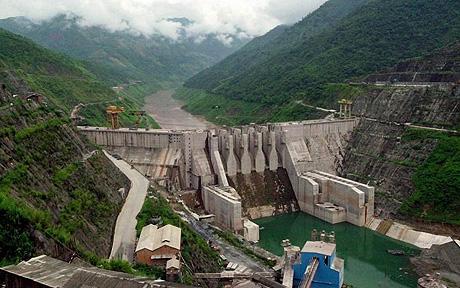
In the latest development, Beijing has announced that it has completed — ahead of schedule — the world’s highest-elevation dam at Zangmu, Tibet. It said that all six power-generating units of the $1.6 billion project on River Brahmaputra have become fully operational.

China is now racing to complete several additional dams located in close proximity to each other on that river. This cascade of dams is likely to affect the quality and quantity of downstream flows into India and Bangladesh.

Only five rivers in the world carry more water than the Brahmaputra and only one — China’s Yellow River — carries more silt. The Brahmaputra is the world’s highest-altitude river. It represents a unique fluvial ecosystem largely due to the heavy load of high-quality nutrient-rich silt it carries from forbidding Himalayan heights.

The Brahmaputra’s annual flooding cycle helps fertilize overworked soils in northeast India’s Assam plains and large parts of Bangladesh, where the river is the biggest source of water supply. The silt-movement impediment by China’s upstream dam projects constitutes a bigger threat to the biophysical vitality of the river and downstream plains than even diminution of cross-border flows.

Several factors have whetted China’s drive to increasingly tap the resources of international rivers, including an officially drawn link between water and national security, the country’s emergence as the global center of dam building, the state-run hydropower industry’s growing clout and the rise of water nationalism at a time of increasing water stress in the northern Chinese plains. With dam building reaching virtual saturation levels in the ethnic Han heartland, the hydro-engineering focus has shifted to minority homelands, from where rivers flow to other countries.

China’s centralized, mega-project-driven approach to water resources has turned it into the world’s most dam-dotted country. This approach is the antithesis of the policy line in India, where water is a state (not federal) subject under the Constitution and where anti-dam nongovernmental organizations are powerful. India’s Narmada Dam project, which remains incomplete decades after its construction began, symbolizes the power of NGOs.

The largest dam India has built since its independence — the 2,000-megawatt Tehri Dam on River Bhagirathi — pales in comparison to China’s giant projects, such as the 22,500-megawatt Three Gorges Dam and the new mega-dams on the Mekong River like Xiaowan, which dwarfs Paris’s Eiffel Tower in height, and Nuozhadu, which boasts a 190-sq.-km reservoir.

The water situation in India, however, is far worse than in China. China’s population is just marginally larger than India’s, but its internally renewable water resources (2,813 billion cubic meters per year) are almost twice as large as India’s. In aggregate water availability, including external inflows (which are sizable in India’s case), China boasts virtually 50 percent larger resources than India.

India’s surface-water storage capacity — an important measure of any nation’s ability to deal with drought or seasonal imbalances in water availability — is one of the world’s lowest. Amounting to 200 cubic meters per head per year, it is more than 11 times lower than China’s. The 2030 Water Resources Group, an international unit, has warned that India is likely to face a 50 percent deficit between water demand and supply by 2030.

Yet, even as China’s dam builders target rivers flowing to India, including the Brahmaputra, Indus, Sutlej and Arun (Kosi), New Delhi has failed to evolve a strategic, long-term approach to the country’s pressing water challenges. In fact, no country faces a bigger challenge than India from China’s throttlehold on the headwaters of Asia’s major transnational rivers and from its growing capability to be the upstream controller by re-engineering trans-boundary flows through dams.

New Delhi has to brace for China moving its dam building from the upper and middle reaches to the lower, border-hugging sections of the rivers flowing to India. The Brahmaputra is particularly a magnet for China’s dam builders because this river’s cross-border annual discharge of 165.4 billion cubic meters into India is greater than the combined trans-boundary flows of the key rivers running from Chinese territory to Southeast Asia. China is expected to embark on Mekong-style mega-dams as it gradually moves its dam building on the Brahmaputra to the area where the river takes a horseshoe bend to enter India, forming the world’s longest and steepest canyon in the process.

To be sure, China’s riparian dominance poses a wider challenge in Asia as it remains impervious to the interests of downstream states and to international norms. Backed by its political control over water-rich minority homelands and by its rapid expansion of upstream hydro-engineering infrastructure, China’s riparian ascendancy is creating a tense and potentially conflict-laden situation where water allocations to co-riparian states in the future could become a function of its political fiat. Indeed, Beijing pays little heed to the interests of even friendly countries, as illustrated by its heavy upstream damming of the Mekong and Salween — Southeast Asia’s largest rivers.

The situation serves as a reminder that power equations are central to riparian relations. If upstream actions are undertaken by a power armed with superior military and economic capabilities and geopolitical influence, the lower riparian state can do little more than protest, unless a water-sharing agreement between the two countries provides for international adjudication or arbitration at the request of one side.

China, however, has refused to enter into a water-sharing arrangement with any co-riparian nation, even though its control over the Tibetan plateau (the starting place of major international rivers) and Xinjiang (the source of the transnational Irtysh and Ili rivers) has armed it with unparalleled hydro-hegemony. Such refusal means it can persist with its frenetic construction of upstream dams, barrages, reservoirs and irrigation systems on international rivers flowing to Central, South and Southeast Asia and to Russia.

By contrast, treaties, agreements or arrangements relating to major shared rivers govern relations between riparian neighbors in South, Southeast and Central Asia.

A balance between rights and obligations is at the heart of how to achieve harmonious, rules-based relations on water-resource issues. Transparency, collaboration and sharing are the building blocks of water peace. China’s unilateralist course on shared freshwater resources, however, indicates that — as in the South China Sea — it wants and insists on getting its own way.

Brahma Chellaney, a geostrategist, is the author of nine books, including, most recently, “Water, Peace, and War: Confronting the Global Water Crisis.”
© The Japan Times, 2015.

Why Japan Should Rearm

Ensuring long-term peace in Asia requires an active role for Japan. By pursuing reforms that enable it to defend itself better, Japan would enhance its capacity to forestall the emergence of a destabilizing power imbalance in East Asia – with far-reaching benefits for Asia and the rest of the world.

BRAHMA CHELLANEY

A column internationally syndicated by Project Syndicate

unnamed

Japan’s political resurgence is one of this century’s most consequential developments in Asia. But it has received relatively little attention, because observers have preferred to focus on the country’s prolonged economic woes. Those woes are real, but Japan’s ongoing national-security reforms and participation in the new 12-country Trans-Pacific Partnership have placed it firmly on the path to reinventing itself as a more secure, competitive, and internationally engaged country.

Japan has historically punched above its weight in world affairs. In the second half of the nineteenth century, Japan became Asia’s first modern economic success story. It went on to defeat Manchu-ruled China and Czarist Russia in two separate wars, making it Asia’s first modern global military power. Even after its crushing World War II defeat and occupation by the United States, Japan managed major economic successes, becoming by the 1980s a global industrial powerhouse, the likes of which Asia had never seen.

Media tend to depict Japan’s current economic troubles in almost funereal terms. But, while it is true that the economy has stagnated for more than two decades, real per capita income has increased faster than in the US and the United Kingdom so far this century. Moreover, the unemployment rate has long been among the lowest of the wealthy economies, income inequality is the lowest in Asia, and life expectancy is the longest in the world.

In fact, it is Japan’s security, not its economy, that merits the most concern today – and Japan knows it. After decades of contentedly relying on the US for protection, Japan is being shaken out of its complacency by fast-changing security and power dynamics in Asia, especially the rise of an increasingly muscular and revisionist China vying for regional hegemony.

Chinese military spending now equals the combined defense expenditure of France, Japan, and the UK; just a decade ago, pacifist Japan outspent China on defense. And China has not hesitated to display its growing might. In the strategically vital South China Sea, the People’s Republic has built artificial islands and military outposts, and it has captured the disputed Scarborough Shoal from the Philippines. In the East China Sea, it has unilaterally declared an air-defense identification zone covering territories that it claims but does not control.

With US President Barack Obama hesitating to impose any costs on China for these aggressive moves, Japan’s leaders are taking matters into their own hands. Recognizing the inadequacy of Japan’s existing national-security policies and laws to protect the country in this new context, the government has established a national security council and moved to “normalize” its security posture. By easing Japan’s longstanding, self-imposed ban on arms exports, boosting defense spending, and asserting its right to exercise “collective self-defense,” the government has opened the path for Japan to collaborate more actively with friendly countries and to pursue broader overseas peacekeeping missions.

To be sure, Japan’s security-enhancing efforts have so far been limited in scope, and do not open the way for the country to become a militaristic power. Restrictions on deployment of offensive weapons, for example, remain in place.

Nonetheless, the government’s moves have proved divisive in a country where pacifism is embedded in the constitution and widely supported by the population. A recent survey by the Pew Research Center found that only 23% of Japanese want their country to play a more active role in Asian security. Another survey last year revealed that only 15.3% of Japanese – the lowest proportion in the world – were willing to defend their country, compared to 75% of Chinese.

But the reality is that ensuring long-term peace in Asia demands a stronger defense posture for Japan. Indeed, reforms that enable Japan to defend itself better, including by building mutually beneficial regional partnerships, would enhance its capacity to forestall the emergence of a destabilizing power imbalance in East Asia.

It is now up to Japan’s government to win over its own citizens, by highlighting the difference between pacifism and passivity. Japan would not encourage or support aggression; it would simply take a more proactive role in securing peace at the regional and global levels.

A more confident and secure Japan would certainly serve the interests of the US, which could then depend on its close ally to take more responsibility for both its own security and regional peace. Americans increasingly seem to recognize this, with 47% of respondents in the Pew survey supporting a more active role for Japan in Asian security.

But there remain questions about precisely how self-sufficient Japan would have to be to carry out this “proactive pacifism” – a term popularized by Prime Minister Shinzo Abe – consistently and effectively. Would Japan need to become a truly independent military power, with formidable deterrent capabilities like those of the UK or France?

The short answer is yes. While Japan should not abandon its security treaty with the US, it can and should rearm, with an exclusive focus on defense.

Of course, unlike the UK and France, Japan does not have the option to possess nuclear weapons. But it can build robust conventional capabilities, including information systems to cope with the risk of cyber warfare. Beyond bolstering Japanese security and regional stability, such an effort would likely boost Japan’s GDP and yield major profits for American defense firms.

As a status quo power, Japan does not need to match Chinese military might. Defense is, after all, easier than offense. Still, the rise of a militarily independent Japan would constitute a game-changing – and highly beneficial – development for Asia and the rest of the world.

© Project Syndicate, 2015.