Unknown's avatar

About Chellaney

Professor, strategic thinker, author and commentator

Why Tibet matters ever more in India-China ties

57921181

The Dalai Lama, after escaping to India in 1959, meets Indian Prime Minister Jawaharlal Nehru and President Sarvepalli Radhakrishnan (right). 

If Tibet is at the heart of the China-India divide, water is at the centre of the Tibet-India bond.

Brahma Chellaney, The Hindustan Times

Wars in space are not just Hollywood fiction but an emerging reality for defence planners. India’s successful “kill” with an anti-satellite (ASAT) weapon is a major milestone in its quest for effective deterrence. Without developing ASAT capability, India risked encouraging China to go after Indian space assets early in a conflict.

The test is meant as a warning shot across China’s bow for another reason: ASAT capability serves as a basic building block of a ballistic missile defence system, which can shoot down incoming missiles. The development thus holds implications also for China’s “all-weather” strategic ally, Pakistan, which maintains a nuclear first-use doctrine against India.

In this light, it is unconscionable that the development of India’s satellite-kill technologies was held up by Prime Minister Manmohan Singh’s government, which, as top scientists have said, refused to give the go-ahead. In the Indian system, no one is held to account, even for compromising national security.

India’s ASAT test should not obscure the fact that March 31 marked the 60th anniversary of the Dalai Lama’s entry into India after a gruelling two-week journey through his Chinese-occupied homeland. Dressed as a Chinese soldier, he escaped from his military-besieged Norbulinka Palace in Lhasa. He entered India as tens of thousands died in China’s brutal suppression of an uprising against its occupation of Tibet.

Today, Tibet remains at the centre of the India-China divide, fuelling territorial disputes, diplomatic tensions and riparian feuds. Indeed, the fall of Tibet represented the most far-reaching geopolitical development in modern India’s history. It gave China borders with India, Bhutan and Nepal for the first time, and opened the path to a Sino-Pakistan strategic axis. The impact has been exacerbated by serial Indian blunders.

When the Dalai Lama fled his homeland, India was the only country to have diplomatic representation in Tibet. In fact, India controlled Tibet’s postal, telegraph and telephone services and had military personnel at Yatung and Gyantse before it ceded those rights under the infamous Panchsheel Agreement of 1954.

Indeed, no sooner had Mao Zedong’s regime annexed the historical buffer of Tibet than New Delhi voluntarily began forfeiting all its extraterritorial rights and privileges there. In 1952, it replaced the 16-year-old Indian Mission in Lhasa (which maintained direct relations with Tibet) with a new consulate-general accredited to China. Nineteen months later, the Panchsheel accord gave its imprimatur to the “Tibet Region of China”, without Beijing’s recognition of the then existing Indo-Tibetan border. After China invaded India in 1962, it shut the Indian consulate in Lhasa.

Tibet enjoyed close transportation, trade and cultural links with India throughout history. But with Tibet now locked behind a Chinese “iron curtain”, the formerly integrated economies and cultures of the entire Himalayan region have broken apart.

In recent years, China has turned the resource-rich but ecologically fragile Tibetan Plateau into the centre of its mining and dam-building activities. The environmental crisis haunting the plateau threatens India’s ecological well-being. This is illustrated by the still turbid waters of the once-pristine Siang, the main artery of the Brahmaputra river system.

The more India has aligned its Tibet stance with China’s position, the more Beijing has upped the ante, including seeking to reengineer trans-boundary river flows, on which India is critically dependent. Beijing began calling Arunachal Pradesh “South Tibet” only after the then Prime Minister Atal Bihari Vajpayee in 2003 formally recognized Tibet as part of China.

Today, despite the ASAT test, India’s China policy seems adrift. The Dalai Lama is a strategic asset for India, yet current Indian policy doesn’t reflect that. Indeed, according to a leaked advisory, New Delhi changed course early last year to shun official relations with the Dalai Lama and other exiled Tibetan leaders — a shift that won Beijing’s tacit appreciation.

Prime Minister Narendra Modi’s first attempt in 2014 to “reset” ties with China boomeranged spectacularly. Undeterred, Modi persisted, even as China furtively expanded its military footprint in Doklam. The Wuhan summit represented Modi’s Reset 2.0. For China, however, Wuhan served as a cover to kill two birds with one stone. While encouraging Modi’s overtures to help instil greater Indian caution to openly challenge China, Beijing has embarked on a major border-force buildup. On Modi’s watch, Chinese exports have flooded India, with Beijing more than doubling its bilateral trade surplus.

Meanwhile, Tibet’s shadow over India-China relations is becoming longer. Beijing is waiting to install a marionette as the Dalai Lama’s successor. China’s increasing militarization of Tibet directly impinges on Indian security. Its punitive denial of hydrological data to India in 2017 was an early warning of the water card it is fashioning. If Tibet is at the heart of the China-India divide, water is at the centre of the Tibet-India bond.

To help curb China’s territorial and riparian revisionism, India must subtly reopen Tibet as an outstanding issue. By recalibrating its Tibet policy, India could elevate Tibet as a broader strategic and environmental issue that impinges on international security and climatic and hydrological stability. More than ASAT and other weapons, India needs political will and clarity to deter China.

Brahma Chellaney is a geostrategist.

© The Hindustan Times, 2019.

The looming specter of Asian space wars

https___s3-ap-northeast-1.amazonaws.com_psh-ex-ftnikkei-3937bb4_images_6_6_5_5_20085566-1-eng-GB_H2019032766431 Interceptor missile_2048x1152

The Indian test is clearly a warning shot across China’s bow. (Handout photo from India’s Press Information Bureau.)

Brahma ChellaneyNikkei Asian Review

When China demonstrated its antisatellite weapon capability in 2007, it spurred international concern and criticism over the potential militarization of outer space.

The muted response to a similar Indian test on March 27 shows that great-power capabilities in this field have so advanced that such an event is no longer a surprise. Indeed, the technology has developed to such an extent that defense planners must deal with the looming specter of wars in space.

The linkages between antisatellite, or ASAT, weapon technologies and ballistic missile defense systems, which can shoot down incoming missiles, underscore how innovations favor both offense and defense. Space wars are no longer just Hollywood fiction.

India’s ASAT test is a reminder that the Asia-Pacific region is the hub of the growing space-war capabilities. The United States and Russia field extensive missile defense systems and boast a diverse range of ground-launched and directed-energy ASAT capabilities. China’s ASAT weaponry is becoming more sophisticated, even as it aggressively seeks theater ballistic missile defenses.

Japan and South Korea are working with the U.S. separately to create missile defense systems. Although aimed at thwarting regional threats, these systems are interoperable with American missile defenses. Australia, for its part, participates in trilateral missile-defense consultations with the U.S. and Japan.

Space-based assets are critical not just for communications but also for imagery, navigation, weather forecasting, surveillance, interception, missile guidance and the delivery of precision munitions. Taking out such assets can blind an enemy.

India’s successful “kill” of one of its own satellites with a missile — confirmed by the U.S. Air Force Space Command — has made it the fourth power, after the United States, Russia and China, to shoot down an object in space. Prime Minister Narendra Modi, facing a tight reelection race, made a rare televised address to announce India’s entry into this exclusive club of nuclear-armed countries that can destroy a moving target in space.

India’s technological leap is being seen internationally as a counter to China’s growing ASAT capabilities, which include ground-based direct ascent missiles and lasers, which can blind or disable satellites.

The international development of ASAT capabilities mirrors the nuclear-weapons proliferation chain. Like nuclear weapons, the U.S. was the first to develop satellite-kill technologies, followed by the former Soviet Union. China, as in nuclear weapons, stepped into this realm much later, only to provoke India to follow suit.

The Indian test was clearly a warning shot across China’s bow, although Modi claimed that it was not aimed against any country.

India finds itself boxed in by the deepening China-Pakistan strategic nexus. China has transferred, according to international evidence, technologies for weapons of mass destruction to Pakistan to help tie down India south of the Himalayas. Beijing currently is seeking to shield Pakistan even from international pressure to root out transnational terrorist groups that operate from its territory.

The Indian ASAT demonstration holds strategic implications also for Pakistan, which values nuclear weapons as an antidote to its conventional military inferiority and thus maintains a nuclear first-use doctrine against stronger India. By shielding it from retaliation, Pakistan’s nuclear weapons enable its nurturing of armed jihadists as a force multiplier in its low-intensity proxy war by terror against India.

An ASAT capability, by potentially arming India with the means to shoot down incoming missiles, could erode Pakistan’s nuclear deterrent. After all, an ASAT capability serves as a building block of a ballistic missile defense system.

However, China remains at the center of Indian security concerns. Without developing ASAT weaponry to help underpin deterrence, India risked encouraging China to go after Indian space-based assets early in a conflict.

In today’s world, one side can impose its demands not necessarily by employing force but by building capabilities that can mount a coercive threat.

China’s ASAT capabilities arguably hold the greatest significance for India, which has no security arrangements with another power and thus is on its own. Japan, South Korea and Australia, by contrast, are ensconced under the U.S. security umbrella. The U.S. and Russia, armed to their teeth, can cripple China’s space-based assets if it dared to strike any of their satellites.

India thus had stood out for its lack of a deterrent against China’s ASAT prowess. Against this background, India’s successful “kill” of a satellite is an important milestone in its quest to plug the vulnerability of its space assets.

To be sure, a space war scenario can arise only in a conflict. But preventing war demands systems of deterrence. And the only counter to ASAT weaponry is a capability to pay back in kind.

The rivalry between the demographic titans, China and India, has ominously moved into space.

India, by placing a low-cost spacecraft in orbit around Mars in 2014, won Asia’s race to the Red Planet. And in 2017, India set a world record by launching 104 satellites into orbit with a single rocket. This beat the previous record of 37 satellites that Russia established in 2014.

China, for its part, has sent six crews into space and launched two space labs into the Earth’s orbit. In 2013, it became the third country, after the U.S. and Russia, to land a rover on the moon. And last December, it landed another probe and a rover on the far side of the moon — the first time this had ever been done. Its first mission to Mars is scheduled for next year.

But it is the extension of the China-India space race to the military realm that underscores the Asian specter of space wars. India’s feat in shooting down a satellite orbiting at 30,000 kilometers an hour highlights its determination to catch up with China’s advances.

According to the Pentagon, China, like Russia, has demonstrated offensive space capabilities through “experimental” satellites able to conduct on-orbit activities. China has used a ground-based laser to “paint,” or illuminate, an American satellite, as if to demonstrate a nascent capability to blind targeted satellites.

India’s ASAT test, like the 2007 Chinese satellite “kill” and the 2008 U.S. strike against a malfunctioning satellite, underscores how the environmental degradation haunting our planet is being extended to outer space. The Indian test, according to the U.S., created 270 pieces of debris in space — a number that will likely grow as the fragments decay. But since the remnants are from a low-earth-orbit satellite, many of the pieces are expected to fall onto the Earth within weeks.

The test highlights the international imperative to prevent the weaponization of outer space, including by strengthening the legal framework. The 1967 Outer Space Treaty, aimed at establishing basic international space law, does not prohibit the stationing of weapons in space or ASAT tests.

Brahma Chellaney is a geostrategist and the author of nine books, including “Water: Asia’s New Battleground,” which won the Bernard Schwartz Award.

© Nikkei Asian Review, 2019.

Pakistan, China and terrorism

imxi

China is left with just one real ally — Pakistan.    © Reuters

Beijing’s support protects Islamabad from global pressure to suppress militants

International calls for Pakistan to take concrete steps against the terrorist groups that operate from its territory have mounted in recent weeks after a Valentine’s Day attack killed 41 Indian paramilitary soldiers and sparked a military crisis on the subcontinent.

Such appeals have been made by the United States, Japan and European powers but one voice has been conspicuous by its absence — China’s.

If anything, Beijing has sought to shield Pakistan from international censure. Most recently, on March 13, China blocked United Nations Security Council action against the ailing founder of the Pakistan-based Jaish-e-Mohammed group, which is already under international terrorism sanctions. The aim was not to protect a terrorist leader reportedly on his deathbed but to frustrate the international pressure that has grown on Islamabad to take credible anti-terror actions.

The U.S., for example, has insisted Pakistan take “sustained, irreversible action against terrorist groups.” Jaish-e-Mohammed, which was quick to claim responsibility for the Valentine’s Day attack, is just one of 22 U.N.-designated terrorist entities that Pakistan hosts.

Pakistan’s civilian leadership routinely denies that the country’s military cultivates terrorist surrogates. But India holds Islamabad responsible for multiple outrages including the Valentine’s Day attack, which coincided with deadly terrorist strikes on Iranian and Afghan troops that Tehran and Kabul also blamed on Pakistan.

In coming to Pakistan’s help at a critical time, China has highlighted the strategic importance it still attaches to its ties with that increasingly fragile and debt-ridden country. In contrast to America’s strong network of allies and partners, China can count on few true strategic allies or reliable security partners. When it joined hands with Washington to impose new international sanctions on North Korea, once its vassal, Beijing implicitly highlighted that it was left with just one real ally — Pakistan.

The China-Pakistan axis has been cemented by “iron brotherhood,” with the two “as close as lips and teeth,” according to Beijing. It calls Pakistan its “all-weather friend.”

China, however, has little in common with Pakistan, beyond the fact that both are dissatisfied with their existing frontiers and claim territory held by neighbors. Their “iron brotherhood” is actually about a shared interest in containing India. That interest has raised the specter for New Delhi of a two-front war in the event military conflict breaks out with either Pakistan or China.

However, the immediate threat India faces is asymmetric warfare, including China’s “salami slicing” strategy of furtive, incremental territorial encroachments in the Himalayas and Pakistan’s use of terrorist proxies. No surprise then, that China seeks to shield Pakistan’s proxy war by Islamist terror against India. Beijing seems untroubled by the seeming contradiction between this approach abroad while, at home, it locks up more than a million Muslims from Xinjiang in the name of cleansing their minds of extremist thoughts.

For years, China has been attracted by Pakistan’s willingness to serve as its economic and military client. China has sold Pakistan weapons its own military has not inducted, as well as prototype nuclear power reactors.

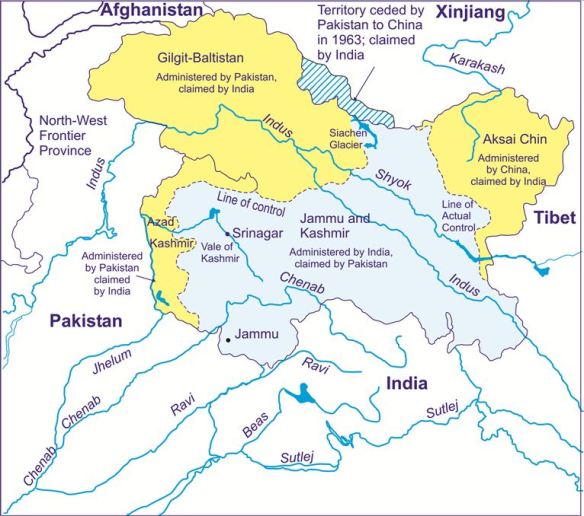
Since at least 2005, Pakistan has allowed Beijing to station thousands of Chinese troops in the Pakistani part of the disputed region of Jammu and Kashmir, where control is divided between India (45%), Pakistan (35%) and China (20%). More recently, China has sought to turn Pakistan into its land corridor to the Arabian Sea and the Indian Ocean. With Chinese involvement, the northern Arabian Sea is becoming militarized: China has supplied warships to the Pakistani navy, it controls Pakistan’s Gwadar port, and its submarines are on patrol.

For Pakistan, however, China’s close embrace is becoming a tight squeeze financially. Fast-rising debt to Beijing has contributed to Pakistan’s dire financial situation today. With its economy teetering on the brink of default, Pakistan is urgently seeking a $12 billion bailout from the International Monetary Fund.

Pakistan is the largest recipient of Chinese financing under President Xi Jinping’s Belt and Road Initiative. The Pakistani military has created a special 15,000-troop army division to protect Chinese projects. In addition, thousands of police have been deployed to protect Chinese workers. Yet, underscoring the security costs, attacks on Chinese people in Pakistan have occurred now and then.

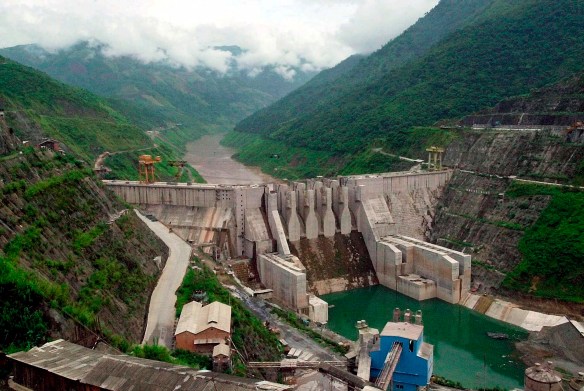
Rising financial costs, however, are triggering a pushback against Chinese projects even in friendly Pakistan. The new military-backed Pakistani government that took office last summer under Imran Khan has sought to scrap, scale back or renegotiate some Chinese projects. It downsized the main Chinese railway project by $2 billion, removed a $14 billion dam from Chinese financing, and canceled a 1,320-megawatt coal-based power plant.

China is receiving 91% of revenues from Gwadar port until its return to Pakistan in four decades.   © Reuters

China’s predatory practices have come under increasing scrutiny. For example, in return for building Gwadar port, China is receiving, tax-free, 91% of revenues from the port until its return to Pakistan in four decades.

Rising capital equipment imports from China, coupled with high returns for Beijing on its investment, have led to large foreign-exchange outflows, spurring Pakistan’s serious balance-of-payments crisis. Pakistan, seeking new loans to repay old ones, finds itself trapped in a vicious circle.

Yet Pakistan is unlikely to stop being China’s loyal client. Despite Western concern that the tide of Chinese strategic projects is making the country dangerously dependent on China, the relationship brings major benefits for Pakistan, including internationally well-documented covert nuclear and missile assistance from Beijing.

China also provides security assurances and political protection, especially diplomatic cover at the U.N., as has been illustrated by its torpedoing of the U.S.-French-British move to designate the Jaish-e-Mohammed chief as a global terrorist. Western powers failed to persuade China that the threat it cites from Islamist terrorism in its own western region demands that it join hands with them.

However, despite securing billions of dollars in recent emergency loans from China, Saudi Arabia and the United Arab Emirates, Pakistan cannot do without a large IMF bailout. This will be Pakistan’s 22nd IMF bailout in six decades, and the largest ever. Pakistan’s cycle of dependency on the IMF has paralleled the rise of its military-Islamist complex.

Unless the latest IMF bailout is made contingent upon concrete anti-terror action, it will, as past experience shows, help underpin Pakistan’s collusion with terrorist groups. This is especially so because a new IMF bailout will also support the Sino-Pakistan link, including by freeing up other resources in Pakistan for debt repayments to Beijing.

Democratic powers, especially the U.S., which holds a dominant 17.46% voting share in the IMF, must now insist on setting tough conditions, including making Pakistan take credible, verifiable and irreversible steps against the terrorist groups that its military has long nurtured. Among other things, an honorable U.S. exit from Afghanistan hinges on the success of such treatment.

Brahma Chellaney is a geostrategist and the author of nine books, including “Water: Asia’s New Battleground,” which won the Bernard Schwartz Award.

© Nikkei Asian Review, 2019.

Use the IMF route to tighten the screws on Pakistan

The international community should call Pakistan’s fiscal bluff: Pakistan has long employed not just nuclear blackmail but also fiscal blackmail — help us financially or face the perils of the country falling apart.

Pakistan-IMF

Brahma Chellaney, The Hindustan Times

The subcontinent’s military crisis is anything but over. Pakistan’s military generals fear another surprise Indian strike, which explains why much of Pakistan’s airspace is still closed to commercial traffic: Most international overflights remain barred, while domestic flights must stick to a narrow western corridor close to Iran and Afghanistan. Pakistan’s armed forces are on full operational alert, with combat air patrols continuing and the army beefing up deployments along the India frontier.

Yet, emboldened by China’s support, Pakistan is ignoring international calls to take concrete, irrevocable steps against the terrorist groups that operate openly from its territory. Indeed, Pakistan has yet to take the first credible step, which is to declare a policy — embraced by the chief of army staff (COAS) and the chairman joint chiefs of staff committee (CJCSC) — to deny sanctuary and financing to all terrorist groups.

The COAS remains Pakistan’s effective ruler. Imran Khan is not just one of Pakistan’s weakest prime ministers ever but also has shown himself to be the military’s willing puppet. Even while announcing the Indian pilot’s release as a “peace gesture”, Khan denied Pakistan is cultivating terror groups but justified terrorist attacks and suggested Pulwama was an Indian conspiracy.

Against this background, China’s action in again blocking UN action against Jaish-e-Mohammed (JeM) founder Masood Azhar was aimed at thwarting international pressure on Pakistan to take credible, irreversible anti-terror actions. That China still protects a terrorist who reportedly is on his deathbed undergirds the extent to which it shields Pakistan’s proxy war by terror against India.

It also helps highlight China’s own proxy war against India by employing Pakistan as a surrogate for containment. While reaping an ever-increasing trade surplus with India, China is systematically undermining Indian interests. Yet, since the Wuhan summit, India’s China policy has become more feckless than ever.

It is not a question of whether but when an Indian target will be attacked again by a Pakistan-based terrorist group. If war is to be averted, major powers other than China must tighten the screws on Pakistan. A major source of international leverage is Pakistan’s current desperate need for a $12 billion International Monetary Fund bailout. This will be Pakistan’s 22nd IMF bailout in six decades, and the largest ever. The IMF should bail out debt-ridden Pakistan only in return for concrete anti-terror action.

An international financial squeeze can effectively force Pakistan’s hand. The key to this is the US, which has the IMF clout (underscored by a dominant 17.46% voting share) to put off the impending bailout or tie it to specific conditions. India must seek to persuade the US — and other key IMF members like Japan and Germany, with 6.48% and 5.60% voting shares respectively — to not let go the present opportunity to reform a scofflaw Pakistan.

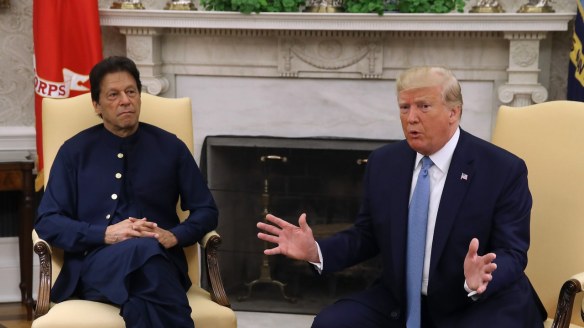
US President Donald Trump’s administration, far from welcoming Khan’s tokenistic anti-terror measures, has insisted Pakistan take “sustained, irreversible action against terrorist groups.” However, Trump’s zeal to finalize a tentative deal that his administration reached with the Pakistan-created Afghan Taliban in late January offers Pakistan’s generals their trump card.

Through their brutal proxies, the Taliban and the Haqqani Network, these generals have compelled the US to negotiate the terms of its exit from Afghanistan and to seek Pakistan’s help to midwife the deal. However, the US will be able to honourably end the longest war in its history, and get the Taliban to keep up its end of the bargain, only if it makes Pakistan’s generals realize that sponsoring cross-border terrorism in Afghanistan carries major costs. If the generals are to take concrete anti-terror steps, there must first be tangible action on America’s part, including stripping Pakistan of its “Major Non-NATO Ally” status, adding it to its list of state sponsors of terrorism, or at least leveraging the IMF bailout.

Pakistan is trapped in a vicious circle, seeking new loans to repay old ones. Despite recently getting $7.5 billion in cash from Saudi, Emirati and Chinese transfers, it cannot do without a large IMF bailout. Pakistan’s cycle of dependency on IMF has paralleled the rise of its military-mullah-jihadist complex. Foreign aid and lending have helped underpin Pakistan’s collusion with terrorist groups.

Today, an IMF bailout will aid Chinese designs by freeing up other resources in Pakistan for debt repayments to Beijing. It will thus implicitly support China’s debt-trap diplomacy with Pakistan, the largest recipient of Belt and Road financing. Such lending has contributed to Pakistan’s dire financial situation, locking it in debt servitude to China.

Pakistan has long employed not just nuclear blackmail but also fiscal blackmail — help us financially or face the perils of the country falling apart. If Pakistan is unwilling to sever its links with state-nurtured terrorists, it is better for the world to let it fail than to continue propping up its military-mullah-jihadist complex with aid and loans — the equivalent of giving more alcohol to an alcoholic, instead of treating the addiction. The treatment now must centre on making Pakistan take verifiable and unalterable anti-terror steps.

Brahma Chellaney is a geostrategist.

© The Hindustan Times, 2019.

Why the Pakistan-Terrorist Nexus Persists

Pulwama-Blast

Brahma Chellaney, an internationally syndicated column from Project Syndicate

Once again, an attack on India by a Pakistan-based terrorist group has raised the specter of a major confrontation on the Indian subcontinent – and fueled international pressure for Pakistan to take concrete action against the 22 United Nations-designated terrorist entities it hosts. But this time, the pressure is compounded by fury over attacks by Pakistan-based terrorists on the country’s other key neighbors, Iran and Afghanistan. Will Pakistan finally respond convincingly?

Over the years, the footprints of many terrorist attacks in the West have been traced to Pakistan. The United States found al-Qaeda leader Osama bin Laden ensconced in the high-security garrison town of Abbottabad, in the shadow of the Pakistan Military Academy. Other terrorist leaders captured since the September 11, 2001, terrorist attacks in the US – including Khalid Sheikh Mohammed, al-Qaeda’s third in command, and Abu Zubeida, the network’s operations chief – were also found living in Pakistan’s heartland.

Such revelations have often fueled calls for Pakistan to tackle its transnational terrorism problem. Last year, US President Donald Trump tweeted that, though Pakistan received more than $33 billion in American aid since 2002, it has returned “nothing but lies and deceit,” including providing “safe haven to the terrorists we hunt in Afghanistan.” The US – which has long had contingency plans to seize Pakistan’s nuclear weapons, if necessary, to prevent terrorists from getting their hands on them – then suspended security aid.

Recent attacks have reinvigorated demands for Pakistan to take action – amid threats of reprisal. On February 14, a suicide bombing claimed by the group Jaish-e-Mohammed killed 41 Indian paramilitary soldiers in India-administered Kashmir. In the same week, another suicide bombing – this one claimed by a group called Jaish ul-Adl – killed 27 Islamic Revolutionary Guard Corps members and injured 13 others in southeastern Iran, and a Taliban strike killed 32 Afghan troops at a remote base.

Since then, India and Pakistan have engaged in tit-for-tat aerial incursions, and Iran has vowed to retaliate. The US has stressed the “urgency” of Pakistan taking meaningful action against terrorist groups. If Pakistan is moved from the “gray” to “black” list of the Paris-based Financial Action Task Force (FATF) – which recently chastised the country for failing to cut off terrorist financing and demanded concrete action by May – Western sanctions will probably follow.

Pakistan’s position as a mecca of terrorism is now raising concerns among even its main patrons – China, which has long stood with it against India, and Saudi Arabia, its bulwark against Iran – which have lent it no support in its present crisis with India. More than ever, Pakistan finds itself internationally isolated, and risks becoming a global pariah.

Beyond the geostrategic repercussions, this outcome poses a grave threat to Pakistan’s economy, which is teetering on the brink of default. Despite having secured emergency loans from China, Saudi Arabia, and the United Arab Emirates, Pakistan desperately needs a large International Monetary Fund bailout. And while a $12 billion IMF deal is in the works, the situation will only deteriorate further if the FATF blacklists Pakistan.

To avoid this, Pakistan’s government is signaling its intent to crack down on terrorist groups. But the international community should not get its hopes up. With the military still dominant, the toothless civilian leadership is offering only tentative, reversible measures, suggesting a likely return to business as usual as soon as external pressure has eased.

Pakistan’s all-powerful military establishment – which includes the rogue Inter-Services Intelligence agency – is loath to sever its cozy alliances with terrorist groups. It would prefer to continue nurturing armed jihadists as a force multiplier in its low-intensity asymmetric wars against neighboring countries. Pakistan’s nuclear weapons enable this approach, because they shield its military and state-nurtured terrorist groups from retaliation.

This constraint is reflected in India’s response to the Pakistani military’s long-term strategy of inflicting on India “death by a thousand cuts.” Pakistan’s protracted terrorism-centered asymmetric warfare has, cumulatively, proved costlier for India than any past full-fledged war on the subcontinent, including the 1971 war that resulted in the creation of Bangladesh. But, as India’s patience wears thin, a limited war that calls the Pakistani generals’ nuclear bluff is no longer inconceivable.

But nuclear weapons are not the only factor protecting Pakistan’s generals. Despite Trump’s complaints, the US has yet to strip Pakistan of its “Major Non-NATO Ally” status or to add the country to its list of state sponsors of terrorism. The reason is simple: Pakistan is now a gatekeeper of America’s geopolitical interests in the region.

Not only does the US supply its Afghanistan-based troops largely via Pakistan; it is depending on Pakistani help in finalizing a peace deal with the Taliban. In other words, Pakistan’s generals are now being rewarded for sponsoring terror in Afghanistan through their brutal proxies – the Taliban and the Haqqani Network – which, according to Afghan President Ashraf Ghani, have killed as many as 45,000 Afghan security personnel since 2014 alone. The message is clear: sponsoring cross-border terrorism pays.

The battle against international terrorism cannot be won unless the nexus between terrorist groups and Pakistan’s military is severed. A good place to start would be to make the IMF bailout contingent on concrete counter-terrorism action. In the longer term, however, civilian-military relations must be rebalanced: the Pakistani generals’ viselike grip on power must be broken, and the military, intelligence, and nuclear establishment must be subordinated to the civilian government.

The international community has enough leverage to force change in debt-ridden and dysfunctional Pakistan. But, to use it, Trump would need to rethink his Faustian bargain with the Taliban. And, unfortunately, that seems unlikely to happen.

© Project Syndicate, 2019.

The China-Pakistan Axis of Evil

While Pakistan employs terrorist groups as proxies to bleed India, China uses Pakistan as a proxy to box in India. The irony is that, while providing cover for Pakistan’s open collusion with terrorists, China is locking up its “radical” Muslims in gulags.

Axisofevil1Brahma Chellaney, Open magazine

The February 26 Indian airstrike on a terrorist sanctuary in Pakistan’s heartland cannot obscure the resurfacing of India-China tensions following the Valentine’s Day terrorist attack in Pulwama that killed dozens of Indian paramilitary troops. China’s culpability in the attack — and in previous lethal cross-border terrorist strikes, such as on the Pathankot airbase — is apparent from its shielding of Pakistan’s export to terrorism to India. China brazenly provides cover for Pakistan’s collusion with state-reared terrorists.

The message from India’s use of airpower for the first time against a cross-border terrorist safe haven is that it is not afraid to escalate its response to the aerial domain in order to call Pakistan’s nuclear bluff. This could potentially mark a defining moment in India’s counterterrorism efforts against Pakistan’s strategy to inflict death by a thousand cuts.

The airstrike, however, is likely to reinforce Beijing’s determination to bolster Pakistan as a counterweight to India, especially because China incurs no strategic or trade costs for containing India. Beijing is not only propping up the Pakistani state financially and militarily, but also has repeatedly blocked United Nations action against the chief of the Pakistan-based Jaish-e-Mohammad terrorist group, which was quick to claim responsibility for the Pulwama massacre.

The paradox is that China, the world’s longest-surviving autocracy, has locked up more than a million Muslims from Xinjiang in the name of cleansing their minds of extremist thoughts, yet is simultaneously protecting Pakistan’s export of deadly Islamist terrorism to India. While Pakistan employs terrorist groups as proxies to bleed India, China uses Pakistan as a proxy to box in India.

The plain fact is that, for China, Pakistan is not just a client state, but a valued instrument to help contain India. So, is it any surprise that since the April 2018 Wuhan summit between Prime Minister Narendra Modi and Chinese President Xi Jinping, Beijing has actually stepped up its use of Pakistan as an India-containment tool, including by accelerating the so-called China-Pakistan Economic Corridor (CPEC) and playing the Kashmir card against New Delhi? In fact, China is steadily encircling India, as several developments underscore — from its new military base in Tajikistan that overlooks the Wakhan Corridor and Pakistan-held Jammu and Kashmir to its increasing encroachments in India’s maritime backyard.

It is extraordinary that China has been able to mount pressure on India from multiple flanks at a time when its own economic and geopolitical fortunes are taking a beating. By China’s own statistics, its economy last year registered the weakest pace of growth in nearly three decades. Add to the picture a new phenomenon — the flight of capital from a country that, between 1994 and 2014, amassed a mounting pile of foreign-exchange reserves by enjoying a surplus in its overall balance of payments.

Now faced with an unstoppable trend of net capital outflows, Xi’s regime has tightened exchange controls and other capital restrictions to prop up the country’s fragile financial system and sagging currency. The regime has used tens of billions of dollars in recent months alone to bolster the yuan’s international value. Not just capital is fleeing China but even wealthy Chinese prefer to live overseas, in a vote of no confidence in the Chinese system.

China’s internal challenges are being compounded by new external factors. Chinese belligerence and propaganda, for example, have spawned a growing international image problem for the country. More significantly, China has come under international pressure on several fronts — from its trade, investment and lending policies to its human-rights abuses. U.S.-led pressure on trade and geopolitical fronts has accentuated Beijing’s dilemmas and fuelled uncertainty in China. As long as the U.S.-China trade war rages, flight of capital will remain a problem for Beijing. Its foreign-exchange reserves have shrunk by about $1 trillion from their peak of just over $4 trillion in mid-2014.

At a time when China’s imperial project, the Belt and Road Initiative (BRI), is running into resistance from a growing number of partner countries, Beijing is also confronting a U.S.-led pushback against its telecommunications giant Huawei. Meanwhile, China is alienating other Asian nations by throwing its weight around too aggressively.

This trend is likely to accelerate with the restructured People’s Liberation Army becoming less of an army and more of a power projection force, the majority of whose troops now are not from the army but from the other services. Indeed, the PLA’s shift toward power projection foreshadows a more aggressive Chinese military approach of the kind already witnessed in the Himalayas or the South China Sea, where China has fundamentally changed the status quo in its favour.

More fundamentally, it is China’s open disregard of international rules and its penchant for bullying that explains why it remains a largely friendless power. Leadership in today’s world demands more than just brute might. Beijing lacks any real strategic allies other than Pakistan. When China joined hands with the U.S. at the United Nations to impose new international sanctions on North Korea, once its vassal, it implicitly highlighted that it now has just one real ally — Pakistan.

China today is increasingly oriented to the primacy of the Communist Party, responsible for the past pogroms and witch-hunts and the current excesses. Under Xi, the party has set out to demolish Muslim, Tibetan and Mongol identities, expand China’s frontiers far out into international waters, and turn the country into a digital totalitarian state. Consequently, four decades after it initiated economic reform, China finds itself at a crossroads, with its future trajectory uncertain.

It is against this background that the Xi regime’s increasing use of Pakistan against India stands out. China is working to extend its reach to the Arabian Sea by turning Pakistan into a client-state and keeping India off-balance.

Beijing not only continues to bolster Pakistan’s offensive capabilities, including in weapons of mass destruction (WMD), but also is working in tandem with that country to militarize the northern Arabian Sea. Chinese-supplied warships have already been pressed into service to secure Pakistan’s Chinese-controlled Gwadar port, the flagship project in the China-Pakistan Economic Corridor (CPEC), which, in turn, is the centrepiece of BRI.

Through CPEC, China is seeking to turn Pakistan into its land corridor to the Arabian Sea and the Indian Ocean. And, as a U.S. Defence Department report in 2016 forewarned, Pakistan — “China’s primary customer for conventional weapons” — is likely to host a Chinese naval hub intended to project power in the Arabian Sea and the Indian Ocean. Such a naval base is expected to come up quietly next to the Gwadar port, directly challenging India’s maritime interests.

China, meanwhile, has actively aided Pakistan’s counter-strategy to the Indian military’s supposed “Cold Start” doctrine. Pakistan’s counter is a mobile WMD capability centred on tactical nuclear weapons for use against enemy battle formations. The “Cold Start” doctrine is reportedly the idea of a quick and limited Indian conventional strike in response to a Pakistan-scripted terrorist attack, so as to deny Pakistani generals the ability to raise conflict to a nuclear level.

That doctrine remains notional, with no indication that India has either integrated it into its military strategy or reconfigured force deployments in order to execute it in a contingency. Yet Pakistan, with Chinese support, has fielded tactical nukes, creating a dangerous situation. Let’s be clear: Pakistan’s recklessness has been egged on by China. A full-fledged war on the subcontinent will open opportunities for China against India that Beijing seeks.

Beijing has repeatedly declared that China and Pakistan are “as close as lips and teeth.” It has also called Pakistan its “irreplaceable all-weather friend.” The two countries often boast of their “iron brotherhood.” In 2010, Pakistan’s then-prime minister, Yousuf Raza Gilani, waxed poetic about the relationship, describing it as “taller than the mountains, deeper than the oceans, stronger than steel, and sweeter than honey.”

In truth, China has little in common with aid-dependent Pakistan other than a shared enmity against India. China and Pakistan are revisionist states not content with their existing frontiers. Both lay claim to vast swaths of Indian territory. Their “iron brotherhood” is about a shared interest in containing India. The prospect of a two-front war, should India enter into conflict with either Pakistan or China, certainly advances that interest.

India will never be able to break the China-Pakistan nexus, however hard it might try. Yet successive Indian governments have failed to grasp this strategic reality. Virtually every Indian prime minister has sought to reinvent the foreign-policy wheel rather than learn the essentials of statecraft or heed the lessons of past national mistakes.

In fact, an economically rising India seeking to chart an independent course only gives Beijing a greater incentive to use Pakistan as a surrogate against it. For China, the appeal of propping up Pakistan is heightened by the latter’s willingness to serve as a loyal proxy. In fact, given that Pakistan is an economic basket case dependent on Chinese lending, Beijing treats it as something of a guinea pig. For example, it has sold Pakistan outdated or untested nuclear power reactors (two such AC-1000 reactors are coming up near Karachi). China has also sold weapons systems not deployed by its own military.

Less known is that Pakistan’s descent into a jihadist dungeon has benefited China, as it has provided an ideal pretext for Beijing to advance its strategic interests within that country. For example, China has deployed thousands of troops in Pakistan-held Jammu and Kashmir since the last decade, ostensibly to secure its strategic projects. The Chinese military presence there means that India faces Chinese troops on both flanks of its portion of Jammu and Kashmir, given that China occupies one-fifth of the original princely state of J&K. This presence also explains why India faces a two-front scenario in the event of a war with either country.

More fundamentally, Beijing has pursued a troubling three-pronged policy to build pressure on New Delhi over J&K, where the disputed borders of India, Pakistan and China converge. First, it has enlarged its footprint in Pakistan-occupied J&K through CPEC projects, despite Indian protestations that such projects in a territory India claims as its own violate Indian sovereignty. Second, Beijing has attempted to question India’s sovereignty over Indian J&K by issuing visas on a separate leaf to J&K residents holding Indian passports. And third, it has officially shortened the length of the Himalayan border it shares with India by purging the 1,597-kilometer line separating Indian J&K from Chinese-held J&K.

Add to the picture China’s shielding of Pakistan’s export of terrorism and its indirect encouragement of separatism in India’s J&K. Then Prime Minister Manmohan Singh cautioned in 2010 that “Beijing could be tempted to use India’s ‘soft underbelly,’ Kashmir.”

While building projects in Pakistan-occupied J&K, a UN-designated disputed territory, China denied a visa in 2010 to the Indian Army’s Northern Command General B.S. Jaswal, who was to lead the Indian side in the bilateral defence dialogue in Beijing, on grounds that he commanded “a disputed area, Jammu and Kashmir.”At the same time, Beijing has signalled an interest in cleverly inserting itself as a mediator in the India-Pakistan tensions over Kashmir. This is part of China’s efforts to obscure the fact that it is actually the third party to the J&K dispute.

While playing the Kashmir card against India, China offers Pakistan security assurances and political protection, especially diplomatic cover at the United Nations. For example, China has repeatedly vetoed UN action against Masood Azhar, the Pakistan-based chief of the Jaish-e-Mohammed, which, backed by Pakistani intelligence services, has carried out several major terrorist attacks on Indian targets, including the Pathankot air base in 2016 and the Parliament in 2001. And in 2016, Sartaj Aziz, the then Pakistani prime minister’s foreign-policy adviser, said that China has helped Pakistan to block India’s U.S.-supported bid to gain membership of the Nuclear Suppliers Group, the export-control cartel.

Pakistan has secured other major benefits from China as well. For example, China provided critical assistance in building Pakistan’s arsenal of nuclear weapons, including by reducing the likelihood of U.S. sanctions or Indian retaliation. China still offers covert nuclear and missile assistance, reflected in the more recent transfer of the launcher for the Shaheen-3, Pakistan’s nuclear-capable ballistic missile, which has a range of 2,750 kilometres.

In this light, a grateful Pakistan has given China exclusive rights to run Gwadar port for the next 40 years — a period in which Beijing will receive, tax free, 91% of the port’s revenues. The port operator, China Overseas Ports Holding Company, will also be exempt from major taxes for more than 20 years. Moreover, Pakistan has established a new 13,000-troop army division to protect CPEC projects. And it has deployed police forces to shield Chinese nationals and construction sites from Baloch insurgents and Islamist gunmen. China’s stationing of its own troops in the Pakistani part of J&K for years, however, betrays its lack of confidence in Pakistani security arrangements — and suggests that China will continue to enlarge its military footprint in Pakistan.

The Chinese strategic penetration of Pakistan, meanwhile, continues to be aided by the U.S. factor, despite President Donald Trump’s suspension of American security aid to that country last year.

Although Trump publicly declared that Pakistan provides the U.S. with “nothing but lies and deceit,” his desperation to get American troops out of Afghanistan has led to Washington cozying up to Pakistan again so as to clinch a final deal with the Pakistan-backed Afghan Taliban. Indeed, the U.S. tentative deal with the Taliban in Qatar in late January was struck with Pakistan’s active support. Pakistan, in effect, is reaping rewards for sponsoring cross-border terrorism, thanks to unflinching Chinese support and the renewed U.S. dependence on the Pakistani military in relation to Afghanistan.

Make no mistake: Despite slowing economic growth, a grinding trade fight with the U.S., and an international pushback against BRI, China has been able to bring India under greater pressure. If anything, it is a reflection of India’s pusillanimity that China continues to contain India without incurring any costs. Far from seeking to impose any costs on China, India is doing the opposite.

For example, External Affairs Minister Sushma Swaraj’s presence in Wuzhen, China, in late February for the Russia-India-China (RIC) initiative meeting sent the message that New Delhi, for tactical reasons, was willing to whitewash Beijing’s culpability in the Pulwama massacre. RIC is actually a meaningless and worthless initiative for India, and the least New Delhi could have done is to force a postponement of the Wuzhen meeting at a time when the Indian republic was mourning the Pulwama mass murder.

Given that New Delhi is loath to impose any costs, including trade related, why would Beijing cease protecting the Pakistani deep state’s terror campaign against India? In fact, India has allowed China to reap ever-increasing rewards while systematically undermining Indian interests.

Just consider one fact: China’s trade surplus with India, on Modi’s watch, has more than doubled to over $66 billion annually. By comparison, India’s new defence budget unveiled in February totals $42.8 billion, or just 65% of China’s bilateral trade surplus. This underscores the extent to which India is underwriting China’s hostile actions against it.

India should be willing to employ trade as a tool to help reform China’s behaviour. Yet New Delhi continues to ignore calls from Indian industry and consumer groups for protection against the rising tide of Chinese imports that is undermining Indian manufacturing and competitiveness. Thanks to China’s large-scale dumping of manufactured goods, Modi’s “Make in India” initiative has yet to seriously take off.

In fact, Modi has little to show from his personal diplomacy with Xi. For Xi, the Wuhan summit has served as a cover to kill two birds with one stone. While encouraging Modi’s overtures to help instil greater Indian caution and reluctance to openly challenge China, Xi has embarked on a major military build-up along the Himalayan border with India. The build-up includes deploying offensive new weapon systems and advertising live-fire combat exercises. Meanwhile, Pakistan’s status as China’s economic and security client has been firmly cemented and Chinese encroachments in India’s maritime backyard have increased.

As China treats Pakistan more and more as a colonial outpost that has a government on Chinese payroll, the challenge for India from the Sino-Pakistan nexus is mounting. Indeed, just as Pakistan wages an unconventional war by terror against India, China is pursuing its own asymmetric warfare against India, both by economic means and by employing Pakistan as a proxy.

The hype from India’s latest counterterrorism airstrike deep inside Pakistan cannot cloak this reality. Without forward-looking and proactive diplomacy that seeks to systematically combat the China-Pakistan nexus, India will continue to be weighed down by its region. Only through more vigorous defence and foreign policies can India hope to ameliorate its regional-security situation, freeing it to play a larger global role.

Brahma Chellaney is a geostrategist and the author of nine books, including the award-winning “Water, Peace, and War.”

© Open magazine, 2019.

How the terrorist threat from Pakistan can be quelled

imagesPakistan’s current faceoff with India has come at an awkward time. All three of its main neighbours – India, Iran and Afghanistan – have accused it of complicity in recent terrorist attacks on their soil. The rising regional tensions, highlighted by Indian and Pakistani tit-for-tat aerial incursions, threaten to complicate U.S. President Donald Trump’s effort to finalize a peace deal with Afghanistan’s Pakistan-created Taliban.

The trigger for the current tensions was a Valentine’s Day attack – claimed by a Pakistan-based terrorist group – that killed 41 Indian troops in the Indian part of divided Kashmir, where the contested borders of India, Pakistan and China meet. That same week, 27 members of Iran’s elite Revolutionary Guards were slain, prompting Tehran to threaten retaliation against Pakistan, while all 32 Afghan troops at a remote base were killed in a Taliban strike.

Pakistan remains a major hub of transnational terrorism. The footprints of many international terrorist attacks have been traced to Pakistan, including the 2005 London bombings, the 2008 Mumbai siege and the 2015 San Bernardino, Calif., killings. The principal architects of the 9/11 attacks in the United States were found ensconced in Pakistan, including Osama bin Laden.

But it is Pakistan’s neighbours that have borne the brunt of its terrorism. Even Bangladesh, which seceded from Pakistan in 1971, blamed its worst terrorist attack on Pakistan’s shadowy Inter-Services Intelligence (ISI) agency.

More than seven decades after it was established as the first Islamic republic of the postcolonial era, Pakistan stares at an uncertain future. Its jihad culture has fostered rising militancy and a serious financial crisis, with the country dependent on bailouts from its patrons, China and Saudi Arabia.

Pakistan’s problems have been compounded by a long-standing nexus between its military and terrorist groups. Nuclear-armed Pakistan is today home to 22 United Nations-designated terrorist entities, several of them reared by its military as proxies. Pakistan’s thriving jihadist groups arose under two military dictators: Muhammad Zia-ul-Haq, who died in 1988, and Pervez Musharraf, who fled overseas in 2008.

Indeed, at the root of Pakistan’s dysfunction are its skewed civil-military relations: The powerful, meddling military, including its ISI agency, remains immune to civilian oversight. Despite an elected government in place, decisive power rests with the military generals, enabling them to maintain ties with terrorist groups.

The current regional tensions have intensified international pressure on the Pakistani military to dismantle the terrorist complex it supports. U.S. Secretary of State Mike Pompeo this week stressed the “urgency of Pakistan taking meaningful action against terrorist groups operating on its soil.” Similar calls have been made in recent days by the European Union and others.

However, such calls are unlikely to be heeded. For Pakistan’s military, waging an undeclared war against India through terrorist proxies remains a useful, low-cost option to contain a larger, more powerful adversary.

The Valentine’s Day attack – the latest in a string of cross-border strikes by Pakistan-backed terrorists – led India to shed its restraint and carry out its first air strike in 48 years inside Pakistan by bombing a terrorist safe haven. This was the first time a nuclear power carried out an air strike inside another nuclear-armed state.

Virtually calling the Pakistani generals’ nuclear bluff, India sent warplanes that deeply penetrated Pakistani air defences and bombed the terrorist sanctuary with impunity. Caught napping, the generals sought to save face with aerial aggression the next day, triggering a brief skirmish over the frontier in which each side lost a warplane.

The matter is unlikely to end there. India’s patience is wearing thin, and it is unwilling to be further gored.

Indeed, behind the recent U.S. decision to cut and run from Afghanistan is the same factor – Pakistan, which harbours not only Taliban leadership and fighters but also the Haqqani Network, responsible for terrorist attacks on American troops and civilians. As the top U.S. military commander in Afghanistan admitted in 2017, “It is very difficult to succeed on the battlefield when your enemy enjoys external support and safe haven.”

The Trump administration’s tentative deal with the Taliban, including an American military exit within 18 months, has come as a shot in the arm for the Pakistani generals. Their long-standing goal to have an Islamist, pro-Pakistan government in Kabul was disrupted when the United States invaded Afghanistan after 9/11 and removed the Taliban from power. But now, the generals hope to realize their goal again.

U.S. negotiators are currently in talks with the Taliban to flesh out the tentative deal. However, U.S. concessions have already emboldened Pakistan’s generals and the Taliban. It may not be a coincidence that the terrorist attacks on Indian and Iranian troops occurred shortly after the tentative U.S.-Taliban deal was unveiled.

Against this background, the crisis in southern Asia will likely rumble on until Pakistan’s military agrees to halt its decades-old use of terrorist proxies to wage asymmetric warfare against neighbouring countries.

The terrorism emanating from Pakistan cannot be stemmed without correcting the country’s civil-military relations. Without civilian control over it, the praetorian military will remain wedded to the export of terrorism, exacting mounting costs for Pakistan, which has already lost American security aid and is now on the grey list of the Paris-based international body combating terrorism financing.

Brahma Chellaney is a geostrategist and award-winning author.

© The Globe and Mail, 2019.

India’s options on Pakistan

Brahma Chellaney, The Hindustan Times, February 28, 2019

terrorismPakistan didn’t wait long to squash India’s Balakot airstrike bravado with its own air incursions. However, the financially strapped country cannot afford a serious escalation of hostilities, not least because India could wreak massive punishment. This explains why Pakistan’s military is at pains to affirm that it is not seeking war.

The mass-murder attack at Pulwama was India’s moment of truth. For too long, India had put up with Pakistan’s cross-border terrorism without imposing any tangible costs. So, when Pulwama happened, it triggered intense anger across the country, not just against Pakistan, but also against the fractious and feckless political class that has reduced India to a soft state.

Peace with Pakistan is a mirage, and the Indian Air Force (IAF) aptly employed its Mirage 2000 aircraft to bomb terrorists there. In a chilling message to Pakistan’s terror masters — the military generals — it demonstrated its ability to deeply penetrate Pakistani air defences and bomb. This represented a major loss of face for the generals. To salvage their image at home, the generals have responded with aerial aggression.

Had the then Prime Minister Atal Bihari Vajpayee quickly responded with punitive airstrikes to the December 2001 Jaish-e-Mohammed attack on Parliament — at a time when much of Pakistan’s F-16 fleet was not airworthy due to a lack of spares — India probably would have been spared the Pakistan-scripted terrorist carnages that have followed. The lost golden opportunity was compounded by nearly 18 years of political dithering on allowing limited uses of air power, such as taking out trans-border terrorist launch pads. India’s belated use of air power to strike a terrorist safe haven has finally sent a clear message — it is not afraid to  call Pakistan’s nuclear bluff.

Balakot represents the first time a nuclear power carried out an airstrike inside another nuclear-armed State. The current conventional military face-off, however, promises to bust Western academic theories about the inevitability of tit-for-tat actions rapidly triggering a serious nuclear crisis. Pakistani generals may be roguish but they are not suicidal. Their delusions of security behind a supposed nuclear shield stand exposed.

A more fundamental question is whether the current face-off will mark a turning point for India, generating a newfound determination not to be continually gored. Or did India carry out the Balakot airstrike — like the 2016 ground-launched surgical strike — largely to assuage public anger, with the calculation that Pakistan would again not respond in kind? A one-off airstrike, in any event, would be as ineffective in deterring Pakistan as the one-off surgical strike was.

Whatever the number of terrorists killed at Balakot, the fact is that Pakistan’s generals were made to pay no costs. Now emboldened by their own quick military response, they will seek to bleed India further. Tellingly, the 2016 terrorists-targeting surgical strike, while underscoring India’s refusal to impose any costs on the terror masters, was followed by serial Pakistan-orchestrated terrorist attacks from Nagrota to Pulwama.

India must bring Pakistan under sustained and multipronged pressure. For example, how can India expect the international community to diplomatically isolate Pakistan when New Delhi is unwilling to do that itself? Indeed, India’s refusal to treat Pakistan as a terrorist state in its policy, as opposed to its rhetoric, has come back to haunt it.

India shies away from taking even non-military measures to penalise Pakistan. Nitin Gadkari’s empty statements on the Indus Waters Treaty have only generated bad international publicity. Far from seeking to weaponise water or leverage the treaty, India is adhering to the pact’s finer details, including supplying Pakistan design data of three proposed hydropower facilities on the eve of Pulwama.

Oddly, just as India called its 1974 nuclear test “peaceful”, only to endure almost a quarter-century of sanctions until it went overtly nuclear, it labelled its Balakot strike a “non-military” pre-emptive action. Pakistan’s military riposte has helped shatter that pretence. More significantly, India’s failure to quickly rebut Pakistan’s disinformation in the current face-off suggests it has learned little from China’s psychological warfare during the Doklam standoff.

India must face up to the fact that Pakistan has been at war with it for years. Labelling that aggression simply “terrorism” minimises its larger strategic dimensions and obviates the need to formulate a comprehensive strategy in place of the present ad hoc, reactive approach. It is a grinding, largely one-sided unconventional war since the 1980s whose cumulative costs for India outweigh those imposed by any full-fledged war in the past. Unless India is willing to take the battle to Pakistan’s terror masters, the latter will continue employing their terrorist proxies against it.

Brahma Chellaney is a geostrategist.

© The Hindustan Times, 2019.

India’s daunting foreign-policy challenges

https___s3-ap-northeast-1.amazonaws.com_psh-ex-ftnikkei-3937bb4_images_0_0_8_9_19349800-1-eng-GB_R20190214 Xi Jinping Modi Wuhan_2048x1152

Brahma Chellaney, Nikkei Asian Review

With the national election approaching, Indian Prime Minister Narendra Modi’s focus is squarely on domestic politics. After holding a secure grip on power for nearly five years, the governing Bharatiya Janata Party (BJP) faces a tough election fight following defeats in three key state-level polls in December.

Foreign affairs are understandably low on the election agenda. But after the vote, India’s new government — whether led by Modi or not — will have to consider urgently the foreign-policy challenges, above all an ascendant China’s muscular revisionism.

For too long, New Delhi has taken a cautious and reactive approach. But with Beijing spreading its influence deep into India’s backyard, New Delhi needs to reverse its eroding regional clout.

A dynamic diplomacy needs strong, bipartisan policies. With India’s fractious politics, building bipartisanship has long been tough in the world’s largest democracy.

The danger now is that the election will likely see Modi’s government lose its commanding majority in the Parliament’s lower house and be replaced either by a weaker BJP-led administration or an opposition coalition of 20 or more groups supported by the Congress Party. Either way, foreign policy would be crimped.

Pragmatism, zeal and showmanship have been trademarks of Modi’s foreign policy. Early on in his term, he unleashed Modi-mania among Indian diaspora audiences by taking the stage like a rock star at several places, including New York’s storied Madison Square Garden.

A penchant for diplomatic surprises, however, has got him into trouble. For example, during a 2015 visit to Paris, Modi pulled a rabbit out of a hat by announcing an on-the-spot decision to buy 36 French Rafale fighter-jets. In the run-up to the election, the opposition has claimed that, behind that decision, there is a scandal involving inflated pricing and cronyism.

Modi has helped shape a nondoctrinaire foreign-policy vision. India, a founder leader of the nonaligned movement, now makes little mention of nonalignment. Shorn of ideology, Indian foreign policy has sought to revitalize the country’s economic and military security, while avoiding having to overtly choose one power over another as a dominant partner.

However, in practice, closer cooperation with the United States has been Modi’s signature foreign-policy initiative. India is now a “major defense partner” of the U.S., with which it holds more military exercises than with any other country. The U.S. has also emerged as India’s largest arms supplier. The Cold War-era India-Russia camaraderie has been replaced by India-U. S. bonhomie.

India, however, relies on Russian spare parts for its Russian-made military hardware. More importantly, Russia has transferred to India offensive weapons that the U.S. does not export, such as an aircraft carrier. So ties to Moscow remain important.

India is also seeking to shield from U.S. pressures its cooperation with Tehran. Iran remains an important oil supplier to energy-poor India and is the route for a transportation corridor India is building to Afghanistan that bypasses New Delhi’s arch-enemy Pakistan.

Although India has secured provisional waivers from American retaliation, the new U.S. sanctions against Russia and Iran have accentuated India’s challenge in balancing its relationships.

Meanwhile, the recent “agreement in principle” that U.S. President Donald Trump’s administration has reached with the Afghan Taliban, including promising an American military pullout within 18 months, is helping to renew the salience of Iran and Russia in India’s Afghanistan policy. If the Pakistan-backed Taliban were to recapture power in Kabul, the relevance of these ties would redouble.

But, despite seeking to exit Afghanistan, the U.S. has become more vital to India’s broader foreign-policy interests, especially in relation to China. Modi has worked to deepen India’s cooperation with the U.S., Japan and the other Indo-Pacific powers that share Indian concerns about China’s territorial and maritime revisionism.

But vexed by the Trump administration’s unpredictability, Modi has also sought to mend ties with China, or at least stop them from deteriorating further. At an “informal” summit ten months ago in Wuhan, Modi and Chinese President Xi Jinping agreed to “reset” relations.

For Xi, however, Wuhan has served as a cover to kill two birds with one stone. While encouraging Modi’s overtures to help instill greater Indian caution to openly challenge China, Xi has embarked on a major military buildup along the Himalayan border with India. The buildup has included deploying new offensive weapons and advertising live-fire combat exercises. Chinese encroachments in India’s maritime backyard have also increased.

Meanwhile, Chinese exports have flooded India, with Beijing more than doubling its bilateral trade surplus, on Modi’s watch, to over $66 billion a year. This trade surplus is more than 50% larger than India’s defense spending, underscoring how India unwittingly is underwriting China’s hostile politics.

India is holding its election after recent polls in most other countries in southern Asia. Since late 2017, elections have brought pro-China communists to power in Nepal and a military-backed party to office in Pakistan, while voters have booted out a quasi-dictator in the Maldives, elected a new government in Bhutan, and, in Bangladesh, retained a prime minister who has turned the country into one of the world’s fastest-growing economies. Recently, Sri Lanka’s Supreme Court forced the country’s president to roll back a coup after he unconstitutionally dismissed the prime minister and called fresh parliamentary polls.

The next Indian government’s most urgent foreign-policy problems relate to the country’s neighborhood, not least a deepening strategic nexus between China and Pakistan — a dangerous combination of an aggressive neighbor and an ascendant superpower. Both these nuclear-armed allies stake claims to swaths of Indian territory.

When Modi took office, many expected him to reinvigorate foreign policy at a time when the yawning power gap between India and China had widened. But, despite considerable Indian efforts, China’s influence in India’s backyard has grown, even in countries long symbiotically tied to India, including Nepal, Sri Lanka and the Maldives.

However, the most recent developments in Bangladesh, Sri Lanka and the Maldives, by bolstering or bringing to power pro-India leaders, have aided Indian interests, even as communist-ruled Nepal has tilted toward China.

Dealing with an aggressive China or complex regional-security challenges demands a decisive leadership that takes a long-term view and does not confound tactics with strategy. But such leadership is unlikely to emerge from the forthcoming election.

To be sure, India has been imbibing greater realism as its quixotic founding philosophy centered on nonviolence assumes a largely rhetorical meaning. Yet India remains intrinsically diffident and reactive. Without proactive diplomacy, India will continue to punch far below its weight.

Brahma Chellaney is a geostrategist and the author of nine books, including “Water: Asia’s New Battleground,” which won the Bernard Schwartz Award.

© Nikkei Asian Review, 2019.

China’s master plan for India

37762-539330-chinapak-20180106061152

China’s culpability in the massacre of Indian paramilitary soldiers by a Pakistan-based terrorist group is unmistakable. It openly shields Pakistan’s export of terrorism. While Pakistan’s proxy war keeps India preoccupied in the west, China’s aid to northeast Indian insurgents weighs down India on its eastern flank.

Brahma Chellaney, The Hindustan Times

The Dalai Lama recently told this newspaper that due to Chinese pressure, no Buddhist country, with the sole exception of the nominally Buddhist Japan, is now willing to grant him entry. China’s ability to browbeat smaller countries into submission, however, should not obscure the major new challenges it faces.

The world’s longest-surviving autocracy turns 70 this year, with its future uncertain. This year also marks the 30th anniversary of the Tiananmen Massacre, which left at least 10,000 people dead. After more than a quarter century of phenomenal economic growth, China has entered a new era of uncertainty.

China’s slowing economy, an international geopolitical pushback against its overweening ambitions, new trade disruptions and tariffs, and President Xi Jinping’s centralization of power have all contributed to a jittery mood among its elites. Add to the picture the flight of capital from a country that had amassed a mountain of foreign-exchange reserves by enjoying a surplus in its overall balance of payments. Not only is capital fleeing China but even wealthy Chinese — in an informal vote of no confidence in the Chinese system — are emigrating.

Meanwhile, China has come under international pressure on multiple fronts — from its trade, investment and lending policies to its incarceration in “re-education camps” of more than a million Muslims from Xinjiang, a sprawling territory Mao Zedong annexed in 1949 just before gobbling up the buffer with India, Tibet. China’s free ride, which helped propel its rise, seems to be ending.

Malaysia’s decision to scrap a $20-billion rail project is just the latest example of how Xi’s Belt and Road Initiative (BRI) is running into growing resistance. Even Pakistan, China’s client-state, has downsized, cancelled or eliminated some BRI projects. Meanwhile, a US-led pushback against China’s Huawei conglomerate has broadened from opposition to its participation in next-generation 5G wireless networks to a broader effort to restrict the use of Chinese technology over espionage concerns.

It is China’s open disregard for international rules, however, that explains why it can count on few true strategic allies or reliable security partners. China’s lonely rise could become more pronounced with the newly restructured People’s Liberation Army (PLA) becoming less of an army and more of a power projection force, the majority of whose troops now are not from the army but from the other services, including the navy, air force, rocket force and the cyber warfare-oriented strategic support force.

For China’s neighbours, the PLA’s restructuring foreshadows a more aggressive Chinese military approach of the kind already being witnessed in the South and East China seas and the Himalayas. In fact, the risk is that — just as Mao staged the 1962 invasion of India after his disastrous “Great Leap Forward” created the worst famine in modern world history — Xi’s mounting challenges at home and abroad could prompt him to divert attention through military aggression.

Undeterred by the international pushback, however, Xi’s regime is still blending economic aggression, debt-trap diplomacy, territorial and maritime revisionism, influence operations and Orwellian tactics to advance unbridled ambitions. Chinese influence operations range from legitimate activities like lobbying to more covert or corrupting actions such as seeking to meddle in the domestic politics of democracies and sway their policy-relevant discourse.

As Indian national elections approach, China has stepped up its influence operations in India. China has been emboldened by its remarkable success in Nepal, which has tilted toward Beijing, despite an open border underscoring its symbiotic relationship with India. On the first anniversary of Nepal’s communist government this weekend, it is important to remember that China played no mean role in the communists’ democratic ascension to power there.

India, with its fragmented polity and fractious political divides, has become an important target of China’s efforts to buy access and influence and sway politics. These efforts have been aided by New Delhi’s feckless approach to Beijing, especially since the Wuhan summit.

Moreover, by more than doubling its trade surplus with India to over $66 billion a year on the BJP government’s watch, Beijing has acquired deeper pockets for influence operations, which aim to help instil greater Indian caution and reluctance to openly challenge China. At a time when India is engrossed in electoral politics, including increasingly petty and bitter feuding, Beijing’s conduct is underlining its master plan for this country: It wants a weak and unwieldy Indian government to emerge from the elections.

China’s culpability in the Pulwama massacre of Indian jawans is unmistakable. In keeping with its master plan, Beijing brazenly shields Pakistan’s export of terrorism, including blocking UN action against Pakistan-based terrorists like Masood Azhar. Indeed, China has long used militants to attack India’s weak points, including by originally training Naga and Mizo guerrillas and currently consorting with several northeast Indian insurgent leaders, some of them ensconced in Yunnan or Myanmar. So, while Pakistan’s proxy war keeps India preoccupied in the west, China’s proxy war weighs down India on its eastern flank.

If India is to safeguard its interests and expand its global footprint, its next government would need a more clearheaded and self-assured foreign policy, including for addressing the insidious China challenge.

Brahma Chellaney is a geostrategist.

© The Hindustan Times, 2019.