Trump’s ambush diplomacy comes with long-term costs

Featured

By Brahma Chellaney, The Hill

Photo: Alex Brandon, Associated Press

President Trump once bragged in “The Art of the Deal” about the virtues of “truthful hyperbole” — manipulating perceptions, exaggerating momentum and creating leverage through illusion. In foreign policy, however, the same instinct has evolved into something far more dangerous: diplomacy as ambush.

One defining feature of Trump’s second presidency has been his repeated use of diplomatic negotiations not as pathways to peace or settlement but as instruments of tactical deception. Again and again, diplomatic engagement has coincided with — and appears in some cases to have facilitated — sudden military escalation. The pattern is now too consistent to dismiss as coincidence.

The risk is that if negotiations becomes associated with strategic chicanery, it could destroy the very credibility that gives U.S. diplomacy its power.

Iran offers the clearest example. In June 2025, U.S. nuclear talks with Iran in Oman provided cover for Israel’s devastating aerial assaults that caught Tehran completely off-guard, before Trump himself widened the conflict by ordering U.S. bombing of Iran’s nuclear sites.

Months later, as renewed Oman-mediated negotiations between Washington and Tehran appeared to be nearing a breakthrough, the Trump administration on February 28 abruptly launched “Operation Epic Fury” alongside Israel. Iranian negotiators reportedly believed they were moving toward a “nuclear freeze for sanctions ease” framework accord. Instead, Trump launched the war while Iranian forces were operating under reduced alert conditions.

Even after the conflict erupted, Trump repeatedly signaled possible de-escalation while widening the bombing campaign to target Iran’s civilian and economic infrastructure.

Then came the latest example. On May 25, shortly after Trump claimed that a deal with Iran to end the conflict was “largely negotiated,” U.S. forces sank two Iranian mine-laying vessels and bombed missile-launch sites in southern Iran, with the president threatening a full-scale resumption of the “shooting.”

The pattern is unmistakable: Diplomacy and military escalation are not operating on separate tracks. They are fused into a single strategy of confusion, misdirection and surprise.

Nor is Iran unique. In Venezuela, negotiations between U.S. officials and President Nicolas Maduro’s close associates continued almost until the moment Washington launched “Operation Absolute Resolve” in January. Venezuelan negotiators believed discussions over a power transition and immunity deal were making progress, even as U.S. intelligence reportedly used the diplomatic channel itself to gather targeting information and breach Maduro’s compound.

Using the negotiation process as a massive intelligence-gathering exercise enabled American agencies to pinpoint Maduro’s location before the strike order was issued, leading to his swift capture.

The same pattern appeared in Yemen. In March 2025, Omani mediators were in Washington discussing a possible maritime and security deal with the Houthis when the U.S. launched “Operation Rough Rider.” Houthi leaders, apparently expecting a diplomatic breakthrough, had not dispersed key missile assets. The opening barrage destroyed a substantial portion of their long-range strike capability, yet the operation failed to defeat the Houthis decisively.

Nigeria offers an even more jarring example, because the country has been a nominal U.S. partner. Throughout fall 2025, Washington held high-level security consultations with Nigerian authorities and negotiated expanded counterterrorism cooperation. Yet on Christmas Day, the U.S. launched strikes inside Nigeria against alleged ISIS-West Africa targets without informing the Nigerian defense ministry beforehand. Intelligence gathered by U.S. surveillance flights and during joint planning sessions reportedly helped facilitate the strikes.

In Syria, the strategy early this year took a different form — a feigned retreat. U.S. officials used deconfliction channels with Russian and Syrian counterparts to signal a “drawdown” of active patrols in the Badia desert. ISIS remnants moved into what appeared to be a security vacuum, only to find themselves drawn into predesignated kill zones targeted by U.S. loitering munitions.

Viewed individually, each case can be defended as clever statecraft or operational necessity. Together, they reveal a negotiate-to-strike doctrine. Under Trump, negotiations increasingly appear designed not merely to resolve disputes or conflicts but to lull adversaries into complacency, lower defenses, gather intelligence and maximize surprise before kinetic action begins. The diplomatic carrot remains visible until the instant the military stick lands its first blow.

Trump’s defenders argue that such tactics save American lives and that diplomacy is simply another instrument of war. But this logic ignores the long-term strategic cost. Diplomacy ultimately depends less on power than on credibility.

Military power can destroy infrastructure, topple governments and intimidate adversaries. It cannot by itself create legitimacy or durable political settlements. Those require credible diplomacy — diplomacy understood not as theater, bait or manipulation, but as a genuine effort to end conflicts or resolve disputes.

Tactical surprise can produce short-term military gains. But great powers require something deeper to sustain influence: durable trust in their intentions and commitments. Once that trust erodes, coalition-building becomes harder, crisis management becomes more dangerous, and deterrence becomes less stable.

During the Cold War, Washington and Moscow engaged in arms-control talks despite profound mistrust because both sides understood that the negotiating table was not itself a targeting mechanism. Once diplomacy is linked to deception, the incentive to negotiate collapses.

Russian officials now increasingly view U.S. diplomacy on Ukraine through a lens of dual-track manipulation — public engagement coupled with covert escalation.

Even allies are uneasy, with Trump’s Iran adventure deepening perceptions of American unpredictability.

Once adversaries conclude that American negotiations are merely preludes to coercion, they will adapt accordingly. They will become less willing to engage and more inclined to escalate preemptively.

That is the paradox at the heart of Trump’s “diplomacy as ambush” strategy: tactics designed to maximize short-term leverage may ultimately weaken America’s long-term global influence.

A superpower can survive military setbacks. It is far harder to recover once its word loses value.

Brahma Chellaney is the author of nine books, including the award-winning “Water: Asia’s New Battleground.

What’s the purpose of the Quad?

Featured

The Quad’s main challenge comes from America’s strategic drift, rather than from China

Indian External Affairs Minister Subrahmanyam Jaishankar speaks in front of the U.S., Japanese and Australian foreign ministers before a Quad meeting at the State Department in Washington in July 2025.
Avatar

Brahma Chellaney

Nikkei Asia

As U.S. President Donald Trump pivots from confronting China to selectively accommodating it, America’s Quad strategic coalition with Japan, India and Australia is becoming increasingly marginal to U.S. strategy and is at risk of strategic irrelevance unless the grouping restores coherence, commitment and purpose.

The Quad was once projected as the democratic world’s strategic answer to China’s growing assertiveness in the Indo-Pacific. It was conceived as a strategic alliance to uphold a “free and open Indo-Pacific,” the vision advanced by the late Japanese Prime Minister Shinzo Abe and later adopted as a central pillar of U.S. strategy.

Today, however, the Quad is losing strategic relevance. The upcoming Quad foreign ministers meeting in New Delhi is unlikely to arrest this drift or restore momentum to a grouping that appears ever more directionless.

Increasingly, the Quad resembles a Potemkin alliance — outwardly intact but hollow at its core.

The signs of drift are unmistakable. No Quad leaders summit has been held since 2024.

In his first term, Trump revived the Quad after a decade of dormancy and made it central to U.S. Indo-Pacific strategy, a priority his second term initially appeared to confirm when Secretary of State Marco Rubio convened a Quad foreign ministers meeting on his first day in office.

But the grouping’s momentum has visibly slowed as Washington’s China policy has fundamentally shifted.

The shift, highlighted by Trump’s visit this month to Beijing, began after the president’s sky-high tariffs on China prompted Beijing in April last year to halt most exports of rare-earth minerals — critical inputs for high-tech civilian and military production. China’s weaponization of its near-monopoly on rare-earth minerals forced Washington to negotiate a truce.

That accommodation has since deepened. The economic and geopolitical fallout from Trump’s Iran war has further weakened his hand, including by aggravating stagflationary pressures at home. With the U.S. still dependent on China-controlled supply chains due to the failed “decoupling” strategy of Trump’s first term, Washington needs a cooperative Beijing to keep inflation from spiraling and to discourage Chinese unloading of U.S. Treasury holdings, especially as U.S. borrowing rises.

To make matters worse, even vis-a-vis allies critical to Indo-Pacific power equilibrium, Trump has subordinated long-term strategy to short-term economic coercion, wielding trade pressure to extract concessions. Viewing allies chiefly as revenue sources may produce short-term returns, but it undermines trust and the foundations of joint strategy.

The self-inflicted damage was apparent when Trump’s trade war against India, in the form of 50% tariffs, killed any prospect of New Delhi hosting the Quad summit last year. India was originally slated to hold the Quad summit in 2024, but previous President Joe Biden persuaded it to host it in 2025 so that he could convene the leaders in his hometown of Wilmington in the twilight of his presidency.

Now India is making a renewed bid to host the Quad summit this year after the U.S. midterm elections, lest the grouping be relegated to geopolitical insignificance or even become defunct.

Washington agreed to the Quad foreign ministers meeting in New Delhi next Monday in an apparent attempt to reassure nervous partners that the arrangement still matters to it. Rubio is confirmed to attend, but the primary purpose of this meeting is essentially damage control — mainly trying to agree on a summit date to demonstrate that the Quad remains a functional pillar of Indo-Pacific security rather than a relic of previous U.S. administrations.

But symbolism cannot substitute for strategy. The reality is that the grouping increasingly lacks strategic clarity, institutional cohesion and political urgency.

The contradiction is glaring. If the U.S. itself is pursuing a more conciliatory approach toward Beijing, what exactly is the Quad’s central strategic purpose?

Originally conceived as a balancing coalition to preserve a favorable Indo-Pacific balance of power, the Quad cannot retain strategic credibility if its leading member simultaneously seeks geopolitical accommodation with the very power the grouping was implicitly designed to counterbalance.

The Trump administration’s own National Security Strategy reflects the grouping’s diminished status. The Quad receives only a single passing mention in the entire document — and even that only in relation to India. Such marginalization would have been unthinkable until 2024, when the Quad was routinely described by Washington as the cornerstone of Indo-Pacific strategy.

Meanwhile, the grouping has drifted toward low-risk initiatives — vaccines, critical technologies, supply chains and maritime-domain awareness — while avoiding the harder strategic questions that originally gave it geopolitical significance. Cooperation in these areas is useful, but such efforts cannot conceal the absence of collective political will.

India, Japan and Australia have reason for concern. Their long-term strategic calculations still rest on assumptions of sustained U.S. commitment to balancing China in the Indo-Pacific. Yet Washington’s signals are increasingly mixed: rhetorical support for the Quad paired with a broader search for accommodation with Beijing. With Trump’s China posture shifting, the Quad has become increasingly marginal to his strategy.

The result is strategic ambiguity and confusion that weaken deterrence and erode confidence among allies and partners alike.

The Quad was never meant to be a talk shop or bargaining chip in U.S.-China relations but a strategic bulwark against Chinese expansionism and a stabilizer of the Indo-Pacific balance of power. Allowing it to wither through neglect risks vindicating Beijing’s longstanding contempt for the Quad.

The Quad is unlikely to disappear formally. Too much diplomatic capital has been invested in it for that. But alliances do not become irrelevant only when they collapse; they can also gradually decay into performative institutions that hold meetings, issue communiques and stage symbolic displays of unity while losing their original strategic rationale.

That is the danger now confronting the Quad. Unless its members restore strategic coherence and political purpose, the grouping risks becoming precisely what it was never meant to be: a Potemkin alliance — impressive in appearance but increasingly hollow underneath.

Brahma Chellaney, a professor of strategic studies at the independent New Delhi-based Centre for Policy Research and fellow at the Robert Bosch Academy in Berlin, is the author of nine books, including “Water: Asia’s New Battleground,” which won the Bernard Schwartz Book Award.

A striking reversal in America’s China policy: From confrontation to accommodation

Featured

What may seem like strategic pragmatism to Trump looks like strategic retrenchment in Tokyo and other Asian capitals

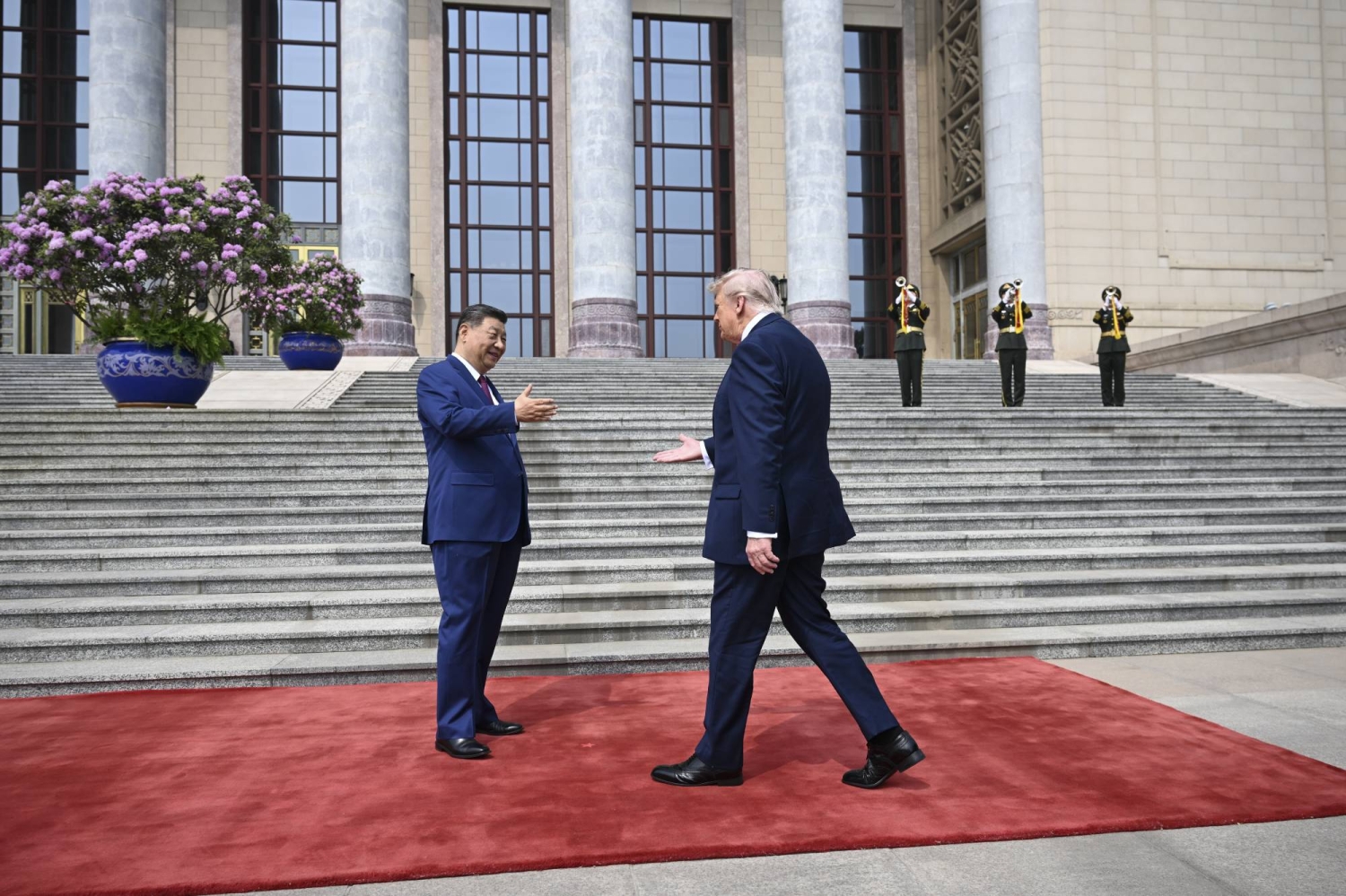
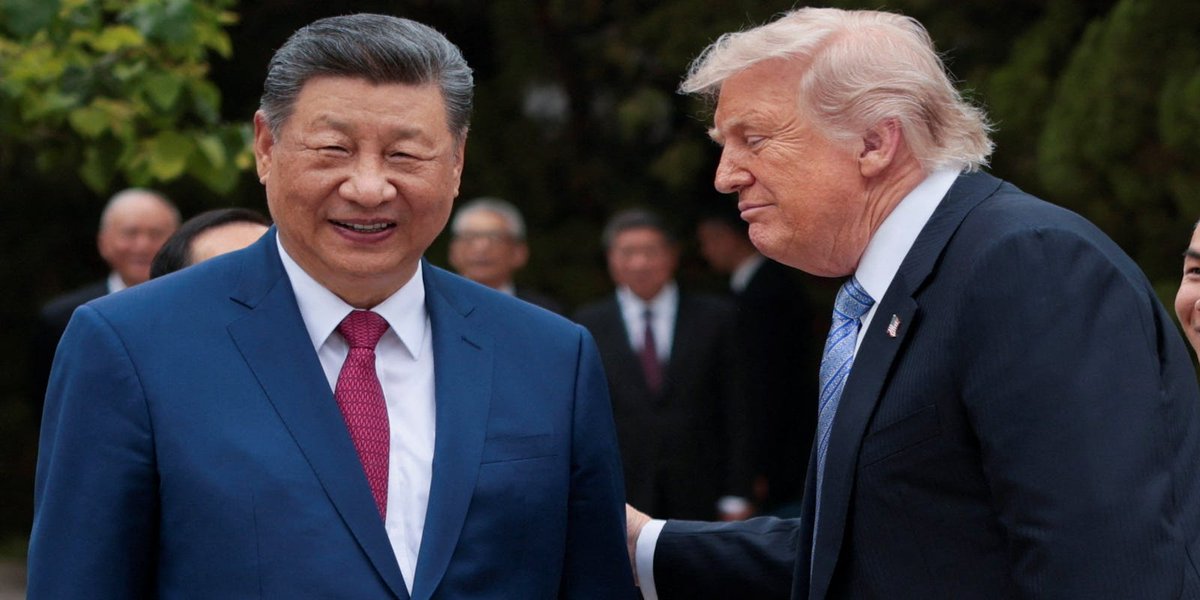
President Xi Jinping of China, left, greets President Donald Trump outside the Great Hall of the People in Beijing during their two-day summit, on Thursday, May 14, 2026. CREDIT: (Kenny Holston/The New York Times)

By Brahma Chellaney
Contributing Writer, The Japan Times

Soon after departing Beijing for the U.S. last Friday, U.S. President Donald Trump called Prime Minister Sanae Takaichi to brief her on his talks with Chinese leader Xi Jinping. The call was intended to reassure Tokyo after Trump’s high-stakes summit in Beijing.

But Japan can scarcely draw comfort from the symbolism of that phone call.

For Tokyo, the critical issue is whether the U.S. is fundamentally rethinking its approach toward China — and whether that shift could leave Japan dangerously exposed at a time of rising Asian instability fueled at least in part by Chinese expansionism.

The Beijing summit underscored a striking reversal in America’s China policy. Trump, casting aside both the adversarial approach of his first term (which the Biden administration largely maintained) and the hawkish rhetoric of the early months of his second term, now appears to be pursuing a policy of pragmatic accommodation.

The seismic shift in China policy, from confrontation to an increasingly dovish posture, holds profound implications for Japanese and broader Asian security, as the reversal comes just when Chinese coercive power is expanding.

During his first presidency, Trump defined China as the most consequential U.S. adversary, launched tariffs and made the Indo-Pacific central to U.S. strategy. He revived “the Quad,” strengthened pressure on Beijing and increasingly treated economic dependence on China as a national-security vulnerability.

In contrast, the latest summit projected a conspicuously conciliatory U.S. stance. The same president who often treats U.S. allies and strategic partners like freeloaders, vassals or adversaries, adopted a strikingly deferential posture toward America’s principal geopolitical rival. He lavished praise on China and Xi, even telling the Chinese leader, “It’s an honor to be your friend.”

The U.S. shift is occurring when Japan, under Takaichi’s leadership, has accelerated military normalization, increased defense spending and linked Taiwan’s security to its own. Now Tokyo faces an uncomfortable paradox: Just as Japan is seeking stronger deterrence against China, its principal ally appears to be edging toward tactical accommodation with Beijing.

For Japanese strategists, this revives an old nightmare — an “over-the-head” arrangement in which Washington and Beijing stabilize their relationship while Japanese security concerns are treated as secondary.

The concern is not that Trump will abandon allies. Rather, it is the prospect of gradual erosion: delayed or scaled-back arms sales to Taiwan, quieter naval operations, greater ambiguity in American commitments and increasing willingness to defer to Chinese “red lines” in exchange for economic or diplomatic concessions.

In a transactional framework, such concessions can accumulate incrementally. Over time, they alter the regional balance.

Trump’s willingness to roll back sanctions on Chinese refiners purchasing Iranian oil, together with his studied ambiguity on Taiwan and arms sales to Taipei, will reinforce concerns in Tokyo that immediate transactional calculations are increasingly outweighing Indo-Pacific deterrence.

His silence on China’s egregious human-rights record further underpins the perception that strategic accommodation is increasingly taking precedence over principle and long-term security.

Behind Trump’s conciliatory turn toward China lie the mounting costs of his Iran war fiasco, economic turbulence at home and slumping approval ratings.

The war against Iran has exposed serious strains in American military capacity. Precision-guided munitions, missile interceptors and other high-end systems have been consumed at alarming rates, depleting stockpiles. The conflict has also revealed vulnerabilities in U.S. forward bases and maritime operations — lessons Beijing is undoubtedly studying closely.

At the same time, China has demonstrated powerful economic leverage. A year ago, in response to Trump’s sky-high tariffs, Beijing effectively pulled a geoeconomic kill switch by halting most exports of rare-earth minerals — critical inputs for high-tech production. Washington was forced to climb down and negotiate a truce.

For Trump, confrontation with China now carries mounting economic and political costs. Inflationary pressures stemming from Middle East instability, fears of supply-chain disruption and concerns over U.S. debt have strengthened Washington’s incentives to stabilize ties with Beijing, lest China weaponize its holdings of U.S. Treasuries and America’s dependence on China-centered supply chains.

But what may seem like strategic pragmatism in Washington looks like strategic retrenchment in Tokyo and other Asian capitals that rely on the credibility of U.S. deterrence.

Japan’s security environment is uniquely vulnerable to any weakening of deterrence in the Taiwan Strait. Taiwan is not a distant geopolitical issue for Japan but central to its national security. If China were to dominate Taiwan, it would gain greater control over the maritime choke points and sea lanes through which much of Japan’s energy imports and trade flow.

Moreover, the Iran conflict itself has highlighted the geopolitical power of choke points. Just as disruptions in the Strait of Hormuz have delivered a global energy shock, Beijing may conclude that pressure on Taiwan and surrounding sea lanes could coerce adversaries without requiring a full-scale invasion.

For Japanese policymakers, unquestioned reliance on an all-encompassing American security umbrella is starting to look risky. That realization is likely to accelerate two trends already under way.

First, Tokyo will intensify efforts to strengthen “minilateral” security networks across the Indo-Pacific, particularly with countries such as India, Australia, the Philippines and Vietnam. These partnerships increasingly serve as insurance against uncertainty in American policy.

Second, Japan’s internal debate over constitutional revision and long-range strike capabilities is likely to accelerate further. Trump’s Beijing pivot may strengthen the argument among Japanese strategists that Japan must become a more autonomous military power capable of defending itself even if Washington’s priorities shift.

The Trump-Xi summit may have reduced immediate tensions between the world’s two largest powers. But for nations on China’s periphery, the summit reinforced a more troubling reality — that Washington increasingly sees the world’s largest autocratic state less as a challenger to be contained and more as a peer superpower whose cooperation America now urgently needs.

For Japan, the deeper fear is no longer merely a rising China, but an America growing less willing to confront it.

Brahma Chellaney, a longstanding contributor to The Japan Times, is the author of nine books, including “Water: Asia’s New Battlefield,” which won the Bernard Schwartz Award.

Gulf allies are quietly starting to break with Washington

Featured

By Brahma Chellaney, The Hill

President Donald Trump meets with Emir of Qatar Sheikh Tamim bin Hamad al-Thani aboard Air Force One. AP Photo

For decades, Washington treated the Gulf monarchies as the immovable pillars of American power in the Middle East. The U.S. military presence there evolved into a vast, interconnected web of bases and infrastructure stretching across Qatar, Saudi Arabia, the United Arab Emirates, Bahrain, Kuwait and Oman.

These states hosted U.S. troops, bought American weapons and aligned themselves with Washington’s regional priorities. In return, they expected the ultimate prize: protection under the American security umbrella.

That bargain is now fraying — and perhaps breaking.

The most important geopolitical shift in the Middle East today is not happening in Tehran, Tel Aviv or Ankara. It is happening quietly inside the royal courts of the Gulf sheikhdoms, which are reassessing whether the U.S. is still a reliable security guarantor or merely a power that uses their territory while leaving them exposed to retaliation.

President Trump’s Iran war has accelerated this reassessment dramatically.

When the U.S., in concert with Israel, launched war on Iran earlier this year, Gulf Arab states cooperated. American warplanes operated from bases on their soil. Trump singled out Saudi Arabia, Qatar and the UAE as “excellent” partners while deriding NATO allies and Indo-Pacific partners for refusing to participate.

But the praise concealed a deeper problem: The Gulf states discovered that supporting American military operations carried potentially catastrophic costs for them, as their energy facilities and desalination plants became targets of Iranian reprisals. Gulf rulers watched as the U.S. deployed enormous military resources (including Aegis-equipped destroyers and advanced interceptors) to shield Israel from Iranian retaliation while Gulf states absorbed the payback for enabling American strikes.

That experience appears to have fundamentally altered their calculations.

Another turning point came recently when Trump announced “Project Freedom,” a U.S. naval initiative to escort commercial shipping through the Strait of Hormuz after Iran disrupted maritime traffic. Washington viewed the mission as a demonstration of resolve. Tehran viewed it as an escalation. The Gulf monarchies viewed it as a potential disaster.

Saudi Arabia refused to grant the U.S. access to its airspace and bases to support the operation. Kuwait followed suit. Qatar, seeking de-escalation, imposed restrictions on activity from Al-Udeid Air Base, the largest U.S. military installation in the Middle East. Without Gulf cooperation, the mission quickly became logistically and politically unsustainable. Trump abruptly suspended it after just two escorted U.S.-flagged vessels passed through the strait.

In effect, Gulf states vetoed a major American military initiative — something that would have been almost unthinkable only a year ago. Only after Trump paused the operation did Gulf governments restore U.S. access to basing and overflight rights, underscoring that such cooperation is no longer automatic but conditional.

Washington had long operated under the assumption that Gulf bases were essentially available on demand during crises in return for American military protection. Now, however, Gulf states are increasingly asking a different question: Protection for whom?

From their perspective, the current arrangements look dangerously asymmetric. The U.S. can launch operations, rotate forces and eventually withdraw. But the six Gulf states remain geographically trapped beside Iran permanently. In any confrontation between Washington and Tehran, the Gulf monarchies become the frontline targets.

The lesson these states appear to have learned from recent hostilities is stark: They are platforms for American power, not equal partners in American protection. That realization is driving a profound strategic shift.

The Gulf states no longer appear willing to practice automatic alignment with Washington. Instead, they are moving toward what might be called “transactional neutrality.” In effect, they are applying Trump’s own worldview back onto the U.S. itself.

“America First” is increasingly being answered with “the Gulf First.”

That means Gulf monarchs are becoming far more selective about which American operations they support. The shift extends beyond military access. Major Gulf states are diversifying their defense partnerships, purchasing non-American technologies and exploring alternative security arrangements. Some Gulf governments are also intensifying diplomatic outreach to regional rivals, including Iran itself.

For them, de-escalation is no longer simply diplomacy; it is strategic self-preservation.

This should deeply concern Washington. The entire architecture of American regional dominance — air operations, naval deployments, intelligence coordination and energy security — has depended on nearly unconditional Gulf cooperation. That era may be ending.

Ironically, Trump himself has helped accelerate the process. His transactional approach to alliances convinced Gulf rulers that relationships with Washington are no longer rooted in enduring strategic commitments but in fluctuating cost-benefit calculations.

Once alliances become transactional, partners naturally begin asking whether the transaction remains worthwhile. The Gulf monarchies increasingly seem to believe it is not.

The implications extend far beyond the current Iran crisis. If Gulf states become reluctant hosts for American military operations, Washington’s ability to project power across the Middle East will shrink dramatically. The U.S. may still possess unmatched military hardware, but hardware alone is insufficient without reliable access, basing and political support.

This is the strategic paradox now confronting Washington. In alienating NATO and Indo-Pacific allies while simultaneously alarming Gulf partners, Washington risks discovering that even a superpower cannot operate effectively in isolation.

The Gulf monarchies are not abandoning the U.S., but they are redefining the relationship on narrower terms. The age of blank-check cooperation is over. Gulf allies are no longer willing to be the lightning rods for U.S. military campaigns while relying on uncertain protection when retaliation arrives.

And once allies learn they can say “no” to Washington, they rarely return to automatic obedience.

Brahma Chellaney is the author of nine books, including the award-winning “Water: Asia’s New Battleground.

In Beijing, Trump faced America’s equal

Featured

Beijing no longer behaves like a rising power seeking acceptance into an American-led order. It behaves like a co-owner of the international system. And increasingly, Washington treats China that way.


Brahma Chellaney, USA Today

For years, Washington comforted itself with a reassuring phrase: China was a “near-peer competitor.” Near-peer implied China was close but not equal. It was a challenger still climbing the ladder while America remained securely at the top.

President Donald Trump’s just-concluded summit with Chinese President Xi Jinping in Beijing shattered that illusion.

The visit showed that the world’s largest autocratic state is no longer America’s near-peer. It is America’s peer.

The symbolism alone was striking. Trump arrived in Beijing not as the triumphant leader of an unchallenged superpower, but as the head of a country increasingly constrained abroad, economically vulnerable at home, and struggling to impose its will even on far weaker adversaries.

When Trump postponed the Beijing trip from March to May, he likely expected to arrive after forcing Iran into submission. Instead, he landed in Beijing with the Iran war still unresolved, America’s military stockpiles depleted, and U.S. credibility bruised.

Xi understood the moment perfectly. The carefully choreographed summit was designed to project parity: two leaders, two superpowers, two equals managing global stability together. Beijing no longer behaves like a rising power seeking acceptance into an American-led order. It behaves like a co-owner of the international system. And increasingly, Washington is treating China that way.

Trump’s tone during the visit reflected the altered realities. The same president who routinely berates allies as freeloaders adopted a strikingly deferential posture toward America’s principal geopolitical rival. He praised Xi lavishly, calling it “an honor” to be his friend.

Equally striking was what Trump did not say. There was no mention of China’s human rights abuses – not of the mass incarceration and surveillance of Uyghur Muslims in Xinjiang, not of the crushing of freedoms in Hong Kong, not of tightening repression in Tibet or Inner Mongolia. A decade ago, such silence from an American president visiting Beijing would have been politically unthinkable.

Today, it reflects a deeper reality: Washington increasingly treats China less as a wayward authoritarian state to be lectured and more as a peer superpower whose cooperation it needs and whose sensitivities it must manage.

In Trump’s first term, Washington still believed it could fundamentally reshape China’s behavior through tariffs, sanctions and technological pressure. The assumption was that America possessed overwhelming leverage. That confidence has eroded.

China today is not the China of 2017. It has built the world’s largest navy. It has dramatically expanded its nuclear arsenal. It has narrowed the technological gap in artificial intelligence, advanced manufacturing, robotics and quantum computing. In several strategic industries – batteriesdronesrare earth processing and green technologies – China now dominates outright.

Most importantly, Beijing has demonstrated that interdependence cuts both ways.

When Trump last year escalated tariffs, China retaliated by tightening rare-earth exports, exposing America’s deep dependence on Chinese supply chains. Suddenly, the world’s strongest economy looked vulnerable to industrial choke points controlled by Beijing.

That vulnerability hovered over the summit.

The most telling aspect of Trump’s Beijing visit was that both sides emphasized “stability” in their relationship. This is no longer a relationship defined by American primacy. It is one increasingly defined by mutual constraint.

The U.S. still possesses enormous advantages. The dollar remains dominant. America retains unmatched alliance networks, global military reach and world-leading innovation ecosystems. China also faces severe internal problems, including mounting debtdemographic decline and slowing growth.

But peer competition does not require symmetry. The Soviet Union was America’s peer despite being economically weaker. Britain was once Germany’s peer despite Germany’s larger industrial base. The defining characteristic is the ability to resist coercion and shape global outcomes independently.

China can now clearly do both.

Indeed, the summit underscored how much Washington’s ambitions have narrowed. Trump once talked about decoupling from China. Now the goal appears far more modest: managed coexistence, stabilized trade and guardrails against open conflict.

That is what peer rivalry looks like.

The danger for the U.S. lies in refusing to adapt to the new reality. Much of Washington still oscillates between complacency and denial, either dismissing China as fundamentally fragile or assuming America can easily restore uncontested dominance.

Yet China’s message during the summit was unmistakable: It no longer seeks admission into an American-led order. It seeks acknowledgment as an equal center of power.

And despite all the pageantry, Trump’s visit ultimately conveyed something Xi desperately wanted the world to see: The U.S. may still be the world’s strongest country but it no longer stands alone at the apex of global power.

Brahma Chellaney is a geostrategist and the author of nine books, including the award-winning “Water: Asia’s New Battleground.”

Is Modi ‘coup-proofing’ India’s top military post?

Featured

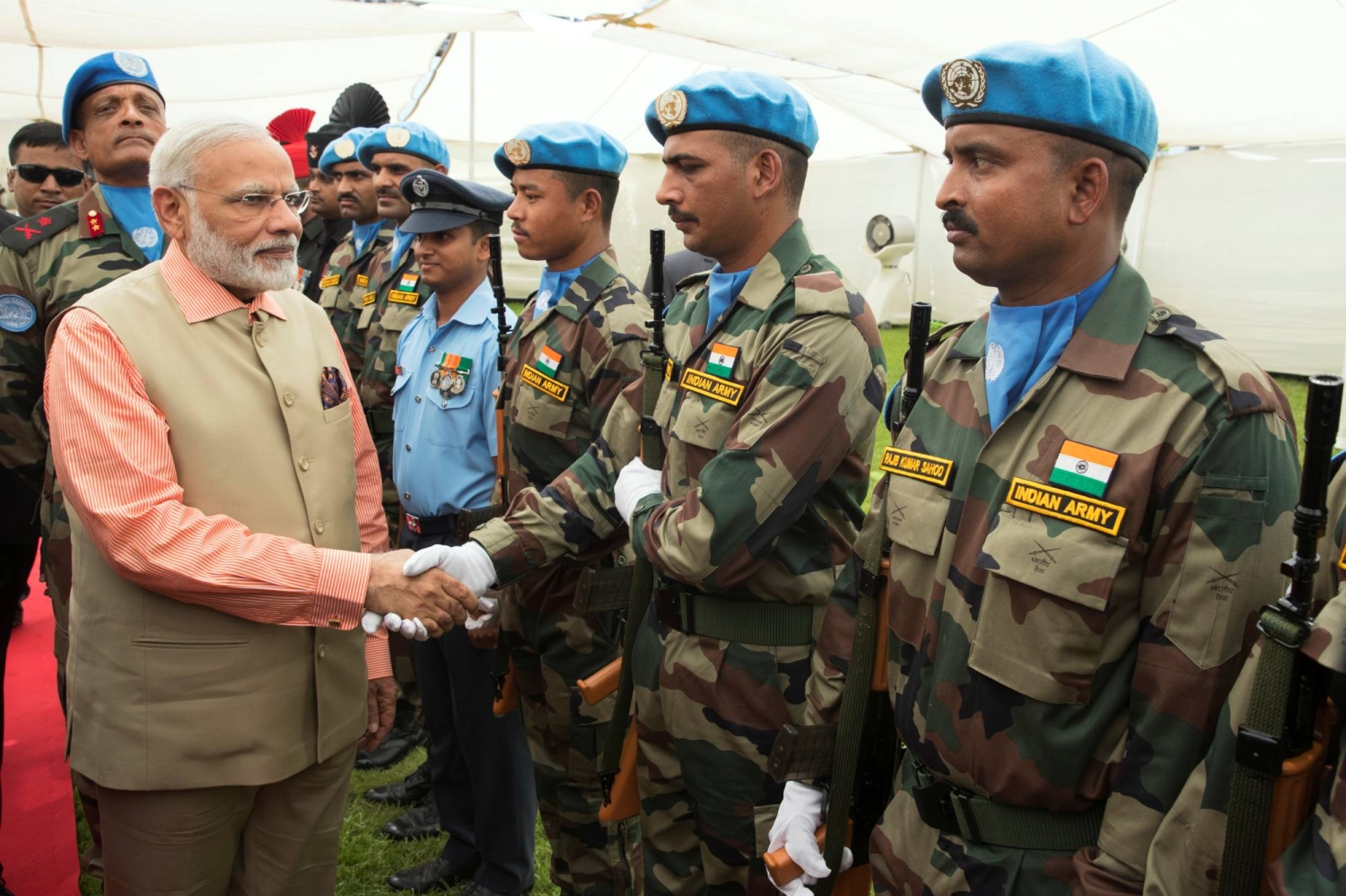
Indian Prime Minister Narendra Modi greets members of the Indian contingent of UNIFIL (United Nations Interim Force in Lebanon) during a visit at the Indian Army Cemetery of World War I to honour fallen Indian soldiers, in the Israeli coastal city of Haifa, July 6, 2017. REUTERS/Jack Guez/Pool

By Brahma Chellaney
Contributing writer, The Japan Times

India created the post of Chief of Defense Staff in 2019 to achieve what its military had long lacked: genuine jointness among the Army, Navy and Air Force.

The CDS was intended to function as the principal military adviser to the government, improve interoperability among the services and push through long-delayed reforms such as integrated theater commands.

Yet less than a decade later, the institution is being weakened by the very government that created it.

The issue goes to the heart of civil-military relations, military effectiveness and India’s ambitions as a rising major power.

The latest appointment to the office illustrates the issue clearly. For the second consecutive time, Prime Minister Narendra Modi’s government has chosen a retired three-star lieutenant general to serve as CDS, immediately elevating him to four-star rank upon appointment. Lt. Gen. N.S. Raja Subramani will now coordinate among serving four-star service chiefs who continue to command troops, budgets and operational structures.

This is an unusual arrangement for a position that was originally conceived as primus inter pares — first among equals.

Only the first CDS, Gen. Bipin Rawat, assumed office while serving as Army chief. His appointment carried institutional weight because he entered the role directly from active command at the apex of the military hierarchy. By contrast, a retired officer re-entering service on a contractual basis inevitably derives authority less from institutional standing than from political selection.

Since Rawat’s death in a helicopter crash in late 2021, the government has moved toward appointing retired officers — a shift that reflects both a rethink of the CDS office and a broader instinct toward institutional “coup-proofing.”

India, unlike neighbors such as Myanmar, Bangladesh and Pakistan, has no history of military intervention in politics.

Indeed, much like Japan, India long remained reluctant to integrate military officers into a defense ministry dominated by civilian bureaucrats often lacking specialized military expertise. Over the past decade, however, Japan has moved further and faster than India in dismantling the bureaucratic walls separating its military from the defense ministry.

Yet, even as career bureaucrats still dominate Indian defense planning, New Delhi appears increasingly wary of concentrating too much institutional authority in a CDS drawn directly from the serving chiefs of staff. A sitting service chief elevated to CDS would carry operational authority, institutional networks and considerable standing within the armed forces.

A retired officer reappointed through executive discretion is inherently more dependent on the political leadership. That may reassure civilian authorities seeking tight control over the military hierarchy. But it also risks weakening the CDS’s credibility within the services themselves, undermining the very jointness and theaterization the office was meant to advance.

That distinction matters. A serving chief who has risen through the ranks and commands active forces possesses independent stature within the military system. Such an individual is better positioned to provide candid advice to political leaders, including advice they may not wish to hear.

A retired officer brought back through a government notification may instead be perceived — fairly or unfairly — as more beholden to the political executive that restored him to office.

Perceptions shape institutions. If serving chiefs begin to see the CDS primarily as a political appointee rather than an impartial coordinator among equals, the trust necessary for meaningful military integration erodes.

This comes at precisely the wrong time for India.

Modern warfare increasingly depends on cross-domain integration. Air power, naval reach, cyber capabilities, space assets and long-range precision systems are becoming as important as massed land forces. The wars in Ukraine and the Middle East have demonstrated that military success now hinges less on the dominance of any single service than on the ability to synchronize all instruments of combat power.

India itself has recognized this reality. The push for theater commands — integrating Army, Navy and Air Force assets under unified operational structures — reflects an understanding that future wars cannot be fought through service silos.

Yet institutional culture matters as much as organizational charts. And here the government risks sending the wrong signal.

Every CDS so far has come from the Army. Given the Army’s size and political influence, that may not be surprising. But repetition creates institutional expectations. If the top military post appears effectively reserved for Army officers — including retired ones — the Navy and Air Force may reasonably conclude that “jointness” in practice means Army predominance.

That is a dangerous perception for a country seeking to become a major maritime and aerospace power.

India’s strategic challenges are increasingly maritime in nature, from the growing Chinese naval presence in the Indian Ocean to the security of sea lanes and energy routes. Likewise, air and missile power will be central to any future conflict involving China or Pakistan. A genuinely integrated military structure requires all three services to feel equally represented and invested in reform.

Instead, New Delhi appears to be moving in the opposite direction: centralizing authority politically while narrowing the institutional base of the CDS.

The irony is striking. With considerable fanfare, Modi announced the creation of the CDS position on Independence Day in 2019 as a transformational reform intended to streamline military advice and reduce bureaucratic barriers between the armed forces and the political leadership. Yet the government has increasingly transformed the CDS into a politically managed bureaucratic office within the Ministry of Defense.

The CDS also serves as secretary of the defense ministry’s Department of Military Affairs, effectively combining military leadership with bureaucratic responsibilities. That dual role risks turning what was envisioned as India’s senior-most military strategist into a highly placed defense administrator.

The country’s political leadership may prefer a CDS who remains firmly dependent on civilian authority and lacks an independent institutional power base. But there is a trade-off between political control and military effectiveness.

An overly constrained CDS may preserve tighter civilian oversight in the short term while weakening the office’s ability to drive difficult reforms, resolve interservice rivalries and provide independent strategic advice. Theaterization, long discussed but still unrealized, could continue to stagnate.

The CDS was created to strengthen India’s military integration. Instead, the office risks evolving into a politically managed coordinating post with diminishing institutional authority.

That would leave India with the appearance of reform, but not its substance.

Brahma Chellaney, a longstanding contributor to The Japan Times, is the author of nine books, including “Water: Asia’s New Battlefield,” which won the Bernard Schwartz Award.

The High Cost of Trump’s Crony Diplomacy

Featured

Effective diplomacy depends on credibility, consistency, and a clear alignment with national interests. The US administration’s personalized, opaque, and venal shadow diplomacy delivers none of that, and it will leave the US less respected, less trusted, and less effective on the world stage.

By Brahma ChellaneyProject Syndicate

In most democracies, a leader outsourcing high-stakes diplomacy to family members and business associates would provoke outrage. But US President Donald Trump has faced little pushback for doing so, with many downplaying his crony diplomacy as mere “heterodoxy.” The long-term consequences will be severe.

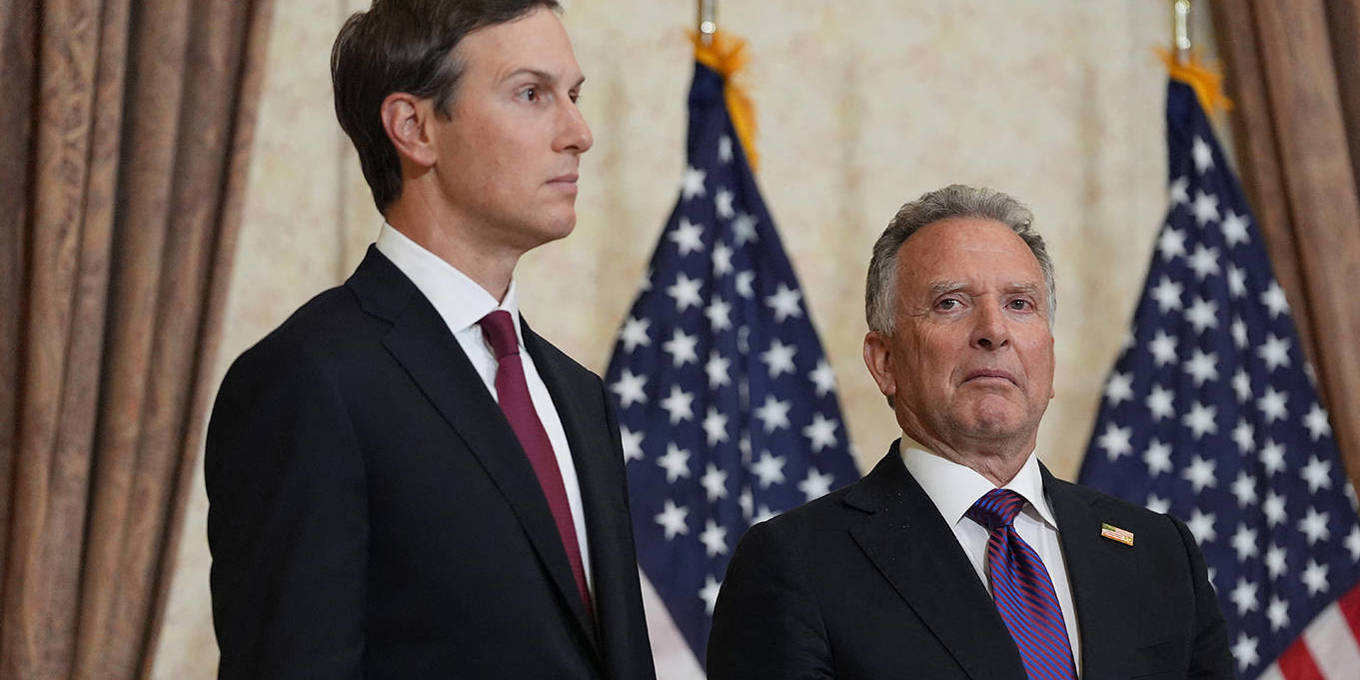
Instead of relying on the secretary of state and the professional diplomatic corps, Trump has placed pivotal diplomacy largely in the hands of his son-in-law, Jared Kushner, and his business partner, the Manhattan real-estate mogul Steve Witkoff. Kushner was a senior adviser in Trump’s first administration, responsible for helping to broker the Abraham Accords between Israel and four Arab states, and is now, like Witkoff, a Special Envoy for Peace.

Together, Kushner and Witkoff have spearheaded negotiations on Ukraine, Gaza, and Iran. Yet neither had any diplomatic experience before Trump tasked them with resolving some of the thorniest and highest-stakes foreign-policy challenges of our time, and both have glaring conflicts of interest.

Start with Witkoff. Last year, Pakistan signed a controversial investment deal with World Liberty Financial, a cryptocurrency firm whose CEO is Witkoff’s son, Zach, and in which the Trump and Witkoff families hold a dominant ownership stake. This past January, a WLF affiliate reached another deal with Pakistan—this time, to introduce the company’s stablecoin for use in cross-border transactions.

But Pakistan has also been the site and, to an extent, the broker of talks between the United States and Iran. When actors are negotiating geopolitical outcomes and pursuing business opportunities in the same arena, diplomacy begins to resemble a marketplace: access, influence, and profit are tightly interwoven.

As for Kushner, after leaving Trump’s first administration, he set up a private-equity firm, Affinity Partners, and took billions of dollars from Gulf monarchies, including about $2 billion from Saudi Arabia’s sovereign wealth fund. In other words, Kushner is dependent on Saudi capital. Yet he is now expected to negotiate a détente with Iran, even as Saudi Crown Prince Mohammed bin Salman reportedly urges Trump to continue the war.

And it is not just Iran. Kushner’s “New Gaza” proposal, unveiled at Davos this past January, has been widely criticized as “real-estate diplomacy,” as it effectively recasts reconstruction as a business venture while ignoring questions of sovereignty and rights.

Kushner and Witkoff’s conflicts of interest, together with their lack of foreign-policy credentials, explain why Trump has not sought to appoint them to official diplomatic positions. Special envoys avoid Senate confirmation hearings, as well as the disclosure requirements, ethics rules, and congressional oversight that bind professional diplomats. Kushner and Witkoff are thus able to exercise influence without transparency, and to negotiate on behalf of the US without accountability.

Of course, Kushner and Witkoff are hardly the only figures capitalizing on their proximity to Trump. Prominent allies and donors, such as Oracle’s Larry Ellison, have won big from their investment in the majority American-owned TikTok venture that Trump effectively forced the Chinese parent company to create, supposedly over national-security concerns.

Moreover, Trump’s sons, Eric and Donald, Jr., recently joined a drone company Powerus, and are attempting to sell drone interceptors to the Gulf states to ward off attacks from Iran as it retaliates for their father’s war. Foundation Future Industries, a robotics startup where Eric is chief strategy adviser, was recently awarded a $24 million Pentagon contract.

Now, reports are emerging of possible insider trading around the Iran war, with large bets being made right before market-moving public statements from Trump. Yet the American public, whether desensitized to Trump’s breaking of norms or simply unable to keep up with the pace and scale of the violations, hardly reacts to such news. Scandals that would have brought any past US administration down—or at least prompted urgent investigation—have become routine under Trump.

With a Republican Party that bows to Trump’s every whim and justifies his every crime—while controlling both houses of Congress—a kind of resignation has taken hold. But as outrage fades, so does the restraining power of political norms. As a result, abuses become increasingly blatant and egregious, and trust is eroded. Even if Trump’s cronies did manage to reach a peace deal, it would warrant suspicion, with every concession raising questions about who really benefits—and who is compromised.

This undercuts not only specific agreements, but also US global leadership more broadly. With US foreign policy now guided by personal loyalty, informal networks, and private gain, whatever credibility the US had as a reliable partner, good-faith negotiator, and champion of the rule of law has been decimated. None of this will be easily restored.

In the meantime, if foreign governments want to influence US policy or secure the country’s geopolitical cooperation, they must make it worth Trump’s while. Nowhere is that more apparent than in Trump’s so-called Board of Peace—a putative alternative to the United Nations where a permanent seat carries a billion-dollar price tag. This is less a multilateral institution than a pay-to-play geopolitical franchise, but some countries appear willing to cough up the cash to stay in the US president’s good graces.

Others seeking to shape US policy head to Trump’s Mar-a-Lago resort in Florida, which he increasingly uses for official diplomatic engagements. And, of course, there are those who go there to get in on the self-dealing, making business deals with Trump’s inner circle. Meanwhile, wars continue to rage, with far-reaching human and economic consequences.

Trump’s defenders argue that unconventional actors can produce breakthroughs where conventional processes have failed. But diplomacy is not merely deal-making; it depends on credibility, consistency, and a clear alignment with national interests. The personalized, opaque, and venal shadow diplomacy being pursued by Kushner and Witkoff can deliver none of that. What it can and will do is ensure that the US is less respected, less trusted, and less effective on the world stage.

Brahma Chellaney, Professor of Strategic Studies at the New Delhi-based Center for Policy Research and Fellow at the Robert Bosch Academy in Berlin, is the author of nine books, including Water: Asia’s New Battleground (Georgetown University Press, 2011), for which he won the 2012 Asia Society Bernard Schwartz Book Award.

© Project Syndicate, 2026.

Trump heads to Beijing with fewer cards to play

Featured

The Iran war has exposed systemic vulnerabilities in the American way of war, offering China a real-time tutorial in how to exploit them.

AP Photo/Mark Schiefelbein

By Brahma Chellaney, The Hill

When President Trump meets Chinese President Xi Jinping in Beijing, it will look like another great-power summit. It is anything but. The balance has shifted — and not in Washington’s favor.

Trump goes with a weakened hand as the Iran war has boomeranged into a global energy shock. The visit, delayed from March to May as the conflict escalated, is less a show of strength than it is damage control.

The geopolitical landscape has shifted markedly since Trump and Xi first agreed to the Beijing summit last October.

The immediate source of weakness is the war itself. What Washington billed as a short, decisive campaign against China’s closest Middle Eastern partner has instead exposed systemic vulnerabilities in the American way of war, offering Beijing a real-time tutorial in how to exploit them.

Iranian reprisals degraded U.S. air defenses, blinded early-warning systems and left many of its 13 regional bases inoperable. Low-cost drones and missiles imposed disproportionate costs. Chokepoints became contested.

Just as consequential is the drain on U.S. munitions. Precision interceptors, missiles and other high-end systems have been consumed at a pace that has forced the Pentagon to divert stockpiles from Asia, thinning deterrence in the Indo-Pacific just as China’s coercive power expands.

Replenishment will take years, not months. And the problem is not just quantity — the war has exposed deeper weaknesses such as vulnerable forward bases, the difficulty of countering drone swarms and how quickly maritime superiority erodes in narrow seas.

These are not abstract lessons for Beijing. They are a playbook.

The Iran conflict has shown China how asymmetric tools can blunt a superior military, and how control of chokepoints can yield leverage without full-scale war. The implications are clear as Beijing plans for contingencies along the First Island Chain — from Japan through Taiwan to the Philippines — which it views as a U.S.-led line of containment.

For Washington, the lesson is sobering: a two-theater posture may be far harder to maintain than had been assumed.

The U.S. economic picture is just as troubling. The war has triggered an energy shock that is feeding inflation and eroding political capital. Gasoline prices now shape the White House’s strategic calculus as much as battlefield outcomes.

Trump’s bargaining position is thus tied to his need for relief — relief Beijing is uniquely positioned to facilitate, whether through its leverage over Iran as its main oil customer or its central role in global supply chains.

In April 2025, in response to Trump’s tariffs, Beijing effectively pulled a geoeconomic kill switch by halting most exports of rare earth minerals — critical inputs for high-tech production. Washington was forced to climb down and negotiate a truce.

This is the context in which Trump’s China policy has shifted — from confrontation to accommodation.

In his first term, Trump recast China as a strategic adversary, launched tariffs and made the Indo-Pacific central to U.S. strategy. He revived the Quad and treated economic interdependence as a vulnerability.

In his second term, that posture has softened. Planned tariffs have been paused, punitive measures shelved and rhetoric cooled. Even baseline steps — such as arms sales to Taiwan — have been delayed. As the administration now frames it, Trump seeks “stable peace, fair trade, and respectful relations” with China.

The shift is unmistakable. The U.S. remains deeply reliant on Chinese inputs, not least rare earths, and Beijing has shown it will weaponize that dependence. At a moment of depleted munitions and economic strain, the risk of disruption is a constraint Trump cannot ignore.

Trump now needs China — a major financier of U.S. government spending — in ways he did not in his first term. Then, a strong economy allowed escalation. Now, stagflation makes confrontation costly. The White House needs stable supply chains, and cannot risk Beijing weaponizing its U.S. Treasury holdings as U.S. borrowing rises.

That dependence reframes the summit. Trump is going not to dictate terms but to seek relief — on energy and financial stability and a political “win.” Chinese cooperation will not come cheap.

Beijing’s leverage is substantial. It has cushioned its energy vulnerabilities through stockpiles and overland pipelines from Russia and Central Asia, while deepening ties with Moscow. China can afford patience, and will trade only for advantage.

Export controls are a prime target. Beijing will push to ease restrictions on advanced semiconductors and AI. Extending the trade truce will be framed as stabilizing but will lock in Chinese gains.

The most sensitive domain is security — above all, Taiwan. The concern is not a dramatic “sell-out,” but gradual erosion: fewer arms sales, quieter naval operations, more ambiguity. In a transactional framework, such concessions can be traded piecemeal. Over time, they shift the balance.

The Iran war has sharpened these concerns by exposing Taiwan’s vulnerabilities. Highly dependent on imported energy and with limited reserves, Taiwan is exposed to sea-lane disruption. The lesson of Hormuz — that chokepoint control can impose pressure without invasion — will not be lost on Beijing.

All this points to a stark conclusion: Trump’s visit comes on terms that favor China. The likely outcome is a managed detente — a cooling of rhetoric and a symbolic reset. Trump will present it as deal-making prowess; Xi as proof of China’s rise. Both will claim success.

But the underlying shift will endure. A rivalry of near-peers is giving way to something closer to a creditor-debtor dynamic, in which Washington seeks relief and Beijing sets terms. Beijing can wait. Washington cannot.

In geopolitics, as in markets, timing matters. Trump is going to Beijing at the wrong time, and with fewer cards than he would like. The question is not whether he can strike a deal, but what he will give up to get one.

Brahma Chellaney is the author of nine books, including the award-winning “Water: Asia’s New Battleground.