Trump’s Peacemaker Hype

Featured

It takes a special kind of genius to end wars that never started. Trump has achieved what no military general in history ever managed: ending wars that never began. No shots fired, no armies on the march — yet Trump claims three historic triumphs
Brahma ChellaneyProject Syndicate

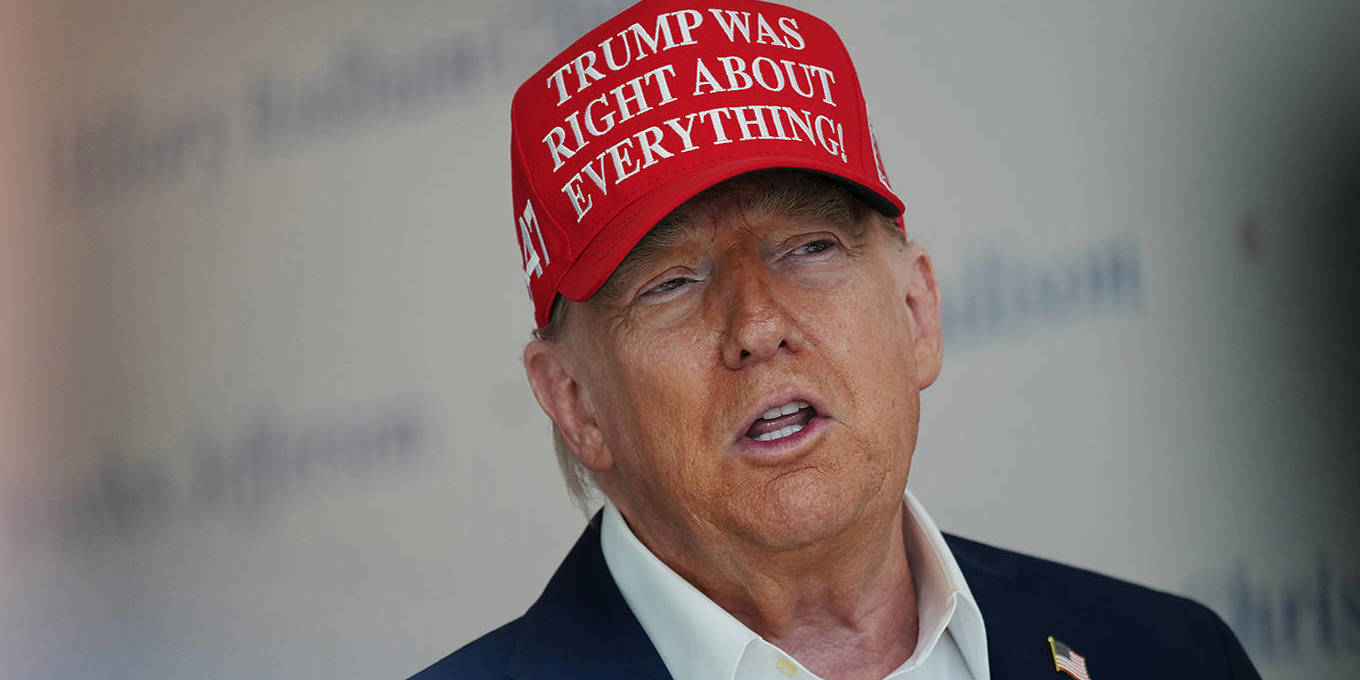
GENEVA – “Everyone says that I should get a Nobel Peace Prize,” US President Donald Trump told the United Nations General Assembly this week, because “I ended seven un-endable wars in seven months.” The boast was classic Trump: extravagantly formulated, unironically delivered, and patently false.

A recent poll indicates that only 22% of US adults believe that Trump deserves the Nobel Prize – a far cry from “everyone” – with 76% of respondents stating that he does not deserve it. Perhaps this reflects the fact that Trump has not ended seven wars. Arguably, he has not even ended one.

Some of Trump’s claims were pure fiction. For example, he took credit for ending a war between Egypt and Ethiopia. But, although bilateral tensions over the Grand Ethiopian Renaissance Dam have simmered for years, they have never boiled over into war. Likewise, Trump claimed to have ended a nonexistent war between Kosovo and Serbia. Despite considerable hostility – and a history of violent clashes – the two countries have not been at war since the 1990s. No war is easier to end than one that has never started.

Perhaps Trump’s most risible invention was the war – “a bad one” – between Armenia and Cambodia, countries located over 4,000 miles (6,500 kilometers) apart that have never had any conflict whatsoever. Armenia did clash with neighboring Azerbaijan this year, and Trump convinced both countries’ leaders to sign a joint declaration aimed at ending their decades-long conflict. But progress on implementing that agreement has stalled, and the accord is in danger of unraveling. That Trump would consider this conflict “ended” reveals the depth of his ignorance about peacemaking.

The same goes for the war between the Democratic Republic of Congo and Rwanda. Trump does have a set piece to point to: a “wonderful” US-mediated deal. But while the war may have ended on paper, deadly clashes continue.

As for Cambodia, it engaged in skirmishes with its neighbor Thailand in July over their contested border. But Trump’s attempts at economic coercion did little to defuse the crisis. What brought the fighting to an end was the Association of Southeast Asian Nations’ diplomacy, with this year’s ASEAN chair, Malaysian Prime Minister Anwar Ibrahim, hosting the Cambodian and Thai leaders for face-to-face talks in Kuala Lumpur. While the underlying border dispute, centered largely on ownership and control of ancient Hindu temples, remains unresolved, the “immediate and unconditional” ceasefire that Anwar brokered halted the violence.

This is not the only example of Trump taking credit for others’ foreign-policy acumen. After Pakistan-backed terrorists massacred Indian tourists in Indian-administered Kashmir in April, India took decisive and carefully calibrated retaliatory action, launching military strikes on Pakistani terror camps. It was this show of force that made Pakistan back down, but Trump would have the world believe that he single-handedly mediated an end to the conflict using his favorite tool: trade threats. So absurd and relentless were his boasts that Indian officials publicly refuted him.

Trump’s most audacious claim, however, was that he ended the war between Israel and Iran. In reality, Trump gave Israel the green light to strike Iranian positions; deployed American military assets to help Israel shoot down Iran’s missiles and drones; and ordered the bombing of Iranian nuclear sites – severely undermining the global nonproliferation regime in the process. If this is Trump’s idea of peacemaking, one dreads to think what his version of warmongering would look like.

Trump’s Nobel Peace Prize campaign has followed a familiar pattern: invent or inflate a problem, claim to have solved it, and then demand a reward. From his photo ops with North Korean leader Kim Jong-un to his Middle East “peace deals” (which merely formalized existing relations between the Gulf states and Israel), Trump engages in theater, not diplomacy – performances staged for headlines and applause. The Norwegian Nobel Committee, one suspects, will not be fooled. The same cannot be said for Trump’s base.

Trump’s absurd claims not only undermine US credibility abroad but also carry real risks. For starters, they trivialize genuine peacemaking. Ending wars is among the most difficult tasks in international politics. It demands quiet diplomacy, painstaking negotiations that address the root causes of conflict, and a commitment to following through on any agreement. Trump has shown little interest in such work. All he cares about is fanfare.

Moreover, false declarations of peace can mask unresolved conflicts and undermine the vigilance needed to prevent new flare-ups, which could ignite with even greater ferocity. Such proclamations can also erode accountability for diplomatic failures – and even for reckless military actions like those Trump sanctioned against Iran.

Trump’s claim to have ended seven “un-endable” wars is best understood as a case study in self-delusion. Branding is not leadership. Real peace depends on leaders who know the difference. But in Trump’s world, peace is not the absence of war, but the presence of applause.

Brahma Chellaney, Professor of Strategic Studies at the New Delhi-based Center for Policy Research and Fellow at the Robert Bosch Academy in Berlin, is the author of nine books, including Water: Asia’s New Battleground (Georgetown University Press, 2011), for which he won the 2012 Asia Society Bernard Schwartz Book Award.

© Project Syndicate, 2025.

China’s Himalayan mega-dam is a global threat

Featured

The largest dam ever conceived symbolizes China’s bid, from oil to water, for 21st-century dominance

Avatar

Brahma Chellaney

Nikkei Asia

20250912 dam

China is about to upend the world’s hydrological balance — with consequences as far-reaching as climate change itself.

Its $168 billion Himalayan super-dam represents not merely the world’s costliest infrastructure project but also one of its riskiest. What Beijing portrays as an engineering marvel is in fact an ecological disaster in the making.

The dam is being constructed on the Yarlung Zangbo River (also known as the Brahmaputra), just before it curves into India. The project’s significance was underscored by the fact that Chinese Premier Li Qiang, flanked by senior officials and leaders of major state-owned enterprises, formally announced the groundbreaking in July, although satellite imagery had indicated activity at the site for some time.

The last time a Chinese leader inaugurated a dam project was 1994, when then-Premier Li Peng presided over the groundbreaking ceremony for the Three Gorges Dam on the Yangtze River. That symbolic parallel underscores the magnitude of the Brahmaputra mega-dam — an undertaking that will surpass the Three Gorges in scale, ambition and peril.

The Three Gorges Dam was initially celebrated as a modern wonder but is now widely recognized as an environmental and social disaster: It displaced more than a million people, triggered recurrent landslides, degraded water quality and disturbed seismic stability. Its mammoth reservoir has even slightly slowed the Earth’s rotation.

China’s new megaproject is in an even more fragile setting: one of the world’s most seismically active zones, straddling a heavily militarized frontier where Beijing claims India’s sprawling Arunachal Pradesh state as “South Tibet.” Constructing the world’s largest dam atop a geological fault line is more than reckless — it is a calculated gamble with catastrophic potential. Any collapse, whether from structural weakness or reservoir-induced seismicity, would devastate India’s northeast and Bangladesh, placing tens of millions at risk.

The dam, designed to generate nearly three times the electricity of the Three Gorges Dam, was approved by the National People’s Congress in March 2021. Yet the project remained cloaked in secrecy until the recent announcement, true to Beijing’s pattern of concealing work on major dams along international rivers until commercially available satellite imagery makes it impossible to hide.

The Brahmaputra, unlike most rivers, is an ecological lifeline, sustaining one of the world’s most biodiverse regions as it descends sharply from Himalayan heights to form the longest and steepest canyon on Earth — twice as deep as America’s Grand Canyon. It is here that China is constructing the behemoth dam to tap the unparalleled concentration of river energy.

Originating in Tibet’s mountain springs, the world’s highest-altitude major river flows through India and Bangladesh, supporting agriculture, fisheries and dense populations. Its annual floods, while destructive, flush toxins, recharge groundwater and deposit nutrient-rich sediment vital for farming. The super-dam will upend this rhythm, trapping silt, shrinking Bangladesh’s delta already imperiled by rising seas and depriving Indian farmers of natural fertilization cycles. Saltwater intrusion and catastrophic floods would become more frequent.

But Beijing sees water not just as a resource; it sees it as power. By placing a mega-dam just before the river leaves Tibet, China would acquire a hydraulic chokehold over hundreds of millions downstream.

Control over oil once defined global power. And, in the 21st century, control over transboundary rivers may prove just as decisive. With the dam, China would hold the ability to weaponize water without firing a shot.

The dam’s enormous price tag reflects not just ambition to generate enormous amounts of electricity but a determination to cement China’s hydro-hegemony through dominance over Asia’s lifelines. This would give Beijing the same strategic leverage over water as OPEC once enjoyed over oil — but with far greater immediacy for the daily survival of populations.

In fact, since annexing Tibet in 1951, China has become the source of cross-border river flows to more countries than any other upstream power. It has built more large dams than the rest of the world combined, with its spree since the 1990s focused on international rivers. Its 11 giant dams on the Mekong have already wreaked havoc downstream, deepening droughts and undercutting livelihoods in Thailand, Laos, Cambodia and Vietnam.

Yet Beijing continues to reject any form of water sharing. It has signed no water-sharing treaty with any neighbor, nor joined the 1997 U.N. Watercourses Convention — the only global treaty governing shared rivers — preferring instead to assert “indisputable sovereignty” over all waters within its borders.

The stakes extend beyond Asia. Tibet is warming twice as fast as the global average, accelerating glacier melt and permafrost thaw. With its towering height rising into the troposphere, the Tibetan Plateau shapes the Asian monsoons, stabilizes climate across Eurasia and influences the Northern Hemisphere’s atmospheric general circulation — the vast system of winds that helps define different climate zones by transporting warm air from the equator toward higher latitudes.

Tampering with the plateau’s hydrology is not just a regional gamble; it is a planetary risk. Altered river flows from Tibet will ripple outward into weather systems, food security and even migration patterns far beyond Asia.

If Beijing succeeds in monopolizing transboundary rivers, other states may be tempted to follow, eroding fragile cooperative frameworks elsewhere — from the Nile Basin to the Tigris-Euphrates. The mega-dam is thus not merely Asia’s problem but the world’s. The precedent it sets could destabilize water security worldwide at a moment when droughts and extreme weather are already straining societies.

This gargantuan dam is a geopolitical and ecological catastrophe in waiting, with its dangers already coming into view. Silence is complicity: The international community must press China to respect international water norms.

Brahma Chellaney, a professor of strategic studies at the independent New Delhi-based Centre for Policy Research and fellow at the Robert Bosch Academy in Berlin, is the author of nine books, including “Water: Asia’s New Battleground,” which won the Bernard Schwartz Book Award.

The fracturing world order

Featured

By Brahma Chellaney, The Hill

The tectonic plates of global power are shifting. The American-led postwar order is eroding without a clear successor. In this uncertain interregnum, there is a growing risk of the world fracturing into rival geopolitical and economic blocs, threatening both prosperity and peace.

Two recent events in China encapsulate this transformation. On Aug. 31 to Sept. 1, leaders gathered in Tianjin for the annual summit of the Shanghai Cooperation Organization, a 10-nation grouping that began as a regional security forum but has steadily expanded its scope and ambition. With China in the driver’s seat, the group is made up mostly of autocracies.

Soon after, on Sept. 3, China staged a massive military parade in Beijing to commemorate the end of the Sino-Japanese War and World War II. Yet far from celebrating peace, the event showcased Chinese military might, with a guest list that read like a who’s who of the world’s strongmen. They included Russian President Vladimir Putin, North Korea’s Kim Jong-un, Myanmar junta chief Min Aung Hlaing, and the presidents of Iran, Cuba, Belarus and Vietnam. They make up the so-called “Axis of Upheaval” — a loose coalition of states determined to reshape the Western-led global order.

The juxtaposition was telling. The summit highlighted how Beijing and Moscow are institutionalizing their strategic alignment, while the military parade underlined the solidarity of a growing authoritarian camp. For China and Russia, the Shanghai Cooperation Organization serves as both a symbol and an instrument of their deepening cooperation — from joint military exercises to efforts at shaping the economic and security architecture of Eurasia.

For Washington and its allies, these gatherings sent a clear signal: An alternative power bloc is taking shape.

President Trump is accelerating the reordering of the international system, though not in the way he believes. Trump may think he is bending nations to his will, but history could record something else: the corrosion of America’s alliances and partnerships, the erosion of its credibility and the acceleration toward a truly multipolar world. By elevating disruption into his governing creed, Trump is unwittingly providing the very shock therapy the international system needs to break free from U.S. dominance.

This geopolitical realignment is mirrored in the economic sphere. Globalization, once seen as irreversible, has stalled and may even be going into reverse. Protectionist policies are proliferating.

Washington has turned to tariffs, subsidies and secondary sanctions to advance its geopolitical ends. Beijing is promoting yuan-based settlement mechanisms and alternative supply chains, while procuring gold at a voracious pace to insulate itself from Western financial pressure, including potential sanctions.

What is emerging is not a single global marketplace but a patchwork of rival trading and financial blocs.

The consequences are already visible. The U.S. push to “de-risk” supply chains has triggered costly reshoring and diversification strategies. Technology is splitting into parallel ecosystems. Energy markets, too, are fragmenting, with Russian oil and gas exports largely shifting from Europe to Asia. In finance, competing payment systems are gaining traction, threatening to erode the central role of the U.S. dollar.

At the same time, the spread of armed conflicts shows how economic and geopolitical fractures feed on each other. In recent years, the number of wars and crises has risen, each with ripple effects on energy prices, supply chains and refugee flows.

The turbulence reflects a world in transition: the slow decline of the U.S.-led order without the emergence of a stable successor. It is the dawn of a new era — fractured, fiercely contested and dangerously unpredictable.

This moment echoes the 1930s — not in its specifics, but in its warning. Then, a world system changing between orders witnessed the emergence of competing economic blocs, fueling nationalist rivalries that eventually erupted into global war. The challenge today is not merely to manage competition, but to prevent economic, technological and ideological fragmentation from spiraling into chaos. That requires leadership, restraint and imagination — qualities in short supply.

In this environment, much will depend on how “swing states” position themselves. A recent report by the Center for a New American Security identified six such states as pivotal to the emerging global order: Brazil, India, Indonesia, Saudi Arabia, South Africa and Turkey. Each is multi-aligned, seeking to balance ties with the U.S., China and Russia rather than choosing sides. Collectively, they wield the ability to influence whether the world fragments into hostile blocs or maintains a degree of pluralism and connectivity.

India is perhaps the most critical of these nations. As the only long-established democracy in the Shanghai Cooperation Organization, it is trying to prevent the grouping from acquiring an overtly anti-Western orientation, even as it participates in Western-led forums such as the Quad and, as a special invitee, the Group of 7.

Brazil, like India, is charting an independent course on trade and climate, while Saudi Arabia and Turkey are expanding ties eastward without severing links to the West. These countries demonstrate that the binary framing of “democracies versus autocracies” does not reflect the real complexity of international politics.

The danger, however, is that intensifying U.S.-China rivalry could reduce the room for maneuver for such states. If Washington sharpens its protectionist edge while Beijing doubles down on its authoritarian partnerships, the middle ground will narrow. Economic and security fragmentation could harden into a bipolar structure — two camps with little trust, minimal cooperation and heightened risk of confrontation.

That outcome is not inevitable. But preventing it will require conscious effort. Multilateral frameworks must be strengthened, not abandoned. Global cooperation — on climate change, pandemic preparedness, food security and technology standards — must be preserved despite geopolitical tensions. Above all, great powers must recognize that fragmentation carries grave risks not just for growth but for stability.

The world has been here before. The lesson of the 20th century is that when trade and politics fracture into competing blocs, confrontation follows. Unless today’s drift is reversed, the coming decade may bring not just the end of globalization, but the return of bloc-driven conflict.

Brahma Chellaney is the author of nine books, including the award-winning “Water: Asia’s New Battleground.”

Taiwan at the crossroads: Adapt or be absorbed

Featured

Brahma Chellaney, Taipei Times

Taiwan stands at the epicenter of a seismic shift that will determine the Indo-Pacific’s future security architecture. Whether deterrence prevails or collapses will reverberate far beyond the Taiwan Strait, fundamentally reshaping global power dynamics.

The stakes could not be higher. Today, Taipei confronts an unprecedented convergence of threats from an increasingly muscular China that has intensified its multidimensional pressure campaign. Beijing’s strategy is comprehensive: military intimidation, diplomatic isolation, economic coercion, and sophisticated influence operations designed to fracture Taiwan’s democratic society from within.

This challenge is magnified by Taiwan’s internal political divisions, which extend to fundamental questions about the island’s identity and future relationship with China. As political polarization deepens, Taiwan’s ability to forge consensus on critical security decisions becomes increasingly constrained — precisely when unity is most essential.

For decades, Taiwan’s security rested on an implicit guarantee: that American military superiority and democratic solidarity would shield the island from Chinese aggression. That certainty has crumbled under the weight of changing geopolitical realities.

The Trump administration’s disruptive approach to Indo-Pacific partnerships — including launching what amounts to an economic war against India, America’s key strategic partner — has introduced dangerous unpredictability into Asian security calculations. Meanwhile, growing American domestic political constraints and strategic exhaustion raise uncomfortable questions about Washington’s willingness to risk direct conflict with China over Taiwan.

These doubts emerge at the worst possible moment. China’s military provocations have become routine, with fighter jets and naval vessels regularly crossing the median line of the Taiwan Strait in brazen displays of force. Diplomatically, Beijing has relentlessly chipped away at Taiwan’s international space, including poaching several of its diplomatic allies. Simultaneously, China wages an unprecedented influence campaign, deploying disinformation, economic inducements, and cyber operations to undermine Taiwan’s democratic institutions and social cohesion.

Perhaps most ominously, China has embarked on the most rapid and ambitious peacetime military expansion in human history. Beijing’s defense industrial complex produces warships, missiles, combat aircraft, and drones at a pace that dwarfs Cold War arms races. Its missile arsenal — now comprising thousands of precision-guided ballistic and cruise missiles — can potentially devastate Taiwan’s military infrastructure.

The Chinese navy has become the world’s largest fleet by ship count, while China’s nuclear weapons stockpile expands at speeds unseen since the 1960s. Through such a buildup, Beijing is signaling to Taipei that absorption of Taiwan is inevitable and resistance futile. Beijing may calculate that overwhelming military superiority provides multiple pathways to absorption — either through direct invasion, economic strangulation via blockade, or gradual political capitulation under the weight of unsustainable military pressure.

Against this backdrop, Taiwan’s survival depends on abandoning outdated security assumptions and embracing harsh realities. Deterrence cannot rely solely on external guarantees; it must begin with credible self-defense capabilities that exploit Taiwan’s inherent geographic advantages.

In fact, Taiwan’s geography is its greatest asset. The island’s mountainous terrain, limited beaches suitable for amphibious landings, and rough waters around it for much of the year create natural defensive barriers — but only if Taiwan adopts the right military strategy.

This means prioritizing asymmetric capabilities over conventional big-ticket systems: mobile anti-ship missiles that can sink invasion fleets, naval mines to seal off landing zones, swarms of defensive drones, and distributed coastal defense units that can operate independently under intense missile bombardment.

Equally important is abandoning investments in vulnerable high-value targets. Advanced fighter jets and large surface ships become expensive liabilities when facing China’s missile barrages. Instead, Taiwan should focus on survivable, cost-effective systems that deny China quick victory and impose prohibitive costs on any invasion attempt.

Civilian resilience forms the other pillar of effective deterrence. Ukraine’s experience offers a lesson: resilience is as much about civilian preparedness as about frontline firepower.

Taiwan must expand reserve training programs, conduct regular civil defense drills, and establish distributed stockpiles of critical supplies including fuel, medical equipment, and communications gear. The goal is ensuring that Chinese missiles or a blockade cannot paralyze civilian infrastructure or break social cohesion.

China’s influence operations represent an equally dangerous threat that demands sophisticated countermeasures. Beijing’s strategy targets Taiwan’s democratic vulnerabilities through cyberattacks, disinformation campaigns, and covert political funding designed to polarize society and erode faith in democratic institutions.

Taiwan’s response must be equally comprehensive. Enhanced media literacy programs can inoculate citizens against online manipulation tactics. Electoral laws require strengthening to prevent covert Chinese financing of political candidates and parties. Cybersecurity capabilities must extend beyond government agencies to encompass private operators of critical infrastructure.

Most crucially, Taiwan’s democratic institutions must remain resilient, transparent, and trusted. The stronger its democracy, the less fertile ground exists for China’s influence operations.

While American support remains vital, Taiwan cannot afford complete dependence on Washington’s commitment. Instead, Taipei should cultivate deeper partnerships with other democracies that share interests in preventing Chinese hegemony.

Japan increasingly views Taiwan’s security as inseparable from its own national defense. India, which faces its own border pressures from China, shares an abiding interest in keeping the Indo-Pacific free from Chinese domination. Australia and Europe, too, are recognizing that Taiwan’s fate is an international concern.

Taiwan’s diplomatic strategy should operate on three levels: informal security dialogues and exercises that build cooperation habits with regional democracies; international legal frameworks emphasizing Taiwanese people’s right to chart their own future free from coercion; and expanded economic partnerships that make Taiwan’s isolation or conquest economically prohibitive for the international community.

None of these measures diminishes the importance of American deterrence, which remains the most significant counterweight to Chinese coercion. However, while continuing to deepen security ties with Washington, Taiwan must also hedge against the possibility that US intervention may be delayed, partial, or politically constrained.

The challenge is maximizing partnership while avoiding dependence. If Taiwan shows genuine resolve and capability, it strengthens the case for international support. Conversely, complacency will breed doubts about Taiwan’s commitment, undermining others’ willingness to take risks on its behalf.

China’s goal to absorb Taiwan is undeniable. What remains uncertain is whether Taiwan will take sufficient steps to ensure this ambition never succeeds. A strategy of layered deterrence — combining robust self-defense, democratic resilience, and expanded global partnerships — can make Chinese aggression far costlier and significantly less likely to achieve its objectives.

Brahma Chellaney, professor of strategic studies at the independent Center for Policy Research in New Delhi, is the author of nine books, including the award-winning Water: Asia’s New Battleground (Georgetown University Press).

China’s Himalayan megadam poses a global threat. Where is the world’s outrage?

Featured

The world ignored warnings about the Three Gorges Dam until it became an environmental nightmare. It cannot afford to repeat that mistake with China’s super-dam near the Indian border — a project whose ecological fallout will ripple globally.

Brahma Chellaney, Special to The Globe and Mail

A man fishes on the banks of the river Brahmaputra, where China is constructing the world’s largest dam. BIJU BORO/AFP/Getty Images

Last month, China officially acknowledged that it is constructing the world’s largest dam, on the Yarlung Zangbo River (better known as the Brahmaputra) in Tibet, just a few kilometres from the Indian border.

Though satellite imagery had suggested activity at the site for some time, Premier Li Qiang‘s July announcement marked Beijing’s first open admission of the megaproject, which will have far-reaching environmental, geopolitical and hydrological consequences across Asia and beyond. For proof, just look at the current largest dam in the world, China’s Three Gorges Dam. It has proved to be an environmental nightmare; its mammoth reservoir has triggered landslides, increased seismic activity and even slightly slowed Earth’s rotation.

One would have expected such a revelation to trigger strong international reactions. Yet, despite the dam’s extraordinary implications, the world has stayed silent.

China’s new super-dam seeks to exploit the immense drop in elevation as the Brahmaputra descends from the Himalayas before curving into India. This geologically unstable, ecologically sensitive zone lies close to the heavily militarized border with India’s Arunachal Pradesh state – a territory almost three times the size of Taiwan that China claims as its own.

Thanks to its 1951 annexation of the resource-rich Tibetan Plateau – the source of 10 major Asian rivers – China is the origin of cross-border flows to more countries than any other nation. Since the 1990s, its frenzy of dam-building has shifted from internal rivers to international ones, without consultation or transparency.

China already boasts more large dams than the rest of the world combined, and it has emerged as the main obstacle to institutionalized co-operation on shared water resources in Asia. It has no water-sharing treaty with any downstream neighbour because it asserts “indisputable sovereignty” over waters within its borders, including claiming the right to divert as much as it wishes. In this way, water is not merely a resource for China, but a strategic instrument.

The havoc caused downstream by China’s 11 giant dams on the Mekong – which sustains Thailand, Laos, Cambodia and Vietnam – has not deterred it from building more on that river. Against this backdrop, China’s colossal Brahmaputra project threatens to accelerate environmental degradation on the Tibetan Plateau, which is warming at twice the global average rate. That degradation could, in turn, disrupt Asian monsoons, weather and climate patterns.

With its towering height rising into the troposphere, the Tibetan Plateau profoundly shapes these patterns, influencing even the Northern Hemisphere’s atmospheric general circulation – the vast system of winds that transports warm air from the equator toward higher latitudes, helping to define different climate zones.

Tibet’s environmental fragility already has planetary implications, including accelerating biodiversity loss. Faster glacial retreat and permafrost thaw threaten to undermine the plateau’s role as Asia’s “water tower.”

Besides destabilizing a delicate Himalayan ecosystem, China’s super-dam – located on a geologic fault line – stands out as the world’s riskiest megaproject. It represents a potential water bomb for millions downstream. The Brahmaputra is a lifeline for northeastern India and for Bangladesh, the world’s most densely populated major country, and the super-dam will disrupt natural river flows, threatening food and water security for millions downstream.

In an era of increasing water stress and climate volatility, China can now deploy water as an instrument of coercion. The new dam will hand Beijing a potent new lever against India, its strategic rival. Should bilateral tensions with India rise, China could regulate or disrupt flows – whether by withholding water during the dry season, releasing excess water in flood season, or altering ecosystems. Even without hostile intent, unilateral control of river flow introduces long-term uncertainties for downstream communities, infrastructure planning and disaster management.

Yet India, in the absence of credible diplomatic options, has responded to China’s acknowledgment with restraint, voicing “concern” while stressing the “need for utmost transparency.” Other powers, meanwhile, have remained conspicuously silent, wary of offending Beijing. Such silence may appear low-risk today, but as the world’s largest dam rises in the fragile Himalayas, inaction carries long-term costs – not just for Asia’s water security, but also for the planet’s ecological balance.

The international community ignored warnings about the Three Gorges Dam until its consequences became undeniable. It should not repeat that mistake. By averting its gaze now, the world risks not only destabilizing South Asia’s water and food security but also undermining the environmental stability of an entire continent – with ripple effects that will be felt worldwide.

Brahma Chellaney is a geostrategist and the author of nine books, including the award-winning Water: Asia’s New Battleground.