India is key to rescuing Joe Biden’s troubled foreign policy legacy

Brahma Chellaney, opinion contributor, The Hill

Indian Prime Minister Narendra Modi and President Biden
Indian Prime Minister Narendra Modi and President Biden are seen during an arrival ceremony on the South Lawn of the White House in Washington, D.C., on June 22, 2023.

History will likely remember President Joe Biden for his disastrous military withdrawal from Afghanistan, which helped make the Taliban great again, and for involving the U.S. deeply in the Ukraine war, only to see Russia incrementally expand its territorial gains.

But his most troubling legacy, which threatens to unravel America’s global preeminence, has been to drive China and Russia, historical rivals, into a de facto strategic alliance. This unholy partnership is the result of Biden’s failure to play China against Russia, despite investing in personal diplomacy with Chinese President Xi Jinping.

Driving a wedge between Moscow and Beijing had long been at the heart of American grand strategy. It helped the U.S. win the Cold War, not militarily, but geopolitically. By co-opting China from the 1970s onward in an informal alliance geared toward containing and rolling back Soviet influence and power, the U.S. established a two-against-one competition that contributed to the Soviet Union’s imperial overstretch and, ultimately, to the West’s triumph in the Cold War without direct armed conflict.

But now the U.S. has become the bridge that unites China and Russia. Xi and Russian President Vladimir Putin portray America as an aggressive hegemon with a Cold War mindset. They share a vision to reshape the world by ending the era of Western dominance. Putin and Xi also seem to be providing cover to each other’s expansionism.

Simply put, a two-against-one geopolitical contest is returning, but with America on the receiving end. Consequently, an overextended U.S. seriously risks accelerating its relative decline through strategic overreach.

The Sino-Russian entente has raised the strategic imperative for America to forge an informal alliance with another nuclear-armed giant: India.

India’s decades-old rivalry with Beijing goes back to China’s 1951 annexation of the buffer Tibet and the resultant Sino-Indian border war of 1962. In more recent years, China and India have been locked in a tense military standoff along their long Himalayan frontier.

India, now the world’s fastest-growing major economy, has a huge market that has become increasingly important for American exporters given China’s sputtering economic-growth engine and deepening demographic crisis. The U.S. needs India as an economic and geopolitical ally, especially if it is to avert strategic overstretch and prevail in its sharpening rivalries with China and Russia.

This explains why there is bipartisan support in Washington for closer ties with India. Indeed, successive presidents since Bill Clinton cultivated closer ties with New Delhi, with every administration leaving the relationship in stronger shape than what it inherited.

However, under Biden, the relationship between the world’s two most populous democracies has come under increasing strain, leading to Indian Prime Minister Narendra Modi’s recent meeting with Xi. The meeting, coinciding with an India-China agreement on border patrolling to ease their military standoff, has signaled a thaw in the icy hostility marking relations between the Asian giants.

The U.S.-India strategic partnership holds the key to counterbalancing China’s hegemonic ambitions and maintaining the balance of power in the Indo-Pacific region, the world’s emerging economic and geopolitical hub. So, by impelling India to seek a thaw with Beijing as a hedge against American unpredictability, Biden has compounded his blunder in helping to build a Sino-Russian axis.

Tensions with New Delhi have arisen over a series of issues, starting with Biden’s surrender of Afghanistan to a Pakistan-reared terrorist militia. Tensions grew with India’s neutral stance on the Ukraine war. In an ungainly attempt to bully New Delhi into submission, the White House in 2022 threatened that “the costs and consequences” for India would be “significant and long-term” if it refused to take sides in Ukraine.

The Biden administration’s hectoring tone has struck a raw nerve in India, including when it recently demanded that it “won’t be fully satisfied until there is meaningful accountability” from New Delhi over what the U.S. alleges was a failed 2023 plot to assassinate Gurpatwant Singh Pannun, a New York-based Sikh separatist who is on India’s most wanted list. But the U.S. has taken no action against Pannun for making terrorist threats against India, including warning passengers not to fly Air India between Nov. 1 and 19 — a notice that has coincided with a spate of hoax bomb threats against Indian carriers that have disrupted air travel.

In fact, the increasing role of terrorism-glorifying Sikh separatists based in the U.S. and Canada is reopening old Indian wounds from the 1985 bombing of an Air India flight that two separate Canadian inquiries found was the handiwork of Canadian Sikh terrorists. The mid-Atlantic bombing killed all 329 people on board.

But at the root of U.S.-India tensions are American policies in South Asia that New Delhi sees as detrimental to its core interests. The Biden administration has been coddling military-backed governments in Pakistan and Bangladesh (where a recent U.S.-supported regime change was seen by many in India as a “color revolution”), while seeking to overthrow Myanmar’s military junta, including through stringent sanctions and “nonlethal” military aid to rebels, despite the spillover effects on Indian border regions.

Restoring mutual respect and trust in the relationship with India, which Biden has acknowledged is “among the most consequential in the world,” should be a priority for the next American administration. Fortuitously, there will be an India connection either way — whether the U.S. elects its first Indian American president in Kamala Harris or its first Indian American second lady in Usha Vance, wife of Sen. JD Vance (R-Ohio).

No less pressing is the imperative for the next president to forestall a formal China-Russia alliance, including by taking advantage of the historical Sino-Russian mistrust to play one against the other. If Beijing and Moscow cement a military and strategic alliance against America, Washington’s worst geopolitical nightmare would come true.

Brahma Chellaney is a geostrategist and the author of nine books, including the award-winning “Water: Asia’s New Battleground.”

World’s most densely populated nation at risk of slide into jihadist chaos

Bangladesh will struggle to restore economic momentum or regain investor confidence

Avatar

Brahma Chellaney, Nikkei Asia

20241029 hindus protest

Bangladesh, the world’s eighth-most populous country, is at a crossroads following a military-backed regime change and violent upheaval. Amid purges, extrajudicial killings, arbitrary arrests, systematic attacks on religious and ethnic minorities, and the freeing of jailed terrorists, one development stands out — an upsurge of radical Islamism across the country.

Since its violent birth in 1971, Bangladesh has been struggling to evolve into a full-fledged democracy, with the powerful military’s two-dozen coups or coup attempts casting an enduring shadow over the country’s politics.

Today, empowered by the overthrow of Prime Minister Sheikh Hasina on Aug. 5, when the military packed her off to neighboring India before she could formally resign, Islamists are asserting themselves on the streets.

Student marchers holding black flags or banners of the Islamic State group are calling for a caliphate. Islamists are harassing and mistreating women for not wearing veils, exposing their stomachs while wearing saris, or for having short hair. Some attacks on women have been brutal, including on mountaineer Shayla Bithi, a national icon.

The Hizbut Tahrir extremist group, proscribed by Hasina and several Western governments as an international terrorist threat, is now operating freely in Bangladesh, holding big rallies. A memorial for police officers killed while repulsing a terrorist attack mainly on foreigners at a famous cafe in Dhaka, the capital, was demolished and a Hizbut Tahrir poster put up.

Since the overthrow of Hasina’s secular government, which kept Islamists and the military in check but became increasingly undemocratic, hundreds of Islamist-backed attacks have been reported on Hindus, Christians, Buddhists and the tribespeople that inhabit the country’s southeastern hill tracts. Hindus, the largest minority, are bearing the brunt of such violence.

During the most important religious occasion of the long-persecuted Hindus, Islamists seized the podium from worshippers at a site and sang a song calling for an Islamist revolution.

According to a U.S. intelligence assessment, Islamic State created a terrorist network in 2015 with the goal of “overthrowing the Bangladeshi government to establish a fundamentalist Islamic state.” The recent regime change has clearly emboldened Islamic State supporters and sympathizers.

Seeking to Arabize Islam in Bangladesh, extremists are targeting the country’s syncretic tradition of Sufism by demolishing shrines and attacking preachers in an effort to wipe out the Sufi culture. Violent attacks have also extended to members of the Ahmadiyya sect, which Islamists refuse to accept as Muslim.

Jihadists, especially those belonging to the student wing of the Hasina-proscribed Jamaat-e-Islami organization, played a key role in the violent, youth-led uprising that overthrew the 76-year-old “Iron Lady.” Hundreds of people were killed in the violence, many by police shooting but also in shooting by rioters, some of whom, according to the new military-installed regime, looted powerful sniper rifles from law enforcement personnel or government armories.

Mob attacks on some 450 police stations reduced them to burned-out shells. Crowds captured dozens of police officers, beating them to death and hanging the bodies of some from bridges in Dhaka.

Today, lawlessness still rules Bangladesh. Amid political vendettas, mob violence and targeted attacks have persisted under the new regime, which is led by the 84-year-old Nobel Peace Prize winner Muhammad Yunus but includes a leader of the radical Hefazat-e-Islam organization that seeks the rule of Islamic law.

Yunus has sought to appease jihadists, including meeting with Islamist leaders. His regime, despite lacking constitutional legitimacy, has lifted bans on Islamist groups and freed jailed terrorists and convicted jihadists, including the chief of the outlawed al-Qaida-affiliate Ansar al-Islam. Hundreds of more Islamists have escaped from prisons.

Furthermore, to Islamist delight, the new regime is rewriting Bangladesh’s history, including attempting to erase or obscure the role of its charismatic founding leader, Sheikh Mujibur Rahman, whose statues and portraits have been defaced or dismantled. Rahman, Hasina’s father, was killed by army officers in the first coup in 1975.

While mollycoddling Islamists, the regime has been making large-scale arrests of critics and political opponents and even scholars and journalists, often on fake murder charges. It also removed the chief justice and the five other most-senior Supreme Court justices.

Just in the first week of October, according to official figures, 7,018 people were arbitrarily jailed. At least 129 journalists have been slapped with trumped-up murder, abduction or assault charges. To make matters worse, political detainees often face physical assault in courts, with a retired Supreme Court justice needing emergency surgery after being badly beaten up.

To be sure, the army is today calling the shots behind a civilian facade, just as it did during 2007-2008 when it kept an interim civilian-led regime in power after staging a coup. The military sees Yunus, the regime’s nominal head, as its fall guy.

Meanwhile, the economic and human toll from the Islamist violence in Bangladesh, including attacks on factories, hospitals and hotels, is increasing. In a case of apparent mass murder, 182 people are still listed missing and presumed dead from the Aug. 27 burning down of an $84 million tire-manufacturing plant, the country’s largest.

Bangladesh is urgently seeking more than $5 billion in financial aid from international lenders to rescue its economy, which was one of the world’s fastest-growing until 2021 but is now in dire straits. The garment industry, which last year accounted for 85% of the country’s total export earnings, is today in turmoil due to vandalism, arson and labor unrest, with many factories shut. Is that correct?

It will not be easy to restore economic activity or reestablish the confidence of foreign investors given that Islamists now have free rein to violently push their revisionist agenda.

In fact, risk is growing that the world’s most densely populated country, excluding microstates and mini-states, could slide into jihadist chaos.

Brahma Chellaney, a professor of strategic studies at the independent, New Delhi-based Centre for Policy Research and fellow at the Robert Bosch Academy in Berlin, is the author of nine books, including “Water: Asia’s New Battleground” (Georgetown University Press), which won the Bernard Schwartz Book Award.

The BRICS Effect

The BRICS have so far struggled to become a united, effective global force with defined and realistic political and economic objectives. Nonetheless, one should not underestimate their potential to catalyze the shift to a multipolar global order.

BRAHMA CHELLANEYProject Syndicate

A new age of international relations is dawning. With the West accounting for a declining share of global GDP, and the world becoming increasingly multipolar, countries are jostling to establish their positions in the emerging order. This includes both the emerging economies – represented by the recently expanded BRICS grouping – that seek a leading role in writing the rules of the new order, and the smaller countries attempting to cultivate relationships that can safeguard their interests.

With the BRICS, what began as an asset class has become a symbol of the yearning for a more broadly representative global order, a hedge against Western-led institutions, and a means of navigating growing geopolitical uncertainty. All this has proved highly attractive. Earlier this year, the BRICS expanded from five countries (Brazil, China, India, Russia, and South Africa) to nine (adding Egypt, Ethiopia, Iran, and the United Arab Emirates). And almost three dozen more countries – including NATO member Turkey, close US partners Thailand and Mexico, and Indonesia, the world’s largest Muslim country – have applied to join.

While the diversity of the grouping’s members (and applicants) highlights the broad appeal of the BRICS+, it also creates challenges. These are countries with very different political systems, economies, and national goals. Some are even at odds with each other: China and India have been locked in a military standoff in the Himalayas for over four years, following China’s stealth encroachments on Indian territory.

Translating shared interests into a common plan of action, and becoming a unified force on the global stage, was difficult even when the BRICS had just five members. With nine – and possibly more – member countries, establishing a common identity and agenda will require sustained effort. But other multilateral groupings that are not formal, charter-based institutions with permanent secretariats – such as the Shanghai Cooperation Organization, the G20, and even the G7 – also struggle with internal divisions.

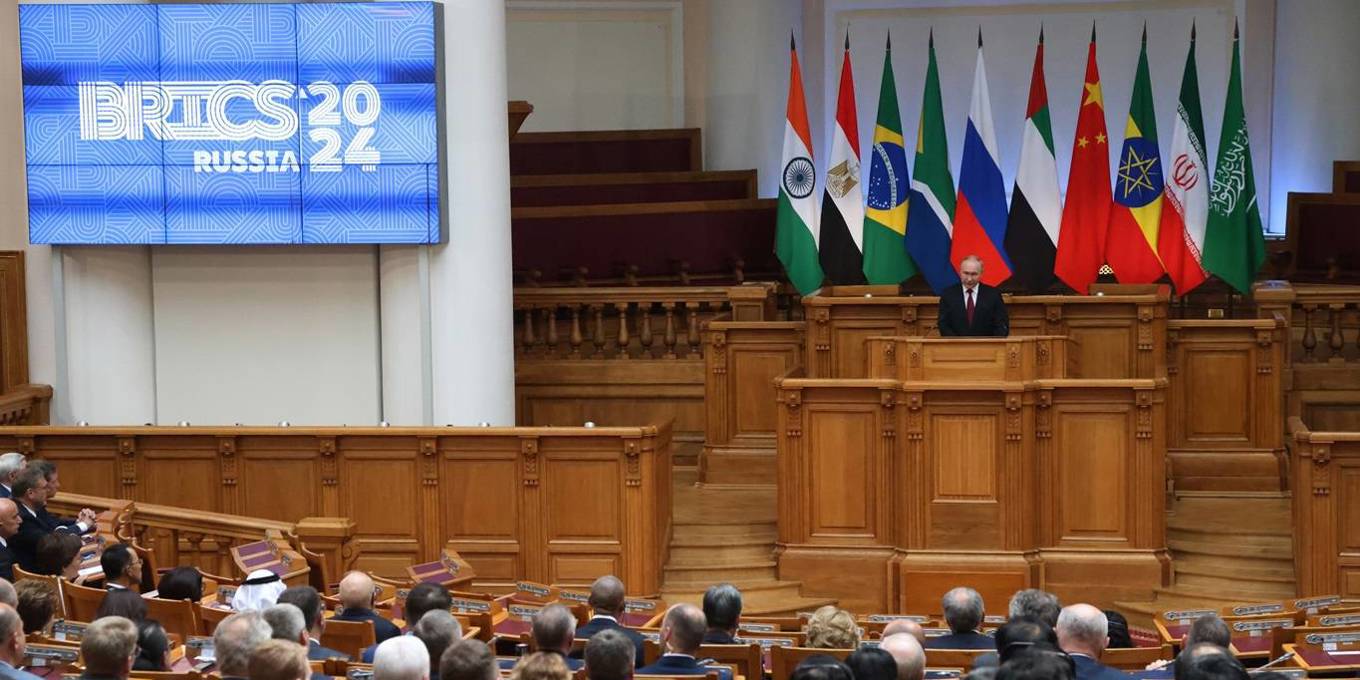
Moreover, the BRICS have demonstrated considerable resilience. Western analysts have been predicting from the start that the grouping would unravel or drift into irrelevance. Yet this month’s BRICS+ summit in Kazan, Russia – the first since the expansion – may well bring movement toward further enlargement, as it underscores the West’s failure to isolate Russia following its 2022 invasion of Ukraine.

This is not to underestimate the challenge of cohesion. The grouping’s founding members do not even agree about its fundamental objectives: whereas China and Russia want to spearhead a direct challenge to the United States-led world order, Brazil and India seek reforms of existing international institutions and appear uneasy about any anti-Western orientation.

In this disagreement, however, the enlargement might tip the scales. Six of the group’s nine members, including all four of the new additions, are formally part of the nonaligned movement, and two (Brazil and China) are observers. This suggests that there will be considerable internal pressure for the BRICS+ to chart a middle ground, focusing on democratizing the global order, rather than challenging the West.

That said, when it comes to fostering mutual trust with developing countries, the West has not been doing itself any favors lately. On the contrary, its weaponization of finance and seizure of the interest earned on frozen Russian central-bank assets have caused deepening disquiet in the non-Western world. As a result, a growing number of countries seem interested in exploring alternative arrangements, including new cross-border payment mechanisms, with some also reassessing their reliance on the US dollar in international transactions and reserve holdings.

All of this could aid the larger designs of Russia and China, two natural competitors that have become close strategic partners partly in response to US policy. China, in particular, stands to gain, such as from increased international use of the renminbi. Russia now generates much of its international export earnings in renminbi and stores them mostly in Chinese banks, thereby effectively giving China a share of the returns. China’s ultimate goal – which Western financial warfare is inadvertently aiding – is to establish an alternative renminbi-based financial system.

The BRICS are already engaged in institution-building, having established the New Development Bank – conceived by India and headquartered in Shanghai – in 2015. The NDB is not only the world’s first multilateral development bank created and led by emerging economies; it is also the only one whose founding members remain equal shareholders with equal voice, even as more countries join. By contrast, the US is the dominant shareholder and holds veto power in the World Bank.

The expanded BRICS+ boast formidable global clout. The grouping dwarfs the G7, both demographically (with nearly 46% of the world’s population, compared to the G7’s 8.8%) and economically (accounting for 35% of global GDP, compared to the G7’s 30%). Its economies are also likely to be the most important source of future global growth. Furthermore, with Iran and the UAE having joined their oil-producing counterparts Brazil and Russia as members, the BRICS+ now account for about 40% of crude-oil production and exports.

Yes, the group faces significant challenges, not least uniting to become a meaningful global force with defined (and realistic) political and economic objectives. But they also have the potential to serve as a catalyst for a long-overdue revamping of global governance so that it better reflects twenty-first-century realities.

Brahma Chellaney, Professor of Strategic Studies at the New Delhi-based Center for Policy Research and Fellow at the Robert Bosch Academy in Berlin, is the author of nine books, including Water: Asia’s New Battleground (Georgetown University Press, 2011), for which he won the 2012 Asia Society Bernard Schwartz Book Award.

© Project Syndicate, 2024.

China still challenges India in the Himalayas as BRICS summit approaches

by Brahma Chellaney, The Hill

(AP Photo/Mukhtar Khan, File) Indian army vehicles move in a convoy in the cold desert region of Ladakh, India, Sept. 18, 2022.

With the Oct. 22 BRICS summit meeting approaching, China and India have stepped up discussions about defusing their tense military standoff along the long Himalayan frontier. But although the 10-nation summit in the Russian city of Kazan is catalyzing efforts to resolve the confrontation — which has sparked rival force buildups and intermittent clashes — it is far from certain that any deal will be reached.

The standoff between the two Asian giants is not grabbing international headlines, thanks in part to the wars raging in Ukraine and the Middle East. But the threat of the confrontation escalating to a border war of the kind fought in 1962 cannot be discounted. Both sides have significantly ramped up border deployments of troops and weapons, with India acknowledging the situation is “very tense and dangerous.”

The Sino-Indian faceoff, as well as the Russian invasion of Ukraine, are detracting from the international appeal of BRICS, the world’s first major non-Western initiative. Founded 15 years ago by Brazil, Russia, India and China as BRIC, the group, with the addition of South Africa in 2011, became BRICS. And with this year’s entry of five additional countries, it has become BRICS-plus, accounting for nearly half the world’s population and 40 percent of global trade.

As many as 40 more countries have lined up to join BRICS, which seeks to shape a multipolar global order in place of the fading era of Western dominance. An easing of military tensions between nuclear-armed titans China and India could help build consensus to further enlarge BRICS.

The Sino-Indian border faceoff was triggered by China’s stealth encroachments on some Indian borderlands in April 2020. India failed to foresee the Chinese aggression largely because Prime Minister Narendra Modi had focused on appeasing Beijing in a bid to chip away at the China-Pakistan strategic axis. Between 2014 and 2019, Modi met with Chinese President Xi Jinping 18 times, building a close personal rapport. The Xi-ordered encroachments were thus widely seen in India as a stab in the back.

Xi seriously miscalculated that China would be able to present the land grabs to India as a fait accompli, like the Chinese “salami-slicing” expansionism elsewhere in Asia. In contrast to Russia’s full-scale invasion of Ukraine, China prefers incremental expansionism, enabled by stealth and deception.

India’s robust military response to China’s encroachments, including more than matching Chinese force deployments, took Beijing by surprise, helping to spotlight not just the Sino-Indian territorial disputes but also India’s challenge to Chinese power and capability. No other nation, not even the U.S., has locked horns with the Chinese military in this century the way India has since 2020.

Xi, by transforming the Sino-Indian frontier into a “hot” border patrolled by tens of thousands of rival troops, has crimped the further pursuit of his own “salami-slicing” strategy on the Himalayan massif. China will find it more challenging from now on to nibble away at Indian territories.

With the U.S.-China rivalry deepening, the last thing Xi should be doing is turning India into an enduring enemy. Yet as the world’s fastest-growing major economy, India is moving closer to America, with Modi’s foreign policy showing a distinct pro-Western tilt.

With an eye on China, India has ramped up its military buildup and modernization. A stronger India aligned with Western powers and Japan is likely to stymie China’s plan to gain strategic preeminence in Asia.

A war with India could expose China’s weaknesses. Whereas the Chinese military relies largely on conscripts, India, with an all-volunteer force, has the world’s most-experienced troops in mountain warfare. The Chinese military, though, has a technological edge over Indian forces.

Against this backdrop, China’s recent charm offensive in India, including initiating renewed efforts to defuse the military standoff, suggests that Xi wants to salvage Beijing’s relationship with New Delhi — but without losing face at home.

For four-and-a-half years, tens of thousands of Chinese troops have remained deployed along the inhospitable Himalayan frontier, which has some of the harshest terrain on Earth. Oxygen levels are so low that soldiers take weeks to acclimatize before being deployed on the front lines. If Xi were to reach a deal with India centered on a pullback of rival forces, it would raise questions in China about why he ever launched this provocation in the first place.

This may well explain why, in the bilateral negotiations up to now, the Chinese side has sought a deal largely on its own terms, dimming the prospect of reaching an agreement by the time Xi and Modi could meet on the sidelines of the BRICS summit.

But even if Xi climbed down to some extent, leading to a deal to implement a sequential process of disengagement, de-escalation and removal of rival forces, the new warfare-related infrastructure China has built along the India frontier will remain in place. India thus would not be able to lower its guard.

China has bored tunnels and shafts into mountainsides to set up an elaborate underground military infrastructure, as if preparing for war. In addition, it has planted settlers in new militarized border villages, the equivalent of the artificial islands it created in the South China Sea to serve as forward military bases.

China and India, which represent more than one-third of the global population, became neighbors only after the Chinese Communist Party annexed Tibet in 1951. Today, China and India need to find ways to peacefully coexist. Yet, despite the latest efforts to mend fences, their strategic rivalry seems likely to endure.

Brahma Chellaney is a geostrategist and the author of nine books, including the award-winning “Water: Asia’s New Battleground.”

Taiwan needs concrete diplomatic support from foreign friends

Brahma Chellaney, Taipei Times

As China steps up a campaign to diplomatically isolate and squeeze Taiwan, it has become more imperative than ever that Taipei play a greater role internationally with the support of the democratic world.

To help safeguard its autonomous status, Taiwan needs to go beyond bolstering its defenses with weapons like anti-ship and anti-aircraft missiles. With the help of its international backers, it must also expand its diplomatic footprint globally.

But are Taiwan’s foreign friends willing to translate their rhetoric into action by helping Taipei carve out more international space for itself? Beating back China’s effort to turn Taiwan into an international pariah demands sustained external support for Taipei.

The recent Quad summit of America, Australia, India and Japan, which was hosted by US President Joe Biden is his Delaware hometown of Wilmington, made no mention of Taiwan or the Taiwan Strait issue while identifying in its joint statement the challenges in the Indo-Pacific region.

Of late, though, several Western countries have criticized China for deliberately misinterpreting United Nations Resolution 2758 to claim that it enshrined Beijing’s “one China principle.” Beijing has used that 1971 resolution to exclude Taiwan from most international organizations.

By falsely conflating the 1971 resolution with its one China principle and speciously claiming that it reflects an international consensus in favor of that principle, Beijing has been vetoing Taipei’s participation even in international forums where Taiwan was present earlier, such as the World Health Organization’s decision-making World Health Assembly.

The fact is that the UN General Assembly adopted Resolution 2758 with a vote of 76 yes to 35 no, with 17 abstentions, “recognizing that the representatives of the Government of the People’s Republic of China are the only lawful representatives of China to the United Nations and that the People’s Republic of China is one of the five permanent members of the Security Council.” While disposing of the question of who had China’s seat in the UN, the resolution made no mention of Taiwan or China’s territorial or population scope.

Simply put, the resolution does not preclude Taiwan’s meaningful participation in the UN system and other multilateral forums.

Yet, for decades, the West did not credibly push back against Beijing’s deliberate misconstruction of the 1971 resolution or its blocking of Taiwan’s participation in international organizations, thereby inadvertently strengthening China’s diplomatic hand against Taipei. Even today, China continues to misuse that resolution in an effort to chip away at Taiwan’s autonomous status.

Take the Biden administration, which says that America’s one-China policy differs from Beijing’s one-China principle. US Secretary of State Antony Blinken has contended that US support for Taiwan’s meaningful participation in international forums aligns with the US reading of the 1971 resolution, as well as with America’s Taiwan Relations Act and bilateral communiques with China.

Still, Biden excluded Taiwan from his Indo-Pacific Economic Framework, a US-led multilateral partnership that covers everything from infrastructure to the digital economy.

The White House offered no explanation for omitting Taiwan, a technological powerhouse with the world’s 22nd-largest economy by gross domestic product that is a hub of global semiconductor production.

Biden’s geopolitical imperative to ensure that China did not undermine the unprecedented, US-led sanctions against Russia may have prompted Taiwan’s exclusion from the Indo-Pacific Economic Framework. Biden’s more conciliatory approach to Beijing, however, has yielded few positive results, with China quietly providing significant support to Russia’s military-industrial complex and effectively becoming Moscow’s banker.

Taiwan, a vibrant democracy, has all the attributes of a robust independent state, and most Taiwanese want it to stay that way.

What Taiwan needs from its international friends is tangible support against the designs of the Chinese Communist Party (CCP), which is totalitarian, expansionist and contemptuous of international law. In fact, under Xi Jinping (習近平), the CCP has become more despotic, coercive and punitive.

As part of a strategy to annex Taiwan, the CCP is working methodically to wipe out that island democracy’s international identity by persuading countries to break off diplomatic ties with Taipei. With its “tribute nation” approach to vulnerable states, Beijing has sought to influence their foreign policy through inducements, extending from loans to bribery.

China has already poached a number of Taiwan’s diplomatic allies, including in Central America where Taipei had strong relationships. From 2016 to 2024, Beijing poached 10 of Taiwan’s 22 allies across the world, with Nauru being the latest. This has left only 11 nations and the Vatican still recognizing Taiwan as a sovereign nation.

In one positive development, the small nation of Lithuania defied Chinese threats and allowed Taiwan in 2021 to open “The Taiwanese Representative Office” in Vilnius, the Lithuanian capital. This was followed by the opening of the Lithuanian Trade Representative Office in Taipei.

A “Taiwanese” representative office stands out in comparison to “Chinese Taipei” (used by a number of nations and the International Olympic Committee) or “Taipei Economic and Cultural Office” (as in Canada and the US, for example). A number of nations, from Britain to Singapore, host a “Taipei Representative Office.”

More broadly, most countries support keeping the status quo in the Taiwan Strait. So, radical ideas are unlikely to gain traction, including former US Secretary of State Mike Pompeo’s proposal that America recognize Taiwan as an independent nation, separate from communist China.

If Taiwan gains greater presence on the international stage, it will be able to shore up its status as a de facto nation, making it more difficult for China to seize the self-governing island in the way it occupied Tibet soon after coming under communist rule in 1949.

The then-independent Tibet should have applied for United Nations membership shortly after that international body came into existence in 1945, but it never did.

If Taiwan is not to go Tibet’s way, major democracies must strengthen and broaden their ties with Taipei and assist it in enlarging its diplomatic footprint. Major democracies must act before it becomes too late.

Brahma Chellaney, professor of strategic studies at the independent Center for Policy Research in New Delhi, is the author of nine books, including the award-winning Water: Asia’s New Battleground (Georgetown University Press).